EP0482794B1 - Faltbare und ausdehnbare Fensteraufdeckung - Google Patents
Faltbare und ausdehnbare Fensteraufdeckung Download PDFInfo
- Publication number
- EP0482794B1 EP0482794B1 EP91309284A EP91309284A EP0482794B1 EP 0482794 B1 EP0482794 B1 EP 0482794B1 EP 91309284 A EP91309284 A EP 91309284A EP 91309284 A EP91309284 A EP 91309284A EP 0482794 B1 EP0482794 B1 EP 0482794B1
- Authority
- EP
- European Patent Office
- Prior art keywords
- fabric
- panel
- pleated panel
- pleated
- window covering
- Prior art date
- Legal status (The legal status is an assumption and is not a legal conclusion. Google has not performed a legal analysis and makes no representation as to the accuracy of the status listed.)
- Expired - Lifetime
Links
- 239000004744 fabric Substances 0.000 claims abstract description 42
- 238000000034 method Methods 0.000 claims abstract description 16
- 239000000463 material Substances 0.000 claims description 71
- 239000000853 adhesive Substances 0.000 claims description 27
- 230000001070 adhesive effect Effects 0.000 claims description 27
- 239000011324 bead Substances 0.000 claims description 25
- 239000004831 Hot glue Substances 0.000 claims description 19
- 238000005520 cutting process Methods 0.000 claims description 5
- 238000004519 manufacturing process Methods 0.000 claims description 5
- 238000001816 cooling Methods 0.000 claims 1
- 238000003825 pressing Methods 0.000 claims 1
- 238000009413 insulation Methods 0.000 abstract description 2
- 210000004027 cell Anatomy 0.000 description 39
- 210000003850 cellular structure Anatomy 0.000 description 5
- 230000001413 cellular effect Effects 0.000 description 3
- 238000010438 heat treatment Methods 0.000 description 2
- 239000000155 melt Substances 0.000 description 2
- 239000008188 pellet Substances 0.000 description 2
- 238000004804 winding Methods 0.000 description 2
- 229920001634 Copolyester Polymers 0.000 description 1
- 238000010276 construction Methods 0.000 description 1
- 238000010586 diagram Methods 0.000 description 1
- 238000006073 displacement reaction Methods 0.000 description 1
- 238000005485 electric heating Methods 0.000 description 1
- 239000003292 glue Substances 0.000 description 1
- 239000012943 hotmelt Substances 0.000 description 1
- 238000002360 preparation method Methods 0.000 description 1
- 238000005086 pumping Methods 0.000 description 1
- 238000009958 sewing Methods 0.000 description 1
- 239000007779 soft material Substances 0.000 description 1
- 238000004383 yellowing Methods 0.000 description 1
Images


Classifications
-
- E—FIXED CONSTRUCTIONS
- E06—DOORS, WINDOWS, SHUTTERS, OR ROLLER BLINDS IN GENERAL; LADDERS
- E06B—FIXED OR MOVABLE CLOSURES FOR OPENINGS IN BUILDINGS, VEHICLES, FENCES OR LIKE ENCLOSURES IN GENERAL, e.g. DOORS, WINDOWS, BLINDS, GATES
- E06B9/00—Screening or protective devices for wall or similar openings, with or without operating or securing mechanisms; Closures of similar construction
- E06B9/24—Screens or other constructions affording protection against light, especially against sunshine; Similar screens for privacy or appearance; Slat blinds
- E06B9/26—Lamellar or like blinds, e.g. venetian blinds
- E06B9/262—Lamellar or like blinds, e.g. venetian blinds with flexibly-interconnected horizontal or vertical strips; Concertina blinds, i.e. upwardly folding flexible screens
-
- E—FIXED CONSTRUCTIONS
- E06—DOORS, WINDOWS, SHUTTERS, OR ROLLER BLINDS IN GENERAL; LADDERS
- E06B—FIXED OR MOVABLE CLOSURES FOR OPENINGS IN BUILDINGS, VEHICLES, FENCES OR LIKE ENCLOSURES IN GENERAL, e.g. DOORS, WINDOWS, BLINDS, GATES
- E06B9/00—Screening or protective devices for wall or similar openings, with or without operating or securing mechanisms; Closures of similar construction
- E06B9/24—Screens or other constructions affording protection against light, especially against sunshine; Similar screens for privacy or appearance; Slat blinds
- E06B2009/2423—Combinations of at least two screens
- E06B2009/2441—Screens joined one below the other
-
- E—FIXED CONSTRUCTIONS
- E06—DOORS, WINDOWS, SHUTTERS, OR ROLLER BLINDS IN GENERAL; LADDERS
- E06B—FIXED OR MOVABLE CLOSURES FOR OPENINGS IN BUILDINGS, VEHICLES, FENCES OR LIKE ENCLOSURES IN GENERAL, e.g. DOORS, WINDOWS, BLINDS, GATES
- E06B9/00—Screening or protective devices for wall or similar openings, with or without operating or securing mechanisms; Closures of similar construction
- E06B9/24—Screens or other constructions affording protection against light, especially against sunshine; Similar screens for privacy or appearance; Slat blinds
- E06B9/26—Lamellar or like blinds, e.g. venetian blinds
- E06B9/262—Lamellar or like blinds, e.g. venetian blinds with flexibly-interconnected horizontal or vertical strips; Concertina blinds, i.e. upwardly folding flexible screens
- E06B2009/2627—Cellular screens, e.g. box or honeycomb-like
-
- Y—GENERAL TAGGING OF NEW TECHNOLOGICAL DEVELOPMENTS; GENERAL TAGGING OF CROSS-SECTIONAL TECHNOLOGIES SPANNING OVER SEVERAL SECTIONS OF THE IPC; TECHNICAL SUBJECTS COVERED BY FORMER USPC CROSS-REFERENCE ART COLLECTIONS [XRACs] AND DIGESTS
- Y10—TECHNICAL SUBJECTS COVERED BY FORMER USPC
- Y10T—TECHNICAL SUBJECTS COVERED BY FORMER US CLASSIFICATION
- Y10T156/00—Adhesive bonding and miscellaneous chemical manufacture
- Y10T156/10—Methods of surface bonding and/or assembly therefor
- Y10T156/1002—Methods of surface bonding and/or assembly therefor with permanent bending or reshaping or surface deformation of self sustaining lamina
- Y10T156/1003—Methods of surface bonding and/or assembly therefor with permanent bending or reshaping or surface deformation of self sustaining lamina by separating laminae between spaced secured areas [e.g., honeycomb expanding]
-
- Y—GENERAL TAGGING OF NEW TECHNOLOGICAL DEVELOPMENTS; GENERAL TAGGING OF CROSS-SECTIONAL TECHNOLOGIES SPANNING OVER SEVERAL SECTIONS OF THE IPC; TECHNICAL SUBJECTS COVERED BY FORMER USPC CROSS-REFERENCE ART COLLECTIONS [XRACs] AND DIGESTS
- Y10—TECHNICAL SUBJECTS COVERED BY FORMER USPC
- Y10T—TECHNICAL SUBJECTS COVERED BY FORMER US CLASSIFICATION
- Y10T156/00—Adhesive bonding and miscellaneous chemical manufacture
- Y10T156/10—Methods of surface bonding and/or assembly therefor
- Y10T156/1002—Methods of surface bonding and/or assembly therefor with permanent bending or reshaping or surface deformation of self sustaining lamina
- Y10T156/1007—Running or continuous length work
- Y10T156/1008—Longitudinal bending
-
- Y—GENERAL TAGGING OF NEW TECHNOLOGICAL DEVELOPMENTS; GENERAL TAGGING OF CROSS-SECTIONAL TECHNOLOGIES SPANNING OVER SEVERAL SECTIONS OF THE IPC; TECHNICAL SUBJECTS COVERED BY FORMER USPC CROSS-REFERENCE ART COLLECTIONS [XRACs] AND DIGESTS
- Y10—TECHNICAL SUBJECTS COVERED BY FORMER USPC
- Y10T—TECHNICAL SUBJECTS COVERED BY FORMER US CLASSIFICATION
- Y10T156/00—Adhesive bonding and miscellaneous chemical manufacture
- Y10T156/10—Methods of surface bonding and/or assembly therefor
- Y10T156/1002—Methods of surface bonding and/or assembly therefor with permanent bending or reshaping or surface deformation of self sustaining lamina
- Y10T156/1007—Running or continuous length work
- Y10T156/1015—Folding
-
- Y—GENERAL TAGGING OF NEW TECHNOLOGICAL DEVELOPMENTS; GENERAL TAGGING OF CROSS-SECTIONAL TECHNOLOGIES SPANNING OVER SEVERAL SECTIONS OF THE IPC; TECHNICAL SUBJECTS COVERED BY FORMER USPC CROSS-REFERENCE ART COLLECTIONS [XRACs] AND DIGESTS
- Y10—TECHNICAL SUBJECTS COVERED BY FORMER USPC
- Y10T—TECHNICAL SUBJECTS COVERED BY FORMER US CLASSIFICATION
- Y10T156/00—Adhesive bonding and miscellaneous chemical manufacture
- Y10T156/10—Methods of surface bonding and/or assembly therefor
- Y10T156/1052—Methods of surface bonding and/or assembly therefor with cutting, punching, tearing or severing
- Y10T156/1062—Prior to assembly
-
- Y—GENERAL TAGGING OF NEW TECHNOLOGICAL DEVELOPMENTS; GENERAL TAGGING OF CROSS-SECTIONAL TECHNOLOGIES SPANNING OVER SEVERAL SECTIONS OF THE IPC; TECHNICAL SUBJECTS COVERED BY FORMER USPC CROSS-REFERENCE ART COLLECTIONS [XRACs] AND DIGESTS
- Y10—TECHNICAL SUBJECTS COVERED BY FORMER USPC
- Y10T—TECHNICAL SUBJECTS COVERED BY FORMER US CLASSIFICATION
- Y10T428/00—Stock material or miscellaneous articles
- Y10T428/24—Structurally defined web or sheet [e.g., overall dimension, etc.]
- Y10T428/24149—Honeycomb-like
-
- Y—GENERAL TAGGING OF NEW TECHNOLOGICAL DEVELOPMENTS; GENERAL TAGGING OF CROSS-SECTIONAL TECHNOLOGIES SPANNING OVER SEVERAL SECTIONS OF THE IPC; TECHNICAL SUBJECTS COVERED BY FORMER USPC CROSS-REFERENCE ART COLLECTIONS [XRACs] AND DIGESTS
- Y10—TECHNICAL SUBJECTS COVERED BY FORMER USPC
- Y10T—TECHNICAL SUBJECTS COVERED BY FORMER US CLASSIFICATION
- Y10T428/00—Stock material or miscellaneous articles
- Y10T428/24—Structurally defined web or sheet [e.g., overall dimension, etc.]
- Y10T428/24628—Nonplanar uniform thickness material
- Y10T428/24669—Aligned or parallel nonplanarities
- Y10T428/24686—Pleats or otherwise parallel adjacent folds
-
- Y—GENERAL TAGGING OF NEW TECHNOLOGICAL DEVELOPMENTS; GENERAL TAGGING OF CROSS-SECTIONAL TECHNOLOGIES SPANNING OVER SEVERAL SECTIONS OF THE IPC; TECHNICAL SUBJECTS COVERED BY FORMER USPC CROSS-REFERENCE ART COLLECTIONS [XRACs] AND DIGESTS
- Y10—TECHNICAL SUBJECTS COVERED BY FORMER USPC
- Y10T—TECHNICAL SUBJECTS COVERED BY FORMER US CLASSIFICATION
- Y10T428/00—Stock material or miscellaneous articles
- Y10T428/24—Structurally defined web or sheet [e.g., overall dimension, etc.]
- Y10T428/24744—Longitudinal or transverse tubular cavity or cell
Definitions
- This invention relates to an expandable and collapsible window covering of the Roman shade type wherein one side of the shade, typically arranged to that this side is toward the interior of the room, consists of a number of horizontal parallel curved surfaces, and in which each of these curved surfaces forms the front wall of a tubular cell extending transversely across the width of the shade, thus creating a thermal insulating window covering with an extremely attractive appearance.
- Prior art disclosures include NE-A-6706563, wherein a plurality of strips of a fabric material are folded about fold lines extending longitudinally and bonded together, the two edges of each strip being bonded to the centre of the next successive strip, to form a screen consisting of a plurality of vertically extending tubular cells.
- US-A-4347887 shows a "thermal shutter" in which a wide band of material is folded transversely to form a double column of adjacent cells, which may have rounded visible contours.
- the cells are adhesively bonded to one another in such a way that both sides of the shade have essentially the same appearance.
- US-A-4450027 shows a method and apparatus for fabricating a multiple cell shade wherein a continuous relatively narrow strip of fabric is folded longitudinally in order to define pleats in the shade material and the edges folded over on the centre portion to create a tubular cell. Successive cells are assembled by applying an adhesive to folded over edges of the cells, and adhering each cell to the preceding cell when wound on a stacking rack.
- US-A-4631217 shows in Figure 3 a shade of asymmetrical construction.
- a rear wall section of each cell is essentially straight when the shade is in its expanded position.
- the width of these rear wall sections thus defines the spacing of the adjacent cells, while the front of each cell, containing more material, presents a pleated outward appearance.
- the shade is formed from a material folded into a Z-shape rather than from a U-shape as shown in US-A-4450027.
- US-A-4846243 shows a foldable window covering formed of a wide material folded transversely, to yield a collapsible shade.
- the front surface of the shade consists of a number of drooping loops formed by doubling the material back on itself.
- the successive cells are spaced in the expanded position of the shade by a relatively vertical rear wall section of each cell.
- US-A-2201356 discloses an expandable and collapsible window covering, comprising an expandable and collapsible pleated panel and a flexible sheet attached to the pleated panel transversely across the width of said panel at longitudinal, periodically spaced intervals with respect to the pleats of said panel to form a plurality of stacked, transverse closed cells, the longitudinal direction of the individual cells being the transverse direction of the window covering, the length of fabric sheet between adjacent points of attachment being greater than the longitudinal spacing of said points of attachment with the window covering in the expanded condition.
- said flexible sheet is an unpleated sheets and is attached to the pleated panel, so that it smoothly curves from one attachment point to beyond an adjacent attachment point below in the expanded condition.
- Such a structure forms a Roman shade consisting of a number of parallel generally tubular cells, each having a front wall formed of a relatively drooping soft material which is essentially uncreased in the finished product, providing an aesthetically pleasing appearance, while the rear wall of each cell is essentially linear when the shade is in the expanded state, such that the width of the rear wall determines the spacing of adjacent cells and holds the front wall from being pulled flat.
- These Roman shades can be easily adapted to the use of custom fabrics and can be manufactures using essentially automated methods and apparatus.
- EP-A-431937 discloses a method of making an expandable and collapsible window covering, said method comprising providing an expandable and collapsible pleated panel having a first side and a second side from which said pleats project.
- such a method is characterised in attaching an unpleated flexible facing sheet to one of said first and second sides of said pleated panel at periodically spaced attachment points, with the length of facing sheet attached between adjacent attachment points being greater than the distance between said attachment points when said panel is expanded.
- Expandable and collapsible window coverings of the present invention are produced by utilizing and adding to the methods disclosed in US-A-4450027 the disclosure of which is incorporated herein by reference. Additional steps of the present invention may include applying additional longitudinal hot-melt glue lines, cutting the cellular shade obtained thereby into two single pleated panels to form a base material and attaching a fabric face to the base material.
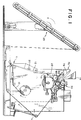
- FIG 1 through 5 illustrate steps used in US-A-4450027 as well as part of the additional apparatus and method steps necessary for the present invention.
- a continuous strip of material 10 is drawn through a series of steps which result in its edges 12 being folded over the central portion 13, so that they approach each other closely near the middle of the strip.
- a creaser assembly 11 includes a pair of spaced-apart creaser wheels 14 that are pressed against strip material 10 as it is drawn around a roller 16.
- the creaser wheels are mounted on an axle 17 which is itself mounted on a pivotal arm assembly 18, and are kept pressed against the shade material 10 by a spring 19 which exerts force against the arm assembly, to form folds along crease lines 15.
- the material 10 is drawn around roller 20 ( Figure 3 and 4) and through folding die 22 to fold over the edges 12 of strip material 10.
- an adhesive applicator assembly 30 (Figure 1) applies adhesive to the strip material in order to subsequently bond layers of the folded strip material together.
- adhesive material is dispensed in beads 31 from an applicator 34 onto the material 10.
- Motor driven belts 36 may be used to drive the roller 32 to assist in drawing the shade material 10.
- the adhesive is dispensed at a rate proportional to the speed at which the shade material 10 is drawn past, so that a like amount of adhesive is applied regardless of the manufacturing rate.
- Two beads 31 of the adhesive are continuously dispensed, one each adjacent to the edges 12 of the shade material 10. The strips of material 10 are then stacked by winding on rotating rack 33. The width of adhesive beads 31 may be adjusted as necessary to achieve an adequate bead in a particular application.
- the present invention utilizes a hot-melt adhesive applicator assembly 70.
- Nozzles 72 apply two beads 74 of hot-melt adhesive to the folded strip material 10, outside adhesive beads 31.
- the hot-melt adhesive beads 74 quickly harden so that when the material 10 is subsequently stacked hot-melt adhesive beads 74 do not bond together adjacent fabric layers.
- the hot-melt adhesive is initially provided in hopper 76, shown in Figure 1, in the form of pellets which fall into cylinder 78 in which a piston is pneumatically powered to force the pellets into heating block 80 where they are melted. Contained within block 80 is a second positive displacement gear pump for pumping the melted hot-melt adhesive to nozzles 72 a constant rate relative to the strip material 10 speed.
- a preferred adhesive for this application is copolyester hot-melt adhesive which melts at 121°C.
- the shade material 10 is stacked, by winding on rotating elongate rack 33, so that the folded edge portions 12 of one strip are adhesively bonded by adhesive beads 31 to the central portion 13 of the next strip.
- the stacked assembly of strips thus curves around the ends of the rack.
- the curved ends of the stack are cut off, leaving two cellular structures one on each side of the rack.
- the stacked material is cut longitudinally down its central portion 13, between the folded side portions 12 yielding two pleated panel base materials 40.
- a preferred method of cutting the cellular stack 42 to obtain the two panels employs a rotating, circular knife blade 44.
- any basic cutting tool can be used, even a simple hand-held knife.
- These pleated panels may then be used as a base material for the Roman shades according to the present invention.
- Figure 7 illustrates the attachment of the facing fabric 86 to the pleated panel base material 40.
- the base material 40 is expanded and fed over a back-up bar 88.
- the facing fabric 86 is fed from a supply roll to a position adjacent the base material 40.
- a heat seal bar 92 moves forward to press the facing fabric 86 against the hot-melt adhesive bead 74 and create an adhesive bond.
- Loops 90 may be formed by feeding the facing fabric at a slightly faster rate than the base material 40.
- the combined temperature and pressure exerted by the heat seal bar 92 melts adhesive bead 74 and forces it into the fibres of facing fabric 86 to create a secure bond.
- the heat seal bar 92 is then removed and hot-melt adhesive bead 74 quickly hardens permanently to bond together the base material 40 and facing fabric 86.
- Arrows 93 in Figure 7 indicate the direction of travel of the base material 84 and facing fabric 86. If the size of the loops 90 desired is large it may be necessary to feed both materials upside down from their normal orientation as a Roman shade as illustrated in Figure 7. This causes the loops 90 to fall naturally out of the way of the bond areas at adhesive beads 74. It should be readily appreciated by those skilled in the art that the heat seal bar 92 may be fully automated or, alternatively, may be a hand held and operated device.
- the hot-melt adhesive method of bonding this facing fabric 86 to the base material 40 is only a preferred embodiment of the present invention.
- the facing fabric 86 could also be fastened to the base material 40 by other means such as a clip system attached to the base material or simply by sewing the two layers together.
- FIG. 8 A finished Roman shade according to the present invention is shown in Figure 8 and 9. Holes 94 have been provided for the passage of a lift cord 96 through the base material 40. The number of lift cords 96 required for a particular shade will depend upon the shade width.
- the base material 40 forms a pleated panel which is the back of the shade.
- the facing fabric 86 provides a smooth, droopy appearance for the front of the shade.
- Transverse cells 98 are defined by the facing fabric 86 and the base material 84, bonded together at the hot-melt adhesive beads 74 above and below each cell 98.
- Individual cells 98 comprise a front wall 99 and a rear wall 100 which has three portions: a first portion 102 is joined to a second, middle portion 104 by rearwardly directed pleat 106 and third portion 108 is joined to the second, middle portion 104 by a forwardly directed pleat 110. It can be seen that first portion 102 and third portion 108 of the cell below are integral with one another and separated only by hot-melt adhesive beads 74 which define the extend of the rear wall of each cell. When fully expanded, the rear wall 100 of each cell 98 is essentially vertical and remains of shorter height than the cell front wall 99 formed by the facing fabric 86. Therefore, even in the fully expanded position, the shade maintains its characteristic droopy front appearance. Transverse cells 98 also provide excellent insulating properties for the Roman shade according to the present invention. To complete the shade, a head rail 112 and bottom rail 114 are added as shown in Figure 9.
- Figures 10, 11 and 12 illustrate alternative embodiments of a window covering according to the present invention.
- the embodiment illustrated in Figure 10 is substantially the same as in Figure 8 except that it is inverted in deployment. Therefore the general arrangement of cells 98 with respect to front wall 99, rear wall 100 and first, second and third rear wall portions 102, 104 and 108 is the same as explained above with respect to Figure 8.
- Figure 11 illustrates an embodiment in which the facing fabric 86 is attached to the pleated panel base material 40 at periodically varied intervals in order to provide first and second transverse cells 98a, 98b of different size in the longitudinal direction of the window covering.
- a second hot-melt adhesive bead 74a is applied to the flat tubular material on the opposite side from the first hot-melt adhesive bead 74.
- Cells of the first type 98a are formed by attaching facing fabric 86 to both adhesive beads 74 and 74a on the associated pleated panel section. This provides first cells 98a with only an inwardly directed pleat 110.
- Cells of the second type 98b thus have one inwardly directed pleat 110 and two outwardly directed pleats 106.
- Adhesive beads 74' and 74a' remain unused.
- Figure 12 illustrates an embodiment of the present invention having relatively larger cells 98c, formed on the same base material 40 as in the previous embodiments.
- every other adhesive bead 74' is skipped in the attachment of facing fabric 86. This provides each cell 98c with two inwardly directed pleats 110 and two outwardly directed pleats 106. It should be apparent that additional adhesive beads may be skipped to provide even larger cells as desired.
- the cellular structure from which the base material 40 is made need not be made in any particular size because the base material is cut from it to suit the particular window to be covered. Therefore, the cellular structure may be produced in relatively large widths, limited only by the size of rotating rack 33, to provide efficient, high volume production. Also, using the same base material 40, a fabricator may choose from a wide range of facing fabrics 86 because no special preparation of the facing fabric is required.
Landscapes
- Engineering & Computer Science (AREA)
- Structural Engineering (AREA)
- Architecture (AREA)
- Civil Engineering (AREA)
- Blinds (AREA)
- Toys (AREA)
- Extensible Doors And Revolving Doors (AREA)
- Curtains And Furnishings For Windows Or Doors (AREA)
Claims (12)
- Auseinanderziehbare und zusammenlegbare Fensterabdeckung, die eine auseinanderziehbare und zusammenlegbare, preßgefaltete Tafel (40) sowie ein flexibles Flächengebilde (86) umfaßt, das an dieser preßgefalteten Tafel quer über deren Breite in regelmäßigen Längsabständen (74) relativ zu den Preßfalten (110) der Tafel (40) befestigt ist, so daß sich mehrere übereinander angeordnete und in Querrichtung verlaufende, geschlossene Zellen (98) ergeben, wobei die Längsrichtung der einzelnen Zellen mit der Querrichtung der Fensterabdeckung identisch ist und die Länge des textilen Flächengebildes (86) zwischen nebeneinanderliegenden Befestigungspunkten größer als der Längsabstand der genannten Befestigungspunkte bei auseinandergezogener Fensterabdeckung ist, dadurch gekennzeichnet, daß das flexible Flächengebilde (86) selbst keine Preßfaltung aufweist und an der preßgefalteten Tafel so befestigt ist, daß es im auseinandergezogenen Zustand der Fensterabdeckung in glattem Bogen von einem Befestigungspunkt bis unter den nächsten darunterliegenden Befestigungspunkt herabhängt.
- Fensterabdeckung gemäß Anspruch 1, dadurch gekennzeichnet, daß die in Querrichtung verlaufenden Zellen (98) jeweils über eine Rückwand (100) mit einem ersten Teil (102) verfügen, der über eine relativ zu der Zelle auswärts gerichtete Preßfalte (106) mit einem zweiten, mittleren Teil (104) verbunden ist, wobei ein dritter Teil (108) über eine relativ zu der Zelle einwärts gerichtete Preßfalte (110) mit diesem zweiten, mittleren Teil verbunden ist, und diese Zellen ferner über eine Vorderwand (99) aus dem genannten textilen Flächengebilde verfügen, das ein nicht preßgefaltetes, lose herabhängendes Äußeres aufweist.
- Fensterabdeckung gemäß Anspruch 1, dadurch gekennzeichnet, daß diese eine abwechselnde Folge von ersten und zweiten Querzellen umfaßt, wobei die ersten Querzellen (98a) jeweils eine Rückwand, die aus der preßgefalteten Tafel mit einer relativ zu der vorgenannten Preßfalte (110) und zu einer dieser ersten Zellen nach außen gerichteten Preßfalte (106) besteht, sowie eine Vorderwand (86) aus dem textilen Flächengebilde mit dem nicht preßgefalteten, locker herabhängenden Äußeren aufweisen und die zweiten Querzellen (98b) über jeweils eine Rückwand, die aus der preßgefalteten Tafel mit einer relativ zu dieser zweiten Zelle nach innen gerichteten Preßfalte (110) und zwei relativ zu dieser zweiten Zelle nach außen gerichteten Preßfalten (106) besteht, sowie ebenfalls eine Vorderwand aus dem textilen Flächengebilde mit dem nicht preßgefalteten, locker herabhängenden Äußeren aufweisen.
- Fensterabdeckung gemäß einem der Ansprüche 1, 2 oder 3, dadurch gekennzeichnet, daß die auseinanderziehbare und zusammenlegbare preßgefaltete Tafel eine Anordnung übereinanderliegender, längsgefalteter Streifen umfaßt, die aufeinandergeklebt sind, wobei diese Längsfalten (110) die in Querrrichtung verlaufende Preßfaltung der preßgefalteten Tafel darstellen und es sich bei diesen Längsfalten um scharfe, dauerhaft eingeformte und quetschgefaltete Falten handelt.
- Fensterabdeckung gemäß einem der vorstehenden Ansprüche, dadurch gekennzeichnet, daß diese zudem über eine oben an der preßgefalteten Tafel sowie dem nicht preßgefalteten textilen Flächengebilde befestigte Kopfschiene (112), eine unten an der preßgefalteten Tafel sowie dem nicht preßgefalteten textilen Flächengebilde befestigte Fußschiene (114) sowie außerdem Mittel (96) zum Anheben und Absenken der genannten Fußschiene und damit auch zum Anheben und Absenken der preßgefalteten Tafel sowie des nicht preßgefalteten Flächengebildes verfügt.
- Verfahren zur Herstellung einer auseinanderziehbaren und zusammenlegbaren Fensterabdeckung unter Beistellung einer auseinanderziehbaren und zusammenlegbaren preßgefalteten Tafel (40) mit einer ersten und einer zweiten Seite, von der die Preßfalten vorstehen, dadurch gekennzeichnet, daß ein nicht preßgefaltetes, flexibles Verkleidungsflächengebilde (86) an in regelmäßigen Abständen vorgesehen Befestigungspunkten (74) an einer der genannten ersten und zweiten Seiten der preßgefalteten Tafel so angebracht wird, daß die zwischen benachbarten Befestigungspunkten befindliche Länge des Verkleidungsflächengebildes (86) größer als der Abstand zwischen diesen Befestigungspunkten bei auseinandergezogener Tafel ist.
- Verfahren gemäß Anspruch 6, dadurch gekennzeichnet, daß das Verkleidungsflächengebilde über die Breite der preßgefalteten Tafel hinweg durchgehend befestigt wird, so daß sich eine Mehrzahl übereinander angeordneter, geschlossener Querzellen ergibt.
- Verfahren gemäß einem der Ansprüche 6 oder 7, dadurch gekennzeichnet, daß der Schritt der Beistellung einer preßgefalteten Tafel die Bereitstellung eines fortlaufenden flachen Materials mit in Längsrichtung verlaufenden Randfalten (12) sowie einem zwischen diesen Falten ebenfalls in Längsrichtung verlaufenden Mittelteil (13), den Auftrag eines ersten Klebstoffs (31) in Längsrichtung entlang dem Mittelteil (13) des vorgenannten Materials, das Stapeln des fortlaufenden röhrenförmigen Materials zu einer übereinanderliegenden Anordnung angrenzender Lagen dieses röhrenförmigen Materials, das Aushärtenlassen des ersten Klebers zwecks Verklebung der Lagen zu einem geschlossenen Stapel sowie das Abschneiden eines Stücks dieses geschlossenen Stapels von dem verbleibenden Stapel röhrenförmigen Materials zwecks Herstellung einer preßgefalteten Tafel umfaßt.
- Verfahren gemäß Anspruch 8, dadurch gekennzeichnet, daß das fortlaufende flache Material aus einem fortlaufenden Abschnitt eines flachen Streifenmaterials durch fortlaufende Faltung an diametral entgegengesetzten Seiten zu einer flachen, zumindest annähernd röhrenförmigen Form verarbeitet wird, und die durchlaufenden Falten durch Wärmebehandlung und Abkühlung des flachen röhrenförmigen Materials unter konstantem Druck und konstanter Spannung dauerhaft eingeformt und quetschgefaltet werden.
- Verfahren gemäß einem der Ansprüche 8 oder 9, bei dem überdies im Trennbereich des röhrenförmigen Materials ein Längsschnitt entlang der Mitte der röhrenförmigen Lagen durchgeführt wird, um zwei Tafeln einfachen preßgefalteten Materials zu bilden, bevor das flache Verkleidungsflächengebilde angebracht wird.
- Verfahren gemäß Anspruch 10, dadurch gekennzeichnet, daß ein Heißkleber als zweiter Klebstoff in Form mindestens einer Raupe (74) aufgebracht wird, und zwar außerhalb des vorgenannten ersten Klebstoffs (31) und in einem Abstand zu diesem.
- Verfahren gemäß Anspruch 11, dadurch gekennzeichnet, daß der Schritt der Befestigung des flachen Verkleidungsflächengebildes das Auseinanderziehen und die Zufuhr einer einzelnen preßgefalteten Tafel (40) über ein an der der Heißkleber-Raupe (74) entgegengesetzten Tafelseite angeordnetes Stützelelement (88) mit einer ersten Geschwindigkeit, die Heranführung eines flachen Verkleidungsflächengebildes an die gefaltete Tafel (86) auf der Seite der Heißkleber-Raupe mit einer gegenüber dieser ersten Geschwindigkeit erhöhten zweiten Geschwindigkeit sowie das Verkleben der flachen Verkleidungsflächengebildes mit der preßgefalteten Tafel durch Zusammenpressen des Verkleidungsflächengebildes, der gefalteten Tafel sowie der vorgenannten Heißkleberraupe zwischen dem Stützelement und einem beweglichen Heizglied (92) umfaßt.
Applications Claiming Priority (2)
| Application Number | Priority Date | Filing Date | Title |
|---|---|---|---|
| US597466 | 1990-10-15 | ||
| US07/597,466 US5158632A (en) | 1990-10-15 | 1990-10-15 | Method of making an expandable and collapsible window covering |
Publications (2)
| Publication Number | Publication Date |
|---|---|
| EP0482794A1 EP0482794A1 (de) | 1992-04-29 |
| EP0482794B1 true EP0482794B1 (de) | 1994-05-18 |
Family
ID=24391631
Family Applications (1)
| Application Number | Title | Priority Date | Filing Date |
|---|---|---|---|
| EP91309284A Expired - Lifetime EP0482794B1 (de) | 1990-10-15 | 1991-10-09 | Faltbare und ausdehnbare Fensteraufdeckung |
Country Status (5)
| Country | Link |
|---|---|
| US (2) | US5158632A (de) |
| EP (1) | EP0482794B1 (de) |
| AT (1) | ATE105916T1 (de) |
| DE (1) | DE69102045T2 (de) |
| ES (1) | ES2053286T3 (de) |
Cited By (9)
| Publication number | Priority date | Publication date | Assignee | Title |
|---|---|---|---|---|
| US7111659B2 (en) | 2003-08-20 | 2006-09-26 | Hunter Douglas Inc. | Retractable shade with collapsible vanes |
| US7191816B2 (en) | 2003-08-20 | 2007-03-20 | Hunter Douglas Inc. | Retractable shade with collapsible vanes |
| US7549455B2 (en) | 2003-08-20 | 2009-06-23 | Hunter Douglas Inc. | Retractable shade with collapsible vanes |
| USD622964S1 (en) | 2004-08-20 | 2010-09-07 | Hunter Douglas Inc. | Retractable cellular fabric with right angle triangular cells having arcuate vanes |
| USD632493S1 (en) | 2003-08-20 | 2011-02-15 | Hunter Douglas Inc. | Retractable cellular fabric with cells of a drooped configuration |
| US8171640B2 (en) | 2004-08-20 | 2012-05-08 | Hunter Douglas Inc. | Apparatus and method for making a window covering having operable vanes |
| US8393080B2 (en) | 2003-08-20 | 2013-03-12 | Hunter Douglas Inc. | Method for making a window covering having operable vanes |
| US8496768B2 (en) | 2009-12-02 | 2013-07-30 | Hunter Douglas Inc. | Collapsible vane structure and related method for a shade for an architectural opening |
| KR20190019210A (ko) * | 2011-01-06 | 2019-02-26 | 헌터더글라스인코포레이티드 | 구획식 가리개 조립체 및 그 구성 방법 |
Families Citing this family (82)
| Publication number | Priority date | Publication date | Assignee | Title |
|---|---|---|---|---|
| US5603368A (en) * | 1990-05-09 | 1997-02-18 | Hunter Douglas Inc. | Roll up roman shade |
| US6152205A (en) | 1992-08-25 | 2000-11-28 | Toti; Andrew J. | Window covering system |
| US5547006A (en) * | 1993-05-04 | 1996-08-20 | Hunter Douglas Inc. | Roll-up cellular shades |
| US6412537B1 (en) | 1999-01-12 | 2002-07-02 | Newell Operating Company | Bottom rail weight and balancing system |
| US5531257A (en) * | 1994-04-06 | 1996-07-02 | Newell Operating Company | Cordless, balanced window covering |
| US6330899B1 (en) | 1994-04-06 | 2001-12-18 | Newell Window Furnishings. Inc. | Cordless balanced window covering |
| CA2152139A1 (en) * | 1994-06-21 | 1995-12-22 | Bryan K. Ruggles | Blind with curtain |
| TW253870B (en) | 1994-07-11 | 1995-08-11 | Newell Operating Co | Cellular panel and method and apparatus for making the same |
| US5834090A (en) * | 1994-12-28 | 1998-11-10 | Teh Yor Industrial Co., Ltd. | Cellular structure |
| US5566735A (en) * | 1995-03-28 | 1996-10-22 | Verosol Usa Inc. | Roman-type shade |
| US5598880A (en) * | 1995-06-02 | 1997-02-04 | Burlington Industries, Inc. | Top treatment for blinds and packaging therefor |
| USD440093S1 (en) | 1995-07-13 | 2001-04-10 | Comfortex Window Fashions | Crush fabric roman shade |
| US5787951A (en) * | 1995-12-15 | 1998-08-04 | Kabushiki Kaisha Nichibei | Roman shade |
| NZ332056A (en) * | 1996-03-01 | 1998-11-25 | Stefan Zigmas Paskevicius | Improvements in relation to blinds, in particular, roman shades |
| US20030234070A1 (en) * | 1996-03-26 | 2003-12-25 | John D. Rupel | Expandable and collapsible window covering and methods for making same |
| US5813447A (en) * | 1996-07-29 | 1998-09-29 | Lysyj; Phillip A. | Cordless cellular and pleated shade |
| US5706876A (en) * | 1996-07-29 | 1998-01-13 | Lysyj; Phillip A. | Cordless, roller bar cellular shade |
| AUPO343896A0 (en) * | 1996-11-06 | 1996-12-05 | Brownlie, Michael Andrew | Roman shade fold forming batten |
| US6192961B1 (en) | 1999-03-25 | 2001-02-27 | Vicki A. Cannarile Martinez | Slipcover for window blind |
| US6289965B1 (en) | 2000-02-11 | 2001-09-18 | Newell Operating Company | Take-up drum for a cordless shade counterbalance |
| US6672186B2 (en) * | 2000-04-13 | 2004-01-06 | Comfortex Corporation | Method of making a single-cell window covering |
| US6571853B1 (en) | 2000-07-06 | 2003-06-03 | Newell Window Furnishings, Inc. | Cordless blind having variable resistance to movement |
| US6527895B1 (en) | 2000-08-17 | 2003-03-04 | Newell Window Furnishings, Inc. | Method and apparatus for making a cellular structure |
| US6725897B2 (en) | 2000-08-22 | 2004-04-27 | Newell Window Furnishings, Inc. | Variable friction device for a cordless blind |
| US7228797B1 (en) | 2000-11-28 | 2007-06-12 | Sundberg-Ferar, Inc. | Cordless blind |
| US6644375B2 (en) | 2001-01-09 | 2003-11-11 | Newell Window Furnishings | Cordless blind brake |
| USD502036S1 (en) | 2001-03-09 | 2005-02-22 | Park B. Smith, Inc. | Drapery |
| FR2833296B1 (fr) * | 2001-12-07 | 2004-07-02 | Bernard Simon | Systeme d'immobilisation d'un tube de renfort dans un tablier souple d'une porte de manutention |
| US6662845B1 (en) | 2002-06-19 | 2003-12-16 | Newell Operating Company | Roman shade with separated backing sheet |
| PL373175A1 (en) * | 2002-10-28 | 2005-08-22 | Teh Yor Co.Ltd | Cellular structure and a method for making a cellular structure |
| CA2514855A1 (en) * | 2003-02-07 | 2004-08-26 | Park B. Smith, Ltd. | Raisable panel |
| US6938664B2 (en) * | 2003-05-19 | 2005-09-06 | Ching Feng Blinds Ind. Co., Ltd. | Folding blind structure |
| US20070074826A1 (en) * | 2003-12-22 | 2007-04-05 | Jelic Ralph G | Retractable shade for coverings for architectural openings |
| USD493651S1 (en) | 2003-11-21 | 2004-08-03 | Park B. Smith, Inc. | Window shade |
| USD492153S1 (en) | 2003-11-21 | 2004-06-29 | Park B. Smith, Inc. | Window shade |
| USD491759S1 (en) | 2003-11-21 | 2004-06-22 | Park B. Smith, Inc. | Window shade |
| USD494400S1 (en) | 2003-11-21 | 2004-08-17 | Park B. Smith, Inc. | Window shade |
| USD493652S1 (en) | 2003-11-21 | 2004-08-03 | Park B. Smith, Inc. | Window shade |
| USD499596S1 (en) | 2003-11-21 | 2004-12-14 | Park B. Smith, Inc. | Window shade |
| US7513292B2 (en) * | 2003-12-19 | 2009-04-07 | Hunter Douglas Inc. | Cellular coverings for roll-up shades |
| US9702185B2 (en) | 2003-12-22 | 2017-07-11 | Hunter Douglas, Inc. | Retractable shade for coverings for architectural openings |
| US20060048902A1 (en) * | 2004-02-06 | 2006-03-09 | Park B. Smith, Ltd. | Raisable panel |
| USD502625S1 (en) * | 2004-02-18 | 2005-03-08 | Park B. Smith, Inc. | Raisable panel |
| USD493321S1 (en) | 2004-02-18 | 2004-07-27 | Park B. Smith, Inc. | Raisable panel |
| USD505289S1 (en) | 2004-05-18 | 2005-05-24 | Park B. Smith, Inc. | Rollable panel |
| USD509091S1 (en) | 2004-05-18 | 2005-09-06 | Park B. Smith, Inc. | Rollable panel |
| USD507918S1 (en) | 2004-05-18 | 2005-08-02 | Park B Smith, Inc. | Rollable panel |
| USD509090S1 (en) | 2004-05-18 | 2005-09-06 | Park B. Smith, Inc. | Rollable panel |
| BE1016626A5 (nl) * | 2005-06-03 | 2007-03-06 | Lampe Dominique | Werkwijze voor het aanbrengen van een knoopsgat in een weefsel. |
| US20080251221A1 (en) * | 2005-09-16 | 2008-10-16 | Jae-Woo Park | Blind Type Curtain |
| US7464655B2 (en) * | 2006-01-12 | 2008-12-16 | Hunter Douglas Inc. | Apparatus for manufacturing fabric for coverings for architectural openings |
| KR100794400B1 (ko) | 2006-01-25 | 2008-01-17 | 박재우 | 블라인드 타입 커튼지 |
| US20080120820A1 (en) * | 2006-11-28 | 2008-05-29 | Wen Ying Liang | Method for making expandable slats for blinds |
| US7730925B1 (en) | 2007-05-09 | 2010-06-08 | Pereira Carlos E | Collapsable screen and design method |
| US8261807B2 (en) | 2008-04-28 | 2012-09-11 | Hunter Douglas Inc. | Dual fabric covering for architectural openings |
| US8220518B2 (en) * | 2009-10-20 | 2012-07-17 | Hunter-Douglas, Inc. | Expandable and contractable window covering |
| WO2011119333A1 (en) * | 2010-03-23 | 2011-09-29 | Hunter Douglas Inc. | System for biasing fabric to gather in predetermined direction |
| CN102240151B (zh) | 2010-05-10 | 2013-08-28 | 德侑股份有限公司 | 窗帘用双蜂巢结构及其制程 |
| CN106567670B (zh) | 2010-06-23 | 2020-01-14 | 亨特道格拉斯公司 | 用于建筑开口的塑料双蜂巢遮帘 |
| US20120175070A1 (en) * | 2011-01-06 | 2012-07-12 | Rupel John D | Cellular Shade Having At Least Two Cellular Columns |
| CA2826686C (en) * | 2011-02-10 | 2020-02-25 | Hunter Douglas Inc. | Band lift system for shades |
| US9885812B2 (en) | 2011-08-26 | 2018-02-06 | Hunter Douglas Inc. | Feature for inhibiting light stripe between cellular elements in a covering for an architectural opening |
| USD686022S1 (en) | 2011-08-26 | 2013-07-16 | Hunter Douglas Inc. | Cellular shade component |
| WO2013033010A1 (en) | 2011-08-26 | 2013-03-07 | Hunter Douglas Inc. | Double pleat cellular shade element |
| USD685210S1 (en) | 2011-08-26 | 2013-07-02 | Hunter Douglas Inc. | Cellular shade component |
| MX2014008489A (es) | 2012-01-12 | 2015-07-06 | Ren Judkins | Material celular para postigos de ventana y metodo para elaborar los mismos. |
| US9316049B2 (en) * | 2012-03-01 | 2016-04-19 | Hunter Douglas, Inc. | Collapsible cellular shade assembly and method for constructing same |
| JP6351603B2 (ja) | 2012-10-10 | 2018-07-04 | ハンツマン・アドバンスド・マテリアルズ・アメリカズ・エルエルシー | 耐紫外線エポキシ構造接着剤 |
| US9133658B2 (en) | 2013-03-05 | 2015-09-15 | Hunter Douglas Inc. | Sound attenuating covering for an architectural opening |
| USD764212S1 (en) | 2013-03-14 | 2016-08-23 | Hunter Douglas Inc. | Covering for an architectural opening |
| USD734060S1 (en) | 2013-04-01 | 2015-07-14 | Hunter Douglas Inc. | Cellular shade component |
| USD734061S1 (en) | 2013-04-01 | 2015-07-14 | Hunter Douglas Inc. | Portion of a cellular shade component |
| US20150034256A1 (en) * | 2013-07-31 | 2015-02-05 | Chicology, Inc. | Curtain and curtain structure producing method |
| US9657515B2 (en) | 2013-12-31 | 2017-05-23 | Hunter Douglas, Inc. | Cellular shade with divider webs |
| USD764836S1 (en) | 2014-09-08 | 2016-08-30 | Hunter Douglas Inc. | Covering for an architectural opening having multiple columns of double cells |
| US9567175B2 (en) | 2014-12-11 | 2017-02-14 | Hunter Douglas, Inc. | Methods for manufacturing continuous sheets for roller shades |
| TWM527914U (zh) * | 2016-04-25 | 2016-09-01 | Ching Feng Home Fashions Co | 簾體安全繫繩構造 |
| CA2956655C (en) | 2016-06-30 | 2026-04-14 | Hunter Douglas Inc. | Architectural covering and method of manufacturing |
| RU195741U1 (ru) * | 2019-11-01 | 2020-02-04 | Або Виндоу Фэшн Корп. | Оконная штора |
| US12116838B2 (en) * | 2020-10-26 | 2024-10-15 | Teh Yor Co., Ltd. | Window shade and panel assembly thereof |
| MX2024003858A (es) * | 2021-10-25 | 2024-04-19 | Lorin K Zitting | Montaje de persianas celulares con adhesivo de curado uv. |
| TWI859848B (zh) * | 2022-05-13 | 2024-10-21 | 德侑股份有限公司 | 製成簾板之方法 |
Citations (1)
| Publication number | Priority date | Publication date | Assignee | Title |
|---|---|---|---|---|
| EP0431937A2 (de) * | 1989-12-08 | 1991-06-12 | Hunter Douglas International Nv | Verfahren zur Herstellung einer Faltjalousie |
Family Cites Families (13)
| Publication number | Priority date | Publication date | Assignee | Title |
|---|---|---|---|---|
| US2201356A (en) * | 1938-11-21 | 1940-05-21 | Gertrude H Terrell | Window fixture |
| GB531462A (en) * | 1939-12-14 | 1941-01-03 | Lawrence Frederick Donner | Improvements in blinds |
| US2803578A (en) * | 1954-01-14 | 1957-08-20 | California Reinforced Plastics | Extensible zigzag pack and method of making same |
| US2874612A (en) * | 1956-03-09 | 1959-02-24 | Luboshez Sergius N Ferris | Thermal insulator |
| NL6706563A (de) * | 1967-05-10 | 1968-11-11 | ||
| FI57161C (fi) * | 1978-03-21 | 1980-06-10 | Suominen Heikki S | Foerfarande foer framstaellning av ett taecke foer vaermeisolation |
| US4347887A (en) * | 1980-10-06 | 1982-09-07 | Brown Lawrence P | Thermal shutters |
| US4424849A (en) * | 1981-12-21 | 1984-01-10 | Robertson Johnye M | Interior window covering |
| US4450027A (en) * | 1982-08-09 | 1984-05-22 | Colson Wendell B | Method and apparatus for fabricating honeycomb insulating material |
| US4631217A (en) * | 1985-10-25 | 1986-12-23 | Hunter Douglas Inc. | Honeycomb structure with Z-folded material and method of making same |
| US4846243A (en) * | 1988-08-19 | 1989-07-11 | Graber Industries, Inc. | Foldable window covering |
| US5090098A (en) * | 1989-11-06 | 1992-02-25 | Hunter Douglas Inc. | Method of manufacturing a roman shade |
| US5104469A (en) * | 1990-05-09 | 1992-04-14 | Hunter Douglas Inc. | Method of making a roman shade |
-
1990
- 1990-10-15 US US07/597,466 patent/US5158632A/en not_active Expired - Lifetime
-
1991
- 1991-10-09 ES ES91309284T patent/ES2053286T3/es not_active Expired - Lifetime
- 1991-10-09 AT AT91309284T patent/ATE105916T1/de not_active IP Right Cessation
- 1991-10-09 EP EP91309284A patent/EP0482794B1/de not_active Expired - Lifetime
- 1991-10-09 DE DE69102045T patent/DE69102045T2/de not_active Expired - Fee Related
-
1992
- 1992-05-14 US US07/868,340 patent/US5313998A/en not_active Expired - Lifetime
Patent Citations (1)
| Publication number | Priority date | Publication date | Assignee | Title |
|---|---|---|---|---|
| EP0431937A2 (de) * | 1989-12-08 | 1991-06-12 | Hunter Douglas International Nv | Verfahren zur Herstellung einer Faltjalousie |
Cited By (15)
| Publication number | Priority date | Publication date | Assignee | Title |
|---|---|---|---|---|
| USD632493S1 (en) | 2003-08-20 | 2011-02-15 | Hunter Douglas Inc. | Retractable cellular fabric with cells of a drooped configuration |
| USD632492S1 (en) | 2003-08-20 | 2011-02-15 | Hunter Douglas Inc. | Cellular fabric with triangular cells |
| US7549455B2 (en) | 2003-08-20 | 2009-06-23 | Hunter Douglas Inc. | Retractable shade with collapsible vanes |
| US7588068B2 (en) | 2003-08-20 | 2009-09-15 | Hunter Douglas Inc. | Retractable shade with collapsible vanes |
| US7971624B2 (en) | 2003-08-20 | 2011-07-05 | Hunter Douglas Inc. | Retractable shade with collapsible vanes |
| US8607838B2 (en) | 2003-08-20 | 2013-12-17 | Hunter Douglas Inc. | Retractable shade with collapsible vanes |
| US7191816B2 (en) | 2003-08-20 | 2007-03-20 | Hunter Douglas Inc. | Retractable shade with collapsible vanes |
| US8393080B2 (en) | 2003-08-20 | 2013-03-12 | Hunter Douglas Inc. | Method for making a window covering having operable vanes |
| US7111659B2 (en) | 2003-08-20 | 2006-09-26 | Hunter Douglas Inc. | Retractable shade with collapsible vanes |
| US8151857B2 (en) | 2003-08-20 | 2012-04-10 | Hunter Douglas Inc. | Retractable shade with collapsible vanes |
| USD622964S1 (en) | 2004-08-20 | 2010-09-07 | Hunter Douglas Inc. | Retractable cellular fabric with right angle triangular cells having arcuate vanes |
| US8171640B2 (en) | 2004-08-20 | 2012-05-08 | Hunter Douglas Inc. | Apparatus and method for making a window covering having operable vanes |
| USD623419S1 (en) | 2004-08-20 | 2010-09-14 | Hunter Douglas Inc. | Retractable cellular fabric with symmetric looped cells |
| US8496768B2 (en) | 2009-12-02 | 2013-07-30 | Hunter Douglas Inc. | Collapsible vane structure and related method for a shade for an architectural opening |
| KR20190019210A (ko) * | 2011-01-06 | 2019-02-26 | 헌터더글라스인코포레이티드 | 구획식 가리개 조립체 및 그 구성 방법 |
Also Published As
| Publication number | Publication date |
|---|---|
| ATE105916T1 (de) | 1994-06-15 |
| US5313998A (en) | 1994-05-24 |
| DE69102045D1 (de) | 1994-06-23 |
| DE69102045T2 (de) | 1994-09-01 |
| ES2053286T3 (es) | 1994-07-16 |
| EP0482794A1 (de) | 1992-04-29 |
| US5158632A (en) | 1992-10-27 |
Similar Documents
| Publication | Publication Date | Title |
|---|---|---|
| EP0482794B1 (de) | Faltbare und ausdehnbare Fensteraufdeckung | |
| US5043038A (en) | Method of manufacture of expandable and collapsible single-panel shades of fabric | |
| US5129440A (en) | Roman shade | |
| EP0427477B1 (de) | Romanstores | |
| US5897731A (en) | Method and apparatus for manufacturing a looped cellular shade | |
| US5090098A (en) | Method of manufacturing a roman shade | |
| US7159634B1 (en) | Pleated and cellular materials | |
| EP0455914B1 (de) | Raffvorhang und Verfahren zum Herstellen | |
| US6761782B2 (en) | Method of treating ends of a fabric for a covering for architectural openings | |
| EP0553888B1 (de) | Ausdehnbare Fensteraufdeckung | |
| AU666076B2 (en) | Method and apparatus for manufacture of a window covering | |
| US6019864A (en) | Composite window covering and method and apparatus for manufacture thereof | |
| CA2051898C (en) | Expandable and collapsible window covering | |
| EP1633552B1 (de) | Vorrichtung zur herstellung von einer zusammklappbaren zellularstruktur | |
| US20060174999A1 (en) | Expandable and collapsible window covering and methods for making same | |
| US7182120B1 (en) | Tabbed multi-cellular shade material | |
| JPH0768835B2 (ja) | 布製スラットの製造方法及び装置 |
Legal Events
| Date | Code | Title | Description |
|---|---|---|---|
| PUAI | Public reference made under article 153(3) epc to a published international application that has entered the european phase |
Free format text: ORIGINAL CODE: 0009012 |
|
| AK | Designated contracting states |
Kind code of ref document: A1 Designated state(s): AT BE CH DE DK ES FR GB GR IT LI LU NL SE |
|
| 17P | Request for examination filed |
Effective date: 19920904 |
|
| 17Q | First examination report despatched |
Effective date: 19930225 |
|
| GRAA | (expected) grant |
Free format text: ORIGINAL CODE: 0009210 |
|
| AK | Designated contracting states |
Kind code of ref document: B1 Designated state(s): AT BE CH DE DK ES FR GB GR IT LI LU NL SE |
|
| PG25 | Lapsed in a contracting state [announced via postgrant information from national office to epo] |
Ref country code: IT Free format text: LAPSE BECAUSE OF FAILURE TO SUBMIT A TRANSLATION OF THE DESCRIPTION OR TO PAY THE FEE WITHIN THE PRESCRIBED TIME-LIMIT;WARNING: LAPSES OF ITALIAN PATENTS WITH EFFECTIVE DATE BEFORE 2007 MAY HAVE OCCURRED AT ANY TIME BEFORE 2007. THE CORRECT EFFECTIVE DATE MAY BE DIFFERENT FROM THE ONE RECORDED. Effective date: 19940518 Ref country code: CH Effective date: 19940518 Ref country code: LI Effective date: 19940518 Ref country code: AT Effective date: 19940518 Ref country code: SE Free format text: THE PATENT HAS BEEN ANNULLED BY A DECISION OF A NATIONAL AUTHORITY Effective date: 19940518 Ref country code: BE Effective date: 19940518 Ref country code: DK Effective date: 19940518 Ref country code: GR Free format text: LAPSE BECAUSE OF FAILURE TO SUBMIT A TRANSLATION OF THE DESCRIPTION OR TO PAY THE FEE WITHIN THE PRESCRIBED TIME-LIMIT Effective date: 19940518 |
|
| REF | Corresponds to: |
Ref document number: 105916 Country of ref document: AT Date of ref document: 19940615 Kind code of ref document: T |
|
| REF | Corresponds to: |
Ref document number: 69102045 Country of ref document: DE Date of ref document: 19940623 |
|
| ET | Fr: translation filed | ||
| REG | Reference to a national code |
Ref country code: ES Ref legal event code: FG2A Ref document number: 2053286 Country of ref document: ES Kind code of ref document: T3 |
|
| REG | Reference to a national code |
Ref country code: CH Ref legal event code: PL |
|
| PGFP | Annual fee paid to national office [announced via postgrant information from national office to epo] |
Ref country code: DE Payment date: 19941010 Year of fee payment: 4 |
|
| PGFP | Annual fee paid to national office [announced via postgrant information from national office to epo] |
Ref country code: FR Payment date: 19941011 Year of fee payment: 4 |
|
| PG25 | Lapsed in a contracting state [announced via postgrant information from national office to epo] |
Ref country code: LU Free format text: LAPSE BECAUSE OF NON-PAYMENT OF DUE FEES Effective date: 19941031 |
|
| PGFP | Annual fee paid to national office [announced via postgrant information from national office to epo] |
Ref country code: ES Payment date: 19941031 Year of fee payment: 4 Ref country code: NL Payment date: 19941031 Year of fee payment: 4 |
|
| PLBE | No opposition filed within time limit |
Free format text: ORIGINAL CODE: 0009261 |
|
| STAA | Information on the status of an ep patent application or granted ep patent |
Free format text: STATUS: NO OPPOSITION FILED WITHIN TIME LIMIT |
|
| 26N | No opposition filed | ||
| PG25 | Lapsed in a contracting state [announced via postgrant information from national office to epo] |
Ref country code: GB Effective date: 19951009 |
|
| PG25 | Lapsed in a contracting state [announced via postgrant information from national office to epo] |
Ref country code: ES Free format text: LAPSE BECAUSE OF EXPIRATION OF PROTECTION Effective date: 19951010 |
|
| PG25 | Lapsed in a contracting state [announced via postgrant information from national office to epo] |
Ref country code: NL Effective date: 19960501 |
|
| GBPC | Gb: european patent ceased through non-payment of renewal fee |
Effective date: 19951009 |
|
| PG25 | Lapsed in a contracting state [announced via postgrant information from national office to epo] |
Ref country code: FR Effective date: 19960628 |
|
| PG25 | Lapsed in a contracting state [announced via postgrant information from national office to epo] |
Ref country code: DE Effective date: 19960702 |
|
| NLV4 | Nl: lapsed or anulled due to non-payment of the annual fee |
Effective date: 19960501 |
|
| REG | Reference to a national code |
Ref country code: FR Ref legal event code: ST |
|
| REG | Reference to a national code |
Ref country code: ES Ref legal event code: FD2A Effective date: 19990601 |