EP0483094B1 - Pulsbreitenmodulierter linearer Leistungsverstärker - Google Patents
Pulsbreitenmodulierter linearer Leistungsverstärker Download PDFInfo
- Publication number
- EP0483094B1 EP0483094B1 EP91850266A EP91850266A EP0483094B1 EP 0483094 B1 EP0483094 B1 EP 0483094B1 EP 91850266 A EP91850266 A EP 91850266A EP 91850266 A EP91850266 A EP 91850266A EP 0483094 B1 EP0483094 B1 EP 0483094B1
- Authority
- EP
- European Patent Office
- Prior art keywords
- amplifier
- pulse
- voltage
- power
- audio
- Prior art date
- Legal status (The legal status is an assumption and is not a legal conclusion. Google has not performed a legal analysis and makes no representation as to the accuracy of the status listed.)
- Expired - Lifetime
Links
- 238000011084 recovery Methods 0.000 claims description 6
- 238000003199 nucleic acid amplification method Methods 0.000 claims description 5
- 230000003321 amplification Effects 0.000 claims description 4
- 230000008878 coupling Effects 0.000 claims 1
- 238000010168 coupling process Methods 0.000 claims 1
- 238000005859 coupling reaction Methods 0.000 claims 1
- 230000001419 dependent effect Effects 0.000 claims 1
- 230000005236 sound signal Effects 0.000 description 17
- 239000003990 capacitor Substances 0.000 description 5
- 239000004065 semiconductor Substances 0.000 description 4
- 230000001629 suppression Effects 0.000 description 4
- 238000010586 diagram Methods 0.000 description 3
- 238000000034 method Methods 0.000 description 3
- 230000033228 biological regulation Effects 0.000 description 2
- 238000010276 construction Methods 0.000 description 2
- 238000001914 filtration Methods 0.000 description 2
- 230000003044 adaptive effect Effects 0.000 description 1
- 230000000295 complement effect Effects 0.000 description 1
- 230000001276 controlling effect Effects 0.000 description 1
- 238000001816 cooling Methods 0.000 description 1
- 230000000694 effects Effects 0.000 description 1
- 230000002349 favourable effect Effects 0.000 description 1
- 230000005669 field effect Effects 0.000 description 1
- 230000001771 impaired effect Effects 0.000 description 1
- 230000010354 integration Effects 0.000 description 1
- 238000002955 isolation Methods 0.000 description 1
- 230000010363 phase shift Effects 0.000 description 1
- 230000001105 regulatory effect Effects 0.000 description 1
- 238000009966 trimming Methods 0.000 description 1
- 238000011144 upstream manufacturing Methods 0.000 description 1
- 238000004804 winding Methods 0.000 description 1
Images



Classifications
-
- H—ELECTRICITY
- H03—ELECTRONIC CIRCUITRY
- H03F—AMPLIFIERS
- H03F3/00—Amplifiers with only discharge tubes or only semiconductor devices as amplifying elements
- H03F3/20—Power amplifiers, e.g. Class B amplifiers, Class C amplifiers
- H03F3/21—Power amplifiers, e.g. Class B amplifiers, Class C amplifiers with semiconductor devices only
- H03F3/217—Class D power amplifiers; Switching amplifiers
-
- H—ELECTRICITY
- H03—ELECTRONIC CIRCUITRY
- H03F—AMPLIFIERS
- H03F1/00—Details of amplifiers with only discharge tubes, only semiconductor devices or only unspecified devices as amplifying elements
- H03F1/02—Modifications of amplifiers to raise the efficiency, e.g. gliding Class A stages, use of an auxiliary oscillation
- H03F1/0205—Modifications of amplifiers to raise the efficiency, e.g. gliding Class A stages, use of an auxiliary oscillation in transistor amplifiers
- H03F1/0211—Modifications of amplifiers to raise the efficiency, e.g. gliding Class A stages, use of an auxiliary oscillation in transistor amplifiers with control of the supply voltage or current
- H03F1/0216—Continuous control
- H03F1/0222—Continuous control by using a signal derived from the input signal
- H03F1/0227—Continuous control by using a signal derived from the input signal using supply converters
-
- H—ELECTRICITY
- H03—ELECTRONIC CIRCUITRY
- H03F—AMPLIFIERS
- H03F1/00—Details of amplifiers with only discharge tubes, only semiconductor devices or only unspecified devices as amplifying elements
- H03F1/02—Modifications of amplifiers to raise the efficiency, e.g. gliding Class A stages, use of an auxiliary oscillation
- H03F1/0205—Modifications of amplifiers to raise the efficiency, e.g. gliding Class A stages, use of an auxiliary oscillation in transistor amplifiers
- H03F1/0211—Modifications of amplifiers to raise the efficiency, e.g. gliding Class A stages, use of an auxiliary oscillation in transistor amplifiers with control of the supply voltage or current
- H03F1/0216—Continuous control
- H03F1/0233—Continuous control by using a signal derived from the output signal, e.g. bootstrapping the voltage supply
- H03F1/0238—Continuous control by using a signal derived from the output signal, e.g. bootstrapping the voltage supply using supply converters
-
- H—ELECTRICITY
- H03—ELECTRONIC CIRCUITRY
- H03F—AMPLIFIERS
- H03F2200/00—Indexing scheme relating to amplifiers
- H03F2200/03—Indexing scheme relating to amplifiers the amplifier being designed for audio applications
-
- H—ELECTRICITY
- H03—ELECTRONIC CIRCUITRY
- H03F—AMPLIFIERS
- H03F2200/00—Indexing scheme relating to amplifiers
- H03F2200/351—Pulse width modulation being used in an amplifying circuit
Definitions
- the present invention relates to audio signal amplifiers which utilize the principle of pulse-width modulation with class D-amplification.
- Audio amplifiers of progressively higher power outputs have been constructed by audio engineers in an attempt to achieve improved fidelity and lower distortion levels. This has necessitated the use of progressively more and larger, and therewith more expensive power semiconductors. Power losses also increase with increasing power outputs, and in order to prevent the power semiconductors being destroyed by high temperatures, it is necessary to provide cooling means of very high capacity, which increases both the cost and the volume of the amplifier.
- the linear power amplifier is driven by two direct current sources of opposite polarity in relation to earth or to a reference.
- the signal to be amplified shall swing between the supply voltages - up and down - in relation to earth or the reference.
- current will flow through the amplifying element/transistor at the same time as a part of or the whole of the supply voltage lies across the transistor.
- the whole of the supply voltage lies across the amplifying element at the same time as current flows to the load/loudspeaker when the load is reactive.
- Commercially available loudspeakers have a relatively large reactive impedance over a major part of their frequency ranges.
- the ability of the amplifying element to deliver high reactive currents when the whole of the supply voltage is applied across said element also places high demands on power endurance and large so-called "Safe Operation Area". This requires a large number of power transistors to be connected in parallel at high power outputs, which greatly increases the cost of the amplifier.
- the audio signal modulates the pulse width of a square wave whose frequency is much higher than the frequency of the audio signal.
- the pulse width modulated square wave switches the power amplifier between the supply voltages such that current will only flow when the amplifying elements/power transistor are fully conductive and no voltage lies across said elements, only a small power loss is caused by non-ideal components.
- the audio signal is then recovered in a lowpass filter succeeding the amplifier, which filters-off the high frequency square wave.
- a known method of reducing amplitude modulation distortion involves the introduction of negative feedback.
- the degree of negative feedback is restricted due to the phase shift in the output filter, and because it is not possible at present to give the square wave in practice a frequency which is sufficiently high (due to delay in the transistors) to eliminate the phase effect of the lowpass filter in that frequency range required to feed back the audio signal.
- class D-amplifiers Another problem associated with class D-amplifiers is that when the polarity of the square wave changes, the energy in the lowpass filter must be handled via switching diodes which feed the energy back to the supply voltages. If the drop in voltage across the power semiconductors and across the so-called recovery diodes does not coincide, amplitude modulating distortion again occurs on the audio signals. Solutions to this problem are known (Attwood, U.S. 4,182,991), although these solutions increase the complexity.
- Another known method of reducing power losses in conventional push-pull amplifiers involves controlling the direct current sources in a manner such that the supply voltages will also be influenced by the audio signal, either continuously or stepwise. This reduces the voltage across the amplifying element at the same time as current flows through said element, resulting in a relatively small power loss.
- the US patent to Iwamatsu (US-A-4,087,759) describes two source circuits connected in series with a push-pull amplifier.
- Each source circuit includes two transistors which are arranged to oscillate between an on-state and an off-state so as to provide a voltage value which ripples within a range around a voltage level provided by a constant voltage source.
- the rippling voltage value is provided to the push-pull amplifier.
- At least one supply voltage in the case of push-pull amplifiers, will lie across the amplifying element at the same time as a full reactive current flows through said element. Similar to the case with the Hamada patent, this is because the supply voltage can only be adjusted down to a minimum around the reference point/earth.
- the object of the present invention as it is defined in the appended claims is to obtain the advantages afforded by a pulse-width modulated (class D) audio amplifier, such as reduced power losses and the ability to drive reactive currents, while at the same time solving the problems of amplitude modulation distortion, supply voltage regulation high frequency ripple, and to provide a cost effective and reproducible construction.
- class D pulse-width modulated
- Figure 3 the distortion content at 400 W (40 Vrms in 4 Ohms), which is shown as being about 1% between 20 Hz and 10 Khz.
- the noise dominates at lower power outputs (e.g. -20 dB beneath 400 W), this noise being the residue of the high frequency pulse-width modulated square wave.
- Figure 4 shows the results obtained with the aid of the present invention.
- the lower curve shows the distortion content at full power output, 400 W.
- the distortion content is shown to be 0.03% at 1 kHz, which is thus a reduction of more than a factor of thirty, compared with Figure 3.
- the upper curve shows distortion plus noise at -20 dB (4 W) power output.
- the noise dominates over the distortion residues also in this case, the noise content has been reduced to about one-tenth of the noise content obtained with the known amplifier according to Figure 3.
- a pulse-width modulated amplifier having an input terminal to which the aforesaid input signal is also applied, is constructed to generate an output signal which consists of the aforesaid output signal from the linear amplifier plus a voltage difference in relation to the output signal.
- the pulse-width modulated amplifier has an output pole which is connected to the positive voltage-supply pole of the linear amplifier.
- the pulse-width modulated amplifier also has a supply-voltage pole which is connected to a source of DC source.
- a second pulse-width modulated amplifier operates in the same manner as the first amplifier, but generates a voltage difference of opposite polarity to the first voltage difference.
- This second amplifier also has a supply-voltage pole which is connected to a DC source of opposite polarity, and an output pole which is connected to the negative supply-voltage pole of the linear amplifier.
- the aforesaid voltage differences are selected so that the linear amplifier will obtain sufficient supply voltage to work linearly, even though the pulse-width modulated amplifiers result in a high degree of distortion.
- this distortion occurs from phenomena in pulse-width modulated amplifiers, such as supply-voltage disturbance suppression, amplitude modulating distortion and crossover distortion.
- the aforesaid object of providing an amplifier which is able to drive reactive currents is fulfilled in that the pulse-width modulated amplifiers themselves take care of the major part of the supply voltage drop without resulting in an increase in power losses. Furthermore, the voltage difference across the linear amplifier will never exceed the maximum voltage that the amplifying elements in said amplifier are capable of enduring at full current load. This fulfills the object of driving reactive currents from the amplifier to the load in a cost effective manner and in the absence of significantly high power losses.
- the voltage difference in an amplifier produced in practice in accordance with the above principle is between 2 V and 20 V.
- the lowest voltage is limited by the saturation voltage of the amplifying element in the linear amplifier, while the highest voltage is limited by the maximum voltage that the amplifying element can withstand at its maximum current usage.
- the voltage difference also varies slightly at different voltage amplitudes, due to the distortion of the pulse-width modulated amplifiers. This applies particularly when maximum output voltage amplitude occurs, since the pulse-width modulated amplifiers then clip. However, provided that a sufficient voltage difference remains, the linear amplifier will operate without distortion up to the direct-current supply voltage minus the saturation voltage of the PWM-amplifier and the linear amplifier together.
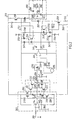
- Figure 1 illustrates schematically a circuit diagram in the nature of a block schematic of an amplifier constructed in accordance with the invention.
- Figure 2 is a more detailed circuit diagram of an inventive amplifier.
- Figure 3 illustrates distortion curves obtained with a class D-amplifier of the prior art, in a double logarithmic diagram.
- Figure 4 illustrates corresponding distortion curves obtained with an inventive amplifier.
- FIG. 1 is a block schematic of an inventive amplifier.
- the DC voltage source 101 delivers positive and negative output voltage to respective poles 114 and 115.
- the voltage amplifier 102 amplifies the audio signal obtained from the input terminal 113, so that a full swing can be obtained at point 116, when full power output is desired.
- the voltage-amplified signal is then applied to the linear push-pull amplifier 111, which then supplies the load/loudspeaker 112.
- the voltage-amplified audio signal 116, plus a DC voltage potential 105/106 are also applied to the input of the pulse-width modulated amplifiers 103/104.
- the pulse width amplifiers 103 and 104 thus amplify the sum of the audio signal and the DC voltage potentials by the amplification 1 (one).
- the filters 109/110 regenerate audio signal plus DC voltage differences together with recovery diodes 107/108.
- These current amplified signals from the pulse width amplifiers 103/104 then supply the linear push-pull amplifier 111 at the points 117 and 118.
- the voltage difference between the supply poles 117 and 118 and the point 116 respectively is therewith equal to the DC voltage references 105 and 106 respectively.
- the linear amplifier 111 thus operates solely at a low supply voltage, which is determined by the references 105 and 106.
- the aim of achieving low power losses in the linear amplifier 111 is realized by the low voltage difference between the poles 117 and 118.
- the points 117 and 118 swing over the whole of the supply voltage range, which is determined by the DC voltages at the points 114 and 115. Because of these possibilities, reactive currents can be driven in the loudspeaker 112 without significant power losses in the amplifier 111.
- the collector impedances in the linear amplifier 111 also assist in the suppression of supply voltage variation, high frequency ripple, and permit considerable distortion from the PWM-amplifiers 103/104. Distortion suppression is also achieved in this way, an achievement not earlier possible with class D-amplifiers.
- a signal voltage V s is delivered on the input of the final stage.
- the power supply poles obtain respective summation voltages V 0 +V s and -Vo +V s , where V o and -V o are constant DC voltages.
- V o and -V o are constant DC voltages.
- These summation voltages are favourable impedances obtained through the combination of respective current amplifying pulse width amplifiers 103, 104, recovery diodes 107, 108 and also the capacitors in the filters 109, 110.
- This enables the power loss in the final stage to be kept low, since maximum current through the conducting half of the final stage will be combined with a collector-base-voltage which is restricted to substantially V o .
- FIG. 2 illustrates schematically a more detailed example of the inventive solution.
- the DC voltage source 200 consists of the transformer 207, which when the proper ratio is chosen between the numbers of windings produces a positive DC voltage in the terminal 213 and a negative DC voltage in the terminal 212, via the diodes 208/210 and the filter capacitors 209/211.
- the primary side of the transformer 207 is connected to a source of alternating current, for example the electric mains supply.
- the audio signal is applied at point 201 to the linear voltage amplifier 202, which in turn drives the linear push-pull-current amplifier 203, which delivers power output to the loudspeaker 229.
- the voltage amplifier 202 consists of a feedback-coupled operational amplifier 214 (of discrete or monolithic construction), which supplies the drive transistors 216/219 through their biassing networks 215/220.
- the current amplifier 203 consists of the push-pull power transistors 222 and 228, with their emitter resistances 224/225. Additional current amplification is obtained by the drive transistors 221/227, the working points of which are determined by the diode network 217/218. These diodes thus determine the class in which the amplifier 203 shall work.
- the class can be selected from between class A, A-B or B, by selecting large forward voltage drops of mutually different values on the diodes 217/218.
- the positive supply-voltage terminal of the amplifier 203 is connected to the output/emitter of the pulse width modulating transistor 258, via the filtering network 252/255. Because the recovery diode 256 is connected to the negative direct current supply pole, the output of the pulse width amplifier is able to operate over the full span of the DC voltage between the points 213 and 212.
- Pulse-width modulation of 258 is effected in the following manner:
- a square wave generator 205 delivers a square wave having a frequency chosen between the frequencies 200 kHz and 2 MHz, through the isolation transformer 230.
- the square wave is integrated to a triangular wave by the resistor 231 and the capacitor 233.
- the reference side of the integration capacitor 233 is connected to the output of the voltage amplifier 203.
- the triangular wave is referred to the audio signal in this way.
- This signal impedance is adapted by the emitter follower circuit 206. The emitter follower 206 then drives the cathode of the comparator diode 242.
- the Zener diode 245 and the filter capacitor 246 form a constant DC voltage source, which influences the output signal from the pulse width amplifier in a manner to produce a voltage difference between the audio output signal 204 and the supply signal to the amplifier 203.
- the current of the Zener diode 245 flows through the opto-coupler light-emitting diode 244 to the current supply resistor 247.
- the comparator diode 242 modulates the light-emitting diode of the opto-coupler with the frequency of the triangular wave, and its audio signal reference modulates the pulse width.
- the current in the opto-coupler transistor in 244 is thus pulse-width modulated via the resistor 261 and is amplified by the power transistor 258, the collector of which is supplied by the DC voltage source 200.
- the emitter of the power transistor 258 then drives the filter 252/255, which forms the one output of the one pulse-width modulated amplifier.
- the emitter follower 206 also drives a second comparator 243.
- the cathode of this diode is connected to a second opto-coupler light-emitting diode 249 and a DC voltage source 250/251 of opposite polarity (compared with 245/246).
- the comparator diode 243 thus modulates the pulse width of the light-emitting diode of the opto-coupler 249 with the aid of the triangular wave and the audio signal with the DC voltage offset 250/251 as a reference.
- the light-emitting diode then current modulates the phototransistor in 249, whose current is amplified in the second pulse width modulating power transistor 259.
- the opto-coupler 244/249 is thus used to isolate the potential between the comparator side and the amplifying side of the pulse-width modulated amplifiers.
- the collector of the power transistor 259 is supplied by the negative part of the DC voltage source 200 and its emitter drives the filter 253/254, which forms the output of the other pulse-width modulated amplifier.
- the outputs of the pulse-width modulated amplifiers drive, in turn, the supply terminals/collectors of the linear push-pull amplifier 203.
- bipolar transistors have been used as amplifying elements. It will be understood, however, that field effect amplifier elements, MOS amplifying elements or like amplifying elements may also be used. It can be added that the present invention may also be applied to different variants of circuit solutions on the linear push-pull amplifier, working in class A, A-B or B, and can also be applied to both complementary and quasi-complementary circuit solutions.
Landscapes
- Engineering & Computer Science (AREA)
- Power Engineering (AREA)
- Amplifiers (AREA)
Claims (7)
- Tonfrequenz-Leistungsverstärker mit Pulsbreitenmodulation, aufweisend:eine Gleichstromversorgungseinheit (200) mit einem positiven Pol (213) und einem negativen Pol (212),einen ersten Signaleingang (113; 201),einen linearen gegentaktverbundenen (engl. push-pull connected) Leistungsverstärker (111; 203) mit einem positiven Energieversorgungsanschluß (117), einem negativen Energieversorgungsanschluß (118), einem zweiten Signaleingang (116) und einem Signalausgang (204), der auch der Ausgang des Tonfrequenz-Leistungsverstärkers ist;wobei der zweite Signaleingang (116) mit einem vom ersten Signaleingang (113; 201) abgeleiteten Eingangssignal verbunden ist;einen Pulsemitter (205, 231, 233) mit einer Pulsfrequenz zwischen 200 kHz und 2 MHz;Pulsmoduliereinrichtung (242, 243) zum Modulieren eines durch den Pulsemitter abgegebenen Signals mit einem vom ersten Eingangssignal abgeleiteten Eingangssignal in ein pulsmoduliertes Signal,Verstärkereinrichtung, die in Klasse D arbeitet, zum Verstärken des pulsmodulierten Signals, wobei die Verstärkereinrichtung zwei Pulsverstärker (258, 259) enthält, die jeweils von einem jeweiligen der Pole (213; 212) der Gleichstromversorgungseinheit gespeist werden;Filtereinrichtung, die zwei Tiefpaßfilterschaltungen (252, 255; 253, 254) enthält, die jeweils mit einem jeweiligen besagten Pulsverstärker (258, 259) verbunden sind;wobei jeder Pulsverstärker (258, 259) mit einer jeweiligen Konstantspannungsquelle (245, 246; 250, 251) und einer jeweiligen Freilaufdiode (256; 257) zusammenwirkt, um so über eine jeweilige Filterschaltung (252, 255; 253, 254) eine gefilterte positive Versorgungsspannung an den positiven Energieversorgungsanschluß (117) bzw. eine gefilterte negative Versorgungsspannung an den negativen Energieversorgungsanschluß (118) abzugeben.
- Tonfrequenz-Leistungsverstärker nach Anspruch 1, bei dem die Freilaufdioden (256, 257) derart verbunden sind, daß die Diode, die zu dem Pulsverstärker gehört, der die positive Spannung abgibt, ihre Kathode mit ihrem Pulsverstärker verbunden und ihre Anode mit dem negativen Pol der Stromversorgungseinheit (200) verbunden aufweist und die Diode, die zu dem Pulsverstärker gehört, der die negative Spannung abgibt, ihre Anode mit dem Pulsverstärker verbunden und ihre Kathode mit dem positiven Pol der Stromversorgungseinheit verbunden aufweist.
- Tonfrequenz-Leistungsverstärker nach Anspruch 2, bei dem die beiden Pulsverstärker und der Endverstärker wechselseitig die gleiche Spannungsverstärkung, vorzugsweise 1, aufweisen.
- Tonfrequenz-Leistungsverstärker nach einem der vorhergehenden Ansprüche, bei dem der Verstärker einen gegentaktverbundenen linearen Spannungsverstärker (202) mit zwei Ausgängen enthält, von denen jeder mit einem jeweiligen Eingang an dem gegentaktverbundenen Leistungsverstärker (203) verbunden ist und die zwei Energieversorgungspole aufweisen, welche mit den gleichen Polen an der Stromversorgungseinheit wie die beiden Pulsverstärker (258, 259) verbunden sind; und bei dem die beiden Pulsverstärker mit der Pulsmodulatoreinrichtung über einen jeweiligen Optokoppler (244, 259) verbunden sind, der ein Spannungspotential isoliert.
- Tonfrequenz-Leistungsverstärker nach Anspruch 4, bei dem Vorwärtsspannungsdioden (217, 218) mit den Ausgängen an dem linearen Spannungsverstärker (202) verbunden sind, um so die verstärkende Klasse des Endverstärkers (203) als entweder Klasse A oder Klasse A-B oder Klasse B zu bestimmen.
- Tonfrequenz-Leistungsstufe mit:einem gegentaktverbundenen Verstärker (111) mit einem Eingang (116), einem Ausgang zum Koppeln an eine Last (112), einem positiven Energieversorgungspol (117), einem negativen Energieversorgungspol (118) undEnergiequellen zum Liefern von Spannungen an die Energieversorgungspole, wobei die Spannungen von einem Leistungsstufeneingangssignal abhängen, wobei jede der Energiequellen eine jeweilige Konstantspannungsquelle (105, 106) und einen jeweiligen pulsbreitenmodulierten Stromverstärker (103, 104) enthält, der durch das Leistungsstufeneingangssignal pulsbreitenmoduliert wird und dessen Ausgangssignale über eine jeweilige Tiefpaßfilterschaltung (109, 110) jeweils an einen jeweiligen der Energieversorgungspole angelegt werden.
- Tonfrequenz-Leistungsstufe nach Anspruch 6, bei der Freilaufdioden (107, 108) mit den Ausgängen des pulsbreitenmodulierten Stromverstärkers verbunden sind, mit dem Ausgang, der mit dem mit einer Kathode verbundenen positiven Energieversorgungspol verbunden ist, und demjenigen der Ausgänge, der mit dem mit einer Anode verbundenen negativen Energieversorgungspol verbunden ist, wobei jeweilige entgegengesetzte Elektroden mit entgegengesetzten Polen einer Stromquelle (101) verbunden sind, die Strom an die Tonfrequenz-Leistungsstufe liefert.
Applications Claiming Priority (2)
| Application Number | Priority Date | Filing Date | Title |
|---|---|---|---|
| SE9003426A SE467331B (sv) | 1990-10-26 | 1990-10-26 | Audio-effektfoerstaerkare med pulsbreddsmodulering samt ett audio-effektsteg |
| SE9003426 | 1990-10-26 |
Publications (3)
| Publication Number | Publication Date |
|---|---|
| EP0483094A2 EP0483094A2 (de) | 1992-04-29 |
| EP0483094A3 EP0483094A3 (en) | 1992-12-09 |
| EP0483094B1 true EP0483094B1 (de) | 1997-08-20 |
Family
ID=20380752
Family Applications (1)
| Application Number | Title | Priority Date | Filing Date |
|---|---|---|---|
| EP91850266A Expired - Lifetime EP0483094B1 (de) | 1990-10-26 | 1991-10-25 | Pulsbreitenmodulierter linearer Leistungsverstärker |
Country Status (4)
| Country | Link |
|---|---|
| US (1) | US5200711A (de) |
| EP (1) | EP0483094B1 (de) |
| DE (1) | DE69127340T2 (de) |
| SE (1) | SE467331B (de) |
Families Citing this family (28)
| Publication number | Priority date | Publication date | Assignee | Title |
|---|---|---|---|---|
| US5450036A (en) * | 1993-02-23 | 1995-09-12 | Rohm Co., Ltd. | Power amplifier circuit for audio signal and audio device using the same |
| US5424684A (en) * | 1993-03-04 | 1995-06-13 | Rohm Co., Ltd. | Power amplifier circuit for audio signal and audio device using the same |
| US5410592A (en) * | 1993-06-04 | 1995-04-25 | Harris Corporation | Class `D` audio speaker amplifier circuit with state variable feedback control |
| US5396194A (en) * | 1993-11-19 | 1995-03-07 | Carver Corporation | Audio frequency power amplifiers |
| US5508658A (en) * | 1994-04-27 | 1996-04-16 | Rohm Co., Ltd. | Power amplifier circuit for audio signal and audio device using the same |
| US5606289A (en) * | 1994-06-22 | 1997-02-25 | Carver Corporation | Audio frequency power amplifiers with actively damped filter |
| US5543753A (en) * | 1994-06-22 | 1996-08-06 | Carver Corporation | Audio frequency power amplifiers with actively damped filter |
| DE19740137A1 (de) * | 1997-09-12 | 1999-03-18 | Alsthom Cge Alcatel | Verfahren und Schaltungsanordnung zur Rufwechselspannungserzeugung für elektronische Teilnehmerschaltungen |
| US5990751A (en) * | 1997-10-16 | 1999-11-23 | Nikon Corporation | Method and apparatus for improving power transfer efficiency of an amplifier system |
| WO2000007291A2 (en) * | 1998-07-24 | 2000-02-10 | Toccata Technology Aps | A method of attenuating zero crossing distortion and noise in an amplifier, an amplifier and uses of the method and the amplifier |
| US6172490B1 (en) * | 1999-12-08 | 2001-01-09 | Alcatel Networks Corporation | Precise rail tracking method for powering dual voltage integrated circuits |
| US6825726B2 (en) * | 2000-07-12 | 2004-11-30 | Indigo Manufacturing Inc. | Power amplifier with multiple power supplies |
| US6621335B2 (en) * | 2001-04-18 | 2003-09-16 | Microsemi Corporation | Class D amplifier with passive RC network |
| US20030095666A1 (en) * | 2001-11-16 | 2003-05-22 | Ramage Robert D. | Machine for controlling and amplifying a low-level audio signal using a high efficiency class D switching amplifier |
| US20030095000A1 (en) * | 2001-11-16 | 2003-05-22 | Acoustic Technology, Inc. | Apparatus with ultra high output power class D audio amplifier |
| JP3894294B2 (ja) * | 2001-11-19 | 2007-03-14 | ソニー株式会社 | パワーアンプ |
| US8036402B2 (en) * | 2005-12-15 | 2011-10-11 | Harman International Industries, Incorporated | Distortion compensation |
| RU2307454C1 (ru) * | 2006-04-10 | 2007-09-27 | Сергей Всеволодович Шпак | Усилитель с высоким кпд |
| GB2446843B (en) * | 2006-06-30 | 2011-09-07 | Wolfson Microelectronics Plc | Amplifier circuit and methods of operation thereof |
| US7719141B2 (en) * | 2006-11-16 | 2010-05-18 | Star Rf, Inc. | Electronic switch network |
| US8362838B2 (en) * | 2007-01-19 | 2013-01-29 | Cirrus Logic, Inc. | Multi-stage amplifier with multiple sets of fixed and variable voltage rails |
| US7863841B2 (en) * | 2007-06-15 | 2011-01-04 | Paolo Menegoli | Class H drive |
| US7786804B2 (en) * | 2008-06-02 | 2010-08-31 | Mediatek Singapore Pte. Ltd. | Driving amplifier circuit with digital control and DC offset equalization |
| DE102008030576B3 (de) * | 2008-06-27 | 2009-12-03 | Texas Instruments Deutschland Gmbh | Hocheffizienter Präzisionsverstärker |
| US8754705B2 (en) | 2011-08-01 | 2014-06-17 | Crestron Electronics Inc. | Audio amplifier power supply with inherent power factor correction |
| JP5883706B2 (ja) * | 2012-03-30 | 2016-03-15 | 株式会社ショーワ | 相対角度検出装置および電動パワーステアリング装置 |
| US9013239B2 (en) | 2012-05-15 | 2015-04-21 | Crestron Electronics Inc. | Audio amplifier power supply with inherent power factor correction |
| CN111512544B (zh) * | 2017-12-20 | 2023-11-24 | 杜比实验室特许公司 | 可配置模态放大器系统 |
Family Cites Families (14)
| Publication number | Priority date | Publication date | Assignee | Title |
|---|---|---|---|---|
| JPS51121239A (en) * | 1975-04-17 | 1976-10-23 | Sony Corp | An amplification circuit |
| JPS6115620Y2 (de) * | 1976-03-02 | 1986-05-15 | ||
| JPS5658303A (en) * | 1979-10-18 | 1981-05-21 | Sony Corp | Amplifying circuit |
| JPS5723309A (en) * | 1980-07-16 | 1982-02-06 | Sanyo Electric Co Ltd | Electric power amplifying circuit of pulse width modulation system |
| JPS5723310A (en) * | 1980-07-17 | 1982-02-06 | Sanyo Electric Co Ltd | Electric power amplifier circuit of pulse width modulation system |
| JPS5732104A (en) * | 1980-08-06 | 1982-02-20 | Hitachi Ltd | Power-voltage-controlled type amplifier |
| US4472687A (en) * | 1980-12-24 | 1984-09-18 | Tokyo Shibaura Denki Kabushiki Kaisha | Audio power amplifier for supplying electric power to a load by switching of power supply voltage |
| JPS57140008A (en) * | 1981-02-20 | 1982-08-30 | Sanyo Electric Co Ltd | Power amplifying circuit |
| JPS5814606A (ja) * | 1981-07-18 | 1983-01-27 | Pioneer Electronic Corp | 増幅器の電源供給回路 |
| JPS58105606A (ja) * | 1981-12-17 | 1983-06-23 | Pioneer Electronic Corp | 増幅器の電源供給回路 |
| JPS58119209A (ja) * | 1982-01-11 | 1983-07-15 | Hitachi Ltd | 電源電圧制御型増幅器 |
| JPS5917710A (ja) * | 1982-07-22 | 1984-01-30 | Toshiba Corp | 電力増幅器 |
| FR2552600A1 (fr) * | 1983-09-27 | 1985-03-29 | Commissariat Energie Atomique | Amplificateur de puissance a alimentation asservie |
| JPH01147907A (ja) * | 1987-12-04 | 1989-06-09 | Oki Electric Ind Co Ltd | 電力増幅回路 |
-
1990
- 1990-10-26 SE SE9003426A patent/SE467331B/sv not_active IP Right Cessation
-
1991
- 1991-10-25 EP EP91850266A patent/EP0483094B1/de not_active Expired - Lifetime
- 1991-10-25 DE DE69127340T patent/DE69127340T2/de not_active Expired - Lifetime
- 1991-10-28 US US07/784,658 patent/US5200711A/en not_active Expired - Lifetime
Also Published As
| Publication number | Publication date |
|---|---|
| SE9003426D0 (sv) | 1990-10-26 |
| EP0483094A3 (en) | 1992-12-09 |
| SE467331B (sv) | 1992-06-29 |
| DE69127340T2 (de) | 1998-02-05 |
| EP0483094A2 (de) | 1992-04-29 |
| DE69127340D1 (de) | 1997-09-25 |
| SE9003426L (sv) | 1992-04-27 |
| US5200711A (en) | 1993-04-06 |
Similar Documents
| Publication | Publication Date | Title |
|---|---|---|
| US5200711A (en) | Pulse-width modulated, linear audio-power amplifier | |
| US6211728B1 (en) | Modulation scheme for filterless switching amplifiers | |
| US6665525B2 (en) | High-level modulation method and apparatus | |
| CN100527605C (zh) | 放大器及使用它的高频功率放大器 | |
| US3413570A (en) | High efficiency rf power amplification with modulation signal controlled "on"-"off" switch varied amplifier dc potentials | |
| US7907010B2 (en) | Digital amplifier | |
| US5410592A (en) | Class `D` audio speaker amplifier circuit with state variable feedback control | |
| KR100760024B1 (ko) | 소프트 시작/정지 기능을 갖는 게이트 제어회로 | |
| US8736367B2 (en) | Power amplifier with switching means and feedback circuit | |
| US5852557A (en) | Switching converter utilizing dual switch outputs | |
| US7161421B2 (en) | Volume control in class D amplifier using variable supply voltage | |
| EP1825592B1 (de) | Leistungsvervielfachervorrichtung und -verfahren | |
| US6970051B2 (en) | Pulse width modulator circuit having negative bias | |
| EP1588484A1 (de) | Pulsmodulierter stromwandler | |
| US20020033734A1 (en) | Self-oscillating variable frequency closed loop class d amplifier | |
| US10469042B1 (en) | Audio amplifier circuit | |
| US11121682B1 (en) | Single-stage boost class-D amplifier | |
| US5216376A (en) | Pulse duration amplifier system having distortion reduction | |
| WO2004091092A1 (en) | Digital amplifier | |
| JPH0744403B2 (ja) | 低歪率d級電力増幅器 | |
| US20050069049A1 (en) | Method of impulse acreage modulation digital power processing and its device | |
| US20240243704A1 (en) | Self-Oscillating Class D Audio Amplifier With Voltage Limiting Circuit | |
| JPS61161005A (ja) | 振幅変調送信機 |
Legal Events
| Date | Code | Title | Description |
|---|---|---|---|
| PUAI | Public reference made under article 153(3) epc to a published international application that has entered the european phase |
Free format text: ORIGINAL CODE: 0009012 |
|
| AK | Designated contracting states |
Kind code of ref document: A2 Designated state(s): DE FR GB IT NL |
|
| PUAL | Search report despatched |
Free format text: ORIGINAL CODE: 0009013 |
|
| AK | Designated contracting states |
Kind code of ref document: A3 Designated state(s): DE FR GB IT NL |
|
| 17P | Request for examination filed |
Effective date: 19930607 |
|
| 17Q | First examination report despatched |
Effective date: 19950316 |
|
| GRAG | Despatch of communication of intention to grant |
Free format text: ORIGINAL CODE: EPIDOS AGRA |
|
| GRAH | Despatch of communication of intention to grant a patent |
Free format text: ORIGINAL CODE: EPIDOS IGRA |
|
| GRAH | Despatch of communication of intention to grant a patent |
Free format text: ORIGINAL CODE: EPIDOS IGRA |
|
| GRAA | (expected) grant |
Free format text: ORIGINAL CODE: 0009210 |
|
| AK | Designated contracting states |
Kind code of ref document: B1 Designated state(s): DE FR GB IT NL |
|
| PG25 | Lapsed in a contracting state [announced via postgrant information from national office to epo] |
Ref country code: IT Free format text: LAPSE BECAUSE OF FAILURE TO SUBMIT A TRANSLATION OF THE DESCRIPTION OR TO PAY THE FEE WITHIN THE PRE;WARNING: LAPSES OF ITALIAN PATENTS WITH EFFECTIVE DATE BEFORE 2007 MAY HAVE OCCURRED AT ANY TIME BEFORE 2007. THE CORRECT EFFECTIVE DATE MAY BE DIFFERENT FROM THE ONE RECORDED.SCRIBED TIME-LIMIT Effective date: 19970820 Ref country code: NL Free format text: LAPSE BECAUSE OF FAILURE TO SUBMIT A TRANSLATION OF THE DESCRIPTION OR TO PAY THE FEE WITHIN THE PRESCRIBED TIME-LIMIT Effective date: 19970820 Ref country code: FR Free format text: LAPSE BECAUSE OF FAILURE TO SUBMIT A TRANSLATION OF THE DESCRIPTION OR TO PAY THE FEE WITHIN THE PRESCRIBED TIME-LIMIT Effective date: 19970820 |
|
| REF | Corresponds to: |
Ref document number: 69127340 Country of ref document: DE Date of ref document: 19970925 |
|
| EN | Fr: translation not filed | ||
| NLV1 | Nl: lapsed or annulled due to failure to fulfill the requirements of art. 29p and 29m of the patents act | ||
| PLBE | No opposition filed within time limit |
Free format text: ORIGINAL CODE: 0009261 |
|
| STAA | Information on the status of an ep patent application or granted ep patent |
Free format text: STATUS: NO OPPOSITION FILED WITHIN TIME LIMIT |
|
| 26N | No opposition filed | ||
| REG | Reference to a national code |
Ref country code: GB Ref legal event code: IF02 |
|
| PGFP | Annual fee paid to national office [announced via postgrant information from national office to epo] |
Ref country code: DE Payment date: 20101019 Year of fee payment: 20 |
|
| PGFP | Annual fee paid to national office [announced via postgrant information from national office to epo] |
Ref country code: GB Payment date: 20101028 Year of fee payment: 20 |
|
| REG | Reference to a national code |
Ref country code: DE Ref legal event code: R071 Ref document number: 69127340 Country of ref document: DE |
|
| REG | Reference to a national code |
Ref country code: DE Ref legal event code: R071 Ref document number: 69127340 Country of ref document: DE |
|
| REG | Reference to a national code |
Ref country code: GB Ref legal event code: PE20 Expiry date: 20111024 |
|
| PG25 | Lapsed in a contracting state [announced via postgrant information from national office to epo] |
Ref country code: GB Free format text: LAPSE BECAUSE OF EXPIRATION OF PROTECTION Effective date: 20111024 |
|
| PG25 | Lapsed in a contracting state [announced via postgrant information from national office to epo] |
Ref country code: DE Free format text: LAPSE BECAUSE OF EXPIRATION OF PROTECTION Effective date: 20111026 |