EP0483646A1 - Korrosionsbeständige Legierung auf Nickelbasis - Google Patents
Korrosionsbeständige Legierung auf Nickelbasis Download PDFInfo
- Publication number
- EP0483646A1 EP0483646A1 EP91117990A EP91117990A EP0483646A1 EP 0483646 A1 EP0483646 A1 EP 0483646A1 EP 91117990 A EP91117990 A EP 91117990A EP 91117990 A EP91117990 A EP 91117990A EP 0483646 A1 EP0483646 A1 EP 0483646A1
- Authority
- EP
- European Patent Office
- Prior art keywords
- alloys
- based alloy
- nickel
- amorphous
- alloy
- Prior art date
- Legal status (The legal status is an assumption and is not a legal conclusion. Google has not performed a legal analysis and makes no representation as to the accuracy of the status listed.)
- Granted
Links
Images
Classifications
-
- C—CHEMISTRY; METALLURGY
- C22—METALLURGY; FERROUS OR NON-FERROUS ALLOYS; TREATMENT OF ALLOYS OR NON-FERROUS METALS
- C22C—ALLOYS
- C22C45/00—Amorphous alloys
- C22C45/04—Amorphous alloys with nickel or cobalt as the major constituent
Definitions
- the present invention relates to amorphous nickel-based alloys having an excellent corrosion-resistance, which are useful in various industrial applications.
- Hastelly C-276 made by Haynes Co.
- Carpenter Cb2 and Cb3 both made by Carpenter Technology Co.
- Japanese Patent Laid-Open No. 57-54242 discloses amorphous alloys which include Fe, Co or Ni or a mixture thereof as a basic component and which have superior saturation magnetic flux density, corrosion resistance and thermal stability due to addition of specified amounts of certain ferromagnetic metals or corrosion-resistance improving metals in combination with elemental metals, such as Zr, Ti, Hf, etc., to the foregoing basic component.
- the above-mentioned alloys are susceptible to pitting and corrosion in highly corrosive environments containing halogen ions, they have been used only in relatively mild corrosive environments.
- the latter alloys disclosed in the Japanese Patent Application Laid-Open No. 57-54242 were developed to obtain a corrosion resistance adequate to use as magnetic materials.
- the latter alloys can also be used only in relatively mild environments, like the above-mentioned alloys.
- the Japanese Application describes that the corrosion resistance can be improved by addition of phosphorus in combination with chromium, the addition of phosphorus significantly deteriorates the mechanical properties, processability, etc., and, thereby, gives rise to a further problem of brittleness.
- the present invention provides a corrosion resistant nickel-based alloy consisting of an amorphous phase or a composite consisting of an amorphous phase and a fine crystalline phase, the nickel-based alloy consisting of a composition represented by the general formula: Ni a Cr b Mo c X d wherein: X is at least one element selected from the group consisting of Zr and Hf, and a, b, c and d are, in atomic percent, 50 ⁇ a ⁇ 88, 5 ⁇ b ⁇ 35, 3 ⁇ c ⁇ 20 and 4 ⁇ d ⁇ 20, preferably, 50 ⁇ a ⁇ 88, 5 ⁇ b ⁇ 35, 3 ⁇ c ⁇ 15 and 4 ⁇ d ⁇ 15, and more preferably, 55 ⁇ a ⁇ 75, 10 ⁇ b ⁇ 25, 5 ⁇ c ⁇ 12 and 5 ⁇ d ⁇ 12.
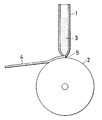
- the single figure shows a schematic view illustrating an embodiment of the production of alloy thin ribbons according to the present invention.
- an alloy has a crystalline structure in the solid state.
- an amorphous structure which is similar to liquid, is formed by preventing the formation of long-range order structure during solidification through, for example, rapid solidification from the liquid state, without forming a crystalline structure.
- the thus obtained alloy is called an amorphous alloy.
- Amorphous alloys are generally composed of a homogeneous single phase of supersaturated solid solution and have a significantly higher strength as compared with ordinary practical metallic materials. Further, some amorphous alloys exhibit a very high corrosion resistance and other various superior properties, depending on their compositions.
- the nickel-based alloys of the present invention can be produced by rapidly quenching and solidifying a melt of an alloy having the composition as specified above, employing liquid quenching method.
- Liquid quenching methods are known as methods for the rapid quenching of alloy melts and, for example, single roller melt-spinning, twin-roller melt-spinning and in-rotating-water melt-spinning are especially effective. In these methods, a cooling rate of about 104 to 107 K/sec can be obtained.
- the molten alloy is ejected from the opening of nozzle onto a roll of, for example, copper or steel, with a diameter of 30 to 300 mm, which is rotating at a constant rate of about 300 to 10000 rpm.
- a roll of, for example, copper or steel with a diameter of 30 to 300 mm, which is rotating at a constant rate of about 300 to 10000 rpm.
- a jet of the molten alloy is directed, under application of a back pressure of argon gas, through a nozzle into a liquid refrigerant layer with a depth of about 1 to 10 cm which is held by centrifugal force in a drum rotating at a rate of about 50 to 500 rpm.
- the angle between the molten alloy ejecting from the nozzle and the liquid refrigerant surface is preferably in the range of about 60 to 90° and the ratio of the relative velocity of the ejecting molten alloy to the liquid refrigerant surface is preferably in the range of about 0.7 to 0.9.
- the nickel-based alloys of the present invention may be also obtained by depositing a source material having the composition represented by the above general formula onto a substrate employing thin film formation techniques, such as sputtering, vacuum deposition, ion plating, etc. and, thereby, forming a thin film having the above composition.
- the sputtering deposition process there may be mentioned diode sputtering process, triode sputtering process, tetrode sputtering process, magnetron sputtering process, opposing target sputtering process, ion beam sputtering process, dual ion beam sputtering process, etc. and, in the former five processes, there are a direct current application type and a high-frequency application type.
- the sputtering deposition process will be more specifically described hereinafter.
- a target having the same composition as that of the thin film to be formed is bombarded by ion sources produced in the ion gun or the plasma, etc., so that neutral particles or ion particles in the state of atoms, molecules or cluster are produced from the target by its bombardment and deposited onto the substrate. It is known that various thin films have been obtained in such a manner.
- ion beam sputtering, plasma sputtering, etc. are effective and these sputtering processes provide a cooling rate of the order of 105 to 107 K/sec. Due to such a cooling rate, it is possible to produce an alloy thin film having an amorphous phase.
- the thickness of the thin film can be adjusted by the processing time and, usually, the thin film formation rate is on the order to 2 to 7 ⁇ m per hour.
- the alloy of the present invention can be also obtained as rapidly solidified powder by various atomizing processes, for example, high pressure gas atomizing; or a spray process.
- Whether the rapidly solidified nickel-based alloys thus obtained are amorphous or not can be determined by checking the presence of the characteristic halo pattern of an amorphous structure using an ordinary X-ray diffraction method.
- the reason why a, b, c and d are limited as above by the atomic percentages is that when they fall outside the respective ranges, amorphization becomes difficult and the resulting alloys become very brittle. Consequently, it becomes impossible to obtain the intended alloys having an amorphous phase by industrial processes, such as sputtering deposition.
- Cr has an important effect of forming a passive film in cooperation with Ni and Mo when contained in coexistence with these elements in the alloy, thereby improving the corrosion resistance of the alloy.
- Another reason why the atomic percentage (b) of Cr is limited to the aforesaid range is that an amount of Cr of less than 5 atomic % is insufficient to provide an improved corrosion resistance contemplated by the present invention.
- the Cr atomic percentage exceeds 35 atomic % the resultant alloy becomes too brittle and impractical for industrial applications.
- Mo has an effect of improving the ability to form an amorphous phase and, in addition, improves the hardness, strength and heat resistance.
- the Mo addition is less than 3 atomic % or more than 20 atomic %, the desired effects can not be obtained. Particularly, addition of Mo not exceeding 15 atomic % is more advantageous to improve the hardness, strength, toughness and processability.
- Element X which is at least one element selected from the group consisting of the group of Zr and Hf, is effective to improve the amorphizing ability of the above-mentioned alloy and, at the same time, has an effect of forming a passive film, thereby improving the corrosion resistance of the alloy.
- Cr unfavorably affects the amorphizing ability of the alloys, although it has a considerable effect in improving the corrosion resistance.
- the X element of the present invention permits the addition of large amounts of Cr and makes it possible to form alloys comprising an amorphous phase, even if Cr is added in large amounts.
- the X element is less than 4 atomic % or more than 20 atomic %, the effects contemplated by the present invention will not be achieved. Particularly, addition not exceeding 15 atomic % is more preferable in the hardness, strength, toughness and processability.
- atomic percentages of 55 ⁇ a ⁇ 75, 10 ⁇ b ⁇ 25, 5 ⁇ c ⁇ 12 and 5 ⁇ d ⁇ 12 are more advantageous.
- the nickel-based alloy of the present invention when prepared as a thin film, it has a high degree of toughness depending upon its composition. Therefore, some alloys can be bond-bent to 180° without cracking or peeling from a substrate.
- Molten alloy 3 having a predetermined composition was prepared using a high-frequency melting furnace and charged into a quartz tube 1 having a small opening 5 (diameter: 0.5 mm) at the tip thereof, as shown in the drawing. After being heated to melt the alloy 3, the quartz tube 1 was disposed right above a copper roll 2. Then, the molten alloy 3 contained in the quartz tube 1 was ejected from the small opening 5 of the quartz tube 1, under the application of an argon gas pressure of 0.7 kg/cm2, and brought into contact with the surface of the roll 2 rapidly rotating at the rate of 5,000 rpm. The molten alloy 3 was rapidly solidified and an alloy thin ribbon 4 was obtained.
- Alloy thin ribbons prepared under the processing conditions as described above were each subjected to X-ray diffraction analysis. It was confirmed from the results that the obtained alloys had an amorphous phase and consisted of an amorphous single phase or of an amorphous phase and a fine crystalline phase. As to the alloys consisting of an amorphous phase and a fine crystalline phase, it can be confirmed which phase was contained in lager percentages by volume. If necessary, further detailed observation can be made by means of TEM (transmission electron microscopy). The composition of each thin ribbon was determined by a quantitative analysis using an X-ray microanalyzer.
- the test results are set forth in Table 1. In the table, corrosion resistance was evaluated in terms of corrosion rate. "Structure" in the same table shows the results of the X-ray diffraction analysis.
- Amo represents an amorphous single phase
- Amo ⁇ Cry represents a composite of an amorphous phase and a crystalline phase in which the later phase was contained in larger percentages by volume than the former phase
- Amo > Cry represents a composite of an amorphous phase and a crystalline phase in which the former phase was contained in larger percentage by volume than the latter phase.
- Thenness in the table shows the results of a 180° bond-bending test.
- “Bri” represents “brittleness” causing cracking or peeling from a substrate.
- Duc represents “ductility” sufficient to permit bond-bending of 180° without cracking or peeling from a substrate.
- nickel-based alloys of the present invention have a superior corrosion resistance to the hydrochloric acid aqueous solution, sodium hydroxide aqueous solution and diluted aqua regia.
- the nickel-based alloys of the present invention have not only a superior corrosion resistance to the aqua regia but also a high level of hardness, tensile strength and toughness.
- Sample Nos. 3 and 5 had a very high toughness and, thus, could be bond-bent to 180 ° and, then, bent back to 360° without breaking or peeling from a substrate.
- Sample Nos. 1 and 7 and Comparative Sample Nos. 1 and 2 were further tested for their corrosion resistance in a mixed solution of hydrofluoric acid, nitric acid and water in a mixing ratio of 1 : 1 : 2, at 30 °C and the results are shown in Table 3.
- Table 3 shows that the nickel-based alloys of the present invention also have a superior corrosion resistance against the above-mentioned mixed solution.
- the amorphous alloys of the present invention prepared by the production procedure set forth in Example 1 were ground or crushed into a powder form. When the resulting powders were used as pigments for metallic paints, they exhibited a high resistance to corrosion attack in the metallic paints over a long period of time and provided highly durable metallic paints.
- the nickel-based alloys of the present invention have an amorphous phase, they have an advantageous combination of properties of high hardness, high strength, high heat-resistance and high wear-resistance which are all characteristic of amorphous alloys. Further, the alloys form a stable protective film by self-passivation. The resulting passive film is durable for a long period of time in severe corrosive environments containing chlorine ions, etc., and has a very high corrosion-resistance. Therefore, the alloys of the present invention are very useful in various industrial applications.
- compositional range as defined above can provide materials having superior properties of high hardness and strength coupled with high toughness, strength and processability.
Landscapes
- Chemical & Material Sciences (AREA)
- Engineering & Computer Science (AREA)
- Materials Engineering (AREA)
- Mechanical Engineering (AREA)
- Metallurgy (AREA)
- Organic Chemistry (AREA)
- Continuous Casting (AREA)
- Physical Vapour Deposition (AREA)
Applications Claiming Priority (2)
| Application Number | Priority Date | Filing Date | Title |
|---|---|---|---|
| JP288574/90 | 1990-10-29 | ||
| JP28857490A JPH04165053A (ja) | 1990-10-29 | 1990-10-29 | 耐食性ニッケル基合金 |
Publications (2)
| Publication Number | Publication Date |
|---|---|
| EP0483646A1 true EP0483646A1 (de) | 1992-05-06 |
| EP0483646B1 EP0483646B1 (de) | 1996-02-07 |
Family
ID=17732027
Family Applications (1)
| Application Number | Title | Priority Date | Filing Date |
|---|---|---|---|
| EP19910117990 Expired - Lifetime EP0483646B1 (de) | 1990-10-29 | 1991-10-22 | Korrosionsbeständige Legierung auf Nickelbasis |
Country Status (3)
| Country | Link |
|---|---|
| EP (1) | EP0483646B1 (de) |
| JP (1) | JPH04165053A (de) |
| DE (1) | DE69116977T2 (de) |
Families Citing this family (1)
| Publication number | Priority date | Publication date | Assignee | Title |
|---|---|---|---|---|
| JP5391929B2 (ja) * | 2009-08-25 | 2014-01-15 | 三菱マテリアル株式会社 | Ni基合金製ハロゲン系ガス用ボンベのバルブ部材 |
Citations (3)
| Publication number | Priority date | Publication date | Assignee | Title |
|---|---|---|---|---|
| EP0036892A1 (de) * | 1979-04-11 | 1981-10-07 | Shin-Gijutsu Kaihatsu Jigyodan | Amorphe legierung, die ein element der eisenfamilie und zirkonium enthält, und daraus erhaltene artikel |
| US4668310A (en) * | 1979-09-21 | 1987-05-26 | Hitachi Metals, Ltd. | Amorphous alloys |
| US4854980A (en) * | 1987-12-17 | 1989-08-08 | Gte Laboratories Incorporated | Refractory transition metal glassy alloys containing molybdenum |
-
1990
- 1990-10-29 JP JP28857490A patent/JPH04165053A/ja active Pending
-
1991
- 1991-10-22 EP EP19910117990 patent/EP0483646B1/de not_active Expired - Lifetime
- 1991-10-22 DE DE1991616977 patent/DE69116977T2/de not_active Expired - Fee Related
Patent Citations (3)
| Publication number | Priority date | Publication date | Assignee | Title |
|---|---|---|---|---|
| EP0036892A1 (de) * | 1979-04-11 | 1981-10-07 | Shin-Gijutsu Kaihatsu Jigyodan | Amorphe legierung, die ein element der eisenfamilie und zirkonium enthält, und daraus erhaltene artikel |
| US4668310A (en) * | 1979-09-21 | 1987-05-26 | Hitachi Metals, Ltd. | Amorphous alloys |
| US4854980A (en) * | 1987-12-17 | 1989-08-08 | Gte Laboratories Incorporated | Refractory transition metal glassy alloys containing molybdenum |
Also Published As
| Publication number | Publication date |
|---|---|
| JPH04165053A (ja) | 1992-06-10 |
| EP0483646B1 (de) | 1996-02-07 |
| DE69116977D1 (de) | 1996-03-21 |
| DE69116977T2 (de) | 1996-09-19 |
Similar Documents
| Publication | Publication Date | Title |
|---|---|---|
| KR100271996B1 (ko) | 내마모성 및 내식성 비정질 합금 주성분 금속성 피니쉬 및 그 제조방법 | |
| EP0361136B1 (de) | Hochfeste Legierungen auf Magnesiumbasis | |
| EP0303100B1 (de) | Hochfeste, hitzebeständige Aluminiumlegierungen und Verfahren zur Herstellung von Gegenständen aus diesen Legierungen | |
| CA2020484C (en) | High strength magnesium-based alloys | |
| US5634989A (en) | Amorphous nickel alloy having high corrosion resistance | |
| KR930000846B1 (ko) | 고 강도 마그네슘-기재 합금 | |
| EP0036892B1 (de) | Amorphe legierung, die ein element der eisenfamilie und zirkonium enthält, und daraus erhaltene artikel | |
| CA1301485C (en) | High strength, heat resistant aluminum alloys | |
| DE69223180T2 (de) | Aluminiumlegierungen sowie mit diesen legierungen beschichtete substrate und ihre verwendungen | |
| EP0470599A1 (de) | Hochfeste Legierungen auf Magnesiumbasis | |
| EP0475101A1 (de) | Hochfeste Legierungen auf Aluminiumbasis | |
| EP0461633B1 (de) | Hochfeste Legierungen auf Magnesiumbasis | |
| EP0458029B1 (de) | Korrosionsbeständige Legierung auf Aluminiumbasis | |
| CA2068046C (en) | High corrosion-resistant amorphous alloys | |
| EP0394825B1 (de) | Korrosionsbeständige Legierung auf Aluminium-Basis | |
| US5221376A (en) | High strength magnesium-based alloys | |
| EP0502540A1 (de) | Opferelektrodenmaterial für den Korrosionsschutz | |
| EP0483646B1 (de) | Korrosionsbeständige Legierung auf Nickelbasis | |
| EP0314805A1 (de) | Hochkorrosionsbeständige amorphe legierung | |
| Schneider et al. | Corrosion behaviour of carbon steel coated with Zr‐based metallic glass | |
| JPH083137B2 (ja) | 耐食性アルミニウム基合金 | |
| auf Zr-Basis | Corrosion behaviour of carbon steel coated with Zr-based metallic glass | |
| JPH0465896B2 (de) |
Legal Events
| Date | Code | Title | Description |
|---|---|---|---|
| PUAI | Public reference made under article 153(3) epc to a published international application that has entered the european phase |
Free format text: ORIGINAL CODE: 0009012 |
|
| AK | Designated contracting states |
Kind code of ref document: A1 Designated state(s): DE FR GB |
|
| 17P | Request for examination filed |
Effective date: 19920807 |
|
| 17Q | First examination report despatched |
Effective date: 19940606 |
|
| RAP1 | Party data changed (applicant data changed or rights of an application transferred) |
Owner name: YKK CORPORATION |
|
| GRAA | (expected) grant |
Free format text: ORIGINAL CODE: 0009210 |
|
| AK | Designated contracting states |
Kind code of ref document: B1 Designated state(s): DE FR GB |
|
| ET | Fr: translation filed | ||
| REF | Corresponds to: |
Ref document number: 69116977 Country of ref document: DE Date of ref document: 19960321 |
|
| PLBE | No opposition filed within time limit |
Free format text: ORIGINAL CODE: 0009261 |
|
| STAA | Information on the status of an ep patent application or granted ep patent |
Free format text: STATUS: NO OPPOSITION FILED WITHIN TIME LIMIT |
|
| 26N | No opposition filed | ||
| REG | Reference to a national code |
Ref country code: GB Ref legal event code: IF02 |
|
| PGFP | Annual fee paid to national office [announced via postgrant information from national office to epo] |
Ref country code: FR Payment date: 20021008 Year of fee payment: 12 |
|
| PGFP | Annual fee paid to national office [announced via postgrant information from national office to epo] |
Ref country code: GB Payment date: 20021016 Year of fee payment: 12 |
|
| PGFP | Annual fee paid to national office [announced via postgrant information from national office to epo] |
Ref country code: DE Payment date: 20021024 Year of fee payment: 12 |
|
| PG25 | Lapsed in a contracting state [announced via postgrant information from national office to epo] |
Ref country code: GB Free format text: LAPSE BECAUSE OF NON-PAYMENT OF DUE FEES Effective date: 20031022 |
|
| PG25 | Lapsed in a contracting state [announced via postgrant information from national office to epo] |
Ref country code: DE Free format text: LAPSE BECAUSE OF NON-PAYMENT OF DUE FEES Effective date: 20040501 |
|
| GBPC | Gb: european patent ceased through non-payment of renewal fee |
Effective date: 20031022 |
|
| PG25 | Lapsed in a contracting state [announced via postgrant information from national office to epo] |
Ref country code: FR Free format text: LAPSE BECAUSE OF NON-PAYMENT OF DUE FEES Effective date: 20040630 |
|
| REG | Reference to a national code |
Ref country code: FR Ref legal event code: ST |