EP0483778A2 - Moteur électrique rotatif - Google Patents
Moteur électrique rotatif Download PDFInfo
- Publication number
- EP0483778A2 EP0483778A2 EP91118456A EP91118456A EP0483778A2 EP 0483778 A2 EP0483778 A2 EP 0483778A2 EP 91118456 A EP91118456 A EP 91118456A EP 91118456 A EP91118456 A EP 91118456A EP 0483778 A2 EP0483778 A2 EP 0483778A2
- Authority
- EP
- European Patent Office
- Prior art keywords
- stator
- electric motor
- rotor
- motor according
- rotor pole
- Prior art date
- Legal status (The legal status is an assumption and is not a legal conclusion. Google has not performed a legal analysis and makes no representation as to the accuracy of the status listed.)
- Granted
Links
Images


Classifications
-
- H—ELECTRICITY
- H02—GENERATION; CONVERSION OR DISTRIBUTION OF ELECTRIC POWER
- H02K—DYNAMO-ELECTRIC MACHINES
- H02K21/00—Synchronous motors having permanent magnets; Synchronous generators having permanent magnets
- H02K21/12—Synchronous motors having permanent magnets; Synchronous generators having permanent magnets with stationary armatures and rotating magnets
- H02K21/14—Synchronous motors having permanent magnets; Synchronous generators having permanent magnets with stationary armatures and rotating magnets with magnets rotating within the armatures
-
- H—ELECTRICITY
- H02—GENERATION; CONVERSION OR DISTRIBUTION OF ELECTRIC POWER
- H02K—DYNAMO-ELECTRIC MACHINES
- H02K1/00—Details of the magnetic circuit
- H02K1/06—Details of the magnetic circuit characterised by the shape, form or construction
- H02K1/22—Rotating parts of the magnetic circuit
- H02K1/27—Rotor cores with permanent magnets
- H02K1/2706—Inner rotors
- H02K1/2713—Inner rotors the magnetisation axis of the magnets being axial, e.g. claw-pole type
-
- H—ELECTRICITY
- H02—GENERATION; CONVERSION OR DISTRIBUTION OF ELECTRIC POWER
- H02K—DYNAMO-ELECTRIC MACHINES
- H02K29/00—Motors or generators having non-mechanical commutating devices, e.g. discharge tubes or semiconductor devices
- H02K29/06—Motors or generators having non-mechanical commutating devices, e.g. discharge tubes or semiconductor devices with position sensing devices
- H02K29/08—Motors or generators having non-mechanical commutating devices, e.g. discharge tubes or semiconductor devices with position sensing devices using magnetic effect devices, e.g. Hall-plates, magneto-resistors
Definitions
- Electric motors are known in very numerous designs. The type of electric motor mentioned at the outset is more special in that it is permanently magnetically excited. In addition, the end faces of permanent magnets do not directly form the pole faces of the rotor, as is the most widespread per se, but a flux-guiding device for magnetic fluxes is located between the permanent-magnet excitation device and the pole faces of the rotor facing the air gap.
- the electric motor according to the invention can be built in a particularly compact manner and can be produced inexpensively. Furthermore, its ease of assembly during manufacture is remarkable.
- the excitation device consists essentially of a permanent magnetic disk, usually with a central opening.
- the excitation device with a plurality of permanent magnets, in particular a plurality of permanent magnet disks which are axially attached to one another or a plurality of, for example sector-shaped, circumferentially attached permanent magnets.
- the magnetic flux transfer surfaces of the stator - measured in the axial direction - are preferably so wide that they cover the rotor pole surfaces of all the partial rotors formed in this way.
- stator as many magnetic flux transfer surfaces of the stator as there are excitation devices can be provided axially next to one another, either with an individually assigned coil or with a common coil.
- excitation devices can be provided axially next to one another, either with an individually assigned coil or with a common coil.
- the described division into partial rotors is magnetically more favorable than just a correspondingly axially thicker excitation device and a flux guide device with correspondingly larger flux guide cross sections.
- the flux guide device preferably has a claw-pole configuration in the area of the rotor pole surfaces.
- the flux guide device can be designed in such a way that the row of the second rotor pole faces lies axially (tightly) next to the row of the first rotor pole faces.
- the magnetic flux transfer surfaces of the stator are usefully - measured in the axial direction - so wide that they cover both the first and the second rotor pole surfaces.
- the electric motor obtains a better volume and magnetic utilization if the first part and the second part of the flux guiding device mesh like a comb in the area of the first and second rotor pole surfaces, whereby this meshing can only be present for part of the width of the rotor pole surfaces measured in the axial direction or, as is particularly preferred, a complete interlocking so that the first and second rotor pole surfaces form a common, aligned row of rotor pole surfaces. It is understood that there are magnetically non-conductive gaps between adjacent rotor pole faces in the circumferential direction.
- the first part and the second part of the flow guide device are designed essentially identically, so that the motor can be constructed with two identical flow guide components.
- the first and the second rotor pole faces — measured in the axial direction — are preferably wider than the essentially disk-shaped excitation device.
- the flow guide device is preferably designed such that the first part and the second part of the flow guide device in the diameter range corresponding to the excitation device each have an axial thickness that increases with increasing diameter.
- the optimum use of material of the flux guide device is obtained if the first and second part of the flux guide cross section is at least roughly constant from the outer circumference of the excitation device to a rotor pole face under consideration.
- a striving for largely exact constancy of the flow guide cross-section is usually not worthwhile; Aspects of complicated manufacturability of the flow guide should also be considered.
- the areas adjacent to the rotor pole faces each have a circumferentially diminishing dimension in the circumferential direction and in comparison have an enlarged dimension in the axial direction for the rotor pole area in question.
- a typical case is a roughly speaking, in the axial direction, trapezoidal shape of the areas adjacent to the rotor pole faces, the shorter trapezoidal base line being radially on the inside.
- care should be taken to ensure that the gaps - usually running in the axial direction - between adjacent rotor pole faces or those adjoining them radially inward Areas from outside to inside - measured in the circumferential direction - become increasingly wider.
- Optimal magnetic conditions result when the rotor pole surfaces - measured in the circumferential direction - each have essentially the same dimensions as the magnetic flux transfer surfaces of the stator.
- the first part of the flux guiding device and / or the second part of the flux guiding device and / or the flux guiding component of the stator consist of plastic-bonded iron powder material (instead of sheet iron material). It is also particularly preferred if the components mentioned are each one-piece components. These components can be molded.
- the two parts of the flux guide device can be produced and connected quasi-integrally by molding with the magnet or magnets of the excitation device. However, the two parts of the flux guiding device can also be combined or connected in a different way with the magnet or the magnets of the excitation device.
- the excitation device is preferably constructed with highly coercive permanent magnet material.
- This permanent magnet material can have a relative permeability close to that of air.
- Favorable materials are those based on rare earth cobalt or rare earth iron, in particular samarium cobalt and iron neodymium.
- the stator is constructed either conventionally with coils attached to magnetically conductive coil cores or preferably with air coils attached to the stator without a magnetically conductive core. Because of the latter possibility, the term “magnetic flux transfer surfaces of the stator” was used instead of the more common term “stator pole surfaces", which is not quite appropriate for air coils.
- the motor according to the invention is preferably electronically commutated. It is advantageous if the number of magnetic flux transfer surfaces of the stator is divisible by 3, so that the stator is suitable for three-phase winding. Furthermore, it is advantageous if the number of rotor pole surfaces is not equal to the number of magnetic flux transfer surfaces of the stator, in particular if there are a few rotor pole surfaces more or less than magnetic flux transfer surfaces of the stator.
- the stator coils are preferably individual coils which are connected individually or in groups or are all connected together to the power supply.
- the term "power supply” does not necessarily mean an external supply circuit, but, for example in the case of the electronically commutated motor, a connection to the power section of the electronic commutation device.
- the electric motor according to the invention can be designed such that wound and unwrapped stator poles alternate with one another in the circumferential direction (the term “wound stator poles” should also include air coils). This reduces the magnetic Interactions between adjacent stator poles, which are switched in their current direction at different times. In most cases, the unwound stator poles consist of two half poles. These can be separated from one another in terms of magnetic flux.
- the rotor is preferably constructed according to the flux concentration principle, in which a rotor pole area under consideration is smaller than the part of the transition area between the excitation device and the flux guide device that is accounted for by it.
- the excitation device and the flux guide device can be attached to a central, magnetically non-conductive sleeve or shaft.
- the sleeve or shaft can hold the excitation device and the flow guide device together or support this holding together.
- the sleeve or shaft can be formed in a quasi-integral manner. The design options mentioned result in a particularly simple manufacture and assembly of the motor.
- the scope of the invention also includes a current generator which is constructed with the features described above.
- the motor / generator according to the invention can also be designed as a linear motor / linear generator instead of being rotatory.
- the rotor can either be an inner rotor, the rotor pole faces of which face the stator outwards, or an outer rotor, the rotor pole faces of which face the stator inwards.
- the electric motor 2 of FIGS. 1 and 2 has a housing 4 schematically indicated with slashes and a rotor 8 rotatably mounted therein by means of a shaft 6.
- the rotor 8 consists essentially of a permanent magnet disk 10 mounted on the shaft 6 as an excitation device and a flux guide device 12 fixed on the shaft 6 and / or on the permanent magnet disk 10.
- the flux guide device 12 consists of a first part 14, which is shown in FIG 1 partly to the right of the permanent magnet disc 10 and partly in the area radially outside the permanent magnet disc 10, and a second part 16, which in FIG. 1 is partly to the left of the permanent magnet disc 10 and partly radially outside of the permanent magnet disc 10.
- the permanent magnet disk 10 is axially magnetized, so that for example on its right end face in FIG. 1 there is an annular north pole and on its left face in FIG. 1 A circular south pole is located at the front.
- the permanent magnet disk 10 is oriented at right angles to the axis of rotation 18 of the shaft 6.
- the annular transition surfaces between the permanent magnet disk 10 and the first part 14 and the second part 16 of the flux guide device 12 are designated by 20.
- the first part 14 and the second part 16 of the flow guide device 12 are mutually identical parts which consist of plastic-bonded iron powder material.
- the parts 14, 16 of the flow guide device 12 - roughly speaking - are L-shaped.
- the respective outer end surface 22 of the flow guide device extends axially outward if one proceeds from radially inward to radially outward.
- This surface 22 then bends axially inwards for the first time and then bends a second time so that an axially extending region results.
- This area forms a rotor pole surface 24.
- the rotor pole surface 24 is symmetrical about a plane of symmetry which runs through the center of the permanent magnet disk 10 at right angles to the axis 18.
- the region 26 radially inward adjacent to the rotor pole surface 24 under consideration leads to the circumferential surface of the permanent magnet disc 10.
- the rotor pole surface 24 under consideration is - measured in the axial direction - wider than the permanent magnet disc 10.
- the first part 14 of the flux guide device 12 on the right in FIG. 1 is in one hatched in the first direction because it is cut overall.
- the second part 16 of the flux guide device 12 on the left in FIG. 1 is hatched in a second direction approximately up to the diameter corresponding to the outer diameter of the permanent magnet disk 10 and is unshaded radially outside of it because of its location there Area is no longer cut and is located behind the drawing plane of FIG. 1.
- the design is such that the flux guide cross section per rotor pole 24 is roughly constant from the outer circumference of the permanent magnet disk 10 to the rotor pole surface 24 in question. Essentially, only at the transition from the disk-shaped area 28 into the individual pole areas and in the radially inner area of the flux guiding device 12 there is, as it were, too much plastic-bonded iron powder material for reasons of production engineering and strength. On the other hand, however, the right magnetic flux exit surface of the permanent magnet disk 10 in FIG. 1 is larger than the sum of the associated ones Rotor pole faces 24, so that the motor 2 on the rotor 8 is constructed according to the flux concentration principle.
- a stator 30 made of plastic-bonded iron powder material is attached to the inner peripheral surface of the housing 4.
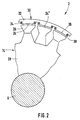
- the stator 30 has a series of circumferentially spaced stator teeth 32 (FIG. 2), and a coil 34 (FIG. 2) is mounted on each stator tooth or every other stator tooth.
- a coil 34 (FIG. 2) is mounted on each stator tooth or every other stator tooth.
- air coils without an iron core can also be provided, which are fastened to an internally essentially smooth-cylindrical stator part, which takes over the function of magnetic inference between adjacent stator poles.
- 2 also shows that the rotor pole surfaces 24 and 24 'and the magnetic flux transition surfaces 36 and pole surfaces 36 of the stator 30 - measured in the circumferential direction - have essentially the same dimensions.
- the motor 2 has, for example, 12 magnetic flux transfer surfaces 36 of the stator 30 and 16 rotor pole surfaces 24 or 24 ', so that the coil winding of the stator 30 can be designed in three phases and the number of rotor pole surfaces 24 or 24' is somewhat larger (or also somewhat smaller) than the number of magnetic flux transfer surfaces 36. Therefore, strictly speaking, the rotor pole surfaces 24 and 24 'are somewhat shorter in the circumferential direction than the magnetic flux transfer surfaces 36, which is deliberately not shown in FIG. 2.
- the motor 2 is commutated electronically.
- the rotor 8 has on one axial side next to the first part 14 of the flux guiding device 12 a sensor disk 40 which is provided on its outer circumference with teeth not shown in the drawing and pointing radially outward.
- a sensor device 42 fastened on the inside of the housing 4, for example one or more Hall sensors, can detect the respective instantaneous rotational position of the rotor 8 on the basis of the teeth of the encoder disk 40.
- the signal from the sensor device 42 is fed to an electronic commutation device 44.
- the power section of the electronic commutation device 44 supplies the individual coils 34 with current with the correct time and sign.
- the power section of the electronic commutation device 44 is either supplied by a direct current source or by an alternating current source, a direct voltage intermediate circuit being present in the commutation device 44.
- the main component of the commutation device 44 is a plurality of two-quadrant controllers or four-quadrant controllers. In the exemplary embodiment described, four coils 34 are connected to one another and then connected together to the commutation device 44.
- Electronically commutated electric motors are known per se, so that no further details of electronic commutation need to be described here. Alternatively, it is possible to connect each coil 34 individually to the commutation device 44 or to connect all the coils 34 to one another and to connect them together to the commutation device 44.
- the motor 2 according to FIG. 3 differs from the motor 2 according to FIGS. 1 and 2 only in that the permanent magnet disk 10 and the flux guiding device 12 and the sensor disk 40 are not fastened on a shaft 6, but on a hollow cylindrical sleeve 46 made of magnet non-conductive material, for example plastic material.
- the sleeve 46 is rotatably mounted in the housing 4 and provided with an internal thread. This internal thread is in engagement with an external thread of a non-rotatably held spindle 48 which is guided through the housing 4. When the rotor 8 rotates, the spindle 48 is thus given a linear movement.
- motors described above had an inner rotor 8 with radially outward-facing rotor pole faces 24 and 24 ', which was arranged inside the stator 30 surrounding the ring. It is pointed out that motors according to the invention can also be built with an outer rotor, the rotor pole faces of which point radially inwards, the stator being arranged within the surrounding rotor.
Landscapes
- Engineering & Computer Science (AREA)
- Power Engineering (AREA)
- Permanent Field Magnets Of Synchronous Machinery (AREA)
- Iron Core Of Rotating Electric Machines (AREA)
- Lens Barrels (AREA)
- Valve Device For Special Equipments (AREA)
- Power Steering Mechanism (AREA)
Applications Claiming Priority (2)
| Application Number | Priority Date | Filing Date | Title |
|---|---|---|---|
| DE4034703 | 1990-10-31 | ||
| DE4034703A DE4034703A1 (de) | 1990-10-31 | 1990-10-31 | Rotatorischer elektromotor |
Publications (3)
| Publication Number | Publication Date |
|---|---|
| EP0483778A2 true EP0483778A2 (fr) | 1992-05-06 |
| EP0483778A3 EP0483778A3 (fr) | 1994-02-02 |
| EP0483778B1 EP0483778B1 (fr) | 1996-09-18 |
Family
ID=6417418
Family Applications (1)
| Application Number | Title | Priority Date | Filing Date |
|---|---|---|---|
| EP91118456A Expired - Lifetime EP0483778B1 (fr) | 1990-10-31 | 1991-10-29 | Moteur électrique rotatif |
Country Status (3)
| Country | Link |
|---|---|
| EP (1) | EP0483778B1 (fr) |
| AT (1) | ATE143192T1 (fr) |
| DE (2) | DE4034703A1 (fr) |
Families Citing this family (1)
| Publication number | Priority date | Publication date | Assignee | Title |
|---|---|---|---|---|
| US6365999B1 (en) | 1998-07-23 | 2002-04-02 | Voith Turbo Gmbh & Co. Kg | Stator module for an electric motor |
Family Cites Families (14)
| Publication number | Priority date | Publication date | Assignee | Title |
|---|---|---|---|---|
| DE7342752U (de) * | 1974-03-07 | Siemens Ag | Ständerwicklung für einen kollektorlosen Gleichstromkleinmotor | |
| CH280292A (de) * | 1949-11-19 | 1952-01-15 | Bbc Brown Boveri & Cie | Generator mit ineinandergreifenden Polkränzen und einem Dauermagnetsystem. |
| FR1122641A (fr) * | 1955-02-26 | 1956-09-11 | Electronique & Automatisme Sa | Générateur de courant électrique perfectionné |
| FR1198011A (fr) * | 1958-02-06 | 1959-12-04 | Comp Generale Electricite | Alternateur hétéropolaire à aimants permanents |
| FR1270077A (fr) * | 1960-07-12 | 1961-08-25 | Fabrications Electromecaniques | Alternateur ou moteur composé d'une pluralité d'éléments identiques |
| DE1853252U (de) * | 1961-09-08 | 1962-06-14 | Kieninger & Obergfell | Rotor fuer synchronkleinmotor. |
| FR1420545A (fr) * | 1964-10-29 | 1965-12-10 | Rech S Magnetiques S E R M A G | Rotor d'alternateur à aimant permanent |
| FR1481150A (fr) * | 1966-04-04 | 1967-05-19 | Rotor inducteur à aimants permanents pour machine électrique | |
| DE1930868A1 (de) * | 1969-06-18 | 1970-12-23 | Goetzewerke | Formwerkzeug mit Mitteln zur Artikelkennzeichnung |
| US3790834A (en) * | 1970-11-21 | 1974-02-05 | T Tanaka | Low speed synchronous motor |
| CH640089A5 (en) * | 1980-11-26 | 1983-12-15 | Forces Motrices Neuchateloises | Alternating electric current generator and method of manufacturing same |
| DD155746A1 (de) * | 1980-12-23 | 1982-06-30 | Peter Stupin | Rotor mit permanentmagneten |
| FR2536603A1 (fr) * | 1982-11-24 | 1984-05-25 | Paris & Du Rhone | Alternateur a aimant permanent d'excitation, avec regulation a commande mecanique |
| DE3607452A1 (de) * | 1986-03-07 | 1987-09-10 | Berger Gmbh & Co Gerhard | Stator fuer einen elektromotor |
-
1990
- 1990-10-31 DE DE4034703A patent/DE4034703A1/de not_active Withdrawn
-
1991
- 1991-10-29 DE DE59108202T patent/DE59108202D1/de not_active Expired - Fee Related
- 1991-10-29 AT AT91118456T patent/ATE143192T1/de active
- 1991-10-29 EP EP91118456A patent/EP0483778B1/fr not_active Expired - Lifetime
Also Published As
| Publication number | Publication date |
|---|---|
| EP0483778A3 (fr) | 1994-02-02 |
| EP0483778B1 (fr) | 1996-09-18 |
| DE59108202D1 (de) | 1996-10-24 |
| DE4034703A1 (de) | 1992-05-14 |
| ATE143192T1 (de) | 1996-10-15 |
Similar Documents
| Publication | Publication Date | Title |
|---|---|---|
| DE2843384C2 (de) | Elektrische Maschine | |
| DE2930223C2 (de) | Rotationsmeßvorrichtung für einen Elektromotor | |
| DE69208225T2 (de) | Dauermagneterregter Läufer für eine dynamoelektrische Maschine | |
| EP0167803B1 (fr) | Moteur à courant continu triphasé sans collecteur | |
| EP0331180B1 (fr) | Machine électrique | |
| DE19512419B4 (de) | Permanentmagnet-Elektromaschine | |
| DE2164866B2 (de) | Mehrphasiger elektrischer Schrittmotor | |
| DE2840057A1 (de) | Buerstenloser gleichstrommotor | |
| EP1110298A1 (fr) | Machine electrique a aimants permanents | |
| DE19547159A1 (de) | Transversalflußmaschine | |
| DE2225442A1 (de) | Kollektorloser gleichstrom-motor | |
| EP0545060A1 (fr) | Machine électrique avec un rotor excité par aimants permanents | |
| EP0307706B1 (fr) | Disposition d'aimants permanents | |
| DE3122049A1 (de) | Kollektorloser gleichstromaussenlaeufermotor | |
| EP0336078B1 (fr) | Dispositif de mesure de la vitesse de rotation et de la position d'un rotor d'une machine électrique | |
| DE2031806A1 (de) | Elektrische Maschine | |
| EP0094978B1 (fr) | Machine électrique rotative | |
| DE3933790C2 (de) | Elektrische Maschine mit einem Rotor und einem Stator | |
| DE2546840C3 (de) | Gleichstrom-Motorgenerator | |
| DE2423665C3 (de) | Kommutatorloser Gleichstrommotor mit axialem Luftspalt | |
| EP0483778B1 (fr) | Moteur électrique rotatif | |
| EP0500873B1 (fr) | Machine electrique | |
| DE3401776A1 (de) | Kollektorloser gleichstrommotor mit eisenloser statorwicklung | |
| DE2913691C2 (de) | Ständer für einen bürstenlosen Elektromotor | |
| EP0583530A1 (fr) | Moteur électrique |
Legal Events
| Date | Code | Title | Description |
|---|---|---|---|
| PUAI | Public reference made under article 153(3) epc to a published international application that has entered the european phase |
Free format text: ORIGINAL CODE: 0009012 |
|
| AK | Designated contracting states |
Kind code of ref document: A2 Designated state(s): AT BE CH DE ES FR GB IT LI NL SE |
|
| PUAL | Search report despatched |
Free format text: ORIGINAL CODE: 0009013 |
|
| AK | Designated contracting states |
Kind code of ref document: A3 Designated state(s): AT BE CH DE ES FR GB IT LI NL SE |
|
| 17P | Request for examination filed |
Effective date: 19940801 |
|
| 17Q | First examination report despatched |
Effective date: 19941031 |
|
| GRAG | Despatch of communication of intention to grant |
Free format text: ORIGINAL CODE: EPIDOS AGRA |
|
| GRAH | Despatch of communication of intention to grant a patent |
Free format text: ORIGINAL CODE: EPIDOS IGRA |
|
| GRAH | Despatch of communication of intention to grant a patent |
Free format text: ORIGINAL CODE: EPIDOS IGRA |
|
| GRAA | (expected) grant |
Free format text: ORIGINAL CODE: 0009210 |
|
| AK | Designated contracting states |
Kind code of ref document: B1 Designated state(s): AT BE CH DE ES FR GB IT LI NL SE |
|
| PG25 | Lapsed in a contracting state [announced via postgrant information from national office to epo] |
Ref country code: IT Free format text: LAPSE BECAUSE OF FAILURE TO SUBMIT A TRANSLATION OF THE DESCRIPTION OR TO PAY THE FEE WITHIN THE PRE;WARNING: LAPSES OF ITALIAN PATENTS WITH EFFECTIVE DATE BEFORE 2007 MAY HAVE OCCURRED AT ANY TIME BEFORE 2007. THE CORRECT EFFECTIVE DATE MAY BE DIFFERENT FROM THE ONE RECORDED.SCRIBED TIME-LIMIT Effective date: 19960918 Ref country code: ES Free format text: THE PATENT HAS BEEN ANNULLED BY A DECISION OF A NATIONAL AUTHORITY Effective date: 19960918 Ref country code: NL Free format text: LAPSE BECAUSE OF FAILURE TO SUBMIT A TRANSLATION OF THE DESCRIPTION OR TO PAY THE FEE WITHIN THE PRESCRIBED TIME-LIMIT Effective date: 19960918 |
|
| REF | Corresponds to: |
Ref document number: 143192 Country of ref document: AT Date of ref document: 19961015 Kind code of ref document: T |
|
| ET | Fr: translation filed | ||
| REF | Corresponds to: |
Ref document number: 59108202 Country of ref document: DE Date of ref document: 19961024 |
|
| ET | Fr: translation filed | ||
| PG25 | Lapsed in a contracting state [announced via postgrant information from national office to epo] |
Ref country code: AT Effective date: 19961029 |
|
| PG25 | Lapsed in a contracting state [announced via postgrant information from national office to epo] |
Ref country code: LI Effective date: 19961031 Ref country code: CH Effective date: 19961031 Ref country code: BE Effective date: 19961031 |
|
| PG25 | Lapsed in a contracting state [announced via postgrant information from national office to epo] |
Ref country code: SE Effective date: 19961218 |
|
| GBT | Gb: translation of ep patent filed (gb section 77(6)(a)/1977) |
Effective date: 19961224 |
|
| NLV1 | Nl: lapsed or annulled due to failure to fulfill the requirements of art. 29p and 29m of the patents act | ||
| REG | Reference to a national code |
Ref country code: CH Ref legal event code: PL |
|
| PLBE | No opposition filed within time limit |
Free format text: ORIGINAL CODE: 0009261 |
|
| STAA | Information on the status of an ep patent application or granted ep patent |
Free format text: STATUS: NO OPPOSITION FILED WITHIN TIME LIMIT |
|
| 26N | No opposition filed | ||
| REG | Reference to a national code |
Ref country code: GB Ref legal event code: IF02 |
|
| PGFP | Annual fee paid to national office [announced via postgrant information from national office to epo] |
Ref country code: GB Payment date: 20021007 Year of fee payment: 12 |
|
| PGFP | Annual fee paid to national office [announced via postgrant information from national office to epo] |
Ref country code: FR Payment date: 20021017 Year of fee payment: 12 |
|
| PGFP | Annual fee paid to national office [announced via postgrant information from national office to epo] |
Ref country code: DE Payment date: 20021216 Year of fee payment: 12 |
|
| PG25 | Lapsed in a contracting state [announced via postgrant information from national office to epo] |
Ref country code: GB Free format text: LAPSE BECAUSE OF NON-PAYMENT OF DUE FEES Effective date: 20031029 |
|
| PG25 | Lapsed in a contracting state [announced via postgrant information from national office to epo] |
Ref country code: DE Free format text: LAPSE BECAUSE OF NON-PAYMENT OF DUE FEES Effective date: 20040501 |
|
| GBPC | Gb: european patent ceased through non-payment of renewal fee |
Effective date: 20031029 |
|
| PG25 | Lapsed in a contracting state [announced via postgrant information from national office to epo] |
Ref country code: FR Free format text: LAPSE BECAUSE OF NON-PAYMENT OF DUE FEES Effective date: 20040630 |
|
| REG | Reference to a national code |
Ref country code: FR Ref legal event code: ST |