EP0483874A2 - Einrichtung zur Aufzeichnung und Wiedergabe von digitalen Bilddaten - Google Patents
Einrichtung zur Aufzeichnung und Wiedergabe von digitalen Bilddaten Download PDFInfo
- Publication number
- EP0483874A2 EP0483874A2 EP91118663A EP91118663A EP0483874A2 EP 0483874 A2 EP0483874 A2 EP 0483874A2 EP 91118663 A EP91118663 A EP 91118663A EP 91118663 A EP91118663 A EP 91118663A EP 0483874 A2 EP0483874 A2 EP 0483874A2
- Authority
- EP
- European Patent Office
- Prior art keywords
- recording
- approximately
- circuit
- data
- signal
- Prior art date
- Legal status (The legal status is an assumption and is not a legal conclusion. Google has not performed a legal analysis and makes no representation as to the accuracy of the status listed.)
- Granted
Links
Images







Classifications
-
- H—ELECTRICITY
- H04—ELECTRIC COMMUNICATION TECHNIQUE
- H04N—PICTORIAL COMMUNICATION, e.g. TELEVISION
- H04N9/00—Details of colour television systems
- H04N9/79—Processing of colour television signals in connection with recording
- H04N9/80—Transformation of the television signal for recording, e.g. modulation, frequency changing; Inverse transformation for playback
- H04N9/804—Transformation of the television signal for recording, e.g. modulation, frequency changing; Inverse transformation for playback involving pulse code modulation of the colour picture signal components
- H04N9/8042—Transformation of the television signal for recording, e.g. modulation, frequency changing; Inverse transformation for playback involving pulse code modulation of the colour picture signal components involving data reduction
-
- G—PHYSICS
- G11—INFORMATION STORAGE
- G11B—INFORMATION STORAGE BASED ON RELATIVE MOVEMENT BETWEEN RECORD CARRIER AND TRANSDUCER
- G11B15/00—Driving, starting or stopping record carriers of filamentary or web form; Driving both such record carriers and heads; Guiding such record carriers or containers therefor; Control thereof; Control of operating function
- G11B15/60—Guiding record carrier
- G11B15/61—Guiding record carrier on drum, e.g. drum containing rotating heads
- G11B15/615—Guiding record carrier on drum, e.g. drum containing rotating heads inside container
-
- G—PHYSICS
- G11—INFORMATION STORAGE
- G11B—INFORMATION STORAGE BASED ON RELATIVE MOVEMENT BETWEEN RECORD CARRIER AND TRANSDUCER
- G11B20/00—Signal processing not specific to the method of recording or reproducing; Circuits therefor
- G11B20/00007—Time or data compression or expansion
-
- G—PHYSICS
- G11—INFORMATION STORAGE
- G11B—INFORMATION STORAGE BASED ON RELATIVE MOVEMENT BETWEEN RECORD CARRIER AND TRANSDUCER
- G11B20/00—Signal processing not specific to the method of recording or reproducing; Circuits therefor
- G11B20/10—Digital recording or reproducing
- G11B20/18—Error detection or correction; Testing, e.g. of drop-outs
- G11B20/1833—Error detection or correction; Testing, e.g. of drop-outs by adding special lists or symbols to the coded information
-
- G—PHYSICS
- G11—INFORMATION STORAGE
- G11B—INFORMATION STORAGE BASED ON RELATIVE MOVEMENT BETWEEN RECORD CARRIER AND TRANSDUCER
- G11B23/00—Record carriers not specific to the method of recording or reproducing; Accessories, e.g. containers, specially adapted for co-operation with the recording or reproducing apparatus ; Intermediate mediums; Apparatus or processes specially adapted for their manufacture
- G11B23/02—Containers; Storing means both adapted to cooperate with the recording or reproducing means
- G11B23/04—Magazines; Cassettes for webs or filaments
- G11B23/08—Magazines; Cassettes for webs or filaments for housing webs or filaments having two distinct ends
- G11B23/087—Magazines; Cassettes for webs or filaments for housing webs or filaments having two distinct ends using two different reels or cores
-
- G—PHYSICS
- G11—INFORMATION STORAGE
- G11B—INFORMATION STORAGE BASED ON RELATIVE MOVEMENT BETWEEN RECORD CARRIER AND TRANSDUCER
- G11B5/00—Recording by magnetisation or demagnetisation of a record carrier; Reproducing by magnetic means; Record carriers therefor
- G11B5/008—Recording on, or reproducing or erasing from, magnetic tapes, sheets, e.g. cards, or wires
- G11B5/00813—Recording on, or reproducing or erasing from, magnetic tapes, sheets, e.g. cards, or wires magnetic tapes
- G11B5/00847—Recording on, or reproducing or erasing from, magnetic tapes, sheets, e.g. cards, or wires magnetic tapes on transverse tracks
- G11B5/0086—Recording on, or reproducing or erasing from, magnetic tapes, sheets, e.g. cards, or wires magnetic tapes on transverse tracks using cyclically driven heads providing segmented tracks
-
- G—PHYSICS
- G11—INFORMATION STORAGE
- G11B—INFORMATION STORAGE BASED ON RELATIVE MOVEMENT BETWEEN RECORD CARRIER AND TRANSDUCER
- G11B5/00—Recording by magnetisation or demagnetisation of a record carrier; Reproducing by magnetic means; Record carriers therefor
- G11B5/008—Recording on, or reproducing or erasing from, magnetic tapes, sheets, e.g. cards, or wires
- G11B5/00813—Recording on, or reproducing or erasing from, magnetic tapes, sheets, e.g. cards, or wires magnetic tapes
- G11B5/00847—Recording on, or reproducing or erasing from, magnetic tapes, sheets, e.g. cards, or wires magnetic tapes on transverse tracks
- G11B5/0086—Recording on, or reproducing or erasing from, magnetic tapes, sheets, e.g. cards, or wires magnetic tapes on transverse tracks using cyclically driven heads providing segmented tracks
- G11B5/00865—Recording on, or reproducing or erasing from, magnetic tapes, sheets, e.g. cards, or wires magnetic tapes on transverse tracks using cyclically driven heads providing segmented tracks for transducing on more than one segment simultaneously
- G11B5/00873—Recording on, or reproducing or erasing from, magnetic tapes, sheets, e.g. cards, or wires magnetic tapes on transverse tracks using cyclically driven heads providing segmented tracks for transducing on more than one segment simultaneously the segments being disposed in different longitudinal zones of the tape
-
- G—PHYSICS
- G11—INFORMATION STORAGE
- G11B—INFORMATION STORAGE BASED ON RELATIVE MOVEMENT BETWEEN RECORD CARRIER AND TRANSDUCER
- G11B5/00—Recording by magnetisation or demagnetisation of a record carrier; Reproducing by magnetic means; Record carriers therefor
- G11B5/02—Recording, reproducing, or erasing methods; Read, write or erase circuits therefor
- G11B5/09—Digital recording
-
- H—ELECTRICITY
- H04—ELECTRIC COMMUNICATION TECHNIQUE
- H04N—PICTORIAL COMMUNICATION, e.g. TELEVISION
- H04N19/00—Methods or arrangements for coding, decoding, compressing or decompressing digital video signals
- H04N19/90—Methods or arrangements for coding, decoding, compressing or decompressing digital video signals using coding techniques not provided for in groups H04N19/10-H04N19/85, e.g. fractals
- H04N19/98—Adaptive-dynamic-range coding [ADRC]
-
- H—ELECTRICITY
- H04—ELECTRIC COMMUNICATION TECHNIQUE
- H04N—PICTORIAL COMMUNICATION, e.g. TELEVISION
- H04N5/00—Details of television systems
- H04N5/76—Television signal recording
- H04N5/78—Television signal recording using magnetic recording
- H04N5/782—Television signal recording using magnetic recording on tape
-
- H—ELECTRICITY
- H04—ELECTRIC COMMUNICATION TECHNIQUE
- H04N—PICTORIAL COMMUNICATION, e.g. TELEVISION
- H04N9/00—Details of colour television systems
- H04N9/79—Processing of colour television signals in connection with recording
- H04N9/80—Transformation of the television signal for recording, e.g. modulation, frequency changing; Inverse transformation for playback
- H04N9/804—Transformation of the television signal for recording, e.g. modulation, frequency changing; Inverse transformation for playback involving pulse code modulation of the colour picture signal components
- H04N9/806—Transformation of the television signal for recording, e.g. modulation, frequency changing; Inverse transformation for playback involving pulse code modulation of the colour picture signal components with processing of the sound signal
-
- H—ELECTRICITY
- H04—ELECTRIC COMMUNICATION TECHNIQUE
- H04N—PICTORIAL COMMUNICATION, e.g. TELEVISION
- H04N5/00—Details of television systems
- H04N5/76—Television signal recording
- H04N5/78—Television signal recording using magnetic recording
- H04N5/782—Television signal recording using magnetic recording on tape
- H04N5/7824—Television signal recording using magnetic recording on tape with rotating magnetic heads
- H04N5/7826—Television signal recording using magnetic recording on tape with rotating magnetic heads involving helical scanning of the magnetic tape
- H04N5/78263—Television signal recording using magnetic recording on tape with rotating magnetic heads involving helical scanning of the magnetic tape for recording on tracks inclined relative to the direction of movement of the tape
-
- H—ELECTRICITY
- H04—ELECTRIC COMMUNICATION TECHNIQUE
- H04N—PICTORIAL COMMUNICATION, e.g. TELEVISION
- H04N9/00—Details of colour television systems
- H04N9/79—Processing of colour television signals in connection with recording
- H04N9/80—Transformation of the television signal for recording, e.g. modulation, frequency changing; Inverse transformation for playback
- H04N9/804—Transformation of the television signal for recording, e.g. modulation, frequency changing; Inverse transformation for playback involving pulse code modulation of the colour picture signal components
- H04N9/8042—Transformation of the television signal for recording, e.g. modulation, frequency changing; Inverse transformation for playback involving pulse code modulation of the colour picture signal components involving data reduction
- H04N9/8047—Transformation of the television signal for recording, e.g. modulation, frequency changing; Inverse transformation for playback involving pulse code modulation of the colour picture signal components involving data reduction using transform coding
-
- H—ELECTRICITY
- H04—ELECTRIC COMMUNICATION TECHNIQUE
- H04N—PICTORIAL COMMUNICATION, e.g. TELEVISION
- H04N9/00—Details of colour television systems
- H04N9/79—Processing of colour television signals in connection with recording
- H04N9/80—Transformation of the television signal for recording, e.g. modulation, frequency changing; Inverse transformation for playback
- H04N9/804—Transformation of the television signal for recording, e.g. modulation, frequency changing; Inverse transformation for playback involving pulse code modulation of the colour picture signal components
- H04N9/806—Transformation of the television signal for recording, e.g. modulation, frequency changing; Inverse transformation for playback involving pulse code modulation of the colour picture signal components with processing of the sound signal
- H04N9/8063—Transformation of the television signal for recording, e.g. modulation, frequency changing; Inverse transformation for playback involving pulse code modulation of the colour picture signal components with processing of the sound signal using time division multiplex of the PCM audio and PCM video signals
Definitions
- the present invention relates to a recording apparatus and, more particularly, to a recording apparatus for recording a digital picture signal having a relatively large number of data bits onto a magnetic tape that can be contained in a relatively small cassette housing.
- a D1 format component type digital VTR and a D2 format composite type digital VTR have been developed for use by broadcasting stations in digitizing color video signals and recording the digitized signals on a recording medium, such as a magnetic tape.
- a luminance signal and first and second color difference signals are A/D converted with sampling frequencies of 13.5 MHz and 6.75 MHz, respectively. Thereafter, the signals are suitably processed and then recorded on a tape. Since the ratio of sampling frequencies of the signal components is 4:2:2, this system is usually referred to as the 4:2:2 system.
- a composite video signal is sampled with a signal having a frequency 4 times higher than the frequency fsc of a color subcarrier signal and then A/D converted. Thereafter, the resultant signal is suitably processed and then recorded on a magnetic tape.
- the digital color video signal which results from each sample being A/D converted into, for example, 8 bits, is recorded without being substantially compressed.
- the data rate representing the color video signal is approximately 216 Mbps (megabits per second).
- the number of effective picture elements of the luminance signal per horizontal interval and the number of effective picture elements of each color difference signal per horizontal interval become 720 and 360, respectively. Since the number of effective scanning lines for each field in the NTSC system (525/60) is 250, the data bit rate Dv can be expressed as follows:
- bit rate of information data to be recorded can be expressed by the following equation:
- the known D1 format digital VTR employs a segment system having a track pattern comprised of 10 tracks for each field in the NTSC system, or comprised of 12 tracks for each field in the PAL system.
- a recording tape with a width of 19 mm is used.
- To house these tapes there are three types of cassettes, which are respectively characterized as being of the large type, middle type, and small type.
- the information data is recorded on such tapes in the above mentioned format with the tape area for each bit of data being approximately 20.4 u.m2/ bit, which corresponds to a recording density of 1/20.4 bit/u.m 2.
- the recording density is increased, an error tends to take place in the playback output data due to interference between codes or non-linearity of the electromagnetic conversion system of the head and tape.
- the above given value of the recording density has been the limit therefor.
- the described D1 format digital VTR can provide satisfactorily high picture quality for use in broadcasting stations, even if a large cassette housing a tape with a thickness of 13 ⁇ m is used, the playback time is at most 1.5 hours. Thus, such a VTR is not adequate for consumer or home use in which a playback time at least sufficient for the recording of a telecast movie is required.
- VTRs intended for consumer or home use the system, the VHS system, the 8-mm system, and so forth have been employed. However, in each of these systems for consumer or home use, analog signals have been recorded and reproduced.
- the data to be recorded and reproduced are in digital form as, for example, in the case of the above-described D1 and D2 digital VTR's
- signals having acceptable picture quality can be produced even if the signal data are dubbed several times.
- the D1 and D2 digital VTR's can produce signals of acceptable picture quality even if the signals are dubbed several times, such digital VTR's are relatively large in size, relatively expensive and, as previously mentioned, are limited to a relatively short record or playback time.
- the D1 and D2 digital VTR's are typically unacceptable for home use.
- the prior art has failed to provide a relatively low-cost VTR for home use which records and reproduces a digital picture signal so as to produce signals having acceptable picture quality when subjected to the above described situations, is of a relatively small size and is capable of recording a reasonably large amount of data.
- an apparatus for recording an input digital picture signal comprises a magnetic tape wound in a cassette and having a width of no more than approximately 8 mm and a thickness of no more than approximately 7 ⁇ m; a data processing device for reducing the data of the input digital picture signal by a ratio of approximately 1 : 9 so as to provide a recordable signal having a reduced data bit rate; and a device for recording the reduced data bit rate signal in successive skewed tracks on the tape with an areal recording density of at least approximately 0.8 bits/u.m 2.
- the size of a VTR is largely dependant on the size of the tape cassette to be used therein. Therefore, by using a relatively small size tape cassette, the size of a VTR can be reduced accordingly.
- a small size cassette holds a proportionately small volume of magnetic tape.
- significant changes are required in the VTR and tape cassette.
- the present VTR and tape cassette incorporate such changes while ensuring that the recording and playback quality will not be adversely affected.
- the tape thickness is decreased to a relatively small value, thereby increasing the recording area of the tape that can be contained in a cassette of predetermined volume.
- tracks having relatively small widths and without guard bands are formed on a metal evaporated (ME) tape having predefined characteristics.
- ME metal evaporated
- these changes have the potential to adversely affect the operation or performance of the VTR.
- reducing the tape thickness may make the tape excessively difficult to handle and may even result in the tape being damaged during normal loading and unloading or recording and reproducing operations.
- reducing the width of the tracks may increase the amount of cross talk between signals on adjacent tracks, may increase the linearity error of the tracks and may decrease the carrier-to-noise (C/N) ratio.
- C/N carrier-to-noise
- these adverse effects may be compensated by incorporating still other changes into the VTR and tape cassette. For example, using a Viterbi decoder and the previously- mentioned ME tape increases the C/N ratio. Further, changing the azimuth angle and the winding angle, from those typically utilized, reduces cross-talk and linearity error. However, changing the azimuth angle may also affect the performance of the VTR.
- the parameters incorporated in the present VTR and tape cassette have been devised so as to enable a relatively large amount of data, for example, the amount of data corresponding to approximately four hours of recording, to be recorded on a relatively small volume of magnetic tape and still provide a relatively high quality reproduced picture signal.
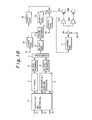
- a digital luminance signal Y and digital color difference signals U and V which are formed by three primary color signals R, G and B, are respectively supplied to input terminals 1Y, 1U and 1V.
- the three primary color signals R, G, and B may, for example, be supplied from a color video camera.
- the respective clock rates of these signals are substantially the same as the frequencies of the component signals of the above-mentioned D1 format digital VTR.
- the sampling frequencies for the luminance and color difference signals are 13.5 MHz and 6.75 MHz, respectively.
- the number of bits per sample is also 8 bits.
- the amount of data per second which is supplied to the input terminals 1 Y, 1U and 1V is also approximately 216 Mbps as earlier described.
- the signals from the input terminals 1Y, 1 U and 1 V are supplied to an effective information retrieval circuit 2 which is adapted to omit or remove data from the received signals during the blanking intervals and to retrieve information only from the effective area.
- an effective information retrieval circuit 2 which is adapted to omit or remove data from the received signals during the blanking intervals and to retrieve information only from the effective area.
- the data are compressed, such that, the data rate is reduced to approximately 167 Mbps.
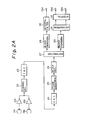
- playback data obtained from the magnetic heads 13A and 13B are supplied through rotation transformers (not shown) and playback amplifiers 21 A and 21 B, respectively, to the channel decoder 22 and an ATF circuit 34.
- the channel decoder 22 is adapted to demodulate the received channel encoded data.
- the output signal of the channel decoder 22 is supplied to the TBC circuit 23 which removes time base fluctuating components from the playback signal.
- the ATF circuit 34 generates a tracking error signal in accordance with the level of a beat component of the reproduced pilot signal.
- the tracking error signal from ATF circuit 34 may be supplied to a phase servo circuit of a capstan servo circuit (not shown).
- the ATF circuit 34 functions in substantially the same manner as that of a conventional VTR.
- the playback data from the TBC circuit 23 is supplied to ECC circuits 24, 37 and 39 which correct and modify errors by using a predetermined error correction code. More particularly, the ECC circuit 24 corrects and modifies errors in the picture data, the ECC circuit 37 corrects and modifies errors in the audio data recorded in an audio dedicated area, and the ECC circuit 39 corrects errors in the subdata.
- the output signal of the ECC circuit 37 is supplied to an audio decoding circuit 38 which decodes the compressed and encoded audio signal.
- the decoded data from the audio decoding circuit 38 are supplied to a composing circuit 36.
- the subdata from the ECC circuit 39 is supplied through an output terminal 33S of the ECC circuit 39 to a system controller (not shown) which controls the operations of the VTR
- the output signal of the ECC circuit 24 is supplied to a frame disassembling circuit 25.
- the frame disassembling circuit 25 separates each component of the block encoded picture data and exchanges between the recording system clock and the picture system clock. Each data component separated in the frame disassembling circuit 25 is supplied to a block decoding circuit 26, as previously described.
- the frame disassembling circuit 25 further separates audio data from the received signal and supplies the separated audio data to an audio decoding circuit 35.
- the audio decoding circuit 35 decodes the separated audio data so as to retrieve the original audio data which are supplied to the composing circuit 36.
- the composing circuit 36 switches between the two audio signals received from the decoding circuits 35 and 38 or combines them in a close fading arrangement and supplies the output audio signal to an output terminal 33A.
- the block encoding circuit 8 of Fig. 1A or 1B may include an ADRC (Adaptive Dynamic Range Coding) encoder similar to that disclosed in Japanese Patent Application Nos. SHO 59-266407 and SHO 59-2698666, which have a common assignee herewith.
- ADRC encoder generally detects the maximum value MAX and the minimum value MIN of data representing a plurality of picture elements contained in each block and then calculates a dynamic range DR of the block from the detected maximum and minimum values. Thereafter, the ADRC encoder encodes the data in accordance with the dynamic range such that the data are requantized so as to have a lesser number of bits than those of the original picture element data.
- the block encoding circuit 8 may include a discrete cosine transform circuit in which the picture element data of each block is subjected to discrete cosine transform (DCT) processing and the coefficient data obtained by the DCT processing are quantized. Thereafter, the quantized data are compressed by utilizing the run-length Huffman encoding process.
- DCT discrete cosine transform
- FIG. 5 An example of a block encoding circuit having an ADRC encoder, in which the picture quality is not degraded by multiple dubbing operations, will now be described with reference to Fig. 5 in which an input terminal 41 receives the output signal from the composing circuit 7 of Fig. 1A or 1B where each sample of the signal has been quantized to 8 bits.
- the block segmentation data from the input terminal 41 are supplied to a maximum value and minimum value detection circuit 43 and a delay circuit 44.
- the maximum value and minimum value detection circuit 43 detects the minimum value MIN and the maximum value MAX for each block of received data.
- the delay circuit 44 delays the received data for the time period necessary for the circuit 43 to detect the maximum and minimum values.
- the picture element data from the delay circuit 44 are supplied to comparison circuits 45 and 46.
- the maximum value MAX and the minimum value MIN from the detection circuit 43 are supplied to a subtraction circuit 47 and an addition circuit 48, respectively.
- the value of a quantized step width for the situation in which non-edge matching quantization is performed with a fixed length of 4 bits, that is A 1/16 DR, is applied from a bit shift circuit 49 to the subtraction circuit 47 and the addition circuit 48. More specifically, in the bit shift circuit 49, the dynamic range DR is shifted by 4 bits so as to deviate or shift the dynamic range by (1/16).
- the value A may be a fixed value which is equivalent to a noise level value and the quantizing step width value.
- the subtraction circuit 47 subtracts the quantized step width value A from the maximum value MAX and outputs a threshold value of (MAX - ⁇ ).
- the addition circuit 48 adds the quantized step width A value and the minimum value MIN together and outputs a threshold value of (MIN + ⁇ ).
- the threshold values from the subtraction circuit 47 and the addition circuit 48 are supplied to the comparison circuits 45 and 46, respectively.
- the output signal of the comparison circuit 45 is supplied to one input terminal of an AND gate 50.
- the output signal of the comparison circuit 46 is supplied to one input terminal of an AND gate 51.
- the delayed data from the delay circuit 44 are supplied to the other input terminals of AND gates 50 and 51.
- the output signal of the comparison circuit 45 is a relatively high value when the level of the data from the delay circuit 44 is greater than that of the threshold value.
- picture element date from the delay circuit 44 having level values in the maximum level range of (MAX to MAX - ⁇ ) are supplied from the output terminal of AND gate 50.
- the output signal of the comparison circuit 46 is a relatively high value when the level of the data from the delay circuit 44 is less than that of the threshold value.
- picture element data from the delay circuit 44 having level values in the minimum level range of (MIN to MIN + ⁇ ) are supplied from the output terminal of AND gate 51.
- ADRC with variable length encoding for a block having a relatively small dynamic range DR', the bit number n is decreased, while for a block having a relatively large dynamic range DR', the bit number n is increased.
- the encoding operation can be effectively performed.
- ADRC with variable length encoding by varying the threshold values T1 to T4, the amount of information generated or supplied can be controlled, that is, the information can be buffered. Thus, even for a transmission path as in the present digital VTR in which the amount of supplied information is set to a predetermined value, ADRC with variable length encoding can be utilized.
- a buffering circuit 60 receives the dynamic range DR' from the subtraction circuit 55 and is adapted for determining the threshold values T1 to T4 so as to set the amount of information which may be generated or supplied to a predetermined value.
- the buffering circuit 60 has a plurality of sets, for example, 32 sets, of threshold values (T1, T2, T3, T4).
- Pi parameter code
- the dynamic range DR' and the average value MIN' from the delay circuits 62 and 64, respectively, are outputted. Furthermore, the parameter code Pi which represents the code signal DT and the set of threshold values is outputted.
- the output of the parity generation circuit 10 is supplied to an adaptive type scramble circuit 71.
- an adaptive type scramble circuit 71 a plurality of M system scramble circuits are provided, with one of such circuits being selected so that the high frequency component and the DC component are smallest therein with respect to the input signal.
- the output of the scramble circuit 71 is supplied to a partial response class 4 detection type precoder 72.
- the precoder 72 calculates 1/1 - D 2 (where D is a unit delay or delay operator).
- the precoder output is supplied to the magnetic heads 13A and 13B through the record amplifiers 12A and 12B, respectively, for recording on the tape.
- the reproduced signals output from the heads 13A and 13B are amplified by the playback amplifiers 21 A and 21 B prior to being supplied to a partial response class 4 calculation process circuit 73 in the channel decoder 22 ( Fig. 7).
- the circuit 73 performs the calculation 1 + D on the reproduced output signals and, the result of such calculation, is supplied to a Viterbi decoding circuit 74 which decodes the output of the calculation process circuit 73 in accordance with the Viterbi algorithm.
- the bit error rate of the decoded data can be reduced as compared with a standard decoding circuit which decodes data with reference to the signal level. Therefore, the decoded data output by the Viterbi decoding circuit 74 has high noise resistance. More specifically, by reason of the Viterbi decoding circuit 74 in the channel decoder 22, the reproduced C/N (carrier/noise) ratio is improved by 3 dB in respect to that achieved when decoding bit-by-bit.
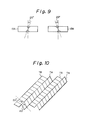
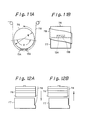
- Figs. 11A and 11B show a practical arrangement in which the magnetic heads 13A and 13B are adjacent each other, as in Fig. 8B and included in a unified structure to provide a so-called double azimuth head.
- the unified magnetic heads 13A and 13B are shown to be mounted on an upper drum 76 which is rotated at a high speed of 150 rps for the NTSC system, while a lower drum 77 is fixed. Therefore, the unified heads 13A and 13B effect 2 1/2 revolutions with the upper drum 76 for each NTSC field so that each field is recorded in five tracks. In other words, each field is divided into five segments recorded in respective tracks on the magnetic tape.
- any eccentricity of the rotary upper drum 76 similarly influences the linearity of the tracks scanned by both heads so that the linearity error is relatively reduced.
- the distance between the heads 13A and 13B is relatively small when the heads are unified, as in the so-called double azimuth head, so that the paired heads can be more accurately adjusted then when the heads are diametrically opposed.
- the tape used in the magnetic recording apparatus embodying this invention is desirably produced as described below so as to contribute to the attainment of the desired high recording density:
- a guide roller 86 is situated in an opening in the partition 82 approximately at the same level as the rolls 84 and 85, and cylindrical cooling cans 87a and 87b are rotatably mounted within the chambers 81 a and 81 b, respectively, at levels substantially below that of the guide roller 86 so that the base material B being unwound from the supply roll 84 is led downwardly therefrom under the cooling can 87a, then over the guide roller 86 and under the cooling can 87b prior to being rewound on the take-up roll 85.
- Evaporation sources of cobalt 88a and 88b which, for example, may be ingots of 100% cobalt, are provided in the chambers 81 a and 81 b, respectively, and are heated by electron beams indicated schematically at 89a and 89b.
- Insulating shields 90a and 90b extend below the cooling cans 87a and 87b, respectively, for restricting the incident angles at which cobalt evaporated from the sources 88a and 88b can impinge on the base material B running under the cooling cans 87a and 87b.
- the chambers 81 a and 81 b are provided with oxygen gas supply pipes 91 a and 91 b for directing flows of oxygen against the surface of the base material B at areas thereof where evaporated cobalt is being deposited on the base material.
- the magnetic head of Fig. 14 provides the Fe-Ga-Si-Ru soft magnetic layers 102 and 103 having a saturation magnetic flux density Bs of 14.5 kG in the vicinity of the gap 104, it is possible for the magnetic head to record data on a magnetic tape of high coercive force without causing magnetic saturation of the head.
- the described ME tape and magnetic head make it possible to record a signal with the shortest wavelength of 0.5 ⁇ m on a track having a width of sum so that the bit area of 1.25u.m 2 /bit can be achieved while minimizing the deterioration of the C/N ratio of the reproduced output that otherwise results as the recording wavelength and track width are reduced.
- the applicant produced an experimental consumer digital VTR which incorporated an ADRC bit reduction scheme, scrambled NRZ coding, a class IV partial response (PR4) detection scheme, and a modified 8mm video transport mechanism used with ME tape.
- an ADRC bit reduction scheme scrambled NRZ coding
- a class IV partial response (PR4) detection scheme PR4 detection scheme
- a modified 8mm video transport mechanism used with ME tape With a rotary drum having a diameter of 40mm and a rotation speed of 60 rps, and using a track pitch of 15 ⁇ m at the wavelength of 0.5 ⁇ m, a raw bit error rate of 4 x 10- 5 and a C/N of 51 dB (with a resolution bandwidth of 30 KHz) at the half-Nyquist frequency were obtained.
- the space between the tape and the magnetic head recording or reproducing a signal on the tape causes the signal output level to decrease.
- the space between the tape and the magnetic head depends on the flatness of the tape.
- the flatness of the tape depends on the coating material that is used, whereas, in the case of a vacuum deposited tape, such as, an ME tape, the flatness of the tape surface depends on the smoothness of the base material on which the metal is vacuum deposited. It has been determined that, when the surface of the base film is made as flat as possible, for example, as described above the C/N is increased by 1 dB.
- the C/N ratio is further improved by 3 dB, as compared with the tape used in the experimental consumer digital VTR produced in 1988.
- a Viterbi channel decoding scheme as described above, there is realized a further increase of 3 dB in the C/N ratio over the bit-by-bit decoding scheme employed in the experimental apparatus.
- the described embodiment of this invention makes it possible to achieve a raw bit error rate of 4 x 10- 5 , that is, a raw bit error rate equivalent to that achieved by the experimental apparatus of 1988 with a track pitch of 15 ⁇ m.
- the raw bit error rate that is, the bit error rate prior to correction, needs to be 10- 4 or less in order to ensure that the errors will be contained within a correctable amount when error correction codes with a redundancy of about 20% are employed.
- a digital picture signal can be recorded on a magnetic tape with a relatively high density by using tracks having a relatively small pitch in accordance with the described embodiment of the present invention.
- such embodiment of the present invention enables a relatively long recording or reproducing operation to be performed on a magnetic tape that can be contained in a relatively small size cassette.
- the size of the cassette housing and of the tape loading mechanism can be further reduced for minimizing the size of the VTR.
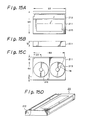
- a transparent window 215 is provided on the top wall of the tape cassette 211 to enable a visual inspection of the inside of the tape cassette.
- the dimensions of the tape cassette 211 are slightly smaller than those of the cassette intended for use in the conventional 8 mm analog VTR. As shown in Figs. 15A and B, the dimensions of the tape cassette 211 may be 93 mm (width) x 64 mm (depth) x 12 mm (thickness).
- Fig. 15C illustrates the tape cassette 211 with its top wall removed to show hubs 213 and 214 which are rotatably disposed within the tape cassette housing. The magnetic tape 78 is wound around hubs 213 and 214, and is suitably guided therebetween.
- a pivoted cover or lid 212 is mounted at the front of the tape cassette 211.
- the lid 212 is pivotally opened by a conventional member provided therefor within the VTR, so as to allow access to the magnetic tape 78 contained in the cassette housing.
- the tape cassette 211 having the indicated dimensions is, nevertheless, adapted to contain an amount of the magnetic tape 78 sufficient to enable 4 hours of recording operations.
- the length of tape needed to obtain a tape recording area of 5.681/ x 105 mm 2 is:
- the volume occupied by a tape having a length of 113.6 m, width of 6 mm and a thickness of 7 /1 .m is:
- the maximum allowable winding radius of the tape 78 in the tape cassette 211 is 22 mm, as shown in Fig. 15C, the above-described amount of tape can be well contained on reel hubs 213 and 214 in the tape cassette 111. Thus, a recording operation of 4 hours can be performed.
- FIG. 16 shows a drum chassis 111 and a cassette support chassis 114.
- the drum chassis 114 has a drum 76, a tension regulator 112 and a capstan 113 mounted thereon.
- the cassette support chassis 114 operatively positions a cassette 115 which contains, reels 116 and 117 and roller guides 118, 119, 122 and 123 for the tape 78 running between the reels.
- the frictional drag of the moving magnetic tape on the drum 76 is less than that of arrangements utilizing a larger winding angle. This reduction in frictional drag is particularly advantageous when the VTR is operated in a fast forward state or a rewind state.
- the winding angle is 180 or more, cross talk between signals may occur when two channels of data are recorded or reproduced using a double azimuth head.
- using a winding angle of less than 180° eliminates cross talk between signals.
- the complexity of the loading mechanism can be minimized.
- both the amount of decrease of cross talk and the amount of decrease of the playback signal are suitable for a digital VTR.
Landscapes
- Engineering & Computer Science (AREA)
- Signal Processing (AREA)
- Multimedia (AREA)
- Television Signal Processing For Recording (AREA)
- Signal Processing For Digital Recording And Reproducing (AREA)
- Optical Recording Or Reproduction (AREA)
Applications Claiming Priority (6)
| Application Number | Priority Date | Filing Date | Title |
|---|---|---|---|
| JP294671/90 | 1990-10-31 | ||
| JP29467190 | 1990-10-31 | ||
| JP2294671A JPH04168603A (ja) | 1990-10-31 | 1990-10-31 | ディジタル画像信号の磁気記録装置 |
| JP306703/90 | 1990-11-13 | ||
| JP30670390A JPH04178904A (ja) | 1990-11-13 | 1990-11-13 | ディジタル画像信号の磁気記録装置 |
| JP30670390 | 1990-11-13 |
Publications (3)
| Publication Number | Publication Date |
|---|---|
| EP0483874A2 true EP0483874A2 (de) | 1992-05-06 |
| EP0483874A3 EP0483874A3 (en) | 1993-05-12 |
| EP0483874B1 EP0483874B1 (de) | 2000-03-01 |
Family
ID=26559938
Family Applications (1)
| Application Number | Title | Priority Date | Filing Date |
|---|---|---|---|
| EP91118663A Expired - Lifetime EP0483874B1 (de) | 1990-10-31 | 1991-10-31 | Einrichtung zur Aufzeichnung von digitalen Bilddaten |
Country Status (4)
| Country | Link |
|---|---|
| EP (1) | EP0483874B1 (de) |
| AT (1) | ATE190182T1 (de) |
| DE (1) | DE69132001T2 (de) |
| ES (1) | ES2142795T3 (de) |
Cited By (2)
| Publication number | Priority date | Publication date | Assignee | Title |
|---|---|---|---|---|
| US5412513A (en) * | 1993-04-19 | 1995-05-02 | Sony Corporation | Recording/reproducing apparatus |
| EP1335598A1 (de) * | 1992-05-22 | 2003-08-13 | Sony Corporation | Vorrichtung zur Umsetzung von digitalen Daten |
Family Cites Families (1)
| Publication number | Priority date | Publication date | Assignee | Title |
|---|---|---|---|---|
| JP2557037B2 (ja) * | 1983-03-30 | 1996-11-27 | ソニー株式会社 | 磁気記録装置 |
-
1991
- 1991-10-31 AT AT91118663T patent/ATE190182T1/de not_active IP Right Cessation
- 1991-10-31 EP EP91118663A patent/EP0483874B1/de not_active Expired - Lifetime
- 1991-10-31 DE DE69132001T patent/DE69132001T2/de not_active Expired - Fee Related
- 1991-10-31 ES ES91118663T patent/ES2142795T3/es not_active Expired - Lifetime
Cited By (2)
| Publication number | Priority date | Publication date | Assignee | Title |
|---|---|---|---|---|
| EP1335598A1 (de) * | 1992-05-22 | 2003-08-13 | Sony Corporation | Vorrichtung zur Umsetzung von digitalen Daten |
| US5412513A (en) * | 1993-04-19 | 1995-05-02 | Sony Corporation | Recording/reproducing apparatus |
Also Published As
| Publication number | Publication date |
|---|---|
| DE69132001D1 (de) | 2000-04-06 |
| ES2142795T3 (es) | 2000-05-01 |
| EP0483874B1 (de) | 2000-03-01 |
| DE69132001T2 (de) | 2000-07-06 |
| ATE190182T1 (de) | 2000-03-15 |
| EP0483874A3 (en) | 1993-05-12 |
Similar Documents
| Publication | Publication Date | Title |
|---|---|---|
| US5416651A (en) | Apparatus for magnetically recording digital data | |
| US5253122A (en) | Recording of digital video signals on a magnetic medium having a particular energy product and surface roughness | |
| US5359428A (en) | Digital video recorder operable in standard and long play modes | |
| US5247397A (en) | Method for magnetically recording digital video signals with specified ranges of the easy axis and the bias magnetic field | |
| US7212728B2 (en) | Disk media, and method of and device for recording and playing back information on or from a disk media | |
| EP0483873B1 (de) | Vorrichtung zur magnetischen Aufzeichnung von digitalen Daten | |
| US5512349A (en) | Method and apparatus for magnetic recording digital video signals and magnetic recording medium therefor | |
| EP0539922B1 (de) | Digitaler Videobandrecorder | |
| EP0563780B1 (de) | Methode zur magnetischen Aufzeichnung und Wiedergabe | |
| US5384666A (en) | Digital picture signal recording apparatus in which a field interval is recorded in a plurality of tracks exhibiting a track pitch no greater than 5.5 μm by a rotary drum having a diameter no greater than 25 mm and a rotary speed no less than 150 rps | |
| EP0483874B1 (de) | Einrichtung zur Aufzeichnung von digitalen Bilddaten | |
| US6631242B1 (en) | Apparatus for recording and reproducing digital picture data | |
| CA2073194C (en) | Magnetic recording apparatus of digital picture signal | |
| US5906880A (en) | Magnetic recording medium | |
| CA2054360C (en) | Apparatus for recording and reproducing digital picture data | |
| JP3104364B2 (ja) | ディジタル画像信号の磁気記録方法 | |
| JP3203005B2 (ja) | ディジタル画像信号の磁気記録方法 | |
| EP0576954B1 (de) | Verfahren zur magnetischen Datenaufzeichnung auf magnetisches Aufzeichnungsmedium. | |
| JPH04281269A (ja) | ディジタルデータの磁気記録装置 | |
| JPH0652545A (ja) | 磁気転写方法及びディジタル画像信号の磁気記録方法 | |
| JPH04291062A (ja) | ディジタルデータの磁気記録装置 | |
| JPH04168604A (ja) | ディジタルデータの磁気記録装置 | |
| JPH04168605A (ja) | ディジタル画像信号の磁気記録再生装置 | |
| JPH04291020A (ja) | ディジタル画像信号の磁気記録方法 | |
| JPH04178904A (ja) | ディジタル画像信号の磁気記録装置 |
Legal Events
| Date | Code | Title | Description |
|---|---|---|---|
| PUAI | Public reference made under article 153(3) epc to a published international application that has entered the european phase |
Free format text: ORIGINAL CODE: 0009012 |
|
| AK | Designated contracting states |
Kind code of ref document: A2 Designated state(s): AT DE ES FR GB IT NL |
|
| PUAL | Search report despatched |
Free format text: ORIGINAL CODE: 0009013 |
|
| AK | Designated contracting states |
Kind code of ref document: A3 Designated state(s): AT DE ES FR GB IT NL |
|
| 17P | Request for examination filed |
Effective date: 19931012 |
|
| 17Q | First examination report despatched |
Effective date: 19951113 |
|
| GRAG | Despatch of communication of intention to grant |
Free format text: ORIGINAL CODE: EPIDOS AGRA |
|
| GRAG | Despatch of communication of intention to grant |
Free format text: ORIGINAL CODE: EPIDOS AGRA |
|
| GRAG | Despatch of communication of intention to grant |
Free format text: ORIGINAL CODE: EPIDOS AGRA |
|
| GRAH | Despatch of communication of intention to grant a patent |
Free format text: ORIGINAL CODE: EPIDOS IGRA |
|
| GRAH | Despatch of communication of intention to grant a patent |
Free format text: ORIGINAL CODE: EPIDOS IGRA |
|
| GRAA | (expected) grant |
Free format text: ORIGINAL CODE: 0009210 |
|
| STAA | Information on the status of an ep patent application or granted ep patent |
Free format text: STATUS: THE PATENT HAS BEEN GRANTED |
|
| AK | Designated contracting states |
Kind code of ref document: B1 Designated state(s): AT DE ES FR GB IT NL |
|
| REF | Corresponds to: |
Ref document number: 190182 Country of ref document: AT Date of ref document: 20000315 Kind code of ref document: T |
|
| REF | Corresponds to: |
Ref document number: 69132001 Country of ref document: DE Date of ref document: 20000406 |
|
| REG | Reference to a national code |
Ref country code: ES Ref legal event code: FG2A Ref document number: 2142795 Country of ref document: ES Kind code of ref document: T3 |
|
| ITF | It: translation for a ep patent filed | ||
| ET | Fr: translation filed | ||
| REG | Reference to a national code |
Ref country code: GB Ref legal event code: IF02 |
|
| PGFP | Annual fee paid to national office [announced via postgrant information from national office to epo] |
Ref country code: NL Payment date: 20081005 Year of fee payment: 18 |
|
| PGFP | Annual fee paid to national office [announced via postgrant information from national office to epo] |
Ref country code: DE Payment date: 20081027 Year of fee payment: 18 |
|
| PGFP | Annual fee paid to national office [announced via postgrant information from national office to epo] |
Ref country code: AT Payment date: 20081013 Year of fee payment: 18 Ref country code: ES Payment date: 20081121 Year of fee payment: 18 |
|
| PGFP | Annual fee paid to national office [announced via postgrant information from national office to epo] |
Ref country code: IT Payment date: 20081028 Year of fee payment: 18 |
|
| PGFP | Annual fee paid to national office [announced via postgrant information from national office to epo] |
Ref country code: FR Payment date: 20081014 Year of fee payment: 18 |
|
| PGFP | Annual fee paid to national office [announced via postgrant information from national office to epo] |
Ref country code: GB Payment date: 20081029 Year of fee payment: 18 |
|
| REG | Reference to a national code |
Ref country code: NL Ref legal event code: V1 Effective date: 20100501 |
|
| REG | Reference to a national code |
Ref country code: FR Ref legal event code: ST Effective date: 20100630 |
|
| PG25 | Lapsed in a contracting state [announced via postgrant information from national office to epo] |
Ref country code: DE Free format text: LAPSE BECAUSE OF NON-PAYMENT OF DUE FEES Effective date: 20100501 Ref country code: NL Free format text: LAPSE BECAUSE OF NON-PAYMENT OF DUE FEES Effective date: 20100501 Ref country code: FR Free format text: LAPSE BECAUSE OF NON-PAYMENT OF DUE FEES Effective date: 20091102 |
|
| PG25 | Lapsed in a contracting state [announced via postgrant information from national office to epo] |
Ref country code: AT Free format text: LAPSE BECAUSE OF NON-PAYMENT OF DUE FEES Effective date: 20091031 |
|
| PG25 | Lapsed in a contracting state [announced via postgrant information from national office to epo] |
Ref country code: GB Free format text: LAPSE BECAUSE OF NON-PAYMENT OF DUE FEES Effective date: 20091031 |
|
| REG | Reference to a national code |
Ref country code: ES Ref legal event code: FD2A Effective date: 20110302 |
|
| PG25 | Lapsed in a contracting state [announced via postgrant information from national office to epo] |
Ref country code: IT Free format text: LAPSE BECAUSE OF NON-PAYMENT OF DUE FEES Effective date: 20091031 |
|
| PG25 | Lapsed in a contracting state [announced via postgrant information from national office to epo] |
Ref country code: ES Free format text: LAPSE BECAUSE OF NON-PAYMENT OF DUE FEES Effective date: 20110301 |
|
| PG25 | Lapsed in a contracting state [announced via postgrant information from national office to epo] |
Ref country code: ES Free format text: LAPSE BECAUSE OF NON-PAYMENT OF DUE FEES Effective date: 20091101 |
|
| RAP4 | Party data changed (patent owner data changed or rights of a patent transferred) |
Owner name: SONY GROUP CORPORATION |