EP0484078B1 - Method of finishing edges of fabric and knitted fabric provided with decorative finish - Google Patents
Method of finishing edges of fabric and knitted fabric provided with decorative finish Download PDFInfo
- Publication number
- EP0484078B1 EP0484078B1 EP91309932A EP91309932A EP0484078B1 EP 0484078 B1 EP0484078 B1 EP 0484078B1 EP 91309932 A EP91309932 A EP 91309932A EP 91309932 A EP91309932 A EP 91309932A EP 0484078 B1 EP0484078 B1 EP 0484078B1
- Authority
- EP
- European Patent Office
- Prior art keywords
- loops
- strand
- knitted fabric
- edge
- knitting
- Prior art date
- Legal status (The legal status is an assumption and is not a legal conclusion. Google has not performed a legal analysis and makes no representation as to the accuracy of the status listed.)
- Expired - Lifetime
Links
- 239000004744 fabric Substances 0.000 title claims description 36
- 238000000034 method Methods 0.000 title claims description 26
- 238000009940 knitting Methods 0.000 claims description 82
- 238000005304 joining Methods 0.000 claims description 6
- 238000005266 casting Methods 0.000 claims description 4
- 238000006073 displacement reaction Methods 0.000 claims description 3
- 206010042618 Surgical procedure repeated Diseases 0.000 claims 1
- 239000011295 pitch Substances 0.000 description 19
- 238000009958 sewing Methods 0.000 description 3
- 230000008878 coupling Effects 0.000 description 2
- 238000010168 coupling process Methods 0.000 description 2
- 238000005859 coupling reaction Methods 0.000 description 2
- 230000003247 decreasing effect Effects 0.000 description 1
- 230000001747 exhibiting effect Effects 0.000 description 1
- 238000004519 manufacturing process Methods 0.000 description 1
- 238000009941 weaving Methods 0.000 description 1
Images








Classifications
-
- D—TEXTILES; PAPER
- D04—BRAIDING; LACE-MAKING; KNITTING; TRIMMINGS; NON-WOVEN FABRICS
- D04B—KNITTING
- D04B1/00—Weft knitting processes for the production of fabrics or articles not dependent on the use of particular machines; Fabrics or articles defined by such processes
- D04B1/22—Weft knitting processes for the production of fabrics or articles not dependent on the use of particular machines; Fabrics or articles defined by such processes specially adapted for knitting goods of particular configuration
Definitions
- the present invention relates to a method of finishing the edges of a knitted fabric, e.g. a neck or cuff portion of a pullover with a decorative pattern and also, a knitted fabric provided at edge with a decorative finish.
- edges of a neck or cuff portion of a pullover are bound off along their edge loops.
- a separately knitted piece of the decorative pattern is sewed with a sewing machine or added using e.g a linking technique to the bound off region of the pullover.
- joining of a decorative pattern to the edges of a knitted fabric by such a linking technique involves stitch-by-stitch weaving of a strand form of stitches, e.g. a series of consecutive arch patterns along the seam. This action requires a considerable length of time and a specific skill, thus decreasing the productivity.
- dropping of a stitch is unavoidable in such stitch-by-stitch joining of loops between the strand of the decorative pattern and the edge of the bound off portion.
- the present invention is intended to overcome the foregoing drawbacks and its object is to provide a method of finishing the edges of a knitted fabric by knitting a series of arch strands in succession to the edge of the knitted fabric and also, a knitted fabric provided at edge with a series of arch strands of a decorative pattern.
- a method of finishing the edges of a knitted fabric according to the present invention comprises the steps of
- the front end loops of the strand during transferring back from the opposite needle bed are placed over given edge loops of the knitted fabric after they have been displaced by more than a width of the stitches of the strand from the start position and then, another strand of stitches is started from a position intermediate of the displacement, as followed by repeating a procedure from casting on of a strand to displacing the front end loops of the strand from its start position to another position and placing them over given edge loops of the knitted fabric.
- the present invention is directed towards a knitted fabric with a decorative finish on at least one edge, characterised by a series of strands of stitches in arch form being formed along the edge of the knitted fabric and knitted in succession to the edge of the knitted fabric.
- the procedure starts with knitting a front and/or a back piece of a pullover using a flat knitting machine which has at least two, front and rear, needle beds, either one or both being arranged for lengthwise movement.
- edge loops of the piece all are transferred from one needle bed to the other.
- a strand of stitches is knitted to a predetermined length from a given number of the loops at one end of the other needle bed.
- the front end loops of the strand are placed over given edge loops of the knitted fabric for coupling. As the result, an arch form of stitches is produced at one end of the edge of the knitted fabric.
- the front end loops of the strand are displaced by more than a width of the stitches of the strand from the start position prior to being transferred back from the opposite needle bed.
- another strand of stitches is started from a position intermediate of the displacement. This action is repeated so that a series of partially overlapped arch strands are neatly formed along the edge of the knitted fabric exhibiting a considerable degree of richness.
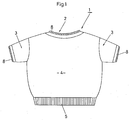
- FIG.l is a front view of a pullover knitted by the method of the present invention
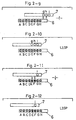
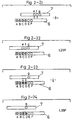
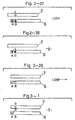
- Figs.2-1 to 2-39 are explanatory views showing a procedure of knitting a decorative pattern of strand shape
- Figs.3-1 to 3-5 are explanatory views showing a procedure of binding off edge loops of the decorative pattern
- Figs.4-A, 4-B, 4-C, and 4-D are front views of different decorative patterns.
- a method of finishing the edges of a knitted fabric with decorative stitches according to the present invention is employed for knitting the edges of a neck portion 2 or cuff portion 3 of a pullover 1, as shown in Fig.1.
- a method is executed using a flat knitting machine which has two, front and rear, movable needle beds provided in the inverted-V shape arrangement when viewed from side, each bed carrying a multiplicity of knitting needles mounted on the top thereof for forward and backward movement.
- a front body piece (knitted fabric) 4 of the pullover 1 shown in Fig.1 starts with its waist region 5 and finishes with the neck portion 2.
- Figs.2-1 to 2-39 illustrate a series of primary courses for knitting a decorative pattern of the neck portion 2, in which the alphabetic capital letters A, B, C, D,... represent knitting needles of the front needle bed 6, the alphabetic small case letters a, b, c, d,... are knitting needles of the rear needle bed 7, the two rightward letters L and R denote the moving directions of the needle beds, and the numeral associated with the letters P and L or R denotes the distance of movement.
- the procedure starts with knitting the front body piece 4 up to the neck portion 2 using the knitting needles A, B, C, D,...of the front needle bed 6 and the knitting needles a, b, c, d,...of the rear needle bed 7.
- the loops on the rear knitting needles a to j are transferred and placed over the loops on the front knitting needles A to J as shown in Fig.2-2.
- the rear needle bed 7 is moved 0.5 pitch rightward from the position shown in Fig.2-2, thus displacing the knitting needles a to j by 0.5 pitch to the right.
- a thread of yarn is fed onto the two rightend knitting needles I and J of the front needle bed 6 and the knitting needle i of the rear needle bed 7 for forming a loop on each of the needles I, J, and i.
- a loop of yarn is formed on the rear knitting needle i and at the course shown in Fig.2-5, loops are formed on the two front knitting needles I and J.
- the rear needle bed 7 is moved 1.5 pitches (by racking) to the right as shown in Fig.2-8 and the loops on the front knitting needles I and J are transferred onto the rear knitting needles g and h respectively.
- the rear needle bed 7 is moved 4 pitches leftward from the position shown in Fig.2-9 or to a position 2.5 pitches leftward distant from the reference position. Then, the loops on the rear knitting needles g and h are transferred onto the front knitting needles E and F as shown in Fig.2-11. As the result, each of the needles E and F now carries three loops of yarn.
- the rear needle bed 7 is further moved by racking one pitch leftward from the position shown in Fig.2-11 (to a position 3.5 pitches leftward distant from the reference position). Then, the loop on the rear knitting needle i is transferred onto the front knitting needle F which thus carries four loops, as shown in Fig.2-13.
- a series of loops are now formed along the front knitting needles E, F, G, and H and simultaneously, the strand 8 developed on the three knitting needles I, J, and i is coupled at one end to the two front knitting needles E and F, thus forming an arch pattern of the stitches.
- the rear needle bed 7 is then moved 0.5 pitch back rightward to the reference position from the position shown in Fig.2-14 and the yarn is fed once again onto the two front knitting needles G and H and the rear knitting needle g for forming a loop on each needle, as shown in Fig.2-15.
- the four leftend knitting needles A, B, C, and D of the front needle bed 6 finally carry a series of loops as shown in Fig.2-27.
- the rear needle bed 7 is then moved 0.5 pitch rightward to return its knitting needles a to j back to the reference position from the position shown in Fig.2-27 and the yarn is fed onto the two front knitting needles C and D and the rear knitting needle c for forming a loop on each needle, as shown in Fig.2-28.
- the rear needle bed 7 is moved one pitch rightward from the position shown in Fig.2-32 or to a position 1.5 pitches rightward distant from the reference position, as shown in Fig.2-33. Then, the two loops on the front knitting needles C and D are transferred onto the rear knitting needles a and b respectively at the course shown in Fig.2-34.
- the rear needle bed 7 is now moved by racking 1.5 pitches leftward from the position shown in Figs.2-34 or to a position 0.5 pitch leftward distant from the reference position as shown in Fig.2-35 and at the course shown in Fig.2-36, the two loops on the rear knitting needles a and b are transferred back onto the front knitting needles A and B respectively.
- the rear needle bed 7 is further moved one pitch leftward from the position shown in Fig.2-36 or to a position 1.5 pitch distant from the reference position. Then, the loop on the rear knitting needle c is transferred onto the front knitting needle B, as shown in Fig.2-38. Accordingly, the front knitting needle A carries two loops while the knitting needle B holds three loops. At the course shown in Fig.2-39, a loop is formed between the two knitting needles A and B. As the result, the number of loops on the four front knitting needles A, B, C, and D shown in Figs.2-27 is reduced to a half and a series of arch patterns of the stitches is now produced along the edge of the neck portion 2 of the pullover 1.
- the loop on the front knitting needle B is first transferred onto the rear knitting needle b as shown in Fig.3-1. Then, the rear needle bed 7 is moved by racking one pitch leftward or to a position 1.5 pitches leftward distant from the reference position at the course shown in Fig.3-2. The loop on the rear knitting needle b is placed over the loop on the front knitting needle A as shown in Fig.3-3.
- the rear needle bed 7 is now moved 1.5 pitches rightward from the position shown in Fig.3-3 or to a position 0.5 pitch distant from the reference position as shown in Figs.3-4 and 3-5. This action is repeated a given number of times for knitting the loops on the knitting needle A into a last strand of the stitches 8 and fastening the end of a series of the strands 8.
- the distal end loops of a strand 8 of stitches are hooked on particular knitting needles of the front needle bed 6 which are located far leftward from the proximal end of the strand 8 during the procedures from Figs.2-10 to 2-13 and Figs.2-22 to 2-25. Then, another strand 8 is started from the succeeding knitting needles of the needle bed 6.
- the edge region 10 beneath each arch is bound off by an appropriate manner.
- the distal end loops of a strand 8 of stitches are hooked on particular knitting needles of the front needle bed 6 which are located far leftward from the proximal end of the strand 8 during the procedures from Figs.2-10 to 2-13 and Figs.2-22 to 2-25.
- the succeeding strand 8 of arch form is started from a position intermediate between the distal and proximal ends of the first strand 8.
- the edge region 10 beneath each arch is also bound off by the same manner as of Fig.4-B.
- two strands of stitches are started from one end of a knitted fabric to be decorated so that the distal end of one strand is coupled to the proximal end of the other.
- a series of arch patterns are formed by repeating the action of knitting the two strands simultaneously.
- Fig.4-D exhibits the two strands arranged as a unit, three or more strands will be simultaneously knitted with equal success.
- front needle bed in place of or in addition to the rear needle bed which is movable in the foregoing embodiment, can be arranged for movement.
Landscapes
- Engineering & Computer Science (AREA)
- Textile Engineering (AREA)
- Knitting Machines (AREA)
- Knitting Of Fabric (AREA)
Applications Claiming Priority (2)
| Application Number | Priority Date | Filing Date | Title |
|---|---|---|---|
| JP2296756A JP2530254B2 (ja) | 1990-10-31 | 1990-10-31 | 編地の端部処理方法及び端部に意匠的処理を施してなる編地 |
| JP296756/90 | 1990-10-31 |
Publications (2)
| Publication Number | Publication Date |
|---|---|
| EP0484078A1 EP0484078A1 (en) | 1992-05-06 |
| EP0484078B1 true EP0484078B1 (en) | 1996-05-22 |
Family
ID=17837712
Family Applications (1)
| Application Number | Title | Priority Date | Filing Date |
|---|---|---|---|
| EP91309932A Expired - Lifetime EP0484078B1 (en) | 1990-10-31 | 1991-10-28 | Method of finishing edges of fabric and knitted fabric provided with decorative finish |
Country Status (5)
| Country | Link |
|---|---|
| US (1) | US5379613A (es) |
| EP (1) | EP0484078B1 (es) |
| JP (1) | JP2530254B2 (es) |
| DE (1) | DE69119697T2 (es) |
| ES (1) | ES2087254T3 (es) |
Cited By (1)
| Publication number | Priority date | Publication date | Assignee | Title |
|---|---|---|---|---|
| CN102828329A (zh) * | 2012-09-25 | 2012-12-19 | 宁波慈星股份有限公司 | 一种横编机的收边编织方法 |
Families Citing this family (3)
| Publication number | Priority date | Publication date | Assignee | Title |
|---|---|---|---|---|
| JP3126315B2 (ja) * | 1996-10-29 | 2001-01-22 | 株式会社島精機製作所 | 2×1ゴム編み組織を有する筒状編地の編成方法 |
| US6912876B2 (en) * | 2003-11-21 | 2005-07-05 | Sara Lee Corporation | Shaped blank |
| US9400008B2 (en) | 2012-10-12 | 2016-07-26 | John L. Tuttle | Easily unraveled textile article |
Family Cites Families (9)
| Publication number | Priority date | Publication date | Assignee | Title |
|---|---|---|---|---|
| US463561A (en) * | 1891-11-17 | Island | ||
| US2283585A (en) * | 1939-12-06 | 1942-05-19 | Hemphill Co | Knitted fabric and method |
| GB597891A (en) * | 1944-02-10 | 1948-02-05 | Scott & Williams Inc | Knitted fabrics with elastic selvage and the method of making same |
| US2854832A (en) * | 1955-01-17 | 1958-10-07 | Joseph L Morris | Method of forming an edge and knitting swiss ribs on knitted fabrics without racking |
| US2847838A (en) * | 1955-06-09 | 1958-08-19 | May Hosiery Mills | Knitted fabric and method of transfer knitting |
| US3224231A (en) * | 1961-09-28 | 1965-12-21 | Swiss Knitting Company Inc | Knit garment and fabric therefor |
| GB1000392A (en) * | 1961-10-09 | 1965-08-04 | Sdruzeni Podniku Textilniho St | Improvements in or relating to hosiery |
| DE3203028C2 (de) * | 1982-01-29 | 1984-08-09 | H. Stoll Gmbh & Co, 7410 Reutlingen | Verfahren zur Herstellung einer Maschenware |
| DE3304326A1 (de) * | 1983-02-09 | 1984-08-09 | VEB Plauener Spitze, DDR 9900 Plauen | Verfahren zur herstellung von kettengewirkter schmalspitze |
-
1990
- 1990-10-31 JP JP2296756A patent/JP2530254B2/ja not_active Expired - Fee Related
-
1991
- 1991-10-28 ES ES91309932T patent/ES2087254T3/es not_active Expired - Lifetime
- 1991-10-28 DE DE69119697T patent/DE69119697T2/de not_active Expired - Fee Related
- 1991-10-28 EP EP91309932A patent/EP0484078B1/en not_active Expired - Lifetime
-
1993
- 1993-07-14 US US08/091,740 patent/US5379613A/en not_active Expired - Fee Related
Cited By (1)
| Publication number | Priority date | Publication date | Assignee | Title |
|---|---|---|---|---|
| CN102828329A (zh) * | 2012-09-25 | 2012-12-19 | 宁波慈星股份有限公司 | 一种横编机的收边编织方法 |
Also Published As
| Publication number | Publication date |
|---|---|
| EP0484078A1 (en) | 1992-05-06 |
| ES2087254T3 (es) | 1996-07-16 |
| US5379613A (en) | 1995-01-10 |
| JP2530254B2 (ja) | 1996-09-04 |
| JPH04174746A (ja) | 1992-06-22 |
| DE69119697T2 (de) | 1996-10-02 |
| DE69119697D1 (de) | 1996-06-27 |
Similar Documents
| Publication | Publication Date | Title |
|---|---|---|
| US5417088A (en) | Knit fabric for a neck portion of a knit product and knitting method thereof | |
| EP0504412B1 (en) | Method of knitting tubular knit fabrics and knitted fabrics thereby | |
| JPH062248A (ja) | リブ編みを有するポケット付き編地及びその編成方法 | |
| JPH04153346A (ja) | 筒状編地の切込部分の編成方法 | |
| KR100706647B1 (ko) | 코 빼기 처리방법 및 코 빼기 처리된 편성포, 및 코 빼기처리를 위한 캐드장치 | |
| EP0455395B1 (en) | Method of knitting in pleats and knitted texture having knitted pleats | |
| CN100554551C (zh) | 针织物的编织方法 | |
| JPH0772384B2 (ja) | 編地の接合方法及び美しい接合部をもつ編地 | |
| EP0416800B1 (en) | Knitting method for thick fabric of reduced elasticity | |
| EP0569159B1 (en) | A method of forming piping at the end of a knitted fabric and a knitted fabric having piping formed at its fabric end | |
| JPH04263654A (ja) | 袖を持つ衣服用成形編地の製造方法 | |
| US5257514A (en) | Connective knitting method of tape-shaped knit end and tape-shaped knit fabric having an end part linked in a knit state | |
| EP0484078B1 (en) | Method of finishing edges of fabric and knitted fabric provided with decorative finish | |
| JP2573101B2 (ja) | ニット製品におけるボタンホールの編成方法 | |
| EP1471175B1 (en) | Neck forming method | |
| EP0867547B1 (en) | A method of knitting tubular fabrics | |
| JPWO2001004398A1 (ja) | 伸縮性に優れた伏目処理方法 | |
| US5259207A (en) | Knitted product | |
| EP0466439B1 (en) | Cast on method for knitting and knitted fabric formed by the same | |
| EP0449544B1 (en) | Connective knitting method of belt-shaped knit end and belt-knit fabric having the end part linked in knit state | |
| EP0420482B1 (en) | Knit fabric and knitting method thereof | |
| JPH06158482A (ja) | 附属編地およびその編成方法 | |
| US4107955A (en) | Method of knitting blank for a sleeved garment and product thereof | |
| CN100410435C (zh) | 针织匹头的收边方法 | |
| JPH1060756A (ja) | 編成柄を有する筒状編地及びその編成方法 |
Legal Events
| Date | Code | Title | Description |
|---|---|---|---|
| PUAI | Public reference made under article 153(3) epc to a published international application that has entered the european phase |
Free format text: ORIGINAL CODE: 0009012 |
|
| AK | Designated contracting states |
Kind code of ref document: A1 Designated state(s): DE ES FR GB IT |
|
| 17P | Request for examination filed |
Effective date: 19920519 |
|
| 17Q | First examination report despatched |
Effective date: 19941011 |
|
| ITF | It: translation for a ep patent filed | ||
| GRAA | (expected) grant |
Free format text: ORIGINAL CODE: 0009210 |
|
| AK | Designated contracting states |
Kind code of ref document: B1 Designated state(s): DE ES FR GB IT |
|
| REG | Reference to a national code |
Ref country code: ES Ref legal event code: BA2A Ref document number: 2087254 Country of ref document: ES Kind code of ref document: T3 |
|
| REF | Corresponds to: |
Ref document number: 69119697 Country of ref document: DE Date of ref document: 19960627 |
|
| REG | Reference to a national code |
Ref country code: ES Ref legal event code: FG2A Ref document number: 2087254 Country of ref document: ES Kind code of ref document: T3 |
|
| ET | Fr: translation filed | ||
| PLBE | No opposition filed within time limit |
Free format text: ORIGINAL CODE: 0009261 |
|
| STAA | Information on the status of an ep patent application or granted ep patent |
Free format text: STATUS: NO OPPOSITION FILED WITHIN TIME LIMIT |
|
| 26N | No opposition filed | ||
| REG | Reference to a national code |
Ref country code: GB Ref legal event code: IF02 |
|
| PGFP | Annual fee paid to national office [announced via postgrant information from national office to epo] |
Ref country code: FR Payment date: 20041008 Year of fee payment: 14 |
|
| PGFP | Annual fee paid to national office [announced via postgrant information from national office to epo] |
Ref country code: DE Payment date: 20041021 Year of fee payment: 14 |
|
| PGFP | Annual fee paid to national office [announced via postgrant information from national office to epo] |
Ref country code: GB Payment date: 20041027 Year of fee payment: 14 |
|
| PGFP | Annual fee paid to national office [announced via postgrant information from national office to epo] |
Ref country code: ES Payment date: 20041116 Year of fee payment: 14 |
|
| PG25 | Lapsed in a contracting state [announced via postgrant information from national office to epo] |
Ref country code: IT Free format text: LAPSE BECAUSE OF NON-PAYMENT OF DUE FEES;WARNING: LAPSES OF ITALIAN PATENTS WITH EFFECTIVE DATE BEFORE 2007 MAY HAVE OCCURRED AT ANY TIME BEFORE 2007. THE CORRECT EFFECTIVE DATE MAY BE DIFFERENT FROM THE ONE RECORDED. Effective date: 20051028 Ref country code: GB Free format text: LAPSE BECAUSE OF NON-PAYMENT OF DUE FEES Effective date: 20051028 |
|
| PG25 | Lapsed in a contracting state [announced via postgrant information from national office to epo] |
Ref country code: ES Free format text: LAPSE BECAUSE OF NON-PAYMENT OF DUE FEES Effective date: 20051029 |
|
| PG25 | Lapsed in a contracting state [announced via postgrant information from national office to epo] |
Ref country code: DE Free format text: LAPSE BECAUSE OF NON-PAYMENT OF DUE FEES Effective date: 20060503 |
|
| GBPC | Gb: european patent ceased through non-payment of renewal fee |
Effective date: 20051028 |
|
| PG25 | Lapsed in a contracting state [announced via postgrant information from national office to epo] |
Ref country code: FR Free format text: LAPSE BECAUSE OF NON-PAYMENT OF DUE FEES Effective date: 20060630 |
|
| REG | Reference to a national code |
Ref country code: FR Ref legal event code: ST Effective date: 20060630 |
|
| REG | Reference to a national code |
Ref country code: ES Ref legal event code: FD2A Effective date: 20051029 |