EP0484571A1 - Projektionsfernsehsystem - Google Patents
Projektionsfernsehsystem Download PDFInfo
- Publication number
- EP0484571A1 EP0484571A1 EP90121212A EP90121212A EP0484571A1 EP 0484571 A1 EP0484571 A1 EP 0484571A1 EP 90121212 A EP90121212 A EP 90121212A EP 90121212 A EP90121212 A EP 90121212A EP 0484571 A1 EP0484571 A1 EP 0484571A1
- Authority
- EP
- European Patent Office
- Prior art keywords
- projection
- infrared
- television system
- signal
- projection device
- Prior art date
- Legal status (The legal status is an assumption and is not a legal conclusion. Google has not performed a legal analysis and makes no representation as to the accuracy of the status listed.)
- Granted
Links
- 230000003287 optical effect Effects 0.000 claims abstract description 10
- 239000002131 composite material Substances 0.000 claims description 2
- 230000001360 synchronised effect Effects 0.000 claims 1
- 230000005540 biological transmission Effects 0.000 abstract description 5
- 239000000725 suspension Substances 0.000 description 1
Images
Classifications
-
- H—ELECTRICITY
- H04—ELECTRIC COMMUNICATION TECHNIQUE
- H04N—PICTORIAL COMMUNICATION, e.g. TELEVISION
- H04N9/00—Details of colour television systems
- H04N9/12—Picture reproducers
- H04N9/31—Projection devices for colour picture display, e.g. using electronic spatial light modulators [ESLM]
- H04N9/3179—Video signal processing therefor
Definitions
- the invention relates to a projection television system with a projection device which is fed with a television signal via an infrared transmission link.
- the transmitted television signal can be transmitted analog or digital as a composite signal or analog or digital as an R, G and B signal with the associated synchronizing characters.
- the main advantage of the invention is that the projection optics of the television projector are also used for the infrared transmission path, so that the transmission power of the infrared transmitter (s) can remain relatively small.
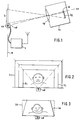
- Fig. 1 shows schematically the television projection system with the projection device tv, which is attached, for example, to a ceiling suspension.
- the power supply is usually not critical, because power lines are laid everywhere. However, the supply of the television signal is usually not provided.
- the received television signal is converted by means of a converter u and an infrared transmitter sd into an infrared signal which can be received by an infrared detector id in the projection device tv.
- the Infrared detector id in the projection device tv which is located immediately above the imager bg, is connected to a receiver which contains electronic filters and amplifiers in order to generate the television signals for the projection device tv from the output signals of the infrared detector id.
- the design of this receiver is not the subject of the invention and it is therefore not shown in FIG. 1.
- the area b in which the projected television picture is reproduced is indicated schematically on the projection wall w and the infrared transmitter sd is located directly below it. If the transmitter diode sd is located in the area of the optical axis ax, the infrared detector id is also located in the projection device tv in the area of the optical axis. This arrangement is particularly advantageous because, regardless of the image distance, the location of the infrared detector id always remains on the optical axis ax. This location also does not change if the optics op are zoom optics that enable a different image size b1, b2, b3, cf. Fig. 2.
- the infrared detector id is designed as a multiple split element. Then the transmitter diode sd shown forms a distorted image on the split detector, which corresponds to the distortion of the reproduced television picture in area b. This distorted image bv is shown schematically in FIG. 3.
- the required correction for the projected television picture can be determined and trigger a corresponding electronic or optical correction, cf. the dashed line bk in FIG. 3.
- the television signal is spatially separated as an R, G and B signal emitted via one transmitter diode each, then three infrared detectors id are required in the projection device tv, which are likewise spatially separated from one another. If they lie in the plane of the optical axis ax, then only a lateral shift of the two outer infrared detectors is required at different projection distances or during zoom operation.
Landscapes
- Engineering & Computer Science (AREA)
- Multimedia (AREA)
- Signal Processing (AREA)
- Transforming Electric Information Into Light Information (AREA)
- Video Image Reproduction Devices For Color Tv Systems (AREA)
Abstract
Description
- Die Erfindung betrifft ein Projektionsfernsehsystem mit einer Projektionseinrichtung, die über eine Infrarotübertragungsstrecke mit einem Fernsehsignal gespeist ist. Das übertragene Fernsehsignal kann dabei analog oder digital als FBAS-Signal oder analog oder digital als R-, G- und B-Signal mit den zugehörigen Synchronzeichen übertragen werden. Der wesentliche Vorteil der Erfindung besteht darin, daß die Projektionsoptik des Fernsehprojektors für die Infrarotübertragungsstrecke mitverwendet wird, so daß die Sendeleistung des oder der Infrarotgeber relativ klein bleiben kann.
- Die Erfindung und ihre Vorteile werden nun anhand der Figuren der Zeichnung näher erläutert:
- Fig. 1 zeigt schematisch das Projektionsfernsehsystem,
- Fig. 2 zeigt eine vorteilhafte räumliche Anordnung des projezierten Bildes und der Infrarotsendeeinrichtung und
- Fig. 3 zeigt schematisch eine automatische Korrektur der Bildgeometrie.
- Fig. 1 zeigt schematisch das Fernsehprojektionssystem mit dem Projektionsgerät tv, das beispielsweise an einer Deckenaufhängung befestigt ist. Die Stromzuführung ist dabei in der Regel unkritisch, weil Netzleitungen überall verlegt sind. Die Zuführung des Fernsehsignals ist jedoch meist nicht vorgesehen. Zu diesem Zweck wird das empfangene Fernsehsignal mittels eines Umsetzers u und einer Infrarotsendeeinrichtung sd in ein Infrarotsignal umgewandelt, das von einem Infrarotdetektor id im Projektionsgerät tv empfangen werden kann. Der Infrarotdetektor id im Projektionsgerät tv, der sich unmittelbar oberhalb des Bildgebers bg befindet, ist an einen Empfänger angeschlossen, der elektronische Filter und Verstärker enthält, um aus den Ausgangssignalen des Infrarotdetektors id die Fernsehsignale für das Projektionsgerät tv zu erzeugen. Die Ausführung dieses Empfängers ist nicht Gegenstand der Erfindung und er ist in Fig. 1 daher auch nicht dargestellt.
- Auf der Projektionswand w ist schematisch der Bereich b angedeutet, in dem das projezierte Fernsehbild wiedergegeben wird und unmittelbar darunter befindet sich die Infrarotsendeeinrichtung sd. Befindet sich dabei die Senderdiode sd im Bereich der optischen Achse ax, dann befindet sich auch im Projektionsgerät tv der Infrarotdetektor id im Bereich der optischen Achse. Diese Anordnung ist besonders vorteilhaft, weil unabhängig von der Bildentfernung der Ort des Infrarotdetektors id stets auf der optischen Achse ax bleibt. Dieser Ort verändert sich auch nicht, wenn die Optik op eine Zoom-Optik ist, die eine unterschiedliche Bildgröße b1, b2, b3 ermöglicht, vgl. Fig. 2.
- Ein weiterer Vorteil dieser Anordnung ergibt sich, wenn der Infrarotdetektor id als Vielfachsplitelement ausgebildet ist. Dann bildet die abgebildete Senderdiode sd auf dem Splitdetektor ein verzerrtes Abbild, das der Verzerrung des wiedergegebenen Fernsehbildes im Bereich b entspricht. In Fig. 3 ist dieses verzerrte Abbild bv schematisch dargestellt. Durch Auswertung der Abbildung auf dem Vielfachsplitdetektor kann die erforderliche Korrektur für das projezierte Fernsehbild bestimmt werden und eine entsprechende elektronische oder optische Korrektur auslösen, vgl. die gestrichelte Linie bk in Fig. 3.
- Wird das Fernsehsignal räumlich getrennt als R-, G- und B-Signal über jeweils eine Sendediode ausgestrahlt, dann sind im Projektionsgerät tv drei Infrarotdetektoren id erforderlich, die ebenfalls räumlich voneinander getrennt sind. Liegen sie in der Ebene der optischen Achse ax, dann ist bei unterschiedlichen Projektionsentfernungen oder beim Zoom-Betrieb lediglich eine seitliche Verschiebung der beiden äußeren Infrarotdetektoren erforderlich.
Claims (6)
- Projektionsfernsehsystem mit einer optischen Projektionseinrichtung für die Fernsehwiedergabe, deren Optik (op) gleichzeitig der optischen Bündelung der von einer Infrarotsendeeinrichtung (sd) ausgehenden Fernsehsignale auf einen Infrarotdetektor (id) im Projektionsgerät (tv) dient.
- Projektionsfernsehsystem nach Anspruch 1, dadurch gekennzeichnet, daß die Infrarotsendeeinrichtung (sd) und der Infrarotdetektor (id) im Bereich der optischen Achse (ax) der Optik (op) liegen.
- Projektionsfernsehsystem nach Anspruch 1, dadurch gekennzeichnet, daß die Infrarotsendeeinrichtung (sd) ein digitalisiertes FBAS-Signal überträgt.
- Projektionsfernsehsystem nach Anspruch 1, dadurch gekennzeichnet, daß die Infrarotsendeeinrichtung (sd) drei räumlich getrennte Sendedioden enthält, die getrennt ein R-, G- und B-Signal zusammen mit Synchronzeichen übertragen und daß im Projektionsgerät (tv) drei entsprechend räumlich getrennte Infrarotdetektoren vorhanden sind.
- Projektionsfernsehsystem nach Anspruch 1, dadurch gekennzeichnet, daß der Infrarotdetektor (id) ein Vielfachsplitelement ist, und daß aus den einzelnen Ausgangssignalen des Vielfachsplitelementes ein Signal abgeleitet wird, das der Verzerrung des projezierten Bildes (bv) entspricht.
- Projektionsfernsehsystem nach Anspruch 5, dadurch gekennzeichnet, daß aus den Ausgangssignalen des Vielfachsplitdetektors ein Signal abgeleitet wird, das der automatischen Entzerrung des projezierten Bildes (bv) dient, wobei die automatische Entzerrung durch elektronische oder optische Mittel erfolgt.
Priority Applications (3)
| Application Number | Priority Date | Filing Date | Title |
|---|---|---|---|
| DE59009699T DE59009699D1 (de) | 1990-11-06 | 1990-11-06 | Projektionsfernsehsystem. |
| EP90121212A EP0484571B1 (de) | 1990-11-06 | 1990-11-06 | Projektionsfernsehsystem |
| US07/784,494 US5170258A (en) | 1990-11-06 | 1991-10-29 | Projection television system employing optics through which transmitted infrared television signals are received |
Applications Claiming Priority (1)
| Application Number | Priority Date | Filing Date | Title |
|---|---|---|---|
| EP90121212A EP0484571B1 (de) | 1990-11-06 | 1990-11-06 | Projektionsfernsehsystem |
Publications (2)
| Publication Number | Publication Date |
|---|---|
| EP0484571A1 true EP0484571A1 (de) | 1992-05-13 |
| EP0484571B1 EP0484571B1 (de) | 1995-09-20 |
Family
ID=8204685
Family Applications (1)
| Application Number | Title | Priority Date | Filing Date |
|---|---|---|---|
| EP90121212A Expired - Lifetime EP0484571B1 (de) | 1990-11-06 | 1990-11-06 | Projektionsfernsehsystem |
Country Status (3)
| Country | Link |
|---|---|
| US (1) | US5170258A (de) |
| EP (1) | EP0484571B1 (de) |
| DE (1) | DE59009699D1 (de) |
Cited By (2)
| Publication number | Priority date | Publication date | Assignee | Title |
|---|---|---|---|---|
| EP0935389A1 (de) * | 1992-01-22 | 1999-08-11 | Kopin Corporation | Anzeigegehäuse |
| WO2000018140A1 (en) * | 1998-09-18 | 2000-03-30 | Koninklijke Philips Electronics N.V. | Projection display system and device with high bandwith wireless communication for projection display data |
Families Citing this family (2)
| Publication number | Priority date | Publication date | Assignee | Title |
|---|---|---|---|---|
| US6047301A (en) * | 1996-05-24 | 2000-04-04 | International Business Machines Corporation | Wearable computer |
| BE1010346A5 (nl) | 1996-06-12 | 1998-06-02 | Barco Nv | Niet expliciet toepassingsgericht apparaat en gebruik ervan voor de automatische afregeling van een projector. |
Citations (2)
| Publication number | Priority date | Publication date | Assignee | Title |
|---|---|---|---|---|
| US4786966A (en) * | 1986-07-10 | 1988-11-22 | Varo, Inc. | Head mounted video display and remote camera system |
| US4916532A (en) * | 1987-09-15 | 1990-04-10 | Jerry R. Iggulden | Television local wireless transmission and control |
Family Cites Families (2)
| Publication number | Priority date | Publication date | Assignee | Title |
|---|---|---|---|---|
| US4019180A (en) * | 1972-11-08 | 1977-04-19 | The United States Of America As Represented By The Secretary Of The Army | Remote infrared signal communicator |
| GB2118803B (en) * | 1982-04-05 | 1987-02-18 | British Broadcasting Corp | Display device |
-
1990
- 1990-11-06 EP EP90121212A patent/EP0484571B1/de not_active Expired - Lifetime
- 1990-11-06 DE DE59009699T patent/DE59009699D1/de not_active Expired - Fee Related
-
1991
- 1991-10-29 US US07/784,494 patent/US5170258A/en not_active Expired - Fee Related
Patent Citations (2)
| Publication number | Priority date | Publication date | Assignee | Title |
|---|---|---|---|---|
| US4786966A (en) * | 1986-07-10 | 1988-11-22 | Varo, Inc. | Head mounted video display and remote camera system |
| US4916532A (en) * | 1987-09-15 | 1990-04-10 | Jerry R. Iggulden | Television local wireless transmission and control |
Non-Patent Citations (2)
| Title |
|---|
| PATENT ABSTRACTS OF JAPAN, Band 12, Nr. 204 (E-620)[3051], 11. Juni 1988; & JP-A-63 002 476 (NEC HOME ELECTRONICS LTD) 07-01-1988 * |
| PATENT ABSTRACTS OF JAPAN, Band 13, Nr. 570 (P-977)[3918], 18. Dezember 1989; & JP-A-1 237 592 (SHARP CORP.) 22-09-1989 * |
Cited By (2)
| Publication number | Priority date | Publication date | Assignee | Title |
|---|---|---|---|---|
| EP0935389A1 (de) * | 1992-01-22 | 1999-08-11 | Kopin Corporation | Anzeigegehäuse |
| WO2000018140A1 (en) * | 1998-09-18 | 2000-03-30 | Koninklijke Philips Electronics N.V. | Projection display system and device with high bandwith wireless communication for projection display data |
Also Published As
| Publication number | Publication date |
|---|---|
| US5170258A (en) | 1992-12-08 |
| DE59009699D1 (de) | 1995-10-26 |
| EP0484571B1 (de) | 1995-09-20 |
Similar Documents
| Publication | Publication Date | Title |
|---|---|---|
| DE2619027C2 (de) | Fernsehaufnahmesystem | |
| EP0033944B1 (de) | Vorrichtung zur elektronischen Abtastung von Aufnahmegegenständen | |
| DE3835976C2 (de) | Digitale Bildsignalverarbeitungseinrichtung, insbesondere für eine Videokamera | |
| DE2847858A1 (de) | Hybrid-farbfernsehkamera | |
| DE844921C (de) | Anordnung zur farbigen Fernsehuebertragung | |
| EP0484571B1 (de) | Projektionsfernsehsystem | |
| DE2027617C3 (de) | System zur Reproduktion eines Farbbildes aus einem zusammengesetzten Schwarz-Weiß-Bild und Verfahren zur Erzeugung eines zusammengesetzten Schwarz-Weiß-Bildes auf einen Medium | |
| EP0421130B1 (de) | Bildübertragungssystem in Operationsleuchten | |
| DE3338496C2 (de) | Afokales Wärmebildgerät | |
| DE1462843A1 (de) | Photographische Kameravorrichtung | |
| US2586558A (en) | Three color television system | |
| DE2137613C (de) | ||
| DD145834A5 (de) | Verfahren zur optisch-elektronischen uebertragung einer bildvorlage | |
| DE2137613B1 (de) | Schaltungsanordnung fuer bildfernsprecher zur beseitigung von stoerungen auf dem bildschirm | |
| DE69026392T2 (de) | Gerät zur optischen Übertragung im freien Raum | |
| EP1584184A1 (de) | Verfahren zum verarbeiten von aus einem filmaufnahmestrahlengang einer laufbildkamera abgezweigten filmbildern | |
| DE2837837C2 (de) | Videoprojektionsgerät | |
| DE68905120T2 (de) | Periskop zum tag- und nachtbetrieb fuer panzerfahrzeuge. | |
| DE2320000A1 (de) | Zweiroehren-farbfernsehkamera | |
| DE2062644A1 (de) | Fernsehkino | |
| DE4305883A1 (de) | Verfahren und Vorrichtung für eine farbechte Bildübertragung | |
| DD154926A5 (de) | Verfahren zur optisch-elektronischen uebertragung einer bildvorlage | |
| DE1597409C (de) | Farbfernsehkamera | |
| DE2216608C3 (de) | Vorrichtung zur selektiven optischen Übertragung eines Lichtbildes aus einer Vielzahl von Lichtbildquellen | |
| DE1462842B2 (de) | Vorrichtung zur erzeugung von farbvideosignalen |
Legal Events
| Date | Code | Title | Description |
|---|---|---|---|
| PUAI | Public reference made under article 153(3) epc to a published international application that has entered the european phase |
Free format text: ORIGINAL CODE: 0009012 |
|
| AK | Designated contracting states |
Kind code of ref document: A1 Designated state(s): DE FR GB IT NL |
|
| RBV | Designated contracting states (corrected) |
Designated state(s): DE FR NL |
|
| 17P | Request for examination filed |
Effective date: 19921026 |
|
| 17Q | First examination report despatched |
Effective date: 19940818 |
|
| GRAA | (expected) grant |
Free format text: ORIGINAL CODE: 0009210 |
|
| AK | Designated contracting states |
Kind code of ref document: B1 Designated state(s): DE FR NL |
|
| REF | Corresponds to: |
Ref document number: 59009699 Country of ref document: DE Date of ref document: 19951026 |
|
| ET | Fr: translation filed | ||
| PLBE | No opposition filed within time limit |
Free format text: ORIGINAL CODE: 0009261 |
|
| STAA | Information on the status of an ep patent application or granted ep patent |
Free format text: STATUS: NO OPPOSITION FILED WITHIN TIME LIMIT |
|
| 26N | No opposition filed | ||
| PGFP | Annual fee paid to national office [announced via postgrant information from national office to epo] |
Ref country code: NL Payment date: 20031022 Year of fee payment: 14 |
|
| PGFP | Annual fee paid to national office [announced via postgrant information from national office to epo] |
Ref country code: FR Payment date: 20031119 Year of fee payment: 14 |
|
| PG25 | Lapsed in a contracting state [announced via postgrant information from national office to epo] |
Ref country code: NL Free format text: LAPSE BECAUSE OF NON-PAYMENT OF DUE FEES Effective date: 20050601 |
|
| PG25 | Lapsed in a contracting state [announced via postgrant information from national office to epo] |
Ref country code: FR Free format text: LAPSE BECAUSE OF NON-PAYMENT OF DUE FEES Effective date: 20050729 |
|
| NLV4 | Nl: lapsed or anulled due to non-payment of the annual fee |
Effective date: 20050601 |
|
| REG | Reference to a national code |
Ref country code: FR Ref legal event code: ST |
|
| PGFP | Annual fee paid to national office [announced via postgrant information from national office to epo] |
Ref country code: DE Payment date: 20070102 Year of fee payment: 17 |
|
| PG25 | Lapsed in a contracting state [announced via postgrant information from national office to epo] |
Ref country code: DE Free format text: LAPSE BECAUSE OF NON-PAYMENT OF DUE FEES Effective date: 20080603 |