EP0484675A2 - Matériau composite comportant un substrat et une couche de revêtement et procédé pour sa préparation - Google Patents
Matériau composite comportant un substrat et une couche de revêtement et procédé pour sa préparation Download PDFInfo
- Publication number
- EP0484675A2 EP0484675A2 EP91116854A EP91116854A EP0484675A2 EP 0484675 A2 EP0484675 A2 EP 0484675A2 EP 91116854 A EP91116854 A EP 91116854A EP 91116854 A EP91116854 A EP 91116854A EP 0484675 A2 EP0484675 A2 EP 0484675A2
- Authority
- EP
- European Patent Office
- Prior art keywords
- coating
- tube
- layer
- composite
- polyvinyl alcohol
- Prior art date
- Legal status (The legal status is an assumption and is not a legal conclusion. Google has not performed a legal analysis and makes no representation as to the accuracy of the status listed.)
- Withdrawn
Links
Images


Classifications
-
- B—PERFORMING OPERATIONS; TRANSPORTING
- B32—LAYERED PRODUCTS
- B32B—LAYERED PRODUCTS, i.e. PRODUCTS BUILT-UP OF STRATA OF FLAT OR NON-FLAT, e.g. CELLULAR OR HONEYCOMB, FORM
- B32B27/00—Layered products comprising a layer of synthetic resin
- B32B27/06—Layered products comprising a layer of synthetic resin as the main or only constituent of a layer, which is next to another layer of the same or of a different material
- B32B27/08—Layered products comprising a layer of synthetic resin as the main or only constituent of a layer, which is next to another layer of the same or of a different material of synthetic resin
-
- B—PERFORMING OPERATIONS; TRANSPORTING
- B05—SPRAYING OR ATOMISING IN GENERAL; APPLYING FLUENT MATERIALS TO SURFACES, IN GENERAL
- B05D—PROCESSES FOR APPLYING FLUENT MATERIALS TO SURFACES, IN GENERAL
- B05D1/00—Processes for applying liquids or other fluent materials
- B05D1/18—Processes for applying liquids or other fluent materials performed by dipping
-
- B—PERFORMING OPERATIONS; TRANSPORTING
- B05—SPRAYING OR ATOMISING IN GENERAL; APPLYING FLUENT MATERIALS TO SURFACES, IN GENERAL
- B05D—PROCESSES FOR APPLYING FLUENT MATERIALS TO SURFACES, IN GENERAL
- B05D7/00—Processes, other than flocking, specially adapted for applying liquids or other fluent materials to particular surfaces or for applying particular liquids or other fluent materials
- B05D7/02—Processes, other than flocking, specially adapted for applying liquids or other fluent materials to particular surfaces or for applying particular liquids or other fluent materials to macromolecular substances, e.g. rubber
-
- B—PERFORMING OPERATIONS; TRANSPORTING
- B32—LAYERED PRODUCTS
- B32B—LAYERED PRODUCTS, i.e. PRODUCTS BUILT-UP OF STRATA OF FLAT OR NON-FLAT, e.g. CELLULAR OR HONEYCOMB, FORM
- B32B27/00—Layered products comprising a layer of synthetic resin
- B32B27/32—Layered products comprising a layer of synthetic resin comprising polyolefins
-
- C—CHEMISTRY; METALLURGY
- C08—ORGANIC MACROMOLECULAR COMPOUNDS; THEIR PREPARATION OR CHEMICAL WORKING-UP; COMPOSITIONS BASED THEREON
- C08J—WORKING-UP; GENERAL PROCESSES OF COMPOUNDING; AFTER-TREATMENT NOT COVERED BY SUBCLASSES C08B, C08C, C08F, C08G or C08H
- C08J7/00—Chemical treatment or coating of shaped articles made of macromolecular substances
- C08J7/04—Coating
- C08J7/0427—Coating with only one layer of a composition containing a polymer binder
-
- C—CHEMISTRY; METALLURGY
- C08—ORGANIC MACROMOLECULAR COMPOUNDS; THEIR PREPARATION OR CHEMICAL WORKING-UP; COMPOSITIONS BASED THEREON
- C08J—WORKING-UP; GENERAL PROCESSES OF COMPOUNDING; AFTER-TREATMENT NOT COVERED BY SUBCLASSES C08B, C08C, C08F, C08G or C08H
- C08J7/00—Chemical treatment or coating of shaped articles made of macromolecular substances
- C08J7/04—Coating
- C08J7/043—Improving the adhesiveness of the coatings per se, e.g. forming primers
-
- C—CHEMISTRY; METALLURGY
- C08—ORGANIC MACROMOLECULAR COMPOUNDS; THEIR PREPARATION OR CHEMICAL WORKING-UP; COMPOSITIONS BASED THEREON
- C08J—WORKING-UP; GENERAL PROCESSES OF COMPOUNDING; AFTER-TREATMENT NOT COVERED BY SUBCLASSES C08B, C08C, C08F, C08G or C08H
- C08J7/00—Chemical treatment or coating of shaped articles made of macromolecular substances
- C08J7/04—Coating
- C08J7/046—Forming abrasion-resistant coatings; Forming surface-hardening coatings
-
- C—CHEMISTRY; METALLURGY
- C08—ORGANIC MACROMOLECULAR COMPOUNDS; THEIR PREPARATION OR CHEMICAL WORKING-UP; COMPOSITIONS BASED THEREON
- C08J—WORKING-UP; GENERAL PROCESSES OF COMPOUNDING; AFTER-TREATMENT NOT COVERED BY SUBCLASSES C08B, C08C, C08F, C08G or C08H
- C08J7/00—Chemical treatment or coating of shaped articles made of macromolecular substances
- C08J7/04—Coating
- C08J7/048—Forming gas barrier coatings
-
- D—TEXTILES; PAPER
- D06—TREATMENT OF TEXTILES OR THE LIKE; LAUNDERING; FLEXIBLE MATERIALS NOT OTHERWISE PROVIDED FOR
- D06N—WALL, FLOOR, OR LIKE COVERING MATERIALS, e.g. LINOLEUM, OILCLOTH, ARTIFICIAL LEATHER, ROOFING FELT, CONSISTING OF A FIBROUS WEB COATED WITH A LAYER OF MACROMOLECULAR MATERIAL; FLEXIBLE SHEET MATERIAL NOT OTHERWISE PROVIDED FOR
- D06N3/00—Artificial leather, oilcloth or other material obtained by covering fibrous webs with macromolecular material, e.g. resins, rubber or derivatives thereof
- D06N3/12—Artificial leather, oilcloth or other material obtained by covering fibrous webs with macromolecular material, e.g. resins, rubber or derivatives thereof with macromolecular compounds obtained otherwise than by reactions only involving carbon-to-carbon unsaturated bonds, e.g. gelatine proteins
-
- B—PERFORMING OPERATIONS; TRANSPORTING
- B05—SPRAYING OR ATOMISING IN GENERAL; APPLYING FLUENT MATERIALS TO SURFACES, IN GENERAL
- B05D—PROCESSES FOR APPLYING FLUENT MATERIALS TO SURFACES, IN GENERAL
- B05D2254/00—Tubes
- B05D2254/02—Applying the material on the exterior of the tube
-
- B—PERFORMING OPERATIONS; TRANSPORTING
- B32—LAYERED PRODUCTS
- B32B—LAYERED PRODUCTS, i.e. PRODUCTS BUILT-UP OF STRATA OF FLAT OR NON-FLAT, e.g. CELLULAR OR HONEYCOMB, FORM
- B32B2307/00—Properties of the layers or laminate
- B32B2307/70—Other properties
- B32B2307/724—Permeability to gases, adsorption
- B32B2307/7242—Non-permeable
-
- C—CHEMISTRY; METALLURGY
- C08—ORGANIC MACROMOLECULAR COMPOUNDS; THEIR PREPARATION OR CHEMICAL WORKING-UP; COMPOSITIONS BASED THEREON
- C08J—WORKING-UP; GENERAL PROCESSES OF COMPOUNDING; AFTER-TREATMENT NOT COVERED BY SUBCLASSES C08B, C08C, C08F, C08G or C08H
- C08J2429/00—Characterised by the use of homopolymers or copolymers of compounds having one or more unsaturated aliphatic radicals, each having only one carbon-to-carbon double bond, and at least one being terminated by an alcohol, ether, aldehydo, ketonic, acetal, or ketal radical; Hydrolysed polymers of esters of unsaturated alcohols with saturated carboxylic acids; Derivatives of such polymer
Definitions
- the invention relates to a composite material with at least one carrier layer on which there is a gas-impermeable coating, which consists of cured polyvinyl alcohol / melamine resin, and a method for its production.
- PVDC polvinylidene chloride
- the invention is based on the object of producing at least equivalent composites with respect to oxygen tightness, the combustion of which does not result in chlorine and HCl emissions.
- This object is achieved according to the invention in the case of a composite with at least one backing layer in that the coating consists of hardened polyvinyl alcohol / melamine resin.
- the invention has the advantage that the composite material is a high-quality material that can be disposed of in an environmentally friendly manner and, in some cases, has a better barrier effect against gases with the same or less material expenditure than the construction of today's common materials.
- a gas-impermeable coating made of polyvinyl alcohol / melamine resin on a carrier layer, which preferably consists of polyolefins.
- the coating is located above a polyamide layer (PA) which is connected at the bottom by an adhesion promoter layer to a polyethylene layer (PE).
- PA polyamide layer
- PE polyethylene layer
- the coating is applied over a low-density polyethylene layer (LD-PE) which is bonded to a polyamide layer by means of an adhesion promoter layer and which in turn is bound to a further LD-PE layer by means of a second adhesion promoter layer.
- LD-PE low-density polyethylene layer
- a further preferred embodiment is a composite in which the coating is applied over a carrier layer made of ethylene-vinyl acetate copolymer (EVA copolymer), which lies over a layer made of polypropylene and a further layer of EVA copolymer.
- EVA copolymer ethylene-vinyl acetate copolymer
- the coating lies over a layer made of polyamide, which in turn lies over a layer made of LD-PE.
- the bond between the coating and the polyamide layer is created by oxidation of the surface in the melt flow before the union.
- the coating serves as a barrier and adhesive layer between a layer made of polypropylene and one made of LD-PE.
- the coating is embedded between a pressure sensitive adhesive and a polyethylene layer.
- the layer over the pressure sensitive adhesive consists of a biaxially oriented film, e.g. Polyester / polypropylene, polyamide or cellophane.
- the top layer consists of polyolefin blend (PO blend), which is coated with a film of e.g. LD-PE is only connected to a limited extent, so that after welding the layers in the seam area, they can be separated again.
- PO blend polyolefin blend
- the layer below is the gas-impermeable coating while the bottom layer is made of polypropylene.
- a plastic film coated with polyvinyl alcohol / melamine resin is applied to a further carrier made of paper, cardboard, cellulose hydrate, textiles or aluminum.
- the application can be carried out in the usual way by lamination or lamination.
- the thickness of the coating is not particularly limited. If the coating is too thin, the gas impermeability is insufficient, and if the coating is too thick, the composite becomes too rigid.
- the thickness of the coating is preferably from 1 to 10 ⁇ m, in particular from 5 to 10 ⁇ m.
- the thickness of the carrier film is between 20 and 200 ⁇ m, preferably in the range between 50 and 150 ⁇ m, particularly preferably in the range between 60 and 100 ⁇ m.
- the finished coating preferably contains 11% solids, 86% water and 3% alcohol. This is achieved, for example, by means of a coating in which 20 parts of polyvinyl alcohol (type LL603, from Wacker-Chemie) are dissolved in 80 parts of water for a basic coating approach. 90 parts of this solution are mixed with 10 parts of melamine resin (45%, type Cymel 1172, Dyno Cyanamid).
- the batch for the coating consists of 100 parts of the basic batch, to which 2.2 parts of catalyst (type Cynat 4040, solution of toluenesulfonic acid (40%) in isopropanol (60%), from Dyno Cyanamid) are added. This approach, in turn, is diluted with 4.3 parts of ethanol and 106 parts of water before being added to the lacquer pan.
- a method for producing a composite as defined in the preceding claims is the subject of claim 9.
- the above statements relating to the composite apply mutatis mutandis.
- Further embodiments of the method described in claim 9 are the subject of claims 10 to 12.
- Toluene sulfonic acid is preferably added as a catalyst in the production of the coating from polyvinyl alcohol and melamine resin.
- the coating hardens under the action of high-energy radiation or heat.
- the temperature during the heat curing is between 100 ° C. and 160 ° C., it is preferably in the range between 110 ° C. and 150 ° C., particularly preferably it is between 120 ° C. and 140 ° C.
- the coating 1 consists of hardened polyvinyl alcohol / melamine resin.
- Layer 2 can be any raw material, preferably polyolefins.
- the composite consists of the coating 1 as in FIG. 1, a polyamide layer 2, an adhesion promoter layer 3 and a polyethylene layer 4.
- the composite consists of the coating 1, an LD-PE layer 2, an adhesion promoter layer 3, a polyamide layer 4, a second adhesion promoter layer 5 and a further LD-PE layer 6.
- Fig. 4 shows a composite in which the gas-impermeable coating 1 forms the top layer; layer 2 consists of EVA copolymer, layer 4 made of polypropylene and layer 6 again made of EVA.
- 5 shows a composite with a gas-impermeable coating 1, a layer 2 made of polyamide and a layer 4 made of LD-PE.
- the bond between 1 and 2 is created by oxidation of the surface in the melt flow before the union.
- the coating 1 serves both as a barrier layer and as an adhesive layer for connecting the layers 2 made of polypropylene and 4 made of LD-PE.
- FIG. 7 shows a composite material in which the coating 1 is embedded between the layers 3 and 4.
- Layer 2 consists of a biaxially oriented film, e.g. Polyester / polypropylene, polyamide or also from cell glass, the connection of the layers 2 and 1/4 being connected by means of a pressure sensitive adhesive 3 by lamination in a second operation.
- Layer 4 is made of polyethylene.
- Fig. 8 shows a composite in which layer 6 consists of PO blend blended with film 2, e.g. LD-PE, is only connected to a limited extent, so that after welding the layers in the seam area, they can be separated again. In technical terms, one speaks of peeling.
- the coating 1 is located between the carrier layers 2 and 4, the layer 4 consisting of polypropylene.
- a film tube 12 is blown on a conventional film tube blowing system 11.
- the film tube is fed to a corona pretreatment station 13, which effects pretreatment on both sides.
- the tube is guided into an immersion bath 14 in which the aqueous solution 15 of polyvinyl alcohol / melamine resin is located.
- the application of the solution is equalized on both sides of the hose via doctor rollers 16 and the application quantity in the wet state is defined by the tension and the surface of the doctor roller.
- the coated tube is inflated 17 and the air introduced is over a Roll pair 18 included and in front of the roll pair 18, the hose is laid flat by a guide device 19.
- the tube On the way from the squeegee roller 16 to the lay flat, the tube is heated in the first stage via infrared radiators 20 and dried and crosslinked in the drying duct 21 at 130 ° C. Before being laid flat, the coated hose is cooled via annular air nozzles 22. The flattened tube is now cut open at the edges in a cutting device 23 and wound up separately in film webs 24, 25.
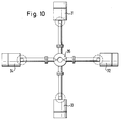
- FIG. 10 is a detail from FIG. 9 and shows a typical arrangement of extruders for feeding various raw materials onto a concentric ring nozzle 35, the layer structure - depending on the raw materials - from the outside in with A, B, C, D (numbers 31 -34) is referred to.
- the layer structure - depending on the raw materials - from the outside in with A, B, C, D (numbers 31 -34) is referred to.
- ABA which means that the film consists of 3 layers, but the extruder A feeds the 1st and 3rd layers.
Landscapes
- Chemical & Material Sciences (AREA)
- Chemical Kinetics & Catalysis (AREA)
- Health & Medical Sciences (AREA)
- Medicinal Chemistry (AREA)
- Polymers & Plastics (AREA)
- Organic Chemistry (AREA)
- Engineering & Computer Science (AREA)
- Dispersion Chemistry (AREA)
- Textile Engineering (AREA)
- Life Sciences & Earth Sciences (AREA)
- Wood Science & Technology (AREA)
- Laminated Bodies (AREA)
Applications Claiming Priority (2)
| Application Number | Priority Date | Filing Date | Title |
|---|---|---|---|
| DE4031630 | 1990-10-05 | ||
| DE4031630A DE4031630A1 (de) | 1990-10-05 | 1990-10-05 | Verbundstoff mit mindestens einer traegerschicht und einer gasundurchlaessigen beschichtung und verfahren zu dessen herstellung |
Publications (2)
| Publication Number | Publication Date |
|---|---|
| EP0484675A2 true EP0484675A2 (fr) | 1992-05-13 |
| EP0484675A3 EP0484675A3 (en) | 1992-09-02 |
Family
ID=6415703
Family Applications (1)
| Application Number | Title | Priority Date | Filing Date |
|---|---|---|---|
| EP19910116854 Withdrawn EP0484675A3 (en) | 1990-10-05 | 1991-10-02 | Composite material having a substrate layer and a gas impermeable coating layer and process for making same |
Country Status (2)
| Country | Link |
|---|---|
| EP (1) | EP0484675A3 (fr) |
| DE (1) | DE4031630A1 (fr) |
Cited By (2)
| Publication number | Priority date | Publication date | Assignee | Title |
|---|---|---|---|---|
| EP0562033A4 (fr) * | 1990-12-13 | 1993-07-15 | Mobil Oil Corp | Pellicule combinee a impermeabilite elevee. |
| WO2006125602A1 (fr) * | 2005-05-23 | 2006-11-30 | Thomas Nicola | Procede de laminage d'un film tubulaire exempt de particules |
Families Citing this family (1)
| Publication number | Priority date | Publication date | Assignee | Title |
|---|---|---|---|---|
| DE19902102B4 (de) * | 1998-06-15 | 2007-07-05 | Ökologische Bausysteme B.I. Moll GmbH & Co. KG | Verbundwerkstoff |
Family Cites Families (7)
| Publication number | Priority date | Publication date | Assignee | Title |
|---|---|---|---|---|
| US3282729A (en) * | 1963-02-27 | 1966-11-01 | Union Carbide Corp | Barrier coated thermoplastic olefin polymer substrates |
| US3294577A (en) * | 1963-08-02 | 1966-12-27 | Union Carbide Corp | Barrier coated thermoplastic olefin high polymer substrates |
| DE1571029C3 (de) * | 1965-02-15 | 1975-01-30 | Kalle Ag, 6202 Wiesbaden-Biebrich | Verfahren zur Herstellung hydrophiler Polyvinylalkoholschichten |
| DE1282975B (de) * | 1965-03-25 | 1968-11-14 | Henkel & Cie Gmbh | Herstellen von Schichtstoffen |
| DE1938748A1 (de) * | 1969-07-30 | 1971-02-18 | Lissmann Alkor Werk | Verfahren zur Beschichtung eines Folienschlauches |
| US4140822A (en) * | 1977-09-14 | 1979-02-20 | Thilmany Pulp & Paper Company | Surface coating of polyolefin film |
| GB8602493D0 (en) * | 1986-02-01 | 1986-03-05 | Silberline Ltd | Producing polymer film laminates |
-
1990
- 1990-10-05 DE DE4031630A patent/DE4031630A1/de not_active Withdrawn
-
1991
- 1991-10-02 EP EP19910116854 patent/EP0484675A3/de not_active Withdrawn
Cited By (4)
| Publication number | Priority date | Publication date | Assignee | Title |
|---|---|---|---|---|
| EP0562033A4 (fr) * | 1990-12-13 | 1993-07-15 | Mobil Oil Corp | Pellicule combinee a impermeabilite elevee. |
| WO2006125602A1 (fr) * | 2005-05-23 | 2006-11-30 | Thomas Nicola | Procede de laminage d'un film tubulaire exempt de particules |
| EP2075296A1 (fr) * | 2005-05-23 | 2009-07-01 | Martin Schmittlein | Procede de laminage d'un film tubulaire contenant une faible quantite de particules |
| RU2442692C2 (ru) * | 2005-05-23 | 2012-02-20 | Мартин ШМИДТЛАЙН | Способ каширования пленочной трубки, содержащей незначительное количество частиц |
Also Published As
| Publication number | Publication date |
|---|---|
| DE4031630A1 (de) | 1992-04-09 |
| EP0484675A3 (en) | 1992-09-02 |
Similar Documents
| Publication | Publication Date | Title |
|---|---|---|
| DE2451651C2 (de) | Verfahren und Vorrichtung zum Herstellen von Wellpappe | |
| DE69820852T2 (de) | Verfahren zur Herstellung von umweltschonenden Papieren wie auch entsprechende Papieren | |
| EP0047373B1 (fr) | Procédé de fabrication de nappes de support imprégnées de plastisols thermoplastiques | |
| DE69609327T2 (de) | Papierfilmlaminat für Klebeband | |
| EP0280922A1 (fr) | Procédé pour joindre sans couture les bords et/ou les tranches de couches photosensibles et emploi pour la fabrication de plaques d'impression | |
| EP0280103B1 (fr) | Procédé de revêtement de cylindres ou de mandrins avec une couche photosensible continue sans couture et leur emploi pour la fabrication de plaques pour rotatives | |
| DE1957276A1 (de) | Beschichtungsverfahren | |
| DE3514667C2 (de) | Verfahren zur Herstellung einer Faltschachtel aus einem Polsterschichtmaterial | |
| DE1779691A1 (de) | Verfahren und Vorrichtung zur Herstellung von Bandmaterial,insbesondere fuer Verpackungszwecke | |
| DE1704117B2 (de) | Verfahren zum Herstellen gas- und flüssigkeitsdichter Tuben | |
| DE1779398B2 (de) | Verfahren zum Herstellen einer Verbundfolienbahn | |
| DE3823069C2 (de) | Verfahren zur Herstellung von Thermoschablonengrund-Flachmaterial für Schablonendruck | |
| DE2527942A1 (de) | Verfahren und vorrichtung zur herstellung von selbstklebenden abdeck- und isolierfolien | |
| DE4031630A1 (de) | Verbundstoff mit mindestens einer traegerschicht und einer gasundurchlaessigen beschichtung und verfahren zu dessen herstellung | |
| DE2008607A1 (de) | Verfahren und Vorrichtung zum Verbinden thermoplastischer Materialien sowie hiernach hergestellte Produkte | |
| DE2704689A1 (de) | Vorrichtung zur herstellung mehrlagiger bahnen | |
| DE2140091C3 (de) | Verfahren und Vorrichtung zur Herstellung einer verstreckten, spleißfreudigen Folienbahn aus Kunststoff | |
| DE1629791B2 (de) | Verpackungsmaterial mit hohen stabilitaets- und dichtigkeitseigenschaften | |
| DE1546867C3 (de) | Verfahren zur Herstellung von Kunststoff-Schichtmaterial und Vorrichtung zu dessen Durchführung | |
| CH710826A1 (de) | Vorrichtungen und Verfahren zur Abscheidung dünner Schichten auf einer laufenden Folienbahn sowie Folienbahn oder Zuschnitte daraus. | |
| DE69702753T2 (de) | Platte, paneel oder ähnliche artikel aus thermoformbarem mehrsichtigem material und verfahren zur herstellung derselben | |
| DE2348350C2 (de) | Polyolefinbeschichtete Papier- oder Kartonfolie für reprografische Zwecke, sowie Verfahren zu ihrer Herstellung und ihre Verwendung | |
| DE2111281A1 (de) | Verfahren und Vorrichtung zur Herstellung mehrlagiger Folien | |
| DE69228394T2 (de) | Laminierverfahren | |
| DE10256040A1 (de) | Mehrschichtiges Kunststoffwerkstück sowie Verfahren zu seiner Herstellung |
Legal Events
| Date | Code | Title | Description |
|---|---|---|---|
| PUAI | Public reference made under article 153(3) epc to a published international application that has entered the european phase |
Free format text: ORIGINAL CODE: 0009012 |
|
| AK | Designated contracting states |
Kind code of ref document: A2 Designated state(s): AT BE CH DE DK ES FR GB GR IT LI LU NL SE |
|
| PUAL | Search report despatched |
Free format text: ORIGINAL CODE: 0009013 |
|
| AK | Designated contracting states |
Kind code of ref document: A3 Designated state(s): AT BE CH DE DK ES FR GB GR IT LI LU NL SE |
|
| 17P | Request for examination filed |
Effective date: 19920826 |
|
| 17Q | First examination report despatched |
Effective date: 19940411 |
|
| STAA | Information on the status of an ep patent application or granted ep patent |
Free format text: STATUS: THE APPLICATION HAS BEEN WITHDRAWN |
|
| 18W | Application withdrawn |
Withdrawal date: 19940721 |