EP0484746B1 - Lamination d'un film monomoléculaire par adsoprtion chimique et procédé de fabrication de ce film - Google Patents
Lamination d'un film monomoléculaire par adsoprtion chimique et procédé de fabrication de ce film Download PDFInfo
- Publication number
- EP0484746B1 EP0484746B1 EP19910118094 EP91118094A EP0484746B1 EP 0484746 B1 EP0484746 B1 EP 0484746B1 EP 19910118094 EP19910118094 EP 19910118094 EP 91118094 A EP91118094 A EP 91118094A EP 0484746 B1 EP0484746 B1 EP 0484746B1
- Authority
- EP
- European Patent Office
- Prior art keywords
- substrate
- group
- film
- chlorosilyl
- monomolecular film
- Prior art date
- Legal status (The legal status is an assumption and is not a legal conclusion. Google has not performed a legal analysis and makes no representation as to the accuracy of the status listed.)
- Expired - Lifetime
Links
Images

Classifications
-
- C—CHEMISTRY; METALLURGY
- C04—CEMENTS; CONCRETE; ARTIFICIAL STONE; CERAMICS; REFRACTORIES
- C04B—LIME, MAGNESIA; SLAG; CEMENTS; COMPOSITIONS THEREOF, e.g. MORTARS, CONCRETE OR LIKE BUILDING MATERIALS; ARTIFICIAL STONE; CERAMICS; REFRACTORIES; TREATMENT OF NATURAL STONE
- C04B41/00—After-treatment of mortars, concrete, artificial stone or ceramics; Treatment of natural stone
- C04B41/45—Coating or impregnating, e.g. injection in masonry, partial coating of green or fired ceramics, organic coating compositions for adhering together two concrete elements
- C04B41/52—Multiple coating or impregnating multiple coating or impregnating with the same composition or with compositions only differing in the concentration of the constituents, is classified as single coating or impregnation
-
- B—PERFORMING OPERATIONS; TRANSPORTING
- B32—LAYERED PRODUCTS
- B32B—LAYERED PRODUCTS, i.e. PRODUCTS BUILT-UP OF STRATA OF FLAT OR NON-FLAT, e.g. CELLULAR OR HONEYCOMB, FORM
- B32B27/00—Layered products comprising a layer of synthetic resin
-
- B—PERFORMING OPERATIONS; TRANSPORTING
- B05—SPRAYING OR ATOMISING IN GENERAL; APPLYING FLUENT MATERIALS TO SURFACES, IN GENERAL
- B05D—PROCESSES FOR APPLYING FLUENT MATERIALS TO SURFACES, IN GENERAL
- B05D1/00—Processes for applying liquids or other fluent materials
-
- B—PERFORMING OPERATIONS; TRANSPORTING
- B05—SPRAYING OR ATOMISING IN GENERAL; APPLYING FLUENT MATERIALS TO SURFACES, IN GENERAL
- B05D—PROCESSES FOR APPLYING FLUENT MATERIALS TO SURFACES, IN GENERAL
- B05D1/00—Processes for applying liquids or other fluent materials
- B05D1/18—Processes for applying liquids or other fluent materials performed by dipping
- B05D1/185—Processes for applying liquids or other fluent materials performed by dipping applying monomolecular layers
-
- B—PERFORMING OPERATIONS; TRANSPORTING
- B82—NANOTECHNOLOGY
- B82Y—SPECIFIC USES OR APPLICATIONS OF NANOSTRUCTURES; MEASUREMENT OR ANALYSIS OF NANOSTRUCTURES; MANUFACTURE OR TREATMENT OF NANOSTRUCTURES
- B82Y30/00—Nanotechnology for materials or surface science, e.g. nanocomposites
-
- B—PERFORMING OPERATIONS; TRANSPORTING
- B82—NANOTECHNOLOGY
- B82Y—SPECIFIC USES OR APPLICATIONS OF NANOSTRUCTURES; MEASUREMENT OR ANALYSIS OF NANOSTRUCTURES; MANUFACTURE OR TREATMENT OF NANOSTRUCTURES
- B82Y40/00—Manufacture or treatment of nanostructures
-
- B—PERFORMING OPERATIONS; TRANSPORTING
- B82—NANOTECHNOLOGY
- B82Y—SPECIFIC USES OR APPLICATIONS OF NANOSTRUCTURES; MEASUREMENT OR ANALYSIS OF NANOSTRUCTURES; MANUFACTURE OR TREATMENT OF NANOSTRUCTURES
- B82Y5/00—Nanobiotechnology or nanomedicine, e.g. protein engineering or drug delivery
-
- C—CHEMISTRY; METALLURGY
- C04—CEMENTS; CONCRETE; ARTIFICIAL STONE; CERAMICS; REFRACTORIES
- C04B—LIME, MAGNESIA; SLAG; CEMENTS; COMPOSITIONS THEREOF, e.g. MORTARS, CONCRETE OR LIKE BUILDING MATERIALS; ARTIFICIAL STONE; CERAMICS; REFRACTORIES; TREATMENT OF NATURAL STONE
- C04B41/00—After-treatment of mortars, concrete, artificial stone or ceramics; Treatment of natural stone
- C04B41/009—After-treatment of mortars, concrete, artificial stone or ceramics; Treatment of natural stone characterised by the material treated
-
- C—CHEMISTRY; METALLURGY
- C04—CEMENTS; CONCRETE; ARTIFICIAL STONE; CERAMICS; REFRACTORIES
- C04B—LIME, MAGNESIA; SLAG; CEMENTS; COMPOSITIONS THEREOF, e.g. MORTARS, CONCRETE OR LIKE BUILDING MATERIALS; ARTIFICIAL STONE; CERAMICS; REFRACTORIES; TREATMENT OF NATURAL STONE
- C04B41/00—After-treatment of mortars, concrete, artificial stone or ceramics; Treatment of natural stone
- C04B41/80—After-treatment of mortars, concrete, artificial stone or ceramics; Treatment of natural stone of only ceramics
- C04B41/81—Coating or impregnation
- C04B41/89—Coating or impregnation for obtaining at least two superposed coatings having different compositions
-
- C—CHEMISTRY; METALLURGY
- C08—ORGANIC MACROMOLECULAR COMPOUNDS; THEIR PREPARATION OR CHEMICAL WORKING-UP; COMPOSITIONS BASED THEREON
- C08J—WORKING-UP; GENERAL PROCESSES OF COMPOUNDING; AFTER-TREATMENT NOT COVERED BY SUBCLASSES C08B, C08C, C08F, C08G or C08H
- C08J7/00—Chemical treatment or coating of shaped articles made of macromolecular substances
-
- C—CHEMISTRY; METALLURGY
- C08—ORGANIC MACROMOLECULAR COMPOUNDS; THEIR PREPARATION OR CHEMICAL WORKING-UP; COMPOSITIONS BASED THEREON
- C08J—WORKING-UP; GENERAL PROCESSES OF COMPOUNDING; AFTER-TREATMENT NOT COVERED BY SUBCLASSES C08B, C08C, C08F, C08G or C08H
- C08J7/00—Chemical treatment or coating of shaped articles made of macromolecular substances
- C08J7/04—Coating
- C08J7/0427—Coating with only one layer of a composition containing a polymer binder
-
- C—CHEMISTRY; METALLURGY
- C09—DYES; PAINTS; POLISHES; NATURAL RESINS; ADHESIVES; COMPOSITIONS NOT OTHERWISE PROVIDED FOR; APPLICATIONS OF MATERIALS NOT OTHERWISE PROVIDED FOR
- C09D—COATING COMPOSITIONS, e.g. PAINTS, VARNISHES OR LACQUERS; FILLING PASTES; CHEMICAL PAINT OR INK REMOVERS; INKS; CORRECTING FLUIDS; WOODSTAINS; PASTES OR SOLIDS FOR COLOURING OR PRINTING; USE OF MATERIALS THEREFOR
- C09D183/00—Coating compositions based on macromolecular compounds obtained by reactions forming in the main chain of the macromolecule a linkage containing silicon, with or without sulfur, nitrogen, oxygen, or carbon only; Coating compositions based on derivatives of such polymers
- C09D183/04—Polysiloxanes
- C09D183/08—Polysiloxanes containing silicon bound to organic groups containing atoms other than carbon, hydrogen, and oxygen
-
- C—CHEMISTRY; METALLURGY
- C09—DYES; PAINTS; POLISHES; NATURAL RESINS; ADHESIVES; COMPOSITIONS NOT OTHERWISE PROVIDED FOR; APPLICATIONS OF MATERIALS NOT OTHERWISE PROVIDED FOR
- C09D—COATING COMPOSITIONS, e.g. PAINTS, VARNISHES OR LACQUERS; FILLING PASTES; CHEMICAL PAINT OR INK REMOVERS; INKS; CORRECTING FLUIDS; WOODSTAINS; PASTES OR SOLIDS FOR COLOURING OR PRINTING; USE OF MATERIALS THEREFOR
- C09D4/00—Coating compositions, e.g. paints, varnishes or lacquers, based on organic non-macromolecular compounds having at least one polymerisable carbon-to-carbon unsaturated bond ; Coating compositions, based on monomers of macromolecular compounds of groups C09D183/00 - C09D183/16
-
- C—CHEMISTRY; METALLURGY
- C04—CEMENTS; CONCRETE; ARTIFICIAL STONE; CERAMICS; REFRACTORIES
- C04B—LIME, MAGNESIA; SLAG; CEMENTS; COMPOSITIONS THEREOF, e.g. MORTARS, CONCRETE OR LIKE BUILDING MATERIALS; ARTIFICIAL STONE; CERAMICS; REFRACTORIES; TREATMENT OF NATURAL STONE
- C04B2111/00—Mortars, concrete or artificial stone or mixtures to prepare them, characterised by specific function, property or use
- C04B2111/00474—Uses not provided for elsewhere in C04B2111/00
- C04B2111/00965—Uses not provided for elsewhere in C04B2111/00 for household applications, e.g. use of materials as cooking ware
-
- C—CHEMISTRY; METALLURGY
- C08—ORGANIC MACROMOLECULAR COMPOUNDS; THEIR PREPARATION OR CHEMICAL WORKING-UP; COMPOSITIONS BASED THEREON
- C08J—WORKING-UP; GENERAL PROCESSES OF COMPOUNDING; AFTER-TREATMENT NOT COVERED BY SUBCLASSES C08B, C08C, C08F, C08G or C08H
- C08J2483/00—Characterised by the use of macromolecular compounds obtained by reactions forming in the main chain of the macromolecule a linkage containing silicon with or without sulfur, nitrogen, oxygen, or carbon only; Derivatives of such polymers
-
- Y—GENERAL TAGGING OF NEW TECHNOLOGICAL DEVELOPMENTS; GENERAL TAGGING OF CROSS-SECTIONAL TECHNOLOGIES SPANNING OVER SEVERAL SECTIONS OF THE IPC; TECHNICAL SUBJECTS COVERED BY FORMER USPC CROSS-REFERENCE ART COLLECTIONS [XRACs] AND DIGESTS
- Y10—TECHNICAL SUBJECTS COVERED BY FORMER USPC
- Y10T—TECHNICAL SUBJECTS COVERED BY FORMER US CLASSIFICATION
- Y10T428/00—Stock material or miscellaneous articles
- Y10T428/26—Web or sheet containing structurally defined element or component, the element or component having a specified physical dimension
- Y10T428/261—In terms of molecular thickness or light wave length
-
- Y—GENERAL TAGGING OF NEW TECHNOLOGICAL DEVELOPMENTS; GENERAL TAGGING OF CROSS-SECTIONAL TECHNOLOGIES SPANNING OVER SEVERAL SECTIONS OF THE IPC; TECHNICAL SUBJECTS COVERED BY FORMER USPC CROSS-REFERENCE ART COLLECTIONS [XRACs] AND DIGESTS
- Y10—TECHNICAL SUBJECTS COVERED BY FORMER USPC
- Y10T—TECHNICAL SUBJECTS COVERED BY FORMER US CLASSIFICATION
- Y10T428/00—Stock material or miscellaneous articles
- Y10T428/31504—Composite [nonstructural laminate]
- Y10T428/31551—Of polyamidoester [polyurethane, polyisocyanate, polycarbamate, etc.]
- Y10T428/31609—Particulate metal or metal compound-containing
- Y10T428/31612—As silicone, silane or siloxane
-
- Y—GENERAL TAGGING OF NEW TECHNOLOGICAL DEVELOPMENTS; GENERAL TAGGING OF CROSS-SECTIONAL TECHNOLOGIES SPANNING OVER SEVERAL SECTIONS OF THE IPC; TECHNICAL SUBJECTS COVERED BY FORMER USPC CROSS-REFERENCE ART COLLECTIONS [XRACs] AND DIGESTS
- Y10—TECHNICAL SUBJECTS COVERED BY FORMER USPC
- Y10T—TECHNICAL SUBJECTS COVERED BY FORMER US CLASSIFICATION
- Y10T428/00—Stock material or miscellaneous articles
- Y10T428/31504—Composite [nonstructural laminate]
- Y10T428/31652—Of asbestos
- Y10T428/31663—As siloxane, silicone or silane
-
- Y—GENERAL TAGGING OF NEW TECHNOLOGICAL DEVELOPMENTS; GENERAL TAGGING OF CROSS-SECTIONAL TECHNOLOGIES SPANNING OVER SEVERAL SECTIONS OF THE IPC; TECHNICAL SUBJECTS COVERED BY FORMER USPC CROSS-REFERENCE ART COLLECTIONS [XRACs] AND DIGESTS
- Y10—TECHNICAL SUBJECTS COVERED BY FORMER USPC
- Y10T—TECHNICAL SUBJECTS COVERED BY FORMER US CLASSIFICATION
- Y10T428/00—Stock material or miscellaneous articles
- Y10T428/31504—Composite [nonstructural laminate]
- Y10T428/31652—Of asbestos
- Y10T428/31667—Next to addition polymer from unsaturated monomers, or aldehyde or ketone condensation product
Definitions
- This invention relates to a laminate comprising an inorganic siloxane-based film and a monomolecular film covalently bonded to the surface of a substrate in that order, and also to a method of manufacturing the same.
- a monomolecular film may be formed by a chemical adsorption process as is well known in the art, for instance in US-A-4 824 766, US-A-4 539 061 and JP-A-2 071 873.
- the principles underlying the manufacture of a chemically adsorbed, i.e. covalently bonded monomolecular film reside in forming a monomolecular film by making use of a hydrochloric acid removal reaction between hydroxyl groups on a substrate surface and chlorosilyl groups of a chlorosilane-based surface active agent.
- a substrate having hydroxyl groups present at a low density on the surface such as aluminum and stainless steel substrates, it is impossible to form a perfect adsorption film in a short period of time because of the low density of hydroxyl groups.
- the surface of the substrate has, in practice, been oxidized to introduce hydroxyl groups.
- the surface of an aluminum or stainless steel substrate is rendered heat-resistant, weather-resistant and wear-resistant by coating the substrate surface with a fluorocarbon-based thin film.
- the prior art method in which the surface of an aluminum or stainless steel substrate is oxidized to introduce hydroxyl groups to the substrate surface so as to obtain a perfect chemically adsorbed film, however, does not have a substantially high effect of increasing hydroxyl groups.
- the formation of a perfect adsorption film requires an adsorbing operation at room temperature for about 100 hours. Besides. the substrate surface becomes coarse.
- the prior art method of manufacturing (or coating) a fluorocarbon-based coating film permits ready formation of the film.
- the polymer is in close contact with the substrate with the sole anchoring effect, there is a limit on the close contact of the polymer with the substrate. Therefore, the performance of the method is insufficient when used for manufacturing, e.g., high mechanical strength apparatuses requiring heat-resistant, weather-resistant and wear-resistant coatings, for instance hot plates, rice cookers and other electric products, vehicles. industrial machines, glass lenses and mirrors.
- the present invention has been developed in the light of the above drawbacks in the prior art, and its object is to provide a chemically adsorbed monomolecular film comprising a chemically adsorbed film efficiently formed on a substrate surface with few hydroxyl groups and a method of manufacturing the same.
- the primary object of this invention is to provide a laminate comprising an inorganic siloxane-based film covalently bonded to a substrate surface and a monomolecular film formed by covalently bonding a surface active agent having a straight carbon chain and a chlorosilyl group at one end to said inorganic siloxane-based film.
- Another object of this invention is to provide a method of manufacturing the above laminate comprising the steps of:
- Yet another object of this invention is to provide a method of manufacturing the above laminate comprising the steps of:
- the inorganic siloxane-based film is an inorganic siloxane-based polymer or monomolecular film.
- the chemically adsorbed monomolecular film contains fluorine.
- the chemically adsorbed monomolecular film contains hydrocarbon chains.
- the substrate is made of metals, ceramics and plastics.
- the substrate is made of metals and ceramics.
- the substrate is a plastic substrate with the surface having been made hydrophilic in advance by a treatment in a plasma or corona atmosphere containing oxygen.
- the material having a chlorosilyl group in the molecule is a member selected from the group consisting of SiCl 4 , SiHCl 3 SiH 2 Cl 2 and Cl - (SiCl 2 O) n - SiCl 3 wherein n is an integer.
- hydrocarbon chain of the chlorosilane-based surface active agent is partly substituted by a - CF 2 - group.
- the chlorosilane-based surface active agent is CF 3 - (C F 2 ) n - (R) m -SiX p Cl 3-p wherein n represents 0 or an integer.
- m represents 0 or 1.
- X represents a hydrogen atom or a substitute group selected from the group consisting of an alkyl group, an alkoxy group, a fluorine-containing alkyl group and a fluorine-containing alkoxy group, and p represents 0, 1 or 2.
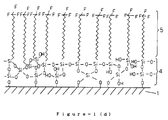
- Figures 1(a) to 1(d) are schematic sectional views showing steps of a process of laminating an organic monomolecular film of Example 1 of this invention.
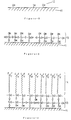
- Figures 2 to 4 are schematic sectional views showing steps of a process of laminating an organic monomolecular film of Example 2 of this invention.
- the method of the present invention permits the formation of e.g. a fluorocarbon-based monomolecular film with satisfactory close contact with respect to the substrate, which is pinhole-free and thin, thus improving the performance of, e.g., apparatuses requiring heat-resistant, weather-resistant and wear-resistant coatings such as hot plates, rice cookers and other electric products, vehicles, industrial apparatuses, glass lenses and mirrors.
- a fluorocarbon-based monomolecular film with satisfactory close contact with respect to the substrate, which is pinhole-free and thin, thus improving the performance of, e.g., apparatuses requiring heat-resistant, weather-resistant and wear-resistant coatings such as hot plates, rice cookers and other electric products, vehicles, industrial apparatuses, glass lenses and mirrors.
- the present invention provides a laminate which comprises a chemically adsorbed monomolecular film formed via an inorganic siloxane-based monomolecular or polymer film on a substrate surface, and a method of forming this laminate which comprises contacting a substrate having hydroxyl groups on the surface with a non-aqueous solution containing a material having a plurality of chlorosilyl groups in the molecule, removing the material remaining on the substrate without reaction by washing the substrate with a non-aqueous organic solution (at this time, if this process is omitted, a siloxane-based polymer film is prepared on the substrate), forming an inorganic siloxane-based film on the substrate after the removal step by exposing the substrate to moisture, and laminating a monomolecular adsorption film by causing a chemical adsorption of a chlorosilane-based surface active agent constituted by straight hydrocarbon chain molecules having a chlorosilyl group at one end onto the substrate after the first inorganic film formation
- an inorganic siloxane-based film having a silanol (-SiOH) group in the film may be formed even on a substrate which hardly has hydroxyl groups present on the surface, by holding the substrate dipped in a non-aqueous solution containing a material with chlorosilyl group in the molecule to bring about a reaction between hydroxyl groups on the substrate surface and chlorosilyl groups of the material.
- the remaining material having chlorosilyl groups is removed without reaction on the substrate by washing the substrate with a non-aqueous organic solvent, followed by washing the substrate with water or exposing the substrate to the air containing moisture.
- -SiOH bonds are formed on the substrate surface at this time, and they are bonded to the substrate via siloxane bonds. Accordingly, by subsequently causing chemical adsorption of another monomolecular film onto the inorganic film having the SiOH bonds, by using a non-aqueous solution containing a silane-based surface active agent containing a chlorosilyl group in the molecule, a hydrochloric acid removal reaction is brought about between -OH groups of the inorganic siloxane-based film, having been formed on the substrate surface in the previous step and having many SiOH groups, and chlorosilyl groups of the silane-based surface active agent, thus forming a monomolecular film chemically bonded via -SiO-bonds to the substrate.
- a substrate contains few hydroxyl groups although it is hydrophilic, such as those made of such metals as Al, Cu and stainless steel or plastic substrates with the surface rendered hydrophilic.
- hydrophilic groups present on the surface of the substrate and chlorosilyl groups react with each other. Therefore, when using a metal for the substrate, metals commonly called base metals are suitable.
- plastic material which does not have any oxide film on the surface it may be rendered hydrophilic, i.e., hydroxyl groups may be introduced onto it, in advance through a treatment of the surface in a plasma atmosphere containing oxygen at 100 W for 20 min or a corona treatment of the surface.
- a surface oxygen treatment is not necessary for plastics having -NH groups such as polyamide or polyurethane substrates. The reason for this is that -NH groups have an active hydrogen, so that it is easy to cause the dehydrochlorination reaction with chlorosilyl groups of the surface active agent.
- a material containing a plurality of chlorosilyl groups is used according to the invention, SiCl 4 , SiHCl 3 , SiH 2 Cl 2 , Cl-(SiCl 2 O) n - SiCl 3 wherein n is an integer and n is preferably in the range of 1 to 22, are suitable.
- SiCl 4 is is preferred because its molecule is small and highly active with respect to the hydroxyl group. thus having a great effect of uniformly rendering the substrate surface to be hydrophilic.
- the solution containing the material with a trichlorosilyl group may, for instance, be a non-aqueous solution containing chloroform.
- the concentration of the material containing a trichlorosilyl group in a molecule in the non-aqueous solution varies with the kind of the material containing a trichlorosilyl group in the molecule that is used or the solution containing such material, but a solution prepared by dissolving about one per cent by weight of the material is used.
- a hydrochloric acid removal reaction is brought about on the surface because of the presence of some hydrophilic -OH groups on the surface of the substrate, and thus a chlorosilane film having the material containing a trichlorosilyl group in the molecule is formed.
- the compound having a plurality of chlorosilyl groups in the molecule SiCl 4 , SiHCl 3 , SiH 2 Cl 2 , or Cl - (SiCl 2 O) n - SiCl 3 wherein n is an integer, may be used.
- a functional group for example an -OH group
- the substrate may be imparted with a functional property owing to the functional group.
- the compound containing a fluorocarbon group may be suitably used to impart a hydrophobic property, an oil-repelling property and lubricity.
- Examples of the compounds used for forming the monomolecular film and containing a hydrocarbon group and a chlorosilyl group in a molecule comprise CH 3 - (CH 2 ) r SiX p Cl 3-p CH 3 (CH 2 ) s O (CH 2 ) t SiX p Cl 3-p , CH 3 (CH 2 ) u - Si(CH 3 ) 2 (CH 2 ) v - SiX p Cl 3-p , and CF 3 COO (CH 2 ) w SiX p Cl 3-p , wherein r represents 1 to 25, s represents 0 to 12, t represents 1 to 20, u represents 0 to 12, v represents 1 to 20 and w represents 1 to 25.
- hydrocarbon-based surface active agent for example; CH 3 CH 2 O (CH 2 ) 15 SiCl 3 , CH 3 (CH 2 ) 2 Si(CH 3 ) 2 (CH 2 ) 15 S i Cl 3 , CH 3 (CH 2 ) 6 S i (CH 3 ) 2 (CH 2 ) 9 S i Cl 3 and CH 3 COO(CH 2 ) 15 SiCl 3 may be used in addition to the agent noted above.
- the invention can widely be applied to the following uses. Materials made of metal, ceramic, glass. plastic, wood and stone, for instance, are applicable to the substrate.
- the surface of the substrate can also be coated with, e.g., paint.
- cutlery a kitchen knife, scissors, a knife, a cutter, a graner, a razor, hair clippers, a saw, a plane, a chisel. a gimlet, a badkin, bite (cutting tools), the edge of a drill. the edge of a mixer and juicer brade, a blade of a mill, a blade of a lawnmower, a punch. a straw cutter, a staple of a stapler, a can opener or a surgical knife.
- needles an acupuncture, a needle, a sewing needle. a matting needle, an injection needle, a surgical needle. a safety pin.
- Examples of products in pottery (ceramics) industry products made of pottery, glass, ceramics or enameled products.
- sanitary potteries e.g., a chamber pot, a wash-bowl, a bathtub
- tableware e.g., a rice-bowl teacup, a dish (plate), a bowl, a teacup, a glass, a bottle, a coffee-pot (siphon), a pan, an earthenware mortar or a cup, vases ( a flower bowl, a flowerpot, a bud vase), water tanks ( e.g., a breeding cistern or an aquarium water tank), chemical experiment appliances (e.g., a beaker, a reactor vessel, a test tube, a flask, a laboratory dish, condenser, a mixing rod, a stirrer, a mortar, a bat, or a syringe) a roof tile, enameled ware, an enameled washbowl, and an enamele
- mirrors examples include a hand mirror, a full-length mirror, a bathroom mirror, a lavatory mirror, vehicle mirrors (e.g., a rear-view mirror, a side mirror, or a door mirror), half mirror, road mirrors such as a curve mirror, a show window glass, a salesroom in the department store. medical care mirrors, a concave mirror or a convex mirror.
- vehicle mirrors e.g., a rear-view mirror, a side mirror, or a door mirror
- half mirror road mirrors such as a curve mirror, a show window glass, a salesroom in the department store.
- medical care mirrors a concave mirror or a convex mirror.
- molding parts dies for press molding, dies for cast molding, dies for injection molding, dies for transfer molding, dies for compression molding, dies for transfer molding, dies for inflation molding, dies for vacuum molding. dies for blow forming, dies for extrusion molding, dies for fiber spinning or a calendar processing roll.
- Examples of ornaments a watch, a jewel, a pearl, a sapphire, a ruby, an emerald, a garnet, a cat's eye, a diamond, a topaz, a bloodstone, an aquamarine, a turquoise, an agate, a marble, an amethyst, a cameo, an opal, a crystal, a glass, a ring, a bracelet, a brooch, a tiepin (a stickpin), an earring, a necklace, jewelry made of platinum, gold, silver, copper, aluminium, titanium, tin and their alloys, stainless steel or a glass frame.
- Examples of forming molds for food cake, cookies, bread-baking, chocolate, jelly, ice cream, ovenware or an ice tray.
- cookware kitchen utensils (a pan and a pot), a kettle, a pot, a frying-pan, a hot plate, a toasting net or a takoyaki plate.
- Examples of papers photogravure paper, hydrophobic and oilphobic paper, poster paper, high-grade pamphlet paper, wrapping paper, package paper, drinking package paper, container paper, printing paper or synthetic insulating paper.
- resin(s) examples include a polyolefin such as a polypropylene and polyethylene, a polyvinyichloride plastic, a polyamide, a polyimide, a polyamideimide, a polyester, an aromatic polyester, a polycarbonate, a polystyrene, a polysulfide, a polysulfone, a polyethersulfone, a polyphenylensulfide, a phenolic resin. a furan resin, a urea resin, an epoxy resin, a polyurethane, a silicon resin, an ABS resin. a methacrylic resin, an acrylate resin, a polyacetal, a polyphenylene oxide, a poly methylpentene. a melamine resin, an alkyd resin and an unsaturated polyester cured resin.
- a polyolefin such as a polypropylene and polyethylene
- a polyvinyichloride plastic such as a polyvinyichloride plastic
- rubber(s) examples include styrene-butadien rubber, butyl rubber, nitrile rubber, chloroprene rubber, polyurethane rubber and silicon rubber.
- Examples of household electrical appliances a television, a radio, a taperecorder, an audio, a compact disc (CD), a refrigerator of freezing machines, a freezer, an air conditioner, a juicer, a mixer, a blade of an electric fan, a lighting apparatus, a dial plate and a dryer(or drier) for perm.
- a television a radio, a taperecorder, an audio
- a compact disc CD
- a refrigerator of freezing machines a freezer
- an air conditioner a juicer
- a mixer a blade of an electric fan
- a lighting apparatus a dial plate and a dryer(or drier) for perm.
- Examples of sports articles skis, fishing rods, poles for pole vaulting, boats, yachts, surfboards, golf balls, bowiing balls, fishing line (yarn), fishing nets and floats floats.
- Examples of office supplies a fountain pen, a ballpoint pen, a propelling pencil (an automatic or a mechanical pencil), a pencil case, a binder, a desk, a chair, a bookshelf, a rack, a telephone stand table, a rule (measure) and a drawing instrument.
- roof materials materials for a roof, and outer wall and interiors.
- Roof materials such as, e.g., brick, slate and tin (a galvanized iron sheet).
- Outer wall materials such as wood (including processed manufactured wood), mortar, concrete, ceramics sizing, metallic sizing, brick, stone, plastics and metal like aluminium.
- Interior materials such as, e.g., a wood (indluding a processed wood), a metal like aluminium, plastic, paper and fiber.
- Examples of building stones granite, marble and others, e.g., used for use as a building, a building material, an architecture, an ornament, a bath, a gravestone. a monument, a gatepost, a stone wall and a paving stone.
- Examples of musical instruments and a sound apparatus a percussion instrument. a stringed instrument, a keyboard instrument, a woodwind instrument, the brass, and a sound apparatus such as a microphone and a speaker.
- musical instruments such as a drum, a cymbal, a violin, a cello. a guitar, a koto (harp), a piano, a flute, a clarinet, a bamboo flute and a horn, and sound apparatuses such as a microphone, a speaker and an ear-phone.
- Further examples are a thermos bottle, a vacuum bottle and a vacuum vessel.
- Examples of a highly resisiting voltage insulator E.g., a power supplying insulator or a spark plug, which have a highly hydrophobic , oilphobic and prevention of contamination properties.
- the inorganic monomolecular film 4 thus obtained was perfectly bonded by chemical bonds of -SiO- to the substrate and never separated from the substrate.
- the monomolecular film 5 containing fluorine was also bonded to the inner inorganic siloxane monomolecular film 4 by covalent bonds as shown in Figure 1(d).
- fluorocarbon-based surface active agent CF 3 CH 2 O(CH 2 15 SiCl 3 , CF 3 (CH 2 ) 2 Si(CH 3 ) 2 (CH 2 ) 15 SiCl 3 , F(CF 2 ) 4 (CH 2 ) 2 Si(CH 3 ) 2 (CH 2 ) 9 SiCl 3 , CF 3 COO (CH 2 ) 15 SiCl 3 may be used in addition to the agent noted above. With any of these agents, satisfactory results could be obtained.
- the invention is never limited to fluorine-containing systems; for instance, it can be usefully applied to super-thin protective films having mechanical strength. In such cases, fluorine is not essential.
- a back mirror 11 made of an acrylate resin permitting weight reduction of the car which was hydrophobic was treated in a plasma atmosphere containing oxygen at 100 W for 20 minutes. Next, it was dipped for about 30 minutes in a solution obtained by dissolving a material represented by the formula [4] of 1 % wt, as a material containing a plurality of chlorosilyl groups in the molecule in a freon 113 solvent as a non-aqueous solvent.
- the inorganic monomolecular film 13 thus obtained is perfectly bonded via covalent bonds of -SiO- to the surface of the back mirror 11 and thus never separated. It also has a great number of -SiOH bonds on its surface.
- the back mirror 11 with the inorganic siloxane monomolecular film 13 formed thereon was held dipped for about one hour in the solution noted before in Example 1.
- a monomoleclar film represented by the formula [3] was laminated on the surface of the inorganic siloxane monomolecular film 13 as shown in Figure 4.
- a chemically adsorbed monomolecular film 14 containing fluorine was formed with a thickness of about 1.5 nm on the entire mirror surface, and it was also chemically bonded to the inner inorganic siloxane monomolecular film 13.
- the treated back mirror in this example was trial used.
- Example 1 a single silane-based surface active agent layer containing fluorine was laminated on a single inorganic siloxane-based monomolecular film.
- the same effects of the invention are obtainable by laminating any desired number of chemically adsorbed monomolecular films.
- Example 2 The same experiment as in Example 2 was conducted except for using a polycarbonate resin substrate instead of the acrylic resin substrate, using tridecafluorooctyltrichlorosilane [CF 3 (CF 2 ) 5 CH 2 CH 2 SiCl 3 ] instead of heptadecafluorodecyl-trichlorosilane [CF 3 (C F 2 ) 7 (CH 2 ) 2 SiCl 3 ] and using 1,1-dichloro-2,2,3,3,3-pentafluoropropane instead of freon 113.
- Example 2 The same experiment as in Example 1 was conducted except for using a stainless steel substrate instead of the Al substrate and using tridecafluorooctyltrichlorosilane instead of heptadecafluorodecyltrichlorosilane.
- Example 2 The same experiment as in Example 2 was conducted except for using an ABS resin substrate instead of the acrylate resin substrate.
- Example 2 The same experiment as in Example 2 was conducted except for using an epoxy resin substrate instead of the acrylate resin substrate.
- Example 2 The same experiment as in Example 2 was conducted except for using a polyurethane resin substrate instead of the acrylate resin substrate.
- Example 2 The same experiment as in Example 2 was conducted except for using a butadiene-styrene rubber substrate instead of the acrylate resin substrate and using 1.1-dtcyclo 2,2,3,3,3-pentafluoropropane instead of freon 113.
- Example 2 The same experiment as in Example 2 was conducted except for using a butyl rubber substrate instead of the acrylate resin substrate and using 1,1-dicyclo-2,2,3,3,3-pentafluoropropane instead of freon 113.
- Example 2 The same experiment as in Example 2 was conducted except for using a nitrile rubber substrate instead of the acrylate resin substrate and using 1,1-dicyclo-2,2,3,3,3--pentafluoropropane instead of freon 113.
- a chemically adsorbed monomolecular film was formed in the same manner as in Example 2 except for using 18-nonadecenyltrichlorosilane instead of heptadecafluorodecyltrichlorosilane, followed by irradiation with a 300-keV 0.02-Mrads electron beam in a Nitrogen atmosphere for 1 min.
- Example 2 The same experiment as in Example 2 was conducted except for using tetracyclosilane instead of heptadecafluorodecyl-trichlorosilane.
- Example 2 The same experiment as in Example 2 was conducted except for adopting, instead of the oxidation method, a method, in which the substrate was dipped for 5 minutes in concentrated sulfuric acid containing 10 % wt, of potassium dichromate.
- a polycarbonate substrate was spin coated with a methanol solution containing 2 % wt of a silane-based coupling agent (i.e., heptadecafluorodecyltrimethoxysilane), followed by drying at 20 °C for 1 hour.
- a silane-based coupling agent i.e., heptadecafluorodecyltrimethoxysilane
- Example 2 On the polycarbonate substrate in Example 2 was formed a chemically adsorbed monomolecular film of heptadecafluorodecyl-trichlorosilane without carrying out any oxidation treatment.
- Example 2 The polycarbonate substrate in Example 2 was spin coated with a suspension of polytetrafluoroethylene, followed by thermal drying at 120 °C for 1 hour.
- the laminates according to the invention retained the hydrophobic and oil-repelling properties or were hydrophobic even after repeated washing of the surface with a water-containing cloth.
- the samples of the Comparative examples no longer retained the hydrophobic and/or oil-repelling properties.
- the laminates according to the invention those provided with a chemical adsorption monomolecular film containing fluoroalkyl groups excellently prevented contamination.
- the sample of Example 2 was dipped in salad oil, and oil attached in this way could be perfectly wiped off with tissue paper.
- the surface was sticky with an oil film remaining on its surface even after wiping the surface many times with tissue paper.
- the laminates according to the invention can be utilized as optical material as well.
- the permeability of visible light was 92 %, which was the same as the value before the formation of the chemical adsorption monomolecular film.
- the sample of Comparative example 3 coated with polytetrafluoroethylene the permeability of visible light was reduced to 50 % or below, which is as bad as that of frosted glass.
- any of the above examples concerned the formation of a single monomolecular film, a polymer composition which was obtained by laminating chemical adsorption monomolecular films or a chemical adsorption film obtained without removal of the non-reacted chlorosilane surface active agent provided the same function. Further, while any of the above examples used a substrate composed of a sole polymer as a polymer-containing substrate, polymers containing, e.g., fillers, plasticizers or coloring agents permitted to obtain the same functions as imparted to polymer compositions.
- This example concerns a knife, which contains few hydroxyl groups although it is hydrophilic.
- a knife may be made of such metal as aluminum, copper or stainless steel. or it may be a plastic knife with the surface made hydrophilic.
- a knife made of a plastic material in situ, i.e.. without any oxide film on the surface, may be treated in advance to make the surface hydrophilic, i.e., introduce hydroxyl groups. This may be done by treating the surface in an oxygen-containing plasma atmosphere at 100 W for 20 minutes, for instance.
- a non-aqueous solution containing a material containing a plurality of chlorosilyl groups in the molecule for instance SiCl 4 , SiHCl 3 , SiH 2 Cl 2 or Cl - (SiC l 2 O) n SiCl 3 , n being an integer, preferably SiC l 4 having a small molecular size, having a high activity to the hydroxyl group and hence being highly effective for making the knife surface uniformly hydrophilic
- a hydrochloric acid removal reaction is brought about on the knife surface owing to some hydrophilic -OH groups present on the surface, whereby a chlorosilane film is formed from the material containing a plurality of chlorosilyl groups in the molecule.
- a hydrochloric acid removal reaction is brought about on the knife surface owing to a small amount of hydrophilic OH groups exposed on the surface to fix molecules to the surface via -SiO- bonds such as Si(Cl) 3 O - or - OSi(Cl) 2 O -.
- the knife is washed with the freon 113 to remove the material remaing on the surface without reaction, followed by washing with water to convert the-SiCl groups to -SiOH groups.
- the inorganic monomolecular film having many hydroxyl groups thus formed is perfectly bonded to the knife via covalent bonds of -SiO-. It is never separated as long as no decomposition reaction takes place. Its surface has a great number of -SiOH bonds, the number corresponding to about three times the initial number of hydroxyl groups.
- the knife which had the aforementioned inorganic monomolecular film having a great number of -SiOH groups formed on its surface was dipped in a non-aqueous solution containing CF 3 (CF 2 ) 7 (CH 2 ) 2 SiCl 3 at a concentration of 1 % wt, in a solvent containing 80 % wt n-hexadecane, 12 % wt of carbon tetrachloride and 8 % wt chloroform for 1 h.
- bonds of CF 3 (CF 2 ) 7 (CH 2 ) 2 Si(O-) 3 were formed on the knife surface, and a fluorine-containing monomolecular film was formed to a thickness of about 2.0 nm on the entire surface of the knife such that it was chemically bonded to the inner inorganic siloxane monomolecular film.
- This fluorocarbon-based monomolecular film was never separated in a checkerboard test.
- This exampie concerns a porcelain dish, which contains few hydroxyl groups although it is hydrophilic.
- a non-aqueous solution containing a material with a plurality of chlorosilyl groups in the molecule for instance SiCl 4 having a small molecular size and being highly active with respect to the hydroxyl group and thus highly effective for uniformly making the porcelain surface hydrophilic
- a solution prepared by dissolving 1 % wt of the material noted above in a chloroform solvent a hydrochloric acid removal reaction is brought about on the surface owing to some hydrophilic -OH groups present on the porcelain surface, and thus a chlorosilane film is formed from the material containing a plurality of chlorosilyl groups in the molecule.
- a hydrochloric acid removal reaction is brought about on the porcelain dish surface owing to a small amount of hydrophilic -OH groups exposed on the porcelain surface to fix the molecules to the surface via -SiO- bonds such as Si(Cl) 3 O-.
- the porcelain dish is washed with the freon 113 to remove the material remaining on the surface without reaction, followed by washing with water, thus converting the -SiCl groups to -SiOH groups.
- the inorganic monomolecular film thus obtained is perfectly bonded to the surface via covalent bonds of -SiO- and thus is never separated. It has a great number of -SiOH groups on its surface. the number corresponding to about three times the initial number of hydroxyl groups.
- the porcelain dish which had the aforementioned inorganic monomolecular film having a great number of -SiOH groups formed on its surface is dipped in a non-aqueous solution containing CF 3 (CF 2 ) 7 (CH 2 ) 2 SiCl 3 at a concentration of 1 % wt, in a solvent containing 80 % wt n-hexadecane, 12 % wt of carbon tetrachloride and 8 % wt chloroform for 1 hour.
- bonds of CF 3 (CF 2 ) 7 (CH 2 ) 2 Si(O-) 3 were produced on the porcelain dish surface, and a fluorine-containing monomolecular film was formed to a thickness of about 2.0 nm on the entire surface of the porcelain dish such that it was chemically coupled to the inner inorganic siloxane-based monomolecular film.
- This fluorocarbon-based monomolecular film was never separated in a separation test.
- This example concerns a metal pan such as an aluminum or stainless steel pan, which contains few hydroxyl groups although it is hydrophilic.
- a metal pan such as an aluminum or stainless steel pan, which contains few hydroxyl groups although it is hydrophilic.
- the inorganic monomolecular film having many hydroxyl groups thus formed is perfectly bonded to the pan via covalent bonds of -SiO- and is thus never separated. It has a great number of -SiOH bonds on the surface, the number corresponding to about three times the initial number of hydroxyl groups.
- the pan which had the aforementioned inorganic monomolecular film having a great number of -SiOH groups formed on its surface was dipped in a non-aqueous solution containing CF 3 (CF 2 ) 7 (CH 2 ) 2 SiCl 3 at a concentration of 1% wt, in a solvent containing 80 % wt n-hexadecane, 12 % wt of carbon tetrachloride and 8 % wt chloroform for 1 hour.
- bonds of CF 3 (CF 2 ) 7 (CH 2 ) 2 Si(O-) 3 were produced on the pan surface, and a fluorine-containing monomolecular film was formed to a thickness of about 1.5 nm on and over the entirety of the pan surface such that it was chemically bonded to the inner inorganic siloxane monomolecular film.
- This monomolecular film was never separated in a separation test.
- This example concerns a porcelain coffee cup which contains few hydroxyl groups although it is hydrophilic.
- a non-aqueous solution containing a material containing a plurality of chlorosilyl groups for instance SiC l 4
- a hydrochloric acid removal reaction is brought about on the surface, and a chlorosilane film of the material containing a plurality of chlorosilyl groups is formed.
- the inorganic monomolecular film having many hydroxyl groups thus formed is perfectly bonded to the coffee cup via covalent bonds of -SiO- and is thus never separated. It has a great number of -SiOH bonds on the surface, the number corresponding to about three times the initial number of hydroxyl groups.
- the coffee cup which had the aforementioned inorganic monomolecular film having a great number of -SiOH groups formed on its surface was dipped in a non-aqueous solution containing CH 3 (CH 2 ) 11 SiCl 3 at a concentration of 1 % wt, in a solvent containing 80 % wt n-hexadecane, 12 % wt of carbon tetrachloride and 8 % wt chloroform for 1 hour.
- the invention concerns a laminate which comprises a chemically adsorbed monomolecular film formed on a substrate surface via an inorganic siloxane-based monomolecular or polymer film, and a method of manufacturing this laminate as specified above.
- a fluorocarbon-based monomolecular film having excellent hydrophilic and oil-repelling properties may be formed even on a metal substrate such as Al, Cu and stainless steel substrates in a state chemically bonded to the substrate, at a high density, pinhole-free, with a uniform thickness and very thin. It is thus possible to provide a very highly durable, high performance and super-thin fluorocarbon-based film.
- the laminate according to the invention may be used for, e.g., apparatuses requiring heat-resistant, whether-resistant and wear-resistant super-thin film coatings such as electronic products, particularly electric products such as hot plates and rice cookers, vehicles industrial apparatuses, mirrors and glass lenses.
- the invention is greatly beneficial to the industry.
Landscapes
- Chemical & Material Sciences (AREA)
- Engineering & Computer Science (AREA)
- Organic Chemistry (AREA)
- Nanotechnology (AREA)
- Ceramic Engineering (AREA)
- Materials Engineering (AREA)
- Crystallography & Structural Chemistry (AREA)
- Structural Engineering (AREA)
- Life Sciences & Earth Sciences (AREA)
- Medicinal Chemistry (AREA)
- Chemical Kinetics & Catalysis (AREA)
- Health & Medical Sciences (AREA)
- Physics & Mathematics (AREA)
- General Physics & Mathematics (AREA)
- Condensed Matter Physics & Semiconductors (AREA)
- Wood Science & Technology (AREA)
- Polymers & Plastics (AREA)
- Pharmacology & Pharmacy (AREA)
- Molecular Biology (AREA)
- General Health & Medical Sciences (AREA)
- Bioinformatics & Cheminformatics (AREA)
- General Engineering & Computer Science (AREA)
- Medical Informatics (AREA)
- Composite Materials (AREA)
- Biotechnology (AREA)
- Biophysics (AREA)
- Manufacturing & Machinery (AREA)
- Laminated Bodies (AREA)
- Application Of Or Painting With Fluid Materials (AREA)
- Manufacture Of Macromolecular Shaped Articles (AREA)
Claims (11)
- Stratifié comprenant un film inorganique à base de siloxane lié de façon covalente à la surface d'un substrat, et un film monomoléculaire formé en liant de façon covalente un surfactant ayant une chaîne carbonée linéaire et un groupe chlorosilyle à une extrémité, audit film inorganique à base de siloxane.
- Stratifié selon la revendication 1, dans lequel ledit film inorganique à base de siloxane est un film polymère ou monomoléculaire inorganique à base de siloxane.
- Stratifié selon la revendication 1, dans lequel ledit film monomoléculaire contient du fluor.
- Stratifié selon la revendication 1, dans lequel ledit substrat est choisi parmi les métaux, les céramiques et les matières plastiques.
- Procédé de fabrication d'un stratifié selon la revendication 1, comprenant les étapes consistant à :mettre en contact un substrat ayant des groupes hydroxyles sur la surface de celui-ci, avec une solution non aqueuse contenant une matière inorganique ayant plusieurs groupes chlorosilyles dans la molécule,former un film polymère inorganique à base de siloxane sur ledit substrat en faisant réagir lesdits groupes chlorosilyles avec de l'eau, etformer un film monomoléculaire en liant de façon covalente un surfactant ayant une chaîne carbonée linéaire et un groupe chlorosilyle à une extrémité, audit film polymère inorganique à base de siloxane.
- Procédé de fabrication d'un stratifié selon la revendication 1, comprenant les étapes consistant à :mettre en contact un substrat ayant des groupes hydroxyles sur la surface de celui-ci, avec une solution non aqueuse contenant une matière inorganique ayant plusieurs groupes chlorosilyles dans la molécule,éliminer la matière inorganique n'ayant pas réagi restant sur ledit substrat, en lavant ledit substrat avec un solvant organique non aqueux,former un film monomoléculaire inorganique à base de siloxane sur ledit substrat, en faisant réagir lesdits groupes chlorosilyles avec de l'eau après ladite étape d'élimination, etformer un film monomoléculaire en liant de façon covalente un surfactant ayant une chaîne carbonée linéaire et un groupe chlorosilyle à une extrémité, audit film monomoléculaire inorganique à base de siloxane.
- Procédé selon la revendication 5 ou 6, dans lequel ledit substrat est choisi parmi les métaux, les céramiques et les matières plastiques.
- Procédé selon la revendication 5 ou 6, dans lequel ledit substrat est un substrat en plastique dont la surface a été rendue hydrophile à l'avance par un traitement dans une atmosphère de plasma ou à effet corona contenant de l'oxygène.
- Procédé selon la revendication 5 ou 6, dans lequel ladite matière inorganique ayant plusieurs groupes chlorosilyles dans la molécule est choisie dans le groupe constitué de SiCl4, SiHCl3, SiH2Cl2 et de Cl-(SiCl2O)n-SiCl3, où n est un nombre entier.
- Procédé selon la revendication 5 ou 6, dans lequel la chaîne carbonée dudit surfactant ayant un groupe chlorosilyle est partiellement substituée par un groupe -CF2-.
- Procédé selon la revendication 10, dans lequel ledit surfactant ayant un groupe chlorosilyle est CF3-(CF2)n-(R)m-SiXpCl3-p, où n représente 0 ou un nombre entier, R représente un groupe alkylène ou un groupe substituant contenant une liaison C≡C, une liaison C=C, un atome de silicium ou un atome d'oxygène, m représente 0 ou 1, X représente un atome d'hydrogène ou un groupe substituant choisi dans le groupe constitué d'un groupe alkyle, d'un groupe alcoxy, d'un groupe alkyle contenant du fluor et d'un groupe alcoxy contenant du fluor, et p représente 0, 1 ou 2.
Applications Claiming Priority (12)
| Application Number | Priority Date | Filing Date | Title |
|---|---|---|---|
| JP28912890 | 1990-10-25 | ||
| JP289128/90 | 1990-10-25 | ||
| JP40575490 | 1990-12-25 | ||
| JP405754/90 | 1990-12-25 | ||
| JP3024026A JPH089510B2 (ja) | 1991-01-23 | 1991-01-23 | 防汚性窯業製品およびその製造方法 |
| JP24026/91 | 1991-01-23 | ||
| JP3024025A JP2501248B2 (ja) | 1991-01-23 | 1991-01-23 | 単分子コ―ティング物体及びその製造方法 |
| JP24025/91 | 1991-01-23 | ||
| JP3008321A JPH0791402B2 (ja) | 1991-01-28 | 1991-01-28 | 高分子組成物の製造方法 |
| JP8321/91 | 1991-01-28 | ||
| JP3038137A JPH0798026B2 (ja) | 1991-02-06 | 1991-02-06 | 調理器具およびその製造方法 |
| JP38137/91 | 1991-02-06 |
Publications (3)
| Publication Number | Publication Date |
|---|---|
| EP0484746A2 EP0484746A2 (fr) | 1992-05-13 |
| EP0484746A3 EP0484746A3 (en) | 1992-10-28 |
| EP0484746B1 true EP0484746B1 (fr) | 1996-09-18 |
Family
ID=27548120
Family Applications (1)
| Application Number | Title | Priority Date | Filing Date |
|---|---|---|---|
| EP19910118094 Expired - Lifetime EP0484746B1 (fr) | 1990-10-25 | 1991-10-23 | Lamination d'un film monomoléculaire par adsoprtion chimique et procédé de fabrication de ce film |
Country Status (5)
| Country | Link |
|---|---|
| US (2) | US5380585A (fr) |
| EP (1) | EP0484746B1 (fr) |
| KR (1) | KR950004153B1 (fr) |
| CA (1) | CA2054094C (fr) |
| DE (1) | DE69122212T2 (fr) |
Cited By (1)
| Publication number | Priority date | Publication date | Assignee | Title |
|---|---|---|---|---|
| US8814862B2 (en) | 2005-05-12 | 2014-08-26 | Innovatech, Llc | Electrosurgical electrode and method of manufacturing same |
Families Citing this family (80)
| Publication number | Priority date | Publication date | Assignee | Title |
|---|---|---|---|---|
| DE69129145T2 (de) * | 1990-12-25 | 1998-07-16 | Matsushita Electric Ind Co Ltd | Transparentes Substrat mit aufgebrachtem monomolekularem Film und Verfahren zu seiner Herstellung |
| DE69211181T2 (de) * | 1991-02-27 | 1996-10-10 | Matsushita Electric Industrial Co., Ltd., Kadoma, Osaka | Selbstschmierende Vorrichtung |
| EP0511548B1 (fr) * | 1991-04-30 | 1997-07-09 | Matsushita Electric Industrial Co., Ltd. | Film chimiquement adsorbé et procédé pour le fabriquer |
| US5372851A (en) * | 1991-12-16 | 1994-12-13 | Matsushita Electric Industrial Co., Ltd. | Method of manufacturing a chemically adsorbed film |
| US5869136A (en) * | 1992-02-27 | 1999-02-09 | Matsushita Electric Industrial Co., Ltd. | Method of manufacturing a chemically adsorbed multilayer film |
| US5552236A (en) * | 1992-03-16 | 1996-09-03 | Matsushita Electric Industrial Co., Ltd. | Organic magnetic film and method of manufacturing the same |
| EP0571896B1 (fr) * | 1992-05-27 | 1996-08-28 | Matsushita Electric Industrial Co., Ltd. | Procédé de fabrication d'un film absorbé chimiquement |
| FR2694369A1 (fr) * | 1992-07-29 | 1994-02-04 | Lyon Ecole Centrale | Procédé de lubrification d'une pièce mécanique de frottement. |
| EP0606174A1 (fr) * | 1993-01-05 | 1994-07-13 | Elf Atochem S.A. | Solide muni d'une couche hydrophobe et oléophobe et procédé d'application de ladite couche |
| US5888290A (en) * | 1996-05-24 | 1999-03-30 | Minnesota Mining And Manufacturing Company | Composition and process for imparting durable repellency to substrates |
| TW422822B (en) * | 1996-04-04 | 2001-02-21 | Matsushita Electric Industrial Co Ltd | Contamination-resistant float glass and process for producing the same as well as cooking device using said contamination-resistant float glass |
| TW470861B (en) * | 1996-08-26 | 2002-01-01 | Matsushita Electric Industrial Co Ltd | Chemical adsorption film, method of manufacturing the same, and chemical absorption solution used for the same |
| US5948476A (en) * | 1996-11-08 | 1999-09-07 | Matsushita Electric Industrial Co., Ltd. | Method and apparatus for producing molecular film |
| JP3773340B2 (ja) * | 1996-12-18 | 2006-05-10 | 大日本印刷株式会社 | 低屈折率SiO2 膜及びその製造方法 |
| US6482524B1 (en) * | 1997-03-11 | 2002-11-19 | Nippon Sheet Glass Co., Ltd. | Substrate having a treatment surface |
| US5955149A (en) * | 1997-05-23 | 1999-09-21 | Material Sciences Corporation | Method and composition for producing a release coating on a bakeware substrate |
| FR2769318B1 (fr) * | 1997-10-06 | 1999-12-10 | Saint Gobain Vitrage | Revetement hydrophobe notamment pour vitrage |
| US7070839B2 (en) | 1998-09-16 | 2006-07-04 | Matsushita Electric Industrial Co., Ltd. | Functional film, method of fabricating the same, liquid crystal display device using functional film, and method of fabricating the same |
| EP1153740A4 (fr) * | 1998-09-16 | 2004-12-08 | Matsushita Electric Industrial Co Ltd | Film fonctionnel, procede de fabrication de ce film, element d'affichage a cristaux liquides utilisant ce film et procede de production de cet element d'affichage |
| FR2787350B1 (fr) | 1998-12-21 | 2002-01-04 | Saint Gobain Vitrage | Vitrage a revetement mesoporeux fonctionnel, notamment hydrophobe |
| US6503359B2 (en) * | 1999-03-05 | 2003-01-07 | Burstein Technologies, Inc. | Monomolecular adhesion methods for manufacturing microfabricated multilaminate devices |
| US6531224B1 (en) * | 1999-03-19 | 2003-03-11 | Battelle Memorial Institute | Self-assembled monolayer and method of making |
| US7629028B2 (en) * | 1999-03-19 | 2009-12-08 | Battelle Memorial Insitute | Methods of making monolayers |
| US6485785B1 (en) * | 1999-08-31 | 2002-11-26 | Matsushita Electric Industrial Co., Ltd. | Coating film, and method and apparatus for producing the same |
| WO2001044592A1 (fr) * | 1999-12-15 | 2001-06-21 | Toto Ltd. | Cuvette de toilettes a chasse d'eau dotee d'une fonction antiadhesion du tartre, composition de revetement pour la fonction et procede de prevention de l'adhesion du tartre sur la cuvette de toilettes a chasse |
| FR2804116B1 (fr) * | 2000-01-20 | 2002-08-23 | Centre Nat Rech Scient | Composes organosilicies, leur procede de preparation et leurs utilisations |
| DE10016485A1 (de) * | 2000-04-01 | 2001-10-11 | Dmc2 Degussa Metals Catalysts | Glas-, Keramik- und Metall-Substrate mit selbstreinigender Oberfläche, Verfahren zu deren Herstellung und deren Verwendung |
| US6686522B2 (en) | 2000-06-22 | 2004-02-03 | Shinko Corporation | Musical instrument with a body made of polyurethane foam |
| US6743516B2 (en) | 2000-09-29 | 2004-06-01 | Guardian Industries Corporation | Highly durable hydrophobic coatings and methods |
| NZ525472A (en) * | 2000-10-19 | 2005-07-29 | Inax Corp | Process for stain resistant treatment and product having glass layer, reinforced ceramic product and process for producing the same, and product having glass layer and process for producing the same |
| DE10063739B4 (de) | 2000-12-21 | 2009-04-02 | Ferro Gmbh | Substrate mit selbstreinigender Oberfläche, Verfahren zu deren Herstellung und deren Verwendung |
| DE10106213A1 (de) * | 2001-02-10 | 2002-08-22 | Dmc2 Degussa Metals Catalysts Cerdec Ag | Selbstreinigende Lackbeschichtungen und Verfahren und Mittel zur Herstellung derselben |
| US20020168663A1 (en) * | 2001-02-27 | 2002-11-14 | Phan Brigitte Chau | Methods for DNA conjugation onto solid phase including related optical biodiscs and disc drive systems |
| US7662009B2 (en) * | 2001-08-10 | 2010-02-16 | Panasonic Corporation | Organic electronic device, method of producing the same, and method of operating the same |
| EP1449641A4 (fr) * | 2001-11-08 | 2007-06-13 | Nippon Sheet Glass Co Ltd | Article recouvert d'un film et article fonctionnel recouvert d'un film utilisant celui-ci |
| JP4474105B2 (ja) * | 2002-02-15 | 2010-06-02 | キヤノン株式会社 | 撥水性部材、及び、インクジェットヘッドの製造方法 |
| JP2004351608A (ja) * | 2003-05-07 | 2004-12-16 | Institute Of Physical & Chemical Research | ナノ材料の製造方法およびナノ材料 |
| US7442412B2 (en) * | 2003-05-08 | 2008-10-28 | Texas Instruments Incorporated | Hydrophobic coating for oxide surfaces |
| EP1548158A3 (fr) * | 2003-12-24 | 2008-12-10 | Panasonic Corporation | Substrat pour la cristallisation et procédé pour sa production |
| US7138186B2 (en) * | 2004-02-05 | 2006-11-21 | Guardian Industries Corp. | Hydrophobic coatings and methods |
| US8814861B2 (en) | 2005-05-12 | 2014-08-26 | Innovatech, Llc | Electrosurgical electrode and method of manufacturing same |
| DE102005052939A1 (de) * | 2005-11-03 | 2007-05-10 | Degussa Gmbh | Herstellung von beschichteten Substraten |
| FR2908406B1 (fr) | 2006-11-14 | 2012-08-24 | Saint Gobain | Couche poreuse, son procede de fabrication et ses applications. |
| US8697234B2 (en) | 2008-05-09 | 2014-04-15 | Amf Gmbh | Self-assembled monolayers and method of production |
| US11786036B2 (en) | 2008-06-27 | 2023-10-17 | Ssw Advanced Technologies, Llc | Spill containing refrigerator shelf assembly |
| US8286561B2 (en) | 2008-06-27 | 2012-10-16 | Ssw Holding Company, Inc. | Spill containing refrigerator shelf assembly |
| EP2346678B1 (fr) | 2008-10-07 | 2017-10-04 | Ross Technology Corporation | Surfaces anti-éclaboussures à bordures hydrophobes et oléophobes |
| EP2251455B1 (fr) | 2009-05-13 | 2017-09-06 | SiO2 Medical Products, Inc. | Revêtement PECVD utilisant un précurseur organosilicié |
| WO2010150029A1 (fr) * | 2009-06-26 | 2010-12-29 | Steelite International Plc | Traitement de surface de céramiques |
| US9458536B2 (en) | 2009-07-02 | 2016-10-04 | Sio2 Medical Products, Inc. | PECVD coating methods for capped syringes, cartridges and other articles |
| ES2613885T3 (es) | 2009-11-04 | 2017-05-26 | Ssw Holding Company, Inc. | Superficies de aparatos de cocción que tienen un patrón de confinamiento de salpicaduras y procedimientos de fabricación de las mismas |
| JP5299260B2 (ja) * | 2009-12-24 | 2013-09-25 | 信越化学工業株式会社 | 固体材料の表面処理方法 |
| CA2796305A1 (fr) | 2010-03-15 | 2011-09-22 | Ross Technology Corporation | Piston et procedes de production de surfaces hydrophobes |
| US11624115B2 (en) | 2010-05-12 | 2023-04-11 | Sio2 Medical Products, Inc. | Syringe with PECVD lubrication |
| US9878101B2 (en) | 2010-11-12 | 2018-01-30 | Sio2 Medical Products, Inc. | Cyclic olefin polymer vessels and vessel coating methods |
| CN103476898A (zh) | 2011-02-21 | 2013-12-25 | 罗斯科技公司 | 具有低voc粘合剂体系的超疏水性和疏油性涂层 |
| US9272095B2 (en) | 2011-04-01 | 2016-03-01 | Sio2 Medical Products, Inc. | Vessels, contact surfaces, and coating and inspection apparatus and methods |
| DE102011085428A1 (de) | 2011-10-28 | 2013-05-02 | Schott Ag | Einlegeboden |
| US11116695B2 (en) | 2011-11-11 | 2021-09-14 | Sio2 Medical Products, Inc. | Blood sample collection tube |
| CN103930595A (zh) | 2011-11-11 | 2014-07-16 | Sio2医药产品公司 | 用于药物包装的钝化、pH保护性或润滑性涂层、涂布方法以及设备 |
| EP2791255B1 (fr) | 2011-12-15 | 2017-11-01 | Ross Technology Corporation | Composition et revêtement pour une performance superhydrophobe |
| CA2887352A1 (fr) | 2012-05-09 | 2013-11-14 | Sio2 Medical Products, Inc. | Enrobage protecteur en saccharide pour conditionnement pharmaceutique |
| EP2864430A4 (fr) | 2012-06-25 | 2016-04-13 | Ross Technology Corp | Revêtements élastomères ayant des propriétés hydrophobes et/ou oléophobes |
| US20150297800A1 (en) | 2012-07-03 | 2015-10-22 | Sio2 Medical Products, Inc. | SiOx BARRIER FOR PHARMACEUTICAL PACKAGE AND COATING PROCESS |
| JP6509734B2 (ja) | 2012-11-01 | 2019-05-08 | エスアイオーツー・メディカル・プロダクツ・インコーポレイテッド | 皮膜検査方法 |
| US9903782B2 (en) | 2012-11-16 | 2018-02-27 | Sio2 Medical Products, Inc. | Method and apparatus for detecting rapid barrier coating integrity characteristics |
| US9764093B2 (en) | 2012-11-30 | 2017-09-19 | Sio2 Medical Products, Inc. | Controlling the uniformity of PECVD deposition |
| WO2014085348A2 (fr) | 2012-11-30 | 2014-06-05 | Sio2 Medical Products, Inc. | Contrôle de l'uniformité de dépôt chimique en phase vapeur activé par plasma (pecvd) sur des seringues médicales, des cartouches et analogues |
| CN103073994A (zh) * | 2013-01-16 | 2013-05-01 | 浙江大学 | 一种利用空间位阻制备均相混合自组装单分子膜的方法 |
| EP2961858B1 (fr) | 2013-03-01 | 2022-09-07 | Si02 Medical Products, Inc. | Seringue revetu. |
| US9937099B2 (en) | 2013-03-11 | 2018-04-10 | Sio2 Medical Products, Inc. | Trilayer coated pharmaceutical packaging with low oxygen transmission rate |
| CN105392916B (zh) | 2013-03-11 | 2019-03-08 | Sio2医药产品公司 | 涂布包装材料 |
| EP2971227B1 (fr) | 2013-03-15 | 2017-11-15 | Si02 Medical Products, Inc. | Procede de revetement. |
| CN104106390B (zh) * | 2013-04-18 | 2017-02-08 | 南京意陶纳米科技有限公司 | 一种防渗透气陶盆以及制备方法 |
| US11066745B2 (en) | 2014-03-28 | 2021-07-20 | Sio2 Medical Products, Inc. | Antistatic coatings for plastic vessels |
| BR112017015003A2 (pt) | 2015-01-21 | 2018-01-02 | Nippon Steel & Sumitomo Metal Corp | chapa de aço com tratamento de superfície para tanque de combustível |
| JP6066019B2 (ja) | 2015-02-03 | 2017-01-25 | 新日鐵住金株式会社 | 燃料タンク用鋼板 |
| US11077233B2 (en) | 2015-08-18 | 2021-08-03 | Sio2 Medical Products, Inc. | Pharmaceutical and other packaging with low oxygen transmission rate |
| JP6730694B2 (ja) * | 2016-10-07 | 2020-07-29 | 日産自動車株式会社 | 汚れ消失性積層物、該汚れ消失性積層物を用いた画像表示装置および自動車部品 |
| EP3617173A1 (fr) | 2018-12-14 | 2020-03-04 | Fyzikální ústav AV CR, v.v.i. | Utilisation d'une couche pour la protection et/ou la préservation de la surface d'un patrimoine culturel tangible |
Family Cites Families (7)
| Publication number | Priority date | Publication date | Assignee | Title |
|---|---|---|---|---|
| US4539061A (en) * | 1983-09-07 | 1985-09-03 | Yeda Research And Development Co., Ltd. | Process for the production of built-up films by the stepwise adsorption of individual monolayers |
| US4751171A (en) * | 1984-07-03 | 1988-06-14 | Matsushita Electric Industrial Co., Ltd. | Pattern forming method |
| JPS6194042A (ja) * | 1984-10-16 | 1986-05-12 | Matsushita Electric Ind Co Ltd | 分子構築体およびその製造方法 |
| US4992300A (en) * | 1988-05-24 | 1991-02-12 | Matsushita Electric Industrial Co., Ltd. | Manufacturing method for a recording medium or a recording head |
| JPH0626706B2 (ja) * | 1988-09-05 | 1994-04-13 | 日本原子力研究所 | 単分子累積膜の製造方法 |
| JP2912694B2 (ja) * | 1990-09-07 | 1999-06-28 | 松下電器産業株式会社 | 記録再生装置 |
| US5139928A (en) * | 1990-10-23 | 1992-08-18 | Isp Investments Inc. | Imageable recording films |
-
1991
- 1991-10-23 EP EP19910118094 patent/EP0484746B1/fr not_active Expired - Lifetime
- 1991-10-23 DE DE69122212T patent/DE69122212T2/de not_active Expired - Lifetime
- 1991-10-23 CA CA 2054094 patent/CA2054094C/fr not_active Expired - Lifetime
- 1991-10-25 KR KR1019910018799A patent/KR950004153B1/ko not_active Expired - Lifetime
-
1993
- 1993-03-26 US US08/037,727 patent/US5380585A/en not_active Expired - Lifetime
-
1994
- 1994-09-30 US US08/316,105 patent/US5466486A/en not_active Expired - Lifetime
Cited By (2)
| Publication number | Priority date | Publication date | Assignee | Title |
|---|---|---|---|---|
| US8814862B2 (en) | 2005-05-12 | 2014-08-26 | Innovatech, Llc | Electrosurgical electrode and method of manufacturing same |
| US8814863B2 (en) | 2005-05-12 | 2014-08-26 | Innovatech, Llc | Electrosurgical electrode and method of manufacturing same |
Also Published As
| Publication number | Publication date |
|---|---|
| KR920007801A (ko) | 1992-05-27 |
| DE69122212D1 (de) | 1996-10-24 |
| US5466486A (en) | 1995-11-14 |
| KR950004153B1 (ko) | 1995-04-27 |
| EP0484746A2 (fr) | 1992-05-13 |
| CA2054094A1 (fr) | 1992-04-26 |
| EP0484746A3 (en) | 1992-10-28 |
| US5380585A (en) | 1995-01-10 |
| CA2054094C (fr) | 1999-12-21 |
| DE69122212T2 (de) | 1997-01-30 |
Similar Documents
| Publication | Publication Date | Title |
|---|---|---|
| US5380585A (en) | Chemically adsorbed monomolecular lamination film | |
| EP0482613B1 (fr) | Film pour revêtement à base d'un polymère fluorécarboné et son procédé de fabrication | |
| EP0497189B1 (fr) | Film adsorbé repoussant l'eau et l'huile et procédé de sa fabrication | |
| US5284707A (en) | Anti-contaminating adsorbed film covalently bonded to a substrate surface through -Si- groups | |
| US6548116B2 (en) | Method for manufacturing a chemically adsorbed film and a chemical adsorbent solution for the method | |
| US5270080A (en) | Method of manufacturing chemically adsorbed film | |
| EP0629673B1 (fr) | Film adsorbé repoussant l'eau et l'huile | |
| US5338579A (en) | Method of manufacturing a chemically adsorbed film | |
| EP0492417B1 (fr) | Procédé de préparation de film adsorbé chimiquement | |
| JPH0596679A (ja) | 吸着単分子膜及びその製造方法 | |
| JP2981040B2 (ja) | 化学吸着単分子累積膜及びその製造方法 | |
| US5234718A (en) | Method of manufacturing a chemically adsorbed film | |
| JPH0531441A (ja) | フロロカーボン系コーテイング膜及びその製造方法 | |
| JPH05161844A (ja) | 化学吸着膜の製造方法 | |
| USRE38752E1 (en) | Method of manufacturing a fluorocarbon-based coating film |
Legal Events
| Date | Code | Title | Description |
|---|---|---|---|
| PUAI | Public reference made under article 153(3) epc to a published international application that has entered the european phase |
Free format text: ORIGINAL CODE: 0009012 |
|
| AK | Designated contracting states |
Kind code of ref document: A2 Designated state(s): DE FR GB IT |
|
| PUAL | Search report despatched |
Free format text: ORIGINAL CODE: 0009013 |
|
| AK | Designated contracting states |
Kind code of ref document: A3 Designated state(s): DE FR GB IT |
|
| 17P | Request for examination filed |
Effective date: 19930125 |
|
| 17Q | First examination report despatched |
Effective date: 19940930 |
|
| GRAH | Despatch of communication of intention to grant a patent |
Free format text: ORIGINAL CODE: EPIDOS IGRA |
|
| GRAH | Despatch of communication of intention to grant a patent |
Free format text: ORIGINAL CODE: EPIDOS IGRA |
|
| GRAA | (expected) grant |
Free format text: ORIGINAL CODE: 0009210 |
|
| RAP1 | Party data changed (applicant data changed or rights of an application transferred) |
Owner name: MATSUSHITA ELECTRIC INDUSTRIAL CO., LTD. |
|
| AK | Designated contracting states |
Kind code of ref document: B1 Designated state(s): DE FR GB IT |
|
| REF | Corresponds to: |
Ref document number: 69122212 Country of ref document: DE Date of ref document: 19961024 |
|
| ET | Fr: translation filed | ||
| ITF | It: translation for a ep patent filed | ||
| PLBE | No opposition filed within time limit |
Free format text: ORIGINAL CODE: 0009261 |
|
| STAA | Information on the status of an ep patent application or granted ep patent |
Free format text: STATUS: NO OPPOSITION FILED WITHIN TIME LIMIT |
|
| 26N | No opposition filed | ||
| REG | Reference to a national code |
Ref country code: GB Ref legal event code: IF02 |
|
| REG | Reference to a national code |
Ref country code: GB Ref legal event code: 746 Effective date: 20031002 |
|
| REG | Reference to a national code |
Ref country code: FR Ref legal event code: D6 |
|
| PGFP | Annual fee paid to national office [announced via postgrant information from national office to epo] |
Ref country code: FR Payment date: 20101020 Year of fee payment: 20 |
|
| PGFP | Annual fee paid to national office [announced via postgrant information from national office to epo] |
Ref country code: DE Payment date: 20101020 Year of fee payment: 20 |
|
| PGFP | Annual fee paid to national office [announced via postgrant information from national office to epo] |
Ref country code: GB Payment date: 20101020 Year of fee payment: 20 |
|
| PGFP | Annual fee paid to national office [announced via postgrant information from national office to epo] |
Ref country code: IT Payment date: 20101015 Year of fee payment: 20 |
|
| REG | Reference to a national code |
Ref country code: DE Ref legal event code: R071 Ref document number: 69122212 Country of ref document: DE |
|
| REG | Reference to a national code |
Ref country code: DE Ref legal event code: R071 Ref document number: 69122212 Country of ref document: DE |
|
| REG | Reference to a national code |
Ref country code: GB Ref legal event code: PE20 Expiry date: 20111022 |
|
| PG25 | Lapsed in a contracting state [announced via postgrant information from national office to epo] |
Ref country code: GB Free format text: LAPSE BECAUSE OF EXPIRATION OF PROTECTION Effective date: 20111022 |
|
| PG25 | Lapsed in a contracting state [announced via postgrant information from national office to epo] |
Ref country code: DE Free format text: LAPSE BECAUSE OF EXPIRATION OF PROTECTION Effective date: 20111024 |