EP0484829A1 - Gemischte schichtförmige Metallhydroxide, hergestellt in nichtwässrigen Medien - Google Patents
Gemischte schichtförmige Metallhydroxide, hergestellt in nichtwässrigen Medien Download PDFInfo
- Publication number
- EP0484829A1 EP0484829A1 EP91118629A EP91118629A EP0484829A1 EP 0484829 A1 EP0484829 A1 EP 0484829A1 EP 91118629 A EP91118629 A EP 91118629A EP 91118629 A EP91118629 A EP 91118629A EP 0484829 A1 EP0484829 A1 EP 0484829A1
- Authority
- EP
- European Patent Office
- Prior art keywords
- amount
- lmmh
- mixed metal
- variety
- range
- Prior art date
- Legal status (The legal status is an assumption and is not a legal conclusion. Google has not performed a legal analysis and makes no representation as to the accuracy of the status listed.)
- Granted
Links
Images
Classifications
-
- C—CHEMISTRY; METALLURGY
- C01—INORGANIC CHEMISTRY
- C01F—COMPOUNDS OF THE METALS BERYLLIUM, MAGNESIUM, ALUMINIUM, CALCIUM, STRONTIUM, BARIUM, RADIUM, THORIUM, OR OF THE RARE-EARTH METALS
- C01F7/00—Compounds of aluminium
- C01F7/78—Compounds containing aluminium, with or without oxygen or hydrogen, and containing two or more other elements
- C01F7/784—Layered double hydroxide, e.g. comprising nitrate, sulfate or carbonate ions as intercalating anions
-
- B—PERFORMING OPERATIONS; TRANSPORTING
- B82—NANOTECHNOLOGY
- B82Y—SPECIFIC USES OR APPLICATIONS OF NANOSTRUCTURES; MEASUREMENT OR ANALYSIS OF NANOSTRUCTURES; MANUFACTURE OR TREATMENT OF NANOSTRUCTURES
- B82Y30/00—Nanotechnology for materials or surface science, e.g. nanocomposites
-
- C—CHEMISTRY; METALLURGY
- C01—INORGANIC CHEMISTRY
- C01B—NON-METALLIC ELEMENTS; COMPOUNDS THEREOF; METALLOIDS OR COMPOUNDS THEREOF NOT COVERED BY SUBCLASS C01C
- C01B13/00—Oxygen; Ozone; Oxides or hydroxides in general
- C01B13/14—Methods for preparing oxides or hydroxides in general
- C01B13/32—Methods for preparing oxides or hydroxides in general by oxidation or hydrolysis of elements or compounds in the liquid or solid state or in non-aqueous solution, e.g. sol-gel process
-
- C—CHEMISTRY; METALLURGY
- C01—INORGANIC CHEMISTRY
- C01B—NON-METALLIC ELEMENTS; COMPOUNDS THEREOF; METALLOIDS OR COMPOUNDS THEREOF NOT COVERED BY SUBCLASS C01C
- C01B13/00—Oxygen; Ozone; Oxides or hydroxides in general
- C01B13/14—Methods for preparing oxides or hydroxides in general
- C01B13/34—Methods for preparing oxides or hydroxides in general by oxidation or hydrolysis of sprayed or atomised solutions
-
- C—CHEMISTRY; METALLURGY
- C01—INORGANIC CHEMISTRY
- C01F—COMPOUNDS OF THE METALS BERYLLIUM, MAGNESIUM, ALUMINIUM, CALCIUM, STRONTIUM, BARIUM, RADIUM, THORIUM, OR OF THE RARE-EARTH METALS
- C01F7/00—Compounds of aluminium
-
- C—CHEMISTRY; METALLURGY
- C09—DYES; PAINTS; POLISHES; NATURAL RESINS; ADHESIVES; COMPOSITIONS NOT OTHERWISE PROVIDED FOR; APPLICATIONS OF MATERIALS NOT OTHERWISE PROVIDED FOR
- C09K—MATERIALS FOR MISCELLANEOUS APPLICATIONS, NOT PROVIDED FOR ELSEWHERE
- C09K8/00—Compositions for drilling of boreholes or wells; Compositions for treating boreholes or wells, e.g. for completion or for remedial operations
- C09K8/60—Compositions for stimulating production by acting on the underground formation
- C09K8/84—Compositions based on water or polar solvents
- C09K8/845—Compositions based on water or polar solvents containing inorganic compounds
-
- C—CHEMISTRY; METALLURGY
- C10—PETROLEUM, GAS OR COKE INDUSTRIES; TECHNICAL GASES CONTAINING CARBON MONOXIDE; FUELS; LUBRICANTS; PEAT
- C10M—LUBRICATING COMPOSITIONS; USE OF CHEMICAL SUBSTANCES EITHER ALONE OR AS LUBRICATING INGREDIENTS IN A LUBRICATING COMPOSITION
- C10M125/00—Lubricating compositions characterised by the additive being an inorganic material
- C10M125/10—Metal oxides, hydroxides, carbonates or bicarbonates
-
- C—CHEMISTRY; METALLURGY
- C10—PETROLEUM, GAS OR COKE INDUSTRIES; TECHNICAL GASES CONTAINING CARBON MONOXIDE; FUELS; LUBRICANTS; PEAT
- C10M—LUBRICATING COMPOSITIONS; USE OF CHEMICAL SUBSTANCES EITHER ALONE OR AS LUBRICATING INGREDIENTS IN A LUBRICATING COMPOSITION
- C10M177/00—Special methods of preparation of lubricating compositions; Chemical modification by after-treatment of components or of the whole of a lubricating composition, not covered by other classes
-
- C—CHEMISTRY; METALLURGY
- C01—INORGANIC CHEMISTRY
- C01P—INDEXING SCHEME RELATING TO STRUCTURAL AND PHYSICAL ASPECTS OF SOLID INORGANIC COMPOUNDS
- C01P2002/00—Crystal-structural characteristics
- C01P2002/20—Two-dimensional structures
- C01P2002/22—Two-dimensional structures layered hydroxide-type, e.g. of the hydrotalcite-type
-
- C—CHEMISTRY; METALLURGY
- C01—INORGANIC CHEMISTRY
- C01P—INDEXING SCHEME RELATING TO STRUCTURAL AND PHYSICAL ASPECTS OF SOLID INORGANIC COMPOUNDS
- C01P2004/00—Particle morphology
- C01P2004/20—Particle morphology extending in two dimensions, e.g. plate-like
- C01P2004/22—Particle morphology extending in two dimensions, e.g. plate-like with a polygonal circumferential shape
-
- C—CHEMISTRY; METALLURGY
- C01—INORGANIC CHEMISTRY
- C01P—INDEXING SCHEME RELATING TO STRUCTURAL AND PHYSICAL ASPECTS OF SOLID INORGANIC COMPOUNDS
- C01P2004/00—Particle morphology
- C01P2004/54—Particles characterised by their aspect ratio, i.e. the ratio of sizes in the longest to the shortest dimension
-
- C—CHEMISTRY; METALLURGY
- C01—INORGANIC CHEMISTRY
- C01P—INDEXING SCHEME RELATING TO STRUCTURAL AND PHYSICAL ASPECTS OF SOLID INORGANIC COMPOUNDS
- C01P2004/00—Particle morphology
- C01P2004/60—Particles characterised by their size
- C01P2004/61—Micrometer sized, i.e. from 1-100 micrometer
-
- C—CHEMISTRY; METALLURGY
- C01—INORGANIC CHEMISTRY
- C01P—INDEXING SCHEME RELATING TO STRUCTURAL AND PHYSICAL ASPECTS OF SOLID INORGANIC COMPOUNDS
- C01P2004/00—Particle morphology
- C01P2004/60—Particles characterised by their size
- C01P2004/64—Nanometer sized, i.e. from 1-100 nanometer
Definitions
- This invention pertains to the preparation of crystalline layered mixed metal hydroxides (LMMHs)in non-aqueous media from metal-organo compounds.
- LMMHs crystalline layered mixed metal hydroxides
- Crystalline layered mixed metal hydroxides (LMMHs) of the monolayer variety have been made in aqueous systems, employing water-soluble reactants (esp. MgCl2 and AlCl3), such as in EPO 0.207.811 and U.S 4,790,954.
- Water-soluble reactants esp. MgCl2 and AlCl3
- EPO 0.207.811 and U.S 4,790,954 Mixed metal hydroxides of the 2-layer and 3-layer variety have also been made in water systems, such as in, e.g., U.S. 4,812,245.
- Some of the layered mixed metal hydroxides that have been prepared in aqueous media have been ion-exchanged with ionizable organic compounds to provide organic anions in the compounds, such as in U.S. 4,727,167.
- LMMHs crystalline layered mixed metal hydroxides
- This lack of water permits the LMMHs to be used in applications in which the presence of water is detrimental, such as in electrorheological fluids which may be employed under conditions which exceed the boiling point of water; or as additives to polymers; or as additives in oil-based paints or coatings where the presence of more than a very minor amount of water is detrimental.
- substantially crystalline layered mixed metal hydroxides are prepared using non-aqueous, essentially anhydrous reaction media as solvents for the reactant metal compounds.
- the reactant metal compounds are "metal-compounds" wherein the anions attached to the metal atoms are organic, illustrated here as (OR), where R is an organic moiety.
- the LMMHs formed by reacting with stoichiometric amounts of added H2O to replace the (OR) groups with (OH) groups in the non-aqueous media conform substantially to the generic formula: anhydrous Li m D d T(OH) (3+m+d) , where Li is a monovalent lithium cation, and m represents an amount of Li of from 0 to 1, D represents a divalent metal cation, and d represents an amount of D of from 0 to 8.0, T represents a unit quantity of trivalent metal cation, and (3+m+d) represents an amount of hydroxyl ion which substantially satisfies the valence requirements of Li, D, and T, and the sum of m+d does not equal zero.
- the LMMH substantially conforms to the formula Mg d Al(OH) (3+d) where, when the amount of Al is taken at unity, d is a numerical value in the range of 0.5 to 4, and the crystal structure is of the monolayer, monodispered variety which is obtained by coprecipitation, in an organic medium, as hydroxides of a mixture of a Mg organo compound and an Al organo compound.
- hydroxides are also sometimes called hydrated oxides, or hydrous oxides even though they are part of a crystal structure comprising mixed metals. In these structures, there is virtually no excess water of hydration, in contrast to similar compounds of the prior art when prepared in aqueous media using metal salts wherein the salt groups are water soluble inorganic materials.
- Gels of theme anhydrous LMMH compounds in organic media are very useful, especially as thickening additives to other organic liquids.
- the present invention beneficially provides dry crystals with non-aqueous material coating the crystals; this is useful in obtaining compositions of the crystals as a disperse phase in a non-aqueous continuous phase as a useful composition product.
- the non-aqueous coating on the crystals is volatile enough to be removed without using temperatures high enough to destroy the layered crystal structures, or is easily washed off with a lower boiling non-aqueous material which can be easily evaporated, one can obtain crystals having little or no coating.
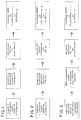
- Figures 1-3 are visual aids for relating the main differences in process steps between the three illustrated reaction processes.
- Figure 1 illustrates, in a general manner, mixing a Li-organo compound and/or D-organo compound (especially a D-organo compound) with a T-organo compound in pre-selected ratios in a solvent which is non-aqueous, and reacting the dissolved mixture of metal compounds with a pre-selected amount of hydroxyl ion, OH-, source (especially H2O) whereby the OH- ion replaces at least a substantial portion of the anionic moiety of the metal organo compounds in the mixture and the reaction product (LMMH) substantially forms as a crystalline monolayer, monodispersed coprecipitate of hydroxides having crystal thicknesses in the range of 0.8 to 1.6 nm (8 to 16 angstroms (A ⁇ )), or
- Figure 2 illustrates, in a general manner, dissolving a Li-organo compound and/or D-organo compound in a substantially anhydrous non-aqueous solvent, with an amount of hydroxyl ion source (especially H2O) sufficient to convert at least a substantial amount of the dissolved metal-organo compound(s) to corresponding hydroxide(s), then adding a pre-determined amount of T-organo compound to that, which may tend to form some equilibration or metathetical reaction products with the previously formed hydroxides, and then reacting that with a sufficient amount of hydroxyl ion source (especially H2O) predetermined to convert the T-organo compound to hydroxide, thereby precipitating LMMHs which are heterodispersed, multilayered crystals of mixed metal hydroxides, substantially of the 2-layer or 3-layer variety, though some monolayer variety can be present, or
- Figure 3 illustrates, in a general manner, dissolving a T-organo compound in a non-aqueous solvent, adding to that an amount of hydroxyl ion source (especially H2O) sufficient to convert at least a substantial amount of the T-organo compound to T-hydroxide, then adding predetermined amounts of Li-organo compound and/or D-organo compound to that, which may tend to form some equilibration or metathetical products with the previously formed T-hydroxide, and then adding to that a sufficient amount of hydroxyl ion source (especially H2O) predetermined to convert the Li-organo compound and/or D-organo compound to hydroxides, thereby precipitating LMMHs which are heterodispersed, multilayered crystals of mixed metal hydroxides, mostly of the 2-layer or 3-layer variety, though some monolayer variety can be present.
- hydroxyl ion source especially H2O
- these mixed metal hydroxides are layered crystals which each contain the mixed metals in the crystal structure, in contradistinction to physical mixtures of individual metal hydroxides.
- the D metal can be an alkaline earth metal, especially Mg or Ca, preferably Mg, or can be Mn, Fe, Co, Ni, Cu, Zn, or mixtures of these.
- the T metal can be any of Al, Ga, Cr, or Fe, preferably Al or Fe, most preferably Al.
- the following descriptions are directed to the preferred Li, D, and T, metals, and most especially to Mg and Al as the D and T metals, respectively.
- m when taking the quanity of T metal at unity, m may be from zero to 1, usually 0.5 to 0.75, when not zero; d may be from zero to 8 or more, preferably 0.5 to 6 and most preferably 0.5 to 4. However, m+d is never zero.
- the anions which can be associated with the metal of the formula Li(OR) or D(OR)2 or T(OR)3 may be hydrophilic organic anions of alcohols (preferably) or from other organic compounds which form a metal-oxygen bond with the Li, D, and T metals, such as alkanoic acids (for instance acetic acid, stearic acid), glycolate, polycarboxylate, or polyacrylates.
- alkanoic acids for instance acetic acid, stearic acid
- glycolate for instance glycolate, polycarboxylate, or polyacrylates.
- Mg compounds and Al compounds which react with a hydroxyl compound, especially H2O, replacing the anions of the metal compounds with OH-anions and forming side products with the anions which are being removed from the metal cations.
- Metal compounds such as MgXR, MgR2, AlR3, AlXR2, AlX2R, where X represents a halide or other inorganic anion and R represents an organic moiety, are examples of compounds which form hydroxides when reacted with water.
- the solvents for these organometallic compounds should be those which, themselves, do not react with the organometallic compounds; this can be anhydrous alkyls or aryls, such as hexane, octane, dodecane, purified gasoline, purified kerosene, toluene, and benzene.
- the desired coprecipitation as the hydroxides is likely to be impaired or prevented.
- the addition of small amounts of water as a reactant should be done slowly, even though the organometallic compounds are normally dissolved only in small percentages in the anhydrous solvents.
- the reaction of the organometallic compounds with water is likely to be more exothermic than those in which metal alkoxides are used.
- the reaction medium be the alcohol which corresponds to the alkoxide anion on the metal cation. That is, if the alkoxide anion is ethoxide, then it is preferred to use ethanol as the medium; if the alkoxide is propoxide, then propanol is preferred as the medium, and so on through the range of alkoxides. If one metal alkoxide has a different alkoxide group than that of another metal alkoxide, it is preferred to use as the medium the alkanol which is found to dissolve the greatest amount of the least soluble metal alkoxdes.
- reaction media other than alcohol such as hydrocarbon solvents (esp. alkanes and isoalkanes), aromatics (such as benzene, toluene, xylene), and other aprotic liquids such a N-methyl pyrrolidone, tetrahydrofuran, and methylene chloride may be employed. Mixtures of such liquids are within the purview of the present inventive concept.
- An alkoxide-based LMMH of the present invention may be prepared, for example, from equimolar amounts of Mg(alkoxy)2 and Al(alkoxy)3, where the alkoxy anion is represented by (-OC n H 2n+1 ), where n can be an amount of from 1 to 20 or more, preferably 1 to 8, to produce crystalline LMMH of formula MgAl(OH)5, which can also be written as Mg(OH)2Al(OH)3, by dissolving the starting materials in a suitable solvent, e.g. an alcohol, and adding to that an amount of H2O sufficient to provide the requisite amount of OH- anions to satisfy the requirements of the metal cations.
- a suitable solvent e.g. an alcohol
- the cationic H+ ion of the H2O combines with the alkoxy anion (RO-) which is released from the metal to form alcohol (ROH).
- RO- alkoxy anion
- Other OH ⁇ sources can be used, e.g., a hydrated material that will slowly release its waters of hydration for reaction with the metal-alkoxy compounds, but which material does not itself attach to the metal.
- OH ⁇ ions of one compound (R'OH) can undergo metathesis with a metal alkoxide (MOR) as illustrated by: R'OH + MOR -> R'OR + MOH , as compared to reaction of H2O: HOH + MOR -> HOR + MOH .
- the reaction is relatively slow, as compared to the aqueous reaction of soluble inorganic metal salts with OH- ions, and the total yield is limited by the extent of solubility of the metal compounds in alcohol or other non-aqueous carriers in which the reaction is carried out.
- solubility is only of the order of 1 wt. percent in most cases with the notable exception of magnesium ethoxide in ethanol which has greater solubility.
- the preparation of the alkoxide-based LMMHs should be conducted in an environment which is essentially free of water until the introduction of sufficient water required by the reaction (described above) since the starting metal alkoxides are hygroscopic, and can react to separately form hydroxide, carbonate and alcohol before the LMMH can be formed. Consequently, the use of nitrogen-purged, moisture-free apparatus is recommended during the initial mixing of the beginning metal alkoxides. Other inert water-free gasses besides nitrogen can be used in the purging of the reactor.
- the metal alkoxides in powder form are blended together and then added to dry alcohol in the approximate weight ratio of alkoxide:alcohol of, for example, 1:50.
- This mixture is stirred while heating, for example to 50 o C, to obtain a solution which may still contain some undissolved solids.
- These solids may be separated by vacuum filtration; if permitted to remain they can form reaction side products which are not part of the desired LMMH crystals (though there are instances in which such side-products can be tolerated).
- the filtrate is then treated with two drops (0.06g) of deionized water for each 1 g of alkoxide while stirring.
- the above procedure can be followed using magnesium ethoxide and aluminum ethoxide combined in methanol.
- LMMHs may be prepared to obtain a relatively narrow distribution of particle sizes. This can be significant, e.g., in an electrorheological fluid (ERF) where the electrorheoiogical effect is believed to be proportional to both surface charge and the surface to mass ratio or aspect ratio.
- ERF electrorheological fluid
- High aspect ratios have been found to be desirable in ERFs, and LMMHs have high aspect ratios, generally ranging from 30 to 1000 or more, with aspect ratios in the range of 600 to 650 being readily obtained.
- an alkoxide gel is prepared by mixing magnesium ethoxide and aluminum ethoxide in dry methanol under moisture-free conditions with subsequent controlled water addition to produce an alkoxide-based LMMH gel.
- This provides a MgAl(OH)5 compound, as described before, which is quite viscuous at room temperature even though the concentration of the LMMH is only 1 wt. percent.
- An ERF is prepared by admixing 45 g of the LMMH gel containing 1 percent LMMH with 139 g of anhydrous methanol. This produces a composition containing 0.45 g LMMH or 2450 ppm by weight.
- the ERF reacts instantly by forming an extremely high viscosity gel.
- the ERF immediately returns to its previous viscosity.
- LMMH crystalline layered mixed metal hdroxides
- LMMHs derived from metal compounds which have organic anion moieties, rather than inorganic anion moieties, were found to have viscosification activity in drilling mud formulations which compare well with that obtained with LMMHs produced from metal halides, such as MgCl2 and AlCl3 as disclosed in U.S 4,790,954. Furthermore, these LMMHs, being free of unbound water, were readily dispersed in anhydrous carriers for use in situations where the presence of water would be detrimental.
- the mixture was removed from the dry box, exposed to air, while stirring, for 2 hours at room temperature.
- the mixture was returned in a capped container to the dry box and stirred an additional 4 hours at room temperture during which time nearly all solids dissolved.
- the mixture was allowed to stand at room temperature over the weekend and a slightly cloudy gel was formed, which, by analysis was found to have a Mg/Al ratio of 1.4, indicating the formula Mg(OH) 2.8 Al(OH)3, which can be written as MgAl(OH) 5.8 , and the amount of LMMH in the methanol was 0.62 percent by weight.
- the two mixtures were combined in one container, removed from the dry box and stirred for 1 hour while exposed to air.
- the container was closed and stirred for 3 more hours.
- a cloudy mixture which formed was filtered through filter paper to clarify the mixture and there was recovered 86.34 parts by weight of clear filtrate and 0.18 parts by weight of dry solids on the filter paper.
Landscapes
- Chemical & Material Sciences (AREA)
- Organic Chemistry (AREA)
- Inorganic Chemistry (AREA)
- Engineering & Computer Science (AREA)
- Life Sciences & Earth Sciences (AREA)
- Nanotechnology (AREA)
- Oil, Petroleum & Natural Gas (AREA)
- General Chemical & Material Sciences (AREA)
- Chemical Kinetics & Catalysis (AREA)
- Geology (AREA)
- Materials Engineering (AREA)
- Crystallography & Structural Chemistry (AREA)
- General Physics & Mathematics (AREA)
- Condensed Matter Physics & Semiconductors (AREA)
- Composite Materials (AREA)
- Physics & Mathematics (AREA)
- General Life Sciences & Earth Sciences (AREA)
- Compounds Of Alkaline-Earth Elements, Aluminum Or Rare-Earth Metals (AREA)
- Oxygen, Ozone, And Oxides In General (AREA)
Applications Claiming Priority (2)
| Application Number | Priority Date | Filing Date | Title |
|---|---|---|---|
| US07/609,966 US5084209A (en) | 1990-11-06 | 1990-11-06 | Layered mixed metal hydroxides made in non-aqueous media |
| US609966 | 1990-11-06 |
Publications (2)
| Publication Number | Publication Date |
|---|---|
| EP0484829A1 true EP0484829A1 (de) | 1992-05-13 |
| EP0484829B1 EP0484829B1 (de) | 1994-12-07 |
Family
ID=24443066
Family Applications (1)
| Application Number | Title | Priority Date | Filing Date |
|---|---|---|---|
| EP91118629A Expired - Lifetime EP0484829B1 (de) | 1990-11-06 | 1991-10-31 | Gemischte schichtförmige Metallhydroxide, hergestellt in nichtwässrigen Medien |
Country Status (7)
| Country | Link |
|---|---|
| US (1) | US5084209A (de) |
| EP (1) | EP0484829B1 (de) |
| JP (1) | JPH0543223A (de) |
| CA (1) | CA2054937A1 (de) |
| DE (1) | DE69105700T2 (de) |
| FI (1) | FI915211L (de) |
| NO (1) | NO914325L (de) |
Cited By (4)
| Publication number | Priority date | Publication date | Assignee | Title |
|---|---|---|---|---|
| DE19503522A1 (de) * | 1995-02-03 | 1996-08-08 | Rwe Dea Ag | Herstellung gemischter schichtförmig aufgebauter Metallhydroxide sowie deren Metalloxide |
| US6514473B2 (en) | 1995-02-03 | 2003-02-04 | Sasol Germany Gmbh | Process for producing hydrotalcites and the metal oxides thereof |
| WO2004050551A1 (en) * | 2002-12-02 | 2004-06-17 | Council Of Scientific And Industrial Research | Rocess for preparing and self-assembling nano-sized binary and ternary oxy/hydroxides |
| US8227046B2 (en) | 2002-11-29 | 2012-07-24 | Council Of Scientific And Industrial Research | Process for preparing self-assembling nanobinary and ternary oxy/hydroxides |
Families Citing this family (8)
| Publication number | Priority date | Publication date | Assignee | Title |
|---|---|---|---|---|
| US5658653A (en) * | 1985-07-05 | 1997-08-19 | The Dow Chemical Company | Polymeric composites with crystalline mixed metal hydroxide particles dispersed therein |
| US5447603A (en) * | 1993-07-09 | 1995-09-05 | The Dow Chemical Company | Process for removing metal ions from liquids |
| BR0207676A (pt) * | 2001-02-28 | 2004-03-09 | Edgar Franklin Hoy | Composições hidrófobas modificadas reologicamente, agentes de modificação e processos de fabricação |
| US7736485B2 (en) * | 2006-08-11 | 2010-06-15 | Aqua Resources Corporation | Nanoplatelet magnesium hydroxides and methods of preparing same |
| US8822030B2 (en) | 2006-08-11 | 2014-09-02 | Aqua Resources Corporation | Nanoplatelet metal hydroxides and methods of preparing same |
| CN107889472B (zh) | 2015-05-11 | 2021-09-07 | 格雷斯公司 | 制备改性粘土负载的茂金属聚合催化剂的方法、所制备的催化剂及其用途 |
| KR20180006409A (ko) | 2015-05-11 | 2018-01-17 | 더블유.알. 그레이스 앤드 캄파니-콘. | 개질된 점토의 제조 방법, 제조된 개질된 점토, 및 이의 용도 |
| CN112357940A (zh) * | 2020-10-27 | 2021-02-12 | 北京化工大学 | 一种水滑石及其制备、改性方法和作为润滑油脂抗氧剂的应用 |
Citations (3)
| Publication number | Priority date | Publication date | Assignee | Title |
|---|---|---|---|---|
| DE2061094A1 (de) * | 1969-12-12 | 1971-08-19 | Kyowa Chem Ind Co Ltd | Neue,kristalline Kompositionsmetallhydroxide und Verfahren zur Herstellung derselben |
| EP0207811A2 (de) * | 1985-07-05 | 1987-01-07 | The Dow Chemical Company | Gemischte Metallhydroxide für das Verdicken von Wasser oder hydrophilen Flüssigkeiten |
| US4822421A (en) * | 1988-03-04 | 1989-04-18 | The Dow Chemical Company | Thixotropic cement compositions |
Family Cites Families (7)
| Publication number | Priority date | Publication date | Assignee | Title |
|---|---|---|---|---|
| US3631083A (en) * | 1970-04-24 | 1971-12-28 | Atlas Chem Ind | Magnesium-aluminum complexes of polyhydroxy compounds and their preparation |
| CA1290137C (en) * | 1984-06-11 | 1991-10-08 | John L. Burba, Iii | Intercalations of crystalline lithium aluminates |
| US4511710A (en) * | 1984-06-11 | 1985-04-16 | The Dow Chemical Company | Halide removal from fluid organic materials |
| US4773936A (en) * | 1985-06-24 | 1988-09-27 | The Dow Chemical Company | Insoluble pigments and preparation thereof |
| US4664843A (en) * | 1985-07-05 | 1987-05-12 | The Dow Chemical Company | Mixed metal layered hydroxide-clay adducts as thickeners for water and other hydrophylic fluids |
| US4980047A (en) * | 1987-03-05 | 1990-12-25 | Uop | Stable intercalated clays and preparation method |
| US4970191A (en) * | 1989-04-18 | 1990-11-13 | Aristech Chemical Corporation | Basic mixed oxide |
-
1990
- 1990-11-06 US US07/609,966 patent/US5084209A/en not_active Expired - Fee Related
-
1991
- 1991-10-31 EP EP91118629A patent/EP0484829B1/de not_active Expired - Lifetime
- 1991-10-31 DE DE69105700T patent/DE69105700T2/de not_active Expired - Fee Related
- 1991-11-05 JP JP3288734A patent/JPH0543223A/ja active Pending
- 1991-11-05 NO NO91914325A patent/NO914325L/no unknown
- 1991-11-05 CA CA002054937A patent/CA2054937A1/en not_active Abandoned
- 1991-11-05 FI FI915211A patent/FI915211L/fi unknown
Patent Citations (3)
| Publication number | Priority date | Publication date | Assignee | Title |
|---|---|---|---|---|
| DE2061094A1 (de) * | 1969-12-12 | 1971-08-19 | Kyowa Chem Ind Co Ltd | Neue,kristalline Kompositionsmetallhydroxide und Verfahren zur Herstellung derselben |
| EP0207811A2 (de) * | 1985-07-05 | 1987-01-07 | The Dow Chemical Company | Gemischte Metallhydroxide für das Verdicken von Wasser oder hydrophilen Flüssigkeiten |
| US4822421A (en) * | 1988-03-04 | 1989-04-18 | The Dow Chemical Company | Thixotropic cement compositions |
Cited By (8)
| Publication number | Priority date | Publication date | Assignee | Title |
|---|---|---|---|---|
| DE19503522A1 (de) * | 1995-02-03 | 1996-08-08 | Rwe Dea Ag | Herstellung gemischter schichtförmig aufgebauter Metallhydroxide sowie deren Metalloxide |
| US6180764B1 (en) | 1995-02-03 | 2001-01-30 | Rwe-Dea Aktiengesellschaft Fur Mineraloel Und Chemie | Process for producing hydrotalcites by hydrolyzing metal alcoholates |
| US6514473B2 (en) | 1995-02-03 | 2003-02-04 | Sasol Germany Gmbh | Process for producing hydrotalcites and the metal oxides thereof |
| US6517795B1 (en) | 1995-02-03 | 2003-02-11 | Sasol Germany Gmbh | Process for producing hydrotalcites and the metal oxides thereof |
| US8227046B2 (en) | 2002-11-29 | 2012-07-24 | Council Of Scientific And Industrial Research | Process for preparing self-assembling nanobinary and ternary oxy/hydroxides |
| WO2004050551A1 (en) * | 2002-12-02 | 2004-06-17 | Council Of Scientific And Industrial Research | Rocess for preparing and self-assembling nano-sized binary and ternary oxy/hydroxides |
| GB2410944A (en) * | 2002-12-02 | 2005-08-17 | Council Scient Ind Res | Process for preparing and self-assembling nano-sized binary and ternary oxy/hydroxides |
| GB2410944B (en) * | 2002-12-02 | 2007-01-17 | Council Scient Ind Res | Process for preparing and self-assembling nano-sized binary and ternary oxy/hydroxides |
Also Published As
| Publication number | Publication date |
|---|---|
| FI915211A7 (fi) | 1992-05-07 |
| EP0484829B1 (de) | 1994-12-07 |
| DE69105700T2 (de) | 1995-06-01 |
| CA2054937A1 (en) | 1992-05-07 |
| DE69105700D1 (de) | 1995-01-19 |
| FI915211A0 (fi) | 1991-11-05 |
| JPH0543223A (ja) | 1993-02-23 |
| FI915211L (fi) | 1992-05-07 |
| US5084209A (en) | 1992-01-28 |
| NO914325L (no) | 1992-05-07 |
| NO914325D0 (no) | 1991-11-05 |
Similar Documents
| Publication | Publication Date | Title |
|---|---|---|
| EP0484829B1 (de) | Gemischte schichtförmige Metallhydroxide, hergestellt in nichtwässrigen Medien | |
| Kessler et al. | Molecular mechanisms of the metal oxide sol-gel process and their application in approaches to thermodynamically challenging complex oxide materials | |
| US4545923A (en) | Process for preparing colloidal ceric oxide and complexes thereof with free organic acids | |
| Huang et al. | Wet chemical synthesis of Sr-and Mg-doped LaGaO3, a perovskite-type oxide-ion conductor | |
| Van Riemsdijk et al. | Reaction of phosphate with gibbsite (AI (OH) 3) beyond the adsorption maximum | |
| CN1307106C (zh) | 基于至少一种镧系元素化合物和络合剂的含水胶态分散体、其制备方法和用途 | |
| DE3751849T2 (de) | Verfahren zur Verbesserung des Gleitvermögens von Polyesterfolie | |
| EP0207707B1 (de) | Anorganische Anionenaustauscher und deren Herstellung | |
| KR20060035568A (ko) | 금속 나노결정 및 그것의 합성 방법 | |
| US4647401A (en) | Process for preparing colloidal ceric oxide and complexes thereof with free organic acids | |
| US4886624A (en) | Colloidal alcohol-dispersible association complexes of ceric dioxide and a hydroxyphenyl carboxylic acid | |
| Turevskaya et al. | Bimetallic alkoxides of niobium | |
| Scott et al. | Non-aqueous synthesis of mesostructured tin dioxide | |
| JPS6238235A (ja) | 水性媒体中のセリウム(4)化合物の新規なコロイド分散体及びその製造方法 | |
| Boulmaâz et al. | Chemical routes to oxides: alkoxide vs. alkoxide–acetate routes: synthesis, characterization, reactivity and polycondensation of MNb 2 (OAc) 2 (OPr i) 10 (M= Mg, Cd, Pb) species | |
| US6355821B1 (en) | Preparation of metal alkoxides | |
| WO2001040150A1 (en) | Process for the extraction of an aromatic compoung from an aliphatic phase using a non-neutral ionic liavin | |
| Wullens et al. | Preparation of ternary Bi–La and Bi–Pr oxides from polyaminocarboxylate complexes | |
| US4326961A (en) | Magnesium aluminate anion exchangers | |
| Boyle et al. | Influencing the morphology and phase of calcium ceramic nanoparticles based on the calcium alkoxide precursors' characteristics | |
| Grebenyuk et al. | Novel mononuclear mixed ligand complexes of heavy lanthanide trifluoroacetates with diethylenetriamine | |
| Meyer | The oxidation of metals with Liebig acids | |
| Altahan et al. | Copper (2+) Complexes of Hydroxyoxidoborates. Synthesis and Characterization of Two Clusters Containing the Hexaborate (2−) Ligand:[Cu (NH2CH2CH2NEt2){B6O7 (OH) 6}]· 5H2O and [Cu (NH3) 2 {B6O7 (OH) 6}]· 2H2O | |
| Alibrahim et al. | Synthesis and spectroscopic characterizations of manganese (II), iron (III), copper (II) and zinc (II) hydrazine complexes as catalytic activity agents | |
| Son et al. | Characterization of precipitates from the reactions between [Al13O4 (OH) 24 (H2O) 12] 7+ polycations and [Mo7O24] 6− polyoxometalate anions |
Legal Events
| Date | Code | Title | Description |
|---|---|---|---|
| PUAI | Public reference made under article 153(3) epc to a published international application that has entered the european phase |
Free format text: ORIGINAL CODE: 0009012 |
|
| AK | Designated contracting states |
Kind code of ref document: A1 Designated state(s): BE DE DK FR GB IT NL SE |
|
| 17P | Request for examination filed |
Effective date: 19921106 |
|
| 17Q | First examination report despatched |
Effective date: 19931019 |
|
| GRAA | (expected) grant |
Free format text: ORIGINAL CODE: 0009210 |
|
| AK | Designated contracting states |
Kind code of ref document: B1 Designated state(s): BE DE DK FR GB IT NL SE |
|
| PG25 | Lapsed in a contracting state [announced via postgrant information from national office to epo] |
Ref country code: IT Free format text: LAPSE BECAUSE OF FAILURE TO SUBMIT A TRANSLATION OF THE DESCRIPTION OR TO PAY THE FEE WITHIN THE PRE;WARNING: LAPSES OF ITALIAN PATENTS WITH EFFECTIVE DATE BEFORE 2007 MAY HAVE OCCURRED AT ANY TIME BEFORE 2007. THE CORRECT EFFECTIVE DATE MAY BE DIFFERENT FROM THE ONE RECORDED.SCRIBED TIME-LIMIT Effective date: 19941207 Ref country code: NL Effective date: 19941207 Ref country code: DK Effective date: 19941207 Ref country code: BE Effective date: 19941207 |
|
| REF | Corresponds to: |
Ref document number: 69105700 Country of ref document: DE Date of ref document: 19950119 |
|
| ET | Fr: translation filed | ||
| PG25 | Lapsed in a contracting state [announced via postgrant information from national office to epo] |
Ref country code: SE Effective date: 19950307 |
|
| NLV1 | Nl: lapsed or annulled due to failure to fulfill the requirements of art. 29p and 29m of the patents act | ||
| PGFP | Annual fee paid to national office [announced via postgrant information from national office to epo] |
Ref country code: FR Payment date: 19950824 Year of fee payment: 5 |
|
| PGFP | Annual fee paid to national office [announced via postgrant information from national office to epo] |
Ref country code: DE Payment date: 19950828 Year of fee payment: 5 |
|
| PGFP | Annual fee paid to national office [announced via postgrant information from national office to epo] |
Ref country code: GB Payment date: 19950929 Year of fee payment: 5 |
|
| PLBE | No opposition filed within time limit |
Free format text: ORIGINAL CODE: 0009261 |
|
| STAA | Information on the status of an ep patent application or granted ep patent |
Free format text: STATUS: NO OPPOSITION FILED WITHIN TIME LIMIT |
|
| 26N | No opposition filed | ||
| PG25 | Lapsed in a contracting state [announced via postgrant information from national office to epo] |
Ref country code: GB Effective date: 19961031 |
|
| GBPC | Gb: european patent ceased through non-payment of renewal fee |
Effective date: 19961031 |
|
| PG25 | Lapsed in a contracting state [announced via postgrant information from national office to epo] |
Ref country code: FR Effective date: 19970630 |
|
| PG25 | Lapsed in a contracting state [announced via postgrant information from national office to epo] |
Ref country code: DE Effective date: 19970701 |
|
| REG | Reference to a national code |
Ref country code: FR Ref legal event code: ST |