EP0484974A1 - Procédé pour la fabrication de gravures - Google Patents
Procédé pour la fabrication de gravures Download PDFInfo
- Publication number
- EP0484974A1 EP0484974A1 EP91119088A EP91119088A EP0484974A1 EP 0484974 A1 EP0484974 A1 EP 0484974A1 EP 91119088 A EP91119088 A EP 91119088A EP 91119088 A EP91119088 A EP 91119088A EP 0484974 A1 EP0484974 A1 EP 0484974A1
- Authority
- EP
- European Patent Office
- Prior art keywords
- pattern
- metal
- composition
- base
- artistic creation
- Prior art date
- Legal status (The legal status is an assumption and is not a legal conclusion. Google has not performed a legal analysis and makes no representation as to the accuracy of the status listed.)
- Withdrawn
Links
Images

Classifications
-
- B—PERFORMING OPERATIONS; TRANSPORTING
- B44—DECORATIVE ARTS
- B44C—PRODUCING DECORATIVE EFFECTS; MOSAICS; TARSIA WORK; PAPERHANGING
- B44C1/00—Processes, not specifically provided for elsewhere, for producing decorative surface effects
- B44C1/22—Removing surface-material, e.g. by engraving, by etching
- B44C1/225—Removing surface-material, e.g. by engraving, by etching by engraving
-
- B—PERFORMING OPERATIONS; TRANSPORTING
- B44—DECORATIVE ARTS
- B44C—PRODUCING DECORATIVE EFFECTS; MOSAICS; TARSIA WORK; PAPERHANGING
- B44C1/00—Processes, not specifically provided for elsewhere, for producing decorative surface effects
- B44C1/22—Removing surface-material, e.g. by engraving, by etching
- B44C1/224—Removing surface-material, e.g. by engraving, by etching manually
-
- C—CHEMISTRY; METALLURGY
- C25—ELECTROLYTIC OR ELECTROPHORETIC PROCESSES; APPARATUS THEREFOR
- C25D—PROCESSES FOR THE ELECTROLYTIC OR ELECTROPHORETIC PRODUCTION OF COATINGS; ELECTROFORMING; APPARATUS THEREFOR
- C25D1/00—Electroforming
- C25D1/10—Moulds; Masks; Masterforms
Definitions
- Dry point is an artistic printing process in which a perfectly flat, smooth and polished metal plate, preferably copper, is used.
- the artist engraves his drawing into the copper by means of exerting pressure on a cutting or carving tool. In this way, bores or indented lines are made in the copper which retain the ink or paint later used for printing a mirror image of the artist's creation.
- Etching is the second category.
- a wax film is applied to a perfectly polished copper surface.
- the artist draws his creation in the wax without exercising the sort of pressure required in the dry point technique.
- the pressure used when writing with a pen or pencil on paper is about the level of pressure required in this instance.
- the wax is removed at the points of pressure from the copper.
- a mixture of acids is poured over the wax-copper combination. The acid attacks the area where the wax has been removed and eats into the surface of the copper at these points. The acid does not attack the wax.
- the wax is removed from the copper and ink is placed over the copper, the ink resting in the portions of the copper eroded away by the acid. Paper is then applied to the copper with ink and a mirror image print of the drawing originally made by the artist is made.
- the present invention duplicates the result of dry point engraving but eliminates the difficulties the artist had to deal with in the past.
- the print which results from the present method is the mirror image of the original artistic creation, just as it is in dry point engraving.
- the dry point process for engraving is the most basic and direct method used by an artist. As noted above, the artist must make his drawing in a copper plate by exerting pressure on a pointed tool. Line variation is achieved by placing more or less pressure on the tool and using a thicker or finer cutting tool. The difficulty in this process is, if a soft enough copper is used to facilitate the artist's ability to draw his or her design in the copper with fluidity, the plate will be too soft for later printing. This is because after engraving the drawing in the plate, the plate is covered with ink, a sheet of paper is placed thereover, and pressure is applied. If the copper is soft, the bores or indentations originally placed therein are rapidly flattened during the step of applying pressure. This causes each print to be less clear than the previous print, and the original drawing to be ultimately lost.
- a method of making a dry point engraving comprising the steps of: providing a soft base in which an artist may readily and with a minimum amount of pressure make an artistic creation thereon; applying to the surface of the base on which the artistic creation has been made a composition which will take the same shape of the artistic creation and will be removable therefrom to present a mirror image thereof; separating the composition from the soft base, the composition presenting a mirror image of the artistic creation contained on the soft base; covering the surface of the composition which reflects the artistic creation of the soft base, with a film of electrically conductive material to create an electrically conductive surface while not altering the artistic creation; immersing the composition with the electrically conductive material into a electrolytic bath and plating with metal the surface of the composition coated with the electrically conductive material; removing the metal from the composition, the metal having in one side a duplication of the artistic creation made in the soft base.
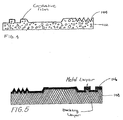
- Figure 1 discloses a sectional view of the soft material upon which an artistic drawing has been made.
- Figure 2 discloses the soft material of figure 1 with an elastomer or curable liquid plastic layer poured thereover.
- Figure 3 discloses the layer of elastomer or curable liquid plastic separated from the soft material.
- Figure 4 discloses the layer of elastomer or curable liquid plastic with a conductive film thereon.
- Figure 5 discloses a metal plate made from the embodiment in figure 4 and backed with a backing.
- the present invention involves a method for making a dry point engraving using an engraving material which is soft enough that the artist may freely express himself in it. It also involves a method for making a metal plate that contains the drawing of the artist and that is hard enough to produce excellent and numerous prints of the drawing.
- the first step in this method is to prepare a composition of soft material in which the artist may freely make his artistic creation.
- Such material might be wax, plaster, putty, soft plastic, soft tar soap or any other soft medium.
- This medium must be able to accept the carvings of the artist using some tool without the artist having to exert more than a minimum amount of pressure.
- This material must not be so soft that after making a line, the material can be deformed or deforms naturally to destroy the line made. Accordingly, materials such as wax, soft plaster or soap are good examples of the types of materials which could be used. In such material, the artist may take an instrument with a slight point, apply a minimal amount of pressure, and make his drawing.
- the pressure necessary would be little more or the same as that required to render a drawing on paper with pen or pencil. Although if desired, more pressure may be applied.
- the artist desires the background of the soft material to be other than flat, he may use a material that is bumpy in texture or that is textured or already has a pattern therein. Instead the artist may cause the material to have a bumpy texture through scraping, pounding, stamping or otherwise altering the surface of the material as discussed later in this description. Because the surface is soft and malleable, the artist is afforded the luxury of obtaining any sort of texture or picture he desires without exerting undue physical effort on his part.
- the soft material may be very thin such as 1/8" in thickness or very thick.
- Figure 1 discloses a sectional view of such a material or base 100 with an artistic rendition shown therein. If desired, the soft material or base 100 may be held within a frame or on a backing.
- soft material or base 100 is placed in a frame of greater depth than soft material or base 100.
- a layer of elastomer, liquid plastic that is curable preferably at room temperature, silicon, or other similar material such as rubber is then poured over the surface of the soft material or base 100 in which the artist has placed his work. This layer should be poured to a depth of at least about 1/2" in thickness.
- Figure 2 depicts this step showing soft material or base 100 with silicon layer 102 thereon.
- the material that is used to pour over the soft material or base 100 be able to take on exactly or almost exactly the shape of the surface of the soft material which it covers, that the material does not alter that surface, and that the material can be readily separated readily from the surface without ruining the shape of the surface of base 100 that it has taken on.
- Silicon is such a material. If soft material or base 100 is wax, liquid silicon may be poured thereon without fear of melting the wax either during the pouring step or the curing step. Further, silicon has excellent dimensional stability over a wide range of temperatures. This is helpful in carrying out the method of this invention.
- the silicon or other material comprising layer 102 is allowed to cure preferably at room temperature. If silicon 102 is used, one may place a backing on it to facilitate the silicon holding its shape. As those skilled in the art are well aware, silicon is somewhat rubbery and flexible in nature and therefore, the backing assists the silicon in holding its shape once it is separated from soft material or base 100. The backing may also ease the operator in removing the silicon 102 from the base 100.
- layer 102 After layer 102 has cured, it is removed from soft material or base 100. If silicon is used, this is accomplished simply by peeling it away from base 100. Another material might be separated from base 100 by applying a temperature differential, heat, cold or by using a jarring action. Backings may be used with these materials if desirable.
- layer 102 now has a mirror image in one surface of the artistic work placed in the soft material or base 100 as shown in figure 1.
- layer 102 is then dusted or very thinly coated with an electrically conductive film 104.
- the film 104 must be thin enough and even enough to not perceivably change the artistic creation on layer 102.
- the surface of layer 102, at least where the artistic drawing is, must be completely covered with film 104.
- Such films are known to those skilled in the art and may include platinum, silver, gold, copper, graphite or other materials.
- layer 102 with its essentially same representation of the artistic work placed in the soft material or base 100, is shown with the electrically conductive film 104 thereover.
- layer 102 With the electrically conductive film 104 on layer 102, layer 102 is placed in a bath for electroplating of metals. Examples of only some metals which may be used are copper, zinc, silver, gold, and the transition metals. The metal is electroplated onto layer 102 in known fashion to those skilled in the art. If copper is used, a low voltage of 1 to 10 volts is applied for a period of approximately 12 to 24 hours to cause a thin layer of metal to be electrically deposited onto the electrically conductive film 104 which lies on top of the layer 102. Those skilled in the art are very familiar with electrodeposition techniques, and the voltages and times required for different metals.
- the bath will be comprised of an aqueous solution of sulfuric acid and copper sulfate.
- Layer 102 and film 104 are placed in this bath.
- the three layers, 102, 104, and 106 are removed from the electrodeposition bath.
- the temperature of the bath in this example will reach approximately 90 degrees fahrenheit.
- the material of layer 102 must be chosen in view of the heat that this layer must tolerate in the bath.
- Layer 102 cannot be susceptible to deformation to a degree which will alter the artistic creation which it carries in its surface. In the foregoing example, silicon is a good choice as it does not deform significantly when exposed to such heat.
- Layer 106 is also extremely hard. It is much harder than a metal which an artist could originally have used for engraving an artistic design. It is so hard, that this layer can be used to make prints of the drawing by standard printing means without concern that the layer will rapidly and perceptibly flatten as each subsequent print is made. This of course, is well known to those familiar with the art of electroplating. In electroplating, desired hardnesses of metals can be achieved by manipulating the chemicals, time, and voltages applied in the electroplating process.
- Layers 102, 104, and 106 now removed from the bath are next placed in a frame with the back side of metal layer 106 on the top.
- liquid resin, metal, glass, plastics, or other backing may be applied to the back side of metal layer 106 and allowed to harden. This will form backing layer 108.
- backing layer 108 is preferable, it is not absolutely necessary and might be dispensed with altogether if metal layer 106 is made thicker than 1/64" or if it is not desired.
- Backing layer 108 is added to eliminate the amount of metal that is used in metal layer 106 and thereby reduce costs. It is also added to facilitate the ease of handling of metal layer 106 and to add to metal layer 106 a smooth, even, and hard surface.
- layer 102 is next separated from metal layer 106, layer 102 pulling easily away therefrom if silicon is used.
- metal layer 106 now carries the imprint of the drawing made in soft material or base 100. This is shown in figure 5.
- Metal layer 106 and backing layer 108 are now ready for printing.
- the surface containing the artistic creation is cleaned to remove any debris and remains of conductive film 104.
- Ink is next placed thereon and metal layer 106 and backing layer 108 are placed in the printing press to make many more quality prints than 15. Because of the hardness of metal layer 106, it will not flatten noticeably while such prints are made.
- backing layer 108 or making metal layer 106 thick enough to provide its own backing layer a smooth hard surface is available so that an even pressure may be applied by the printing press to metal layer 106 to create an even print therefrom. While such pressure is applied, any flaws or bumps in the printing platen will be kept from contact with the underside of metal layer 106 near the original drawing, by backing layer 108.
- the artist Due to the use of soft material or base 100, the artist is able to freely and flowingly create his work. Due to the creation of hard metal layer 106, a larger than usual number of mirror image prints of the artistic drawing originally made in soft material or base 100 can be made. These prints will not or not perceptibly differ in quality. Thus, as can be seen, the present invention responds to the needs of both the printer and the artist. Further, the resulting product looks like a dry point etching without the disadvantages associated with such etchings having been present.
- a surface plate 100 is prepared of a material that is soft but which will hold an engraving.
- An artist works in this material using minimum pressure to create his artistic work.
- a material such as liquid silicon 102 or similar elastomer composition 102 is poured over the surface of soft material or base 100 covering the finished work.
- the layer 102 is allowed to cure and solidify so that it takes on the surface condition of the soft material or base 100.
- Layer 102 is then separated from the soft material or base 100 and presents a mirror image of the work in soft material 100.
- the surface of layer 102 with the mirror image of the original engraving is dusted or coated with a thin film of electrically conductive material. Because the film of electrically conductive material 104 is very thin, it does not perceivably affect the artistic rendition of the artist. It merely coats it.
- the surface of layer 102 ia covered with film 104 it is placed in a bath for electroplating of metal layer 106 thereon. After metal layer 106 is formed it is backed on its back surface with an epoxy resin or other backing material 108.
- Metal layer 106 is preferably made of copper. The metal layer 106 and backing layer 108 are then separated from layer 102. If layer 102 is silicon, this may be accomplished by pulling layer 102 away from metal layer 106.
- Metal layer 106 has to the naked eye, the same surface pattern of the surface of soft material or base 100 upon which the artist first worked. Layers 106 and 108 are now ready to be mounted on the platen of a printing press and inked or colored with paint to make a large number of prints of the artistic work originally placed in base 100. The variation in quality in these prints will be minimal throughout a much greater number of prints than was traditionally the case.
- base 100 must reflect this desire.
- the artist may wish to couple a chiseled engraving made in concrete or wood with his dry point engraving created in the fashion discussed herein, or couple a design placed in steel through application of chemicals and perhaps force with a dry point engraving according to the method described herein.
- the artist may wish to reflect a collage. All of this is possible.
- the creation is made in any medium, perhaps chiseled in concrete or wood or the pattern desired is made in steel. Perhaps thereafter a collage of materials is added to one of these mediums.
- a layer such as layer 102. That is, it is covered with a material that will take on essentially the exact shape of the artistic creation and separate easily therefrom. Again, silicon or rubber or the like are materials that would serve this purpose. Once this rubber-like layer has taken on essentially the exact shape of the surface of the artistic creation, it is separated therefrom.
- a material that can serve as base 100 such as wax
- This wax or other similar material is then separated from the rubber-like layer and forms base 100 described in preceding paragraphs.
- the artistic creation may be placed in a frame before pouring the silicon or rubber-like material thereon. Further once the silicon or rubber-like material is separated from the artistic creation, it too may be placed in a frame so that the material for base 100 may be placed thereover.
- the steps are as follows.
- the artist may choose to omit the engraving step altogether and move instead directly onto the next step in which layer 102 is poured over the surface of base 100 and the above-mentioned process is completed with the portion of step 5) in the preceding example, the "engraving" in base 100 by light pressure by the artist being omitted.
- base 100 may be made of any material and dealt with in any fashion.
- the steps 1) through 6) set forth in Example 1 above may then be significantly shortened to the following.
- the end product will not be a mirror image of the artistic creation while in Example 2 above, it will.
- the etching step be omitted and it may be desired that the final product not be a mirror image of the artistic creation.
- the steps may then be as follows.
Landscapes
- Chemical & Material Sciences (AREA)
- Engineering & Computer Science (AREA)
- Chemical Kinetics & Catalysis (AREA)
- Electrochemistry (AREA)
- Materials Engineering (AREA)
- Metallurgy (AREA)
- Organic Chemistry (AREA)
- Mechanical Engineering (AREA)
- Manufacture Or Reproduction Of Printing Formes (AREA)
Applications Claiming Priority (4)
| Application Number | Priority Date | Filing Date | Title |
|---|---|---|---|
| US61222390A | 1990-11-09 | 1990-11-09 | |
| US612223 | 1990-11-09 | ||
| US78638391A | 1991-11-01 | 1991-11-01 | |
| US786383 | 1997-01-16 |
Publications (1)
| Publication Number | Publication Date |
|---|---|
| EP0484974A1 true EP0484974A1 (fr) | 1992-05-13 |
Family
ID=27086717
Family Applications (1)
| Application Number | Title | Priority Date | Filing Date |
|---|---|---|---|
| EP91119088A Withdrawn EP0484974A1 (fr) | 1990-11-09 | 1991-11-08 | Procédé pour la fabrication de gravures |
Country Status (1)
| Country | Link |
|---|---|
| EP (1) | EP0484974A1 (fr) |
Cited By (2)
| Publication number | Priority date | Publication date | Assignee | Title |
|---|---|---|---|---|
| DE10205489A1 (de) * | 2002-02-09 | 2003-08-21 | Konrad Schaefer Gmbh | Badmodell für eine Galvanoschale und Verfahren zu dessen Herstellung |
| FR2837135A1 (fr) * | 2002-03-13 | 2003-09-19 | Qualipac Sa | Procede de fabrication d'une piece en matiere plastique presentant un decor metal duquel se detache visuellement un motif |
Citations (4)
| Publication number | Priority date | Publication date | Assignee | Title |
|---|---|---|---|---|
| US4166092A (en) * | 1975-01-02 | 1979-08-28 | Remba Grondovski Luis | Process for making artistic prints |
| DE2912694A1 (de) * | 1979-03-30 | 1980-10-09 | Peter Mack | Verfahren zum herstellen von reproduzierbaren gegenstaenden |
| EP0287746A1 (fr) * | 1987-04-22 | 1988-10-26 | W. Blösch AG | Procédé pour la fabrication d'une surface en relief décorative, avec un hologramme ou un motif de diffraction |
| US5013409A (en) * | 1989-03-23 | 1991-05-07 | Doug Czor | Electrodeposition process |
-
1991
- 1991-11-08 EP EP91119088A patent/EP0484974A1/fr not_active Withdrawn
Patent Citations (4)
| Publication number | Priority date | Publication date | Assignee | Title |
|---|---|---|---|---|
| US4166092A (en) * | 1975-01-02 | 1979-08-28 | Remba Grondovski Luis | Process for making artistic prints |
| DE2912694A1 (de) * | 1979-03-30 | 1980-10-09 | Peter Mack | Verfahren zum herstellen von reproduzierbaren gegenstaenden |
| EP0287746A1 (fr) * | 1987-04-22 | 1988-10-26 | W. Blösch AG | Procédé pour la fabrication d'une surface en relief décorative, avec un hologramme ou un motif de diffraction |
| US5013409A (en) * | 1989-03-23 | 1991-05-07 | Doug Czor | Electrodeposition process |
Cited By (2)
| Publication number | Priority date | Publication date | Assignee | Title |
|---|---|---|---|---|
| DE10205489A1 (de) * | 2002-02-09 | 2003-08-21 | Konrad Schaefer Gmbh | Badmodell für eine Galvanoschale und Verfahren zu dessen Herstellung |
| FR2837135A1 (fr) * | 2002-03-13 | 2003-09-19 | Qualipac Sa | Procede de fabrication d'une piece en matiere plastique presentant un decor metal duquel se detache visuellement un motif |
Similar Documents
| Publication | Publication Date | Title |
|---|---|---|
| US2400518A (en) | Electrotyping | |
| US2294865A (en) | Method of making decorated articles | |
| US4321105A (en) | Method of producing embossed designs on surfaces | |
| EP0484974A1 (fr) | Procédé pour la fabrication de gravures | |
| US4221758A (en) | Method of embossing wood grain patterns | |
| EP0402377B1 (fr) | Procede de fabrication de bandes metalliques sans fin pourvues d'un motif repousse | |
| US4166092A (en) | Process for making artistic prints | |
| DE2906902C2 (de) | Vorsensibilisierte Tiefdruckplatte | |
| US250239A (en) | Christian h | |
| Forster | From Xylographs to Lead Molds; AD 1440-AD 1921 | |
| US3994223A (en) | Method of fabricating a printing block | |
| US670A (en) | Improved mode of forming raised surfaces for printing on paper, calico | |
| US2060828A (en) | Method of forming printing surfaces on cylinders | |
| JPH11156871A (ja) | プラスチック成形物の製造方法 | |
| US753746A (en) | Method of preparing color-plates for printing. | |
| US2024840A (en) | Printing plate and method of making the same | |
| CN1074248A (zh) | 具多层次金属花纹的制造方法 | |
| DE2555627C3 (de) | Herstellung von Prägeformen für die Herstellung reliefartig ausgebildeter Kunstdrucke | |
| US306625A (en) | Bobekt lanham | |
| US1570246A (en) | Process of making metal articles | |
| US438918A (en) | Method of producing | |
| Purinton | A historical map-printing technique: wax engraving | |
| US302226A (en) | Process of engraving | |
| JPH05127599A (ja) | 合成樹脂製彫刻銘板の製造方法 | |
| US1000916A (en) | Process for making printing blocks and stamps. |
Legal Events
| Date | Code | Title | Description |
|---|---|---|---|
| PUAI | Public reference made under article 153(3) epc to a published international application that has entered the european phase |
Free format text: ORIGINAL CODE: 0009012 |
|
| AK | Designated contracting states |
Kind code of ref document: A1 Designated state(s): DE ES FR GB IT |
|
| STAA | Information on the status of an ep patent application or granted ep patent |
Free format text: STATUS: THE APPLICATION IS DEEMED TO BE WITHDRAWN |
|
| 18D | Application deemed to be withdrawn |
Effective date: 19921114 |