EP0485059A2 - Halbleiterbauelement mit einer Pin-Diode mit hoher Durchbruchspannung - Google Patents
Halbleiterbauelement mit einer Pin-Diode mit hoher Durchbruchspannung Download PDFInfo
- Publication number
- EP0485059A2 EP0485059A2 EP91308637A EP91308637A EP0485059A2 EP 0485059 A2 EP0485059 A2 EP 0485059A2 EP 91308637 A EP91308637 A EP 91308637A EP 91308637 A EP91308637 A EP 91308637A EP 0485059 A2 EP0485059 A2 EP 0485059A2
- Authority
- EP
- European Patent Office
- Prior art keywords
- layer
- current blocking
- breakdown voltage
- type
- high breakdown
- Prior art date
- Legal status (The legal status is an assumption and is not a legal conclusion. Google has not performed a legal analysis and makes no representation as to the accuracy of the status listed.)
- Ceased
Links
- 239000004065 semiconductor Substances 0.000 title claims description 75
- 230000015556 catabolic process Effects 0.000 title claims description 57
- 230000000903 blocking effect Effects 0.000 claims abstract description 71
- 238000011084 recovery Methods 0.000 claims abstract description 28
- 239000012535 impurity Substances 0.000 claims description 57
- 238000009792 diffusion process Methods 0.000 claims description 26
- 230000003071 parasitic effect Effects 0.000 abstract description 15
- 230000000694 effects Effects 0.000 abstract description 12
- 238000002347 injection Methods 0.000 abstract description 8
- 239000007924 injection Substances 0.000 abstract description 8
- 238000009826 distribution Methods 0.000 description 19
- 238000010586 diagram Methods 0.000 description 14
- 238000010276 construction Methods 0.000 description 7
- 238000009413 insulation Methods 0.000 description 6
- 238000012986 modification Methods 0.000 description 5
- 230000004048 modification Effects 0.000 description 5
- 239000000969 carrier Substances 0.000 description 4
- 238000009825 accumulation Methods 0.000 description 3
- 238000000034 method Methods 0.000 description 3
- 230000015572 biosynthetic process Effects 0.000 description 2
- 239000004642 Polyimide Substances 0.000 description 1
- 238000007599 discharging Methods 0.000 description 1
- 229920001721 polyimide Polymers 0.000 description 1
- 229910052710 silicon Inorganic materials 0.000 description 1
- 239000010703 silicon Substances 0.000 description 1
- 229920002379 silicone rubber Polymers 0.000 description 1
- 239000004945 silicone rubber Substances 0.000 description 1
Images












Classifications
-
- H—ELECTRICITY
- H10—SEMICONDUCTOR DEVICES; ELECTRIC SOLID-STATE DEVICES NOT OTHERWISE PROVIDED FOR
- H10D—INORGANIC ELECTRIC SEMICONDUCTOR DEVICES
- H10D62/00—Semiconductor bodies, or regions thereof, of devices having potential barriers
- H10D62/10—Shapes, relative sizes or dispositions of the regions of the semiconductor bodies; Shapes of the semiconductor bodies
- H10D62/13—Semiconductor regions connected to electrodes carrying current to be rectified, amplified or switched, e.g. source or drain regions
- H10D62/141—Anode or cathode regions of thyristors; Collector or emitter regions of gated bipolar-mode devices, e.g. of IGBTs
- H10D62/142—Anode regions of thyristors or collector regions of gated bipolar-mode devices
-
- H—ELECTRICITY
- H10—SEMICONDUCTOR DEVICES; ELECTRIC SOLID-STATE DEVICES NOT OTHERWISE PROVIDED FOR
- H10D—INORGANIC ELECTRIC SEMICONDUCTOR DEVICES
- H10D62/00—Semiconductor bodies, or regions thereof, of devices having potential barriers
- H10D62/10—Shapes, relative sizes or dispositions of the regions of the semiconductor bodies; Shapes of the semiconductor bodies
- H10D62/13—Semiconductor regions connected to electrodes carrying current to be rectified, amplified or switched, e.g. source or drain regions
- H10D62/133—Emitter regions of BJTs
-
- H—ELECTRICITY
- H10—SEMICONDUCTOR DEVICES; ELECTRIC SOLID-STATE DEVICES NOT OTHERWISE PROVIDED FOR
- H10D—INORGANIC ELECTRIC SEMICONDUCTOR DEVICES
- H10D62/00—Semiconductor bodies, or regions thereof, of devices having potential barriers
- H10D62/10—Shapes, relative sizes or dispositions of the regions of the semiconductor bodies; Shapes of the semiconductor bodies
- H10D62/13—Semiconductor regions connected to electrodes carrying current to be rectified, amplified or switched, e.g. source or drain regions
- H10D62/137—Collector regions of BJTs
-
- H—ELECTRICITY
- H10—SEMICONDUCTOR DEVICES; ELECTRIC SOLID-STATE DEVICES NOT OTHERWISE PROVIDED FOR
- H10D—INORGANIC ELECTRIC SEMICONDUCTOR DEVICES
- H10D8/00—Diodes
- H10D8/50—PIN diodes
-
- Y—GENERAL TAGGING OF NEW TECHNOLOGICAL DEVELOPMENTS; GENERAL TAGGING OF CROSS-SECTIONAL TECHNOLOGIES SPANNING OVER SEVERAL SECTIONS OF THE IPC; TECHNICAL SUBJECTS COVERED BY FORMER USPC CROSS-REFERENCE ART COLLECTIONS [XRACs] AND DIGESTS
- Y10—TECHNICAL SUBJECTS COVERED BY FORMER USPC
- Y10S—TECHNICAL SUBJECTS COVERED BY FORMER USPC CROSS-REFERENCE ART COLLECTIONS [XRACs] AND DIGESTS
- Y10S257/00—Active solid-state devices, e.g. transistors, solid-state diodes
- Y10S257/928—Active solid-state devices, e.g. transistors, solid-state diodes with shorted PN or schottky junction other than emitter junction
Definitions
- This invention relates to a power semiconductor device having a high breakdown voltage.
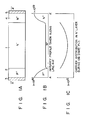
- Figs. 1A, 1B and 1C respectively show the cross sectional structure of the main portion of a conventional diode having a high breakdown voltage, the distribution of impurity concentration and the distribution of carrier concentration in the ON state.
- An anode electrode 3 is formed over one surface of a high-resistance base layer 1 formed of n ⁇ -type silicon with a p+-type anode layer 2 disposed therebetween and a cathode electrode 5 is formed over the other surface of the base layer 1 with an n+-type cathode layer 4 disposed therebetween.
- a high breakdown voltage diode having a blocking voltage of approx.
- the impurity concentration and dimension of each portion are determined such that the impurity concentration of the high-resistance base layer 1 is 1.0 x 10¹³ to 1.8 x 10¹³/cm3, the thickness thereof is 450 to 900 ⁇ m, the surface impurity concentration of the p+-type anode layer 2 and n+-type cathode layer 4 is 1 x 10¹⁹/cm3, and the thickness thereof is 14 to 70 ⁇ m.
- an ON voltage of approx. 2.6 V can be obtained with a current of 100 A/cm2.
- the high breakdown voltage characteristic can be attained by forming the junction end (termination) portion in the bevel structure.
- a large amount of carriers are accumulated in the high-resistance base layer 1 in the highly injected state.
- the carrier distribution as shown in Fig. 1C is obtained.
- high impurity concentration is exhibited in portions near the n+-type cathode layer 4 in which electrons are injected and the p+-type anode layer 2 in which holes are injected.
- a large reverse recovery current flows in the OFF time in which a reverse bias voltage is applied. For example, in the case of the above element parameters, a reverse recovery current of approx.
- An object of this invention is to provide a high breakdown voltage semiconductor device in which the reverse recovery characteristic is improved to attain low power consumption and high speed operation.
- a high breakdown voltage semiconductor device comprises a pn junction diode section including a semiconductor layer of a first conductivity type, a semiconductor layer of a second conductivity type formed in one of surface areas of the semiconductor layer of the first conductivity type, contact layers of the second conductivity type with high impurity concentration and current blocking layers of the first conductivity type with high impurity concentration which is dispersedly formed in the surface area of the semiconductor layer of the second conductivity type by diffusion in a preset area ratio with respect to the contact layer; and a main electrode formed in contact with the contact layer as well as the current blocking layer of the pn junction diode section; wherein the impurity concentration and dimension of each layer are determined such that a voltage drop in the lateral direction of a portion of the semiconductor layer of the second conductivity type which lies under the current blocking layer will not exceed the built-in voltage of a junction between the semiconductor layer of the second conductivity type and the current blocking layer at the time of reverse recovery of the pn junction diode section.
- the impurity concentration of the p-type anode layer is reduced in comparison with the conventional case, and the n-type current blocking layer of high impurity concentration and p-type contact layer of high impurity concentration are dispersedly formed in the surface area of the anode layer so as to suppress the carrier injection.
- the carrier concentration in the high-resistance base layer on the anode side in the highly injected ON state can be made sufficiently lower than that on the cathode side. As a result, the reverse recovery current can be reduced.
- the ohmic contact portion between the anode layer and the anode electrode can be formed with sufficiently low resistance by alternately arranging the the p-type contact layers of sufficiently high impurity concentration and the n-type current blocking layers in the surface area of the p-type anode layer.
- the depletion layer can be prevented from reaching the anode electrode when the reverse bias voltage is applied.
- conditions are set such that a voltage drop in the lateral direction of a portion of the semiconductor layer of the second conductivity type which lies under the current blocking layer will not exceed the built-in voltage of a junction between the semiconductor layer of the second conductivity type and the current blocking layer at the time of reverse recovery of the pn junction diode section. Therefore, the parasitic transistor effect due to the provision of the current blocking layer can be suppressed and occurrence of latch-up phenomenon can be prevented. As a result, the reverse recovery current is not increased and the switching loss can be reduced, thereby making it possible to attain the high-speed switching operation.
- a high breakdown voltage semiconductor device in which the distribution of carrier concentration in the element in the highly injected state can be controlled by forming the current blocking layer in the emitter layer and in which the parasitic transistor effect at the time of reverse recovery time is suppressed so as to improve the reverse recovery characteristic, thereby attaining the low power consumption and high-speed operation.
- a first conductivity type is a p-type and a second conductivity type is an n-type.
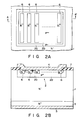
- Fig. 2A is a plan view showing the anode side of a high breakdown voltage diode according to one embodiment of this invention and Fig. 2B is a cross sectional view taken along the line A-A′ of Fig. 2A.
- a p-type emitter layer (anode layer) 2 of high impurity concentration is selectively formed by diffusion in the surface area of a high-resistance n ⁇ -type base layer 1.
- the p-type anode layer 2 has a p+-type layer 2a which is the main body of the anode layer formed by diffusion in the n ⁇ -type layer 1 and a p++-type layer 2b of higher impurity concentration formed by diffusion in the surface area of the layer 2a. As shown in Fig.
- n++-type layers 6 formed by diffusion in a stripe pattern in the p++-type layer 2b.
- An anode electrode 4 is formed in contact with the p++-type layer 2b as well as the n++-type layers 6.
- the p++-type layer 2b is a contact layer for permitting an ohmic contact of low resistance to be formed between the anode electrode 4 and the anode layer 2 and the n++-type layers 6 are current blocking layers for reducing the area in which holes can be injected from the anode layer 2 to the n ⁇ -type base layer 1. Therefore, n++-type layers 6 is dispersedly formed in p++-type layer 2b at a preset area ratio by taking the low-resistance contact and the hole injection amount into consideration.
- An n+-type cathode layer 3 of high impurity concentration is formed on the entire portion of the other surface of the n ⁇ -type layer 1 and a cathode electrode 5 is formed on the cathode layer.
- the exposed surface of the n ⁇ -type layer 1 on the anode side is covered with an oxide film 7.
- Fig. 3A is a cross sectional view showing a basic structure portion formed of the p++-type layer 2b and the n++-type layer 6 adjacent to the layer 2b on the anode side of the diode according to this embodiment.
- Fig. 3B shows the distribution of impurity concentration along the line A-A′ and
- Fig. 3C shows the distribution of impurity concentration along the line B-B′.
- the thickness of the n ⁇ -type base layer 1 is 450 ⁇ m and the impurity concentration thereof is 1 x 10¹³/cm3, the diffusion depth of the p+-type layer 2a is 1.5 ⁇ m and the surface impurity concentration thereof is 1 x 10¹⁷/cm3, the diffusion depth of the p++-type layer 2b is 0.3 ⁇ m and the surface impurity concentration thereof is 1 x 10¹⁹/cm3, the diffusion depth of the n++-type layer 6 is 0.4 ⁇ m and the surface impurity concentration thereof is 1 x 10¹⁹/cm3, and the diffusion depth of the n+-type cathode layer 3 is 15 ⁇ m and the surface impurity concentration thereof is 1 x 10²⁰/cm3.
- the sheet resistance ⁇ of a portion of the p+-type layer 2a lying under the n++-type layer 6 is preferable to set the sheet resistance ⁇ of a portion of the p+-type layer 2a lying under the n++-type layer 6 within a range of 500 ⁇ / ⁇ ⁇ ⁇ ⁇ 20000 ⁇ / ⁇ .
- the widths d1 and d2 of the p++-type layers 2b and n++-type layers 6 which is disposed in the p++-type layers 2b in a stripe pattern are so set as to satisfy the relation of d1 ⁇ d2.
- d1 d2.
- the p-type anode layer 2 is mainly formed of the p+-type layer 2a whose impurity concentration is lower than that of the conventional case and the n++-type layers 6 are formed as blocking layers for suppressing hole injection from the anode layer 2. Therefore, as shown in Fig. 3D, in the highly injected state, the distribution of carrier concentration in the n ⁇ -type base layer 1 is 1 x 10¹⁷/cm3 on the cathode side but is approx. 1 x 10¹⁶/cm3 which is less than the former value by one digit on the anode side. Thus, since the carrier concentration in the n ⁇ -type base layer 1 on the anode side becomes less, the reverse recovery characteristic can be improved.
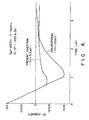
- Fig. 4 shows the reverse recovery characteristic of the diode of this embodiment together with the conventional case for comparison.
- the parasitic transistor effect may occur at the time of reverse recovery.
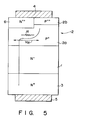
- the parasitic transistor effect may be caused when a reverse recovery current flows in a lateral direction in the p+-type layer 2a of the anode layer 2 as shown in Fig. 5 and a voltage V between the p+-type layer 2a and the n++-type layer 6 causes a forward bias to be higher than the built-in voltage (0.5 V). Therefore, it is necessary to suppress the voltage V.
- V in the lateral direction in the p+-type layer 2a lying directly under the n++-type layer 6 can be expressed by the following equation by use of the sheet resistance ⁇ p + of the p+-type layer 2a lying directly under the n++-type layer 6, the current density i flowing in the layer 2a and the width d1 of the n++-type layer 6.
- V ⁇ p + (i/2)(d12/4)
- the parasitic transistor of n++p+n ⁇ n+ will not be operated and the switching loss can be reduced.
- the above equation indicates an equation for a case where the n++-type layers 6 are formed in a stripe pattern.
- the condition for preventing the operation of the parasitic transistor may be generalized and explained as follows by taking all of the possibilities of the dispersed arrangements of the n++-type layers 6 and the p++-type layer 2b into consideration.
- the density of current flowing in the element is i [A/cm2]
- the sheet resistance of a portion of the p+-type layer 2a lying directly under the n++-type layer 6 is ⁇ p + ( ⁇ / ⁇ )
- the set of points in the area of the n++-type layer 6 is A(a)
- the set of points on the boundary between the area of the n++-type layer 6 and the area of the p++-type layer 2b is B(b).
- (min d ab ) defines a direction in which a current tends to easily flow from the point a of the n++-type layer 6 to the boundary point b.
- max (min d ab ) indicates the maximum resistance in the direction in which the current may easily flow.
- Fig. 6 shows the condition for operating the parasitic transistor by reference to the relation between the sheet resistance ⁇ p + and the width d1 of the n++-type layer 6.
- d1 can be set to a relatively large value, but when the element area is large and the current concentration occurs, it is preferable to set d1 to a small value, for example, 3 ⁇ m or less.
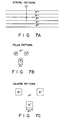
- Figs. 7A, 7B and 7C Some examples of the relations between the n++-type layer 6 and the width d1 are shown in Figs. 7A, 7B and 7C. When any one of the patterns is selected, it is important to suppress the parasitic transistor effect by taking the above-described conditions into consideration.
- Figs. 8A to 8D respectively show the construction of a main portion of a high breakdown voltage diode according to another embodiment, the distributions of impurity concentration and the distribution of carrier concentration in the ON state of the diode and correspond to Figs. 3A to 3D of the former embodiment.
- Figs. 9A to 9D respectively show the construction of a main portion of a high breakdown voltage diode according to still another embodiment, the distributions of impurity concentration and the distribution of carrier concentration in the ON state of the diode and correspond to Figs. 3A to 3D of the former embodiment.
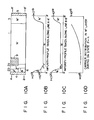
- Figs. 10A to 10D respectively show the construction of a main portion of a high breakdown voltage diode according to another embodiment, the distributions of impurity concentration and the distribution of carrier concentration in the ON state of the diode and correspond to Figs. 3A to 3D of the former embodiment.
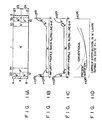
- Figs. 11A to 11D respectevely show the construction of a main portion of a high breakdown voltage diode according to another embodiment, the distributions of impurity concentration and the distribution of carrier concentration in the ON state of the diode and correspond to Figs. 3A to 3D of the former embodiment.
- life time killer is selectively injected into a portion of the n ⁇ -type base layer 1 on the anode side to form a low carrier life time region 8.
- the life time control can be easily effected by use of the technique such as irradiation of H+ or He+, for example.
- the critical back power at the time of reverse recovery an be enhanced by forming the low carrier life time region 8
- a low carrier life time region 8 is formed in a portion of the n ⁇ -type base layer 1 on the cathode side in the same manner as in the former embodiment.
- a low carrier life time region 9 is selectively formed in a region directly under the p++-type layer 2b.
- carrier injection blocking layers 10 are formed in portions on the anode and cathode sides. That is, the cathode layer 3 has a double-layered structure formed of an n+-type layer 3a and n++-type layers 3b of higher impurity concentration and the n++-type layers 3b is dispersedly arranged in the surface area on the cathode side.
- the width d3 of the n++-type layer 3b and the width d4 of the p++-type layer 10 are substantially equal to each other (d3 ⁇ d4).
- the carrier concentration of the n ⁇ -type base layer 1 in the highly injected state becomes lower on the anode and cathodes sides than that of the conventional case, and consequently, the reverse recovery characteristic can be further improved.
- the high impurity concentration layers serving as the current blocking layers for example, n++-type layers 6 in the embodiment of Figs. 2A and 2B are disposed in a stripe pattern in the p++-type layer 2b, but this pattern can be variously modified. Examples of the pattern are shown in Figs. 12 to 14 in the same manner as in Fig. 2A.
- n++-type layer 6 is formed by diffusion in the anode layer 2
- a plurality of p++-type layers 2b are dispersedly formed by diffusion in the layer 6.
- a plurality of n++-type layers 6 are formed by diffusion not in a stripe pattern but in a dispersed pattern.
- This invention can be applied to a diode in which structure the high breakdown voltage is attained in the junction end portion. Such embodiments are described below.
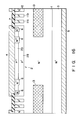
- Fig. 15 shows an embodiment in which p+-type guard ring layers 11a and 11b are formed outside the p-type anode layer 2.
- An n+-type layer 12 for potential fixation is formed outside the guard ring layers 11a and 11b.
- n++-type layers 6 serving as the current blocking layers on the anode side are selectively formed near the junction end portion.
- a portion on the cathode side has a double-layered structure formed of an n+-type layer 3a and an n++-type layer 3b, and p++-type layers 10 serving as the current blocking layers are formed in the double-layered structure.
- Fig. 16 shows an embodiment in which p+-type guard ring layers 11a and 11b are formed outside the p-type anode layer 2, and at the same time, a low carrier life time region 13 is formed in a portion of the n ⁇ -type base layer 1 near the function end portion.
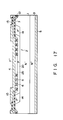
- Fig. 17 shows an embodiment in which a p ⁇ -type resurf layer 14 is formed outside the p-type anode layer 2 and a high-resistance film 15 such as SIPOS is formed over the resurf layer 14 and the surrounding portion thereof with an oxide film 7 disposed therebetween.
- One end of the high-resistance film 15 is connected to the anode layer 2 and the other end thereof is connected to an n+-type layer 12 formed apart from the anode layer by a preset distance in the n ⁇ -type base layer.
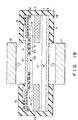
- Fig. 18 shows an embodiment in which the structure of Fig. 17 is used as a basic structure and boding electrodes 16 and 17 are formed thereon. A portion outside the region to which the bonding electrodes 16 and 17 are bonded is covered with an insulation film 18 formed of polyimide, encapped silicone rubber, for example.
- Fig. 19 shows an embodiment in which a low carrier life time region 13 is additionally formed in the n ⁇ -type base layer 1 in the embodiment of Fig. 18.
- Fig. 20 shows an embodiment of a thyristor.
- a p-type base layer 21 is formed in one of the surface areas of an n ⁇ -type base layer 1 and an n-type emitter layer 22 is formed in the surface area of the p-type base layer 21.
- the n-type emitter layer 22 has an n-type layer 22a and a plurality of n+-type layers 22b serving as high impurity concentration contacts, for example, formed in the surface area of the n-type layer 22a, and p+-type layers 23 serving as current blocking layers are each formed between the n+-type layers 22b.
- a p-type emitter layer 24 is formed in the other surface area of the n ⁇ -type base layer 1.
- the same structure as that on the cathode side is used in the p-type emitter layer 24. That is, the p-type emitter layer 24 is constructed by a p-type layer 24a and a plurality of p+-type layers 24b of high impurity concentration dispersedly formed in the surface area of the layer 24a, and n+-type layers 25 serving as current blocking layers are each formed between the p+-type layers 24b.
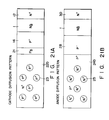
- Figs. 21A and 21B show examples of the respective diffusion patterns on the cathode and anode sides of the thyristor of this embodiment.
- a cathode electrode 26 which is disposed in contact with the p+-type layer 23 is formed in contact with the n-type emitter layer 22, and anode electrode 27 which is disposed in contact with the n+-type layer 25 is formed in contact with the p-type emitter layer 24.
- a gate electrode 28 is formed in contact with the p-type base layer 21.
- a p ⁇ -type resurf layer 14 is formed on the end portion of the p-type base layer 21 and a high-resistance film 15 is formed over the layer 14 with an insulation film 7 disposed therebetween.
- One end portion of the high-resistance film 15 is connected to the n-type emitter layer 22 and the other end portion thereof is connected to an n+-type layer 12 for potential fixation formed in the n-type base layer 1.
- a p ⁇ -type resurf layer 28 is formed on the end portion of the p-type emitter layer 24 and a high-resistance film 31 is formed over the layer 28 with an insulation film 29 disposed therebetween.
- One end portion of the high-resistance film 31 is connected to the p-type emitter layer 24 and the other end portion thereof is connected to an n+-type layer 30 for potential fixation formed in the n-type base layer 1.
- excessive carrier injection can be suppressed on the anode and cathode sides and carrier accumulation in a portion near the anode and cathode electrodes in the ON state can be reduced.
- the operation of the pnp parasitic transistor can be prevented by satisfying the same condition as is set in the former embodiment by formation of the n+-type 22a and p+-type layer 23.
- the operation of the pnp parasitic transistor can be prevented in the same manner by formation of the p+-type 24b and n+-type layer 25.
- the turn-off characteristic of the thyristor can be improved.
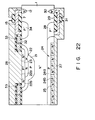
- Fig. 22 shows an embodiment in which this invention is applied to a thyristor having a turn-on MOS gate.
- a p-type base layer 21 is selectively formed in one surface area of the n ⁇ -type base layer 1 and an n-type emitter layer 22 is formed in the surface area of the base layer 21.
- the n-type emitter layer 22 is constructed by an n-type layer 22a serving as the main body of the emitter and n+-type layers 22b of high impurity concentration formed in the surface area of the layer 22a and a p+-type layer 23 serving as a current blocking layer is formed between the n+-type layers 22b.
- Gate electrodes 33 are formed over the exposed surface portions of the p-type base layer 21 which lie between the n-type emitter layer 22 and the n ⁇ -type base layer 1 with a gate insulation film 32 disposed therebetween.
- a p ⁇ -type layer 34 is formed outside the p-type base layer 21 to be partly overlapped with the gate electrode 33.
- a high-resistance film 15 is formed outside the layer 21 and on an insulation film 7. One end portion of the high-resistance film 15 is connected to the p ⁇ -type layer 34 and the other end portion thereof is connected to an n+-type layer 12 for potential fixation.
- the anode side structure is the same as that of the former embodiment of Fig. 20.
- a voltage which is positive with respect to the cathode is applied to the gate electrode 33 at the turn-on time. Therefore, electrons are injected from the n-type emitter layer 22 into the n ⁇ -type layer 1 via the channel under the gate electrode 33.
- the gate electrode is set to a potential equal to or less than that of the cathode. The element is turned off by discharging holes towards the cathode by means of a gate electrode which is not shown in Fig. 22.
- a high-speed turn-off operation can be attained with less power loss by suppressing the excessive carrier accumulation and the parasitic transistor effect.
- Fig. 23 shows an embodiment in which this invention is applied to a thyristor having a turn-off MOS gate.
- an n-type emitter layer 22 is formed in the surface area of the p-type base layer 21 and p+-type source layers 35 are selectively formed in the end surface area of the n-type emitter layer 22.
- Gate electrodes 37 are formed over the exposed surface portions of the n-type emitter layer 22 which lie between the p+-type source layer and the p-type base layer 21 with a gate insulation film 36 disposed therebetween.
- a turn-on gate section is not shown in the drawing.
- the anode side structure is the same as that of the former embodiment.
- the element of this embodiment is turned on by supplying a base current via a gate electrode which is not shown. At the turn-off time, a voltage which is negative with respect to the cathode is applied to the gate electrode 37. Therefore, holes in the n ⁇ -type base layer 1 are discharged from the p+-type source layer 35 to the cathode electrode 26 via the p-type base layer 21 and the channel under the gate electrode 37.
- Fig. 24 shows an embodiment obtained by modifying the embodiment of Fig. 23.
- an n-type buffer layer 38 is formed on the anode side of the n ⁇ -type base layer 1 and the anode structure having current blocking layers like the former embodiment is formed in the surface area of the n-type buffer layer 38.
- the anode side section is formed to have an emitter short-circuiting structure.
- Fig. 25 shows an embodiment in which this invention is applied to a bipolar transistor.
- a p-type emitter layer 41 is formed in one surface area of the n ⁇ -type base layer 1 and a p-type collector layer 43 is formed in the other surface area thereof.
- the p-type emitter layer 41 is constructed by a p-type layer 41a and p+-type layers 41b of high impurity concentration dispersedly formed in the surface area of the layer 41a, and n+-type layers 42 serving as current blocking layers are each formed between the p+-type layers 41b.
- the p-type collector layer 43 is constructed by a p-type layer 43a and p+-type layers 43b of high impurity concentration dispersedly formed in the surface area of the layer 43a, and n+-type layers 44 serving as current blocking layers are each formed between the p+-type layers 43b.
- An emitter electrode 45 is formed on the p-type emitter layer 41, a collector electrode 46 is formed on the p-type collector layer 43 and a base electrode 47 is formed on the n ⁇ -type layer 1.
- the reverse recovery characteristic can be improved.
- Fig. 26 shows an embodiment in which this invention is applied to a bipolar transistor.
- a planar structure is utilized in which an n ⁇ -type base layer 1 is used as a high-resistance collector layer. That is, a p-type base layer 51 is formed by diffusion in one surface area of the n ⁇ -type base layer 1, and an n-type emitter layer 52 is formed by diffusion in the surface area of the p-type base layer 51.
- the n-type emitter layer 52 is constructed by an n-type layer 52a and n+-type layers 52b of high impurity concentration dispersedly formed in the surface area of the layer 52a, and p+-type layers 53 serving as current blocking layers are each formed between the n+-type layers 52b.
- An emitter electrode 45 is formed in contact with both of the p+-type layer 53 and the n+-type layer 52b.
- An n+-type collector layer 54 is formed on the entire portion of the other surface of the n ⁇ -type base layer 1, and a collector electrode 46 is formed on the collector layer.
- a base electrode 47 is formed on the p-type base layer 51.
- the same structure as that of the former embodiment for attaining the high breakdown voltage is formed in the end portion of the p-type base layer 51.
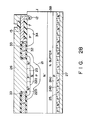
- Figs. 27 and 28 show embodiments in which this invention is applied to a pn junction portion on the anode side of an IGBT having a junction end portion of the main junction which lies in the same plane as the cathode side electrode.
- Such a pn junction portion (guard ring, resurf, resistive field plate, field plate or the like) has a limitation of the breakdown voltage which is equal to approx. 70 to 90 % of the theoretical breakdown voltage of the high-resistance base layer. Therefore, in order to attain a desired breakdown voltage, it is necessary to set the impurity concentration of the high-resistance layer to be lower than that of a normal element (for example, an element having the bevel structure). The trade-off of the turn-off loss and ON-resistance deteriorated by the above impurity concentration setting can be improved by inserting the n-type buffer layer 38 and using the structure of this invention.
- the trade-off of the turn-off loss and ON-resistance deteriorated by use of the above impurity concentration can be improved when applying this invention to any type of element (such as MCT, IGBT, EST and GTO) having the above-described junction end portion.
- carrier injection blocking layers 10 are formed in the portion on the cathode side, as shown in Fig. 29A. That is, the cathode layer 3 has a double-layered structure formed of an n+-type layer 3a and n++-type layers 3b of higher impurity concentration and the n++-type layers 3b are dispersedly arranged in the surface area on the cathode side. According to this embodiment, a tail current of a reverse recovery current is reduced.
- Figs. 30 and 31 there are provided another IGBTs according to the present invention. These IGBTs have trench gate structures.
- the IGBT of Fig. 30 is a modification of the device shown in Fig. 23.
- the IGBT of Fig. 31 is a modification of the device shown in Fig. 27.
- the present invention is applied to the device having the trench gate structure, the device characteristics are improved.
Landscapes
- Thyristors (AREA)
- Electrodes Of Semiconductors (AREA)
- Bipolar Transistors (AREA)
Applications Claiming Priority (4)
| Application Number | Priority Date | Filing Date | Title |
|---|---|---|---|
| JP259064/90 | 1990-09-28 | ||
| JP25906490 | 1990-09-28 | ||
| JP129535/91 | 1991-05-31 | ||
| JP12953591A JP3321185B2 (ja) | 1990-09-28 | 1991-05-31 | 高耐圧半導体装置 |
Publications (2)
| Publication Number | Publication Date |
|---|---|
| EP0485059A2 true EP0485059A2 (de) | 1992-05-13 |
| EP0485059A3 EP0485059A3 (en) | 1992-12-02 |
Family
ID=26464894
Family Applications (1)
| Application Number | Title | Priority Date | Filing Date |
|---|---|---|---|
| EP19910308637 Ceased EP0485059A3 (en) | 1990-09-28 | 1991-09-23 | Semiconductor device including a pin-diode having high breakdown voltage |
Country Status (3)
| Country | Link |
|---|---|
| US (1) | US5162876A (de) |
| EP (1) | EP0485059A3 (de) |
| JP (1) | JP3321185B2 (de) |
Cited By (13)
| Publication number | Priority date | Publication date | Assignee | Title |
|---|---|---|---|---|
| DE4240027A1 (de) * | 1992-11-28 | 1994-06-01 | Asea Brown Boveri | MOS-gesteuerte Diode |
| WO1996001501A1 (de) * | 1994-07-06 | 1996-01-18 | Robert Bosch Gmbh | Laterale halbleiterstruktur zur bildung einer temperaturkompensierten spannungsbegrenzung |
| GB2320363A (en) * | 1996-12-12 | 1998-06-17 | Westinghouse Brake & Signal | Insulated gate bipolar transistor |
| EP0967659A1 (de) * | 1998-06-26 | 1999-12-29 | Delphi Technologies, Inc. | IGBT-Leistungsbauelement mit verbessertem Widerstand gegen rückwartige Leistungspulse |
| US6147382A (en) * | 1996-12-12 | 2000-11-14 | Westcode Semiconductors Limited | Semiconductor switching device with segmented sources |
| EP0755076B1 (de) * | 1995-07-21 | 2003-07-30 | Mitsubishi Denki Kabushiki Kaisha | Vertikale MOS-Halbleiteranordnung mit versenktem Gate und Herstellungsverfahren |
| DE10250608A1 (de) * | 2002-10-30 | 2004-05-19 | eupec Europäische Gesellschaft für Leistungshalbleiter mbH | Thyristorbauelement mit verbessertem Sperrverhalten in Rückwärtsrichtung |
| WO2006029921A1 (de) * | 2004-09-13 | 2006-03-23 | Robert Bosch Gmbh | Halbleiteranordnung zur spannungsbegrenzung |
| EP1909332A1 (de) * | 2006-10-05 | 2008-04-09 | ABB Technology AG | Leistungshalbleiteranordnung |
| WO2012041836A1 (en) | 2010-09-27 | 2012-04-05 | Abb Technology Ag | Bipolar non-punch-through power semiconductor device |
| US8421145B2 (en) | 2010-06-23 | 2013-04-16 | Mitsubishi Electric Corporation | Power semiconductor device |
| DE10226908B4 (de) * | 2001-07-17 | 2014-03-13 | Mitsubishi Denki K.K. | Isolierschicht-Bipolartransistor |
| CN112838006A (zh) * | 2020-12-31 | 2021-05-25 | 扬州扬杰电子科技股份有限公司 | 一种氮化镓pin二极管及其制备方法 |
Families Citing this family (55)
| Publication number | Priority date | Publication date | Assignee | Title |
|---|---|---|---|---|
| US6100575A (en) | 1987-08-19 | 2000-08-08 | Mitsubishi Denki Kabushiki Kaisha | Semiconductor switching device having different carrier lifetimes between a first portion serving as a main current path and the remaining portion of the device |
| JPH05152574A (ja) * | 1991-11-29 | 1993-06-18 | Fuji Electric Co Ltd | 半導体装置 |
| US5969400A (en) * | 1995-03-15 | 1999-10-19 | Kabushiki Kaisha Toshiba | High withstand voltage semiconductor device |
| US6204717B1 (en) | 1995-05-22 | 2001-03-20 | Hitachi, Ltd. | Semiconductor circuit and semiconductor device for use in equipment such as a power converting apparatus |
| JP3488772B2 (ja) * | 1996-01-16 | 2004-01-19 | 三菱電機株式会社 | 半導体装置 |
| JP3444081B2 (ja) * | 1996-02-28 | 2003-09-08 | 株式会社日立製作所 | ダイオード及び電力変換装置 |
| WO1999007020A1 (de) * | 1997-07-30 | 1999-02-11 | Siemens Aktiengesellschaft | Gate-gesteuerter thyristor |
| US6271061B1 (en) | 1997-12-03 | 2001-08-07 | Stmicroelectronics S.R.L. | Fabrication of insulated gate bipolar devices |
| JP4157184B2 (ja) * | 1998-02-18 | 2008-09-24 | 株式会社東芝 | 高耐圧半導体素子 |
| US6448160B1 (en) * | 1999-04-01 | 2002-09-10 | Apd Semiconductor, Inc. | Method of fabricating power rectifier device to vary operating parameters and resulting device |
| US8294172B2 (en) * | 2002-04-09 | 2012-10-23 | Lg Electronics Inc. | Method of fabricating vertical devices using a metal support film |
| US6841802B2 (en) | 2002-06-26 | 2005-01-11 | Oriol, Inc. | Thin film light emitting diode |
| DE10238797B4 (de) * | 2002-08-23 | 2007-09-20 | Infineon Technologies Ag | Kommutierfeste Diode und Verfahren zu ihrer Herstellung |
| JP2006518107A (ja) * | 2003-02-18 | 2006-08-03 | コーニンクレッカ フィリップス エレクトロニクス エヌ ヴィ | 半導体装置及びそのような装置の製造方法 |
| JP4799829B2 (ja) * | 2003-08-27 | 2011-10-26 | 三菱電機株式会社 | 絶縁ゲート型トランジスタ及びインバータ回路 |
| DE10339691B3 (de) * | 2003-08-28 | 2005-04-07 | Infineon Technologies Ag | Leistungshalbleiterbauelement |
| DE10361136B4 (de) * | 2003-12-23 | 2005-10-27 | Infineon Technologies Ag | Halbleiterdiode und IGBT |
| JP2005354031A (ja) * | 2004-05-13 | 2005-12-22 | Mitsubishi Electric Corp | 半導体装置 |
| US7615801B2 (en) * | 2005-05-18 | 2009-11-10 | Cree, Inc. | High voltage silicon carbide devices having bi-directional blocking capabilities |
| JP5011748B2 (ja) * | 2006-02-24 | 2012-08-29 | 株式会社デンソー | 半導体装置 |
| US8669554B2 (en) | 2006-05-10 | 2014-03-11 | Ho-Yuan Yu | Fast recovery reduced p-n junction rectifier |
| US7880166B2 (en) * | 2006-05-10 | 2011-02-01 | Ho-Yuan Yu | Fast recovery reduced p-n junction rectifier |
| JP4743447B2 (ja) | 2008-05-23 | 2011-08-10 | 三菱電機株式会社 | 半導体装置 |
| JP2010098189A (ja) * | 2008-10-17 | 2010-04-30 | Toshiba Corp | 半導体装置 |
| US20100117725A1 (en) * | 2008-11-12 | 2010-05-13 | Infineon Technologies Austria Ag | Semiconductor diode |
| US9153674B2 (en) * | 2009-04-09 | 2015-10-06 | Infineon Technologies Austria Ag | Insulated gate bipolar transistor |
| JP2010283132A (ja) * | 2009-06-04 | 2010-12-16 | Mitsubishi Electric Corp | 半導体装置 |
| JP2011023527A (ja) * | 2009-07-15 | 2011-02-03 | Toshiba Corp | 半導体装置 |
| CN102414817B (zh) * | 2009-09-14 | 2014-01-08 | 丰田自动车株式会社 | 具备具有二极管区和igbt区的半导体基板的半导体装置 |
| JP5925991B2 (ja) * | 2010-05-26 | 2016-05-25 | 三菱電機株式会社 | 半導体装置 |
| JP2012069579A (ja) * | 2010-09-21 | 2012-04-05 | Toshiba Corp | 逆通電型の絶縁ゲート型バイポーラトランジスタ |
| JP5321669B2 (ja) * | 2010-11-25 | 2013-10-23 | 株式会社デンソー | 半導体装置 |
| JP5937413B2 (ja) * | 2011-06-15 | 2016-06-22 | 株式会社デンソー | 半導体装置 |
| JP5753114B2 (ja) * | 2012-03-08 | 2015-07-22 | 株式会社豊田中央研究所 | ダイオード |
| JP2013201206A (ja) * | 2012-03-23 | 2013-10-03 | Toshiba Corp | 遮蔽板、半導体装置の製造方法、半導体装置 |
| KR101378094B1 (ko) | 2012-07-13 | 2014-03-27 | 주식회사 케이이씨 | 고속 회복 다이오드 |
| US9306045B2 (en) * | 2013-11-19 | 2016-04-05 | United Microelectronics Corp. | Semiconductor power device |
| JP2016029685A (ja) * | 2014-07-25 | 2016-03-03 | 株式会社東芝 | 半導体装置 |
| DE112015006128B4 (de) * | 2015-02-09 | 2026-04-09 | Mitsubishi Electric Corporation | Halbleitervorrichtungen |
| JP6217700B2 (ja) * | 2015-07-21 | 2017-10-25 | トヨタ自動車株式会社 | ダイオード |
| DE112016006787T5 (de) * | 2016-04-25 | 2019-01-17 | Mitsubishi Electric Corporation | Halbleitervorrichtung |
| JP6846119B2 (ja) * | 2016-05-02 | 2021-03-24 | 株式会社 日立パワーデバイス | ダイオード、およびそれを用いた電力変換装置 |
| DE102016117723A1 (de) | 2016-09-20 | 2018-03-22 | Infineon Technologies Ag | Diodenstruktur eines Leistungshalbleiterbauelements |
| JP6677615B2 (ja) * | 2016-09-20 | 2020-04-08 | 株式会社東芝 | 半導体装置 |
| WO2019097662A1 (ja) * | 2017-11-17 | 2019-05-23 | 新電元工業株式会社 | 電力変換回路 |
| JP7126361B2 (ja) * | 2018-03-08 | 2022-08-26 | 三菱電機株式会社 | 半導体装置、電力変換装置、及び、半導体装置の製造方法 |
| CN108493291B (zh) * | 2018-04-13 | 2020-03-31 | 电子科技大学 | 高di/dt光控晶闸管版图设计方法 |
| CN109390389A (zh) * | 2018-09-17 | 2019-02-26 | 西安理工大学 | 具有双侧调整区的高压快速软恢复二极管及其制备方法 |
| JP7585646B2 (ja) | 2019-08-13 | 2024-11-19 | 富士電機株式会社 | 半導体装置および半導体装置の製造方法 |
| JP7342742B2 (ja) * | 2020-03-11 | 2023-09-12 | 三菱電機株式会社 | 半導体装置 |
| US20210343837A1 (en) * | 2020-05-01 | 2021-11-04 | Vanguard International Semiconductor Corporation | Semiconductor structures |
| DE102021115971A1 (de) | 2021-06-21 | 2022-12-22 | Infineon Technologies Ag | Feldstoppgebiet enthaltende halbleitervorrichtung |
| CN115241293B (zh) * | 2022-06-15 | 2023-12-05 | 江苏新顺微电子股份有限公司 | 一种高速软恢复高压肖特基二极管器件及制造方法 |
| EP4439680A1 (de) * | 2023-03-31 | 2024-10-02 | Hitachi Energy Ltd | Leistungshalbleiterbauelement und verfahren zur herstellung eines leistungshalbleiterbauelements |
| EP4439633A1 (de) * | 2023-03-31 | 2024-10-02 | Hitachi Energy Ltd | Leistungshalbleiterbauelement und verfahren zur herstellung eines leistungshalbleiterbauelements |
Family Cites Families (8)
| Publication number | Priority date | Publication date | Assignee | Title |
|---|---|---|---|---|
| US4259683A (en) * | 1977-02-07 | 1981-03-31 | General Electric Company | High switching speed P-N junction devices with recombination means centrally located in high resistivity layer |
| JPS55128870A (en) * | 1979-03-26 | 1980-10-06 | Semiconductor Res Found | Electrostatic induction thyristor and semiconductor device |
| GB2050694B (en) * | 1979-05-07 | 1983-09-28 | Nippon Telegraph & Telephone | Electrode structure for a semiconductor device |
| JPS56103466A (en) * | 1980-01-21 | 1981-08-18 | Nippon Telegr & Teleph Corp <Ntt> | Thyristor |
| JPS5949712A (ja) * | 1982-09-14 | 1984-03-22 | 松下電器産業株式会社 | ジユ−サ |
| US4760431A (en) * | 1985-09-30 | 1988-07-26 | Kabushiki Kaisha Toshiba | Gate turn-off thyristor with independent turn-on/off controlling transistors |
| JPS6384066A (ja) * | 1986-09-26 | 1988-04-14 | Semiconductor Res Found | 集積化光トリガ・光クエンチ静電誘導サイリスタ及びその製造方法 |
| JPH0642542B2 (ja) * | 1988-04-08 | 1994-06-01 | 株式会社東芝 | 高耐圧半導体装置の製造方法 |
-
1991
- 1991-05-31 JP JP12953591A patent/JP3321185B2/ja not_active Expired - Fee Related
- 1991-09-23 EP EP19910308637 patent/EP0485059A3/en not_active Ceased
- 1991-09-27 US US07/766,076 patent/US5162876A/en not_active Expired - Lifetime
Cited By (28)
| Publication number | Priority date | Publication date | Assignee | Title |
|---|---|---|---|---|
| DE4240027A1 (de) * | 1992-11-28 | 1994-06-01 | Asea Brown Boveri | MOS-gesteuerte Diode |
| WO1996001501A1 (de) * | 1994-07-06 | 1996-01-18 | Robert Bosch Gmbh | Laterale halbleiterstruktur zur bildung einer temperaturkompensierten spannungsbegrenzung |
| AU693568B2 (en) * | 1994-07-06 | 1998-07-02 | Robert Bosch Gmbh | Lateral semiconductor structure designed to produce a temperature-compensated voltage limitation |
| US6262466B1 (en) | 1994-07-06 | 2001-07-17 | Robert Bosch Gmbh | Lateral semiconductor structure for forming a temperature-compensated voltage limitation |
| EP0755076B1 (de) * | 1995-07-21 | 2003-07-30 | Mitsubishi Denki Kabushiki Kaisha | Vertikale MOS-Halbleiteranordnung mit versenktem Gate und Herstellungsverfahren |
| GB2320363A (en) * | 1996-12-12 | 1998-06-17 | Westinghouse Brake & Signal | Insulated gate bipolar transistor |
| US6147382A (en) * | 1996-12-12 | 2000-11-14 | Westcode Semiconductors Limited | Semiconductor switching device with segmented sources |
| GB2320363B (en) * | 1996-12-12 | 2001-04-18 | Westinghouse Brake & Signal | Semiconductor switching device |
| EP0967659A1 (de) * | 1998-06-26 | 1999-12-29 | Delphi Technologies, Inc. | IGBT-Leistungsbauelement mit verbessertem Widerstand gegen rückwartige Leistungspulse |
| DE10226908B4 (de) * | 2001-07-17 | 2014-03-13 | Mitsubishi Denki K.K. | Isolierschicht-Bipolartransistor |
| DE10250608A1 (de) * | 2002-10-30 | 2004-05-19 | eupec Europäische Gesellschaft für Leistungshalbleiter mbH | Thyristorbauelement mit verbessertem Sperrverhalten in Rückwärtsrichtung |
| DE10250608B4 (de) * | 2002-10-30 | 2005-09-29 | eupec Europäische Gesellschaft für Leistungshalbleiter mbH | Thyristorbauelement mit verbessertem Sperrverhalten in Rückwärtsrichtung |
| US7671379B2 (en) | 2004-09-13 | 2010-03-02 | Robert Bosch Gmbh | Semiconductor system for voltage limitation |
| CN101019238B (zh) * | 2004-09-13 | 2010-06-02 | 罗伯特·博世有限公司 | 用于电压限制的半导体结构 |
| WO2006029921A1 (de) * | 2004-09-13 | 2006-03-23 | Robert Bosch Gmbh | Halbleiteranordnung zur spannungsbegrenzung |
| US9048340B2 (en) | 2006-10-05 | 2015-06-02 | Abb Technology Ag | Power semiconductor device with a reduced dynamic avalanche effect and subsequent local heating |
| EP1909332A1 (de) * | 2006-10-05 | 2008-04-09 | ABB Technology AG | Leistungshalbleiteranordnung |
| WO2008040733A1 (en) * | 2006-10-05 | 2008-04-10 | Abb Technology Ag | Power semiconductor device |
| US8421145B2 (en) | 2010-06-23 | 2013-04-16 | Mitsubishi Electric Corporation | Power semiconductor device |
| US8829600B2 (en) | 2010-06-23 | 2014-09-09 | Mitsubishi Electric Corporation | Power semiconductor device |
| US9257542B2 (en) | 2010-06-23 | 2016-02-09 | Mitsubishi Electric Corporation | Power semiconductor device with resistance control structure |
| DE102011077841B4 (de) * | 2010-06-23 | 2020-12-24 | Mitsubishi Electric Corp. | Leistungshalbleitervorrichtungen |
| WO2012041836A1 (en) | 2010-09-27 | 2012-04-05 | Abb Technology Ag | Bipolar non-punch-through power semiconductor device |
| DE112011103230T5 (de) | 2010-09-27 | 2013-08-01 | Abb Technology Ag | Non-Punch-Through-Bipolarleistungshalbleiterbauelement |
| US8803192B2 (en) | 2010-09-27 | 2014-08-12 | Abb Technology Ag | Bipolar non-punch-through power semiconductor device |
| DE112011103230B4 (de) | 2010-09-27 | 2021-11-25 | Abb Schweiz Ag | Non-Punch-Through-Bipolarleistungshalbleiterbauelement und ein Verfahren zum Herstellen eines derartigen Halbleiterbauelements |
| CN112838006A (zh) * | 2020-12-31 | 2021-05-25 | 扬州扬杰电子科技股份有限公司 | 一种氮化镓pin二极管及其制备方法 |
| CN112838006B (zh) * | 2020-12-31 | 2023-08-01 | 扬州扬杰电子科技股份有限公司 | 一种氮化镓pin二极管及其制备方法 |
Also Published As
| Publication number | Publication date |
|---|---|
| US5162876A (en) | 1992-11-10 |
| JP3321185B2 (ja) | 2002-09-03 |
| EP0485059A3 (en) | 1992-12-02 |
| JPH04312981A (ja) | 1992-11-04 |
Similar Documents
| Publication | Publication Date | Title |
|---|---|---|
| EP0485059A2 (de) | Halbleiterbauelement mit einer Pin-Diode mit hoher Durchbruchspannung | |
| US4969028A (en) | Gate enhanced rectifier | |
| EP0450082B1 (de) | Bipolarer transistor mit isolierter steuerelektrode | |
| JP4357753B2 (ja) | 高耐圧半導体装置 | |
| US6051850A (en) | Insulated gate bipolar junction transistors having built-in freewheeling diodes therein | |
| US5969378A (en) | Latch-up free power UMOS-bipolar transistor | |
| US4827321A (en) | Metal oxide semiconductor gated turn off thyristor including a schottky contact | |
| IE52758B1 (en) | Gate enhanced rectifier | |
| US6091107A (en) | Semiconductor devices | |
| JP2811526B2 (ja) | 静電誘導ショットキー短絡構造を有する静電誘導型半導体素子 | |
| US4969027A (en) | Power bipolar transistor device with integral antisaturation diode | |
| US6133607A (en) | Semiconductor device | |
| US5319222A (en) | MOS gated thyristor having on-state current saturation capability | |
| EP0154082B1 (de) | Gate-abschaltbarer Thyristor | |
| US5793066A (en) | Base resistance controlled thyristor structure with high-density layout for increased current capacity | |
| EP0338312B1 (de) | Bipolarer Transistor mit isolierter Steuerelektrode | |
| US5079607A (en) | Mos type semiconductor device | |
| US4933740A (en) | Insulated gate transistor with vertical integral diode and method of fabrication | |
| EP0761016B1 (de) | Halbleiteranordnung mit einem ligbt element | |
| JPH10173170A (ja) | 半導体装置 | |
| EP0565350B1 (de) | Halbleiterbauelement mit Bufferstruktur | |
| JP7800218B2 (ja) | 半導体装置 | |
| US5455442A (en) | COMFET switch and method | |
| JP3338276B2 (ja) | 電力用半導体装置 | |
| US20220045205A1 (en) | Trench gate power switch with doped regions to induce breakdown at selected areas |
Legal Events
| Date | Code | Title | Description |
|---|---|---|---|
| PUAI | Public reference made under article 153(3) epc to a published international application that has entered the european phase |
Free format text: ORIGINAL CODE: 0009012 |
|
| 17P | Request for examination filed |
Effective date: 19911014 |
|
| AK | Designated contracting states |
Kind code of ref document: A2 Designated state(s): DE FR GB |
|
| PUAL | Search report despatched |
Free format text: ORIGINAL CODE: 0009013 |
|
| AK | Designated contracting states |
Kind code of ref document: A3 Designated state(s): DE FR GB |
|
| 17Q | First examination report despatched |
Effective date: 19950320 |
|
| STAA | Information on the status of an ep patent application or granted ep patent |
Free format text: STATUS: THE APPLICATION HAS BEEN REFUSED |
|
| 18R | Application refused |
Effective date: 19980922 |