EP0485108A2 - Kodierte Modulation mit ungleichen Fehlerschutzebenen - Google Patents
Kodierte Modulation mit ungleichen Fehlerschutzebenen Download PDFInfo
- Publication number
- EP0485108A2 EP0485108A2 EP91310012A EP91310012A EP0485108A2 EP 0485108 A2 EP0485108 A2 EP 0485108A2 EP 91310012 A EP91310012 A EP 91310012A EP 91310012 A EP91310012 A EP 91310012A EP 0485108 A2 EP0485108 A2 EP 0485108A2
- Authority
- EP
- European Patent Office
- Prior art keywords
- bits
- symbols
- data elements
- constellation
- group
- Prior art date
- Legal status (The legal status is an assumption and is not a legal conclusion. Google has not performed a legal analysis and makes no representation as to the accuracy of the status listed.)
- Granted
Links
Images



Classifications
-
- H—ELECTRICITY
- H03—ELECTRONIC CIRCUITRY
- H03M—CODING; DECODING; CODE CONVERSION IN GENERAL
- H03M13/00—Coding, decoding or code conversion, for error detection or error correction; Coding theory basic assumptions; Coding bounds; Error probability evaluation methods; Channel models; Simulation or testing of codes
- H03M13/35—Unequal or adaptive error protection, e.g. by providing a different level of protection according to significance of source information or by adapting the coding according to the change of transmission channel characteristics
-
- H—ELECTRICITY
- H04—ELECTRIC COMMUNICATION TECHNIQUE
- H04N—PICTORIAL COMMUNICATION, e.g. TELEVISION
- H04N7/00—Television systems
- H04N7/12—Systems in which the television signal is transmitted via one channel or a plurality of parallel channels, the bandwidth of each channel being less than the bandwidth of the television signal
-
- H—ELECTRICITY
- H04—ELECTRIC COMMUNICATION TECHNIQUE
- H04L—TRANSMISSION OF DIGITAL INFORMATION, e.g. TELEGRAPHIC COMMUNICATION
- H04L27/00—Modulated-carrier systems
- H04L27/32—Carrier systems characterised by combinations of two or more of the types covered by groups H04L27/02, H04L27/10, H04L27/18 or H04L27/26
- H04L27/34—Amplitude- and phase-modulated carrier systems, e.g. quadrature-amplitude modulated carrier systems
- H04L27/3405—Modifications of the signal space to increase the efficiency of transmission, e.g. reduction of the bit error rate, bandwidth, or average power
- H04L27/3416—Modifications of the signal space to increase the efficiency of transmission, e.g. reduction of the bit error rate, bandwidth, or average power in which the information is carried by both the individual signal points and the subset to which the individual points belong, e.g. using coset coding, lattice coding, or related schemes
- H04L27/3422—Modifications of the signal space to increase the efficiency of transmission, e.g. reduction of the bit error rate, bandwidth, or average power in which the information is carried by both the individual signal points and the subset to which the individual points belong, e.g. using coset coding, lattice coding, or related schemes in which the constellation is not the n - fold Cartesian product of a single underlying two-dimensional constellation
-
- H—ELECTRICITY
- H04—ELECTRIC COMMUNICATION TECHNIQUE
- H04L—TRANSMISSION OF DIGITAL INFORMATION, e.g. TELEGRAPHIC COMMUNICATION
- H04L27/00—Modulated-carrier systems
- H04L27/32—Carrier systems characterised by combinations of two or more of the types covered by groups H04L27/02, H04L27/10, H04L27/18 or H04L27/26
- H04L27/34—Amplitude- and phase-modulated carrier systems, e.g. quadrature-amplitude modulated carrier systems
- H04L27/3488—Multiresolution systems
-
- H—ELECTRICITY
- H04—ELECTRIC COMMUNICATION TECHNIQUE
- H04N—PICTORIAL COMMUNICATION, e.g. TELEVISION
- H04N21/00—Selective content distribution, e.g. interactive television or video on demand [VOD]
- H04N21/40—Client devices specifically adapted for the reception of or interaction with content, e.g. set-top-box [STB]; Operations thereof
- H04N21/41—Structure of client; Structure of client peripherals
- H04N21/426—Internal components of the client ; Characteristics thereof
-
- H—ELECTRICITY
- H04—ELECTRIC COMMUNICATION TECHNIQUE
- H04N—PICTORIAL COMMUNICATION, e.g. TELEVISION
- H04N7/00—Television systems
- H04N7/08—Systems for the simultaneous or sequential transmission of more than one television signal, e.g. additional information signals, the signals occupying wholly or partially the same frequency band, e.g. by time division
-
- H—ELECTRICITY
- H04—ELECTRIC COMMUNICATION TECHNIQUE
- H04L—TRANSMISSION OF DIGITAL INFORMATION, e.g. TELEGRAPHIC COMMUNICATION
- H04L1/00—Arrangements for detecting or preventing errors in the information received
- H04L2001/0098—Unequal error protection
Definitions
- the present invention relates to the transmission of digital data, particularly the transmission of digital data which represents video signals.
- HDTV high definition television
- SNR signal-to-noise ratio
- a first one of the aforementioned data streams carries components of the overall television signal which are regarded as the most important--for example, the audio, the framing information, and the vital portions of the video information--and that data stream is mapped such that its data elements have the lowest probability of error.
- a second one of the data streams carries components of the overall television signal which are regarded as less important than those of the first data stream and that data stream is mapped such that its data elements have a probability of error that is not as low as those of the first data stream.
- the symbols in a predetermined 2N-dimensional channel symbol constellation, N ⁇ 1, are divided into groups, each of which is referred to herein as a "supersymbol.”
- a predetermined number of the most important data elements are channel encoded, and the resulting channel coded data elements identify a particular one of the supersymbols.
- the remaining data elements which may also be channel encoded, are used to select for transmission a particular symbol from the identified supersymbol.
- the approach as thus far described is similar in a general way to conventional coded modulation schemes in that the latter also divide the channel symbols into groups, typically referred to as "subsets.”
- subsets are formed under the constraint that the minimum Euclidean distance (hereinafter referred to as the "minimum distance") between the symbols in a subset is greater than the minimum distance between the symbols in the constellation as a whole.
- the minimum distance between the symbols of a supersymbol is the same as the minimum distance between the symbols in the constellation as a whole.
- video signal source 101 generates an analog video signal representing picture information or "intelligence" which signal is passed on to source encoder 104.
- the latter generates a digital signal in which at least one subset of the data elements represents a portion of the information, or intelligence, that is more important than the portion of the information, or intelligence, represented by the rest of the data elements.
- each data element is a data bit, with m+k information bits being generated for each of a succession of symbol intervals.
- the symbol intervals are comprised of N signalling intervals, where 2N is the number of dimensions of the constellation (as described below).
- the signaling intervals have duration of T seconds and, accordingly, the symbol intervals each have a duration of NT seconds.
- N two-dimensional constellations
- the bits within the stream of m bits per symbol interval, appearing on lead 105 are more important than the bits within the stream of k bits per symbol interval, appearing on lead 106.
- Two examples of how one might generate a television signal of this type are given hereinbelow.
- the bits on leads 105 and 106 are independently scrambled in scramblers 110 and 111, which respectively output m and k parallel bits on leads 112 and 113. (Scrambling is customarily carried out on a serial bit stream. Thus although not explicitly shown in FIG.
- scramblers 110 and 111 may be assumed to perform a parallel-to-serial conversion on their respective input bits prior to scrambling and a serial-to-parallel conversion at their outputs.)
- the respective groups of bits on leads 112 and 113 are extended to channel encoders--illustratively trellis encoders--114 and 115 which generate, for each symbol interval, respective expanded groups of the expanded r and p bits on leads 121 and 122, where r > m and p > k.
- the values of those bits jointly identify a particular channel symbol of a predetermined constellation of channel symbols (such as the constellation of FIG. 4 as described in detail hereinbelow).
- Complex plane coordinates of the identified channel symbol are output by constellation mapper 131, illustratively realized as a lookup table or as a straightforward combination of logic elements.
- Conventional passband shaping and television modulation are then performed by passband shaper 141 and television modulator 151, respectively.
- the resultant analog signal is then broadcast via antenna 152 over a communication channel, in this case a free-space channel.
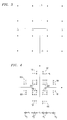
- FIG. 3 depicts a standard two-dimensional data transmission constellation of the type conventionally used in digital radio and voiceband data transmission systems.
- quadrature-amplitude modulation (QAM)--data words each comprised of four information bits are each mapped into one of 16 possible two-dimensional channel symbols.
- Each channel symbol has an in-phase, or I, coordinate on the horizontal axis and has a quadrature-phase, or Q, coordinate on the vertical axis.
- the channel symbol coordinates are ⁇ 1 or ⁇ 3 so that the distance between each symbol and each of the symbols that are horizontally or vertically adjacent to it is the same for all symbols--that distance being "2".
- the channel symbol coordinates are ⁇ 1 or ⁇ 3 so that the distance between each symbol and each of the symbols that are horizontally or vertically adjacent to it is the same for all symbols--that distance being "2".
- the known noise immunity and bandwidth efficiency advantages of coded modulation are achieved while providing different levels of error protection to different classes of bits.
- I have discovered that it is possible to achieve a level of error protection for a class of "most important" bits which is substantially greater than what can be achieved with the aforementioned conventional coded modulation approach.
- the transmitter of FIG. 1 embodies the inventive concept, as will now be described in further detail.
- the constellation used in the transmitter of FIG. 1 is illustratively the two-dimensional 64-symbol constellation shown in FIG. 4 (each symbol is represented as a dot in the figure).
- the symbols in the signal constellation are divided into groups which I refer to as "supersymbols.”
- Four of the supersymbols, labeled 000,011, 100 and 111 are each comprised of eight contiguous channel symbols assigned to that supersymbol.
- the other four supersymbols, labeled 001, 010, 101 and 110 are each comprised of two non-contiguous groups, each comprised of four contiguous channel symbols.
- the use of such two-group supersymbols allows the overall constellation to have, for example, better signal-to-noise ratio, lower peak-to-average power ratio and better symmetry than would otherwise be possible.
- the minimum distance between the symbols of a supersymbol--that distance being denoted d 2-- is the same as the minimum distance between the symbols in the constellation as a whole. Indeed, it can be verified by observation that this criterion is satisfied in FIG. 4.
- d 1 is the minimum distance between the supersymbols.
- the parameter d 1 is given by the minimum of the distances between all the pairs of supersymbols.
- the distance between any pair of supersymbols is the minimum distance between any symbol of one of the pair of supersymbols and any symbol of the other.
- a coded modulation scheme can now be constructed for the most important bits as though the eight supersymbols were eight conventional symbols in a conventional constellation. (It is true that in a conventional constellation a symbol cannot be divided into halves, as is the case for supersymbols 001, 010, 101 and 110. However, for the purpose of coding design, one may treat each of the halved supersymbols as being located in only one of its two positions.) To design such a coded modulation scheme, the eight supersymbols are partitioned, as is conventional, into a predetermined number of subsets and an appropriate code is used to encode some of the most important input bits to generate a stream of coded output bits which define a sequence of subsets.
- each subset contains only a single supersymbol, i.e., there are eight subsets, and all most important input bits--i.e, the two bits on lead 112--are encoded.
- the identification of a particular subset also identifies a particular supersymbol. It is from this particular supersymbol that the symbol that is ultimately to be transmitted will be selected as a function of the other, or less important, bits.
- the less important bits, on lead 113 are then used to select a particular symbol from the identified supersymbol for transmission.
- this selection also involves the use of coded modulation wherein at least some of the less important bits are encoded to identify a particular subset of symbols within a supersymbol and, if the subset contains more than one symbol, any remaining bits are used to select a particular one of those symbols.
- the arrangement of the symbols within a supersymbol should, of course, be chosen jointly with encoder 115 to maximize its coding gain.
- the three coded bits on lead 122 identify, at one and the same time, both a subset and a specific symbol from the earlier identified supersymbol.
- FIG. 6 A particular illustrative embodiment for both encoders 114 and 115 is shown in FIG. 6.
- the boxes labelled “T” are T-second delay elements
- the circles labelled “+” are exclusive-or gates
- the two-input gates are AND gates, one of which has one of its inputs inverted.
- the 3-bit output of encoder 114 identifies a particular supersymbol.
- the bit values "110" output by encoder 114 on its three output leads (reading from top to bottom in FIG. 6) identifies the supersymbol labeled 110 in FIG. 4, and so forth for each of the seven other possible bit patterns.
- the 3-bit output of encoder 115 selects a particular symbol within the identified supersymbol.
- the assignment of bit values to particular channel symbols within the supersymbols is shown in FIG. 5 for the upper right quadrant of the FIG. 4 constellation.
- the bit assignment scheme for the other three quadrants are arrived at by simply rotating FIG. 5.
- the bit values "001" output by encoder 115 on its three output leads identifies the channel symbol labeled 001 in the identified supersymbol--there being one such symbol in each supersymbol.
- a coding gain of 6.6 dB is achieved for the more important bits at a cost of a coding gain of -4.6 dB for the less important bits.
- the peak-to-average power ratio is about "2" (as it is for all the examples described herein), which is comparable to that achieved with conventional uncoded modulation.
- the analog broadcast signal is received by antenna 201, is subjected to conventional television front-end processing including, for example, demodulation in processing unit 211, and is converted to digital form by A/D converter 212.
- the signal is then equalized by passband channel equalizer 221 and passed on parallel rails 222 and 223 to channel decoders 231 and 232.
- Each of the channel decoders is, illustratively, a maximum likelihood decoder, such as a Viterbi decoder.
- the function of channel decoder 231 is to identify the most likely sequence of supersymbols
- the function of channel decoder 232 is to identify the most likely sequence of symbols, given that sequence of supersymbols.
- decoder 231 has stored within it information about the code used by channel encoder 114, while decoder 232 has stored within it information about the code used by channel encoder 115. Additionally, between the two of them these two decoders have stored within them information about the constellation being used and the manner in which the symbols are assigned to their respective supersymbols.
- the first step of decoding is to find the supersymbol or half supersymbol in each subset that is closest to the received symbol--such as the point denoted "A" in FIGS. 4 and 5. In this case, it will be remembered, there is only one supersymbol per subset.
- Channel decoder 231 assumes a specific single location in the signal space for each supersymbol or half supersymbol. Three such locations, denoted with a dashed "x", are shown in FIG. 4. The other locations are placed similarly. The distance between that supersymbol or half supersymbol and the received symbol is then determined.
- decoding proceeds to find the most likely sequence of transmitted supersymbols in just the same way that a Viterbi decoder operates in a conventional coded modulation system to find the most likely sequence of conventional symbols.
- the operation of channel decoder 232 will be explained with reference to FIG. 5.
- the first step is to rotate the received symbol by an integral multiple of 90 degrees so that the resulting symbol is always in, say, the so-called first quadrant, which is the quadrant depicted in FIG. 5. It is then determined whether the rotated symbol is closer to supersymbol 000, or one of the first-quadrant halves of supersymbols 001 and 101. After this, for each subset of symbols of the supersymbol or two supersymbol halves (in this decoding procedure, these two supersymbol halves are treated as if they belonged to the same supersymbol), the symbol that is closest to the rotated symbol is identified and the distances between them are calculated.
- channel decoder 232 This information is then used by channel decoder 232 to identify--for the purpose of recovering the less important bits--the most likely sequence of transmitted symbols. Alternatively stated, this determination of the most likely sequence of transmitted symbols is used only for purposes of extracting the less important bits. The more important bits are recovered from channel decoder 231 as described above.
- An alternative way of realizing decoder 232 is to wait for decoder 231 to form its decision as to the identity of each supersymbol and then use this information in the recovery of the less important bits. (No rotation would be required in this case.)
- Such an approach has the potential advantage of allowing one to use a more complex code for the less important bits--and thereby achieve greater noise immunity for them--but at a cost of increased receiver processing delay.
- the bits output by decoders 231 and 232 are descrambled by descramblers 241 and 242, which respectively perform the inverse function of scramblers 110 and 111 in the transmitter.
- a video signal formatted so as to be displayable by, for example, a CRT display is then generated from the descrambler outputs by source decoder 253, thereby recovering the original video information, or intelligence. That signal is then applied to CRT display 260.
- the two-dimensional constellation of FIG. 8 which is comprised of four supersymbols each being comprised, in turn, of eight symbols.
- this same constellation can be used as the basis of a four-dimensional code which supports four information bits per signaling interval.
- the four-dimensional constellation is constructed by concatenating the constellation of FIG. 8 with itself so that each four-dimensional symbol is comprised of a first point selected from the two-dimensional constellation concatenated with a second such point.
- points we herein use the word "point” to refer to an element of the two-dimensional constellation of FIG. 8, thereby differentiating it from the overall coded entity, which we consistently refer to herein as a "symbol," no matter what its dimensionality. We will use the term “superpoint” in a similar way.
- FIG. 9 shows the structure of channel encoders 114 and 115 for this four-dimensional embodiment.
- Encoder 114 adds a single redundant bit to its 3-bit input to provide a pair of 2-bit outputs which respectively identify first and second superpoints from FIG. 8. The first point of the four-dimensional symbol to be transmitted is to be selected from the first such superpoint and the second point of the four-dimensional symbol to be transmitted is to be selected from the second such superpoint.
- encoder 115 adds a single redundant bit to the 5-bit input on lead 113 to provide two 3-bit outputs which, as just noted, respectively select specific points from the first and second superpoints identified by encoder 114.
- FIG. 10 Specific circuitry for carrying out the actual encoding within channel encoders 114 and 115 is shown in FIG. 10, the bit converter of which operates in accordance with the table of FIG. 11.
- channel encoder 114 may include a bit interleaver, which performs such rearrangment, as shown in FIG. 15.
- the two-dimensional constellation of FIG. 12 which is comprised of eight supersymbols each being comprised, in turn, of four symbols.
- this same constellation can be used as the basis of a four-dimensional code.
- m 5 and k 3 for an average of four information bits per signaling interval.
- the constellations used to implement the invention need not have orthogonally aligned points, as is the case for all of the constellations described thus far.
- the constellation of FIG. 14 has radially-aligned points.
- Each of the supersymbols can be identified based solely on angular information. Therefore, this constellation, like that of FIG. 8, allows for the use of coded modulation schemes which are expected to provide greater immunity against impulse noise for the more important bits than other constellations.
- encoders 114 and 115 are always of the same dimensionality. However, this is not necessary.
- a two-dimensional code could be used for the more important data elements to identify a sequence of superpoints of a predetermined two-dimensional constellation.
- a four-dimensional code could then be used for the less important data elements to select points from sequential pairs of superpoints from that sequence.
- a four-dimensional code could be used for the more important data elements and a two-dimensional code for the less important data elements.
- encoders 114 and 115 always implement 8-state trellis codes. However, this is not necessary. Codes having other than 8 states are equally usable. Moreover, other types of codes, such as block codes, can be used instead of trellis codes.
- differential encoding circuitry may be included within channel encoder 114 to take care of this problem.
- the invention is illustrated herein in the context of a digital video transmission system. However, it is equally applicable to other types of digital transmission systems. Moreover, although particular constellations are shown herein, numerous other constellations, which may be of any desired dimensionality, can be used.
Landscapes
- Engineering & Computer Science (AREA)
- Signal Processing (AREA)
- Multimedia (AREA)
- Computer Networks & Wireless Communication (AREA)
- Physics & Mathematics (AREA)
- Theoretical Computer Science (AREA)
- Probability & Statistics with Applications (AREA)
- Error Detection And Correction (AREA)
- Digital Transmission Methods That Use Modulated Carrier Waves (AREA)
- Compression Or Coding Systems Of Tv Signals (AREA)
- Detection And Prevention Of Errors In Transmission (AREA)
- Transmission Systems Not Characterized By The Medium Used For Transmission (AREA)
- Compression, Expansion, Code Conversion, And Decoders (AREA)
Applications Claiming Priority (2)
| Application Number | Priority Date | Filing Date | Title |
|---|---|---|---|
| US611200 | 1990-11-07 | ||
| US07/611,200 US5105442A (en) | 1990-11-07 | 1990-11-07 | Coded modulation with unequal error protection |
Publications (3)
| Publication Number | Publication Date |
|---|---|
| EP0485108A2 true EP0485108A2 (de) | 1992-05-13 |
| EP0485108A3 EP0485108A3 (en) | 1992-09-30 |
| EP0485108B1 EP0485108B1 (de) | 1997-02-19 |
Family
ID=24448027
Family Applications (1)
| Application Number | Title | Priority Date | Filing Date |
|---|---|---|---|
| EP91310012A Expired - Lifetime EP0485108B1 (de) | 1990-11-07 | 1991-10-30 | Kodierte Modulation mit ungleichen Fehlerschutzebenen |
Country Status (7)
| Country | Link |
|---|---|
| US (1) | US5105442A (de) |
| EP (1) | EP0485108B1 (de) |
| JP (1) | JP2665091B2 (de) |
| KR (1) | KR950014380B1 (de) |
| DE (1) | DE69124727T2 (de) |
| HK (1) | HK119297A (de) |
| SG (1) | SG46318A1 (de) |
Cited By (34)
| Publication number | Priority date | Publication date | Assignee | Title |
|---|---|---|---|---|
| EP0540232A3 (en) * | 1991-10-31 | 1993-08-11 | American Telephone And Telegraph Company | Coded modulation with unequal error protection |
| EP0540231A3 (en) * | 1991-10-31 | 1993-08-11 | American Telephone And Telegraph Company | Coded modulation with unequal error protection |
| EP0562875A1 (de) * | 1992-03-26 | 1993-09-29 | Matsushita Electric Industrial Co., Ltd. | Mehrfachauflösungs-QAM-System |
| US5289501A (en) * | 1991-11-26 | 1994-02-22 | At&T Bell Laboratories | Coded modulation with unequal error protection for fading channels |
| EP0594505A1 (de) * | 1992-10-22 | 1994-04-27 | France Telecom | Verfahren zur hierarchischen Kodierung/Dekodierung eines digitalen Signals, und entsprechendes System zur Anwendung bei digitalem Fernsehen |
| WO1994018795A1 (en) * | 1993-02-09 | 1994-08-18 | British Broadcasting Corporation | Television systems |
| EP0617531A1 (de) * | 1993-03-25 | 1994-09-28 | Matsushita Electric Industrial Co., Ltd. | Mehrfachauflösungsübertragungssystem |
| EP0589709A3 (en) * | 1992-09-25 | 1994-09-28 | Matsushita Electric Industrial Co Ltd | Multiresolution transmission system |
| EP0609017A3 (de) * | 1993-01-29 | 1994-12-14 | At & T Corp | Übertragungsschema für kodierte Blöcke von Bildsignalen mit verschiedenen Übertragungsraten. |
| EP0632661A1 (de) * | 1993-06-30 | 1995-01-04 | Laboratoires D'electronique Philips S.A.S. | System zum Empfang und zur Dekodierung von digitalen Signalen entsprechend zweier Bildauflösungen |
| WO1995028050A1 (en) * | 1994-04-08 | 1995-10-19 | Zenith Electronics Corporation | Data level selection for multilevel vsb transmission system |
| EP0624019A3 (en) * | 1993-05-05 | 1997-09-17 | Gen Instrument Corp | Trellis coded qam using punctured convolutional codes. |
| GB2311913A (en) * | 1996-03-31 | 1997-10-08 | Fujitsu Ltd | A judging method and a precoding apparatus |
| US5802241A (en) * | 1992-03-26 | 1998-09-01 | Matsushita Electric Industrial Co., Ltd. | Communication system |
| US5892879A (en) * | 1992-03-26 | 1999-04-06 | Matsushita Electric Industrial Co., Ltd. | Communication system for plural data streams |
| EP0677966A3 (de) * | 1994-04-12 | 1999-11-17 | AT&T Corp. | Verkettet kodierte Restseitenbandmodulation für hochauflösende Fernsehsignale |
| EP0973335A1 (de) * | 1991-03-27 | 2000-01-19 | Matsushita Electric Industrial Co., Ltd. | Signalübertragungssystem |
| GB2378368A (en) * | 2001-06-18 | 2003-02-05 | Samsung Electronics Co Ltd | Data transmission and reception |
| USRE38483E1 (en) | 1992-03-26 | 2004-03-30 | Matsushita Electric Industrial Co., Ltd. | Communication system |
| US6724976B2 (en) | 1992-03-26 | 2004-04-20 | Matsushita Electric Industrial Co., Ltd. | Communication system |
| US6728467B2 (en) | 1992-03-26 | 2004-04-27 | Matsushita Electric Industrial Co., Ltd. | Communication system |
| WO2005057817A1 (en) * | 2003-12-03 | 2005-06-23 | Ut-Battelle, Llc | Multidimensional signal modulation and/or demodulation for data communications |
| EP1248404A3 (de) * | 2001-04-04 | 2006-03-22 | Samsung Electronics Co., Ltd. | Anordnung und Verfahren zur Datenübertragung und zum Datenempfang in einem CDMA Mobilkommunikationssystem |
| US7092440B1 (en) | 2000-09-27 | 2006-08-15 | Ut-Battelle Llc | Hybrid spread-spectrum technique for expanding channel capacity |
| US7158577B1 (en) | 1992-03-26 | 2007-01-02 | Matsushita Electric Industrial Co., Ltd. | Communication system |
| WO2007046558A1 (ja) | 2005-10-21 | 2007-04-26 | Nec Corporation | 変復調方法、並びに変調装置及び復調装置 |
| USRE39890E1 (en) | 1991-03-27 | 2007-10-23 | Matsushita Electric Industrial Co., Ltd. | Communication system |
| USRE39902E1 (en) | 1991-03-27 | 2007-10-30 | Matsushita Electric Industrial Co., Ltd. | Communication system |
| USRE39929E1 (en) | 1991-03-27 | 2007-11-27 | Matsushita Electric Industrial Co., Ltd. | Communication system |
| US7315563B2 (en) | 2003-12-03 | 2008-01-01 | Ut-Battelle Llc | Multicarrier orthogonal spread-spectrum (MOSS) data communications |
| EP2134052A1 (de) * | 2008-06-13 | 2009-12-16 | THOMSON Licensing | Verbessertes QAM-Übertragungsverfahren für AWGN-Kanäle |
| US7656931B2 (en) | 2003-12-31 | 2010-02-02 | Ut-Battelle, Llc | Hybrid spread spectrum radio system |
| US7894541B2 (en) | 1992-03-26 | 2011-02-22 | Panasonic Corporation | Communication system |
| USRE42643E1 (en) | 1991-03-27 | 2011-08-23 | Panasonic Corporation | Communication system |
Families Citing this family (55)
| Publication number | Priority date | Publication date | Assignee | Title |
|---|---|---|---|---|
| US5247579A (en) * | 1990-12-05 | 1993-09-21 | Digital Voice Systems, Inc. | Methods for speech transmission |
| US5349589A (en) * | 1991-07-01 | 1994-09-20 | Ericsson Ge Mobile Communications Inc. | Generalized viterbi algorithm with tail-biting |
| DE4135070C1 (de) * | 1991-10-24 | 1993-05-19 | Institut Fuer Rundfunktechnik Gmbh, 8000 Muenchen, De | |
| US5243419A (en) * | 1991-10-31 | 1993-09-07 | At&T Bell Laboratories | Soft coding for HDTV |
| DE69228980T2 (de) * | 1991-12-06 | 1999-12-02 | National Semiconductor Corp., Santa Clara | Integriertes Datenverarbeitungssystem mit CPU-Kern und unabhängigem parallelen, digitalen Signalprozessormodul |
| US5377194A (en) * | 1991-12-16 | 1994-12-27 | At&T Corp. | Multiplexed coded modulation with unequal error protection |
| EP0552034B1 (de) | 1992-01-14 | 2003-04-09 | Fujitsu Limited | Gleichzeitige Übertragung von Daten und analogen Sprachbandsignalen |
| US5267021A (en) * | 1992-04-03 | 1993-11-30 | The Trustees Of Columbia University In The City Of New York | Multiresolution digital television broadcast system |
| US5388124A (en) * | 1992-06-12 | 1995-02-07 | University Of Maryland | Precoding scheme for transmitting data using optimally-shaped constellations over intersymbol-interference channels |
| US5438369A (en) * | 1992-08-17 | 1995-08-01 | Zenith Electronics Corporation | Digital data interleaving system with improved error correctability for vertically correlated interference |
| DE4240226C2 (de) * | 1992-11-30 | 1996-12-12 | Deutsche Forsch Luft Raumfahrt | Verfahren zum digitalen Übertragen von hierarchischen HDTV-, EDTV- und SDTV-Fernsehsignalen |
| DE69317867T2 (de) * | 1992-12-14 | 1998-10-22 | Koninkl Philips Electronics Nv | Verfahren und Vorrichtung zur Realisierung eines Quasiproduktkodes mit verschiedenen Fehlerschutzstufen |
| US5453797A (en) * | 1993-02-22 | 1995-09-26 | Massachusetts Institute Of Technology | Method and apparatus for decoding broadcast digital HDTV in the presence of quasi-cyclostationary interference |
| US5565926A (en) * | 1993-05-07 | 1996-10-15 | Philips Electronics North America Corporation | Method and apparatus for communicating digital television signals using a signal constellation formed by four signal constellations placed in the quadrants |
| US5596604A (en) * | 1993-08-17 | 1997-01-21 | Amati Communications Corporation | Multicarrier modulation transmission system with variable delay |
| US5541964A (en) * | 1993-08-30 | 1996-07-30 | At&T Corp. | Distortion compensation technique |
| EP0688483B1 (de) * | 1993-12-03 | 2001-04-04 | Koninklijke Philips Electronics N.V. | Digitales vermittlungssystem und empfänger zur verwendung darin |
| US5631645A (en) * | 1993-12-29 | 1997-05-20 | Zenith Electronics Corporation | Symbol to byte converter |
| CA2145566C (en) * | 1994-04-29 | 1999-12-28 | Nambirajan Seshadri | Methods of and devices for enhancing communications that use spread spectrum technology |
| JPH0823283A (ja) * | 1994-07-07 | 1996-01-23 | Murata Mach Ltd | 通信方法及びモデム |
| US5583889A (en) * | 1994-07-08 | 1996-12-10 | Zenith Electronics Corporation | Trellis coded modulation system for HDTV |
| US5617541A (en) * | 1994-12-21 | 1997-04-01 | International Computer Science Institute | System for packetizing data encoded corresponding to priority levels where reconstructed data corresponds to fractionalized priority level and received fractionalized packets |
| WO1996027962A2 (en) * | 1995-03-03 | 1996-09-12 | Philips Electronics N.V. | Error protected multichannel digital data transmission system and method having graceful degration quality through multi-resolution, and transmitter station and receiver station for use in such system |
| JP3170193B2 (ja) * | 1995-03-16 | 2001-05-28 | 松下電器産業株式会社 | 画像信号の符号化装置及び復号装置 |
| US5960041A (en) * | 1995-09-21 | 1999-09-28 | Lucent Technologies Inc. | Method and apparatus for generating high rate codes for recording information on a magnetic medium |
| DE19547707A1 (de) * | 1995-12-20 | 1997-07-03 | Thomson Brandt Gmbh | Verfahren, Encoder und Decoder zur Übertragung von hierarchisch in mehrere Teile gegliederten digitalen Signalen |
| US5796784A (en) * | 1996-03-27 | 1998-08-18 | Motorola, Inc. | Method and apparatus for modifying amplitude of at least one symbol |
| US5923711A (en) * | 1996-04-02 | 1999-07-13 | Zenith Electronics Corporation | Slice predictor for a signal receiver |
| US5907581A (en) * | 1996-09-27 | 1999-05-25 | International Business Machines Corporation | Two-dimensional low-pass filtering code apparatus and method |
| US5996095A (en) * | 1997-07-25 | 1999-11-30 | At & T Corp | Set partitioning for sub-optimal decoding |
| US6031874A (en) * | 1997-09-26 | 2000-02-29 | Ericsson Inc. | Unequal error protection in coded modulation schemes |
| US20020167949A1 (en) * | 1998-02-26 | 2002-11-14 | Gordon Bremer | Apparatus and method for asynchronous transfer mode (ATM) adaptive time domain duplex (ATDD) communication |
| US6950444B1 (en) * | 1999-08-24 | 2005-09-27 | Paradyne Corporation | System and method for a robust preamble and transmission delimiting in a switched-carrier transceiver |
| JP2002533013A (ja) * | 1998-12-17 | 2002-10-02 | シーメンス アクチエンゲゼルシヤフト | フレーム内に構造化された情報の伝送符号化乃至復号化用の方法及び装置 |
| US6574218B1 (en) * | 1999-05-25 | 2003-06-03 | 3Com Corporation | Method and system for spatially disjoint joint source and channel coding for high-quality real-time multimedia streaming over connection-less networks via circuit-switched interface links |
| TW444506B (en) | 1999-09-16 | 2001-07-01 | Ind Tech Res Inst | Real-time video transmission method on wireless communication networks |
| US6307890B1 (en) * | 1999-12-06 | 2001-10-23 | Cue Corporation | High density FM subcarrier modulation with standardized network layer |
| US6700926B1 (en) * | 1999-12-10 | 2004-03-02 | Nokia Corporation | Method and apparatus providing bit-to-symbol mapping for space-time codes |
| WO2001065748A1 (fr) * | 2000-02-29 | 2001-09-07 | Fujitsu Limited | Procede de codage pour transmission a porteuses multiples et codeur utilisant ce procede |
| US7230993B2 (en) * | 2002-03-06 | 2007-06-12 | Nokia Corporation | Method and apparatus for modulation using an at least four-dimensional signal constellation |
| GB0229320D0 (en) * | 2002-12-17 | 2003-01-22 | Koninkl Philips Electronics Nv | Signal processing method and apparatus |
| US20040141875A1 (en) * | 2003-01-15 | 2004-07-22 | Rajiv Doshi | System and method for treating microorganisms within motor vehicle heating, ventilation, and air conditioning units |
| US7613985B2 (en) * | 2003-10-24 | 2009-11-03 | Ikanos Communications, Inc. | Hierarchical trellis coded modulation |
| DE102004023889A1 (de) * | 2004-05-12 | 2005-12-08 | Micronas Gmbh | Verfahren und Schaltungsanordnung zum Bestimmen der Frequenz eines empfangenen Signals zum Demodulieren von empfangenen Symbolen |
| US20070297612A1 (en) * | 2005-10-21 | 2007-12-27 | Meir Feder | Method, device and system of encrypted wireless communication |
| US8340006B2 (en) * | 2006-04-12 | 2012-12-25 | Panasonic Corporation | Transmission of multicast/broadcast services in a wireless communication network |
| US8107552B2 (en) * | 2006-06-28 | 2012-01-31 | Samsung Electronics Co., Ltd. | System and method of wireless communication of uncompressed video having a fast fourier transform-based channel interleaver |
| US8194750B2 (en) * | 2006-10-16 | 2012-06-05 | Samsung Electronics Co., Ltd. | System and method for digital communication having a circulant bit interleaver for equal error protection (EEP) and unequal error protection (UEP) |
| US8464120B2 (en) * | 2006-10-18 | 2013-06-11 | Panasonic Corporation | Method and system for data transmission in a multiple input multiple output (MIMO) system including unbalanced lifting of a parity check matrix prior to encoding input data streams |
| CN101370160B (zh) * | 2007-08-13 | 2011-12-21 | 电信科学技术研究院 | 一种tfci信息的调制方法及装置 |
| JP4450073B2 (ja) | 2008-01-08 | 2010-04-14 | ソニー株式会社 | 送信装置、及び送信方法、情報処理装置、及び情報処理方法、並びにプログラム |
| US8526454B2 (en) * | 2009-03-27 | 2013-09-03 | Nokia Corporation | Apparatus and method for bit remapping in a relay enhanced communication system |
| US8792469B2 (en) * | 2009-10-02 | 2014-07-29 | Sharp Laboratories Of America, Inc. | Coding a control message with determined data code block repetition |
| RU2677854C2 (ru) * | 2017-04-24 | 2019-01-22 | Акционерное общество "Научно-производственное предприятие "Полет" | Способ уплотнения каналов передачи данных и комплекс средств для его реализации |
| US10601517B1 (en) * | 2019-01-22 | 2020-03-24 | Fujitsu Limited | Probabilistic shaping on eight-dimensional super-symbols |
Family Cites Families (8)
| Publication number | Priority date | Publication date | Assignee | Title |
|---|---|---|---|---|
| US4346473A (en) * | 1980-02-26 | 1982-08-24 | Harris Corporation | Error correction coding method and apparatus for multilevel signaling |
| US4597090A (en) * | 1983-04-14 | 1986-06-24 | Codex Corporation | Block coded modulation system |
| US4520490A (en) * | 1983-08-05 | 1985-05-28 | At&T Information Systems Inc. | Differentially nonlinear convolutional channel coding with expanded set of signalling alphabets |
| US4601044A (en) * | 1983-11-04 | 1986-07-15 | Racal Data Communications Inc. | Carrier-phase adjustment using absolute phase detector |
| US4641179A (en) * | 1984-12-21 | 1987-02-03 | At&T Bell Laboratories | Economical high-definition television using a modulated-signal combination |
| US4651320A (en) * | 1984-12-24 | 1987-03-17 | American Telephone And Telegraph Company | Inband coding of secondary data |
| JPH088685B2 (ja) * | 1986-09-16 | 1996-01-29 | 日本電信電話株式会社 | 階層化バ−スト通信方式 |
| US4882733A (en) * | 1987-03-13 | 1989-11-21 | Ford Aerospace Corporation | Method and apparatus for combining encoding and modulation |
-
1990
- 1990-11-07 US US07/611,200 patent/US5105442A/en not_active Expired - Lifetime
-
1991
- 1991-10-23 JP JP3302628A patent/JP2665091B2/ja not_active Expired - Fee Related
- 1991-10-30 DE DE69124727T patent/DE69124727T2/de not_active Expired - Lifetime
- 1991-10-30 EP EP91310012A patent/EP0485108B1/de not_active Expired - Lifetime
- 1991-10-30 SG SG1996002808A patent/SG46318A1/en unknown
- 1991-11-01 KR KR1019910019376A patent/KR950014380B1/ko not_active Expired - Lifetime
-
1997
- 1997-06-26 HK HK119297A patent/HK119297A/en not_active IP Right Cessation
Cited By (96)
| Publication number | Priority date | Publication date | Assignee | Title |
|---|---|---|---|---|
| USRE39927E1 (en) | 1991-03-27 | 2007-11-27 | Matsushita Electric Industrial Co., Ltd. | Communication system |
| USRE40779E1 (en) | 1991-03-27 | 2009-06-23 | Panasonic Corporation | Communication system |
| USRE40255E1 (en) | 1991-03-27 | 2008-04-22 | Matsushita Electric Industrial Co., Ltd. | Communication system |
| USRE40978E1 (en) | 1991-03-27 | 2009-11-17 | Panasonic Corporation | Communication system |
| USRE41001E1 (en) | 1991-03-27 | 2009-11-24 | Panasonic Corporation | Communication system |
| USRE40241E1 (en) | 1991-03-27 | 2008-04-15 | Matsushita Electric Industrial Co., Ltd. | Communication system |
| USRE40242E1 (en) | 1991-03-27 | 2008-04-15 | Matsushita Electric Industrial Co., Ltd. | Communication system |
| USRE40175E1 (en) | 1991-03-27 | 2008-03-25 | Matsushita Electric Industrial Co., Ltd. | Communication system |
| USRE40174E1 (en) | 1991-03-27 | 2008-03-25 | Matsushita Electric Industrial Co., Ltd. | Communication system |
| USRE40256E1 (en) | 1991-03-27 | 2008-04-22 | Matsushita Electrical Industrial Co., Ltd. | Communication system |
| USRE40134E1 (en) | 1991-03-27 | 2008-03-04 | Matsushita Electric Industrial Co., Ltd. | Communication system |
| USRE39956E1 (en) | 1991-03-27 | 2007-12-25 | Matsushita Electric Industrial Co., Ltd. | Communication system |
| EP1049334A1 (de) * | 1991-03-27 | 2000-11-02 | Matsushita Electric Industrial Co., Ltd. | Signalübertragungssystem |
| USRE39928E1 (en) | 1991-03-27 | 2007-11-27 | Matsushita Electric Industrial Co., Ltd. | Communication system |
| EP1359761A3 (de) * | 1991-03-27 | 2006-01-18 | Matsushita Electric Industrial Co., Ltd. | Signalübertragungssystem |
| USRE39902E1 (en) | 1991-03-27 | 2007-10-30 | Matsushita Electric Industrial Co., Ltd. | Communication system |
| USRE39890E1 (en) | 1991-03-27 | 2007-10-23 | Matsushita Electric Industrial Co., Ltd. | Communication system |
| USRE40701E1 (en) | 1991-03-27 | 2009-04-14 | Panasonic Corporation | Communication system |
| USRE39929E1 (en) | 1991-03-27 | 2007-11-27 | Matsushita Electric Industrial Co., Ltd. | Communication system |
| USRE42643E1 (en) | 1991-03-27 | 2011-08-23 | Panasonic Corporation | Communication system |
| EP0973335A1 (de) * | 1991-03-27 | 2000-01-19 | Matsushita Electric Industrial Co., Ltd. | Signalübertragungssystem |
| EP0766478A3 (de) * | 1991-03-27 | 2000-01-19 | Matsushita Electric Industrial Co., Ltd. | Signalübertragungssystem |
| EP0975172A1 (de) * | 1991-03-27 | 2000-01-26 | Matsushita Electric Industrial Co., Ltd. | Signalübertragungssystem |
| EP0540232A3 (en) * | 1991-10-31 | 1993-08-11 | American Telephone And Telegraph Company | Coded modulation with unequal error protection |
| US5305352A (en) * | 1991-10-31 | 1994-04-19 | At&T Bell Laboratories | Coded modulation with unequal error protection |
| EP0540231A3 (en) * | 1991-10-31 | 1993-08-11 | American Telephone And Telegraph Company | Coded modulation with unequal error protection |
| US5289501A (en) * | 1991-11-26 | 1994-02-22 | At&T Bell Laboratories | Coded modulation with unequal error protection for fading channels |
| US7146092B2 (en) | 1992-03-19 | 2006-12-05 | Matsushita Electric Industrial Co., Ltd. | Communication system |
| US5802241A (en) * | 1992-03-26 | 1998-09-01 | Matsushita Electric Industrial Co., Ltd. | Communication system |
| US7542729B2 (en) | 1992-03-26 | 2009-06-02 | Panasonic Corporation | Communication system |
| US6549716B1 (en) | 1992-03-26 | 2003-04-15 | Matsushita Electric Industrial Co., Ltd. | Communication system |
| EP1330093A3 (de) * | 1992-03-26 | 2003-08-13 | Matsushita Electric Industrial Co., Ltd. | Mehrauflösungsübertragung |
| EP1330088A3 (de) * | 1992-03-26 | 2003-08-13 | Matsushita Electric Industrial Co., Ltd. | Übertragung mit mehreren Auflösungen |
| EP1330090A3 (de) * | 1992-03-26 | 2003-08-13 | Matsushita Electric Industrial Co., Ltd. | Mehrauflösungsübertragung mit Mehrträgermodulation |
| EP1330092A3 (de) * | 1992-03-26 | 2003-08-13 | Matsushita Electric Industrial Co., Ltd. | Mehrauflösungsübertragung |
| EP1330089A3 (de) * | 1992-03-26 | 2003-08-13 | Matsushita Electric Industrial Co., Ltd. | Übertragung mit mehreren Auflösungen sowie fehlerkorriegierende Kodierung, bei Mehrträgersignalen |
| EP0562875A1 (de) * | 1992-03-26 | 1993-09-29 | Matsushita Electric Industrial Co., Ltd. | Mehrfachauflösungs-QAM-System |
| US6256357B1 (en) | 1992-03-26 | 2001-07-03 | Matsushita Electric Industrial Co., Ltd. | Communication system |
| USRE38483E1 (en) | 1992-03-26 | 2004-03-30 | Matsushita Electric Industrial Co., Ltd. | Communication system |
| US6724976B2 (en) | 1992-03-26 | 2004-04-20 | Matsushita Electric Industrial Co., Ltd. | Communication system |
| US6728467B2 (en) | 1992-03-26 | 2004-04-27 | Matsushita Electric Industrial Co., Ltd. | Communication system |
| USRE38513E1 (en) | 1992-03-26 | 2004-05-11 | Matsushita Electric Industrial Co., Ltd. | Communication system |
| USRE41003E1 (en) * | 1992-03-26 | 2009-11-24 | Panasonic Corporation | Communication system |
| USRE41004E1 (en) | 1992-03-26 | 2009-11-24 | Panasonic Corporation | Communication system |
| EP2180649A1 (de) * | 1992-03-26 | 2010-04-28 | Panasonic Corporation | Mehrauflösungsübertragung |
| US7894541B2 (en) | 1992-03-26 | 2011-02-22 | Panasonic Corporation | Communication system |
| USRE40936E1 (en) * | 1992-03-26 | 2009-10-13 | Panasonic Corporation | Communication system |
| USRE39111E1 (en) | 1992-03-26 | 2006-05-30 | Matsushita Electric Industrial Co., Ltd. | Communication system |
| US6049651A (en) * | 1992-03-26 | 2000-04-11 | Matsushita Electric Industrial Co., Ltd. | Communication system |
| USRE41146E1 (en) | 1992-03-26 | 2010-02-23 | Panasonic Corporation | Communication system |
| US5892879A (en) * | 1992-03-26 | 1999-04-06 | Matsushita Electric Industrial Co., Ltd. | Communication system for plural data streams |
| US7158577B1 (en) | 1992-03-26 | 2007-01-02 | Matsushita Electric Industrial Co., Ltd. | Communication system |
| US7362813B2 (en) | 1992-03-26 | 2008-04-22 | Matsushita Electric Industrial Co., Ltd. | Communication system |
| US7280806B2 (en) | 1992-03-26 | 2007-10-09 | Matsushita Electric Industrial Co., Ltd. | Communication system |
| USRE43093E1 (en) | 1992-03-26 | 2012-01-10 | Panasonic Corporation | Communication system |
| US7352822B2 (en) | 1992-03-26 | 2008-04-01 | Matsushita Electric Industrial Co., Ltd. | Telephone for transmitting an uplink signal to a base station and for receiving first and second downlink signals from the base station, and a base station for receiving an uplink signal from a telephone and transmitting first and second downlink signals to the telephone |
| US7496146B2 (en) | 1992-03-26 | 2009-02-24 | Panasonic Corporation | Communication system |
| US8160173B2 (en) | 1992-03-26 | 2012-04-17 | Panasonic Corporation | Communication system |
| US7302007B1 (en) | 1992-03-26 | 2007-11-27 | Matsushita Electric Industrial Co., Ltd. | Communication system |
| EP0589709A3 (en) * | 1992-09-25 | 1994-09-28 | Matsushita Electric Industrial Co Ltd | Multiresolution transmission system |
| EP1257104A3 (de) * | 1992-09-25 | 2003-09-17 | Matsushita Electric Industrial Co., Ltd. | Hierachische Übertragung mit Mehrträgermodulation sowie Fehlerkorrekturkodierung |
| FR2697395A1 (fr) * | 1992-10-22 | 1994-04-29 | France Telecom | Procédé de codage-décodage hiérarchique d'un signal numérique, et système correspondant utilisés en télévision numérique. |
| EP0594505A1 (de) * | 1992-10-22 | 1994-04-27 | France Telecom | Verfahren zur hierarchischen Kodierung/Dekodierung eines digitalen Signals, und entsprechendes System zur Anwendung bei digitalem Fernsehen |
| EP0609017A3 (de) * | 1993-01-29 | 1994-12-14 | At & T Corp | Übertragungsschema für kodierte Blöcke von Bildsignalen mit verschiedenen Übertragungsraten. |
| US5508748A (en) * | 1993-02-08 | 1996-04-16 | Zenith Electronics Corporation | Data level selection for multilevel VSB transmission system |
| WO1994018795A1 (en) * | 1993-02-09 | 1994-08-18 | British Broadcasting Corporation | Television systems |
| CN100373829C (zh) * | 1993-03-25 | 2008-03-05 | 松下电器产业株式会社 | 正交频分复用型接收机 |
| EP0617531A1 (de) * | 1993-03-25 | 1994-09-28 | Matsushita Electric Industrial Co., Ltd. | Mehrfachauflösungsübertragungssystem |
| EP0624019A3 (en) * | 1993-05-05 | 1997-09-17 | Gen Instrument Corp | Trellis coded qam using punctured convolutional codes. |
| FR2707130A1 (fr) * | 1993-06-30 | 1995-01-06 | Philips Laboratoire Electroniq | Système de réception et de décodage de signaux numériques selon deux niveaux de définition d'image. |
| EP0632661A1 (de) * | 1993-06-30 | 1995-01-04 | Laboratoires D'electronique Philips S.A.S. | System zum Empfang und zur Dekodierung von digitalen Signalen entsprechend zweier Bildauflösungen |
| KR100257954B1 (ko) * | 1994-04-08 | 2000-06-01 | 비트쿠스 리차드 에프. | 멀티레벨 잔류측파대 전송 시스템 |
| WO1995028050A1 (en) * | 1994-04-08 | 1995-10-19 | Zenith Electronics Corporation | Data level selection for multilevel vsb transmission system |
| EP0677966A3 (de) * | 1994-04-12 | 1999-11-17 | AT&T Corp. | Verkettet kodierte Restseitenbandmodulation für hochauflösende Fernsehsignale |
| GB2311913B (en) * | 1996-03-31 | 2000-11-22 | Fujitsu Ltd | A judging method and a precoding apparatus |
| GB2311913A (en) * | 1996-03-31 | 1997-10-08 | Fujitsu Ltd | A judging method and a precoding apparatus |
| US6078624A (en) * | 1996-03-31 | 2000-06-20 | Fujitsu Limited | Judging method and a precoding apparatus |
| US7092440B1 (en) | 2000-09-27 | 2006-08-15 | Ut-Battelle Llc | Hybrid spread-spectrum technique for expanding channel capacity |
| US9276705B2 (en) | 2001-04-04 | 2016-03-01 | Samsung Electronics Co., Ltd | Apparatus and method for transporting/receiving data in a CDMA mobile communication system |
| EP1248404A3 (de) * | 2001-04-04 | 2006-03-22 | Samsung Electronics Co., Ltd. | Anordnung und Verfahren zur Datenübertragung und zum Datenempfang in einem CDMA Mobilkommunikationssystem |
| US7782973B2 (en) | 2001-04-04 | 2010-08-24 | Samsung Electronics Co., Ltd | Apparatus and method for transporting/receiving data in a CDMA mobile communication system |
| US7093178B2 (en) | 2001-06-18 | 2006-08-15 | Samsung Electronics Co., Ltd. | Apparatus and method for transmitting and receiving data in a CDMA mobile communication system |
| GB2393086A (en) * | 2001-06-18 | 2004-03-17 | Samsung Electronics Co Ltd | Apparatus and method for receiving data in a mobile communication system |
| GB2378368B (en) * | 2001-06-18 | 2004-12-22 | Samsung Electronics Co Ltd | Apparatus and method for transmitting and receiving data in a mobile communication system |
| GB2393086B (en) * | 2001-06-18 | 2004-12-22 | Samsung Electronics Co Ltd | Apparatus and method for receiving data in a mobile communication system |
| GB2378368A (en) * | 2001-06-18 | 2003-02-05 | Samsung Electronics Co Ltd | Data transmission and reception |
| WO2005057817A1 (en) * | 2003-12-03 | 2005-06-23 | Ut-Battelle, Llc | Multidimensional signal modulation and/or demodulation for data communications |
| US7340001B2 (en) | 2003-12-03 | 2008-03-04 | Ut-Battelle Llc | Multidimensional signal modulation and/or demodulation for data communications |
| US7315563B2 (en) | 2003-12-03 | 2008-01-01 | Ut-Battelle Llc | Multicarrier orthogonal spread-spectrum (MOSS) data communications |
| US7660338B2 (en) | 2003-12-31 | 2010-02-09 | Ut-Battelle, Llc | Hybrid spread spectrum radio system |
| US7656931B2 (en) | 2003-12-31 | 2010-02-02 | Ut-Battelle, Llc | Hybrid spread spectrum radio system |
| WO2007046558A1 (ja) | 2005-10-21 | 2007-04-26 | Nec Corporation | 変復調方法、並びに変調装置及び復調装置 |
| EP1940102A4 (de) * | 2005-10-21 | 2012-06-20 | Nec Corp | Verfahren zum modulieren/demodulieren, modulationsvorrichtung und demodulationsvorrichtung |
| US8229022B2 (en) | 2005-10-21 | 2012-07-24 | Nec Corporation | Modulation and demodulation method, modulation apparatus and demodulation apparatus |
| WO2009150501A1 (en) * | 2008-06-13 | 2009-12-17 | Thomson Licensing | An effective qam transmission scheme for improving performance on an awgn channel |
| EP2134052A1 (de) * | 2008-06-13 | 2009-12-16 | THOMSON Licensing | Verbessertes QAM-Übertragungsverfahren für AWGN-Kanäle |
Also Published As
| Publication number | Publication date |
|---|---|
| DE69124727T2 (de) | 1997-10-23 |
| SG46318A1 (en) | 1998-02-20 |
| JPH04322592A (ja) | 1992-11-12 |
| EP0485108B1 (de) | 1997-02-19 |
| KR950014380B1 (ko) | 1995-11-25 |
| EP0485108A3 (en) | 1992-09-30 |
| HK119297A (en) | 1997-09-05 |
| JP2665091B2 (ja) | 1997-10-22 |
| DE69124727D1 (de) | 1997-03-27 |
| US5105442A (en) | 1992-04-14 |
| KR920011266A (ko) | 1992-06-27 |
Similar Documents
| Publication | Publication Date | Title |
|---|---|---|
| EP0485108B1 (de) | Kodierte Modulation mit ungleichen Fehlerschutzebenen | |
| EP0540231B1 (de) | Kodierte Modulation mit ungleichen Fehlerschutzebenen | |
| EP0540232B1 (de) | Kodierte Modulation mit ungleichmässigem Fehlerschutz | |
| EP0485105B1 (de) | Kodierung für digitale Übertragung | |
| US5548615A (en) | Methods and apparatus for rotationally invariant multilevel coding | |
| EP0490552B1 (de) | Multiplexierte, kodierte Modulation mit ungleichen Fehlerschutzebenen | |
| CA2164174C (en) | Rotationally invariant trellis coding incorporating transparent binary convolutional codes | |
| US5398073A (en) | Concatenated coded vestigial sideband modulation for high definition television | |
| US5442626A (en) | Digital communications system with symbol multiplexers | |
| US5598432A (en) | Equalizing received signal samples by receiving input in a first register at a first rate greater than or equal to the transmission rate and further receiving samples into a plurality of register at a second rate lower than the first rate | |
| US5418798A (en) | Multidimensional trellis-coded communication system | |
| CA2012914C (en) | Trellis precoding for modulation systems | |
| Schlegel et al. | Trellis-Coded Modulation |
Legal Events
| Date | Code | Title | Description |
|---|---|---|---|
| PUAI | Public reference made under article 153(3) epc to a published international application that has entered the european phase |
Free format text: ORIGINAL CODE: 0009012 |
|
| AK | Designated contracting states |
Kind code of ref document: A2 Designated state(s): DE FR GB NL |
|
| PUAL | Search report despatched |
Free format text: ORIGINAL CODE: 0009013 |
|
| AK | Designated contracting states |
Kind code of ref document: A3 Designated state(s): DE FR GB NL |
|
| 17P | Request for examination filed |
Effective date: 19930319 |
|
| RAP3 | Party data changed (applicant data changed or rights of an application transferred) |
Owner name: AT&T CORP. |
|
| 17Q | First examination report despatched |
Effective date: 19950316 |
|
| GRAG | Despatch of communication of intention to grant |
Free format text: ORIGINAL CODE: EPIDOS AGRA |
|
| GRAH | Despatch of communication of intention to grant a patent |
Free format text: ORIGINAL CODE: EPIDOS IGRA |
|
| GRAH | Despatch of communication of intention to grant a patent |
Free format text: ORIGINAL CODE: EPIDOS IGRA |
|
| GRAA | (expected) grant |
Free format text: ORIGINAL CODE: 0009210 |
|
| AK | Designated contracting states |
Kind code of ref document: B1 Designated state(s): DE FR GB NL |
|
| ET | Fr: translation filed | ||
| REF | Corresponds to: |
Ref document number: 69124727 Country of ref document: DE Date of ref document: 19970327 |
|
| PLBE | No opposition filed within time limit |
Free format text: ORIGINAL CODE: 0009261 |
|
| STAA | Information on the status of an ep patent application or granted ep patent |
Free format text: STATUS: NO OPPOSITION FILED WITHIN TIME LIMIT |
|
| 26N | No opposition filed | ||
| PGFP | Annual fee paid to national office [announced via postgrant information from national office to epo] |
Ref country code: NL Payment date: 20011008 Year of fee payment: 11 |
|
| REG | Reference to a national code |
Ref country code: GB Ref legal event code: IF02 |
|
| PG25 | Lapsed in a contracting state [announced via postgrant information from national office to epo] |
Ref country code: NL Free format text: LAPSE BECAUSE OF NON-PAYMENT OF DUE FEES Effective date: 20030501 |
|
| NLV4 | Nl: lapsed or anulled due to non-payment of the annual fee |
Effective date: 20030501 |
|
| PGFP | Annual fee paid to national office [announced via postgrant information from national office to epo] |
Ref country code: FR Payment date: 20101104 Year of fee payment: 20 |
|
| PGFP | Annual fee paid to national office [announced via postgrant information from national office to epo] |
Ref country code: DE Payment date: 20101022 Year of fee payment: 20 |
|
| PGFP | Annual fee paid to national office [announced via postgrant information from national office to epo] |
Ref country code: GB Payment date: 20101021 Year of fee payment: 20 |
|
| REG | Reference to a national code |
Ref country code: DE Ref legal event code: R071 Ref document number: 69124727 Country of ref document: DE |
|
| REG | Reference to a national code |
Ref country code: DE Ref legal event code: R071 Ref document number: 69124727 Country of ref document: DE |
|
| REG | Reference to a national code |
Ref country code: GB Ref legal event code: PE20 Expiry date: 20111029 |
|
| PG25 | Lapsed in a contracting state [announced via postgrant information from national office to epo] |
Ref country code: GB Free format text: LAPSE BECAUSE OF EXPIRATION OF PROTECTION Effective date: 20111029 |
|
| PG25 | Lapsed in a contracting state [announced via postgrant information from national office to epo] |
Ref country code: DE Free format text: LAPSE BECAUSE OF EXPIRATION OF PROTECTION Effective date: 20111031 |