EP0485928A2 - Verfahren zur Herstellung von Ureidoperoxicarbonsäuren - Google Patents
Verfahren zur Herstellung von Ureidoperoxicarbonsäuren Download PDFInfo
- Publication number
- EP0485928A2 EP0485928A2 EP91119185A EP91119185A EP0485928A2 EP 0485928 A2 EP0485928 A2 EP 0485928A2 EP 91119185 A EP91119185 A EP 91119185A EP 91119185 A EP91119185 A EP 91119185A EP 0485928 A2 EP0485928 A2 EP 0485928A2
- Authority
- EP
- European Patent Office
- Prior art keywords
- acid
- alkyl
- reaction mixture
- der
- bis
- Prior art date
- Legal status (The legal status is an assumption and is not a legal conclusion. Google has not performed a legal analysis and makes no representation as to the accuracy of the status listed.)
- Granted
Links
- 238000000034 method Methods 0.000 title claims abstract description 22
- GSYOMZFOFOMGJJ-UHFFFAOYSA-N carbamoylcarbamoperoxoic acid Chemical class NC(=O)NC(=O)OO GSYOMZFOFOMGJJ-UHFFFAOYSA-N 0.000 title claims abstract description 18
- 238000002360 preparation method Methods 0.000 title claims abstract description 6
- AVWRKZWQTYIKIY-UHFFFAOYSA-N urea-1-carboxylic acid Chemical compound NC(=O)NC(O)=O AVWRKZWQTYIKIY-UHFFFAOYSA-N 0.000 claims abstract description 30
- 239000002253 acid Substances 0.000 claims abstract description 27
- XLYOFNOQVPJJNP-UHFFFAOYSA-N water Chemical compound O XLYOFNOQVPJJNP-UHFFFAOYSA-N 0.000 claims abstract description 26
- MHAJPDPJQMAIIY-UHFFFAOYSA-N Hydrogen peroxide Chemical compound OO MHAJPDPJQMAIIY-UHFFFAOYSA-N 0.000 claims abstract description 23
- -1 Chlorphenyl Chemical group 0.000 claims abstract description 22
- 239000011541 reaction mixture Substances 0.000 claims abstract description 20
- 239000003054 catalyst Substances 0.000 claims abstract description 14
- 239000000243 solution Substances 0.000 claims abstract description 11
- UFHFLCQGNIYNRP-UHFFFAOYSA-N Hydrogen Chemical compound [H][H] UFHFLCQGNIYNRP-UHFFFAOYSA-N 0.000 claims abstract description 10
- 238000006243 chemical reaction Methods 0.000 claims abstract description 9
- 229910052739 hydrogen Inorganic materials 0.000 claims abstract description 8
- 239000001257 hydrogen Substances 0.000 claims abstract description 8
- 125000003118 aryl group Chemical group 0.000 claims abstract description 7
- 125000001997 phenyl group Chemical group [H]C1=C([H])C([H])=C(*)C([H])=C1[H] 0.000 claims abstract description 7
- 239000007800 oxidant agent Substances 0.000 claims abstract description 5
- 125000000732 arylene group Chemical group 0.000 claims abstract description 4
- 238000004061 bleaching Methods 0.000 claims abstract description 4
- 239000007844 bleaching agent Substances 0.000 claims abstract description 4
- 125000003178 carboxy group Chemical group [H]OC(*)=O 0.000 claims abstract description 4
- 125000000068 chlorophenyl group Chemical group 0.000 claims abstract description 4
- 239000000645 desinfectant Substances 0.000 claims abstract description 4
- 125000003106 haloaryl group Chemical group 0.000 claims abstract description 4
- 150000002431 hydrogen Chemical class 0.000 claims abstract description 4
- 125000000843 phenylene group Chemical group C1(=C(C=CC=C1)*)* 0.000 claims abstract description 4
- 125000000217 alkyl group Chemical group 0.000 claims abstract description 3
- 230000001590 oxidative effect Effects 0.000 claims abstract 3
- QAOWNCQODCNURD-UHFFFAOYSA-N Sulfuric acid Chemical compound OS(O)(=O)=O QAOWNCQODCNURD-UHFFFAOYSA-N 0.000 claims description 16
- AFVFQIVMOAPDHO-UHFFFAOYSA-N Methanesulfonic acid Chemical compound CS(O)(=O)=O AFVFQIVMOAPDHO-UHFFFAOYSA-N 0.000 claims description 8
- 239000007864 aqueous solution Substances 0.000 claims description 4
- 229940098779 methanesulfonic acid Drugs 0.000 claims description 4
- 230000002378 acidificating effect Effects 0.000 claims description 3
- 239000008187 granular material Substances 0.000 claims description 2
- 125000003837 (C1-C20) alkyl group Chemical group 0.000 abstract description 3
- NFBAXHOPROOJAW-UHFFFAOYSA-N phenindione Chemical class O=C1C2=CC=CC=C2C(=O)C1C1=CC=CC=C1 NFBAXHOPROOJAW-UHFFFAOYSA-N 0.000 abstract description 3
- 150000001875 compounds Chemical class 0.000 abstract description 2
- 150000003951 lactams Chemical class 0.000 description 10
- 239000012948 isocyanate Substances 0.000 description 7
- 150000002513 isocyanates Chemical class 0.000 description 7
- 230000003647 oxidation Effects 0.000 description 4
- 238000007254 oxidation reaction Methods 0.000 description 4
- 150000003839 salts Chemical class 0.000 description 4
- SCKXCAADGDQQCS-UHFFFAOYSA-N Performic acid Chemical compound OOC=O SCKXCAADGDQQCS-UHFFFAOYSA-N 0.000 description 3
- HEMHJVSKTPXQMS-UHFFFAOYSA-M Sodium hydroxide Chemical compound [OH-].[Na+] HEMHJVSKTPXQMS-UHFFFAOYSA-M 0.000 description 3
- 238000001816 cooling Methods 0.000 description 3
- 239000012065 filter cake Substances 0.000 description 3
- 229910052500 inorganic mineral Inorganic materials 0.000 description 3
- 239000011707 mineral Substances 0.000 description 3
- 239000000047 product Substances 0.000 description 3
- 230000035484 reaction time Effects 0.000 description 3
- JHWNWJKBPDFINM-UHFFFAOYSA-N Laurolactam Chemical compound O=C1CCCCCCCCCCCN1 JHWNWJKBPDFINM-UHFFFAOYSA-N 0.000 description 2
- WQDUMFSSJAZKTM-UHFFFAOYSA-N Sodium methoxide Chemical compound [Na+].[O-]C WQDUMFSSJAZKTM-UHFFFAOYSA-N 0.000 description 2
- 238000009825 accumulation Methods 0.000 description 2
- 150000007513 acids Chemical class 0.000 description 2
- 230000015572 biosynthetic process Effects 0.000 description 2
- 239000000203 mixture Substances 0.000 description 2
- 238000005580 one pot reaction Methods 0.000 description 2
- 150000004965 peroxy acids Chemical class 0.000 description 2
- 238000003756 stirring Methods 0.000 description 2
- 239000004753 textile Substances 0.000 description 2
- DYQFCTCUULUMTQ-UHFFFAOYSA-N 1-isocyanatooctane Chemical compound CCCCCCCCN=C=O DYQFCTCUULUMTQ-UHFFFAOYSA-N 0.000 description 1
- YOVRNJUIHVNXCB-UHFFFAOYSA-N 2-oxo-n-[6-[(2-oxoazepane-1-carbonyl)amino]hexyl]azepane-1-carboxamide Chemical compound C1CCCCC(=O)N1C(=O)NCCCCCCNC(=O)N1CCCCCC1=O YOVRNJUIHVNXCB-UHFFFAOYSA-N 0.000 description 1
- KRMWJYDLDZJRNK-UHFFFAOYSA-N 2-oxo-n-phenylazepane-1-carboxamide Chemical compound C1CCCCC(=O)N1C(=O)NC1=CC=CC=C1 KRMWJYDLDZJRNK-UHFFFAOYSA-N 0.000 description 1
- MGYGFNQQGAQEON-UHFFFAOYSA-N 4-tolyl isocyanate Chemical compound CC1=CC=C(N=C=O)C=C1 MGYGFNQQGAQEON-UHFFFAOYSA-N 0.000 description 1
- QEUADOXVTIPMNS-UHFFFAOYSA-N 6-(cyclohexylcarbamoylamino)hexaneperoxoic acid Chemical compound OOC(=O)CCCCCNC(=O)NC1CCCCC1 QEUADOXVTIPMNS-UHFFFAOYSA-N 0.000 description 1
- VQMPTVQCADWACQ-UHFFFAOYSA-N CCC(C)(CC)N Chemical compound CCC(C)(CC)N VQMPTVQCADWACQ-UHFFFAOYSA-N 0.000 description 1
- 239000005057 Hexamethylene diisocyanate Substances 0.000 description 1
- CTQNGGLPUBDAKN-UHFFFAOYSA-N O-Xylene Chemical compound CC1=CC=CC=C1C CTQNGGLPUBDAKN-UHFFFAOYSA-N 0.000 description 1
- 150000001447 alkali salts Chemical class 0.000 description 1
- 150000001412 amines Chemical class 0.000 description 1
- 238000009835 boiling Methods 0.000 description 1
- 238000005119 centrifugation Methods 0.000 description 1
- 238000003776 cleavage reaction Methods 0.000 description 1
- KQWGXHWJMSMDJJ-UHFFFAOYSA-N cyclohexyl isocyanate Chemical compound O=C=NC1CCCCC1 KQWGXHWJMSMDJJ-UHFFFAOYSA-N 0.000 description 1
- 230000000694 effects Effects 0.000 description 1
- JBKVHLHDHHXQEQ-UHFFFAOYSA-N epsilon-caprolactam Chemical compound O=C1CCCCCN1 JBKVHLHDHHXQEQ-UHFFFAOYSA-N 0.000 description 1
- 238000001914 filtration Methods 0.000 description 1
- 238000005469 granulation Methods 0.000 description 1
- 230000003179 granulation Effects 0.000 description 1
- RRAMGCGOFNQTLD-UHFFFAOYSA-N hexamethylene diisocyanate Chemical compound O=C=NCCCCCCN=C=O RRAMGCGOFNQTLD-UHFFFAOYSA-N 0.000 description 1
- 230000007062 hydrolysis Effects 0.000 description 1
- 238000006460 hydrolysis reaction Methods 0.000 description 1
- 239000011261 inert gas Substances 0.000 description 1
- 150000002500 ions Chemical class 0.000 description 1
- 238000004519 manufacturing process Methods 0.000 description 1
- 229910052751 metal Inorganic materials 0.000 description 1
- 239000002184 metal Substances 0.000 description 1
- NHDMSUQSDCHDAK-UHFFFAOYSA-N n-cyclohexyl-2-oxoazepane-1-carboxamide Chemical compound C1CCCCC(=O)N1C(=O)NC1CCCCC1 NHDMSUQSDCHDAK-UHFFFAOYSA-N 0.000 description 1
- VGNLTWXYTHRFIA-UHFFFAOYSA-N n-octyl-2-oxoazepane-1-carboxamide Chemical compound CCCCCCCCNC(=O)N1CCCCCC1=O VGNLTWXYTHRFIA-UHFFFAOYSA-N 0.000 description 1
- 239000003960 organic solvent Substances 0.000 description 1
- DGTNSSLYPYDJGL-UHFFFAOYSA-N phenyl isocyanate Chemical compound O=C=NC1=CC=CC=C1 DGTNSSLYPYDJGL-UHFFFAOYSA-N 0.000 description 1
- 239000002244 precipitate Substances 0.000 description 1
- 239000002243 precursor Substances 0.000 description 1
- HNJBEVLQSNELDL-UHFFFAOYSA-N pyrrolidin-2-one Chemical compound O=C1CCCN1 HNJBEVLQSNELDL-UHFFFAOYSA-N 0.000 description 1
- 230000007017 scission Effects 0.000 description 1
- 238000004659 sterilization and disinfection Methods 0.000 description 1
- 238000003786 synthesis reaction Methods 0.000 description 1
- 239000008096 xylene Substances 0.000 description 1
Classifications
-
- A—HUMAN NECESSITIES
- A01—AGRICULTURE; FORESTRY; ANIMAL HUSBANDRY; HUNTING; TRAPPING; FISHING
- A01N—PRESERVATION OF BODIES OF HUMANS OR ANIMALS OR PLANTS OR PARTS THEREOF; BIOCIDES, e.g. AS DISINFECTANTS, AS PESTICIDES OR AS HERBICIDES; PEST REPELLANTS OR ATTRACTANTS; PLANT GROWTH REGULATORS
- A01N47/00—Biocides, pest repellants or attractants, or plant growth regulators containing organic compounds containing a carbon atom not being member of a ring and having no bond to a carbon or hydrogen atom, e.g. derivatives of carbonic acid
- A01N47/08—Biocides, pest repellants or attractants, or plant growth regulators containing organic compounds containing a carbon atom not being member of a ring and having no bond to a carbon or hydrogen atom, e.g. derivatives of carbonic acid the carbon atom having one or more single bonds to nitrogen atoms
- A01N47/28—Ureas or thioureas containing the groups >N—CO—N< or >N—CS—N<
-
- A—HUMAN NECESSITIES
- A01—AGRICULTURE; FORESTRY; ANIMAL HUSBANDRY; HUNTING; TRAPPING; FISHING
- A01N—PRESERVATION OF BODIES OF HUMANS OR ANIMALS OR PLANTS OR PARTS THEREOF; BIOCIDES, e.g. AS DISINFECTANTS, AS PESTICIDES OR AS HERBICIDES; PEST REPELLANTS OR ATTRACTANTS; PLANT GROWTH REGULATORS
- A01N47/00—Biocides, pest repellants or attractants, or plant growth regulators containing organic compounds containing a carbon atom not being member of a ring and having no bond to a carbon or hydrogen atom, e.g. derivatives of carbonic acid
- A01N47/08—Biocides, pest repellants or attractants, or plant growth regulators containing organic compounds containing a carbon atom not being member of a ring and having no bond to a carbon or hydrogen atom, e.g. derivatives of carbonic acid the carbon atom having one or more single bonds to nitrogen atoms
- A01N47/28—Ureas or thioureas containing the groups >N—CO—N< or >N—CS—N<
- A01N47/30—Derivatives containing the group >N—CO—N aryl or >N—CS—N—aryl
-
- A—HUMAN NECESSITIES
- A01—AGRICULTURE; FORESTRY; ANIMAL HUSBANDRY; HUNTING; TRAPPING; FISHING
- A01N—PRESERVATION OF BODIES OF HUMANS OR ANIMALS OR PLANTS OR PARTS THEREOF; BIOCIDES, e.g. AS DISINFECTANTS, AS PESTICIDES OR AS HERBICIDES; PEST REPELLANTS OR ATTRACTANTS; PLANT GROWTH REGULATORS
- A01N47/00—Biocides, pest repellants or attractants, or plant growth regulators containing organic compounds containing a carbon atom not being member of a ring and having no bond to a carbon or hydrogen atom, e.g. derivatives of carbonic acid
- A01N47/08—Biocides, pest repellants or attractants, or plant growth regulators containing organic compounds containing a carbon atom not being member of a ring and having no bond to a carbon or hydrogen atom, e.g. derivatives of carbonic acid the carbon atom having one or more single bonds to nitrogen atoms
- A01N47/28—Ureas or thioureas containing the groups >N—CO—N< or >N—CS—N<
- A01N47/32—Ureas or thioureas containing the groups >N—CO—N< or >N—CS—N< containing >N—CO—N< or >N—CS—N< groups directly attached to a cycloaliphatic ring
-
- C—CHEMISTRY; METALLURGY
- C07—ORGANIC CHEMISTRY
- C07C—ACYCLIC OR CARBOCYCLIC COMPOUNDS
- C07C407/00—Preparation of peroxy compounds
-
- C—CHEMISTRY; METALLURGY
- C11—ANIMAL OR VEGETABLE OILS, FATS, FATTY SUBSTANCES OR WAXES; FATTY ACIDS THEREFROM; DETERGENTS; CANDLES
- C11D—DETERGENT COMPOSITIONS; USE OF SINGLE SUBSTANCES AS DETERGENTS; SOAP OR SOAP-MAKING; RESIN SOAPS; RECOVERY OF GLYCEROL
- C11D3/00—Other compounding ingredients of detergent compositions covered in group C11D1/00
- C11D3/39—Organic or inorganic per-compounds
- C11D3/3945—Organic per-compounds
-
- C—CHEMISTRY; METALLURGY
- C07—ORGANIC CHEMISTRY
- C07C—ACYCLIC OR CARBOCYCLIC COMPOUNDS
- C07C2601/00—Systems containing only non-condensed rings
- C07C2601/12—Systems containing only non-condensed rings with a six-membered ring
- C07C2601/14—The ring being saturated
Definitions
- Ureidoperoxycarboxylic acids are oxidizing agents and can be used for bleaching textiles and for disinfection, especially in sanitary facilities, since their effect occurs at temperatures of 60 ° C and below (German patent application P 40 16 980.4).
- the synthesis of ureidocarboxylic acids, the precursors of analogous peroxycarboxylic acids, can be carried out from an isocyanate and a w-aminocarboxylic acid (German patent application P 40 16 980.4).
- one mole of salt is formed per mole of ureidocarboxylic acid.
- the subsequent oxidation to the corresponding peracids takes place as described in EP-A-349 940.
- Another process is based on isocyanates and lactams, from which carbamoyl lactams are initially prepared.
- Carbamoyl lactams themselves are widely used as blocked isocyanates and are readily and inexpensively accessible (EP-A-10 766, EP-A-23 649, BE-A-739 313). Opening the lactam ring under basic conditions, for example with sodium hydroxide, inevitably leads to the undesirable accumulation of salt and is therefore also unsuitable for large-scale use. However, cleavages with amines are unselective and give product mixtures (Arch. Pharm. 320 (1987), 430). An opening of the lactam ring in the carbamoyllactam with sodium methylate is described in DE-A-35 04 967 and proceeds selectively, but naturally with salt formation.
- the object of the present invention is to provide a process for the production of ureidoperoxycarboxylic acids which is ecologically harmless and in which inexpensive starting products can be used.
- sulfuric acid methanesulfonic acid or an acidic ion exchanger are used as strong catalyst acids.
- Sulfuric acid is preferably used as a 50 to 96% by weight, in particular as a 75 to 96% by weight, aqueous solution.
- the carbamoyl lactam is expediently first dissolved in 1 to 6 times, preferably 1 to 3 times, the amount by weight, based on the carbamoyl lactam, of catalyst acid.
- water in a one to 10-fold, preferably one to three-fold, molar excess per lactam ring is added to the solution of the carbamoyl lactam in the above-mentioned catalyst acid and the reaction mixture for at least 10, preferably 10 to 120 Minutes, in particular 30 to 80 minutes, heated to temperatures of at least 40, preferably 40 to 120 ° C., in particular 50 to 80 ° C.
- the ureidocarboxylic acid formed from the reaction of the carbamoyllactam with acid and water can be oxidized directly to the ureidoperoxycarboxylic acid in the present reaction mixture without it being necessary to isolate the ureidocarboxylic acid before the oxidation.
- hydrogen peroxide per oxidizable carboxyl group of ureidocarboxylic acid is added to the reaction mixture in one to ten times, preferably two to four times, molar excess. It is expedient to use hydrogen peroxide as a 5 to 95% by weight, preferably 25 to 85% by weight, aqueous solution.
- the reaction temperature and reaction time for the oxidation depend on the stability of the ureidoperoxycarboxylic acid formed.
- the reaction temperature is between -20 and + 80 ° C, preferably between 5 and 60 ° C, in particular between 15 and 50 ° C, the reaction time between 15 and 180 minutes, preferably between 20 and 120 minutes.
- the ureidoperoxycarboxylic acid generally precipitates from the reaction mixture by adding water and can be isolated by filtration or centrifugation. It is also possible to precipitate ureidoperoxycarboxylic acids which are not or only incompletely precipitated by the addition of water by adding aqueous solutions of basic salts.
- the carbamoyl lactams required as starting products for the process according to the invention can, according to known processes, either in an organic solvent (EP-A-23 649 and DE-A-33 22 722) or solvent-free (DE-A-31 43 060 and DE-A-35 36 017) from an isocyanate of the general formula A- [NCO] x and a lactam of the general formula where A, B and x have the meanings given above, are prepared.
- Phenyl isocyanate, p-tolyl isocyanate, cyclohexyl isocyanate, octyl isocyanate and hexamethylene diisocyanate are preferably used as isocyanates, and laurolactam, E- caprolactam and pyrrolidone are preferably used as lactams.
- the advantages of the process according to the invention are the inexpensive preparation of the ureidocarboxylic acids, the avoidance of a process-related salt accumulation and the possibility of obtaining the ureidoperoxycarboxylic acids in a "one-pot reaction".
- the ureidoperoxycarboxylic acids produced according to the invention can be used as bleaching agents for textiles, as oxidizing agents or as disinfectants, preferably in sanitary facilities.
- they can be used either in pure form or in an appropriately packaged form, preferably as granules.
- the methods described in EP-A-376 360, EP-A-273 334, EP-A-272 402, EP-A-256 443 or the methods described in German patent applications P 40 11 185.7 and P 40 12 769.9 be applied.
- the lactam (1 equiv.) Is introduced and heated to 80 ° C. under an inert gas atmosphere.
- the corresponding isocyanate (1 equiv.) Is then added dropwise at a temperature between 75 and 85 ° C. within 60 minutes.
- the reaction mixture is then stirred for a further 3 hours between 120 and 130 ° C. and poured onto a metal sheet to crystallize out.
- the yields are quantitative and the compounds obtained can usually be reacted directly.
- the reaction is carried out in boiling xylene, the isocyanate being added dropwise to the solution of the lactam.
- the reaction time is 8 hours.
- N- (N'-phenylcarbamoyl) -2-oxo-azepane 23.2 g (0.1 mol) of N- (N'-phenylcarbamoyl) -2-oxo-azepane are mixed in a mixture of 50.0 g of sulfuric acid (96% by weight) and 3.6 g (0.05 2 mol) of water and heated to 60 ° C for 40 minutes. After cooling to 15 ° C., 29.2 g (0.3 mol) of hydrogen peroxide (35% by weight) are added dropwise so that the internal temperature does not exceed 15 ° C. The reaction mixture is stirred under cooling for a further 60 minutes between 15 and 20 ° C. and then mixed with 100 ml of water. The precipitated peroxycarboxylic acid is filtered off with suction and the filter cake is washed free of mineral acid with water and dried at 40 ° C. in a water jet vacuum.
Landscapes
- Life Sciences & Earth Sciences (AREA)
- Chemical & Material Sciences (AREA)
- Organic Chemistry (AREA)
- Engineering & Computer Science (AREA)
- Wood Science & Technology (AREA)
- Pest Control & Pesticides (AREA)
- Agronomy & Crop Science (AREA)
- General Health & Medical Sciences (AREA)
- Health & Medical Sciences (AREA)
- Zoology (AREA)
- Environmental Sciences (AREA)
- Plant Pathology (AREA)
- Dentistry (AREA)
- Chemical Kinetics & Catalysis (AREA)
- Oil, Petroleum & Natural Gas (AREA)
- Inorganic Chemistry (AREA)
- Organic Low-Molecular-Weight Compounds And Preparation Thereof (AREA)
- Cephalosporin Compounds (AREA)
- Acyclic And Carbocyclic Compounds In Medicinal Compositions (AREA)
- Detergent Compositions (AREA)
- Low-Molecular Organic Synthesis Reactions Using Catalysts (AREA)
Abstract

- x die Zahlen 1 oder 2,
- A falls x = 1 ist, Wasserstoff, C1-C20-Alkyl, Aryl, vorzugsweise Phenyl, oder Halogenaryl, vorzugsweise Chlorphenyl, falls x = 2 ist, C1-C20-Alkylen oder Arylen, vorzugsweise Phenylen, bedeuten,
- B eine Gruppe der Formeln -(CH2)n- ,


- n die Zahlen von 1 bis 20,
- m die Zahlen 0, 1 oder 2,
- R1 C1-C2o-Alkyl und
- R2 jeweils Wasserstoff oder C1-C20-Alkyl bedeuten,
dadurch gekennzeichnet, daß Carbamoyllactame der allgemeinen Formel
Description
- Die vorliegende Erfindung bezieht sich auf ein Verfahren zur Herstellung von Ureidoperoxicarbonsäuren der allgemeinen Formel

- x die Zahlen 1 oder 2,
- A falls x = 1 ist, Wasserstoff, C1-C2o-Alkyl, Aryl, vorzugsweise Phenyl, oder Halogenaryl, vorzugsweise Chlorphenyl, falls x = 2 ist, C1-C20-Alkylen oder Arylen, vorzugsweise Phenylen, bedeuten,
- B eine Gruppe der Formeln -(CH2)n- ,


- n die Zahlen von 1 bis 20,
- m die Zahlen 0, 1 oder 2,
- R1 C1-C2o-Alkyl und
- R2 jeweils Wasserstoff oder C1-C20-Alkyl bedeuten.
- Ureidoperoxicarbonsäuren sind Oxidationsmittel und können zur Bleiche von Textilien und zur Desinfektion, insbesondere in sanitären Anlagen, verwendet werden, da ihre Wirkung bereits bei Temperaturen von 60 °C und darunter eintritt (Deutsche Patentanmeldung P 40 16 980.4). Die Synthese der Ureidocarbonsäuren, die Vorläufer der analogen Peroxicarbonsäuren, kann aus einem Isocyanat und einer w-Aminocarbonsäure erfolgen (Deutsche Patentanmeldung P 40 16 980.4). Verfahrensbedingt entsteht dabei pro Mol Ureidocarbonsäure ein Mol Salz. Die sich anschließende Oxidation zu den entsprechenden Persäuren geschieht wie in EP-A-349 940 beschrieben.
- Ein anderes Verfahren geht von Isocyanaten und Lactamen aus, aus denen zunächst Carbamoyllactame dargestellt werden. Carbamoyllactame an sich finden als verkappte Isocyanate eine breite Anwendung und sind gut und kostengünstig zugänglich (EP-A-10 766, EP-A-23 649, BE-A-739 313). Eine Öffnung des Lactamringes unter basischen Bedingungen, beispielsweise mit Natriumhydroxid, führt zwangsläufig zum unerwünschten Salzanfall und ist daher für die großtechnische Anwendung ebenfalls ungeeignet. Spaltungen mit Aminen verlaufen jedoch unselektiv und ergeben Produktgemische (Arch. Pharm. 320 (1987), 430). Eine Öffnung des Lactamringes im Carbamoyllactam mit Natriummethylat ist in DE-A-35 04 967 beschrieben und verläuft zwar selektiv, aber naturgemäß unter Salzbildung.
- Der vorliegenden Erfindung liegt die Aufgabe zugrunde, ein Verfahren zur Herstellung von Ureidoperoxicarbonsäuren zur Verfügung zu stellen, das ökologisch unbedenklich ist und bei dem preiswerte Ausgangsprodukte eingesetzt werden können.
- Es wurde überraschend gefunden, daß die Hydrolyse der Carbamoyllactame unter sauren Bedingungen einen eindeutigen Raktionsverlauf nimmt und in hoher Ausbeute und Reinheit die Ureidocarbonsäuren liefert. Darüberhinaus können diese Ureidocarbonsäuren unter den angewandten Reaktionsbedingungen mit Wasserstoffperoxid direkt, d.h. in einer Eintopfreaktion, zu den entsprechenden Persäuren oxidiert werden.
- Die Aufgabe wird dadurch gelöst, daß Carbamoyllactame der allgemeinen Formel

- x die Zahlen 1 oder 2,
- A falls x = 1 ist, Wasserstoff, C1-C2o-Alkyl, Aryl, vorzugsweise Phenyl, oder Halogenaryl, vorzugsweise Chlorphenyl, falls x = 2 ist, C1-C20-Alkylen oder Arylen, vorzugsweise Phenylen, bedeuten und
- B eine Gruppe der Formeln -(CH2)n- ,


- n die Zahlen von 1 bis 20,
- m die Zahlen 0, 1 oder 2,
- R1 C1-C2o-Alkyl und
- R2 jeweils Wasserstoff oder C1-C2o-Alkyl, bedeuten,
- Als starke Katalysatorsäuren werden beispielsweise Schwefelsäure, Methansulfonsäure oder ein saurer lonenaustauscher verwendet. Vorzugsweise wird Schwefelsäure als 50 bis 96 gew.-%ige, insbesondere als 75 bis 96 gew.-%ige, wäßrige Lösung eingesetzt. Zweckmäßigerweise wird das Carbamoyllactam zunächst in der 1- bis 6-fachen, vorzugsweise der 1- bis 3-fachen, Gewichtsmenge, bezogen auf das Carbamoyllactam, an Katalysatorsäure gelöst. Um den oder die Lactamringe des Carbamoyllactams hydrolytisch zu öffnen, wird zu der Lösung des Carbamoyllactams in der obengenannten Katalysatorsäure Wasser im einbis 10-fachen, vorzugsweise ein- bis dreifachen, molaren Überschuß pro Lactamring zugesetzt und das Reaktionsgemisch für mindestens 10, vorzugsweise 10 bis 120 Minuten, insbesondere 30 bis 80 Minuten, auf Temperaturen von mindestens 40, vorzugsweise 40 bis 120°C, insbesondere 50 bis 80 °C erwärmt.
- Die aus der Umsetzung des Carbamoyllactams mit Säure und Wasser entstandene Ureidocarbonsäure kann in dem vorliegenden Reaktionsgemisch direkt zur Ureidoperoxicarbonsäure oxidiert werden, ohne daß es notwendig wäre, die Ureidocarbonsäure vor der Oxidation zu isolieren. Für die Oxidation wird Wasserstoffperoxid pro oxidierbarer Carboxylgruppe der Ureidocarbonsäure im ein- bis zehnfachen, vorzugsweise zwei- bis vierfachen, molaren Überschuß dem Reaktionsgemisch zugesetzt. Zweckmäßigerweise verwendet man dabei Wasserstoffperoxid als 5 bis 95 gew.-%ige, vorzugsweise 25 bis 85 gew.-%ige, wäßrige Lösung. Die Reaktionstemperatur und Reaktionszeit für die Oxidation richten sich nach der Stabilität der entstehenden Ureidoperoxicarbonsäure. Die Reaktionstemperatur liegt zwischen -20 und +80°C, vorzugsweise zwischen 5 und 60 °C, insbesondere zwischen 15 und 50 °C, die Reaktionszeit zwischen 15 und 180 Minuten, vorzugsweise zwischen 20 und 120 Minuten.
- Die Ureidoperoxicarbonsäure fällt im allgemeinen durch Zugabe von Wasser aus dem Reaktionsgemisch aus und kann durch Filtration oder Zentrifugation isoliert werden. Es ist auch möglich, Ureidoperoxicarbonsäuren, die durch Wasserzugabe nicht oder nur unvollständig ausfallen, durch Zugabe von wäßrigen Lösungen basischer Salze auszufällen.
- Die für das erfindungsgemäße Verfahren als Ausgangsprodukte benötigten Carbamoyllactame können nach bekannten Verfahren entweder in einem organischen Lösungsmittel (EP-A-23 649 und DE-A-33 22 722) oder lösungsmittelfrei (DE-A-31 43 060 und DE-A-35 36 017) aus einem Isocyanat der allgemeinen Formel A-[NCO]x und einem Lactam der allgemeinen Formel

- Als vorteilhaft für die Zwecke der Erfindung haben sich folgende Ureidoperoxicarbonsäuren erwiesen:
- N-(N'-Octylcarbamoyl)-6-aminoperoxihexansäure,
- N-(N'-Cyclohexylcarbamoyl)-6-aminoperoxihexansäure,
- N-(N'-Phenylcarbamoyl)-6-aminoperoxihexansäure,
- N-(N'-Phenylcarbamoyl)-12-aminoperoxiundecansäure und
- N,N'-Bis-(6-carbamoylperoxihexansäure)-1,6-diaminohexan.
- Die Vorteile des erfindungsgemäßen Verfahrens sind die kostengünstige Darstellung der Ureidocarbonsäuren, die Vermeidung eines verfahrensbedingten Salzanfalls und die Möglichkeit, die Ureidoperoxicarbonsäuren in einer "Eintopfreaktion" zu erhalten.
- Die erfindungsgemäß hergestellten Ureidoperoxicarbonsäuren können als Bleichmittel für Textilien, als Oxidationsmittel oder als Desinfektionsmittel, vorzugsweise in sanitären Anlagen, verwendet werden. Zu diesen Zwecken können sie entweder in reiner Form oder in entsprechend konfektionierter Form, vorzugsweise als Granulat, eingesetzt werden. Für die Granulierung können die in EP-A-376 360, EP-A-273 334, EP-A-272 402, EP-A-256 443 oder die in den deutschen Patentanmeldungen P 40 11 185.7 und P 40 12 769.9 beschriebenen Verfahren angewendet werden.
- Das erfindungsgemäße Verfahren wird anhand der folgenden Beispiele näher erläutert.
- Das Lactam (1 Äquiv.) wird vorgelegt und unter einer Inertgas-Atmosphäre auf 80 ° C erwärmt. Bei einer Temperatur zwischen 75 und 85 °C wird dann das entsprechende Isocyanat (1 Äquiv.) innerhalb von 60 Minuten zugetropft. Die Reaktionsmischung wird anschließend noch 3 Stunden zwischen 120 und 130°C gerührt und zum Auskristallisieren auf ein Blech gegossen. Die Ausbeuten sind quantitativ und die erhaltenen Verbindungen können meist direkt weiter umgesetzt werden.
- Mit Laurinlactam wird die Reaktion in siedendem Xylol durchgeführt, wobei das Isocyanat zur Lösung des Lactams getropft wird. Die Reaktionsdauer beträgt 8 Stunden.
- 23,2 g (0,1 Mol) N-(N'-Phenylcarbamoyl)-2-oxo-azepan werden in einer Mischung aus 50,0 g Schwefelsäure (96 gew.-%ig) und 3,6 g (0,2 Mol) Wasser gelöst und für 40 Minuten auf 60°C erwärmt. Nach dem Abkühlen auf 15°C werden 29,2 g (0,3 Mol) Wasserstoffperoxid (35 gew.-%ig) so zugetropft, daß die Innentemperatur 15°C nicht übersteigt. Die Reaktionsmischung wird unter Kühlung noch 60 Minuten zwischen 15 und 20 ° C gerührt und dann mit 100 ml Wasser versetzt. Die ausgefallene Peroxicarbonsäure wird abgesaugt und der Filterkuchen mit Wasser mineralsäurefrei gewaschen und bei 40°C im Wasserstrahlvakuum getrocknet.
-
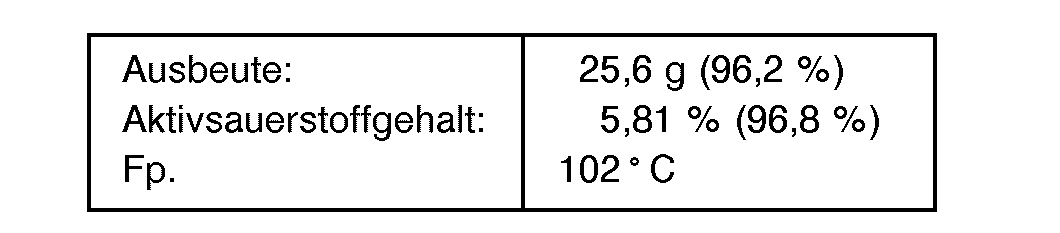
- 31,6 g (0,1 Mol) N-Phenylcarbamoyllaurinlactam werden in 50,0 g Methansulfonsäure (98 gew.-%ig) gelöst, mit 3,6 g (0,2 Mol) Wasser versetzt und für 30 Minuten auf 80°C erwärmt. Nach Abkühlen der Reaktionsmischung auf 25°C werden 17,0 g (0,25 Mol) Wasserstoffperoxid (50 gew.-%ig) so zugetropft, daß die Innentemperatur zwischen 22 und 25 ° C gehalten werden kann. Nach 20 Minuten Rühren bei 25 ° C wird mit 100 ml Wasser versetzt und die ausgefallene Peroxicarbonsäure abgesaugt. Der Filterkuchen wird mit Wasser mineralsäurefrei gewaschen und bei 40 ° C im Wasserstrahlvakuum getrocknet.

- 23,7 g (0,1 Mol) N-(N'-Cyclohexylcarbamoyl)-2-oxo-azepan werden in 50,0 g Schwefelsäure (96 gew.- %ig) gelöst, mit 3,6 g (0,2 Mol) Wasser versetzt und für 30 Minuten auf 80 °C erhitzt. Nach Abkühlen der Reaktionsmischung auf 25 °C werden 20,4 g (0,3 Mol) Wasserstoffperoxid (50 gew.-%ig) so zugetropft, daß die Innentemperatur 25°C nicht übersteigt. Nach 30 Minuten Rühren bei Raumtemperatur wird unter Eiskühlung mit 100 ml Wasser versetzt und die ausgefallene Peroxicarbonsäure abgesaugt. Der Filterkuchen wird mit Wasser mineralsäurefrei gewaschen und bei 40 ° C im Wasserstrahlvakuum getrocknet.

- 26,8 g (0,1 Mol) N-(N'-Octylcarbamoyl)-2-oxo-azepan, 50,0 g Schwefelsäure (96 gew.-%ig) und 3,6 g (0,2 Mol) Wasser werden für 30 Minuten auf 80°C erwärmt und anschließend mit 20,4 g (0,3 Mol) Wasserstoffperoxid (50 gew.-%ig) für 30 Minuten bei 15°C wie in Beispiel 4 beschrieben zur Reaktion gebracht und aufgearbeitet.
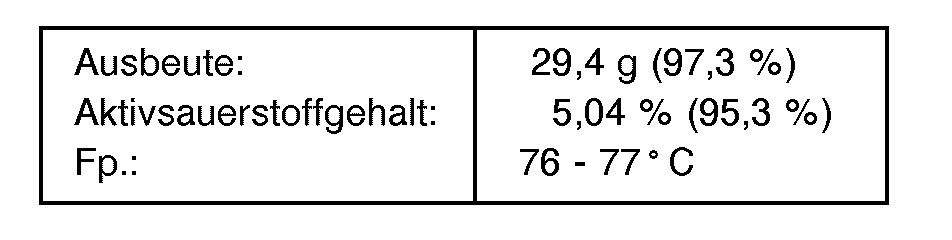
- 39,4 g (0,1 Mol) N,N'-Bis-(2-oxo-azepan-1-carbonyl)-hexandiyldiamin, 50,0 g Schwefelsäure (96 gew.- %ig) und 7,2 g (0,4 Mol) Wasser werden für 30 Minuten auf 80 °C erwärmt und anschließend mit 34,0 g (0,5 Mol) Wasserstoffperoxid (50 gew.-%ig) für 30 Minuten zwischen 25 und 30°C wie in Beispiel 4 beschrieben zur Reaktion gebracht und aufgearbeitet.

in der ein- bis sechsfachen, vorzugsweise ein- bis dreifachen, Gewichtsmenge einer starken Katalysatorsäure gelöst werden, daß danach zu der Lösung des Carbamoyllactams in der Katalysatorsäure Wasser in einbis zehnfachem molarem Überschuß, bezogen auf das Carbamoyllactam, zugegeben und das Reaktionsgemisch zur Bildung der Ureidocarbonsäure erwärmt wird, daß anschließend eine wäßrige Wasserstoffperoxid-Lösung im ein- bis zehnfachen molaren Überschuß pro oxidierbarer Carboxylgruppe der im vorhergehenden Reaktionsschritt entstandenen Ureidocarbonsäure dem Reaktionsgemisch zugesetzt wird, und daß danach die entstandene Ureidoperoxicarbonsäure aus dem Reaktionsgemisch ausgefällt wird.
Claims (10)


dadurch gekennzeichnet, daß Carbamoyllactame der allgemeinen Formel

Applications Claiming Priority (2)
| Application Number | Priority Date | Filing Date | Title |
|---|---|---|---|
| DE4036646 | 1990-11-16 | ||
| DE4036646A DE4036646A1 (de) | 1990-11-16 | 1990-11-16 | Verfahren zur herstellung von ureidoperoxicarbonsaeuren |
Publications (3)
| Publication Number | Publication Date |
|---|---|
| EP0485928A2 true EP0485928A2 (de) | 1992-05-20 |
| EP0485928A3 EP0485928A3 (en) | 1992-07-15 |
| EP0485928B1 EP0485928B1 (de) | 1995-02-01 |
Family
ID=6418439
Family Applications (1)
| Application Number | Title | Priority Date | Filing Date |
|---|---|---|---|
| EP91119185A Expired - Lifetime EP0485928B1 (de) | 1990-11-16 | 1991-11-11 | Verfahren zur Herstellung von Ureidoperoxicarbonsäuren |
Country Status (9)
| Country | Link |
|---|---|
| US (1) | US5235099A (de) |
| EP (1) | EP0485928B1 (de) |
| JP (1) | JPH04273855A (de) |
| AT (1) | ATE117991T1 (de) |
| AU (1) | AU8785691A (de) |
| CA (1) | CA2055701A1 (de) |
| DE (2) | DE4036646A1 (de) |
| ES (1) | ES2069801T3 (de) |
| ZA (1) | ZA919057B (de) |
Cited By (4)
| Publication number | Priority date | Publication date | Assignee | Title |
|---|---|---|---|---|
| WO1995003276A1 (en) * | 1993-07-26 | 1995-02-02 | Unilever N.V. | Amido peroxycarboxylic acids for bleaching |
| WO1995003275A1 (en) * | 1993-07-26 | 1995-02-02 | Unilever N.V. | Amido peroxycarboxylic acids for bleaching |
| EP0739880A3 (de) * | 1995-04-27 | 1996-11-20 | Hoechst Aktiengesellschaft | Verfahren zur Herstellung von Amidoperoxicarbonsäuren |
| US5840667A (en) * | 1994-08-05 | 1998-11-24 | Warwick International Group, Ltd. | Bleach activators |
Families Citing this family (1)
| Publication number | Priority date | Publication date | Assignee | Title |
|---|---|---|---|---|
| JP3520990B2 (ja) * | 2002-02-22 | 2004-04-19 | 丸三産業株式会社 | 天然繊維の未脱脂漂白方法 |
Family Cites Families (5)
| Publication number | Priority date | Publication date | Assignee | Title |
|---|---|---|---|---|
| NL6717087A (de) * | 1967-12-14 | 1969-06-17 | ||
| US4634551A (en) * | 1985-06-03 | 1987-01-06 | Procter & Gamble Company | Bleaching compounds and compositions comprising fatty peroxyacids salts thereof and precursors therefor having amide moieties in the fatty chain |
| US4686063A (en) * | 1986-09-12 | 1987-08-11 | The Procter & Gamble Company | Fatty peroxyacids or salts thereof having amide moieties in the fatty chain and low levels of exotherm control agents |
| DE3823172C2 (de) * | 1988-07-08 | 1998-01-22 | Hoechst Ag | omega-Phthalimidoperoxihexansäure, Verfahren zu dessen Herstellung und dessen Verwendung |
| DE4016980A1 (de) * | 1990-05-25 | 1991-11-28 | Hoechst Ag | Ureidoperoxicarbonsaeuren, verfahren zu deren herstellung und deren verwendung |
-
1990
- 1990-11-16 DE DE4036646A patent/DE4036646A1/de not_active Withdrawn
-
1991
- 1991-11-11 ES ES91119185T patent/ES2069801T3/es not_active Expired - Lifetime
- 1991-11-11 EP EP91119185A patent/EP0485928B1/de not_active Expired - Lifetime
- 1991-11-11 AT AT91119185T patent/ATE117991T1/de active
- 1991-11-11 DE DE59104485T patent/DE59104485D1/de not_active Expired - Fee Related
- 1991-11-14 JP JP3299102A patent/JPH04273855A/ja not_active Withdrawn
- 1991-11-15 ZA ZA919057A patent/ZA919057B/xx unknown
- 1991-11-15 CA CA002055701A patent/CA2055701A1/en not_active Abandoned
- 1991-11-15 AU AU87856/91A patent/AU8785691A/en not_active Abandoned
- 1991-11-18 US US07/793,815 patent/US5235099A/en not_active Expired - Fee Related
Cited By (6)
| Publication number | Priority date | Publication date | Assignee | Title |
|---|---|---|---|---|
| WO1995003276A1 (en) * | 1993-07-26 | 1995-02-02 | Unilever N.V. | Amido peroxycarboxylic acids for bleaching |
| WO1995003275A1 (en) * | 1993-07-26 | 1995-02-02 | Unilever N.V. | Amido peroxycarboxylic acids for bleaching |
| US5672295A (en) * | 1993-07-26 | 1997-09-30 | Lever Brothers Company, Division Of Conopco, Inc. | Amido peroxycarboxylic acids for bleaching |
| US5840667A (en) * | 1994-08-05 | 1998-11-24 | Warwick International Group, Ltd. | Bleach activators |
| EP0739880A3 (de) * | 1995-04-27 | 1996-11-20 | Hoechst Aktiengesellschaft | Verfahren zur Herstellung von Amidoperoxicarbonsäuren |
| US5648521A (en) * | 1995-04-27 | 1997-07-15 | Hoechst Aktiengesellschaft | Process for the preparation of amidoperoxycarboxylic acids |
Also Published As
| Publication number | Publication date |
|---|---|
| AU8785691A (en) | 1992-05-21 |
| DE4036646A1 (de) | 1992-05-21 |
| EP0485928B1 (de) | 1995-02-01 |
| US5235099A (en) | 1993-08-10 |
| JPH04273855A (ja) | 1992-09-30 |
| DE59104485D1 (de) | 1995-03-16 |
| ZA919057B (en) | 1992-09-30 |
| EP0485928A3 (en) | 1992-07-15 |
| ES2069801T3 (es) | 1995-05-16 |
| CA2055701A1 (en) | 1992-05-17 |
| ATE117991T1 (de) | 1995-02-15 |
Similar Documents
| Publication | Publication Date | Title |
|---|---|---|
| EP0485928B1 (de) | Verfahren zur Herstellung von Ureidoperoxicarbonsäuren | |
| EP0458327B1 (de) | Ureidoperoxicarbonsäuren, Verfahren zu deren Herstellung und deren Verwendung | |
| EP0400429A2 (de) | Verfahren zur Herstellung von Triphendioxazinen | |
| DE2109339A1 (de) | Mono und dl substituierte Sulfamoyl benzoesauren | |
| DE1191383B (de) | Verfahren zur Herstellung von 3-Amino-1, 2, 4-triazinen | |
| DE2700454C3 (de) | Verfahren zur Herstellung von organischen Aluminiumimiden | |
| DE3630184A1 (de) | Bis-(2-gluconamidoalkyl)-disulfide | |
| DE3535451A1 (de) | Verfahren zur herstellung von n-alkyl-substituierten hydroxylammoniumchloriden und neue n-alkyl-substituierte hydroxylammoniumchloride | |
| DD286354A5 (de) | Verfahren zur herstellung substituierter 2-carbamoyl-methyl-4-phenyl-1,2,5,6-tetrahydro- und 1,2-dihydro-1-oxo-pyridazine | |
| AT208872B (de) | Verfahren zur Herstellung neuer 1,4-Diazacycloheptane | |
| DE2932951A1 (de) | Verfahren zur herstellung von hexamethylen-bis-dicyandiamid | |
| DE3324844C1 (de) | 3,3-Bis-[2-carboxyethyl]-3-(hydroxy-ammonium)-propionsäurebetain sowie Verfahren zur Herstellung und dessen Verwendung | |
| DE850297C (de) | Verfahren zur Herstellung von Amidinsalzen | |
| AT226726B (de) | Verfahren zur Herstellung von neuen Sulfonylharnstoffen | |
| AT239797B (de) | Verfahren zur Herstellung des neuen 3-Phenoxypropylguanidins und seiner Säureadditionssalze | |
| AT216521B (de) | Verfahren zur Herstellung von neuen Benzolsulfonylharnstoffen | |
| DE1122070C2 (de) | Verfahren zur Herstellung von diuretisch wirksamen Disulfamylanilinverbindungen | |
| DE3135728A1 (de) | Verfahren zur herstellung von apovincaminsaeureestern | |
| AT226725B (de) | Verfahren zur Herstellung von neuen Sulfonylharnstoffen | |
| DE3111518A1 (de) | Salze von carbamoylsulfonsaeurederivaten und verfahren zu ihrer herstellung | |
| DE2742158A1 (de) | Herstellung substituierter harnstoffe | |
| AT236980B (de) | Verfahren zur Herstellung von neuen, beispielsweise zur Schädlingsbekämpfung verwendbaren Carbaminsäureestern | |
| DE1595876C (de) | Aminomethylderivate von Rifamycin-SV und Verfahren zu ihrer Herstellung | |
| DE825548C (de) | Verfahren zur Herstellung von neuen diquartaeren Salzen von Pyrimidylaminocinnolinen | |
| AT208831B (de) | Verfahren zur Herstellung des neuen 2-Methyl-pentyl-4-hydrazins und seiner Salze |
Legal Events
| Date | Code | Title | Description |
|---|---|---|---|
| PUAI | Public reference made under article 153(3) epc to a published international application that has entered the european phase |
Free format text: ORIGINAL CODE: 0009012 |
|
| AK | Designated contracting states |
Kind code of ref document: A2 Designated state(s): AT BE CH DE DK ES FR GB IT LI NL |
|
| PUAL | Search report despatched |
Free format text: ORIGINAL CODE: 0009013 |
|
| AK | Designated contracting states |
Kind code of ref document: A3 Designated state(s): AT BE CH DE DK ES FR GB IT LI NL |
|
| 17P | Request for examination filed |
Effective date: 19920814 |
|
| RBV | Designated contracting states (corrected) |
Designated state(s): AT BE CH DE ES FR GB IT LI NL |
|
| 17Q | First examination report despatched |
Effective date: 19931104 |
|
| GRAA | (expected) grant |
Free format text: ORIGINAL CODE: 0009210 |
|
| AK | Designated contracting states |
Kind code of ref document: B1 Designated state(s): AT BE CH DE ES FR GB IT LI NL |
|
| REF | Corresponds to: |
Ref document number: 117991 Country of ref document: AT Date of ref document: 19950215 Kind code of ref document: T |
|
| REF | Corresponds to: |
Ref document number: 59104485 Country of ref document: DE Date of ref document: 19950316 |
|
| ITF | It: translation for a ep patent filed | ||
| GBT | Gb: translation of ep patent filed (gb section 77(6)(a)/1977) |
Effective date: 19950407 |
|
| REG | Reference to a national code |
Ref country code: ES Ref legal event code: FG2A Ref document number: 2069801 Country of ref document: ES Kind code of ref document: T3 |
|
| ET | Fr: translation filed | ||
| PLBE | No opposition filed within time limit |
Free format text: ORIGINAL CODE: 0009261 |
|
| STAA | Information on the status of an ep patent application or granted ep patent |
Free format text: STATUS: NO OPPOSITION FILED WITHIN TIME LIMIT |
|
| PGFP | Annual fee paid to national office [announced via postgrant information from national office to epo] |
Ref country code: DE Payment date: 19960115 Year of fee payment: 5 |
|
| 26N | No opposition filed | ||
| PGFP | Annual fee paid to national office [announced via postgrant information from national office to epo] |
Ref country code: FR Payment date: 19961011 Year of fee payment: 6 |
|
| PGFP | Annual fee paid to national office [announced via postgrant information from national office to epo] |
Ref country code: NL Payment date: 19961015 Year of fee payment: 6 |
|
| PGFP | Annual fee paid to national office [announced via postgrant information from national office to epo] |
Ref country code: GB Payment date: 19961016 Year of fee payment: 6 |
|
| PGFP | Annual fee paid to national office [announced via postgrant information from national office to epo] |
Ref country code: CH Payment date: 19961017 Year of fee payment: 6 |
|
| PGFP | Annual fee paid to national office [announced via postgrant information from national office to epo] |
Ref country code: AT Payment date: 19961031 Year of fee payment: 6 |
|
| PGFP | Annual fee paid to national office [announced via postgrant information from national office to epo] |
Ref country code: BE Payment date: 19961114 Year of fee payment: 6 |
|
| PGFP | Annual fee paid to national office [announced via postgrant information from national office to epo] |
Ref country code: ES Payment date: 19961119 Year of fee payment: 6 |
|
| PG25 | Lapsed in a contracting state [announced via postgrant information from national office to epo] |
Ref country code: DE Effective date: 19970801 |
|
| PG25 | Lapsed in a contracting state [announced via postgrant information from national office to epo] |
Ref country code: GB Free format text: LAPSE BECAUSE OF NON-PAYMENT OF DUE FEES Effective date: 19971111 Ref country code: AT Free format text: LAPSE BECAUSE OF NON-PAYMENT OF DUE FEES Effective date: 19971111 |
|
| PG25 | Lapsed in a contracting state [announced via postgrant information from national office to epo] |
Ref country code: ES Free format text: LAPSE BECAUSE OF NON-PAYMENT OF DUE FEES Effective date: 19971112 |
|
| PG25 | Lapsed in a contracting state [announced via postgrant information from national office to epo] |
Ref country code: LI Free format text: LAPSE BECAUSE OF NON-PAYMENT OF DUE FEES Effective date: 19971130 Ref country code: FR Free format text: THE PATENT HAS BEEN ANNULLED BY A DECISION OF A NATIONAL AUTHORITY Effective date: 19971130 Ref country code: CH Free format text: LAPSE BECAUSE OF NON-PAYMENT OF DUE FEES Effective date: 19971130 Ref country code: BE Free format text: LAPSE BECAUSE OF NON-PAYMENT OF DUE FEES Effective date: 19971130 |
|
| BERE | Be: lapsed |
Owner name: HOECHST A.G. Effective date: 19971130 |
|
| PG25 | Lapsed in a contracting state [announced via postgrant information from national office to epo] |
Ref country code: NL Free format text: LAPSE BECAUSE OF NON-PAYMENT OF DUE FEES Effective date: 19980601 |
|
| GBPC | Gb: european patent ceased through non-payment of renewal fee |
Effective date: 19971111 |
|
| REG | Reference to a national code |
Ref country code: CH Ref legal event code: PL |
|
| NLV4 | Nl: lapsed or anulled due to non-payment of the annual fee |
Effective date: 19980601 |
|
| REG | Reference to a national code |
Ref country code: FR Ref legal event code: ST |
|
| REG | Reference to a national code |
Ref country code: ES Ref legal event code: FD2A Effective date: 19981212 |
|
| PG25 | Lapsed in a contracting state [announced via postgrant information from national office to epo] |
Ref country code: IT Free format text: LAPSE BECAUSE OF NON-PAYMENT OF DUE FEES;WARNING: LAPSES OF ITALIAN PATENTS WITH EFFECTIVE DATE BEFORE 2007 MAY HAVE OCCURRED AT ANY TIME BEFORE 2007. THE CORRECT EFFECTIVE DATE MAY BE DIFFERENT FROM THE ONE RECORDED. Effective date: 20051111 |