EP0486110B1 - Latice von Copolymeren von Estern von (Meth)Acrylsäure und Vinylestern von verzweigter Karboxylsäure - Google Patents
Latice von Copolymeren von Estern von (Meth)Acrylsäure und Vinylestern von verzweigter Karboxylsäure Download PDFInfo
- Publication number
- EP0486110B1 EP0486110B1 EP19910202962 EP91202962A EP0486110B1 EP 0486110 B1 EP0486110 B1 EP 0486110B1 EP 19910202962 EP19910202962 EP 19910202962 EP 91202962 A EP91202962 A EP 91202962A EP 0486110 B1 EP0486110 B1 EP 0486110B1
- Authority
- EP
- European Patent Office
- Prior art keywords
- weight
- pbw
- latex
- interpolymers
- water
- Prior art date
- Legal status (The legal status is an assumption and is not a legal conclusion. Google has not performed a legal analysis and makes no representation as to the accuracy of the status listed.)
- Expired - Lifetime
Links
- 229920000126 latex Polymers 0.000 title claims description 60
- 229920001567 vinyl ester resin Polymers 0.000 title claims description 15
- CERQOIWHTDAKMF-UHFFFAOYSA-N Methacrylic acid Chemical compound CC(=C)C(O)=O CERQOIWHTDAKMF-UHFFFAOYSA-N 0.000 title claims description 7
- 125000000391 vinyl group Chemical group [H]C([*])=C([H])[H] 0.000 title description 6
- 150000001735 carboxylic acids Chemical class 0.000 title description 3
- 150000002148 esters Chemical class 0.000 title description 3
- XLYOFNOQVPJJNP-UHFFFAOYSA-N water Substances O XLYOFNOQVPJJNP-UHFFFAOYSA-N 0.000 claims description 37
- 239000004816 latex Substances 0.000 claims description 32
- 239000000178 monomer Substances 0.000 claims description 30
- 239000000203 mixture Substances 0.000 claims description 24
- IJGRMHOSHXDMSA-UHFFFAOYSA-N Atomic nitrogen Chemical compound N#N IJGRMHOSHXDMSA-UHFFFAOYSA-N 0.000 claims description 16
- 239000004094 surface-active agent Substances 0.000 claims description 15
- 125000004432 carbon atom Chemical group C* 0.000 claims description 14
- 238000006243 chemical reaction Methods 0.000 claims description 14
- 239000000839 emulsion Substances 0.000 claims description 14
- -1 alkaryl sulphonate Chemical compound 0.000 claims description 11
- SMZOUWXMTYCWNB-UHFFFAOYSA-N 2-(2-methoxy-5-methylphenyl)ethanamine Chemical compound COC1=CC=C(C)C=C1CCN SMZOUWXMTYCWNB-UHFFFAOYSA-N 0.000 claims description 10
- NIXOWILDQLNWCW-UHFFFAOYSA-N 2-Propenoic acid Natural products OC(=O)C=C NIXOWILDQLNWCW-UHFFFAOYSA-N 0.000 claims description 10
- 238000006116 polymerization reaction Methods 0.000 claims description 10
- 150000001732 carboxylic acid derivatives Chemical group 0.000 claims description 9
- 239000008199 coating composition Substances 0.000 claims description 8
- 238000001035 drying Methods 0.000 claims description 8
- 238000000034 method Methods 0.000 claims description 8
- 229910052757 nitrogen Inorganic materials 0.000 claims description 8
- HRPVXLWXLXDGHG-UHFFFAOYSA-N Acrylamide Chemical compound NC(=O)C=C HRPVXLWXLXDGHG-UHFFFAOYSA-N 0.000 claims description 7
- 239000004159 Potassium persulphate Substances 0.000 claims description 7
- 238000010521 absorption reaction Methods 0.000 claims description 7
- 125000000129 anionic group Chemical group 0.000 claims description 7
- 239000003945 anionic surfactant Substances 0.000 claims description 7
- 150000001875 compounds Chemical class 0.000 claims description 7
- 239000003999 initiator Substances 0.000 claims description 7
- USHAGKDGDHPEEY-UHFFFAOYSA-L potassium persulfate Chemical compound [K+].[K+].[O-]S(=O)(=O)OOS([O-])(=O)=O USHAGKDGDHPEEY-UHFFFAOYSA-L 0.000 claims description 7
- 235000019394 potassium persulphate Nutrition 0.000 claims description 7
- 239000007787 solid Substances 0.000 claims description 7
- VVQNEPGJFQJSBK-UHFFFAOYSA-N Methyl methacrylate Chemical compound COC(=O)C(C)=C VVQNEPGJFQJSBK-UHFFFAOYSA-N 0.000 claims description 6
- 239000002253 acid Substances 0.000 claims description 6
- 150000002763 monocarboxylic acids Chemical class 0.000 claims description 6
- 238000002360 preparation method Methods 0.000 claims description 6
- CQEYYJKEWSMYFG-UHFFFAOYSA-N butyl acrylate Chemical compound CCCCOC(=O)C=C CQEYYJKEWSMYFG-UHFFFAOYSA-N 0.000 claims description 5
- 239000000470 constituent Substances 0.000 claims description 5
- 239000002736 nonionic surfactant Substances 0.000 claims description 5
- 239000000049 pigment Substances 0.000 claims description 5
- 230000000087 stabilizing effect Effects 0.000 claims description 5
- 150000003254 radicals Chemical class 0.000 claims description 4
- 239000003381 stabilizer Substances 0.000 claims description 4
- 125000000217 alkyl group Chemical group 0.000 claims description 3
- 125000003178 carboxy group Chemical group [H]OC(*)=O 0.000 claims description 3
- 230000009477 glass transition Effects 0.000 claims description 3
- FQPSGWSUVKBHSU-UHFFFAOYSA-N methacrylamide Chemical compound CC(=C)C(N)=O FQPSGWSUVKBHSU-UHFFFAOYSA-N 0.000 claims description 3
- 238000002156 mixing Methods 0.000 claims description 3
- 229920006395 saturated elastomer Polymers 0.000 claims description 3
- 238000010586 diagram Methods 0.000 claims description 2
- OMNKZBIFPJNNIO-UHFFFAOYSA-N n-(2-methyl-4-oxopentan-2-yl)prop-2-enamide Chemical compound CC(=O)CC(C)(C)NC(=O)C=C OMNKZBIFPJNNIO-UHFFFAOYSA-N 0.000 claims description 2
- 239000003505 polymerization initiator Substances 0.000 claims description 2
- BWYYYTVSBPRQCN-UHFFFAOYSA-M sodium;ethenesulfonate Chemical compound [Na+].[O-]S(=O)(=O)C=C BWYYYTVSBPRQCN-UHFFFAOYSA-M 0.000 claims description 2
- 238000000576 coating method Methods 0.000 description 11
- 239000003973 paint Substances 0.000 description 9
- 239000011248 coating agent Substances 0.000 description 7
- 239000000843 powder Substances 0.000 description 6
- 239000011541 reaction mixture Substances 0.000 description 5
- JIGUQPWFLRLWPJ-UHFFFAOYSA-N Ethyl acrylate Chemical compound CCOC(=O)C=C JIGUQPWFLRLWPJ-UHFFFAOYSA-N 0.000 description 4
- 239000006172 buffering agent Substances 0.000 description 4
- 239000011521 glass Substances 0.000 description 4
- 230000000977 initiatory effect Effects 0.000 description 4
- PNJWIWWMYCMZRO-UHFFFAOYSA-N pent‐4‐en‐2‐one Natural products CC(=O)CC=C PNJWIWWMYCMZRO-UHFFFAOYSA-N 0.000 description 4
- 150000003467 sulfuric acid derivatives Chemical class 0.000 description 4
- QTBSBXVTEAMEQO-UHFFFAOYSA-N Acetic acid Chemical compound CC(O)=O QTBSBXVTEAMEQO-UHFFFAOYSA-N 0.000 description 3
- 239000007795 chemical reaction product Substances 0.000 description 3
- 239000004567 concrete Substances 0.000 description 3
- 239000011888 foil Substances 0.000 description 3
- 239000004615 ingredient Substances 0.000 description 3
- 229920006254 polymer film Polymers 0.000 description 3
- 239000000047 product Substances 0.000 description 3
- IAYPIBMASNFSPL-UHFFFAOYSA-N Ethylene oxide Chemical compound C1CO1 IAYPIBMASNFSPL-UHFFFAOYSA-N 0.000 description 2
- MHAJPDPJQMAIIY-UHFFFAOYSA-N Hydrogen peroxide Chemical compound OO MHAJPDPJQMAIIY-UHFFFAOYSA-N 0.000 description 2
- BAPJBEWLBFYGME-UHFFFAOYSA-N Methyl acrylate Chemical compound COC(=O)C=C BAPJBEWLBFYGME-UHFFFAOYSA-N 0.000 description 2
- XTXRWKRVRITETP-UHFFFAOYSA-N Vinyl acetate Chemical compound CC(=O)OC=C XTXRWKRVRITETP-UHFFFAOYSA-N 0.000 description 2
- 239000003513 alkali Substances 0.000 description 2
- 125000005250 alkyl acrylate group Chemical group 0.000 description 2
- 125000005907 alkyl ester group Chemical group 0.000 description 2
- 230000015572 biosynthetic process Effects 0.000 description 2
- 230000000052 comparative effect Effects 0.000 description 2
- 229920001577 copolymer Polymers 0.000 description 2
- 238000007334 copolymerization reaction Methods 0.000 description 2
- 238000005260 corrosion Methods 0.000 description 2
- GHVNFZFCNZKVNT-UHFFFAOYSA-N decanoic acid Chemical compound CCCCCCCCCC(O)=O GHVNFZFCNZKVNT-UHFFFAOYSA-N 0.000 description 2
- 230000002939 deleterious effect Effects 0.000 description 2
- 239000006185 dispersion Substances 0.000 description 2
- YCUBDDIKWLELPD-UHFFFAOYSA-N ethenyl 2,2-dimethylpropanoate Chemical compound CC(C)(C)C(=O)OC=C YCUBDDIKWLELPD-UHFFFAOYSA-N 0.000 description 2
- 238000001704 evaporation Methods 0.000 description 2
- 230000008020 evaporation Effects 0.000 description 2
- BXWNKGSJHAJOGX-UHFFFAOYSA-N hexadecan-1-ol Chemical compound CCCCCCCCCCCCCCCCO BXWNKGSJHAJOGX-UHFFFAOYSA-N 0.000 description 2
- 239000004922 lacquer Substances 0.000 description 2
- DNIAPMSPPWPWGF-UHFFFAOYSA-N monopropylene glycol Natural products CC(O)CO DNIAPMSPPWPWGF-UHFFFAOYSA-N 0.000 description 2
- 229920000847 nonoxynol Polymers 0.000 description 2
- 239000002245 particle Substances 0.000 description 2
- 238000011160 research Methods 0.000 description 2
- 150000003839 salts Chemical class 0.000 description 2
- 239000000126 substance Substances 0.000 description 2
- 125000001273 sulfonato group Chemical group [O-]S(*)(=O)=O 0.000 description 2
- 239000002562 thickening agent Substances 0.000 description 2
- 230000001988 toxicity Effects 0.000 description 2
- 231100000419 toxicity Toxicity 0.000 description 2
- 229940117958 vinyl acetate Drugs 0.000 description 2
- XHZPRMZZQOIPDS-UHFFFAOYSA-N 2-Methyl-2-[(1-oxo-2-propenyl)amino]-1-propanesulfonic acid Chemical compound OS(=O)(=O)CC(C)(C)NC(=O)C=C XHZPRMZZQOIPDS-UHFFFAOYSA-N 0.000 description 1
- QTBSBXVTEAMEQO-UHFFFAOYSA-M Acetate Chemical compound CC([O-])=O QTBSBXVTEAMEQO-UHFFFAOYSA-M 0.000 description 1
- NLHHRLWOUZZQLW-UHFFFAOYSA-N Acrylonitrile Chemical compound C=CC#N NLHHRLWOUZZQLW-UHFFFAOYSA-N 0.000 description 1
- QGZKDVFQNNGYKY-UHFFFAOYSA-O Ammonium Chemical compound [NH4+] QGZKDVFQNNGYKY-UHFFFAOYSA-O 0.000 description 1
- BVKZGUZCCUSVTD-UHFFFAOYSA-M Bicarbonate Chemical compound OC([O-])=O BVKZGUZCCUSVTD-UHFFFAOYSA-M 0.000 description 1
- OKTJSMMVPCPJKN-UHFFFAOYSA-N Carbon Chemical group [C] OKTJSMMVPCPJKN-UHFFFAOYSA-N 0.000 description 1
- DGAQECJNVWCQMB-PUAWFVPOSA-M Ilexoside XXIX Chemical compound C[C@@H]1CC[C@@]2(CC[C@@]3(C(=CC[C@H]4[C@]3(CC[C@@H]5[C@@]4(CC[C@@H](C5(C)C)OS(=O)(=O)[O-])C)C)[C@@H]2[C@]1(C)O)C)C(=O)O[C@H]6[C@@H]([C@H]([C@@H]([C@H](O6)CO)O)O)O.[Na+] DGAQECJNVWCQMB-PUAWFVPOSA-M 0.000 description 1
- 239000004698 Polyethylene Substances 0.000 description 1
- GOOHAUXETOMSMM-UHFFFAOYSA-N Propylene oxide Chemical compound CC1CO1 GOOHAUXETOMSMM-UHFFFAOYSA-N 0.000 description 1
- 230000006750 UV protection Effects 0.000 description 1
- 150000001298 alcohols Chemical class 0.000 description 1
- 150000007933 aliphatic carboxylic acids Chemical group 0.000 description 1
- 229910000288 alkali metal carbonate Inorganic materials 0.000 description 1
- 150000008041 alkali metal carbonates Chemical class 0.000 description 1
- 125000002947 alkylene group Chemical group 0.000 description 1
- 239000002518 antifoaming agent Substances 0.000 description 1
- 239000012298 atmosphere Substances 0.000 description 1
- 239000002585 base Substances 0.000 description 1
- OGBUMNBNEWYMNJ-UHFFFAOYSA-N batilol Chemical class CCCCCCCCCCCCCCCCCCOCC(O)CO OGBUMNBNEWYMNJ-UHFFFAOYSA-N 0.000 description 1
- 230000009286 beneficial effect Effects 0.000 description 1
- 239000011230 binding agent Substances 0.000 description 1
- 230000000903 blocking effect Effects 0.000 description 1
- 229910021538 borax Inorganic materials 0.000 description 1
- 230000015556 catabolic process Effects 0.000 description 1
- 229960000541 cetyl alcohol Drugs 0.000 description 1
- 238000010411 cooking Methods 0.000 description 1
- 230000007797 corrosion Effects 0.000 description 1
- 239000006184 cosolvent Substances 0.000 description 1
- 238000005336 cracking Methods 0.000 description 1
- 238000004132 cross linking Methods 0.000 description 1
- 238000011161 development Methods 0.000 description 1
- 230000029087 digestion Effects 0.000 description 1
- 239000002270 dispersing agent Substances 0.000 description 1
- 125000003438 dodecyl group Chemical group [H]C([H])([H])C([H])([H])C([H])([H])C([H])([H])C([H])([H])C([H])([H])C([H])([H])C([H])([H])C([H])([H])C([H])([H])C([H])([H])C([H])([H])* 0.000 description 1
- 238000007720 emulsion polymerization reaction Methods 0.000 description 1
- UIWXSTHGICQLQT-UHFFFAOYSA-N ethenyl propanoate Chemical compound CCC(=O)OC=C UIWXSTHGICQLQT-UHFFFAOYSA-N 0.000 description 1
- 150000002170 ethers Chemical class 0.000 description 1
- 239000000945 filler Substances 0.000 description 1
- 150000002432 hydroperoxides Chemical class 0.000 description 1
- 150000002440 hydroxy compounds Chemical class 0.000 description 1
- 238000007654 immersion Methods 0.000 description 1
- 239000003112 inhibitor Substances 0.000 description 1
- 150000002688 maleic acid derivatives Chemical class 0.000 description 1
- 238000004519 manufacturing process Methods 0.000 description 1
- 239000000463 material Substances 0.000 description 1
- 238000005259 measurement Methods 0.000 description 1
- 239000000693 micelle Substances 0.000 description 1
- 125000002347 octyl group Chemical group [H]C([*])([H])C([H])([H])C([H])([H])C([H])([H])C([H])([H])C([H])([H])C([H])([H])C([H])([H])[H] 0.000 description 1
- 150000007524 organic acids Chemical class 0.000 description 1
- 230000002093 peripheral effect Effects 0.000 description 1
- 150000002978 peroxides Chemical class 0.000 description 1
- JRKICGRDRMAZLK-UHFFFAOYSA-L persulfate group Chemical group S(=O)(=O)([O-])OOS(=O)(=O)[O-] JRKICGRDRMAZLK-UHFFFAOYSA-L 0.000 description 1
- 230000019612 pigmentation Effects 0.000 description 1
- 229920000573 polyethylene Polymers 0.000 description 1
- 229920000642 polymer Polymers 0.000 description 1
- 239000003755 preservative agent Substances 0.000 description 1
- PNXMTCDJUBJHQJ-UHFFFAOYSA-N propyl prop-2-enoate Chemical compound CCCOC(=O)C=C PNXMTCDJUBJHQJ-UHFFFAOYSA-N 0.000 description 1
- 229920005604 random copolymer Polymers 0.000 description 1
- 230000009257 reactivity Effects 0.000 description 1
- 239000012966 redox initiator Substances 0.000 description 1
- 238000006479 redox reaction Methods 0.000 description 1
- 238000010992 reflux Methods 0.000 description 1
- 229910052708 sodium Inorganic materials 0.000 description 1
- 239000011734 sodium Substances 0.000 description 1
- 239000004328 sodium tetraborate Substances 0.000 description 1
- 235000010339 sodium tetraborate Nutrition 0.000 description 1
- 239000007858 starting material Substances 0.000 description 1
- 239000000758 substrate Substances 0.000 description 1
- 238000010998 test method Methods 0.000 description 1
- 238000012360 testing method Methods 0.000 description 1
- 229920002554 vinyl polymer Polymers 0.000 description 1
- NLVXSWCKKBEXTG-UHFFFAOYSA-N vinylsulfonic acid Chemical compound OS(=O)(=O)C=C NLVXSWCKKBEXTG-UHFFFAOYSA-N 0.000 description 1
- 230000002087 whitening effect Effects 0.000 description 1
- 239000002023 wood Substances 0.000 description 1
Images

Classifications
-
- C—CHEMISTRY; METALLURGY
- C08—ORGANIC MACROMOLECULAR COMPOUNDS; THEIR PREPARATION OR CHEMICAL WORKING-UP; COMPOSITIONS BASED THEREON
- C08F—MACROMOLECULAR COMPOUNDS OBTAINED BY REACTIONS ONLY INVOLVING CARBON-TO-CARBON UNSATURATED BONDS
- C08F220/00—Copolymers of compounds having one or more unsaturated aliphatic radicals, each having only one carbon-to-carbon double bond, and only one being terminated by only one carboxyl radical or a salt, anhydride ester, amide, imide or nitrile thereof
- C08F220/02—Monocarboxylic acids having less than ten carbon atoms; Derivatives thereof
- C08F220/10—Esters
- C08F220/12—Esters of monohydric alcohols or phenols
- C08F220/14—Methyl esters, e.g. methyl (meth)acrylate
-
- C—CHEMISTRY; METALLURGY
- C08—ORGANIC MACROMOLECULAR COMPOUNDS; THEIR PREPARATION OR CHEMICAL WORKING-UP; COMPOSITIONS BASED THEREON
- C08F—MACROMOLECULAR COMPOUNDS OBTAINED BY REACTIONS ONLY INVOLVING CARBON-TO-CARBON UNSATURATED BONDS
- C08F218/00—Copolymers of compounds having one or more unsaturated aliphatic radicals, each having only one carbon-to-carbon double bond, and at least one being terminated by an acyloxy radical of a saturated carboxylic acid, of carbonic acid or of a haloformic acid
- C08F218/02—Esters of monocarboxylic acids
- C08F218/04—Vinyl esters
- C08F218/10—Vinyl esters of monocarboxylic acids containing three or more carbon atoms
Definitions
- This invention relates to interpolymers of esters of (meth)-acrylic acid and vinyl esters of branched chain carboxylic acids, to latices containing such interpolymers, to the preparation of such interpolymers, to coating compositions comprising such latices and to solid polymeric products, for example redispersible latex powders formed by drying of such latices.
- GB-A-967,479 actually discloses a method for the preparation of a stable latex comprising copolymerizing a monomer mixture containing
- I-IX monomer premix compositions are used as starting materials which comprise as sole alkyl ester of alpha,beta-ethylenically unsaturated carboxylic acid component ethylacrylate or propylacrylate or methylmethacrylate, whereas as the vinyl ester of saturated branched aliphatic monocarboxylic acid component, inter alia mixtures of several carboxylic acids are applied, which contain from 7-19 carbon atoms.
- US-A-4,397,984 discloses an aqueous paper coating composition, which essentially comprises a finely divided pigment and an emulsion copolymer of
- interpolymer compositions aimed at, showing a very attractive combination of properties such as high monomer conversion and freeze thaw stability of the latex and chemical stability, alkali resistance, light resistance and flexibility and more particularly ultra-violet resistance, and water resistance of latex film.
- interpolymers are provided, which are derivable from the components (a)-(d), wherein the component (c) is the vinyl ester of Versatic 10 acid (VeoVa 10) and wherein the component (d) is acrylic acid, used in an amount of from 0.5 to 2% by weight and preferably 1% by weight.
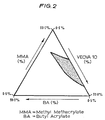
- starting monomer compositions containing monomers (a), (b) and (c) in proportions meeting the aforementioned equations (I) to (IV) are represented by the shaded area in figure 1, in the event that 1% by weight of acrylic acid is used as stabilizing monomer.
- interpolymers are derivable from comonomer mixtures, wherein the weight fraction of the components (a), (b) and (c) simultaneously fulfill the equations (I) to (IV), however wherein CONV has a value of at least 99.2%; wherein T g has a value in the range from 10 to 50 °C; wherein WA has a value of at most 25%; and wherein WS (24 hours) has a rating of at least 7.
- the most preferred embodiments of the interpolymers of the present invention are formed by those, characterized in that they are derivable from a starting comonomer mixture comprising:
- the present invention is also relating to latices, containing as polymeric constituent 30-60% by weight of an interpolymer as described hereinbefore and more preferably those wherein the polymeric constituent amounts from 40-50% by weight, to coating compositions comprising a latex and preferably at least one pigment, and to solid interpolymeric products formed by physical drying of such latices or coatings and to redispersible latex powders formed by physical drying of such latices and to coating compositions derived from such powders.
- a further aspect of the present invention relates to a process for the preparation of latices containing the hereinbefore specified interpolymers.
- thermal initiation of the starting reaction mixture being rather independent on the actual relative proportions of the components (a)-(d) in the indicated ranges. More preferably thermal initiation of the reaction mixture is applied.
- the interpolymers containing latices according to the present invention may be prepared by polymerization of the comonomer mixture under conditions which are known in the art and generally involve a temperature of 20-100 °C. More particularly the preparation process is carried out in a temperature range of from 60-100 °C, and preferably 75-85 °C.
- additional stabilizers optionally to be copolymerized, one or more polymerization initiators and optionally buffering agents are to be included, but more preferably not any buffering agent is used.
- Stabilizers suitably constitute about 1-4% by weight of the latex in total. It is preferred that the stabilizers used in the latex comprise at least one anionic surface active agent, which is believed to have a beneficial effect on the stability of the latex and in particular on the reaction mixture during the polymerization process, facilitating the formation of micelles in which the interpolymer is formed, and optionally a non-ionic surface active agent, which is believed to contribute to latex stability; or at least one surface active agent of the mixed anionic/non-ionic type.
- Suitable anionic surface active agents include alkylarylsulphonates, for example alkylbenzene sulphonates; salts of sulphosuccinic esters; alkylsulphates, alkylsulphonates, alkylarylphosphates, sulphates of hydroxyethyl esters of monocarboxylic acids, sulphates of alkylphenoxypolyethoxyethanols, sulphates and sulphonates of hydroxypropyl esters of monocarboxylic acids and sulphates of monoglycerides of monocarboxylic acids, such compounds having 12-24 carbon atoms; and salts of C 9-19 monocarboxylic acids.
- 0.05-1% by weight of the latex may be constituted by anionic surface active agents, preferably 0.1-0.5%.
- Suitable non-ionic surface active agents include reaction products of hydroxy compounds with alkylene oxides, such as ethylene oxide or propylene oxide, for example a compound of the general formula R-C 6 H 4 -O-(CH 2 -CH 2 -O) n -H where R represents a C 6-16 , especially C 8-9 , alkyl group and n represents a number from 3 to 40; reaction products of ethylene oxide with propylene glycol ethers, or with alcohols, suitably of 6-20 carbon atoms, for example octyl, lauryl or cetyl alcohol.
- 0.5-2% of the weight of the latex may be constituted by non-ionic surface active agents.
- Suitable surface active agents of the mixed anionic/non-ionic type include sulphonates based on alkylarylpolyglycol ethers.
- both an anionic and a non-ionic surface active agent are used.
- Suitable initiators are compounds which form free radicals under the reaction conditions for the aqueous emulsion polymerization, whether by thermal breakdown, redox reaction or photo initiation.
- Initiators include organic, water-soluble peroxides, hydroperoxides and persulphates. Examples are hydrogen peroxide and sodium, ammonium or, especially, potassium persulphate. 0.1-1%, preferably 0.4-0.7% of initiator, based on weight of the reaction mixture, is suitably employed.
- Buffering agents if any needed, suitable for use in the polymerization process are water-soluble compounds which can prevent the pH of the mixture falling below about 4.
- Preferred buffering agents include borax and an organic acid, suitable acetic acid, or an alkali metal carbonate or bicarbonate, or acetate.
- thermal initiation is applied and the reaction is carried out in an inert atmosphere, nitrogen suitably being used to flush out the reaction vessel prior to the start of the reaction.
- an emulsion premix is prepared in demineralized water from a part of one or more surface active agents, and a part of one or more redox initiators and comonomers (a), (b), (c) and (d).
- the reactor is flushed with nitrogen and filled with about an equal amount of demineralized water, and the remaining amounts of the surface active agent(s) and initiator.
- the reactor is heated to a temperature in the specified range, preferably 80 °C, the nitrogen stream is stopped and the emulsion premix addition is started.
- the addition is normally extended over a period of from 2 to 5 hours during which the originally adjusted temperature is maintained.
- a post polymerization period after termination of the addition of premix of from 1 to 3 hours is normally used at a temperature of 80 °C.
- the latex obtained is cooled and if necessary filtered.
- the generally obtained latices have a total solids content in the range of from 30-60% by weight of the latex and preferably from 40-50% and a weight average particle diameter in the range of from 90-170 nm depending on the surfactant repartition between the emulsion premix and the initial reactor charge.
- a further aspect of the present invention relates to a latex produced by the process described above, and the interpolymer which forms on physical drying of such a latex, for example to form a coating on a substrate or a powder intended for reconstitution as a latex or use in a concrete or other latex based end product.
- Latices in accordance with the invention may find application in concretes, lacquers, paints, wood coatings, anti-corrosive paints and textured coatings. They are of particular interest for composing lacquers and paints due to their good film forming properties, their water resistance, their high pigment binding power, flexibility, the lack of tackiness of the films, their alkali resistance and resistance to ultra violet light. Paints containing the latices of the invention contain pigments, and will commonly contain further constituents, examples being fillers, cosolvents, thickeners, dispersants, preservatives, corrosion inhibitors, and anti foaming agents.
- coating compositions comprising the latices according to the present invention and solid interpolymer product formed thereof, also form an aspect of the present invention.
- reaction flask In a three litre reaction flask, provided with a central and four peripheral glass openings fitted with a reflux condenser, stirrer, thermometer, nitrogen inlet tube and emulsion premix inlet tube.
- An emulsion premix is prepared by mixing the following ingredients in the given amounts.
- Demineralized water 575.0 g Humifen SF 90 (10% in water) + 5.0 Arkopal N230 (25% in water) ++ 120.0 Potassium persulphate 4.0 Methyl methacrylate 390.0 butylacrylate 100.0 VeoVa 10 +++ 500.0
- "Humifen SF 90” is a registered trade mark for an alkaryl sulphonate anionic surfactant ++
- "Arkopal N230" is a registered trade mark for a non-ionic surfactant +++
- VeoVa 10 is a trade mark for vinyl esters of tertiary carboxylic acid containing 10 carbon atoms
- the ingredients in the reaction flask are heated to 80 °C. When the temperature reaches 80 °C, the nitrogen stream is stopped and the emulsion premix addition is started. The monomer pre-emulsion is added regularly over a period of 3 hours and a temperature of 80 °C is maintained. A 2-hour digestion period (at the same temperature) is applied. After the post-cooking, the latex is cooled and if necessary filtered. In general, these latices have a total solids content of 45% and the weight average particle diameter is about 150 nm.
- the obtained latices were tested as to water absorption, water spot resistance of latex polymer film, whereas also monomer conversion, viscosity, minimum film formation, temperature, glass transition temperature, tensile strength and yield value, and surface hardness, were measured.
- interpolymer latices were prepared from different sets of comonomers.
- a wet film of 2 mm thickness is applied on a polyethylene foil (the latex is kept on the foil by applying an automotive sealer on the edges of the foil).
- the panels are covered with some water vapour transmitting material and then stored at 20 °C above the T g for a week. The cover is removed after clear films are formed.
- Three pieces of 2 x 2 cm are cut from the film after removal from the glass panel and weighed to the nearest 0.1 mg. These are stored in demineralized water at 23 °C and reweighed after 1, 2, 4, 7 and eventually 14 days (after removal of the excess of water by filter paper). The water absorption is calculated from the observed weight increase.
- the result of the triplicate measurements are averaged and usually the relation between immersion time and water absorption is graphically plotted. In case the water absorption of emulsion paints is of interest, it is suggested to prepare a paint film with 40% PVC pigmentation.
- the water spot resistance of latex polymer films was measured as described hereinafter.
- a wet latex film of 200 ⁇ m (micron) is applied on a glass panel and allowed to dry for a week at 20 °C above the T g .
- a drop of water is brought on the film and the panel is placed on a dark underground.
- the whitening effect is visually judged.
- a rating between 10 (film is unaffected) and 0 (film is completely white) is given every time.
- the four scores are added and divided by four (max. score 40). If the film scores very high it is worthwhile to continue the test for another 23 hours and to give a 24 hours rating between 0 and 10. In order to avoid evaporation of the water droplet, it can be covered overnight by a watch glass.
Landscapes
- Chemical & Material Sciences (AREA)
- Health & Medical Sciences (AREA)
- Chemical Kinetics & Catalysis (AREA)
- Medicinal Chemistry (AREA)
- Polymers & Plastics (AREA)
- Organic Chemistry (AREA)
- Addition Polymer Or Copolymer, Post-Treatments, Or Chemical Modifications (AREA)
- Paints Or Removers (AREA)
- Compositions Of Macromolecular Compounds (AREA)
Claims (9)
- Mischpolymerisate, erhältlich durch Polymerisation einer Comonomermischung aus(a) Methacrylsäuremethylester;(b) Acrylsäurebutylester;(c) dem Vinylester einer oder mehrerer gesättigter Monocarbonsäuren, in denen die Carboxylgruppen an tertiäre und/oder quaternäre Kohlenstoffatome gebunden sind und der Säurerest 10 Kohlenstoffatome enthält;(d) einem stabilisierend wirkenden Monomer, ausgewählt aus der Gruppe Acrylsäure, Methacrylsäure, Acrylamid, Methacrylamid, Diacetonacrylamid und Natriumvinylsulfonat sowie deren Mischungen in einer Menge von 0,5 bis 5 Gew.-%, bezogen auf das Gesamtgewicht der Monomere,wobei die jeweiligen Gewichtsprozentsätze der Komponenten (a), (b) und (c), bezogen auf das Gesamtgewicht der Summe der Mengen dieser Komponenten berechnet, gleichzeitig die folgenden, jeweils Zusammensetzungen gleicher Leistungskonturlinien in einem Dreiecksdiagramm beschreibenden Gleichungen erfüllen:


- Mischpolymerisate nach Anspruch 1, dadurch gekennzeichnet, daß die Komponente (d) aus Acrylsäure und Acrylamid ausgewählt ist.
- Mischpolymerisate nach Anspruch 1, dadurch gekennzeichnet, daß die Gewichtsanteile der Komponenten (a), (b) und (c) gleichzeitig die Gleichungen (I) bis (IV) erfüllen, wobei UMS einen Wert von mindestens 99,2%; Tg einen Wert im Bereich von 10 bis 50°C; WA einen Wert von höchstens 25% und WS (24 Stunden) einen Wert von mindestens 7 hat.
- Mischpolymerisate nach den Ansprüchen 1 bis 3, dadurch gekennzeichnet, daß sie sich aus einer Ausgangsmischung aus:(a) 15 bis 65 Gew.-% Methacrylsäuremethylester;(b) 0,5 bis 20 Gew.-% Acrylsäurebutylester;(c) 20 bis 85% Gew.-% Vinylestern einer tertiären Carbonsäure mit 10 Kohlenstoffatomen;(d) 0,5 bis 3 Gew.-% Acrylsäure oder Acrylamid ableiten lassen.
- Latex, das als polymeren Bestandteil 30-60 Gew.-% eines Mischpolymerisats nach einem der Ansprüche 1 bis 4 enthält.
- Latex nach Anspruch 5, dadurch gekennzeichnet, daß der polymere Bestandteil 40-50 Gew.-% ausmacht.
- Beschichtungszusammensetzungen, enthaltend einen Latex nach einem der Ansprüche 5 und 6 und mindestens ein Pigment.
- Festes, mischpolymerisiertes Produkt, gebildet durch physikalisches Trocknen eines Latex nach den Ansprüchen 5 und 6.
- Verfahren zur Herstellung von Latices, die die Mischpolymerisate nach einem der Ansprüche 1 bis 4 enthalten, durch Polymerisation der Comonomermischungen bei einer Temperatur im Bereich von 20 bis 100°C in Gegenwart eines oder mehrerer Polymerisationsinitiatoren und eines anionischen oberflächenaktiven Mittels, das ein Alkylarylsulfonat enthält, zusammen mit einem nichtionischen oberflächenaktiven Mittel, die eine Verbindung R-C6H4-O(̵CH2-CH2-O)̵n-H, wobei R eine C6-16-Alkylgruppe und n eine Zahl zwischen 3 und 40 darstellen, enthält, in einer Menge von 1 bis 4 Gew.-% als Stabilisierungsmittel.
Applications Claiming Priority (2)
| Application Number | Priority Date | Filing Date | Title |
|---|---|---|---|
| GB9024753 | 1990-11-14 | ||
| GB909024753A GB9024753D0 (en) | 1990-11-14 | 1990-11-14 | Interpolymer latices from esters of(meth)acrylic acid and vinyl esters of branched chain carboxylic acids |
Publications (2)
| Publication Number | Publication Date |
|---|---|
| EP0486110A1 EP0486110A1 (de) | 1992-05-20 |
| EP0486110B1 true EP0486110B1 (de) | 1997-01-29 |
Family
ID=10685363
Family Applications (1)
| Application Number | Title | Priority Date | Filing Date |
|---|---|---|---|
| EP19910202962 Expired - Lifetime EP0486110B1 (de) | 1990-11-14 | 1991-11-13 | Latice von Copolymeren von Estern von (Meth)Acrylsäure und Vinylestern von verzweigter Karboxylsäure |
Country Status (6)
| Country | Link |
|---|---|
| EP (1) | EP0486110B1 (de) |
| JP (1) | JP3308574B2 (de) |
| CA (1) | CA2055345A1 (de) |
| DE (1) | DE69124468T2 (de) |
| DK (1) | DK0486110T3 (de) |
| GB (1) | GB9024753D0 (de) |
Families Citing this family (8)
| Publication number | Priority date | Publication date | Assignee | Title |
|---|---|---|---|---|
| GB9109484D0 (en) * | 1991-05-02 | 1991-06-26 | Shell Int Research | Interpolymer latices from esters of(meth)acrylic acid and a vinyl ester of a branched chain carboxylic acid |
| WO1994014891A1 (en) * | 1992-12-18 | 1994-07-07 | Exxon Chemical Patents Inc. | Neo-acid ester acrylic adhesives |
| TW334392B (en) * | 1993-07-28 | 1998-06-21 | Shell Int Research | Process for preparing laminates of at least one layer a polyolefin and at least one layer of polyurethane and/or polyisocyanurate |
| JP3234158B2 (ja) * | 1996-07-08 | 2001-12-04 | 株式会社日本触媒 | 揺変性樹脂組成物 |
| DE19825052A1 (de) | 1998-06-04 | 1999-12-16 | Wacker Chemie Gmbh | Verfahren zur Herstellung von Klebemitteln mit verbesserter Adhäsion |
| WO2001044378A1 (en) * | 1999-12-17 | 2001-06-21 | Exxonmobil Chemical Patents Inc. | Vinyl neoester monomers used in radiation curable applications |
| BRPI0923825A2 (pt) * | 2008-12-29 | 2017-05-30 | Celanese Emulsions Gmbh | copolímeros de metacrilato de alquila/acrilato de alquila usados como tratamento para reforço de fibra. |
| JP7204642B2 (ja) * | 2016-09-29 | 2023-01-16 | ビーエーエスエフ ソシエタス・ヨーロピア | 水性ポリマー分散液およびインキ定着プライマーとしてのその使用 |
Family Cites Families (3)
| Publication number | Priority date | Publication date | Assignee | Title |
|---|---|---|---|---|
| NL279922A (de) * | 1961-06-02 | |||
| DE3128062A1 (de) * | 1981-07-16 | 1983-02-03 | Hoechst Ag, 6000 Frankfurt | Waessrige copolymerisat-dispersionen, verfahren zu ihrer herstellung und verwendung der dispersionen |
| GB8924984D0 (en) * | 1989-11-06 | 1989-12-28 | Shell Int Research | Interpolymer latices from esters of(meth)acrylic acid and vinyl esters of branched chain carboxylic acids |
-
1990
- 1990-11-14 GB GB909024753A patent/GB9024753D0/en active Pending
-
1991
- 1991-11-12 JP JP32232291A patent/JP3308574B2/ja not_active Expired - Fee Related
- 1991-11-12 CA CA 2055345 patent/CA2055345A1/en not_active Abandoned
- 1991-11-13 DK DK91202962T patent/DK0486110T3/da active
- 1991-11-13 EP EP19910202962 patent/EP0486110B1/de not_active Expired - Lifetime
- 1991-11-13 DE DE1991624468 patent/DE69124468T2/de not_active Expired - Fee Related
Also Published As
| Publication number | Publication date |
|---|---|
| DK0486110T3 (da) | 1997-01-29 |
| DE69124468T2 (de) | 1997-06-26 |
| EP0486110A1 (de) | 1992-05-20 |
| GB9024753D0 (en) | 1991-01-02 |
| DE69124468D1 (de) | 1997-03-13 |
| JP3308574B2 (ja) | 2002-07-29 |
| CA2055345A1 (en) | 1992-05-15 |
| JPH04285612A (ja) | 1992-10-09 |
Similar Documents
| Publication | Publication Date | Title |
|---|---|---|
| EP0431656B1 (de) | Latices von Copolymeren von (Meth-)Acrylsäureestern und Vinylestern verzweigter Carboxylsäuren | |
| US7169846B2 (en) | Process for improving water-whitening resistance of pressure sensitive adhesives | |
| EP0486110B1 (de) | Latice von Copolymeren von Estern von (Meth)Acrylsäure und Vinylestern von verzweigter Karboxylsäure | |
| EP0629672B1 (de) | Polymerisierbare Imidarolidinone als Nass-Haftpromotore in wässrigen Farben | |
| EP0432811B1 (de) | Latices von Copolymeren von (Meth-)Acrylsäureestern und Vinylestern verzweigter Carboxylsäuren | |
| US6964991B2 (en) | Process for improving water-whitening resistance of pressure sensitive adhesives | |
| EP0315278A1 (de) | Vinylester-Latizes | |
| EP0516202B1 (de) | Polymer Latice von Estern von (meth) Acrylsäure und Vinylestern von verzweigter Karboxylsäure | |
| EP0614919A1 (de) | Latexzusammensetzung, die Polymerteilchen mit einer Kern-/Schalenstruktur enthält | |
| EP0516201B1 (de) | Polymer Latice von Vinyl Acetat und Vinylestern von verzweigter Karboxylsäure | |
| EP0513889B1 (de) | Polymer-Latice von Vinylacetat und Vinylester von verzweigter Karboxylsäure | |
| WO1985002191A1 (en) | Vinylidene chloride and styrene-containing copolymer latices | |
| EP0518406A1 (de) | Polymer Dispersionen von Vinylpivalat, Vinylacetat und Alkylen | |
| EP0376411A2 (de) | Vinylesterlatex | |
| EP0614920A1 (de) | Eine Latexzusammensetzung, die Polymerteilchen mit einer Kern/Schale Struktur enthält |
Legal Events
| Date | Code | Title | Description |
|---|---|---|---|
| PUAI | Public reference made under article 153(3) epc to a published international application that has entered the european phase |
Free format text: ORIGINAL CODE: 0009012 |
|
| AK | Designated contracting states |
Kind code of ref document: A1 Designated state(s): BE CH DE DK FR GB IT LI NL |
|
| 17P | Request for examination filed |
Effective date: 19920923 |
|
| 17Q | First examination report despatched |
Effective date: 19940616 |
|
| GRAG | Despatch of communication of intention to grant |
Free format text: ORIGINAL CODE: EPIDOS AGRA |
|
| GRAH | Despatch of communication of intention to grant a patent |
Free format text: ORIGINAL CODE: EPIDOS IGRA |
|
| GRAH | Despatch of communication of intention to grant a patent |
Free format text: ORIGINAL CODE: EPIDOS IGRA |
|
| GRAA | (expected) grant |
Free format text: ORIGINAL CODE: 0009210 |
|
| AK | Designated contracting states |
Kind code of ref document: B1 Designated state(s): BE CH DE DK FR GB IT LI NL |
|
| REG | Reference to a national code |
Ref country code: CH Ref legal event code: NV Representative=s name: KIRKER & CIE SA Ref country code: CH Ref legal event code: EP |
|
| REG | Reference to a national code |
Ref country code: DK Ref legal event code: T3 |
|
| ITF | It: translation for a ep patent filed | ||
| REF | Corresponds to: |
Ref document number: 69124468 Country of ref document: DE Date of ref document: 19970313 |
|
| ET | Fr: translation filed | ||
| PLBE | No opposition filed within time limit |
Free format text: ORIGINAL CODE: 0009261 |
|
| STAA | Information on the status of an ep patent application or granted ep patent |
Free format text: STATUS: NO OPPOSITION FILED WITHIN TIME LIMIT |
|
| 26N | No opposition filed | ||
| NLS | Nl: assignments of ep-patents |
Owner name: RESOLUTION RESEARCH NEDERLAND B.V. |
|
| REG | Reference to a national code |
Ref country code: GB Ref legal event code: IF02 |
|
| PGFP | Annual fee paid to national office [announced via postgrant information from national office to epo] |
Ref country code: DE Payment date: 20021119 Year of fee payment: 12 |
|
| PGFP | Annual fee paid to national office [announced via postgrant information from national office to epo] |
Ref country code: DK Payment date: 20021120 Year of fee payment: 12 |
|
| PGFP | Annual fee paid to national office [announced via postgrant information from national office to epo] |
Ref country code: GB Payment date: 20021122 Year of fee payment: 12 Ref country code: FR Payment date: 20021122 Year of fee payment: 12 |
|
| PGFP | Annual fee paid to national office [announced via postgrant information from national office to epo] |
Ref country code: CH Payment date: 20021125 Year of fee payment: 12 Ref country code: BE Payment date: 20021125 Year of fee payment: 12 |
|
| PGFP | Annual fee paid to national office [announced via postgrant information from national office to epo] |
Ref country code: NL Payment date: 20021130 Year of fee payment: 12 |
|
| PG25 | Lapsed in a contracting state [announced via postgrant information from national office to epo] |
Ref country code: GB Free format text: LAPSE BECAUSE OF NON-PAYMENT OF DUE FEES Effective date: 20031113 |
|
| PG25 | Lapsed in a contracting state [announced via postgrant information from national office to epo] |
Ref country code: LI Free format text: LAPSE BECAUSE OF NON-PAYMENT OF DUE FEES Effective date: 20031130 Ref country code: CH Free format text: LAPSE BECAUSE OF NON-PAYMENT OF DUE FEES Effective date: 20031130 Ref country code: BE Free format text: LAPSE BECAUSE OF NON-PAYMENT OF DUE FEES Effective date: 20031130 |
|
| PG25 | Lapsed in a contracting state [announced via postgrant information from national office to epo] |
Ref country code: DK Free format text: LAPSE BECAUSE OF NON-PAYMENT OF DUE FEES Effective date: 20031201 |
|
| BERE | Be: lapsed |
Owner name: *SHELL INTERNATIONALE RESEARCH MAATSCHAPPIJ B.V. Effective date: 20031130 |
|
| PG25 | Lapsed in a contracting state [announced via postgrant information from national office to epo] |
Ref country code: NL Free format text: LAPSE BECAUSE OF NON-PAYMENT OF DUE FEES Effective date: 20040601 |
|
| PG25 | Lapsed in a contracting state [announced via postgrant information from national office to epo] |
Ref country code: DE Free format text: LAPSE BECAUSE OF NON-PAYMENT OF DUE FEES Effective date: 20040602 |
|
| GBPC | Gb: european patent ceased through non-payment of renewal fee |
Effective date: 20031113 |
|
| REG | Reference to a national code |
Ref country code: DK Ref legal event code: EBP |
|
| REG | Reference to a national code |
Ref country code: CH Ref legal event code: PL |
|
| PG25 | Lapsed in a contracting state [announced via postgrant information from national office to epo] |
Ref country code: FR Free format text: LAPSE BECAUSE OF NON-PAYMENT OF DUE FEES Effective date: 20040730 |
|
| NLV4 | Nl: lapsed or anulled due to non-payment of the annual fee |
Effective date: 20040601 |
|
| REG | Reference to a national code |
Ref country code: FR Ref legal event code: ST |
|
| PG25 | Lapsed in a contracting state [announced via postgrant information from national office to epo] |
Ref country code: IT Free format text: LAPSE BECAUSE OF NON-PAYMENT OF DUE FEES;WARNING: LAPSES OF ITALIAN PATENTS WITH EFFECTIVE DATE BEFORE 2007 MAY HAVE OCCURRED AT ANY TIME BEFORE 2007. THE CORRECT EFFECTIVE DATE MAY BE DIFFERENT FROM THE ONE RECORDED. Effective date: 20051113 |