EP0486676B1 - Verfahren zum entfernen von sox aus rauchgasen und anderen gasströmen unter verwendung von sorbentien - Google Patents
Verfahren zum entfernen von sox aus rauchgasen und anderen gasströmen unter verwendung von sorbentien Download PDFInfo
- Publication number
- EP0486676B1 EP0486676B1 EP91912279A EP91912279A EP0486676B1 EP 0486676 B1 EP0486676 B1 EP 0486676B1 EP 91912279 A EP91912279 A EP 91912279A EP 91912279 A EP91912279 A EP 91912279A EP 0486676 B1 EP0486676 B1 EP 0486676B1
- Authority
- EP
- European Patent Office
- Prior art keywords
- anion
- group
- metal
- sorbents
- ldh
- Prior art date
- Legal status (The legal status is an assumption and is not a legal conclusion. Google has not performed a legal analysis and makes no representation as to the accuracy of the status listed.)
- Expired - Lifetime
Links
Images
Classifications
-
- B—PERFORMING OPERATIONS; TRANSPORTING
- B01—PHYSICAL OR CHEMICAL PROCESSES OR APPARATUS IN GENERAL
- B01J—CHEMICAL OR PHYSICAL PROCESSES, e.g. CATALYSIS OR COLLOID CHEMISTRY; THEIR RELEVANT APPARATUS
- B01J8/00—Chemical or physical processes in general, conducted in the presence of fluids and solid particles; Apparatus for such processes
-
- C—CHEMISTRY; METALLURGY
- C01—INORGANIC CHEMISTRY
- C01F—COMPOUNDS OF THE METALS BERYLLIUM, MAGNESIUM, ALUMINIUM, CALCIUM, STRONTIUM, BARIUM, RADIUM, THORIUM, OR OF THE RARE-EARTH METALS
- C01F7/00—Compounds of aluminium
- C01F7/78—Compounds containing aluminium, with or without oxygen or hydrogen, and containing two or more other elements
- C01F7/784—Layered double hydroxide, e.g. comprising nitrate, sulfate or carbonate ions as intercalating anions
-
- B—PERFORMING OPERATIONS; TRANSPORTING
- B01—PHYSICAL OR CHEMICAL PROCESSES OR APPARATUS IN GENERAL
- B01D—SEPARATION
- B01D53/00—Separation of gases or vapours; Recovering vapours of volatile solvents from gases; Chemical or biological purification of waste gases, e.g. engine exhaust gases, smoke, fumes, flue gases, aerosols
- B01D53/34—Chemical or biological purification of waste gases
- B01D53/46—Removing components of defined structure
- B01D53/48—Sulfur compounds
- B01D53/50—Sulfur oxides
- B01D53/508—Sulfur oxides by treating the gases with solids
-
- B—PERFORMING OPERATIONS; TRANSPORTING
- B01—PHYSICAL OR CHEMICAL PROCESSES OR APPARATUS IN GENERAL
- B01J—CHEMICAL OR PHYSICAL PROCESSES, e.g. CATALYSIS OR COLLOID CHEMISTRY; THEIR RELEVANT APPARATUS
- B01J20/00—Solid sorbent compositions or filter aid compositions; Sorbents for chromatography; Processes for preparing, regenerating or reactivating thereof
- B01J20/02—Solid sorbent compositions or filter aid compositions; Sorbents for chromatography; Processes for preparing, regenerating or reactivating thereof comprising inorganic material
- B01J20/06—Solid sorbent compositions or filter aid compositions; Sorbents for chromatography; Processes for preparing, regenerating or reactivating thereof comprising inorganic material comprising oxides or hydroxides of metals not provided for in group B01J20/04
-
- B—PERFORMING OPERATIONS; TRANSPORTING
- B82—NANOTECHNOLOGY
- B82Y—SPECIFIC USES OR APPLICATIONS OF NANOSTRUCTURES; MEASUREMENT OR ANALYSIS OF NANOSTRUCTURES; MANUFACTURE OR TREATMENT OF NANOSTRUCTURES
- B82Y30/00—Nanotechnology for materials or surface science, e.g. nanocomposites
-
- C—CHEMISTRY; METALLURGY
- C01—INORGANIC CHEMISTRY
- C01G—COMPOUNDS CONTAINING METALS NOT COVERED BY SUBCLASSES C01D OR C01F
- C01G1/00—Methods of preparing compounds of metals not covered by subclasses C01B, C01C, C01D, or C01F, in general
-
- C—CHEMISTRY; METALLURGY
- C01—INORGANIC CHEMISTRY
- C01G—COMPOUNDS CONTAINING METALS NOT COVERED BY SUBCLASSES C01D OR C01F
- C01G49/00—Compounds of iron
- C01G49/009—Compounds containing iron, with or without oxygen or hydrogen, and containing two or more other elements
-
- C—CHEMISTRY; METALLURGY
- C01—INORGANIC CHEMISTRY
- C01P—INDEXING SCHEME RELATING TO STRUCTURAL AND PHYSICAL ASPECTS OF SOLID INORGANIC COMPOUNDS
- C01P2002/00—Crystal-structural characteristics
- C01P2002/20—Two-dimensional structures
- C01P2002/22—Two-dimensional structures layered hydroxide-type, e.g. of the hydrotalcite-type
-
- C—CHEMISTRY; METALLURGY
- C01—INORGANIC CHEMISTRY
- C01P—INDEXING SCHEME RELATING TO STRUCTURAL AND PHYSICAL ASPECTS OF SOLID INORGANIC COMPOUNDS
- C01P2002/00—Crystal-structural characteristics
- C01P2002/70—Crystal-structural characteristics defined by measured X-ray, neutron or electron diffraction data
- C01P2002/78—Crystal-structural characteristics defined by measured X-ray, neutron or electron diffraction data by stacking-plane distances or stacking sequences
Definitions
- the present invention relates to a process for removing the So x components from a flue gas stream containing oxygen, sulfur dioxide and sulfur trioxide from the combustion of coal from a coal-fired boiler.
- the present invention relates to the use of crystalline layered double hydroxide with an interlayer of an ion which oxidizes sulfur dioxide to sulfur trioxide.
- SO x sulfur oxides
- Formation of SO x in combustion processes can be reduced by modifying the burner design and combustion system, by changing the operating conditions and by using fuels with lower sulfur contents.
- the most popular and inexpensive method of reducing SO x emission is the addition of reactive dry sorbents with the fuel. Accordingly at present, SO x removal is most often accomplished by using lime (CaO) or lime stone (CaCO 3 ).
- CaO lime
- CaCO 3 lime stone
- Several other basic sorbents like MgO, ZnO also are found to be effective in removing SO x .
- Group 2 (formerly Group IIA) metal oxides such as magnesium and calcium oxides as SO x sorbents has been disclosed in several patent disclosures and recent examples include U.S. Patent Nos. 3,835,031 and 3,699,037.
- Several other metal oxides of varying effectiveness as SO x sorbents are described in U.S. Patent No. 4,153,534 which include oxides such as sodium, scandium, titanium, iron, chromium, molybdenum, manganese, cobalt, nickel, copper, zinc, cadmium, rare earth metals, and lead.
- ground sorbent for example lime or limestone
- the ground sorbent for example lime or limestone
- the SO 2 reacts with calcium hydroxide to form a calcium sulfite slurry which is then partially oxidized with air to calcium sulfate.
- the sulfur oxides are retained as harmless solid compounds which can be removed from the stack gas by electrostatic precipitation or other standard methods.
- European Patent Application EP-A 278 535 has recently described a catalyst composition suitable for the refining of heavy sulfur- and metal-containing petroleum feeds.
- the catalyst composition according to the disclosure contained a catalytically active zeolitic material such as ZSM-5, ZSM-11 etc. for the conversion of hydrocarbons, an anionic clay material with an LDH structure for the binding and removal of sulfur oxides, and a matrix material such as kaolin or alumina.
- Preferred catalyst compositions contained 1 to 30 percent amounts of anionic clay compositions, based on total catalyst composition.
- LDHs are a group of anionic clay minerals. These have positively charged sheets of metal hydroxides, between which are located anions and some water molecules. Most common LDHs are based on double hydroxides of such main group metals as Mg, and Al and transition metals such as Ni, Co, Cr, Zn and Fe etc. These clays have a structure similar to brucite [Mg(OH) 2 ] in which the magnesium ions are octahedrally surrounded by hydroxyl groups with the resulting octahedra sharing edges to form infinite sheets. In the LDHs, some of the magnesium is isomorphously replaced by a trivalent ion, such as Al 3+ . The Mg 2+ , Al 3+ , OH - layers are then positively charged, necessitating charge balancing by insertion of anions between the layers.
- hydrotalcite in which the carbonate ion is the interstitial anion, and has the idealized unit cell formula [Mg 6 Al 2 (OH) 16 ](CO 3 ) ⁇ 4H 2 O.
- the ratio of Mg/Al in hydrotalcite-like materials can vary between 1.7 and 4 and various divalent and trivalent ions may be substituted for Mg and Al.
- the anion which is carbonate in hydrotalcite can be varied in synthesis by a large number of simple anions such as NO 3- , Cl-, OH-, SO 4 2- etc.
- LDHs based on their structure, fall into the Pyroaurite-Sjogrenite group, where brucite-like layers carrying a net positive charge alternate with layers in which the oxygen atoms of carbonate groups and water molecules are distributed on a single set of sites.
- Hydrocalumite and related synthetic compounds also have a layered structure in which positively charged metal hydroxide layers alternate with the interlayers containing anions and water.
- the hydroxide layers contain specific combinations of metal ions derived from on one hand divalent calcium cations and on the other from trivalent cations of metals such as iron, or more particularly, aluminum.
- the interlayers contain anions such as OH - , SO 4 2- , Cl - , NO 3 - and, in particular CO 3 2- .
- the general formula for the group is [Ca 2 M 3+ (OH) 6 ]X.yH 2 O, where M 3+ is a tripositive ion and typically Al 3+ , X is a singly charged anion or equal amounts of more highly charged ones, and y is between 2 and 6.
- M 3+ is a tripositive ion and typically Al 3+
- X is a singly charged anion or equal amounts of more highly charged ones
- y is between 2 and 6.
- principal layers alternate with inter-layers, the principal layers having the composition [Ca 2 M 3+ (OH) 6 ] + and the interlayers consisting of water molecules and anion X.
- the M 2+ :M 3+ ratio is fixed at 2:1 and their arrangement is ordered.
- the only known natural mineral in the group is hydrocalumite the composition of which is approximately [Ca 2 Al(OH) 6 ](OH) 0.75 (CO 3 ) 0.125 .2.5H 2 O, but there are many synthetic analogues such as [Ca 2 Fe(OH) 6 ](SO 4 ) 0.5 .3H 2 O, [Ca 2 Al(OH) 6 ](OH).6H 2 O etc.
- the syntheses of LDHs are generally simple, and the so-called "precipitation method" is most popular. If a carbonate-containing product is desired, then the aqueous solution of magnesium and aluminum salts, i.e., nitrate, or chloride, is added to an aqueous solution of sodium hydroxide-carbonate with good mixing at room temperature. The resulting amorphous precipitate is then heated for several hours at 60 to 200°C to obtain a crystalline material. Washing and drying complete the synthesis in quantitative yield.
- magnesium and aluminum salts i.e., nitrate, or chloride
- U.S. Patent Nos. 3,796,792, 3,879,523 and 3,879,525 describe hydrotalcite-like derivatives with both cationic layer and anionic substitution including the smaller transition metal anions like CrO 4 2- , MoO 4 2- and Mo 2 O 7 2- . Both composition and preparative methods are described, and the compositions are said to be useful for catalytic purposes, absorbents, desiccants and the like. Synthetic hydrotalcite-like derivatives with small anions, including anions of transition elements, and also large organic anions such as long chain aliphatic dicarboxylates, are shown to catalyze aldol condensation effectively.
- hydrotalcite [Mg 6 Al 2 (OH) 16 ](CO 3 ).4H 2 O loses weight in two stages. First, it loses the four interstitial water molecules when heated to 200°C, while retaining the skeletal hydroxide and the interlayer carbonate. Additional heating from 275°C to 450°C results in the simultaneous loss of hydroxyl groups and carbonate as water and carbon dioxide, respectively.
- These magnesium aluminum solid solutions have the sodium chloride type structure with cations deficiencies. Reichle in J. Catal.
- JP-A-54056089 discloses a gasphase desulphurisation agent comprising a compound obtained by burning a crystalline compound having hydrotalcite-like structure.
- Said object is achieved by a process for removing the So x components from a flue gas stream containing oxygen, sulfur dioxide and sulfur trioxide from the combustion of coal from a coal-fired boiler which comprises combusting the coal in the boiler to provide the flue gas stream and contacting said gas stream with a heated sorbent composition at 400 to 1000°C wherein said sorbent before being heated is selected from the group consisting of a layered double hydroxide composition of formula: [M l-x II M x III (OH) 2 ](A n- ) x/n .yH 2 0 wherein M II is a divalent metal cation; M III is a trivalent metal cation selected from the group consisting of Group IIA, IIB and IIIA metals; A
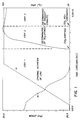
- Figure 1 is a graph of a thermogravimetric analysis (TGA) plot for SO 2 uptake by [Mg 6 Al 2 (OH) 16 ](FeO 4 ).xH 2 O as the layered double hydroxide (LDH).
- TGA thermogravimetric analysis
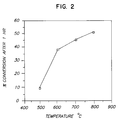
- Figure 2 is a graph showing the temperature dependence for SO 2 uptake by [Mg 6 Al 2 (OH) 16 ] (V 10 O 28 ) 1/3 .xH 2 O.
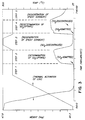
- Figure 3 is a graph of a TGA plot for SO 2 uptake by [Zn 2 Al(OH) 6 ](SiV 3 W 9 O 40 ) 1/7 .xH 2 O and thermolysis of the spent sorbent.
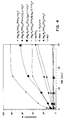
- Figure 4 is a graph comparing the rate of SO 2 uptake by different Mg containing sorbents prepared according to this invention and sorbents presently used in flue gas desulfurization.
- Thermal decomposition of LDHs leads to the formation of active metal oxides with fairly high basic character (pKa ⁇ 35) and high surface area.
- thermally treated materials should have exceptionally well-dispersed reactive metal centers, as judged from their catalytic properties. These properties have lead us to synthesize and to utilize thermally treated LDH materials as suitable sorbents for flue gas desulfurization.
- the SO 2 oxidation catalysts, (usually transition metals) and the SO 3 sorbents usually a metal oxide from either group IA or IIA
- the SO 2 oxidation catalysts, (usually transition metals) and the SO 3 sorbents can be easily incorporated into the layers or in the interlayers of LDH materials, using inexpensive starting materials.
- the present invention relates to a process using layered double hydroxide compositions, more specifically hydrotalcite-like and hydrocalumite-like materials for the absorption of SO x from flue gas streams.
- other metal components preferably transition metal ions, capable of promoting the oxidation of sulfur dioxide to sulfur trioxide at calcination temperatures.
- transition metal ions preferably transition metal ions
- LDH sorbents react at different temperatures, particularly at 500 to 1000°C, with SO 2 such that the sorbents find particular use in diminishing the emissions of sulfur oxides from the coal-fired boilers.
- Both M II and/or M III comprise in total or in part metals (preferably from group IIA, IIB and IIIA) that form reactive basic oxides at calcination temperatures (preferably above 500°C) that are capable of reacting with SO x .
- the preferred LDHs for use in the present invention comprise of these metals in the brucite-like [Mg(OH) 2 -like] layers, in particular magnesium and aluminum.
- Other alkaline earth metal ions, such as calcium, strontium, barium and mixtures thereof may replace all or part of magnesium ions.
- this invention considers the use of these LDH sorbents in controlling the sulfur oxides from gas streams, more particularly from coal-fired boiler systems.
- These systems include a boiler, economizer and dust collectors such as electrostatic precipitator or bag filter house ("bag house").
- bag house electrostatic precipitator or bag filter house
- the injection of the sorbents into these, particularly to the boiler (700-1000°C), along with the coal, or onto the electrostatic precipitators (hot side temp. 400-500°C) has been considered in this invention.
- the LDH sorbents were thermally treated in a temperature-programmed thermogravimetric balance at a temperature in the range of 500 to 1000°C in a stream of air or nitrogen, and SO x gas was introduced. The amount of SO 2 that reacted with the sorbents was monitored as the weight uptake.
- the reaction of the hydrotalcite sorbent, [Mg 6 Al 2 (OH) 16 ](CO 3 ) ⁇ xH 2 O (abbreviated as Mg 3 Al-LDH) with SO 2 provided a general description of the typical experimental method used to investigate the LDH reactivity.
- the hydrotalcite was heated to 700°C under a stream of air in a temperature controlled thermogravimetric balance at a rate of 5°C/min.
- the sample was calcined at 700°C for further one hour. During the above calcination process the sample lost weight due to the removal of CO 2 and H 2 O. This sample was then exposed to SO 2 -containing gas stream at 0.5% v/v concentration, at a flow rate of 200 ml/min.
- a weight gain of 6.2 % was observed. This corresponded to the amount of SO x absorbed to form the metal sulfate, MgSO 4 .
- the diffraction peaks observed in the X-ray diffraction pattern of the final product were due to crystalline MgSO 4 , indicating that the magnesium sites were the reactive species at this temperature.
- the weight uptake observed corresponded to a 4.4% conversion of MgO to MgSO 4 . However, this value is low compared to the other modified sorbents described later in this invention.
- a third metal component is incorporated in the LDH to promote the oxidation of sulfur dioxide to sulfur trioxide.
- the third metal component is preferably a component of a metal selected from the transition metals, rare earth metals, and Group IVA in the periodic table.
- Some of the known transition metal and transition metal oxide catalysts that are suitable for SO 2 oxidation include, Pt, WO 3 , Ag, Ag 3 VO 4 , Cu 3 (VO 4 ) 2 , V 2 O 5 , Fe 2 O 3 , TiO 2 , CuO, CrO 3 , MnO 2 , PbO 2 , MoO 3 , CeO 2 , Cr 2 O 3 , SnO 2 and ZnO.
- Platinum is an excellent oxidation catalyst, and other oxides such as vanadium pentoxide and iron oxides are also especially effective for catalyzing the oxidation of SO 2 to SO 3 .
- oxides such as vanadium pentoxide and iron oxides
- the catalytic process on these oxides will involve the following steps: sorption of SO 2 to form a sulfite, oxidation of sulfite to sulfate, and sulfate decomposition with evolution of SO 3 .
- the selection of a good metal oxide catalyst for SO 2 oxidation is very important. Requirements for a good catalyst can be compared to those for the SO 2 sorbent.
- transition metals especially iron or vanadium
- transition metals were introduced to the LDH as the third metal.
- metals were incorporated into the LDH sorbent compositions by structural means during the synthesis.
- metal components are introduced into the interlayers between [M l-x II M x III (OH) 2 ] layers in such a way, that a part or whole of A n- in the LDH structure, [M l-x II M x III (OH) 2 ](A x/n ) n- ⁇ H 2 O is replaced by anions containing sulfur dioxide oxidizing metals described earlier.
- the anions that contain metal ions such as copper, zinc, cobalt, iron, cadmium, mercury, lead, manganese, tin, nickel, palladium, chromium, vanadium, manganese, gallium, boron, cobalt, and mixtures thereof may replace all or part of interlayer anion A n- in the LDH structure.
- metal ions such as copper, zinc, cobalt, iron, cadmium, mercury, lead, manganese, tin, nickel, palladium, chromium, vanadium, manganese, gallium, boron, cobalt, and mixtures thereof may replace all or part of interlayer anion A n- in the LDH structure.
- the anions can be one or more from metal anionic complexes such as oxalates (ox), Fe(ox) 3 3- , simple oxo-anions such as, CrO 4 2- , FeO 4 2- , MnO 4 - , etc., or larger oxo-anions with higher charge such as, V 10 O 28 6- , W 7 O 24 6- , Mo 7 O 24 6- etc.
- metal anionic complexes such as oxalates (ox), Fe(ox) 3 3- , simple oxo-anions such as, CrO 4 2- , FeO 4 2- , MnO 4 - , etc.
- larger oxo-anions with higher charge such as, V 10 O 28 6- , W 7 O 24 6- , Mo 7 O 24 6- etc.
- the incorporation of guest anions into the hydrotalcite structure was carried out by replacing CO 3 2- from the interlayer as follows:
- the hydrotalcite material with suitable Mg/Al ratio was first calcined at 500°C and then hydrolyzed in aqueous solutions under anaerobic conditions to reform the hydrotalcite-like LDH containing OH - as the interlayer anion.
- This OH - in the interlayer can easily be replaced by wide variety of anions, such as FeO 4 2- , CrO 4 2- , Fe(ox) 3 3- etc., or larger anions such as V 10 O 28 6- , W 7 O 24 6- or much larger anions with Keggin structure such as H 2 W 12 O 40 6- , BVW 10 O 40 7- , SiV 3 W 9 O 40 7- etc., or defect structure such as SiW 11 O 39 9- , BCoW 11 O 39 7- , etc.
- the products isolated showed X-ray diffraction peaks corresponding to crystalline phases with well-defined basal spacings (Table 1).
- the incorporation of the guest polyoxome talate anions into the Zn/Al-LDH was also carried out in a similar manner starting with an aqueous hot suspension of [Zn 2 Al(OH) 6 ](NO 3 ) ⁇ xH 2 O (referred to as Zn 2 Al-LDH) and was found to undergo complete intercalative ion exchange reaction with aqueous solutions of polyoxometalate anions including alpha-[H 2 W 12 O 40 ] 6- and alpha-[SiV 3 W 9 O 40 ] 7- alpha-Keggin-type ions or defect Keggin-type ions such as SiW 11 O 39 9- , BCoW 11 O 39 7- .
- the anions with lower charge such as [PW 12 O 40 ] 3- and [SiW 12 O 40 ] 4- show no ion exchange whereas, intermediate anions show partial intercalation (e.g. [PCuW 11 O 39 (H 2 O)] 5- ).
- polyoxometalate anions with beta-Keggin structure such as beta-[SiV 3 W 9 O 40 ] 7- undergo partial intercalation. See Kwon, T. and Pinnavaia, T. J., "Pillaring of a Layered Double Hydroxide by Polyoxometalates with Keggin-Ion Structures", Chemistry of Materials, 1 , 381 to 383 (1989).
- hydrotalcite-like Mg 3 Al-LDHs when intercalated with Fe(ox) 3 3- , FeO 4 2- , V 10 O 28 6- , W 7 O 24 6- and Mo 7 O 24 6- , gave better SO x sorption than normal hydrotalcite (Table 2). TABLE 2 SO 2 Uptake by [M l-x II M x III (OH) 2 ](A n- ) x/n ⁇ yH 2 O at 700°C.
- the V 10 O 28 6- intercalated crystalline Zn 2 Al-LDH showed a weight uptake of 23.6% at 700°C under the conditions described earlier in this invention.
- the corresponding amorphous material showed a 20% weight uptake at this temperature.
- the crystalline sorbent formed by intercalating Zn 2 Al-LDH with alpha-[SiV 3 W 9 O 40 ] 7- showed 5.78% weight uptake at 700°C with SO x whereas, the partially intercalated sorbent with beta-[SiV 3 W 9 O 40 ] 7- in the interlayer showed 5.12% weight uptake under similar conditions.
- Mg 3 Al-LDH intercalated with V 10 O 28 6- , [Mg 6 Al 2 (OH) 16 ](V 10 O 28 ) 1/3 ⁇ xH 2 O was subjected to air containing 0.5% SO 2 (v/v) in the temperature range 500-800°C. As evident by the uptake measurements ( Figure 2), better SO x sorption was seen in the temperature range 600-800°C.
- LDH sorbents intercalated with vanadium containing anions such as V 10 O 28 6- , HVO 4 2- , SiV 3 W 9 O 40 7- and BVW 10 O 40 7- also showed better SO x uptake values (Table 2 and Figure 4). Moreover, these polyoxometalate anions intercalated LDH sorbents exhibited better initial SO x uptake than MgO or Mg(OH) 2 .
- European patent EP-A 278 535 which was described herein earlier, disclosed hydrocarbon cracking catalyst compositions containing as a component, anionic clays with LDH structures, for the purpose of binding the SO x liberated in the refining process, especially when processing high sulfur feeds.
- the LDH components incorporated many of the known SO 2 oxidation catalysts, including rare earth metal ions (e.g., La 3+ , Ce 3+ ), noble metals (e.g., Pt, Rh) and transition metal ions (Cu 2+ , Fe 3+ , Mn 2+ , Cr 3+ ).
- the rare earth and noble metal catalysts were preferred over the transition metal catalysts, in part, because of their greater reactivity.
- transition metals particularly iron
- transition metals are undesirable constituents of petroleum cracking catalysts because they promote the formation of coke.
- iron is an economically attractive SO 2 oxidation catalyst for applications where coke formation is not a concern, such as in the reduction of SO x from the flue gases of coal-burning power plants.
- transition metal ions particularly iron and vanadium
- the effectiveness of transition metal ions in promoting SO 2 uptake by LDH materials depends substantially on the transition metal composition.
- the incorporation of transition metals into the interlayers of LDH structure affords an order of increase in SO x absorption. This teaching is illustrated by the results presented in Table 2 for SO 2 uptake at 700°C by Mg 3 Al and Zn 2 Al-LDH compositions with different interlayer anions consisting of SO 2 oxidation catalysts.
- the oxidation catalyst iron when incorporated to the interlayers of the LDH structure in the form of FeO 4 2- for example, showed an enhancement of SO x uptake capability of hydrotalcite from 12.5% conversion of Mg sites to MgSO 4 to 85.2%. This is about 72.7% improvement of utilizing the Mg sites for SO uptake.
- incorporation of other iron containing anions such as Fe(ox) 3 3- as well as vanadium containing polyoxometalate anions showed significant improvements in SO x uptake capabilities of the LDH sorbents.
- iron and vanadium are preferred as SO 2 oxidation catalyst for the sorbents disclosed in this invention which are fabricated to use in flue gas desulfurization processes.
- sorbents disclosed in this invention contained Mg 2+ as the M II cation.
- Ca 2+ containing LDHs such as hydrocalumite and its derivatives also could be used as sorbents for SO x scrubbing after intercalating with said polyoxometalate.
- LDHs such as hydrocalumite and its derivatives
- SO x scrubbing after intercalating with said polyoxometalate should have similar or superior SO x sorptivity as judged by reactivity of CaO with SO 2 and SO 3 (see above, background of the invention).
- the metal-containing LDH useful as precursor for the preparation of compositions disclosed in the present invention may be synthesized from inexpensive starting materials.
- hydrotalcite-like materials can be prepared starting with MgO and alumina (Al 2 O 3 ) and hydrocalumite-like materials from CaO and alumina. Both CaO and MgO can be obtained by calcining the natural minerals such as Calcite (CaCO 3 ) and Magnesite (MgCO 3 ).
- Some of these layered double hydroxides, such as hydrotalcite are commercially available and some may be naturally occurring. Moreover, methods for their synthesis are known in the art.
- the SO 2 oxidation catalysts can be incorporated into the interlayers of the LDHs using wide variety of different metal containing anions other than the ones disclosed in this invention. These include, among other things, metal carbonyls such as V(CO) 6- , Fe 2 (CO) 8 2- , Fe(CO) 4 2- , Fe 3 (CO) 11 2- , Cr(CO) 5 2- etc., or metal halides such as VCl 4 - , CrCl 6 3- , W 2 Cl 9 3- , FeCl 6 3- etc., or metal nitriles such as Mn(CN) 6 4- , W(CN) 8 4- , Fe(CN) 6 3- etc. or transition metal complex chelates such as metal-oxalates, Fe(ox) 2 2- , WO 2 (ox) - , Cr(ox) 3 3- , or metal-acetylacetonates etc.
- metal carbonyls such as V(CO) 6- , Fe 2 (CO) 8 2- , Fe(CO)
- transition metals particularly iron
- the transition metal-containing LDH sorbents especially the iron-containing sorbents disclosed in this invention may be used to remove NO x components from flue gas streams and other gas streams.
- the calcined LDHs will react with NO x components to form solid nitrates.
- sorbents may be used, for example, in the form of particles of any suitable size and shape. Such particles may be formed by conventional techniques, such as spray drying, pilling, tableting, bead formation and the like.
- the present sorbents may be added, either separately or with coal, to the combustion zone, (e.g., the boiler, temp. 700-1000°C) when combustion takes place. Sorbents then leave the combustion zone with coal ash and can be removed from the bag house. This process will in turn, provide enough contact time for the sorbents to react with SO x from the flue gas streams. Thus the flue gas leaving the combustion zone/contacting zone systems have reduced amounts of sulfur oxide relative to the processing in the absence of present sorbents. If necessary, reacted sorbents can be separated from the ash, (especially the sorbents with Zn and Al, for the regeneration), e.g., by screening, density separation, or other well-known solid separation techniques.
- the spent sorbents can be safely disposed without any serious environmental pollution, since SO x in the spent sorbents is now in a thermally stable sulfate form.
- sorbents disclosed herein could be used in other processes such as hydrocarbon cracking processes where diminision of SO x from gas streams are necessary.
- the X-ray diffraction pattern of the dried solid corresponded to hydrotalcite and the basal spacing was found to be 7.78 ⁇ 10 -10 m (7.78 ⁇ ).
- Chemical analysis showed the Mg/Al ratio to be 3.2, very near the value expected for hydrotalcite with an idealized formula unit of [Mg 3 Al(OH) 8 ](CO 3 ) 0.5 ⁇ xH 2 O.
- the X-ray diffraction powder pattern of the dried solid corresponded to a LDH structure powder pattern of the dried solid corresponded to a LDH structure with a basal spacing value of 7.7 ⁇ 10 -10 m (7.7 ⁇ ).
- the Cl - derivative, [Zn 2 Al(OH) 6 ]Cl.zH 2 O can be prepared using AlCl 3 and MgCl 2 .
- a boiling solution containing about 5 mequiv. portion of Zn 2 Al-X (X NO 3 , Cl) LDH prepared in Example 2, was added drop-wise to a stirred aqueous solution containing about 7.5 mequiv. of polyoxometalate anion. After the addition was complete, the pH of the resultant slurry was adjusted to about 6 by adding dilute HNO 3 acid. The slurry was stirred for about 1 hour and the solid product was isolated and washed thoroughly with water by centrifugation. The X-ray diffraction powder patterns of the dried solids correspond to a hyrotalcite-like layered structures, with polyoxometalate anions in the interlayer. The basal spacings are given in Table 1. Chemical analyses conformed to the structure Zn 2 Al(OH) 6 [POM n- ] l/n .YH 2 O, where POM represent the polyoxometalate with a charge of n.
- the anions with lower charge such as [PW 12 O 40 ] 3- and [SiW 12 O 40 ] 4- show no ion exchange, whereas intermediate anions show partial intercalation (e.g. [PCuW 11 O 39 (H O)] 5- ).
- polyoxometalate anions with beta-Keggin structure such as beta-[SiV 3 W 9 O 40 ] 7- undergo partial intercalation.
- the preparation of polyoxometalate intercalated Zn/Al-LDH materials from [Zn 2 Al(OH) 6 ]NO 3 .zH 2 O according to the U.S. Patent No. 4,454,244 resulted in X-ray amorphous materials.
- This example describes the general method adopted in preparing the polyoxometallate-intercalated Mg 3 Al-LDHs.
- the uptake of SO x by various LDH sorbents was determined by thermogravimetric analysis using a Cahn Model TG-121 thermogravimetric analyzer.
- Hydrotalcite-like materials intercalated with metal polyoxoanions as in Examples 3 and 5 were tested for SO x sorption at 700°C according to the procedure of Example 6. The results are given in Table 2. LDHs that contain Mg and Al show better SO x adsorption than that contain Zn and Al.
- the preferred polyoxoanion is FeO 4 2- , which showed more than 85% conversion of Mg sites to MgSO 4 when exposed to SO 2 .
- polyoxoanions containing V, W and Mo also show enhanced SO x adsorption, compared to free hydrotalcite.
- the corresponding Zn 2 Al-LDH formed metastable products with SO x .
- the hydrotalcite-like material intercalated with V 10 O 28 6- according to Example 4 was tested for SO x sorption at different calcining temperatures according to the procedure of Example 6. Results are given in Figure 2. Preferred calcining temperatures were in the range 550-800°C where 32% to 52% conversion of Mg sites to MgSO 4 was observed. At very high temperatures (>900°C) the uptake was very low.
- Step 2 when SO 2 was introduced for the first time a weight uptake of 5.6% was observed (Figure 3). Almost all (90%) of this weight gain was lost in Step 3 at higher temperatures from this spent sorbent, indicating the release of the absorbed SO x . The SO 3 uptake by this regenerated sorbent was 6.4% in Step 4 indicating that this recovered material was as good as the virgin sorbent.
Landscapes
- Chemical & Material Sciences (AREA)
- Organic Chemistry (AREA)
- Engineering & Computer Science (AREA)
- Inorganic Chemistry (AREA)
- Chemical Kinetics & Catalysis (AREA)
- Nanotechnology (AREA)
- Analytical Chemistry (AREA)
- Geology (AREA)
- Biomedical Technology (AREA)
- General Physics & Mathematics (AREA)
- Materials Engineering (AREA)
- Crystallography & Structural Chemistry (AREA)
- Life Sciences & Earth Sciences (AREA)
- Composite Materials (AREA)
- Physics & Mathematics (AREA)
- Condensed Matter Physics & Semiconductors (AREA)
- Environmental & Geological Engineering (AREA)
- Health & Medical Sciences (AREA)
- General Chemical & Material Sciences (AREA)
- Oil, Petroleum & Natural Gas (AREA)
- Solid-Sorbent Or Filter-Aiding Compositions (AREA)
- Treating Waste Gases (AREA)
- Separation Of Gases By Adsorption (AREA)
- Gas Separation By Absorption (AREA)
Claims (18)
- Verfahren zum Entfernen der SOx-Bestandteile aus einem Rauchgasstrom, enthaltend Sauerstoff, Schwefeldioxid und Schwefeltrioxid, aus der Verbrennung von Kohle aus einem mit Kohle befeuerten Heißwasserbereiter, umfassend das Verbrennen der Kohle in dem Heißwasserbereiter, um den Rauchgasstrom zu erzeugen, und das Inkontaktbringen des Gasstroms mit einer erwärmten Sorbenszusammensetzung bei 400 bis 1000°C, wobei das Sorbens, bevor es erwärmt wird, ausgewählt ist aus der Gruppe, bestehend aus einer Doppelhydroxidzusammensetzung mit Schichtstruktur der Formel:
[ M1-x II Mx III (OH)2 ] (An-)x/n · yH2O
worin
MII ein zweiwertiges Metallkation ist;
MIII ist ein dreiwertiges Kation eines Metalls, ausgewählt aus der Gruppe, bestehend aus Metallen der Gruppen IIA, IIB und IIIA;
A ist ein Polyoxometallatanion oder ein Metalloxalatanion mit der Ladung n, umfassend mindestens ein Metallatom, ausgewählt aus der Gruppe, bestehend aus Metallen der Hauptgruppen und Übergangsmetallen;
x liegt im Bereich von 0,8 bis 0,12; und
y sind die Mole an Wasser. - Verfahren nach Anspruch 1, dadurch gekennzeichnet, daß mindestens ein Teil von MII ein Erdalkalimetallkation ist.
- Verfahren nach Anspruch 2, worin mindestens ein Teil von MII ein Erdalkalimetallkation ist, ausgewählt aus der Gruppe, bestehend aus Magnesium- und Calciumkationen.
- Verfahren nach Anspruch 1, worin mindestens ein Teil von MII ausgewählt ist aus der Gruppe, bestehend aus Übergangsmetallkationen.
- Verfahren nach Anspruch 4, worin das Übergangsmetallkation ein Zinkkation ist.
- Verfahren nach Anspruch 1, worin mindestens ein Teil von MIII aus Kationen der Metalle der Gruppe IIIA des Periodensystems ausgewählt ist.
- Verfahren nach Anspruch 6, worin das Kation des Metalls der Gruppe IIIA ein Aluminiumkation ist.
- Verfahren nach Anspruch 1, worin das Polyoxometallatanion ein Isopolyoxometallat ist, das ein Metallatom und Sauerstoff enthält.
- Verfahren nach Anspruch 8, worin die Anionen aus CrO4 2-, FeO4 2-, HVO4 2-, MoO4 2-, V10O28 6-, Mo7O24 6- und W7O24 6-, und Gemischen davon ausgewählt sind.
- Verfahren nach Anspruch 1, worin das Polyoxometallatanion ein Heteropolyoxometallat ist, das mehr als ein Metallatom und Sauerstoff enthält.
- Verfahren nach Anspruch 10, worin das Heteropolyoxometallatanion ein Anion mit einer Keggin-Struktur ist.
- Verfahren nach Anspruch 11, worin das Anton mit einer Keggin-Struktur ausgewählt ist aus der Gruppe, bestehend aus H2W12O40 6-, SiV3W9O40 7-, BVW10O40 7- und Gemischen davon.
- Verfahren nach Anspruch 10, worin das Heteropolyoxometallatanion ein Anton mit einer defekten Keggin-Struktur mit der Formel [XM11O39]n- und [XM9O34]n- ist, worin X und M Kombinationen von Metallen aus dem Periodensystem sind.
- Verfahren nach Anspruch 13, worin das Anton mit einer defekten Keggin-Struktur ausgewählt ist aus der Gruppe, bestehend aus BCoW11O39 9- und SiW11O39 9-, und Gemischen davon.
- Verfahren nach Anspruch 10, worin das Heteropolyoxometallatanion ein Anton ist, ausgewählt aus widerstandsfähigen Anionen (robust anions) mit einer verknüpften Keggin-Struktur.
- Verfahren nach Anspruch 15, worin das Anton mit einer verknüpften Keggin-Struktur BCoW12O42 8- ist.
- Verfahren nach Anspruch 1, dadurch gekennzeichnet, daß das Metalloxalatanion ein Eisenoxalat ist.
- Verfahren nach Anspruch 1, worin MII Zn ist, welches durch Erwärmen regeneriert wird, um das gebundene SOx zu entfernen und um das Sorbens für die erneute Verwendung zu isolieren.
Applications Claiming Priority (3)
| Application Number | Priority Date | Filing Date | Title |
|---|---|---|---|
| US535147 | 1990-06-08 | ||
| US07/535,147 US5114691A (en) | 1990-01-18 | 1990-06-08 | Process using sorbents for the removal of SOx from flue gas |
| PCT/US1991/003642 WO1991018667A1 (en) | 1990-06-08 | 1991-05-28 | PROCESS USING SORBENTS FOR THE REMOVAL OF SOx FROM FLUE GAS AND OTHER GAS STREAMS |
Publications (3)
| Publication Number | Publication Date |
|---|---|
| EP0486676A1 EP0486676A1 (de) | 1992-05-27 |
| EP0486676A4 EP0486676A4 (en) | 1992-11-25 |
| EP0486676B1 true EP0486676B1 (de) | 1996-10-09 |
Family
ID=24133032
Family Applications (1)
| Application Number | Title | Priority Date | Filing Date |
|---|---|---|---|
| EP91912279A Expired - Lifetime EP0486676B1 (de) | 1990-06-08 | 1991-05-28 | Verfahren zum entfernen von sox aus rauchgasen und anderen gasströmen unter verwendung von sorbentien |
Country Status (12)
| Country | Link |
|---|---|
| US (1) | US5114691A (de) |
| EP (1) | EP0486676B1 (de) |
| JP (1) | JPH0722678B2 (de) |
| KR (1) | KR950011824B1 (de) |
| CN (1) | CN1057211A (de) |
| AT (1) | ATE143827T1 (de) |
| CA (1) | CA2064715A1 (de) |
| DE (1) | DE69122591T2 (de) |
| IE (1) | IE911685A1 (de) |
| MX (1) | MX171531B (de) |
| MY (1) | MY106394A (de) |
| WO (1) | WO1991018667A1 (de) |
Families Citing this family (40)
| Publication number | Priority date | Publication date | Assignee | Title |
|---|---|---|---|---|
| US5334564A (en) * | 1990-07-16 | 1994-08-02 | Board Of Trustees Operating Michigan State University | Method for the preparation of highly reactive clay composites for the removal of SOx from flue gas streams |
| US5364568A (en) * | 1992-07-08 | 1994-11-15 | Georgetown University | Compounds and methods for separation and molecular encapsulation of metal ions |
| US5358701A (en) * | 1992-11-16 | 1994-10-25 | Board Of Trustees Operating Michigan State University | Process of using layered double hydroxides as low temperature recyclable sorbents for the removal of SOx from flue gas and other gas streams |
| US5785938A (en) * | 1992-11-16 | 1998-07-28 | Board Of Trustees Operating Michigan State University | Process using recyclable sorbents for the removal of sox from flue gases and other gas streams |
| US5302709A (en) * | 1992-11-25 | 1994-04-12 | Board Of Trustees Operating Michigan State University | Polyaryl-metallic complex intercalated layered double hydroxides |
| US5415850A (en) * | 1993-02-24 | 1995-05-16 | The Research Foundation Of State Univeristy Of New York | Pillared interlayered clay catalysts for the selective reduction of nitrogen oxides with ammonia |
| AU2700295A (en) * | 1994-06-09 | 1996-01-04 | Abb Environmental Systems | Improved entrainment separator for high velocity gases and reheating of scrubber gases |
| US5928496A (en) * | 1996-06-20 | 1999-07-27 | Contract Materials Processing, Inc. | Hydrotalcite sulfer oxide sorption |
| US6028023A (en) | 1997-10-20 | 2000-02-22 | Bulldog Technologies U.S.A., Inc. | Process for making, and use of, anionic clay materials |
| US6074437A (en) * | 1998-12-23 | 2000-06-13 | Unilever Home & Personal Care Usa, Division Of Conopco, Inc. | Bleaching with polyoxometalates and air or molecular oxygen |
| US20030049191A1 (en) * | 1999-12-11 | 2003-03-13 | Twigg Martyn Vincent | Process for treating exhaust gas including sox |
| WO2002016026A2 (en) * | 2000-08-25 | 2002-02-28 | Apyron Technologies, Inc. | Adsorbent and/or catalyst compounds promoted with halide ions and methods of making and using thereof |
| US6662951B1 (en) * | 2000-09-27 | 2003-12-16 | Basic Resources, Inc. | Process for extracting and purifying naturally occurring zeolite |
| JP4574884B2 (ja) * | 2001-03-27 | 2010-11-04 | 住友重機械工業株式会社 | 排ガス処理システムの硫酸回収方法及び硫酸回収装置 |
| CN1245079C (zh) * | 2002-12-13 | 2006-03-15 | 北京化工大学 | 一种超分子结构草甘膦缓释剂及其制备方法 |
| US20050100494A1 (en) | 2003-11-06 | 2005-05-12 | George Yaluris | Ferrierite compositions for reducing NOx emissions during fluid catalytic cracking |
| US20050161410A1 (en) * | 2003-11-06 | 2005-07-28 | Wilson Gregg L. | System, method and composition for treatment of wastewater |
| US20050100493A1 (en) * | 2003-11-06 | 2005-05-12 | George Yaluris | Ferrierite compositions for reducing NOx emissions during fluid catalytic cracking |
| US6998100B2 (en) * | 2003-11-19 | 2006-02-14 | Toll Processing And Consulting, Llc | Sulfur oxide sorption with layered chlorite-type contact solids |
| US7304011B2 (en) * | 2004-04-15 | 2007-12-04 | W.R. Grace & Co. -Conn. | Compositions and processes for reducing NOx emissions during fluid catalytic cracking |
| US20050232839A1 (en) * | 2004-04-15 | 2005-10-20 | George Yaluris | Compositions and processes for reducing NOx emissions during fluid catalytic cracking |
| US7238288B1 (en) | 2004-08-13 | 2007-07-03 | Sandia Corporation | Method for absorbing an ion from a fluid |
| AU2006229690B2 (en) * | 2005-03-24 | 2011-09-08 | W.R. Grace & Co.-Conn. | Method for controlling NOx emissions in the FCCU |
| CN101166574B (zh) | 2005-04-27 | 2011-09-21 | 格雷斯公司 | 用于减少流化催化裂化过程中的NOx排放物的组合物和方法 |
| JP4535016B2 (ja) * | 2006-03-28 | 2010-09-01 | 住友ベークライト株式会社 | 塩化ビニル樹脂組成物、それを用いて作製した塩化ビニル樹脂シートおよび成形体 |
| MX2009004594A (es) * | 2006-10-31 | 2009-09-18 | Intercat Inc | Aditivos de remocion de oxido de azufre y metodos para condiciones de oxidacion parcial. |
| US20100327224A1 (en) * | 2009-06-26 | 2010-12-30 | Manuela Serban | Compounds for Desulfurization of Hot Fuel Gases |
| US20100135884A1 (en) * | 2009-06-26 | 2010-06-03 | Manuela Serban | Process for Desulfurization of Hot Fuel Gases |
| CN103589450B (zh) * | 2012-08-14 | 2015-11-04 | 中国科学院大连化学物理研究所 | 一种柴油的超深度氧化脱硫方法 |
| US9951196B2 (en) | 2012-10-24 | 2018-04-24 | J.M. Huber Corporation | Cationic polyoxometalate-coated alumina trihydrate dispersants |
| CN103041769B (zh) * | 2012-12-31 | 2015-01-28 | 东南大学 | 高温脱氯剂及其制备方法 |
| CN105771619A (zh) * | 2016-04-25 | 2016-07-20 | 张锐 | 一种复合脱硫剂及其制备方法 |
| US10882753B2 (en) * | 2016-09-15 | 2021-01-05 | Paris Sciences Et Lettres—Quartier Latin | Method for exchanging interlayer anions of a layered double hydroxide |
| CN111295361A (zh) * | 2017-09-08 | 2020-06-16 | 联邦科学和工业研究组织 | 水处理方法 |
| CN108754203A (zh) * | 2018-07-10 | 2018-11-06 | 上海大学 | 一种抗退化的铝硅系合金细化剂及其制备方法和应用 |
| KR102558233B1 (ko) * | 2019-04-19 | 2023-07-21 | 쿠리타 고교 가부시키가이샤 | 산성 배기가스 처리제, 산성 배기가스 처리방법 및 산성 배기가스 처리설비 |
| JP6898627B2 (ja) * | 2019-12-10 | 2021-07-07 | 栗田工業株式会社 | 炭酸型層状複水酸化物の再生方法、及び酸性排ガス処理設備 |
| CN113416585B (zh) * | 2021-07-09 | 2022-11-01 | 深圳灏权环保有限公司 | 一种吸附焦炉煤气中h2s的方法 |
| CN114452811B (zh) * | 2021-12-27 | 2023-03-17 | 深圳华明环保科技有限公司 | 一种脱硫脱硝剂及其制备方法 |
| CN115999499A (zh) * | 2022-12-27 | 2023-04-25 | 国家电投集团远达环保工程有限公司 | 一种用于脱除烟气中so3的吸附剂及其制备方法 |
Family Cites Families (12)
| Publication number | Priority date | Publication date | Assignee | Title |
|---|---|---|---|---|
| US3796792A (en) * | 1969-12-12 | 1974-03-12 | Kyowa Chem Ind Co Ltd | Composite metal hydroxides |
| US3699037A (en) * | 1970-10-28 | 1972-10-17 | Chevron Res | Catalytic cracking |
| US3835031A (en) * | 1973-05-23 | 1974-09-10 | Standard Oil Co | Catalytic cracking with reduced emission of sulfur oxides |
| US4153534A (en) * | 1975-12-19 | 1979-05-08 | Standard Oil Company (Indiana) | Catalytic cracking with reduced emission of noxious gases |
| US4472532A (en) * | 1982-11-29 | 1984-09-18 | Atlantic Richfield Company | Preparative process for alkaline earth metal, aluminum-containing spinels |
| US4454244A (en) * | 1983-03-28 | 1984-06-12 | Ashland Oil, Inc. | New compositions |
| US4492678A (en) * | 1984-05-17 | 1985-01-08 | Atlantic Richfield Company | Preparative process for alkaline earth metal, aluminum-containing spinels and their use for reducing sulfur oxide content in gases |
| US4866019A (en) * | 1987-01-13 | 1989-09-12 | Akzo N.V. | Catalyst composition and absorbent which contain an anionic clay |
| US4774212A (en) * | 1987-12-22 | 1988-09-27 | Amoco Corporation | Pillared hydrotalcites |
| US5116587A (en) * | 1990-01-18 | 1992-05-26 | Board Of Trustees Operating Michigan State University | Layered double hydroxide sorbents for the removal of sox from flue gas resulting from coal combustion |
| US5075089A (en) * | 1990-03-20 | 1991-12-24 | Aluminum Company Of America | Method of making pillared hydrotalcites and associated products |
| US5079203A (en) * | 1990-05-25 | 1992-01-07 | Board Of Trustees Operating Michigan State University | Polyoxometalate intercalated layered double hydroxides |
-
1990
- 1990-06-08 US US07/535,147 patent/US5114691A/en not_active Expired - Lifetime
-
1991
- 1991-05-13 MY MYPI91000807A patent/MY106394A/en unknown
- 1991-05-17 IE IE168591A patent/IE911685A1/en unknown
- 1991-05-28 WO PCT/US1991/003642 patent/WO1991018667A1/en not_active Ceased
- 1991-05-28 JP JP3511454A patent/JPH0722678B2/ja not_active Expired - Lifetime
- 1991-05-28 CA CA002064715A patent/CA2064715A1/en not_active Abandoned
- 1991-05-28 DE DE69122591T patent/DE69122591T2/de not_active Expired - Fee Related
- 1991-05-28 KR KR1019920700271A patent/KR950011824B1/ko not_active Expired - Fee Related
- 1991-05-28 AT AT91912279T patent/ATE143827T1/de not_active IP Right Cessation
- 1991-05-28 EP EP91912279A patent/EP0486676B1/de not_active Expired - Lifetime
- 1991-05-31 MX MX026026A patent/MX171531B/es unknown
- 1991-06-08 CN CN91103857A patent/CN1057211A/zh active Pending
Also Published As
| Publication number | Publication date |
|---|---|
| KR950011824B1 (ko) | 1995-10-11 |
| WO1991018667A1 (en) | 1991-12-12 |
| DE69122591D1 (de) | 1996-11-14 |
| MX171531B (es) | 1993-11-03 |
| CN1057211A (zh) | 1991-12-25 |
| JPH04506932A (ja) | 1992-12-03 |
| IE911685A1 (en) | 1991-12-18 |
| US5114691A (en) | 1992-05-19 |
| JPH0722678B2 (ja) | 1995-03-15 |
| ATE143827T1 (de) | 1996-10-15 |
| CA2064715A1 (en) | 1991-12-09 |
| EP0486676A1 (de) | 1992-05-27 |
| DE69122591T2 (de) | 1997-02-13 |
| KR920702248A (ko) | 1992-09-03 |
| EP0486676A4 (en) | 1992-11-25 |
| MY106394A (en) | 1995-05-30 |
Similar Documents
| Publication | Publication Date | Title |
|---|---|---|
| US5114691A (en) | Process using sorbents for the removal of SOx from flue gas | |
| US5116587A (en) | Layered double hydroxide sorbents for the removal of sox from flue gas resulting from coal combustion | |
| US5114898A (en) | Layered double hydroxide sorbents for the removal of SOx from flue gas and other gas streams | |
| US5358701A (en) | Process of using layered double hydroxides as low temperature recyclable sorbents for the removal of SOx from flue gas and other gas streams | |
| AU689591B2 (en) | Absorbent and process for removing sulfur oxides from a gaseous mixture | |
| US5785938A (en) | Process using recyclable sorbents for the removal of sox from flue gases and other gas streams | |
| US5334564A (en) | Method for the preparation of highly reactive clay composites for the removal of SOx from flue gas streams | |
| US6156696A (en) | Hydrotalcite contact materials | |
| CA1197224A (en) | Preparative process for alkaline earth metal, aluminum-containing spinels | |
| CA2308748C (en) | Process for making and use of anionic clay materials | |
| CA2562014C (en) | Method of obtaining multimetallic oxides derived from hydrotalcite-type compounds | |
| US4472532A (en) | Preparative process for alkaline earth metal, aluminum-containing spinels | |
| US5298473A (en) | Hydrated lime clay composites for the removal of SOx from flue gas streams | |
| US5843862A (en) | Process for manufacturing an absorbent composition | |
| IE910688A1 (en) | Layered double hydroxide sorbents for the removal of SOx¹from flue gas and other gas streams | |
| CA2190745C (en) | Absorbent and process for removing sulfur oxides from a gaseous mixture | |
| JP3758675B6 (ja) | ガス混合物から硫黄酸化物を除去する吸収剤および方法 |
Legal Events
| Date | Code | Title | Description |
|---|---|---|---|
| PUAI | Public reference made under article 153(3) epc to a published international application that has entered the european phase |
Free format text: ORIGINAL CODE: 0009012 |
|
| 17P | Request for examination filed |
Effective date: 19920305 |
|
| AK | Designated contracting states |
Kind code of ref document: A1 Designated state(s): AT BE CH DE DK ES FR GB GR IT LI LU NL SE |
|
| A4 | Supplementary search report drawn up and despatched |
Effective date: 19921007 |
|
| AK | Designated contracting states |
Kind code of ref document: A4 Designated state(s): AT BE CH DE DK ES FR GB GR IT LI LU NL SE |
|
| 17Q | First examination report despatched |
Effective date: 19940422 |
|
| GRAH | Despatch of communication of intention to grant a patent |
Free format text: ORIGINAL CODE: EPIDOS IGRA |
|
| GRAH | Despatch of communication of intention to grant a patent |
Free format text: ORIGINAL CODE: EPIDOS IGRA |
|
| GRAA | (expected) grant |
Free format text: ORIGINAL CODE: 0009210 |
|
| AK | Designated contracting states |
Kind code of ref document: B1 Designated state(s): AT BE CH DE DK ES FR GB GR IT LI LU NL SE |
|
| PG25 | Lapsed in a contracting state [announced via postgrant information from national office to epo] |
Ref country code: IT Free format text: LAPSE BECAUSE OF FAILURE TO SUBMIT A TRANSLATION OF THE DESCRIPTION OR TO PAY THE FEE WITHIN THE PRE;WARNING: LAPSES OF ITALIAN PATENTS WITH EFFECTIVE DATE BEFORE 2007 MAY HAVE OCCURRED AT ANY TIME BEFORE 2007. THE CORRECT EFFECTIVE DATE MAY BE DIFFERENT FROM THE ONE RECORDED.SCRIBED TIME-LIMIT Effective date: 19961009 Ref country code: ES Free format text: THE PATENT HAS BEEN ANNULLED BY A DECISION OF A NATIONAL AUTHORITY Effective date: 19961009 Ref country code: NL Free format text: LAPSE BECAUSE OF FAILURE TO SUBMIT A TRANSLATION OF THE DESCRIPTION OR TO PAY THE FEE WITHIN THE PRESCRIBED TIME-LIMIT Effective date: 19961009 Ref country code: GR Free format text: LAPSE BECAUSE OF FAILURE TO SUBMIT A TRANSLATION OF THE DESCRIPTION OR TO PAY THE FEE WITHIN THE PRESCRIBED TIME-LIMIT Effective date: 19961009 Ref country code: AT Effective date: 19961009 Ref country code: LI Effective date: 19961009 Ref country code: DK Effective date: 19961009 Ref country code: CH Effective date: 19961009 Ref country code: BE Effective date: 19961009 |
|
| REF | Corresponds to: |
Ref document number: 143827 Country of ref document: AT Date of ref document: 19961015 Kind code of ref document: T |
|
| REF | Corresponds to: |
Ref document number: 69122591 Country of ref document: DE Date of ref document: 19961114 |
|
| ET | Fr: translation filed | ||
| PG25 | Lapsed in a contracting state [announced via postgrant information from national office to epo] |
Ref country code: SE Effective date: 19970109 |
|
| NLV1 | Nl: lapsed or annulled due to failure to fulfill the requirements of art. 29p and 29m of the patents act | ||
| REG | Reference to a national code |
Ref country code: CH Ref legal event code: PL |
|
| PG25 | Lapsed in a contracting state [announced via postgrant information from national office to epo] |
Ref country code: GB Effective date: 19970528 |
|
| PG25 | Lapsed in a contracting state [announced via postgrant information from national office to epo] |
Ref country code: LU Free format text: LAPSE BECAUSE OF NON-PAYMENT OF DUE FEES Effective date: 19970531 |
|
| PLBE | No opposition filed within time limit |
Free format text: ORIGINAL CODE: 0009261 |
|
| STAA | Information on the status of an ep patent application or granted ep patent |
Free format text: STATUS: NO OPPOSITION FILED WITHIN TIME LIMIT |
|
| 26N | No opposition filed | ||
| GBPC | Gb: european patent ceased through non-payment of renewal fee |
Effective date: 19970528 |
|
| PG25 | Lapsed in a contracting state [announced via postgrant information from national office to epo] |
Ref country code: FR Free format text: LAPSE BECAUSE OF NON-PAYMENT OF DUE FEES Effective date: 19980130 |
|
| PG25 | Lapsed in a contracting state [announced via postgrant information from national office to epo] |
Ref country code: DE Free format text: LAPSE BECAUSE OF NON-PAYMENT OF DUE FEES Effective date: 19980203 |
|
| REG | Reference to a national code |
Ref country code: FR Ref legal event code: ST |