EP0486704B1 - Organische, elektrolytische batterie - Google Patents
Organische, elektrolytische batterie Download PDFInfo
- Publication number
- EP0486704B1 EP0486704B1 EP91911187A EP91911187A EP0486704B1 EP 0486704 B1 EP0486704 B1 EP 0486704B1 EP 91911187 A EP91911187 A EP 91911187A EP 91911187 A EP91911187 A EP 91911187A EP 0486704 B1 EP0486704 B1 EP 0486704B1
- Authority
- EP
- European Patent Office
- Prior art keywords
- electrolytic solution
- cell
- organic
- electrolyte
- alkali metal
- Prior art date
- Legal status (The legal status is an assumption and is not a legal conclusion. Google has not performed a legal analysis and makes no representation as to the accuracy of the status listed.)
- Expired - Lifetime
Links
Images
Classifications
-
- H—ELECTRICITY
- H01—ELECTRIC ELEMENTS
- H01M—PROCESSES OR MEANS, e.g. BATTERIES, FOR THE DIRECT CONVERSION OF CHEMICAL ENERGY INTO ELECTRICAL ENERGY
- H01M6/00—Primary cells; Manufacture thereof
- H01M6/14—Cells with non-aqueous electrolyte
- H01M6/16—Cells with non-aqueous electrolyte with organic electrolyte
- H01M6/162—Cells with non-aqueous electrolyte with organic electrolyte characterised by the electrolyte
- H01M6/166—Cells with non-aqueous electrolyte with organic electrolyte characterised by the electrolyte by the solute
-
- H—ELECTRICITY
- H01—ELECTRIC ELEMENTS
- H01M—PROCESSES OR MEANS, e.g. BATTERIES, FOR THE DIRECT CONVERSION OF CHEMICAL ENERGY INTO ELECTRICAL ENERGY
- H01M6/00—Primary cells; Manufacture thereof
- H01M6/14—Cells with non-aqueous electrolyte
- H01M6/16—Cells with non-aqueous electrolyte with organic electrolyte
- H01M6/162—Cells with non-aqueous electrolyte with organic electrolyte characterised by the electrolyte
Definitions
- the present invention relates to an organic electrolytic solution cell, and more particularly, it relates to an improvement of an organic electrolytic solution of such cell.
- the organic electrolytic solution cell such as a lithium-manganese dioxide cell which comprises a lithium negative electrode, a manganese dioxide positive electrode and an organic electrolytic solution, has increasingly come into wide use, because of its high energy density, light weight and long-life.
- LiClO 4 As an electrolyte for the organic electrolytic solution cell, LiClO 4 is commonly used. [see, for example, T. Iwamaru, O. Kajii, Practical Lithium Batteries, p53 (1988)]
- a cylindrical lithium-manganese dioxide cell has also increasingly come into widely use as a battery of a camera.
- Combinations of the electrolytic solution such as a cyclic ether and the electrolyte are studied in order to provide excellent characteristics even at a low temperature.
- this type of the cell is provided with a PTC device a resistance of which increases to decrease an intensity of an electric current when a temperature of the cell rises abnormally by an electric current or a heat or a safety valve device, which exhausts the inner gas in the cell thrugh a vent hole to prevent explosion of the cell under high pressure, when an inner pressure of the cell is increased abnormally by generation of gas in the cell.
- the cell may be fired after continuation of overdischarge under a large electric current without the PTC device.
- the cylindrical lithium-manganese dioxide cell comprising LiClO 4 as the electrolyte as shown in Fig.1 which has an outer diameter of 15 mm and a height of 40 mm abnormally generates heat when it is overdischarged at 4 A and discharged at a constant voltage of -3 V after reaching -3 V, and sometime causes the fire or the detonation.
- LiCF 3 SO 3 As an electrolyte, it is proposed to use LiCF 3 SO 3 as an electrolyte. Though the cell using LiCF 3 SO 3 is stable under the normal condition, it generates the abnormal heat when the discharge electric current exceeds 15 A.
- An object of the present invention is to provide an organic electrolytic solution cell which does not generate an abnormal heat during the overdischarge to maintain cell safety.
- WO 92/02966 A1 discloses salts for use in non-aqueous electrolytes, and electrolytes and electrochemical generators including such materials.
- An exemplary compound for use as an electrolyte in an electrochemical cell has formula (I) SO 2 (a) CO; (b) wherein M n+ is an ion of Li, Na, K, Ca, Mg, Zn, or Al; each of the moieties Y, Y' and Y" are (a) or (b); the groups R and R' are separate halogenated alkyl groups of 1-4 carbon atoms, respectively or are joined together to constitute a unitary halogenated alkylene radical of from 2-4 carbon atoms linking Y and Y' and forming a ring structure which includes R, R', Y, Y' and the carbon atom to which Y and Y' are attached; the group R" is an alkyl or haloalkyl radical of 1-4 carbon atoms or a halogenated phen
- the -Y"-R" group is replaced by Z, which is an electron-withdrawing substituent selected from the group consisting of -C(O)H, -NO 2 ,-CN, -F and perfluorinated alkyls and aryls containing no more than 8 carbons.
- JP 30-49 157 A relates to a non-aqueous electrolyte battery.
- At least one of ethane halogenide lithium sulfonate and propane halogenide lithium sulfonate is used for the solute of the electrolyte of a non-aqueous electrolyte battery A.
- At least one selected among a group of pentafluoroethane lithium sulfonate, heptafluoropropane lithium sulfonate, tetrafluoroethane lithium sulfonate, and heptachloropropane lithium sulfonate is used for the solute.
- WO 88/03331 A1 discloses new ionic conduction material comprised of a salt diluted in a liquid solvent.
- the salt is represented by one of the following formulae: M[RF-SO 2 -N-SO 2 R'F]; M[RF-SO 2 -N-CO-R'F]; M[RF-CO-N-CO-R'F], or formula (IV).
- CpF is a divalent perfluorinated radical having from 2 to 6 carbon atoms.
- the abnormal heat generation of the cell during the overdischarge is prevented by using an organic metal salt in which a perfluoroalkyl group having at least 4 carbon atoms and an anionic group being a -SO 3 - or -CO 2 - group are covalently bonded, and to said anionic group, an alkali metal ion or an alkaline earth metal ion is ionically bonded, excluding an electrolyte being dilithium 1,4-perfluorobutyldisulfonate [Li 2 C 4 F 8 (SO 3 ) 2 ] dissolved in sulfolane.
- the anionic group is a -SO 3 - or -CO 2 - group, which is able to bond with the alkali metal ion or the alkaline earth metal ion.
- the reason why the abnormal heat generation of the cell during the overdischarge is prevented by using the above electrolyte may be as follows:
- the use of the electrolyte of the present invention can prevent the generation of the abnormal heat of the cell because of the preventon of the large electric current in the cell by the effect of an absorption of the fluoroalkyl group to the negative electrode and an interaction between the fluoroalkyl group-and the alkali metal ion such as Li + ion in the electrolytic solution.
- the separator When the electrolyte of the present invention is used, the separator is clogged at overdischarge of -3 V and the electric current gradually decreases after a short time.
- the electric current does not always monotonously decrease but sometimes increases on the way.
- alkali metals such as Li (lithium), Na (sodium) and K (potassium) or alkaline earth metals such as Ca (calcium), Mg (magnesium) and Be (beryllium).
- Li (lithium) because a lithium or a compound of lithium is usually used as the negative electrode.
- MCF 3 SO 3 e.g. LiCF 3 SO 3
- the cell sometime generates the abnormal heat, the fire and the detonation.
- the perfluoroalkyl group having at least 4 carbon atoms is effective in improving the safety of the cell and seldom generates the abnormal heat, the fire and the detonation.
- the number of the carbon atoms may prefer to large, preferably from 4 to 10. If the number of the carbon atoms is more than 10, an ionic conductivity is decreased and therefore the characteristics such as discharge characteristic is deteriorated. Taking stability of the electrolyte in the cell into account, the fluoroalkyl group is a perfluoroalkyl group.
- the electrolytic solution is important to obtain the cell having an excellent discharge characteristic, since the ionic conductivity is decreased by increasing the number of the carbon atoms in the perfluoroalkyl group.
- the ionic conductivity of a solution of Li 2 C 2 F 4 (SO 3 ) 2 in a concentration of 0.6 mol/l in tetrahydrofuran is 0.45 mS ⁇ cm -1
- the ionic conductivity of a solution of Li 2 C 4 F 8 (SO 3 ) 2 in tetrahydrofuran is only 0.0043 mS ⁇ cm -1 since it is dissolved in a concentration of 0.001 mol/l (V. R. Koch, et al, J.
- a mixed solvent of an ester and an ether especially an ester and a linear ether, is very effective in getting the cell having the excellent discharge characteristic, because said mixed solvent is able to dissolve well said electrolyte.
- a mixed solvent of propylene carbonate and 1,2-dimethoxyethane in a volume ratio of 1:2 is able to dissolve at least 5 mole/l of LiC 4 F 9 SO 3 even though the number of carbon atoms in the perfluoroalkyl group is 4.
- the ester is used for preventing a reaction between an active material for positive electrode such as manganese dioxide and the ether to improve a storage stability.
- the ester are propylene carbonate, butylene carbonate, ⁇ -butyrolactone, ⁇ -valerolactone, etc. Among them, propylene carbonate is preferred.
- the content of the ester in the solvent of the electrolytic solution is preferably at least 10 % by volume to maintain the storage stability by preventing the reaction between the active material for positive electrode and the ether.
- the ether examples include 1,2-dimethoxyethane, dimethoxymethane, dimethoxypropane, 1,3-dioxolane, tetrahydrofuran, 4-methyl-1,3-dioxolane, 2-methyltetrahydrofuran,etc.
- linear ethers such as 1,2-dimethoxyethane, dimethoxymethane and dimethoxypropane are preferred, because these ethers have an good effect on discharge characteristics at low temperature.
- the content of the ether in the solvent of the electrolytic solution is preferably at least 50 % by volume, more preferably at least 60 % by volume.
- the mixed solvent is preferably a combination of propylene carbonate and 1,2-dimethoxyethane.
- the content of 1,2-dimethoxyethane in the combination is preferably from 55 to 80 % by volume, more preferably from 60 to 75 % by volume.
- the selection of solvent is quite effective, because it can improve solubility of the electrolyte and ionic conductivity.
- the content of the electrolyte in the electrolytic solution is preferably form 0.1 to 2.0 mol/l, more preferably from 0.2 to 0.7 mol/l.
- the content of electrolyte is less than above range, an intermittent discharge characteristic of the cell is deteriorated.
- the content is more than above range, a viscosity of the solution increases so that the intermittent discharge characteristic is deteriorated.
- the fluoroalkyl group in the electrolytic solution described above may be not only the linear type but the cyclic type.
- the number of the carbon atoms is preferably at most 10, because the ionic conductivity is decreased with the increase of the number of the carbon atoms, therefore if the number of carbon atoms is too large, it become difficult to increase the ionic conductivity even though the solvent is selected.
- the solvent for the electrolytic solution in which the electrolyte of the present invention has large solubility it is necessary to use the solvent for the electrolytic solution in which the electrolyte of the present invention has large solubility.
- the internal resistance of the cell tends to increase due to a reaction between the alkali metal as the negative electrode and the electrolyte solution when the cell is left or stored after partial discharge.
- the increase of internal resistance can be prevented by adding at least one compound selected from the group consisting of ethylene carbonate, glymes such as methyldiglyme [CH 3 (OCH 2 CH 2 ) 2 OCH 3 ], methyltriglyme [CH 3 (OCH 2 CH 2 ) 3 OCH 3 ], and methyltetraglyme [CH 3 (OCH 2 CH 2 ) 4 OCH 3 ], a BF 4 - containing salt, BF 3 , a SbF 6 - containing salt and SbF 5 .
- glymes such as methyldiglyme [CH 3 (OCH 2 CH 2 ) 2 OCH 3 ], methyltriglyme [CH 3 (OCH 2 CH 2 ) 3 OCH 3 ], and methyltetraglyme [CH 3 (OCH 2 CH 2 ) 4 OCH 3 ], a BF 4 - containing salt, BF 3 , a SbF 6 - containing salt and SbF 5 .
- Ethylene carbonate and the glymes described above can be used as the solvent for the electrolytic solution.
- the reason why these solvents can prevent the increase of the internal resistance of the cell when the cell is left or stored after the partial discharge may be as follows.
- Ethylene carbonate and the glymes have an effect to decrease basicity (or increase acidity) of the electrolytic solution at an interface between the alkali metal as the negative electrode and the electrolytic solution, consequently a reactivity between the solvent of the electrolytic solution and the alkali metal as the negative electrode is decreased.
- An amount of ethylene carbonate or the glyme is preferably from 1/15 to 1/3 by volume, more preferably from 1/10 to 1/5 of the ether volume.
- an amount of the ethylene carbonate or the glyme is less than 1/15 of the ether volume, it is difficult to prevent the increase of the internal resistance when the cell is left or stored after the partial discharge.
- the amount of the ethylene carbonate or the glyme is more than 1/3 of the ether volume, the characteristics at low temperature are deteriorated.
- the BF 4 - containing salt includes LiBF 4 , (C 2 H 5 ) 4 NBF 4 , etc.
- the SbF 6 - containning salt includes LiSbF 6 , (C 2 H 5 ) 4 NSbF 6 , etc. Both can be used as an electrolyte. Because these are all Lewis acids and can decrease Lewis basicity, the BF 4 - or SbF 6 - containing salt, BF 3 and SbF 5 can prevent the increase of internal resistance when the cell is left or stored after partial discharge.
- An amount of the BF 4 - or SbF 6 - containing salt, BF 3 or SbF 5 is preferably from 5 ⁇ 10 -4 to 2 ⁇ 10 -2 mole per one mole of ether, more preferably from 3 ⁇ 10 -3 to 6 ⁇ 10 -3 moles.
- the amount of the BF 4 - or SbF 6 - containing salt, BF 3 or SbF 5 is less than 5 ⁇ 10 -4 mole per one mole of the ether, it is difficult to prevent the increase of the internal resistance when the cell is left or stored after partial discharge.
- its amount is more than 2 ⁇ 10 -2 mole, the storage stability of the undischarged cell is deteriorated
- the electrolytic solution of the present invention contains the electrolyte having the above structure for the safety of the cell, this type of the electrolyte sometimes corrodes a metal part of a current collecter provided at the positive electrode. Such corrosion can be prevented to some extend by using austenitic stainless steel or titanium as a metal part of the current collecter.
- the addition of water to the electrolytic solution is effective for preventing the corrosion of the metal provided at the positive electrode, and the content of water in the electrolytic solution is preferably at least 50 ppm, more preferably at least 200 ppm. Water restrains the corrosive action of fluorine against the metal. However when the content of the water is more than 1000 ppm, water will react with the negative electrode.
- the separator is made as thin as possible, preferably at most 50 ⁇ m, more preferably at most 30 ⁇ m.
- a band shape positive electrode plate which comprises a current collector and a sheet of the manganese dioxide mixture (a thickness of 0.4 mm and a width of 30 mm) comprising a stainless steal mesh as a core and manganese dioxide, carbon black and polytetrafluoroethylene which had been heat treated at 450°C, C, was dried at 250°C C for 9 hours, then cooled down to room temperature in dry air.
- the band shape positive electrode plate was wrapped with a separator made of a microporous polypropylene film having a thickness of 25 ⁇ m, laminated with a band shape negative electrode plate made of lithium and wound in the form of a spindle. Then, the wound electrodes were installed in a stainless steel cell case having an outer diameter of 15 mm and a lead member was attached by spot welding.
- an electrolytic solution was prepared by dissolving 0.6 mole/liter of LiC 4 F 9 SO 3 in a mixed solvent of propylene carbonate (PC) and 1,2-dimethoxyethane (DME) in a volume ratio of 1:2 (0.6MLiC 4 F 9 SO 3 /PC:DME(1:2)).
- the solution contained 23 ppm of water when measured by the Karl Fischer's method.
- the electrolytic solution was poured in the cell case which contained the electrodes.
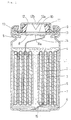
- the opening of the cell case was closed by the conventional method, and the cell was stabilized and aged to obtain a cylindrical organic electrolytic solution cell having the structure shown in Fig. 1
- (1) is a positive electrode made of the manganese dioxide mixture mentioned above, which comprises the stainless steel mesh as the core material.
- (2) is a negative electrode made of lithium, which is bonded to the stainless steel mesh by pressure welding.
- the stainless steel mesh and the current collecter which are used for producing the positive electrode (1) and negative electrode (2) are not shown in Fig. 1 for simplicity.
- (3) is a separator and (4) is an electrolytic solution.
- (5) is a stainless steel cell case which acts as a negative terminal.
- an insulation plate (6) made of a polytetrafluoroethylene sheet is arranged, and in the inside, an insulation plate (7) made of a polytetrafluoroethylene sheet is arranged.
- the wound electrode consisting of the positive electrode (1), the negative electrode (2) and the separator (3), and the electrolytic solution are accommodated in the cell case (5).
- (8) is a sealing plate made of stainless steel having, at a central portion, a gas venthole (8a).
- (9) is a ring-form packing made of polypropylene and (10) is a flexible thin plate made of titanium.
- (11) is a ring-form thermal deformable member made of polypropylene, which has an action of altering destruction pressure of the flexible film (10) by deformation with temperature.
- (12) is a terminal plate made of a nickel-plated iron plate which is formed by rolling. The terminal plate (12) is provided with a cut blade (12a) and a gas vent hole (12b).
- Example 2 In the same manner as in Example 1 except that an electrolytic solution was prepared by dissolving 0.6 mole/liter of LiC 4 F 9 SO 3 in a mixed solvent of propylene carbonate (PC), 1,2-dimethoxyethane (DME) and ethylene carbonate (EC) in a volume ratio of 3:6:1 (0.6MLiC 4 F 9 SO 3 /PC:DME:EC(3:6:1)), the cylindrical organic electrolytic solution cell was produced.
- PC propylene carbonate
- DME 1,2-dimethoxyethane
- EC ethylene carbonate
- Example 2 In the same manner as in Example 1 except that an electrolytic solution was prepared by dissolving 0.6 mole/liter of LiC 4 F 9 SO 3 in a mixed solvent of propylene carbonate (PC), 1,2-dimethoxyethane (DME) and methyldiglyme (MDG) in a volume ratio of 3:8:1 (0.6MLiC 4 F 9 SO 3 /PC:DME:MDG (3:8:1)), the cylindrical organic electrolytic solution cell was produced.
- PC propylene carbonate
- DME 1,2-dimethoxyethane
- MDG methyldiglyme
- Example 2 In the same manner as in Example 1 except that an electrolytic solution was prepared by dissolving 0.6 mole/liter of LiC 4 F 9 SO 3 and 0.03 mole/liter of LiBF 4 in a mixed solvent of propylene carbonate (PC) and 1,2-dimethoxyethane (DME) in a volume ratio of 1:2 (0.6MLiC 4 F 9 SO 3 +0.03cMLiBF 4 /PC:DME /PC:DME (1:2)), the cylindrical organic electrolytic solution cell was produced.
- PC propylene carbonate
- DME 1,2-dimethoxyethane
- Example 2 In the same manner as in Example 1 except that an electrolytic solution was prepared by dissolving 0.6 mole/liter of LiC 4 F 9 SO 3 and 0.03 mole/liter of LiSbF 6 in a mixed solvent of propylene carbonate (PC) and 1,2-dimethoxyethane (DME) in a volume ratio of 1:2 (0.6MLiC 4 F 9 SO 3 +0.03MLiSbF 6 /PC:DME /PC:DME (1:2)), the cylindrical organic electrolytic solution cell was produced.
- PC propylene carbonate
- DME 1,2-dimethoxyethane
- Example 2 In the same manner as in Example 1 except that an electrolytic solution was prepared by dissolving 0.6 mole/liter of LiC 4 F 9 SO 3 and 0.03 mole/liter of LiBF 4 in a mixed solvent of propylene carbonate (PC), 1,2-dimethoxyethane (DME) and ethylene carbonate (EC) in a volume ratio of 3:8:1 (0.6MLiC 4 F 9 SO 3 +0.03MLiBF 4 /PC:DME:EC (3:8:1)), the cylindrical organic electrolytic solution cell was produced.
- PC propylene carbonate
- DME 1,2-dimethoxyethane
- EC ethylene carbonate
- Example 2 In the same manner as in Example 1 except that the content of water in the electrolytic solution was adjusted to 200 ppm by adding water, the cylindrical organic electrolytic solution cell was produced.
- Each of the cells produced in Examples 1 to 6 and Comparative Examples 1 and 2 was discharged at a constant current of 5 amperes, and after the cell voltage was reversed to -3 volts, discharged at a constant voltage of -3 volts.
- the number of the cells which generated heat at least 150°C on the surface or which were damaged was counted. The results are shown in Table 1. Five cells of the each Example or Comparative Example were subjected to the test. In Table 1, numerator is the number of generated heat at least 150°C on the surface (abnormal heat) or damaged cell and denominator is the number of the tested cells. Ratio of heated or damaged cell Example 1. 0/5 Example 2. 0/5 Example 3. 0/5 Example 4. 0/5 Example 5. 0/5 Example 6. 0/5 Comparative Example 1. 5/5 Comparative Example 2. 0/5
- Examples 1 to 6 of the present invention did not generate the abnormal heat or damage, namely the addition of LiC 4 F 9 SO 3 is effective to the safety of the cell during overdischarge.
- the results of Table 1 indicate the cells in Comparative Example 2 using LiCF 3 SO 3 as the electrolyte are safer than the cells in Comparative Example 1 under the overdischarge condition mentioned above.
- each of the cells produced in Examples 1 to 6 and Comparative Examples 1 and 2 was overdischarged at a constant voltage of -3 volts and maximum current of 15 amperes. The number of the cells which generated heat at least 150°C on the surface or damaged was counted. The results are shown in Table 2. Five cells of the each Example or Comparative Example were subjected to the test. The results in Table 2 are indicated in the same manner as in Table 1. Ratio of heated or damaged cell Example 1. 0/5 Example 2. 0/5 Example 3. 0/5 Example 4. 0/5 Example 5. 0/5 Example 6. 0/5 Comparative Example 1. 5/5 Comparative Example 2. 3/5
- the cell of Examples 1 to 6 of the present invention did not generate abnormal heat or damage, namely they are safe even under the severe condition of overdischarge.
- many of the cells in Comparative Examples 1 and 2 generated abnormal heat or damaged.
- the cells in Comparative Example 2 using LiCF 3 SO 3 as the electrolyte had insufficient safety under the severe condition such as unlimited current in overdischarge.
- Example 1 The cells of Examples 1 to 6 were subjected to the intermittent discharge test which applied 880 cycles at 20°C The condition of one intermittent discharging was discharging at 1.2 A for 3 seconds and stopping for 7 seconds. The cells were measured in terms of the internal resistance at 1KHz after 4 hours from the applied intermittent discharge and the internal resistance at 1KHz after being stored at 60°C for 3 days and cooled down to the room temperature by LCR meter (4262A manufactured by Yokogawa Hewlett Packard). The results are shown in Table 4. Internal resistance( ⁇ ) Original After 3 days at 60°C Example 1. 0.4 1.2 Example 2. 0.4 0.7 Example 3. 0.4 0.8 Example 4. 0.4 0.6 Example 5. 0.4 0.5 Example 6. 0.4 0.5
- Example 7 10 ml of the electrolyte solution used in Example 1 was charged in a vial. In the vial, a center part piece of the positive electrode used in Example 1 was added. The vial was closed tightly and stored at 80°C for 6 days. The same experiment was carried out with the materials used in Example 7.
- the present invention prevents precipitation of metal elements of positive electrode on the surface of lithium and their growth which causes the internal short circuit, and prevents deterioration of an open circuit voltage of the cell.
- the organic electrolytic solution cell of the present invention does not generate the abnormal heat and is safe under the overdischarge.
Landscapes
- Engineering & Computer Science (AREA)
- Manufacturing & Machinery (AREA)
- Chemical & Material Sciences (AREA)
- Chemical Kinetics & Catalysis (AREA)
- Electrochemistry (AREA)
- General Chemical & Material Sciences (AREA)
- Secondary Cells (AREA)
- Primary Cells (AREA)
Claims (10)
- Batterie mit einer organischen, elektrolytischen Lösung, die nach einer Überentladung bei einer Spannung von -3 V entladbar ist, umfassend eine positive Elektrode, eine negative Elektrode, die ein Alkalimetall oder eine Verbindung eines Alkalimetalls umfaßt, und eine elektrolytische Lösung, die ein organisches Lösungsmittel und einen Elektrolyten umfaßt,
worin die elektrolytische Lösung ein gelöstes, organisches Metallsalz enthält, in dem eine Perfluoralkyl-Gruppe mit wenigstens 4 Kohlenstoffatomen und eine anionische Gruppe, die eine -SO3- oder -CO2-Gruppe darstellt, kovalent gebunden sind, und ein Alkalimetallion oder ein Erdalkalimetallion an diese anionische Gruppe ionisch gebunden ist, ausschließlich eines Elektrolyts, der Dilithium-1,4-perfluorbutyldisulfonat [Li2C4F8(SO3)2], gelöst in Sulfolan, ist. - Batterie mit einer organischen, elektrolytischen Lösung gemäß Anspruch 1, worin die anionische Gruppe eine -SO3- Gruppe ist.
- Batterie mit einer organischen, elektrolytischen Lösung, umfassend eine positive Elektrode, eine negative Elektrode, die ein Alkalimetall oder eine Verbindung eines Alkalimetalls umfaßt, und eine elektrolytische Lösung, die ein organisches Lösungsmittel und einen Elektrolyt umfaßt,
worin die elektrolytische Lösung eine Verbindung der Formel M(CnF2n+1SO3)x als Elektrolyt umfaßt,
worin M ein Alkalimetall oder ein Erdalkalimetall ist, n eine ganze Zahl von wenigstens 4 ist, und x 1 ist, wenn M das Alkalimetall ist, oder x 2 ist, wenn M das Erdalkalimetall ist. - Batterie mit einer organischen, elektrolytischen Lösung gemäß Anspruch 1, worin der Ester- und Ether-Gehalt in dem organischen Lösungsmittel für die elektrolytische Lösung wenigstens 10 Vol.-% bzw. wenigstens 55 Vol.-% beträgt.
- Batterie mit einer organischen, elektrolytischen Lösung gemäß Anspruch 4, worin der Ether 1,2-Dimethoxyethan ist.
- Batterie mit einer organischen, elektrolytischen Lösung gemäß Anspruch 4, worin der Ester Propylencarbonat ist und der Ether 1,2-Dimethoxyethan ist.
- Batterie mit einer organischen, elektrolytischen Lösung gemäß Anspruch 1, worin das organische Lösungsmittel für die elektrolytische Lösung einen Ether in einer Menge von wenigstens 55 Vol.-% und Ethylencarbonat enthält.
- Batterie mit einer organischen, elektrolytischen Lösung gemäß Anspruch 7, worin die elektrolytische Lösung ein BF4 - enthaltendes Salz oder BF3 enthält.
- Batterie mit einer organischen, elektrolytischen Lösung gemäß Anspruch 7, worin die elektrolytische Lösung ein SbF6 - enthaltendes Salz oder SbF5 enthält.
- Batterie mit einer organischen, elektrolytischen Lösung gemäß Anspruch 1, worin das organische Lösungsmittel für die elektrolytische Lösung wenigstens 50 ppm Wasser enthält.
Applications Claiming Priority (5)
| Application Number | Priority Date | Filing Date | Title |
|---|---|---|---|
| JP153082/90 | 1990-06-12 | ||
| JP2153082A JP3011740B2 (ja) | 1990-06-12 | 1990-06-12 | 有機電解液電池 |
| JP2217963A JP2974739B2 (ja) | 1990-08-17 | 1990-08-17 | 有機電解液電池 |
| JP217963/90 | 1990-08-17 | ||
| PCT/JP1991/000787 WO1991020104A1 (fr) | 1990-06-12 | 1991-06-12 | Batterie electrolytique organique |
Publications (3)
| Publication Number | Publication Date |
|---|---|
| EP0486704A1 EP0486704A1 (de) | 1992-05-27 |
| EP0486704A4 EP0486704A4 (en) | 1993-02-24 |
| EP0486704B1 true EP0486704B1 (de) | 1999-03-31 |
Family
ID=26481811
Family Applications (1)
| Application Number | Title | Priority Date | Filing Date |
|---|---|---|---|
| EP91911187A Expired - Lifetime EP0486704B1 (de) | 1990-06-12 | 1991-06-12 | Organische, elektrolytische batterie |
Country Status (4)
| Country | Link |
|---|---|
| US (1) | US5437944A (de) |
| EP (1) | EP0486704B1 (de) |
| DE (1) | DE69131064T2 (de) |
| WO (1) | WO1991020104A1 (de) |
Families Citing this family (19)
| Publication number | Priority date | Publication date | Assignee | Title |
|---|---|---|---|---|
| US5352547A (en) * | 1992-08-27 | 1994-10-04 | Hitachi Maxell, Ltd. | Organic electrolytic solution and organic electrolytic solution cell |
| CA2119959C (en) * | 1993-03-30 | 2000-03-14 | Soichiro Kawakami | Secondary battery |
| FR2704099B1 (fr) * | 1993-04-15 | 1995-07-07 | Centre Nat Etd Spatiales | Electrolyte pour accumulateur electrique. |
| US5902698A (en) * | 1995-04-14 | 1999-05-11 | Hitachi Maxell, Ltd. | Ion conductive material and electrochemical device comprising the same |
| JP3048899B2 (ja) * | 1995-09-06 | 2000-06-05 | キヤノン株式会社 | リチウム二次電池 |
| US5691081A (en) * | 1995-09-21 | 1997-11-25 | Minnesota Mining And Manufacturing Company | Battery containing bis(perfluoroalkylsulfonyl)imide and cyclic perfluoroalkylene disulfonylimide salts |
| US5652072A (en) * | 1995-09-21 | 1997-07-29 | Minnesota Mining And Manufacturing Company | Battery containing bis(perfluoroalkylsulfonyl)imide and cyclic perfluoroalkylene disulfonylimide salts |
| EP0910874B1 (de) * | 1996-06-14 | 2001-11-21 | Moltech Corporation | Zusammensetzung verwendbar in elektrolyten für sekundär batteriezellen |
| CA2215756C (en) * | 1997-09-18 | 2006-04-04 | Moli Energy (1990) Limited | Additives for improving cycle life of non-aqueous rechargeable lithium batteries |
| KR100559110B1 (ko) | 1997-12-10 | 2006-03-13 | 미네소타 마이닝 앤드 매뉴팩춰링 캄파니 | 전기화학 시스템에서의 비스(퍼플루오로알킬설포닐)이미드 계면활성제 염 |
| US6194010B1 (en) * | 1998-11-30 | 2001-02-27 | Kerry Ingredients, Inc. | Compositions useful in preparing unified food serving products |
| MXPA01007820A (es) * | 1999-02-04 | 2003-06-19 | Technion Res & Dev Foundation | Metodo y aparato para mantenimiento y expansion de celulas de tallo hemopoyeticas y/o celulas progenitoras. |
| JP2003229172A (ja) * | 2002-01-31 | 2003-08-15 | Sony Corp | 非水電解質電池 |
| KR100472513B1 (ko) * | 2002-11-16 | 2005-03-11 | 삼성에스디아이 주식회사 | 리튬 설퍼 전지용 유기 전해액 및 이를 채용한 리튬 설퍼전지 |
| CN100541863C (zh) | 2003-12-15 | 2009-09-16 | 三菱化学株式会社 | 非水电解液二次电池 |
| US8352031B2 (en) | 2004-03-10 | 2013-01-08 | Impulse Dynamics Nv | Protein activity modification |
| US8465860B2 (en) * | 2008-01-23 | 2013-06-18 | The Gillette Company | Lithium cell |
| US8273483B2 (en) | 2008-02-14 | 2012-09-25 | The Gillette Company | Lithium cell |
| KR102248230B1 (ko) | 2017-12-07 | 2021-05-03 | 주식회사 엘지화학 | 이차전지 모듈 |
Citations (2)
| Publication number | Priority date | Publication date | Assignee | Title |
|---|---|---|---|---|
| WO1988003331A1 (fr) * | 1986-10-30 | 1988-05-05 | Centre National De La Recherche Scientifique (Cnrs | Nouveau materiau a conduction ionique constitue par un sel en solution dans un electrolyte liquide |
| WO1992002966A1 (en) * | 1990-08-01 | 1992-02-20 | Covalent Associates Incorporated | Methide salts, formulations, electrolytes and batteries formed therefrom |
Family Cites Families (9)
| Publication number | Priority date | Publication date | Assignee | Title |
|---|---|---|---|---|
| US4074028A (en) * | 1977-05-09 | 1978-02-14 | General Electric Company | Dendrite-inhibiting electrolytic solution and rechargeable aqueous zinc-halogen cell containing the solution |
| CA1174274A (en) * | 1980-09-29 | 1984-09-11 | Union Carbide Corporation | Nonaqueous cell employing an iron compound cathode and a pc-dme-licf.sub.3so.sub.3 electrolyte |
| JPS5935365A (ja) * | 1982-08-20 | 1984-02-27 | Sanyo Electric Co Ltd | 非水電解液電池 |
| JPS59108276A (ja) * | 1982-12-10 | 1984-06-22 | Hitachi Maxell Ltd | 有機電解質電池 |
| JPS59205162A (ja) * | 1983-05-09 | 1984-11-20 | Sanyo Electric Co Ltd | 非水電解液電池 |
| JPS63155560A (ja) * | 1986-12-18 | 1988-06-28 | Matsushita Electric Ind Co Ltd | 有機電解液電池 |
| JPH02198643A (ja) * | 1989-01-26 | 1990-08-07 | Matsushita Electric Works Ltd | イオン導伝体 |
| JP2735891B2 (ja) * | 1989-07-17 | 1998-04-02 | 三洋電機株式会社 | 非水系電解液電池 |
| JPH0738306B2 (ja) * | 1991-04-22 | 1995-04-26 | 松下電器産業株式会社 | 亜鉛アルカリ電池 |
-
1991
- 1991-06-12 EP EP91911187A patent/EP0486704B1/de not_active Expired - Lifetime
- 1991-06-12 US US07/829,061 patent/US5437944A/en not_active Expired - Lifetime
- 1991-06-12 DE DE69131064T patent/DE69131064T2/de not_active Expired - Fee Related
- 1991-06-12 WO PCT/JP1991/000787 patent/WO1991020104A1/ja not_active Ceased
Patent Citations (2)
| Publication number | Priority date | Publication date | Assignee | Title |
|---|---|---|---|---|
| WO1988003331A1 (fr) * | 1986-10-30 | 1988-05-05 | Centre National De La Recherche Scientifique (Cnrs | Nouveau materiau a conduction ionique constitue par un sel en solution dans un electrolyte liquide |
| WO1992002966A1 (en) * | 1990-08-01 | 1992-02-20 | Covalent Associates Incorporated | Methide salts, formulations, electrolytes and batteries formed therefrom |
Also Published As
| Publication number | Publication date |
|---|---|
| US5437944A (en) | 1995-08-01 |
| EP0486704A4 (en) | 1993-02-24 |
| DE69131064T2 (de) | 1999-11-18 |
| EP0486704A1 (de) | 1992-05-27 |
| WO1991020104A1 (fr) | 1991-12-26 |
| DE69131064D1 (de) | 1999-05-06 |
Similar Documents
| Publication | Publication Date | Title |
|---|---|---|
| US5437944A (en) | Organic electrolytic solution cell | |
| JP3055358B2 (ja) | 非水電解質電池 | |
| US6225002B1 (en) | Dioxolane as a proctector for lithium electrodes | |
| US7097944B2 (en) | Nonaqueous secondary cell | |
| EP1527488B1 (de) | Elektrolytzusatzstoff für nichtwässrige elektrochemische zellen | |
| US6994936B2 (en) | Nonaqueous electrolyte secondary battery | |
| JP2618453B2 (ja) | 非水性単電池 | |
| US6350542B1 (en) | Sulfite additives for nonaqueous electrolyte rechargeable cells | |
| EP0631339B1 (de) | Sekundärbatterie | |
| CA2316438A1 (en) | Sulfate additives for nonaqueous electrolyte rechargeable cells | |
| JPH0318309B2 (de) | ||
| CN102640322A (zh) | 具有改进的分隔体和电解质组合的电化学电池 | |
| JP3055536B2 (ja) | 非水電解質電池 | |
| CA2359634A1 (en) | Electrochemical cell having an electrode with a carbonate additive in the electrode active mixture | |
| EP0589229B1 (de) | Organische Elektrolytlösung und diese Lösung enthaltende Zelle | |
| EP1867001B1 (de) | Nichtwässrige elektrochemische primärzellen | |
| US20030087161A1 (en) | Non-aqueous electrochemical cell | |
| JP2001217001A (ja) | 非水電解液二次電池用添加剤 | |
| KR100470288B1 (ko) | 리튬폴리머전지 | |
| JP2004087226A (ja) | リチウム二次電池 | |
| JP3431641B2 (ja) | 有機電解液およびそれを使用した有機電解液電池 | |
| JPH0765843A (ja) | 有機電解液電池 | |
| CA2299102C (en) | Sulfite additives for nonaqueous electrolyte rechargeable cells | |
| JP3011740B2 (ja) | 有機電解液電池 | |
| JP3722824B2 (ja) | 積層型有機電解液電池 |
Legal Events
| Date | Code | Title | Description |
|---|---|---|---|
| PUAI | Public reference made under article 153(3) epc to a published international application that has entered the european phase |
Free format text: ORIGINAL CODE: 0009012 |
|
| 17P | Request for examination filed |
Effective date: 19920211 |
|
| AK | Designated contracting states |
Kind code of ref document: A1 Designated state(s): DE FR GB |
|
| A4 | Supplementary search report drawn up and despatched |
Effective date: 19930106 |
|
| AK | Designated contracting states |
Kind code of ref document: A4 Designated state(s): DE FR GB |
|
| 17Q | First examination report despatched |
Effective date: 19940406 |
|
| GRAG | Despatch of communication of intention to grant |
Free format text: ORIGINAL CODE: EPIDOS AGRA |
|
| GRAG | Despatch of communication of intention to grant |
Free format text: ORIGINAL CODE: EPIDOS AGRA |
|
| GRAH | Despatch of communication of intention to grant a patent |
Free format text: ORIGINAL CODE: EPIDOS IGRA |
|
| GRAH | Despatch of communication of intention to grant a patent |
Free format text: ORIGINAL CODE: EPIDOS IGRA |
|
| GRAA | (expected) grant |
Free format text: ORIGINAL CODE: 0009210 |
|
| AK | Designated contracting states |
Kind code of ref document: B1 Designated state(s): DE FR GB |
|
| REF | Corresponds to: |
Ref document number: 69131064 Country of ref document: DE Date of ref document: 19990506 |
|
| ET | Fr: translation filed | ||
| PLBE | No opposition filed within time limit |
Free format text: ORIGINAL CODE: 0009261 |
|
| STAA | Information on the status of an ep patent application or granted ep patent |
Free format text: STATUS: NO OPPOSITION FILED WITHIN TIME LIMIT |
|
| 26N | No opposition filed | ||
| REG | Reference to a national code |
Ref country code: GB Ref legal event code: IF02 |
|
| PGFP | Annual fee paid to national office [announced via postgrant information from national office to epo] |
Ref country code: DE Payment date: 20080619 Year of fee payment: 18 |
|
| PGFP | Annual fee paid to national office [announced via postgrant information from national office to epo] |
Ref country code: FR Payment date: 20080617 Year of fee payment: 18 |
|
| PGFP | Annual fee paid to national office [announced via postgrant information from national office to epo] |
Ref country code: GB Payment date: 20080618 Year of fee payment: 18 |
|
| GBPC | Gb: european patent ceased through non-payment of renewal fee |
Effective date: 20090612 |
|
| REG | Reference to a national code |
Ref country code: FR Ref legal event code: ST Effective date: 20100226 |
|
| PG25 | Lapsed in a contracting state [announced via postgrant information from national office to epo] |
Ref country code: FR Free format text: LAPSE BECAUSE OF NON-PAYMENT OF DUE FEES Effective date: 20090630 |
|
| PG25 | Lapsed in a contracting state [announced via postgrant information from national office to epo] |
Ref country code: GB Free format text: LAPSE BECAUSE OF NON-PAYMENT OF DUE FEES Effective date: 20090612 |
|
| PG25 | Lapsed in a contracting state [announced via postgrant information from national office to epo] |
Ref country code: DE Free format text: LAPSE BECAUSE OF NON-PAYMENT OF DUE FEES Effective date: 20100101 |