EP0486801A1 - Sportschuh, insbesondere zum Gehen und für den Skilanglauf, mit abnehmbarer hoher Schaftmanschette - Google Patents
Sportschuh, insbesondere zum Gehen und für den Skilanglauf, mit abnehmbarer hoher Schaftmanschette Download PDFInfo
- Publication number
- EP0486801A1 EP0486801A1 EP91117103A EP91117103A EP0486801A1 EP 0486801 A1 EP0486801 A1 EP 0486801A1 EP 91117103 A EP91117103 A EP 91117103A EP 91117103 A EP91117103 A EP 91117103A EP 0486801 A1 EP0486801 A1 EP 0486801A1
- Authority
- EP
- European Patent Office
- Prior art keywords
- collar
- sports shoe
- articulation
- projections
- locking means
- Prior art date
- Legal status (The legal status is an assumption and is not a legal conclusion. Google has not performed a legal analysis and makes no representation as to the accuracy of the status listed.)
- Granted
Links
- 239000000463 material Substances 0.000 claims description 4
- 239000011324 bead Substances 0.000 claims description 3
- 230000014759 maintenance of location Effects 0.000 claims description 2
- 238000000465 moulding Methods 0.000 claims description 2
- 239000003351 stiffener Substances 0.000 abstract 2
- 210000002683 foot Anatomy 0.000 description 6
- 238000000034 method Methods 0.000 description 5
- 241001573881 Corolla Species 0.000 description 3
- 210000003423 ankle Anatomy 0.000 description 3
- 229920002994 synthetic fiber Polymers 0.000 description 2
- 230000003797 telogen phase Effects 0.000 description 2
- 229920004943 Delrin® Polymers 0.000 description 1
- 229920002614 Polyether block amide Polymers 0.000 description 1
- 238000005452 bending Methods 0.000 description 1
- 244000309466 calf Species 0.000 description 1
- 238000010276 construction Methods 0.000 description 1
- 238000009434 installation Methods 0.000 description 1
- 239000002184 metal Substances 0.000 description 1
- 230000003252 repetitive effect Effects 0.000 description 1
- 230000009466 transformation Effects 0.000 description 1
- 210000003462 vein Anatomy 0.000 description 1
Images


Classifications
-
- A—HUMAN NECESSITIES
- A43—FOOTWEAR
- A43B—CHARACTERISTIC FEATURES OF FOOTWEAR; PARTS OF FOOTWEAR
- A43B5/00—Footwear for sporting purposes
- A43B5/04—Ski or like boots
- A43B5/0411—Ski or like boots for cross-country
Definitions
- the present invention relates to a sports shoe, intended for sports requiring longitudinal mobility of the foot relative to the leg and good ankle grip and which is more specifically adapted to walking (hiking, trekking) or to skiing. background.
- this is defined by repetitive cycles in which alternate, motor phases and rest phase; a motor phase corresponding to an impulse provided by one leg, being followed by a rest phase where one slides on the other leg, the skis remaining substantially parallel during these cycles.
- the lower train works on sliding supports, which forces the skier to exert a thrust directed laterally, with respect to its trajectory, by making its skis diverge to rest on the edges .
- the alternative step only requires the shoe to have front / rear flexibility in the direction of movement for the leg extension / flexion movements, while in the case of the skater's step, an additional requirement is required. which is added to the previous one and which consists in obtaining maximum rigidity of the shoe in the direction perpendicular to the movement for good grip of the ankle. It should be noted that the requirements for shoes for skating steps are the same as for walking shoes.
- shoes with low upper for the practice of the alternative step on the one hand, and shoes with high upper for the practice of the skater's step or walking, on the other hand .
- shoes with a high articulated upper are desirable for hiking while shoes with a low upper are necessary for the practice of sport requiring only one unrolling of the foot.
- the articulation of the rigid collar on the low rod is located at the upper end thereof, the collar extending upward from its articulation, beyond the end upper stem.
- This document therefore teaches how to obtain, from a shoe with a low upper, a shoe with a high upper, which moreover is articulated, but does not solve the problem posed, namely to offer a shoe that can be used for both for the practice of the alternative step and the skater step.
- these fixing means consist of an elastically deformable nail coming from the rear buttress and formed of a plurality of parallel elastic arms arranged around the transverse axis of articulation of the collar, and which engage by a transverse action, in a cylindrical hole in the collar until the hooks placed as a corolla on the end of the said arms, snap elastically onto the external face of the collar emerging from it.
- such a corolla constitutes a projection liable to be dangerous in the event of a fall or a collision with another skier.
- fixing means require for the removal of the collar the use of a tightening tool capable of pinching the corolla formed by the end of the arms, thus making such manual removal difficult (if not impossible), given the small grip surface available, often snow-covered in addition.
- the object of the present invention is to remedy these various drawbacks and to provide a dual-use sports shoe, that is to say with a low upper or a high articulated upper, which can be easily transformed with simple means and without requiring 'special tools.
- the invention relates to a sports shoe in particular for walking and cross-country skiing, obtained from a low rod provided with a buttress. rear and comprising a rigid collar intended to surround the lower leg and articulated on the rear buttress of the rod at the upper level thereof, the collar extending upwards from its articulation, beyond the end of the rod, characterized in that the collar comprises on either side of its articulation zone overlapping the top of the rod, elastic locking means which are specific to it, capable of making it removable manually and cooperating elastically when mounted with two projections integral with the buttress, which define the transverse axis of articulation of the collar, and with respect to which axis, the collar locking means engage radially in the manner of a fork on the projections of the buttress , to form the joint of the removable collar.
- the locking means of the collar are arranged on either side of its articulation zone and are constituted respectively by a jaw of which at least one of the two branches is elastically deformable when passing the projections.
- Such a characteristic offers the advantage of being able to dispose of the collar itself, as a gripping means, making it possible to remove it by traction, with a single gesture, or to put it in place by gripping it by its lateral sides.
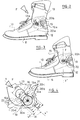
- the shoe shown by way of example in FIG. 1 is particularly suitable for skating or skating or for hiking and has the appearance of a shoe originally made up of a low rod 10, c ' that is to say of a rod whose rigid parts do not extend in height beyond malleoli, an outer sole 11 and a lacing system 40 of a type known per se.
- the rod 10 is made of flexible material and is provided at the heel with a rear buttress 12 which can be produced in any way known per se.
- This buttress 12 is preferably made of rigid synthetic material, and extends over the entire rear part of the shoe, all around the heel thereof.
- This buttress 12 extends, in the region of the malleoli, to the top of the upper, for the reception of an articulated collar 13, and has at its upper end, at the level of these malleoli, on each side of the shoe , a projection or boss 12a extending outward substantially perpendicular to the wall of the buttress and adapted to be introduced into an associated cylindrical hole 13a, formed on each side of the collar 13 (see Figure 4).
- Each boss 12a is also provided with a hole 12b for fixing the collar 13 by means of nails 19 (see FIG. 5).
- the collar 13 can therefore be mounted articulated on the projecting parts 12a of the buttress of the rod at the upper end of the latter.
- nails 19 can be replaced by any other connection method allowing rotation such as rivets.
- the use of nails 19 is particularly advantageous, because it allows installation by simple application of pressure on the head 19a, without requiring a counterpart as in the case of rivets.
- the nails 19 will advantageously be made of a relatively flexible material with respect to a metal rivet, such as delrin, so that their head 19a follows any deformations of the rigid collar 13, for example during a torsion of the leg, such a construction making it possible to avoid the tearing of these nails during such a twist.
- a metal rivet such as delrin
- the articulated collar 13 is constituted by a cuff made of rigid material and in particular of a synthetic material such as pebax.
- This collar 13 extends up to the bottom of the calf and surrounds the entire lower leg. It is open at its front part to allow the foot to be placed in the shoe and is provided with clamping means 15 of a type known per se, and constituted for example by hook-and-loop means.
- This collar 13 is also provided at the rear with a notch 13b intended to facilitate the rearward rotation of this collar (cf. position in dotted lines in FIG. 1).
- the large height of the collar 13 allows excellent lateral holding of the leg when skating or hiking, such a height also allowing greater distribution of the reaction forces over the leg. and, therefore, better comfort for the user.
- the total and independent articulation of the collar 13 on the rod allows the latter to pivot freely and without any discomfort for the user.
- the tongue 42, like the lacing system 40, of the shoe does not extend, in height, not beyond the flexion fold of the user's foot, so as not to hinder it. bending.
- the position of the hinge pin 30 of the collar 13 on the rod is chosen so as to achieve the best compromise between comfort and an axis as close as possible to the natural position of the tibio-tarsal joint, depending different morphologies and foot sizes.
- the collar 13 comprises in its articulation zone overlapping the top of the rod 10 with elastic locking means which are specific to it, capable of making it removable manually and cooperating in mounting with the projecting bosses 12a, integral of the buttress 12 and materializing the transverse articulation axis 30.
- These means are arranged on either side of the articulation zone of the collar 13 and are constituted respectively by a jaw 20 of which at least one of the two branches 20a, 20b, in this case 20a is elastically deformable.
- each jaw 20 delimit between them a passage, flared outwards over a large width L and opening out by its small width l into the aforementioned cylindrical hole 13a of diameter D1 substantially equal to that D2 of the boss 12a , but greater than the said small width l of the passage.
- the passage delimits, in its small width l, with the hole 13a of diameter D1, two beads 21, 22 projecting on either side of the entrance to the hole 13a, which beads are suitable for retract elastically during the passage of the boss 12a between the branches 20a, 20b during assembly, by an engagement force exerted on their engagement faces 20c, 20d, to then return to their initial position after introduction of said boss 12a in the hole 13a of the jaw 20, and thus ensure its retention.
- the width L of the flared part of the passage is at least equal to the diameter D2 of the boss 12a so as to allow its prior engagement in the passage, before snapping into the hole 13a.
- boss 12a could be eliminated and replaced by a nail 19 of a larger diameter, but the solution is not advantageous in terms of the rigidity of the locking assembly.
- Figures 2 and 3 respectively show the stages of mounting a collar 13 on a rod 10 for the transformation of a shoe with a low rod into a shoe with a high rod.
- the head 19a of the neck 19 has been removed by cutting.
- the jaws 20 are formed at the lower part of the collar 13 along a longitudinal axis XX 'corresponding to a direction of engagement F of the collar 13 on the bosses 12a.
- the axis XX ' here forms an angle ⁇ with a vertical axis YY' of the collar 13 and the direction of engagement F takes place generally towards the rear of the shoe.
- the angle ⁇ shown is equal to approximately 45 ° relative to the axis yy 'but it can obviously be chosen by a larger or smaller value.
- FIG. 6 essentially differs from the previous one, in that the jaw 20A is produced at the lower part of the collar 13A along a longitudinal axis corresponding or substantially parallel to the vertical axis YY 'of the collar 13A, which corresponds to an angle ⁇ zero.
Landscapes
- Health & Medical Sciences (AREA)
- General Health & Medical Sciences (AREA)
- Physical Education & Sports Medicine (AREA)
- Footwear And Its Accessory, Manufacturing Method And Apparatuses (AREA)
Applications Claiming Priority (2)
| Application Number | Priority Date | Filing Date | Title |
|---|---|---|---|
| FR9013888A FR2668686B1 (fr) | 1990-11-06 | 1990-11-06 | Chaussure de sport notamment pour la marche et le ski de fond pourvue d'un collier amovible formant une tige haute. |
| FR9013888 | 1990-11-06 |
Publications (2)
| Publication Number | Publication Date |
|---|---|
| EP0486801A1 true EP0486801A1 (de) | 1992-05-27 |
| EP0486801B1 EP0486801B1 (de) | 1995-12-20 |
Family
ID=9401995
Family Applications (1)
| Application Number | Title | Priority Date | Filing Date |
|---|---|---|---|
| EP91117103A Expired - Lifetime EP0486801B1 (de) | 1990-11-06 | 1991-10-08 | Sportschuh, insbesondere zum Gehen und für den Skilanglauf, mit abnehmbarer hoher Schaftmanschette |
Country Status (4)
| Country | Link |
|---|---|
| EP (1) | EP0486801B1 (de) |
| AT (1) | ATE131698T1 (de) |
| DE (1) | DE69115657T2 (de) |
| FR (1) | FR2668686B1 (de) |
Cited By (5)
| Publication number | Priority date | Publication date | Assignee | Title |
|---|---|---|---|---|
| FR2726976A1 (fr) * | 1994-11-17 | 1996-05-24 | Rossignol Sa | Chaussure de sport, notamment de marche ou de ski de fond |
| EP0917834A1 (de) * | 1997-11-24 | 1999-05-26 | Skis Rossignol S.A. | Langlauf-schischuh |
| FR2793391A1 (fr) | 1999-05-12 | 2000-11-17 | Salomon Sa | Chaussure de ski de fond |
| US7370442B2 (en) * | 2004-03-15 | 2008-05-13 | Cerbio Co., Ltd. | Ankle support to be attached to footwear and footwear equipped with it |
| US20140215855A1 (en) * | 2011-09-15 | 2014-08-07 | Dahu Sports Company Sa | Sports Boot |
Citations (5)
| Publication number | Priority date | Publication date | Assignee | Title |
|---|---|---|---|---|
| FR2043998A5 (de) * | 1969-05-14 | 1971-02-19 | Rosaz Albert | |
| US4019267A (en) * | 1976-01-07 | 1977-04-26 | Dorofix Design Establishment | Ski boot structure |
| DE8807537U1 (de) * | 1987-12-21 | 1988-07-28 | Alpina Tovarna Obutve, n.sol.o., Žiri | Langlaufschuh |
| EP0416437A1 (de) * | 1989-09-07 | 1991-03-13 | Salomon S.A. | Langlaufskischuh |
| WO1991007889A1 (en) * | 1989-12-05 | 1991-06-13 | Alfa Skofabrik A/S | Device for cross-country ski boot |
-
1990
- 1990-11-06 FR FR9013888A patent/FR2668686B1/fr not_active Expired - Fee Related
-
1991
- 1991-10-08 EP EP91117103A patent/EP0486801B1/de not_active Expired - Lifetime
- 1991-10-08 DE DE69115657T patent/DE69115657T2/de not_active Expired - Fee Related
- 1991-10-08 AT AT91117103T patent/ATE131698T1/de active
Patent Citations (5)
| Publication number | Priority date | Publication date | Assignee | Title |
|---|---|---|---|---|
| FR2043998A5 (de) * | 1969-05-14 | 1971-02-19 | Rosaz Albert | |
| US4019267A (en) * | 1976-01-07 | 1977-04-26 | Dorofix Design Establishment | Ski boot structure |
| DE8807537U1 (de) * | 1987-12-21 | 1988-07-28 | Alpina Tovarna Obutve, n.sol.o., Žiri | Langlaufschuh |
| EP0416437A1 (de) * | 1989-09-07 | 1991-03-13 | Salomon S.A. | Langlaufskischuh |
| WO1991007889A1 (en) * | 1989-12-05 | 1991-06-13 | Alfa Skofabrik A/S | Device for cross-country ski boot |
Cited By (12)
| Publication number | Priority date | Publication date | Assignee | Title |
|---|---|---|---|---|
| FR2726976A1 (fr) * | 1994-11-17 | 1996-05-24 | Rossignol Sa | Chaussure de sport, notamment de marche ou de ski de fond |
| EP0917834A1 (de) * | 1997-11-24 | 1999-05-26 | Skis Rossignol S.A. | Langlauf-schischuh |
| FR2771264A1 (fr) * | 1997-11-24 | 1999-05-28 | Rossignol Sa | Chaussure destinee a la pratique du ski de fond |
| US6098317A (en) * | 1997-11-24 | 2000-08-08 | Skis Rossignol S.A. | Boot intended for cross-country skiing |
| FR2793391A1 (fr) | 1999-05-12 | 2000-11-17 | Salomon Sa | Chaussure de ski de fond |
| WO2000069298A1 (fr) | 1999-05-12 | 2000-11-23 | Salomon S.A. | Chaussure de ski de fond |
| US6453580B1 (en) | 1999-05-12 | 2002-09-24 | Salomon S.A. | Cross-country ski boot |
| US7370442B2 (en) * | 2004-03-15 | 2008-05-13 | Cerbio Co., Ltd. | Ankle support to be attached to footwear and footwear equipped with it |
| US20140215855A1 (en) * | 2011-09-15 | 2014-08-07 | Dahu Sports Company Sa | Sports Boot |
| US11425960B2 (en) * | 2011-09-15 | 2022-08-30 | Nb Newboots Sa | Sports boot |
| US20220386737A1 (en) * | 2011-09-15 | 2022-12-08 | Nb Newboots Sa | Sports boot |
| US11918080B2 (en) | 2011-09-15 | 2024-03-05 | Nb Newboots Sa | Sports boot |
Also Published As
| Publication number | Publication date |
|---|---|
| DE69115657T2 (de) | 1996-07-18 |
| DE69115657D1 (de) | 1996-02-01 |
| FR2668686A1 (fr) | 1992-05-07 |
| EP0486801B1 (de) | 1995-12-20 |
| ATE131698T1 (de) | 1996-01-15 |
| FR2668686B1 (fr) | 1992-12-31 |
Similar Documents
| Publication | Publication Date | Title |
|---|---|---|
| EP0088673B1 (de) | Vorrichtung für Langlaufski | |
| EP2060196B1 (de) | Schuh mit verbesserter Festziehmöglichkeit des Schafts | |
| EP2314177B1 (de) | Schuh mit verbesserter Festziehmöglichkeit des Schafts | |
| EP2762023B1 (de) | Schuhwerk, das ein erstes Schuhelement und ein zweites Schuhelement umfasst | |
| WO1980001056A1 (fr) | Dispositif de fixation d'une chaussure sur une pedale de bicyclette | |
| EP2580978A1 (de) | Boot with improved leg tightening | |
| EP0153210A1 (de) | Platte für Fahrradschuhe | |
| CH682879A5 (fr) | Chaussure de ski. | |
| FR2953692A1 (fr) | Chaussure a tige amelioree | |
| EP0620711B1 (de) | Langlaufschischuh und kombination von schi, bindung und schuh | |
| EP0416437A1 (de) | Langlaufskischuh | |
| EP0486801B1 (de) | Sportschuh, insbesondere zum Gehen und für den Skilanglauf, mit abnehmbarer hoher Schaftmanschette | |
| EP0379836A1 (de) | Schischuh | |
| CH687802A5 (fr) | Chaussure de ski. | |
| EP0514642B1 (de) | Langlauf-Skischuh | |
| EP0484683B1 (de) | Sportschuh, insbesondere für Gehen und Skilanglauf, mit abnehmbarer Schaftmanschette | |
| EP0430821A1 (de) | Skischuh aus Kunststoff | |
| FR2560054A1 (fr) | Chaussure de ski, fixation de ski et ensemble constitue d'une fixation de securite montee sur un ski et d'une chaussure de ski | |
| FR2544969A1 (fr) | Chaussure de ski | |
| WO1993025107A1 (fr) | Chaussure avec dispositif de tenue de pied | |
| FR2848869A1 (fr) | Dispositif de retenue d'une chaussure sur un engin de sport | |
| EP0436444B1 (de) | Skischuh aus Kunststoff | |
| FR2492233A1 (fr) | Chaussure pour la pratique du ski de randonnee | |
| EP1025768A1 (de) | Schischuh | |
| FR2568455A1 (fr) | Chaussure perfectionnee notamment pour la pratique d'un sport. |
Legal Events
| Date | Code | Title | Description |
|---|---|---|---|
| PUAI | Public reference made under article 153(3) epc to a published international application that has entered the european phase |
Free format text: ORIGINAL CODE: 0009012 |
|
| AK | Designated contracting states |
Kind code of ref document: A1 Designated state(s): AT CH DE IT LI |
|
| 17P | Request for examination filed |
Effective date: 19920629 |
|
| 17Q | First examination report despatched |
Effective date: 19920826 |
|
| GRAA | (expected) grant |
Free format text: ORIGINAL CODE: 0009210 |
|
| AK | Designated contracting states |
Kind code of ref document: B1 Designated state(s): AT CH DE IT LI |
|
| REF | Corresponds to: |
Ref document number: 131698 Country of ref document: AT Date of ref document: 19960115 Kind code of ref document: T |
|
| ITF | It: translation for a ep patent filed | ||
| REF | Corresponds to: |
Ref document number: 69115657 Country of ref document: DE Date of ref document: 19960201 |
|
| PLBE | No opposition filed within time limit |
Free format text: ORIGINAL CODE: 0009261 |
|
| STAA | Information on the status of an ep patent application or granted ep patent |
Free format text: STATUS: NO OPPOSITION FILED WITHIN TIME LIMIT |
|
| PG25 | Lapsed in a contracting state [announced via postgrant information from national office to epo] |
Ref country code: LI Effective date: 19961031 Ref country code: CH Effective date: 19961031 |
|
| 26N | No opposition filed | ||
| REG | Reference to a national code |
Ref country code: CH Ref legal event code: PL |
|
| PGFP | Annual fee paid to national office [announced via postgrant information from national office to epo] |
Ref country code: AT Payment date: 20001010 Year of fee payment: 10 |
|
| PG25 | Lapsed in a contracting state [announced via postgrant information from national office to epo] |
Ref country code: AT Free format text: LAPSE BECAUSE OF NON-PAYMENT OF DUE FEES Effective date: 20011008 |
|
| PGFP | Annual fee paid to national office [announced via postgrant information from national office to epo] |
Ref country code: DE Payment date: 20040930 Year of fee payment: 14 |
|
| PG25 | Lapsed in a contracting state [announced via postgrant information from national office to epo] |
Ref country code: IT Free format text: LAPSE BECAUSE OF NON-PAYMENT OF DUE FEES;WARNING: LAPSES OF ITALIAN PATENTS WITH EFFECTIVE DATE BEFORE 2007 MAY HAVE OCCURRED AT ANY TIME BEFORE 2007. THE CORRECT EFFECTIVE DATE MAY BE DIFFERENT FROM THE ONE RECORDED. Effective date: 20051008 |
|
| PG25 | Lapsed in a contracting state [announced via postgrant information from national office to epo] |
Ref country code: DE Free format text: LAPSE BECAUSE OF NON-PAYMENT OF DUE FEES Effective date: 20060503 |