EP0486987B2 - Dispositif de visualisation d'image de télévision - Google Patents
Dispositif de visualisation d'image de télévision Download PDFInfo
- Publication number
- EP0486987B2 EP0486987B2 EP91119632A EP91119632A EP0486987B2 EP 0486987 B2 EP0486987 B2 EP 0486987B2 EP 91119632 A EP91119632 A EP 91119632A EP 91119632 A EP91119632 A EP 91119632A EP 0486987 B2 EP0486987 B2 EP 0486987B2
- Authority
- EP
- European Patent Office
- Prior art keywords
- cursor
- picture
- visualising
- television
- pictures
- Prior art date
- Legal status (The legal status is an assumption and is not a legal conclusion. Google has not performed a legal analysis and makes no representation as to the accuracy of the status listed.)
- Expired - Lifetime
Links
Images
Classifications
-
- H—ELECTRICITY
- H04—ELECTRIC COMMUNICATION TECHNIQUE
- H04N—PICTORIAL COMMUNICATION, e.g. TELEVISION
- H04N5/00—Details of television systems
- H04N5/44—Receiver circuitry for the reception of television signals according to analogue transmission standards
- H04N5/445—Receiver circuitry for the reception of television signals according to analogue transmission standards for displaying additional information
-
- H—ELECTRICITY
- H04—ELECTRIC COMMUNICATION TECHNIQUE
- H04N—PICTORIAL COMMUNICATION, e.g. TELEVISION
- H04N21/00—Selective content distribution, e.g. interactive television or video on demand [VOD]
- H04N21/40—Client devices specifically adapted for the reception of or interaction with content, e.g. set-top-box [STB]; Operations thereof
- H04N21/41—Structure of client; Structure of client peripherals
- H04N21/422—Input-only peripherals, i.e. input devices connected to specially adapted client devices, e.g. global positioning system [GPS]
- H04N21/42204—User interfaces specially adapted for controlling a client device through a remote control device; Remote control devices therefor
- H04N21/42206—User interfaces specially adapted for controlling a client device through a remote control device; Remote control devices therefor characterized by hardware details
- H04N21/4221—Dedicated function buttons, e.g. for the control of an EPG, subtitles, aspect ratio, picture-in-picture or teletext
-
- H—ELECTRICITY
- H04—ELECTRIC COMMUNICATION TECHNIQUE
- H04N—PICTORIAL COMMUNICATION, e.g. TELEVISION
- H04N21/00—Selective content distribution, e.g. interactive television or video on demand [VOD]
- H04N21/40—Client devices specifically adapted for the reception of or interaction with content, e.g. set-top-box [STB]; Operations thereof
- H04N21/41—Structure of client; Structure of client peripherals
- H04N21/422—Input-only peripherals, i.e. input devices connected to specially adapted client devices, e.g. global positioning system [GPS]
- H04N21/42204—User interfaces specially adapted for controlling a client device through a remote control device; Remote control devices therefor
- H04N21/42206—User interfaces specially adapted for controlling a client device through a remote control device; Remote control devices therefor characterized by hardware details
- H04N21/42212—Specific keyboard arrangements
- H04N21/42213—Specific keyboard arrangements for facilitating data entry
- H04N21/42216—Specific keyboard arrangements for facilitating data entry for quick navigation, e.g. through an EPG
-
- H—ELECTRICITY
- H04—ELECTRIC COMMUNICATION TECHNIQUE
- H04N—PICTORIAL COMMUNICATION, e.g. TELEVISION
- H04N21/00—Selective content distribution, e.g. interactive television or video on demand [VOD]
- H04N21/40—Client devices specifically adapted for the reception of or interaction with content, e.g. set-top-box [STB]; Operations thereof
- H04N21/43—Processing of content or additional data, e.g. demultiplexing additional data from a digital video stream; Elementary client operations, e.g. monitoring of home network or synchronising decoder's clock; Client middleware
- H04N21/431—Generation of visual interfaces for content selection or interaction; Content or additional data rendering
- H04N21/4312—Generation of visual interfaces for content selection or interaction; Content or additional data rendering involving specific graphical features, e.g. screen layout, special fonts or colors, blinking icons, highlights or animations
- H04N21/4314—Generation of visual interfaces for content selection or interaction; Content or additional data rendering involving specific graphical features, e.g. screen layout, special fonts or colors, blinking icons, highlights or animations for fitting data in a restricted space on the screen, e.g. EPG data in a rectangular grid
-
- H—ELECTRICITY
- H04—ELECTRIC COMMUNICATION TECHNIQUE
- H04N—PICTORIAL COMMUNICATION, e.g. TELEVISION
- H04N21/00—Selective content distribution, e.g. interactive television or video on demand [VOD]
- H04N21/40—Client devices specifically adapted for the reception of or interaction with content, e.g. set-top-box [STB]; Operations thereof
- H04N21/47—End-user applications
- H04N21/482—End-user interface for programme selection
- H04N21/4821—End-user interface for programme selection using a grid, e.g. sorted out by channel and broadcast time
-
- H—ELECTRICITY
- H04—ELECTRIC COMMUNICATION TECHNIQUE
- H04N—PICTORIAL COMMUNICATION, e.g. TELEVISION
- H04N5/00—Details of television systems
- H04N5/44—Receiver circuitry for the reception of television signals according to analogue transmission standards
- H04N5/445—Receiver circuitry for the reception of television signals according to analogue transmission standards for displaying additional information
- H04N5/45—Picture in picture, e.g. displaying simultaneously another television channel in a region of the screen
-
- H—ELECTRICITY
- H04—ELECTRIC COMMUNICATION TECHNIQUE
- H04N—PICTORIAL COMMUNICATION, e.g. TELEVISION
- H04N5/00—Details of television systems
- H04N5/44—Receiver circuitry for the reception of television signals according to analogue transmission standards
- H04N5/50—Tuning indicators; Automatic tuning control
Definitions
- the present invention relates to a method for visualising a television picture, with a step comprising means for receiving an elaborating the picture signal, memory means for memorising the picture signals received and picture visualising means, with the possibility of simultaneously viewing a plurality of different pictures.
- the invention relates to a television picture visualising device for executing the method.
- Videorecorders are also known that allow for the simultaneous viewing of 16 different television pictures, each occupying a sixteenth of the screen.
- a television picture visualising device comprising means for receiving and operating the picture signals and picture visualising means and additional means for indicating by means of a cursor a determined picture element.
- EP-A-390041 a remote control unit for audiovisual apparatus by which a cursor can be moved in a diagonal direction over a screen to control several icons on the screen.
- EP-A-267020 a television picture visualising device, comprising means for receiving and processing the picture signal, memory means for memorising the picture signals received and picture visualising means, with the possibility of simultaneously viewing a plurality of different pictures.
- a device for visualising a picture with means for receiving and processing the picture signal and the picture visualising means whereby this device comprises a command device as a track ball comprising a sphere, which moved to a plurality of directions, produces relevant control signals in order to act on a visual indicating means signalling the effect produced by the command given by the user through said sphere and presetting the device to accept an operating command.
- a command device as a track ball comprising a sphere, which moved to a plurality of directions, produces relevant control signals in order to act on a visual indicating means signalling the effect produced by the command given by the user through said sphere and presetting the device to accept an operating command.
- the invention is based on the knowledge of the fact that it may be useful for the television user in given cases to simultaneously view a plurality of television pictures on the screen, so as to see what is being transmitted by different broadcasters and to be able to select a program of interest.
- the user usually has to remember the number of the picture that is of interest, cancel the multiple picture and to call, in the normal method provided, the program that he has chosen to see; in particular, the fact that the number must be remembered is inconvenient, in as much that distractions (for example somebody saying something) may cause the user to forget.
- the invention takes into consideration such a fact; the aim of the present invention is to indicate an improved method and system with regards those known, for obtaining in the mentioned cases the viewing of the chosen program.
- the present invention proposes a method according to claim 1 and a television picture visualising device according to claim 5.
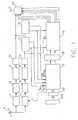
- FIG 1 a block diagram of a part of the invention according to the invention is represented; this concerns a device comprising the so called PIP, meaning picture in picture, or as would be more precise, 'multipip', that is able to visualise more than two television signals.
- the reference number 6 indicates the recieving antenna; whereas the reference numbers 7 and 11 indicate two tuners, of the type known, that simultaneously tune in to two television signals belonging to two different television channels (A and B).
- numbers 8 and 12 indicate two intermediate frequency amplifyers; numbers 9 and 13 refer to two video detectors and the numbers 10 and 14 to two video signal amplifyers.
- Number 15 refers to the circuit that generates the syncronism signals, vertical and horizontal, starting from the relative impulses contained in the second video signal B; while number 16 indicates an analogous circuit that generates the syncronism signals for the first video signal A.
- Reference number 200 indicates a remote control signal transmitter, for example the usual type using infrared rays; number 201 indicates the respective signal receiver; which is linked to a control circuit, indicated with the reference number 17, of which will be mentioned later; syncronism signals (VA, HA, VB, HB) also reach the circuit 17.
- a control signal (Y) for the tuner B departs from the circuit 17, which serves in the cyclic selectioning of the secondary television signal.
- Number 18 relates to a clock impulse generator; 19 relates to a memory for memorising the video signal B.
- Reference number 20 indicates a reference circuit which is reached by the video signals A and the signals coming from the memory 19;
- reference number 21 refers to an output terminal, to which the mixed video signal is available, containing both the picture A and the picture B of a reduced dimension.
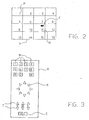
- the screen of the device according to the invention is represented; such a device can be, for example, a television set or a monitor.
- the actual screen is indicated, which is supposed to be that of a picture relationship of 3:4; naturally the relationship may be different, for example 4:5 or 4:9; such relationships are of no importance for the aim of the present invention.
- the screen is represented divided into 16 parts, each of which maintaining the same picture relationship; also here the parts could be of 4 or 64 without being determining.
- Each part represents an picture of decreased dimensions of a received corrisponding program whose tuning coordinates have been memorised by combining them to a numerical key; the number of such a key, i.e. the number assigned to a corrisponding program is visualised in the lower left hand corner of each single picture (note for instance reference symbol P).
- the reference symbol F represents the cursor, in the form of an arrow (but could be could be of any other form , such as a square or circle), presented in the upper right hand corner of picture number 11, obtained, also by known techniques, by superimposing it on the picture or pictures, as is so for the numbers P.
- Such a cursor element can be made more visable by making it flash, which can be done, also with known means, for example by supressing it for 5 rasters and making it visible for the following 5 rasters.
- program number could simply be used at this point, made to flash, so as to avoid the need of the additional element F.
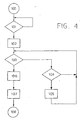
- Figure 3 represents a command unit of the device, the screen of which is designed in figure 1 ;
- the symbol M represents a plurality of numbered keys, with known and obvious functions, that are used for the normal control of the devices functions;
- the symbol T represents other usual keys, such as the volume control (V), brightness (B) and colour (C).
- the symbol W indicates a key used for obtaining on the screen the picture represented in figure 2 (multipip).
- Such keys are used for moving the cursor element F from a picture to a neighbouring one; in the case in which the cursor element F is, as is indicated in figure 1 , in the picture number 11, it can be moved, by means of one of the 8 keys K, in one of the neighbouring pictures (6,7,8,10,12,14,15,16,). For example by pushing the uppermost key, the cursor is moved to the relative picture number 7; pushing the upper left hand key, the cursor is moved to the picture number 6, and so on. In such a way it is easy for anyone to move the cursor; by using a maximum of three moves any picture can be reached starting from any other picture.
- the pressing of the key indicated with the symbol E provides for the visualisation on the whole screen of the relative program. This is obtained because the character generator, that generates the numbers P and eventually the cursor F (in the case where the number itself is not used as a marker, in the flashing form), knows the coordinates (lines and columns) of the cursor itself, and therefore in which square of the board it is to be found.
- a single key could be used, for example in the form of an octagon, or a circular disc, that, depending on how it is pressed, activates the relative contacts.
- 8 arrows will be printed so as to indicate the direction in which it is to be pressed.
- Figure 4 represents a block diagram of a part of the command logic circuit of the device in figure 1 ; such circuit, that can be incorporated in the block indicated in figure 1 with the number 17, may be indiscriminately embodied with the cabled logic system or with the programmed logic system, i.e. utilising a microprocessor, said second system is generally cheaper, also because televisions and videorecorders are normally realised with one or more microprocessors; the part represented in figure 4 is typical of the invention.
- the block 100 is the starting block of the program selection operation.
- Block 101 is a control block; it checks whether the key W has been pressed; in the affirmative control passes to block 102; in the negative control passes back to block 101 itself (in all the checking blocks the inferior output is the YES output, whereas the lateral output is the NO output).
- Block 102 provides to visualise the multiple picture (multipip), in which every picture corrisponds to one of the 16 programs memorised by the user, by the known means, in the program memory; the pictures are explored in a cyclic manner by means of the tuner B in figure 1 , reduced in dimension and memorised in the memory 19.
- the numbers P are also generated, by means of a suitable character generator, and the cursor F, that is positioned on picture N°1, i.e. in the upper left hand corner of the screen. Control then passes to block 103.
- Block 103 is a control block; it checks whether key E has been pressed; in the affirmative control passes to block 106; in the negative control passes to block 104.
- Block 104 is a control block; it checks whether key K has been pressed; in the affirmative control passes to block 105; in the negative case the control passes back to block 103.
- Block 105 provides for the cancelling of the cursor from within the square it is to be found and to visualise it in one of the adjacent squares depending on which key K has been pressed; control passes back to block 130.
- Block 106 provides to identify which square the cursor is to be found, interrogating the state of the character generator, and calculating from the number of lines and columns; the control then passes to the successive block 107.
- Block 107 provides for the giving of suitable operative commands for reading within the program memory the tuning coordinates relative to the corrisponding program of the selected picture; to supply such coordinates to the tuner; and finally to visualise on the whole screen the picture corrisponding to the signal coming from the tuner A. Control then passes to block 108.
- Block 108 is the final block of the program selection operation.
- the pictures can be visualised in two successive screens of sixteen; for passing from one to another the "+" key could be utilised in one sense and the "-" key in the other; such keys are usually always present on all remote control units; their functioning as described would be enabled after activating the key W.
Landscapes
- Engineering & Computer Science (AREA)
- Multimedia (AREA)
- Signal Processing (AREA)
- Human Computer Interaction (AREA)
- Controls And Circuits For Display Device (AREA)
- User Interface Of Digital Computer (AREA)
- Testing, Inspecting, Measuring Of Stereoscopic Televisions And Televisions (AREA)
- Lubrication Of Internal Combustion Engines (AREA)
- Transforming Electric Information Into Light Information (AREA)
- Display Devices Of Pinball Game Machines (AREA)
Claims (7)
- Procédé de sélection d'un programme de télévision et d'activation de sa réception et de sa visualisation sur un écran (S) d'un dispositif de visualisation d'image de télévision, caractérisé en ce qu'il combine les étapes suivantes consistant à :- visualiser sur ledit écran plusieurs images de dimensions réduites des programmes de télévision correspondants, mémorisées dans une mémoire et affichées dans une matrice selon une pluralité de rangées et colonnes ;- visualiser sur ledit écran un curseur (F), superposé sur une desdites images, ledit curseur (F) est généré par un générateur de caractères ;- prévoir des moyens de commande (K) pour déplacer le curseur (F) entre une des images et une quelconque des images voisines, en agissant sur une ou plusieurs touches desdits moyens de commande ;- prévoir des moyens supplémentaires (17) pour identifier parmi lesdites multiples images de télévision l'image sélectionnée dans laquelle est positionné le curseur (F), interrogeant l'état dudit générateur de caractères et calculant à partir du nombre de rangées et de colonnes, par rapport au curseur (F), la cellule correspondante d'une mémoire de réglage où sont stockées des données de syntonisation correspondant à l'image sélectionnée ;- fournir lesdites données de syntonisation à un syntoniseur (A) pour régler ledit programme indiqué par le curseur (F) ; et- visualiser une image pleine page correspondant au signal de télévision en provenance dudit syntoniseur (A).
- Procédé selon la revendication 1, caractérisé en ce que la sélection de l'image sélectionnée est réalisée par un curseur clignotant (F), ledit curseur (F) se déplaçant dans le sens vertical, horizontal et/ou en diagonale.
- Procédé selon la revendication 1 ou 2, caractérisé en ce que ladite étape consistant à déplacer ledit curseur (F) même en diagonale prévoit un dispositif de commande (R) équipé de 8 touches (K) agencées selon les sommets d'un octogone.
- Procédé selon l'une quelconque des revendications précédentes, caractérisé en ce que ledit curseur (F) est sous la forme d'une flèche ou sous la forme d'un nombre.
- Dispositif de visualisation d'image de télévision pour sélectionner un programme de télévision et activer sa réception et sa visualisation sur un écran (S), caractérisé en ce qu'il comprend,- des moyens pour visualiser sur ledit écran plusieurs images de dimensions réduites des programmes de télévision correspondants, mémorisées dans une mémoire et affichées dans une matrice selon une pluralité de rangées et colonnes ;- des moyens pour visualiser sur ledit écran un curseur (F), superposé sur une desdites images, ledit curseur (F) est généré par un générateur de caractères ;- des moyens de commande (K) pour déplacer le curseur (F) entre une des images et une quelconque des images voisines, en agissant sur une ou plusieurs touches desdits moyens de commande (K);- des moyens supplémentaires (17) pour identifier parmi lesdites multiples images de télévision l'image sélectionnée dans laquelle est positionné le curseur (F), interrogeant l'état dudit générateur de caractères et calculant à partir du nombre de rangées et de colonnes, par rapport au curseur (F), la cellule correspondante d'une mémoire de réglage où sont stockées des données de syntonisation correspondant à l'image sélectionnée ;- des moyens pour fournir lesdites données de syntonisation à un syntoniseur (A) pour régler ledit programme indiqué par le curseur (F) ; et- des moyens pour visualiser une image pleine page correspondant au signal de télévision en provenance dudit syntoniseur (A).
- Dispositif de visualisation d'image de télévision selon la revendication 5, caractérisé par le fait que lesdits moyens de commande pour visualiser sur la totalité de l'écran l'image sélectionnée comprennent une touche appropriée (E).
- Dispositif de visualisation d'image de télévision selon la revendication 6, caractérisé par le fait que ladite touche (E) génère un signal de commande pour sélectionner le programme correspondant au nombre (N) de l'image sélectionnée (11), obtenue en fonction des coordonnées de ligne et de colonne auxquelles un générateur de caractères qui génère ce nombre (N) a écrit sur l'image.
Applications Claiming Priority (2)
| Application Number | Priority Date | Filing Date | Title |
|---|---|---|---|
| IT67914A IT1241293B (it) | 1990-11-22 | 1990-11-22 | Apparecchio visualizzatore di immagini |
| IT6791490 | 1990-11-22 |
Publications (4)
| Publication Number | Publication Date |
|---|---|
| EP0486987A2 EP0486987A2 (fr) | 1992-05-27 |
| EP0486987A3 EP0486987A3 (en) | 1992-08-26 |
| EP0486987B1 EP0486987B1 (fr) | 1999-02-10 |
| EP0486987B2 true EP0486987B2 (fr) | 2008-10-29 |
Family
ID=11306332
Family Applications (1)
| Application Number | Title | Priority Date | Filing Date |
|---|---|---|---|
| EP91119632A Expired - Lifetime EP0486987B2 (fr) | 1990-11-22 | 1991-11-18 | Dispositif de visualisation d'image de télévision |
Country Status (4)
| Country | Link |
|---|---|
| EP (1) | EP0486987B2 (fr) |
| DE (1) | DE69130888T3 (fr) |
| ES (1) | ES2131502T5 (fr) |
| IT (1) | IT1241293B (fr) |
Families Citing this family (1)
| Publication number | Priority date | Publication date | Assignee | Title |
|---|---|---|---|---|
| MY114897A (en) * | 1994-10-25 | 2003-02-28 | Thomson Consumer Electronics | Use of audio processing channel in a television receiver during a multipicture mode of operation |
Family Cites Families (5)
| Publication number | Priority date | Publication date | Assignee | Title |
|---|---|---|---|---|
| US4464652A (en) * | 1982-07-19 | 1984-08-07 | Apple Computer, Inc. | Cursor control device for use with display systems |
| US5142275A (en) * | 1984-12-10 | 1992-08-25 | General Electric Company | Method and means for manipulating images in a video display |
| JPH0748834B2 (ja) * | 1986-11-04 | 1995-05-24 | 松下電器産業株式会社 | 映像信号処理装置 |
| EP0355172B1 (fr) * | 1988-08-06 | 1994-07-20 | Deutsche ITT Industries GmbH | Système de commande à distance |
| US4959719A (en) * | 1988-12-21 | 1990-09-25 | North American Philips Corporation | Picture-in-picture television receiver control |
-
1990
- 1990-11-22 IT IT67914A patent/IT1241293B/it active IP Right Grant
-
1991
- 1991-11-18 ES ES91119632T patent/ES2131502T5/es not_active Expired - Lifetime
- 1991-11-18 EP EP91119632A patent/EP0486987B2/fr not_active Expired - Lifetime
- 1991-11-18 DE DE69130888T patent/DE69130888T3/de not_active Expired - Lifetime
Also Published As
| Publication number | Publication date |
|---|---|
| ES2131502T5 (es) | 2009-03-01 |
| IT9067914A0 (it) | 1990-11-22 |
| EP0486987A3 (en) | 1992-08-26 |
| IT9067914A1 (it) | 1992-05-23 |
| EP0486987B1 (fr) | 1999-02-10 |
| DE69130888D1 (de) | 1999-03-25 |
| DE69130888T3 (de) | 2010-06-24 |
| ES2131502T3 (es) | 1999-08-01 |
| DE69130888T2 (de) | 1999-09-30 |
| EP0486987A2 (fr) | 1992-05-27 |
| IT1241293B (it) | 1993-12-29 |
Similar Documents
| Publication | Publication Date | Title |
|---|---|---|
| US4959719A (en) | Picture-in-picture television receiver control | |
| KR0150786B1 (ko) | 픽춰-인-픽춰 기능을 가진 텔레비젼 수상기 | |
| EP0390041B1 (fr) | ContrÔle à distance pour appareil électronique | |
| US4903129A (en) | Audio signal section apparatus | |
| US5315392A (en) | Apparatus for display and selection of available television channels | |
| EP0393664A2 (fr) | Dispositif de commutation programmable par l'usager | |
| JPH07193795A (ja) | 文字放送受信機 | |
| GB2264426A (en) | Character broadcasting receiving set | |
| US5031044A (en) | Inset picture centering in a pix-in-pix system | |
| EP0486989B1 (fr) | Dispositif de sélectionnement de signaux de télévision | |
| EP0486987B2 (fr) | Dispositif de visualisation d'image de télévision | |
| JP2552498Y2 (ja) | マルチ画面表示装置 | |
| KR100195713B1 (ko) | 디지탈 dbs수신기에 있어서 반투명배경 출력기능을 갖는 osd구현장치 및 그 구현방법 | |
| HU212955B (en) | Channel selection method and device for tuning a multi-standard tv receiver | |
| KR100203292B1 (ko) | 초간편 예약녹화장치 | |
| US20040040038A1 (en) | Program guide display apparatus | |
| JPH01246972A (ja) | 選局制御装置 | |
| ES2103769T5 (es) | Dispositivo mejorado de deteccion de señal de television. | |
| KR950010885B1 (ko) | 방송방식 채널절환장치 | |
| KR19990015574A (ko) | 오 에스 디 데이터의 위치 및 크기 조절장치 및 그 방법 | |
| KR960007543B1 (ko) | 텔레비젼 수상기의 온 스크린 디스플레이 장치 | |
| KR100608642B1 (ko) | 방송 프로그램 안내 표시 방법 및 장치 | |
| EP1686798A2 (fr) | Appareil de télévision | |
| JPH05252459A (ja) | テレビジョン受像機 | |
| JPH02117288A (ja) | 文字放送受信装置 |
Legal Events
| Date | Code | Title | Description |
|---|---|---|---|
| PUAI | Public reference made under article 153(3) epc to a published international application that has entered the european phase |
Free format text: ORIGINAL CODE: 0009012 |
|
| AK | Designated contracting states |
Kind code of ref document: A2 Designated state(s): DE ES FR GB NL |
|
| PUAL | Search report despatched |
Free format text: ORIGINAL CODE: 0009013 |
|
| AK | Designated contracting states |
Kind code of ref document: A3 Designated state(s): DE ES FR GB NL |
|
| RAP1 | Party data changed (applicant data changed or rights of an application transferred) |
Owner name: EDICO S.R.L. |
|
| 17P | Request for examination filed |
Effective date: 19930218 |
|
| 17Q | First examination report despatched |
Effective date: 19930630 |
|
| RAP1 | Party data changed (applicant data changed or rights of an application transferred) |
Owner name: EDICO S.R.L. |
|
| GRAG | Despatch of communication of intention to grant |
Free format text: ORIGINAL CODE: EPIDOS AGRA |
|
| GRAG | Despatch of communication of intention to grant |
Free format text: ORIGINAL CODE: EPIDOS AGRA |
|
| GRAH | Despatch of communication of intention to grant a patent |
Free format text: ORIGINAL CODE: EPIDOS IGRA |
|
| GRAH | Despatch of communication of intention to grant a patent |
Free format text: ORIGINAL CODE: EPIDOS IGRA |
|
| GRAA | (expected) grant |
Free format text: ORIGINAL CODE: 0009210 |
|
| AK | Designated contracting states |
Kind code of ref document: B1 Designated state(s): DE ES FR GB NL |
|
| REF | Corresponds to: |
Ref document number: 69130888 Country of ref document: DE Date of ref document: 19990325 |
|
| ET | Fr: translation filed | ||
| REG | Reference to a national code |
Ref country code: ES Ref legal event code: FG2A Ref document number: 2131502 Country of ref document: ES Kind code of ref document: T3 |
|
| PLBQ | Unpublished change to opponent data |
Free format text: ORIGINAL CODE: EPIDOS OPPO |
|
| PLBI | Opposition filed |
Free format text: ORIGINAL CODE: 0009260 |
|
| PLBF | Reply of patent proprietor to notice(s) of opposition |
Free format text: ORIGINAL CODE: EPIDOS OBSO |
|
| 26 | Opposition filed |
Opponent name: INTERESSENGEMEINSCHAFT FUER RUNDFUNKSCHUTZRECHTE G Effective date: 19991110 Opponent name: KONINKLIJKE PHILIPS ELECTRONICS N.V. Effective date: 19991009 |
|
| NLR1 | Nl: opposition has been filed with the epo |
Opponent name: INTERESSENGEMEINSCHAFT FUER RUNDFUNKSCHUTZRECHTE G Opponent name: KONINKLIJKE PHILIPS ELECTRONICS N.V. |
|
| PLBF | Reply of patent proprietor to notice(s) of opposition |
Free format text: ORIGINAL CODE: EPIDOS OBSO |
|
| PLBF | Reply of patent proprietor to notice(s) of opposition |
Free format text: ORIGINAL CODE: EPIDOS OBSO |
|
| RDAH | Patent revoked |
Free format text: ORIGINAL CODE: EPIDOS REVO |
|
| APAC | Appeal dossier modified |
Free format text: ORIGINAL CODE: EPIDOS NOAPO |
|
| APAE | Appeal reference modified |
Free format text: ORIGINAL CODE: EPIDOS REFNO |
|
| APAC | Appeal dossier modified |
Free format text: ORIGINAL CODE: EPIDOS NOAPO |
|
| APAC | Appeal dossier modified |
Free format text: ORIGINAL CODE: EPIDOS NOAPO |
|
| REG | Reference to a national code |
Ref country code: GB Ref legal event code: IF02 |
|
| PLBP | Opposition withdrawn |
Free format text: ORIGINAL CODE: 0009264 |
|
| APBY | Invitation to file observations in appeal sent |
Free format text: ORIGINAL CODE: EPIDOSNOBA2O |
|
| APCA | Receipt of observations in appeal recorded |
Free format text: ORIGINAL CODE: EPIDOSNOBA4O |
|
| APAH | Appeal reference modified |
Free format text: ORIGINAL CODE: EPIDOSCREFNO |
|
| APAH | Appeal reference modified |
Free format text: ORIGINAL CODE: EPIDOSCREFNO |
|
| PLAB | Opposition data, opponent's data or that of the opponent's representative modified |
Free format text: ORIGINAL CODE: 0009299OPPO |
|
| APBU | Appeal procedure closed |
Free format text: ORIGINAL CODE: EPIDOSNNOA9O |
|
| PLBP | Opposition withdrawn |
Free format text: ORIGINAL CODE: 0009264 |
|
| R26 | Opposition filed (corrected) |
Opponent name: IGR GMBH & CO. KG. Effective date: 19991110 |
|
| NLR1 | Nl: opposition has been filed with the epo |
Opponent name: IGR GMBH & CO. KG. |
|
| PLAB | Opposition data, opponent's data or that of the opponent's representative modified |
Free format text: ORIGINAL CODE: 0009299OPPO |
|
| PUAH | Patent maintained in amended form |
Free format text: ORIGINAL CODE: 0009272 |
|
| STAA | Information on the status of an ep patent application or granted ep patent |
Free format text: STATUS: PATENT MAINTAINED AS AMENDED |
|
| 27A | Patent maintained in amended form |
Effective date: 20081029 |
|
| AK | Designated contracting states |
Kind code of ref document: B2 Designated state(s): DE ES FR GB NL |
|
| NLR2 | Nl: decision of opposition |
Effective date: 20081029 |
|
| NLR3 | Nl: receipt of modified translations in the netherlands language after an opposition procedure | ||
| REG | Reference to a national code |
Ref country code: ES Ref legal event code: DC2A Date of ref document: 20081110 Kind code of ref document: T5 |
|
| REG | Reference to a national code |
Ref country code: FR Ref legal event code: CA |
|
| PLAB | Opposition data, opponent's data or that of the opponent's representative modified |
Free format text: ORIGINAL CODE: 0009299OPPO |
|
| PGFP | Annual fee paid to national office [announced via postgrant information from national office to epo] |
Ref country code: NL Payment date: 20101130 Year of fee payment: 20 Ref country code: FR Payment date: 20101209 Year of fee payment: 20 |
|
| PGFP | Annual fee paid to national office [announced via postgrant information from national office to epo] |
Ref country code: DE Payment date: 20101112 Year of fee payment: 20 |
|
| PGFP | Annual fee paid to national office [announced via postgrant information from national office to epo] |
Ref country code: GB Payment date: 20101213 Year of fee payment: 20 |
|
| PGFP | Annual fee paid to national office [announced via postgrant information from national office to epo] |
Ref country code: ES Payment date: 20101125 Year of fee payment: 20 |
|
| REG | Reference to a national code |
Ref country code: DE Ref legal event code: R071 Ref document number: 69130888 Country of ref document: DE |
|
| REG | Reference to a national code |
Ref country code: DE Ref legal event code: R071 Ref document number: 69130888 Country of ref document: DE |
|
| REG | Reference to a national code |
Ref country code: NL Ref legal event code: V4 Effective date: 20111118 |
|
| REG | Reference to a national code |
Ref country code: GB Ref legal event code: PE20 Expiry date: 20111117 |
|
| PG25 | Lapsed in a contracting state [announced via postgrant information from national office to epo] |
Ref country code: NL Free format text: LAPSE BECAUSE OF EXPIRATION OF PROTECTION Effective date: 20111118 |
|
| REG | Reference to a national code |
Ref country code: ES Ref legal event code: FD2A Effective date: 20120220 |
|
| PG25 | Lapsed in a contracting state [announced via postgrant information from national office to epo] |
Ref country code: GB Free format text: LAPSE BECAUSE OF EXPIRATION OF PROTECTION Effective date: 20111117 |
|
| PG25 | Lapsed in a contracting state [announced via postgrant information from national office to epo] |
Ref country code: ES Free format text: LAPSE BECAUSE OF EXPIRATION OF PROTECTION Effective date: 20111119 |
|
| PG25 | Lapsed in a contracting state [announced via postgrant information from national office to epo] |
Ref country code: DE Free format text: LAPSE BECAUSE OF EXPIRATION OF PROTECTION Effective date: 20111119 |