EP0487086B2 - Method of preparing volume type phase hologram member using a photosensitive recording medium - Google Patents
Method of preparing volume type phase hologram member using a photosensitive recording medium Download PDFInfo
- Publication number
- EP0487086B2 EP0487086B2 EP91119877A EP91119877A EP0487086B2 EP 0487086 B2 EP0487086 B2 EP 0487086B2 EP 91119877 A EP91119877 A EP 91119877A EP 91119877 A EP91119877 A EP 91119877A EP 0487086 B2 EP0487086 B2 EP 0487086B2
- Authority
- EP
- European Patent Office
- Prior art keywords
- radical
- cationic
- polymerizable monomer
- polymerization initiator
- hologram
- Prior art date
- Legal status (The legal status is an assumption and is not a legal conclusion. Google has not performed a legal analysis and makes no representation as to the accuracy of the status listed.)
- Expired - Lifetime
Links
- 238000000034 method Methods 0.000 title claims description 24
- 239000000178 monomer Substances 0.000 claims description 64
- 239000007870 radical polymerization initiator Substances 0.000 claims description 24
- 239000003505 polymerization initiator Substances 0.000 claims description 23
- 238000010538 cationic polymerization reaction Methods 0.000 claims description 22
- 229920000642 polymer Polymers 0.000 claims description 14
- 239000003999 initiator Substances 0.000 claims description 7
- 230000001427 coherent effect Effects 0.000 claims description 4
- 239000000470 constituent Substances 0.000 claims description 4
- 238000010438 heat treatment Methods 0.000 claims description 4
- 230000000977 initiatory effect Effects 0.000 claims description 3
- 238000006116 polymerization reaction Methods 0.000 claims description 3
- -1 silver halide Chemical class 0.000 description 13
- IISBACLAFKSPIT-UHFFFAOYSA-N bisphenol A Chemical compound C=1C=C(O)C=CC=1C(C)(C)C1=CC=C(O)C=C1 IISBACLAFKSPIT-UHFFFAOYSA-N 0.000 description 11
- 150000001875 compounds Chemical class 0.000 description 9
- 239000000203 mixture Substances 0.000 description 9
- CERQOIWHTDAKMF-UHFFFAOYSA-M Methacrylate Chemical compound CC(=C)C([O-])=O CERQOIWHTDAKMF-UHFFFAOYSA-M 0.000 description 7
- 230000009257 reactivity Effects 0.000 description 7
- 0 C1CC*CC1 Chemical compound C1CC*CC1 0.000 description 6
- 239000011230 binding agent Substances 0.000 description 5
- 239000000975 dye Substances 0.000 description 5
- 238000002834 transmittance Methods 0.000 description 5
- 238000011282 treatment Methods 0.000 description 5
- 238000006243 chemical reaction Methods 0.000 description 4
- 239000000463 material Substances 0.000 description 4
- 230000035945 sensitivity Effects 0.000 description 4
- VNQXSTWCDUXYEZ-UHFFFAOYSA-N 1,7,7-trimethylbicyclo[2.2.1]heptane-2,3-dione Chemical compound C1CC2(C)C(=O)C(=O)C1C2(C)C VNQXSTWCDUXYEZ-UHFFFAOYSA-N 0.000 description 3
- LEJBBGNFPAFPKQ-UHFFFAOYSA-N 2-(2-prop-2-enoyloxyethoxy)ethyl prop-2-enoate Chemical compound C=CC(=O)OCCOCCOC(=O)C=C LEJBBGNFPAFPKQ-UHFFFAOYSA-N 0.000 description 3
- XFCMNSHQOZQILR-UHFFFAOYSA-N 2-[2-(2-methylprop-2-enoyloxy)ethoxy]ethyl 2-methylprop-2-enoate Chemical compound CC(=C)C(=O)OCCOCCOC(=O)C(C)=C XFCMNSHQOZQILR-UHFFFAOYSA-N 0.000 description 3
- CDSULTPOCMWJCM-UHFFFAOYSA-N 4h-chromene-2,3-dione Chemical class C1=CC=C2OC(=O)C(=O)CC2=C1 CDSULTPOCMWJCM-UHFFFAOYSA-N 0.000 description 3
- YMWUJEATGCHHMB-UHFFFAOYSA-N Dichloromethane Chemical compound ClCCl YMWUJEATGCHHMB-UHFFFAOYSA-N 0.000 description 3
- 108010010803 Gelatin Proteins 0.000 description 3
- VVQNEPGJFQJSBK-UHFFFAOYSA-N Methyl methacrylate Chemical compound COC(=O)C(C)=C VVQNEPGJFQJSBK-UHFFFAOYSA-N 0.000 description 3
- OPLZHVSHWLZOCP-UHFFFAOYSA-N [2-hydroxy-3-[2-hydroxy-3-(2-methylprop-2-enoyloxy)propoxy]propyl] 2-methylprop-2-enoate Chemical compound CC(=C)C(=O)OCC(O)COCC(O)COC(=O)C(C)=C OPLZHVSHWLZOCP-UHFFFAOYSA-N 0.000 description 3
- 150000001450 anions Chemical class 0.000 description 3
- 229930006711 bornane-2,3-dione Natural products 0.000 description 3
- 125000004386 diacrylate group Chemical group 0.000 description 3
- 229920000159 gelatin Polymers 0.000 description 3
- 239000008273 gelatin Substances 0.000 description 3
- 235000019322 gelatine Nutrition 0.000 description 3
- 235000011852 gelatine desserts Nutrition 0.000 description 3
- 239000011521 glass Substances 0.000 description 3
- 229920003229 poly(methyl methacrylate) Polymers 0.000 description 3
- 239000004926 polymethyl methacrylate Substances 0.000 description 3
- 238000010526 radical polymerization reaction Methods 0.000 description 3
- 229910052709 silver Inorganic materials 0.000 description 3
- 239000004332 silver Substances 0.000 description 3
- INQDDHNZXOAFFD-UHFFFAOYSA-N 2-[2-(2-prop-2-enoyloxyethoxy)ethoxy]ethyl prop-2-enoate Chemical compound C=CC(=O)OCCOCCOCCOC(=O)C=C INQDDHNZXOAFFD-UHFFFAOYSA-N 0.000 description 2
- JWAZRIHNYRIHIV-UHFFFAOYSA-N 2-naphthol Chemical compound C1=CC=CC2=CC(O)=CC=C21 JWAZRIHNYRIHIV-UHFFFAOYSA-N 0.000 description 2
- KUDUQBURMYMBIJ-UHFFFAOYSA-N 2-prop-2-enoyloxyethyl prop-2-enoate Chemical compound C=CC(=O)OCCOC(=O)C=C KUDUQBURMYMBIJ-UHFFFAOYSA-N 0.000 description 2
- VEORPZCZECFIRK-UHFFFAOYSA-N 3,3',5,5'-tetrabromobisphenol A Chemical compound C=1C(Br)=C(O)C(Br)=CC=1C(C)(C)C1=CC(Br)=C(O)C(Br)=C1 VEORPZCZECFIRK-UHFFFAOYSA-N 0.000 description 2
- VVBLNCFGVYUYGU-UHFFFAOYSA-N 4,4'-Bis(dimethylamino)benzophenone Chemical compound C1=CC(N(C)C)=CC=C1C(=O)C1=CC=C(N(C)C)C=C1 VVBLNCFGVYUYGU-UHFFFAOYSA-N 0.000 description 2
- XKRFYHLGVUSROY-UHFFFAOYSA-N Argon Chemical compound [Ar] XKRFYHLGVUSROY-UHFFFAOYSA-N 0.000 description 2
- 239000004593 Epoxy Substances 0.000 description 2
- QIGBRXMKCJKVMJ-UHFFFAOYSA-N Hydroquinone Chemical compound OC1=CC=C(O)C=C1 QIGBRXMKCJKVMJ-UHFFFAOYSA-N 0.000 description 2
- XYFCBTPGUUZFHI-UHFFFAOYSA-N Phosphine Chemical compound P XYFCBTPGUUZFHI-UHFFFAOYSA-N 0.000 description 2
- JUJWROOIHBZHMG-UHFFFAOYSA-N Pyridine Chemical compound C1=CC=NC=C1 JUJWROOIHBZHMG-UHFFFAOYSA-N 0.000 description 2
- PPBRXRYQALVLMV-UHFFFAOYSA-N Styrene Chemical compound C=CC1=CC=CC=C1 PPBRXRYQALVLMV-UHFFFAOYSA-N 0.000 description 2
- KYPYTERUKNKOLP-UHFFFAOYSA-N Tetrachlorobisphenol A Chemical compound C=1C(Cl)=C(O)C(Cl)=CC=1C(C)(C)C1=CC(Cl)=C(O)C(Cl)=C1 KYPYTERUKNKOLP-UHFFFAOYSA-N 0.000 description 2
- UYXTWWCETRIEDR-UHFFFAOYSA-N Tributyrin Chemical compound CCCC(=O)OCC(OC(=O)CCC)COC(=O)CCC UYXTWWCETRIEDR-UHFFFAOYSA-N 0.000 description 2
- DAKWPKUUDNSNPN-UHFFFAOYSA-N Trimethylolpropane triacrylate Chemical compound C=CC(=O)OCC(CC)(COC(=O)C=C)COC(=O)C=C DAKWPKUUDNSNPN-UHFFFAOYSA-N 0.000 description 2
- OKKRPWIIYQTPQF-UHFFFAOYSA-N Trimethylolpropane trimethacrylate Chemical compound CC(=C)C(=O)OCC(CC)(COC(=O)C(C)=C)COC(=O)C(C)=C OKKRPWIIYQTPQF-UHFFFAOYSA-N 0.000 description 2
- 239000002253 acid Substances 0.000 description 2
- DPKHZNPWBDQZCN-UHFFFAOYSA-N acridine orange free base Chemical compound C1=CC(N(C)C)=CC2=NC3=CC(N(C)C)=CC=C3C=C21 DPKHZNPWBDQZCN-UHFFFAOYSA-N 0.000 description 2
- 125000003545 alkoxy group Chemical group 0.000 description 2
- 125000000217 alkyl group Chemical group 0.000 description 2
- 125000003118 aryl group Chemical group 0.000 description 2
- WURBFLDFSFBTLW-UHFFFAOYSA-N benzil Chemical class C=1C=CC=CC=1C(=O)C(=O)C1=CC=CC=C1 WURBFLDFSFBTLW-UHFFFAOYSA-N 0.000 description 2
- 150000008366 benzophenones Chemical class 0.000 description 2
- DZBUGLKDJFMEHC-UHFFFAOYSA-N benzoquinolinylidene Natural products C1=CC=CC2=CC3=CC=CC=C3N=C21 DZBUGLKDJFMEHC-UHFFFAOYSA-N 0.000 description 2
- 125000002091 cationic group Chemical group 0.000 description 2
- MVPPADPHJFYWMZ-UHFFFAOYSA-N chlorobenzene Chemical compound ClC1=CC=CC=C1 MVPPADPHJFYWMZ-UHFFFAOYSA-N 0.000 description 2
- 239000012141 concentrate Substances 0.000 description 2
- 238000010276 construction Methods 0.000 description 2
- 125000004663 dialkyl amino group Chemical group 0.000 description 2
- OZLBDYMWFAHSOQ-UHFFFAOYSA-N diphenyliodanium Chemical class C=1C=CC=CC=1[I+]C1=CC=CC=C1 OZLBDYMWFAHSOQ-UHFFFAOYSA-N 0.000 description 2
- 238000001093 holography Methods 0.000 description 2
- 239000007788 liquid Substances 0.000 description 2
- 238000004519 manufacturing process Methods 0.000 description 2
- LQNUZADURLCDLV-UHFFFAOYSA-N nitrobenzene Chemical compound [O-][N+](=O)C1=CC=CC=C1 LQNUZADURLCDLV-UHFFFAOYSA-N 0.000 description 2
- 230000003287 optical effect Effects 0.000 description 2
- 239000004014 plasticizer Substances 0.000 description 2
- WQGWDDDVZFFDIG-UHFFFAOYSA-N pyrogallol Chemical class OC1=CC=CC(O)=C1O WQGWDDDVZFFDIG-UHFFFAOYSA-N 0.000 description 2
- 230000001235 sensitizing effect Effects 0.000 description 2
- 239000000243 solution Substances 0.000 description 2
- 239000003381 stabilizer Substances 0.000 description 2
- YRHRIQCWCFGUEQ-UHFFFAOYSA-N thioxanthen-9-one Chemical class C1=CC=C2C(=O)C3=CC=CC=C3SC2=C1 YRHRIQCWCFGUEQ-UHFFFAOYSA-N 0.000 description 2
- JNELGWHKGNBSMD-UHFFFAOYSA-N xanthone Chemical compound C1=CC=C2C(=O)C3=CC=CC=C3OC2=C1 JNELGWHKGNBSMD-UHFFFAOYSA-N 0.000 description 2
- QNODIIQQMGDSEF-UHFFFAOYSA-N (1-hydroxycyclohexyl)-phenylmethanone Chemical compound C=1C=CC=CC=1C(=O)C1(O)CCCCC1 QNODIIQQMGDSEF-UHFFFAOYSA-N 0.000 description 1
- URWUDHFIOMIXCX-UHFFFAOYSA-N (2,2-dimethyl-1-adamantyl) 2-methylprop-2-enoate Chemical compound C1C(C2)CC3CC2C(C)(C)C1(OC(=O)C(=C)C)C3 URWUDHFIOMIXCX-UHFFFAOYSA-N 0.000 description 1
- LGPAKRMZNPYPMG-UHFFFAOYSA-N (3-hydroxy-2-prop-2-enoyloxypropyl) prop-2-enoate Chemical compound C=CC(=O)OC(CO)COC(=O)C=C LGPAKRMZNPYPMG-UHFFFAOYSA-N 0.000 description 1
- PSGCQDPCAWOCSH-UHFFFAOYSA-N (4,7,7-trimethyl-3-bicyclo[2.2.1]heptanyl) prop-2-enoate Chemical compound C1CC2(C)C(OC(=O)C=C)CC1C2(C)C PSGCQDPCAWOCSH-UHFFFAOYSA-N 0.000 description 1
- YNANGXWUZWWFKX-UHFFFAOYSA-N 1,2-bis(4-methoxyphenyl)ethane-1,2-dione Chemical compound C1=CC(OC)=CC=C1C(=O)C(=O)C1=CC=C(OC)C=C1 YNANGXWUZWWFKX-UHFFFAOYSA-N 0.000 description 1
- IAUKWGFWINVWKS-UHFFFAOYSA-N 1,2-di(propan-2-yl)naphthalene Chemical compound C1=CC=CC2=C(C(C)C)C(C(C)C)=CC=C21 IAUKWGFWINVWKS-UHFFFAOYSA-N 0.000 description 1
- CWABICBDFJMISP-UHFFFAOYSA-N 1,3,5-tris(prop-1-en-2-yl)benzene Chemical compound CC(=C)C1=CC(C(C)=C)=CC(C(C)=C)=C1 CWABICBDFJMISP-UHFFFAOYSA-N 0.000 description 1
- WDCYWAQPCXBPJA-UHFFFAOYSA-N 1,3-dinitrobenzene Chemical compound [O-][N+](=O)C1=CC=CC([N+]([O-])=O)=C1 WDCYWAQPCXBPJA-UHFFFAOYSA-N 0.000 description 1
- 239000005059 1,4-Cyclohexyldiisocyanate Substances 0.000 description 1
- ZENYUPUKNXGVDY-UHFFFAOYSA-N 1,4-bis(prop-1-en-2-yl)benzene Chemical compound CC(=C)C1=CC=C(C(C)=C)C=C1 ZENYUPUKNXGVDY-UHFFFAOYSA-N 0.000 description 1
- 150000005208 1,4-dihydroxybenzenes Chemical class 0.000 description 1
- ALQLPWJFHRMHIU-UHFFFAOYSA-N 1,4-diisocyanatobenzene Chemical compound O=C=NC1=CC=C(N=C=O)C=C1 ALQLPWJFHRMHIU-UHFFFAOYSA-N 0.000 description 1
- ZDQNWDNMNKSMHI-UHFFFAOYSA-N 1-[2-(2-prop-2-enoyloxypropoxy)propoxy]propan-2-yl prop-2-enoate Chemical compound C=CC(=O)OC(C)COC(C)COCC(C)OC(=O)C=C ZDQNWDNMNKSMHI-UHFFFAOYSA-N 0.000 description 1
- PHPRWKJDGHSJMI-UHFFFAOYSA-N 1-adamantyl prop-2-enoate Chemical compound C1C(C2)CC3CC2CC1(OC(=O)C=C)C3 PHPRWKJDGHSJMI-UHFFFAOYSA-N 0.000 description 1
- KFQPRNVTVMCYEH-UHFFFAOYSA-N 1-amino-3-(4-methoxyphenoxy)propan-2-ol Chemical compound COC1=CC=C(OCC(O)CN)C=C1 KFQPRNVTVMCYEH-UHFFFAOYSA-N 0.000 description 1
- PMPBFICDXLLSRM-UHFFFAOYSA-N 1-propan-2-ylnaphthalene Chemical compound C1=CC=C2C(C(C)C)=CC=CC2=C1 PMPBFICDXLLSRM-UHFFFAOYSA-N 0.000 description 1
- LRZPQLZONWIQOJ-UHFFFAOYSA-N 10-(2-methylprop-2-enoyloxy)decyl 2-methylprop-2-enoate Chemical compound CC(=C)C(=O)OCCCCCCCCCCOC(=O)C(C)=C LRZPQLZONWIQOJ-UHFFFAOYSA-N 0.000 description 1
- RHNJVKIVSXGYBD-UHFFFAOYSA-N 10-prop-2-enoyloxydecyl prop-2-enoate Chemical compound C=CC(=O)OCCCCCCCCCCOC(=O)C=C RHNJVKIVSXGYBD-UHFFFAOYSA-N 0.000 description 1
- WJFKNYWRSNBZNX-UHFFFAOYSA-N 10H-phenothiazine Chemical compound C1=CC=C2NC3=CC=CC=C3SC2=C1 WJFKNYWRSNBZNX-UHFFFAOYSA-N 0.000 description 1
- HECLRDQVFMWTQS-RGOKHQFPSA-N 1755-01-7 Chemical compound C1[C@H]2[C@@H]3CC=C[C@@H]3[C@@H]1C=C2 HECLRDQVFMWTQS-RGOKHQFPSA-N 0.000 description 1
- KWVGIHKZDCUPEU-UHFFFAOYSA-N 2,2-dimethoxy-2-phenylacetophenone Chemical compound C=1C=CC=CC=1C(OC)(OC)C(=O)C1=CC=CC=C1 KWVGIHKZDCUPEU-UHFFFAOYSA-N 0.000 description 1
- MIGVPIXONIAZHK-UHFFFAOYSA-N 2,2-dimethylpropane-1,3-diol;prop-2-enoic acid Chemical compound OC(=O)C=C.OC(=O)C=C.OCC(C)(C)CO MIGVPIXONIAZHK-UHFFFAOYSA-N 0.000 description 1
- PUGOMSLRUSTQGV-UHFFFAOYSA-N 2,3-di(prop-2-enoyloxy)propyl prop-2-enoate Chemical compound C=CC(=O)OCC(OC(=O)C=C)COC(=O)C=C PUGOMSLRUSTQGV-UHFFFAOYSA-N 0.000 description 1
- SMZOUWXMTYCWNB-UHFFFAOYSA-N 2-(2-methoxy-5-methylphenyl)ethanamine Chemical compound COC1=CC=C(C)C=C1CCN SMZOUWXMTYCWNB-UHFFFAOYSA-N 0.000 description 1
- JHQVCQDWGSXTFE-UHFFFAOYSA-N 2-(2-prop-2-enoxycarbonyloxyethoxy)ethyl prop-2-enyl carbonate Chemical compound C=CCOC(=O)OCCOCCOC(=O)OCC=C JHQVCQDWGSXTFE-UHFFFAOYSA-N 0.000 description 1
- OVOUKWFJRHALDD-UHFFFAOYSA-N 2-[2-(2-acetyloxyethoxy)ethoxy]ethyl acetate Chemical compound CC(=O)OCCOCCOCCOC(C)=O OVOUKWFJRHALDD-UHFFFAOYSA-N 0.000 description 1
- KCNIYOMOUYURBQ-UHFFFAOYSA-N 2-[2-(2-decanoyloxyethoxy)ethoxy]ethyl decanoate Chemical compound CCCCCCCCCC(=O)OCCOCCOCCOC(=O)CCCCCCCCC KCNIYOMOUYURBQ-UHFFFAOYSA-N 0.000 description 1
- AWKXKNCCQLNZDB-UHFFFAOYSA-N 2-[2-(2-propanoyloxyethoxy)ethoxy]ethyl propanoate Chemical compound CCC(=O)OCCOCCOCCOC(=O)CC AWKXKNCCQLNZDB-UHFFFAOYSA-N 0.000 description 1
- SSKNCQWPZQCABD-UHFFFAOYSA-N 2-[2-[2-(2-heptanoyloxyethoxy)ethoxy]ethoxy]ethyl heptanoate Chemical compound CCCCCCC(=O)OCCOCCOCCOCCOC(=O)CCCCCC SSKNCQWPZQCABD-UHFFFAOYSA-N 0.000 description 1
- HWSSEYVMGDIFMH-UHFFFAOYSA-N 2-[2-[2-(2-methylprop-2-enoyloxy)ethoxy]ethoxy]ethyl 2-methylprop-2-enoate Chemical compound CC(=C)C(=O)OCCOCCOCCOC(=O)C(C)=C HWSSEYVMGDIFMH-UHFFFAOYSA-N 0.000 description 1
- ISRGONDNXBCDBM-UHFFFAOYSA-N 2-chlorostyrene Chemical compound ClC1=CC=CC=C1C=C ISRGONDNXBCDBM-UHFFFAOYSA-N 0.000 description 1
- ZCDADJXRUCOCJE-UHFFFAOYSA-N 2-chlorothioxanthen-9-one Chemical compound C1=CC=C2C(=O)C3=CC(Cl)=CC=C3SC2=C1 ZCDADJXRUCOCJE-UHFFFAOYSA-N 0.000 description 1
- OMIGHNLMNHATMP-UHFFFAOYSA-N 2-hydroxyethyl prop-2-enoate Chemical compound OCCOC(=O)C=C OMIGHNLMNHATMP-UHFFFAOYSA-N 0.000 description 1
- GWZMWHWAWHPNHN-UHFFFAOYSA-N 2-hydroxypropyl prop-2-enoate Chemical compound CC(O)COC(=O)C=C GWZMWHWAWHPNHN-UHFFFAOYSA-N 0.000 description 1
- LWRBVKNFOYUCNP-UHFFFAOYSA-N 2-methyl-1-(4-methylsulfanylphenyl)-2-morpholin-4-ylpropan-1-one Chemical compound C1=CC(SC)=CC=C1C(=O)C(C)(C)N1CCOCC1 LWRBVKNFOYUCNP-UHFFFAOYSA-N 0.000 description 1
- VTWDKFNVVLAELH-UHFFFAOYSA-N 2-methylcyclohexa-2,5-diene-1,4-dione Chemical compound CC1=CC(=O)C=CC1=O VTWDKFNVVLAELH-UHFFFAOYSA-N 0.000 description 1
- HPSGLFKWHYAKSF-UHFFFAOYSA-N 2-phenylethyl prop-2-enoate Chemical compound C=CC(=O)OCCC1=CC=CC=C1 HPSGLFKWHYAKSF-UHFFFAOYSA-N 0.000 description 1
- GGRBZHPJKWFAFZ-UHFFFAOYSA-N 3,4-bis(2-methylprop-2-enoyloxy)butyl 2-methylprop-2-enoate Chemical compound CC(=C)C(=O)OCCC(OC(=O)C(C)=C)COC(=O)C(C)=C GGRBZHPJKWFAFZ-UHFFFAOYSA-N 0.000 description 1
- HTWRFCRQSLVESJ-UHFFFAOYSA-N 3-(2-methylprop-2-enoyloxy)propyl 2-methylprop-2-enoate Chemical compound CC(=C)C(=O)OCCCOC(=O)C(C)=C HTWRFCRQSLVESJ-UHFFFAOYSA-N 0.000 description 1
- LXCJXYYYOPFEDH-UHFFFAOYSA-N 3-(2-oxochromene-3-carbonyl)chromen-2-one Chemical compound C1=CC=C2OC(=O)C(C(C=3C(OC4=CC=CC=C4C=3)=O)=O)=CC2=C1 LXCJXYYYOPFEDH-UHFFFAOYSA-N 0.000 description 1
- GFLJTEHFZZNCTR-UHFFFAOYSA-N 3-prop-2-enoyloxypropyl prop-2-enoate Chemical compound C=CC(=O)OCCCOC(=O)C=C GFLJTEHFZZNCTR-UHFFFAOYSA-N 0.000 description 1
- JIGUICYYOYEXFS-UHFFFAOYSA-N 3-tert-butylbenzene-1,2-diol Chemical class CC(C)(C)C1=CC=CC(O)=C1O JIGUICYYOYEXFS-UHFFFAOYSA-N 0.000 description 1
- XOJWAAUYNWGQAU-UHFFFAOYSA-N 4-(2-methylprop-2-enoyloxy)butyl 2-methylprop-2-enoate Chemical compound CC(=C)C(=O)OCCCCOC(=O)C(C)=C XOJWAAUYNWGQAU-UHFFFAOYSA-N 0.000 description 1
- DBCAQXHNJOFNGC-UHFFFAOYSA-N 4-bromo-1,1,1-trifluorobutane Chemical compound FC(F)(F)CCCBr DBCAQXHNJOFNGC-UHFFFAOYSA-N 0.000 description 1
- JHWGFJBTMHEZME-UHFFFAOYSA-N 4-prop-2-enoyloxybutyl prop-2-enoate Chemical compound C=CC(=O)OCCCCOC(=O)C=C JHWGFJBTMHEZME-UHFFFAOYSA-N 0.000 description 1
- XAMCLRBWHRRBCN-UHFFFAOYSA-N 5-prop-2-enoyloxypentyl prop-2-enoate Chemical compound C=CC(=O)OCCCCCOC(=O)C=C XAMCLRBWHRRBCN-UHFFFAOYSA-N 0.000 description 1
- NIXOWILDQLNWCW-UHFFFAOYSA-M Acrylate Chemical compound [O-]C(=O)C=C NIXOWILDQLNWCW-UHFFFAOYSA-M 0.000 description 1
- 229920002126 Acrylic acid copolymer Polymers 0.000 description 1
- 229930185605 Bisphenol Natural products 0.000 description 1
- NLZUEZXRPGMBCV-UHFFFAOYSA-N Butylhydroxytoluene Chemical compound CC1=CC(C(C)(C)C)=C(O)C(C(C)(C)C)=C1 NLZUEZXRPGMBCV-UHFFFAOYSA-N 0.000 description 1
- PMKKPEDIJSEWDC-VMPITWQZSA-N C/C=N/[IH]CONO[N](C)(C)C Chemical compound C/C=N/[IH]CONO[N](C)(C)C PMKKPEDIJSEWDC-VMPITWQZSA-N 0.000 description 1
- OECTYKWYRCHAKR-UHFFFAOYSA-N C1OC1C1CC2OC2CC1 Chemical compound C1OC1C1CC2OC2CC1 OECTYKWYRCHAKR-UHFFFAOYSA-N 0.000 description 1
- RYGMFSIKBFXOCR-UHFFFAOYSA-N Copper Chemical class [Cu] RYGMFSIKBFXOCR-UHFFFAOYSA-N 0.000 description 1
- 229910021591 Copper(I) chloride Inorganic materials 0.000 description 1
- VIZORQUEIQEFRT-UHFFFAOYSA-N Diethyl adipate Chemical compound CCOC(=O)CCCCC(=O)OCC VIZORQUEIQEFRT-UHFFFAOYSA-N 0.000 description 1
- CERQOIWHTDAKMF-UHFFFAOYSA-N Methacrylic acid Chemical compound CC(=C)C(O)=O CERQOIWHTDAKMF-UHFFFAOYSA-N 0.000 description 1
- 206010070834 Sensitisation Diseases 0.000 description 1
- 206010042674 Swelling Diseases 0.000 description 1
- FRQDZJMEHSJOPU-UHFFFAOYSA-N Triethylene glycol bis(2-ethylhexanoate) Chemical compound CCCCC(CC)C(=O)OCCOCCOCCOC(=O)C(CC)CCCC FRQDZJMEHSJOPU-UHFFFAOYSA-N 0.000 description 1
- GTVWRXDRKAHEAD-UHFFFAOYSA-N Tris(2-ethylhexyl) phosphate Chemical compound CCCCC(CC)COP(=O)(OCC(CC)CCCC)OCC(CC)CCCC GTVWRXDRKAHEAD-UHFFFAOYSA-N 0.000 description 1
- QYKIQEUNHZKYBP-UHFFFAOYSA-N Vinyl ether Chemical class C=COC=C QYKIQEUNHZKYBP-UHFFFAOYSA-N 0.000 description 1
- VYPRXWXGLLURNB-FRRDWIJNSA-N [(1r,2s,5r)-5-methyl-2-propan-2-ylcyclohexyl] 2-methylprop-2-enoate Chemical compound CC(C)[C@@H]1CC[C@@H](C)C[C@H]1OC(=O)C(C)=C VYPRXWXGLLURNB-FRRDWIJNSA-N 0.000 description 1
- IAXXETNIOYFMLW-COPLHBTASA-N [(1s,3s,4s)-4,7,7-trimethyl-3-bicyclo[2.2.1]heptanyl] 2-methylprop-2-enoate Chemical compound C1C[C@]2(C)[C@@H](OC(=O)C(=C)C)C[C@H]1C2(C)C IAXXETNIOYFMLW-COPLHBTASA-N 0.000 description 1
- TVGGFVNRRGKACD-UHFFFAOYSA-N [2,2,4-trimethyl-3-(2-methylprop-2-enoyloxy)pentyl] 2-methylprop-2-enoate Chemical compound CC(=C)C(=O)OC(C(C)C)C(C)(C)COC(=O)C(C)=C TVGGFVNRRGKACD-UHFFFAOYSA-N 0.000 description 1
- HVVWZTWDBSEWIH-UHFFFAOYSA-N [2-(hydroxymethyl)-3-prop-2-enoyloxy-2-(prop-2-enoyloxymethyl)propyl] prop-2-enoate Chemical compound C=CC(=O)OCC(CO)(COC(=O)C=C)COC(=O)C=C HVVWZTWDBSEWIH-UHFFFAOYSA-N 0.000 description 1
- UOGPKCHLHAWNIY-UHFFFAOYSA-N [2-hydroxy-3-(2-hydroxy-3-prop-2-enoyloxypropoxy)propyl] prop-2-enoate Chemical compound C=CC(=O)OCC(O)COCC(O)COC(=O)C=C UOGPKCHLHAWNIY-UHFFFAOYSA-N 0.000 description 1
- KNSXNCFKSZZHEA-UHFFFAOYSA-N [3-prop-2-enoyloxy-2,2-bis(prop-2-enoyloxymethyl)propyl] prop-2-enoate Chemical compound C=CC(=O)OCC(COC(=O)C=C)(COC(=O)C=C)COC(=O)C=C KNSXNCFKSZZHEA-UHFFFAOYSA-N 0.000 description 1
- FHLPGTXWCFQMIU-UHFFFAOYSA-N [4-[2-(4-prop-2-enoyloxyphenyl)propan-2-yl]phenyl] prop-2-enoate Chemical compound C=1C=C(OC(=O)C=C)C=CC=1C(C)(C)C1=CC=C(OC(=O)C=C)C=C1 FHLPGTXWCFQMIU-UHFFFAOYSA-N 0.000 description 1
- OSWRVYBYIGOAEZ-UHFFFAOYSA-N acetic acid;2-hydroxypropanoic acid Chemical compound CC(O)=O.CC(O)C(O)=O OSWRVYBYIGOAEZ-UHFFFAOYSA-N 0.000 description 1
- BGLGAKMTYHWWKW-UHFFFAOYSA-N acridine yellow Chemical compound [H+].[Cl-].CC1=C(N)C=C2N=C(C=C(C(C)=C3)N)C3=CC2=C1 BGLGAKMTYHWWKW-UHFFFAOYSA-N 0.000 description 1
- 239000000654 additive Substances 0.000 description 1
- 150000001334 alicyclic compounds Chemical class 0.000 description 1
- 125000005250 alkyl acrylate group Chemical group 0.000 description 1
- 150000001412 amines Chemical class 0.000 description 1
- 239000001000 anthraquinone dye Substances 0.000 description 1
- 229910052786 argon Inorganic materials 0.000 description 1
- 150000008365 aromatic ketones Chemical class 0.000 description 1
- QVGXLLKOCUKJST-UHFFFAOYSA-N atomic oxygen Chemical compound [O] QVGXLLKOCUKJST-UHFFFAOYSA-N 0.000 description 1
- UHOVQNZJYSORNB-UHFFFAOYSA-N benzene Substances C1=CC=CC=C1 UHOVQNZJYSORNB-UHFFFAOYSA-N 0.000 description 1
- ISAOCJYIOMOJEB-UHFFFAOYSA-N benzoin Chemical class C=1C=CC=CC=1C(O)C(=O)C1=CC=CC=C1 ISAOCJYIOMOJEB-UHFFFAOYSA-N 0.000 description 1
- RWCCWEUUXYIKHB-UHFFFAOYSA-N benzophenone Chemical compound C=1C=CC=CC=1C(=O)C1=CC=CC=C1 RWCCWEUUXYIKHB-UHFFFAOYSA-N 0.000 description 1
- 239000012965 benzophenone Substances 0.000 description 1
- 230000015572 biosynthetic process Effects 0.000 description 1
- ZPOLOEWJWXZUSP-AATRIKPKSA-N bis(prop-2-enyl) (e)-but-2-enedioate Chemical compound C=CCOC(=O)\C=C\C(=O)OCC=C ZPOLOEWJWXZUSP-AATRIKPKSA-N 0.000 description 1
- 238000004061 bleaching Methods 0.000 description 1
- 125000000609 carbazolyl group Chemical group C1(=CC=CC=2C3=CC=CC=C3NC12)* 0.000 description 1
- 229920002301 cellulose acetate Polymers 0.000 description 1
- 229910052802 copper Inorganic materials 0.000 description 1
- 239000010949 copper Chemical class 0.000 description 1
- OXBLHERUFWYNTN-UHFFFAOYSA-M copper(I) chloride Chemical compound [Cu]Cl OXBLHERUFWYNTN-UHFFFAOYSA-M 0.000 description 1
- ZYGHJZDHTFUPRJ-UHFFFAOYSA-N coumarin Chemical compound C1=CC=C2OC(=O)C=CC2=C1 ZYGHJZDHTFUPRJ-UHFFFAOYSA-N 0.000 description 1
- 229940045803 cuprous chloride Drugs 0.000 description 1
- 150000004292 cyclic ethers Chemical class 0.000 description 1
- 230000007547 defect Effects 0.000 description 1
- 125000004177 diethyl group Chemical group [H]C([H])([H])C([H])([H])* 0.000 description 1
- ATUOYWHBWRKTHZ-UHFFFAOYSA-N dimethylmethane Natural products CCC ATUOYWHBWRKTHZ-UHFFFAOYSA-N 0.000 description 1
- 239000006185 dispersion Substances 0.000 description 1
- 238000001035 drying Methods 0.000 description 1
- LYCAIKOWRPUZTN-UHFFFAOYSA-N ethylene glycol Natural products OCCO LYCAIKOWRPUZTN-UHFFFAOYSA-N 0.000 description 1
- STVZJERGLQHEKB-UHFFFAOYSA-N ethylene glycol dimethacrylate Substances CC(=C)C(=O)OCCOC(=O)C(C)=C STVZJERGLQHEKB-UHFFFAOYSA-N 0.000 description 1
- 239000003302 ferromagnetic material Substances 0.000 description 1
- 239000000852 hydrogen donor Substances 0.000 description 1
- WGCNASOHLSPBMP-UHFFFAOYSA-N hydroxyacetaldehyde Natural products OCC=O WGCNASOHLSPBMP-UHFFFAOYSA-N 0.000 description 1
- 238000003384 imaging method Methods 0.000 description 1
- 150000002500 ions Chemical class 0.000 description 1
- 229940119545 isobornyl methacrylate Drugs 0.000 description 1
- IQPQWNKOIGAROB-UHFFFAOYSA-N isocyanate group Chemical group [N-]=C=O IQPQWNKOIGAROB-UHFFFAOYSA-N 0.000 description 1
- 230000031700 light absorption Effects 0.000 description 1
- CDOSHBSSFJOMGT-UHFFFAOYSA-N linalool Chemical compound CC(C)=CCCC(C)(O)C=C CDOSHBSSFJOMGT-UHFFFAOYSA-N 0.000 description 1
- 229920001427 mPEG Polymers 0.000 description 1
- 229920003145 methacrylic acid copolymer Polymers 0.000 description 1
- CXKWCBBOMKCUKX-UHFFFAOYSA-M methylene blue Chemical compound [Cl-].C1=CC(N(C)C)=CC2=[S+]C3=CC(N(C)C)=CC=C3N=C21 CXKWCBBOMKCUKX-UHFFFAOYSA-M 0.000 description 1
- 229960000907 methylthioninium chloride Drugs 0.000 description 1
- 230000000269 nucleophilic effect Effects 0.000 description 1
- 239000001301 oxygen Substances 0.000 description 1
- 229910052760 oxygen Inorganic materials 0.000 description 1
- NWVVVBRKAWDGAB-UHFFFAOYSA-N p-methoxyphenol Chemical compound COC1=CC=C(O)C=C1 NWVVVBRKAWDGAB-UHFFFAOYSA-N 0.000 description 1
- WXZMFSXDPGVJKK-UHFFFAOYSA-N pentaerythritol Chemical compound OCC(CO)(CO)CO WXZMFSXDPGVJKK-UHFFFAOYSA-N 0.000 description 1
- CMCWWLVWPDLCRM-UHFFFAOYSA-N phenidone Chemical compound N1C(=O)CCN1C1=CC=CC=C1 CMCWWLVWPDLCRM-UHFFFAOYSA-N 0.000 description 1
- 229950000688 phenothiazine Drugs 0.000 description 1
- 125000001997 phenyl group Chemical group [H]C1=C([H])C([H])=C(*)C([H])=C1[H] 0.000 description 1
- WRAQQYDMVSCOTE-UHFFFAOYSA-N phenyl prop-2-enoate Chemical compound C=CC(=O)OC1=CC=CC=C1 WRAQQYDMVSCOTE-UHFFFAOYSA-N 0.000 description 1
- 229910000073 phosphorus hydride Inorganic materials 0.000 description 1
- 229920002120 photoresistant polymer Polymers 0.000 description 1
- 229920002037 poly(vinyl butyral) polymer Polymers 0.000 description 1
- 229920001223 polyethylene glycol Polymers 0.000 description 1
- 229920000139 polyethylene terephthalate Polymers 0.000 description 1
- 239000005020 polyethylene terephthalate Substances 0.000 description 1
- 229920005596 polymer binder Polymers 0.000 description 1
- 239000002491 polymer binding agent Substances 0.000 description 1
- 230000000379 polymerizing effect Effects 0.000 description 1
- 229920001451 polypropylene glycol Polymers 0.000 description 1
- 229920002689 polyvinyl acetate Polymers 0.000 description 1
- 239000011118 polyvinyl acetate Substances 0.000 description 1
- 238000002360 preparation method Methods 0.000 description 1
- 239000001294 propane Substances 0.000 description 1
- UMJSCPRVCHMLSP-UHFFFAOYSA-N pyridine Natural products COC1=CC=CN=C1 UMJSCPRVCHMLSP-UHFFFAOYSA-N 0.000 description 1
- 229940079877 pyrogallol Drugs 0.000 description 1
- 150000004053 quinones Chemical class 0.000 description 1
- 230000005855 radiation Effects 0.000 description 1
- 150000003254 radicals Chemical class 0.000 description 1
- 150000003839 salts Chemical class 0.000 description 1
- 230000008313 sensitization Effects 0.000 description 1
- 239000007787 solid Substances 0.000 description 1
- 239000002904 solvent Substances 0.000 description 1
- 238000003860 storage Methods 0.000 description 1
- 239000000758 substrate Substances 0.000 description 1
- 230000008961 swelling Effects 0.000 description 1
- KKEYFWRCBNTPAC-UHFFFAOYSA-L terephthalate(2-) Chemical compound [O-]C(=O)C1=CC=C(C([O-])=O)C=C1 KKEYFWRCBNTPAC-UHFFFAOYSA-L 0.000 description 1
- 229920001897 terpolymer Polymers 0.000 description 1
- UGNWTBMOAKPKBL-UHFFFAOYSA-N tetrachloro-1,4-benzoquinone Chemical compound ClC1=C(Cl)C(=O)C(Cl)=C(Cl)C1=O UGNWTBMOAKPKBL-UHFFFAOYSA-N 0.000 description 1
- 229920001169 thermoplastic Polymers 0.000 description 1
- 239000004416 thermosoftening plastic Substances 0.000 description 1
- 125000000101 thioether group Chemical group 0.000 description 1
- DQFBYFPFKXHELB-VAWYXSNFSA-N trans-chalcone Chemical class C=1C=CC=CC=1C(=O)\C=C\C1=CC=CC=C1 DQFBYFPFKXHELB-VAWYXSNFSA-N 0.000 description 1
- STCOOQWBFONSKY-UHFFFAOYSA-N tributyl phosphate Chemical compound CCCCOP(=O)(OCCCC)OCCCC STCOOQWBFONSKY-UHFFFAOYSA-N 0.000 description 1
- ZIBGPFATKBEMQZ-UHFFFAOYSA-N triethylene glycol Chemical compound OCCOCCOCCO ZIBGPFATKBEMQZ-UHFFFAOYSA-N 0.000 description 1
- YFNKIDBQEZZDLK-UHFFFAOYSA-N triglyme Chemical compound COCCOCCOCCOC YFNKIDBQEZZDLK-UHFFFAOYSA-N 0.000 description 1
- XLYOFNOQVPJJNP-UHFFFAOYSA-N water Substances O XLYOFNOQVPJJNP-UHFFFAOYSA-N 0.000 description 1
- 150000007964 xanthones Chemical class 0.000 description 1
Images

Classifications
-
- G—PHYSICS
- G03—PHOTOGRAPHY; CINEMATOGRAPHY; ANALOGOUS TECHNIQUES USING WAVES OTHER THAN OPTICAL WAVES; ELECTROGRAPHY; HOLOGRAPHY
- G03F—PHOTOMECHANICAL PRODUCTION OF TEXTURED OR PATTERNED SURFACES, e.g. FOR PRINTING, FOR PROCESSING OF SEMICONDUCTOR DEVICES; MATERIALS THEREFOR; ORIGINALS THEREFOR; APPARATUS SPECIALLY ADAPTED THEREFOR
- G03F7/00—Photomechanical, e.g. photolithographic, production of textured or patterned surfaces, e.g. printing surfaces; Materials therefor, e.g. comprising photoresists; Apparatus specially adapted therefor
- G03F7/004—Photosensitive materials
- G03F7/027—Non-macromolecular photopolymerisable compounds having carbon-to-carbon double bonds, e.g. ethylenic compounds
- G03F7/028—Non-macromolecular photopolymerisable compounds having carbon-to-carbon double bonds, e.g. ethylenic compounds with photosensitivity-increasing substances, e.g. photoinitiators
- G03F7/029—Inorganic compounds; Onium compounds; Organic compounds having hetero atoms other than oxygen, nitrogen or sulfur
-
- C—CHEMISTRY; METALLURGY
- C08—ORGANIC MACROMOLECULAR COMPOUNDS; THEIR PREPARATION OR CHEMICAL WORKING-UP; COMPOSITIONS BASED THEREON
- C08F—MACROMOLECULAR COMPOUNDS OBTAINED BY REACTIONS ONLY INVOLVING CARBON-TO-CARBON UNSATURATED BONDS
- C08F2/00—Processes of polymerisation
- C08F2/46—Polymerisation initiated by wave energy or particle radiation
- C08F2/48—Polymerisation initiated by wave energy or particle radiation by ultraviolet or visible light
- C08F2/50—Polymerisation initiated by wave energy or particle radiation by ultraviolet or visible light with sensitising agents
-
- G—PHYSICS
- G03—PHOTOGRAPHY; CINEMATOGRAPHY; ANALOGOUS TECHNIQUES USING WAVES OTHER THAN OPTICAL WAVES; ELECTROGRAPHY; HOLOGRAPHY
- G03F—PHOTOMECHANICAL PRODUCTION OF TEXTURED OR PATTERNED SURFACES, e.g. FOR PRINTING, FOR PROCESSING OF SEMICONDUCTOR DEVICES; MATERIALS THEREFOR; ORIGINALS THEREFOR; APPARATUS SPECIALLY ADAPTED THEREFOR
- G03F7/00—Photomechanical, e.g. photolithographic, production of textured or patterned surfaces, e.g. printing surfaces; Materials therefor, e.g. comprising photoresists; Apparatus specially adapted therefor
- G03F7/0005—Production of optical devices or components in so far as characterised by the lithographic processes or materials used therefor
- G03F7/001—Phase modulating patterns, e.g. refractive index patterns
-
- G—PHYSICS
- G03—PHOTOGRAPHY; CINEMATOGRAPHY; ANALOGOUS TECHNIQUES USING WAVES OTHER THAN OPTICAL WAVES; ELECTROGRAPHY; HOLOGRAPHY
- G03F—PHOTOMECHANICAL PRODUCTION OF TEXTURED OR PATTERNED SURFACES, e.g. FOR PRINTING, FOR PROCESSING OF SEMICONDUCTOR DEVICES; MATERIALS THEREFOR; ORIGINALS THEREFOR; APPARATUS SPECIALLY ADAPTED THEREFOR
- G03F7/00—Photomechanical, e.g. photolithographic, production of textured or patterned surfaces, e.g. printing surfaces; Materials therefor, e.g. comprising photoresists; Apparatus specially adapted therefor
- G03F7/004—Photosensitive materials
- G03F7/027—Non-macromolecular photopolymerisable compounds having carbon-to-carbon double bonds, e.g. ethylenic compounds
-
- G—PHYSICS
- G03—PHOTOGRAPHY; CINEMATOGRAPHY; ANALOGOUS TECHNIQUES USING WAVES OTHER THAN OPTICAL WAVES; ELECTROGRAPHY; HOLOGRAPHY
- G03F—PHOTOMECHANICAL PRODUCTION OF TEXTURED OR PATTERNED SURFACES, e.g. FOR PRINTING, FOR PROCESSING OF SEMICONDUCTOR DEVICES; MATERIALS THEREFOR; ORIGINALS THEREFOR; APPARATUS SPECIALLY ADAPTED THEREFOR
- G03F7/00—Photomechanical, e.g. photolithographic, production of textured or patterned surfaces, e.g. printing surfaces; Materials therefor, e.g. comprising photoresists; Apparatus specially adapted therefor
- G03F7/004—Photosensitive materials
- G03F7/038—Macromolecular compounds which are rendered insoluble or differentially wettable
-
- G—PHYSICS
- G03—PHOTOGRAPHY; CINEMATOGRAPHY; ANALOGOUS TECHNIQUES USING WAVES OTHER THAN OPTICAL WAVES; ELECTROGRAPHY; HOLOGRAPHY
- G03H—HOLOGRAPHIC PROCESSES OR APPARATUS
- G03H1/00—Holographic processes or apparatus using light, infrared or ultraviolet waves for obtaining holograms or for obtaining an image from them; Details peculiar thereto
- G03H1/04—Processes or apparatus for producing holograms
- G03H1/18—Particular processing of hologram record carriers, e.g. for obtaining blazed holograms
- G03H1/182—Post-exposure processing, e.g. latensification
-
- G—PHYSICS
- G03—PHOTOGRAPHY; CINEMATOGRAPHY; ANALOGOUS TECHNIQUES USING WAVES OTHER THAN OPTICAL WAVES; ELECTROGRAPHY; HOLOGRAPHY
- G03H—HOLOGRAPHIC PROCESSES OR APPARATUS
- G03H1/00—Holographic processes or apparatus using light, infrared or ultraviolet waves for obtaining holograms or for obtaining an image from them; Details peculiar thereto
- G03H1/02—Details of features involved during the holographic process; Replication of holograms without interference recording
- G03H2001/026—Recording materials or recording processes
-
- G—PHYSICS
- G03—PHOTOGRAPHY; CINEMATOGRAPHY; ANALOGOUS TECHNIQUES USING WAVES OTHER THAN OPTICAL WAVES; ELECTROGRAPHY; HOLOGRAPHY
- G03H—HOLOGRAPHIC PROCESSES OR APPARATUS
- G03H2260/00—Recording materials or recording processes
- G03H2260/12—Photopolymer
Definitions
- the present invention relates to a method of preparing a volume phase hologram comprising a photosensitive recording medium.
- a coherent light wave like a laser beam When a coherent light wave like a laser beam is projected onto an object, the amplitude and the phase of the light wave are modulated in accordance with the shape of the object.
- the modulated light reflected thereon or transmitted is received on a photo-sensitive recording medium and recorded, and a hologram thus formed is irradiated by light to reproduce an optical image.
- hologram material such as bleached silver halide, photoresists, thermoplastics, dichromated gelatin, inorganic glass materials, ferromagnetic materials, and the like, and the characteristics of the materials are being investigated comprehensively.
- bleached silver halide, and dichromated gelatin sensitized by Methylene Blue or the like are well known as a photosensitive hologram recording medium sensitive in a visible region.
- U.S. Patent 4,942,112 discloses a photopolymerizable composition composed of a polymer binder and an ethylenic unsaturated monomer having a carbazole ring or an aromatic ring for the photosensitive recording medium.
- a bleached silver halide type and a dichromated gelatin type of recording mediums are practically usable although not being completely satisfactory.
- the former type of mediums has the disadvantages that they require bleaching treatment in addition to the usual treatments and the resulting hologram has low light-durability, and the latter type of mediums has serious defect of low water durability.
- the recording mediums described in the aforementioned U.S. Patent 4,942,112 are required to be improved to give larger refractive index modulation and to give a hologram of thinner film thickness.
- EP-A-0 324 482 describes a process of forming refraction holograms in photo-polymerizable layers comprising an image-wise exposing and fixing the imaging element by, for example, a heat treatment.
- US-A-4,849,320 describes a process for the production of an image.
- the process comprises the use of a liquid composition comprising (A) a cationically polymerizable residue, (B) a radiation-activated polymerization initiator for (A), (C) a radiation-curable residue which is different from (A) and optionally (D) a radiation-acitvated initiator for curing of (C).
- a relief pattern is formed. This process may be used in the production of printing plates and printed circuits.
- US-A-3,993,485 discloses the preparation of optical devices such as volume gratings wherein a photopolymerizable composition is polymerized by a free radical polymerization process. Specifically, the concentration gradient between a high reactivity monomer and a low reactivity monomer which are both radical-polymerized is induced. Thus, the high reactivity monomer concentrates in irradiated regions (antinodes regions) and polymerizes whereas the low reactivity monomer concentrates in the non-irradiated regions (nodes regions) and is not polymerized. The low reactivity monomer is only polymerized upon a second irradiation step (overall light exposure).
- the second monomer may also be polymerized via a different route than the first polymer.
- the volume phase hologram prepared according to the above method contains an irradiated region containing only a high reactivity component and the dark region containing only a low reactivity component.
- the present invention intends to provide a method of preparing an improved volume phase hologram comprising a photosensitive recording medium having above-described required properties, which could not be attained by a known hologram recording medium.
- the present invention provides a volume phase hologram as defined in claim 1.
- Preferred embodiments are set out in claims 2 to 9.
- Fig. 1 illustrates an example of construction optics employed in a process of preparing a hologram.
- the volume phase hologram prepared according to the invention comprises a photosensitive recording medium containing a radical-polymerizable monomer, a cationic-polymerizable monomer, a radical-polymerization initiator, and a cationic-polymerization initiator as main constituents.
- a radical-polymerizable monomer or the cationic-polymerizable monomer is selectively polymerized imagewise to form a hologram.
- a radical polymerization or a cationic polymerization starts selectively within a wavelength region where only one of the radical-polymerizable and the cationic polymerizable monomer selectively polymerizes and proceeds in bright region (antinodes) by interference fringe.
- the recording medium used in the present invention is firstly irradiated with coherent light in accordance with a hologram information to cause a reaction of only a radical polymerization initiator and to polymerize only a radical-polymerizable monomer, whereby hologram is formed on the recording medium.
- the wavelength range of the irradiation light is selected such that the cationic-polymerization initiator does not respond to the irradiated light.
- the entire face of the medium is irradiated with another light to which both of the radical-polymerization initiator and the cationic-polymerization initiator will respond.
- the antinodes portion contains the polymer of the radical-polymerizable monomer
- the nodes portion contains both the polymer of the radical-polymerizable monomer and the polymer of the cationic-polymerizable monomer, thereby causing a large difference between the refractive index of the antinodes portion and that of the nodes portion.
- the above is only one example of the present invention.
- the cationic-polymerizable monomer may firstly be polymerized selectively.
- the radical polymerizable monomer to be employed in the present invention may be either monofunctional or multifunctional, provided that it has an ethylenic unsaturated double bond in the molecule, and may be either in a liquid state or in a solid state.
- the radical-polymerizable monomer includes 1,5-pentanediol diacrylate, ethylene glycol diacrylate, 1,4-butanediol diacrylate, diethylene glycol diacrylate, hexamethyelne glycol diacrylate, 1,3-propanediol diacrylate, decamethylene glycol diacrylate, decamethylene glycol dimethacrylate, 1,4-hyclohexanediol diacrylate, 2,2-dimethylolpropane diacrylate, glycerol diacrylate, tripropylene glycol diacrylate, glycerol triacrylate, trimethylolpropane triacrylate, pentaerythritol triacrylate, polyoxyethylate trimethylolpropane triacrylate or trimethacrylate and analogous compounds to those mentioned in U.S.
- Patent 3,380,831 pentaerythritol tetracrylate, triethylene glycol diacrylate, triethylene glycol dimethacrylate, polyoxypropyltrimethylolpropane triacrylate, ethylene glycol dimethacrylate, butylene glycol dimethacrylate, 1,3-propanediol dimethacrylate, 1,2,4-butanetriol trimethacrylate, 2,2,4-trimethyl-1,3-pentanediol dimethacrylate, pentaerythritol trimetacrylate, pentaerythritol tetramethacrylate, trimethylolpropane trimethacrylate, 1,5-pentanediol dimethacrylate, diallyl fumarate, and the like.
- diacrylate and dimethacrylate of bisphenol A, and bisphenol A-epoxy adducts are-also useful, specifically including di(3-methacryloxy-2-hydroxypropyl) ether of bisphenol A, di-(2-methacryloxyethyl) ether of bisphenol A, di(3-acryloxy-2-hydroxypropyl) ether of bisphenol A, di(2-acryloxyethyl) ether of bisphenol A, ethoxylate bisphenol A diacrylate, di(3-methacryloxy-2-hydroxypropyl) ether of tetrachlorobisphenol A, di(2-methacryloxyethyl) ether of tetrachlorobisphenol A, di(3-methacryloxy-2-hydroxypropyl) ether of tetrabromobisphenol A, di(2-methacryloxyethyl) ether of tetrabromobisphenol A, and the like.
- useful radical-polymerizable monomers are compounds having an isocyanate group, such as adducts of a compound such as 1,4-cyclohexyl diisocyanate, 1,3,5-cyclohexyl triisocyanate and 1,4-benzene diisocyanate with a compounds such as 2-hydroxyethyl acrylate (or methacrylate), and 2-hydroxypropyl acrylate.
- isocyanate group such as adducts of a compound such as 1,4-cyclohexyl diisocyanate, 1,3,5-cyclohexyl triisocyanate and 1,4-benzene diisocyanate with a compounds such as 2-hydroxyethyl acrylate (or methacrylate), and 2-hydroxypropyl acrylate.
- Still further examples of the useful radical-polymerizable monomers are styrene, 2-chlorostyrene, phenyl acrylate, 2-phenylethyl acrylate, 2,2'-di(p-hydroxyphenyl)propane diacrylate and methacrylate, 1,4-benzene diacrylate and methacrylate, 1,4-diisopropenylbenzene, 1,3,5-triisopropenylbenzene, and the like.
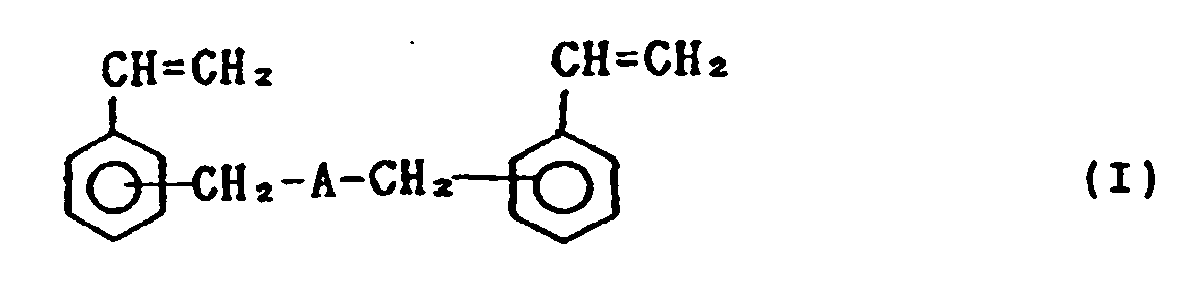
- radical-polymerizable monomer isobornyl methacrylate, isobornyl acrylate, adamantyl acrylate and methacrylate, CR-39; acrylate, methacrylate, diacrylate and dimethacrylate having a dicyclopentadiene represented by the structural formula (X) below on the side chain: phentyl methacrylate, l-menthyl methacrylate, dimethyladamantyl methacrylate; the compounds represented by the general formula (I) below: (where A represents or
- the present invention is not limited to the above monomers.
- the radical-polymerizable monomer is incorporated in the photosensitive composition in an amount of from 10 to 60 % by weight.
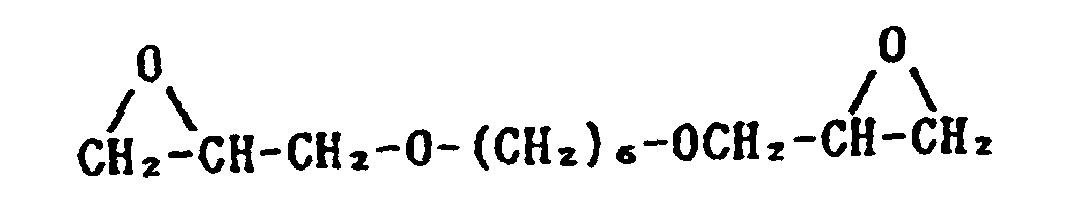
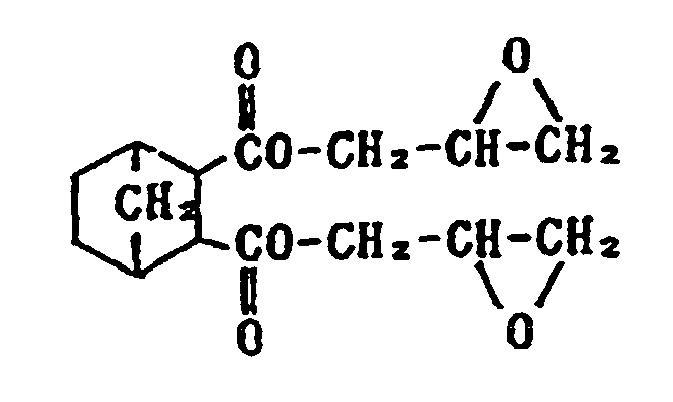
- the cationic-polymerizable monomer employed in the present invention generally has, in the molecule, a cyclic ether or thioether group such as epoxy ring.
- a cyclic ether or thioether group such as epoxy ring.
- typical alicyclic compounds are listed below without limiting the invention.
- spiro-orthoesters spiro-orthocarbonate, and bicyclo-orthoesters are also useful. The examples are shown below. These compounds preferably cause large modulation of the refractive index since they have small volume-constriction on polymerization. (where R is an alkyl group, or an alkoxy group, and n is an integer.)
- the cationic-polymerizable monomer is incorporated in the photosensitive composition in an amount of from 10 to 60 % by weight.
- the photo-polymerization initiator employed in the present invention which consists of radical polymerization initiator and cationic-polymerization initiator, is explained below.
- radical-polymerization initiator useful are conventionally employed aromatic ketones, aromatic diketones, and the like.
- the examples are benzophenone derivatives, benzoin derivatives, benzil derivatives, xanthone derivatives, thioxanthone derivatives, ketocoumarine derivatives, and so forth.
- a radical-polymerization initiator which is effective in a visible region is desirable for hologram recording.
- Such an initiator include 3,3'-carbonylbiscoumarine having a dialkylamino group at 7-position from among the aforementioned 3-ketocoumarine derivatives, since it is capable of being sensitized at the wavelength of up to about 500 nm.
- the cationic dye-borate anion complexes described in Japanese Patent Application Laid-Open Nos. 62-143044 and 62-150242 are made sensitive in the wavelength region of up to about 700-800 nm by suitably selecting the dye, and are especially useful as the radical-polymerization initiator of the present invention.
- polymerization initiators which are a combination of a radical-polymerization initiator with a sensitizer capable of absorbing light effectively in visible region.
- Such initiators as of the type are also useful in the present invention.
- the sensitizer used therefor includes merrocyanine dyes, coumarine dyes, anthraquinone dyes, styryl phenyl ketone derivatives having a dialkylamino group, styryl styryl ketone derivatives, and the like.
- the radical-polymerization initiator includes camphorquinone, diphenyl iodonium salt, biimidazole derivatives, and the like.
- the radical-polymerization initiator employed is diphenyl iodonium salt
- the counter ion such as B ⁇ F 4 , P ⁇ F 6 , and As ⁇ F 6 generates a strong acid which initiates cationic polymerization, and therefore the generation of a strong acid needs to be suppressed by using a counter anion such as B ⁇ (phenyl) 4 .
- the sensitivity of the radical-polymerization initiator can be improved by adding an amine or a mercaptane as the hydrogen donor.
- the radical-polymerization initiator is used singly, and is added to the sensitization composition in an amount of from 0.5 to 5 wt%.
- the initiator is used in combination with a sensitizer.
- the initiator and the sensitizer are added thereto in an amount of from 0.5 to 5 wt% collectively.
- the cationic-polymerization initiator used in the present invention is explained below.
- the useful cationic-polymerization initiator includes salts having non-nucleophilic anion such as B ⁇ F 4 , P ⁇ F 6 , As ⁇ F 6 , Sb ⁇ F 6 , and so forth.
- the examples thereof are shown below.
- Ar 3 S ⁇ X ⁇ where Ar is an aryl group; X - is an anion of B - F 4 , P - F 6 , As - F 6 , or Sb - F 6 ; R' is an alkyl group or an alkoxy group.
- the above cationic-polymerization initiators are made sensitive in visible light region by combining with a sensitizing dye such as Acridine Orange, Acridine Yellow, Phosphine R, benzoflavin, merrocyanine, and so forth.
- a sensitizing dye such as Acridine Orange, Acridine Yellow, Phosphine R, benzoflavin, merrocyanine, and so forth.
- Such a cationic-polymerization initiator is used singly or in combination with a sensitizing dye, and is incorporated in the photosensitive composition in an amount of from 0.5 to 5 wt%.
- the essential constituents of the recording medium of the present invention are described above.
- the recording medium of the present invention may suitably further contain a binder, a plasticizer, a stabilizer, or the like according to the purpose such as increase of contrast, improvement in heat stability, and improvement in film formation property.
- Any organic linear polymer which is compatible with the aforementioned essential components may be used as the binder.
- the examples of the binder include cellulose acetate lactate, polymethyl methacrylate, acryl type polymers and interpolymers including methyl methacrylate/methacrylic acid copolymers and methyl methacrylate/acrylic acid copolymers, terpolymers of methyl methacrylate/(C 2 -C 4 alkyl acrylate or methacrylate)/(acrylic or methacrylic acid), polyvinyl acetate, polyvinylacetal, polyvinylbutyral, polyvinylformal, and the like.
- the examples of the plasticizer are triethylene glycol, triethylene glycol diacetate, triethylene glycol dipropionate, triethylene glycol dicaprate, triethylene glycol dimethyl ether, triethylene glycol bis(2-ethylhexanoate), tetraethylene glycol diheptanoate, poly(ethylene glycol), poly(ethylene glycol) methyl ether, isopropylnaphthalene, diisopropylnaphthalene, poly(propylene glycol) glyceryltributyrate, diethyl adipate, diethyl cebacate, tributyl phosphate, tris(2-ethylhexyl) phosphate, BREE®30 [C 12 H 25 (OCH 2 CH 2 ) 4 OH], BREE®35 [C 12 H 25 (OCH 2 CH 2 ) 20 OH], and the like.
- the examples of the useful stabilizer are hydroquinone, Phenidone, p-methoxyphenol, alkyl- or allyl-substituted hydroquinones and quinones, t-butylcatechol, pyrogallol, copper resinate, naphtylamine, ⁇ -naphthol, cuprous chloride, 2,6-di-t-butyl-p-cresol, phenothiazine, pyridine, nitrobenzene, dinitrobenzene, p-toluquinone, chloranil, and the like.
- the essential constituents of the present invention and optional additives are dissolved or dispersed in a solvent. Then the solution or the dispersion is applied on a glass plate or a transparent film as a support. After drying, a transparent film such as a polyethylene terephthalate film is laminated thereon as a retaining layer (which serves also to intercept oxygen).
- laser beam is irradiated to the above recording medium: the laser beam which causes the reaction of the initiator for polymerizing selectively the intended monomer contained in the medium. Thereby a hologram is formed.
- a hologram recording medium contains a radical-polymerization initiator causing reaction by visible light and a cationic-polymerization initiator causing reaction by ultraviolet light.
- Fig. 1 illustrates an example of a construction optics employed in a process of preparing hologram.
- the numeral 1 denotes a light source (laser); 2 a half mirror; 3 a mirror; 4 a beam expander (x 20); and 5 a recording medium.
- Hologram is recorded by an interference pattern produced by two coherent beams, comprising an object beam and a reference beam which have a wavelength within the photosensitive range of the radical-polymerization initiator. Consequently, only the radical-polymerizable monomer in the bright portion polymerizes selectively, forming volume type phase hologram.
- the entire face of the recording medium is exposed to light (in the region from ultraviolet light to visible light) such as light from Xe-ray lamp, to which both of the radical-polymerization initiator and the cationic-polymerization initiator respond, to polymerize the radical-polymerizable monomer and the cationic-polymerizable monomer in the nodes respectively.
- light in the region from ultraviolet light to visible light
- Xe-ray lamp to which both of the radical-polymerization initiator and the cationic-polymerization initiator respond
- the antinodes portion of the medium is constituted only of a polymer derived from the radical-polymerizable monomer, while the other portion of the medium is constituted of a mixture of a polymer of the radical-polymerizable monomer and a polymer of the cationic-polymerizable monomer.
- modulation of refractive index is brought about between the two portions.
- the resulting hologram has sufficiently modulation of refractive index.
- the extent of the modulation of refractive index is further increased by suitable swelling treatment or heating treatment.
- the heating treatment is conducted preferably at a temperature in the range of from 50 to 150°C, more preferably from 80 to 120°C, for a time of from 30 to 120 minutes.
- the radical-polymerizable monomer and the cationic-polymerizable monomer may be preliminarily polymerized to some extent by exposure to an Xe-ray lamp.
- the components below were dissolved in a mixture of chlorobenzene and dichloromethane in the volume ratio of 4:1. The solution was applied on a glass substrate plate, and dried to form a film of 10 ⁇ m thick.
- a polyethyelne terephthalate film is laminated in a thickness of 3.5 ⁇ m to prepare a recording medium.
- the above recording medium was firstly exposed to laser beam from an Ar laser (488 nm) by means of an apparatus as shown in Fig. 1 (about 200 mJ/cm 2 ). Subsequently, the entire face of the recording medium is exposed to light from a 500-W Xe-lamp at a distance of 20 cm from the recording medium face for about 10 seconds.
- the resulting hologram was a volume type phase hologram having diffraction efficiency of 80 % and transmittance of 72 %.
- a recording medium was prepared in the same manner as in Example 1 except that the components below were used.
- the resulting hologram was a volume type phase hologram having diffraction efficiency of 82 % and transmittance of 80 %.
- a recording medium was prepared in the same manner as in Example 1 except that the components below were used.
- the light source as shown in Fig. 1 employed in this Example was an argon laser (488 nm).
- the resulting hologram was a volume type phase hologram having diffraction efficiency of 75 % and transmittance of 83 %.
- the cationic-polymeizable monomer was selectively polymerized by an interference pattern.
- a recording medium was prepared in the same manner as in Example 1 except that the components below were used.
- the resulting hologram was a volume type phase hologram having diffraction efficiency of 50 % and transmittance of 85 %.
- the above hologram was heated at 120°C for 30 minutes, thereby a volume type phase hologram being obtained, which had diffraction efficiency of 83 % and transmittance of 80 %.
- Example 1 The hologram obtained in Example 1 was heated at 120°C for 2 hours. Consequently, the diffraction efficiency was improved from 80 % to 93 %.
- Example 6 Three kinds of recording mediums different in thickness were prepared in the same manner as in Example 1 except that the components below were used: the thicknesses being 7 ⁇ m in Example 6, 15 ⁇ m in Example 7, and 23 ⁇ m in Example 8.
- Example 7 Three kinds of recording mediums were prepared in the same maner as in Example 7 except that the cationic-polymerizable monomer was replaced by the following three compounds respectively.
- Holograms were prepared by using the above recording mediums in the same manner as in Example 2. The prepared holograms were heated at 100°C for one hour. The resulting holograms had the diffraction efficiencies as below:
- the present invention provide a method of producing a volume phase hologram, wherein a photosensitive recording medium and a hologram having excellent properties below:
Landscapes
- Physics & Mathematics (AREA)
- General Physics & Mathematics (AREA)
- Chemical & Material Sciences (AREA)
- Spectroscopy & Molecular Physics (AREA)
- Inorganic Chemistry (AREA)
- Health & Medical Sciences (AREA)
- Chemical Kinetics & Catalysis (AREA)
- Medicinal Chemistry (AREA)
- Polymers & Plastics (AREA)
- Organic Chemistry (AREA)
- Holo Graphy (AREA)
Description
- The present invention relates to a method of preparing a volume phase hologram comprising a photosensitive recording medium.
- When a coherent light wave like a laser beam is projected onto an object, the amplitude and the phase of the light wave are modulated in accordance with the shape of the object. The modulated light reflected thereon or transmitted is received on a photo-sensitive recording medium and recorded, and a hologram thus formed is irradiated by light to reproduce an optical image.
- With the development of the study on holography technique, requirements on the properties of recording mediums for holography have become more clear. Many materials are proposed for the hologram material, such as bleached silver halide, photoresists, thermoplastics, dichromated gelatin, inorganic glass materials, ferromagnetic materials, and the like, and the characteristics of the materials are being investigated comprehensively.
- For example, bleached silver halide, and dichromated gelatin sensitized by Methylene Blue or the like are well known as a photosensitive hologram recording medium sensitive in a visible region.
-
U.S. Patent 4,942,112 discloses a photopolymerizable composition composed of a polymer binder and an ethylenic unsaturated monomer having a carbazole ring or an aromatic ring for the photosensitive recording medium. - The properties required to the photosensitive recording medium for hologram are as follows:
- (1) High recording sensitivity, in particular, high sensitivity to laser beam in visible region,
- (2) High resolution,
- (3) High diffraction efficiency of hologram,
- (4) Low noise in hologram,
- (5) Stability of hologram, and
- (6) Easiness of the operations of recording and reproduction.
- These properties cannot readily be achieved. Only few of known recording mediums have some of the above properties at practically usable levels.
- A bleached silver halide type and a dichromated gelatin type of recording mediums are practically usable although not being completely satisfactory. However, the former type of mediums has the disadvantages that they require bleaching treatment in addition to the usual treatments and the resulting hologram has low light-durability, and the latter type of mediums has serious defect of low water durability.
- The recording mediums described in the aforementioned
U.S. Patent 4,942,112 are required to be improved to give larger refractive index modulation and to give a hologram of thinner film thickness. -
EP-A-0 324 482 describes a process of forming refraction holograms in photo-polymerizable layers comprising an image-wise exposing and fixing the imaging element by, for example, a heat treatment. -
US-A-4,849,320 describes a process for the production of an image. The process comprises the use of a liquid composition comprising (A) a cationically polymerizable residue, (B) a radiation-activated polymerization initiator for (A), (C) a radiation-curable residue which is different from (A) and optionally (D) a radiation-acitvated initiator for curing of (C). By curing of (C) a relief pattern is formed. This process may be used in the production of printing plates and printed circuits. -
US-A-3,993,485 discloses the preparation of optical devices such as volume gratings wherein a photopolymerizable composition is polymerized by a free radical polymerization process. Specifically, the concentration gradient between a high reactivity monomer and a low reactivity monomer which are both radical-polymerized is induced. Thus, the high reactivity monomer concentrates in irradiated regions (antinodes regions) and polymerizes whereas the low reactivity monomer concentrates in the non-irradiated regions (nodes regions) and is not polymerized. The low reactivity monomer is only polymerized upon a second irradiation step (overall light exposure). The second monomer may also be polymerized via a different route than the first polymer. The volume phase hologram prepared according to the above method contains an irradiated region containing only a high reactivity component and the dark region containing only a low reactivity component. - The present invention intends to provide a method of preparing an improved volume phase hologram comprising a photosensitive recording medium having above-described required properties, which could not be attained by a known hologram recording medium.
- The present invention provides a volume phase hologram as defined in claim 1. Preferred embodiments are set out in
claims 2 to 9. -
Fig. 1 illustrates an example of construction optics employed in a process of preparing a hologram. - The volume phase hologram prepared according to the invention comprises a photosensitive recording medium containing a radical-polymerizable monomer, a cationic-polymerizable monomer, a radical-polymerization initiator, and a cationic-polymerization initiator as main constituents. Firstly, either the radical-polymerizable monomer or the cationic-polymerizable monomer is selectively polymerized imagewise to form a hologram.
Namely, either a radical polymerization or a cationic polymerization starts selectively within a wavelength region where only one of the radical-polymerizable and the cationic polymerizable monomer selectively polymerizes and proceeds in bright region (antinodes) by interference fringe. As selective monomer is considered to diffuse from dark region (nodes) to bright region, therefore, density or refractive index gradient is formed. Subsequently the entire face is exposed to light within a wavelength region where both of the radical-polymerizable monomer and the cationic-polymerizable monomer are polymerized in the non-imaged (nodes) portion to obtain high modulation of refractive index. - For example, the recording medium used in the present invention is firstly irradiated with coherent light in accordance with a hologram information to cause a reaction of only a radical polymerization initiator and to polymerize only a radical-polymerizable monomer, whereby hologram is formed on the recording medium. In this case, the wavelength range of the irradiation light is selected such that the cationic-polymerization initiator does not respond to the irradiated light.
- Subsequently, the entire face of the medium is irradiated with another light to which both of the radical-polymerization initiator and the cationic-polymerization initiator will respond.
- Consequently, the antinodes portion contains the polymer of the radical-polymerizable monomer, while the nodes portion contains both the polymer of the radical-polymerizable monomer and the polymer of the cationic-polymerizable monomer, thereby causing a large difference between the refractive index of the antinodes portion and that of the nodes portion.
- The above is only one example of the present invention. The cationic-polymerizable monomer may firstly be polymerized selectively.
- Preferred embodiment is further described to explain the present invention in more detail.
- The radical polymerizable monomer to be employed in the present invention may be either monofunctional or multifunctional, provided that it has an ethylenic unsaturated double bond in the molecule, and may be either in a liquid state or in a solid state.
- Specifically, the radical-polymerizable monomer includes 1,5-pentanediol diacrylate, ethylene glycol diacrylate, 1,4-butanediol diacrylate, diethylene glycol diacrylate, hexamethyelne glycol diacrylate, 1,3-propanediol diacrylate, decamethylene glycol diacrylate, decamethylene glycol dimethacrylate, 1,4-hyclohexanediol diacrylate, 2,2-dimethylolpropane diacrylate, glycerol diacrylate, tripropylene glycol diacrylate, glycerol triacrylate, trimethylolpropane triacrylate, pentaerythritol triacrylate, polyoxyethylate trimethylolpropane triacrylate or trimethacrylate and analogous compounds to those mentioned in
U.S. Patent 3,380,831 , pentaerythritol tetracrylate, triethylene glycol diacrylate, triethylene glycol dimethacrylate, polyoxypropyltrimethylolpropane triacrylate, ethylene glycol dimethacrylate, butylene glycol dimethacrylate, 1,3-propanediol dimethacrylate, 1,2,4-butanetriol trimethacrylate, 2,2,4-trimethyl-1,3-pentanediol dimethacrylate, pentaerythritol trimetacrylate, pentaerythritol tetramethacrylate, trimethylolpropane trimethacrylate, 1,5-pentanediol dimethacrylate, diallyl fumarate, and the like. - Further, diacrylate and dimethacrylate of bisphenol A, and bisphenol A-epoxy adducts are-also useful, specifically including di(3-methacryloxy-2-hydroxypropyl) ether of bisphenol A, di-(2-methacryloxyethyl) ether of bisphenol A, di(3-acryloxy-2-hydroxypropyl) ether of bisphenol A, di(2-acryloxyethyl) ether of bisphenol A, ethoxylate bisphenol A diacrylate, di(3-methacryloxy-2-hydroxypropyl) ether of tetrachlorobisphenol A, di(2-methacryloxyethyl) ether of tetrachlorobisphenol A, di(3-methacryloxy-2-hydroxypropyl) ether of tetrabromobisphenol A, di(2-methacryloxyethyl) ether of tetrabromobisphenol A, and the like.
- Further examples of the useful radical-polymerizable monomers are compounds having an isocyanate group, such as adducts of a compound such as 1,4-cyclohexyl diisocyanate, 1,3,5-cyclohexyl triisocyanate and 1,4-benzene diisocyanate with a compounds such as 2-hydroxyethyl acrylate (or methacrylate), and 2-hydroxypropyl acrylate.
- Still further examples of the useful radical-polymerizable monomers are styrene, 2-chlorostyrene, phenyl acrylate, 2-phenylethyl acrylate, 2,2'-di(p-hydroxyphenyl)propane diacrylate and methacrylate, 1,4-benzene diacrylate and methacrylate, 1,4-diisopropenylbenzene, 1,3,5-triisopropenylbenzene, and the like.
- Still further examples of the preferable radical-polymerizable monomer are shown below: isobornyl methacrylate, isobornyl acrylate, adamantyl acrylate and methacrylate, CR-39; acrylate, methacrylate, diacrylate and dimethacrylate having a dicyclopentadiene represented by the structural formula (X) below on the side chain:





- The present invention, however, is not limited to the above monomers.
- The radical-polymerizable monomer is incorporated in the photosensitive composition in an amount of from 10 to 60 % by weight.
- Next, the cationic-polymerizable monomer employed in the present invention is described below. The cationic-polymerizable monomer generally has, in the molecule, a cyclic ether or thioether group such as epoxy ring. In particular, in view of the sensitivity, typical alicyclic compounds are listed below without limiting the invention.






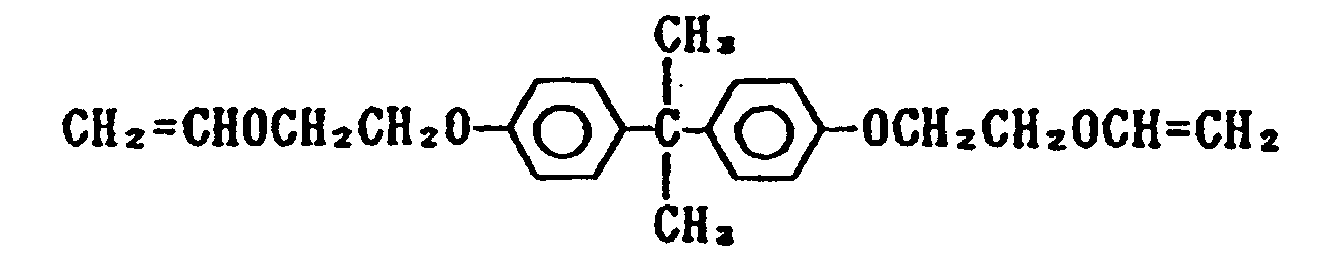
- The vinyl ethers shown below are also useful (see J.V. Crivello, et al.: Journal of Polymer Science, Polymer Chemistry Ed. 21, 1785 (1983)).


- Further, spiro-orthoesters, spiro-orthocarbonate, and bicyclo-orthoesters are also useful. The examples are shown below. These compounds preferably cause large modulation of the refractive index since they have small volume-constriction on polymerization.


- The cationic-polymerizable monomer is incorporated in the photosensitive composition in an amount of from 10 to 60 % by weight.
- The photo-polymerization initiator employed in the present invention, which consists of radical polymerization initiator and cationic-polymerization initiator, is explained below.
- As the radical-polymerization initiator, useful are conventionally employed aromatic ketones, aromatic diketones, and the like. The examples are benzophenone derivatives, benzoin derivatives, benzil derivatives, xanthone derivatives, thioxanthone derivatives, ketocoumarine derivatives, and so forth.
- Specific examples include benzophenone, Michler's ketone, benzil, 4,4'-dimethoxybenzil, camphorquinone, benzophenone derivatives having a peroxy-acid-ester structure, xanthone, thioxanthone, 2-chlorothioxanthone, 3-ketocoumarine derivatives (see: Donald P.S. Pecht, et al.: Tetrahedron, Vol. 38, No. 9, 1203-1211 (1982)), and so forth. Further, commercially available Irgacure-184, -651, and -907 supplied by Ciba Geigy Co. are useful. The formulas thereof are shown below.


- Most of these compounds exhibit effective light absorption at a short wavelength region (a UV region) of 400 nm or shorter. However, a radical-polymerization initiator which is effective in a visible region is desirable for hologram recording.
- Preferable examples of such an initiator include 3,3'-carbonylbiscoumarine having a dialkylamino group at 7-position from among the aforementioned 3-ketocoumarine derivatives, since it is capable of being sensitized at the wavelength of up to about 500 nm.
- The cationic dye-borate anion complexes described in
Japanese Patent Application Laid-Open Nos. 62-143044 62-150242 - In recent years, polymerization initiators, which are a combination of a radical-polymerization initiator with a sensitizer capable of absorbing light effectively in visible region, are comprehensively investigated. Such initiators as of the type are also useful in the present invention. The sensitizer used therefor includes merrocyanine dyes, coumarine dyes, anthraquinone dyes, styryl phenyl ketone derivatives having a dialkylamino group, styryl styryl ketone derivatives, and the like. The radical-polymerization initiator includes camphorquinone, diphenyl iodonium salt, biimidazole derivatives, and the like.
- In the case where the radical-polymerization initiator employed is diphenyl iodonium salt, the counter ion such as B⊖F4, P⊖F6, and As⊖F6 generates a strong acid which initiates cationic polymerization, and therefore the generation of a strong acid needs to be suppressed by using a counter anion such as B⊖(phenyl)4. The sensitivity of the radical-polymerization initiator can be improved by adding an amine or a mercaptane as the hydrogen donor.
- The radical-polymerization initiator is used singly, and is added to the sensitization composition in an amount of from 0.5 to 5 wt%.
- Further the initiator is used in combination with a sensitizer. In this case, the initiator and the sensitizer are added thereto in an amount of from 0.5 to 5 wt% collectively.
- The cationic-polymerization initiator used in the present invention is explained below.
- The useful cationic-polymerization initiator includes salts having non-nucleophilic anion such as B⊖F4, P⊖F6, As⊖F6, Sb⊖F6, and so forth. The examples thereof are shown below.


Ar3S⊕X⊖
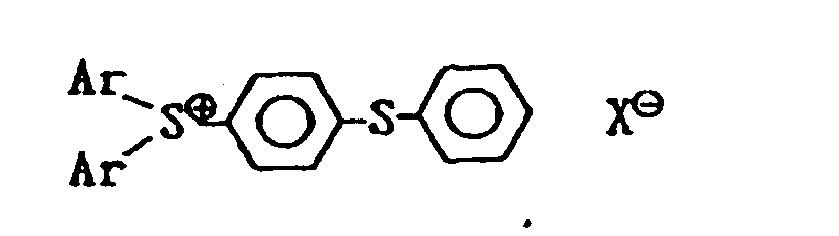


- The compounds of Ar-I+-Ar X-, although they seem to be useful, cannot be used because they have high ability of initiating radical polymerization as mentioned above.
- The above cationic-polymerization initiators are made sensitive in visible light region by combining with a sensitizing dye such as Acridine Orange, Acridine Yellow, Phosphine R, benzoflavin, merrocyanine, and so forth.
- Such a cationic-polymerization initiator is used singly or in combination with a sensitizing dye, and is incorporated in the photosensitive composition in an amount of from 0.5 to 5 wt%.
- The essential constituents of the recording medium of the present invention are described above. The recording medium of the present invention may suitably further contain a binder, a plasticizer, a stabilizer, or the like according to the purpose such as increase of contrast, improvement in heat stability, and improvement in film formation property.
- Any organic linear polymer which is compatible with the aforementioned essential components may be used as the binder.
- The examples of the binder include cellulose acetate lactate, polymethyl methacrylate, acryl type polymers and interpolymers including methyl methacrylate/methacrylic acid copolymers and methyl methacrylate/acrylic acid copolymers, terpolymers of methyl methacrylate/(C2-C4 alkyl acrylate or methacrylate)/(acrylic or methacrylic acid), polyvinyl acetate, polyvinylacetal, polyvinylbutyral, polyvinylformal, and the like.
- The examples of the plasticizer are triethylene glycol, triethylene glycol diacetate, triethylene glycol dipropionate, triethylene glycol dicaprate, triethylene glycol dimethyl ether, triethylene glycol bis(2-ethylhexanoate), tetraethylene glycol diheptanoate, poly(ethylene glycol), poly(ethylene glycol) methyl ether, isopropylnaphthalene, diisopropylnaphthalene, poly(propylene glycol) glyceryltributyrate, diethyl adipate, diethyl cebacate, tributyl phosphate, tris(2-ethylhexyl) phosphate, BREE®30 [C12H25(OCH2CH2)4OH], BREE®35 [C12H25(OCH2CH2)20OH], and the like.
- The examples of the useful stabilizer are hydroquinone, Phenidone, p-methoxyphenol, alkyl- or allyl-substituted hydroquinones and quinones, t-butylcatechol, pyrogallol, copper resinate, naphtylamine, β-naphthol, cuprous chloride, 2,6-di-t-butyl-p-cresol, phenothiazine, pyridine, nitrobenzene, dinitrobenzene, p-toluquinone, chloranil, and the like.
- The operation of preparing the hologram by use of the recording medium of the present invention is described below.
- The essential constituents of the present invention and optional additives are dissolved or dispersed in a solvent. Then the solution or the dispersion is applied on a glass plate or a transparent film as a support. After drying, a transparent film such as a polyethylene terephthalate film is laminated thereon as a retaining layer (which serves also to intercept oxygen).
- Subsequently, laser beam is irradiated to the above recording medium: the laser beam which causes the reaction of the initiator for polymerizing selectively the intended monomer contained in the medium. Thereby a hologram is formed.
- Here, the case is explained below in which a hologram recording medium contains a radical-polymerization initiator causing reaction by visible light and a cationic-polymerization initiator causing reaction by ultraviolet light.
-
Fig. 1 illustrates an example of a construction optics employed in a process of preparing hologram. InFig. 1 , the numeral 1 denotes a light source (laser); 2 a half mirror; 3 a mirror; 4 a beam expander (x 20); and 5 a recording medium. - Hologram is recorded by an interference pattern produced by two coherent beams, comprising an object beam and a reference beam which have a wavelength within the photosensitive range of the radical-polymerization initiator. Consequently, only the radical-polymerizable monomer in the bright portion polymerizes selectively, forming volume type phase hologram.
- Thereafter, the entire face of the recording medium is exposed to light (in the region from ultraviolet light to visible light) such as light from Xe-ray lamp, to which both of the radical-polymerization initiator and the cationic-polymerization initiator respond, to polymerize the radical-polymerizable monomer and the cationic-polymerizable monomer in the nodes respectively.
- By the above-mentioned process, the antinodes portion of the medium is constituted only of a polymer derived from the radical-polymerizable monomer, while the other portion of the medium is constituted of a mixture of a polymer of the radical-polymerizable monomer and a polymer of the cationic-polymerizable monomer. Thereby, modulation of refractive index is brought about between the two portions.
- The resulting hologram has sufficiently modulation of refractive index. In some cases, the extent of the modulation of refractive index is further increased by suitable swelling treatment or heating treatment. The heating treatment is conducted preferably at a temperature in the range of from 50 to 150°C, more preferably from 80 to 120°C, for a time of from 30 to 120 minutes.
- Before exposure to light of interference pattern, the radical-polymerizable monomer and the cationic-polymerizable monomer may be preliminarily polymerized to some extent by exposure to an Xe-ray lamp.
- The present invention is described in more detail by reference to examples.
- The components below were dissolved in a mixture of chlorobenzene and dichloromethane in the volume ratio of 4:1. The solution was applied on a glass substrate plate, and dried to form a film of 10 µm thick.
- Radical-polymerizable monomer:

- Cationic-polymerizable monomer:

- Radical-polymerization initiator:

Camphorquinone 2 wt%
- Cationic-polymerization initiator:

- Binder:
PMMA (Elvacite 2401 made by DuPont) 35 wt% - Onto this film, a polyethyelne terephthalate film is laminated in a thickness of 3.5 µm to prepare a recording medium.
- The above recording medium was firstly exposed to laser beam from an Ar laser (488 nm) by means of an apparatus as shown in
Fig. 1 (about 200 mJ/cm2). Subsequently, the entire face of the recording medium is exposed to light from a 500-W Xe-lamp at a distance of 20 cm from the recording medium face for about 10 seconds. - The resulting hologram was a volume type phase hologram having diffraction efficiency of 80 % and transmittance of 72 %.
- A recording medium was prepared in the same manner as in Example 1 except that the components below were used.
- Radical-polymerizable monomer:

- Cationic-polymerizable monomer:

- Radical-polymerization initiator:


- Cationic-polymerization initiator:

- With this recording medium, a hologram was obtained in the same manner as in Example 1 except that He-Ne laser was used as the light source in the apparatus as shown in
Fig. 1 . - The resulting hologram was a volume type phase hologram having diffraction efficiency of 82 % and transmittance of 80 %.
- A recording medium was prepared in the same manner as in Example 1 except that the components below were used.
- Radical-polymerizable monomer:

- Cationic-polymerizable monomer:

- Radical-polymerization initiator:
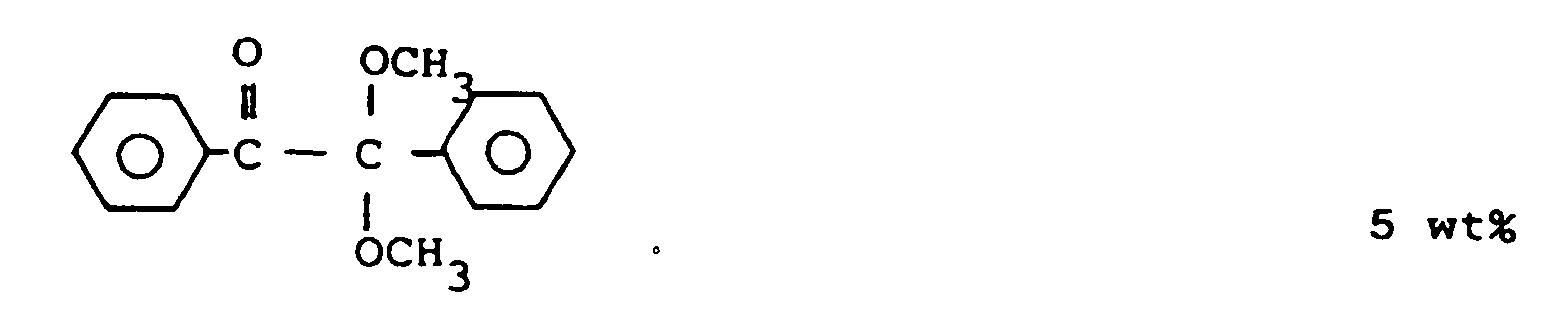
- Cationic-polymerization initiator:
Acridine Orange 2 wt%
- Binder:
PMMA (Elvacite 2401 made by DuPont) 21 wt% - With this recording medium, a hologram was prepared in the same manner as in Example 1.
- Incidentally, the light source as shown in
Fig. 1 employed in this Example was an argon laser (488 nm). - The resulting hologram was a volume type phase hologram having diffraction efficiency of 75 % and transmittance of 83 %.
- In this Example, the cationic-polymeizable monomer was selectively polymerized by an interference pattern.
- A recording medium was prepared in the same manner as in Example 1 except that the components below were used.
- Radical-polymerizable monomer:

- Cationic-polymerizable monomer:

- Radical-polymerization initiator:
1,3,3,1',3',3'-hexamethyl-2,2'-indodicarbocyanine tri-p-methoxyphenylbutylborate 2 wt%
- Cationic-polymerization initiator:

- With this recording medium, a hologram was obtained in the same manner as in Example 1.
- The resulting hologram was a volume type phase hologram having diffraction efficiency of 50 % and transmittance of 85 %.
- The above hologram was heated at 120°C for 30 minutes, thereby a volume type phase hologram being obtained, which had diffraction efficiency of 83 % and transmittance of 80 %.
- The hologram obtained in Example 1 was heated at 120°C for 2 hours. Consequently, the diffraction efficiency was improved from 80 % to 93 %.
- Three kinds of recording mediums different in thickness were prepared in the same manner as in Example 1 except that the components below were used: the thicknesses being 7 µm in Example 6, 15 µm in Example 7, and 23 µm in Example 8.
- Radical-polymerizable monomer:

- Cationic-polymerizable monomer:

- Radical-polymerization initiator:


- Cationic-polymerization initiator:

- By using the above recording mediums, holograms were prepared in the same manner as in Example 2.
- The resulting holograms had the diffraction efficiencies below:
- Example 6 (thickness: 7 µm) : 35 %
- Example 7 (thickness: 15 µm) : 63 %
- Example 8 (thickness: 23 µm) : 80 %
- Three kinds of recording mediums were prepared in the same maner as in Example 7 except that the cationic-polymerizable monomer was replaced by the following three compounds respectively.
-

-

-

- Holograms were prepared by using the above recording mediums in the same manner as in Example 2. The prepared holograms were heated at 100°C for one hour. The resulting holograms had the diffraction efficiencies as below:
- Example 9: 87 % (Diffraction efficiency)
- Example 10: 67 % (Diffraction efficiency)
- Example 11: 30 % (Diffraction efficiency)
- As described above, the present invention provide a method of producing a volume phase hologram, wherein a photosensitive recording medium and a hologram having excellent properties below:
- (1) The hologram has high resolution and high diffraction efficiency stably.
- (2) Large refractive index modulation is obtained by operations of interference pattern exposure and entire face exposure only.
- (3) Hologram recording is feasible in a visible region by selecting the radical-polymerization initiator and the cationic-polymerization initiator.
- (4) The recording medium has a good durability.
- (5) The recorded hologram is stable in storage (resistant to environment) since the monomer has been changed to a polymer in the whole region.
Claims (9)
- A method of producing a volume phase hologram having large difference of refractive index between antinodes and nodes portion containing a step of exposing a photosensitive recording medium to irradiation, the method comprising:a first step of preparing a photosensitive recording medium for forming a hologram, said medium containing as main constituents a radical-polymerizable monomer, a cationic-polymerizable monomer, a radical-polymerization initiator capable of initiating a polymerization of the radical-polymerizable monomer by exposing the medium to light within a wavelength region where said radical polymerization initiator is photosensitive, and a cationic-polymerization initiator capable of initiating a polymerization of the cationic-polymerizable monomer by exposing the medium to light within a wavelength region where said cationic polymerization initiator is photosensitive different from the wavelength region in which the radical-polymerizable initiator is photosensitive, wherein the radical-polymerization initiator and the cationic-polymerization initiator are not the same;a second step of exposing the medium to an interference pattern of coherent laser light selectively in antinodes regions by interference fringe within a wavelength region where only one of the radical-polymerizable monomer and the cationic-polymerizable monomer selectively polymerizes in the antinodes portion for forming a hologram; anda third step after the second step of exposing the entire region of the medium to light within a wavelength region where both of the radical polymerizable monomer and the cationic-polymerizable monomer are polymerized in the nodes portion, respectively,wherein the antinodes portion contains the radical-polymerized polymer or the cationic-polymerized polymer.
- The method according to claim 1, wherein the second step is practiced by using visible light.
- The method according to claim 1, wherein the second step is practiced by using ultraviolet light.
- The method according to claim 1, wherein the radical-polymerizable monomer is polymerized in the second step.
- The method according to claim 4, wherein the cationic-polymerization initiator is insensitive to the light in the second step.
- The method according to any of claims 1 to 5, further comprising a fourth step of heating the entire region of the medium.
- The method according to claim 6, wherein the third step and the fourth step are sequentially practiced.
- The method according to claim 6, wherein the third step and the fourth step are simultaneously practiced.
- The method according to claim 6, wherein the fourth step is practiced at a temperature in the range of from 50°C to 150°C for a time of 30 to 120 minutes.
Applications Claiming Priority (2)
| Application Number | Priority Date | Filing Date | Title |
|---|---|---|---|
| JP31617890 | 1990-11-22 | ||
| JP316178/90 | 1990-11-22 |
Publications (3)
| Publication Number | Publication Date |
|---|---|
| EP0487086A1 EP0487086A1 (en) | 1992-05-27 |
| EP0487086B1 EP0487086B1 (en) | 1999-04-21 |
| EP0487086B2 true EP0487086B2 (en) | 2008-08-13 |
Family
ID=18074167
Family Applications (1)
| Application Number | Title | Priority Date | Filing Date |
|---|---|---|---|
| EP91119877A Expired - Lifetime EP0487086B2 (en) | 1990-11-22 | 1991-11-21 | Method of preparing volume type phase hologram member using a photosensitive recording medium |
Country Status (3)
| Country | Link |
|---|---|
| US (2) | US5776634A (en) |
| EP (1) | EP0487086B2 (en) |
| DE (1) | DE69131158T2 (en) |
Families Citing this family (28)
| Publication number | Priority date | Publication date | Assignee | Title |
|---|---|---|---|---|
| JP2873126B2 (en) * | 1991-04-17 | 1999-03-24 | 日本ペイント株式会社 | Photosensitive composition for volume hologram recording |
| JP2849021B2 (en) * | 1993-04-12 | 1999-01-20 | 日本ペイント株式会社 | Photosensitive composition for volume hologram recording |
| JP3075090B2 (en) * | 1994-07-29 | 2000-08-07 | 凸版印刷株式会社 | Hologram photosensitive recording material, hologram photosensitive recording medium, and hologram manufacturing method using the same |
| US5702846A (en) * | 1994-10-03 | 1997-12-30 | Nippon Paint Co. Ltd. | Photosensitive composition for volume hologram recording |
| EP0853774B1 (en) * | 1995-10-06 | 2001-11-07 | Polaroid Corporation | Holographic medium and process |
| US6489065B1 (en) * | 1996-05-17 | 2002-12-03 | Polaroid Corporation | Holographic medium and process for use thereof |
| KR100245180B1 (en) * | 1996-05-29 | 2000-02-15 | 니시무로 타이죠 | Photosensitive composition and pattern formation method using the same |
| US6482551B1 (en) * | 1998-03-24 | 2002-11-19 | Inphase Technologies | Optical article and process for forming article |
| US6103454A (en) * | 1998-03-24 | 2000-08-15 | Lucent Technologies Inc. | Recording medium and process for forming medium |
| US6141123A (en) * | 1998-05-29 | 2000-10-31 | Denso Corporation | Hologram and process for producing hologram |
| US6124076A (en) | 1998-07-01 | 2000-09-26 | Lucent Technologies Inc. | Material exhibiting compensation for polymerization-induced shrinkage and recording medium formed therefrom |
| US6322933B1 (en) | 1999-01-12 | 2001-11-27 | Siros Technologies, Inc. | Volumetric track definition for data storage media used to record data by selective alteration of a format hologram |
| US6627354B1 (en) * | 1999-03-01 | 2003-09-30 | Lucent Technologies Inc. | Photorecording medium, process for fabricating medium, and process for holography using medium |
| US6322931B1 (en) * | 1999-07-29 | 2001-11-27 | Siros Technologies, Inc. | Method and apparatus for optical data storage using non-linear heating by excited state absorption for the alteration of pre-formatted holographic gratings |
| US6310850B1 (en) | 1999-07-29 | 2001-10-30 | Siros Technologies, Inc. | Method and apparatus for optical data storage and/or retrieval by selective alteration of a holographic storage medium |
| US6512606B1 (en) | 1999-07-29 | 2003-01-28 | Siros Technologies, Inc. | Optical storage media and method for optical data storage via local changes in reflectivity of a format grating |
| US6909684B2 (en) * | 2001-03-22 | 2005-06-21 | Fuji Xerox Co., Ltd. | Optical recording medium, holographic recording and/or retrieval method and holographic recording and/or retrieval apparatus |
| US6743552B2 (en) | 2001-08-07 | 2004-06-01 | Inphase Technologies, Inc. | Process and composition for rapid mass production of holographic recording article |
| US6780546B2 (en) | 2001-08-30 | 2004-08-24 | Inphase Technologies, Inc. | Blue-sensitized holographic media |
| JP4344177B2 (en) * | 2002-07-12 | 2009-10-14 | 大日本印刷株式会社 | Photosensitive composition for volume hologram recording, photosensitive medium for volume hologram recording, and volume hologram |
| JP2004287138A (en) * | 2003-03-24 | 2004-10-14 | Konica Minolta Holdings Inc | Composition for holographic recording, holographic recording medium and its recording method |
| WO2004090646A1 (en) * | 2003-04-09 | 2004-10-21 | Konica Minolta Medical & Graphic, Inc. | Holographic recording medium and recording method using the same |
| DE112004001165T5 (en) * | 2003-06-25 | 2006-05-04 | Cmet Inc., Yokohama | An actinic radiation-curable stereolithographic resin composition having improved stability |
| EP1723475A4 (en) * | 2003-12-12 | 2009-03-25 | Dce Aprilis Inc | METHODS AND APPARATUS FOR FIXING HOLOGRAPHIC MEDIA IN HOLOGRAPHIC DATA STORAGE SYSTEMS |
| JP4633562B2 (en) * | 2005-07-06 | 2011-02-16 | 大日本印刷株式会社 | Volume hologram photosensitive composition |
| JP2007264091A (en) * | 2006-03-27 | 2007-10-11 | Toshiba Corp | Hologram recording medium |
| US20070248890A1 (en) * | 2006-04-20 | 2007-10-25 | Inphase Technologies, Inc. | Index Contrasting-Photoactive Polymerizable Materials, and Articles and Methods Using Same |
| WO2008123303A1 (en) * | 2007-03-30 | 2008-10-16 | Daikin Industries, Ltd. | Composition for fluorine-containing volume hologram optical information recording material and fluorine-containing volume hologram optical information recording medium using the same |
Family Cites Families (40)
| Publication number | Priority date | Publication date | Assignee | Title |
|---|---|---|---|---|
| US3380831A (en) * | 1964-05-26 | 1968-04-30 | Du Pont | Photopolymerizable compositions and elements |
| US3715293A (en) * | 1971-12-17 | 1973-02-06 | Union Carbide Corp | Acetophenone-type photosensitizers for radiation curable coatings |
| DE2214054A1 (en) * | 1972-03-23 | 1973-09-27 | Agfa Gevaert Ag | SENSITIZED ELECTROPHOTOGRAPHIC LAYERS |
| US4210449A (en) * | 1972-10-16 | 1980-07-01 | American Can Company | Radiation sensitive composition comprising copolymer of glycidyl methacrylate and allyl glycidyl ether and diazonium salt of complex halogenide |
| US4058401A (en) * | 1974-05-02 | 1977-11-15 | General Electric Company | Photocurable compositions containing group via aromatic onium salts |
| US4058400A (en) * | 1974-05-02 | 1977-11-15 | General Electric Company | Cationically polymerizable compositions containing group VIa onium salts |
| US4054455A (en) * | 1974-09-26 | 1977-10-18 | American Can Company | Article having a layer containing a copolymer of glycidyl methacrylate and allyl glycidyl ether |
| JPS5315152A (en) * | 1976-07-27 | 1978-02-10 | Canon Inc | Hologram |
| US4156035A (en) * | 1978-05-09 | 1979-05-22 | W. R. Grace & Co. | Photocurable epoxy-acrylate compositions |
| US4428807A (en) * | 1978-06-30 | 1984-01-31 | The Dow Chemical Company | Composition containing polymerizable entities having oxirane groups and terminal olefinic unsaturation in combination with free-radical and cationic photopolymerizations means |
| US4291114A (en) * | 1978-10-18 | 1981-09-22 | Minnesota Mining And Manufacturing Co. | Imageable, composite-dry transfer sheet and process of using same |
| US4250053A (en) * | 1979-05-21 | 1981-02-10 | Minnesota Mining And Manufacturing Company | Sensitized aromatic iodonium or aromatic sulfonium salt photoinitiator systems |
| US4426431A (en) * | 1982-09-22 | 1984-01-17 | Eastman Kodak Company | Radiation-curable compositions for restorative and/or protective treatment of photographic elements |
| US4588664A (en) * | 1983-08-24 | 1986-05-13 | Polaroid Corporation | Photopolymerizable compositions used in holograms |
| US4717605A (en) * | 1984-05-16 | 1988-01-05 | Merck Patent Gesellschaft Mit Beschrankter Haftung | Radiation curable adhesives |
| US4623676A (en) * | 1985-01-18 | 1986-11-18 | Minnesota Mining And Manufacturing Company | Protective coating for phototools |
| US4937159A (en) * | 1985-11-20 | 1990-06-26 | The Mead Corporation | Photosensitive materials and compositions containing ionic dye compounds as initiators and thiols as autooxidizers |
| CH678897A5 (en) * | 1986-05-10 | 1991-11-15 | Ciba Geigy Ag | |
| US4970129A (en) * | 1986-12-19 | 1990-11-13 | Polaroid Corporation | Holograms |
| US4751102A (en) * | 1987-07-27 | 1988-06-14 | The Mead Corporation | Radiation-curable ink and coating compositions containing ionic dye compounds as initiators |
| US4913990A (en) * | 1987-10-20 | 1990-04-03 | Rallison Richard D | Method of tuning a volume phase recording |
| DE68905610T2 (en) * | 1988-01-15 | 1993-10-07 | Du Pont | Process for the production of reflection holograms in photopolymerizable layers. |
| US4942112A (en) * | 1988-01-15 | 1990-07-17 | E. I. Du Pont De Nemours And Company | Photopolymerizable compositions and elements for refractive index imaging |
| US4959283A (en) * | 1988-01-15 | 1990-09-25 | E. I. Du Pont De Nemours And Company | Dry film process for altering wavelength response of holograms |
| US4942102A (en) * | 1988-01-15 | 1990-07-17 | E. I. Du Pont De Nemours And Company | Holographic optical elements having a reflection hologram formed in a photopolymer |
| US5026618A (en) * | 1988-02-16 | 1991-06-25 | Canon Kabushiki Kaisha | Photosensitive material and volume type phase hologram member formed therefrom |
| JP2538652B2 (en) * | 1988-09-19 | 1996-09-25 | 旭電化工業株式会社 | Resin composition for optical modeling |
| WO1989007620A1 (en) * | 1988-02-19 | 1989-08-24 | Asahi Denka Kogyo K.K. | Resin composition for optical modeling |
| MX169037B (en) * | 1988-03-29 | 1993-06-17 | Rohm & Haas | PROCEDURE FOR PREPARING PHOTO CURED COATINGS |
| US4985340A (en) * | 1988-06-01 | 1991-01-15 | Minnesota Mining And Manufacturing Company | Energy curable compositions: two component curing agents |
| CA1340758C (en) * | 1988-06-01 | 1999-09-21 | Robert J. Devoe | Energy curable compositions: single component curing agents |
| US5178988A (en) * | 1988-09-13 | 1993-01-12 | Amp-Akzo Corporation | Photoimageable permanent resist |
| US5262277A (en) * | 1988-12-16 | 1993-11-16 | Hitachi Chemical Company, Inc. | Photosensitive resin composition and photosensitive element using the same |
| US5098804A (en) * | 1989-01-13 | 1992-03-24 | E. I. Du Pont De Nemours And Company | Multiplexer-demultiplexer for integrated optic circuit |
| JPH02280423A (en) * | 1989-04-21 | 1990-11-16 | Kokusai Denshin Denwa Co Ltd <Kdd> | Transmission power control system using superimposing modulation |
| US5002855A (en) * | 1989-04-21 | 1991-03-26 | E. I. Du Pont De Nemours And Company | Solid imaging method using multiphasic photohardenable compositions |
| US5213915A (en) * | 1989-05-19 | 1993-05-25 | Agency Of Industrial Science & Technology, Ministry Of International Trade & Industry | Holographic recording material and method for holographic recording |
| DE59007720D1 (en) * | 1989-10-27 | 1994-12-22 | Ciba Geigy Ag | Method for tuning the radiation sensitivity of photopolymerizable compositions. |
| US5102924A (en) * | 1990-08-16 | 1992-04-07 | Minnesota Mining And Manufacturing Company | Polymeric mixtures and process therefor |
| JP2873126B2 (en) * | 1991-04-17 | 1999-03-24 | 日本ペイント株式会社 | Photosensitive composition for volume hologram recording |
-
1991
- 1991-11-21 EP EP91119877A patent/EP0487086B2/en not_active Expired - Lifetime
- 1991-11-21 DE DE69131158T patent/DE69131158T2/en not_active Expired - Lifetime
-
1994
- 1994-05-23 US US08/247,456 patent/US5776634A/en not_active Expired - Lifetime
-
1997
- 1997-06-27 US US08/884,463 patent/US5869210A/en not_active Expired - Lifetime
Also Published As
| Publication number | Publication date |
|---|---|
| DE69131158D1 (en) | 1999-05-27 |
| US5776634A (en) | 1998-07-07 |
| US5869210A (en) | 1999-02-09 |
| DE69131158T2 (en) | 1999-12-16 |
| EP0487086A1 (en) | 1992-05-27 |
| EP0487086B1 (en) | 1999-04-21 |
Similar Documents
| Publication | Publication Date | Title |
|---|---|---|
| EP0487086B1 (en) | Volume phase hologram comprising a photosensitive recording medium and method of preparing volume type phase hologram member using same | |
| KR940007967B1 (en) | Process for making volume hologram using modulated wavelength response | |
| US5759721A (en) | Holographic medium and process for use thereof | |
| US5702846A (en) | Photosensitive composition for volume hologram recording | |
| US5858614A (en) | Photosensitive composition for volume hologram recording | |
| US5698345A (en) | Photosensitive recording material, photosensitive recording medium, and process for producing hologram using this photosensitive recording medium | |
| US6045953A (en) | Photosensitive recording material, photosensitive recording medium, and process for producing hologram using this photosensitive recording medium | |
| JPH05204288A (en) | Dry-film method for changing of response wavelength of hologram | |
| AU608403B2 (en) | Process of forming reflection holograms in photopolymerizable layers | |
| JPH02216154A (en) | Visible light sensitizer for photopolymerizing composition | |
| US5024909A (en) | Dry film process for altering wavelength response of holograms | |
| JP2880342B2 (en) | Photosensitive recording medium for forming hologram and method for forming volume phase hologram using the same | |
| US20080305404A1 (en) | Hologram Recording Material | |
| JP3532621B2 (en) | Photosensitive composition for volume hologram recording, recording medium using the same, and method for forming volume hologram | |
| JPH08160842A (en) | Photosensitive composition for three-dimensional hologram recording, recording medium using that and forming method of three-dimensional hologram | |
| JPH0594014A (en) | Photosensitive resin composition for hologram | |
| JPH075796A (en) | Holographic recording composition, hologram recording medium, and method for producing hologram using the same | |
| JPH06295150A (en) | Holographic recording composition, hologram recording medium, and method for producing hologram using the same | |
| JP2000112322A (en) | Transparent hologram recording material | |
| JPH06230224A (en) | Element for volume transmission hologram record | |
| JPH04116584A (en) | Composition for hologram recording and recording method | |
| JPH07281436A (en) | Visible light sensitizer for photopolymerization agent and / or photocrosslinking agent, photosensitive composition and hologram recording medium | |
| JPH06295151A (en) | Holographic recording composition, hologram recording medium, and method for producing hologram using the same | |
| JPH0816076A (en) | Holographic photosensitive recording material, hologram photosensitive recording medium, and hologram manufacturing method using the same | |
| KR20070017980A (en) | Photopolymerizable composition and photopolymerizable recording medium for manufacturing 3D optical memory using same |
Legal Events
| Date | Code | Title | Description |
|---|---|---|---|
| PUAI | Public reference made under article 153(3) epc to a published international application that has entered the european phase |
Free format text: ORIGINAL CODE: 0009012 |
|
| AK | Designated contracting states |
Kind code of ref document: A1 Designated state(s): DE FR GB |
|
| 17P | Request for examination filed |
Effective date: 19921013 |
|
| 17Q | First examination report despatched |
Effective date: 19960708 |
|
| GRAG | Despatch of communication of intention to grant |
Free format text: ORIGINAL CODE: EPIDOS AGRA |
|
| GRAG | Despatch of communication of intention to grant |
Free format text: ORIGINAL CODE: EPIDOS AGRA |
|
| GRAH | Despatch of communication of intention to grant a patent |
Free format text: ORIGINAL CODE: EPIDOS IGRA |
|
| GRAH | Despatch of communication of intention to grant a patent |
Free format text: ORIGINAL CODE: EPIDOS IGRA |
|
| GRAA | (expected) grant |
Free format text: ORIGINAL CODE: 0009210 |
|
| AK | Designated contracting states |
Kind code of ref document: B1 Designated state(s): DE FR GB |
|
| REF | Corresponds to: |
Ref document number: 69131158 Country of ref document: DE Date of ref document: 19990527 |
|
| ET | Fr: translation filed | ||
| PLBQ | Unpublished change to opponent data |
Free format text: ORIGINAL CODE: EPIDOS OPPO |
|
| PLBI | Opposition filed |
Free format text: ORIGINAL CODE: 0009260 |
|
| PLBF | Reply of patent proprietor to notice(s) of opposition |
Free format text: ORIGINAL CODE: EPIDOS OBSO |
|
| RIN2 | Information on inventor provided after grant (corrected) |
Free format text: OHKUMA, NORIO, C/O CANON KABUSHIKI KAISHA * KUWAYAMA, TETSURO, C/O CANON KABUSHIKI KAISHA * MAJIMA, TOSHIAKI, C/O CANON KABUSHIKI KAISHA * TANIGUCHI, NAOSATO, C/O CANON KABUSHIKI KAISHA * TOSHIDA, YOMISHI, C/O CANON KABUSHIKI KAISHA * YOSHINAGA, YOKO, C/O CANON KABUSHIKI KAISHA * FUKUI, TETSURO, C/O CANON KABUSHIKI KAISHA |
|
| 26 | Opposition filed |
Opponent name: NIPPON PAINT CO., LTD. Effective date: 20000121 |
|
| PLBF | Reply of patent proprietor to notice(s) of opposition |
Free format text: ORIGINAL CODE: EPIDOS OBSO |
|
| PLBF | Reply of patent proprietor to notice(s) of opposition |
Free format text: ORIGINAL CODE: EPIDOS OBSO |
|
| REG | Reference to a national code |
Ref country code: GB Ref legal event code: IF02 |
|
| RDAH | Patent revoked |
Free format text: ORIGINAL CODE: EPIDOS REVO |
|
| RIC2 | Information provided on ipc code assigned after grant |
Free format text: 7G 03F 7/027 A, 7G 03F 7/00 B, 7C 08F 2/50 B |
|
| RTI2 | Title (correction) |
Free format text: VOLUME PHASE HOLOGRAM COMPRISING A PHOTOSENSITIVE RECORDING MEDIUM AND METHOD OF PREPARING VOLUME TYPE PHASE HOLOGRAM MEMBER USING SAME |
|
| APAC | Appeal dossier modified |
Free format text: ORIGINAL CODE: EPIDOS NOAPO |
|
| APAC | Appeal dossier modified |
Free format text: ORIGINAL CODE: EPIDOS NOAPO |
|
| APBU | Appeal procedure closed |
Free format text: ORIGINAL CODE: EPIDOSNNOA9O |
|
| PLAY | Examination report in opposition despatched + time limit |
Free format text: ORIGINAL CODE: EPIDOSNORE2 |
|
| PLBC | Reply to examination report in opposition received |
Free format text: ORIGINAL CODE: EPIDOSNORE3 |
|
| PLAY | Examination report in opposition despatched + time limit |
Free format text: ORIGINAL CODE: EPIDOSNORE2 |
|
| APAA | Appeal reference recorded |
Free format text: ORIGINAL CODE: EPIDOS REFN |
|
| APAH | Appeal reference modified |
Free format text: ORIGINAL CODE: EPIDOSCREFNO |
|
| PLAY | Examination report in opposition despatched + time limit |
Free format text: ORIGINAL CODE: EPIDOSNORE2 |
|
| RTI2 | Title (correction) |
Free format text: METHOD OF PREPARING VOLUME TYPE PHASE HOLOGRAM MEMBER USING A PHOTOSENSITIVE RECORDING MEDIUM |
|
| PUAH | Patent maintained in amended form |
Free format text: ORIGINAL CODE: 0009272 |
|
| STAA | Information on the status of an ep patent application or granted ep patent |
Free format text: STATUS: PATENT MAINTAINED AS AMENDED |
|
| 27A | Patent maintained in amended form |
Effective date: 20080813 |
|
| AK | Designated contracting states |
Kind code of ref document: B2 Designated state(s): DE FR GB |
|
| PGFP | Annual fee paid to national office [announced via postgrant information from national office to epo] |
Ref country code: FR Payment date: 20081124 Year of fee payment: 18 |
|
| PGFP | Annual fee paid to national office [announced via postgrant information from national office to epo] |
Ref country code: DE Payment date: 20101130 Year of fee payment: 20 |
|
| PGFP | Annual fee paid to national office [announced via postgrant information from national office to epo] |
Ref country code: GB Payment date: 20101126 Year of fee payment: 20 |
|
| REG | Reference to a national code |
Ref country code: FR Ref legal event code: ST Effective date: 20110729 |
|
| PG25 | Lapsed in a contracting state [announced via postgrant information from national office to epo] |
Ref country code: FR Free format text: LAPSE BECAUSE OF NON-PAYMENT OF DUE FEES Effective date: 20091130 |
|
| REG | Reference to a national code |
Ref country code: DE Ref legal event code: R071 Ref document number: 69131158 Country of ref document: DE |
|
| REG | Reference to a national code |
Ref country code: DE Ref legal event code: R071 Ref document number: 69131158 Country of ref document: DE |
|
| REG | Reference to a national code |
Ref country code: GB Ref legal event code: PE20 Expiry date: 20111120 |
|
| PG25 | Lapsed in a contracting state [announced via postgrant information from national office to epo] |
Ref country code: GB Free format text: LAPSE BECAUSE OF EXPIRATION OF PROTECTION Effective date: 20111120 |
|
| PG25 | Lapsed in a contracting state [announced via postgrant information from national office to epo] |
Ref country code: DE Free format text: LAPSE BECAUSE OF EXPIRATION OF PROTECTION Effective date: 20111122 |