EP0487230B1 - Particules sphériques d'oxyde de fer noir de type spinelle et procédé pour les préparer - Google Patents
Particules sphériques d'oxyde de fer noir de type spinelle et procédé pour les préparer Download PDFInfo
- Publication number
- EP0487230B1 EP0487230B1 EP91310366A EP91310366A EP0487230B1 EP 0487230 B1 EP0487230 B1 EP 0487230B1 EP 91310366 A EP91310366 A EP 91310366A EP 91310366 A EP91310366 A EP 91310366A EP 0487230 B1 EP0487230 B1 EP 0487230B1
- Authority
- EP
- European Patent Office
- Prior art keywords
- particles
- spinel
- iron oxide
- oxide particles
- magnetic
- Prior art date
- Legal status (The legal status is an assumption and is not a legal conclusion. Google has not performed a legal analysis and makes no representation as to the accuracy of the status listed.)
- Expired - Lifetime
Links
- 239000002245 particle Substances 0.000 title claims description 99
- WTFXARWRTYJXII-UHFFFAOYSA-N iron(2+);iron(3+);oxygen(2-) Chemical compound [O-2].[O-2].[O-2].[O-2].[Fe+2].[Fe+3].[Fe+3] WTFXARWRTYJXII-UHFFFAOYSA-N 0.000 title claims description 35
- SZVJSHCCFOBDDC-UHFFFAOYSA-N iron(II,III) oxide Inorganic materials O=[Fe]O[Fe]O[Fe]=O SZVJSHCCFOBDDC-UHFFFAOYSA-N 0.000 title claims description 35
- 238000000034 method Methods 0.000 title claims description 22
- 230000005291 magnetic effect Effects 0.000 claims description 53
- 239000000725 suspension Substances 0.000 claims description 25
- 230000005415 magnetization Effects 0.000 claims description 20
- 238000007254 oxidation reaction Methods 0.000 claims description 16
- 239000011701 zinc Substances 0.000 claims description 14
- 239000011347 resin Substances 0.000 claims description 10
- 229920005989 resin Polymers 0.000 claims description 10
- 238000007664 blowing Methods 0.000 claims description 9
- 239000007789 gas Substances 0.000 claims description 8
- BAUYGSIQEAFULO-UHFFFAOYSA-L iron(2+) sulfate (anhydrous) Chemical compound [Fe+2].[O-]S([O-])(=O)=O BAUYGSIQEAFULO-UHFFFAOYSA-L 0.000 claims description 8
- XEEYBQQBJWHFJM-UHFFFAOYSA-N Iron Chemical compound [Fe] XEEYBQQBJWHFJM-UHFFFAOYSA-N 0.000 claims description 7
- HCHKCACWOHOZIP-UHFFFAOYSA-N Zinc Chemical compound [Zn] HCHKCACWOHOZIP-UHFFFAOYSA-N 0.000 claims description 7
- 239000012670 alkaline solution Substances 0.000 claims description 7
- 229910021506 iron(II) hydroxide Inorganic materials 0.000 claims description 7
- 230000003647 oxidation Effects 0.000 claims description 7
- 229910052725 zinc Inorganic materials 0.000 claims description 7
- 150000003752 zinc compounds Chemical class 0.000 claims description 7
- 238000000576 coating method Methods 0.000 claims description 6
- NCNCGGDMXMBVIA-UHFFFAOYSA-L iron(ii) hydroxide Chemical compound [OH-].[OH-].[Fe+2] NCNCGGDMXMBVIA-UHFFFAOYSA-L 0.000 claims description 5
- 239000012266 salt solution Substances 0.000 claims description 5
- 239000011248 coating agent Substances 0.000 claims description 4
- 230000001590 oxidative effect Effects 0.000 claims description 4
- 239000000049 pigment Substances 0.000 claims description 4
- 229910021511 zinc hydroxide Inorganic materials 0.000 claims description 4
- MYMOFIZGZYHOMD-UHFFFAOYSA-N Dioxygen Chemical compound O=O MYMOFIZGZYHOMD-UHFFFAOYSA-N 0.000 claims description 3
- 238000004040 coloring Methods 0.000 claims description 3
- 229910001882 dioxygen Inorganic materials 0.000 claims description 3
- 229910052742 iron Inorganic materials 0.000 claims description 3
- 239000006249 magnetic particle Substances 0.000 claims description 2
- UGZADUVQMDAIAO-UHFFFAOYSA-L zinc hydroxide Chemical compound [OH-].[OH-].[Zn+2] UGZADUVQMDAIAO-UHFFFAOYSA-L 0.000 claims description 2
- 229940007718 zinc hydroxide Drugs 0.000 claims description 2
- UQSXHKLRYXJYBZ-UHFFFAOYSA-N Iron oxide Chemical compound [Fe]=O UQSXHKLRYXJYBZ-UHFFFAOYSA-N 0.000 description 34
- HEMHJVSKTPXQMS-UHFFFAOYSA-M Sodium hydroxide Chemical compound [OH-].[Na+] HEMHJVSKTPXQMS-UHFFFAOYSA-M 0.000 description 12
- 230000000052 comparative effect Effects 0.000 description 8
- 238000006243 chemical reaction Methods 0.000 description 7
- 239000007788 liquid Substances 0.000 description 7
- 230000032683 aging Effects 0.000 description 6
- 239000007864 aqueous solution Substances 0.000 description 5
- 239000000969 carrier Substances 0.000 description 5
- 230000004907 flux Effects 0.000 description 5
- 239000006247 magnetic powder Substances 0.000 description 5
- 239000000463 material Substances 0.000 description 5
- 238000002156 mixing Methods 0.000 description 5
- 239000002244 precipitate Substances 0.000 description 5
- 238000000635 electron micrograph Methods 0.000 description 4
- CDBYLPFSWZWCQE-UHFFFAOYSA-L sodium carbonate Substances [Na+].[Na+].[O-]C([O-])=O CDBYLPFSWZWCQE-UHFFFAOYSA-L 0.000 description 4
- 239000011790 ferrous sulphate Substances 0.000 description 3
- 235000003891 ferrous sulphate Nutrition 0.000 description 3
- 229910000359 iron(II) sulfate Inorganic materials 0.000 description 3
- 239000000203 mixture Substances 0.000 description 3
- 239000000243 solution Substances 0.000 description 3
- CWYNVVGOOAEACU-UHFFFAOYSA-N Fe2+ Chemical compound [Fe+2] CWYNVVGOOAEACU-UHFFFAOYSA-N 0.000 description 2
- 239000011324 bead Substances 0.000 description 2
- 238000001311 chemical methods and process Methods 0.000 description 2
- 239000000084 colloidal system Substances 0.000 description 2
- 239000006185 dispersion Substances 0.000 description 2
- 238000010438 heat treatment Methods 0.000 description 2
- 239000011261 inert gas Substances 0.000 description 2
- 239000000696 magnetic material Substances 0.000 description 2
- 238000004519 manufacturing process Methods 0.000 description 2
- 239000011259 mixed solution Substances 0.000 description 2
- BWHMMNNQKKPAPP-UHFFFAOYSA-L potassium carbonate Chemical compound [K+].[K+].[O-]C([O-])=O BWHMMNNQKKPAPP-UHFFFAOYSA-L 0.000 description 2
- 229910000029 sodium carbonate Inorganic materials 0.000 description 2
- 239000012798 spherical particle Substances 0.000 description 2
- 239000000758 substrate Substances 0.000 description 2
- XLYOFNOQVPJJNP-UHFFFAOYSA-N water Substances O XLYOFNOQVPJJNP-UHFFFAOYSA-N 0.000 description 2
- JIAARYAFYJHUJI-UHFFFAOYSA-L zinc dichloride Chemical compound [Cl-].[Cl-].[Zn+2] JIAARYAFYJHUJI-UHFFFAOYSA-L 0.000 description 2
- NWONKYPBYAMBJT-UHFFFAOYSA-L zinc sulfate Chemical compound [Zn+2].[O-]S([O-])(=O)=O NWONKYPBYAMBJT-UHFFFAOYSA-L 0.000 description 2
- 229960001763 zinc sulfate Drugs 0.000 description 2
- 229910000368 zinc sulfate Inorganic materials 0.000 description 2
- ATRRKUHOCOJYRX-UHFFFAOYSA-N Ammonium bicarbonate Chemical compound [NH4+].OC([O-])=O ATRRKUHOCOJYRX-UHFFFAOYSA-N 0.000 description 1
- VHUUQVKOLVNVRT-UHFFFAOYSA-N Ammonium hydroxide Chemical compound [NH4+].[OH-] VHUUQVKOLVNVRT-UHFFFAOYSA-N 0.000 description 1
- 238000004438 BET method Methods 0.000 description 1
- BVKZGUZCCUSVTD-UHFFFAOYSA-L Carbonate Chemical compound [O-]C([O-])=O BVKZGUZCCUSVTD-UHFFFAOYSA-L 0.000 description 1
- 239000002253 acid Substances 0.000 description 1
- 239000003513 alkali Substances 0.000 description 1
- 229910001854 alkali hydroxide Inorganic materials 0.000 description 1
- 150000008044 alkali metal hydroxides Chemical class 0.000 description 1
- 239000001099 ammonium carbonate Substances 0.000 description 1
- 235000012501 ammonium carbonate Nutrition 0.000 description 1
- 235000011114 ammonium hydroxide Nutrition 0.000 description 1
- QVGXLLKOCUKJST-UHFFFAOYSA-N atomic oxygen Chemical compound [O] QVGXLLKOCUKJST-UHFFFAOYSA-N 0.000 description 1
- 239000002585 base Substances 0.000 description 1
- 239000011230 binding agent Substances 0.000 description 1
- 239000011246 composite particle Substances 0.000 description 1
- 239000000470 constituent Substances 0.000 description 1
- 238000007796 conventional method Methods 0.000 description 1
- 230000018109 developmental process Effects 0.000 description 1
- 238000001035 drying Methods 0.000 description 1
- 238000003912 environmental pollution Methods 0.000 description 1
- 238000002474 experimental method Methods 0.000 description 1
- 230000005294 ferromagnetic effect Effects 0.000 description 1
- 229960002089 ferrous chloride Drugs 0.000 description 1
- 238000005558 fluorometry Methods 0.000 description 1
- 229910052598 goethite Inorganic materials 0.000 description 1
- AEIXRCIKZIZYPM-UHFFFAOYSA-M hydroxy(oxo)iron Chemical compound [O][Fe]O AEIXRCIKZIZYPM-UHFFFAOYSA-M 0.000 description 1
- 150000002505 iron Chemical class 0.000 description 1
- NMCUIPGRVMDVDB-UHFFFAOYSA-L iron dichloride Chemical compound Cl[Fe]Cl NMCUIPGRVMDVDB-UHFFFAOYSA-L 0.000 description 1
- 235000014413 iron hydroxide Nutrition 0.000 description 1
- 229910000015 iron(II) carbonate Inorganic materials 0.000 description 1
- 238000004898 kneading Methods 0.000 description 1
- 239000001301 oxygen Substances 0.000 description 1
- 229910052760 oxygen Inorganic materials 0.000 description 1
- 229910000027 potassium carbonate Inorganic materials 0.000 description 1
- 235000011181 potassium carbonates Nutrition 0.000 description 1
- 230000002265 prevention Effects 0.000 description 1
- 239000011164 primary particle Substances 0.000 description 1
- 239000000047 product Substances 0.000 description 1
- 230000000630 rising effect Effects 0.000 description 1
- 230000035945 sensitivity Effects 0.000 description 1
- 235000017550 sodium carbonate Nutrition 0.000 description 1
- 230000003068 static effect Effects 0.000 description 1
- 238000005406 washing Methods 0.000 description 1
- 239000002699 waste material Substances 0.000 description 1
- 239000011592 zinc chloride Substances 0.000 description 1
- 235000005074 zinc chloride Nutrition 0.000 description 1
Images
Classifications
-
- G—PHYSICS
- G11—INFORMATION STORAGE
- G11B—INFORMATION STORAGE BASED ON RELATIVE MOVEMENT BETWEEN RECORD CARRIER AND TRANSDUCER
- G11B5/00—Recording by magnetisation or demagnetisation of a record carrier; Reproducing by magnetic means; Record carriers therefor
- G11B5/62—Record carriers characterised by the selection of the material
- G11B5/68—Record carriers characterised by the selection of the material comprising one or more layers of magnetisable material homogeneously mixed with a bonding agent
- G11B5/70—Record carriers characterised by the selection of the material comprising one or more layers of magnetisable material homogeneously mixed with a bonding agent on a base layer
- G11B5/706—Record carriers characterised by the selection of the material comprising one or more layers of magnetisable material homogeneously mixed with a bonding agent on a base layer characterised by the composition of the magnetic material
- G11B5/70626—Record carriers characterised by the selection of the material comprising one or more layers of magnetisable material homogeneously mixed with a bonding agent on a base layer characterised by the composition of the magnetic material containing non-metallic substances
- G11B5/70642—Record carriers characterised by the selection of the material comprising one or more layers of magnetisable material homogeneously mixed with a bonding agent on a base layer characterised by the composition of the magnetic material containing non-metallic substances iron oxides
-
- G—PHYSICS
- G03—PHOTOGRAPHY; CINEMATOGRAPHY; ANALOGOUS TECHNIQUES USING WAVES OTHER THAN OPTICAL WAVES; ELECTROGRAPHY; HOLOGRAPHY
- G03G—ELECTROGRAPHY; ELECTROPHOTOGRAPHY; MAGNETOGRAPHY
- G03G9/00—Developers
- G03G9/08—Developers with toner particles
- G03G9/10—Developers with toner particles characterised by carrier particles
- G03G9/107—Developers with toner particles characterised by carrier particles having magnetic components
- G03G9/1075—Structural characteristics of the carrier particles, e.g. shape or crystallographic structure
-
- C—CHEMISTRY; METALLURGY
- C01—INORGANIC CHEMISTRY
- C01G—COMPOUNDS CONTAINING METALS NOT COVERED BY SUBCLASSES C01D OR C01F
- C01G49/00—Compounds of iron
- C01G49/0018—Mixed oxides or hydroxides
- C01G49/0063—Mixed oxides or hydroxides containing zinc
-
- G—PHYSICS
- G03—PHOTOGRAPHY; CINEMATOGRAPHY; ANALOGOUS TECHNIQUES USING WAVES OTHER THAN OPTICAL WAVES; ELECTROGRAPHY; HOLOGRAPHY
- G03G—ELECTROGRAPHY; ELECTROPHOTOGRAPHY; MAGNETOGRAPHY
- G03G9/00—Developers
- G03G9/08—Developers with toner particles
- G03G9/083—Magnetic toner particles
- G03G9/0831—Chemical composition of the magnetic components
- G03G9/0833—Oxides
-
- G—PHYSICS
- G03—PHOTOGRAPHY; CINEMATOGRAPHY; ANALOGOUS TECHNIQUES USING WAVES OTHER THAN OPTICAL WAVES; ELECTROGRAPHY; HOLOGRAPHY
- G03G—ELECTROGRAPHY; ELECTROPHOTOGRAPHY; MAGNETOGRAPHY
- G03G9/00—Developers
- G03G9/08—Developers with toner particles
- G03G9/083—Magnetic toner particles
- G03G9/0835—Magnetic parameters of the magnetic components
-
- G—PHYSICS
- G03—PHOTOGRAPHY; CINEMATOGRAPHY; ANALOGOUS TECHNIQUES USING WAVES OTHER THAN OPTICAL WAVES; ELECTROGRAPHY; HOLOGRAPHY
- G03G—ELECTROGRAPHY; ELECTROPHOTOGRAPHY; MAGNETOGRAPHY
- G03G9/00—Developers
- G03G9/08—Developers with toner particles
- G03G9/083—Magnetic toner particles
- G03G9/0836—Other physical parameters of the magnetic components
-
- G—PHYSICS
- G03—PHOTOGRAPHY; CINEMATOGRAPHY; ANALOGOUS TECHNIQUES USING WAVES OTHER THAN OPTICAL WAVES; ELECTROGRAPHY; HOLOGRAPHY
- G03G—ELECTROGRAPHY; ELECTROPHOTOGRAPHY; MAGNETOGRAPHY
- G03G9/00—Developers
- G03G9/08—Developers with toner particles
- G03G9/083—Magnetic toner particles
- G03G9/0837—Structural characteristics of the magnetic components, e.g. shape, crystallographic structure
-
- G—PHYSICS
- G03—PHOTOGRAPHY; CINEMATOGRAPHY; ANALOGOUS TECHNIQUES USING WAVES OTHER THAN OPTICAL WAVES; ELECTROGRAPHY; HOLOGRAPHY
- G03G—ELECTROGRAPHY; ELECTROPHOTOGRAPHY; MAGNETOGRAPHY
- G03G9/00—Developers
- G03G9/08—Developers with toner particles
- G03G9/10—Developers with toner particles characterised by carrier particles
- G03G9/107—Developers with toner particles characterised by carrier particles having magnetic components
- G03G9/108—Ferrite carrier, e.g. magnetite
-
- C—CHEMISTRY; METALLURGY
- C01—INORGANIC CHEMISTRY
- C01P—INDEXING SCHEME RELATING TO STRUCTURAL AND PHYSICAL ASPECTS OF SOLID INORGANIC COMPOUNDS
- C01P2002/00—Crystal-structural characteristics
- C01P2002/30—Three-dimensional structures
- C01P2002/32—Three-dimensional structures spinel-type (AB2O4)
-
- C—CHEMISTRY; METALLURGY
- C01—INORGANIC CHEMISTRY
- C01P—INDEXING SCHEME RELATING TO STRUCTURAL AND PHYSICAL ASPECTS OF SOLID INORGANIC COMPOUNDS
- C01P2004/00—Particle morphology
- C01P2004/01—Particle morphology depicted by an image
- C01P2004/03—Particle morphology depicted by an image obtained by SEM
-
- C—CHEMISTRY; METALLURGY
- C01—INORGANIC CHEMISTRY
- C01P—INDEXING SCHEME RELATING TO STRUCTURAL AND PHYSICAL ASPECTS OF SOLID INORGANIC COMPOUNDS
- C01P2004/00—Particle morphology
- C01P2004/30—Particle morphology extending in three dimensions
- C01P2004/32—Spheres
-
- C—CHEMISTRY; METALLURGY
- C01—INORGANIC CHEMISTRY
- C01P—INDEXING SCHEME RELATING TO STRUCTURAL AND PHYSICAL ASPECTS OF SOLID INORGANIC COMPOUNDS
- C01P2006/00—Physical properties of inorganic compounds
- C01P2006/12—Surface area
-
- C—CHEMISTRY; METALLURGY
- C01—INORGANIC CHEMISTRY
- C01P—INDEXING SCHEME RELATING TO STRUCTURAL AND PHYSICAL ASPECTS OF SOLID INORGANIC COMPOUNDS
- C01P2006/00—Physical properties of inorganic compounds
- C01P2006/42—Magnetic properties
-
- C—CHEMISTRY; METALLURGY
- C01—INORGANIC CHEMISTRY
- C01P—INDEXING SCHEME RELATING TO STRUCTURAL AND PHYSICAL ASPECTS OF SOLID INORGANIC COMPOUNDS
- C01P2006/00—Physical properties of inorganic compounds
- C01P2006/60—Optical properties, e.g. expressed in CIELAB-values
Definitions
- the present invention relates to spinel-type spherical black iron oxide particles, to a process for their production, to magnetic toners, magnetic carriers and magnetic cards containing them and to coatings or colouring resins where they are present as a pigment.
- Spinel-type black iron oxide particles are sometimes dispersed in a vehicle so as to obtain a magnetic coating.
- the thus-obtained magnetic coating is directly applied to a card substrate, or a magnetic tape obtained by applying the magnetic coating to a base film is adhered to a card substrate.
- spinel-type black iron oxide particles are also used as material particles for magnetic cards such as credit cards provided with a magnetic stripe, railway tickets, railway season tickets, highway passes, telephone cards and railway cards.
- spinel-type black iron oxide particles are required to have improved properties, in particular, to have as large an initial magnetization as possible and excellent dispersibility which facilitates the kneading of the particles with a resin or the mixing thereof with a vehicle.
- Magnetic powders for magnetic toners of a one-component type are generally required to have the following properties.
- the magnetic flux density in a magnetic field of about 103 Oe is as high as possible.
- the maximum magnetization ( ⁇ m ) is about not less than 40 emu/g. This is in order to keep the height of the spike as a magnetic brush high....
- Magnetic powders are well mixed with a resin.
- the particle size of an ordinary toner is not more than several 10 »m, so that the microscopic mixing degree in the toner is important for the properties of the toner.
- Spinel-type black iron oxide particles as material particles for magnetic toners, magnetic carriers and magnetic cards, are generally produced directly from an aqueous solution, namely, by "wet process", because this process makes easy to produce discrete particles, in other words, particles having good dispersibility.
- the wet process comprises the steps of: blowing an oxidizing gas in a temperature range of 60 to 100°C into an aqueous solution which contains an Fe-containing precipitate such as Fe(OH)2 and FeCO3, and which is obtained by mixing an aqueous ferrous salt solution such as ferrous sulfate and an aqueous alkaline solution such as sodium hydroxide and sodium carbonate thereby obtaining a black precipitate, removing the acid radical and the like by washing the precipitate with water, and drying the precipitate so as not to cause color change (Japanese Patent Publication No. 44-668 (1969)).
- a process for producing the above spinel-type spherical black iron oxide particles which comprises the steps of: preparing a mixed suspension which contains ferrous hydroxide and zinc hydroxide and which has a pH of 6 to 9 in a non-oxidizing atmosphere by using an aqueous ferrous salt solution, a zinc compound and an aqueous alkaline solution; and blowing a molecular oxygen-containing gas into the mixed suspension to oxidize ferrous hydroxide until the pH reaches a value of from 4 to 6 and the oxidation degree is such that the amount of Fe3+ in the mixed suspension is 60 to 70 mol% (this will be referred to below as "the oxidation degree is 60 to 70 mol%”) based on the total amount of iron and zinc in the oxidization step.
- an aqueous ferrous salt solution used in the present invention an aqueous ferrous sulfate and an aqueous ferrous chloride may be exemplified.
- zinc sulfate As a zinc compound used in the present invention, zinc sulfate, zinc chloride, etc. are usable.
- an aqueous alkaline solution used in the present invention examples include an aqueous alkali hydroxide such as aqueous sodium hydroxide, an aqueous alkali carbonate such as sodium carbonate, potassium carbonate and ammonium carbonate, and ammonia water.
- the mixed suspension in the present invention is prepared by mixing an aqueous ferrous solution, a zinc compound and an aqueous alkaline solution.
- the mixing order of these constituents is not specified, and they may also be mixed simultaneously.
- the mixed suspension is prepared at a temperature of from 45 to 100°C.
- the mixed suspension is prepared in an inert atmosphere produced by blowing an inert gas such as N2 into a liquid or onto the liquid surface. If the atmosphere is not inert, it is impossible to obtain spinel-type black iron oxide particles having a low coercive force.
- the pH of the mixed suspension in the present invention is 6 to 9, preferably 6.5 to 8.5. If the pH is less than 6, it is difficult to obtain particles which contain sufficient zinc and, hence, to obtain the target spinel-type black iron oxide particles having a large magnetization and a low coercive force.
- the mixed suspension may be aged, if necessary, prior to the oxidization.
- the aging of the mixed suspension facilitates the production of spinel-type black iron oxide particles having a low coercive force.
- the aging process is carried out by holding the mixed solution at 40 to 100°C, preferably 60 to 100°C for a predetermined time, for example, not less than 5 minutes, preferably not less than 20 minutes while blowing an inert gas such as N2 into the liquid or onto the liquid surface.
- the mixed suspension is oxidized until the pH reaches a value of from 4 to 6, and the oxidation degree is such that Fe3+ in the mixed suspension is 60 to 70 mol% based on the total amount of iron and zinc in the oxidation step.
- the oxidation step should be conducted at a temperature of from 45 to 100°C.
- the pH is less than 4, it is difficult to obtain particles which contain sufficient zinc and, hence, to obtain the target spinel-type black iron oxide particles having a large magnetization and a low coercive force.
- the oxidization in the present invention is carried out by blowing an oxygen-containing gas such as air into the liquid.
- the reaction temperature in the present invention is 45 to 100°C, which are temperatures at which spinel-type iron oxide particles are generally produced, preferably 60 to 100°C.
- reaction temperature is lower than 45°C, it is apt that there exist acicular goethite particles mixed with the spinel-type spherical black iron oxide particles. Even if the reaction temperature exceeds 100°C, it is possible to obtain the target spinel-type iron oxide particles, but in this case, a special apparatus such as an autoclave is required industrially unfavorably.
- the spinel-type black iron oxide particles according to the present invention have a specific surface area of 5 to 15 m2/g, preferably 6 to 12 m2/g and contain 1.5 to 17.0 wt% of Zn, preferably 3.0 to 12.0 wt% based on the spinel-type black iron oxide particles.
- the oxidization reaction in the present invention may be stopped when the oxidization degree reaches 60 to 70 mol%.
- the aqueous alkaline solution may be further added so that the pH becomes not less than 10.
- the un-oxidized iron hydroxide which remains in the reaction mother liquid may be deposited onto the surfaces of the particles produced. This is advantageous from the point of view of prevention of environmental pollution because it is possible to prevent the discharge of the waste liquid containing iron salt.
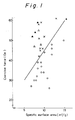
- Fig. 1 shows the relationship between the BET specific surface area and the coercive force of spinel-type iron oxide particles.
- the marks of ⁇ , ⁇ , ⁇ , and ⁇ represent the spinel-type iron oxide particles produced in accordance with the process of the present invention, the spinel-type iron oxide particles produced directly from aqueous solution in accordance with the process described in Japanese Patent Application Laid-Open (KOKAI) No. 63-68847 (1988), the spinel-type iron oxide particles produced by heating at 500°C the spinel-type iron oxide particles produced directly from an aqueous solution in accordance with the process described in Japanese Patent Application Laid-Open (KOKAI) No. 63-68847 (1988), and the spinel-type iron oxide particles according to Japanese Patent Application Laid-Open (KOKAI) No. 63-91423 (1988), respectively.
- the spinel-type iron oxide particles according to the present invention have a lower coercive force than the spinel-type iron oxide particles obtained by a conventional method.
- the spinel-type iron oxide particles produced in accordance with the present invention have a lower coercive force than the value represented by the straight line a in Fig. 1.
- the spinel-type black iron oxide particles according to the present invention have a large magnetization in an external magnetic field of 1 kOe, and as low a coercive force as possible so as to have a small magnetic cohesion, they are suitable as material particles for magnetic toners, magnetic carriers and magnetic cards. Since they are ferromagnetic particles they can be mixed with a resin so as to produce composite particles which can be used as material particles for magnetic toners, magnetic carriers and magnetic cards.
- the spinel-type black iron oxide particles according to the present invention are produced directly from an aqueous solution, the particles are discrete and the particle shape is a sphere. Therefore, since the spinel-type black iron oxide particles according to the present invention have excellent dispersibility, they are also usable as a known pigment for coatings and a known pigment for coloring resins.
- the magnetization and the coercive force of the particles in the following examples and comparative examples were measured by using a "sample vibrating type magnetometer VSM-3S-15", produced by Toei Kogyo K.K. and applying an external magnetic field of 1 kOe thereto.
- the specific surface area (m2/g) of the particles was measured by a BET method.
- the oxidization degree at this time was 64 mol%, and the pH of the suspension was 4.2. After the pH of the reaction suspension was adjusted to 11 by adding an aqueous NaOH solution thereto, air was blown into the suspension for 60 minutes so as to deposit a black precipitate. The pH at this time was 11.
- the precipitated black particles were filtered, washed with water, dried and pulverized.
- the black particles obtained were discrete spherical particles as a result of the observation through an electron micrograph, and the Zn content was 5.47wt% based on the black particles as a result of X-ray fluorometry.
- the particles had a specific surface area of 10.8 m2/g.
- the coercive force was 31 Oe and the magnetization was 74.4 emu/g.
- Black particles were obtained in the same way as in Example 1 except that the concentration of the aqueous ferrous salt solution was varied, the kind and concentration of zinc compound and the method of adding a zinc compound was varied, the pH of the suspension was varied, the aging process was sometimes omitted, the aging time was varied, and the oxidization degree in the oxidization process was varied.
- the main conditions for producing the particles are shown in Table 1 and various properties of the particles obtained are shown in Table 2.
- the particles obtained in Examples 2 to 7 and Comparative Examples 1 and 4 were discrete spherical particles as a result of the observation through an electron micrograph.
- the particles obtained in Comparative Example 2 were amorphous particles and the particles obtained in Comparative Example 3 were polyhedral particles such as hexahedral and octahedral particles.
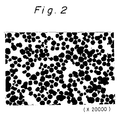
- Fig. 2 is an electron micrograph (x 20000) of the particles obtained in Example 2.
- the BET specific surface area of the particles obtained in Comparative Example 2 was 11.6 m2/g.
- the coercive force was 97 Oe, and the magnetization was 58.2 emu/g.
- Example 2 before blowing air into the suspension for 90 minutes at a rate of 100 l /min, the suspension was gradually oxidized at a rate of 20 l /min for 30 minutes and 15 minutes, respectively.
- Comparative Example 1 air was blown at a rate of 20 l /min in place of blowing N2 gas at a rate of 20 l /min.
Landscapes
- Physics & Mathematics (AREA)
- General Physics & Mathematics (AREA)
- Chemical & Material Sciences (AREA)
- Crystallography & Structural Chemistry (AREA)
- Organic Chemistry (AREA)
- Inorganic Chemistry (AREA)
- Compounds Of Iron (AREA)
- Hard Magnetic Materials (AREA)
Claims (10)
- Particules sphériques d'oxyde de fer noir de type spinelle contenant 1,5 à 17,0% en poids de Zn et ayant une aire superficielle spécifique de 5 à 15 m²/g, une magnétisation d'au moins 70 Am²/g (70 ému/g) dans un champ magnétique externe de 7,96 x 10⁴ A/m (1 kOe) et une force coercitive (Hc) ne dépassant pas la valeur obtenue à partir de l'expression suivante :


- Particules suivant la revendication 1, contenant de 3,0 à 12,0% en poids de Zn.
- Particules suivant les revendications 1 ou 2, ayant une aire superficielle spécifique de 6 à 12 m²/g.
- Particules suivant l'une quelconque des revendications précédentes, ayant une magnétisation allant jusqu'à 75,7 Am²/g (75,7 ému/g).
- Particules suivant l'une quelconque des revendications précédentes, ayant une force coercitive (Hc) ne dépassant pas la valeur obtenue à partir de l'expression suivante :


- Procédé pour la production des particules sphériques d'oxyde de fer noir de type spinelle suivant la revendication 1, qui comprend:(i) la préparation d'une suspension mélangée qui contient de l'hydroxyde ferreux et de l'hydroxyde de zinc et qui a un pH de 6 à 9 dans une atmosphère non oxydante, par utilisation d'une solution aqueuse d'un sel ferreux, d'un composé du zinc et d'une solution alcaline aqueuse; et(ii) l'injection d'un gaz contenant de l'oxygène moléculaire dans la suspension mélangée pour oxyder l'hydroxyde ferreux jusqu'à obtention d'un pH compris entre 4 et 6 et d'un degré d'oxydation tel que la quantité de Fe³⁺ dans la suspension mélangée représente de 60 à 70% en modes par rapport à la quantité totale de fer et de zinc dans l'étape d'oxydation.
- Procédé suivant la revendication 6, dans lequel la suspension mélangée est vieillie avant l'étape (ii) par maintien de la suspension à une température comprise entre 60 et 100°C pendant au moins 20 minutes.
- Procédé suivant les revendications 6 ou 7, dans lequel l'étape (ii) est conduite à une température comprise entre 60 et 100°C.
- Procédé suivant l'une quelconque des revendications 6 à 8, comprenant de plus:(iii) l'addition d'une solution alcaline aqueuse à la suspension obtenue dans l'étape (ii) pour ajuster le pH à une valeur d'au moins 10; et(iv) l'injection supplémentaire de gaz contenant de l'oxygène moléculaire dans la suspension.
- Toner magnétique, support magnétique ou carte magnétique dans lesquels les particules magnétiques sont des particules sphériques d'oxyde de fer noir de type spinelle suivant l'une quelconque des revendications 1 à 5; ou revêtement ou résine colorante dans lesquels ces particules sont présentes en tant que pigment.
Applications Claiming Priority (2)
| Application Number | Priority Date | Filing Date | Title |
|---|---|---|---|
| JP319101/90 | 1990-11-22 | ||
| JP2319101A JP2906084B2 (ja) | 1990-11-22 | 1990-11-22 | 球形を呈した黒色スピネル型酸化鉄粒子粉末及びその製造法 |
Publications (2)
| Publication Number | Publication Date |
|---|---|
| EP0487230A1 EP0487230A1 (fr) | 1992-05-27 |
| EP0487230B1 true EP0487230B1 (fr) | 1995-07-12 |
Family
ID=18106483
Family Applications (1)
| Application Number | Title | Priority Date | Filing Date |
|---|---|---|---|
| EP91310366A Expired - Lifetime EP0487230B1 (fr) | 1990-11-22 | 1991-11-08 | Particules sphériques d'oxyde de fer noir de type spinelle et procédé pour les préparer |
Country Status (3)
| Country | Link |
|---|---|
| EP (1) | EP0487230B1 (fr) |
| JP (1) | JP2906084B2 (fr) |
| DE (1) | DE69111196T2 (fr) |
Families Citing this family (5)
| Publication number | Priority date | Publication date | Assignee | Title |
|---|---|---|---|---|
| JPH0764322A (ja) * | 1993-08-26 | 1995-03-10 | Hitachi Metals Ltd | 磁性トナー |
| DE69408253T2 (de) * | 1993-09-30 | 1998-05-14 | Toda Kogyo Corp | Körnige Magnetitteilchen und Verfahren zu ihrer Herstellung |
| US5641600A (en) * | 1994-08-05 | 1997-06-24 | Canon Kabushiki Kaisha | Magnetic toner and image forming method |
| US5795692A (en) * | 1997-03-31 | 1998-08-18 | Xerox Corporation | Carrier composition and processes thereof |
| US6383637B1 (en) * | 1999-04-16 | 2002-05-07 | Toda Kogyo Corporation | Black magnetic iron oxide particles for magnetic toner and process for producing the same |
Family Cites Families (2)
| Publication number | Priority date | Publication date | Assignee | Title |
|---|---|---|---|---|
| GB1142215A (en) * | 1966-02-21 | 1969-02-05 | Nippon Electric Co | Improvements in or relating to ferrite particles and process for manufacturing same |
| DE3435698A1 (de) * | 1984-09-28 | 1986-04-03 | Basf Ag, 6700 Ludwigshafen | Verfahren zur herstellung von feinteiligem isotropen ferritpulver mit spinellstruktur |
-
1990
- 1990-11-22 JP JP2319101A patent/JP2906084B2/ja not_active Expired - Fee Related
-
1991
- 1991-11-08 EP EP91310366A patent/EP0487230B1/fr not_active Expired - Lifetime
- 1991-11-08 DE DE69111196T patent/DE69111196T2/de not_active Expired - Fee Related
Non-Patent Citations (1)
| Title |
|---|
| DERWENT JAPANESE PATENTS REPORT, Derwent Publications Ltd., London, GB; and JP-A-56 005 330 * |
Also Published As
| Publication number | Publication date |
|---|---|
| JPH04187523A (ja) | 1992-07-06 |
| DE69111196T2 (de) | 1996-03-21 |
| DE69111196D1 (de) | 1995-08-17 |
| EP0487230A1 (fr) | 1992-05-27 |
| JP2906084B2 (ja) | 1999-06-14 |
Similar Documents
| Publication | Publication Date | Title |
|---|---|---|
| US5336421A (en) | Spinel-type spherical, black iron oxide particles and process for the producing the same | |
| US5843610A (en) | Magnetic particles for magentic toner and process for producing the same | |
| EP0566790B1 (fr) | Poudre magnétique et toner magnétique | |
| EP0622426B1 (fr) | Particules granulaires de magnétite revêtues et leur procédé de fabrication | |
| EP0160496B1 (fr) | Particules magnétiques d'oxyde de fer | |
| EP0826635B1 (fr) | Particules de magnétite et leur procédé de préparation | |
| EP0279626B1 (fr) | Particules de magnétite et particules de maghémite de forme plate ainsi que leur méthode de fabrication | |
| EP0487230A1 (fr) | Particules sphériques d'oxyde de fer noir de type spinelle et procédé pour les préparer | |
| US5188898A (en) | Ferromagnetic metal particles and preparation process thereof | |
| EP0647593B1 (fr) | Particules granulaires de magnétite et procédé de leur fabrication | |
| EP0515749B1 (fr) | Procédé pour la production de particules aciculaires de goethite et particules magnétiques aciculaires d'oxyde de fer | |
| EP0401000B1 (fr) | Particules de magnétite en forme de plaques et procédé pour les produire | |
| JP3440586B2 (ja) | 粒状マグネタイト粒子粉末及びその製造法 | |
| EP0515748B1 (fr) | Procédé pour la production de particules aciculaires de goethite et particules aciculaires magnétiques d'oxyde de fer | |
| EP0817178B1 (fr) | Particules magnétiques d'oxydes de fer revêtues aciculaires | |
| JP3317359B2 (ja) | 磁気画像文字認識に用いる磁性トナー用磁性粒子粉末 | |
| JP3427850B2 (ja) | 粒状マグネタイト粒子粉末及びその製造法 | |
| JPS63105901A (ja) | 球形を呈した鉄合金を主成分とする磁性粒子粉末及びその製造法 | |
| JP3314788B2 (ja) | 粒状マグネタイト粒子粉末及びその製造法 | |
| JP2897794B2 (ja) | コバルト被着型磁性酸化鉄粒子粉末の製造法 | |
| JP3055308B2 (ja) | 針状磁性酸化鉄粒子粉末の製造法 | |
| JPH0532422A (ja) | 粒状マグネタイト粒子粉末の製造法 | |
| JPH0755831B2 (ja) | 磁性粒子粉末及びその製造法 | |
| JPH01176229A (ja) | 磁性粒子粉末及びその製造法 | |
| JPH08208237A (ja) | マグネタイト粒子およびその製造方法 |
Legal Events
| Date | Code | Title | Description |
|---|---|---|---|
| PUAI | Public reference made under article 153(3) epc to a published international application that has entered the european phase |
Free format text: ORIGINAL CODE: 0009012 |
|
| AK | Designated contracting states |
Kind code of ref document: A1 Designated state(s): DE FR GB NL |
|
| 17P | Request for examination filed |
Effective date: 19921103 |
|
| 17Q | First examination report despatched |
Effective date: 19930924 |
|
| GRAA | (expected) grant |
Free format text: ORIGINAL CODE: 0009210 |
|
| AK | Designated contracting states |
Kind code of ref document: B1 Designated state(s): DE FR GB NL |
|
| REF | Corresponds to: |
Ref document number: 69111196 Country of ref document: DE Date of ref document: 19950817 |
|
| ET | Fr: translation filed | ||
| PLBE | No opposition filed within time limit |
Free format text: ORIGINAL CODE: 0009261 |
|
| STAA | Information on the status of an ep patent application or granted ep patent |
Free format text: STATUS: NO OPPOSITION FILED WITHIN TIME LIMIT |
|
| 26N | No opposition filed | ||
| REG | Reference to a national code |
Ref country code: GB Ref legal event code: IF02 |
|
| PGFP | Annual fee paid to national office [announced via postgrant information from national office to epo] |
Ref country code: FR Payment date: 20021108 Year of fee payment: 12 |
|
| PGFP | Annual fee paid to national office [announced via postgrant information from national office to epo] |
Ref country code: NL Payment date: 20021129 Year of fee payment: 12 |
|
| PG25 | Lapsed in a contracting state [announced via postgrant information from national office to epo] |
Ref country code: NL Free format text: LAPSE BECAUSE OF NON-PAYMENT OF DUE FEES Effective date: 20040601 |
|
| PG25 | Lapsed in a contracting state [announced via postgrant information from national office to epo] |
Ref country code: FR Free format text: LAPSE BECAUSE OF NON-PAYMENT OF DUE FEES Effective date: 20040730 |
|
| NLV4 | Nl: lapsed or anulled due to non-payment of the annual fee |
Effective date: 20040601 |
|
| REG | Reference to a national code |
Ref country code: FR Ref legal event code: ST |
|
| PGFP | Annual fee paid to national office [announced via postgrant information from national office to epo] |
Ref country code: GB Payment date: 20041104 Year of fee payment: 14 |
|
| PG25 | Lapsed in a contracting state [announced via postgrant information from national office to epo] |
Ref country code: GB Free format text: LAPSE BECAUSE OF NON-PAYMENT OF DUE FEES Effective date: 20051108 |
|
| GBPC | Gb: european patent ceased through non-payment of renewal fee |
Effective date: 20051108 |
|
| PGFP | Annual fee paid to national office [announced via postgrant information from national office to epo] |
Ref country code: DE Payment date: 20071101 Year of fee payment: 17 |
|
| PG25 | Lapsed in a contracting state [announced via postgrant information from national office to epo] |
Ref country code: DE Free format text: LAPSE BECAUSE OF NON-PAYMENT OF DUE FEES Effective date: 20090603 |