EP0487515A2 - Plate-formes marines - Google Patents
Plate-formes marines Download PDFInfo
- Publication number
- EP0487515A2 EP0487515A2 EP92200379A EP92200379A EP0487515A2 EP 0487515 A2 EP0487515 A2 EP 0487515A2 EP 92200379 A EP92200379 A EP 92200379A EP 92200379 A EP92200379 A EP 92200379A EP 0487515 A2 EP0487515 A2 EP 0487515A2
- Authority
- EP
- European Patent Office
- Prior art keywords
- capture
- spring
- mating
- stabbing
- deck
- Prior art date
- Legal status (The legal status is an assumption and is not a legal conclusion. Google has not performed a legal analysis and makes no representation as to the accuracy of the status listed.)
- Withdrawn
Links
Images





Classifications
-
- E—FIXED CONSTRUCTIONS
- E02—HYDRAULIC ENGINEERING; FOUNDATIONS; SOIL SHIFTING
- E02B—HYDRAULIC ENGINEERING
- E02B17/00—Artificial islands mounted on piles or like supports, e.g. platforms on raisable legs or offshore constructions; Construction methods therefor
- E02B17/02—Artificial islands mounted on piles or like supports, e.g. platforms on raisable legs or offshore constructions; Construction methods therefor placed by lowering the supporting construction to the bottom, e.g. with subsequent fixing thereto
- E02B17/021—Artificial islands mounted on piles or like supports, e.g. platforms on raisable legs or offshore constructions; Construction methods therefor placed by lowering the supporting construction to the bottom, e.g. with subsequent fixing thereto with relative movement between supporting construction and platform
- E02B17/024—Artificial islands mounted on piles or like supports, e.g. platforms on raisable legs or offshore constructions; Construction methods therefor placed by lowering the supporting construction to the bottom, e.g. with subsequent fixing thereto with relative movement between supporting construction and platform shock absorbing means for the supporting construction
Definitions
- This invention relates to offshore platforms, and especially to the assembly of an offshore platform by mating a deck portion being carried by a barge or the like onto a base portion that is already standing secured to the bed of a sea or other body of water, or floating, with its top at or slightly above water level.
- EP-A-65695 discloses a combination of a deck portion and a base portion for an offshore platform, including a mating device which comprises an extendable stabbing pin mounted on one of said portions, capture means for said stabbing pin mounted on the other of the said portions, and resilient means arranged to oppose a coming together of the said portions, when the stabbing pin is engaged with the capture member, with a spring rate that is greater when they are closer together than when they are further apart.
- the present invention is characterised in that said capture means is capable of tilting from its normal position in response to the non-axial engagement thereof by said stabbing pin, resilient restoring means surrounding said capture means for restoring it to its normal position.
- the invention is especially applicable where the said base portion has previously been installed on, for example, the sea bed, in comparatively deep and exposed water, and a deck structure is to be lowered onto it from a barge or the like.
- the stabbing pin can be extended into engagement with the said capture means and then serve to guide the deck portion into correct mating alignment as it is lowered onto the base portion, while the increasing spring rate of the said resilient means ensures a smooth transfer of the weight of the deck portion from the barge onto the base portion.
- the stabbing pin is mounted on the deck portion and the capture means on the base portion.
- a distal end portion of the stabbing pin and a corresponding portion of the capture means may be so shaped as to tend to produce a self-centering action.
- the distal end portion of the stabbing pin is advantageously convex and the corresponding portion of the capture means concave, and they preferably have conical surfaces.
- the said deck portion and base portion may include tubular leg members that are arranged to abut end to end when the said portions are fully mated, and a said mating device is then advantageously disposed within a said leg member of the base portion and the corresponding leg member of the deck portion.
- the stabbing pin is retracted the mating device lies completely within the space envelope of the two legs, where it will neither be exposed to accidental damage nor obstruct other operations carried out within the vicinity of either the deck portion or the base portion.
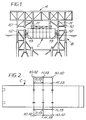
- a deck portion which here is a generally rectangular integrated deck of tubular or plate girder steel construction indicated generally by the reference letter A, is arranged to mate onto a base portion, which here is a tubular steel jacket indicated generally by the reference letter B, to form a platform.
- the deck has twelve legs, comprising four corner legs 10 and eight inner legs 11 (see Figure 2), the lower end of each of which is arranged to abut end-to-end with a respective corner or inner leg 12, 13 of the jacket.
- Many other possible arrangements of legs may be envisaged, for example eight legs in two groups of four, or sixteen in two groups of eight.
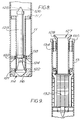
- a stabbing pin indicated generally by the reference numeral 14, comprising a cylindrical body 15 with a convex conical bottom end cap 16 and with an outwardly extending flange 17 at its upper end.
- a stop collar 18 secured to the inside of the deck leg 10 encircles the cylinder 15 near the bottom end of the deck leg.
- a bearing 19 fixed to the flange 17 slidably engages the inner surface of the deck leg 10.
- Bearings 20 and 21 fixed to the stop collar 18 and a further collar 22 respectively slidably engage the cylinder 15.
- the bearings 19 to 21 permit the stabbing pin 14 to move axially while maintaining it co-axial with the deck leg 10.
- the bearings 19 to 21 are plain bearings.
- a hydraulic ram 23 is connected at its lower end to a bracket 24 on the top of the cylindrical body 15 and at its upper end to a bracket 25 on a crossbar 26 fixed within the deck leg 10.
- the hydraulic ram 23 is fully retracted, as shown in Fig. 3, the conical cap 16 is at the level of the bottom end of the deck leg.
- the cylinder of the hydraulic ram 23 is attached to the crossbar 26 and the piston rod is attached to the stabbing pin 14.
- the hydraulic ram 23 is connected by pipes (not shown) to a source of hydraulic power (not shown).
- a capture funnel indicated generally by the reference numeral 27 that comprises a cylindrical tube 28, the internal diameter of which is somewhat larger than the external diameter of the stabbing pin 14. At the upper end of the tube 28 the funnel 27 spreads out to form a concave secondary capture cone 29, the extreme diameter of the funnel being somewhat less than the internal diameter of the legs 10 and 12.
- Two flanges 30 and 31 extend outwards from the tube 28.
- the capture funnel 27 stands on, but is not secured to, the top end of resilient means in the form of a compression spring stack 32.
- the spring stack 32 is long compared with the stroke of the ram 23, and is preferably made of elastomeric material with spacers so that it can deform and be compressed axially fairly easily. As shown, the spring stack 32 comprises a stack of separate elastomeric members which may each be of generally annular form.
- a concave primary capture cone 33 stands on, and is preferably secured to, the top of the spring stack 32.
- the tube 28 is encircled at its upper part by a resilient bearing 34 in the form of a collar of elastomeric material secured to the outside of the tube.
- the resilient bearing 34 serves mainly to resist horizontal loads, and also to stabilise the capture funnel 27 against radial displacement and tilting.
- the operation of the mating device provided in the corner legs 10 and 12 is as follows:
- the jacket B is installed at a desired location on the sea-bed, and the deck A is manoeuvred over it while being supported by a barge or the like C Figure 1).
- the deck is so positioned that each deck corner leg 10 is approximately coaxial with its respective jacket corner leg 12, with the conical cap 16 of the stabbing pin 14 separated from the primary capture cone 33 by a distance slightly shorter than the stroke of the ram 23.
- the ram 23 is fully retracted. That is the position shown in Fig. 1. It will be appreciated, however, that because of the reaction of wind and waves it will not normally be possible to align the deck legs and the jacket legs exactly, except transiently.
- the rams 23 of two diagonally opposite corner legs are then extended, extending the stabbing pin 14. That may be done quickly when the legs 10 and 11 are sufficiently closely aligned.
- Each conical cap 16 either enters the tube directly or is guided into it by the secondary capture cone 29, and then seats in the primary capture cone 33, as shown in Figure 7.
- the stabbing pin 14 is kept co-axial with the deck leg 10 by the bearings 19 to 21.
- the stabbing pin 14 preferably pushes down the primary capture cone 33 and begins to compress the spring stack 32 so that the cap 16 and the cone 33 will remain in engagement even if the barge C carrying the deck A is lifted by a wave.
- the secondary mating cones 122 in the inner legs engage the secondary capture cones 129 and the next about 20 percent of the load transfer is taken up by the stiffer spring stacks 132.
- the mating surfaces of the leg tubulars make contact. Ballasting then continues with no relative motion between the deck and the jacket until about 80 percent of the deck weight has been transferred, whereafter the barge is separated from the deck by the actuation of drop blocks which do not form part of the present invention.
- the leg tubulars may now be welded together to complete the operation of assembling the deck and jacket.
- the spring stack 32 is manufactured as a series of standard rubber layer elements, each incorporating steel plate reinforcement to form a stack height of 6.47m.
- the steel plate is arranged to operate as internal bearing around a central guide pin, and provide clearance to avoid rubber bulging inwards and binding on the guide pin.
- the rubber is bonded to the reinforcement during vulcanisation, which would be carried out in a large flat bed press. Shaping is included both on the internal and external diameters to minimise bulging and maximise tear resistance.
- Proposed sizes for the spring stack 32 are 104 elements 1250mm OD, 525mm ID with a rubber thickness of 58mm to provide a total stack height of 6.47m and axial stiffness of 1250 Tonne/m.
- the specification is as follows:
- the spring stack 132 would utilise the same elements as specified for the stack 32 and operate under similar conditions. Proposed sizes for the stack 132 consist of 61 elements 1250mm OD, 525mm ID with a rubber thickness of 58mm to provide a total stack height of 3.9m and axial stiffness of 2125 Tonne/m.
- the specification is as follows:
- the resilient bearing 34 is manufactured as a set of four complete rings, stacked vertically. Each ring element is 2.2m OD and 0.5m high. Moulding is an autoclave, the elastomer ring being bonded to a back flange for attachment to the capture cone body.
- the lateral stiffness of the assembly is 12500 Tonne/m.
- the bearing 34 is designed to accommodate 0.2m of lateral deflection and form an integral part of the total composite lateral stiffness of the jacket leg ends. This feature minimises overloading of the jacket leg, the bearing deflection being limited by external stops on the capture cone body.
- the specification is as follows:
- a stabbing pin indicated generally by the reference numeral 203, comprising a hollow cylinder 204 with a convex conical bottom end cap 205 and with an outwardly extending flange 206 at its upper end.
- a stop collar 207 secured to the inside of the deck leg 201 encircles the cylinder 204 near the bottom end of the deck leg, and a secondary mating cone 208, in the form of a collar with a convex frustoconical lower surface, is secured within the deck leg 301 substantially at the bottom end thereof and encircles the cylinder 204 below the stop collar 207.
- a bearing 209 fixed to the flange 206 slidably engages the inner surface of the deck leg 201.
- the bearings 209 to 211 permit the stabbing pin 203 to move axially while maintaining it co-axial with the deck leg 201.
- the bearings 209 to 211 are plain bearings.
- a hydraulic ram 212 is connected at its lower end to a bracket 213 on the top of the conical end cap 205 and at its upper end to a bracket 214 on a crossbar 215 fixed within the deck leg 201.
- the conical cap 205 is at the level of the secondary mating cone 208 and the crossbar 215 is just above the top of the stabbing pin 203.
- the lowest parts of the conical cap 205 and the secondary mating cone 208 are level with or slightly above the bottom end of the deck leg 201.
- the cylinder of the hydraulic ram 212 is attached to the crossbar 215 and the piston rod is attached to the stabbing pin 203.
- the hydraulic ram 212 is connected by pipes (not shown) to a source of hydraulic power (not shown).
- a capture funnel indicated generally by the reference numeral 216 that comprises a cylindrical tube 217, the internal diameter of which is somewhat larger than the external diameter of the stabbing pin 203. At the upper end of the tube 217, the funnel 216 spreads out to form a concave secondary capture cone 218, the extreme diameter of the funnel being just less than the internal diameter of the legs 201 and 202.
- Two flanges 219 and 220 extend outwards from the middle and the bottom, respectively, of the tube 217.
- the capture funnel 216 stands on, but is not secured to, the top end of a first compression spring 221.
- the first spring 221 is long compared with the stroke of the ram 212, and is preferably made of elastomeric material with spacers so that it can deform and be compressed axially fairly easily. As shown, the first spring 221 is made up of a stack of separate elastomeric members which may each be of generally annular form.
- a concave primary capture cone 222 stands on, and is preferably secured to, the top of the first spring 221.
- the tube 217 is encircled above the middle flange 219 by a resilient bearing 223 in the form of a collar of elastomeric material which may be secured to the outside of the tube or to the inside of the jacket leg 202.
- the resilient bearing 223 may be stiffened by one or more metal tubes, coaxial with the leg 202, embedded in the elastomer, and is advantageously wound in a spiral with alternate turns or metal and elastomer.
- the resilient bearing 223 serves mainly to resist horizontal loads, and also to stabilise the capture funnel 216 against radial displacement and tilting.
- An annular second compression spring 224 in the form of a sleeve of elastomeric material encircles the tube 217 below the middle flange 219 and is supported by a flange 225 on the inside of the jacket leg 202.
- the second spring 224 is much stiffer than the first spring 221, and may have metal disc annuli embedded in it to increase its stiffness.
- the resilient bearing 223 and/or the second spring 224 may instead be in the form of a plurality of discrete blocks spaced apart or contiguous around the circumference of the tube 217. If either the resilient bearing 223 or the second spring 224 is in the form of discrete blocks and has metal reinforcement, then the metal is in the form of corresponding sectors of the reinforcement for the equivalent annular arrangement.
- the jacket B is installed at a desired location on the sea-bed, and the deck A is manoeuvred over it while being supported by the barge or the like C.
- the deck is so positioned that each deck leg 201 is approximately coaxial with its respective jacket let 202, with the conical cap 205 of the stabbing pin 203 separated from the primary capture cone 222 by a distance slightly shorter than the stroke of the ram 212.
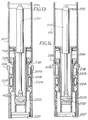
- the ram 212 is fully retracted. That is the position shown in Fig. 11. It will be appreciated, however, that because of the action of wind and waves it will not normally be possible to align the deck leg 201 and the jacket leg 202 exactly except transiently.
- the ram 212 is then extended, extending the stabbing pin 203. That may be done quickly when the legs 201 and 202 are sufficiently closely aligned, and if as in this embodiment there are a plurality of pairs of legs 201 and 202 with mating devices then the stabbing pins 203 may be extended separately as and when the opportunity arises for each, but it is preferred to extend all of the stabbing pins together.
- the conical cap 205 either enters the tube 217 directly or is guided into it by the secondary capture cone 218, and then seats in the primary capture cone 222, as shown in Fig. 12.
- the stabbing pin is kept co-axial with the deck leg 201 by the bearings 209 to 211.
- the stabbing pin 203 preferably pushes down the primary capture cone 222 and compresses the first spring 221 slightly, so that the cap 205 and the cone 222 will remain in engagement even if the barge C carrying the deck A is lifted by a wave.
- the deck is then lowered, while keeping the ram 212 extended. Part of the weight of the deck is then transmitted from the leg 201 through the ram 212 and the primary capture cone 222 to the first spring 221, which is compressed, and the engagement of the stabbing pin 203 with the capture cone keeps the legs 201 and 202 approximately aligned. That continues, with the force in the ram 212 gradually increasing, until the secondary mating cone 208 engages and seats on the secondary capture cone 218, which is supported by the second spring 224 abutting its middle flange 219 now that the first spring 221 is compressed, as shown in Fig. 13. Because the first springs 221 are both long and soft, only a minor proportion of the weight of the deck is ever carried by the rams 212.
- a small separation of the axes of the deck leg 201 and the jacket leg 202 can be accommodated because of the thickness of the rim 226 on which the deck leg seats. Because the second spring 224 acts between the legs 201 and 202 by way only of the second mating cone 208, the capture funnel 216, and the flange 225, the ram 212 is never subjected to the full load on the second spring and the degree of compression of, and hence the force taken by, the second spring at the moment when the legs 201 and 202 can be accurately predetermined.
- the legs 201 and 202 are then welded together and it may then be possible to dismantle the mating device and to remove at least part of it from inside the leg.
- the stabbing pin 203 is extended when there is angular misalignment between the deck leg 201 and the jacket leg 202, of if the deck tilts after the stabbing pin has engaged the primary capture cone 222, then the primary capture cone and the capture funnel 216 will tilt to accommodate the misalignment.
- the resilient bearing 223 compresses on one side, and the first spring 221 compresses unevenly so that its top face tilts, with the result that the capture funnel tends to pivot in a sense to align itself with the stabbing pin 203.
- even a very large misalignment of 5° can be accommodated at that stage, but it is preferred that the angular alignment should be no more than 1° out of true.
- a tilt of the deck corresponds to a difference in the separation between different legs 201 and their respective springs 221 and 224 that tends to right the deck, and becomes greater as the second springs 224 are engaged.
- the hydraulic ram 212 may be replaced by a pneumatic ram or by some other suitable driving means.
- the mating surfaces of the cap 205, the secondary mating cone 208, and the primary and secondary capture cones 221 and 218 are preferably, as shown in the drawings, conical surfaces, convex and concave, co-axial with the legs 201 and 202 and of equal cone angles, but any other surfaces that will provide the desired self-centring engagement may be used instead.
- the mating surfaces are advantageously provided with a low-friction coating to assist centring.
- the legs 201 and 202 may be about 2 metres in diameter, the ram 212 may have a stroke of about 3 metres, and the first spring 221 may have an uncompressed length of about 6 metres.
Landscapes
- Engineering & Computer Science (AREA)
- General Engineering & Computer Science (AREA)
- Mechanical Engineering (AREA)
- Civil Engineering (AREA)
- Structural Engineering (AREA)
- Revetment (AREA)
- Load-Engaging Elements For Cranes (AREA)
- Springs (AREA)
Applications Claiming Priority (4)
| Application Number | Priority Date | Filing Date | Title |
|---|---|---|---|
| GB8502600 | 1985-02-01 | ||
| GB858502600A GB8502600D0 (en) | 1985-02-01 | 1985-02-01 | Offshore platforms |
| GB858522975A GB8522975D0 (en) | 1985-09-17 | 1985-09-17 | Offshore platforms |
| GB8522975 | 1985-09-17 |
Related Parent Applications (1)
| Application Number | Title | Priority Date | Filing Date |
|---|---|---|---|
| EP86300673.0 Division | 1986-01-31 |
Publications (2)
| Publication Number | Publication Date |
|---|---|
| EP0487515A2 true EP0487515A2 (fr) | 1992-05-27 |
| EP0487515A3 EP0487515A3 (en) | 1992-08-26 |
Family
ID=26288741
Family Applications (2)
| Application Number | Title | Priority Date | Filing Date |
|---|---|---|---|
| EP19920200379 Withdrawn EP0487515A3 (en) | 1985-02-01 | 1986-01-31 | Offshore platforms |
| EP86300673A Expired - Lifetime EP0190055B1 (fr) | 1985-02-01 | 1986-01-31 | Plate-forme offshore |
Family Applications After (1)
| Application Number | Title | Priority Date | Filing Date |
|---|---|---|---|
| EP86300673A Expired - Lifetime EP0190055B1 (fr) | 1985-02-01 | 1986-01-31 | Plate-forme offshore |
Country Status (4)
| Country | Link |
|---|---|
| US (1) | US4662788A (fr) |
| EP (2) | EP0487515A3 (fr) |
| DK (1) | DK46186A (fr) |
| NO (1) | NO860346L (fr) |
Cited By (4)
| Publication number | Priority date | Publication date | Assignee | Title |
|---|---|---|---|---|
| EP0908382A3 (fr) * | 1997-09-16 | 1999-08-11 | Deep Oil Technology, Incorporated | Méthodes d'assemblage de structures flottantes de haute mer |
| EP2278084A1 (fr) * | 2009-06-18 | 2011-01-26 | Overdick GmbH & co. KG | Agencement en mer et procédé d'installation d'un agencement en mer |
| WO2013006032A1 (fr) * | 2011-07-07 | 2013-01-10 | Lembaga Getah Malaysia (Malaysian Rubber Board) | Dispositif amortisseur permettant de monter un pont intégré sur des jambes en treillis tubulaires métalliques |
| WO2014036464A3 (fr) * | 2012-08-31 | 2014-07-31 | Robert Johns | Procédés et connecteurs pour réalisation de liaisons structurales sans soudage en mer de connecteurs |
Families Citing this family (23)
| Publication number | Priority date | Publication date | Assignee | Title |
|---|---|---|---|---|
| NL8701856A (nl) * | 1987-01-14 | 1988-08-01 | Allseas Eng Bv | Werkwijze voor het manoeuvreren van een opbouwelement ten opzichte van een in water aangebrachte vaste constructie, werkwijze voor het bouwen van een bouwwerk en bouwwerk gebouwd volgens een dergelijke werkwijze. |
| US4883387A (en) * | 1987-04-24 | 1989-11-28 | Conoco, Inc. | Apparatus for tensioning a riser |
| DE3726247C1 (de) * | 1987-08-07 | 1988-11-10 | Fischer Ag Georg | Verbindungselement |
| US4848967A (en) * | 1988-01-04 | 1989-07-18 | Exxon Production Research Company | Load-transfer system for mating an integrated deck with an offshore platform substructure |
| US4902169A (en) * | 1989-05-17 | 1990-02-20 | Sutton John R | Jack-up type platform including adjustable stop assembly |
| US4930938A (en) * | 1989-06-02 | 1990-06-05 | Exxon Production Research Company | Offshore platform deck/jacket mating system and method |
| US5037241A (en) * | 1990-03-29 | 1991-08-06 | Exxon Production Research Company | Method and apparatus for setting a superstructure onto an offshore platform |
| US5219451A (en) * | 1992-04-24 | 1993-06-15 | Atlantic Richfield Company | Offshore deck to substructure mating system and method |
| FR2711687B1 (fr) * | 1993-10-29 | 1995-12-29 | Etpm Sa | Procédé pour installer le pont d'une plate-forme marine sur une structure support en mer. |
| US5553977A (en) * | 1994-12-16 | 1996-09-10 | Northrop Grumman Corporation | Off-shore platform construction, and method for transferring loads |
| IT1283508B1 (it) * | 1996-07-26 | 1998-04-21 | Saipem Spa | Sistema e procedimento per trasferire un carico da una bettolina ad una sottostruttura |
| USH1815H (en) * | 1997-03-24 | 1999-11-02 | Exxon Production Research Company | Method of offshore platform construction using a tension-moored barge |
| US5972192A (en) * | 1997-07-23 | 1999-10-26 | Advanced Micro Devices, Inc. | Pulse electroplating copper or copper alloys |
| FR2779754B1 (fr) | 1998-06-12 | 2000-08-25 | Technip Geoproduction | Dispositif de transport et de pose d'un pont d'une plate-forme petroliere d'exploitation en mer |
| NO20010703D0 (no) * | 2001-02-09 | 2001-02-09 | Marine Shuttle Operations As | Fremgangsmåte og anordning ved fjerning av plattformdeler |
| NO317848B1 (no) * | 2003-01-17 | 2004-12-20 | Aker Marine Contractors As | Fremgangsmate og arrangement for installasjon og fjerning av gjenstander til havs |
| NO322872B1 (no) * | 2003-11-13 | 2006-12-18 | Aker Marine Contractors As | Vertikal installasjon av en langstrakt prosess-enhet |
| US8251615B2 (en) * | 2007-06-27 | 2012-08-28 | Horton Wison Deepwater, Inc. | System and method for releasing a barge from a topside during a float-over installation |
| EP3384094A2 (fr) * | 2015-12-04 | 2018-10-10 | Techlam S.A. | Unite de connexion d'un element structurel de plateforme marine a une structure d'accueil et utilisations liees |
| US11255062B2 (en) * | 2017-12-06 | 2022-02-22 | Fmc Technologies, Inc. | Universal block platform lower platform block and method of use |
| DE102018133261A1 (de) * | 2018-12-20 | 2020-06-25 | Tractebel Overdick GmbH | Offshore-Plattform mit wenigstens einem Stützbein und ein Verfahren zu ihrer Gründung |
| CN113353202B (zh) * | 2020-03-04 | 2022-11-29 | 中国电建集团华东勘测设计研究院有限公司 | 一种海上换流站的浮托式安装结构及方法 |
| US11686362B2 (en) | 2020-09-30 | 2023-06-27 | Saudi Arabian Oil Company | Shock absorber stand |
Family Cites Families (5)
| Publication number | Priority date | Publication date | Assignee | Title |
|---|---|---|---|---|
| FR1255804A (fr) * | 1960-04-30 | 1961-03-10 | Hansens Gummi & Packungswerke | Suspension élastique pour véhicules, notamment pour véhicules sur rails |
| NL7806612A (nl) * | 1977-09-21 | 1979-03-23 | Babcock Ag | Zeeplatform. |
| US4252468A (en) * | 1978-04-03 | 1981-02-24 | Brown & Root, Inc. | Method and apparatus for installing deck structures entailing composite shock absorbing and alignment aspects |
| FR2496730A1 (fr) * | 1980-12-23 | 1982-06-25 | Bretagne Atel Chantiers | Dispositif pour la mise en place d'une plate-forme marine sur sa structure support |
| FR2505900A1 (fr) * | 1981-05-15 | 1982-11-19 | Bretagne Atel Chantiers | Dispositif pour la mise en place d'une plate-forme et procede d'utilisation dudit dispositif |
-
1986
- 1986-01-30 DK DK46186A patent/DK46186A/da unknown
- 1986-01-31 NO NO860346A patent/NO860346L/no unknown
- 1986-01-31 EP EP19920200379 patent/EP0487515A3/en not_active Withdrawn
- 1986-01-31 EP EP86300673A patent/EP0190055B1/fr not_active Expired - Lifetime
- 1986-01-31 US US06/825,183 patent/US4662788A/en not_active Expired - Fee Related
Cited By (6)
| Publication number | Priority date | Publication date | Assignee | Title |
|---|---|---|---|---|
| EP0908382A3 (fr) * | 1997-09-16 | 1999-08-11 | Deep Oil Technology, Incorporated | Méthodes d'assemblage de structures flottantes de haute mer |
| EP2278084A1 (fr) * | 2009-06-18 | 2011-01-26 | Overdick GmbH & co. KG | Agencement en mer et procédé d'installation d'un agencement en mer |
| WO2013006032A1 (fr) * | 2011-07-07 | 2013-01-10 | Lembaga Getah Malaysia (Malaysian Rubber Board) | Dispositif amortisseur permettant de monter un pont intégré sur des jambes en treillis tubulaires métalliques |
| GB2503134A (en) * | 2011-07-07 | 2013-12-18 | Lembaga Getah Malaysia Malaysian Rubber Board | A shock absorbing device for mating of an integrated deck to jacket legs |
| US9080633B2 (en) | 2011-07-07 | 2015-07-14 | Lembaga Getah Malaysia (Malaysian Rubber Board) | Shock absorbing device for mating of an integrated deck to jacket legs |
| WO2014036464A3 (fr) * | 2012-08-31 | 2014-07-31 | Robert Johns | Procédés et connecteurs pour réalisation de liaisons structurales sans soudage en mer de connecteurs |
Also Published As
| Publication number | Publication date |
|---|---|
| EP0190055A2 (fr) | 1986-08-06 |
| NO860346L (no) | 1986-08-04 |
| EP0190055B1 (fr) | 1992-09-02 |
| EP0487515A3 (en) | 1992-08-26 |
| DK46186A (da) | 1986-08-02 |
| DK46186D0 (da) | 1986-01-30 |
| EP0190055A3 (en) | 1987-08-12 |
| US4662788A (en) | 1987-05-05 |
Similar Documents
| Publication | Publication Date | Title |
|---|---|---|
| EP0190055B1 (fr) | Plate-forme offshore | |
| EP0259072B1 (fr) | Système d'amarrage et système pour amarrer une structure flottante | |
| US4930938A (en) | Offshore platform deck/jacket mating system and method | |
| US4222683A (en) | Offshore construction | |
| US4724970A (en) | Compensating device for a crane hook | |
| US5219451A (en) | Offshore deck to substructure mating system and method | |
| GB1589549A (en) | Bumpers | |
| EP3354894A1 (fr) | Dispositif de guidage pour le montage de mâts éoliens | |
| US4721417A (en) | Compliant offshore structure stabilized by resilient pile assemblies | |
| KR20190075161A (ko) | 교체 가능한 요소 롤러 베어링 조립체 | |
| EP0157585B1 (fr) | Arrangement cylindrique d'altitude considérable | |
| US5092712A (en) | Inclined leg jack-up platform with flexible leg guides | |
| US4702636A (en) | System for connecting two members together | |
| CN112628096A (zh) | 一种基于温差能发电的冷海水管作业系统 | |
| US4453859A (en) | Device for connecting and disconnecting the swivel of an oscillating marine platform and a method for putting the said device into use | |
| EP0045651B1 (fr) | Appareil et method de support pour puits | |
| CA1246880A (fr) | Dispositif de positionnement pour plates-formes marines | |
| CN214424644U (zh) | 一种基于温差能发电的冷海水管作业系统 | |
| US20220388815A1 (en) | Transport apparatus | |
| JP3779000B2 (ja) | 免震装置 | |
| CN1331708C (zh) | 可转动地支承于船只上的转塔的轴向支承结构 | |
| JPS6241814A (ja) | 海洋プラットホ−ム用組立て装置及びその組立て方法 | |
| US5743677A (en) | Subsea multi-segmented pile gripper | |
| US4475609A (en) | Device for gauging large load exerted on steel structure or the like | |
| CN115654073B (zh) | 一种拉杆支撑装置 |
Legal Events
| Date | Code | Title | Description |
|---|---|---|---|
| PUAI | Public reference made under article 153(3) epc to a published international application that has entered the european phase |
Free format text: ORIGINAL CODE: 0009012 |
|
| AC | Divisional application: reference to earlier application |
Ref document number: 190055 Country of ref document: EP |
|
| AK | Designated contracting states |
Kind code of ref document: A2 Designated state(s): FR GB NL |
|
| PUAL | Search report despatched |
Free format text: ORIGINAL CODE: 0009013 |
|
| AK | Designated contracting states |
Kind code of ref document: A3 Designated state(s): FR GB NL |
|
| 17P | Request for examination filed |
Effective date: 19921026 |
|
| STAA | Information on the status of an ep patent application or granted ep patent |
Free format text: STATUS: THE APPLICATION HAS BEEN WITHDRAWN |
|
| 18W | Application withdrawn |
Withdrawal date: 19930612 |