EP0487672B1 - Ensemble structural d'informations et/ou de stimulii associes - Google Patents
Ensemble structural d'informations et/ou de stimulii associes Download PDFInfo
- Publication number
- EP0487672B1 EP0487672B1 EP91910754A EP91910754A EP0487672B1 EP 0487672 B1 EP0487672 B1 EP 0487672B1 EP 91910754 A EP91910754 A EP 91910754A EP 91910754 A EP91910754 A EP 91910754A EP 0487672 B1 EP0487672 B1 EP 0487672B1
- Authority
- EP
- European Patent Office
- Prior art keywords
- stimulii
- data
- game
- boards
- information
- Prior art date
- Legal status (The legal status is an assumption and is not a legal conclusion. Google has not performed a legal analysis and makes no representation as to the accuracy of the status listed.)
- Expired - Lifetime
Links
- 239000000463 material Substances 0.000 claims description 9
- 239000003086 colorant Substances 0.000 claims description 7
- 230000008901 benefit Effects 0.000 description 2
- 239000003054 catalyst Substances 0.000 description 1
- 230000001419 dependent effect Effects 0.000 description 1
- 230000003467 diminishing effect Effects 0.000 description 1
- 230000008447 perception Effects 0.000 description 1
- 230000000638 stimulation Effects 0.000 description 1
- 239000012780 transparent material Substances 0.000 description 1
- 230000000007 visual effect Effects 0.000 description 1
- 239000002023 wood Substances 0.000 description 1
Images

Classifications
-
- A—HUMAN NECESSITIES
- A63—SPORTS; GAMES; AMUSEMENTS
- A63F—CARD, BOARD, OR ROULETTE GAMES; INDOOR GAMES USING SMALL MOVING PLAYING BODIES; VIDEO GAMES; GAMES NOT OTHERWISE PROVIDED FOR
- A63F1/00—Card games
- A63F1/04—Card games combined with other games
Definitions
- This report is to describe a structural set that relates information and/or stimulii to each other, and more particularly, to describe a cybernetic or pedagogic model which is presented in the form of a game.
- This game uses especially designed boards - either fixed or dissassemblable -, dice and playing-like cards that are used to enhance the ability of the learner to create and to establish relationships between the different elements that make up one or more subjects or topics.
- the Structural Set being described herein incentivates the learner to think for himself or herself, through a process of relating information or stimulii presented to him or to her by the different objects that make up the set.
- a game which comprises a board having a schematic plan of an geographical area, a die, a plurality of cards and which is suitable for several players.
- the cards contain anagrams and each player has to solve the anagrams for proceeding the game.
- This game is based upon recognition of facts of different fields of knowledge. It does not apply to the intelligence of the single player and there is no learning aspect regarding basic education.
- the Structural Set in question is suitable to a wide variety of topics and subjects, such as all spoken languages for instance, including the so-called dead languages. It can also be used to help the learner with Grammar, High-School, College and all Technical courses, such as history, geography, science, arts, math and others - in summary, any and all information that can be taught.
- this invention is made up of a set of fixed boards, of flexible board sets that may be folded; of dissassemblable boards; of dice and of special game-like cards that contain a set of data and other elements which stimulate and which allow the learner to relate the data and the other elements, expressing the relationships between them, and creating a series of answers to a given question or request, which in itself is also contained in the physical components of the game.
- the structural set being described herein allows the learner to work alone or in partnership, soliciting and/or deriving combinations that enhance, if necessary, the relationship between the elements that have been furnished.
- All the elements that compose the set; namely the boards, the dice and the cards have at first moment, the purpose to stimulate; to ask and/or to formulate questions or requests to the learner. In the second moment, to serve as an answer sheet so that the learner's replies may be checked and corrected.
- a pedagogic game cybernetic model made up of a base board (TB) manufactured of wood or some other rigid material; a foldable board (TV), manufacutred of some resistent material that allows itself to be folded; a board that may be dissassembled (TD) which is made up of flat, rectangular pieces which when placed together make up the board itself; a die with multiple faces like for example, six, nine, twelve or more faces (D), and a glossematic set of playing-like cards (B), made up of a minimum of twenty cards (C).
- the base board (TB) usually presents three lines - L1, L2 and L3, of different colors, and three or four columns - C1, C2, C3 and C4. The number of columns is determined by the subject being studied.
- Each color for the lines L1, L2 and L3 contains one item of a given topic.
- the item could be a verb form.
- Each column - C1, C2, C3 ....Cm - contains information related to that item.
- the columns C1, C2, C3...Cm are mandatorily named according to the type of information being discussed and according to the relationships that are to be recreated.
- the Portuguese language the first column C1 may act as a catalyst or stimulus.
- Column C2 may serve as a help column;
- column C3 may be a difficulty;
- column C4 may show situations of actual usage, and so on.
- the base board, TB should be manufactured of rigid material with nothing written on in, but it should be able to accept the assembly of the other boards of variations (TV), that contain a wide variety of subjects.
- the base board, TB should have an all-around frame.
- the title of each column - C1, C2, C3,...Cn should come above the square subdivisions.
- the line for the title (LT) should be demarcated by a white line above the said subdivisions.
- the board of variations is normally subdivided into twelve sections, made up of four columns and of three lines, identical to the ones described for the base board TB.
- the subdivisions of the variations board (TV) will contain the different items of information relating to a given topic. For instance, they may contain a verb form distributed in three lines, L1, L2 and L3, with the present, the past perfect and the future tenses.
- the four columns, C1, C2, C3 and C4 would contain a stimulus, the facilities, the difficulties and a situation of usage.
- verb forms would be the determined topic.
- the variations board may be supplied in kit form, each kit dealing with a specific topic, such as geography: climate and/or fauna; history: the industrial revolution and so on.
- the dissassemblable board, TD is made up of square pieces, painted with the same color scheme used on the variations board TV.
- Each square piece (1) should have a frontal face containing the same items of information contained on each one of the spaces on the variations board TV. On the back, the items of information would be expanded. In other words, the learner would be presented with new elements or new items of information.
- the number of square pieces on the disassemblable board TD varies according with need. It should, however, be more than twelve.
- the square pieces, 1, should be in such a number that they would contain enough information about a given topic to really exhaust its range of study.
- the number of squares (1) is subdivided into nine levels, each level corresponding to an increased degree of difficulty.
- the nine levels of the dissassemblable board TD of the kit being discussed would correspond to the first eight years of basic schooling, with an additional level for advanced students.
- the structured kit in question encompasses: a single base board TB.
- white TV and TD boards there may be also included elements establishing relationships that were not part of the original kit, and which were developed later as the need arose.
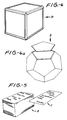
- the die, D contains multiple faces which are dissassemblable, and which may be taken out of its original structural frame. These faces may contain information and/or stimulii either on the front or on the back portion of each face, as illustrated in figures 4 and 4a.
- the die has the purpose of incentivating the learner to relate the elements and/or informations on the die with other items on the same die. Or to relate the elements and/or informations on the die with other components of the set. Or even to sometimes identify theoretical denominations.
- the glossematic deck of playing-like cards, B is made up of at least twenty cards relating to the same topic. Each card contains items of information that were selected according the their degree of utility to their target public. They are, therefore, selected according the their frequency of usage.
- the cards C of the deck of play-like cards B contain the spaces determining the specific fields that will contain the different items of information.
- the type of information that will be found on each card C is determined according to: its positioning relative to the physical space of the card C; the shading of the color in which the information was printed; and by symbols printed on the front face of the card C.
- each card C there is a symbol defined for each card C and this symbol is printed on the front face of the card. This symbol is used to define the classification type for a given expression, title or topic.
- the front face of the card C also contains at least one expression-title containing relatable information .
- On the back of the card C there are pairs or couplets of information that are related and which are relatable to the expression 'title' which was defined on the front face of the card C.
- the items of information on the back portion of the card C are related in some form to the items of information contained on the corresponding variations board TV.
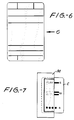
- the items of information contained on the cube or die D refer to techical terms that allow one to estabish - or not as the case may be - adequate relationships with the remaining component pieces of thee structural set; including relationships with one or more additional cubes or dice that make up the kit.
- a lay-out, G is also an integral part of the kit.
- the lay-out is made of a convenient transparent material, that allows easy viewing of the items of information contained on eack card.
- a mask, M made of a convenient translucid material, and in different colors is also part of the kit. The mask M, when placed over the card C, hides selected items of data and/or stimulii, that have been printed on the card using the same color as that of the mask M.
- the system may additionally be manipulated in parts. Meaning individually each one of its component elements TD, TV, D, B or any combination among them; two by two, three by three, or all of them simultaneously.
Landscapes
- Engineering & Computer Science (AREA)
- Multimedia (AREA)
- Electrically Operated Instructional Devices (AREA)
Abstract
Claims (8)
- "ENSEMBLE STRUCTUREL POUR ÉTABLIR DES RELATIONS ENTRE DES INFORMATIONS ET/OU DES STIMULI" jeu présenté dans la forme d'un modèle pédagogique, comprennant un tablier fixe (TB), un ensemble de tabliers pliables (TV), lesquels sont identiques à un ensemble de tabliers démontables (TD), chaque tablier démontable (TD) comprennant une pluralité de lignes (L) et colonnes (C1....Cm), les tabliers démontables (TD) ayant le même nombre de lignes et colonnes que chacun des autres, chaque tablier démontable (TD) contenant encore au moins trois lignes (L1, L2, L3) de différentes couleurs et au moins quatre colonnes (C1, C2, C3, C4, Cm-1, Cm) définissant des carrés dans lesquels il est assigné une couleur spécifique et topique pour chaque ligne (L1, L2, L3) et dis lesquels il est assigné un aspect pour chaque colonne (C1, C2, C3, C4, Cm-1, Cm ) lequel détermine des données spécifiques se rapportant au topique présenté dans la ligne (L1, L2, L3), l'ensemble structurel comprennant encore plusieurs dés (D) et une multiplicité de jeux de carte (B, C), ledit tablier de base (TB) étant manufacturé d'un matériel rigide et étant dépourvu de données, chacun desdits tabliers pliables (TV) étant manufacturé d'un matériel résistant ayant sur soi des données sélectionnées, ledit tablier démontable (TD) définissant une base rigide réalisée avec au moins douze unités carrées (1) ayant les mêmes couleurs et données des tabliers pliables correspondants (TV), chacun desdits dés (D) étant démontable et manufacturé de matériel rigide, ledit jeu de cartes constitué d'au moins vingt cartes (B), chacune d'elles contenant des champs spécifiques imprimés sur leurs deux côtés, où des indices sont imprimés avec des couleurs sélectionnées, et comprennant encore un gabarit (G), réalisé dans un matériel translucide convenable de différentes couleurs et une masque (M), faite également d'un matériel translucide convenable de différentes couleurs cachant des items sélectionnés de données et/ou stimuli, lesquels ont été imprimés sur la carte (B) utilisant la même couleur de la masque (M).
- "ENSEMBLE STRUCTUREL POUR ÉTABLIR DES RELATIONS ENTRE DES INFORMATIONS ET/OU DES STIMULI", jeu comme revendiqué dans la revendication 1, caractérisé en ce que le nombre d'unités carrées desdits tabliers démontables (TD) est significativement plus grand que le nombre d'espaces prévus sur les tabliers pliables (TV).
- "ENSEMBLE STRUCTUREL POUR ÉTABLIR DES RELATIONS ENTRE DES INFORMATIONS ET/OU DES STIMULI", jeu comme revendiqué dans la revendication 1, caractérisé en ce que quelques uns des côtés desdits dés démontables (D) présentent des données aussi bien sur leur face avant que sur leur face arrière, où lesdites faces sont colorées différemment et compatibles avec lesdites faces colorées prévues sur lesdits tabliers pliables (TV).
- "ENSEMBLE STRUCTUREL POUR ÉTABLIR DES RELATIONS ENTRE DES INFORMATIONS ET/OU DES STIMULI", jeu comme revendiqué dans la revendication 3, caractérisé en ce que le dé (D) a une pluralité de faces avec un minimum de six faces.
- "ENSEMBLE STRUCTUREL POUR ÉTABLIR DES RELATIONS ENTRE DES INFORMATIONS ET/OU DES STIMULI", jeu comme revendiqué dans la revendication 1, caractérisé en ce que chacune desdites cartes (C) contient, dans sa face avant, un critéria pour la classification pour chaque expression titre ou topique, contient encore au moins un expression titre avec des données rapportables, et la face arrière de la carte (C) contient encore des paires spécifiques d'information sur des données rapportables, lesquelles sont rapportables avec l'expression qui est définie dans la face avant de la carte (C).
- "ENSEMBLE STRUCTUREL POUR ÉTABLIR DES RELATIONS ENTRE DES INFORMATIONS ET/OU DES STIMULI", jeu comme revendiqué dans l'une quelconque des revendications précédentes, caractérisé en ce que les données contenues dans chacune desdites cartes (C) sont rapportables avec l'information et/ou stimuli qui sont contenus dans les autres pièces (TV, TD, D).
- "ENSEMBLE STRUCTUREL POUR ÉTABLIR DES RELATIONS ENTRE DES INFORMATIONS ET/OU DES STIMULI", jeu comme revendiqué dans la revendication 6, caractérisé en ce que les données qui sont contenues dans la face arrière de chacune desdites cartes (C) sont rapportables avec les données qui sont contenues dans le tablier pliable (TV) correspondant.
- "ENSEMBLE STRUCTUREL POUR ÉTABLIR DES RELATIONS ENTRE DES INFORMATIONS ET/OU DES STIMULI", jeu comme revendiqué dans la revendication 1, caractérisé en ce que le gabarit (G) définit l'orientation relative à l'information positionnée sur la face avant de ladite carte (C).
Applications Claiming Priority (3)
| Application Number | Priority Date | Filing Date | Title |
|---|---|---|---|
| BR9002945 | 1990-06-18 | ||
| BR9002945A BR9002945A (pt) | 1990-06-18 | 1990-06-18 | Conjunto estrutural de relacionar informacoes e/ou estimulos |
| PCT/BR1991/000007 WO1991019550A1 (fr) | 1990-06-18 | 1991-06-18 | Ensemble structural d'informations et/ou de stimulii associes |
Publications (2)
| Publication Number | Publication Date |
|---|---|
| EP0487672A1 EP0487672A1 (fr) | 1992-06-03 |
| EP0487672B1 true EP0487672B1 (fr) | 1995-10-11 |
Family
ID=4049667
Family Applications (1)
| Application Number | Title | Priority Date | Filing Date |
|---|---|---|---|
| EP91910754A Expired - Lifetime EP0487672B1 (fr) | 1990-06-18 | 1991-06-18 | Ensemble structural d'informations et/ou de stimulii associes |
Country Status (5)
| Country | Link |
|---|---|
| EP (1) | EP0487672B1 (fr) |
| BR (1) | BR9002945A (fr) |
| DE (1) | DE69113747T2 (fr) |
| ES (1) | ES2082210T3 (fr) |
| WO (1) | WO1991019550A1 (fr) |
Families Citing this family (1)
| Publication number | Priority date | Publication date | Assignee | Title |
|---|---|---|---|---|
| DE10325540A1 (de) * | 2003-06-04 | 2004-12-30 | Wilhelm Bronner | Informationssystem |
Family Cites Families (4)
| Publication number | Priority date | Publication date | Assignee | Title |
|---|---|---|---|---|
| GB1597706A (en) * | 1978-05-31 | 1981-09-09 | Bonner Morgan B M | Board games |
| US4213616A (en) * | 1979-07-02 | 1980-07-22 | Dickey Thomas E | Four-in-a-row board game |
| US4706960A (en) * | 1985-11-18 | 1987-11-17 | Nowacki Robert S | Fields of law and legal process card and board game apparatus |
| GB8609305D0 (en) * | 1986-04-16 | 1986-05-21 | Donnelly G | Apparatus for playing board game |
-
1990
- 1990-06-18 BR BR9002945A patent/BR9002945A/pt not_active IP Right Cessation
-
1991
- 1991-06-18 WO PCT/BR1991/000007 patent/WO1991019550A1/fr not_active Ceased
- 1991-06-18 ES ES91910754T patent/ES2082210T3/es not_active Expired - Lifetime
- 1991-06-18 DE DE69113747T patent/DE69113747T2/de not_active Expired - Fee Related
- 1991-06-18 EP EP91910754A patent/EP0487672B1/fr not_active Expired - Lifetime
Also Published As
| Publication number | Publication date |
|---|---|
| WO1991019550A1 (fr) | 1991-12-26 |
| ES2082210T3 (es) | 1996-03-16 |
| EP0487672A1 (fr) | 1992-06-03 |
| BR9002945A (pt) | 1990-12-11 |
| DE69113747T2 (de) | 1996-09-12 |
| DE69113747D1 (de) | 1995-11-16 |
Similar Documents
| Publication | Publication Date | Title |
|---|---|---|
| Ellington | Games and Simulations in Science Education. | |
| Baer | The impact of the core knowledge curriculum on creativity | |
| US4923198A (en) | Board game of geopolitical and related knowledge | |
| Sato | The culturally different gifted child—The dawning of his day? | |
| Harrison | Training Students To Tutor. | |
| National Art Education Association | Quality art education: Goals for schools: An interpretation | |
| Varga | Mathematics education in Hungary today | |
| EP0487672B1 (fr) | Ensemble structural d'informations et/ou de stimulii associes | |
| US6386880B2 (en) | Numerical problem solving game | |
| US7520508B2 (en) | Board game apparatus for teaching electoral college, historical and geographical concepts | |
| Wang | The Rationale and Design of the Self-Schedule System. | |
| Benderson | Foreign Lanuages in the Schools. | |
| Kilcrease | Principals' perceptions of the functions and characteristics of middle schools in Mississippi | |
| Eidson | The role of instructional aids in arithmetic education. | |
| KORDICH | An instructional strategy in art criticism for the middle school: A game approach focusing on the stage of analysis | |
| CA1143555A (fr) | Systeme d'enseignement autocorrecteur | |
| UNRUH | A STUDY OF JUNIOR HIGH SCHOOLS AND MIDDLE SCHOOLS WITH REFERENCE TO PHILOSOPHY, FUNCTION, CURRICULUM, PERSONNEL, AND ACTIVITIES PROGRAM. | |
| Klausmeier | The Gifted: What Will They Become? | |
| Asan | The affective and cognitive effects on eighth-grade students of the Project REACH multicultural program | |
| Bippert | Activities: Cube Challenge | |
| Thiagarajan et al. | Chain gang: A framegame for teaching algorithms and heuristics | |
| McElwee | Systematic instruction in Proofreading for spelling and its effects on fourth and sixth grade composition. | |
| Stolurow et al. | Teaching Machines and Self-Instructional Programming | |
| Ellingsworth | A Learning Center Approach to Basic Communication Courses. | |
| Wilson | On Learning to Study: A Few Suggestions |
Legal Events
| Date | Code | Title | Description |
|---|---|---|---|
| PUAI | Public reference made under article 153(3) epc to a published international application that has entered the european phase |
Free format text: ORIGINAL CODE: 0009012 |
|
| 17P | Request for examination filed |
Effective date: 19920318 |
|
| AK | Designated contracting states |
Kind code of ref document: A1 Designated state(s): DE DK ES FR |
|
| 17Q | First examination report despatched |
Effective date: 19930823 |
|
| GRAA | (expected) grant |
Free format text: ORIGINAL CODE: 0009210 |
|
| AK | Designated contracting states |
Kind code of ref document: B1 Designated state(s): DE DK ES FR |
|
| PG25 | Lapsed in a contracting state [announced via postgrant information from national office to epo] |
Ref country code: DK Effective date: 19951011 |
|
| REF | Corresponds to: |
Ref document number: 69113747 Country of ref document: DE Date of ref document: 19951116 |
|
| ET | Fr: translation filed | ||
| REG | Reference to a national code |
Ref country code: ES Ref legal event code: FG2A Ref document number: 2082210 Country of ref document: ES Kind code of ref document: T3 |
|
| PGFP | Annual fee paid to national office [announced via postgrant information from national office to epo] |
Ref country code: ES Payment date: 19960719 Year of fee payment: 6 |
|
| PLBE | No opposition filed within time limit |
Free format text: ORIGINAL CODE: 0009261 |
|
| STAA | Information on the status of an ep patent application or granted ep patent |
Free format text: STATUS: NO OPPOSITION FILED WITHIN TIME LIMIT |
|
| 26N | No opposition filed | ||
| PGFP | Annual fee paid to national office [announced via postgrant information from national office to epo] |
Ref country code: DE Payment date: 19961107 Year of fee payment: 6 |
|
| PG25 | Lapsed in a contracting state [announced via postgrant information from national office to epo] |
Ref country code: ES Free format text: LAPSE BECAUSE OF NON-PAYMENT OF DUE FEES Effective date: 19970619 |
|
| PGFP | Annual fee paid to national office [announced via postgrant information from national office to epo] |
Ref country code: FR Payment date: 19970626 Year of fee payment: 7 |
|
| PG25 | Lapsed in a contracting state [announced via postgrant information from national office to epo] |
Ref country code: DE Free format text: LAPSE BECAUSE OF NON-PAYMENT OF DUE FEES Effective date: 19980303 |
|
| PG25 | Lapsed in a contracting state [announced via postgrant information from national office to epo] |
Ref country code: FR Free format text: LAPSE BECAUSE OF NON-PAYMENT OF DUE FEES Effective date: 19990226 |
|
| REG | Reference to a national code |
Ref country code: FR Ref legal event code: ST |
|
| REG | Reference to a national code |
Ref country code: ES Ref legal event code: FD2A Effective date: 20000503 |