EP0487730A1 - Temperaturdetektor - Google Patents
Temperaturdetektor Download PDFInfo
- Publication number
- EP0487730A1 EP0487730A1 EP90912031A EP90912031A EP0487730A1 EP 0487730 A1 EP0487730 A1 EP 0487730A1 EP 90912031 A EP90912031 A EP 90912031A EP 90912031 A EP90912031 A EP 90912031A EP 0487730 A1 EP0487730 A1 EP 0487730A1
- Authority
- EP
- European Patent Office
- Prior art keywords
- zero
- heat
- voltage
- sensitive wire
- current
- Prior art date
- Legal status (The legal status is an assumption and is not a legal conclusion. Google has not performed a legal analysis and makes no representation as to the accuracy of the status listed.)
- Withdrawn
Links
Images

Classifications
-
- G—PHYSICS
- G01—MEASURING; TESTING
- G01K—MEASURING TEMPERATURE; MEASURING QUANTITY OF HEAT; THERMALLY-SENSITIVE ELEMENTS NOT OTHERWISE PROVIDED FOR
- G01K7/00—Measuring temperature based on the use of electric or magnetic elements directly sensitive to heat ; Power supply therefor, e.g. using thermoelectric elements
- G01K7/34—Measuring temperature based on the use of electric or magnetic elements directly sensitive to heat ; Power supply therefor, e.g. using thermoelectric elements using capacitative elements
- G01K7/343—Measuring temperature based on the use of electric or magnetic elements directly sensitive to heat ; Power supply therefor, e.g. using thermoelectric elements using capacitative elements the dielectric constant of which is temperature dependant
-
- G—PHYSICS
- G01—MEASURING; TESTING
- G01K—MEASURING TEMPERATURE; MEASURING QUANTITY OF HEAT; THERMALLY-SENSITIVE ELEMENTS NOT OTHERWISE PROVIDED FOR
- G01K7/00—Measuring temperature based on the use of electric or magnetic elements directly sensitive to heat ; Power supply therefor, e.g. using thermoelectric elements
- G01K7/34—Measuring temperature based on the use of electric or magnetic elements directly sensitive to heat ; Power supply therefor, e.g. using thermoelectric elements using capacitative elements
Definitions
- the present invention relates to a temperature detector using a heat-sensitive wire as a temperature measuring element.
- a heat-sensitive wire is obtained such that a thermistor made of a polymer compound is buried between coaxial internal and external conductors, and they are drawn to have a linear shape.
- an impedance between the conductors is varied according to a temperature. The impedance is low at a high temperature, and the impedance is high at a low temperature.
- a temperature detector is formed using the above characteristics of the heat-sensitive wire.
- the impedance of the heat-sensitive wire is mainly constituted by a resistance component obtained by moving ions contained in a polymer compound and an electrostatic capacitance between the conductors.
- a temperature measuring element an error occurs in a measurement value due to localization of ions or charge accumulation in a capacitor, and the degradation of the heat-sensitive wire is accelerated.
- an ac voltage having symmetrical positive and negative components must be applied to the heat-sensitive wire, and a commercial power source having a sine wave is usually used to measure the impedance. Therefore, an impedance Z of the heat-sensitive wire can be represented by a vector.
- the impedance Z can be represented by the following equation:
- R and C of the right-hand side are changed in accordance with a temperature.
- Z of the left-hand side has a value corresponding to the temperature.
- the heat-sensitive wire has also an inductance component as a matter of course, when the heat-sensitive wire has a practical length (several meters to several tens of meters), the magnitude of the inductance component is smaller than that of the resistor component or the electrostatic capacitance enough to be negligible. Therefore, the inductance component is omitted in equation (1).
- a temperature is detected by the following means. That is, the impedance of a heat-sensitive wire is calculated as the absolute value
- the impedance of the heat-sensitive wire will be described below in detail.
- the section of the heat-sensitive wire is shown in Fig. 1.
- L the length of a heat-sensitive wire 1
- a resistance component R and an electrostatic capacitance C are obtained by the following equations:
- the internal conductor 101 is obtained by winding a thin wire or a conductive ribbon around a core made of synthetic fibers, and the external conductor 102 has the same structure as that of the internal conductor 101. Therefore, the outer radius a and the inner radius b of the conductors cannot be easily processed with high dimensional precision in the manufacturing process, and the impedance Z and its absolute value
- the cut wire is discriminated, or the cut wire is connected to a detector so that the cut wire is able to meet properly with its practical use.
- a temperature detector comprising zero voltage detecting means for detecting zero-cross points of an ac voltage waveform applied to a heat-sensitive wire, zero current detecting means for detecting zero-cross points of an ac current waveform flowing into the heat-sensitive wire, and interval measuring means for receiving outputs from the zero voltage detecting means and the zero current detecting means to measure an interval between the zero-cross points of the voltage waveform and the current waveform, wherein a temperature measurement value is obtained from an output from the interval measuring means.
- equations (5) and (6) are obviously obtained by the following equations:
- the specific resistance ⁇ and the permitivity ⁇ of the polymer compound 103 are constants respectively determined by the physical properties of the polymer compound itself regardless of the size of the heat-sensitive wire, and the angular velocity ⁇ is a constant determined by the frequency of a power source. Therefore, ⁇ represented in equation (7) has a numerical value which is independent of the size of the heat-sensitive wire, and the numerical value corresponds to a temperature.
- ⁇ corresponds to a voltage vector E applied to the heat-sensitive wire and the phase angle of a current vector I flowing into the heat-sensitive wire at the time of application of the voltage E. For this reason, when the phase angle ⁇ is measured, highly accurate temperature detection can be performed regardless of the dimensional precision of the heat-sensitive wire.
- the phase angle ⁇ can be measured with high accuracy by measuring an interval between the zero-cross points of a current waveform and a voltage waveform. This interval measurement is completed preferably based on digital processing performed by counting clock pulses. In addition, an interval measurement value can be output as an analog amount.
- a heat-sensitive wire is obtained as follows. That is, a thermistor made of a polymer compound is buried between coaxial internal and external conductors, and they are drawn to have a linear shape. Since a specific resistance ⁇ and a permitivity ⁇ of the polymer compound constituting the thermistor are changed with a temperature, the temperature can be calculated from a phase angle ⁇ on the basis of equation (7).
- a means for measuring the angular frequency ⁇ in equation (7) is provided to remove the influence of a change in measurement frequency.
- a pulse generating circuit is used as a means for detecting zero current and voltage waveforms, thereby easily performing digital processing using, e.g., a microprocessor.
- Fig. 2 shows a temperature detector according to an embodiment of the present invention.
- an ac power source 2 is applied to a heat-sensitive wire 1 through a protecting resistor 5, zero-cross points of an instantaneous voltage v applied to the heat-sensitive wire 1 are detected by a zero voltage detection unit 3, and zero-cross points of a current i flowing into the heat-sensitive wire 1 are detected by a zero current detection unit 4.
- Both intervals between the zero-cross points are measured by an interval measuring unit 7, and an output unit 8 outputs a temperature measurement value T obtained by converting the measurement value measured by the measuring unit 7 into a signal having a form suitable for an equipment connected to the output of the output unit 8.
- the zero voltage detection unit 3 has a detection transistor 301, and the base of the transistor 301 is connected to the power source terminal of the heat-sensitive wire 1 through a resistor 303 and to a ground line through a diode 302.
- a base current flows into the transistor 301 through the resistor 303 to turn on the transistor 301.
- the diode 302 is turned on, and the transistor 301 is turned off. Therefore, as shown in Fig. 3(b), a detection pulse B which is set to "0" level in a positive half-wave interval of the voltage v of the power source 2 and set to "1" level in a negative half-wave interval thereof can be obtained from the collector of the transistor 301.
- the zero current detection unit 4 has the same arrangement as that of the zero voltage detection unit 3.
- the zero current detection unit 4 includes a detection transistor 401 which has the base connected to the ground terminal of the heat-sensitive wire 1 and which is clamped at an almost ground potential by a diode 402.
- This transistor 401 outputs a detection pulse C from its collector in response to the ac current i (Fig. 3(a)) flowing into the heat-sensitive wire 1.
- the detection pulse C is set to "0" level in a positive half-wave interval of the current i and set to "1" level in a negative half-wave interval of the current i .
- the voltage of the commercial ac power source 2 is set in an effective value of several 10 to 100 V, and each of the threshold voltages of the transistors 301 and 401 and the diodes 302 and 402 is set at a dc voltage of 0.7 V or less. Therefore, when these threshold voltages are neglected, the zero-cross points of the instantaneous voltage v applied to the heat-sensitive wire 1 and the instantaneous current i flowing into the heat-sensitive wire 1 can be detected as leading and trailing edges of the collector voltages of the transistors 301 and 401.
- the instantaneous voltage v and the instantaneous current i are illustrated by the operating waveforms shown in Fig. 3. That is, in Fig. 3(a), time is plotted in the abscissa, and the instantaneous voltage v applied to the heat-sensitive wire 1 and the instantaneous current i flowing into the heat-sensitive wire 1 are indicated.
- the collector voltage of the transistor 301 changed to correspond to each time is shown in Fig. 3(b), and the collector voltage of the transistor 401 is shown in Fig. 3(c).
- the diode 302 having a polarity opposite to that of the transistor 301 is connected between the base and emitter of the transistor 301, and the diode 402 having a polarity opposite to that of the transistor 401 is connected between the base and emitter of the transistor 401, thereby obtaining the instantaneous voltage v and the instantaneous current i each having symmetrical positive and negative components.
- each of all intervals between the zero-cross points of the instantaneous voltage v and the zero-cross points of the instantaneous current i corresponds to the phase angle ⁇ at a ratio of 1 : 1. For this reason, when convenient zero-cross points are selected, and an interval between the zero-cross points is measured, the phase angle ⁇ can be obtained.
- the length of the interval can be variously measured by well-known circuit techniques.
- This voltage is measured by a voltage measuring unit 715 to achieve an object of the present invention.
- a signal is generally processed as a pulse shape rather than as a change in level.
- the signals B and C pass through a differential circuit, and then the signals are used such that the polarities of the signals are matched, the signals can be suitable for the above object.
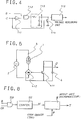
- a zero voltage detection unit 3 and a zero current detection unit 4 may have an arrangement in which a voltage and a current are rectified by a diode bridge 412 to be supplied to a transistor 411.
- a diode bridge 412 to be supplied to a transistor 411.
- the collector voltage of the transistor 411 is obtained as a pulse waveform at a zero-cross point, a pulse processing technique is easily applied to the collector voltage.
- a power source 6 for the transistor 411 and the ground line of an ac power source 2 are not easily connected to each other.
- the heat-sensitive wire is an element having a considerably high impedance
- a high input-impedance element such as a field effect transistor is preferably used as a transistor.
- a proper level point of an instantaneous voltage or an instantaneous current e.g., a maximum value point
- a proper level point of an instantaneous voltage or an instantaneous current e.g., a maximum value point
- the heat-sensitive wire has a large number of nonlinear factors, a current flowing into the heat-sensitive wire is distorted, and the shape factor of the current is changed in accordance with a change in temperature. For this reason, when the phase angle is measured at points other than zero-cross points, an increase in error of the phase angle must be taken into consideration.
- This current distortion has been neglected in the above description for the sake of descriptive convenience. However, it should be understood that the current distortion has been described with reference to an equivalent sine wave.
- an AND element 710 causes the oscillator 703 in Fig. 1 to output clock pulses in an interval in which a zero voltage detection pulse B is set at "1" level, and the clock pulses are counted by a counter 711, thereby obtaining data corresponding to an angular frequency ⁇ .
- This data is supplied together with data of a phase angle ⁇ to an output unit 8 constituted by, e.g., a microprocessor or the like.
- the phase angle ⁇ is output from the counter 704 shown in Fig. 1. Therefore, a temperature T (corresponding to the phase angle ⁇ ) can be obtained on the basis of equation (7).
- zero-cross points of the instantaneous voltage v applied to the heat-sensitive wire 1 and the instantaneous current i flowing into the heat-sensitive wire 1 are detected by the zero voltage detection unit 3 and the zero current detection unit 4, respectively, intervals between the zero-cross points are measured by a zero-cross point interval measuring unit 7 to obtain a measurement value corresponding to the phase angle ⁇ .
- a temperature detector capable of detecting an accurate temperature regardless of the dimensional precision of the heat-sensitive wire can be obtained.
Landscapes
- Engineering & Computer Science (AREA)
- Power Engineering (AREA)
- Physics & Mathematics (AREA)
- General Physics & Mathematics (AREA)
- Measuring Temperature Or Quantity Of Heat (AREA)
- Measurement Of Current Or Voltage (AREA)
- Measuring And Recording Apparatus For Diagnosis (AREA)
Applications Claiming Priority (2)
| Application Number | Priority Date | Filing Date | Title |
|---|---|---|---|
| JP1214002A JPH0833328B2 (ja) | 1989-08-19 | 1989-08-19 | 温度検出装置 |
| JP214002/89 | 1989-08-19 |
Publications (2)
| Publication Number | Publication Date |
|---|---|
| EP0487730A1 true EP0487730A1 (de) | 1992-06-03 |
| EP0487730A4 EP0487730A4 (en) | 1993-01-13 |
Family
ID=16648637
Family Applications (1)
| Application Number | Title | Priority Date | Filing Date |
|---|---|---|---|
| EP19900912031 Withdrawn EP0487730A4 (en) | 1989-08-19 | 1990-08-14 | Temperature detector |
Country Status (5)
| Country | Link |
|---|---|
| US (1) | US5257864A (de) |
| EP (1) | EP0487730A4 (de) |
| JP (1) | JPH0833328B2 (de) |
| KR (1) | KR920704109A (de) |
| WO (1) | WO1991002956A1 (de) |
Cited By (8)
| Publication number | Priority date | Publication date | Assignee | Title |
|---|---|---|---|---|
| EP0656533A1 (de) * | 1993-12-03 | 1995-06-07 | Kidde Fire Protection Limited | Vorrichtungen und Verfahren zur Temperaturdetektion |
| WO2003038379A1 (en) * | 2001-10-30 | 2003-05-08 | Gentech Investment Group Ag | Sensing apparatus and method |
| US7196604B2 (en) | 2001-05-30 | 2007-03-27 | Tt Electronics Technology Limited | Sensing apparatus and method |
| US7205775B2 (en) | 2003-02-17 | 2007-04-17 | Sensopad Limited | Sensing apparatus and method |
| US7298137B2 (en) | 2002-10-16 | 2007-11-20 | Tt Electronics Technology Limited | Position sensing apparatus and method |
| US7514919B2 (en) | 2002-10-16 | 2009-04-07 | Tt Electronics Technology Limited | Sensing apparatus and method |
| US9599652B2 (en) | 2013-06-28 | 2017-03-21 | Pr Electronics A/S | System and method for detection of wire breakage |
| DE102017215517B3 (de) | 2017-09-05 | 2018-10-11 | Leoni Kabel Gmbh | Verfahren zur Überwachung einer Leitung auf veränderte Umgebungsbedingungen sowie Messanordnung zur Überwachung einer Leitung auf veränderte Umgebungsbedingungen |
Families Citing this family (4)
| Publication number | Priority date | Publication date | Assignee | Title |
|---|---|---|---|---|
| DE19821773C1 (de) * | 1998-05-14 | 1999-10-07 | Reinhausen Maschf Scheubeck | Meßwertaufnehmer zur Temperaturmessung an ölgefüllten Betriebsmitteln und dafür geeignetes Verfahren zur Temperaturmessung |
| KR100750011B1 (ko) * | 2005-04-01 | 2007-08-16 | 길종진 | 안전장치를 구비하는 심플형 유해 전자파 차단 조절기 |
| JP5006739B2 (ja) * | 2007-09-10 | 2012-08-22 | 株式会社リコー | 温度検出回路およびそれを用いた電子機器 |
| JP5736744B2 (ja) * | 2010-01-26 | 2015-06-17 | セイコーエプソン株式会社 | 熱センサーデバイス及び電子機器 |
Family Cites Families (7)
| Publication number | Priority date | Publication date | Assignee | Title |
|---|---|---|---|---|
| JPS513275A (ja) * | 1974-06-27 | 1976-01-12 | Mitsubishi Electric Corp | Isosakenshutsusochi |
| CH586397A5 (de) * | 1975-06-16 | 1977-03-31 | Bbc Brown Boveri & Cie | |
| JPS54136877A (en) * | 1978-04-14 | 1979-10-24 | Mitsubishi Electric Corp | Phase coincidence detecting circuit |
| US4635055A (en) * | 1983-04-13 | 1987-01-06 | Niagara Mohawk Power Corporation | Apparatus for measuring the temperature and other parameters of an electic power conductor |
| JPS60125533A (ja) * | 1983-12-09 | 1985-07-04 | Nippon Steel Corp | 送液用パイプラインの温度測定方法 |
| JPS61211627A (ja) * | 1985-03-15 | 1986-09-19 | Matsushita Electric Ind Co Ltd | 暖房器 |
| JPH05320370A (ja) * | 1992-05-27 | 1993-12-03 | Dainippon Ink & Chem Inc | ラミネート方法 |
-
1989
- 1989-08-19 JP JP1214002A patent/JPH0833328B2/ja not_active Expired - Lifetime
-
1990
- 1990-08-14 KR KR1019920700335A patent/KR920704109A/ko not_active Withdrawn
- 1990-08-14 US US07/829,063 patent/US5257864A/en not_active Expired - Fee Related
- 1990-08-14 EP EP19900912031 patent/EP0487730A4/en not_active Withdrawn
- 1990-08-14 WO PCT/JP1990/001033 patent/WO1991002956A1/ja not_active Ceased
Non-Patent Citations (1)
| Title |
|---|
| See references of WO9102956A1 * |
Cited By (13)
| Publication number | Priority date | Publication date | Assignee | Title |
|---|---|---|---|---|
| US5655840A (en) * | 1993-12-03 | 1997-08-12 | Kidde Fire Protection Limited | Temperature detecting methods and systems |
| EP0656533A1 (de) * | 1993-12-03 | 1995-06-07 | Kidde Fire Protection Limited | Vorrichtungen und Verfahren zur Temperaturdetektion |
| US7196604B2 (en) | 2001-05-30 | 2007-03-27 | Tt Electronics Technology Limited | Sensing apparatus and method |
| EP1736736A3 (de) * | 2001-10-30 | 2009-06-03 | TT Electronics Technology Limited | Messgerät und Messverfahren |
| US7208945B2 (en) | 2001-10-30 | 2007-04-24 | Tt Electronics Technology Limited | Sensing apparatus and method |
| US7319319B2 (en) | 2001-10-30 | 2008-01-15 | Tt Electronics Technology Limited | Sensing apparatus and method |
| WO2003038379A1 (en) * | 2001-10-30 | 2003-05-08 | Gentech Investment Group Ag | Sensing apparatus and method |
| US7298137B2 (en) | 2002-10-16 | 2007-11-20 | Tt Electronics Technology Limited | Position sensing apparatus and method |
| US7514919B2 (en) | 2002-10-16 | 2009-04-07 | Tt Electronics Technology Limited | Sensing apparatus and method |
| US7205775B2 (en) | 2003-02-17 | 2007-04-17 | Sensopad Limited | Sensing apparatus and method |
| US9599652B2 (en) | 2013-06-28 | 2017-03-21 | Pr Electronics A/S | System and method for detection of wire breakage |
| DE102017215517B3 (de) | 2017-09-05 | 2018-10-11 | Leoni Kabel Gmbh | Verfahren zur Überwachung einer Leitung auf veränderte Umgebungsbedingungen sowie Messanordnung zur Überwachung einer Leitung auf veränderte Umgebungsbedingungen |
| US11486770B2 (en) | 2017-09-05 | 2022-11-01 | Leoni Kabel Gmbh | Method and measuring system for monitoring a line for changed ambient conditions |
Also Published As
| Publication number | Publication date |
|---|---|
| EP0487730A4 (en) | 1993-01-13 |
| JPH0833328B2 (ja) | 1996-03-29 |
| KR920704109A (ko) | 1992-12-19 |
| JPH0377036A (ja) | 1991-04-02 |
| WO1991002956A1 (en) | 1991-03-07 |
| US5257864A (en) | 1993-11-02 |
Similar Documents
| Publication | Publication Date | Title |
|---|---|---|
| EP1042651B1 (de) | Integritätsprüfung von elektroden | |
| US3883812A (en) | Diode-quad bridge circuit means | |
| EP0487730A1 (de) | Temperaturdetektor | |
| US4243932A (en) | Method and system for checking sealed containers for pinholes by comparing two discharge currents | |
| KR830001671B1 (ko) | 자동 교정되는 부반송과 원격계측 전송장치 | |
| US4788488A (en) | Continuous condition sensing system | |
| US4242631A (en) | Front-end circuit apparatus for impedance measurements and the like | |
| US2046436A (en) | Ground impedance measurement | |
| US3947760A (en) | Integrating component measuring device | |
| US3345562A (en) | Ac-dc meter | |
| US6424146B2 (en) | Proximity sensor method and apparatus that is insensitive to temperature, noise and length of wire | |
| KR910003193B1 (ko) | Rf 전력계 | |
| US6433533B1 (en) | Giant magneto-impedance(GMI) spin rate sensor | |
| JPS6256870A (ja) | 避雷器の劣化検出装置 | |
| US20130342218A1 (en) | Cable Detector | |
| US3840805A (en) | Device for measuring parameters of resonant lc-circuit | |
| JPH0638088B2 (ja) | 容量測定用回路 | |
| US3576491A (en) | Resistance measuring bridge circuit including output gating means | |
| GB1299203A (en) | Direct reading water content meter | |
| US4060761A (en) | Tubular magnetic field sensor with means to rectify the sensed signal | |
| SU1370460A1 (ru) | Измерительный преобразователь напр жени индукционных датчиков | |
| US3614614A (en) | Method and circuit for measuring effective capacitance of a semiconductive device | |
| JPH0316069Y2 (de) | ||
| EP0125006A1 (de) | Vorrichtung zur Messung des elektrischen Potentials in einem elektrischen Feld | |
| US3315158A (en) | Instrument for measuring the speed of an internal combustion engine |
Legal Events
| Date | Code | Title | Description |
|---|---|---|---|
| PUAI | Public reference made under article 153(3) epc to a published international application that has entered the european phase |
Free format text: ORIGINAL CODE: 0009012 |
|
| 17P | Request for examination filed |
Effective date: 19920225 |
|
| AK | Designated contracting states |
Kind code of ref document: A1 Designated state(s): DE FR GB NL |
|
| A4 | Supplementary search report drawn up and despatched |
Effective date: 19921123 |
|
| AK | Designated contracting states |
Kind code of ref document: A4 Designated state(s): DE FR GB NL |
|
| 17Q | First examination report despatched |
Effective date: 19941223 |
|
| STAA | Information on the status of an ep patent application or granted ep patent |
Free format text: STATUS: THE APPLICATION IS DEEMED TO BE WITHDRAWN |
|
| 18D | Application deemed to be withdrawn |
Effective date: 19961023 |