EP0487761B1 - Petit moteur,procédé pour sa fabrication et son utilisation - Google Patents
Petit moteur,procédé pour sa fabrication et son utilisation Download PDFInfo
- Publication number
- EP0487761B1 EP0487761B1 EP90122599A EP90122599A EP0487761B1 EP 0487761 B1 EP0487761 B1 EP 0487761B1 EP 90122599 A EP90122599 A EP 90122599A EP 90122599 A EP90122599 A EP 90122599A EP 0487761 B1 EP0487761 B1 EP 0487761B1
- Authority
- EP
- European Patent Office
- Prior art keywords
- motor
- casing
- electronic unit
- coil
- electronic
- Prior art date
- Legal status (The legal status is an assumption and is not a legal conclusion. Google has not performed a legal analysis and makes no representation as to the accuracy of the status listed.)
- Expired - Lifetime
Links
- 238000000034 method Methods 0.000 title claims 3
- 238000004519 manufacturing process Methods 0.000 title claims 2
- 239000004020 conductor Substances 0.000 claims description 9
- 229920003023 plastic Polymers 0.000 claims description 9
- 239000004033 plastic Substances 0.000 claims description 9
- 238000001816 cooling Methods 0.000 claims description 8
- 239000002184 metal Substances 0.000 claims 2
- 239000012777 electrically insulating material Substances 0.000 claims 1
- 238000003466 welding Methods 0.000 claims 1
- 238000004804 winding Methods 0.000 claims 1
- 230000015654 memory Effects 0.000 description 3
- 230000005494 condensation Effects 0.000 description 2
- 238000009833 condensation Methods 0.000 description 2
- 239000000428 dust Substances 0.000 description 2
- 238000010276 construction Methods 0.000 description 1
- 230000002349 favourable effect Effects 0.000 description 1
- 239000007788 liquid Substances 0.000 description 1
- 230000007257 malfunction Effects 0.000 description 1
- 210000000056 organ Anatomy 0.000 description 1
- 230000000149 penetrating effect Effects 0.000 description 1
- 230000008054 signal transmission Effects 0.000 description 1
- XLYOFNOQVPJJNP-UHFFFAOYSA-N water Substances O XLYOFNOQVPJJNP-UHFFFAOYSA-N 0.000 description 1
Images

Classifications
-
- H—ELECTRICITY
- H02—GENERATION; CONVERSION OR DISTRIBUTION OF ELECTRIC POWER
- H02K—DYNAMO-ELECTRIC MACHINES
- H02K37/00—Motors with rotor rotating step by step and without interrupter or commutator driven by the rotor, e.g. stepping motors
-
- H—ELECTRICITY
- H02—GENERATION; CONVERSION OR DISTRIBUTION OF ELECTRIC POWER
- H02K—DYNAMO-ELECTRIC MACHINES
- H02K11/00—Structural association of dynamo-electric machines with electric components or with devices for shielding, monitoring or protection
- H02K11/30—Structural association with control circuits or drive circuits
- H02K11/33—Drive circuits, e.g. power electronics
-
- H—ELECTRICITY
- H02—GENERATION; CONVERSION OR DISTRIBUTION OF ELECTRIC POWER
- H02K—DYNAMO-ELECTRIC MACHINES
- H02K11/00—Structural association of dynamo-electric machines with electric components or with devices for shielding, monitoring or protection
- H02K11/40—Structural association with grounding devices
Definitions
- Small motors in particular stepper or servomotors, are used for longer the more, sometimes in considerable numbers, for adjusting or adjusting organs. Some of these applications are carried out under extreme conditions, for example in the automotive industry, where they should work reliably under considerable temperature fluctuations in dusty, dirty, damp and even wet environments.
- Such small motors, in particular stepper motors are usually controlled by central control electronics, which generally requires an at least four-wire cable connection from the central electronics to each motor and is associated with considerable expenditure.
- the number of connection points which are often the cause of interruptions and thus malfunctions, is considerable.
- the aim of the present invention is to simplify the control and wiring and thus make it more reliable and also to design the engine so that it works reliably even under extreme operating conditions, for example in the engine compartment of a motor vehicle.
- the control electronics are preferably housed in a plastic housing, which is firmly connected to the coil body of the motor, and this housing is preferably provided with a non-hermetically sealed closure element, which prevents dust and dirt from entering the housing space, but allows sufficient steam exchange, to allow condensation water formed in the housing to evaporate and escape.
- Fig. 1 shows purely schematically a small stepper motor 1.
- the plastic bobbin of this motor is provided with one or more connecting extensions 2 penetrating through the stator parts of the motor, with which a plastic housing 3 is firmly connected, for example glued or welded.
- This plastic housing is used to hold the control electronics for the motor 1, and it is provided with a connection socket 4 for a cable plug.
- housing parts could be provided, which on different Places are provided with connection sockets 4 'in order to be able to select the most favorable position of this connection socket for all applications.
- Fig. 2 shows a longitudinal section through an embodiment of the housing 3 with the electronics. It consists of a lower housing part 3a and a housing upper part 3b, for example spot welded. In the lower housing part there is a connection body 5, in which there are contacts which form a plug connection with connection pins 6 of the coil body of the motor 1, which is not shown in FIG. 2. These connecting pins 6 pass through conical guide sleeves 7 of a guide part 8. A circuit board 9 is held between the two housing parts 3a and 3b, to which an integrated circuit 10 and a switching element or possibly cooling element 11 of the electronics are connected. Connection pins 12, which protrude into the connection socket 4, are soldered to the printed circuit board 9. For example, three contact pins 12 can be provided.
- a lateral housing opening 13 is closed off by the flat leg 14a of an L-shaped leaf spring 14.
- the leaf spring 14 is split at its ends resiliently on the circuit board into individual teeth 14b, these teeth being dimensioned and arranged in such a way that they lie between conductor tracks Grasp circuit board 9.
- the leaf spring forms a not completely hermetic or vapor-tight seal of the housing 3, which is sufficient, however, to prevent the entry of dust and dirt or liquid, but allows a certain exchange of steam between the interior of the housing and the environment, in order to prevent condensation or ice has formed in the housing to evaporate and leak.
- the leaf spring 14 has the purpose of providing heat, especially from the driver stages can originate for the motor to effectively dissipate from the circuit board 9.
- FIG. 3 shows an embodiment variant, in which corresponding parts are identified in the same way as in FIG. 2.
- the closing element for opening the housing 3 is again designed as a leaf spring 15, which however rests with spring ends against the top and bottom of the printed circuit board 9 and thus ensuring an even more intensive cooling of the electronics.
- FIG. 4 shows a further embodiment variant, according to which the opening of the housing 3 is closed with a plastic cover 16, to which a leaf spring 16a similar to that according to FIG. 3 is connected.
- This leaf spring also serves as a holding member for the cover 16 and for cooling the printed circuit board 9.
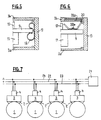
- FIG. 5 shows a further embodiment variant similar to that according to FIG. 4 with a closing element 17 made of plastic, which is provided with a differently shaped leaf spring 18 as a holding and cooling element.
- FIG. 6 shows a further embodiment variant with a terminating element 19 made of plastic, which is no longer connected to a retaining spring, but instead is glued or welded to the housing 3 in places.
- a terminating element 19 made of plastic, which is no longer connected to a retaining spring, but instead is glued or welded to the housing 3 in places.
- One leg 20a of a leaf spring 20 is inserted into a deep groove of the upper housing part 3b, the W-shaped part 20b of which rests on the printed circuit board 9 at two points and thus acts as a cooling element.
- Fig. 7 shows 4 small motors 1, which are controlled and fed by a common central control electronics 21.
- the control electronics are connected in parallel with a three-wire bus cable. As indicated in Fig. 7 serve two conductors 22 and 23 of this cable to power the motors with their control electronics, while the conductor 24 is used for signal transmission.
- One of the conductors 22 and 23 can be used to return the control signals. However, one could also make do with only two conductors or, in extreme cases, with a single conductor, namely if the return is made via the ground, as is customary in vehicle construction, for example. Control signals could then be simultaneously transmitted and energy supplied via a single conductor.
- the electronics of each motor have memories in which digitized commands for motor control can be stored.
- the electronics of each motor have an individual address code, and the memories are activated when the relevant address code is sent by the control electronics 21. In this way, each motor or the control electronics assigned to it can be activated individually in order to read command data into the memory and to control the assigned motor accordingly.
- a plastic part or the housing can be firmly connected to the circuit board.
- the connecting socket 4 or the connecting pins 12 can also be used for additional cooling.
- a thermally conductive rubber can be clamped between the circuit board and the housing. In all cases, however, it must be ensured that the exchange or removal of moisture is guaranteed.
Landscapes
- Engineering & Computer Science (AREA)
- Power Engineering (AREA)
- Microelectronics & Electronic Packaging (AREA)
- Motor Or Generator Frames (AREA)
- Arrangement Or Mounting Of Propulsion Units For Vehicles (AREA)
Claims (11)
- Petit moteur, notamment moteur pas à pas ou moteur de réglage auquel est associée une électronique de commande (9, 10) prévue directement au niveau du moteur (1), caractérisé en ce que l'électronique (9, 10) est logée dans un boîtier en matière plastique (3) relié au corps de bobine (2) du moteur (1), de préférence par une soudure et en ce qu'entre l'électronique et les branchements (6) de l'enroulement du moteur (1), il y a une liaison d'enfichage.
- Moteur selon la revendication 1, caractérisé en ce que le boîtier (3) est fermé par un organe de fermeture (14, 15, 16, 17, 19), de mesure non hermétiquement étanche.
- Moteur selon l'une des revendications 1 ou 2, caractérisé en ce qu'au moins une partie du boîtier (3), de préférence un organe de fermeture (14, 15, 16) de celui-ci, est reliée à l'électronique, par exemple à une plaque de circuit imprimé (9), par une liaison conductrice de chaleur et servant de radiateur.
- Moteur selon la revendication 3, caractérisé par un organe de fermeture métallique (14, 15) ou un organe de maintien métallique (16a, 18) qui est appliqué élastiquement contre la plaque de circuit imprimé 9 et est maintenu dans le boîtier (3).
- Moteur selon l'une des revendications 1 à 4, caractérisé par un matériau conducteur de chaleur, isolant électrique, prévu entre l'électronique (9, 10) et la paroi du boîtier.
- Moteur selon l'une des revendications 1 à 5, caractérisé en ce que l'électronique (10) comporte une mémoire pour des ordres d'entraînement qui est activée par un code d'adresse.
- Procédé de fabrication d'un petit moteur selon la revendication 1, caractérisé en ce que la bobine du moteur (2) est réalisée avec des raccords enfichables (6) et un boîtier logeant l'électronique (9, 10) est muni de raccords enfichables qui sont alors assemblés les uns les autres et solidarisés.
- Procédé selon la revendication 7, caractérisé en ce que après avoir réuni la bobine (2) du moteur au boîtier (3) de l'électronique, on monte les parties de stator du moteur, notamment du moteur pas à pas (1).
- Procédé selon la revendication 7 ou 8, caractérisé en ce qu'une partie (3a) du boîtier (3) est reliée à la bobine (2), puis on introduit l'électronique (9, 10) et enfin on ferme le boîtier par la mise en place d'au moins une autre pièce (3b, 14, 16, 16, 17, 19).
- Application de petits moteurs selon la revendication 1, caractérisée en ce que l'électronique de commande (9, 10) de plusieurs moteurs (1) est reliée par un bus de données (22-24) à une commande centrale (21).
- Application selon la revendication (10) caractérisée en ce qu'au moins un conducteur du bus de données (22-24) sert en même temps à l'alimentation d'énergie d'entraînement.
Priority Applications (4)
| Application Number | Priority Date | Filing Date | Title |
|---|---|---|---|
| ES90122599T ES2067632T3 (es) | 1990-11-27 | 1990-11-27 | Motor pequeño, metodo para su realizacion y utilizacion. |
| DE59008442T DE59008442D1 (de) | 1990-11-27 | 1990-11-27 | Kleinmotor, Verfahren zur Herstellung desselben und Verwendung desselben. |
| EP90122599A EP0487761B1 (fr) | 1990-11-27 | 1990-11-27 | Petit moteur,procédé pour sa fabrication et son utilisation |
| US07/798,086 US5283485A (en) | 1990-11-27 | 1991-11-27 | Small-size motor and a process for manufacture and use thereof |
Applications Claiming Priority (1)
| Application Number | Priority Date | Filing Date | Title |
|---|---|---|---|
| EP90122599A EP0487761B1 (fr) | 1990-11-27 | 1990-11-27 | Petit moteur,procédé pour sa fabrication et son utilisation |
Publications (2)
| Publication Number | Publication Date |
|---|---|
| EP0487761A1 EP0487761A1 (fr) | 1992-06-03 |
| EP0487761B1 true EP0487761B1 (fr) | 1995-02-08 |
Family
ID=8204755
Family Applications (1)
| Application Number | Title | Priority Date | Filing Date |
|---|---|---|---|
| EP90122599A Expired - Lifetime EP0487761B1 (fr) | 1990-11-27 | 1990-11-27 | Petit moteur,procédé pour sa fabrication et son utilisation |
Country Status (4)
| Country | Link |
|---|---|
| US (1) | US5283485A (fr) |
| EP (1) | EP0487761B1 (fr) |
| DE (1) | DE59008442D1 (fr) |
| ES (1) | ES2067632T3 (fr) |
Families Citing this family (7)
| Publication number | Priority date | Publication date | Assignee | Title |
|---|---|---|---|---|
| DE4327584A1 (de) * | 1993-08-17 | 1995-02-23 | Bayerische Motoren Werke Ag | Elektrische Antriebseinheit |
| FR2750542B1 (fr) * | 1996-06-27 | 1998-10-02 | Ecia Equip Composants Ind Auto | Dispositif de raccordement electrique pour moteur a courant continu |
| JP3349118B2 (ja) * | 1999-07-23 | 2002-11-20 | 日本電産コパル株式会社 | モータ及び携帯電話 |
| JP4274473B2 (ja) * | 2004-06-14 | 2009-06-10 | ミネベア株式会社 | アクチュエータ |
| DE102005046390A1 (de) * | 2005-09-28 | 2007-04-05 | J. Eberspächer GmbH & Co. KG | Kombination einer Steuereinheit mit einem Gehäuse zur Aufnahme derselben |
| CN104115378B (zh) * | 2011-12-26 | 2017-05-03 | 阿塞里克股份有限公司 | 永磁同步电动机 |
| US9667106B2 (en) * | 2013-09-25 | 2017-05-30 | Regal Beloit Australia Pty Ltd | Motor housing and methods of assembling the same |
Family Cites Families (8)
| Publication number | Priority date | Publication date | Assignee | Title |
|---|---|---|---|---|
| US3506898A (en) * | 1966-11-07 | 1970-04-14 | Skil Corp | Stator construction including an encapsulated semi-conductor device mounted on the stator |
| JPS5754636U (fr) * | 1980-09-16 | 1982-03-30 | ||
| JPS60224391A (ja) * | 1984-04-21 | 1985-11-08 | Matsushita Electric Works Ltd | 遠隔制御装置 |
| JPS611234A (ja) * | 1984-06-14 | 1986-01-07 | Matsushita Electric Works Ltd | ロボツトア−ムの駆動装置 |
| US4825133A (en) * | 1986-08-05 | 1989-04-25 | Oki Electric Industry Co., Ltd. | Electromechanical actuator control system |
| DE3710659A1 (de) * | 1987-03-31 | 1988-10-13 | Standard Elektrik Lorenz Ag | Elektronisch kommutierter, kollektorloser gleichstrommotor |
| US4795930A (en) * | 1987-12-03 | 1989-01-03 | Timex Corporation | Stepping motor coil core and stator assembly for a timepiece |
| JP2534683Y2 (ja) * | 1990-07-16 | 1997-05-07 | 愛三工業株式会社 | ステップモータのターミナル固定構造 |
-
1990
- 1990-11-27 ES ES90122599T patent/ES2067632T3/es not_active Expired - Lifetime
- 1990-11-27 EP EP90122599A patent/EP0487761B1/fr not_active Expired - Lifetime
- 1990-11-27 DE DE59008442T patent/DE59008442D1/de not_active Expired - Lifetime
-
1991
- 1991-11-27 US US07/798,086 patent/US5283485A/en not_active Expired - Lifetime
Also Published As
| Publication number | Publication date |
|---|---|
| DE59008442D1 (de) | 1995-03-23 |
| EP0487761A1 (fr) | 1992-06-03 |
| US5283485A (en) | 1994-02-01 |
| ES2067632T3 (es) | 1995-04-01 |
Similar Documents
| Publication | Publication Date | Title |
|---|---|---|
| DE102018205914B4 (de) | Elektrischer Anschlusskasten und Kabelbaum | |
| DE19832561A1 (de) | Einheit zum Steuern von Elektromotoren | |
| DE3932005A1 (de) | Modul fuer eine programmierbare steuerung | |
| EP1171680B1 (fr) | Carter de moteur et element polaire cupuliforme, notamment pour moteurs de leve-vitres et de toits ouvrants | |
| DE69013582T2 (de) | Keilförmiger Sockel, befestigt an SPG-Substrat. | |
| DE19548961A1 (de) | Elektrischer Anschlußkasten | |
| EP1814764B1 (fr) | Dispositif electronique | |
| EP0760313A2 (fr) | Centrale électrique pour véhicules | |
| EP0487761A1 (fr) | Petit moteur,procédé pour sa fabrication et son utilisation | |
| EP1985162A2 (fr) | Support pour une carte de circuits imprimés flexible | |
| EP0662741B1 (fr) | Appareil de coupure à basse tension | |
| DE69923506T2 (de) | Elektrisches Verbindungsgehäuse | |
| DE2900763C2 (de) | Flüssigkeitsdichte mit einem Flachstecker ausgerüstete Durchführung | |
| DE68910793T2 (de) | Schalterklemmenschraube. | |
| EP0209160A2 (fr) | Dispositif de contact pour automobiles | |
| DE102023120897A1 (de) | Statoreinheit, Elektroventil und Elektroventilvorrichtung | |
| DE2107464C3 (de) | Elektrischer Wippenschalter | |
| DE69800965T2 (de) | Gehäuse für elektrische Installation mit Befestigungsvorrichtung für den Deckel und Wandbefestigung | |
| EP0844701B1 (fr) | Connecteur à fiche multipolaire | |
| EP1357645B1 (fr) | Connecteur intelligent pour un bus de données | |
| DE19532280A1 (de) | Anschlußvorrichtung zum codierbaren Anschließen elektrischer Verbraucher | |
| DE3340742A1 (de) | Programmsteuergeraet fuer haushaltsmaschinen | |
| DE3731474A1 (de) | Kabelanschlussblock | |
| EP0802598A2 (fr) | Module de tableau de contrÔle | |
| DE4302264C2 (de) | Tauchbadgerät |
Legal Events
| Date | Code | Title | Description |
|---|---|---|---|
| PUAI | Public reference made under article 153(3) epc to a published international application that has entered the european phase |
Free format text: ORIGINAL CODE: 0009012 |
|
| AK | Designated contracting states |
Kind code of ref document: A1 Designated state(s): CH DE ES FR GB IT LI SE |
|
| 17P | Request for examination filed |
Effective date: 19920926 |
|
| 17Q | First examination report despatched |
Effective date: 19931013 |
|
| GRAA | (expected) grant |
Free format text: ORIGINAL CODE: 0009210 |
|
| AK | Designated contracting states |
Kind code of ref document: B1 Designated state(s): CH DE ES FR GB IT LI SE |
|
| REF | Corresponds to: |
Ref document number: 59008442 Country of ref document: DE Date of ref document: 19950323 |
|
| ET | Fr: translation filed | ||
| REG | Reference to a national code |
Ref country code: ES Ref legal event code: FG2A Ref document number: 2067632 Country of ref document: ES Kind code of ref document: T3 |
|
| GBT | Gb: translation of ep patent filed (gb section 77(6)(a)/1977) |
Effective date: 19950323 |
|
| ITF | It: translation for a ep patent filed | ||
| PLBE | No opposition filed within time limit |
Free format text: ORIGINAL CODE: 0009261 |
|
| STAA | Information on the status of an ep patent application or granted ep patent |
Free format text: STATUS: NO OPPOSITION FILED WITHIN TIME LIMIT |
|
| 26N | No opposition filed | ||
| REG | Reference to a national code |
Ref country code: GB Ref legal event code: IF02 |
|
| PGFP | Annual fee paid to national office [announced via postgrant information from national office to epo] |
Ref country code: CH Payment date: 20051017 Year of fee payment: 16 |
|
| PG25 | Lapsed in a contracting state [announced via postgrant information from national office to epo] |
Ref country code: LI Free format text: LAPSE BECAUSE OF NON-PAYMENT OF DUE FEES Effective date: 20061130 Ref country code: CH Free format text: LAPSE BECAUSE OF NON-PAYMENT OF DUE FEES Effective date: 20061130 |
|
| REG | Reference to a national code |
Ref country code: CH Ref legal event code: PL |
|
| PGFP | Annual fee paid to national office [announced via postgrant information from national office to epo] |
Ref country code: ES Payment date: 20071031 Year of fee payment: 18 |
|
| PGFP | Annual fee paid to national office [announced via postgrant information from national office to epo] |
Ref country code: IT Payment date: 20071129 Year of fee payment: 18 |
|
| PGFP | Annual fee paid to national office [announced via postgrant information from national office to epo] |
Ref country code: SE Payment date: 20071106 Year of fee payment: 18 |
|
| PGFP | Annual fee paid to national office [announced via postgrant information from national office to epo] |
Ref country code: FR Payment date: 20071129 Year of fee payment: 18 Ref country code: GB Payment date: 20071129 Year of fee payment: 18 |
|
| EUG | Se: european patent has lapsed | ||
| GBPC | Gb: european patent ceased through non-payment of renewal fee |
Effective date: 20081127 |
|
| PG25 | Lapsed in a contracting state [announced via postgrant information from national office to epo] |
Ref country code: IT Free format text: LAPSE BECAUSE OF NON-PAYMENT OF DUE FEES Effective date: 20081127 |
|
| REG | Reference to a national code |
Ref country code: FR Ref legal event code: ST Effective date: 20090731 |
|
| PG25 | Lapsed in a contracting state [announced via postgrant information from national office to epo] |
Ref country code: GB Free format text: LAPSE BECAUSE OF NON-PAYMENT OF DUE FEES Effective date: 20081127 |
|
| REG | Reference to a national code |
Ref country code: ES Ref legal event code: FD2A Effective date: 20081128 |
|
| PG25 | Lapsed in a contracting state [announced via postgrant information from national office to epo] |
Ref country code: ES Free format text: LAPSE BECAUSE OF NON-PAYMENT OF DUE FEES Effective date: 20081128 |
|
| PGFP | Annual fee paid to national office [announced via postgrant information from national office to epo] |
Ref country code: DE Payment date: 20091212 Year of fee payment: 20 |
|
| PG25 | Lapsed in a contracting state [announced via postgrant information from national office to epo] |
Ref country code: SE Free format text: LAPSE BECAUSE OF NON-PAYMENT OF DUE FEES Effective date: 20081128 |
|
| PG25 | Lapsed in a contracting state [announced via postgrant information from national office to epo] |
Ref country code: FR Free format text: LAPSE BECAUSE OF NON-PAYMENT OF DUE FEES Effective date: 20081130 |
|
| PG25 | Lapsed in a contracting state [announced via postgrant information from national office to epo] |
Ref country code: DE Free format text: LAPSE BECAUSE OF EXPIRATION OF PROTECTION Effective date: 20101127 |