EP0487832A2 - Induktionsheizgerät mit breitvariabler Erhitzungsgeschwindigkeit - Google Patents
Induktionsheizgerät mit breitvariabler Erhitzungsgeschwindigkeit Download PDFInfo
- Publication number
- EP0487832A2 EP0487832A2 EP91113800A EP91113800A EP0487832A2 EP 0487832 A2 EP0487832 A2 EP 0487832A2 EP 91113800 A EP91113800 A EP 91113800A EP 91113800 A EP91113800 A EP 91113800A EP 0487832 A2 EP0487832 A2 EP 0487832A2
- Authority
- EP
- European Patent Office
- Prior art keywords
- coil elements
- current
- electromagnetic induction
- strip
- induction heater
- Prior art date
- Legal status (The legal status is an assumption and is not a legal conclusion. Google has not performed a legal analysis and makes no representation as to the accuracy of the status listed.)
- Withdrawn
Links
- 230000005674 electromagnetic induction Effects 0.000 title claims abstract description 31
- 238000010438 heat treatment Methods 0.000 title claims abstract description 18
- 238000004804 winding Methods 0.000 description 12
- 239000000463 material Substances 0.000 description 6
- 239000003990 capacitor Substances 0.000 description 5
- 238000010586 diagram Methods 0.000 description 2
Images

Classifications
-
- H—ELECTRICITY
- H05—ELECTRIC TECHNIQUES NOT OTHERWISE PROVIDED FOR
- H05B—ELECTRIC HEATING; ELECTRIC LIGHT SOURCES NOT OTHERWISE PROVIDED FOR; CIRCUIT ARRANGEMENTS FOR ELECTRIC LIGHT SOURCES, IN GENERAL
- H05B6/00—Heating by electric, magnetic or electromagnetic fields
- H05B6/02—Induction heating
- H05B6/10—Induction heating apparatus, other than furnaces, for specific applications
- H05B6/101—Induction heating apparatus, other than furnaces, for specific applications for local heating of metal pieces
- H05B6/103—Induction heating apparatus, other than furnaces, for specific applications for local heating of metal pieces multiple metal pieces successively being moved close to the inductor
- H05B6/104—Induction heating apparatus, other than furnaces, for specific applications for local heating of metal pieces multiple metal pieces successively being moved close to the inductor metal pieces being elongated like wires or bands
-
- H—ELECTRICITY
- H05—ELECTRIC TECHNIQUES NOT OTHERWISE PROVIDED FOR
- H05B—ELECTRIC HEATING; ELECTRIC LIGHT SOURCES NOT OTHERWISE PROVIDED FOR; CIRCUIT ARRANGEMENTS FOR ELECTRIC LIGHT SOURCES, IN GENERAL
- H05B6/00—Heating by electric, magnetic or electromagnetic fields
- H05B6/02—Induction heating
- H05B6/06—Control, e.g. of temperature, of power
Definitions
- This invention relates to an electromagnetic induction heater for heating a strip by the use of electromagnetic induction.
- a conventional electromagnetic induction heater of the type described is helpful to heat a strip which is continuously fed from a feeder or the like at a predetermined speed in a predetermined direction, namely, a transport direction and which has a pair of principal surfaces.
- the strip may be conductive.
- the conventional electromagnetic induction heater comprises a pair of heater units which are faced to both the principal surfaces with spaces left therebetween.
- Each of the heater units comprises a magnetic pole block which is juxtaposed to the strip and which is divisible into a plurality of subunits along the predetermined direction.
- a plurality of coil elements are wound around the subunits, respectively, and connected to a current source to cause electric current to flow through the coil elements to generate magnetic fields.
- the conventional electromagnetic induction heater is not suitable for heating a wide variety of materials of the strips.
- An electromagnetic induction heater to which this invention is applicable is for use in heating, by electromagnetic induction, a strip which is fed in a predetermined direction.
- the strip has a pair of principal surfaces.
- the electromagnetic induction heater comprises a heater unit which is faced to a selected one of the principal surfaces.
- the heater unit comprises a magnetic pole block juxtaposed to the strip and divisible along the predetermined direction into a plurality of subunits each of which is located along the predetermined direction, a plurality of coil elements wound around the subunits, and current feeding means connected to the coil elements for selectively feeding current to the coil elements to make the subunits selectively generate magnetic fields.
- an electromagnetic induction heater to which this invention is applicable is for use in heating a strip 11 or plate by electromagnetic induction.
- the strip 11 is continuously transported at a predetermined speed in a predetermined direction, namely, a transport direction.
- the transport direction is directed downwards of Fig. 1, as shown by an arrowhead A in Fig. 1.
- the strip has first and second principal surfaces directed forwards and backwards of Fig. 1, respectively.
- the electromagnetic induction heater comprises first and second magnetic pole blocks 121 and 122 juxtaposed to the first and the second principal surfaces with spaces left therebetween.
- Each of the first and the second magnetic pole blocks 121 and 122 has a plurality of magnetic pole segments 13 which are arranged in parallel to one another along the transport direction and which are extended along the transport direction.
- Each of the magnetic pole segments 13 has a plurality of grooves 14 which are adjacent to each of the first and the second principal surfaces of the strip 11 and which are extended along the transverse direction.
- each of the first and the second magnetic pole blocks 121 and 122 is divided along the transport direction into a plurality of subunits, namely, sub-pole blocks by the grooves 14.
- the subunits are arranged in parallel to one another in a direction transverse to the transport direction.
- first and second coil elements 15a and 15b are wound around the subunits of the first and the second magnetic pole blocks 121 and 122 by embedding each coil element 15a and 15b into the grooves 14.
- the first coil elements 15a are depicted at 15a1 to 15a4 while the second coil elements 15b are depicted at 15b1 to 15b4.
- the first and the second coil elements 15a and 15b and the subunits define, along the transport direction A of Fig. 2, first, second, third, and fourth heating zone lengths L1 to L4 which are gradually expanded with an increase of the zone length numbers.
- the second, the third, and the fourth zone lengths L2 to L4 become equal to two times, third times, and fourth times the first zone length L1, respectively.
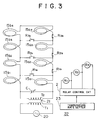
- first and the second coil elements 15a and 15b are coupled to an a.c. power source 20 through a transformer 21 and an electric circuit which will be mentioned in detail.
- the transformer 21 has a primary winding T1 connected to the a.c. power source 20 and a secondary winding T2 connected to the electric circuit.
- the illustrated electric circuit comprises a capacitor C connected in parallel to the secondary winding T2, the first coil elements 15a are connected in series to a point of connection between the secondary winding T2 and the capacitor C through normally-closed contacts R1b, R2b, and R3b to form a first series circuit.
- the first coil elements 15a are connected so that the current flows through two coil elements 15a1 and 15a3 in a direction inverse to the current flowing through the remaining coil elements 15a2 and 15a4.
- the second coil elements 15b are also connected in series to another point of connection between the secondary winding T2 and the capacitor C to form a second series circuit.
- the second coil elements 15b are connected so that the current flows through two coil elements 15b1 and 15b3 in a direction inverse to the current flowing through the remaining coil elements 15b2 and 15b4.
- the first and the second series circuits are connected in series to each other, as illustrated in Fig. 3.
- the coil elements 15a1 and 15b1 are connected to each other through a first normally-opened contact R1a.
- the coil elements 15a2 and 15b2 and the coil elements 15a3 and 15b3 are connected to each other through second and third normally-opened contacts R2a and R3a, respectively.
- coil pairs of the first and the second coil elements that are opposite to each other through the strip 11 cause the current to flow therethrough in inverse directions, as understood from the above description.
- the contacts such as R1a, R1b, are controlled by a power controller 22.
- the power controller 22 comprises a temperature rate setter 23 for setting a temperature rate on heating the strip 11, a relay controller 24 connected to the temperature rate setter 23, and first, second, and third relays R1, R2, and R3 selectively energized by the relay controller 24.
- the first relay R1 has the first normally-opened contact R1a and the first normally-closed contact R1b while the second relay R2 has the second normally-opened contact R2a and the second normally-closed contact R2b.
- the third relay R3 has the third normally-opened contact R3a and the normally-closed contact R3b.
- the temperature rate is determined in consideration of a material of the strip 11 and set in the temperature rate setter 23.
- the temperature rate is sent to the relay control circuit 24 to select the first through the third relays R1 to R3.
- the illustrated heater can vary the temperature rate over four stages from a lowest temperature stage to a highest temperature stage, as will become clear. More specifically, when the lowest temperature stage is set in the temperature rate setter 23, the relay control circuit 24 energizes the first relay R1 to open the first normally-closed contact R1b and to close the first normally-opened contact R1a. Therefore, an a.c. current flows through the coil elements 15a1 and 15b1 from the secondary winding T2 of the transformer 21. This shows that the strip 11 is heated only in the first zone depicted at L1 in Fig. 2.
- the third normally-closed contact R3b is opened while the third normally-opened contact R3a is closed. Therefore, the current flows through the coil elements 15a1, 15a2, 15a3, 15b3, 15b2, and 15b1 to heat the strip 11 over the first through the third zones depicted at L1 to L3 in Fig. 2.
- Equations (1) through (4) From comparison of Equations (1) through (4), it is readily understood that the temperature rate HR can be varied over the four stages and that an optimum temperature rate can be obtained in consideration of the materials of the strip 11 even when the a.c. current and a frequency of the power source 20 is kept unchanged. This means that a wide variety of materials can be heated by the illustrated heater.
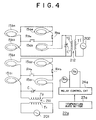
- an electromagnetic induction heater comprises first and second a.c. power sources 201 and 202 for supplying a.c. currents to first and second transformers 211 and 212 coupled to the first and the second a.c. power sources 201 and 202, respectively.
- the first a.c. power source 201 is connected to a primary winding T1 of the first transformer 211 which has a secondary winding T2 connected in parallel to a first variable capacitor C.
- the second a.c. power source 202 is connected to a primary winding T1' of the second transformer 212 which has a secondary winding T2' connected in parallel to a second variable capacitor C'.
- the illustrated electromagnetic induction heater comprises a power controller 22a which comprises a temperature rate setter 23a and a relay control circuit 24a like in Fig. 3.
- the illustrated relay control circuit 24a serves to control first and second subsidiary relays depicted at R4 and R5, respectively.
- first coil elements 15a1 to 15a4 are divided into a first group of the coil elements 15a1 and 15a2 and a second group of the coil elements 15a3 and 15a4.
- second coil elements 15b1 to 15b4 are also divided into a first group of the coil elements 15b1 and 15b2 and a second group of the coil elements 15b3 and 15b4.
- the coil elements 15a1, 15a2, 15b1, and 15b2 are connected in series to the secondary winding T2 of the first transformer 211 with a first normally-closed contact R4b of the first subsidiary relay R4 interposed between the coil elements 15a1 and 15a2.
- the coil elements 15a1 and 15b1 are connected through a first normally-opened contact R4a of the first subsidiary relay R4.
- the coil elements 15a3, 15a4, 15b3, and 15b4 are connected in series to one another with a second normally-closed contact R5b of the second subsidiary relay R5 while the coil elements 15a3 and 15b3 are connected through a second normally-opened contact R5a of the second subsidiary relay R5.
- the first subsidiary relay R4 be selected and energized by the temperature rate setter 23a and the relay control circuit 24a to open the first normally-closed contact R4b and to close the first normally-opened contact R4a.
- a current is caused to flow through the coil elements 15a1 and 15b1 from the first a.c. power source 201 via the first transformer 211.
- the second subsidiary relay R5 is not energized during energization of the first subsidiary relay R4
- a current is supplied from the second a.c. power source 202 through the second transformer 212 to the coil elements connected to the second transformer 212 and is caused to flow through the coil elements 15a3, 15a4, 15b4, and 15b1.
- the second subsidiary relay R5 alone is selected to be energized with the first subsidiary relay R4 not selected, the second normally-closed contact R5b is opened while the second normally-opened contact R5a is closed. In this event, a current is caused to flow through the coil elements 15a3 and 15b3.
- the first a.c. power source 201 supplies a current through the first transformer 211 to the coil elements 15a1, 15a2, 15b2, and 15b1. Consequently, magnetic fields are generated from the coil elements 15a3, 15b3, 15a1, 15b1, 15a2, and 15b2 to heat the strip at the third zone depicted at L3 in Fig. 2.
- both the first and the second subsidiary relays R4 and R5 are selected and energized under control of the temperature rate setter 23a and the relay controller 24a, the first and the second normally-closed contacts R4b and R5b are opened while the first and the second normally-opened contacts R4a and R5a are closed.
- a current is caused to flow through the coil elements 15a1 and 15b1 from the first a.c. power source 201 and through the coil elements 15a3 and 15b3 from the second a.c. power source 202. Therefore, the strip is heated under the coil elements 15a1, 15b1, 15a3, and 15b3.
- first and the second a.c. power sources 201 and 202 may be turned on or off by switches (not shown) connected in series to the sources 201 and 202.
- combinations of the coil elements can be voluntarily selected by selecting combinations of the relays R4 and R5 and/or combinations of the power sources 201 and 202.
- the coil elements are selectively supplied with the current from a plurality of power sources, as mentioned with reference to Fig. 4, it is possible to vary electric power over a wide range and to reduce a power level in each of the power sources. This shows that the heating rate can be widely changed on the strip.
- the coil elements may be controlled by electronic switches or the like instead of the relays and the contacts.
Landscapes
- Physics & Mathematics (AREA)
- Electromagnetism (AREA)
- Engineering & Computer Science (AREA)
- Power Engineering (AREA)
- Heat Treatment Of Strip Materials And Filament Materials (AREA)
- General Induction Heating (AREA)
Applications Claiming Priority (2)
| Application Number | Priority Date | Filing Date | Title |
|---|---|---|---|
| JP33706990A JPH03225789A (ja) | 1989-12-27 | 1990-11-30 | 電磁誘導加熱装置 |
| JP337069/90 | 1990-11-30 |
Publications (2)
| Publication Number | Publication Date |
|---|---|
| EP0487832A2 true EP0487832A2 (de) | 1992-06-03 |
| EP0487832A3 EP0487832A3 (en) | 1992-06-17 |
Family
ID=18305137
Family Applications (1)
| Application Number | Title | Priority Date | Filing Date |
|---|---|---|---|
| EP19910113800 Withdrawn EP0487832A3 (en) | 1990-11-30 | 1991-08-16 | Electromagnetic induction heater capable of realizing a wide variety of heating rates |
Country Status (2)
| Country | Link |
|---|---|
| EP (1) | EP0487832A3 (de) |
| CA (1) | CA2049379A1 (de) |
Cited By (5)
| Publication number | Priority date | Publication date | Assignee | Title |
|---|---|---|---|---|
| WO1996009739A1 (en) * | 1994-09-19 | 1996-03-28 | Magnatech Uk Limited | Drive circuit for magnetic field heating device |
| US20120111855A1 (en) * | 2009-07-15 | 2012-05-10 | Benjamin Provoost | Modular induction heater system |
| EP4398681A4 (de) * | 2021-09-01 | 2024-12-18 | Nippon Steel Corporation | Querfluss-induktionsheizvorrichtung |
| EP4398682A4 (de) * | 2021-09-01 | 2024-12-25 | Nippon Steel Corporation | Querinduktionsheizvorrichtung |
| RU2852218C2 (ru) * | 2021-09-01 | 2025-12-05 | Ниппон Стил Корпорейшн | Устройство индукционного нагрева поперечным потоком |
Family Cites Families (4)
| Publication number | Priority date | Publication date | Assignee | Title |
|---|---|---|---|---|
| DE1006545B (de) * | 1952-07-05 | 1957-04-18 | Siemens Ag | Verfahren und Einrichtung zum induktiven Erwaermen von gut leitenden Metallteilen in einem induktiven Hochfrequenzfeld |
| DE1192343B (de) * | 1962-03-27 | 1965-05-06 | Siemens Ag | Vorrichtung zum induktiven Erwaermen von insbesondere stabfoermigen Werkstuecken |
| EP0159337B2 (de) * | 1983-10-03 | 1996-02-28 | Valmet Oy | Verfahren und vorrichtung zum elektromagnetischen aufwärmen einer rolle, vorzugsweise einer kalanderrolle verwendet bei der papierherstellung oder sonstigem blattförmigen erzeugnis |
| DE3928629A1 (de) * | 1989-08-30 | 1991-03-14 | Junker Gmbh O | Vorrichtung zum induktiven erwaermen von flachem metallischem gut |
-
1991
- 1991-08-16 CA CA 2049379 patent/CA2049379A1/en not_active Abandoned
- 1991-08-16 EP EP19910113800 patent/EP0487832A3/en not_active Withdrawn
Cited By (6)
| Publication number | Priority date | Publication date | Assignee | Title |
|---|---|---|---|---|
| WO1996009739A1 (en) * | 1994-09-19 | 1996-03-28 | Magnatech Uk Limited | Drive circuit for magnetic field heating device |
| US20120111855A1 (en) * | 2009-07-15 | 2012-05-10 | Benjamin Provoost | Modular induction heater system |
| EP4398681A4 (de) * | 2021-09-01 | 2024-12-18 | Nippon Steel Corporation | Querfluss-induktionsheizvorrichtung |
| EP4398682A4 (de) * | 2021-09-01 | 2024-12-25 | Nippon Steel Corporation | Querinduktionsheizvorrichtung |
| RU2852218C2 (ru) * | 2021-09-01 | 2025-12-05 | Ниппон Стил Корпорейшн | Устройство индукционного нагрева поперечным потоком |
| RU2859189C2 (ru) * | 2021-09-01 | 2026-03-31 | Ниппон Стил Корпорейшн | Устройство индукционного нагрева поперечным потоком |
Also Published As
| Publication number | Publication date |
|---|---|
| EP0487832A3 (en) | 1992-06-17 |
| CA2049379A1 (en) | 1992-05-31 |
Similar Documents
| Publication | Publication Date | Title |
|---|---|---|
| US6498328B2 (en) | Transverse flux induction heating device with magnetic circuit of variable width | |
| EP0271614B1 (de) | Elektromagnetisches Induktionsheizgerät | |
| CA1054792A (en) | Induction heating of strip and other elongate metal workpieces | |
| SI0999564T1 (en) | Output choke for a direct current welding device and method for adjusting the inductivity in the electrical output circuit of a direct current welding device | |
| US4769519A (en) | Ferromagnetic element with temperature regulation | |
| JP2002210510A (ja) | 圧延ロールの誘導加熱装置および誘導加熱方法 | |
| GB9216709D0 (en) | Induction heating | |
| EP0295072B1 (de) | Induktionsheizgerät | |
| JPH081829B2 (ja) | 偏平金属材料を誘導加熱する装置 | |
| USRE33644E (en) | Ferromagnetic element with temperature regulation | |
| EP0404209A1 (de) | Ferromagnetisches Element mit Temperaturregelung | |
| CA2049379A1 (en) | Electromagnetic induction heater capable of realizing a wide variety of heating rates | |
| EP0438130B1 (de) | Elektromagnetisches Induktionsheizgerät | |
| JPH07101633B2 (ja) | 平板の誘導加熱装置 | |
| JP2001006861A (ja) | 電磁誘導加熱装置 | |
| JPH07169561A (ja) | 誘導加熱装置 | |
| ES8304327A1 (es) | Perfeccionamientos introducidos en una fuente de alimentacion con nucleo saturable autorregulable para desarrollar un voltaje de salida regulado para un sistema de exhibicion de television. | |
| JPH07101632B2 (ja) | 平板の誘導加熱方法 | |
| JPH0597443A (ja) | ガラスの電気溶融炉 | |
| JPH07153560A (ja) | 平らな金属材料の縦磁界誘導加熱装置 | |
| JP2979447B2 (ja) | 電磁誘導加熱装置 | |
| JP2712339B2 (ja) | 平板の誘導加熱コイル装置 | |
| JPH054712Y2 (de) | ||
| JPH0735353Y2 (ja) | マイクロ波加熱装置 | |
| JPS57211538A (en) | Electromagnet |
Legal Events
| Date | Code | Title | Description |
|---|---|---|---|
| PUAI | Public reference made under article 153(3) epc to a published international application that has entered the european phase |
Free format text: ORIGINAL CODE: 0009012 |
|
| PUAL | Search report despatched |
Free format text: ORIGINAL CODE: 0009013 |
|
| AK | Designated contracting states |
Kind code of ref document: A2 Designated state(s): AT DE FR GB IT SE |
|
| AK | Designated contracting states |
Kind code of ref document: A3 Designated state(s): AT DE FR GB IT SE |
|
| 17P | Request for examination filed |
Effective date: 19920818 |
|
| 17Q | First examination report despatched |
Effective date: 19940224 |
|
| STAA | Information on the status of an ep patent application or granted ep patent |
Free format text: STATUS: THE APPLICATION IS DEEMED TO BE WITHDRAWN |
|
| 18D | Application deemed to be withdrawn |
Effective date: 19940907 |