EP0487855A1 - Verfahren zur Untersuchung des Bewegungssystems des Auges - Google Patents
Verfahren zur Untersuchung des Bewegungssystems des Auges Download PDFInfo
- Publication number
- EP0487855A1 EP0487855A1 EP91116429A EP91116429A EP0487855A1 EP 0487855 A1 EP0487855 A1 EP 0487855A1 EP 91116429 A EP91116429 A EP 91116429A EP 91116429 A EP91116429 A EP 91116429A EP 0487855 A1 EP0487855 A1 EP 0487855A1
- Authority
- EP
- European Patent Office
- Prior art keywords
- fractal dimension
- dimension
- analysis method
- eyeball
- fractal
- Prior art date
- Legal status (The legal status is an assumption and is not a legal conclusion. Google has not performed a legal analysis and makes no representation as to the accuracy of the status listed.)
- Granted
Links
- 210000005252 bulbus oculi Anatomy 0.000 title claims abstract description 33
- 238000004458 analytical method Methods 0.000 title claims description 13
- 210000001508 eye Anatomy 0.000 claims abstract description 17
- 230000010355 oscillation Effects 0.000 claims description 12
- 238000001028 reflection method Methods 0.000 abstract description 3
- 238000010586 diagram Methods 0.000 description 14
- 238000000034 method Methods 0.000 description 6
- 238000004364 calculation method Methods 0.000 description 5
- 238000005314 correlation function Methods 0.000 description 5
- 238000002474 experimental method Methods 0.000 description 5
- 238000005259 measurement Methods 0.000 description 5
- 230000000007 visual effect Effects 0.000 description 4
- 230000004308 accommodation Effects 0.000 description 3
- 230000000694 effects Effects 0.000 description 3
- 208000020016 psychiatric disease Diseases 0.000 description 3
- 230000004434 saccadic eye movement Effects 0.000 description 3
- 238000005070 sampling Methods 0.000 description 3
- 208000022873 Ocular disease Diseases 0.000 description 2
- 238000003759 clinical diagnosis Methods 0.000 description 2
- 238000011156 evaluation Methods 0.000 description 2
- 210000001747 pupil Anatomy 0.000 description 2
- 238000011158 quantitative evaluation Methods 0.000 description 2
- 206010027339 Menstruation irregular Diseases 0.000 description 1
- 210000003403 autonomic nervous system Anatomy 0.000 description 1
- 230000005540 biological transmission Effects 0.000 description 1
- 238000010276 construction Methods 0.000 description 1
- 230000003247 decreasing effect Effects 0.000 description 1
- 238000003745 diagnosis Methods 0.000 description 1
- 201000010099 disease Diseases 0.000 description 1
- 208000037265 diseases, disorders, signs and symptoms Diseases 0.000 description 1
- 239000003814 drug Substances 0.000 description 1
- 230000004424 eye movement Effects 0.000 description 1
- 210000003128 head Anatomy 0.000 description 1
- 238000004519 manufacturing process Methods 0.000 description 1
- 238000007781 pre-processing Methods 0.000 description 1
- 238000011002 quantification Methods 0.000 description 1
- 238000012552 review Methods 0.000 description 1
- 229920006395 saturated elastomer Polymers 0.000 description 1
- 238000001228 spectrum Methods 0.000 description 1
Images




Classifications
-
- A—HUMAN NECESSITIES
- A61—MEDICAL OR VETERINARY SCIENCE; HYGIENE
- A61B—DIAGNOSIS; SURGERY; IDENTIFICATION
- A61B3/00—Apparatus for testing the eyes; Instruments for examining the eyes
- A61B3/10—Objective types, i.e. instruments for examining the eyes independent of the patients' perceptions or reactions
- A61B3/113—Objective types, i.e. instruments for examining the eyes independent of the patients' perceptions or reactions for determining or recording eye movement
Definitions
- the present invention relates generally to analysis methods of an eyeball control system and, more particularly, to an analysis method of eyeball control system that can be employed for a more quantitative diagnosis method in ophthalmology and psychoneurology in medical engineering and for quantitative evaluation of visual psychological experiments in psychology. Description of the Background Art
- the flicks are classified in detail as follows: 1. A small oscillation with an amplitude angle of approximately 15'' and a frequency band of 30-100Hz in small movement; 2. Flicks generated in the form of step or pulse at the angle of anomaly of approximately 20' in an irregular period of 0.03-5sec.; and 3. Drifts known as a slow kinetic component which is produced during the flicks at the angle of anomaly of approximately 5' or less.
- a principal object of the present invention is therefore to provide an analysis method of an eyeball control system that makes it possible to numerically represent the characteristics of an eyeball control system by using fractal dimension and implement quantitative evaluation as evaluation parameters of the eyeball control system.
- small oscillation is measured by focusing on a small amplitude included in the eyeball control system of eyes, fractal dimension is calculated in accordance with the measured small oscillation, and the characteristics of the eyeball control system are quantified in accordance with the calculated fractal dimension.
- eyeball information included in the small movement that has been almost ignored and regarded as noise can be efficiently quantified from a fractal dimension analysis or multi-fractal. This makes it possible to examine a clinical diagnosis, curative effects and the like in ocular or mental diseases by an extremely short-time calculation.
- the use of measurement of an eyeball control system upon a visual psychological experiment makes it possible to quantitatively evaluate results of the experiment by using fractal dimension.
- small oscillation is output as time-serial two-dimensional data
- the dimension of phase space is then set on the basis of the two-dimensional data
- correlation dimension is calculated on the basis of the set dimension of the phase space.
- Fig. 1 is a schematic block diagram of one embodiment of the present invention.
- Figs. 2 and 3 are diagrams for use in explaining a method of measuring flicks of an eyeball by using a limbus reflection method.
- Fig. 4 is a flow chart for use in explaining an operation of the above embodiment of the present invention.
- Fig. 5 is a diagram showing the relationship between correlation distance and correlation function obtained in the above embodiment of the present invention.
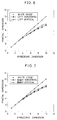
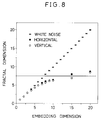
- Fig. 6 is a diagram showing dependence of fractal dimension on embedding dimension with respect to horizontal and vertical directions of a left eye.
- Fig. 7 is a diagram showing dependence of fractal dimension on embedding dimension with respect to horizontal and vertical directions of a right eye.
- Fig. 8 is a diagram showing fractal dimension of a drift component of the difference between left and right eyes in horizontal and vertical directions.
- Fig. 9 is a flow chart for use in explaining another embodiment of the present invention.
- Fig. 10 is a diagram showing fractal dimension depending on time obtained in the embodiment shown in Fig. 9.
- Fig. 11 is a diagram showing still another embodiment of the present invention.
- Fig. 12 is a diagram showing distribution of fractal dimension of phase space obtained in the embodiment shown in Fig. 11.
- a sensor 1 serves to measure flicks of an eyeball by using a limbus reflection method. As shown in Fig. 2, when a subject is looking at a target not shown, sensor 1 illuminates an eyeball 5 of the subject with infrared light emitted from a light emitting diode 11, and then detects the amount of reflected light at the boundary between a white part 6 and a colored part 7 of the eye by left and right photodiodes 12 and 13 as shown in Fig. 3.
- vertical flicks of the eye can be detected from a sensor amplifier 8 by detecting the amount of reflected light at the boundary between white part 6 and a lower portion of colored part 7 by using photodiodes 12 and 13 as shown in Fig. 3 (a).
- horizontal flicks of the eye can be detected from sensor amplifier 8 by detecting the amount of reflected light at the boundary between white part 6 and horizontal opposite ends of colored part 7 by using photodiodes 12 and 13 as shown in Fig. 3 (b).
- An output of sensor amplifier 8 is applied to an A/D converter 2.
- the applied output is digitized by A/D converter 2 and then applied to a computer 3.
- Computer 3 processes flicks data of eyeball 5 by calculation, then obtains a fractal dimension value and time dependence of the fractal dimension and displays the results on a display device 4.
- Fig. 4 is a flow chart for use in explaining an operation of the embodiment of the present invention. A detailed operation of the embodiment will now be described with reference to Figs. 1-4.
- Computer 3 accepts the flicks data digitized by A/D converter 2 as time-serial two-dimensional sampling data at step SP1 and carries out pre-processing of the data at step SP2.
- the flicks data includes a very slow small movement of a head, a saccade that is not produced frequently but occurs with a great deviation from the target, a nictitation component and the like. If the flicks data includes other components than flicks in presuming degrees of freedom in the flicks, those components are over-evaluated as the degrees of freedom of a system. Accordingly, great waviness close to a direct current component, a component corresponding to saccade that is produced sometimes and has an extremely large amplitude, and the like are removed.
- the above-described two-dimensional data corresponds to coordinates of an arbitrary coordinate system, i.e., a polar coordinate system or orthogonal coordinate system.
- the fractal dimension of flicks is derived with one of these coordinate values being x (t).
- geometric representation of distribution of data such as a locus of a corresponding system is quantified. For example, if data is distributed in a linear manner, its fractal dimension becomes almost one dimension. If the data is arranged in a planar manner, the fractal dimension becomes two dimensions. Further, if the data is overlapped with each other on a curved surface, then the fractal dimension becomes at least two and less than three dimensions. If the data is distributed completely spatially, then the fractal dimension becomes three dimensions.
- fractal dimension is approximately equal to the degree of freedom of its system. In the case with complete noise, the fractal dimension becomes infinite. More specifically, even if data seems random at sight, when the fractal dimension of the data is not infinite but finite, it is highly possible that the data is not noise. Calculating the fractal dimension makes it possible to presume a minimum degree of internal freedom required to describe the system.
- time-serial one-dimensional data is x (t)
- An orbit X1 on pseudo-phase space is topologically identical to (x (t), v (t)) on phase space wherein v (t) is time differential (speed) of x (t).
- computer 3 performs a calculation of correlation function at step SP4. More specifically, computer 3 calculates a correlation dimension defined in the following as fractal dimension with respect to a data point set on pseudo-phase space in accordance with the above-described method by N. B. Abraham et al.
- x i is the position of a measured point at time t i
- H (r) is Heaviside step function where the following relation is satisfied:
- computer 3 calculates fractal dimension at step SP5, then compares the value of the fractal dimension with a pre-measured standard value of a healthy person or the value of a patient at step SP6, and displays the result on display device 4.
- Fig. 5 is a diagram showing the relationship between correlation distance and correlation function obtained in the embodiment shown in Fig. 4.
- the abscissa indicates correlation distances and the ordinate indicates correlation functions, showing the respective characteristics of one to ten fractal dimensions.
- the inclination of the characteristics of each dimension is the value of the fractal dimension.
- Fig. 6 is a diagram showing dependence of fractal dimension on embedding dimension, in which the fractal dimension is calculated with one to ten embedding dimensions with respect to the horizontal and vertical directions of a left eye.
- Fig. 7 is a diagram showing dependence of the fractal dimension on the embedding dimension, in which the fractal dimension is calculated with one to ten embedding dimensions with respect to the horizontal and vertical directions of a right eye.
- Figs. 6 and 7 the abscissa indicates one to ten embedding dimensions, and the ordinate indicates the fractal dimension.
- Fig. 6 shows the correlation between white noise and the left horizontal and vertical directions.
- Fig. 7 shows the correlation between the right horizontal and vertical directions.
- Fig. 8 is a diagram showing the fractal dimension of a drift component of the difference between left and right eyes in the horizontal and vertical directions.
- left-eye data and right-eye data are input as measurement data of Fig. 4, and the difference between the left and right data is obtained to calculate fractal dimension.
- the fractal dimension of drifts in the horizontal direction is always approximately 0.5 dimensions higher than the fractal dimension of drifts in the vertical direction.
- embedding dimension starts to be saturated around dimensions higher than five. When embedding dimensions are 15 or 20, the fractal dimension is converged on approximately 7.5 dimensions.
- the fractal dimension may be calculated by oscillating the target looked by the subject and measuring how eyeball movement, saccade in particular follows the movement of the target. If the eyeball movement completely follows the movement of the target, the fractal dimension is one.
- a noise component that always exists at a frequency of approximately 2Hz of a normal pupil movement is confirmed, and fractal dimension of such a noise component may be calculated.
- a pupil system in particular is controlled by an autonomic nervous system and is available for evaluations (quantifications) in diagnoses of mental diseases or curative effects of various internal medicine diseases as well as in a field of ophthalmology.
- Fig. 9 is a flow chart showing another embodiment of the present invention.
- steps SP1 - SP5 shown in Fig. 4 which is from the input of measurement data to the calculation of fractal dimension, is used, time dependence of the fractal dimension is analyzed with respect to both the left and right eyeball control systems at the same time at step SP12, and an overall index of eyeballs is obtained as a system from its correlation relationship at step SP13. That is, data is sampled at appropriate intervals, and fractal dimension is calculated on the basis of the data provided at the intervals.
- Fig. 10 is a plot of the vertical and horizontal fractal dimensions of the left and right eyeballs obtained in the embodiment shown in Fig. 9.
- the abscissa indicates times and the ordinate indicates fractal dimensions in Fig. 10, in which data is sampled at appropriate intervals, left and right fractal dimensions at respective times are calculated and plotted, and interpolation is made between the respective fractal dimensions.
- the fractal dimensions become lower with an elapse of times. This suggests that with the elapse of time, the eyes are fatigued and flicks become decreased.
- Fig. 11 is a flow chart showing still another embodiment of the present invention.
- Fig. 12 is a diagram showing distribution of fractal dimension in phase space obtained in the embodiment shown in Fig. 11.
- phase space is represented by coordinates of x (t), x (t + ⁇ ) and x (t + 2 ⁇ ) wherein ⁇ is periods. Fractal dimensions represented by x (t), x (t + ⁇ ) and x (t + 2 ⁇ ) are illustrated in this phase space.
- measurement of data in the phase space is made at one time, and the space is divided into subspaces as shown by dotted lines of Fig. 12 at step SP22, whereby fractal dimensions are calculated in the respective subspaces at step SP23.
- a small amplitude of each of various eyeball control systems is measured, whereby information of eyeballs included in small eyeball movement that has conventionally been neglected and regarded as noise can be quantified with high efficiency from a fractal dimension analysis or multi-fractal. Consequently, a clinical diagnosis, curative effects and the like in ocular and mental diseases can be examined by a very short-time calculation.
- the use of measurement of eyeball control systems upon visual psychological experiments makes it possible to quantitively evaluate the results of the experiments by using fractal dimension.
Landscapes
- Health & Medical Sciences (AREA)
- Life Sciences & Earth Sciences (AREA)
- Engineering & Computer Science (AREA)
- Heart & Thoracic Surgery (AREA)
- Molecular Biology (AREA)
- Biophysics (AREA)
- Ophthalmology & Optometry (AREA)
- Biomedical Technology (AREA)
- Human Computer Interaction (AREA)
- Medical Informatics (AREA)
- Physics & Mathematics (AREA)
- Surgery (AREA)
- Animal Behavior & Ethology (AREA)
- General Health & Medical Sciences (AREA)
- Public Health (AREA)
- Veterinary Medicine (AREA)
- Eye Examination Apparatus (AREA)
- Measurement Of The Respiration, Hearing Ability, Form, And Blood Characteristics Of Living Organisms (AREA)
Applications Claiming Priority (2)
| Application Number | Priority Date | Filing Date | Title |
|---|---|---|---|
| JP326283/90 | 1990-11-27 | ||
| JP2326283A JPH04193255A (ja) | 1990-11-27 | 1990-11-27 | 眼球制御系の解析装置 |
Publications (2)
| Publication Number | Publication Date |
|---|---|
| EP0487855A1 true EP0487855A1 (de) | 1992-06-03 |
| EP0487855B1 EP0487855B1 (de) | 1995-05-17 |
Family
ID=18186038
Family Applications (1)
| Application Number | Title | Priority Date | Filing Date |
|---|---|---|---|
| EP91116429A Expired - Lifetime EP0487855B1 (de) | 1990-11-27 | 1991-09-26 | Verfahren zur Untersuchung des Bewegungssystems des Auges |
Country Status (4)
| Country | Link |
|---|---|
| US (1) | US5212506A (de) |
| EP (1) | EP0487855B1 (de) |
| JP (1) | JPH04193255A (de) |
| DE (1) | DE69109824T2 (de) |
Cited By (4)
| Publication number | Priority date | Publication date | Assignee | Title |
|---|---|---|---|---|
| EP0598983A1 (de) * | 1992-11-27 | 1994-06-01 | Atr Auditory And Visual Perception Research Laboratories | Gerät zur Messung kleiner ungewollter Bewegung |
| EP0587976A3 (de) * | 1992-09-17 | 1995-04-05 | Atr Auditory Visual Perception | Gerät zur Untersuchung des Blickwechsels in Tiefenrichtung. |
| WO2001043067A3 (en) * | 1999-12-10 | 2002-05-10 | Durand Technology Ltd | Improvements in or relating to applications of fractal and/or chaotic techniques |
| CN111281335A (zh) * | 2020-03-19 | 2020-06-16 | 连云港市妇幼保健院(连云港市第三人民医院) | 一种眼内散光度及散光轴的检测方法 |
Families Citing this family (9)
| Publication number | Priority date | Publication date | Assignee | Title |
|---|---|---|---|---|
| JPH074343B2 (ja) * | 1992-09-29 | 1995-01-25 | 株式会社エイ・ティ・アール視聴覚機構研究所 | 奥行き知覚分析装置 |
| WO1996013199A2 (en) * | 1994-10-28 | 1996-05-09 | Eyesys Technologies, Inc. | Multi-camera corneal analysis system |
| US5696700A (en) * | 1995-06-26 | 1997-12-09 | The United States Of America As Represented By The Secretary Of The Navy | System and computer-implemented method for fractal-dimension measurement for target-motion analysis noise discrimination |
| US7011410B2 (en) * | 2000-11-22 | 2006-03-14 | Eyetect, L.L.C. | Method and apparatus for monitoring eye tremor |
| JP2002200046A (ja) * | 2000-12-28 | 2002-07-16 | Canon Inc | 眼科機器及びその制御方法 |
| US7872635B2 (en) * | 2003-05-15 | 2011-01-18 | Optimetrics, Inc. | Foveated display eye-tracking system and method |
| US20090177098A1 (en) * | 2006-01-16 | 2009-07-09 | Kousuke Yakubo | Examination System and Examination Method |
| JP5072553B2 (ja) * | 2007-11-29 | 2012-11-14 | 浜松ホトニクス株式会社 | 眼球運動計測装置 |
| JP5351704B2 (ja) * | 2009-10-14 | 2013-11-27 | 日本放送協会 | 映像酔い耐性評価装置及びプログラム |
Family Cites Families (2)
| Publication number | Priority date | Publication date | Assignee | Title |
|---|---|---|---|---|
| US4660945A (en) * | 1983-01-25 | 1987-04-28 | Trachtman Joseph N | Methods and apparatus for accommodation training |
| US4973149A (en) * | 1987-08-19 | 1990-11-27 | Center For Innovative Technology | Eye movement detector |
-
1990
- 1990-11-27 JP JP2326283A patent/JPH04193255A/ja active Granted
-
1991
- 1991-09-17 US US07/760,442 patent/US5212506A/en not_active Expired - Fee Related
- 1991-09-26 DE DE69109824T patent/DE69109824T2/de not_active Expired - Fee Related
- 1991-09-26 EP EP91116429A patent/EP0487855B1/de not_active Expired - Lifetime
Non-Patent Citations (3)
| Title |
|---|
| PHYSICAL REVIEW vol. 33, no. 2, February 1986, pages 1141 - 1151; T. C. HALSEY ET AL.: 'Fractal measures and their singularities: The characterization of strange sets' * |
| PROC. OF THE 13TH. ANNUAL NORTHEAST BIOENGINEERING CONFERENCE vol. 1, 12 March 1987, PHILADELPHIA (US) pages 181 - 184; D. M. DROUIN; A. D. DRAKE: 'A Fiber Optic Eye Position Sensor' * |
| SYSTEMS & COMPUTERS IN JAPAN vol. 18, no. 8, August 1987, SILVER SPRING (US) pages 88 - 96; M. YAMADA ET AL.: 'Definition of Gazing Point for Picture Analysis and its Application' * |
Cited By (5)
| Publication number | Priority date | Publication date | Assignee | Title |
|---|---|---|---|---|
| EP0587976A3 (de) * | 1992-09-17 | 1995-04-05 | Atr Auditory Visual Perception | Gerät zur Untersuchung des Blickwechsels in Tiefenrichtung. |
| EP0598983A1 (de) * | 1992-11-27 | 1994-06-01 | Atr Auditory And Visual Perception Research Laboratories | Gerät zur Messung kleiner ungewollter Bewegung |
| US5365941A (en) * | 1992-11-27 | 1994-11-22 | Atr Auditory And Visual Perception Research Laboratories | Apparatus for detecting small involuntary movement |
| WO2001043067A3 (en) * | 1999-12-10 | 2002-05-10 | Durand Technology Ltd | Improvements in or relating to applications of fractal and/or chaotic techniques |
| CN111281335A (zh) * | 2020-03-19 | 2020-06-16 | 连云港市妇幼保健院(连云港市第三人民医院) | 一种眼内散光度及散光轴的检测方法 |
Also Published As
| Publication number | Publication date |
|---|---|
| JPH04193255A (ja) | 1992-07-13 |
| EP0487855B1 (de) | 1995-05-17 |
| JPH0553490B2 (de) | 1993-08-10 |
| DE69109824T2 (de) | 1995-11-16 |
| DE69109824D1 (de) | 1995-06-22 |
| US5212506A (en) | 1993-05-18 |
Similar Documents
| Publication | Publication Date | Title |
|---|---|---|
| EP0487855B1 (de) | Verfahren zur Untersuchung des Bewegungssystems des Auges | |
| EP2150170B1 (de) | Verfahren und geräte zur abschätzung des blickpunkts in drei dimensionen | |
| Delignlères et al. | A methodological note on nonlinear time series analysis: is the open-and closed-loop model of Collins and De Luca (1993) a statistical artifact? | |
| KR102045569B1 (ko) | 조종사 상태의 통합 감시 제어 장치 및 이를 이용한 조종사의 임무 수행 능력 유도 방법 | |
| EP1164919B1 (de) | Verfahren und vorrichtung zur augenverfolgung | |
| EP1982645A1 (de) | Verfahren und Vorrichtung zur Anzeige eines Gehirnfeldes eines Patienten und gehirnchirurgisches Navigationssystem | |
| US8175686B2 (en) | External condition control device based on measurement of brain functions | |
| Verleger et al. | Suspense and surprise: On the relationship between expectancies and P3 | |
| US20260076758A1 (en) | Method for guiding a robot arm, guiding system | |
| US12456256B2 (en) | Method for generating a three-dimensional working surface of a human body, system | |
| JP2000504256A (ja) | 生物の血管を検査するための装置および方法 | |
| US12467786B2 (en) | Measurement device, synthesized light applying method, optical measuring method, service providing system, and service providing method | |
| Fairbanks et al. | Measuring the scaling properties of temporal and spatial patterns: from the human eye to the foraging albatross | |
| Lippi | Bootstrap prediction and confidence bands for frequency response functions in posturography | |
| Iliasova et al. | Methods for estimating geometric parameters of retinal vessels using diagnostic images of fundus | |
| Kruchinina et al. | 54‐4: Prediction of Saccadic Eye Movement for Foveated Rendering | |
| Gainer et al. | Pilot eye fixations while flying selected maneuvers using two instrument panels | |
| Rosenberg et al. | Pupillary hippus: an unrecognized example of biologic chaos | |
| RU2204943C1 (ru) | Способ определения степени зрительного утомления | |
| Hoeks | The pupillary response as a measure of mental processing load: with application to picture naming | |
| Model et al. | A probabilistic approach for the estimation of angle kappa in infants | |
| Antipov et al. | Development of an Algorithm for Detecting Saccadic Eye Movements Based on Model Approximation | |
| Kachanov et al. | Flicker noise simulation by superposition of normal stationary processes | |
| Sadchikova et al. | Laser self-mixing interferometry for measuring and analyzing micromovements of the eyeball | |
| Alonso-Diaz et al. | What is in a reach? Domain-general spatial modulation of motor responses by number representations |
Legal Events
| Date | Code | Title | Description |
|---|---|---|---|
| PUAI | Public reference made under article 153(3) epc to a published international application that has entered the european phase |
Free format text: ORIGINAL CODE: 0009012 |
|
| AK | Designated contracting states |
Kind code of ref document: A1 Designated state(s): DE FR GB NL |
|
| 17P | Request for examination filed |
Effective date: 19920521 |
|
| 17Q | First examination report despatched |
Effective date: 19940131 |
|
| GRAA | (expected) grant |
Free format text: ORIGINAL CODE: 0009210 |
|
| AK | Designated contracting states |
Kind code of ref document: B1 Designated state(s): DE FR GB NL |
|
| REF | Corresponds to: |
Ref document number: 69109824 Country of ref document: DE Date of ref document: 19950622 |
|
| ET | Fr: translation filed | ||
| PLBE | No opposition filed within time limit |
Free format text: ORIGINAL CODE: 0009261 |
|
| STAA | Information on the status of an ep patent application or granted ep patent |
Free format text: STATUS: NO OPPOSITION FILED WITHIN TIME LIMIT |
|
| 26N | No opposition filed | ||
| PGFP | Annual fee paid to national office [announced via postgrant information from national office to epo] |
Ref country code: GB Payment date: 20010814 Year of fee payment: 11 |
|
| PGFP | Annual fee paid to national office [announced via postgrant information from national office to epo] |
Ref country code: FR Payment date: 20010822 Year of fee payment: 11 |
|
| PGFP | Annual fee paid to national office [announced via postgrant information from national office to epo] |
Ref country code: NL Payment date: 20010920 Year of fee payment: 11 |
|
| PGFP | Annual fee paid to national office [announced via postgrant information from national office to epo] |
Ref country code: DE Payment date: 20010926 Year of fee payment: 11 |
|
| REG | Reference to a national code |
Ref country code: GB Ref legal event code: IF02 |
|
| PG25 | Lapsed in a contracting state [announced via postgrant information from national office to epo] |
Ref country code: GB Free format text: LAPSE BECAUSE OF NON-PAYMENT OF DUE FEES Effective date: 20020926 |
|
| PG25 | Lapsed in a contracting state [announced via postgrant information from national office to epo] |
Ref country code: NL Free format text: LAPSE BECAUSE OF NON-PAYMENT OF DUE FEES Effective date: 20030401 Ref country code: DE Free format text: LAPSE BECAUSE OF NON-PAYMENT OF DUE FEES Effective date: 20030401 |
|
| GBPC | Gb: european patent ceased through non-payment of renewal fee |
Effective date: 20020926 |
|
| PG25 | Lapsed in a contracting state [announced via postgrant information from national office to epo] |
Ref country code: FR Free format text: LAPSE BECAUSE OF NON-PAYMENT OF DUE FEES Effective date: 20030603 |
|
| REG | Reference to a national code |
Ref country code: FR Ref legal event code: ST |