EP0488150A2 - Neuronales Netzwerk, angepasst für nicht-lineare Verarbeitung - Google Patents
Neuronales Netzwerk, angepasst für nicht-lineare Verarbeitung Download PDFInfo
- Publication number
- EP0488150A2 EP0488150A2 EP91120155A EP91120155A EP0488150A2 EP 0488150 A2 EP0488150 A2 EP 0488150A2 EP 91120155 A EP91120155 A EP 91120155A EP 91120155 A EP91120155 A EP 91120155A EP 0488150 A2 EP0488150 A2 EP 0488150A2
- Authority
- EP
- European Patent Office
- Prior art keywords
- neural network
- data
- neurons
- neuron
- output
- Prior art date
- Legal status (The legal status is an assumption and is not a legal conclusion. Google has not performed a legal analysis and makes no representation as to the accuracy of the status listed.)
- Granted
Links
Images














Classifications
-
- G—PHYSICS
- G06—COMPUTING OR CALCULATING; COUNTING
- G06J—HYBRID COMPUTING ARRANGEMENTS
- G06J3/00—Systems for conjoint operation of complete digital and complete analogue computers
-
- G—PHYSICS
- G06—COMPUTING OR CALCULATING; COUNTING
- G06N—COMPUTING ARRANGEMENTS BASED ON SPECIFIC COMPUTATIONAL MODELS
- G06N3/00—Computing arrangements based on biological models
- G06N3/02—Neural networks
- G06N3/08—Learning methods
-
- G—PHYSICS
- G06—COMPUTING OR CALCULATING; COUNTING
- G06N—COMPUTING ARRANGEMENTS BASED ON SPECIFIC COMPUTATIONAL MODELS
- G06N3/00—Computing arrangements based on biological models
- G06N3/02—Neural networks
- G06N3/04—Architecture, e.g. interconnection topology
- G06N3/042—Knowledge-based neural networks; Logical representations of neural networks
-
- G—PHYSICS
- G06—COMPUTING OR CALCULATING; COUNTING
- G06N—COMPUTING ARRANGEMENTS BASED ON SPECIFIC COMPUTATIONAL MODELS
- G06N3/00—Computing arrangements based on biological models
- G06N3/02—Neural networks
- G06N3/04—Architecture, e.g. interconnection topology
- G06N3/043—Architecture, e.g. interconnection topology based on fuzzy logic, fuzzy membership or fuzzy inference, e.g. adaptive neuro-fuzzy inference systems [ANFIS]
-
- G—PHYSICS
- G06—COMPUTING OR CALCULATING; COUNTING
- G06N—COMPUTING ARRANGEMENTS BASED ON SPECIFIC COMPUTATIONAL MODELS
- G06N3/00—Computing arrangements based on biological models
- G06N3/02—Neural networks
- G06N3/04—Architecture, e.g. interconnection topology
- G06N3/0495—Quantised networks; Sparse networks; Compressed networks
-
- G—PHYSICS
- G06—COMPUTING OR CALCULATING; COUNTING
- G06N—COMPUTING ARRANGEMENTS BASED ON SPECIFIC COMPUTATIONAL MODELS
- G06N3/00—Computing arrangements based on biological models
- G06N3/02—Neural networks
- G06N3/04—Architecture, e.g. interconnection topology
- G06N3/0499—Feedforward networks
-
- G—PHYSICS
- G06—COMPUTING OR CALCULATING; COUNTING
- G06N—COMPUTING ARRANGEMENTS BASED ON SPECIFIC COMPUTATIONAL MODELS
- G06N3/00—Computing arrangements based on biological models
- G06N3/02—Neural networks
- G06N3/08—Learning methods
- G06N3/082—Learning methods modifying the architecture, e.g. adding, deleting or silencing nodes or connections
-
- G—PHYSICS
- G06—COMPUTING OR CALCULATING; COUNTING
- G06N—COMPUTING ARRANGEMENTS BASED ON SPECIFIC COMPUTATIONAL MODELS
- G06N3/00—Computing arrangements based on biological models
- G06N3/02—Neural networks
- G06N3/08—Learning methods
- G06N3/09—Supervised learning
-
- G—PHYSICS
- G06—COMPUTING OR CALCULATING; COUNTING
- G06N—COMPUTING ARRANGEMENTS BASED ON SPECIFIC COMPUTATIONAL MODELS
- G06N7/00—Computing arrangements based on specific mathematical models
- G06N7/02—Computing arrangements based on specific mathematical models using fuzzy logic
- G06N7/04—Physical realisation
- G06N7/046—Implementation by means of a neural network
-
- Y—GENERAL TAGGING OF NEW TECHNOLOGICAL DEVELOPMENTS; GENERAL TAGGING OF CROSS-SECTIONAL TECHNOLOGIES SPANNING OVER SEVERAL SECTIONS OF THE IPC; TECHNICAL SUBJECTS COVERED BY FORMER USPC CROSS-REFERENCE ART COLLECTIONS [XRACs] AND DIGESTS
- Y10—TECHNICAL SUBJECTS COVERED BY FORMER USPC
- Y10S—TECHNICAL SUBJECTS COVERED BY FORMER USPC CROSS-REFERENCE ART COLLECTIONS [XRACs] AND DIGESTS
- Y10S706/00—Data processing: artificial intelligence
- Y10S706/90—Fuzzy logic
Definitions
- the present invention relates to a neural network system, or more in particular to a neural network system suitable for high-speed learning/recalling of non-linear processing.
- a neural network can perform the pattern recognition of an image or a voice by learning reference patterns in an information processing system without using a complicated algorithm.
- the couplings between neurons in the neural network are corrected in such a manner as to minimize an error between a recalled output pattern from the neural network system and a teacher information pattern.
- each neuron in the neural network is set to perform a designated operation.
- a configuration and an operation of such a neural network are described, for example, in "Algorithm of Pattern Recognition and Learning" by Yoshinori Kamisaka and Kazuhiko Ozeki, published by Bunichi Sougou Shuppan Co., Ltd.
- One of the important problems in applying a neural network to an actual apparatus is to learn the features of various types of input learning information patterns and to assure an adaptability also for an unknown input information pattern analogous or homogeneous to the learning information patterns.
- JP-A-01-241667 discloses a neural network system in which variations in the duration of unknown voice data are normalized dynamically along the time axis to recognize the same word.
- JP-A-2-98770 discloses a learning system for a multilayered neural network which responds uniquely to an input information pattern by non-linear processing of an input information pattern through a Gaussian filter.
- the number of running vehicles and the natural wind which are quite heterogenous from each other are a part of the input information pattern.
- the former has a unit [vehicles/five min] ranging from 0 to 200, and the latter [m/sec] ranging from -5 to +5.
- the effect of the former on pollution is so non-linear that there is substantially no effect in the range from 0 to 10 [vehicles/five mins], the effect becomes substantially conspicuous and approaches a linear form in the range from 30 to 70 [vehicles/five mins], and the effect on the pollution slackens again in the range for more than 70 [vehicles/five mins].
- the non-linearity is excessive for large-sized trucks which emit a large amount of exhaust gases.
- the latter on the other hand, has a comparatively uniform effect on the pollution and is small in range.
- the process control or the like requires conversion of the recalled output of a neural network from a crisp value into a continuous quantity. Quantification is therefore difficult when a non-linear element is conspicuous.
- JP-A-1-201764 Another important problem in applying a neural network to an actual apparatus is the fact that a long time is required for computation of the product and a non-linear function in the learning and recalling.
- a solution of this problem is disclosed in JP-A-1-201764.
- a new state (output value) of the next neuron is determined by computation of products of the states (output values) of a plurality of neurons and a plurality of coupling coefficients (weights of synapses) and non-linear computation based on the total sum of these products.
- a suggestion has been made to improve the speed of the non-linear computation by performing the computation on the neurons in parallel.
- JP-A-64-82133 proposes a method of improving the learning ability of a neural network by again initializing the neurons inhibited in the process of learning.
- Still another important problem encountered in applying a neural network to an actual apparatus is that it is often impossible to secure the convergence of learning and a high speed of recalling.
- a typical neural network recently introduced by many references has a multilayer structure including an input layer, an output layer and an intermediate (hidden) layer with all the neurons of adjacent layers interconnected by synapses.
- the learning method is called “the error back propagation learning method” and is such that a learned information pattern is inputted to the neural network and the coupling coefficient (weight of synapse) is adjusted in such a manner that the deviation from an ideal value of the output information pattern, i.e., the teacher information pattern is minimum.
- the weight of each synapse is fixed.
- the output information of the process for example, can be obtained also for an unknown input information pattern different from the teacher information pattern.
- This technique of the neural network is described in detail, for instance, in "Algorithm of Pattern Recognition and Learning” cited above. Also, a specific circuit configuration of a neural network is disclosed, for instance, in JP-A-1-201764.
- a comparatively effective application of a neural network such as described above is found in prediction of stock prices and pattern recognition.
- the features of a given event i.e., the chronological change of stock prices or an image distribution is learned for prediction and recognition.
- An application of a neural network to the process control and various diagnoses requires handling of a great variety of parameters and actuators, so that if they are applied as inputs/outputs of the neural network as they are, it is practically impossible in many cases to secure the convergence of learning or high-speed of recalling.
- the neural network is fraught with great difficulties of application to complex problems.
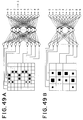
- the above-mentioned problems of the prior art will be explained taking the pattern recognition of numerals shown in Figs. 49A and 49B as an example.
- the neural network shown in Fig. 49A has an image divided into 64 segments as an input information pattern and corresponding 64 neurons of the input layer. Twenty neurons are allocated to an intermediate layer. According to this neural network, as compared with Fig. 49B, the learning is converged in a short time with a higher accuracy of recalling. An increased number of neurons, however, decreases the recalling speed.
- the neural network shown in Fig. 49B has the same image divided into 16 segments as an input information pattern and includes 16 neurons of an input layer, ten neurons of an intermediate layer and ten neurons of an output layer.
- this neural network as compared with that shown in Fig. 49A, the smaller number of neurons increases the recalling speed although the convergence of learning and the recalling accuracy are decreased. In other words, with the increase in the total number of neurons, the sum-of-the-products computation becomes so extensive that the processing speed is decreased.
- JP-A-64-82133 discloses a method of improving the accuracy by several percentage points by initialization of neurons inhibited in the process of learning for relearning.
- JP-A-1-248268 proposes a method of improving the processing speed of propagation of a neural network by a plurality of parallel computation circuits and pipelining.
- a research in which the brain is assumed as an assembly of subsystems, is aimed at analyzing the contents of the subsystems to grasp the essential nature of the brain. This effort is considered to contribute to optimization by minimizing the network configuration in modelling the brain by a neural network. Under the circumstances, however, no effective method of segmentation of subsystems has been proposed.
- the present invention has been developed in view of the above-mentioned problems, and the object thereof is to provide a neural network system for and a method of learning or recalling which are optimized for objects of learning/recalling.
- the processing in a neural netowrk is effected according to not the absolute values of input information such as a linear model, but by extraction of feature quantities thereof and is based on the idea that each input value of an input layer neurons is not required to be handled in the same dimension (unit dimension).
- This invention is, therefore, such that even when the input information has various ranges and contains a strong non-linearity or many indefinite elements, if the correlationship between input values and the recalled result can be grasped to some extent and expressed in a qualitative fashion, then the learning/recalling are made possible by using qualitative values evaluated by fuzzy membership functions for providing particular qualitative expressions as input information to the neural network.
- a quantified value can be determined by defuzzying the recalled result of the neural network as long as the correlationship between the evaluated value and the quantified value is known to some extent, in view of the fact that the recalled result represents a qualitative evaluation.
- the learning/recalling of a neural network which can properly respond to various types of characteristics of a process is made possible, if the present invention is applied to various information on process diagnosis and control, which have so far been considered not applicable, in accordance with the nature of each information.
- the non-linear processing is effected based on the fuzzy set concept and hence the present invention can be applied to the non-linear processing if the correlationship between input information and a recalled result is predetermined from experiences and experiments to some extent, resulting in a range of application being extended.
- the inference rule in conventional fuzzy interference is replaceable by the particular neural network.
- the tuning time can be shortened and accuracy can be improved as compared with the conventional fuzzy inference.
- a forward neural network is based on the characteristic that the more sufficiently the learning is effected, the more asphyctic states of synapses/neurons occur, thereby making it more difficult to refresh the asphyctic synapses/neurons in their direct form. More specifically, a neural network is optimized by separating both the synapses having the absolute value of synapse weight less than a predetermined value near to zero and the neurons with all the synapses thereof separated. It is thus possible to eliminate the redundant product computation and the computation of non-linear function values in the learning and recalling, thereby improving the processing performance.
- a neural network system based on the technique that an actual system in the fields of industry and information is sufficiently effective in a limited range of input information and weight coefficient, and therefore the computation of the products and non-linear function requiring a great amount of time are facilitated by limiting the numerical space used in a neural network to a predetermined range.
- the processing in a neural network is effected not on the basis of the absolute values of input information like a linear model but by extracting the feature quantities thereof.
- the segmentation unit of a neural network is clearly defined on the basis of the experiences of a qualitative causal network between input information and a recalled target. Since subnets having causal relations are accumulated, the network configuration is optimized, thereby to improve the processing speed and accuracy at the same time.
- synapse connections of neurons not correlated to each other i.e., asphyctic synapses are excluded from the neural network. All operations redundant for the learning of the neural network, therefore, can be eliminated, thereby making convergence of the learning possible within a short length of time.
- a process control system which uses an optimized neural network behaving as if a qualitative causal network of the process has been transplanted for qualitative inference, facilitates construction of a control system and realizes a highly accurate prediction as well as a real-time processing thereof.
- the optimized neural network and the learning function thereof according to the present invention which can replace the conventional fuzzy theory with high accuracy, completely eliminates the definition of the inference rule and tuning of membership functions which have posed a bottleneck in applications of the fuzzy theory to complicated processes.
- Figs. 1 to 4 are diagrams for explaining the embodiment of the present invention.
- a general configuration of the neural network system according to the present invention is shown in the block diagram of Fig. 1.
- the system 1 includes a fuzzy section 2 for qualitatively evaluating a pattern X of learned/unknown information inputted from an input unit 31, a forward neural network 6, a fuzzy section 4 for qualitatively evaluating a teacher information pattern d(X), a weight-correcting section 7 for correcting weights of synapse connections by back propagation of an error, a quantifying section 3 for converting an output of the neural network 6 into a quantified value, an output unit 32 for outputting the result by display thereof, for example, and a control section 8 for controlling operations of the respective sections.
- the sections 6, 7 and 8 make up a neural network section 5.
- the fuzzy sections 2, 4, the correcting section 7, the control section 8 and the network 6 constitute a learning unit, while the fuzzy section 2, the network 6, the control section 8 and the quantifying section 3 make up a recalling unit.
- the neural network 6 includes an input layer for inputting information, an output layer for outputting the final result, at least one intermediate layer interposed between the input and output layers, a plurality of neurons and synapses having weight coefficients for connecting between neurons of adjacent layers.
- the input information is subjected to qualitative evaluation by the fuzzy sections 2 and 4 by use of fuzzy membership functions predetermined according to empirical knowledge and normalized in a dynamic range, and then inputted to the input layer of the neural network 6.
- the output value of the neural network 6, which is regarded as a qualitative evaluation of fuzzy membership functions predetermined empirically, is quantified by the quantifying section.
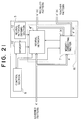
- Fig. 2 shows a configuration of the fuzzy section 2, which is similar to that of the section 4.
- Fig. 3 is a diagram for explaining an operation of the adaptability processing section 21.
- the section 21 has prestored therein membership functions respectively corresponding to three types of qualitative evaluations such as S (small), M (medium) and L (large), for example, on the basis of the empirical information from experiences and experiments.
- ⁇ S (x i ) x iS ( ⁇ S represents an adaptability function for the evaluation type S)
- a pattern X' of these qualitative evaluations is inputted to the neural network 6.
- the teacher information pattern d(X) is converted to three types of evaluations for respective elements of the information pattern d(X) by the fuzzy section 4 as a pattern d'(X) of the qualitative evaluations.
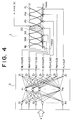
- Fig. 4 schematically shows a configuration of the forward neural network 6 and the quantifying section 3.
- a forward three-layer network model is illustrated in the diagram, the present invention is also applicable to a network of multilayered structure having four or more layers.
- the weights W ij and V jk range from -1.0 to 1.0.
- Each neuron has spatial additive and non-linear characteristics and is subjected to the processing (recalling) described later.
- the correcting section 5 which is supplied with outputs X' and d'(X) from the fuzzy sections 2 and 4 and a recalled output h'(X) of the neural network 6, corrects the weight of synapses of the neural network 6 in such a manner as to minimize or reduce below a predetermined value difference between the outputs h'(X) and d'(X).
- Step (1) An output value of each neuron of the intermediate layer is calculated:
- the output value of each neuron of the intermediate layer is calculated. Specifically, after the product of each element of the evaluated pattern d'(X) of the learned information pattern as each input value and the weight W ij of each synapse of each neuron is computed, and the total sum of the products for each neuron is determined, computation of the value of a non-linear function (the value of a sigmoid function in the case under consideration) is performed for the total sum for each neuron, thereby determining output values of the neurons of the intermediate layer.
- a non-linear function the value of a sigmoid function in the case under consideration
- Step (2) Output values of the neurons of the output layer is calculated:
- the learning process described below is effected by the correcting section 7 shown in Fig. 1, thereby to correct the synapse weight.
- the learning of the neural network 6 is effected.
- Step (3) The correction amount of each synapse weight is computed.
- ⁇ 2k (X) ⁇ (X)(h' k (X) - d' k (X)) ⁇ h' k (X)(1-d' k (X))
- ⁇ (X) is the degree of importance relating to the proximity of the output information pattern, i.e., a vector h'(X) against an input information pattern, i.e., a vector X', and is a known item
- a learned information pattern and a teacher information pattern are qualitatively evaluated, and the value of each element is normalized in a range of 0 to 1 by membership functions.
- the consistency of correlationship between the learned information pattern and the teacher information pattern is improved, thereby making possible stable and high-accuracy learning.
- the weights of synapses are fixed.
- the neural network having the fixed weights may be transplanted to a system used as a recalling unit.
- the recalling unit is able to make accurate decision even against an unknown input information.
- An operation of the recalling unit is identical to the one described in the above Steps (1) and (2). Specifically, the total sum of the products of the qualitative evaluations of the input information and the synapse weights is computed for each neuron and then values of the sigmoid function is determined for the neurons, thereby obtaining output values of the neurons of the intermediate layer. Next, the output values of the neurons of the output layer, i.e., the recalled result is generated from the output values of the neurons of the intermediate layer and the synapse weights of the neurons of the output layers.
- the section 2 and the neural network 6 perform the same operation as the learning unit and will not be described again.
- Fig. 4 is a diagram for explaining an operation of the quantifying section 3.
- seven types of evaluations including NL (large minus), NM (medium minus), NS (small minus), Z0 (zero), PS (small plus), PM (medium plus) and PL (large plus) are defined as a value of each neuron of the output layer, i.e., a qualitative evaluation of the output value of the network 6.
- Seven types of qualitative evaluation curves are prepared with the ordinate representing an adaptability in the range of 0.0 to 1.0 and the abscissa representing the value of the recalled object H (-H MAX to +H MAX ) on the basis of empirical information.
- the number of neurons of the output layer of the network 6 is seven in the present embodiment and corresponds to the qualitative evaluations NL, NM, NS, Z0, PS, PM and PL.
- the evaluation curve of each membership function is cut off by the output value of each neuron, thereby to determine the gravity center of the hatched area.
- a value H corresponding to this gravity center is outputted as a recalled result h(X).
- the input information is qualitatively evaluated and normalized before being inputted to the neural network 6, so that the recalled output of the network 6 can be handled as a qualitative evaluation pattern. It is possible to quantity by defuzzying this recalled output by predetermined membership functions.
- input information is evaluated qualitatively by a fuzzy set and used as an input to the neural network. Therefore, even input information containing a strong non-linearity or many indefinite characteristics can be evaluated accurately. In addition, since the evaluation is normalized within a predetermined range, even input information of different natures can be subjected to learning/recalling with stability and high accuracy.
- the learning/recalling can be effected with high stability and accuracy.
- the inference rule of the conventional fuzzy inference system can be replaced with the neural network recalling unit, and therefore the tuning time can be shortened and accuracy of the inference can be improved, compared with the conventional fuzzy system.
- a neural network including an input layer for inputting information, an output layer for outputting a final result, at least one intermediate layer interposed between the input and output layers, a plurality of neurons for each layer, and synapses with weight coefficients, for connecting the neurons, when the absolute value of the weight coefficient of a synapse is reduced below a predetermined value, the synapse is removed from the neural network.
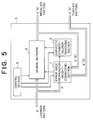
- Fig. 5 is a block diagram showing a configuration of the neural network section 5 capable of removing asphyctic synapses/neurons from the neural network 6 for an improved computation speed.
- the section 5 includes a neural network 6, a weight-correcting section 7, a section 9 for removing asphyctic synapses/neurons and a control section 8.
- a qualitatively evaluated pattern x' as the learning information pattern and a qualitatively evaluated pattern d'(x) as a known teacher information pattern corresponding to the pattern x' are supplied to the correcting section 7.
- the section 7 computes and sets anew the weight of each synapse in such a manner that the output of the neural network 6 for the input x', i.e., the error between the recalled information pattern h'(x) and the pattern d'(x) is minimized.
- This process is repeated, and after correction of the synapse weight is completed, the removing section 9 is initialed to remove asphyctic synapse/neurons.
- the control section 8 controls the processes described above.
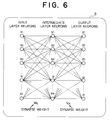
- Fig. 6 schematically shows a configuration of the neural network 6. Although a network model of three layers is illustrated, the present invention is applicable with equal effect to a multilayered network of four or more layers. The learning process of the neural network 6 is similar to that described above and will not be explained again.
- the corrected weight of each synapse is determined as explained below by the removing section 9, so that asphyctic synapses/neurons are removed from the neural network 6.
- the removal of the asphyctic synapses/neurons may be effected by a method of omitting the operating procedure for the asphyctic synapses/neurons by the control unit 8 or the like in the recalling/learning process.
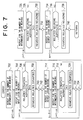
- Fig. 7 shows a flow of the procedure for removing asphyctic synapses/neurons by the removing section 9.
- Asphyctic synapses between input and intermediate layers are removed at steps 702 to 712, those between intermediate and output layers at steps 714 to 724, asphyctic neurons in the intermediate layer at steps 726 to 732, and those in the output layer at steps 734 to 740.
- Step 706 As a criterion of asphyxia, a synapse is considered to be asphyctic when
- the synapse having w ij is removed from the neural network 6.
- Step 7128 As a criterion of asphyxia, a synapse is considered to be asphyctic when
- Step 720 the synapse having v ik is removed from the neural network 6.
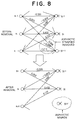
- Fig. 8 is a diagram for explaining the operation of the removing section 9.
- all neurons are connected by synapses as shown at the upper part of the diagram.
- ⁇ used for determing asphyxia is given as 0.013.
- the condition for asphyxia is met by synapses having the following weights:
- 0.008
- 0.009
- 0.012 Therefore, the synapses are removed.
- the neuron y j+1 of the intermediate layer also become asphyctic.
- the neural network 6 is optimized by removing asphyctic synapses/neurons at the time of completion of learning, with the result that the number of computaitons of the products of neuron output values and synapses weight is reduced at the time of recalling operation, thereby achieving a higher speed.
- the foregoing is a description on a method of optimizing a neural network immediately after learning.
- the "recalling” here means an operation of the neural network of the actual system.
- the recalling operation is the same as that described in the above Steps (1) and (2). Specifically, the total sum of the products of elements of an evaluated pattern as input information and the synapse weights are computed, and then a value of the sigmoid function for the total sum is computed, so as to determine an output value of each neuron of the intermediate layer.
- the neuron output values of the output layer i.e., the recalled result is obtained from the neuron output values of the intermediate layer and the synapse weights of the neurons of the output layer.
- asphyctic synapses/neurons are removed after completion of the learning in the case described above, they may instead be removed during the process of learning.
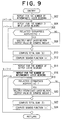
- Fig. 9 is a flowchart for explaining the operation of the neural network system when the present invention is applied for recalling to a neural network 6 from which asphyctic synapses/neurons are not yet removed. Computations are omitted for asphyctic synapses of neurons between input and intermediate layers at steps 902 to 912, and those for asphyctic synapses of neurons between intermediate and output layers at steps 914 to 924. As a result, a high-speed recalling can be realized by the present method even for a neural network not optimized.
- a neural network including an input layer for inputting information, an output layer for outputting a final result, at least one intermediate layer interposed between the input and output layers, a plurality of neurons disposed for each layer and synapses with weight coefficient for connecting the neurons between adjacent layers, there is provided a section for normalizing the input information in a predetermined range and inputting the normalized information to the input layer, whereby a dynamic range of the neuron output value can be determined.
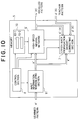
- Fig. 10 shows a configuration of the neural network section 5 to which the present invention is applied.
- An input information normalizing section is for normalizing an information evaluated pattern x' for the learning.
- a high-speed neural network 6', the error back propagation weight correcting section 7 and the control section 8 except for a memory 10 in the section 5 are equivalent to corresponding component parts in Fig. 5.
- the weights of synapses in the high-speed neural network 6' is determined by use of the teacher information evaluated pattern d'(X) for the pattern x'.
- the input data x' i is either analog or digital. Explanation will be made below about the normalizing operation of the input data x' i having a bits.
- Fig. 13 shows an example of the normalizing section 11 in a case of an input x' i having indefinite elements and non-linear characteristics.
- concept of the fuzzy set is introduced, and three types of qualitative evaluations x iL , x iM and x iS having a range of (2 b - 1) for the input data x' i are outputted.
- the abscissa represents the range of 0 to (2 a - 1) of x i
- the ordinate the range of 0 to (2 b - 1) of x' i .
- Types of qualitative evaluations are defined as membership functions of a degree S (small), M (middle) and L (large).
- the input data x' i of a bits is converted into a b-bit data x'' iS (small in degree), x'' iM (middle in degree) or x'' iL (large in degree).
- x'' iS small in degree
- x'' iM small in degree
- x'' iL large in degree
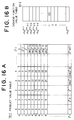
- Fig. 16A shows a two-dimensional product value table 10-1 prestored in the memory 10 as a case in which a product value of (b+c) bits is searched from the product value table of (0 to (2 b - 1)) x (0 to (2 C - 1)) in accordance with an address including a synapse weight and input data.
- Fig. 16B shows a sigmoid function table 10-2 prestored in the memory 10.
- the S range of the sigmoid function is limited to (-P x 2 b+c ) to (P x 2 b+c ) when the maximum number of neurons in the intermediate/output layers is assumed to be P.
- Fig. 16B it is possible to read out a computating result in accordance with a total sum of product values as an address if the function value table 10-2 in which function values are defined in advance, is stored in the memory 10.
- the computation for a non-linear function (sigmoid function) can be omitted.
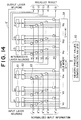
- Fig. 14 is a block diagram showing a configuration of the high-speed neural network 6' aimed at a higher speed by parallel processing with sync signals.
- the network 6' includes a search section 63 for searching for a value of the product of an output value of a neuron or input value, and a synapse weight from the memory 10 in accordance with the output value or input value and the synapse weight, a total sum computation section 62, and a search section 61 for searching for a sigmoid function value from the memory 10 in accordance with a total sum of product values.
- Fig. 15 shows a detailed configuration of a part of the neural network 6'.
- the configuration of the network 6' is shown as an example for securing the coupling between neurons y i to y n of the intermediate layers and the output neurons z1.
- the section 63 which is supplied with the output value y1 of a neuron of the intermediate layer and the synapse value w11, determines the product y1 x w11 without any product computation by reference to the above-mentioned product value table 10-1.
- the total sum computation section 52 is supplied with the output values of all the neurons of the intermediate layer and outputs the total sum thereof.
- the search section 61 is for determining a value of the sigmoid function without any non-linear computation by reference to the above-mentioned sigmoid function value table 10-2.
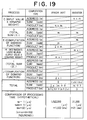
- T parallel t1 (processing time of input value x synapse weight) + t2 (total sum processing time) + t3 (processing time of sigmoid function) + t4 (processing time of output value of intermediate layer neuron x synapse weight coefficient) + t5 (processing time of total sum) + t6 (processing time of sigmoid function)
- T parallel t1 (processing time of input value x synapse weight) + t2 (total sum processing time) + t3 (processing time of sigmoid function) + t4 (processing time of output value of intermediate layer neuron x synapse weight coefficient) + t5 (processing time of total sum) + t6 (processing time of sigmoid function)
- T parallel t1 (processing time of input value x synapse weight) + t2 (total sum processing time) + t3 (processing time of sigmoid function) + t
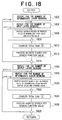
- Fig. 18 is a flowchart for explaining the recalling operation of the neural network 6' shown in Fig. 10.
- the output values of neurons of the intermediate layer are determined at steps 1802 to 1814, and the output values of neurons of the output layer, i.e., the output values of the high-speed neural network 6' at steps 1816 to 1826.
- Important steps included in this process are 1806, 1812, 1820 and 1826. Since steps 1806 and 1820 perform the same operation as steps 1812 and 1826 respectively, the process of steps 1806 and 1812 will be explained below.
- the product of an input value x'' i (b bits) obtained by normalizing information and a synapse weight w ij (c bits) is determined as x'' i x w ij .
- the range of input value x' i is indefinite and therefore there has been no way but to carry out the product computation actually.
- the value x' i is normalized to b bits by the normalizing section 11, and therefore the computation result is obtained directly by searching the product value table 10-1 stored in the memory 10 in advance, in accordance with the b bits and c bits as an address.
- the sigmoid function value for the total sum of the products determined above is calculated.
- Figs. 16A and 16B show an example in which both bit numbers of b and c are 11 and an effective range is set from -1000 to 1000.
- the ordinate represents the neuron output value of -1000 to 1000 and the abscissa the synapse weight of -1000 to 1000, each product value being stored in each column.
- the output value of a neuron is 998 and the synapse weight is 999, for instance, 997002 is search for directly as a product value.
- the sigmoid function table 10-2 of Fig. 16B is a one-dimensional one and as many memory areas as the product of the synapse weight range, the neuron output value range and the maximum value P of the number of neurons of each layer in an object neural network 6' are secured in the table 10-2. Since the maximum number of neurons is ten in this example, -10,000,000 to 10,000,000 areas are available. Assuming that a value is S, the memory area has stored therein The value S is divided by 1,000,000 in order to effect dimensional adjustment, and is multiplied by 1,000 in order to set the range of the object neural network 6' at -1000 to 1000.
- the unit recalling time according to the prior art is given as In constrast, the recalling time for the neural network system according to the present invention is expressed as It is seen that the processing time according to the present invention is one fiftieth that required in the prior art.
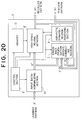
- Fig. 20 is a block diagram showing a configuration of the third modification of the neural network section 5 combined with the second modification.
- the section 5 includes a normalizing section 11, a high-speed neural network 6', a memory 10, a control section 8 and an asphyctic synapse/neuron removing section 9. Since this modification has the operation of the second modification at the same time to achieve dual effects, an even higher speed of a learning unit is realized.
- the present invention which is configured as described above, is adapted to optimize a neural network as redundant asphyctic synapses/neurons not contributing to recalling are removed by the removing section 9.
- the normalizing section 11 makes it possible to replace the computation of the product of a neuron output and synapse weight and that of non-linear function (sigmoid function) by the above address search process.
- the learning and recalling of the neural network are remarkably increased in speed.
- the neural network is applicable also to real-time control and diagnosis of a process unlike in the prior art. Taking this effect into consideration, it can be said that the function of qualitative evaluation has been remained while removing the normalizing function from the section 2 shown in Fig. 1.
- a subneural network 7-2 having a unit as the direct qualitative causal relation between events handled as variables in the statement of an object (hereinafter called the "subnetwork") is used as a basic configuration.
- the subnetwork By accumulating subnetworks, qualitatively meaningless connections are removed and an optimized neural network is constructed.
- a qualitative causal relation between variables i.e., directly-coupled neurons are defined on the basis of a qualitative causal network providing a method of statement of a qualitative model. This definition is extended sequentially to neurons of each layer, thereby to construct the neural network.
- the method of learning in the neural network according to the present embodiment handles the processing only between the neurons whose coupling is defined by the initial qualitative causal relation, and the method of recalling thereof is related to the processing only between the neurons connected by the qualitative causal relation.
- Fig. 22 is a diagram showing a functional configuration of the neural network section 5 according to the present embodiment, for effecting the learning and recalling as applied to an expert system.
- This system includes a neural network section 5 having a control section 8 for computation or control operations in accordance with a program and a memory 10' for storing a program and data, a man-machine unit 27 for displaying the result of processing and a designation input by an operator, an input unit 25 for inputting input data or a teacher data for learning, and an output unit 26 for outputting recalled data.
- the network section 5 includes a defining section 12 for defining a neural network 6'', a neural network 6'' for executing the learning or recalling, the memory 10' for storing parameters of the neural network defined or learned, and the control section 8 for controlling these units and sections directly or through interfaces 19-1 and 19-2.
- Fig. 21 is a block diagram showing a configuration of the neural network section 5.
- the neural network 6'' when learned information evaluated pattern x' is inputted thereto by the control section 8, computes a value of the non-linear function for the total sum of the product values of the output values of neurons and synapse weights for each neuron and outputs an output value pattern h'(x).
- the section 5 includes a weight-correcting section 7 for correcting each synapse weight in such a manner as to minimize the error between known teacher information evaluated pattern d'(x) and the output value pattern h'(x).
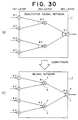
- the definition of the neural network determines the connection of the synapses of the neural network shown at the lower part of Fig. 30 on the basis of the qualitative causal network shown at the upper part of Fig. 30.
- the qualitative causal network here means that it hierarchically described the coupling from input information to output information in a model of a process or the like on the basis of the qualitative causal relation between a multiplicity of information (which can be expressed by variables for statement) representing events.
- Such a qualitative causal network as this though the quantitative expression thereof by equations or the like is difficult, can be utilized as a model in the case of qualitative inference by an empirical or fuzzy rule for an object for which the input-output causal relation is known to some extent.
- An actual example of this model is described in detail in JP-A-1-243102.
- the qualitative causal network shown at the upper part of Fig. 30 is comprised of first to third layers, and a variable set representing an event (information) is described by numerals 1 to 7.
- An input to the causal network corresponds to input variables 1 to 4 of the first layer, the output of the network to the output variable 7 of the third layer, and the variables 5 and 6 of the second layer to the output variable of the first layer.
- the numbers with # at the upper left part of the variables indicate serial numbers of the variables for each layer.
- the variables 1, 2 and 5 represent a logic product (AND), the variables 3, 4 and 6 a logic product (AND) and the variables 5, 6 and 7 a combination (COMB).
- the neural network 6'' is such that in a three-layered structure of input, intermediate and output layers as shown at the lower part of Fig. 30 and the neurons 1 to 7 are defined as corresponding to the variables 1 to 7 of the qualitative causal network, and only neurons corresponding to causal network variables connected to each other are connected by weighted synapses a to f.
- the neurons 1 and 2 of the input layer are connected to the neuron 5 of the intermediate layer by the synapses a and b , thereby to make up a single subnetwork.
- the neurons 3 and 4 are connected to the neuron 6 of the intermediate layer by the synapses c and d , thereby to make up another subnetwork.
- the neurons 5 and 6 of the intermediate layer are connected to the neuron 7 of the output layer, thus constituting another subnetwork.
- the neural network is defined in such a manner that a plurality of subnetworks in the same layer are arranged in parallel independently of each other and connected in series to the subnetworks with another layer. This system is thus configured in the same manner as if a causal network is transplanted to the neural network in a projection manner.
- a definition is made automatically on the basis of the causal relation between variables and the variables of the qualitative causal network, and an optimized neural network 6'' is configured free of wasteful connections which died in the learning in the prior art.
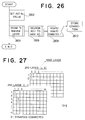
- each table in steps 2302 to 2312 and the network shown in Fig. 30 is displayed in the man-machine interface unit 27 and therefore the definition can be confirmed by the operator.
- the method of learning is based on the well-known error back propagation learning method.
- the number of computations of the products of the synapse weights and the neuron outputs shown in equations (1) and (3) is enormous in the conventional neural network with all neurons connected as shown at the upper part of Fig. 28.
- an optimized neural network according to the present invention is configured not merely by reducing the synapse connections but also by holding the characteristics (qualitative causal relation) of a qualitative causal network.
- Fig. 29 shows an example of the fuzzy inference model called the "MAX-MIN combination method" stated by the qualitative causal network.
- the qualitative relation of AND is satisfied, that is "if x1 and x2 then y, ty ⁇ MIN (ty1, ty2)", and the minimum one of the adaptability ty1 of the variable x1 and that of the variable x2 is used as an adaptability ty of the variable y.
- the inference of adaptability at the conclusion section is associated with the qualitative relation of a combination (COMB), so that the maximum one of ty1, ty2, that is, "if x1 then y (ty1), if x2 then y (ty2), ty ⁇ MAX (ty1, ty2)", is used as an adaptability ty of the variable y.
- this fuzzy inference model is superior in modelling a process not quantitatively grasped, a long time is required for tuning of membership functions providing a formula relating to the process quantity and adaptability, thus making application difficult to a complex process.
- the recalling unit is supplied with input data through the input unit 25 for adapting to the input layer of the neural network and computes the same forward propagation as in the learning steps (1) and (2) described above.
- the recalled output obtained from the output layer provides a prediction for the present input and the diagnosis result for the causal input, and is outputted and converted appropriately through the output unit 26. It may alternatively be displayed on the man-machine interface unit 27.
- the recalling according to this embodiment in which the synapse connections of the neural network are optimized from dual viewpoints of processing speed and accuracy, improves both the processing characteristic of recalling and accuracy at the same time. Further, the qualitative inference equivalent to the fuzzy inference is easily realized without using any membership function.
- the minimum unit of the causal relation between variables is set to subnetworks which are accumulated to constitute a neural network.
- the neural network is provided in which the synapse connections are reduced remarkably, while improving the processing characteristics and accuracy of learning/recalling.
- the connections (synapse weights) of the neural network are obtained as the result of substantial transplantation of the causal relation of a qualitative causal network, qualitative inference equivalent to the fuzzy inference can be realized.
- a long time is not required for tuning of the membership functions unlike in the fuzzy inference, thereby leading to the advantage of easy applicability to the diagnosis and control of a complicated process.
- the description made above has referred to a neural network system in which the neural network section 5 is connected with the fuzzy unit 2 for inputting a learned/unknown information pattern, the quantifying section 3 for quantifying the output from the section 5, and the fuzzy unit 4 for inputting a teacher information pattern.
- the neural network system can be constructed of only the neural network section 5 according to any of the first to fourth modifications without the fuzzy sections 2 and 4, and the quantifying section 3. Therefore, when the neural network system using only one of the fuzzy units 2 and 4 can be obtained the similar effect depending on an object to be recalled.
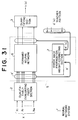
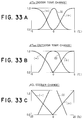
- Fig. 31 shows a configuration of the neural network system for subjecting only an input to qualitative evaluation.
- Fig. 32 is a diagram for explaining an operation of this system.
- the learning of a change in indoor temperature due to an air-conditioner is effected in accordance with a learned information pattern including a known indoor temperature deviation ⁇ T in , an outdoor temperature deviation ⁇ T out and an air-conditioner operation deviation ⁇ CL, after a predetermined time period, and a known indoor temperature deviation ⁇ T in after the predetermined time period as a teacher information pattern.
- a learned information pattern including a known indoor temperature deviation ⁇ T in , an outdoor temperature deviation ⁇ T out and an air-conditioner operation deviation ⁇ CL, after a predetermined time period, and a known indoor temperature deviation ⁇ T in after the predetermined time period as a teacher information pattern.
- the temperature deviation of indoor or outdoor temperature is in a range of ⁇ 5°C and that of the air-conditioner is in the range of ⁇ 20°C, and these deviations have different non-linear characteristics.
- inputting information data in its direct form would make convergence difficult in some cases.
- each input information is subjected to a qualitative evaluation (doubling as a normalization) by a predetermined fuzzy membership functions based on experiences or actual measurements, and the resulting evaluation is inputted to the neural network 6, whereby the features of each information can be extracted in satisfactory manner for an improved learning accuracy and efficiency at the same time.
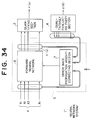
- Fig. 34 shows a configuration of the neural network system for quantitative evaluation of an output alone. This system is suitable for homogenous time series information (voice, image or the like).
- a non-linear change is involved.
- a recalled data is defined from an output of only one neuron, it would result in delayed convergence and deteriorate accuracy.
- three neurons are used for the output layer, for example, and defines evaluation types of evaluations, i.e., "up (+)", “same (0)” and “down (-)", respectively.
- evaluation types of evaluations i.e., "up (+)", “same (0)” and “down (-)”, respectively.
- a known stock price change width ⁇ P i+1 for the next day as a teacher information pattern is qualitatively evaluated by the fuzzy unit 4 to generate the above-mentioned three types of evaluations, a pattern including which is used as a teacher information evaluated pattern.
- the non-linear characteristics between input information can be grasped sufficiently, thereby to improve both the accuracy and speed of learning. This is because the inherent ability of the forward neural network 6 to grasp non-linear features is reasonably utilized by defining outputs from the neurons of the output layer as qualitative values.
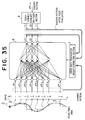
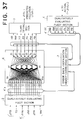
- the quantifying section 3 may be omitted. Also, when a qualitative evaluation is recalled or inferred from input information requiring no qualitative evaluation (as in the case of Fig. 35 above), the recalling may be effected with a configuration without a qualitative evaluation section 2. Further, in the case where a recalled output is generated as a quantitative value and it is desired to generate it as a qualitative evaluation, the quantifying section 3 may be replaced by a qualitative evaluation fuzzy section such as the section 2 in Figs. 31 and 34.
- Figs. 36 to 42 are diagrams for explaining application of the present invention to actual processes.
- FIG. 38 A tunnel ventilation process as an object process is shown in Fig. 38.
- the ventilation process in a road tunnel has many indefinite elements and large non-linear elements, which make it difficult to obtain a satisfactory result from conventional control methods.
- An example of application of a neural network according to the present invention to pollution prediction in this process will be described below.
- Fig. 36 shows input information to a pollution predicting system 30.
- Main factors determining a pollution change during a predetermined time period include a change in the number of large-sized vehicles ( ⁇ TB, where ⁇ is a symbol indicating a change, defined as "present value minus preceding value"), a vehicle speed (TS), a pollution value change ( ⁇ VI), a change in mechanical ventilation capability ( ⁇ M), a change in traffic volume ( ⁇ TR) and natural wind (W N ).
- ⁇ TB large-sized vehicles
- ⁇ vehicle speed
- ⁇ VI pollution value change
- ⁇ M change in mechanical ventilation capability
- ⁇ TR change in traffic volume
- W N natural wind
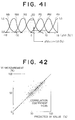
- the accuracy of this method stands at about 0.72 in correlation coefficient, as shown in Fig. 39.
- the "correlation coefficient” is an index representing accuracy of a prediction value VI c+1 predicted and an actual measurement VI c+1 actual at time point tc, as shown in Fig. 40.
- a learned information pattern X includes the data ⁇ TB, TS, ⁇ VI c , ⁇ M, ⁇ TR and W N .
- These six types of data are subjected to qualitative evaluation by the fuzzy unit 2 according to an empirically-determined membership functions representing three types of qualitative evaluations, i.e., "down (-)", “unchanged (0)” and "up (+)".
- the number of neurons of the input layer of the neural network 6, therefore, is 18.
- the pollution level change measurement ⁇ VI c+1 actual after a predetermined time period which is known, is also qualitatively evaluated by the fuzzy unit 4 by use of the empirically-determined membership functions.
- the weight-correcting section 7 using the data qualitatively evaluated by the section 2 as the learned information pattern, is supplied with a qualitative evaluation of the measurement ⁇ VI c+1 actual from the section 4 as a teacher information pattern and correct the synapse weights of the neural network 6 according to the steps mentioned above to conduct the learning.
- the synapse weights of the neural network 6 after has completed the learning are fixed in the manner mentioned above.
- the fuzzy unit 2 and the forward neural network 6 perform the same operation as in the learning process.
- the neural network 6 outputs from the neurons of the output layer seven types of evaluations including N NL ( ⁇ VI c+1 ) (considerably down), N NM ( ⁇ VI c+1 ) (down), N NS ( ⁇ VI c+1 ) (rather down), N ZO ( ⁇ VI c+1 ) (unchanged), N PS ( ⁇ VI c+1 ) (slightly up), N PM ( ⁇ VI c+1 ) (up) and N PL ( ⁇ VI c+1 ) (considerably up) on the pollution value change ⁇ VI.
- the quantifying section 3 which is supplied with these data, quantifies these evaluations by use of membership functions determined on the basis of empirical data and outputs a pollution change prediction value ⁇ VI c+1 predicted as an output of the predicting system.
- the correlation coefficient between prediction value and measurement is 0.85, indicating a remarkable improvement as compared with the conventional methods.
- the inference rule for the conventional fuzzy inference system is replaced by a neural network, and a recalling system according to the present invention, i.e., a neural network system combining the qualitative evaluation of input data with the quantification of the recalled result realizes a novel fuzzy inference system.
- a process control method is in conducting a qualitative prediction of a process behaviour by use of a neural network including a transplant of a qualitative causal network instead of the fuzzy theory, for instance.
- Fig. 38 is a schematic diagram showing a tunnel ventilation process as an example of actual process.
- the tunnel ventilation control is intended to determine and control the operation quantity of a duster and a jet fan and to maintain the pollution within a reference range by predicting a pollution quantity VI of smoke (soot) from process quantities such as traffic volume.
- Fig. 43 shows a configuration of a process control unit 30' according to the present embodiment and an example of application to a tunnel ventilation process.
- An inference section 35 similar to the neural network section 5 is configured of input-output interfaces 39-1, 39-2 and a neural network 36 optimized by a causal network, and is connected with a process 40 through a process input unit 31 and a process output unit 32.
- the inference section 35 is supplied periodically (at intervals of five minutes in the case under consideration) from the process input unit 34 with a change ⁇ TBt (vehicles/five min) of the number of large-sized vehicles, a vehicle speed change ⁇ TRt (vehicles/five min), a pollution change ⁇ VIt (%), a traffic volume change ⁇ TRt (vehicles/five min), a natural wind velocity WNt (m/s) and a change in mechanical ventilation (m3/s), at a time point t (current), which are measured by a process quantity measuring unit 41 (Each change is determined as a difference from the preceding value). Each process quantity is adapted at the interface 39-1 and inputted to the neural network 36.
- the neural network 36 predicts the pollution change ⁇ VI t+1 at a time point (t + 1) by the steps (1) and (2) mentioned above in such a manner as to maintain the pollution level within a reference level the process output unit 32 determines and outputs to a control unit 42 an operation quantity (a quantity variable from the present control quantity) of the control unit 42 from the pollution change ⁇ VI t+1 . At this time the recalling computation is conducted in accordance with the synapse connections.
- Fig. 44 shows a qualitative causal network for a tunnel ventilation process.
- the change in the number of large-sized vehicles, vehicle speed and pollution level from a time point (t-1) to the current time point are in causal relation with the pollution level change in tunnel.
- the change in traffic volume and mechanical ventilation and the natural wind velocity is causally related with the overall ventilation capacity change.
- the pollution level change in tunnel and the overall ventilation capacity change are in causal relation with the predicted pollution level change at a predetermined time later (t+1).
- the data representing process factors and the causal relation thereof are obtained in this way as empirical data from a causal network.
- Figs. 45A, 45B and 45C show an example in which variables, causal relation and qualitative causal network are defined from this qualitative causal network at steps 2302 to 2306 in Fig. 23.
- Fig. 45A is a table for storing variables Nos. 1 to 9 corresponding to the process quantities mentioned above and names thereof with appropriate values of upper and lower limits of each variable.
- Fig. 45D shows definition of the causal relation in minimum unit and the process quantities are divided into a subnetwork of variables 1, 2 and 3 of the first layer and variable 7 of the second layer and another subnetwork of variables 4, 5 and 6 of the first layer and the variable 8 of the second layer.
- the respective variables are arranged in order of serial numbers in a layer unit and a configuration of a qualitative causal network is defined.
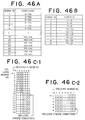
- Figs. 46A, 46B, 46C-1 and 46C-2 are for defining the relation between neurons and variables and the synapse connections at steps 2308 to 2312.
- three types of evaluations including ⁇ + (up), ⁇ 0 (unchanged) and ⁇ - (down) are used for the normalization for neuron inputs.
- the normalization is performed by use of membership functions (empirically determined in advance) representing the adaptability ⁇ (a value of 0 to 1) of the process quantity for each evaluation (+, 0, -), for instance. Nevertheless, an ordinary linear normalizing method may be performed.
- evaluations including N-TBt, Z-TBt and P-TBt, for example are inputted to the neurons Nos. 1 to 3 as a change ⁇ TBt in the number of large-sized vehicles.
- neurons corresponding to three types of evaluations are arranged for a process quantity of the second layer, as in the case of the input layer, as compared with seven neurons corresponding to seven types of evaluations arranged for the output layer.
- the predicted pollution level change ⁇ VI t+1 is evaluated according to the criteria including ⁇ nl (considerably down), ⁇ nm (down), ⁇ ns (slightly down), ⁇ z0 (unchanged), ⁇ ps (slightly up), ⁇ pm (up) and ⁇ pl (considerably up), and the resulting adaptability value ⁇ is outputted to the neurons Nos. 25 to 31.
- Figs. 46C-1 and 46C-2 show a synapse connection table group.
- the neurons Nos. 1 to 9 of the first layer are interconnected with the neurons Nos. 19 to 21 of the second layer (serial Nos. 1 to 3 for the second layer), and the neurons Nos. 10 to 18 of the first layer are interconnected with the neurons Nos. 22 to 24 of the second layer (serial Nos. 4 to 6 for the second layer), each constituting a subnetwork.
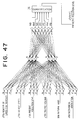
- Fig. 47 is a diagram showing the neural network 36 constructed according to the above definitions.
- the neurons of the input and intermediate layers are divided into two subnetworks, and therefore only synapses indicated by a solid line are actually connected.
- the neural network initially defined in this way has the synapse weights thereof determined by the learning of a teacher information pattern based on actual measurement data of a tunnel process, and after a qualitative causal network of a tunnel ventilation process is substantially transplanted, is incorporated into an inference section 35 of the process control unit.
- the seven adaptability values from the neurons of the output layer are inversely transformed from a fuzzy quantity by the interface 39-2 into a quantitative value, so as to determine a predicted pollution level change.
- This inverse transformation is effected by a defuzzy section similar to the above quantifying section by the center-of-gravity computation conducted when each adaptability value crosses a corresponding membership function in an evaluation unit.
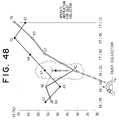
- Fig. 48 is a graph plotting the time along the abscissa and the transmittance TI (reciprocal of pollution level VI) in tunnel along the ordinate for explaining the operational relation between TI and the ventilation control unit.
- the thick solid line represents an actual measurement of TI, and a double line a prediction value of TI according to the inference unit 31.
- the target range of TI is set to 30% in upper limit and 40% in lower limit.
- the optimization of a neural network improves the effect of shortening the recalling time as the increase in the complexity of a process and input data as in the present embodiment, thereby making possible a real-time prediction control.
- the tuning of membership functions for fuzzy control in a complicated process which requires as long as one year or two in the prior art is processed within one day or two by the learning of a neural network with equivalent accuracy according to the present invention.
Landscapes
- Engineering & Computer Science (AREA)
- Physics & Mathematics (AREA)
- Theoretical Computer Science (AREA)
- Software Systems (AREA)
- General Physics & Mathematics (AREA)
- Evolutionary Computation (AREA)
- General Health & Medical Sciences (AREA)
- Molecular Biology (AREA)
- Data Mining & Analysis (AREA)
- Computing Systems (AREA)
- Health & Medical Sciences (AREA)
- Life Sciences & Earth Sciences (AREA)
- Artificial Intelligence (AREA)
- Biomedical Technology (AREA)
- General Engineering & Computer Science (AREA)
- Mathematical Physics (AREA)
- Biophysics (AREA)
- Computational Linguistics (AREA)
- Fuzzy Systems (AREA)
- Automation & Control Theory (AREA)
- Pure & Applied Mathematics (AREA)
- Mathematical Optimization (AREA)
- Mathematical Analysis (AREA)
- Computational Mathematics (AREA)
- Algebra (AREA)
- Computer Hardware Design (AREA)
- Image Analysis (AREA)
- Feedback Control In General (AREA)
Applications Claiming Priority (9)
| Application Number | Priority Date | Filing Date | Title |
|---|---|---|---|
| JP2317807A JPH04199259A (ja) | 1990-11-26 | 1990-11-26 | ニューラルネットワーク、ニューラルネットワークの想起方法および学習方法または装置 |
| JP317807/90 | 1990-11-26 | ||
| JP31780790 | 1990-11-26 | ||
| JP2329138A JP2609760B2 (ja) | 1990-11-30 | 1990-11-30 | ニューラルネットワーク、ニューラルネットワークの想起または学習方法、およびニューラルネットワークを用いたファジイ推論装置 |
| JP32913890 | 1990-11-30 | ||
| JP329138/90 | 1990-11-30 | ||
| JP231482/91 | 1991-09-11 | ||
| JP3231482A JPH0573522A (ja) | 1991-09-11 | 1991-09-11 | ニユーラルネツトワークとその構築方法及びニユーラルネツトワークを用いたプロセス制御方式 |
| JP23148291 | 1991-09-11 |
Publications (3)
| Publication Number | Publication Date |
|---|---|
| EP0488150A2 true EP0488150A2 (de) | 1992-06-03 |
| EP0488150A3 EP0488150A3 (en) | 1994-06-08 |
| EP0488150B1 EP0488150B1 (de) | 2000-03-01 |
Family
ID=27331772
Family Applications (1)
| Application Number | Title | Priority Date | Filing Date |
|---|---|---|---|
| EP91120155A Expired - Lifetime EP0488150B1 (de) | 1990-11-26 | 1991-11-26 | Fuzzy-Inferenz-basiertes System und darin enthaltenes neuronales Netzwerk |
Country Status (4)
| Country | Link |
|---|---|
| US (1) | US5402519A (de) |
| EP (1) | EP0488150B1 (de) |
| KR (1) | KR100243353B1 (de) |
| DE (1) | DE69132003T2 (de) |
Cited By (7)
| Publication number | Priority date | Publication date | Assignee | Title |
|---|---|---|---|---|
| EP0681232A1 (de) * | 1994-05-03 | 1995-11-08 | Yamatake-Honeywell Co. Ltd. | Vorrichtung zur Entscheidungsunterstützung bei Sollwertparametern für die Verwaltung eines Gebäudes, Vorrichtung zum Lernen von Sollwertparametern, Vorrichtung zur Bestimmung von Sollwertparametern, und Vorrichtung die mit neuronalen Netzen funktioniert |
| DE4443193A1 (de) * | 1994-12-05 | 1996-06-13 | Siemens Ag | Verfahren zum Betrieb neuronaler Netze in Industrieanlagen |
| EP0590305A3 (de) * | 1992-08-31 | 1998-08-05 | Yamatake-Honeywell Co. Ltd. | Anlage zum Schätzen des Zustands eines Systems auf der Grundlage von aufgezeichneten Eingabe-Ausgabedaten für das System |
| WO2003079285A3 (de) * | 2002-03-20 | 2004-09-10 | Siemens Ag | Verfahren und anordnung sowie computerprogramm mit programmcode-mitteln und computerprogramm-produkt zur gewichtung von eingangsgrössen für eine neuronale struktur sowie neuronale struktur |
| EP3217400A1 (de) * | 2016-03-10 | 2017-09-13 | Philips Lighting Holding B.V. | Verschmutzungsschätzungssystem |
| WO2019076095A1 (zh) * | 2017-10-20 | 2019-04-25 | 上海寒武纪信息科技有限公司 | 处理方法及装置 |
| CN114504777A (zh) * | 2022-04-19 | 2022-05-17 | 西南石油大学 | 基于神经网络和模糊综合评价的锻炼强度计算系统和方法 |
Families Citing this family (31)
| Publication number | Priority date | Publication date | Assignee | Title |
|---|---|---|---|---|
| US5402520A (en) * | 1992-03-06 | 1995-03-28 | Schnitta; Bonnie S. | Neural network method and apparatus for retrieving signals embedded in noise and analyzing the retrieved signals |
| KR0131754B1 (en) * | 1992-03-19 | 1998-04-24 | Fujitsu Ltd | Neuro processing service system |
| JPH0694116A (ja) * | 1992-09-08 | 1994-04-05 | Hitachi Ltd | 自動変速制御装置 |
| JP3070643B2 (ja) * | 1992-10-23 | 2000-07-31 | 株式会社デンソー | ニューラルネット型追加学習装置 |
| AU674227B2 (en) * | 1992-11-24 | 1996-12-12 | Pavilion Technologies, Inc. | Method and apparatus for operating a neural network with missing and/or incomplete data |
| US5619619A (en) * | 1993-03-11 | 1997-04-08 | Kabushiki Kaisha Toshiba | Information recognition system and control system using same |
| DE4416317B4 (de) * | 1993-05-17 | 2004-10-21 | Siemens Ag | Verfahren und Regeleinrichtung zur Regelung eines materialverarbeitenden Prozesses |
| JPH07175876A (ja) * | 1993-10-12 | 1995-07-14 | At & T Corp | ニューラルネットワークを用いたプロセスのフィードバックの制御方法とその装置 |
| US5581658A (en) * | 1993-12-14 | 1996-12-03 | Infobase Systems, Inc. | Adaptive system for broadcast program identification and reporting |
| US5566092A (en) * | 1993-12-30 | 1996-10-15 | Caterpillar Inc. | Machine fault diagnostics system and method |
| US5671333A (en) * | 1994-04-07 | 1997-09-23 | Lucent Technologies Inc. | Training apparatus and method |
| JP3129932B2 (ja) * | 1995-05-16 | 2001-01-31 | シャープ株式会社 | ファジィ・ニューラルネットワーク装置およびその学習方法 |
| US6314414B1 (en) * | 1998-10-06 | 2001-11-06 | Pavilion Technologies, Inc. | Method for training and/or testing a neural network with missing and/or incomplete data |
| US6363289B1 (en) * | 1996-09-23 | 2002-03-26 | Pavilion Technologies, Inc. | Residual activation neural network |
| GB2321364A (en) * | 1997-01-21 | 1998-07-22 | Northern Telecom Ltd | Retraining neural network |
| US6038338A (en) * | 1997-02-03 | 2000-03-14 | The United States Of America As Represented By The Secretary Of The Navy | Hybrid neural network for pattern recognition |
| US6678640B2 (en) * | 1998-06-10 | 2004-01-13 | Matsushita Electric Industrial Co., Ltd. | Method and apparatus for parameter estimation, parameter estimation control and learning control |
| US6985781B2 (en) * | 1999-01-12 | 2006-01-10 | Pavilion Technologies, Inc. | Residual activation neural network |
| JP4678943B2 (ja) * | 2000-12-22 | 2011-04-27 | 富士通株式会社 | 新製品の初期投入量予測方法、新製品の初期投入量予測装置及び記録媒体 |
| US20040054636A1 (en) * | 2002-07-16 | 2004-03-18 | Cognita, Inc. | Self-organizing neural mapper |
| DE10238831A1 (de) * | 2002-08-23 | 2004-03-11 | Siemens Ag | Verfahren und Vorrichtung zur Prozessoptimierung |
| DE102007017259B4 (de) * | 2007-04-12 | 2009-04-09 | Siemens Ag | Verfahren zur rechnergestützten Steuerung und/oder Regelung eines technischen Systems |
| US8655813B2 (en) | 2010-12-30 | 2014-02-18 | International Business Machines Corporation | Synaptic weight normalized spiking neuronal networks |
| US9460382B2 (en) | 2013-12-23 | 2016-10-04 | Qualcomm Incorporated | Neural watchdog |
| KR102434729B1 (ko) * | 2017-10-20 | 2022-08-19 | 상하이 캠브리콘 인포메이션 테크놀로지 컴퍼니 리미티드 | 처리방법 및 장치 |
| US10657439B2 (en) | 2017-10-24 | 2020-05-19 | Shanghai Cambricon Information Technology Co., Ltd | Processing method and device, operation method and device |
| US10755560B2 (en) * | 2018-06-19 | 2020-08-25 | International Business Machines Corporation | Real-time pollution control at a traffic junction |
| JP6702390B2 (ja) * | 2018-10-09 | 2020-06-03 | トヨタ自動車株式会社 | 車両用駆動装置の制御装置、車載電子制御ユニット、学習済みモデル、機械学習システム、車両用駆動装置の制御方法、電子制御ユニットの製造方法及び出力パラメータ算出装置 |
| US12079592B2 (en) | 2018-11-20 | 2024-09-03 | Samsung Electronics Co., Ltd. | Deep neural network accelerator including lookup table based bit-serial processing elements |
| CN112437419B (zh) * | 2020-10-30 | 2022-12-02 | 浙江佳乐科仪股份有限公司 | 基于数据共享的变频器系统 |
| US20230107247A1 (en) * | 2021-10-01 | 2023-04-06 | Deepmind Technologies Limited | Neural networks with transformed activation function layers |
Family Cites Families (13)
| Publication number | Priority date | Publication date | Assignee | Title |
|---|---|---|---|---|
| US5014327A (en) * | 1987-06-15 | 1991-05-07 | Digital Equipment Corporation | Parallel associative memory having improved selection and decision mechanisms for recognizing and sorting relevant patterns |
| JPS6482133A (en) * | 1987-09-24 | 1989-03-28 | Nec Corp | Network learning system |
| FR2625347B1 (fr) * | 1987-12-23 | 1990-05-04 | Labo Electronique Physique | Structure de reseau de neurones et circuit et arrangement de reseaux de neurones |
| JP2518007B2 (ja) * | 1988-03-23 | 1996-07-24 | 日本電気株式会社 | 学習機構を有するダイナミック・ニユ―ラル・ネットワ―ク |
| JP2635087B2 (ja) * | 1988-03-25 | 1997-07-30 | 株式会社日立製作所 | プロセス制御方法 |
| EP0378689B1 (de) * | 1988-05-20 | 1998-03-18 | Matsushita Electric Industrial Co., Ltd. | Verfahren zur bestimmung der inferenzregel sowie inferenzmotor |
| JPH0680505B2 (ja) * | 1988-10-06 | 1994-10-12 | 工業技術院長 | 多層神経回路網の学習方式 |
| JP2703010B2 (ja) * | 1988-12-23 | 1998-01-26 | 株式会社日立製作所 | ニユーラルネツト信号処理プロセツサ |
| US5195169A (en) * | 1989-03-03 | 1993-03-16 | Sharp Kabushiki Kaisha | Control device for controlling learning of a neural network |
| JPH02292602A (ja) * | 1989-05-02 | 1990-12-04 | Nkk Corp | 人工神経回路網型ファジィ制御装置 |
| JP2821189B2 (ja) * | 1989-09-01 | 1998-11-05 | 株式会社日立製作所 | 学習型意思決定支援システム |
| US5159660A (en) * | 1990-08-09 | 1992-10-27 | Western Thunder | Universal process control using artificial neural networks |
| US5220373A (en) * | 1991-03-22 | 1993-06-15 | Ricoh Company, Ltd. | Electrophotographic process control device using a neural network for estimating states of the device |
-
1991
- 1991-11-25 US US07/797,534 patent/US5402519A/en not_active Expired - Lifetime
- 1991-11-26 DE DE69132003T patent/DE69132003T2/de not_active Expired - Fee Related
- 1991-11-26 EP EP91120155A patent/EP0488150B1/de not_active Expired - Lifetime
- 1991-11-26 KR KR1019910021293A patent/KR100243353B1/ko not_active Expired - Fee Related
Cited By (13)
| Publication number | Priority date | Publication date | Assignee | Title |
|---|---|---|---|---|
| EP0590305A3 (de) * | 1992-08-31 | 1998-08-05 | Yamatake-Honeywell Co. Ltd. | Anlage zum Schätzen des Zustands eines Systems auf der Grundlage von aufgezeichneten Eingabe-Ausgabedaten für das System |
| US5918200A (en) * | 1992-08-31 | 1999-06-29 | Yamatake-Honeywell Co., Ltd. | State estimating apparatus |
| EP0681232A1 (de) * | 1994-05-03 | 1995-11-08 | Yamatake-Honeywell Co. Ltd. | Vorrichtung zur Entscheidungsunterstützung bei Sollwertparametern für die Verwaltung eines Gebäudes, Vorrichtung zum Lernen von Sollwertparametern, Vorrichtung zur Bestimmung von Sollwertparametern, und Vorrichtung die mit neuronalen Netzen funktioniert |
| EP0740256A3 (de) * | 1994-05-03 | 1996-11-06 | Yamatake-Honeywell Co. Ltd. | Vorrichtung zur Entscheidungsunterstützung bei Sollwertparametern für die Verwaltung eines Gebäudes, Vorrichtung zum Lernen von Sollwertparametern, Vorrichtung zur Bestimmung von Sollwertparametern und Vorrichtung, die mit neuronalen Netzen funktioniert |
| US5751916A (en) * | 1994-05-03 | 1998-05-12 | Yamatake-Honeywell Co. Ltd. | Building management system having set offset value learning and set bias value determining system for controlling thermal environment |
| DE4443193A1 (de) * | 1994-12-05 | 1996-06-13 | Siemens Ag | Verfahren zum Betrieb neuronaler Netze in Industrieanlagen |
| WO2003079285A3 (de) * | 2002-03-20 | 2004-09-10 | Siemens Ag | Verfahren und anordnung sowie computerprogramm mit programmcode-mitteln und computerprogramm-produkt zur gewichtung von eingangsgrössen für eine neuronale struktur sowie neuronale struktur |
| EP3217400A1 (de) * | 2016-03-10 | 2017-09-13 | Philips Lighting Holding B.V. | Verschmutzungsschätzungssystem |
| WO2017153207A1 (en) * | 2016-03-10 | 2017-09-14 | Philips Lighting Holding B.V. | Pollution estimation system |
| US11042805B2 (en) | 2016-03-10 | 2021-06-22 | Signify Holding B.V. | Pollution estimation system |
| WO2019076095A1 (zh) * | 2017-10-20 | 2019-04-25 | 上海寒武纪信息科技有限公司 | 处理方法及装置 |
| CN114504777A (zh) * | 2022-04-19 | 2022-05-17 | 西南石油大学 | 基于神经网络和模糊综合评价的锻炼强度计算系统和方法 |
| CN114504777B (zh) * | 2022-04-19 | 2022-07-15 | 西南石油大学 | 基于神经网络和模糊综合评价的锻炼强度计算系统和方法 |
Also Published As
| Publication number | Publication date |
|---|---|
| US5402519A (en) | 1995-03-28 |
| DE69132003T2 (de) | 2000-11-16 |
| KR100243353B1 (ko) | 2000-02-01 |
| EP0488150B1 (de) | 2000-03-01 |
| DE69132003D1 (de) | 2000-04-06 |
| EP0488150A3 (en) | 1994-06-08 |
| KR920010489A (ko) | 1992-06-26 |
Similar Documents
| Publication | Publication Date | Title |
|---|---|---|
| EP0488150A2 (de) | Neuronales Netzwerk, angepasst für nicht-lineare Verarbeitung | |
| Jang | Input selection for ANFIS learning | |
| Kong et al. | Comparison of fuzzy and neural truck backer-upper control systems | |
| Buckley et al. | Neural nets for fuzzy systems | |
| Ishibuchi et al. | Neural networks that learn from fuzzy if-then rules | |
| Vairappan et al. | Batch type local search-based adaptive neuro-fuzzy inference system (ANFIS) with self-feedbacks for time-series prediction | |
| Castillo et al. | Soft computing and fractal theory for intelligent manufacturing | |
| EP2287785A1 (de) | Vorrichtung für unscharfe Inferenz und Verfahren, Systeme und Vorrichtung mit solch einer Inferenzvorrichtung | |
| US20130080376A1 (en) | Fuzzy inference apparatus and methods, systems and apparatuses using such inference apparatus | |
| Zhang et al. | A literature review of reinforcement learning methods applied to job-shop scheduling problems | |
| US20060009864A1 (en) | Method for the computer-supported generation of prognoses for operative systems and a system for the generation of prognoses for operative systems | |
| Gupta et al. | Fuzzy neuro-computational technique and its application to modelling and control | |
| Farag et al. | Neuro-fuzzy modeling of complex systems using genetic algorithms | |
| JPH07168799A (ja) | ニューラルネットワークの学習装置 | |
| Van Cleave et al. | Tuning of fuzzy logic controller using neural network | |
| Palit et al. | Fuzzy logic based automatic rule generation and forecasting of time series | |
| Neagu et al. | A neuro-fuzzy approach for functional genomics data interpretation and analysis | |
| Evsukoff et al. | A knowledge acquisition method for fuzzy expert systems in diagnosis problems | |
| Baruch et al. | A neuro-fuzzy model for nonlinear plants identification | |
| Baruch et al. | Fuzzy-neural model for nonlinear systems identification | |
| Bhumireddy et al. | Genetic learning of functional link networks | |
| Vergara et al. | Optimization of fuzzy models by global numeric optimization | |
| WO1993021598A1 (en) | Neural network/fuzzy conversion device | |
| Klebanova et al. | The algorithm for neuro-fuzzy network construction based on model of corporate bankruptcy risk estimation | |
| Mammadova et al. | Development of a technological process control algorithm using fuzzy logical operators |
Legal Events
| Date | Code | Title | Description |
|---|---|---|---|
| PUAI | Public reference made under article 153(3) epc to a published international application that has entered the european phase |
Free format text: ORIGINAL CODE: 0009012 |
|
| AK | Designated contracting states |
Kind code of ref document: A2 Designated state(s): DE SE |
|
| PUAL | Search report despatched |
Free format text: ORIGINAL CODE: 0009013 |
|
| AK | Designated contracting states |
Kind code of ref document: A3 Designated state(s): DE SE |
|
| 17P | Request for examination filed |
Effective date: 19940706 |
|
| 17Q | First examination report despatched |
Effective date: 19961104 |
|
| GRAG | Despatch of communication of intention to grant |
Free format text: ORIGINAL CODE: EPIDOS AGRA |
|
| GRAG | Despatch of communication of intention to grant |
Free format text: ORIGINAL CODE: EPIDOS AGRA |
|
| GRAG | Despatch of communication of intention to grant |
Free format text: ORIGINAL CODE: EPIDOS AGRA |
|
| GRAH | Despatch of communication of intention to grant a patent |
Free format text: ORIGINAL CODE: EPIDOS IGRA |
|
| GRAH | Despatch of communication of intention to grant a patent |
Free format text: ORIGINAL CODE: EPIDOS IGRA |
|
| GRAA | (expected) grant |
Free format text: ORIGINAL CODE: 0009210 |
|
| AK | Designated contracting states |
Kind code of ref document: B1 Designated state(s): DE SE |
|
| PG25 | Lapsed in a contracting state [announced via postgrant information from national office to epo] |
Ref country code: SE Free format text: THE PATENT HAS BEEN ANNULLED BY A DECISION OF A NATIONAL AUTHORITY Effective date: 20000301 |
|
| REF | Corresponds to: |
Ref document number: 69132003 Country of ref document: DE Date of ref document: 20000406 |
|
| EN | Fr: translation not filed | ||
| PLBE | No opposition filed within time limit |
Free format text: ORIGINAL CODE: 0009261 |
|
| STAA | Information on the status of an ep patent application or granted ep patent |
Free format text: STATUS: NO OPPOSITION FILED WITHIN TIME LIMIT |
|
| 26N | No opposition filed | ||
| PGFP | Annual fee paid to national office [announced via postgrant information from national office to epo] |
Ref country code: DE Payment date: 20081126 Year of fee payment: 18 |
|
| PG25 | Lapsed in a contracting state [announced via postgrant information from national office to epo] |
Ref country code: DE Free format text: LAPSE BECAUSE OF NON-PAYMENT OF DUE FEES Effective date: 20100601 |