EP0488996A2 - Verbundmaterial auf Magnesiumbasis und Verfahren zu seiner Herstellung - Google Patents
Verbundmaterial auf Magnesiumbasis und Verfahren zu seiner Herstellung Download PDFInfo
- Publication number
- EP0488996A2 EP0488996A2 EP19920103613 EP92103613A EP0488996A2 EP 0488996 A2 EP0488996 A2 EP 0488996A2 EP 19920103613 EP19920103613 EP 19920103613 EP 92103613 A EP92103613 A EP 92103613A EP 0488996 A2 EP0488996 A2 EP 0488996A2
- Authority
- EP
- European Patent Office
- Prior art keywords
- magnesium
- boron
- sintered
- modulus
- elasticity
- Prior art date
- Legal status (The legal status is an assumption and is not a legal conclusion. Google has not performed a legal analysis and makes no representation as to the accuracy of the status listed.)
- Granted
Links
Images




Classifications
-
- C—CHEMISTRY; METALLURGY
- C22—METALLURGY; FERROUS OR NON-FERROUS ALLOYS; TREATMENT OF ALLOYS OR NON-FERROUS METALS
- C22C—ALLOYS
- C22C32/00—Non-ferrous alloys containing at least 5% by weight but less than 50% by weight of oxides, carbides, borides, nitrides, silicides or other metal compounds, e.g. oxynitrides, sulfides, whether added as such or formed in situ
- C22C32/001—Non-ferrous alloys containing at least 5% by weight but less than 50% by weight of oxides, carbides, borides, nitrides, silicides or other metal compounds, e.g. oxynitrides, sulfides, whether added as such or formed in situ with only oxides
- C22C32/0015—Non-ferrous alloys containing at least 5% by weight but less than 50% by weight of oxides, carbides, borides, nitrides, silicides or other metal compounds, e.g. oxynitrides, sulfides, whether added as such or formed in situ with only oxides with only single oxides as main non-metallic constituents
- C22C32/0036—Matrix based on Al, Mg, Be or alloys thereof
-
- C—CHEMISTRY; METALLURGY
- C22—METALLURGY; FERROUS OR NON-FERROUS ALLOYS; TREATMENT OF ALLOYS OR NON-FERROUS METALS
- C22C—ALLOYS
- C22C1/00—Making non-ferrous alloys
- C22C1/04—Making non-ferrous alloys by powder metallurgy
- C22C1/05—Mixtures of metal powder with non-metallic powder
- C22C1/051—Making hard metals based on borides, carbides, nitrides, oxides or silicides; Preparation of the powder mixture used as the starting material therefor
-
- C—CHEMISTRY; METALLURGY
- C22—METALLURGY; FERROUS OR NON-FERROUS ALLOYS; TREATMENT OF ALLOYS OR NON-FERROUS METALS
- C22C—ALLOYS
- C22C49/00—Alloys containing metallic or non-metallic fibres or filaments
- C22C49/02—Alloys containing metallic or non-metallic fibres or filaments characterised by the matrix material
- C22C49/04—Light metals
Definitions
- the present invention relates to a sintered magnesium-based composite material and a process for preparing the same.
- Magnesium alloys have attracted attention as a light-weight, high mechanical strength, metal. They are used in aircraft and space equipment and components and in electronics equipment and components.
- mechanical parts for magnetic recording particularly a head arm
- mechanical parts for magnetic recording particularly a head arm
- a head arm often comprise a diecast article made of a magnesium alloy.
- the important characteristics of the material for a head arm include low density and high mechanical strength, particularly the Young's modulus of elasticity. Magnesium and magnesium-based alloys are good candidates for such a head arm due to their low density, but they have a low Young's modulus of elasticity.
- a method of improving the modulus of elasticity of a magnesium alloy in which a very small amount of zirconium or a rare earth metal is added to prevent a growth of the crystal grains of the magnesium, but this provides only a low modulus of elasticity of about 4500kgf/mm2.
- Sintering magnesium powders in the form of a shape to obtain a sintered body of that shape is known, but do not provide a body having a sufficient Young's modulus of elasticity.
- a sintered material according to the invention has a matrix of magnesium or a magnesium-based alloy and is characterised in that it includes reinforcement dispersed in the matrix.
- the reinforcement that is used, and the amount of the reinforcement is selected in order that the sintered material has the desired properties, and in particular generally in order that the modulus of elasticity of the material is substantially greater than it would be in the absence of the reinforcement, although the density is not significantly increased.
- the reinforcement should be distributed substantially uniformly throughout the matrix and the material is normally the product obtained by sintering a compress formed of particles of the magnesium or magnesium-based alloy and that has the reinforcement substantially uniformly distributed throughout.
- the reinforcement is normally a material that is added to the magnesium or magnesium-based alloy, and the preferred added materials are boron or boron-coated materials selected from boron carbide, silicon nitride, silicon carbide, aluminium oxide and magnesium oxide.
- Another suitable reinforcement is magnesium oxide formed by oxidation within the matrix.
- the matrix may be magnesium or a magnesium-based alloy that is formed mainly of magnesium, for instance being formed of at least 88% magnesium.
- Magnesium aluminium alloys are particularly suitable.
- the preferred materials of the invention are the materials that have a reinforcement comprising boron or a boron-coated material selected from boron carbide, silicon nitride, silicon carbide, aluminium oxide and magnesium oxide.
- a reinforcement comprising boron or a boron-coated material selected from boron carbide, silicon nitride, silicon carbide, aluminium oxide and magnesium oxide.
- Table 1 Material Density (g/cc) Modulus of elasticity (kgf/mm2) Magnesium 1.74 4.5 x 10³ Boron 2.55 4.0 x 10⁴ Boron carbide 2.52 4.6 x 10⁴ Silicon nitride 3.10 3.5 x 10⁴ Silicon carbide 3.12 5.0 x 10⁴ Aluminium oxide 3.99 3.7 x 10⁴ Magnesium oxide 3.65 2.5 x 10⁴
- Boron is the most preferable of the materials shown in Table 1, since boron does not easily react with magnesium and does not mechanically weaken a composite. Conversely boron carbide, silicon nitride, silicon carbide, aluminium oxide, and magnesium oxide react with magnesium to form a mechanically weak composite produce, and as a result, mechanically weaken the composite or cause deficiencies therein. Nevertheless, boron carbide (B4C), silicon nitride, silicon carbide, aluminium oxide, and magnesium oxide may be used as a reinforcement for magnesium, without the above-mentioned problems, if the surface of the silicon nitride, etc., is coated with boron.
- the reinforcement used in the present invention can he selected from the group of boron and boron-coated, boron carbide, silicon nitride, silicon carbide, aluminium oxide, and magnesium oxide, and this reinforcement may be in any form, for example, powder, whiskers, and short fibres.
- the size of the reinforcement is not partiuclarly limited, but preferably, the maximum size of the reiforcement is 0.1 ⁇ m to 1mm, more preferably 0.1 ⁇ m to 100 ⁇ m. Up to 50% by volume of the reinforcement can be dispersed in the matrix of magnesium or magnesium alloy, which is obtained by sintering magnesium or magnesium alloy powder.
- the amount of reinforcement is preferably in the range 2 to 30% by volume. Preferably the amount is 2 to 25%, most preferably 4 to 25%, but best improvement in mechanical strength while maintaining satisfactory density is generally obtained with amounts of from 4 to 20% by volume.
- the coating of the reinforcement such as silicon nitride, etc., with boron can be carried out by any suitable method, although a gas phase deposition method such as CVD, sputtering, or evaporation is most convenient.
- boron is most preferable from the viewpoint of the inert nature thereof with magnesium, but boron is a relatively expensive material and, therefore, a boron-coated material such as silicon nitride or the like provides an advantage of a lower cost.
- the matrix of magnesium or magnesium-based alloy is not particularly limited, in that a magnesium-aluminium system (particularly 3-12 wt% Al), a magnesium-aluminium-zinc system (particularly 3-9 wt% Al and 0.1-3.0 wt% zinc), and a magnesium-zirconium-zinc system may be used as this magnesium-based alloy.
- the magnesium-based composite of the present invention is prepared by sintering a mixture of magnesium particles and reinforcement.
- Sintering is advantageous in that it provides a uniform dispersion of the boron-based reinforcement in the matrix by forming a mixture of magnesium particles and a reinforcement into a shape close to the desired final shape and allows a uniform dispersion of the boron-based reinforcement in the matrix in the final sintered shaped product.
- a process for preparing a sintered magnesium-based composite material comprising the steps of: preparing a mixture of magnesium or magnesium-based alloy particle or a mixture of magnesium particle with other metal particle(s) with a reinforcement selected from the group of boron and boron-coated boron carbide, silicon nitride, silicon carbide, aluminum oxide and magnesium oxide, the reinforcement being in an amount of 2 to 30% by volume of the mixture; pressing the mixture at a pressure of 1 to 8 tons/cm2 to form a shaped body; and heating the shaped body at a temperature of 550 to 650°C in an inert atmosphere to obtain a sintered magnesium-based composite material.
- the sintered magnesium-based composite material may be further subjected to an HIP treatment to increase the density thereof.
- the magnesium or magnesium-based alloy or a metal mixture of magnesium with other metal(s) may have a particle size of 0.1 to 100 ⁇ m.
- the magnesium-based mixture is a mixture of magnesium with another metal or metals by which a magnesium-based alloy is formed by the following sintering process.
- the pressing may be carried out in the conventional manner.
- the sintering of the shaped body is carried out in an inert atmosphere, for example, under an argon or helium gas flow of 1 to 10 l/min, at a temperature of 550 to 650°C, for 10 minutes to 10 hours or more.
- a relative density of 95 to 98% may be obtained by this sintering process.
- the structure is relatively dense and necking among the particles occurs.
- the structure is less dense.
- the structure is too coarse to be strengthened.
- a process for preparing a sintered magnesium-based composite material comprising the steps of: pressing a magnesium-based particle to form a porous magnesium-based body; heating the porous shaped body in an oxidizing atmosphere to form a sintered magnesium-based body containing magnesium oxide therein; and subjecting the sintered magnesium body to a plastic deformation processing to increase a relative density of the sintered magnesium-based body due to a reinforcement by the magnesium oxide.
- the sintered magnesium-based body containing magnesium oxide therein is subjected to a plastic deformation process to increase the relative density thereof, and as a result, the magnesium matrix and magnesium oxide are made into a composite without heating or a reaction therebetween, i.e., without mechanically weakening the composite.
- the starting magnesium-based particle may be a particle of magnesium, a magnesium alloy, or a mixture of magnesium and another metal or metals forming a magnesium alloy.
- the above particle typically has a size of 1 to 100 ⁇ m.
- the pressing is carried out at a pressure of 0.5 to 4 tons/cm2 to form a porous body having a relative density of 50% to 93%, and the sintering is carried out at a temperature of 500 to 600°C in an oxidizing atmosphere, for example, an argon atmosphere containing 50 to 1000 ppm of oxygen, for 10 minutes to 10 hours.
- an oxidizing atmosphere for example, an argon atmosphere containing 50 to 1000 ppm of oxygen
- the plastic deformation of the sintered body may be carried out by, for example, pressing, rolling swagging, etc.; for example, it may be pressed at a pressure of 1 to 8 tons/cm2.
- a magnesium-based material has an improved mechanical strength, particularly the modulus of elasticity thereof, and no substantial loss of the small density thereof, as shown in the following Examples.
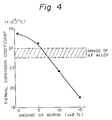
- the sintered magnesium-based composite material according to the present invention has an additional advantage in that the thermal expansion coefficient of the magnesium-based material can be adjusted by an appropriate selection of the composition of the composite. This ability to adjust the thermal expansion coefficient prevents a mismatch of the thermal expansion coefficient of a head arm with a recording disc, so that a deviation of the head from the tracks formed on a disc of e.g., aluminum, can be prevented.
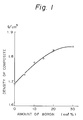
- a powder mixture of Mg-9 wt% Al was prepared by mixing a -200 mesh magnesium powder and -325 mesh aluminium powder, and a boron powder (average particle size of 20 ⁇ m) was mixed with the above powder mixture in an amount of 0 to 30% by volume.
- the resultant powder mixture was pressed at 4 tons/cm2 to form a tensile sample test piece, and the sample test piece was sintered in an argon atmosphere at 560-620°C for 1 hour.
- the density of the composite material was 1.8 g/cm3 at most, which is almost the same as the 1.83 g/cm3 of the density of a conventional magnesium alloy for a head arm (AZ91: a magnesium alloy with 9 wt% Al and 1 wt% Zn).
- AZ91 a magnesium alloy with 9 wt% Al and 1 wt% Zn.
- the modulus of elasticity was improved to 6300 kg/mm2, 1.4 times larger than that of the conventional magnesium alloy (AZ91), and the tensile strength was 20 kgf/mm2, about 2 times larger than that of the conventional magnesium alloy (AZ91).
- the Al content of the B/Mg sintered composite system was varied.
- the aluminum content was varied between 0 and 18 wt%, to determine the composition dependency of the modulus of elasticity.
- the dependence of the modulus of elasticity on aluminum content is shown in Fig. 5.
- the modulus of elasticity has a value of 6300 kgf/mm2 (1.4 times higher than that of the cast Mg-Al alloy without boron) when the aluminum content is 9% by weight. In comparison, without boron, the optimum aluminum content is 6% by weight.
- Figures 6A and 6B show the results of XMA analysis for the samples containing 6, and 9 percent Al by weight, and 10 percent B by volume. Both samples have a uniform distribution of Al and Mg in the matrix. However, the sample containing 9% Al by weight has an aluminum-rich layer several microns in thickness around the boron particles. This concentration of aluminum around the boron particles may promote good boron-magnesium interface bonding, resulting in a B/Mg-Al alloy with high modulus of elasticity. This aluminum concentration may explain the differences in the optimum aluminum content for the samples with or without boron.
- a magnesium-aluminum sintered alloy, reinforced with boron particles has been developed that has an increased modulus of elasticity.
- Light weight magnesium-aluminum alloys have proved to be viable candidates for high-speed moving components used in computer peripherals.
- a composite material technique has been used in which boron particles reinforce the alloy matrix.
- XMA analysis revealed that an aluminum-rich interface layer which forms around the boron particles may promote the formation of strong bonds between the boron particulate reinforcement and the magnesium-aluminum matrix.
- the coated powders were mixed with a -200 mesh magnesium alloy (Mg-9 wt% Al) in an amount of 10% by volume of the coated powders based on the total volume of the mixture.
- the obtained mixtures of powders were pressed at 4 tons/cm2 and sintered in an argon atmosphere at 600°C for 1 hour.
- a -200 mesh magnesium powder was pressed at 2 tons/cm2 to form a porous magnesium shaped body having a relative density of 85%.
- the porous magnesium body was heat treated in a gas flow of argon containing 200 ppm of oxygen, at 500°C for 1 hour, and a sintered magnesium body containing a thickness of 0.1 to 2 ⁇ m of magnesium oxide inside pores of the body, a relative density of the sintered body being 87%, was obtained.
- This sintered magnesium body containing magnesium oxide was pressed again at 4 tons/cm2 to obtain a shaped body of a Mg-MgO composite.
- This composite shaped body had a relative density of 96%, and the properties shown in Table 3.
- Table 3 Reinforcing Material Density (g/cm3) Modulus of Elasticity (kgf/mm2) Tensile strength (kgf/mm2) Mg-MgO composite 1.76 5400 11.5 Sintered Mg 1.69 3800 8.0
Landscapes
- Chemical & Material Sciences (AREA)
- Engineering & Computer Science (AREA)
- Materials Engineering (AREA)
- Mechanical Engineering (AREA)
- Metallurgy (AREA)
- Organic Chemistry (AREA)
- Powder Metallurgy (AREA)
- Manufacture Of Alloys Or Alloy Compounds (AREA)
- Compositions Of Oxide Ceramics (AREA)
- Forging (AREA)
Applications Claiming Priority (7)
| Application Number | Priority Date | Filing Date | Title |
|---|---|---|---|
| JP62313142A JPH01156448A (ja) | 1987-12-12 | 1987-12-12 | マグネシウム系複合材料 |
| JP313142/87 | 1987-12-12 | ||
| JP89489/88 | 1988-04-12 | ||
| JP63089489A JPH01261266A (ja) | 1988-04-12 | 1988-04-12 | マグネシウム系複合材料の製造方法 |
| JP63090927A JPH01263232A (ja) | 1988-04-13 | 1988-04-13 | 酸化マグネシウム強化マグネシウム複合体の製造方法 |
| JP90927/88 | 1988-04-13 | ||
| EP88311738A EP0323067B1 (de) | 1987-12-12 | 1988-12-12 | Gesintertes Verbundmaterial auf Magnesiumbasis und Verfahren zu seiner Herstellung |
Related Parent Applications (1)
| Application Number | Title | Priority Date | Filing Date |
|---|---|---|---|
| EP88311738.4 Division | 1988-12-12 |
Publications (3)
| Publication Number | Publication Date |
|---|---|
| EP0488996A2 true EP0488996A2 (de) | 1992-06-03 |
| EP0488996A3 EP0488996A3 (en) | 1992-07-08 |
| EP0488996B1 EP0488996B1 (de) | 1996-02-28 |
Family
ID=27306127
Family Applications (2)
| Application Number | Title | Priority Date | Filing Date |
|---|---|---|---|
| EP92103613A Expired - Lifetime EP0488996B1 (de) | 1987-12-12 | 1988-12-12 | Verbundmaterial auf Magnesiumbasis und Verfahren zu seiner Herstellung |
| EP88311738A Expired - Lifetime EP0323067B1 (de) | 1987-12-12 | 1988-12-12 | Gesintertes Verbundmaterial auf Magnesiumbasis und Verfahren zu seiner Herstellung |
Family Applications After (1)
| Application Number | Title | Priority Date | Filing Date |
|---|---|---|---|
| EP88311738A Expired - Lifetime EP0323067B1 (de) | 1987-12-12 | 1988-12-12 | Gesintertes Verbundmaterial auf Magnesiumbasis und Verfahren zu seiner Herstellung |
Country Status (5)
| Country | Link |
|---|---|
| US (1) | US4941918A (de) |
| EP (2) | EP0488996B1 (de) |
| KR (1) | KR910009872B1 (de) |
| DE (2) | DE3855052T2 (de) |
| ES (1) | ES2045150T3 (de) |
Cited By (3)
| Publication number | Priority date | Publication date | Assignee | Title |
|---|---|---|---|---|
| CN104451223A (zh) * | 2014-10-30 | 2015-03-25 | 苏州莱特复合材料有限公司 | 一种SiC/Mg合金材料的制备方法 |
| CN104498753A (zh) * | 2014-12-02 | 2015-04-08 | 常熟市东涛金属复合材料有限公司 | 一种陶瓷金属生物复合材料的制备方法 |
| CN109112442A (zh) * | 2018-10-25 | 2019-01-01 | 西安石油大学 | 一种多尺度增强低/负热膨胀镁基复合材料及其制备方法 |
Families Citing this family (16)
| Publication number | Priority date | Publication date | Assignee | Title |
|---|---|---|---|---|
| US5051231A (en) * | 1989-09-20 | 1991-09-24 | Agency Of Industrial Science & Technology | Method for fabrication of superplastic composite material having metallic aluminum reinforced with silicon nitride |
| US5149496A (en) * | 1991-02-04 | 1992-09-22 | Allied-Signal Inc. | Method of making high strength, high stiffness, magnesium base metal alloy composites |
| US5672433A (en) * | 1993-06-02 | 1997-09-30 | Pcc Composites, Inc. | Magnesium composite electronic packages |
| US5669059A (en) * | 1994-01-19 | 1997-09-16 | Alyn Corporation | Metal matrix compositions and method of manufacturing thereof |
| US5980602A (en) * | 1994-01-19 | 1999-11-09 | Alyn Corporation | Metal matrix composite |
| US5722033A (en) * | 1994-01-19 | 1998-02-24 | Alyn Corporation | Fabrication methods for metal matrix composites |
| US6151198A (en) * | 1998-11-18 | 2000-11-21 | International Business Machines Corporation | Overmolding of actuator E-block by thixotropic or semisolid forging |
| US6250364B1 (en) | 1998-12-29 | 2001-06-26 | International Business Machines Corporation | Semi-solid processing to form disk drive components |
| JP2001344732A (ja) * | 2000-05-29 | 2001-12-14 | Fujitsu Ltd | 磁気記録媒体用基板及びその製造方法、並びに磁気記録媒体の評価方法 |
| DE602004014753D1 (de) * | 2003-04-09 | 2008-08-14 | Dow Global Technologies Inc | Zusammensetzung für die herstellung von metal verbundwerkstoffe |
| US20060141237A1 (en) * | 2004-12-23 | 2006-06-29 | Katherine Leighton | Metal-ceramic materials |
| CN100444994C (zh) * | 2005-04-07 | 2008-12-24 | 上海交通大学 | 镀铜碳化硅颗粒增强镁基复合材料的制备方法 |
| CN101386926B (zh) * | 2007-09-14 | 2011-11-09 | 清华大学 | 镁基复合材料的制备方法及制备装置 |
| CN115261747B (zh) * | 2021-04-29 | 2023-08-22 | 苏州铜宝锐新材料有限公司 | 粉末冶金复合功能材料、其制作方法及应用 |
| CN116103530B (zh) * | 2023-02-17 | 2025-07-22 | 上海交通大学 | 微、纳米协同增强异构金属基复合材料及分级组装制备 |
| CN117286388B (zh) * | 2023-09-26 | 2025-11-25 | 哈尔滨工业大学 | 一种高体分石墨烯增强镁基复合材料及其制备方法 |
Family Cites Families (20)
| Publication number | Priority date | Publication date | Assignee | Title |
|---|---|---|---|---|
| US3216824A (en) * | 1961-07-03 | 1965-11-09 | Commissariat Energie Atomique | Preparation of materials of composite structure |
| FR1363294A (fr) * | 1963-04-29 | 1964-06-12 | Louyot Comptoir Lyon Alemand | Perfectionnements aux procédés de préparation de pseudo-alliages |
| FR1444901A (fr) * | 1965-05-26 | 1966-07-08 | Louyot Comptoir Lyon Alemand | Procédé d'élaboration de matériaux composites et nouveaux matériaux ainsi obtenus |
| DD102319A1 (de) * | 1971-04-13 | 1973-12-12 | ||
| US3775530A (en) * | 1971-08-13 | 1973-11-27 | Dow Chemical Co | Manufacture of composites containing a thermally shaped inorganic fiber form |
| JPS5298716A (en) * | 1976-02-17 | 1977-08-18 | Fujitsu Ltd | Magnesium sintered bodies |
| JPS6041136B2 (ja) * | 1976-09-01 | 1985-09-14 | 財団法人特殊無機材料研究所 | シリコンカ−バイド繊維強化軽金属複合材料の製造方法 |
| JPS55161495A (en) * | 1979-05-31 | 1980-12-16 | Matsushita Electric Ind Co Ltd | Diaphragm for acoustic transducer |
| JPS57169037A (en) * | 1981-04-07 | 1982-10-18 | Sumitomo Chem Co Ltd | Fiber reinforced metallic composite material |
| JPS5747843A (en) * | 1980-09-05 | 1982-03-18 | Nissan Motor Co Ltd | Damping composite magnesium material with high strength and wear resistance |
| JPS57169039A (en) * | 1981-04-07 | 1982-10-18 | Sumitomo Chem Co Ltd | Fiber reinforced metallic composite material |
| JPS57169036A (en) * | 1981-04-07 | 1982-10-18 | Sumitomo Chem Co Ltd | Fiber reinforced metallic composite material |
| JPS5846521A (ja) * | 1981-09-11 | 1983-03-18 | 田中貴金属工業株式会社 | 組み合せ電気接点 |
| JPS58107435A (ja) * | 1981-12-18 | 1983-06-27 | Nippon Denso Co Ltd | 炭素繊維強化金属複合材料 |
| JPS59208042A (ja) * | 1983-05-13 | 1984-11-26 | Toyota Motor Corp | 分散強化マグネシウム合金 |
| JPS60251247A (ja) * | 1984-05-28 | 1985-12-11 | Agency Of Ind Science & Technol | 無機繊維一金属複合材料とその製造方法 |
| JPS6199655A (ja) * | 1984-10-18 | 1986-05-17 | Toyota Motor Corp | 鉱物繊維強化金属複合材料 |
| JPS61201745A (ja) * | 1985-03-01 | 1986-09-06 | Toyota Motor Corp | アルミナ−シリカ繊維及び鉱物繊維強化金属複合材料 |
| JPS61231133A (ja) * | 1985-04-05 | 1986-10-15 | Mitsubishi Electric Corp | 周辺機器用構造材 |
| US4749545A (en) * | 1986-04-02 | 1988-06-07 | British Petroleum Co. P.L.C. | Preparation of composites |
-
1988
- 1988-12-12 ES ES88311738T patent/ES2045150T3/es not_active Expired - Lifetime
- 1988-12-12 US US07/282,506 patent/US4941918A/en not_active Expired - Fee Related
- 1988-12-12 DE DE3855052T patent/DE3855052T2/de not_active Expired - Fee Related
- 1988-12-12 EP EP92103613A patent/EP0488996B1/de not_active Expired - Lifetime
- 1988-12-12 DE DE88311738T patent/DE3885259T2/de not_active Expired - Fee Related
- 1988-12-12 EP EP88311738A patent/EP0323067B1/de not_active Expired - Lifetime
- 1988-12-12 KR KR1019880016512A patent/KR910009872B1/ko not_active Expired
Cited By (4)
| Publication number | Priority date | Publication date | Assignee | Title |
|---|---|---|---|---|
| CN104451223A (zh) * | 2014-10-30 | 2015-03-25 | 苏州莱特复合材料有限公司 | 一种SiC/Mg合金材料的制备方法 |
| CN104451223B (zh) * | 2014-10-30 | 2016-09-14 | 宁夏康诚机电产品设计有限公司 | 一种SiC/Mg合金材料的制备方法 |
| CN104498753A (zh) * | 2014-12-02 | 2015-04-08 | 常熟市东涛金属复合材料有限公司 | 一种陶瓷金属生物复合材料的制备方法 |
| CN109112442A (zh) * | 2018-10-25 | 2019-01-01 | 西安石油大学 | 一种多尺度增强低/负热膨胀镁基复合材料及其制备方法 |
Also Published As
| Publication number | Publication date |
|---|---|
| DE3885259D1 (de) | 1993-12-02 |
| DE3885259T2 (de) | 1994-02-17 |
| KR890010253A (ko) | 1989-08-07 |
| KR910009872B1 (ko) | 1991-12-03 |
| US4941918A (en) | 1990-07-17 |
| EP0488996A3 (en) | 1992-07-08 |
| ES2045150T3 (es) | 1994-01-16 |
| EP0488996B1 (de) | 1996-02-28 |
| DE3855052T2 (de) | 1996-07-11 |
| EP0323067A3 (en) | 1990-01-10 |
| EP0323067A2 (de) | 1989-07-05 |
| EP0323067B1 (de) | 1993-10-27 |
| DE3855052D1 (de) | 1996-04-04 |
Similar Documents
| Publication | Publication Date | Title |
|---|---|---|
| EP0488996A2 (de) | Verbundmaterial auf Magnesiumbasis und Verfahren zu seiner Herstellung | |
| EP0291441B1 (de) | Verbundwerkstoffe mit Metallmatrix | |
| CA1317317C (en) | Method of modifying ceramic composite bodies by a carburization process and articles produced thereby | |
| EP0775098B1 (de) | Bauteile aus borkarbid-verbundkörpermaterial mit hoher biegefestigheit bei erhöhten temperaturen | |
| EP0375588A1 (de) | Verfahren zur Herstellung von Verbundwerkstoff-Körpern mit Metallmatrix durch freiwillige Infiltration | |
| CS277307B6 (en) | Process for producing self-supporting ceramic body | |
| EP0368789B1 (de) | Verfahren zum Thermoformen von Verbundwerkstoff-Körpern | |
| EP0299905B1 (de) | Verfahren zur Herstellung selbsttragender Körper und danach hergestellte Produkte | |
| EP0402677B1 (de) | Verfahren zur Herstellung von kubischem Bornitrid aus hexagonalem, beschichteten Bornitrid | |
| CA2084085A1 (en) | Metal carbides and derived composites | |
| EP0630306B1 (de) | Herstellung von Cementkörpern durch reaktive Infiltration | |
| EP0765297B1 (de) | Verbundmaterial für hochtemperaturanwendungen aus pulver im nanometer-bereich | |
| EP0527955B1 (de) | Makro-verbundkörper und verfahren zu ihrer herstellung | |
| US5329984A (en) | Method of forming a filler material for use in various metal matrix composite body formation processes | |
| US5556486A (en) | Composite material having an intermetallic matrix of AlNi reinforced by silicon carbide particles | |
| US5298051A (en) | Method of modifying ceramic composite bodies by a post-treatment process and articles produced thereby | |
| US5120684A (en) | Pressure assisted technique for forming self-supporting composite bodies and articles formed thereby | |
| CN118755978A (zh) | 一种碳化钒/氧化铝陶瓷颗粒增强铜-石墨复合材料及其制备方法 | |
| US5264401A (en) | Pressure assisted technique for forming self-supporting composite bodies and articles formed thereby | |
| JPH05339079A (ja) | 炭化硼素被覆炭素材料の製造法及び該製造法で製造した炭化硼素被覆炭素材料 | |
| WO1993003193A1 (en) | Hardened cermets and method of forming hardened cermets | |
| Yamaki | Reaction sintered silicon nitride as a coating for carbon-carbon composites | |
| WO1994000610A1 (en) | A method of modifying the properties of a metal matrix composite body |
Legal Events
| Date | Code | Title | Description |
|---|---|---|---|
| PUAI | Public reference made under article 153(3) epc to a published international application that has entered the european phase |
Free format text: ORIGINAL CODE: 0009012 |
|
| PUAL | Search report despatched |
Free format text: ORIGINAL CODE: 0009013 |
|
| 17P | Request for examination filed |
Effective date: 19920327 |
|
| AC | Divisional application: reference to earlier application |
Ref document number: 323067 Country of ref document: EP |
|
| AK | Designated contracting states |
Kind code of ref document: A2 Designated state(s): DE ES FR GB NL |
|
| AK | Designated contracting states |
Kind code of ref document: A3 Designated state(s): DE ES FR GB NL |
|
| RIN1 | Information on inventor provided before grant (corrected) |
Inventor name: SATO, TAKEHIKO Inventor name: IIKAWA, TSUTOMU Inventor name: HORIKOSHI, EIJI |
|
| 17Q | First examination report despatched |
Effective date: 19940322 |
|
| GRAA | (expected) grant |
Free format text: ORIGINAL CODE: 0009210 |
|
| AC | Divisional application: reference to earlier application |
Ref document number: 323067 Country of ref document: EP |
|
| AK | Designated contracting states |
Kind code of ref document: B1 Designated state(s): DE ES FR GB NL |
|
| PG25 | Lapsed in a contracting state [announced via postgrant information from national office to epo] |
Ref country code: NL Free format text: LAPSE BECAUSE OF FAILURE TO SUBMIT A TRANSLATION OF THE DESCRIPTION OR TO PAY THE FEE WITHIN THE PRESCRIBED TIME-LIMIT Effective date: 19960228 Ref country code: ES Free format text: THE PATENT HAS BEEN ANNULLED BY A DECISION OF A NATIONAL AUTHORITY Effective date: 19960228 |
|
| PGFP | Annual fee paid to national office [announced via postgrant information from national office to epo] |
Ref country code: FR Payment date: 19960313 Year of fee payment: 9 |
|
| REF | Corresponds to: |
Ref document number: 3855052 Country of ref document: DE Date of ref document: 19960404 |
|
| ET | Fr: translation filed | ||
| NLV1 | Nl: lapsed or annulled due to failure to fulfill the requirements of art. 29p and 29m of the patents act | ||
| PG25 | Lapsed in a contracting state [announced via postgrant information from national office to epo] |
Ref country code: GB Effective date: 19961212 |
|
| PLBE | No opposition filed within time limit |
Free format text: ORIGINAL CODE: 0009261 |
|
| STAA | Information on the status of an ep patent application or granted ep patent |
Free format text: STATUS: NO OPPOSITION FILED WITHIN TIME LIMIT |
|
| 26N | No opposition filed | ||
| GBPC | Gb: european patent ceased through non-payment of renewal fee |
Effective date: 19961212 |
|
| PG25 | Lapsed in a contracting state [announced via postgrant information from national office to epo] |
Ref country code: FR Effective date: 19970829 |
|
| PG25 | Lapsed in a contracting state [announced via postgrant information from national office to epo] |
Ref country code: DE Effective date: 19970902 |
|
| REG | Reference to a national code |
Ref country code: FR Ref legal event code: ST |