EP0489323A1 - Optisch reine Dithiolanyl- und Dithianoaminosäuren und deren Derivate, Verfahren zu ihrer Herstellung und ihre Verwendung - Google Patents
Optisch reine Dithiolanyl- und Dithianoaminosäuren und deren Derivate, Verfahren zu ihrer Herstellung und ihre Verwendung Download PDFInfo
- Publication number
- EP0489323A1 EP0489323A1 EP91120028A EP91120028A EP0489323A1 EP 0489323 A1 EP0489323 A1 EP 0489323A1 EP 91120028 A EP91120028 A EP 91120028A EP 91120028 A EP91120028 A EP 91120028A EP 0489323 A1 EP0489323 A1 EP 0489323A1
- Authority
- EP
- European Patent Office
- Prior art keywords
- carbon atoms
- chain
- straight
- branched alkyl
- compounds
- Prior art date
- Legal status (The legal status is an assumption and is not a legal conclusion. Google has not performed a legal analysis and makes no representation as to the accuracy of the status listed.)
- Withdrawn
Links
- 238000000034 method Methods 0.000 title claims abstract description 26
- 238000002360 preparation method Methods 0.000 title claims abstract description 10
- 239000002253 acid Substances 0.000 title abstract description 8
- 150000007513 acids Chemical class 0.000 title abstract description 4
- 230000002255 enzymatic effect Effects 0.000 claims abstract description 13
- 238000003776 cleavage reaction Methods 0.000 claims abstract description 9
- 230000007017 scission Effects 0.000 claims abstract description 9
- 125000004432 carbon atom Chemical group C* 0.000 claims description 45
- 150000001875 compounds Chemical class 0.000 claims description 41
- 125000000217 alkyl group Chemical group 0.000 claims description 37
- XLYOFNOQVPJJNP-UHFFFAOYSA-N water Substances O XLYOFNOQVPJJNP-UHFFFAOYSA-N 0.000 claims description 28
- 229910052739 hydrogen Inorganic materials 0.000 claims description 23
- 239000001257 hydrogen Substances 0.000 claims description 23
- 125000001797 benzyl group Chemical group [H]C1=C([H])C([H])=C(C([H])=C1[H])C([H])([H])* 0.000 claims description 20
- 125000002887 hydroxy group Chemical group [H]O* 0.000 claims description 17
- 125000001997 phenyl group Chemical group [H]C1=C([H])C([H])=C(*)C([H])=C1[H] 0.000 claims description 16
- 125000003754 ethoxycarbonyl group Chemical group C(=O)(OCC)* 0.000 claims description 13
- UFHFLCQGNIYNRP-UHFFFAOYSA-N Hydrogen Chemical compound [H][H] UFHFLCQGNIYNRP-UHFFFAOYSA-N 0.000 claims description 12
- 125000000051 benzyloxy group Chemical group [H]C1=C([H])C([H])=C(C([H])=C1[H])C([H])([H])O* 0.000 claims description 10
- 229920002554 vinyl polymer Polymers 0.000 claims description 10
- 125000005544 phthalimido group Chemical group 0.000 claims description 8
- 125000002924 primary amino group Chemical group [H]N([H])* 0.000 claims description 8
- 108091005804 Peptidases Proteins 0.000 claims description 7
- 102000035195 Peptidases Human genes 0.000 claims description 7
- 125000001584 benzyloxycarbonyl group Chemical group C(=O)(OCC1=CC=CC=C1)* 0.000 claims description 7
- 125000001160 methoxycarbonyl group Chemical group [H]C([H])([H])OC(*)=O 0.000 claims description 7
- 125000004433 nitrogen atom Chemical group N* 0.000 claims description 7
- UYWQUFXKFGHYNT-UHFFFAOYSA-N phenylmethyl ester of formic acid Natural products O=COCC1=CC=CC=C1 UYWQUFXKFGHYNT-UHFFFAOYSA-N 0.000 claims description 7
- 125000003088 (fluoren-9-ylmethoxy)carbonyl group Chemical group 0.000 claims description 6
- 125000006239 protecting group Chemical group 0.000 claims description 6
- 229940024999 proteolytic enzymes for treatment of wounds and ulcers Drugs 0.000 claims description 6
- 239000002904 solvent Substances 0.000 claims description 5
- 125000001424 substituent group Chemical group 0.000 claims description 5
- 125000003118 aryl group Chemical group 0.000 claims description 4
- 108090000765 processed proteins & peptides Proteins 0.000 claims description 4
- 239000000126 substance Substances 0.000 claims description 4
- 125000005931 tert-butyloxycarbonyl group Chemical group [H]C([H])([H])C(OC(*)=O)(C([H])([H])[H])C([H])([H])[H] 0.000 claims description 4
- YNAVUWVOSKDBBP-UHFFFAOYSA-N Morpholine Chemical group C1COCCN1 YNAVUWVOSKDBBP-UHFFFAOYSA-N 0.000 claims description 3
- 125000001495 ethyl group Chemical group [H]C([H])([H])C([H])([H])* 0.000 claims description 3
- 125000001449 isopropyl group Chemical group [H]C([H])([H])C([H])(*)C([H])([H])[H] 0.000 claims description 3
- 125000002496 methyl group Chemical group [H]C([H])([H])* 0.000 claims description 3
- 102000004196 processed proteins & peptides Human genes 0.000 claims description 3
- 125000001436 propyl group Chemical group [H]C([*])([H])C([H])([H])C([H])([H])[H] 0.000 claims description 3
- 238000007796 conventional method Methods 0.000 claims description 2
- 230000006340 racemization Effects 0.000 claims description 2
- 125000004435 hydrogen atom Chemical group [H]* 0.000 claims 12
- 108090000783 Renin Proteins 0.000 claims 1
- 102100028255 Renin Human genes 0.000 claims 1
- 229910052799 carbon Inorganic materials 0.000 claims 1
- 230000002401 inhibitory effect Effects 0.000 claims 1
- 239000003814 drug Substances 0.000 abstract description 2
- 239000000543 intermediate Substances 0.000 abstract description 2
- 230000000707 stereoselective effect Effects 0.000 abstract description 2
- OKKJLVBELUTLKV-UHFFFAOYSA-N Methanol Chemical compound OC OKKJLVBELUTLKV-UHFFFAOYSA-N 0.000 description 51
- XEKOWRVHYACXOJ-UHFFFAOYSA-N Ethyl acetate Chemical compound CCOC(C)=O XEKOWRVHYACXOJ-UHFFFAOYSA-N 0.000 description 39
- YMWUJEATGCHHMB-UHFFFAOYSA-N Dichloromethane Chemical compound ClCCl YMWUJEATGCHHMB-UHFFFAOYSA-N 0.000 description 29
- QTBSBXVTEAMEQO-UHFFFAOYSA-N Acetic acid Chemical compound CC(O)=O QTBSBXVTEAMEQO-UHFFFAOYSA-N 0.000 description 26
- HEMHJVSKTPXQMS-UHFFFAOYSA-M Sodium hydroxide Chemical compound [OH-].[Na+] HEMHJVSKTPXQMS-UHFFFAOYSA-M 0.000 description 21
- -1 heterocyclic amino acids Chemical class 0.000 description 21
- RTZKZFJDLAIYFH-UHFFFAOYSA-N Diethyl ether Chemical compound CCOCC RTZKZFJDLAIYFH-UHFFFAOYSA-N 0.000 description 18
- VEXZGXHMUGYJMC-UHFFFAOYSA-N Hydrochloric acid Chemical compound Cl VEXZGXHMUGYJMC-UHFFFAOYSA-N 0.000 description 18
- ZMANZCXQSJIPKH-UHFFFAOYSA-N Triethylamine Chemical compound CCN(CC)CC ZMANZCXQSJIPKH-UHFFFAOYSA-N 0.000 description 17
- 102000004190 Enzymes Human genes 0.000 description 16
- 108090000790 Enzymes Proteins 0.000 description 16
- 229940088598 enzyme Drugs 0.000 description 16
- UIHCLUNTQKBZGK-UHFFFAOYSA-N Methyl isobutyl ketone Natural products CCC(C)C(C)=O UIHCLUNTQKBZGK-UHFFFAOYSA-N 0.000 description 15
- NTIZESTWPVYFNL-UHFFFAOYSA-N Methyl isobutyl ketone Chemical compound CC(C)CC(C)=O NTIZESTWPVYFNL-UHFFFAOYSA-N 0.000 description 14
- 235000019439 ethyl acetate Nutrition 0.000 description 14
- IAZDPXIOMUYVGZ-UHFFFAOYSA-N Dimethylsulphoxide Chemical compound CS(C)=O IAZDPXIOMUYVGZ-UHFFFAOYSA-N 0.000 description 12
- 239000000203 mixture Substances 0.000 description 12
- 239000012071 phase Substances 0.000 description 10
- ZCYVEMRRCGMTRW-UHFFFAOYSA-N 7553-56-2 Chemical compound [I] ZCYVEMRRCGMTRW-UHFFFAOYSA-N 0.000 description 9
- WFDIJRYMOXRFFG-UHFFFAOYSA-N Acetic anhydride Chemical compound CC(=O)OC(C)=O WFDIJRYMOXRFFG-UHFFFAOYSA-N 0.000 description 9
- 229960000583 acetic acid Drugs 0.000 description 9
- 150000002431 hydrogen Chemical class 0.000 description 9
- 229910052740 iodine Inorganic materials 0.000 description 9
- 239000011630 iodine Substances 0.000 description 9
- 238000002955 isolation Methods 0.000 description 8
- FEMOMIGRRWSMCU-UHFFFAOYSA-N ninhydrin Chemical compound C1=CC=C2C(=O)C(O)(O)C(=O)C2=C1 FEMOMIGRRWSMCU-UHFFFAOYSA-N 0.000 description 8
- 239000000243 solution Substances 0.000 description 8
- RYHBNJHYFVUHQT-UHFFFAOYSA-N 1,4-Dioxane Chemical compound C1COCCO1 RYHBNJHYFVUHQT-UHFFFAOYSA-N 0.000 description 7
- QGZKDVFQNNGYKY-UHFFFAOYSA-N Ammonia Chemical compound N QGZKDVFQNNGYKY-UHFFFAOYSA-N 0.000 description 7
- 108010056079 Subtilisins Proteins 0.000 description 7
- 102000005158 Subtilisins Human genes 0.000 description 7
- 239000000969 carrier Substances 0.000 description 6
- 238000006243 chemical reaction Methods 0.000 description 6
- 150000002148 esters Chemical class 0.000 description 6
- 230000007062 hydrolysis Effects 0.000 description 6
- 238000006460 hydrolysis reaction Methods 0.000 description 6
- VLKZOEOYAKHREP-UHFFFAOYSA-N n-Hexane Chemical compound CCCCCC VLKZOEOYAKHREP-UHFFFAOYSA-N 0.000 description 6
- SOJSYOXMFGDLHY-UHFFFAOYSA-N methyl acetate;hydrochloride Chemical compound Cl.COC(C)=O SOJSYOXMFGDLHY-UHFFFAOYSA-N 0.000 description 5
- 239000012074 organic phase Substances 0.000 description 5
- 238000005160 1H NMR spectroscopy Methods 0.000 description 4
- QOSSAOTZNIDXMA-UHFFFAOYSA-N Dicylcohexylcarbodiimide Chemical compound C1CCCCC1N=C=NC1CCCCC1 QOSSAOTZNIDXMA-UHFFFAOYSA-N 0.000 description 4
- 239000004365 Protease Substances 0.000 description 4
- 229920002678 cellulose Polymers 0.000 description 4
- 235000010980 cellulose Nutrition 0.000 description 4
- 238000004128 high performance liquid chromatography Methods 0.000 description 4
- 239000008363 phosphate buffer Substances 0.000 description 4
- 238000003786 synthesis reaction Methods 0.000 description 4
- SYTBZMRGLBWNTM-SNVBAGLBSA-N (R)-flurbiprofen Chemical compound FC1=CC([C@H](C(O)=O)C)=CC=C1C1=CC=CC=C1 SYTBZMRGLBWNTM-SNVBAGLBSA-N 0.000 description 3
- UHOVQNZJYSORNB-UHFFFAOYSA-N Benzene Chemical compound C1=CC=CC=C1 UHOVQNZJYSORNB-UHFFFAOYSA-N 0.000 description 3
- PMZURENOXWZQFD-UHFFFAOYSA-L Sodium Sulfate Chemical compound [Na+].[Na+].[O-]S([O-])(=O)=O PMZURENOXWZQFD-UHFFFAOYSA-L 0.000 description 3
- UIIMBOGNXHQVGW-UHFFFAOYSA-M Sodium bicarbonate Chemical compound [Na+].OC([O-])=O UIIMBOGNXHQVGW-UHFFFAOYSA-M 0.000 description 3
- YXFVVABEGXRONW-UHFFFAOYSA-N Toluene Chemical compound CC1=CC=CC=C1 YXFVVABEGXRONW-UHFFFAOYSA-N 0.000 description 3
- 125000003545 alkoxy group Chemical group 0.000 description 3
- 230000015572 biosynthetic process Effects 0.000 description 3
- 239000007795 chemical reaction product Substances 0.000 description 3
- 238000010992 reflux Methods 0.000 description 3
- 229910052938 sodium sulfate Inorganic materials 0.000 description 3
- 235000011152 sodium sulphate Nutrition 0.000 description 3
- 229960002317 succinimide Drugs 0.000 description 3
- 125000000391 vinyl group Chemical group [H]C([*])=C([H])[H] 0.000 description 3
- HZAXFHJVJLSVMW-UHFFFAOYSA-N 2-Aminoethan-1-ol Chemical compound NCCO HZAXFHJVJLSVMW-UHFFFAOYSA-N 0.000 description 2
- VHYFNPMBLIVWCW-UHFFFAOYSA-N 4-Dimethylaminopyridine Chemical compound CN(C)C1=CC=NC=C1 VHYFNPMBLIVWCW-UHFFFAOYSA-N 0.000 description 2
- CSCPPACGZOOCGX-UHFFFAOYSA-N Acetone Chemical compound CC(C)=O CSCPPACGZOOCGX-UHFFFAOYSA-N 0.000 description 2
- 241000194108 Bacillus licheniformis Species 0.000 description 2
- 244000063299 Bacillus subtilis Species 0.000 description 2
- 235000014469 Bacillus subtilis Nutrition 0.000 description 2
- 0 C[C@@]1C(C2)*2CC1 Chemical compound C[C@@]1C(C2)*2CC1 0.000 description 2
- HEDRZPFGACZZDS-UHFFFAOYSA-N Chloroform Chemical compound ClC(Cl)Cl HEDRZPFGACZZDS-UHFFFAOYSA-N 0.000 description 2
- QNAYBMKLOCPYGJ-UHFFFAOYSA-N D-alpha-Ala Natural products CC([NH3+])C([O-])=O QNAYBMKLOCPYGJ-UHFFFAOYSA-N 0.000 description 2
- ROSDSFDQCJNGOL-UHFFFAOYSA-N Dimethylamine Chemical compound CNC ROSDSFDQCJNGOL-UHFFFAOYSA-N 0.000 description 2
- QNAYBMKLOCPYGJ-UWTATZPHSA-N L-Alanine Natural products C[C@@H](N)C(O)=O QNAYBMKLOCPYGJ-UWTATZPHSA-N 0.000 description 2
- JGFZNNIVVJXRND-UHFFFAOYSA-N N,N-Diisopropylethylamine (DIPEA) Chemical compound CCN(C(C)C)C(C)C JGFZNNIVVJXRND-UHFFFAOYSA-N 0.000 description 2
- LRHPLDYGYMQRHN-UHFFFAOYSA-N N-Butanol Chemical compound CCCCO LRHPLDYGYMQRHN-UHFFFAOYSA-N 0.000 description 2
- MQUMNKDULYGRPJ-GSVOUGTGSA-N N[C@@H](C1SCCS1)C(O)=O Chemical compound N[C@@H](C1SCCS1)C(O)=O MQUMNKDULYGRPJ-GSVOUGTGSA-N 0.000 description 2
- JUJWROOIHBZHMG-UHFFFAOYSA-N Pyridine Chemical compound C1=CC=NC=C1 JUJWROOIHBZHMG-UHFFFAOYSA-N 0.000 description 2
- 239000007868 Raney catalyst Substances 0.000 description 2
- NPXOKRUENSOPAO-UHFFFAOYSA-N Raney nickel Chemical compound [Al].[Ni] NPXOKRUENSOPAO-UHFFFAOYSA-N 0.000 description 2
- 229910000564 Raney nickel Inorganic materials 0.000 description 2
- 125000002252 acyl group Chemical group 0.000 description 2
- 125000003277 amino group Chemical group 0.000 description 2
- 229910021529 ammonia Inorganic materials 0.000 description 2
- 125000004744 butyloxycarbonyl group Chemical group 0.000 description 2
- 125000003178 carboxy group Chemical group [H]OC(*)=O 0.000 description 2
- 238000001816 cooling Methods 0.000 description 2
- 230000008878 coupling Effects 0.000 description 2
- 238000010168 coupling process Methods 0.000 description 2
- 238000005859 coupling reaction Methods 0.000 description 2
- 238000006477 desulfuration reaction Methods 0.000 description 2
- 230000023556 desulfurization Effects 0.000 description 2
- 238000009826 distribution Methods 0.000 description 2
- ODCCJTMPMUFERV-UHFFFAOYSA-N ditert-butyl carbonate Chemical compound CC(C)(C)OC(=O)OC(C)(C)C ODCCJTMPMUFERV-UHFFFAOYSA-N 0.000 description 2
- 238000006911 enzymatic reaction Methods 0.000 description 2
- 239000000706 filtrate Substances 0.000 description 2
- 238000004817 gas chromatography Methods 0.000 description 2
- 201000011243 gastrointestinal stromal tumor Diseases 0.000 description 2
- 239000000499 gel Substances 0.000 description 2
- 150000007529 inorganic bases Chemical class 0.000 description 2
- ZXEKIIBDNHEJCQ-UHFFFAOYSA-N isobutanol Chemical compound CC(C)CO ZXEKIIBDNHEJCQ-UHFFFAOYSA-N 0.000 description 2
- 238000004519 manufacturing process Methods 0.000 description 2
- 244000005700 microbiome Species 0.000 description 2
- 150000007530 organic bases Chemical class 0.000 description 2
- 230000020477 pH reduction Effects 0.000 description 2
- 229920002401 polyacrylamide Polymers 0.000 description 2
- 238000000926 separation method Methods 0.000 description 2
- 238000001179 sorption measurement Methods 0.000 description 2
- KZNICNPSHKQLFF-UHFFFAOYSA-N succinimide Chemical compound O=C1CCC(=O)N1 KZNICNPSHKQLFF-UHFFFAOYSA-N 0.000 description 2
- FYSNRJHAOHDILO-UHFFFAOYSA-N thionyl chloride Chemical compound ClS(Cl)=O FYSNRJHAOHDILO-UHFFFAOYSA-N 0.000 description 2
- MTCFGRXMJLQNBG-REOHCLBHSA-N (2S)-2-Amino-3-hydroxypropansäure Chemical compound OC[C@H](N)C(O)=O MTCFGRXMJLQNBG-REOHCLBHSA-N 0.000 description 1
- 125000004747 1,1-dimethylethoxycarbonyl group Chemical group CC(C)(OC(=O)*)C 0.000 description 1
- YQTCQNIPQMJNTI-UHFFFAOYSA-N 2,2-dimethylpropan-1-one Chemical group CC(C)(C)[C]=O YQTCQNIPQMJNTI-UHFFFAOYSA-N 0.000 description 1
- BFSVOASYOCHEOV-UHFFFAOYSA-N 2-diethylaminoethanol Chemical compound CCN(CC)CCO BFSVOASYOCHEOV-UHFFFAOYSA-N 0.000 description 1
- 125000002672 4-bromobenzoyl group Chemical group BrC1=CC=C(C(=O)*)C=C1 0.000 description 1
- 125000000242 4-chlorobenzoyl group Chemical group ClC1=CC=C(C(=O)*)C=C1 0.000 description 1
- 229960000549 4-dimethylaminophenol Drugs 0.000 description 1
- HRPVXLWXLXDGHG-UHFFFAOYSA-N Acrylamide Chemical compound NC(=O)C=C HRPVXLWXLXDGHG-UHFFFAOYSA-N 0.000 description 1
- 240000006439 Aspergillus oryzae Species 0.000 description 1
- 235000002247 Aspergillus oryzae Nutrition 0.000 description 1
- 241000283690 Bos taurus Species 0.000 description 1
- 108010004032 Bromelains Proteins 0.000 description 1
- LCGLNKUTAGEVQW-UHFFFAOYSA-N Dimethyl ether Chemical group COC LCGLNKUTAGEVQW-UHFFFAOYSA-N 0.000 description 1
- 108090000270 Ficain Proteins 0.000 description 1
- 230000005526 G1 to G0 transition Effects 0.000 description 1
- SXRSQZLOMIGNAQ-UHFFFAOYSA-N Glutaraldehyde Chemical compound O=CCCCC=O SXRSQZLOMIGNAQ-UHFFFAOYSA-N 0.000 description 1
- 229910004373 HOAc Inorganic materials 0.000 description 1
- QNAYBMKLOCPYGJ-REOHCLBHSA-N L-alanine Chemical compound C[C@H](N)C(O)=O QNAYBMKLOCPYGJ-REOHCLBHSA-N 0.000 description 1
- 239000004367 Lipase Substances 0.000 description 1
- 102000004882 Lipase Human genes 0.000 description 1
- 108090001060 Lipase Proteins 0.000 description 1
- 108090000526 Papain Proteins 0.000 description 1
- 241000589540 Pseudomonas fluorescens Species 0.000 description 1
- 241000235403 Rhizomucor miehei Species 0.000 description 1
- 240000005384 Rhizopus oryzae Species 0.000 description 1
- MTCFGRXMJLQNBG-UHFFFAOYSA-N Serine Natural products OCC(N)C(O)=O MTCFGRXMJLQNBG-UHFFFAOYSA-N 0.000 description 1
- VYPSYNLAJGMNEJ-UHFFFAOYSA-N Silicium dioxide Chemical compound O=[Si]=O VYPSYNLAJGMNEJ-UHFFFAOYSA-N 0.000 description 1
- FAPWRFPIFSIZLT-UHFFFAOYSA-M Sodium chloride Chemical class [Na+].[Cl-] FAPWRFPIFSIZLT-UHFFFAOYSA-M 0.000 description 1
- 108090000787 Subtilisin Proteins 0.000 description 1
- WJGAPUXHSQQWQF-UHFFFAOYSA-N acetic acid;hydrochloride Chemical compound Cl.CC(O)=O WJGAPUXHSQQWQF-UHFFFAOYSA-N 0.000 description 1
- 125000002777 acetyl group Chemical group [H]C([H])([H])C(*)=O 0.000 description 1
- 239000008186 active pharmaceutical agent Substances 0.000 description 1
- 230000010933 acylation Effects 0.000 description 1
- 238000005917 acylation reaction Methods 0.000 description 1
- 229960003767 alanine Drugs 0.000 description 1
- 150000001298 alcohols Chemical class 0.000 description 1
- 108010027597 alpha-chymotrypsin Proteins 0.000 description 1
- 125000003368 amide group Chemical group 0.000 description 1
- 150000001408 amides Chemical class 0.000 description 1
- 229940024606 amino acid Drugs 0.000 description 1
- 150000008064 anhydrides Chemical class 0.000 description 1
- 239000008346 aqueous phase Substances 0.000 description 1
- 238000010923 batch production Methods 0.000 description 1
- 125000003236 benzoyl group Chemical group [H]C1=C([H])C([H])=C(C([H])=C1[H])C(*)=O 0.000 description 1
- 238000003339 best practice Methods 0.000 description 1
- 235000015895 biscuits Nutrition 0.000 description 1
- 235000019835 bromelain Nutrition 0.000 description 1
- 239000007853 buffer solution Substances 0.000 description 1
- 238000006555 catalytic reaction Methods 0.000 description 1
- 239000001913 cellulose Substances 0.000 description 1
- 239000003153 chemical reaction reagent Substances 0.000 description 1
- 238000004587 chromatography analysis Methods 0.000 description 1
- 229960002376 chymotrypsin Drugs 0.000 description 1
- 229920001577 copolymer Polymers 0.000 description 1
- 238000004132 cross linking Methods 0.000 description 1
- 239000012043 crude product Substances 0.000 description 1
- 238000002425 crystallisation Methods 0.000 description 1
- 230000008025 crystallization Effects 0.000 description 1
- MGNCLNQXLYJVJD-UHFFFAOYSA-N cyanuric chloride Chemical compound ClC1=NC(Cl)=NC(Cl)=N1 MGNCLNQXLYJVJD-UHFFFAOYSA-N 0.000 description 1
- 230000006196 deacetylation Effects 0.000 description 1
- 238000003381 deacetylation reaction Methods 0.000 description 1
- 238000007257 deesterification reaction Methods 0.000 description 1
- 238000001212 derivatisation Methods 0.000 description 1
- IJKVHSBPTUYDLN-UHFFFAOYSA-N dihydroxy(oxo)silane Chemical compound O[Si](O)=O IJKVHSBPTUYDLN-UHFFFAOYSA-N 0.000 description 1
- 230000000694 effects Effects 0.000 description 1
- 239000003480 eluent Substances 0.000 description 1
- 230000032050 esterification Effects 0.000 description 1
- 238000005886 esterification reaction Methods 0.000 description 1
- 235000019836 ficin Nutrition 0.000 description 1
- POTUGHMKJGOKRI-UHFFFAOYSA-N ficin Chemical compound FI=CI=N POTUGHMKJGOKRI-UHFFFAOYSA-N 0.000 description 1
- 238000001914 filtration Methods 0.000 description 1
- 238000003818 flash chromatography Methods 0.000 description 1
- 125000002485 formyl group Chemical group [H]C(*)=O 0.000 description 1
- 238000001640 fractional crystallisation Methods 0.000 description 1
- 239000012362 glacial acetic acid Substances 0.000 description 1
- 150000005694 halopyrimidines Chemical class 0.000 description 1
- 239000012442 inert solvent Substances 0.000 description 1
- 150000002500 ions Chemical class 0.000 description 1
- 125000005929 isobutyloxycarbonyl group Chemical group [H]C([H])([H])C([H])(C([H])([H])[H])C([H])([H])OC(*)=O 0.000 description 1
- 125000005928 isopropyloxycarbonyl group Chemical group [H]C([H])([H])C([H])(OC(*)=O)C([H])([H])[H] 0.000 description 1
- 210000003734 kidney Anatomy 0.000 description 1
- 235000019421 lipase Nutrition 0.000 description 1
- 125000003588 lysine group Chemical group [H]N([H])C([H])([H])C([H])([H])C([H])([H])C([H])([H])C([H])(N([H])[H])C(*)=O 0.000 description 1
- FPYJFEHAWHCUMM-UHFFFAOYSA-N maleic anhydride Chemical compound O=C1OC(=O)C=C1 FPYJFEHAWHCUMM-UHFFFAOYSA-N 0.000 description 1
- 150000002734 metacrylic acid derivatives Chemical class 0.000 description 1
- FQPSGWSUVKBHSU-UHFFFAOYSA-N methacrylamide Chemical compound CC(=C)C(N)=O FQPSGWSUVKBHSU-UHFFFAOYSA-N 0.000 description 1
- PSHKMPUSSFXUIA-UHFFFAOYSA-N n,n-dimethylpyridin-2-amine Chemical compound CN(C)C1=CC=CC=N1 PSHKMPUSSFXUIA-UHFFFAOYSA-N 0.000 description 1
- LLYKPZOWCPVRPD-UHFFFAOYSA-N n,n-dimethylpyridin-2-amine;n,n-dimethylpyridin-4-amine Chemical compound CN(C)C1=CC=NC=C1.CN(C)C1=CC=CC=N1 LLYKPZOWCPVRPD-UHFFFAOYSA-N 0.000 description 1
- 238000006386 neutralization reaction Methods 0.000 description 1
- 230000003472 neutralizing effect Effects 0.000 description 1
- 229910000069 nitrogen hydride Inorganic materials 0.000 description 1
- 230000003287 optical effect Effects 0.000 description 1
- 239000003960 organic solvent Substances 0.000 description 1
- 125000003232 p-nitrobenzoyl group Chemical group [N+](=O)([O-])C1=CC=C(C(=O)*)C=C1 0.000 description 1
- 125000000636 p-nitrophenyl group Chemical group [H]C1=C([H])C(=C([H])C([H])=C1*)[N+]([O-])=O 0.000 description 1
- 210000000496 pancreas Anatomy 0.000 description 1
- 229940055729 papain Drugs 0.000 description 1
- 235000019834 papain Nutrition 0.000 description 1
- 239000003208 petroleum Substances 0.000 description 1
- 125000006678 phenoxycarbonyl group Chemical group 0.000 description 1
- 125000000612 phthaloyl group Chemical group C(C=1C(C(=O)*)=CC=CC1)(=O)* 0.000 description 1
- 229920000642 polymer Polymers 0.000 description 1
- 239000011148 porous material Substances 0.000 description 1
- 125000001501 propionyl group Chemical group O=C([*])C([H])([H])C([H])([H])[H] 0.000 description 1
- 125000004742 propyloxycarbonyl group Chemical group 0.000 description 1
- UMJSCPRVCHMLSP-UHFFFAOYSA-N pyridine Natural products COC1=CC=CN=C1 UMJSCPRVCHMLSP-UHFFFAOYSA-N 0.000 description 1
- 239000012429 reaction media Substances 0.000 description 1
- 108010026906 renin inhibitory peptide Proteins 0.000 description 1
- 229920005989 resin Polymers 0.000 description 1
- 239000011347 resin Substances 0.000 description 1
- 150000003839 salts Chemical class 0.000 description 1
- 238000004062 sedimentation Methods 0.000 description 1
- 239000000741 silica gel Substances 0.000 description 1
- 229910002027 silica gel Inorganic materials 0.000 description 1
- 235000017557 sodium bicarbonate Nutrition 0.000 description 1
- 229910000030 sodium bicarbonate Inorganic materials 0.000 description 1
- 239000007858 starting material Substances 0.000 description 1
- 238000003756 stirring Methods 0.000 description 1
- 239000000758 substrate Substances 0.000 description 1
- 125000003396 thiol group Chemical group [H]S* 0.000 description 1
Classifications
-
- C—CHEMISTRY; METALLURGY
- C07—ORGANIC CHEMISTRY
- C07D—HETEROCYCLIC COMPOUNDS
- C07D339/00—Heterocyclic compounds containing rings having two sulfur atoms as the only ring hetero atoms
- C07D339/02—Five-membered rings
- C07D339/06—Five-membered rings having the hetero atoms in positions 1 and 3, e.g. cyclic dithiocarbonates
-
- C—CHEMISTRY; METALLURGY
- C07—ORGANIC CHEMISTRY
- C07D—HETEROCYCLIC COMPOUNDS
- C07D339/00—Heterocyclic compounds containing rings having two sulfur atoms as the only ring hetero atoms
- C07D339/08—Six-membered rings
-
- C—CHEMISTRY; METALLURGY
- C12—BIOCHEMISTRY; BEER; SPIRITS; WINE; VINEGAR; MICROBIOLOGY; ENZYMOLOGY; MUTATION OR GENETIC ENGINEERING
- C12P—FERMENTATION OR ENZYME-USING PROCESSES TO SYNTHESISE A DESIRED CHEMICAL COMPOUND OR COMPOSITION OR TO SEPARATE OPTICAL ISOMERS FROM A RACEMIC MIXTURE
- C12P17/00—Preparation of heterocyclic carbon compounds with only O, N, S, Se or Te as ring hetero atoms
-
- C—CHEMISTRY; METALLURGY
- C12—BIOCHEMISTRY; BEER; SPIRITS; WINE; VINEGAR; MICROBIOLOGY; ENZYMOLOGY; MUTATION OR GENETIC ENGINEERING
- C12P—FERMENTATION OR ENZYME-USING PROCESSES TO SYNTHESISE A DESIRED CHEMICAL COMPOUND OR COMPOSITION OR TO SEPARATE OPTICAL ISOMERS FROM A RACEMIC MIXTURE
- C12P41/00—Processes using enzymes or microorganisms to separate optical isomers from a racemic mixture
- C12P41/003—Processes using enzymes or microorganisms to separate optical isomers from a racemic mixture by ester formation, lactone formation or the inverse reactions
- C12P41/005—Processes using enzymes or microorganisms to separate optical isomers from a racemic mixture by ester formation, lactone formation or the inverse reactions by esterification of carboxylic acid groups in the enantiomers or the inverse reaction
-
- C—CHEMISTRY; METALLURGY
- C12—BIOCHEMISTRY; BEER; SPIRITS; WINE; VINEGAR; MICROBIOLOGY; ENZYMOLOGY; MUTATION OR GENETIC ENGINEERING
- C12P—FERMENTATION OR ENZYME-USING PROCESSES TO SYNTHESISE A DESIRED CHEMICAL COMPOUND OR COMPOSITION OR TO SEPARATE OPTICAL ISOMERS FROM A RACEMIC MIXTURE
- C12P41/00—Processes using enzymes or microorganisms to separate optical isomers from a racemic mixture
- C12P41/006—Processes using enzymes or microorganisms to separate optical isomers from a racemic mixture by reactions involving C-N bonds, e.g. nitriles, amides, hydantoins, carbamates, lactames, transamination reactions, or keto group formation from racemic mixtures
- C12P41/007—Processes using enzymes or microorganisms to separate optical isomers from a racemic mixture by reactions involving C-N bonds, e.g. nitriles, amides, hydantoins, carbamates, lactames, transamination reactions, or keto group formation from racemic mixtures by reactions involving acyl derivatives of racemic amines
Definitions
- the present invention relates to optically pure S- and R-dithiolanyl and dithianoamino acids and their derivatives, an enzymatic process for their preparation by stereoselective cleavage of the corresponding racemic R, S compounds, and their use as intermediates for the production of medicaments.
- Amino protecting groups in the context of the invention are the usual amino protecting groups used in peptide chemistry.
- benzyloxycarbonyl 3,4-dimethoxybenzyloxycarbonyl, 3,5-dimethoxybenzyloxycarbonyl, 2,4-dimethoxybenzyloxycarbonyl, 4-methoxybenzyloxycarbonyl, 4-nitrobenzyloxycarbonyl, 2-nitrobenzyloxycarbonyl, 2-nitro-4,5-dimethoxybenzyloxycarbonyl, methoxycarbonyl, ethoxycarbonyl, propoxycarbonyl, isopropoxycarbonyl, butoxycarbonyl, isobutoxycarbonyl, tert , Cyclohexoxycarbonyl, 1,1-dimethylethoxycarbonyl, adamantylcarbonyl, phthaloyl, 2,2,2-trichloroethoxycarbonyl, 2,2,2-trichloro-tert-butoxycarbonyl, menthyloxycarbonyl, phenoxycarbonyl, 4-nitrophenoxycarbonyl, fluorenyl-9-
- the hydrolysis step is also important in the process according to the invention.
- the respective ester or amide groups in the R compounds are converted into the corresponding free carboxyl or amine group by hydrolysis, while the S compounds are not subject to this hydrolysis. If the S-form is to be obtained optically pure, then complete hydrolysis of the R-derivative must be ensured; however, if the R form is to be isolated purely, the hydrolysis of the R esters and amides should not be carried out completely.
- Suitable solvents for the process according to the invention are organic solvents which are not completely miscible with water, for example methylene chloride, chloroform, toluene, benzene, ethyl acetate, petroleum ether, methyl isobutyl ketone or isobutanol. Methyl isobutyl ketone is preferred.
- the enzymatic cleavage takes place in a temperature range from 20 ° C. to 40 ° C., preferably at 25 ° C. to 37 ° C.
- racemic compounds are added as an approx. 10-20% organic solution to the enzyme or enzyme carrier suspended in the water, the solvent fraction based on the total volume being at most 75-80% by volume.
- the reaction medium is stirred intensively during the enzymatic reaction.
- the course and the end point of the enzymatic reaction can be determined by neutralizing the resulting H+ ions.
- Neutralization is generally carried out using organic or inorganic bases.
- Suitable bases are inorganic bases such as ammonia or sodium hydroxide solution or organic bases such as triethylamine, ethanolamine, pyridine, diisopropylethylamine or dimethylamine.
- Ammonia and sodium hydroxide solution are preferred.
- Enzymes which can be cleaved are carboxyl ester and acyl groups as selective proteolytic enzymes for the process.
- Enzymes which cleave carboxyl esters include serine and sulfhydryl proteases, such as subtilisin, which is isolated from Bacillus subtilis or from Bacillus licheniformis, which is isolated from bovine or porcine pancreas, ⁇ -chymotrypsin or TLCK-chymotrypsin, papain, ficin, bromelain or lipases that can be isolated, for example, from the microorganisms Pseudomonas fluorescens, Mucor miehei or Rhizopus japonicus.
- the proteolytic enzymes isolated from Bacillus subtilis and Bacillus licheniformis are preferred.
- Maxatase® manufactured by Gist-Brocades NV, Delft / Netherlands
- Optimase® manufactured by Miles-Kali Chemie, Hanover
- Alcalase® manufactured by Alcalase
- Suitable enzymes which cleave acyl groups are acylase which are isolated from pig kidneys or from microorganisms such as, for example, Aspergillus oryzae.
- the proteolytic enzymes can be coupled to the polymeric support by a covalent bond via a lysine residue which is not essential for catalysis.
- the carrier-bound enzymes formed by covalent binding of the enzyme to the carrier lose their activity only very slowly after repeated use. Another possibility is the adsorption of the enzyme on the pores of a charged carrier and the subsequent cross-linking with glutardialdehyde.
- Enzyme carriers are polymeric, porous carriers such as celluloses, for example DEAE or CM cellulose, modified polyacrylamide gels with amino or hydroxyl groups or organic copolymers of acrylamide, methacrylates or Methacrylamide and maleic anhydride according to DE.OS 22 15 539 and 22 15 687 in question.
- the enzyme is reacted for coupling with the polymeric carrier under optimal conditions for the stability of the enzyme.
- the effectiveness of the coupling can be determined by measuring the enzymatic activity on the polymer and in the wash water.
- the polymeric enzyme can easily be separated from the reaction solution by sedimentation or filtration and used several times.
- the enzyme carrier can also be filled in columns and substrate solution can be flowed through in the presence of a buffer system.
- an enzyme carrier for the process according to the invention is a previous test for the adsorption of the starting and end products. Suitable carriers may only adsorb the starting and end products to a very small extent or not at all.
- the various celluloses, derivatized celluloses, amino- or hydroxyl group-containing polyacrylamide gels and the anhydride resins modified by amino or hydroxyl groups have proven to be particularly good carriers for the proteolytic enzymes.
- all amino and hydroxyl group-bearing polymeric carriers which do not adsorb as starting and end products of the process according to the invention can be used as carriers.
- the polymeric carrier is treated with cyanuric chloride [cf. GB-PS 1 302 706, NL Smith and HM Lehnhoff, Arch. Biochem., 61 , (1974), 392-415; TH Finlay et al., Arch. Biochem. 87 , (1978) 77-90] or various halopyrimidines according to DE-OS 26 19 521 or DE-OS 26 19 451 activated.
- racemic compounds of the general formula (II) are known and can be prepared by using the compounds of the general formula (V) in which n has the meaning given above, in the case of the substituent R 1 ' with acylating reagents, for example (R 1' -O-CO) 2O, R 1 ' -O-CO-Cl or (R 1' -O-CO) -ON-succinimide according to the usual method in inert solvents in the presence of a base, for example in a mixture of dioxane / water and sodium hydroxide or in dioxane with triethylamine in a temperature range from 0 ° C to + 50 ° C, preferably at room temperature and normal pressure, and in the case of the esters the acids by a method known from the literature with the corresponding alcohols (R 3 ' -OH).
- acylating reagents for example (R 1' -O-CO) 2O, R 1 ' -O-CO-
- the compound of formula (V) is known [cf. MP Mertes, AA Ramsey, J. Med. Chem. 12 , 342 (1969)].
- the enantiomerically pure compounds according to the invention can optionally also be prepared via diastereomers (for example salts) by customary methods such as, for example, fractional crystallization, by acid chromatography or by Craig distribution. What that best practice, must be decided on a case-by-case basis, sometimes it is also appropriate to use combinations of the individual procedures. Separation by crystallization or Craig distribution or a combination of both methods is particularly suitable.
- optically pure compounds of the general formula (I) are required for the synthesis of active pharmaceutical ingredients, in particular for the synthesis of renin-inhibitory peptides.
- N-tert-butoxycarbonyl-2-R, S-amino-2- [2- (1,3-dithiolano)] ethyl acetate 1.038 g (5 mmol) of 2-R, S-amino-2- [2- (1,3-dithiolano)] ethyl acetate [MP Mertes, AA Ramsey, J. Med. Chem. 12 , 342 (1969)] are described in 10 ml of dioxane dissolved, 1.038 ml (7.5 mmol) of triethylamine and finally 1.64 g (7.5 mmol) of di-tert-butyl carbonate added while cooling with ice.
- the mixture is stirred overnight at room temperature and spun off from the dioxane.
- the residue is taken up in water and extracted 3 times with diethyl ether.
- the combined organic phase is washed 3 times with cold 1N hydrochloric acid and 1 time with sodium bicarbonate solution, dried over sodium sulfate and concentrated.
- the crude product is purified by flash chromatography on silica gel with dichloromethane as the eluent.
- the uncleaved ester was extracted at pH 7.5 with 3 times 250 ml of MIBK according to HPLC. Yield: 8.15 g (89.5% of theory)
- 0.1 g of the compound from Example 2 are suspended in 10 ml of 0.1 M phosphate buffer pH 7.5 and mixed with 0.1 g of Acylase 1 from Serva No. 10720. The mixture is shaken at 37 ° C. for 24 hours and then analyzed by means of TLC.
- 0.1 g of the compound from Example III are suspended in 10 ml of 0.1 M phosphate buffer pH 7.5 and mixed with 0.1 g of Acylase 1 from Serva No. 10720. The mixture is shaken at 37 ° C. for 24 hours and then analyzed by means of TLC. It shows a reaction of about half of the approach.
- Example 6 (V) can be converted into the natural L-alanine by desulfurization with Raney nickel.
- the GC analysis shows an optical purity of 89.3% L.
- N-acetyl-S-amino-2- [2- (1,3-dithiolano) acetic acid 0.1 g of the compound from Example III is suspended in 10 ml of 0.1 M phosphate buffer pH 7.5 and 0.1 g of Acylase 1 from Serva No. 10720 is added. The mixture is shaken at 37 ° C. for 24 hours and then analyzed by means of TLC. It shows a reaction of about half of the approach.
- the aqueous phase is adjusted to pH 7.5-8 with saturated sodium bicarbonate solution and extracted 3 times with 200 ml of dichloromethane each time.
- the combined organic phase is over sodium sulfate dried and concentrated.
- the residue is taken up in diethyl ether and mixed with 4 N hydrochloric acid in dioxane.
- the precipitated hydrochloride is suction filtered, triturated with diethyl ether, suction filtered again and dried over KOH.
- the compound of Example 13 can be converted into the unnatural D-alanine by desulfurization with Raney nickel.
Landscapes
- Chemical & Material Sciences (AREA)
- Organic Chemistry (AREA)
- Engineering & Computer Science (AREA)
- Life Sciences & Earth Sciences (AREA)
- Zoology (AREA)
- Wood Science & Technology (AREA)
- Health & Medical Sciences (AREA)
- General Engineering & Computer Science (AREA)
- General Chemical & Material Sciences (AREA)
- Chemical Kinetics & Catalysis (AREA)
- Biotechnology (AREA)
- Biochemistry (AREA)
- Bioinformatics & Cheminformatics (AREA)
- Microbiology (AREA)
- General Health & Medical Sciences (AREA)
- Genetics & Genomics (AREA)
- Analytical Chemistry (AREA)
- Preparation Of Compounds By Using Micro-Organisms (AREA)
- Pharmaceuticals Containing Other Organic And Inorganic Compounds (AREA)
- Heterocyclic Compounds Containing Sulfur Atoms (AREA)
- Plural Heterocyclic Compounds (AREA)
Abstract
Die vorliegende Erfindung betrifft optisch reine S- und R-Dithiolanyl- und Dithianoaminosäuren und deren Derivate der allgemeinen Formel (I) <IMAGE> in welcher n, R¹, R² und R³ die in der Beschreibung angegebene Bedeutung haben, ein enzymatisches Verfahren zu ihrer Herstellung durch stereoselektive Spaltung der entsprechenden racemischen R,S-Verbindungen, sowie ihre Verwendung als Zwischenprodukte für die Herstellung von Arzneimitteln.
Description
- Die vorliegende Erfindung betrifft optisch reine S- und R-Dithiolanyl- und Dithianoaminosäuren und deren Derivate, ein enzymatisches Verfahren zu ihrer Herstellung durch stereoselektive Spaltung der entsprechenden racemischen R,S-Verbindungen, sowie ihre Verwendung als Zwischenprodukte für die Herstellung von Arzneimitteln.
- Optisch reine heterocyclische Aminosäuren und ein enzymatisches Verfahren zu ihrer Herstellung sind aus US P 4 389 489 bereits bekannt.
- Die Erfindung betrifft neue optisch reine Verbindungen der allgemeinen Formel (I)

in welcher - n
- für die Zahl 1 oder 2 steht,
- R¹
- für Wasserstoff, geradkettiges oder verzweigtes Alkyl mit bis zu 8 Kohlenstoffatomen, Benzyl oder für eine Gruppe der Formel -COR⁴ steht,
worin - R⁴
- geradkettiges oder verzweigtes Alkyl mit bis zu 10 Kohlenstoffatomen oder Aryl mit 6 bis 10 Kohlenstoffatomen bedeutet, oder
für eine typische Aminoschutzgruppe steht, - R²
- für Wasserstoff, geradkettiges oder verzweigtes Alkyl mit bis zu 8 Kohlenstoffatomen oder Benzyl steht, oder
- R¹ und R²
- gemeinsam mit dem Stickstoffatom einen Morpholinring oder einen Phthalimidorest bilden,
- R³
- für Hydroxy, geradkettiges oder verzweigtes, gegebenenfalls durch Vinyl substituiertes Alkoxy mit bis zu 10 Kohlenstoffatomen, Benzyloxy oder für die Gruppe -NR⁵R⁶ steht,
worin
R⁵ und R⁶ gleich oder verschieden sind und Wasserstoff, geradkettiges oder verzweigtes Alkyl mit bis zu 6 Kohlenstoffatomen oder Phenyl bedeuten, - Aminoschutzgruppe im Rahmen der Erfindung sind die üblichen in der Peptid-Chemie verwendeten Aminoschutzgruppen.
- Hierzu gehören bevorzugt: Benzyloxycarbonyl, 3,4-Dimethoxybenzyloxycarbonyl, 3,5-Dimethoxybenzyloxycarbonyl, 2,4-Dimethoxybenzyloxycarbonyl, 4-Methoxybenzyloxycarbonyl, 4-Nitrobenzyloxycarbonyl, 2-Nitrobenzyloxycarbonyl, 2-Nitro-4,5-dimethoxybenzyloxycarbonyl, Methoxycarbonyl, Ethoxycarbonyl, Propoxycarbonyl, Isopropoxycarbonyl, Butoxycarbonyl, Isobutoxycarbonyl, tert.-Butoxycarbonyl, Allyloxycarbonyl, Vinyloxycarbonyl, 2-Nitrobenzyloxycarbonyl, 3,4,5-Trimethoxybenzyloxycarbonyl, Cyclohexoxycarbonyl, 1,1-Dimethylethoxycarbonyl, Adamantylcarbonyl, Phthaloyl, 2,2,2-Trichlorethoxycarbonyl, 2,2,2-Trichlor-tertbutoxycarbonyl, Menthyloxycarbonyl, Phenoxycarbonyl, 4-Nitrophenoxycarbonyl, Fluorenyl-9-methoxycarbonyl, Formyl, Acetyl, Propionyl, Pivaloyl, 2-Chloracetyl, 2-Bromacetyl, 2,2,2-Trifluoracetyl, 2,2,2-Trichloracetyl, Benzoyl, 4-Chlorbenzoyl, 4-Brombenzoyl, 4-Nitrobenzoyl, Phthalimido, Isovaleroyl oder Benzyloxymethylen, 4-Nitrobenzyl, 2,4-Dinitrobenzyl, 4-Nitrophenyl.
- Bevorzugt sind Verbindungen der allgemeinen Formel (I), in welcher
- n
- für eine Zahl 1 oder 2 steht,
- R¹
- für Wasserstoff, geradkettiges oder verzweigtes Alkyl mit bis zu 6 Kohlenstoffatomen oder Benzyl steht, oder für eine Gruppe der Formel -COR⁴ steht,
worin - R⁴
- geradkettiges oder verzweigtes Alkyl mit bis zu 8 Kohlenstoffatomen oder Phenyl bedeutet, oder
für tert.Butoxycarbonyl (Boc), Benzyloxycarbonyl (Z), Ethoxycarbonyl (EtOC), Allyloxycarbonyl (AllOC), Fluorenyl-9-methoxycarbonyl (Fmoc) oder Methoxycarbonyl (MetOC) steht, - R²
- für Wasserstoff, geradkettiges oder verzweigtes Alkyl mit bis zu 6 Kohlenstoffatomen oder Benzyl steht, oder
- R¹ und R²
- gemeinsam mit dem Stickstoffatom den Phthalimidorest bilden,
- R³
- für Hydroxy, geradkettiges oder verzweigtes, gegebenenfalls durch Vinyl substituiertes Alkoxy mit bis zu 8 Kohlenstoffatomen, Benzyloxy oder für die Gruppe -NR⁵R⁶ steht,
worin
R⁵ und R⁶ gleich oder verschieden sind und Wasserstoff, geradkettiges oder verzweigtes Alkyl mit bis zu 4 Kohlenstoffatomen oder Phenyl bedeuten, - Besonders bevorzugt sind Verbindungen der allgemeinen Formel (I), in welcher
- n
- für die Zahl 1 oder 2 steht,
- R¹
- für Wasserstoff, geradkettiges oder verzweigtes Alkyl mit bis zu 4 Kohlenstoffatomen oder Benzyl steht, oder
für eine Gruppe der Formel -CO-R⁴ steht,
worin
R⁴ geradkettiges oder verzweigtes Alkyl mit bis zu 8 Kohlenstoffatomen oder Phenyl bedeutet, oder
für tert.-Butoxycarbonyl (BOC), Benzyloxycarbonyl(Z), Allyloxycarbonyl (AllOC), Ethoxycarbonyl (EtOC) oder Fluorenyl-9-methoxycarbonyl (Fmoc) steht, - R²
- für Wasserstoff, geradkettiges oder verzweigtes Alkyl mit bis zu 4 Kohlenstoffatomen oder Benzyl steht, oder
- R¹ und R²
- gemeinsam mit dem Stickstoffatom den Phthalimidorest bilden,
- R³
- für Hydroxy, geradkettiges oder verzweigtes, gegebenenfalls durch Vinyl substituiertes Alkoxy mit bis zu 8 Kohlenstoffatomen, Benzyloxy oder für die Gruppe -NR⁵R⁶ steht,
worin
R⁵ und R⁶ gleich oder verschieden sind und Wasserstoff, Methyl, Ethyl, Propyl, Isopropyl oder Phenyl bedeuten - Außerdem wurde in Verfahren zur Herstellung der erfindungsgemäßen optisch reinen Verbindungen der allgemeinen Formel (I) gefunden, dadurch gekennzeichnet, daß man die racemischen Verbindungen der allgemeinen Formel (II)

in welcher - n und R²
- die oben angegebene Bedeutung haben,
- R1' und R3'
- die oben angegebenen Bedeutungen von R¹ und R³ haben und mit diesen gleich oder verschieden sind, aber R1' nicht für Wasserstoff und R3' nicht für Hydroxy stehen darf,
- Das erfindungsgemäße Verfahren kann durch folgendes Formelschema beispielhaft erläutert werden:

- Bei dem erfindungsgemäßen Verfahren ist neben der Auswahl des Enzyms auch der Hydrolyseschritt von Bedeutung. Wie oben gezeigt, werden in den R-Verbindungen die jeweiligen Ester- bzw. Amidgruppen durch Hydrolyse in die entsprechende freie Carboxyl- oder Amingruppe überführt, während die S-Verbindungen dieser Hydrolyse nicht unterliegt. Soll die S-Form optisch rein erhalten werden, so ist auf die vollständige Hydrolyse des R-Derivates zu achten; soll hingegen die R-Form rein isoliert werden, so sollte die Hydrolyse der R-Ester und Amide nicht vollständig durchgeführt werden.
- Als Lösemittel für das erfindungsgemaße Verfahren eignen sich organische, mit Wasser nicht vollständig mischbare Lösemittel wie beispielsweise Methylenchlorid, Chloroform, Toluol, Benzol, Essigsäureethylester, Petrolether, Methylisobutylketon oder Isobutanol. Bevorzugt ist Methylisobutylketon.
- Die enzymatische Spaltung erfolgt in einem Temperaturbereich von 20°C bis 40°C, vorzugsweise bei 25°C bis 37°C.
- Sie verläuft in einem pH-Bereich von 6 bis 8, wobei der pH-Wen vorzugsweise durch Zugabe einer starken Base bei 7,0 konstant gehalten wird.
- Die racemischen Verbindungen werden als ca. 10-20%ige organische Losung zu dem im Wasser suspendierten Enzym oder Enzym-Träger zugesetzt, wobei der Lösemittelanteil bezogen auf das Gesamtvolumen maximal 75-80 Vol-% betragen kann.
- Das Reaktionsmedium wird während der enzymatischen Umsetzung intensiv gerührt. Der Verlauf und der Endpunkt der enzymatischen Reaktion kann durch die Neutralisation der entstehenden H⁺-Ionen bestimmt werden. Die Neutralisation erfolgt im allgemeinen mit organischen oder anorganischen Basen.
- Als Basen eignen sich anorganische Basen wie beispielsweise Ammoniak oder Natronlauge oder organische Basen wie beispielsweise Triethylamin, Ethanolamin, Pyridin, Diisopropylethylamin oder Dimethylamin.
- Bevorzugt sind Ammoniak und Natronlauge.
- Als selektive proteolytische Enzyme eignen sich für das Verfahren Carboxylester- und Acylgruppen spaltbare Enzyme.
- Zu den Carboxylester spaltenden Enzymen gehören Serin- und Sulfhydryl-Proteasen, wie Subtilisin, das aus Bacillus subtilis oder aus Bacillus licheniformis isoliert wird, das aus Rinder- oder Schweinepankreas isolierte α-Chymotrypsin oder TLCK-Chymotrypsin, Papain, Ficin, Bromelain oder Lipasen, das beispielsweise aus den Mikroorganismen Pseudomonas fluorescens, Mucor miehei oder Rhizopus japonicus isoliert werden kann.
Bevorzugt sind die aus Bacillus subtilis und Bacillus licheniformis isolierten proteolytischen Enzyme. Diese technischen Enzyme sind unter den Firmennamen Maxatase® (Hersteller: Gist-Brocades N.V., Delft/Niederlande), Optimase® (Hersteller: Miles-Kali Chemie, Hannover) und Alcalase® (Hersteller: Novo Industrie AS, Kopenhagen/Dänemark) bekannt. - Als Acylgruppen spaltende Enzyme eignen sich Acylase, die aus Schweinenieren oder aus Mikroorganismen wie beispielsweise Aspergillus oryzae isoliert werden.
- Die proteolytischen Enzyme können durch eine kovalente Bindung über einen zur Katalyse nicht essentiellen Lysinrest an den polymeren Träger gekuppelt werden. Die durch kovalente Bindung des Enzyms an den Träger entstehenden trägergebundenen Enzyme verlieren nur sehr langsam nach vielfacher Wiederverwendung ihre Aktivität. Eine weitere Möglichkeit ist, die Adsorption des Enzyms an die Poren eines geladenen Trägers sowie die anschließende Quervernetzung mit Glutardialdehyd.
- Als Enzymträger kommen polymere, poröse Träger wie Cellulosen, z.B. DEAE- oder CM-Cellulose, modifizierte Polyacrylamidgele mit Amino- oder Hydroxylgruppen oder organische Copolymerisate aus Acrylamid, Methacrylaten oder Methacrylamid und Maleinsäureandydrid nach den DE.OS 22 15 539 und 22 15 687 in Frage.
- Das Enzym wird zur Kupplung mit dem polymeren Träger unter optimalen Bedingungen für die Stabilität des Enzyms zur Reaktion gebracht. Die Effektivität der Kupplung kann durch Messung der enzymatischen Aktivität am Polymer und im Waschwasser bestimmt werden. Das polymere Enzym kann bei Verwendung im Batch-Verfahren leicht durch Sedimentation oder Filtration von der Reaktionslösung abgetrennt und mehrfach eingesetzt werden. Der Enzymträger kann auch in Säulen gefüllt und in Gegenwart eines Puffersystems von Substratlösung durchströmt werden.
- Vorraussetzung zur Eignung eines Enzymträgers für das erfindungsgemäße Verfahren ist ein vorheriger Test zur Adsorption der Ausgangs- und Endprodukte. Geeignete Träger dürfen die Ausgangs- und Endprodukte nur in ganz geringem Umfang oder gar nicht adsorbieren.
- Als besonders gute Träger für die proteolytischen Enzyme haben sich die verschiedenen Cellulosen, derivatisierten Cellulosen, Amino- oder Hydroxylgruppen-haltigen Polyacrylamidgele sowie die durch Amino- oder Hydroxylgruppen modifizierten Anhydridharze erwiesen. Generell können als Träger alle Amino- und Hydroxylgruppen tragenden polymeren Träger eingesetzt werden, die als Ausgangs- und Endprodukte des erfindungsgemäßen Verfahrens nicht adsorbieren. Der polymere Träger wird nach an sich bekannten Methoden mit Cyanurchlorid [vgl. GB-PS 1 302 706, N.L. Smith und H.M. Lehnhoff, Arch. Biochem., 61, (1974), 392-415; T.H. Finlay et al., Arch. Biochem. 87, (1978) 77-90] oder verschiedenen Halogenpyrimidinen nach DE-OS 26 19 521 oder DE-OS 26 19 451 aktiviert.
- Die racemischen Verbindungen der allgemeinen Formel (II) sind teilweise bekannt und können hergestellt werden, indem man die Verbindungen der allgemeinen Formel (V)

in welcher
n die oben angegebene Bedeutung hat,
im Fall des Substituenten R1' mit acylierenden Reagentien, beispielsweise (R1'-O-CO)₂O, R1'-O-CO-Cl oder (R1'-O-CO)-O-N-succinimid nach üblicher Methode in inerten Lösemitteln in Anwesenheit einer Base, beispielsweise im Gemisch Dioxan/Wasser und Natriumhydroxid oder in Dioxan mit Triethylamin in einem Temperaturbereich von 0°C bis +50°C, bevorzugt bei Raumtemperatur und Normaldruck umsetzt, und im Fall der Ester die Säuren nach literaturbekannter Methode mit den entsprechenden Alkoholen(R3'-OH) umsetzt. - Die Verbindung der Formel (V) ist bekannt [vgl. M.P. Mertes, A.A. Ramsey, J. Med. Chem. 12, 342(1969)].
- Die enantiomerenreinen Verbindungen der allgemeinen Formeln (IIa), (III) und (IV) sind neu und können nach der oben aufgeführten Methode hergestellt werden.
- Die oben aufgeführte Derivatisierung nach Trennung der racemischen in die optisch reinen Verbindungen erfolgt im allgemeinen nach dem Herstellungsverfahren der Verbindungen der allgemeinen Formel (III), d.h. durch literaturbekannte Acylierung oder Veresterung [vgl. Houben-Weyl "Methoden der organischen Chemie, Synthese von Peptiden, Teil 1, 1974, Georg Thieme Verlag, Stuttgart; Th.W. Greene, Protective Groups in Organic Synthesis, John Wiley & Sons, New York].
- Die Herstellung der erfindungsgemäßen, enantiomerenreinen Verbindungen kann gegebenenfalls auch über Diastereomere (beispielsweise Salze) nach üblichen Methoden wie beispielsweise fraktionierte Kristallisation, durch Säurenchromatographie oder durch Craig-Verteilung erfolgen. Welches das optimale Verfahren ist, muß von Fall zu Fall entschieden werden, manchmal ist es auch zweckmäßig, Kombinationen der einzelnen Verfahren zu benutzen. Besonders geeignet ist die Trennung durch Kristallisaiton oder Craig-Verteilung bzw. eine Kombination beider Verfahren.
- Die optisch reinen Verbindungen der allgemeinen Formel (I) werden zur Synthese von pharmazeutischen Wirkstoffen, insbesondere zur Synthese von renininhibitorischen Peptiden benötigt.
- Merck DC-Fertigplatten Kieselgel 60 F-254, 5 x 10cm,
Schichtdicke 0,25 mm, Art.-Nr. 5719.Mobile Phasen (im Test als "DC-System") I CH₂Cl₂/MeOH 9:1 II CH₂Cl₂/MeOH 95:5 III NH₃/CH₂Cl₂/MeOH 0,2:9:1 IV HOAc/CH₂Cl₂/MeOH 0,2:9:1 V Eisessig/n-Butanol/H₂O 1:3:1 VI EtOAc/n-Hexan 2:1 VII EtOAc/n-Hexan 1:3 VIII EtOAc/n-Hexan 1:1 IX CH₂Cl₂/MeOH 98:2 X CH₂Cl₂/MeOH 7:3 XI CH₂Cl₂ 100 -
- HPLC-System I:
- Säule Merck LichrosorbR RP-8, 250-4,
10 µm, Kat.-No. 50318 - HPLC-System II:
- Säule Merck LichrosorbR RP-18, 250-4,
10 µm, Kat.-No. 50334 -
- MIBK:
- Methylisobutylketon
- dem. Wasser:
- demineralisiertes Wasser
- N-tert.Butoxycarbonyl-2-R,S-amino-2-[2-(1,3-dithiolano)]essigsäureethylester

1,038 g (5 mmol) 2-R,S-Amino-2-[2-(1,3-dithiolano)]essigsäureethylester [M.P. Mertes, A.A. Ramsey, J. Med. Chem. 12, 342 (1969)] werden in 10 ml Dioxan gelöst, mit 1,038 ml (7,5 mmol) Triethylamin und schließlich unter Eiskühlung mit 1,64 g (7,5 mmol) Di-tert.Butylcarbonat versetzt. Der Ansatz wird über Nacht bei Raumtemperatur gerührt und vom Dioxan abrotiert. Der Rückstand wird in Wasser aufgenommen und 3 mal mit Diethylether ausgeschüttelt. Die vereinigte organische Phase wird 3 mal mit kalter 1 N Salzsäure und 1 mal mit Natriumbicarbonatlösung gewaschen, über Natriumsulfat getrocknet und eingeengt. Das Rohprodukt wird durch Flashchromatographie an Kieselgel mit Dichlormethan als Eluens gereinigt. Ausbeute: 1,27 g(82,6% der Theorie)
Fp.: 62°C
DC-System I:Rf = 0,89
MS-DCI: m/z = 308 (M+H); m/z = 352 ; m/z = 208
In Analogie zur Vorschrift des Beispiels I werden die in Tabelle 1 aufgeführten Beispiele hergestellt:
- N-Acetyl-2-S-amino-2-[2-(1,3-dithiolano)]essigsäureethylester (Beispiel 1) und
N-Acetyl-2-R-amino-[2-(1,3-dithiolano)]essigsäure (Beispiel 2)
- 130 g (0,52 mol) der Verbindung aus dem Beispiel II werden in 1,3 l Wasser und 1,3 l MIBK (Methylisobutylketon) bei 37°C und pH 7,8 gelöst und mit dem gelösten Anteil von 26 g Maxatase puur (Gist-Brocades NV, Delft, Niederlande) in 250 ml Wasser versetzt. Der pH-Wert wird mit 2 N NaOH nachgestellt. Nach 2,5 Stunden ist die Reaktion beendet, die Phasen werden getrennt.
- Die Wasserphase wird mit 2 mal 1 l MIBK nachextrahiert, die organischen Phasen werden vereinigt und am Rotationsverdampfer zur Trockene eingeengt.
Ausbeute: 64,8 g (99,6% der Theorie) - Die Wasserphase wird mit 18%iger Salzsäure auf pH 1,0 eingestellt und dort mit 3 mal 1 l MIKB extrahiert. Die organischen Phasen werden vereinigt und ebenfalls zur Trockene eingeengt.
Ausbeute: 39.9 g (67,9% der Theorie) - Analytische Daten der Beispiele 1 und 2
- Fp.: 119°C
α [D]₅₈₉ = + 43,0; c = 1 in Methanol
DC-System I: Rf = 0,75
MS-DCI: m/z = 250 (M+H)
¹H-NMR (DMSO, 250 MHz): δ = 1,19 (t, 3H); 1,86 (s, 3H); 3,20 (m, 4H); 4,11 (q, 2H); 4,46 (dd, 1H); 4,78 (d, 1H); 8,45 (d, 1H).
Chirale Reinheit (GC): 1,2 % R/98,8% S - α [D]₅₈₉ = -21,7; c = 1 in Methanol
DC-System IV: Rf = 0,34
MS-DCI: m/z= 222 (M+H)
¹H-NMR (DMSO, 250 MHz): δ = 1,84 (s, 3H); 3,18 (m, 4H); 4,44 (dd, 1H); 4,79 (d, 1H); 8,31 (d, 1H); 12,84(breit, 1H).
Chirale Reinheit (GC): 93,6% R/6,5% S - N-Acetyl-2-S-amino-2-[2-(1,3-dithiano)]essigsäureethylester (Beipsiel 3) und
N-Acetyl-2-R-amino-2-[2-(1,3-dithiano)]essigsäure (Beispiel 4)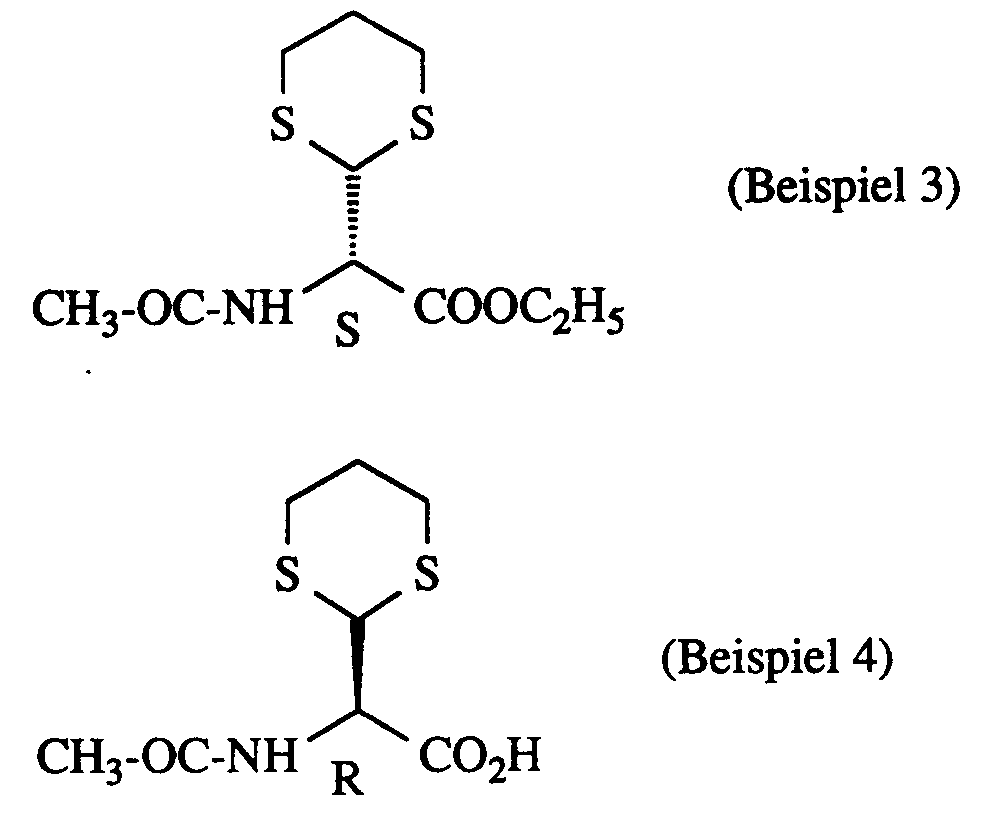
- Analog der Vorschrift für die Beispiele 1 und 2 werden 18,25 g (0,069 mol) der Verbindung aus dem Beispiel VI in 300 ml dem. Wasser und 200 ml MIBK bei 32,5°C und pH 7,5, mit dem löslichen Anteil von 2 g Maxatase puur (GIST-BROCADES) in 2 Stunden gespalten.
- Der nicht gespaltene Ester wurde bei pH 7,5 mit 3 mal 250 ml MIBK nach HPLC extrahiert.
Ausbeute: 8,15 g (89,5% der Theorie) - Die gebildete Säure wurde nach dem Einstellen des pH-Wertes mit 18%iger Salzsäure auf pH 1,0 mit 12 mal 250 ml MIBK extrahiert.
Ausbeute: 4,68 g (54,2% der Theorie) - Analytische Daten zu Beispiel 3 und 4
- α[D]₅₈₉ = +27,8°; c = 1 in Methanol
DC-System IV = 0,76
MS (DCI: m/z = 264 (M+H) - α[D]₅₈₉ = -9,8°; c = 1 in Methanol
- 2-S-Amino-2-[2-(1,3-dithiolano)]essigsäureeethylester
(Beispiel 5) und 2-R-Amino-2-[2-(1,3-dithiolano)]essigsäure (Beispiel 6)
- 0,97 g (4,7 mmol) 2-R,S-Amino-2-[2-(1,3-dithiolano)]essigsäureesthylester [M.P. Mertes, A.A. Ramsey, J. Med. Chem. 12, 342 (1969)] werden in 25 ml dem. Wasser und 15 ml Methylisobutylketon bei pH 7,8 und 37°C mit dem löslichen Anteil von 500 mg Maxatase puur (GIST-BROCADES, Delft, NL) gespalten. Der pH-Wert wird mit 0,1 N NaOH nachgestellt Nach 5 Stunden ist die Reaktion beendet, die Phasen werden getrennt.
- Die Wasserphase wird 3 mal mit je 50 ml Methylisobutylketon bei pH 7,8 extrahiert und am Rotationsverdampfer zur Trockene eingeengt.
Ausbeute: 0,164 g - Die erhaltene Säure wird nach ansäuern mit 18%iger Salzsäure bei pH 1,5 zur Trockene eingeengt. Es wurde mit 95% Aceton/5% Wasser extrahiert und zur Trockne eingeengt.
Ausbeute: 0,76 g - 2-R-Amino-2-[2-(1,3-dithiolano)]essigsäure

- 260 mg 2-R-Amino-2-[2-(1,3-dithiolano)]essigsäuremethylester Hydrochlorid (Beispiel 12) werden in 30 ml Wasser gelöst und mit 10 mg Maxatase puur (Gist-Brocades) bei 37°C und einem pH von 7,8 gespalten. Nach 5 Stunden wird zur Trockene eingeengt.
Ausbeute: 298 mg - 0,1 g der Verbindung aus Beispiel 2 werden in 10 ml 0,1 M Phosphatpuffer pH 7,5 suspendiert und mit 0,1 g Acylase 1 Fa. Serva Nr. 10720 versetzt. Man schüttelt 24 Stunden bei 37°C und analysiert dann mittels DC.
- DC-Analytische Daten:
DC-System V: Beispiel 2: Rf = 0,6; Ninhydrin negativ, Jod-positiv
DC-System V: Beispiel 6: Rf = 0,37, Ninhydrin positiv, Jod-positiv
Abreaktion > 95% zu Beispiel 6 - 0,1 g der Verbindung aus Beispiel III werden in 10ml 0,1 M Phosphatpuffer pH 7,5 suspendiert und mit 0,1 g Acylase 1 Fa. Serva Nr. 10720 versetzt. Man schüttelt 24 Stunden bei 37°C und analysiert dann mittels DC. Es zeigt eine Abreaktion des Ansatzes etwa zur Hälfte.
- DC-analytische Daten:
DC-System V: Beispiel III: Rf = 0,6; Ninhydrin negativ, Jod positiv
DC-System V: Beispiel 6: Rf = 0,37; Ninhydrin positiv, Jod positiv - 32,2 g (145 mol) N-Acetyl-2-R-[2-(1,3-dithiolano)]essigsäure (Beispiel 2) werden in 600 ml 6 N HCl gelöst und 1 h unter Rückfluß gerührt. Der Ansatz wird heiß vom unlöslichen Rückstand abfiltriert und das Filtrat zur Trockene eingeengt. Der Rückstand wird mit Diethylether verrührt, abgesaugt und über KOH getrocknet. Ausbeute: 30.65 g (98% der Theorie)
α[D]20°/₅₈₉ = -22,08; c = 1 in Methanol
MS-DCI: m/z = 180 (M+H)
¹H-NMR (DMSO, 250 MHz): δ = 3,30 (m, 4H); 4,18 (d, 1H); 5,09 (d, 1H); 8,60 (breit, 3H).
DC-System V: Rf = 0,14 - Die Verbindung des Beispiels 6 (V) läßt sich durch Entschwefeln mit Raney-Nickel in das natürliche L-Alanin überführen. Die GC-Analyse ergibt eine optische Reinheit von 89,3% L.
- N-tert.-Butoxycarbonyl-2-S-amino-2-[2-(1,3-dithiolano)]essigsäureethylester (Beispiel 7) und N-tert.Butyloxycarbonyl-2-R-amino-2-[2-(1,3-dithiolano)]-essigsäure (Beispiel 8)

- 0,95 g (3,1 mmol) der Verbindung aus Beispiel I werden in 40 ml dem. Wasser und 10 ml MIBK bei pH 7,8 und 37°C mit dem löslichen Anteil von 400 mg Maxatase puur gespalten. Der pH wird mt 0,1 N NaOH nachgestellt. Nach 70 min ist die Reaktion beendet.
- Der nicht gespaltene Ester wird mit 3 mal 50 ml MIBK extrahiert und am Rotationsverdampfer zur Trockne eingeengt.
Ausbeute: 0,49 g
α[D]₅₈₉ = +37,1°; c = 1 in Methanol - 9,27 g (43 mmol) der Verbindung aus Beispiel 6 (V) werden in 112 ml Wasser und 225 ml Dioxan gelöst. Man gibt 5 g (125 mmol) Natriumhydroxidplätzchen dazu und versetzt den Ansatz unter Rühren und Kühlen im Eisbad mit 23,5 g (108 mmol) Di-tert.-Butylcarbonat. Die Mischung wird über Nacht bei Raumtemperatur gerührt und vom Dioxan abrotiert. Man verdünnt mit 300 ml Wasser und extrahiert die basische Wasserphase mit 3 mal 300 ml Diethylether Die Wasserphase wird mit 165 ml 1 N HCl auf pH 3 gestellt und mit 3 mal 300 ml Dichlormethan extrahiert. Die vereinigte organische Phase wird mit gesättigter Natriumchloridlösung gewaschen, über Natriumsulfat getrocknet und eingeengt.
Ausbeute: 11,4 g (95% der Theorie)
DC-System IV: Rf = 0,55
MS-DCI: m/z = 280 (M+H); m/z = 297 (M+NH₄)
¹H-NMR (DMSO, 250 MHz): δ = 1,39 (s, 9H); 3,17 (m, 4H); 4,02 (dd, 1H); 4,72 (d, 1H); 7,28 (d, 1H); 12,80 (breit, 1H).
α[D]²⁰/₅₈₉ = -17,71°; c = 1 in Methanol - N-Acetyl-S-amino-2-[2-(1,3-dithiolano)essigsäure

0,1 g der Verbindung aus Beispiel III werden in 10 ml 0,1 M Phosphatpuffer pH 7,5 suspendiert und mit 0,1 g Acylase 1 Fa. Serva Nr. 10720 versetzt. Man schüttelt 24 Stunden bei 37°C und analysiert dann mittels DC. Es zeigt eine Abreaktion des Ansatzes etwa zur Hälfte. - DC-analytische Daten:
DC-System V: Beispiel III: Rf = 0,6; Ninhydrin negativ, Jod positiv
(DC-System V: Beispiel 6: Rf = 0,37; Ninhydrin positiv, Jod positiv)
DC-System V: Beispiel 9: Rf = 0,6; Ninhydrin negativ, Jod positiv - 2-R-Amino-2-[2-(1,3-dithiolano)]essigsäureethylester (Beipsiel 10) und
2-S-Amino-2-[2-(1,3-dithiolano)essigsäureethylester(Beispiel 11)
0,1 g der Verbindung aus Beispiel II werden in 10 ml 0,1 M Phosphatpuffer pH 7,5 suspendiert und mit 0,1 g Acylase 1 Fa. Serva Nr. 10720 versetzt. Man schüttelt 24 Stunden bei 37°C und analysiert dann mittels DC. Bei der Umsetzung des Esters entsteht laut DC zusätzlich etwas der Verbindung des Beispiels 6. DC-analytische Daten:
DC-System V: Beispiel 10: Rf = 0,65, Ninhydrin positiv, Jod positiv
DC-System V: Beispiel 11: Rf = 0,80; Ninhydridn negativ, Jod positiv - 2-R-Amino-2-[2-(1,3-dithiolano)]essigsäuremethylester Hydrochlorid

22,6 g (102 mmol) N-Acetyl-2-R-amino-2-[2-(1,3-dithiolano)]essigsäure (Beispiel 2) werden in 500 ml Methanol gelöst und unter Rühren mit 18,2 ml (0,25 mol) Thionylchlorid versetzt. Der Ansatz wird 3 Tage am Rückfluß erhitzt und eingeengt. De Rückstand wird in 250 ml 1 N Salzsäure aufgenommen und 3 mal mit je 200 ml Dichlormethan ausgeschüttelt. Die wäßrige Phase wird mit gesättigter Natriumbicarbonatlösung auf pH 7,5 - 8 gestellt und 3 mal mit je 200 ml Dichlormethan extrahiert. Die vereinigte organische Phase wird über Natriumsulfat getrocknet und eingeengt. Der Rückstand wird in Diethylether aufgenommen und mit 4 N Salzsäure in Dioxan versetzt. Das ausgefallene Hydrochlorid wird abgesaugt, mit Diethylether verrieben, nochmals abgesaugt und über KOH getrocknet.
Ausbeute: 9,95 g (42,6% der Theorie)
DC-System III: Rf= 0,88
MS-EI: m/z = 193 (M⁺); m/z 134; m/z 106 (Basispeak)
α[D]₅₈₉20°C = -24,67; c = 1 Methanol - 2-S-Amino-2-[2-(1,3-dithiolano)]essigsäure Hydrochlorid

19,8 g (79,4 mmol) N-Acetyl-2-S-[2-(1,3-dithiolano)]essigsäureethylester (Beispiel 1) werden in 400 ml 6 N HCl unter Rückfluß gerührt. Der Ansatz wird heiß vom unlöslichen, schwarzen Rückstand abfiltriert und das Filtrat wird zur Trockene eingeengt. Der Rückstand wird mit Diethylether verrührt, abgesaugt und über KOH getrocknet.
Ausbeute: 16,27 g (95% der Theorie)
α[D]20°C₅₈₉ = +30,29; c = 1 in Methanol
Die Verbindung des Beispiels 13 läßt sich durch Entschwefeln mit Raney-Nickel in das unnatürliche D-Alanin überführen. - Die in Tabelle 2 aufgeführten Beispiele werden analog hergestellt.
- Abkürzungen in Tabelle 2:
- Ac₂O
- Essigsäureanhydrid
- TEA
- Triethylamin
- FMOC-O-Su
- Fluorenylmethyloxycarbonyl-O-N-succinimid
- Z-O-Su
- Benzyloxycarbonyl-O-N-succinimid
- DCC
- Dicyclohexylcarbodiimid
- DMAP
- Dimethylaminopyridin

in welchen
n, R¹, R1', R² und R3' die oben angegebene Bedeutung haben,
überführt, von den ebenfalls anfallenden optisch reinen S-Verbindungen der Formel (IIa)

in welcher
R1',R² und R3' die oben angegebene Bedeutung haben,
nach üblicher Methode abtrennt, wobei diese nach üblicher chemischer Racemisierung dem enzymatischen Prozeß erneut zugeführt werden können, und
in einem letzten Schritt gegebenenfalls die Substituenten R1' und/oder R3' in den Verbindungen der allgemeinen Formeln (IIa), (III) und (IV) nach üblicher chemischer Methode in die Substituenten R¹ und R³ überführt.
Bestimmung der Enantiomerenverhältnisse durch Gaschromatographie an chiralen Phasen [vgl. H. Frank, g.J. Nicholson and E. Bayer, J.Chromatogr. Sci. 15 (1977), 174; H. Frank, G.J. Nicholson and E. Bayer, Angew. Chem. 90, (1980) 396; Angew. Chem. Int Ed. Engl. 17 (1978), 363].


Claims (7)
- Optisch reine Verbindungen der allgemeinen Formel I
 n für die Zahl 1 oder 2 steht,R¹ für Wasserstoff, geradkettiges oder verzweigtes Alkyl mit bis zu 8 Kohlenstoffatomen, Benzyl oder für eine Gruppe der Formel -COR⁴ steht,
worinR⁴ geradkettiges oder verzweigtes Alkyl mit bis zu 10 Kohlenstoffatomen oder Aryl mit 6 bis 10 Kohlenstoffatomen bedeutet, oder
für eine typische Aminoschutzgruppe steht,R² für Wasserstoff, geradkettiges oder verzweigtes Alkyl mit bis zu 8 Kohlenstoffatomen oder Benzyl steht, oderR¹ und R² gemeinsam mit dem Stickstoffatom einen Morpholinring oder einen Phthalimidorest bilden,R³ für Hydroxy, geradkettiges oder verzweigtes, gegebenenfalls durch Vinyl substituiertes Alkoxy mit bis zu 10 Kohlenstoffatomen, Benzyloxy oder für die Gruppe -NR⁵R⁶ steht, worinR⁵ und R⁶ gleich oder verschieden sind und Wasserstoff, geradkettiges oder verzweigtes Alkyl mit bis zu 6 Kohlenstoffatomen oder Phenyl bedeuten,
und das mit * gekennzeichnete C-Atom entweder in der S- oder R-Form vorliegt. - Verbindungen der allgemeinen Formel I gemäß Anspruch 1, in welchern für eine Zahl 1 oder 2 steht,R¹ für Wasserstoff, geradkettiges oder verzweigtes Alkyl mit bis zu 6 Kohlenstoffatomen oder Benzyl steht, oder
für eine Gruppe der Formel -COR⁴ steht,
worinR⁴ geradkettiges oder verzweigtes Alkyl mit bis zu 8 Kohlenstoffatomen oder Phenyl bedeutet, oder
für tert.Butoxycarbonyl (Boc), Benzyloxycarbonyl (Z), Ethoxycarbonyl (EtOC), Allyloxycarbonyl (AllOC), Fluorenyl-9-methoxycarbonyl (Fmoc) oder Methoxycarbonyl (MetOC) steht,R² für Wasserstoff, geradkettiges oder verzweigtes Alkyl mit bis zu 6 Kohlenstoffatomen oder Benzyl steht, oderR¹ und R² gemeinsam mit dem Stickstoffatom den Phthalimidorest bilden,R³ für Hydroxy, geradkettiges oder verzweigtes, gegebenenfalls durch Vinyl substituiertes Alkoxy mit bis zu 8 Kohlenstoffatomen, Benzyloxy oder für die Gruppe -NR⁵R⁶ steht,und das mit * gekennzeichnete C-Atom entweder in der S- oder R-Form vorliegt.
worin
R⁵ und R⁶ gleich oder verschieden sind und Wasserstoff, geradkettiges oder verzweigtes Alkyl mit bis zu 4 Kohlenstoffatomen oder Phenyl bedeuten, - Verbindungen der allgemeinen Formel I gemäß Anspruch 1, in welchern für die Zahl 1 oder 2 steht,R¹ für Wasserstoff, geradkettiges oder verzweigtes Alkyl mit bis zu 4 Kohlenstoffatomen oder Benzyl steht, oder
für eine Gruppe der Formel -CO-R⁴ steht,
worin
R⁴ geradkettiges oder verzweigtes Alkyl mit bis zu 8 Kohlenstoffatomen oder Phenyl bedeutet, oder
für tert.-Butoxycarbonyl (BOC), Benzyloxycarbonyl(Z), Allyloxycarbonyl (AllOC), Ethoxycarbonyl (EtOC) oder Fluorenyl-9-methoxycarbonyl (Fmoc) steht,R² für Wasserstoff, geradkettiges oder verzweigtes Alkyl mit bis zu 4 Kohlenstoffatomen oder Benzyl steht, oderR¹ und R² gemeinsam mit dem Stickstoffatom den Phthalimidorest bilden,R³ für Hydroxy, geradkettiges oder verzweigtes, gegebenenfalls durch Vinyl substituiertes Alkoxy mit bis zu 8 Kohlenstoffatomen, Benzyloxy oder für die Gruppe -NR⁵R⁶ steht,
worin
R⁵ und R⁶ gleich oder verschieden sind und Wasserstoff, Methyl, Ethyl, Propyl, Isopropyl oder Phenyl bedeuten. - Verfahren zur Herstellung von Verbindungen der allgemeinen Formel I
 n für die Zahl 1 oder 2 steht,R¹ für Wasserstoff, geradkettiges oder verzweigtes Alkyl mit bis zu 8 Kohlenstoffatomen, Benzyl oder für eine Gruppe der Formel -COR⁴ steht,
worin
R⁴ geradkettiges oder verzweigtes Alkyl mit bis zu 10 Kohlenstoffatomen oder Aryl mit 6 bis 10 Kohlenstoffatomen bedeutet, oder
für eine typische Aminoschutzgruppe steht,R² für Wasserstoff, geradkettiges oder verzweigtes Alkyl mit bis zu 8 Kohlenstoffatomen oder Benzyl steht, oderR¹ und R² gemeinsam mit dem Stickstoffatom einen Morpholinring oder einen Phthalimidorest bilden,R³ für Hydroxy, geradkettiges oder verzweigtes, gegebenenfalls durch Vinyl substituiertes Alkoxy mit bis zu 10 Kohlenstoffatomen, Benzyloxy oder für die Gruppe -NR⁵R⁶ steht,und das mit * gekennzeichnete C-Atom entweder in der S- oder R-Form vorliegt, dadurch gekennzeichnet, daß man racemische Verbindungen der allgemeinen Formel II
worin
R⁵ und R⁶ gleich oder verschieden sind und Wasserstoff, geradkettiges oder verzweigtes Alkyl mit bis zu 6 Kohlenstoffatomen oder Phenyl bedeuten, n und R² die oben angegebene Bedeutung haben,R1' und R3' die oben angegebenen Bedeutungen von R¹ und R³ haben und mit diesen gleich oder verschieden sind, aber R1' nicht für Wasserstoff und R3' nicht für Hydroxy stehen darf,
unter Einwirkung von spezifisch spaltenden trägergebundenen und/oder freien proteolytischen Enzymen, in einem zweiphasigen Medium, bestehend aus Wasser und einem mit Wasser nicht mischbaren Lösemittel, in die optisch reinen R-Verbindungen der Formeln (III) oder (IV)
n, R¹, R1', R² und R3' die oben angegebene Bedeutung haben,
überführt,
von den ebenfalls anfallenden optisch reinen S-Verbindungen der Formel (IIa)
R1', R² und R3' die oben angegebene Bedeutung haben,
nach üblicher Methode abtrennt, wobei diese nach üblicher chemischer Racemisierung dem enzymatischen Prozeß erneut zugeführt werden können, und
in einem letzten Schritt gegebenenfalls die Substituenten R1' und/oder R3' in den Verbindungen der allgemeinen Formeln (IIa), (III) und (IV) nach üblicher chemischer Methode in die Substituenten R¹ und R³ überführt. - Verfahren gemäß Anspruch 4, dadurch gekennzeichnet, daß man die enzymatische Spaltung in einem Temperaturbereich von 20 bis 40°C und in einem pH-Bereich von 6 bis 8 durchführt.
- Verwendung der Verbindungen der allgemeinen Formel I gemäß Anspruch 1 zur Herstellung von Peptiden.
- Verwendung von Verbindungen der allgemeinen Formel I gemäß Anspruch 1 zur Herstellung von Peptiden mit renininhibitorischer Wirkung.
Applications Claiming Priority (2)
| Application Number | Priority Date | Filing Date | Title |
|---|---|---|---|
| DE4038834 | 1990-12-06 | ||
| DE19904038834 DE4038834A1 (de) | 1990-12-06 | 1990-12-06 | Optisch reine dithiolanyl- und dithianoaminosaeuren und deren derivate, verfahren zu ihrer herstellung und ihre verwendung |
Publications (1)
| Publication Number | Publication Date |
|---|---|
| EP0489323A1 true EP0489323A1 (de) | 1992-06-10 |
Family
ID=6419673
Family Applications (1)
| Application Number | Title | Priority Date | Filing Date |
|---|---|---|---|
| EP91120028A Withdrawn EP0489323A1 (de) | 1990-12-06 | 1991-11-25 | Optisch reine Dithiolanyl- und Dithianoaminosäuren und deren Derivate, Verfahren zu ihrer Herstellung und ihre Verwendung |
Country Status (3)
| Country | Link |
|---|---|
| EP (1) | EP0489323A1 (de) |
| JP (1) | JPH0725869A (de) |
| DE (1) | DE4038834A1 (de) |
Citations (2)
| Publication number | Priority date | Publication date | Assignee | Title |
|---|---|---|---|---|
| EP0022206A2 (de) * | 1979-07-07 | 1981-01-14 | Bayer Ag | Optisch reine heterocyclische Aminosäuren, Verfahren zu ihrer Herstellung und ihre Verwendung |
| EP0403828A1 (de) * | 1989-06-09 | 1990-12-27 | Bayer Ag | Renininhibitorische Peptide, Verfahren zur ihrer Herstellung und ihre Verwendung in Arzneimitteln |
-
1990
- 1990-12-06 DE DE19904038834 patent/DE4038834A1/de not_active Withdrawn
-
1991
- 1991-11-25 EP EP91120028A patent/EP0489323A1/de not_active Withdrawn
- 1991-12-02 JP JP34172791A patent/JPH0725869A/ja active Pending
Patent Citations (2)
| Publication number | Priority date | Publication date | Assignee | Title |
|---|---|---|---|---|
| EP0022206A2 (de) * | 1979-07-07 | 1981-01-14 | Bayer Ag | Optisch reine heterocyclische Aminosäuren, Verfahren zu ihrer Herstellung und ihre Verwendung |
| EP0403828A1 (de) * | 1989-06-09 | 1990-12-27 | Bayer Ag | Renininhibitorische Peptide, Verfahren zur ihrer Herstellung und ihre Verwendung in Arzneimitteln |
Non-Patent Citations (1)
| Title |
|---|
| JOURNAL OF MEDICINAL CHEMISTRY, Bd. 12, Nr. 2, Mai 1969, Washington, DC, US, Seiten 342 - 343; M.P. MERTES ET AL.: 'omega-Dithiolano amino acids' * |
Also Published As
| Publication number | Publication date |
|---|---|
| JPH0725869A (ja) | 1995-01-27 |
| DE4038834A1 (de) | 1992-06-11 |
Similar Documents
| Publication | Publication Date | Title |
|---|---|---|
| DE3424440C2 (de) | ||
| DE69914458T2 (de) | Verfahren zur enzymatischen auflösung von laktamen | |
| DE68919184T2 (de) | Verfahren zur Herstellung von optisch aktiven 3-Phenylglycidsäureestern. | |
| EP0496373A1 (de) | Verfahren zur enzymatischen Herstellung geschützter und ungeschützter Di- und Oligopeptide in wässrigen Lösungen | |
| EP0003786B1 (de) | Stereoselektive Spaltung von Phenylglycinderivaten und 4-Hydroxyphenylglycinderivaten mit Enzymharzen | |
| EP0022206B1 (de) | Optisch reine heterocyclische Aminosäuren, Verfahren zu ihrer Herstellung und ihre Verwendung | |
| US5756800A (en) | Process for the enzymatic resolution of 2-amino-4-methyl-phosphinobutyric acid derivatives | |
| DE69732772T2 (de) | Enzymatisches verfahren zur stereoselektiven herstellung von therapeutischen amiden | |
| DE69813053T2 (de) | Verfahren zur Herstellung von optisch aktiven Azetidin-2-Carbonsäurederivaten | |
| EP1966118B1 (de) | Verbessertes verfahren zur herstellung von ramipril | |
| EP0489323A1 (de) | Optisch reine Dithiolanyl- und Dithianoaminosäuren und deren Derivate, Verfahren zu ihrer Herstellung und ihre Verwendung | |
| DE19955283A1 (de) | Verfahren zur enantioselektiven Gewinnung von Aminosäuren und Aminosäurederivaten unter Verwendung von Racemisierungskatalysatoren | |
| EP0890649B1 (de) | Verfahren zur Herstellung von acylierten Aminosäureestern und Racematspaltung von Aminosäureestern durch Enzym-katalysierte Acylierung | |
| EP1361279A1 (de) | Verfahren zur enzymatischen Herstellung enantiomerenangereicherter beta-Aminosäuren | |
| EP0316725A2 (de) | Verfahren zur enzymatischen Peptidsynthese mit mindestens einer nicht-proteinogenen Aminsäure sowie die neuen, bei der Synthese anfallenden Peptide | |
| DE602004005947T2 (de) | Verfahren zur Herstellung einer optisch aktiven Octahydro-1H-Indol-2-Carbonsäure | |
| JPH1033191A (ja) | 光学活性3−n置換アミノイソ酪酸類およびその塩ならびにそれらの製造方法 | |
| DE69913557T2 (de) | Enzymatische synthese von peptidomimetika | |
| EP0310012A2 (de) | Verfahren zur Herstellung von optisch reinem Homophenylalanin | |
| US20040054216A1 (en) | Method for producing lysine derivative | |
| DE69818133T2 (de) | Herstellung von einer optisch-aktiven Sphingoid-Verbindung | |
| KR100973710B1 (ko) | 효소적 방법에 의한 광학활성 엔-치환된 페닐글리신 알킬에스테르의 제조 방법 | |
| DE19523151A1 (de) | Racematspaltung primärer und sekundärer heteroatomsubstituierter Amine durch Enzym-katalysierte Acylierung | |
| EP0514780A2 (de) | Verfahren zur Herstellung enantiomerenreiner offenkettiger N-Alkyl-L oder D-aminosäuren | |
| WO1999007873A1 (de) | VERFAHREN ZUR HERSTELLUNG ENANTIOMERENREINER CYCLISCHER α-AMINOSÄUREN BZW. DEREN N-GESCHÜTZTER DERIVATE MITTELS EINER D-SPEZIFISCHEN AMINOACYLASE |
Legal Events
| Date | Code | Title | Description |
|---|---|---|---|
| PUAI | Public reference made under article 153(3) epc to a published international application that has entered the european phase |
Free format text: ORIGINAL CODE: 0009012 |
|
| AK | Designated contracting states |
Kind code of ref document: A1 Designated state(s): AT BE CH DE DK ES FR GB GR IT LI LU NL SE |
|
| STAA | Information on the status of an ep patent application or granted ep patent |
Free format text: STATUS: THE APPLICATION HAS BEEN WITHDRAWN |
|
| 18W | Application withdrawn |
Withdrawal date: 19920812 |