EP0489783B1 - Procede et appareil de nettoyage - Google Patents
Procede et appareil de nettoyage Download PDFInfo
- Publication number
- EP0489783B1 EP0489783B1 EP90912761A EP90912761A EP0489783B1 EP 0489783 B1 EP0489783 B1 EP 0489783B1 EP 90912761 A EP90912761 A EP 90912761A EP 90912761 A EP90912761 A EP 90912761A EP 0489783 B1 EP0489783 B1 EP 0489783B1
- Authority
- EP
- European Patent Office
- Prior art keywords
- holes
- cleaning
- hole
- cleaned
- die
- Prior art date
- Legal status (The legal status is an assumption and is not a legal conclusion. Google has not performed a legal analysis and makes no representation as to the accuracy of the status listed.)
- Expired - Lifetime
Links
- 238000004140 cleaning Methods 0.000 title claims abstract description 73
- XLYOFNOQVPJJNP-UHFFFAOYSA-N water Substances O XLYOFNOQVPJJNP-UHFFFAOYSA-N 0.000 claims abstract description 55
- 238000000034 method Methods 0.000 claims abstract description 29
- 239000000463 material Substances 0.000 claims abstract description 23
- 238000004519 manufacturing process Methods 0.000 claims abstract description 11
- 239000008188 pellet Substances 0.000 claims abstract description 11
- 238000003825 pressing Methods 0.000 claims abstract description 5
- 238000005553 drilling Methods 0.000 claims description 10
- 238000005453 pelletization Methods 0.000 claims description 9
- 239000000725 suspension Substances 0.000 claims description 6
- 238000006073 displacement reaction Methods 0.000 claims 3
- 230000004913 activation Effects 0.000 claims 1
- 239000000203 mixture Substances 0.000 description 5
- 229910000831 Steel Inorganic materials 0.000 description 4
- 239000010959 steel Substances 0.000 description 4
- 239000000843 powder Substances 0.000 description 3
- 238000005406 washing Methods 0.000 description 3
- 230000015572 biosynthetic process Effects 0.000 description 2
- 238000001816 cooling Methods 0.000 description 2
- 238000005520 cutting process Methods 0.000 description 2
- 230000003628 erosive effect Effects 0.000 description 2
- 230000001747 exhibiting effect Effects 0.000 description 2
- 238000002474 experimental method Methods 0.000 description 2
- 238000005755 formation reaction Methods 0.000 description 2
- 230000006870 function Effects 0.000 description 2
- 239000002245 particle Substances 0.000 description 2
- 229910000906 Bronze Inorganic materials 0.000 description 1
- 229910000760 Hardened steel Inorganic materials 0.000 description 1
- OAICVXFJPJFONN-UHFFFAOYSA-N Phosphorus Chemical compound [P] OAICVXFJPJFONN-UHFFFAOYSA-N 0.000 description 1
- 230000003213 activating effect Effects 0.000 description 1
- 230000001464 adherent effect Effects 0.000 description 1
- 238000005452 bending Methods 0.000 description 1
- 238000007664 blowing Methods 0.000 description 1
- 239000010974 bronze Substances 0.000 description 1
- KUNSUQLRTQLHQQ-UHFFFAOYSA-N copper tin Chemical compound [Cu].[Sn] KUNSUQLRTQLHQQ-UHFFFAOYSA-N 0.000 description 1
- 230000008878 coupling Effects 0.000 description 1
- 238000010168 coupling process Methods 0.000 description 1
- 238000005859 coupling reaction Methods 0.000 description 1
- 230000007423 decrease Effects 0.000 description 1
- 230000002542 deteriorative effect Effects 0.000 description 1
- 230000000694 effects Effects 0.000 description 1
- 238000010438 heat treatment Methods 0.000 description 1
- 238000005304 joining Methods 0.000 description 1
- 230000000670 limiting effect Effects 0.000 description 1
- 239000002184 metal Substances 0.000 description 1
- 230000002093 peripheral effect Effects 0.000 description 1
- 238000005498 polishing Methods 0.000 description 1
- 230000001681 protective effect Effects 0.000 description 1
- 230000002829 reductive effect Effects 0.000 description 1
- 230000000284 resting effect Effects 0.000 description 1
- 238000005096 rolling process Methods 0.000 description 1
- 230000011664 signaling Effects 0.000 description 1
- 239000007787 solid Substances 0.000 description 1
- 238000003860 storage Methods 0.000 description 1
Images

Classifications
-
- B—PERFORMING OPERATIONS; TRANSPORTING
- B08—CLEANING
- B08B—CLEANING IN GENERAL; PREVENTION OF FOULING IN GENERAL
- B08B3/00—Cleaning by methods involving the use or presence of liquid or steam
- B08B3/02—Cleaning by the force of jets or sprays
-
- B—PERFORMING OPERATIONS; TRANSPORTING
- B29—WORKING OF PLASTICS; WORKING OF SUBSTANCES IN A PLASTIC STATE IN GENERAL
- B29C—SHAPING OR JOINING OF PLASTICS; SHAPING OF MATERIAL IN A PLASTIC STATE, NOT OTHERWISE PROVIDED FOR; AFTER-TREATMENT OF THE SHAPED PRODUCTS, e.g. REPAIRING
- B29C48/00—Extrusion moulding, i.e. expressing the moulding material through a die or nozzle which imparts the desired form; Apparatus therefor
- B29C48/25—Component parts, details or accessories; Auxiliary operations
- B29C48/27—Cleaning; Purging; Avoiding contamination
-
- B—PERFORMING OPERATIONS; TRANSPORTING
- B30—PRESSES
- B30B—PRESSES IN GENERAL
- B30B11/00—Presses specially adapted for forming shaped articles from material in particulate or plastic state, e.g. briquetting presses, tabletting presses
- B30B11/20—Roller-and-ring machines, i.e. with roller disposed within a ring and co-operating with the inner surface of the ring
- B30B11/201—Roller-and-ring machines, i.e. with roller disposed within a ring and co-operating with the inner surface of the ring for extruding material
-
- B—PERFORMING OPERATIONS; TRANSPORTING
- B30—PRESSES
- B30B—PRESSES IN GENERAL
- B30B11/00—Presses specially adapted for forming shaped articles from material in particulate or plastic state, e.g. briquetting presses, tabletting presses
- B30B11/20—Roller-and-ring machines, i.e. with roller disposed within a ring and co-operating with the inner surface of the ring
- B30B11/201—Roller-and-ring machines, i.e. with roller disposed within a ring and co-operating with the inner surface of the ring for extruding material
- B30B11/205—Roller-and-ring machines, i.e. with roller disposed within a ring and co-operating with the inner surface of the ring for extruding material using an annular series of radial die cells, especially for crop material
-
- B—PERFORMING OPERATIONS; TRANSPORTING
- B30—PRESSES
- B30B—PRESSES IN GENERAL
- B30B15/00—Details of, or accessories for, presses; Auxiliary measures in connection with pressing
- B30B15/0082—Dust eliminating means; Mould or press ram cleaning means
-
- B—PERFORMING OPERATIONS; TRANSPORTING
- B29—WORKING OF PLASTICS; WORKING OF SUBSTANCES IN A PLASTIC STATE IN GENERAL
- B29C—SHAPING OR JOINING OF PLASTICS; SHAPING OF MATERIAL IN A PLASTIC STATE, NOT OTHERWISE PROVIDED FOR; AFTER-TREATMENT OF THE SHAPED PRODUCTS, e.g. REPAIRING
- B29C48/00—Extrusion moulding, i.e. expressing the moulding material through a die or nozzle which imparts the desired form; Apparatus therefor
- B29C48/03—Extrusion moulding, i.e. expressing the moulding material through a die or nozzle which imparts the desired form; Apparatus therefor characterised by the shape of the extruded material at extrusion
Definitions
- the present invention relates to a cleaning procedure and an apparatus for cleaning of clogged holes or passages of small diameter, such as through-holes of varying sizes, in particular such holes in dies provided with a large amount of such holes for through-pressing of materials for the manufacturing of pellets, such as dies employed at pelletizing of feed stuff pellets.
- Such dies for pelletizing may be embodied with a length in axial direction of .15 through .25 m and a diameter of about .4 through .6 m being made as cylindric elements of steel with a material thickness of about .05 through .15 m provided in radial direction with a large amount of drilled through-holes or passages exhibiting each a light of about 1.3 through 10 mm.
- the holes or the passages are drilled, as from the periphery of the cylindric elements by means of a precisely guided drilling machinery, with the holes being distributed so that the holes are spaced mutually with the spcaing between them being about two to three times their light diameters, and whereby the holes are distributed in a formation ringwise encircling the cylindric periphery of the die elements, i.e. comprising in total some hundred holes contained within each of 20 through 45 ringwise formations encircling the single elements.
- the dies are employed for pelleting, most often in the manner, that two or three cylindric rolls at distances of about .5 through 1 mm are rolling against the internal surfaces of the cylindric dies.
- a material to be pelleted i.e. a feed stuff powder
- a feed stuff powder is supplied to the spacing between the rolls and the inner surface of the die.
- the powder is pressed through the single die holes and is shaped into thin bars, which by means of suitable cutting means are cut into suitable lengths at the outer side of the die.
- a die of the aforementioned size which for instance comprises 10,000 holes, with a light diameter each of about 3 mm, 5 to 10 t of feed stuff may be passing per hour, i.e. per hour a considerable amount of material.
- Clogging may also be the result of a deforming of the feed stuff input ends of the holes by the pressing rolls due to too large pressure being provided by them when they during manufacturing of feed stuff pellets are pressing against the inner side of the dies, etc. Dies causing reduced production have to be exchanged with dies giving optimum of production. As the dies are rather expensive it is wanted to get them restored. Unto now this has been provided by means of a simple drilling process taking place by means of manually guided drilling machines, as this manner of restoring the dies is more efficient than using a pillar drill because pillar drills leave more broken drills sticking unremovably in the die holes as compared to a manual restoring procedure.
- the thin cutting jet apparently does not damage the die material.
- the energy supplied to the water jet and to the maintaining of it is considerable, i.e. 50 through 75 kw are required for a 1 through 3 mm thick water jet, resulting in powerful heating of the water.
- the water before it possibly for reuse is led to a storage tank has to be cooled.
- the procedure has furthermore to be thus understood that in principle the water jet may be exchanged with a drilling means, and in that those steps of the procedure which thus are influenced herethrough may be carried out as the first respectively as the last steps of the procedure. According to the invention it is thus foreseen that further procedure steps may be applied to the procedure by which the water jet is substituted with a drilling or cleaning means which solely is able to perform cleaning of the area at one end of the holes, and whereby the detecting means is provided able to detect terminated cleaning of the single areas of these ends of the holes.
- the cleaning water jet under an extremely high pressure is emitted from a nozzle and leaves this with approximately supersonic, respectively with supersonic, speed as compared to the surrounding atmosphere around the locality to be cleaned.
- the problems which are to be solved by means of the invention are met at water jets or at jets of other media where the particles of the jet assume much smaller speeds.
- the memory means is provided with means which at non-detecting of emissions of water; clogging material from the respective hole, respectively of non-terminated cleaning of a hole area, at the elapse of a certain time of operation is able to release a signal to the running of the following procedure-step, respectively running of a halt-providing operational routine.
- a further development according to the invention connected with the procedure can be that the mentioned elapse of time of operation in case of water as cleaning means is 10 through 30 times the expected operational cleaning time per hole, and/or the memory means comprises means to up-count and/or to determine the frequency of appearing non-fulfilled cleanings of holes and for provision of alarm of error conditions and for possible issuing of signals for the providing of a halt of the cleaning operation.
- the invention furthermore relates to an apparatus for the carrying out of the procedure.
- Such apparatus can be characterized in that is provides the features set out in claim 7.
- the die with holes or passages to be cleaned may be arranged in two or more different sub-apparatuses provided for the different kinds of hole or passage cleaning means, and of which at least one is a water jet cleaning means.
- the described procedure also takes into consideration that, although at the manufacturing of the pelletizing dies accurately operating drilling devices are used, then in case of thin through-holes or passages the drills may have been bending sidewards during the drilling operation due to the elasticity of the drills. Of this reason some of the through-holes may happen to be somewhat oblique oriented. But, during the cleaning no damages of the holes takes place including those of even rather oblique orientation. On the other hand, the described device for positioning of the cleaning means is able to function effectively despite of the through-holes being unprecise located as due to such unprecise orientation of the drills.
- the positioning of the cleaning means above a first die opening to be cleaned has to take place manually, whereupon the actual cleaning means is put into operation and sequentially the cleaning operations of the single through-holes or openings in the die is automatically brought to be carried out.
- the procedure according to the invention also is applicable for holes or openings which do not present a tube shaped or conical shaped passage through the die, but may be composed of more cylindric shaped portions of different light, i.e. such as stepwise tapering light or a mixture of any such light and conically tapering lights.
- the aforementioned detecting means enabling a detecting of achieved cleaning of the single holes comprises mechanical, and in particular movable, means or members against which material and cleaning medium from the cleaned holes abuts.
- a suitable suspension and shape such as to describe as follows, a certain throw-back of cleaning medium, such as water, against the rear end of the cleaned openings may be attained advantageously providing a simultaneous cleaning of the rear ends of the die holes or openings.
- a water jet apparatus is intended employed for cleaning of clogged radially oriented through-passages, -openings or -holes in a massive cylindric pelletizing die 1 of tempered steel material which is illustrated laying on a for instance horizontally oriented turntable 5A to which the die is for instance fastened rigidly with fastening means which are not shown but may be of per se known kind able to perform a rigid fastening of the die to the table, on one hand to maintain the position of the die on the table 5A on the other hand because a large pressure is exerted through the waterjet arriving at the die from a nozzle 2A on a lance 2AA.
- the turntable 5A is sitting on a rotary shaft 5B carried by bearings which are not shown.
- the table 5A may be arranged displaceable upwards and downwards at its bearings by resting on the periphery of an excentric disc 5HT being shown in dotted line and being located on a to the first mentioned shaft 5B perpendicular arranged and in dotted line shown rotary and through not illustrated bearings suspended shaft 5IT able to be turned by means of a stepmotor 5IDT shown in dotted line.
- the stepmotor comprises not shown gear means.
- this device to provide an upwards and downwards displacing of the table 5A is not well suited because the die 1 including the table 5A incorporates a considerable weight, such as 40 through 700 kg.
- nozzle 2A As through the waterjet from the nozzle 2A large forces exist between the nozzle 2A and the die 1 demands are posed to rather rigid guiding means to provide a mechanical holding of the nozzle 2A in relation to the die 1 which lays on the table 5A.
- the first mentioned shaft 5B carries a wormwheel 5C rotated by a worm 5D located on a driving shaft 5D driven, such as through a not illustrated gear means, by means of for instance a stepmotor 5ED.
- the lance 2B is rigidly fastened by means of clamps 2C to a such as in U- or C-shape formed plate means 2D being arranged displaceable up and down on an as rail serving holding means 2E which through further suitable fastening means is located on a supporting means, which here carries reference numeral 6, and by means of which also the table 5A and the driving means belonging to the table are kept properly fastened.
- the supporting means is shown as a rigid box-shaped means 6 supported on four legs comprising a cavity, the front of which is to be closed by means of a not illustrated door or cover plate which on the one hand serves to catch water emanating from the nozzle 2A and clogging matter being released from the cleaned holes or openings, and which door or cover plate on the other hand protects the surroundings against water or any other as fluent or rayed, such as in powder shape rayed, matter which with great power is ejected from the nozzle 2A.
- a threaded shaft 5I is provided which at one end undisplaceably is kept in place by a bearing 5H at the plate means 2D and at the other end is kept rotary in place by means of an internally threaded bearing means, such as the hub of a tooth wheel driven by a drive motor 5ID which thus may be a stepmotor device incorporating a not further illustrated gear means being inserted between the motor and the said toothwheel.
- the nozzle 2A through the lance 2B is thought connected to a not illustrated pressurized water producing compressor device.
- the said stepmotors may be stepmotors of the electric kind which through indicated connecting wires are connected to a not shown control unit issuing the necessary control signals able to control and drive the stepmotors.
- This electric control unit also comprises a possible memory device or other control means which is connected to a signalling or detecting means 3 to be described with reference to FIG 4 and indicated in FIG 1 and through which the stepwise movings of the die 1 and the nozzle 2A are provided.
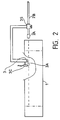
- FIG 2 which on the other hand illustrates a somewhat different manner of fastening the detecting means 3 it is to be understood that at the piercing through the die 1 a by dotted line indicated waterjet from the nozzle 2A together with ejected clogging matter from the hole or opening in the die 1 is going to hit for instance a slab member 3A being suspended pivotable around a horizontal axis and which slab member 3A through its moving is activating an electric switch or signal means for as long a duration of time as the waterjet is passing through at this detecting means 3.
- the stepsize of the mutual moving between the nozzle 2A and the die 1 has to be so adapted that a mutual moving is permitted with an accuracy which is better than equal to the half of the smallest diameter of the holes or openings in concern, i.e. as measured from the middle of a cleaned hole or opening to the next hole or opening to be cleaned and which hole or opening generally, for a given direction of moving, simultaneously is the nearest hole or opening.
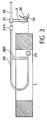
- FIG 2 and FIG 3 embodiments of nozzle devices 2A and cooperating detecting means 3 are illustrated as already mentioned.
- the detecting means 3 comprises a pivotable slab means 3A which through its upwards moving due to influence from the in dotted line indicated and through a hole or an opening in the die arriving waterjet from the nozzle 2A activates a signal means 3C.
- the detecting means 3 is kept in place by means of a suitable strong holding means 3S at the lance 2B.
- a phosphor bronze ribbon having a width of 10 through 30 mm and a thickness of 2 through 5 mm.
- the nozzle according to FIG 2 by means of for instance a suitable coupling procedure is substituted with a rigid tube joining means 2AX bringing the lance 2B to extend to the nozzle 2A which in this case is arranged turned against the internal wall of the die 1.
- a longer length of the lance 2B is running shaped as a straight length behind the nozzle 2A.
- a connecting strut member 2BB is arranged for the lance 2B.
- the waterjet from the nozzle 2A is going to pass through the die 1 in opposite direction as compared to the direction at the embodiments according to FIG 1 and FIG 2.
- dies fitted with very long and narrow holes or openings i.e. such as having lengths greater than 15 cm and diameters of the holes or openings smaller than 5 mm
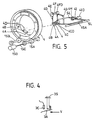
- FIG 4. A possible embodiment of the detecting means 3 is more clearly illustrated in FIG 4. Though, the suspension 3S is only indicated. On the other hand, it is shown that the pivotable slab means 3A is somewhat S-shaped. This shape has shown itself advantageous in relation to the waterjet which is indicated by means of an arrow V. Through this embodiment two advantages are attained, namely firstly in that it is counteracted that the waterjet influences mechanically strongly eroding on the materials which the jet hits, and thus the indicated shape is advantageous in that a low degree of erosion is achieved, and secondly in that water which hits this pivotable slab means is brought to sprinkle in different directions.
- the sprinkling which is achieved has shown itself to be effective in suitably rincing the surface of the dies which have become dirty by being covered with feed pellet material when the dies were used for pelletizing, and thus the surroundings of the holes or openings are cleaned for adherent pellet material.
- This effect is in particular advantageous when the detecting means 3 with the pivotable slab means is located at the open inner range of the die.
- FIG 1 it is furthermore illustrated that material being caught by the housing 6 within the housing is led to an outlet tube 7A and in shape of a ray 7B to a water cleaning filtre 7D and through a collecting channel 7C.
- the water cleaning filtre 7D catches solid particles and is able collecting to be turned forward by being pulled by driving rolls at 7E arranged at a box 7S belonging to the water cleaning filtre.
- Water, having passed through the apparatus and the die, from the very hot condition existing for the arriving mixture of water and clogging matter is for instance led to a cooling device, such as of cooling tower type, and from there to a water supply able to deliver water for a renewed passage through a compressor device providing, by passing the water through the nozzle 2A, a waterjet exhibiting very high water pressure.
- the provided waterjet then only has a thickness of approximately the size of the half of the smallest hole or opening to be cleaned by means of the apparatus.
- a drill 4A is bearing supported by a holding means 4B and is driven by means of a drilling drive means 4CD through a shaft 4C and through a not illustrated gear means which for instance may be located in the holding means 4B.
- the holding means permits through an up and down displaceable means 4D a corresponding up and down moving of the drill 4A controlled by a plate shaped excenter means 4E located on a shaft 4F driven by a step-motor 4FD.
- This is carried by a supporting means 4G which together with the holding means 4B and the drill drive motor 4CD is located on an on rails to and fro movable supporting means which through suitable sliding bearing means 4SA rests on rails SL.
- An in relation to the rails SL stationary stepmotor 4ID is through a not illustrated gear means through a for instance indicated threaded shaft 41 and through a with internal thread fitted hub provided toothwheel as bearing 4H able to drive the supporting means to and fro on the rails SL.
- the complete portion of the apparatus carries reference numeral 4 and can as shown in the left hand portion of FIG 2 be located in position within a die 1.
- the die 1 rests between two supporting plate means located on two, here as horizontally oriented, shown shafts 1SA and 1SB, of which one of them 1SA through a shaft extension 1SC is able to be rotated by means of a stepmotor 1SD through for instance a gear means which is not illustrated.
- the stepmotors 1SD and 4ID correspond to the stepmotors 5ED and 5ID according to FIG 1 in what relates to the providing of a mutual moving between the working members, namely respectively 4A and 2A, and the holes or openings to be cleaned in the die 1.
- the mutual moving may in both cases be controlled in the same manner in that the detecting means 3, which was described under reference to embodiments according to FIG 1, when employing a working member 4A is thought substituted by a corresponding one which for instance is mounted so that it is connected with the up-down-movable means 4D or with the excentric plate means 4E, and whereby the detecting means indicates satisfactory done drill-cleaning-operations when cleaning the single holes or openings of a die 1.
- step-moving mtutally between the working means 4A and the die 1 to achieve poitioning is provided in the same manner as earlier described, such as to attain the required positioning for carrying out of a cleaning of the next hole or opening of the die.
- a counter may be used for counting the amount of cleaned holes or openingswhereby the counting is carried out in one direction or the other for instance around along or across the embodied ring shape of a die, i.e. a successive counting of cleaned holes or openings is carried out unto a wanted amount of holes or openings is reached, whereafter the cleaning is brought to continue with another successive row of holes or openings along or across the ring shape of the die, etc.
- Such counter devices are known and belong to the state of the art and need no further description.
Landscapes
- Mechanical Engineering (AREA)
- Engineering & Computer Science (AREA)
- Cleaning By Liquid Or Steam (AREA)
- Control Of Vending Devices And Auxiliary Devices For Vending Devices (AREA)
- Perforating, Stamping-Out Or Severing By Means Other Than Cutting (AREA)
- Cleaning Or Drying Semiconductors (AREA)
- Power Steering Mechanism (AREA)
- Pinball Game Machines (AREA)
- Excavating Of Shafts Or Tunnels (AREA)
- Sink And Installation For Waste Water (AREA)
- Electrical Discharge Machining, Electrochemical Machining, And Combined Machining (AREA)
- Vehicle Body Suspensions (AREA)
- Glass Compositions (AREA)
- Acyclic And Carbocyclic Compounds In Medicinal Compositions (AREA)
- Mechanical Treatment Of Semiconductor (AREA)
- Non-Flushing Toilets (AREA)
- Indicating And Signalling Devices For Elevators (AREA)
- Processing And Handling Of Plastics And Other Materials For Molding In General (AREA)
- Cleaning In General (AREA)
- Nozzles (AREA)
Claims (10)
- Procédé pour nettoyer des passages ou des trous obstrués de petit diamètre, tels que des trous débouchants de dimensions variables, en particulier des trous dans des moules munis d'un grand nombre de tels trous pour le moulage de matières pour la fabrication de boulettes, tels que des moules utilisés pour la pelletisation de boulettes de matière alimentaire,
caractérisé par les étapes de procédé suivantes dans lesquelles les objets ayant des trous obstrués à nettoyer sont des moules, et en ce que le moule est situé sur des moyens de support appropriés incluant des moyens de maintien pour la fixation du moule par rapport à des moyens à jet d'eau, lesdits moyens de maintien comprenant des moyens de réglage en position actionnables pour ajuster ou réajuster ladite position de maintien mutuellement fixée, laquelle fixation, éventuellement par l'intermédiaire d'une élasticité mineure et/ou d'une élasticité induite par ressort, est seulement sensiblement fixée, et en ce qu'un jet d'eau, ayant une précision en dimension inférieure à la moitié du diamètre du plus petit trou ou mieux, avec un diamètre de dimension inférieure à la moitié du diamètre du plus petit trou, est dirigé contre le premier trou à nettoyer dans la direction de l'orientation longitudinale du trou, et en ce que le degré de fixation mutuelle entre les éléments mentionnés est maintenu à tel point que l'élasticité de la fixation permet relativement un déplacement mutuel entre ces éléments, inférieur à ladite moitié du diamètre du plus petit trou dans le moule à nettoyer, et en ce que, derrière le trou, sont agencés des moyens de détection qui détectent l'arrivée d'eau/matière obstruée de l'extrémité arrière du trou et activent des moyens de mémoire aboutissant soit à l'arrêt de l'opération de nettoyage ou à un déplacement mutuel se produisant par l'activation desdits moyens d'ajustement ou de réajustement en position pour le moule ou le jet d'eau, avec un déplacement mutuel correspondant à l'espacement mutuel entre le centre du trou nettoyé et le centre du prochain trou à nettoyer avec une précision de déplacement meilleure que la moitié du diamètre du plus petit trou ; les étapes respectives ci-dessus étant répétées afin de nettoyer les trous subséquents. - Procédé selon la revendication 1,
caractérisé en ce que d'autres étapes sont prévues dans le procédé par lesquelles le jet d'eau est remplacé par des moyens de nettoyage ou de perçage qui sont uniquement capables de réaliser le nettoyage de la zone à une extrémité des trous, et en ce que les moyens de détection sont prévus pour être capables de détecter le nettoyage terminé des zones individuelles de ces extrémités de trous. - Procédé selon la revendication 1 ou 2,
caractérisé en ce que le jet d'eau de nettoyage peut être prévu pour être capable de nettoyer dans une direction usuelle, ainsi que dans la direction opposée à travers les trous. - Procédé selon la revendication 1, 2 ou 3,
caractérisé en ce que le jet d'eau de nettoyage, sous une pression extrêmement élevée, est émis à partir d'une buse et sort de celle-ci avec une vitesse approximativement supersonique, respectivement supersonique, comme comparé à l'atmosphère environnante autour de l'emplacement à nettoyer. - Procédé selon la revendication 1, 2, 3 ou 4,
caractérisé en ce que les moyens de mémoire sont munis de moyens qui, à une non-détection des émissions d'eau/matière obstruante du trou respectif, respectivement d'un nettoyage non terminé d'une zone du trou, à un écoulement d'un certain temps de fonctionnement, sont capables de délivrer un signal pour la mise en oeuvre de l'étape suivante du procédé, respectivement la mise en oeuvre de l'étape suivante du procédé, respectivement la mise en oeuvre d'une routine opératoire fournissant l'arrêt. - Procédé selon la revendication 5,
caractérisé en ce que l'écoulement de temps mentionné du fonctionnement dans le cas de l'eau comme moyens de nettoyage est de 10 à 30 fois le temps de nettoyage opérationnel attendu par trou, et/ou les moyens de mémoire comprennent des moyens pour compter et/ou pour déterminer la fréquence d'apparition des nettoyages de trous non-accomplis et pour fournir l'alarme de conditions d'erreur et pour délivrer éventuellement des signaux pour l'arrêt de l'opération de nettoyage. - Appareil pour la mise en oeuvre du procédé selon la revendication 1, 2, 3, 4, 5 ou 6,
caractérisé en ce qu'un tel appareil comprend des moyens de déplacement pas-à-pas, éventuellement des moyens de déplacement pas-à-pas tournant et s'élevant, pour le déplacement mutuel entre les moyens de nettoyage et le moule ayant des trous ou des passages à nettoyer, la précision de la longueur des pas étant meilleure que, c'est-à-dire ayant des longueurs de pas plus courtes que, ou égales à la moitié du plus petit diamètre des trous ou des passages à nettoyer. - Appareil selon la revendication 7,
caractérisé en ce que le moule ayant des trous ou des passages à nettoyer est agencé dans deux ou plusieurs sous-appareils différents, prévus pour les différentes sortes de moyens de nettoyage des trous ou passages et dont au moins un correspond aux moyens de nettoyage à jet d'eau. - Appareil selon la revendication 7,
caractérisé en ce que les moyens de détection ci-dessus mentionnés, permettant la détection du nettoyage réalisé des trous individuels, comprennent des moyens ou des organes mécaniques, et en particulier mobiles, contre lesquels la matière et l'agent de nettoyage des trous nettoyés viennent en butée. - Appareil selon la revendication 9,
caractérisé en ce que les moyens de détection (3), à titre d'exemple en coupe longitudinale, sont des moyens (3A) à plaque en forme de S, supportés, de façon pivotante, par une suspension portante (3S) appropriée résistante, c'est-à-dire rigide.
Applications Claiming Priority (3)
| Application Number | Priority Date | Filing Date | Title |
|---|---|---|---|
| DK401789A DK401789D0 (da) | 1989-08-16 | 1989-08-16 | Rensefremgangsmaade |
| DK4017/89 | 1989-08-16 | ||
| PCT/DK1990/000207 WO1991002600A1 (fr) | 1989-08-16 | 1990-08-15 | Procede et appareil de nettoyage |
Publications (2)
| Publication Number | Publication Date |
|---|---|
| EP0489783A1 EP0489783A1 (fr) | 1992-06-17 |
| EP0489783B1 true EP0489783B1 (fr) | 1994-07-06 |
Family
ID=8129327
Family Applications (1)
| Application Number | Title | Priority Date | Filing Date |
|---|---|---|---|
| EP90912761A Expired - Lifetime EP0489783B1 (fr) | 1989-08-16 | 1990-08-15 | Procede et appareil de nettoyage |
Country Status (12)
| Country | Link |
|---|---|
| US (1) | US5370746A (fr) |
| EP (1) | EP0489783B1 (fr) |
| AT (1) | ATE108097T1 (fr) |
| AU (1) | AU6279890A (fr) |
| CA (1) | CA2064771C (fr) |
| DE (1) | DE69010503T2 (fr) |
| DK (2) | DK401789D0 (fr) |
| ES (1) | ES2060196T3 (fr) |
| FI (1) | FI97867C (fr) |
| NO (1) | NO175670C (fr) |
| RU (1) | RU2082511C1 (fr) |
| WO (1) | WO1991002600A1 (fr) |
Cited By (1)
| Publication number | Priority date | Publication date | Assignee | Title |
|---|---|---|---|---|
| WO2023009921A1 (fr) | 2021-07-27 | 2023-02-02 | Exxonmobil Chemical Patents Inc. | Systèmes et procédés de nettoyage d'extrudeuses |
Families Citing this family (11)
| Publication number | Priority date | Publication date | Assignee | Title |
|---|---|---|---|---|
| JP2959763B1 (ja) * | 1998-01-13 | 1999-10-06 | 島田理化工業株式会社 | ウェーハ洗浄装置 |
| EP1029601A1 (fr) * | 1999-02-18 | 2000-08-23 | Aurelio Caroli | Procédé et appareil de lavage de pièces |
| NL1026171C2 (nl) | 2004-05-11 | 2005-11-14 | Stork Titan Bv | Vormen. |
| CN101961716B (zh) * | 2010-09-28 | 2013-01-23 | 桂林电子科技大学 | 环模智能自动清理装置 |
| CA2979497A1 (fr) | 2015-03-13 | 2016-09-22 | Gea Food Solutions Bakel B.V. | Procede de nettoyage et de stockage d'un tambour de moule |
| CN108787525B (zh) * | 2018-06-15 | 2023-06-02 | 酒泉钢铁(集团)有限责任公司 | 一种便于清理造球盘盘边的造球机 |
| EP3656530B2 (fr) * | 2018-11-21 | 2026-04-01 | Coperion GmbH | Dispositif de raccordement destiné à raccorder une machine à vis sans fin à un engrenage et procédé de nettoyage d'un tel dispositif de raccordement |
| CN112537010B (zh) * | 2020-11-18 | 2023-08-25 | 邓权塑业科技(湖南)有限公司 | 一种大口径管道制作用托板的在线自清洗装置 |
| CN112606294B (zh) * | 2020-12-01 | 2022-12-06 | 深圳华达精密科技有限公司 | 一种自适应式聚四氟乙烯蝶板模具清理装置 |
| CN113198789A (zh) * | 2021-06-03 | 2021-08-03 | 南通宝泰机械科技有限公司 | 一种自动模具清洗机 |
| CN114308835B (zh) * | 2022-01-05 | 2022-12-16 | 张卫英 | 一种妇产科用仪器清洗装置 |
Family Cites Families (7)
| Publication number | Priority date | Publication date | Assignee | Title |
|---|---|---|---|---|
| US3526237A (en) * | 1968-05-08 | 1970-09-01 | Scott E Neill Jr | Filter cleaner |
| US3840402A (en) * | 1970-01-26 | 1974-10-08 | B Tobin | Method for cleaning and inspection of canister type air filters |
| US3608567A (en) * | 1970-06-26 | 1971-09-28 | Scott E Neill Jr | Filter cleaning process and apparatuses |
| US3799178A (en) * | 1972-10-30 | 1974-03-26 | Corning Glass Works | Extrusion die cleaning apparatus |
| US4299245A (en) * | 1980-04-21 | 1981-11-10 | Clapper Millard F | Filter cleaning system |
| DE3518988A1 (de) * | 1985-05-25 | 1986-11-27 | Dick & Z. Metalloberflächentechnik GmbH, 5132 Übach-Palenberg | Dueseneinheit zum reinigen von werkstuecken |
| FI884502A7 (fi) * | 1988-09-30 | 1990-03-31 | Labsystems Oy | Tvaettningsanordning. |
-
1989
- 1989-08-16 DK DK401789A patent/DK401789D0/da unknown
-
1990
- 1990-08-15 ES ES90912761T patent/ES2060196T3/es not_active Expired - Lifetime
- 1990-08-15 AT AT90912761T patent/ATE108097T1/de active
- 1990-08-15 US US07/834,269 patent/US5370746A/en not_active Expired - Lifetime
- 1990-08-15 RU SU905011688A patent/RU2082511C1/ru active
- 1990-08-15 CA CA002064771A patent/CA2064771C/fr not_active Expired - Lifetime
- 1990-08-15 DE DE69010503T patent/DE69010503T2/de not_active Expired - Lifetime
- 1990-08-15 EP EP90912761A patent/EP0489783B1/fr not_active Expired - Lifetime
- 1990-08-15 AU AU62798/90A patent/AU6279890A/en not_active Abandoned
- 1990-08-15 DK DK90912761.5T patent/DK0489783T3/da active
- 1990-08-15 WO PCT/DK1990/000207 patent/WO1991002600A1/fr not_active Ceased
-
1992
- 1992-02-12 FI FI920591A patent/FI97867C/fi not_active IP Right Cessation
- 1992-02-13 NO NO920566A patent/NO175670C/no unknown
Cited By (1)
| Publication number | Priority date | Publication date | Assignee | Title |
|---|---|---|---|---|
| WO2023009921A1 (fr) | 2021-07-27 | 2023-02-02 | Exxonmobil Chemical Patents Inc. | Systèmes et procédés de nettoyage d'extrudeuses |
Also Published As
| Publication number | Publication date |
|---|---|
| NO920566L (no) | 1992-02-13 |
| NO175670B (no) | 1994-08-08 |
| FI920591A0 (fi) | 1992-02-12 |
| CA2064771C (fr) | 2002-06-18 |
| DK401789D0 (da) | 1989-08-16 |
| ES2060196T3 (es) | 1994-11-16 |
| DE69010503D1 (de) | 1994-08-11 |
| ATE108097T1 (de) | 1994-07-15 |
| DK0489783T3 (da) | 1994-11-07 |
| EP0489783A1 (fr) | 1992-06-17 |
| US5370746A (en) | 1994-12-06 |
| NO175670C (no) | 1994-11-16 |
| FI97867B (fi) | 1996-11-29 |
| WO1991002600A1 (fr) | 1991-03-07 |
| AU6279890A (en) | 1991-04-03 |
| FI97867C (fi) | 1997-03-10 |
| RU2082511C1 (ru) | 1997-06-27 |
| CA2064771A1 (fr) | 1991-02-17 |
| DE69010503T2 (de) | 1995-02-16 |
| NO920566D0 (no) | 1992-02-13 |
Similar Documents
| Publication | Publication Date | Title |
|---|---|---|
| EP0489783B1 (fr) | Procede et appareil de nettoyage | |
| KR100450099B1 (ko) | 공작 기계의 가공 헤드에 의해 생성된 칩을 제거하기 위한 칩 제거 장치 | |
| CN1326660C (zh) | 刀具更换装置及刀具清洁方法 | |
| US6773334B1 (en) | Dust collection and removal system | |
| KR920009812B1 (ko) | 절삭기 | |
| CA2386693C (fr) | Methode, disposition, dispositif et chargeur de remplacement automatique de lames d'une trancheuse annulaire | |
| JP3333778B2 (ja) | 研磨定盤の洗浄方法及びその洗浄装置 | |
| CN118559620A (zh) | 一种不锈钢棒材表面磨料喷射处理装置 | |
| JP2001327932A (ja) | ゴムロール洗浄装置 | |
| US7063593B2 (en) | Apparatus and process for surface treating interior of workpiece | |
| CN220162108U (zh) | 一种管道抑尘除锈装置 | |
| CN102554801A (zh) | 粉末冶金锻造生坯喷丸设备 | |
| KR102059838B1 (ko) | 드라이아이스 세척기 | |
| EP0248096A1 (fr) | Procédé pour ébavurer des pièces ainsi que le dispositif pour l'utilisation du procédé | |
| JP2003117819A (ja) | 研磨定盤の洗浄方法及びその洗浄装置 | |
| KR19990046033A (ko) | 제진기 | |
| CN213033060U (zh) | 一种钻床用钻头清洗装置 | |
| CN219378195U (zh) | 一种自动进给清洗装置 | |
| RU2066614C1 (ru) | Станок для ленточного шлифования и полирования длинномерных цилиндрических изделий | |
| JPH09314469A (ja) | 中子砂除去装置及び除去方法 | |
| CN218427735U (zh) | 一种抛丸机用抛丸器 | |
| JPH01135575A (ja) | パイプのクリーニング装置 | |
| CN212240648U (zh) | 一种抛丸机排丸清堵装置 | |
| JPH09208129A (ja) | 残糸カッティング装置 | |
| KR970000403Y1 (ko) | 스크러빙용 브러쉬의 세척액 공급 구조 |
Legal Events
| Date | Code | Title | Description |
|---|---|---|---|
| PUAI | Public reference made under article 153(3) epc to a published international application that has entered the european phase |
Free format text: ORIGINAL CODE: 0009012 |
|
| 17P | Request for examination filed |
Effective date: 19920210 |
|
| AK | Designated contracting states |
Kind code of ref document: A1 Designated state(s): AT BE CH DE DK ES FR GB IT LI NL SE |
|
| 17Q | First examination report despatched |
Effective date: 19930830 |
|
| GRAA | (expected) grant |
Free format text: ORIGINAL CODE: 0009210 |
|
| AK | Designated contracting states |
Kind code of ref document: B1 Designated state(s): AT BE CH DE DK ES FR GB IT LI NL SE |
|
| REF | Corresponds to: |
Ref document number: 108097 Country of ref document: AT Date of ref document: 19940715 Kind code of ref document: T |
|
| REF | Corresponds to: |
Ref document number: 69010503 Country of ref document: DE Date of ref document: 19940811 |
|
| ITF | It: translation for a ep patent filed | ||
| REG | Reference to a national code |
Ref country code: DK Ref legal event code: T3 |
|
| REG | Reference to a national code |
Ref country code: ES Ref legal event code: FG2A Ref document number: 2060196 Country of ref document: ES Kind code of ref document: T3 |
|
| ET | Fr: translation filed | ||
| EAL | Se: european patent in force in sweden |
Ref document number: 90912761.5 |
|
| PLBE | No opposition filed within time limit |
Free format text: ORIGINAL CODE: 0009261 |
|
| STAA | Information on the status of an ep patent application or granted ep patent |
Free format text: STATUS: NO OPPOSITION FILED WITHIN TIME LIMIT |
|
| 26N | No opposition filed | ||
| PGFP | Annual fee paid to national office [announced via postgrant information from national office to epo] |
Ref country code: AT Payment date: 19970829 Year of fee payment: 8 |
|
| PGFP | Annual fee paid to national office [announced via postgrant information from national office to epo] |
Ref country code: CH Payment date: 19971106 Year of fee payment: 8 |
|
| PG25 | Lapsed in a contracting state [announced via postgrant information from national office to epo] |
Ref country code: AT Free format text: LAPSE BECAUSE OF NON-PAYMENT OF DUE FEES Effective date: 19980815 |
|
| PG25 | Lapsed in a contracting state [announced via postgrant information from national office to epo] |
Ref country code: LI Free format text: LAPSE BECAUSE OF NON-PAYMENT OF DUE FEES Effective date: 19980831 Ref country code: CH Free format text: LAPSE BECAUSE OF NON-PAYMENT OF DUE FEES Effective date: 19980831 |
|
| REG | Reference to a national code |
Ref country code: CH Ref legal event code: PL |
|
| REG | Reference to a national code |
Ref country code: GB Ref legal event code: IF02 |
|
| PGFP | Annual fee paid to national office [announced via postgrant information from national office to epo] |
Ref country code: ES Payment date: 20050726 Year of fee payment: 16 |
|
| PGFP | Annual fee paid to national office [announced via postgrant information from national office to epo] |
Ref country code: IT Payment date: 20060831 Year of fee payment: 17 Ref country code: DK Payment date: 20060831 Year of fee payment: 17 |
|
| PGFP | Annual fee paid to national office [announced via postgrant information from national office to epo] |
Ref country code: SE Payment date: 20060821 Year of fee payment: 17 |
|
| EUG | Se: european patent has lapsed | ||
| REG | Reference to a national code |
Ref country code: DK Ref legal event code: EBP |
|
| PG25 | Lapsed in a contracting state [announced via postgrant information from national office to epo] |
Ref country code: SE Free format text: LAPSE BECAUSE OF NON-PAYMENT OF DUE FEES Effective date: 20070816 |
|
| PG25 | Lapsed in a contracting state [announced via postgrant information from national office to epo] |
Ref country code: DK Free format text: LAPSE BECAUSE OF NON-PAYMENT OF DUE FEES Effective date: 20070831 |
|
| REG | Reference to a national code |
Ref country code: ES Ref legal event code: FD2A Effective date: 20070816 |
|
| PG25 | Lapsed in a contracting state [announced via postgrant information from national office to epo] |
Ref country code: ES Free format text: LAPSE BECAUSE OF NON-PAYMENT OF DUE FEES Effective date: 20070816 |
|
| PG25 | Lapsed in a contracting state [announced via postgrant information from national office to epo] |
Ref country code: IT Free format text: LAPSE BECAUSE OF NON-PAYMENT OF DUE FEES Effective date: 20070815 |
|
| PGFP | Annual fee paid to national office [announced via postgrant information from national office to epo] |
Ref country code: NL Payment date: 20090827 Year of fee payment: 20 Ref country code: GB Payment date: 20090818 Year of fee payment: 20 Ref country code: DE Payment date: 20090825 Year of fee payment: 20 |
|
| PGFP | Annual fee paid to national office [announced via postgrant information from national office to epo] |
Ref country code: BE Payment date: 20090910 Year of fee payment: 20 |
|
| REG | Reference to a national code |
Ref country code: NL Ref legal event code: V4 Effective date: 20100815 |
|
| BE20 | Be: patent expired |
Owner name: *O & J HOJTRYK A/S Effective date: 20100815 |
|
| REG | Reference to a national code |
Ref country code: GB Ref legal event code: PE20 Expiry date: 20100814 |
|
| PG25 | Lapsed in a contracting state [announced via postgrant information from national office to epo] |
Ref country code: NL Free format text: LAPSE BECAUSE OF EXPIRATION OF PROTECTION Effective date: 20100815 |
|
| PG25 | Lapsed in a contracting state [announced via postgrant information from national office to epo] |
Ref country code: GB Free format text: LAPSE BECAUSE OF EXPIRATION OF PROTECTION Effective date: 20100814 |
|
| PGFP | Annual fee paid to national office [announced via postgrant information from national office to epo] |
Ref country code: FR Payment date: 20090908 Year of fee payment: 20 |
|
| PG25 | Lapsed in a contracting state [announced via postgrant information from national office to epo] |
Ref country code: DE Free format text: LAPSE BECAUSE OF EXPIRATION OF PROTECTION Effective date: 20100815 |