EP0489824B1 - Bloc de cable a reduction - Google Patents
Bloc de cable a reduction Download PDFInfo
- Publication number
- EP0489824B1 EP0489824B1 EP90913374A EP90913374A EP0489824B1 EP 0489824 B1 EP0489824 B1 EP 0489824B1 EP 90913374 A EP90913374 A EP 90913374A EP 90913374 A EP90913374 A EP 90913374A EP 0489824 B1 EP0489824 B1 EP 0489824B1
- Authority
- EP
- European Patent Office
- Prior art keywords
- cable
- channel
- members
- disposed
- section
- Prior art date
- Legal status (The legal status is an assumption and is not a legal conclusion. Google has not performed a legal analysis and makes no representation as to the accuracy of the status listed.)
- Expired - Lifetime
Links
- 239000013307 optical fiber Substances 0.000 claims description 56
- 238000010276 construction Methods 0.000 claims description 11
- 230000013011 mating Effects 0.000 claims description 6
- 238000007789 sealing Methods 0.000 claims description 4
- 230000035515 penetration Effects 0.000 claims description 3
- 230000005611 electricity Effects 0.000 claims 2
- 230000001681 protective effect Effects 0.000 claims 1
- 239000002184 metal Substances 0.000 abstract description 2
- 230000000750 progressive effect Effects 0.000 abstract 1
- 230000007613 environmental effect Effects 0.000 description 9
- 239000000499 gel Substances 0.000 description 9
- 239000000835 fiber Substances 0.000 description 8
- XLYOFNOQVPJJNP-UHFFFAOYSA-N water Substances O XLYOFNOQVPJJNP-UHFFFAOYSA-N 0.000 description 6
- 238000004891 communication Methods 0.000 description 3
- WABPQHHGFIMREM-UHFFFAOYSA-N lead(0) Chemical compound [Pb] WABPQHHGFIMREM-UHFFFAOYSA-N 0.000 description 2
- 230000004888 barrier function Effects 0.000 description 1
- 230000000903 blocking effect Effects 0.000 description 1
- 230000000295 complement effect Effects 0.000 description 1
- 239000000356 contaminant Substances 0.000 description 1
- 230000008878 coupling Effects 0.000 description 1
- 238000010168 coupling process Methods 0.000 description 1
- 238000005859 coupling reaction Methods 0.000 description 1
- 230000000694 effects Effects 0.000 description 1
- 230000036039 immunity Effects 0.000 description 1
Images



Classifications
-
- G—PHYSICS
- G02—OPTICS
- G02B—OPTICAL ELEMENTS, SYSTEMS OR APPARATUS
- G02B6/00—Light guides; Structural details of arrangements comprising light guides and other optical elements, e.g. couplings
- G02B6/44—Mechanical structures for providing tensile strength and external protection for fibres, e.g. optical transmission cables
- G02B6/4401—Optical cables
- G02B6/4415—Cables for special applications
- G02B6/4427—Pressure resistant cables, e.g. undersea cables
- G02B6/4428—Penetrator systems in pressure-resistant devices
-
- G—PHYSICS
- G02—OPTICS
- G02B—OPTICAL ELEMENTS, SYSTEMS OR APPARATUS
- G02B6/00—Light guides; Structural details of arrangements comprising light guides and other optical elements, e.g. couplings
- G02B6/44—Mechanical structures for providing tensile strength and external protection for fibres, e.g. optical transmission cables
- G02B6/4439—Auxiliary devices
-
- G—PHYSICS
- G02—OPTICS
- G02B—OPTICAL ELEMENTS, SYSTEMS OR APPARATUS
- G02B6/00—Light guides; Structural details of arrangements comprising light guides and other optical elements, e.g. couplings
- G02B6/44—Mechanical structures for providing tensile strength and external protection for fibres, e.g. optical transmission cables
- G02B6/4439—Auxiliary devices
- G02B6/4471—Terminating devices ; Cable clamps
- G02B6/44775—Cable seals e.g. feed-through
-
- H—ELECTRICITY
- H02—GENERATION; CONVERSION OR DISTRIBUTION OF ELECTRIC POWER
- H02G—INSTALLATION OF ELECTRIC CABLES OR LINES, OR OF COMBINED OPTICAL AND ELECTRIC CABLES OR LINES
- H02G15/00—Cable fittings
- H02G15/08—Cable junctions
- H02G15/10—Cable junctions protected by boxes, e.g. by distribution, connection or junction boxes
- H02G15/117—Cable junctions protected by boxes, e.g. by distribution, connection or junction boxes for multiconductor cables
Definitions
- the present invention relates to a cable block optimally designed for providing an environmental block for communication cable, e.g. optical fiber cable or electrical cable, having an intermediate section or end section thereof stripped away so as to be accessible to optical fibers or electrical wires therewithin.
- an environmental block for communication cable e.g. optical fiber cable or electrical cable
- Optical fiber networks are widely preferred over networks utilizing electrical conduction medium due to the increased bandwidth of optical fibers and the immunity of optical fiber to EMI and RFI effects.
- problems exist in accessing optical fibers within optical fiber cables in an environmentally safe manner so as to preclude environmental contaminants, such as water, from contaminating inner portions of the optical fiber cable including the optical fibers contained therewithin as well as various electrooptical components and circuitry associated with the fiber. Similar problems exist for electrical cable.
- FR-A- 2 494 856 discloses an environmental seal for a communication cable having a corrugated envelope. Two half-shell members, each having an inner concave profile matching the corrugation, are compressingly urged together about the cable.
- EP-A- 0 305 832 discloses a connector for optical fibre cables, in which the cable has a stepwise reduced cross-section and the connector body is crimped on to the cable at sections of different cross-section.
- a telecommunications cable block for a telecommunications cable comprising: a telecommunications cable having a first portion thereof stripped of its outer and inner sheathes so as to expose an intermediate section of the inner sheath along the cable and so as to expose a length of telecommunication transporting media protected by the cable; first and second engageable and disengageable members, the members when engaged forming at least a first stepped substantially cylindrical channel having first and second longitudinal portions with at least one step therebetween, the section of the inner sheath being disposed in the first channel portion, a section of the outer sheath being disposed in the second channel portion; and means for compressingly urging the first and second members together so as to sealingly engage the inner and outer sheathes in the first and second channel portions, respectively.
- An embodiment of the invention specifically related to optical fibre cables is defined in claim 12.
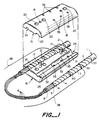
- FIG 1 illustrates a first preferred embodiment of the invention for providing an environmental block for a cable, preferably a loose tube or slotted core optical fiber cable, a slotted core cable 1 being shown in this figure.
- the optical fiber cable 1 has an outer sheath 2 surrounding a metal grounding shield 3 which in turn surrounds an inner sheath 4 which surrounds a slotted core 5 having helical grooves 9 on an outer surface thereof which guide a plurality of optical fibers 8 in the grooves.
- FIG 7 illustrates a similar optical fiber cable 11 having a similar outer sheath, metallic shield, inner sheath construction except that the cable 11 in FIG 7 is of the loose tube type wherein instead of the slotted core 5 the cable surrounds a plurality of loose tubes 10, with a plurality of optical fibers optimally being contained within each individual tube 10. Accordingly, it is tubes, rather than optical fibers, which are exposed when the various cable layers are stripped away and individually sealed as explained below.
- the cable 1, 11 is blocked by utilizing first and second half shell members 15, 16 which are engageable by aligning alignment pins 17 with alignment holes 18 and interengaging same.
- the half shell members are secured together utilizing bolts and nuts, or screws, which interengage the members through mating holes 20, 21.
- Each half shell member preferably has two longitudinally oriented stepped semicylindrical channels 24 therein which extend from a substantially planar face 25. The faces 25 mate and sealingly engage with each other and form a seal therebetween as described in more detail below.
- Each channel 24 optimally has a plurality of stepped channel portions, one portion for each cable layer to be successively sealed so as to form a water block regardless of which layer boundary may be contaminated and having a water flow longitudinally down the cable.
- the embodiment of FIG 1 illustrates three stepped substantially semicylindrical channel portions 31, 32, 33, again the precise number of channels being determined by the number of cable layers to which a seal is required.
- a plurality of electrical grounding pins 35 extend into one or more of the channel portions 31-33 radially a depth sufficient so as to make electrical contact with the metallic cable shield 3, and optimally an electrical lead wire (not shown) extends from a surface, e.g. back surface away from an optical fiber breakout portion of the cable, from the half shell members.
- the lead wire is preferably connected to an appropriate grounding medium.
- This construction safely protects the optical fiber cable (or other kinds of cable) from lightening strikes and other types of current surges.
- an environmental sealing tape 37 is helically wound around those portions of an outer surface of the cable which are to be environmentally sealed by the half shell members 15, 16.
- the tape 37 is gel impregnated and has thereon and therein a relatively soft elastic gel whose cone penetration is between 100 and 350 (10 ⁇ 1mm) and has an ultimate elongation of at least 100%, such gels and tapes being more fully described in USP 4,600,261; 4,634,207; 4,643,924; and 4,650,228.
- an intermediate portion of the exposed cable inner sheath is removed along a third section of the optical fiber which is collinear with the first and second sections except again shorter than both the first and second sections so as to result in a short portion of the inner cable sheath 4 being exposed and thus forming a third step 41 from which extends the slotted core 5 of the cable.
- an intermediate section of the exposed slotted core is removed which again is collinear with but shorter than the third section thus leaving the optical fibers 8 free and accessible along a substantial intermediate length thereof.
- the exact length of the exposed metallic shield 3 and inner sheath 4 is matched to the extent practical to a length of its corresponding channel portion 33, 32 respectively.
- the entire length of the various layered cable sections thus exposed and to be seated in the channel portions 31-33 is wrapped with the gel impregnated tape 37 in a helical fashion, as illustrated in FIG 1, and the layered and stripped cable at opposite sides of the fiber breakout portion is inserted into the semicylindrical channels 24 in the first and second half shell members as illustrated in FIG 1, and the half shell members are assembled using the alignment pins 17 and holes 18 and then secured together by utilizing bolts or other similar means in mating holes 20, 21.
- an inside diameter of each stepped channel portion 31, 32, 33 is only slightly larger than an outside diameter of each stepped cable portion 2, 3, 4 such that subsequent to wrapping the stepped cable portion with the gel impregnated tape the overall diameter of the cable plus tape is slightly larger than the insider diameter of the channel portions. Accordingly, when the half shell members are assembled as described, the gel is placed under a compressive load and is elastically resiliently urged around and within surfaces it contacts with a small amount of gel and/or gel tape being compressively urged and displaced between the mating faces 25 of the half shell members 15, 16 so as to form an excellent environmental cable barrier.
- FIG 7 The construction of FIG 7 is quite similar to that of FIG 1 except that in FIG 7 the optical fiber cable 1 has been replaced with an optical fiber cable 11 which is of the loose tube type wherein the major difference in the cable construction is the lack of a slotted core. Hence subsequent to removing the inner sheath 4 one or more plurality of loose tubes are finally exposed from an innermost cable core 29, with individual optical fibers 8 being contained within the hollow tubes 10. Portions of intermediate sections of the tubes 10 can then be removed as necessary to access individual optical fibers 8.
- the cable block of FIG 7 is functionally and operationally the same as that of FIG 1.
- the cable block as described by reference to FIGs 1 and 4 forms an excellent water block for an optical fiber cable having an intermediate section thereof which is to be entered so as to access optical fibers in the cable, preferably for optically coupling therewith using passive noninvasive couplers of the type described in any of USP 4,728,169; 4,741,585; 4,824,199; and U.S. application serial no. 252,915 filed September 30, 1988 and U.S. application serial no. 383,828 filed July 21, 1989.
- any type of conventional closure such as that disclosed in U.S. application serial no. 262,067 filed October 24, 1988, can be utilized for forming environmental seals around an exterior portion of the half shells 15, 16 and any electrical and/or power cables which are also required to enter the housing or exit therefrom.
- the invention is further useful for environmentally blocking and protecting an end segment of an optical fiber cable such as can occur at an end termination, such as at an office interface unit where termination of optical fibers ultimately is to be made at a fiber distribution panel 45 as illustrated in FIG 5.
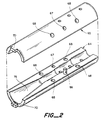
- a further preferred embodiment of the invention utilizes a member which again comprises mating first and second half shell members 64, 65 but which together form only one interior stepped longitudinal channel since it is only an end of the cable which is to be sealed, as shown in FIG 2.
- Each half shell member 64, 65 contains a pin 66 which engages a mating hole 67 on the other member so as to correctly seat the half shell members 64, 65 together, and they are secured thereto, like in the embodiment of FIG 1, with bolts or screws which extend through securing holes 68 with a substantially cylindrical shaped stepped channel being formed therebetween which tightly engages a gel wrapped stripped stepped cable (not shown in FIG 2).
- a pin 66 which engages a mating hole 67 on the other member so as to correctly seat the half shell members 64, 65 together, and they are secured thereto, like in the embodiment of FIG 1, with bolts or screws which extend through securing holes 68 with a substantially cylindrical shaped stepped channel being formed therebetween which tightly engages a gel wrapped stripped stepped cable (not shown in FIG 2).
- member 51 in FIG 3 has a central longitudinal and substantially cylindrical channel 52 which extends longitudinally part way through the member 51 and which receives an end portion of the exposed cable slotted core 5 and is securely attached thereto by set screws (not shown) which radially are inserted through the member 51 in holes 53 illustrated in FIG 3b.
- the member 51 is useable with first and second half shell members 64, 65 which have a similar construction to that of half shell members 15, 16 except that together the half shell members 64, 65 form only a single longitudinal stepped substantially cylindrical bore, as previously explained.
- An end of the half shell members 64, 65 preferably has extensions, e.g. pins 70, protruding therefrom longitudinally which align with and mate with corresponding holes 71 at an end of the member 51.
- a side 75 of the members 64, 65 where the exposed slotted core and fibers of the cable exit has an enlarging conical design as illustrated.
- the member 51 can easily be attached to the half shell members 64, 65, as illustrated in FIG 4 (which shows only part of the terminated cable), and the entire assembly, e.g. the members 51, 64, 65, and a portion of an unstripped cable entering into the half shell 64, 65 can be environmentally surrounded and protected by a heat shrinkable recoverable sleeve 72.
- FIG 3b further shows a cylindrical bore extending partially from an end face of the member 51 from a side opposite that of the bore 52 which accommodates the exposed portion of the slotted core, this element being identified by reference numeral 73.
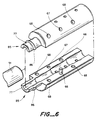
- FIG 6 illustrates a preferred construction whereby first and second half shell members having a structure similar to that illustrated in FIG 2 is shown except that one end 85 of the half shells has a substantially reduced diameter section 77 through which loose tubes of the cable extend.
- a ridge 86 also extends upward from an outside surface of the reduced diameter section 77.
- the loose tubes containing optical fibers simply extend through the reduced diameter section 77, and to provide further environmental protection optionally a further tube 91 can be disposed over an exterior portion of the reduced section 77 and held thereon by the ridge 86 so as to further protect the loose tubes and the fibers contained therewithin.
- the tube 91 has a longitudinal channel therein and can optimally be slid over the exterior part of the one end 85 of the half shells and be secured thereto by the ridge 86 by a resilient tight fit. More specifically, the tube 91 can be made of a resilient rubber having a diameter substantially similar to that of the one end 85 so as to have to be stretched over the ridge 86 so as to form a friction fit therebetween.
Landscapes
- Physics & Mathematics (AREA)
- General Physics & Mathematics (AREA)
- Optics & Photonics (AREA)
- Cable Accessories (AREA)
- Laying Of Electric Cables Or Lines Outside (AREA)
- Communication Cables (AREA)
- Light Guides In General And Applications Therefor (AREA)
Claims (15)
- Bloc de câble de télécommunications pour un câble de télécommunications, comportant :
un câble (1, 11) de télécommunications ayant un premier tronçon dénudé de ses gaines extérieure et intérieure (2, 4) afin de mettre à nu une partie intermédiaire de la gaine intérieure (4) le long du câble et afin de mettre à nu une longueur de milieux (8, 10) de transport de télécommunication protégés par le câble ;
des premier et second éléments (15, 16, 64, 65) pouvant être engagés et dégagés, les éléments, lorsqu'ils sont engagés formant au moins un premier canal épaulé, sensiblement cylindrique, ayant des premier et second tronçons longitudinaux (32, 31) avec au moins un épaulement entre eux, la partie de la gaine extérieure (4) étant disposée dans le premier tronçon (32) de canal, une partie de la gaine extérieure (2) étant disposée dans le second tronçon (31) de canal ; et
des moyens pour solliciter en compression les premier et second éléments l'un contre l'autre afin d'engager de façon étanche les gaines intérieure et extérieure dans les premier et second tronçons de canal, respectivement. - Bloc de câble selon la revendication 1, comportant en outre un ruban à gel élastique, relativement mou (37), le ruban étant imprégné d'un gel ayant une pénétration de cône comprise entre 100 et 350 (10⁻¹ mm) et un allongement à la rupture supérieur à au moins 100 %, le ruban à gel étant enroulé autour du câble afin d'entrer en contact à la fois avec une surface intérieure du canal cylindrique et une surface extérieure du câble, sur une circonférence de 360°.
- Bloc de câble selon la revendication 1 ou 2, le tronçon de câble étant dénudé pour mettre à nu une partie d'un blindage métallique (3) du câble entre une extrémité d'une portion non dénudée de la gaine extérieure (2) et la partie à nu de la gaine intérieure (4), le blindage métallique à nu étant disposé dans un troisième tronçon (33) de canal qui est situé entre les premier et deuxième tronçons de canal, qui leur est adjacent et qui est en séparé par des épaulements, une longueur du troisième tronçon de canal étant sensiblement similaire à une longueur du blindage métallique à nu, les premier et deuxième tronçons de canal étant sensiblement occupés, sur une certaine longueur, par la gaine intérieure à nu et la gaine extérieure, respectivement, un gel (37) étant avantageusement disposé dans la totalité des trois tronçons de canal, le câble comprenant un câble à fibres optiques à âme fendue ou un câble à fibres optiques à tubes non serrés.
- Bloc de câble selon la revendication 3, comportant en outre des moyens (35) pour connecter électriquement le blindage métallique (3), les moyens de connexion étant disposés à l'intérieur du troisième tronçon de canal (33) afin de pouvoir conduire de l'électricité à partir de celui-ci et depuis les premier et deuxième éléments vers une masse électrique.
- Bloc de câble selon la revendication 4, dans lequel les premier et second éléments comprennent des éléments à demi-coque renfermant chacun un canal longitudinal épaulé semi-cylindrique, les canaux des deux éléments formant ensemble le canal épaulé sensiblement cylindrique lorsque les premier et second éléments sont engagés, les éléments comprenant des ergots et trous complémentaires d'alignement alignant les éléments l'un avec l'autre pour faciliter leur engagement.
- Bloc de câble selon la revendication 5, comportant en outre un troisième élément (51) ayant une extrémité pouvant être accouplée avec une extrémité des premier et deuxième éléments (64, 65), les premier, deuxième et troisième éléments ayant des moyens (70, 71) pour aligner leurs extrémités respectives entre elles,le troisième élément ayant un premier canal longitudinal (52) qui ne le traverse longitudinalement que partiellement, le premier canal longitudinal du troisième élément logeant une courte partie d'une âme fendue à nu d'un câble à fibres optiques qui s'étend depuis une extrémité de la gaine intérieure à nu du câble, le troisième élément contenant au moins un second canal longitudinal (80) qui s'étend sensiblement parallèlement à son premier canal longitudinal pour loger des fibres optiques sortant d'une surface extérieure de l'âme fendue.
- Bloc de câble selon la revendication 6, dans lequel le troisième élément renferme au moins un canal (53) s'étendant radialement, qui pénètre dans une longueur intermédiaire du premier canal du troisième élément, et comportant en outre des moyens disposés à l'intérieur du canal s'étendant radialement pour fixer le troisième élément à l'âme fendue.
- Bloc de câble selon la revendication 6, comportant en outre un manchon protecteur disposé sur une surface extérieure d'au moins une partie du troisième élément, sur une surface extérieure complète des premier et deuxième éléments et sur une partie d'une portion non dénudée de la gaine extérieure du câble.
- Bloc de câble selon la revendication 4, dans lequel les premier et deuxième éléments forment ensemble un canal (77) de sortie pour plusieurs tubes non serrés contenus dans le câble, qui sont mis à nu après que le câble a été dénudé, une surface circonférentielle extérieure du canal de sortie ayant une nervure circonférentielle (86) qui l'entoure pour maintenir un élément tubulaire (91) sur une surface extérieure du canal de sortie.
- Bloc de câble selon la revendication 1, dans lequel les éléments, lorsqu'ils sont engagés, forment un second canal longitudinal épaulé ayant une construction sensiblement similaire à celle du premier canal et destiné à recevoir et sceller de façon étanche un second tronçon de câble dénudé ayant une structure sensiblement similaire à celle du premier tronçon de câble dénudé, mais qui en est décalé longitudinalement le long du câble, les milieux de conduction de télécommunication étant à nu pour un accès aisé entre les premier et second tronçons de câble dénudés.
- Bloc de câble selon la revendication 4, dans lequel les éléments, lorsqu'ils sont engagés, forment un second canal longitudinal épaulé ayant une construction sensiblement similaire à celle du premier canal et destiné à loger et sceller de façon étanche un second tronçon de câble dénudé ayant une structure sensiblement similaire à celle du premier tronçon de câble dénudé, mais décalé longitudinalement de celui-ci le long du câble, les milieux de conduction de télécommunication étant à nu pour un accès aisé entre les premier et second tronçons de câble dénudés.
- Bloc de câble à fibres optiques pour un câble à fibres optiques contenant des fibres optiques, comportant :
un câble (1, 11) à fibres optiques ayant au moins une gaine extérieure (2) et une gaine intérieure (4) et au moins une fibre optique disposée à l'intérieur de ce câble, une première partie du câble ayant une longueur longitudinale de la gaine extérieure (2) qui en est enlevée afin de mettre à nu au moins une gaine intérieure (4) de câble située au-dessous d'elle le long d'une deuxième partie de câble qui est plus courte que la première partie de câble et qui est colinéaire avec elle ;
des premiers et seconds éléments à demi-coque (15, 16, 64, 65) pouvant être engagés et dégagés, chaque élément à demi-coque contenant au moins un canal semi-cylindrique, épaulé et longitudinal (24) disposé de façon à s'étendre depuis une surface (25) de chacun des éléments pouvant être engagés l'un avec l'autre, les éléments, lorsqu'ils sont engagés, formant au moins, à l'intérieur, un canal cylindrique longitudinal épaulé, des premier (32) et deuxième (31) tronçons longitudinaux du canal ayant des diamètres d'épaulement d'une dimension similaire à celles des gaines intérieure (4) et extérieure (2) du câble, respectivement, les premier et second éléments à demi-coque étant disposés autour du câble de manière qu'une première longueur de la gaine intérieure à nu soit disposée à l'intérieur du premier tronçon de canal (32) et qu'un tronçon non dénudé du câble soit disposé à l'intérieur du deuxième tronçon de canal (31), la première longueur de la gaine intérieure étant plus courte que la deuxième partie du câble ;
des moyens pour solliciter en compression les premier et deuxième éléments à demi-coque l'un contre l'autre afin d'engager de façon étanche les gaines intérieure et extérieure dans les premier et deuxième tronçons de canal, respectivement. - Bloc de câble selon la revendication 12, dans lequel une longueur intermédiaire de la gaine intérieure (4) du câble est enlevée le long d'une troisième partie du câble qui est colinéaire avec la deuxième partie du câble, mais plus courte que celle-ci, les premier (32) et deuxième (31) tronçons de canal étant avantageusement disposés sur des extrémités opposées des éléments à demi-coque, comportant en outre, avantageusement, un ruban à gel élastique relativement mou, le ruban étant imprégné d'un gel ayant une pénétration de cône comprise entre 100 et 350 (10⁻¹ mm) et un allongement à la rupture supérieur à au moins 100 %, le ruban à gel étant enroulé autour du câble afin d'être en contact à la fois avec une surface intérieure du canal cylindrique et une surface extérieure du câble sur une circonférence de 360°.
- Bloc de câble selon la revendication 13, le câble comprenant un blindage métallique (13) entre les gaines intérieure (4) et extérieure (2), une longueur intermédiaire du blindage métallique étant enlevée le long d'une quatrième partie du câble qui est colinéaire avec la première partie du câble, mais plus courte que celle-ci et plus longue que la deuxième partie du câble, le canal longitudinal épaulé ayant un troisième tronçon longitudinal (33) disposé entre les premier (32) et deuxième (31) tronçons de canal, une longueur intermédiaire de blindage qui est à nu étant disposée à l'intérieur du troisième tronçon longitudinal du canal.
- Bloc de câble selon la revendication 14, comportant en outre des moyens (35) pour une connexion électrique sur le blindage métallique (3), des moyens de connexion étant disposés à l'intérieur du troisième tronçon (33) du canal afin de pouvoir conduire de l'électricité à partir de celui-ci et en sortie des premier et second éléments à demi-coque, les moyens de connexion électrique comportant plusieurs éléments allongés et minces qui s'étendent radialement à travers au moins une portion de l'un des éléments à demi-coque afin d'avoir une extrémité se terminant à l'intérieur du troisième tronçon de canal pour établir un contact électrique avec le blindage métallique, une extrémité opposée des éléments allongés étant connectée électriquement à une masse électrique.
Applications Claiming Priority (3)
| Application Number | Priority Date | Filing Date | Title |
|---|---|---|---|
| US399689 | 1982-07-19 | ||
| US07/399,689 US4978194A (en) | 1989-08-28 | 1989-08-28 | Stepped cable block |
| PCT/US1990/004656 WO1991003853A1 (fr) | 1989-08-28 | 1990-08-17 | Bloc de cable a reduction |
Publications (2)
| Publication Number | Publication Date |
|---|---|
| EP0489824A1 EP0489824A1 (fr) | 1992-06-17 |
| EP0489824B1 true EP0489824B1 (fr) | 1995-01-25 |
Family
ID=23580588
Family Applications (1)
| Application Number | Title | Priority Date | Filing Date |
|---|---|---|---|
| EP90913374A Expired - Lifetime EP0489824B1 (fr) | 1989-08-28 | 1990-08-17 | Bloc de cable a reduction |
Country Status (9)
| Country | Link |
|---|---|
| US (1) | US4978194A (fr) |
| EP (1) | EP0489824B1 (fr) |
| JP (1) | JPH04507489A (fr) |
| KR (1) | KR920704391A (fr) |
| AT (1) | ATE117852T1 (fr) |
| AU (1) | AU642161B2 (fr) |
| CA (1) | CA2065241A1 (fr) |
| DE (1) | DE69016443T2 (fr) |
| WO (1) | WO1991003853A1 (fr) |
Families Citing this family (12)
| Publication number | Priority date | Publication date | Assignee | Title |
|---|---|---|---|---|
| US5048918A (en) * | 1990-02-07 | 1991-09-17 | Raychem Corporation | Optical fiber cable termination |
| US5073044A (en) * | 1990-10-31 | 1991-12-17 | Amp Incorporated | Right angle strain relief for optical fiber connector |
| US5187764A (en) * | 1991-04-25 | 1993-02-16 | Cablelite Corporation | Conduit for fiber optical cables |
| DE4226368A1 (de) * | 1992-08-09 | 1994-02-10 | Suhner Elektronik Gmbh | Übertragungsstrecke für mit Lichtwellenleitern bestückte Anlagen |
| US5305405A (en) * | 1993-02-25 | 1994-04-19 | Adc Telecommunications, Inc. | Patch cord |
| ES2100801B1 (es) * | 1994-05-05 | 1998-02-16 | Garcia Maurino De Vigo Luis | Mejoras introducidas en canalizaciones electricas modulares prefabricadas. |
| US5666453A (en) * | 1994-07-15 | 1997-09-09 | Roy Witte | Fiber optic jumper cables and tracing method using same |
| US5710851A (en) * | 1995-11-06 | 1998-01-20 | Amphenol Corporation | Strain relief system for a fiber optic connector |
| GB2352110A (en) * | 1999-07-14 | 2001-01-17 | Taiko Denki Co Ltd | Plastic optical fibre cables in a telecommunication exchange |
| US6743044B2 (en) * | 2002-08-14 | 2004-06-01 | Adc Telecommunications, Inc. | Cross-connect jumper assembly having tracer lamp |
| ES2435424T3 (es) * | 2009-02-10 | 2013-12-19 | Tyco Electronics Raychem Bvba | Dispositivo de protección de empalme para empalmes ópticos y conjunto de cables de fibras ópticas que lo incorpora |
| CN214041821U (zh) * | 2020-12-31 | 2021-08-24 | 惠州市飞博康实业有限公司 | 一种gh分支器 |
Family Cites Families (12)
| Publication number | Priority date | Publication date | Assignee | Title |
|---|---|---|---|---|
| FR2494856A1 (fr) * | 1980-11-27 | 1982-05-28 | Lignes Telegraph Telephon | Dispositif d'etancheite pour boitier de raccordement d'un cable sous enveloppe ondulee |
| US4744629A (en) * | 1985-08-16 | 1988-05-17 | Augat Inc. | Multifiber optical cable connector |
| JPS6270805A (ja) * | 1985-09-25 | 1987-04-01 | Furukawa Electric Co Ltd:The | 光・メタル複合ケ−ブル端末部 |
| US4746187A (en) * | 1985-10-07 | 1988-05-24 | The United States Of America As Represented By The Secretary Of The Navy | Kink-free fiber optic cable connector |
| FR2588670B1 (fr) * | 1985-10-16 | 1987-12-11 | Lignes Telegraph Telephon | Tete d'eclatement d'un cable a fibres optiques |
| JPS6276303U (fr) * | 1985-10-31 | 1987-05-15 | ||
| JPH077139B2 (ja) * | 1985-12-24 | 1995-01-30 | 日本電信電話株式会社 | 浮動ホルダ型光コネクタ |
| FR2597616B1 (fr) * | 1986-04-17 | 1988-08-05 | Telecommunications Sa | Dispositif et procede d'epanouissement de fibres optiques sortant d'un cable a raccorder |
| US4772081A (en) * | 1986-09-15 | 1988-09-20 | Tsi Incorporated | Fiber optic connector assembly |
| US4834479A (en) * | 1986-12-11 | 1989-05-30 | American Telephone And Telegraph Company | High and low pressure fluidblock assembly |
| US4900118A (en) * | 1987-05-22 | 1990-02-13 | Furukawa Electric Co., Ltd. | Multiple-fiber optical component and method for manufacturing of the same |
| DE3729075A1 (de) * | 1987-09-01 | 1989-03-16 | Schmidt Feinmech | Steckverbindung fuer lichtleiter |
-
1989
- 1989-08-28 US US07/399,689 patent/US4978194A/en not_active Expired - Lifetime
-
1990
- 1990-08-17 KR KR1019920700449A patent/KR920704391A/ko not_active Withdrawn
- 1990-08-17 JP JP2512513A patent/JPH04507489A/ja active Pending
- 1990-08-17 AU AU63349/90A patent/AU642161B2/en not_active Ceased
- 1990-08-17 EP EP90913374A patent/EP0489824B1/fr not_active Expired - Lifetime
- 1990-08-17 CA CA002065241A patent/CA2065241A1/fr not_active Abandoned
- 1990-08-17 DE DE69016443T patent/DE69016443T2/de not_active Expired - Fee Related
- 1990-08-17 WO PCT/US1990/004656 patent/WO1991003853A1/fr not_active Ceased
- 1990-08-17 AT AT90913374T patent/ATE117852T1/de not_active IP Right Cessation
Also Published As
| Publication number | Publication date |
|---|---|
| EP0489824A1 (fr) | 1992-06-17 |
| ATE117852T1 (de) | 1995-02-15 |
| DE69016443T2 (de) | 1995-09-21 |
| AU6334990A (en) | 1991-04-08 |
| KR920704391A (ko) | 1992-12-19 |
| CA2065241A1 (fr) | 1991-03-01 |
| WO1991003853A1 (fr) | 1991-03-21 |
| AU642161B2 (en) | 1993-10-14 |
| US4978194A (en) | 1990-12-18 |
| DE69016443D1 (de) | 1995-03-09 |
| JPH04507489A (ja) | 1992-12-24 |
Similar Documents
| Publication | Publication Date | Title |
|---|---|---|
| US10036859B2 (en) | Cable termination assembly and method for connectors | |
| EP0489824B1 (fr) | Bloc de cable a reduction | |
| EP1775610B1 (fr) | Connecteur à fibre optique | |
| JP5158754B2 (ja) | 光ケーブルシールド層接続部 | |
| US4110550A (en) | Electrical connector with adaptor for paper-insulated, lead-jacketed electrical cables and method | |
| EP0105597A2 (fr) | Système de connexion à fibre optique | |
| CA1133996A (fr) | Adaptateur pour cables electriques a isolant en papier et gaine de plomb | |
| US4314094A (en) | Cable seal splice enclosure | |
| CA1267009A (fr) | Conducteur toronne composite aerien comportant un compose de remplissage entre les fibres optiques et un tube protecteur | |
| GB2120467A (en) | Shield termination enclosure with access means and shield connection device | |
| JPS5939970B2 (ja) | 内部伝熱ジヤケツトを持つたスプライス・コネクタ | |
| JPS582816A (ja) | 架空電気伝送システム | |
| GB2088584A (en) | Overhead electric cable | |
| GB1591597A (en) | Electrical connector | |
| KR101245365B1 (ko) | 광전복합 팬아웃 케이블 | |
| WO1998028822A1 (fr) | Connecteur pour blindage a la masse de raccord d'extremite | |
| CN121394026B (zh) | 一种分支器及复合缆结构 | |
| GB2075770A (en) | Improvements in or relating to cable glands | |
| US6621963B1 (en) | Submarine casing for a submarine optical cable | |
| JPH0253762B2 (fr) | ||
| WO2016126480A1 (fr) | Ensemble câble à fibre optique universel à protection contre les oiseaux pour unité radio distante | |
| JPS63143514A (ja) | 電力・光複合ケ−ブルの光ケ−ブル接続方法 | |
| HK29194A (en) | Fiber optic connection system | |
| HK1201330B (en) | Fiber optic plug | |
| JPS63292104A (ja) | 電力・光複合ケ−ルの光ケ−ブル接続部 |
Legal Events
| Date | Code | Title | Description |
|---|---|---|---|
| PUAI | Public reference made under article 153(3) epc to a published international application that has entered the european phase |
Free format text: ORIGINAL CODE: 0009012 |
|
| 17P | Request for examination filed |
Effective date: 19920226 |
|
| AK | Designated contracting states |
Kind code of ref document: A1 Designated state(s): AT BE CH DE DK ES FR GB IT LI NL SE |
|
| 17Q | First examination report despatched |
Effective date: 19940214 |
|
| GRAA | (expected) grant |
Free format text: ORIGINAL CODE: 0009210 |
|
| AK | Designated contracting states |
Kind code of ref document: B1 Designated state(s): AT BE CH DE DK ES FR GB IT LI NL SE |
|
| PG25 | Lapsed in a contracting state [announced via postgrant information from national office to epo] |
Ref country code: IT Free format text: LAPSE BECAUSE OF FAILURE TO SUBMIT A TRANSLATION OF THE DESCRIPTION OR TO PAY THE FEE WITHIN THE PRE;WARNING: LAPSES OF ITALIAN PATENTS WITH EFFECTIVE DATE BEFORE 2007 MAY HAVE OCCURRED AT ANY TIME BEFORE 2007. THE CORRECT EFFECTIVE DATE MAY BE DIFFERENT FROM THE ONE RECORDED.SCRIBED TIME-LIMIT Effective date: 19950125 Ref country code: BE Effective date: 19950125 Ref country code: CH Effective date: 19950125 Ref country code: NL Effective date: 19950125 Ref country code: LI Effective date: 19950125 Ref country code: AT Effective date: 19950125 Ref country code: ES Free format text: THE PATENT HAS BEEN ANNULLED BY A DECISION OF A NATIONAL AUTHORITY Effective date: 19950125 Ref country code: DK Effective date: 19950125 |
|
| REF | Corresponds to: |
Ref document number: 117852 Country of ref document: AT Date of ref document: 19950215 Kind code of ref document: T |
|
| REF | Corresponds to: |
Ref document number: 69016443 Country of ref document: DE Date of ref document: 19950309 |
|
| ET | Fr: translation filed | ||
| PG25 | Lapsed in a contracting state [announced via postgrant information from national office to epo] |
Ref country code: SE Effective date: 19950425 |
|
| REG | Reference to a national code |
Ref country code: CH Ref legal event code: PL |
|
| NLV1 | Nl: lapsed or annulled due to failure to fulfill the requirements of art. 29p and 29m of the patents act | ||
| PLBE | No opposition filed within time limit |
Free format text: ORIGINAL CODE: 0009261 |
|
| STAA | Information on the status of an ep patent application or granted ep patent |
Free format text: STATUS: NO OPPOSITION FILED WITHIN TIME LIMIT |
|
| 26N | No opposition filed | ||
| PGFP | Annual fee paid to national office [announced via postgrant information from national office to epo] |
Ref country code: GB Payment date: 19960808 Year of fee payment: 7 |
|
| PGFP | Annual fee paid to national office [announced via postgrant information from national office to epo] |
Ref country code: FR Payment date: 19960809 Year of fee payment: 7 |
|
| PG25 | Lapsed in a contracting state [announced via postgrant information from national office to epo] |
Ref country code: GB Free format text: LAPSE BECAUSE OF NON-PAYMENT OF DUE FEES Effective date: 19970817 |
|
| GBPC | Gb: european patent ceased through non-payment of renewal fee |
Effective date: 19970817 |
|
| PG25 | Lapsed in a contracting state [announced via postgrant information from national office to epo] |
Ref country code: FR Free format text: LAPSE BECAUSE OF NON-PAYMENT OF DUE FEES Effective date: 19980430 |
|
| REG | Reference to a national code |
Ref country code: FR Ref legal event code: ST |
|
| PGFP | Annual fee paid to national office [announced via postgrant information from national office to epo] |
Ref country code: DE Payment date: 20050930 Year of fee payment: 16 |
|
| PG25 | Lapsed in a contracting state [announced via postgrant information from national office to epo] |
Ref country code: DE Free format text: LAPSE BECAUSE OF NON-PAYMENT OF DUE FEES Effective date: 20070301 |