EP0489914A1 - Verfahren zum bilden einer titan-nitrid deckschicht und pfanne gefertigt mittels dieses verfahrens - Google Patents
Verfahren zum bilden einer titan-nitrid deckschicht und pfanne gefertigt mittels dieses verfahrens Download PDFInfo
- Publication number
- EP0489914A1 EP0489914A1 EP90910902A EP90910902A EP0489914A1 EP 0489914 A1 EP0489914 A1 EP 0489914A1 EP 90910902 A EP90910902 A EP 90910902A EP 90910902 A EP90910902 A EP 90910902A EP 0489914 A1 EP0489914 A1 EP 0489914A1
- Authority
- EP
- European Patent Office
- Prior art keywords
- frying pan
- titanium nitride
- tin
- pan
- tin film
- Prior art date
- Legal status (The legal status is an assumption and is not a legal conclusion. Google has not performed a legal analysis and makes no representation as to the accuracy of the status listed.)
- Granted
Links
- NRTOMJZYCJJWKI-UHFFFAOYSA-N Titanium nitride Chemical compound [Ti]#N NRTOMJZYCJJWKI-UHFFFAOYSA-N 0.000 title claims abstract description 129
- 238000000034 method Methods 0.000 title claims abstract description 58
- 239000011248 coating agent Substances 0.000 title abstract description 18
- 238000000576 coating method Methods 0.000 title abstract description 18
- IJGRMHOSHXDMSA-UHFFFAOYSA-N Atomic nitrogen Chemical compound N#N IJGRMHOSHXDMSA-UHFFFAOYSA-N 0.000 claims abstract description 28
- 229910052757 nitrogen Inorganic materials 0.000 claims abstract description 13
- 239000012298 atmosphere Substances 0.000 claims abstract description 10
- GWEVSGVZZGPLCZ-UHFFFAOYSA-N Titan oxide Chemical compound O=[Ti]=O GWEVSGVZZGPLCZ-UHFFFAOYSA-N 0.000 claims abstract description 9
- QVGXLLKOCUKJST-UHFFFAOYSA-N atomic oxygen Chemical compound [O] QVGXLLKOCUKJST-UHFFFAOYSA-N 0.000 claims abstract description 8
- 239000012299 nitrogen atmosphere Substances 0.000 claims abstract description 8
- OGIDPMRJRNCKJF-UHFFFAOYSA-N titanium oxide Inorganic materials [Ti]=O OGIDPMRJRNCKJF-UHFFFAOYSA-N 0.000 claims abstract description 8
- 239000001301 oxygen Substances 0.000 claims abstract description 7
- 229910052760 oxygen Inorganic materials 0.000 claims abstract description 7
- 238000005229 chemical vapour deposition Methods 0.000 claims abstract description 3
- 238000005240 physical vapour deposition Methods 0.000 claims abstract description 3
- 235000019646 color tone Nutrition 0.000 claims description 30
- 230000000087 stabilizing effect Effects 0.000 claims description 3
- 238000010438 heat treatment Methods 0.000 abstract description 38
- 238000010411 cooking Methods 0.000 abstract description 31
- 238000007733 ion plating Methods 0.000 abstract description 24
- 239000000463 material Substances 0.000 abstract description 8
- 230000006641 stabilisation Effects 0.000 abstract description 7
- 238000011105 stabilization Methods 0.000 abstract description 7
- 230000000694 effects Effects 0.000 abstract description 6
- 239000000203 mixture Substances 0.000 abstract description 3
- 150000004767 nitrides Chemical class 0.000 abstract 1
- 239000010936 titanium Substances 0.000 description 38
- 239000000758 substrate Substances 0.000 description 35
- 230000015572 biosynthetic process Effects 0.000 description 18
- 241000467686 Eschscholzia lobbii Species 0.000 description 17
- 238000002474 experimental method Methods 0.000 description 15
- RTAQQCXQSZGOHL-UHFFFAOYSA-N Titanium Chemical compound [Ti] RTAQQCXQSZGOHL-UHFFFAOYSA-N 0.000 description 14
- 235000013305 food Nutrition 0.000 description 13
- PCHJSUWPFVWCPO-UHFFFAOYSA-N gold Chemical compound [Au] PCHJSUWPFVWCPO-UHFFFAOYSA-N 0.000 description 13
- 239000010931 gold Substances 0.000 description 13
- 229910052737 gold Inorganic materials 0.000 description 13
- 238000010586 diagram Methods 0.000 description 11
- 239000007789 gas Substances 0.000 description 11
- 239000004809 Teflon Substances 0.000 description 10
- 229920006362 Teflon® Polymers 0.000 description 10
- 229910052719 titanium Inorganic materials 0.000 description 9
- 229910000831 Steel Inorganic materials 0.000 description 8
- 239000010959 steel Substances 0.000 description 8
- 239000002245 particle Substances 0.000 description 7
- XKRFYHLGVUSROY-UHFFFAOYSA-N Argon Chemical compound [Ar] XKRFYHLGVUSROY-UHFFFAOYSA-N 0.000 description 6
- 238000005406 washing Methods 0.000 description 5
- 239000002537 cosmetic Substances 0.000 description 4
- 238000000227 grinding Methods 0.000 description 4
- 238000004519 manufacturing process Methods 0.000 description 4
- XLYOFNOQVPJJNP-UHFFFAOYSA-N water Substances O XLYOFNOQVPJJNP-UHFFFAOYSA-N 0.000 description 4
- 241000251468 Actinopterygii Species 0.000 description 3
- 238000002441 X-ray diffraction Methods 0.000 description 3
- 229910052786 argon Inorganic materials 0.000 description 3
- 238000002845 discoloration Methods 0.000 description 3
- 238000010894 electron beam technology Methods 0.000 description 3
- 150000002500 ions Chemical class 0.000 description 3
- 239000007769 metal material Substances 0.000 description 3
- 238000001465 metallisation Methods 0.000 description 3
- 239000003921 oil Substances 0.000 description 3
- 239000002253 acid Substances 0.000 description 2
- 230000006866 deterioration Effects 0.000 description 2
- 238000010849 ion bombardment Methods 0.000 description 2
- 230000002265 prevention Effects 0.000 description 2
- 239000000126 substance Substances 0.000 description 2
- LFQSCWFLJHTTHZ-UHFFFAOYSA-N Ethanol Chemical compound CCO LFQSCWFLJHTTHZ-UHFFFAOYSA-N 0.000 description 1
- 241000416536 Euproctis pseudoconspersa Species 0.000 description 1
- 240000007594 Oryza sativa Species 0.000 description 1
- 235000007164 Oryza sativa Nutrition 0.000 description 1
- 239000003513 alkali Substances 0.000 description 1
- 238000006243 chemical reaction Methods 0.000 description 1
- 238000004140 cleaning Methods 0.000 description 1
- 238000005520 cutting process Methods 0.000 description 1
- 238000005238 degreasing Methods 0.000 description 1
- 239000000428 dust Substances 0.000 description 1
- 238000001704 evaporation Methods 0.000 description 1
- 230000008020 evaporation Effects 0.000 description 1
- 239000003925 fat Substances 0.000 description 1
- JEIPFZHSYJVQDO-UHFFFAOYSA-N iron(III) oxide Inorganic materials O=[Fe]O[Fe]=O JEIPFZHSYJVQDO-UHFFFAOYSA-N 0.000 description 1
- 230000007774 longterm Effects 0.000 description 1
- 230000035515 penetration Effects 0.000 description 1
- 235000015277 pork Nutrition 0.000 description 1
- 235000009566 rice Nutrition 0.000 description 1
- 238000005201 scrubbing Methods 0.000 description 1
- 150000003608 titanium Chemical class 0.000 description 1
Images



Classifications
-
- C—CHEMISTRY; METALLURGY
- C23—COATING METALLIC MATERIAL; COATING MATERIAL WITH METALLIC MATERIAL; CHEMICAL SURFACE TREATMENT; DIFFUSION TREATMENT OF METALLIC MATERIAL; COATING BY VACUUM EVAPORATION, BY SPUTTERING, BY ION IMPLANTATION OR BY CHEMICAL VAPOUR DEPOSITION, IN GENERAL; INHIBITING CORROSION OF METALLIC MATERIAL OR INCRUSTATION IN GENERAL
- C23C—COATING METALLIC MATERIAL; COATING MATERIAL WITH METALLIC MATERIAL; SURFACE TREATMENT OF METALLIC MATERIAL BY DIFFUSION INTO THE SURFACE, BY CHEMICAL CONVERSION OR SUBSTITUTION; COATING BY VACUUM EVAPORATION, BY SPUTTERING, BY ION IMPLANTATION OR BY CHEMICAL VAPOUR DEPOSITION, IN GENERAL
- C23C14/00—Coating by vacuum evaporation, by sputtering or by ion implantation of the coating forming material
- C23C14/58—After-treatment
- C23C14/5806—Thermal treatment
-
- A—HUMAN NECESSITIES
- A47—FURNITURE; DOMESTIC ARTICLES OR APPLIANCES; COFFEE MILLS; SPICE MILLS; SUCTION CLEANERS IN GENERAL
- A47J—KITCHEN EQUIPMENT; COFFEE MILLS; SPICE MILLS; APPARATUS FOR MAKING BEVERAGES
- A47J36/00—Parts, details or accessories of cooking-vessels
- A47J36/02—Selection of specific materials, e.g. heavy bottoms with copper inlay or with insulating inlay
-
- C—CHEMISTRY; METALLURGY
- C23—COATING METALLIC MATERIAL; COATING MATERIAL WITH METALLIC MATERIAL; CHEMICAL SURFACE TREATMENT; DIFFUSION TREATMENT OF METALLIC MATERIAL; COATING BY VACUUM EVAPORATION, BY SPUTTERING, BY ION IMPLANTATION OR BY CHEMICAL VAPOUR DEPOSITION, IN GENERAL; INHIBITING CORROSION OF METALLIC MATERIAL OR INCRUSTATION IN GENERAL
- C23C—COATING METALLIC MATERIAL; COATING MATERIAL WITH METALLIC MATERIAL; SURFACE TREATMENT OF METALLIC MATERIAL BY DIFFUSION INTO THE SURFACE, BY CHEMICAL CONVERSION OR SUBSTITUTION; COATING BY VACUUM EVAPORATION, BY SPUTTERING, BY ION IMPLANTATION OR BY CHEMICAL VAPOUR DEPOSITION, IN GENERAL
- C23C14/00—Coating by vacuum evaporation, by sputtering or by ion implantation of the coating forming material
- C23C14/06—Coating by vacuum evaporation, by sputtering or by ion implantation of the coating forming material characterised by the coating material
- C23C14/0641—Nitrides
-
- C—CHEMISTRY; METALLURGY
- C23—COATING METALLIC MATERIAL; COATING MATERIAL WITH METALLIC MATERIAL; CHEMICAL SURFACE TREATMENT; DIFFUSION TREATMENT OF METALLIC MATERIAL; COATING BY VACUUM EVAPORATION, BY SPUTTERING, BY ION IMPLANTATION OR BY CHEMICAL VAPOUR DEPOSITION, IN GENERAL; INHIBITING CORROSION OF METALLIC MATERIAL OR INCRUSTATION IN GENERAL
- C23C—COATING METALLIC MATERIAL; COATING MATERIAL WITH METALLIC MATERIAL; SURFACE TREATMENT OF METALLIC MATERIAL BY DIFFUSION INTO THE SURFACE, BY CHEMICAL CONVERSION OR SUBSTITUTION; COATING BY VACUUM EVAPORATION, BY SPUTTERING, BY ION IMPLANTATION OR BY CHEMICAL VAPOUR DEPOSITION, IN GENERAL
- C23C14/00—Coating by vacuum evaporation, by sputtering or by ion implantation of the coating forming material
- C23C14/58—After-treatment
-
- C—CHEMISTRY; METALLURGY
- C23—COATING METALLIC MATERIAL; COATING MATERIAL WITH METALLIC MATERIAL; CHEMICAL SURFACE TREATMENT; DIFFUSION TREATMENT OF METALLIC MATERIAL; COATING BY VACUUM EVAPORATION, BY SPUTTERING, BY ION IMPLANTATION OR BY CHEMICAL VAPOUR DEPOSITION, IN GENERAL; INHIBITING CORROSION OF METALLIC MATERIAL OR INCRUSTATION IN GENERAL
- C23C—COATING METALLIC MATERIAL; COATING MATERIAL WITH METALLIC MATERIAL; SURFACE TREATMENT OF METALLIC MATERIAL BY DIFFUSION INTO THE SURFACE, BY CHEMICAL CONVERSION OR SUBSTITUTION; COATING BY VACUUM EVAPORATION, BY SPUTTERING, BY ION IMPLANTATION OR BY CHEMICAL VAPOUR DEPOSITION, IN GENERAL
- C23C14/00—Coating by vacuum evaporation, by sputtering or by ion implantation of the coating forming material
- C23C14/58—After-treatment
- C23C14/5846—Reactive treatment
- C23C14/5853—Oxidation
-
- C—CHEMISTRY; METALLURGY
- C23—COATING METALLIC MATERIAL; COATING MATERIAL WITH METALLIC MATERIAL; CHEMICAL SURFACE TREATMENT; DIFFUSION TREATMENT OF METALLIC MATERIAL; COATING BY VACUUM EVAPORATION, BY SPUTTERING, BY ION IMPLANTATION OR BY CHEMICAL VAPOUR DEPOSITION, IN GENERAL; INHIBITING CORROSION OF METALLIC MATERIAL OR INCRUSTATION IN GENERAL
- C23C—COATING METALLIC MATERIAL; COATING MATERIAL WITH METALLIC MATERIAL; SURFACE TREATMENT OF METALLIC MATERIAL BY DIFFUSION INTO THE SURFACE, BY CHEMICAL CONVERSION OR SUBSTITUTION; COATING BY VACUUM EVAPORATION, BY SPUTTERING, BY ION IMPLANTATION OR BY CHEMICAL VAPOUR DEPOSITION, IN GENERAL
- C23C16/00—Chemical coating by decomposition of gaseous compounds, without leaving reaction products of surface material in the coating, i.e. chemical vapour deposition [CVD] processes
- C23C16/22—Chemical coating by decomposition of gaseous compounds, without leaving reaction products of surface material in the coating, i.e. chemical vapour deposition [CVD] processes characterised by the deposition of inorganic material, other than metallic material
- C23C16/30—Deposition of compounds, mixtures or solid solutions, e.g. borides, carbides, nitrides
- C23C16/34—Nitrides
-
- C—CHEMISTRY; METALLURGY
- C23—COATING METALLIC MATERIAL; COATING MATERIAL WITH METALLIC MATERIAL; CHEMICAL SURFACE TREATMENT; DIFFUSION TREATMENT OF METALLIC MATERIAL; COATING BY VACUUM EVAPORATION, BY SPUTTERING, BY ION IMPLANTATION OR BY CHEMICAL VAPOUR DEPOSITION, IN GENERAL; INHIBITING CORROSION OF METALLIC MATERIAL OR INCRUSTATION IN GENERAL
- C23C—COATING METALLIC MATERIAL; COATING MATERIAL WITH METALLIC MATERIAL; SURFACE TREATMENT OF METALLIC MATERIAL BY DIFFUSION INTO THE SURFACE, BY CHEMICAL CONVERSION OR SUBSTITUTION; COATING BY VACUUM EVAPORATION, BY SPUTTERING, BY ION IMPLANTATION OR BY CHEMICAL VAPOUR DEPOSITION, IN GENERAL
- C23C16/00—Chemical coating by decomposition of gaseous compounds, without leaving reaction products of surface material in the coating, i.e. chemical vapour deposition [CVD] processes
- C23C16/56—After-treatment
Definitions
- the present invention relates to a method for forming a titanium nitride (TiN) film over the surface of a substrate and to a cooking vessel with a TiN coating manufactured using the formation method thereof.
- TiN titanium nitride
- a cooking pan such as a frying pan or a shallow pot (hereinafter referred to as the "pan") is made simply by forming a piece of metallic material, such as steel, and coating the inner surface of the pan with a fluororesin such as Teflon.
- Pans coated with fluororesin have been extensively used as frying pans and the like because of their prevention of charred food during cooking and their resistance to rust.
- pans coated with fluororesin are not attractive because fluororesins are colorless, and they do not have sufficient durability because fluororesins are soft. Such fluororesin properties cause the coated layers to deteriorate or peel off after repeated use and result in reduced effectiveness in the prevention of burnt food.
- the present invention is designed in consideration of the reasons above, and an object of the present invention is to provide a method of forming a TiN film and the pan obtained by such a method.
- TiN film is formed over the surface of the substrate by using a physical vapor deposition method, whereby it is possible to form, on the surface of the substrate, a TiN film with a beautiful golden color, a high hardness value, and chemical stability.
- a pan which is manufactured by forming TiN film over the surface of the substrate of the pan in accordance with the above method and obtained in such a manner, provides the following effects:
- the TiN film is first formed on the surface of the substrate, the substrate is heated in an oxygen and nitrogen atmosphere, thereby coating the surface of the TiN film with a very thin layer of titanium oxide (TiO2) several 100A thick.
- TiO2 titanium oxide
- the thin TiO2 layer over the TiN film surface is transparent and will not change the color of the golden TiN film.
- the thin TiO2 film restricts the penetration of external oxygen to areas within the film, it is possible to obtain a TiN film with a stable color which will not change even if subjected to high temperatures.
- the TiN film is first formed over the surface of the substrate and the substrate is heated in a nitrogen atmosphere to diffuse the nitrogen into the TiN film, thereby fixing the residual titanium (Ti) as TiN.
- the TiN film is first formed over the surface of the substrate and the substrate is heated in a nitrogen atmosphere to diffuse the nitrogen into the TiN film, thereby fixing the residual titanium (Ti) as TiN.
- a TiN film is formed on the surface of a pan by the methods mentioned above, which restrict changes in color, and such a pan is thus provided.
- FIG. 1 is an embodiment of the present design showing a perspective diagram of a frying pan.
- FIG. 2 is cross-sectional view of the main part of the frying pan shown in FIG. 1.
- FIG. 3 is a conceptual diagram showing an ion plating apparatus.
- FIG. 4 through FIG. 7 are diagrams to illustrate examples of the experiments related to the present design.
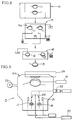
- FIG. 8 is a conceptual diagram showing an example of the apparatus which implements the TiN film formation method of the present invention.
- FIG. 9 is a conceptual diagram showing the ion plating apparatus used by the apparatus shown in FIG. 8.
- FIG. 10 is a conceptual diagram that shows an example of a heat treatment apparatus used in the apparatus shown in FIG. 8.
- FIG. 11 is a conceptual diagram that shows another example of the heat treatment apparatus used in the apparatus shown in FIG. 8.
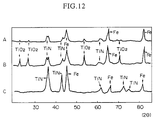
- FIG. 12 is a diagram that shows the result of an X-ray diffraction in order to explain an embodiment of the present invention.
- FIG. 3 shows an example of an ion plating apparatus used in the manufacture of a frying pan (1) according to the method of the first embodiment of the present invention.
- the inside of this ion plating apparatus (5) is maintained at a vacuum of about 10 ⁇ 5 to 10 ⁇ 7 Torr by a vacuum pump (6).
- Several hundred volts are applied to the body (2) of the frying pan arranged inside of the ion plating apparatus (5).
- Titanium (7) (a coating material) is placed on the side opposite to the body (2) of this frying pan.
- an ion electrode (8) which uses Ar gas for Argon cleaning the surface before the film formation of the frying pan body (2), and adds nitrogen to the atmosphere for heating and evaporation during film formation followed further by ionisation.
- the inner surface (the surface to be coated) of the frying pan body (2) is first ground to a mirror finish and has removed from it any unevenness such as cutting marks from the lathe or oil sumps. Debris or oil is removed from the pan by means of the washing and degreasing of the ground surface. Once the frying pan body (2) has completed such pretreatment, it is placed inside the ion plating apparatus (5).
- the titanium (7) is subjected to ion bombardment in an Ar atmosphere and heated by an electron beam issued from the ion electrode (8).
- the titanium (7) is evaporated, and the evaporated particles are ionized.
- the ionised particles have high kinetic energy and collide strongly with and attach to the frying pan body (2), so that a Ti layer (3) is formed over the surface of the frying pan body (2).
- the voltage applied to the frying pan body (2) is lowered, and nitrogen is introduced into the ion plating apparatus (5) through a nitrogen supply passage (9) in order to maintain the pressure inside the apparatus (5) at about 10 ⁇ 5 Torr.
- the aforementioned ionised titanium particles and the nitrogen are caused to react by the above operation so as to attach TiN to the Ti layer (3) on the surface of the frying pan body (2), and a uniform TiN layer (4) 2 to 3 micron thick is formed thereon.
- a frying pan (1) is thus manufactured by the above operation.
- FIG. 1 shows the frying pan manufactured by such a method, wherein the numeral 1 denotes the frying pan.
- This frying pan is, as shown in FIG. 2, composed by providing a 2 to 3 micron thick TiN layer (4) on the inside of the frying pan body (2), which is made from a metallic material such as steel by means of a Ti layer (3) several hundred angstroms thick.
- the above Ti layer (3) is formed directly over the surface of the frying pan body (2) and is very firmly attached thereto.
- the TiN layer (4) is firmly formed in close contact with the Ti layer (3), so that the TiN layer (4) is securely joined to the frying pan body (2).
- the frying pan (1) manufactured by this method is provided on the surface of the body (2) thereof, with the TiN layer (4) producing a beautiful golden color, thereby improving the cosmetic properties of the pan, and conferring a feeling of high quality thereto.
- the TiN layer has high hardness (about Hv2000 in Vickers' hardness), it is possible to improve the durability of the pan's surface. Furthermore, because the TiN layer (4) is chemically stable, it does not react to burned food and is excellent in its resistance to burning, the frying pan (1) will not allow food to burn while cooking and even if food is burned, it can be easily removed therefrom.
- the frying pan is given as an example, but a relatively shallow pan can be produced instead of a frying pan.
- the TiN layer is formed only on the inside surface of the frying pan body, but the TiN layer can also be formed over the entire surface, including the handle, or only a part of the inside surface.
- the apparatus shown in FIG. 3 was used to form at 2 to 3 micron TiN layer over the surface of a steel frying pan by means of an approximately 200 A Ti layer, and a frying pan having the same composition as the one shown in FIG. 1 (hereinafter referred to as the TiN-coated frying pan) was thus manufactured.
- a TiN coated frying pan a traditional steel frying pan (uncoated) and a Teflon coated frying pan, were used to conduct the following experiments.
- the results of this experiment are shown in FIG. 4 and FIG. 5.
- the burning levels shown in these diagrams are expressed as an absolute value of the weight of the burned portion of the fish, where the amount of burned fish cooked on an uncoated frying pan is taken to be 100.
- kiao-tz dumplings stuffed with minced pork
- Fifty dumplings of almost the same size were prepared for one frying pan; three types of unused frying pans similar to those used in the first experiment were prepared; and the fifty dumplings were placed on their cooking planes.
- the three types of frying pans with the dumplings were placed on household gas burners and were heated simultaneously for about five minutes with a strong flame of the same intensity. Afterwards, the number of burned dumplings was counted.
- the TiN-coated frying pan had no scratches and maintained a lustrous shine.
- FIG. 8 is a diagram to explain the second embodiment of the present invention, in which the numeral 11 denotes a substrate of the frying pan, 12 a frying pan formed with TiN film thereon, 13 a frying pan processed for color stabilization, 14 a grinding and washing apparatus, 15 an ion plating apparatus, and 16 denotes a heat treatment apparatus which accomplishes the color tone stabilization process.
- the surface of the frying pan substrate (11) is first ground and cleaned by the grinding and washing apparatus (14).
- the frying pan substrate (11) is composed of a metallic material such as steel. Because the frying pan substrate (11) may be uneven or have dust, oils, or fats attached to the surface where the film is to be formed (which could cause reduced adhesion of the TiN film to the substrate during the formation process thereof), the surface is ground, degreased and washed clean with demineralized water, acid, alkali and the like within the grinding and washing apparatus (14).
- the TiN film is formed on the surface of the frying pan substrate (11), which has been pretreated in such a manner, by the ion plating apparatus (15).
- the ion plating apparatus (15) comprising the body (15A) of the apparatus as shown in FIG.
- a crucible (18) in which the film-formation material titanium (17) is to be placed a power source for a substrate of an integrated circuit (19), a gas (Ar, N2) supply regulator (20), an ionization electrode (21), an electron beam apparatus (22), a vacuum apparatus (23), a heater (24), and a gas (Ar, N2) supply opening (25).
- a gas (Ar, N2) supply regulator (20) an ionization electrode (21), an electron beam apparatus (22), a vacuum apparatus (23), a heater (24), and a gas (Ar, N2) supply opening (25).
- Ar gas is injected into the apparatus by the gas supply regulator (20) to accomplish ion bombardment in the Ar atmosphere over the surface of the frying pan substrate (11).
- the titanium (17) placed in the crucible (18) is heated and evaporated by the electron beam apparatus (22) to produce Ti particles.
- the Ti particles are ionized by the ionization electrode (21) to cause the ionised Ti particle to collide with the surface of the frying pan substrate (11), thereby forming the Ti film.
- the applied voltage of the frying pan substrate (11) is lowered, and N2 is introduced from the gas supply opening (25) into the body of the ion plating apparatus (15A).
- the internal pressure of the ion plating apparatus (15) is then adjusted to about 10 ⁇ 5 Torr by the gas (Ar, N2) supply regulator (20).
- the ionised Ti particles above and the N2 that was also ionised are caused to react by the ionization electrode (21) and form a 2 to 3 micron TiN film over the Ti film formed on the surface of the frying pan substrate (11), thereby manufacturing a frying pan (12).
- the frying pan (12) is then placed in the heat treatment apparatus (16). As shown in FIG.
- the heat treatment apparatus (16) comprising the body (16A) of the heat treatment apparatus, a nitrogen (N2) cylinder (26), an oxygen (O2) cylinder (27), a purifier (28, 29), a heater (30), a shelf (31), and a pump (32).
- the heater (30) is used to heat the TiN-formed frying pan (12) to 350 to 500 o C to form a uniform TiO2 film of about several hundred angstroms over the TiN film surface, thereby obtaining a frying pan (13) with a TiN film of stabilized color tone.
- the temperature conditions (350 to 500 o C) used for the above operation are set to a level which is close to the upper limit where the frying pan is used at high temperatures, and yet the golden color of TiN is not lost.
- the color tone of the heat-treated TiN film can be changed to various tones by changing the composition ratio of Ti:N while forming TiN film by the ion plating method.
- a frying pan (13) in which the surface of the frying pan substrate (11) is provided with a TiN film having excellent color tone stability during high-temperature cooking.
- this method of forming TiN film it is possible to stabilize the TiN film color tone while heating by forming a very thin TiO2 film over the TiN surface, which is produced by heating Ti in the TiN film in a mixed atmosphere of oxygen and nitrogen.
- the Ti/N ratio which is among the conditions used for film formation with the ion plating apparatus, it becomes possible to form a TiN film of various color tones.
- the frying pan obtained by the aforementioned method will have an improved appearance and will acquire a feeling of high quality because the TiN film is a beautiful gold color. Because the TiN film has a stable color tone, it will not change color when heated during cooking, and its beautiful gold color can be maintained over a long period of time.
- a apparatus similar to that used in the above embodiments is used and a frying pan (12) is obtained by forming a TiN film over the surface of the frying pan substrate (11) through operations similar to the ones above.
- the frying pan (12) obtained in such manner is placed in a heat treatment apparatus (33) shown in FIG. 11.
- the heat treatment apparatus (33) comprising the body (33A) of the heat treatment apparatus, a nitrogen (N2) cylinder (34), a purifier (35), a heater (36), a shelf (37), and a pump (38).
- the frying pan (12) is placed on the shelf (37), and N2 is supplied from the N2 cylinder (34) into the heat treatment apparatus body (33A) through the purifier (35).
- the inside of the heat treatment body (33A) is maintained in an N2 atmosphere (760 to 765 Torr).
- the frying pan (12) is heated to 350 to 600 o C by the heater (36) under the above conditions so as to diffuse the nitrogen into the TiN film, and the Ti remaining in the TiN during film formation becomes TiN.
- the TiN film is formed using the ion plating method, but other film forming methods such as the spattering, metalization or the chemical vapor deposition method may be used to form the TiN film.
- the method for this invention is applied when manufacturing frying pans, but this invention's method can also be applied to various cooking utensils for heating other than frying pans such as a pan with a relatively shallow bottom or a spatula.
- the apparatus shown in FIG. 8 through FIG. 11 was used to manufacture a frying pan which has a color tone stabilized TiN film on its surface.
- the frying pan substrate body (11) was placed in the grinding and washing apparatus (14), the surface thereof is ground, washed first with water then with demineralized water, acid, bose, again with water and finally with alcohol.
- this substrate (11) was then placed in the ion plating apparatus body (15A).
- the inside of the ion plating apparatus body (15A) was maintained in a vacuum, about 10 ⁇ 5 to 10 ⁇ 7 Torr in the vacuum apparatus (23), and several hundred volts were applied to the installed frying pan substrate (11).
- the argon gas was injected into the apparatus which bombarded the frying pan substrate (11) with ions in an argon gas atmosphere, and a 200A thick layer of Ti was formed over the surface of the frying pan substrate (11).
- the applied voltage of the frying pan substrate (11) was lowered, N2 was injected into the ion plating apparatus body (15A) by the gas supply regulator (20), the internal pressure of the ion plating apparatus body (15A) is maintained at about 10 ⁇ 5 Torr, and a 2 to 3 micron TiN layer was formed.
- the frying pan (12) obtained by the aforementioned method was placed on the shelf inside the heat treatment apparatus body (16A), N2 and O2 were supplied into the heat treatment apparatus body (16A) from the N2 cylinder (26) and the O2 cylinder (27), respectively, through the purifier (28, 29).
- a frying pan (called embodiment A) with a TiN-film surface and a gold color tone was obtained.
- the frying pan (12) was placed on the shelf (37) in the heat treatment apparatus (33), N2 was supplied from the nitrogen cylinder (34) into the heat treatment apparatus body (33A) through the N2 purifier (35).
- the inside of the heat treatment apparatus body (33A) was maintained in an N2 atmosphere (760 to 765 Torr) in the manner stated above, and the frying pan was heated to 350 o C by the heater (36) under such conditions.
- a frying pan (called embodiment D) formed with a TiN-film surface and a pure gold color tone was obtained.
- the frying pan of embodiment A and a frying pan (called the compared sample) coated with TiN that was not provided with color tone stabilization treatment were heated to 300 o C.
- the frying pan of the compared sample changed color to yellow with a tinge of black.
- X-ray diffraction tests were carried out on each of the heated frying pans. The results of the X-ray diffraction tests are shown in FIG. 12.
- the symbol "A” shown in FIG. 12 denotes a frying pan of embodiment A provided with the TiN coating and heated to 300 o C
- the symbol “B” denotes a frying pan of the compared sample uncoated and heated to 300 o C
- the symbol “C” denotes a frying pan of the compared sample provided with the TiN coating.
- a 300 o C heating test was also conducted on the frying pan of embodiment D, but no discoloration was observed.
- the frying pans of embodiment A and embodiment D were used for long-term tests in which fish and rice cakes were baked, but both frying pans burned no food at all.
- the method of forming the TiN film and the pan according to the present invention has the following effects:
Landscapes
- Chemical & Material Sciences (AREA)
- Engineering & Computer Science (AREA)
- Mechanical Engineering (AREA)
- Chemical Kinetics & Catalysis (AREA)
- Materials Engineering (AREA)
- Metallurgy (AREA)
- Organic Chemistry (AREA)
- General Chemical & Material Sciences (AREA)
- Thermal Sciences (AREA)
- Physics & Mathematics (AREA)
- Food Science & Technology (AREA)
- Inorganic Chemistry (AREA)
- Frying-Pans Or Fryers (AREA)
- Physical Vapour Deposition (AREA)
- Cookers (AREA)
Applications Claiming Priority (5)
| Application Number | Priority Date | Filing Date | Title |
|---|---|---|---|
| JP6927490U JPH0729951Y2 (ja) | 1990-06-29 | 1990-06-29 | 調理用鍋類 |
| JP69274/90U | 1990-06-29 | ||
| JP176968/90 | 1990-07-04 | ||
| JP2176968A JPH0774448B2 (ja) | 1990-07-04 | 1990-07-04 | 調理用鍋類 |
| PCT/JP1990/000974 WO1992000032A1 (en) | 1990-06-29 | 1990-07-31 | Method of forming titanium nitride coating and pan made by this method |
Publications (3)
| Publication Number | Publication Date |
|---|---|
| EP0489914A1 true EP0489914A1 (de) | 1992-06-17 |
| EP0489914A4 EP0489914A4 (en) | 1993-07-14 |
| EP0489914B1 EP0489914B1 (de) | 1996-04-17 |
Family
ID=26410470
Family Applications (1)
| Application Number | Title | Priority Date | Filing Date |
|---|---|---|---|
| EP90910902A Expired - Lifetime EP0489914B1 (de) | 1990-06-29 | 1990-07-31 | Verfahren zum bilden einer titan-nitrid deckschicht und pfanne gefertigt mittels dieses verfahrens |
Country Status (7)
| Country | Link |
|---|---|
| US (1) | US5447803A (de) |
| EP (1) | EP0489914B1 (de) |
| CN (1) | CN1057867A (de) |
| AU (1) | AU648258B2 (de) |
| CA (1) | CA2065303A1 (de) |
| DE (1) | DE69026619T2 (de) |
| WO (1) | WO1992000032A1 (de) |
Cited By (10)
| Publication number | Priority date | Publication date | Assignee | Title |
|---|---|---|---|---|
| BE1008276A3 (nl) * | 1994-01-25 | 1996-03-05 | Finem Naamloze Vennootschap | Recipient voor voedingswaren. |
| EP0704187A4 (de) * | 1994-04-06 | 1996-05-15 | ||
| FR2760621A1 (fr) * | 1997-03-14 | 1998-09-18 | Thermocompact Sa | Article culinaire a surface de contact alimentaire |
| US6197438B1 (en) * | 1998-03-11 | 2001-03-06 | Roger Faulkner | Foodware with ceramic food contacting surface |
| FR2807071A1 (fr) * | 2000-03-28 | 2001-10-05 | Dja Dodane Jean Et Associes | Revetement anti-adherent ceramo-metallique pour ustensiles culinaires |
| FR2862512A1 (fr) * | 2003-11-25 | 2005-05-27 | Opus 69 | Revetement pour interface professionnelle de cuisson des aliments |
| FR2862511A1 (fr) * | 2003-11-25 | 2005-05-27 | Opus 69 | Revetement pour interfaces professionnelles de cuisson des aliments |
| EP1595970A1 (de) * | 2004-05-05 | 2005-11-16 | Opus 69 | Kochfläche für Vorrichtungen in Gemeinschafts- und Gaststättenküchen |
| CN111387807A (zh) * | 2020-05-11 | 2020-07-10 | 珠海格力电器股份有限公司 | 烹饪器具及其烹饪控制方法、装置、系统 |
| CN111975294A (zh) * | 2020-07-30 | 2020-11-24 | 江门市伊尔乐厨卫电器有限公司 | 铁质压力锅生产工艺及铁质压力锅锅盖生产工艺 |
Families Citing this family (35)
| Publication number | Priority date | Publication date | Assignee | Title |
|---|---|---|---|---|
| JP2634771B2 (ja) * | 1993-06-16 | 1997-07-30 | 日本冶金工業株式会社 | 電磁調理器用容器及びその製造方法 |
| CN1049017C (zh) * | 1995-05-31 | 2000-02-02 | 西南交通大学 | 一种在人工器官表面沉积氧化钛和氮化钛复合膜的方法 |
| CA2241421A1 (en) * | 1995-12-29 | 1997-07-10 | Illinois Tool Works Inc. | Coating for cooking vessel |
| US6604941B2 (en) * | 1996-03-29 | 2003-08-12 | Garth W. Billings | Refractory crucibles and molds for containing reactive molten metals and salts |
| US5766784A (en) * | 1996-04-08 | 1998-06-16 | Battelle Memorial Institute | Thin films and uses |
| US7093340B2 (en) | 1997-12-16 | 2006-08-22 | All-Clad Metalcrafters Llc | Stick resistant ceramic coating for cookware |
| US6360423B1 (en) | 1997-12-16 | 2002-03-26 | Clad Metals Llc | Stick resistant coating for cookware |
| US6245435B1 (en) | 1999-03-01 | 2001-06-12 | Moen Incorporated | Decorative corrosion and abrasion resistant coating |
| US7026057B2 (en) | 2002-01-23 | 2006-04-11 | Moen Incorporated | Corrosion and abrasion resistant decorative coating |
| US6906295B2 (en) * | 2003-02-20 | 2005-06-14 | National Material L.P. | Foodware with multilayer stick resistant ceramic coating and method of making |
| US6942935B2 (en) * | 2003-03-24 | 2005-09-13 | National Material Ip | Foodware with a tarnish-resistant ceramic coating and method of making |
| CN1240331C (zh) * | 2004-02-02 | 2006-02-08 | 吉林大学 | 不粘炊具 |
| US7337518B2 (en) * | 2004-03-19 | 2008-03-04 | Meyer Intellectual Properties Limited | Method of fabricating titanium lined composite cookware |
| US20050205582A1 (en) * | 2004-03-19 | 2005-09-22 | Meyer Intellectual Properties Ltd. | Titanium based composite cookware |
| DE102005017327B4 (de) * | 2005-04-14 | 2007-08-30 | EKATO Rühr- und Mischtechnik GmbH | Bearbeitungsanlage |
| US8569665B2 (en) * | 2006-10-17 | 2013-10-29 | Meyer Intellectual Properties Limited | Cookware with tarnish protected copper exterior |
| US8021768B2 (en) | 2009-04-07 | 2011-09-20 | National Material, L.P. | Plain copper foodware and metal articles with durable and tarnish free multiplayer ceramic coating and method of making |
| CN101734920B (zh) * | 2009-12-04 | 2012-07-04 | 西安交通大学 | 一种氮化钛多孔陶瓷及其制备方法 |
| CN102340953A (zh) * | 2010-07-28 | 2012-02-01 | 鸿富锦精密工业(深圳)有限公司 | 具有色彩的外壳及其制备方法 |
| CN102378512A (zh) * | 2010-08-16 | 2012-03-14 | 鸿富锦精密工业(深圳)有限公司 | 壳体及其制作方法 |
| CN102373413A (zh) * | 2010-08-26 | 2012-03-14 | 鸿富锦精密工业(深圳)有限公司 | 壳体的制作方法及由该方法制得的壳体 |
| CN102469709A (zh) * | 2010-11-11 | 2012-05-23 | 鸿富锦精密工业(深圳)有限公司 | 壳体及其制作方法 |
| US9833101B2 (en) * | 2011-04-01 | 2017-12-05 | Nuwave, Llc | Pan and method for making |
| US20130161336A1 (en) * | 2011-12-27 | 2013-06-27 | Meyer Intellectual Properties Ltd. | Laminated Cookware Having Microscopic And Macroscopic Clad Constructions |
| CN103540942B (zh) * | 2012-07-10 | 2017-08-25 | 深圳富泰宏精密工业有限公司 | 金属基体表面处理方法及其制品 |
| FR2998464B1 (fr) * | 2012-11-26 | 2015-05-22 | Seb Sa | Dispositif de cuisson comportant une surface de cuisson facile a nettoyer et resistant a la rayure |
| CN107960848B (zh) * | 2013-03-15 | 2020-02-04 | 全包层金属制品公司 | 制造用于炊具制造的选择性粘接复合材料的方法 |
| CN103349491A (zh) * | 2013-07-11 | 2013-10-16 | 郑新科 | 钛或钛合金复合锅及制备工艺 |
| DE102014205413A1 (de) * | 2014-03-24 | 2015-09-24 | Siemens Aktiengesellschaft | Beschichtungsverfahren und Bauteil |
| US10151021B2 (en) | 2015-09-30 | 2018-12-11 | Apple Inc. | Durable cosmetic finishes for titanium surfaces |
| CN108823552A (zh) * | 2018-06-19 | 2018-11-16 | 南昌大学 | 一种氮化钛/二氧化钛纳米复合耐蚀涂层的制备方法 |
| USD980667S1 (en) | 2019-07-03 | 2023-03-14 | Primus Ab | Cooking pot |
| CN113679253A (zh) * | 2020-05-18 | 2021-11-23 | 佛山市顺德区美的电热电器制造有限公司 | 容器及烹饪器具 |
| DE102023204491A1 (de) | 2023-05-12 | 2024-11-14 | Matthias Gurris | Kochgeschirr mit einer dekorativer Schicht und Verfahren zur Herstellung einer dekorativen Schicht |
| CN121313013A (zh) * | 2024-07-13 | 2026-01-13 | 浙江新唐实业有限公司 | 一种烹饪器具 |
Family Cites Families (11)
| Publication number | Priority date | Publication date | Assignee | Title |
|---|---|---|---|---|
| JPS4918604A (de) * | 1972-06-05 | 1974-02-19 | ||
| JPS5836671B2 (ja) * | 1976-06-07 | 1983-08-10 | シチズン時計株式会社 | 表面処理方法 |
| DE2705225C2 (de) * | 1976-06-07 | 1983-03-24 | Nobuo Tokyo Nishida | Ornamentteil für Uhren usw. |
| JPS5662961A (en) * | 1979-10-26 | 1981-05-29 | Mitsubishi Metal Corp | Surface coated sintered hard alloy member for cutting tool |
| DE3142312A1 (de) * | 1981-10-24 | 1983-05-05 | Degussa Ag, 6000 Frankfurt | Beschichtetes geschirr zum zubereiten von speisen |
| JPS6014831A (ja) * | 1983-07-05 | 1985-01-25 | 株式会社東芝 | 調理具 |
| JPS60208472A (ja) * | 1984-04-02 | 1985-10-21 | Citizen Watch Co Ltd | イオンプレ−テイング被膜の製法 |
| JPS6257576A (ja) * | 1985-09-05 | 1987-03-13 | 株式会社角野刃物 | 調理用、理美容用及び医療用刃物 |
| JPS6318049A (ja) * | 1986-07-11 | 1988-01-25 | Kawasaki Steel Corp | 超低鉄損一方向性けい素鋼板の製造方法 |
| JPH0614831A (ja) * | 1992-02-13 | 1994-01-25 | Tokai Plast Kk | 容 器 |
| JPH06318049A (ja) * | 1993-05-10 | 1994-11-15 | Kawasaki Steel Corp | 液晶表示器セグメントドライブ回路 |
-
1990
- 1990-07-31 AU AU60531/90A patent/AU648258B2/en not_active Ceased
- 1990-07-31 DE DE69026619T patent/DE69026619T2/de not_active Expired - Fee Related
- 1990-07-31 CA CA002065303A patent/CA2065303A1/en not_active Abandoned
- 1990-07-31 WO PCT/JP1990/000974 patent/WO1992000032A1/ja not_active Ceased
- 1990-07-31 EP EP90910902A patent/EP0489914B1/de not_active Expired - Lifetime
- 1990-09-03 CN CN90107238.9A patent/CN1057867A/zh active Pending
-
1993
- 1993-12-20 US US08/171,248 patent/US5447803A/en not_active Expired - Fee Related
Cited By (12)
| Publication number | Priority date | Publication date | Assignee | Title |
|---|---|---|---|---|
| BE1008276A3 (nl) * | 1994-01-25 | 1996-03-05 | Finem Naamloze Vennootschap | Recipient voor voedingswaren. |
| EP0704187A4 (de) * | 1994-04-06 | 1996-05-15 | ||
| FR2760621A1 (fr) * | 1997-03-14 | 1998-09-18 | Thermocompact Sa | Article culinaire a surface de contact alimentaire |
| EP0870458A1 (de) * | 1997-03-14 | 1998-10-14 | Thermocompact | Kochgerät mit lebensmittelechter Kontaktfläche |
| US6197438B1 (en) * | 1998-03-11 | 2001-03-06 | Roger Faulkner | Foodware with ceramic food contacting surface |
| FR2807071A1 (fr) * | 2000-03-28 | 2001-10-05 | Dja Dodane Jean Et Associes | Revetement anti-adherent ceramo-metallique pour ustensiles culinaires |
| US6699303B2 (en) | 2000-03-28 | 2004-03-02 | Dja Dodane Jean Et Associes Dja Cristel | Non-stick ceramo-metallic coating for cooking utensils |
| FR2862512A1 (fr) * | 2003-11-25 | 2005-05-27 | Opus 69 | Revetement pour interface professionnelle de cuisson des aliments |
| FR2862511A1 (fr) * | 2003-11-25 | 2005-05-27 | Opus 69 | Revetement pour interfaces professionnelles de cuisson des aliments |
| EP1595970A1 (de) * | 2004-05-05 | 2005-11-16 | Opus 69 | Kochfläche für Vorrichtungen in Gemeinschafts- und Gaststättenküchen |
| CN111387807A (zh) * | 2020-05-11 | 2020-07-10 | 珠海格力电器股份有限公司 | 烹饪器具及其烹饪控制方法、装置、系统 |
| CN111975294A (zh) * | 2020-07-30 | 2020-11-24 | 江门市伊尔乐厨卫电器有限公司 | 铁质压力锅生产工艺及铁质压力锅锅盖生产工艺 |
Also Published As
| Publication number | Publication date |
|---|---|
| CA2065303A1 (en) | 1991-12-30 |
| CN1057867A (zh) | 1992-01-15 |
| AU648258B2 (en) | 1994-04-21 |
| AU6053190A (en) | 1992-01-23 |
| DE69026619T2 (de) | 1996-11-28 |
| EP0489914B1 (de) | 1996-04-17 |
| EP0489914A4 (en) | 1993-07-14 |
| US5447803A (en) | 1995-09-05 |
| DE69026619D1 (de) | 1996-05-23 |
| WO1992000032A1 (en) | 1992-01-09 |
Similar Documents
| Publication | Publication Date | Title |
|---|---|---|
| EP0489914B1 (de) | Verfahren zum bilden einer titan-nitrid deckschicht und pfanne gefertigt mittels dieses verfahrens | |
| US7462375B2 (en) | Method of making a stick resistant multi-layer ceramic coating | |
| EP2417282B1 (de) | Metallische Gegenstände für Speisezwecke, bevorzugt aus blankem Kupfer, mit langlebigem und anlauffreiem, keramischen, mehrlagigen Überzug und Herstellungsverfahren | |
| US6360423B1 (en) | Stick resistant coating for cookware | |
| CA2611288C (en) | Seasoned ferrous cookware | |
| US6942935B2 (en) | Foodware with a tarnish-resistant ceramic coating and method of making | |
| FR2516020A1 (fr) | Procede d'obtention d'objets decoratifs | |
| EP0247922A1 (de) | Kochgefäss mit einem Bräunungsüberzug für Mikrowellenöfen und Verfahren zum Herstellen des Überzuges | |
| US3773543A (en) | Process for the production of luster color coatings on ceramic, glass of similar bodies | |
| MXPA05005918A (es) | Aparato calentador recubierto con un revestimiento de auto-limipeza. | |
| JPH0729951Y2 (ja) | 調理用鍋類 | |
| JPH0774448B2 (ja) | 調理用鍋類 | |
| JPH07207446A (ja) | チタン系被膜の形成方法 | |
| JPH0351015A (ja) | 有機物固着防止処理法および加熱調理用器具 | |
| KR20040025275A (ko) | 표면에 TiN층을 갖는 주방용품의 제조방법 | |
| JPS6389285A (ja) | 刃物及びその製造方法 | |
| JPS62109964A (ja) | 装飾用イオンプレ−テイング方法 |
Legal Events
| Date | Code | Title | Description |
|---|---|---|---|
| PUAI | Public reference made under article 153(3) epc to a published international application that has entered the european phase |
Free format text: ORIGINAL CODE: 0009012 |
|
| 17P | Request for examination filed |
Effective date: 19920227 |
|
| AK | Designated contracting states |
Kind code of ref document: A1 Designated state(s): CH DE FR GB IT LI |
|
| A4 | Supplementary search report drawn up and despatched |
Effective date: 19930526 |
|
| AK | Designated contracting states |
Kind code of ref document: A4 Designated state(s): CH DE FR GB IT LI |
|
| 17Q | First examination report despatched |
Effective date: 19950216 |
|
| GRAH | Despatch of communication of intention to grant a patent |
Free format text: ORIGINAL CODE: EPIDOS IGRA |
|
| GRAA | (expected) grant |
Free format text: ORIGINAL CODE: 0009210 |
|
| AK | Designated contracting states |
Kind code of ref document: B1 Designated state(s): CH DE FR GB IT LI |
|
| REG | Reference to a national code |
Ref country code: CH Ref legal event code: NV Representative=s name: PATENTANWALTSBUERO EDER AG |
|
| REF | Corresponds to: |
Ref document number: 69026619 Country of ref document: DE Date of ref document: 19960523 |
|
| ITF | It: translation for a ep patent filed | ||
| ET | Fr: translation filed | ||
| PLBE | No opposition filed within time limit |
Free format text: ORIGINAL CODE: 0009261 |
|
| STAA | Information on the status of an ep patent application or granted ep patent |
Free format text: STATUS: NO OPPOSITION FILED WITHIN TIME LIMIT |
|
| 26N | No opposition filed | ||
| PGFP | Annual fee paid to national office [announced via postgrant information from national office to epo] |
Ref country code: DE Payment date: 19970704 Year of fee payment: 8 |
|
| PGFP | Annual fee paid to national office [announced via postgrant information from national office to epo] |
Ref country code: CH Payment date: 19970714 Year of fee payment: 8 |
|
| PGFP | Annual fee paid to national office [announced via postgrant information from national office to epo] |
Ref country code: FR Payment date: 19970718 Year of fee payment: 8 |
|
| PGFP | Annual fee paid to national office [announced via postgrant information from national office to epo] |
Ref country code: GB Payment date: 19970722 Year of fee payment: 8 |
|
| PG25 | Lapsed in a contracting state [announced via postgrant information from national office to epo] |
Ref country code: LI Free format text: LAPSE BECAUSE OF NON-PAYMENT OF DUE FEES Effective date: 19980731 Ref country code: GB Free format text: LAPSE BECAUSE OF NON-PAYMENT OF DUE FEES Effective date: 19980731 Ref country code: CH Free format text: LAPSE BECAUSE OF NON-PAYMENT OF DUE FEES Effective date: 19980731 |
|
| REG | Reference to a national code |
Ref country code: CH Ref legal event code: PL |
|
| GBPC | Gb: european patent ceased through non-payment of renewal fee |
Effective date: 19980731 |
|
| PG25 | Lapsed in a contracting state [announced via postgrant information from national office to epo] |
Ref country code: FR Free format text: LAPSE BECAUSE OF NON-PAYMENT OF DUE FEES Effective date: 19990331 |
|
| PG25 | Lapsed in a contracting state [announced via postgrant information from national office to epo] |
Ref country code: DE Free format text: LAPSE BECAUSE OF NON-PAYMENT OF DUE FEES Effective date: 19990501 |
|
| REG | Reference to a national code |
Ref country code: FR Ref legal event code: ST |
|
| PG25 | Lapsed in a contracting state [announced via postgrant information from national office to epo] |
Ref country code: IT Free format text: LAPSE BECAUSE OF NON-PAYMENT OF DUE FEES Effective date: 20050731 |