EP0489924A1 - Compose cristallin thermostable resultant de la modification de colorants et production de ce compose - Google Patents
Compose cristallin thermostable resultant de la modification de colorants et production de ce compose Download PDFInfo
- Publication number
- EP0489924A1 EP0489924A1 EP91911362A EP91911362A EP0489924A1 EP 0489924 A1 EP0489924 A1 EP 0489924A1 EP 91911362 A EP91911362 A EP 91911362A EP 91911362 A EP91911362 A EP 91911362A EP 0489924 A1 EP0489924 A1 EP 0489924A1
- Authority
- EP
- European Patent Office
- Prior art keywords
- dye
- crystalline form
- water
- preparing
- soluble organic
- Prior art date
- Legal status (The legal status is an assumption and is not a legal conclusion. Google has not performed a legal analysis and makes no representation as to the accuracy of the status listed.)
- Withdrawn
Links
- 0 *C(C=C([C@]1N=Nc(c(*)c2)cc(C=O)c2N)Br)=CC1N=O Chemical compound *C(C=C([C@]1N=Nc(c(*)c2)cc(C=O)c2N)Br)=CC1N=O 0.000 description 1
Images

Classifications
-
- C—CHEMISTRY; METALLURGY
- C09—DYES; PAINTS; POLISHES; NATURAL RESINS; ADHESIVES; COMPOSITIONS NOT OTHERWISE PROVIDED FOR; APPLICATIONS OF MATERIALS NOT OTHERWISE PROVIDED FOR
- C09B—ORGANIC DYES OR CLOSELY-RELATED COMPOUNDS FOR PRODUCING DYES, e.g. PIGMENTS; MORDANTS; LAKES
- C09B67/00—Influencing the physical, e.g. the dyeing or printing properties of dyestuffs without chemical reactions, e.g. by treating with solvents grinding or grinding assistants, coating of pigments or dyes; Process features in the making of dyestuff preparations; Dyestuff preparations of a special physical nature, e.g. tablets, films
- C09B67/0025—Crystal modifications; Special X-ray patterns
- C09B67/0028—Crystal modifications; Special X-ray patterns of azo compounds
- C09B67/0029—Crystal modifications; Special X-ray patterns of azo compounds of monoazo compounds
-
- C—CHEMISTRY; METALLURGY
- C09—DYES; PAINTS; POLISHES; NATURAL RESINS; ADHESIVES; COMPOSITIONS NOT OTHERWISE PROVIDED FOR; APPLICATIONS OF MATERIALS NOT OTHERWISE PROVIDED FOR
- C09B—ORGANIC DYES OR CLOSELY-RELATED COMPOUNDS FOR PRODUCING DYES, e.g. PIGMENTS; MORDANTS; LAKES
- C09B67/00—Influencing the physical, e.g. the dyeing or printing properties of dyestuffs without chemical reactions, e.g. by treating with solvents grinding or grinding assistants, coating of pigments or dyes; Process features in the making of dyestuff preparations; Dyestuff preparations of a special physical nature, e.g. tablets, films
- C09B67/0025—Crystal modifications; Special X-ray patterns
Definitions
- the present invention relates to a heat-stable crystalline modification of a dye and a process for preparing the same.
- a dye represented by the formula (I) has been known by Japanese Patent Publication (KOKOKU) No.61-37391(1986): It is known that the dye represented by the formula (I) dyes a synthetic fiber, for example, a polyethylene terephthalate fiber, navy blue.
- the heat-unstable crystalline form of the dye represented by the formula (I) (this will be hereinafter referred to as the ⁇ -crystal form) can be prepared according to a known method, by diazotizing 6-bromo-2,4-dinitroaniline and then coupling the diazotization product with 3-N,N-diallyloxyethylamino-4-methoxyacetanilide in an acid medium.
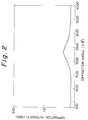
- the ⁇ -crystal form is in the so-called amorphous form, exhibiting, for example, a diffraction pattern with a gentle slope as shown in Fig. 2 in a Cu-K ⁇ line diffractometry.
- dispersants for example, a sodium salt of formalin condensates of naphthalenesulfonic acid or a sodium salt of lignin sulfonic acid, in a sand mill or the like according to a customary commercialization method and then applied to dyeing of a woven fabric of a polyester fiber or a blended woven fabric of a polyester fiber with an acrylic fiber, cotton or the like
- the ⁇ -crystal form since the ⁇ -crystal form is instable to heat, it makes dye particles tarry or forms agglomerates at a temperature of 95 to 135°C, at which a polyester fiber is dyed.
- the tarry substance and the bulked dye particles hinder uniform dyeing.
- the agglomerated particle of the dye is filtered by a fiber layer and becomes causative of clogging, failure of internal penetration, and casing spots, which not only makes it impossible to attain uniform dyed material but also brings about a problem, for example, of lowering in the fastness of the dyed material.
- the present inventors have made earnest studies with a view to eliminating the above-described drawbacks and, as a result, have found a crystalline form of the dye represented by the formula (I), which is stable to heat and very excellent in the dyeing stability at a high temperature.
- the present invention has been accomplished based on this finding.
- the present invention relates to a heat-stable crystalline form of the dye represented by the formula (I): characterized by an X-ray diffraction pattern (Fig. 1) having strong peaks at the angles of diffraction (2 ⁇ ) [°] of 8.6, 24.7, 25.0 and 25.3 and relatively strong peaks at the angles of diffraction (2 ⁇ ) [°] of 4.9, 19.1, 21.5, 22.4, 23.1 and 26.2 according to X-ray powder diffractometry by a Cu-K ⁇ line (this will be hereinafter referred to as the ⁇ -crystal form) and a process for preparing the same. (An error within a usual range ( ⁇ 0.2) for an angle of diffraction is regarded as tolerable.)
- the heat-unstable ⁇ -crystal form of the dye represented by the formula (I) can be prepared according to the above-mentioned known method. That is, it can be obtain by diazotizing 6-bromo-2,4-dinitroaniline and coupling the diazotization product with 3-N,N-diallyloxyethylamino-4-methoxyacetanilide in an acid medium.
- the ⁇ -crystal form of the dye represented by the formula (I), which is stable in the dyeing at a high temperature can be prepared by heating a wet cake or a dried cake of the ⁇ -crystal form thus formed in water, a water-soluble organic solvent, a mixed solvent of water and a water-soluble organic solvent, or the solvent containing an anionic or nonionic surfactant at a temperature of 40°C or above.
- the solvent may be added preferably by 5 to 100 parts by weight based on one part by weight (dry basis) of the ⁇ -crystal form.
- the treating time may be prolonged or shortened according to need.
- the ⁇ -crystal form is transformed into the ⁇ -crystal form by, for example, heating at a temperature of 40 to 200°C, preferably 50 to 100°C for about 1 to 3 hr. Although further prolongation of the treating time brings about no problem, it is disadvantageous from the viewpoint of economy. It is preferred to add the water-soluble organic solvent usually by 5 to 50% by weight based on the water and the surfactant by 0.1 to 50% by weight based on water or the sum of water and the water-soluble organic solvent.
- Crystal transformation from the ⁇ -crystal form to the ⁇ -crystal form can be also conducted without by way of a filtration step, i.e., by heating the reaction solution after the coupling reaction as it is, by heating the reaction solution after adjusting pH to 3 to 6 with sodium hydroxide, sodium carbonate or sodium hydrogen carbonate, or by heating the reaction solution after adding a required amount of a water-soluble organic solvent and/or anionic or nonionic surfactant and adjusting pH in the same manner as described above, at a temperature higher than 40°C, preferably, 40 to 200°C and, more preferably, 50 to 100°C for about 1 to 3 hours.
- the water-soluble organic solvent or the surfactant may be added prior to the coupling reaction so long as it gives no undesired effect on the coupling reaction.
- crystal transformation from the ⁇ -crystal form to the ⁇ -crystal form is also possible by adjusting the pH of the reaction solution in the same way as above after the completion of the coupling reaction and by applying a heat treatment as a relatively low temperature (for example, 15 to 40°C).
- a heat treatment as a relatively low temperature (for example, 15 to 40°C).
- It is preferred to add the water-soluble organic solvent usually by 5 to 50% by weight based on water and the surfactant by 0.1 to 50% by weight based on water or the sum of the water and the water-soluble organic solvent.
- water-soluble organic solvent usable herein can include lower alcohols such as methanol, ethanol, isopropyl alcohol and butyl alcohol, ethylene glycol monoalkyl ethers such as methyl cellosolve, ethyl cellosolve and butyl cellosolve, glycols such as ethylene glycol, ketones such as acetone and methyl ethyl ketone, and cyclic ethers such as tetrahydrofuran and dioxane.
- lower alcohols such as methanol, ethanol, isopropyl alcohol and butyl alcohol
- ethylene glycol monoalkyl ethers such as methyl cellosolve, ethyl cellosolve and butyl cellosolve
- glycols such as ethylene glycol
- ketones such as acetone and methyl ethyl ketone
- cyclic ethers such as tetrahydrofuran and dioxane.
- examples of the anionic surfactant can include salts of ⁇ -naphthalenesulfonic acid-formalin condensates, and salts of ligninsulfonic acid
- examples of the nonionic surfactant can include sorbitan fatty acid esters, polyoxyethylene sorbitan fatty acid esters, polyoxyethylene alkyl ethers, polyoxyethylene alkylphenols and polyoxyethylene alkylamides. These may be used alone or in a combination of two or more of them.
- Examples of the fibers which can be dyed with the dye having the ⁇ -crystal form of the present invention can include a polyethylene terephthalate fiber, and a blended spinning product or a blended woven fabric comprising the same and a natural fiber such as cotton, silk or wool.
- a cake of the dye of ⁇ -crystal form is usually dispersed minutely in an aqueous medium in the presence of a dispersant such as salts of condensates of naphthalenesulfonic acid and formalin, an ester of a higher alcohol with sulfuric acid or a higher alkylbenzenesulfonate, to prepare a dye bath or a printing paste, and dip dyeing or printing treatment can be conducted by using it.
- Dyeing is conducted usually at a pH 4 to 7 and at a temperature of 80 to 220°C.
- the dye of the present invention can be applied, for example, to dyeing processes such as high temperature dyeing (120 to 140°C of dying temperature), e.g., Obermaier dyeing, cheese dyeing and beam dyeing method, carrier dyeing method (80 to 110°C of dying temperature) or thermosol dyeing method (180 to 220°C of dying temperature).
- high temperature dyeing 120 to 140°C of dying temperature
- Obermaier dyeing e.g., Obermaier dyeing, cheese dyeing and beam dyeing method
- carrier dyeing method 80 to 110°C of dying temperature
- thermosol dyeing method 180 to 220°C of dying temperature
- the dye compound of the formula (I) having the ⁇ -crystal form according to the present invention Upon conducting dying, it is possible to use the dye compound of the formula (I) having the ⁇ -crystal form according to the present invention in combination with other dye, or various compounding additives may be added in the step of preparing a disperse dye composition.
- Fig. 1 is an X-ray diffraction pattern of the heat-stable ⁇ -crystal form.
- Fig. 2 is an X-ray diffraction pattern of the heat-unstable ⁇ -crystal form (amorphous).
- the abscissa represents an angle of diffraction (2 ⁇ ), while the ordinate represents the intensity of diffraction.
- the cake of the dye compound was dispersed in 500 ml of water and heat-treated at 70 to 75°C for one hour while stirring. After treatment, a cake of the dye compound was obtained by filtration. The cake of the dye compound was found to be ⁇ -crystal form showing the X-ray diffraction pattern as shown in Fig. 1, as a result of analysis by X-ray diffractometry.
- the resultant dye compound had the same X-ray diffraction pattern as that shown in Fig. 1, and was found to be ⁇ -crystal form.
- the ⁇ -crystal form was obtained in the same procedure as that of Example 2, by using 7.5 g of Rheodol TW-O (polyoxyethylene sorbitan nonionic surfactant, manufactured by Kao Atlas Co., Ltd.) instead of the surfactant used for conversion of crystalline form in Example 2.
- Rheodol TW-O polyoxyethylene sorbitan nonionic surfactant, manufactured by Kao Atlas Co., Ltd.
- the ⁇ -crystal form was obtained in the same procedure as that of Example 2, by using 30 g of ethylene glycol monomethyl ether instead of the surfactant used for conversion of crystalline form in Example 2.
- a solution of a diazotization product was prepared in the same manner as in Example 1. To a solution obtained by dissolving a predetermined coupler into an aqueous solution of sulfuric acid and, further, adding 1.25 g of Rheodol TW-O, the solution of the diazotization product was added dropwise at a temperature of 0°C or below to conduct coupling. After the completion of the addition, it was maintained at a temperature of 0 to 5°C for 2 hours and then neutralized with sodium carbonate to Congo Red neutrality. Further, after maintaining it at a temperature of 15 to 25°C for one hour, it was filtered and washed with water. The resultant crystal of the dye compound showed ⁇ -form.
- 21 g of a dye compound having the ⁇ -crystal form or the ⁇ -crystal form was subjected to wet grinding together with 21 g of a sodium salt of naphthalenesulfonic acid-formalin condensate and 28 g of a sodium salt of naphthalenesulfonic acid-cresolsulfonic acid-formalin condensate by means of a sand grind mill and, subsequently, it was dried in vacuo to prepare dispersed dye compositions, respectively.
- a dispersed dye composition was dispersed in 100 ml of water and pH was adjusted to 4.5 with acetic acid and sodium acetate to obtain a dye bath.
- the dye bath was heated from 60°C to 130°C over a period of 40 min without immersing a fiber (blank bath) and, after being maintained at 130°C for 10 min, cooled to 95°C within 5 min.
- the dye bath was subjected to suction filtration with a quantitative filter paper (Toyo filter paper No. 5A), and visual judgment was conducted based on the amount and the state of the residue remaining on the filter paper, according to the following five ratings of 5th grade (excellent) to 1st grade (poor). 5th grade: no residues were observed at all 4th grade: slight residues were observed 3rd grade: some residues were observed 2nd grade: considerable residues were observed 1st grade: residues were remarkable
- 0.6 g of a dispersed dye composition was dispersed in 180 ml of water and pH was adjusted to 4.5 with acetic acid and sodium acetate to obtain a dye bath.
- 10 g of a Tetoron jersey was immersed in the dye bath and heated from 60°C to 130°C over a period of 40 min and, after being maintained at 130°C for 10 min, cooled to 60°C to complete dyeing.
- a color pet dying machine was used for the dyeing.
- the heat-stable crystalline form ( ⁇ -crystal form) of the dye compound shown by the formula (I) according to the present invention exhibits an excellent dispersion stability also in dyeing at a high temperature and can provide a dyed product of a uniform dyeing depth.
- the ⁇ -crystal form of the dye compound is useful, in particular, to the dyeing of polyester that requires a high temperature.
Landscapes
- Chemical & Material Sciences (AREA)
- Chemical Kinetics & Catalysis (AREA)
- Organic Chemistry (AREA)
- Coloring (AREA)
- Thermal Transfer Or Thermal Recording In General (AREA)
- Heat Sensitive Colour Forming Recording (AREA)
Abstract
Composé cristallin résultant de la modification d'un colorant représenté par la formule (I), caractérisé par un motif de diffraction de rayons X présentant des pics importants à des angles de diffraction 2 correspondant à 8,6, 24,7, 25,0 et 25,3 degrés et des pics moins importants à des angles de diffraction 2 correspondant à 4,9, 19,1, 21,5, 22,4, 23,1 et 26,2 degrés. Ce composé est thermostable et présente une excellente dispersibilité à haute température, et permet d'obtenir un article coloré de manière uniforme présentant une excellente solidité des couleurs même lors de teintures effectuées à une température égale ou supérieure à 130 °C.
Applications Claiming Priority (2)
| Application Number | Priority Date | Filing Date | Title |
|---|---|---|---|
| JP2168472A JP2772998B2 (ja) | 1990-06-28 | 1990-06-28 | 染料の熱に安定な結晶変態 |
| JP168472/90 | 1990-06-28 |
Publications (2)
| Publication Number | Publication Date |
|---|---|
| EP0489924A1 true EP0489924A1 (fr) | 1992-06-17 |
| EP0489924A4 EP0489924A4 (en) | 1992-07-22 |
Family
ID=15868741
Family Applications (1)
| Application Number | Title | Priority Date | Filing Date |
|---|---|---|---|
| EP19910911362 Withdrawn EP0489924A4 (en) | 1990-06-28 | 1991-06-20 | Thermally stable crystal modification of dye and production thereof |
Country Status (4)
| Country | Link |
|---|---|
| EP (1) | EP0489924A4 (fr) |
| JP (1) | JP2772998B2 (fr) |
| KR (1) | KR920702396A (fr) |
| WO (1) | WO1992000356A1 (fr) |
Cited By (1)
| Publication number | Priority date | Publication date | Assignee | Title |
|---|---|---|---|---|
| US5942603A (en) * | 1996-03-19 | 1999-08-24 | Nippon Kayaku Co., Ltd. | Thermally stable crystal modification of dyestuff, process for production thereof, and method of dyeing hydrophobic fiber with it |
Family Cites Families (2)
| Publication number | Priority date | Publication date | Assignee | Title |
|---|---|---|---|---|
| JPS5557076A (en) * | 1978-10-14 | 1980-04-26 | Nippon Kayaku Kk | Dyeing and printing of hydrophobic fiber |
| JP2628363B2 (ja) * | 1988-12-15 | 1997-07-09 | 日本化薬株式会社 | 染料の結晶変態及びその製造法 |
-
1990
- 1990-06-28 JP JP2168472A patent/JP2772998B2/ja not_active Expired - Fee Related
-
1991
- 1991-06-20 KR KR1019920700071A patent/KR920702396A/ko not_active Withdrawn
- 1991-06-20 WO PCT/JP1991/000826 patent/WO1992000356A1/fr not_active Ceased
- 1991-06-20 EP EP19910911362 patent/EP0489924A4/en not_active Withdrawn
Cited By (1)
| Publication number | Priority date | Publication date | Assignee | Title |
|---|---|---|---|---|
| US5942603A (en) * | 1996-03-19 | 1999-08-24 | Nippon Kayaku Co., Ltd. | Thermally stable crystal modification of dyestuff, process for production thereof, and method of dyeing hydrophobic fiber with it |
Also Published As
| Publication number | Publication date |
|---|---|
| JP2772998B2 (ja) | 1998-07-09 |
| EP0489924A4 (en) | 1992-07-22 |
| KR920702396A (ko) | 1992-09-03 |
| JPH0457855A (ja) | 1992-02-25 |
| WO1992000356A1 (fr) | 1992-01-09 |
Similar Documents
| Publication | Publication Date | Title |
|---|---|---|
| EP0373525B1 (fr) | Forme cristalline d'un colorant et son procédé d'obtention | |
| JPS6368669A (ja) | 水溶性ジスアゾ化合物、その製法及び該化合物を染料として使用する方法 | |
| US4453944A (en) | Dye stable to dyeing, processes for producing it, and its use for dyeing and printing synthetic and semi-synthetic fibre materials | |
| JPH0311315B2 (fr) | ||
| JP2772998B2 (ja) | 染料の熱に安定な結晶変態 | |
| JP2647939B2 (ja) | アゾ染料の製造方法 | |
| JP2628383B2 (ja) | 染料の熱に安定な結晶変態及びその製造法 | |
| JP2628381B2 (ja) | 染料の結晶変態及びその製造法 | |
| JP2628367B2 (ja) | 染料の熱に安定な結晶変態及びその製造法 | |
| KR100302539B1 (ko) | 염료의열에안정한결정변형체,그의제조방법및그것을사용하는소수성섬유의염색방법 | |
| JP2628382B2 (ja) | 染料の熱に安定な結晶変態及びその製造法 | |
| JPH10245503A (ja) | 染料の熱に安定な結晶変態、その製造方法及びこれを用いる疎水性繊維の染色方法 | |
| JP3105368B2 (ja) | 熱に安定な結晶変態を有するアゾ染料の混合物及びその製造法 | |
| US5019132A (en) | Process for the preparation of concentrated 1:2 metal complex dye preparations | |
| JPH05222316A (ja) | 熱に安定な結晶変態及びこれを用いる染色法 | |
| JP3032591B2 (ja) | 水不溶性染料混合物 | |
| GB2054632A (en) | Improvements in or relating to organic compounds | |
| EP0433693A1 (fr) | Colorants monoazoiques insolubles dans l'eau et leurs mélanges | |
| JPH042625B2 (fr) | ||
| JPH03265666A (ja) | 染料の結晶変態及びそれによる染色法 | |
| JPS63210172A (ja) | 結晶構造を有するモノアゾベンゾチアゾ−ル化合物、その製造法およびそれを用いて疎水性繊維材料を染色する方法 | |
| JPH03163170A (ja) | 水不溶性モノアゾ染料 | |
| JPH093352A (ja) | 水不溶性赤色系モノアゾ染料 | |
| JPS591749B2 (ja) | 染色安定性の分散染料及びその製法 | |
| JPS5996169A (ja) | ピリドンアゾ化合物 |
Legal Events
| Date | Code | Title | Description |
|---|---|---|---|
| PUAI | Public reference made under article 153(3) epc to a published international application that has entered the european phase |
Free format text: ORIGINAL CODE: 0009012 |
|
| AK | Designated contracting states |
Kind code of ref document: A1 Designated state(s): CH DE GB LI |
|
| A4 | Supplementary search report drawn up and despatched |
Effective date: 19920605 |
|
| AK | Designated contracting states |
Kind code of ref document: A4 Designated state(s): CH DE GB LI |
|
| 17P | Request for examination filed |
Effective date: 19920702 |
|
| STAA | Information on the status of an ep patent application or granted ep patent |
Free format text: STATUS: THE APPLICATION HAS BEEN WITHDRAWN |
|
| 18W | Application withdrawn |
Withdrawal date: 19930417 |