EP0490678A2 - Verfahren zur Herstellung von Fibrillen aus Zelluloseester - Google Patents
Verfahren zur Herstellung von Fibrillen aus Zelluloseester Download PDFInfo
- Publication number
- EP0490678A2 EP0490678A2 EP91311566A EP91311566A EP0490678A2 EP 0490678 A2 EP0490678 A2 EP 0490678A2 EP 91311566 A EP91311566 A EP 91311566A EP 91311566 A EP91311566 A EP 91311566A EP 0490678 A2 EP0490678 A2 EP 0490678A2
- Authority
- EP
- European Patent Office
- Prior art keywords
- solvent
- fibrets
- cellulose ester
- mixture
- separation zone
- Prior art date
- Legal status (The legal status is an assumption and is not a legal conclusion. Google has not performed a legal analysis and makes no representation as to the accuracy of the status listed.)
- Ceased
Links
- 229920002678 cellulose Polymers 0.000 title claims abstract description 34
- 238000000034 method Methods 0.000 title claims abstract description 25
- 238000004519 manufacturing process Methods 0.000 title abstract description 9
- 239000002904 solvent Substances 0.000 claims abstract description 50
- 239000000203 mixture Substances 0.000 claims abstract description 21
- 239000002002 slurry Substances 0.000 claims abstract description 15
- 229920006395 saturated elastomer Polymers 0.000 claims abstract description 7
- 238000000926 separation method Methods 0.000 claims abstract 12
- CSCPPACGZOOCGX-UHFFFAOYSA-N Acetone Chemical group CC(C)=O CSCPPACGZOOCGX-UHFFFAOYSA-N 0.000 claims description 23
- XLYOFNOQVPJJNP-UHFFFAOYSA-N water Substances O XLYOFNOQVPJJNP-UHFFFAOYSA-N 0.000 claims description 14
- 229920002301 cellulose acetate Polymers 0.000 claims description 11
- 239000011877 solvent mixture Substances 0.000 claims description 11
- 238000001556 precipitation Methods 0.000 claims description 6
- 239000006187 pill Substances 0.000 claims description 5
- JBTWLSYIZRCDFO-UHFFFAOYSA-N ethyl methyl carbonate Chemical compound CCOC(=O)OC JBTWLSYIZRCDFO-UHFFFAOYSA-N 0.000 claims description 3
- 238000001914 filtration Methods 0.000 claims description 3
- 238000010008 shearing Methods 0.000 claims description 3
- 239000007787 solid Substances 0.000 claims description 3
- 239000007788 liquid Substances 0.000 abstract description 6
- 239000003960 organic solvent Substances 0.000 description 7
- 239000007921 spray Substances 0.000 description 4
- ZWEHNKRNPOVVGH-UHFFFAOYSA-N 2-Butanone Chemical compound CCC(C)=O ZWEHNKRNPOVVGH-UHFFFAOYSA-N 0.000 description 3
- XEKOWRVHYACXOJ-UHFFFAOYSA-N Ethyl acetate Chemical compound CCOC(C)=O XEKOWRVHYACXOJ-UHFFFAOYSA-N 0.000 description 3
- OKKJLVBELUTLKV-UHFFFAOYSA-N Methanol Chemical compound OC OKKJLVBELUTLKV-UHFFFAOYSA-N 0.000 description 3
- GWEVSGVZZGPLCZ-UHFFFAOYSA-N Titan oxide Chemical compound O=[Ti]=O GWEVSGVZZGPLCZ-UHFFFAOYSA-N 0.000 description 3
- 239000001913 cellulose Substances 0.000 description 3
- IKHGUXGNUITLKF-UHFFFAOYSA-N Acetaldehyde Chemical compound CC=O IKHGUXGNUITLKF-UHFFFAOYSA-N 0.000 description 2
- LFQSCWFLJHTTHZ-UHFFFAOYSA-N Ethanol Chemical compound CCO LFQSCWFLJHTTHZ-UHFFFAOYSA-N 0.000 description 2
- 239000000654 additive Substances 0.000 description 2
- TZCXTZWJZNENPQ-UHFFFAOYSA-L barium sulfate Chemical compound [Ba+2].[O-]S([O-])(=O)=O TZCXTZWJZNENPQ-UHFFFAOYSA-L 0.000 description 2
- 230000015572 biosynthetic process Effects 0.000 description 2
- 239000012141 concentrate Substances 0.000 description 2
- 230000001419 dependent effect Effects 0.000 description 2
- 150000002148 esters Chemical class 0.000 description 2
- 238000010438 heat treatment Methods 0.000 description 2
- 239000000463 material Substances 0.000 description 2
- 238000005549 size reduction Methods 0.000 description 2
- 229920002284 Cellulose triacetate Polymers 0.000 description 1
- 229920002488 Hemicellulose Polymers 0.000 description 1
- 241000208125 Nicotiana Species 0.000 description 1
- 235000002637 Nicotiana tabacum Nutrition 0.000 description 1
- 229920001131 Pulp (paper) Polymers 0.000 description 1
- NNLVGZFZQQXQNW-ADJNRHBOSA-N [(2r,3r,4s,5r,6s)-4,5-diacetyloxy-3-[(2s,3r,4s,5r,6r)-3,4,5-triacetyloxy-6-(acetyloxymethyl)oxan-2-yl]oxy-6-[(2r,3r,4s,5r,6s)-4,5,6-triacetyloxy-2-(acetyloxymethyl)oxan-3-yl]oxyoxan-2-yl]methyl acetate Chemical compound O([C@@H]1O[C@@H]([C@H]([C@H](OC(C)=O)[C@H]1OC(C)=O)O[C@H]1[C@@H]([C@@H](OC(C)=O)[C@H](OC(C)=O)[C@@H](COC(C)=O)O1)OC(C)=O)COC(=O)C)[C@@H]1[C@@H](COC(C)=O)O[C@@H](OC(C)=O)[C@H](OC(C)=O)[C@H]1OC(C)=O NNLVGZFZQQXQNW-ADJNRHBOSA-N 0.000 description 1
- 230000021736 acetylation Effects 0.000 description 1
- 238000006640 acetylation reaction Methods 0.000 description 1
- 238000005054 agglomeration Methods 0.000 description 1
- 230000002776 aggregation Effects 0.000 description 1
- 125000001797 benzyl group Chemical group [H]C1=C([H])C([H])=C(C([H])=C1[H])C([H])([H])* 0.000 description 1
- 206010061592 cardiac fibrillation Diseases 0.000 description 1
- 229920006217 cellulose acetate butyrate Polymers 0.000 description 1
- 239000004927 clay Substances 0.000 description 1
- 230000015271 coagulation Effects 0.000 description 1
- 238000005345 coagulation Methods 0.000 description 1
- 239000000284 extract Substances 0.000 description 1
- 230000002600 fibrillogenic effect Effects 0.000 description 1
- 238000000265 homogenisation Methods 0.000 description 1
- 229910052500 inorganic mineral Inorganic materials 0.000 description 1
- 239000011707 mineral Substances 0.000 description 1
- 239000004745 nonwoven fabric Substances 0.000 description 1
- TWNQGVIAIRXVLR-UHFFFAOYSA-N oxo(oxoalumanyloxy)alumane Chemical compound O=[Al]O[Al]=O TWNQGVIAIRXVLR-UHFFFAOYSA-N 0.000 description 1
- 229920000642 polymer Polymers 0.000 description 1
- OVARTBFNCCXQKS-UHFFFAOYSA-N propan-2-one;hydrate Chemical compound O.CC(C)=O OVARTBFNCCXQKS-UHFFFAOYSA-N 0.000 description 1
- 239000000779 smoke Substances 0.000 description 1
- 239000004408 titanium dioxide Substances 0.000 description 1
- OGIDPMRJRNCKJF-UHFFFAOYSA-N titanium oxide Inorganic materials [Ti]=O OGIDPMRJRNCKJF-UHFFFAOYSA-N 0.000 description 1
- 238000002166 wet spinning Methods 0.000 description 1
Images
Classifications
-
- D—TEXTILES; PAPER
- D01—NATURAL OR MAN-MADE THREADS OR FIBRES; SPINNING
- D01D—MECHANICAL METHODS OR APPARATUS IN THE MANUFACTURE OF ARTIFICIAL FILAMENTS, THREADS, FIBRES, BRISTLES OR RIBBONS
- D01D5/00—Formation of filaments, threads, or the like
- D01D5/40—Formation of filaments, threads, or the like by applying a shearing force to a dispersion or solution of filament formable polymers, e.g. by stirring
-
- D—TEXTILES; PAPER
- D01—NATURAL OR MAN-MADE THREADS OR FIBRES; SPINNING
- D01F—CHEMICAL FEATURES IN THE MANUFACTURE OF ARTIFICIAL FILAMENTS, THREADS, FIBRES, BRISTLES OR RIBBONS; APPARATUS SPECIALLY ADAPTED FOR THE MANUFACTURE OF CARBON FILAMENTS
- D01F2/00—Monocomponent artificial filaments or the like of cellulose or cellulose derivatives; Manufacture thereof
- D01F2/24—Monocomponent artificial filaments or the like of cellulose or cellulose derivatives; Manufacture thereof from cellulose derivatives
- D01F2/28—Monocomponent artificial filaments or the like of cellulose or cellulose derivatives; Manufacture thereof from cellulose derivatives from organic cellulose esters or ethers, e.g. cellulose acetate
Definitions
- This invention relates to an improved process for the production of cellulose ester fibrets.
- this invention relates to a process for the production of cellulose ester fibrets substantially free of chips and pills.
- the invention relates to an improved cellulose ester fibret process for separating an organic solvent from the produced fibrets.
- Short fibrillar cellulose ester material are employed in a variety of applications such as in the manufacture of tobacco smoke filters and as a replacement for clay and titanium dioxide in paper opacification.
- Fibrets can be produced using an unstable wet spinning process in which the fibrets are precipitated out of an organic solution of the polymer and formed, in a non-solvent, under controlled conditions. The formed fibrets are in a mixture of the organic solvent and non-solvent. The mixture can then be screened or filtered to increase the fibret concentration and the fibret concentrate thereafter heated to evaporate the organic solvent.
- the heating step is conducted indirectly in a steam-jacketed vessel.
- This method of separating the organic solvent is unsatisfactory because of the formation of large clots of fused fibrets, referred to as "chips", on the heated vessel walls. These chips plug up piping and equipment.
- the formation of chips can be eliminated by replacing the indirect heating step with the introduction of live superheated steam into the mixture.
- the resultant fibrets are chip-free but contain agglomerations of fused fibrets having diameters of less than 1 mm, referred to as "pills".
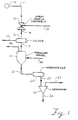
- Figure 1 is a schematic flow sheet of the process of the invention.
- a supply 10 of cellulose ester in a liquid mixture is prepared, such liquid mixture comprising two miscible components: an organic solvent such as acetone, methyl ethyl ketone, acetaldehyde or ethyl acetate and a miscible liquid non-solvent for the cellulose ester such as water, methanol or ethanol.
- the liquid non-solvent comprises from about 2 to about 20 percent by weight of the solvent and non-solvent mixture.
- the preferred organic solvent is acetone which is miscible with the preferred nonsolvent, water.
- the cellulose esters of this invention include cellulose acetate, cellulose triacetate, cellulose acetate butyrate, benzyl cellulose, or mixtures thereof with cellulose acetate being the preferred cellulose ester.
- the cellulose esters of this invention are prepared from an acetylation grade wood pulp with higher than 90 percent by weight of hemicellulose. It is also preferred that high purity cellulose esters be employed.
- the concentration of cellulose ester in the solvent and nonsolvent mixture should preferably be from about 5 to about 15 percent by weight with the particular concentration of the cellulose ester being dependent upon the method selected to form the fibrets.
- the cellulose ester, solvent and non-solvent mixture is then introduced into the precipitation non-solvent in a fibret precipitation zone under shearing conditions.
- the shearing high velocity of the non-solvent stream in the venturi throat region attenuates the cellulose ester-solvent mixture and additionally extracts the solvent, forming fibrets.
- concentration of the cellulose ester in the solvent and non-solvent mixture By changing the concentration of the cellulose ester in the solvent and non-solvent mixture, the flow rate of non-solvent, the non-solvent temperature or by adding solvents to the non-solvent stream, the size, degree of fibrillation and length of the fibrets can be controlled.
- the term "fibret" as employed herein refers to a high surface area, cellulose ester fibrillar material having surface areas in excess of 5.0 square meters per gram, lengths of less than 1000 microns and diameters of from about 0.5 to 50 microns.
- Mineral additives such as titanium oxide, barium sulfate and aluminum oxide can be included in the cellulose ester-solvent mixture passed to the capillary needle. If included, the concentration of such additives can be up to 75 percent of the weight of the cellulose ester as part of the total solids.
- filter means 16 can comprise a commercially available screen which forms a thickened slurry of the fibrets which is passed via conduit 15 to a pressure vessel 19. A mixture of the solvent and non-solvent is withdrawn from filter means 16 via conduit 17.
- Saturated steam is introduced into pressure vessel 19 via conduit 20 at a rate so as to maintain the hereafter described temperature.
- the pressure within pressure vessel 20 is normally within the range of about 0 to about 15 pounds per square inch gauge (psig) and the temperature within vessel is such as to separate substantially all of the remaining solvent from the fibrets at the vessel pressure.
- psig pounds per square inch gauge
- the pressure within vessel 20 is in the range of about 10 psig to about 12 psig and the temperature is in the range of about 220° to about 140°.
- Vaporized solvent and non-solvent are withdrawn from pressure vessel 19 via conduit 18.
- the fully formed fibrets are withdrawn from pressure vessel 19 as a slurry in the non-solvent, normally less than 2.0 weight percent solids, via conduit 21 and passed to a homogenizer vessel 22 wherein size reduction of the large fibrets can be effected. Size reduction can be accomplished by passing the dilute slurry through a narrow orifice with a high pressure drop. After homogenization, the slurry can be passed to a non-solvent separator 24, such as a centrifuge, wherein the non-solvent is separated from the fibrets and withdrawn via conduit 27.
- Product pill-free fibrets normally containing from about 65 to about 88 weight percent non-solvent are withdrawn from separator 24 via conduit 26.
- the product fibrets of the invention can be used as filter aids and in the production of heavy weight paper.
- the fibrets because of their pill-free characteristics are particularly suitable in the production of fine paper, filtration paper, and lightweight nonwovens applications.
- the invention is further illustrated by the following example.
- a dilute fibret slurry comprising 0.44 weight percent cellulose acetate fibrets, 3.54 weight percent acetone and 96.2 weight percent water was passed to filter means 16.
- the slurry concentrate withdrawn from filter means 16 and passed to pressure vessel 19 comprised 2.00 weight percent cellulose acetate fibrets, 3.54 weight percent acetone and 94.46 weight percent water.
- the liquid stream withdrawn from filter means 16 comprised 3.5 weight percent acetone and 96.5 weight percent water.
- Saturated steam was introduced into pressure vessel 19 via conduit 20 at a rate and temperature so as to achieve and maintain a temperature in vessel 19 of 230° F.
- Vessel 19 was pressurized to a pressure of 10 psig.
- a vaporized stream comprising 12.2 weight percent acetone and 87.8 weight percent water was withdrawn from vessel 19 via conduit 18.
- the fibret slurry withdrawn from vessel 19 via conduit 21 comprised 1.94 weight percent cellulose acetate and 98.06 weight percent water and was substantially free of chips and pills.
Landscapes
- Engineering & Computer Science (AREA)
- Chemical & Material Sciences (AREA)
- Textile Engineering (AREA)
- Chemical Kinetics & Catalysis (AREA)
- General Chemical & Material Sciences (AREA)
- Dispersion Chemistry (AREA)
- Mechanical Engineering (AREA)
- Artificial Filaments (AREA)
- Paper (AREA)
Applications Claiming Priority (2)
| Application Number | Priority Date | Filing Date | Title |
|---|---|---|---|
| US627082 | 1990-12-14 | ||
| US07/627,082 US5175276A (en) | 1990-12-14 | 1990-12-14 | Process for the production of cellulose ester fibrets |
Publications (2)
| Publication Number | Publication Date |
|---|---|
| EP0490678A2 true EP0490678A2 (de) | 1992-06-17 |
| EP0490678A3 EP0490678A3 (en) | 1992-12-16 |
Family
ID=24513120
Family Applications (1)
| Application Number | Title | Priority Date | Filing Date |
|---|---|---|---|
| EP19910311566 Ceased EP0490678A3 (en) | 1990-12-14 | 1991-12-12 | Process for the production of cellulose ester fibrets |
Country Status (3)
| Country | Link |
|---|---|
| US (2) | US5175276A (de) |
| EP (1) | EP0490678A3 (de) |
| JP (1) | JPH04300316A (de) |
Families Citing this family (9)
| Publication number | Priority date | Publication date | Assignee | Title |
|---|---|---|---|---|
| US5175276A (en) * | 1990-12-14 | 1992-12-29 | Hoechst Celanese Corporation | Process for the production of cellulose ester fibrets |
| AU5183596A (en) * | 1995-03-06 | 1996-09-23 | Weyerhaeuser Company | Fibrous web having improved strength and method of making the same |
| RU2156839C2 (ru) * | 1996-03-06 | 2000-09-27 | Мицубиси Рэйон Ко., Лтд. | Волокна фибрилловой системы (варианты), формованное изделие, способ изготовления волокон фибрилловой системы, прядильная фильера для изготовления волокон фибрилловой системы |
| US5695647A (en) * | 1996-04-19 | 1997-12-09 | North Carolina State University | Methods of treating wastewater |
| DE19616010C2 (de) * | 1996-04-23 | 1998-07-09 | Seitz Filter Werke | Verfahren und Vorrichtung zur Herstellung von Fibrets (Fibriden) aus Zellulosederivaten |
| US7406603B1 (en) * | 1999-08-31 | 2008-07-29 | Intertrust Technologies Corp. | Data protection systems and methods |
| US6184373B1 (en) | 1999-09-03 | 2001-02-06 | Eastman Chemical Company | Method for preparing cellulose acetate fibers |
| WO2002037990A2 (en) * | 2000-11-10 | 2002-05-16 | Vector Tobacco Ltd. | Method and product for removing carcinogens from tobacco smoke |
| CN114834046B (zh) * | 2022-01-21 | 2024-06-04 | 深圳市纵维立方科技有限公司 | 打印控制方法、装置、可读存储介质及三维打印机 |
Family Cites Families (5)
| Publication number | Priority date | Publication date | Assignee | Title |
|---|---|---|---|---|
| GB429739A (en) * | 1933-12-05 | 1935-06-05 | British Celanese | Improvements in the manufacture of cellulose esters |
| US3342921A (en) * | 1966-03-16 | 1967-09-19 | West Virginia Pulp & Paper Co | Process for producing fibrous filler having high wet end retention |
| US4040856A (en) * | 1975-06-17 | 1977-08-09 | Crown Zellerbach Corporation | Production of discrete cellulose acetate fibers by emulsion flashing |
| US4047862A (en) * | 1975-10-24 | 1977-09-13 | Celanese Corporation | Cellulose ester fibrillar structure |
| US5175276A (en) * | 1990-12-14 | 1992-12-29 | Hoechst Celanese Corporation | Process for the production of cellulose ester fibrets |
-
1990
- 1990-12-14 US US07/627,082 patent/US5175276A/en not_active Expired - Lifetime
-
1991
- 1991-12-12 EP EP19910311566 patent/EP0490678A3/en not_active Ceased
- 1991-12-16 JP JP3332196A patent/JPH04300316A/ja active Pending
-
1992
- 1992-08-27 US US07/936,430 patent/US5316705A/en not_active Expired - Fee Related
Also Published As
| Publication number | Publication date |
|---|---|
| US5316705A (en) | 1994-05-31 |
| US5175276A (en) | 1992-12-29 |
| JPH04300316A (ja) | 1992-10-23 |
| EP0490678A3 (en) | 1992-12-16 |
Similar Documents
| Publication | Publication Date | Title |
|---|---|---|
| DE69622727T2 (de) | Verfahren zur herstellung einer mischung von cellulosischen fasern und mikrofasern | |
| DE69733415T2 (de) | Auf fibrillen basierende fasern, methode zu deren herstellung, dabei verwendete spinndüse und damit hergestellte formkörper | |
| US4047862A (en) | Cellulose ester fibrillar structure | |
| JP3251018B2 (ja) | メルトブロー形成布およびその製造方法およびその使用法 | |
| DE69719796T2 (de) | Verfahren zur herstellung eines vliesstoffes | |
| US6184373B1 (en) | Method for preparing cellulose acetate fibers | |
| US3342921A (en) | Process for producing fibrous filler having high wet end retention | |
| US5175276A (en) | Process for the production of cellulose ester fibrets | |
| US4192838A (en) | Process for producing filter material | |
| EP0850979B1 (de) | Verfahren zur Herstellung von Celluloseperlen | |
| US5071599A (en) | Process for the production of cellulose ester fibrets | |
| US4270914A (en) | Process for controlling hemicellulose concentration during the mercerization of cellulose | |
| US4283186A (en) | Method of forming cigarette filter material | |
| EP0725110A1 (de) | Herstellung geformter Gegenstände aus Celluloseacetat unter Verwendung eines überkritischem Fluids | |
| US4267002A (en) | Melt blowing process | |
| KR960011600B1 (ko) | 셀룰로오즈 아세테이트 필라멘트, 셀룰로오즈 아세테이트 필라멘트용의 광학 등방성 방사 용액, 및 이 용액의 필라멘트 제조에의 용도 | |
| DE4219658C2 (de) | Verfahren zur Herstellung von Cellulosefasern -filamenten und -folien nach dem Trocken-Naßextrusionsverfahren | |
| DE2402896C2 (de) | Verfahren zur Herstellung von Polymerfasern | |
| US5705631A (en) | Laminar flow process of preparing cellulose diacetate fibers | |
| EP0597658B1 (de) | Verfahren zum Flash-Spinnen von starken diskontinuierlichen Fasern | |
| DE2744796A1 (de) | Filtermaterial, seine herstellung und verwendung | |
| DE19959532C1 (de) | Verfahren und Vorrichtung zur Herstellung von filtrationsaktiven Fasern | |
| EP0454075B1 (de) | Verfahren zur Herstellung von Zigarettenfiltern | |
| JPH07502312A (ja) | 繊維状澱粉原料を製造するための装置および方法 | |
| US2943946A (en) | Manufacture of artificial materials |
Legal Events
| Date | Code | Title | Description |
|---|---|---|---|
| PUAI | Public reference made under article 153(3) epc to a published international application that has entered the european phase |
Free format text: ORIGINAL CODE: 0009012 |
|
| AK | Designated contracting states |
Kind code of ref document: A2 Designated state(s): AT BE CH DE DK ES FR GB GR IT LI LU NL SE |
|
| PUAL | Search report despatched |
Free format text: ORIGINAL CODE: 0009013 |
|
| AK | Designated contracting states |
Kind code of ref document: A3 Designated state(s): AT BE CH DE DK ES FR GB GR IT LI LU NL SE |
|
| 17P | Request for examination filed |
Effective date: 19930525 |
|
| 17Q | First examination report despatched |
Effective date: 19940525 |
|
| STAA | Information on the status of an ep patent application or granted ep patent |
Free format text: STATUS: THE APPLICATION HAS BEEN REFUSED |
|
| 18R | Application refused |
Effective date: 19960108 |