EP0491364A2 - Elektroaktive Verbindungen, Zusammensetzungen und Vorrichtungen und Verfahren zu deren Herstellung - Google Patents
Elektroaktive Verbindungen, Zusammensetzungen und Vorrichtungen und Verfahren zu deren Herstellung Download PDFInfo
- Publication number
- EP0491364A2 EP0491364A2 EP91121628A EP91121628A EP0491364A2 EP 0491364 A2 EP0491364 A2 EP 0491364A2 EP 91121628 A EP91121628 A EP 91121628A EP 91121628 A EP91121628 A EP 91121628A EP 0491364 A2 EP0491364 A2 EP 0491364A2
- Authority
- EP
- European Patent Office
- Prior art keywords
- ring system
- substituted
- carbons
- members
- substituents
- Prior art date
- Legal status (The legal status is an assumption and is not a legal conclusion. Google has not performed a legal analysis and makes no representation as to the accuracy of the status listed.)
- Withdrawn
Links
- 150000001875 compounds Chemical class 0.000 title claims abstract description 156
- 239000000203 mixture Substances 0.000 title claims abstract description 104
- 238000000034 method Methods 0.000 title claims description 50
- 230000003287 optical effect Effects 0.000 claims abstract description 52
- 230000005684 electric field Effects 0.000 claims abstract description 49
- 230000008859 change Effects 0.000 claims abstract description 40
- 230000005855 radiation Effects 0.000 claims abstract description 14
- 230000031700 light absorption Effects 0.000 claims abstract description 8
- 125000001424 substituent group Chemical group 0.000 claims description 80
- 229910052757 nitrogen Inorganic materials 0.000 claims description 69
- 229910052760 oxygen Inorganic materials 0.000 claims description 69
- 229910052717 sulfur Inorganic materials 0.000 claims description 66
- 229910052698 phosphorus Inorganic materials 0.000 claims description 64
- 125000004122 cyclic group Chemical group 0.000 claims description 57
- 229910052711 selenium Inorganic materials 0.000 claims description 54
- 229910052785 arsenic Inorganic materials 0.000 claims description 48
- 125000004429 atom Chemical group 0.000 claims description 42
- 125000000623 heterocyclic group Chemical group 0.000 claims description 42
- 125000006615 aromatic heterocyclic group Chemical group 0.000 claims description 41
- 125000005842 heteroatom Chemical group 0.000 claims description 41
- 229910052714 tellurium Inorganic materials 0.000 claims description 40
- -1 -N=O Chemical group 0.000 claims description 34
- 239000000178 monomer Substances 0.000 claims description 30
- 230000008569 process Effects 0.000 claims description 30
- 239000013307 optical fiber Substances 0.000 claims description 29
- 239000011159 matrix material Substances 0.000 claims description 26
- 239000000463 material Substances 0.000 claims description 25
- 229920000642 polymer Polymers 0.000 claims description 25
- 229910052787 antimony Inorganic materials 0.000 claims description 22
- 229910052801 chlorine Inorganic materials 0.000 claims description 22
- 229910052794 bromium Inorganic materials 0.000 claims description 21
- 229910052740 iodine Inorganic materials 0.000 claims description 21
- 229910052731 fluorine Inorganic materials 0.000 claims description 20
- 125000003118 aryl group Chemical group 0.000 claims description 19
- 238000010521 absorption reaction Methods 0.000 claims description 18
- BQCIDUSAKPWEOX-UHFFFAOYSA-N 1,1-Difluoroethene Chemical compound FC(F)=C BQCIDUSAKPWEOX-UHFFFAOYSA-N 0.000 claims description 16
- 125000000217 alkyl group Chemical group 0.000 claims description 16
- 239000013078 crystal Substances 0.000 claims description 15
- 239000007858 starting material Substances 0.000 claims description 15
- 125000004432 carbon atom Chemical group C* 0.000 claims description 14
- 238000005253 cladding Methods 0.000 claims description 14
- 125000000753 cycloalkyl group Chemical group 0.000 claims description 14
- 230000002441 reversible effect Effects 0.000 claims description 12
- BFKJFAAPBSQJPD-UHFFFAOYSA-N tetrafluoroethene Chemical group FC(F)=C(F)F BFKJFAAPBSQJPD-UHFFFAOYSA-N 0.000 claims description 12
- LFQSCWFLJHTTHZ-UHFFFAOYSA-N Ethanol Chemical compound CCO LFQSCWFLJHTTHZ-UHFFFAOYSA-N 0.000 claims description 10
- 229910052799 carbon Inorganic materials 0.000 claims description 10
- 230000006835 compression Effects 0.000 claims description 10
- 238000007906 compression Methods 0.000 claims description 10
- HCDGVLDPFQMKDK-UHFFFAOYSA-N hexafluoropropylene Chemical group FC(F)=C(F)C(F)(F)F HCDGVLDPFQMKDK-UHFFFAOYSA-N 0.000 claims description 10
- 229910052739 hydrogen Inorganic materials 0.000 claims description 10
- 239000007788 liquid Substances 0.000 claims description 10
- 239000004973 liquid crystal related substance Substances 0.000 claims description 9
- 229920001897 terpolymer Polymers 0.000 claims description 9
- 239000004988 Nematic liquid crystal Substances 0.000 claims description 7
- 239000000853 adhesive Substances 0.000 claims description 7
- 230000001070 adhesive effect Effects 0.000 claims description 7
- 150000001450 anions Chemical class 0.000 claims description 7
- 229920001577 copolymer Polymers 0.000 claims description 7
- 125000006575 electron-withdrawing group Chemical group 0.000 claims description 7
- WNZQDUSMALZDQF-UHFFFAOYSA-N 2-benzofuran-1(3H)-one Chemical class C1=CC=C2C(=O)OCC2=C1 WNZQDUSMALZDQF-UHFFFAOYSA-N 0.000 claims description 6
- 239000002253 acid Substances 0.000 claims description 6
- NIXOWILDQLNWCW-UHFFFAOYSA-N acrylic acid group Chemical group C(C=C)(=O)O NIXOWILDQLNWCW-UHFFFAOYSA-N 0.000 claims description 6
- 150000003973 alkyl amines Chemical class 0.000 claims description 6
- 150000002148 esters Chemical class 0.000 claims description 6
- OKTJSMMVPCPJKN-UHFFFAOYSA-N Carbon Chemical group [C] OKTJSMMVPCPJKN-UHFFFAOYSA-N 0.000 claims description 5
- QYKIQEUNHZKYBP-UHFFFAOYSA-N Vinyl ether Chemical compound C=COC=C QYKIQEUNHZKYBP-UHFFFAOYSA-N 0.000 claims description 5
- 125000002947 alkylene group Chemical class 0.000 claims description 5
- 125000002837 carbocyclic group Chemical group 0.000 claims description 5
- 125000002915 carbonyl group Chemical group [*:2]C([*:1])=O 0.000 claims description 5
- 150000001732 carboxylic acid derivatives Chemical class 0.000 claims description 5
- 229920002981 polyvinylidene fluoride Polymers 0.000 claims description 5
- 230000002378 acidificating effect Effects 0.000 claims description 4
- 230000002427 irreversible effect Effects 0.000 claims description 4
- 150000003839 salts Chemical class 0.000 claims description 4
- 125000002348 vinylic group Chemical group 0.000 claims description 4
- UHKAJLSKXBADFT-UHFFFAOYSA-N 1,3-indandione Chemical compound C1=CC=C2C(=O)CC(=O)C2=C1 UHKAJLSKXBADFT-UHFFFAOYSA-N 0.000 claims description 3
- 150000001721 carbon Chemical group 0.000 claims description 3
- 230000001678 irradiating effect Effects 0.000 claims description 3
- 125000005395 methacrylic acid group Chemical group 0.000 claims description 3
- 239000003880 polar aprotic solvent Substances 0.000 claims description 3
- 229910052710 silicon Inorganic materials 0.000 claims description 3
- 229920006029 tetra-polymer Polymers 0.000 claims description 3
- JHPBZFOKBAGZBL-UHFFFAOYSA-N (3-hydroxy-2,2,4-trimethylpentyl) 2-methylprop-2-enoate Chemical compound CC(C)C(O)C(C)(C)COC(=O)C(C)=C JHPBZFOKBAGZBL-UHFFFAOYSA-N 0.000 claims description 2
- HRPVXLWXLXDGHG-UHFFFAOYSA-N Acrylamide Chemical compound NC(=O)C=C HRPVXLWXLXDGHG-UHFFFAOYSA-N 0.000 claims description 2
- 229910052732 germanium Inorganic materials 0.000 claims description 2
- 230000007062 hydrolysis Effects 0.000 claims description 2
- 238000006460 hydrolysis reaction Methods 0.000 claims description 2
- 150000001457 metallic cations Chemical class 0.000 claims description 2
- 125000002485 formyl group Chemical class [H]C(*)=O 0.000 claims 7
- 150000001768 cations Chemical class 0.000 claims 2
- 229920000106 Liquid crystal polymer Polymers 0.000 claims 1
- 239000004977 Liquid-crystal polymers (LCPs) Substances 0.000 claims 1
- SNWQUNCRDLUDEX-UHFFFAOYSA-N inden-1-one Chemical compound C1=CC=C2C(=O)C=CC2=C1 SNWQUNCRDLUDEX-UHFFFAOYSA-N 0.000 claims 1
- 238000000206 photolithography Methods 0.000 claims 1
- 239000000243 solution Substances 0.000 description 57
- KFZMGEQAYNKOFK-UHFFFAOYSA-N Isopropanol Chemical compound CC(C)O KFZMGEQAYNKOFK-UHFFFAOYSA-N 0.000 description 42
- 239000010410 layer Substances 0.000 description 37
- 238000006243 chemical reaction Methods 0.000 description 33
- XLYOFNOQVPJJNP-UHFFFAOYSA-N water Substances O XLYOFNOQVPJJNP-UHFFFAOYSA-N 0.000 description 30
- RTZKZFJDLAIYFH-UHFFFAOYSA-N Diethyl ether Chemical compound CCOCC RTZKZFJDLAIYFH-UHFFFAOYSA-N 0.000 description 28
- 239000011162 core material Substances 0.000 description 27
- 230000015572 biosynthetic process Effects 0.000 description 26
- OKKJLVBELUTLKV-UHFFFAOYSA-N Methanol Chemical compound OC OKKJLVBELUTLKV-UHFFFAOYSA-N 0.000 description 24
- 238000003786 synthesis reaction Methods 0.000 description 24
- WEVYAHXRMPXWCK-UHFFFAOYSA-N Acetonitrile Chemical compound CC#N WEVYAHXRMPXWCK-UHFFFAOYSA-N 0.000 description 22
- 150000003254 radicals Chemical class 0.000 description 22
- 239000000543 intermediate Substances 0.000 description 21
- VLTRZXGMWDSKGL-UHFFFAOYSA-N perchloric acid Chemical compound OCl(=O)(=O)=O VLTRZXGMWDSKGL-UHFFFAOYSA-N 0.000 description 19
- XKRFYHLGVUSROY-UHFFFAOYSA-N Argon Chemical compound [Ar] XKRFYHLGVUSROY-UHFFFAOYSA-N 0.000 description 18
- WYURNTSHIVDZCO-UHFFFAOYSA-N Tetrahydrofuran Chemical compound C1CCOC1 WYURNTSHIVDZCO-UHFFFAOYSA-N 0.000 description 18
- 0 *C(c1ccc(C=CC(CCNC2)C2C2*C2)cc1)(C#N)S Chemical compound *C(c1ccc(C=CC(CCNC2)C2C2*C2)cc1)(C#N)S 0.000 description 17
- QTBSBXVTEAMEQO-UHFFFAOYSA-N Acetic acid Chemical compound CC(O)=O QTBSBXVTEAMEQO-UHFFFAOYSA-N 0.000 description 16
- VLTRZXGMWDSKGL-UHFFFAOYSA-M perchlorate Chemical compound [O-]Cl(=O)(=O)=O VLTRZXGMWDSKGL-UHFFFAOYSA-M 0.000 description 16
- CSCPPACGZOOCGX-UHFFFAOYSA-N Acetone Chemical compound CC(C)=O CSCPPACGZOOCGX-UHFFFAOYSA-N 0.000 description 15
- 238000010992 reflux Methods 0.000 description 15
- 239000002904 solvent Substances 0.000 description 15
- SECXISVLQFMRJM-UHFFFAOYSA-N N-Methylpyrrolidone Chemical compound CN1CCCC1=O SECXISVLQFMRJM-UHFFFAOYSA-N 0.000 description 14
- NQRYJNQNLNOLGT-UHFFFAOYSA-N Piperidine Chemical compound C1CCNCC1 NQRYJNQNLNOLGT-UHFFFAOYSA-N 0.000 description 14
- 238000003756 stirring Methods 0.000 description 14
- 150000001299 aldehydes Chemical class 0.000 description 13
- 238000001914 filtration Methods 0.000 description 13
- IAZDPXIOMUYVGZ-UHFFFAOYSA-N Dimethylsulphoxide Chemical compound CS(C)=O IAZDPXIOMUYVGZ-UHFFFAOYSA-N 0.000 description 10
- 229910052786 argon Inorganic materials 0.000 description 9
- 238000009835 boiling Methods 0.000 description 9
- 239000000460 chlorine Substances 0.000 description 9
- 239000000725 suspension Substances 0.000 description 9
- AYNWTBRWIUVJOI-UHFFFAOYSA-N 4-(1,3-dioxoinden-2-yl)benzaldehyde Chemical compound C1=CC(C=O)=CC=C1C1C(=O)C2=CC=CC=C2C1=O AYNWTBRWIUVJOI-UHFFFAOYSA-N 0.000 description 8
- CDBYLPFSWZWCQE-UHFFFAOYSA-L Sodium Carbonate Chemical compound [Na+].[Na+].[O-]C([O-])=O CDBYLPFSWZWCQE-UHFFFAOYSA-L 0.000 description 8
- 239000000835 fiber Substances 0.000 description 8
- 239000010408 film Substances 0.000 description 8
- 125000000524 functional group Chemical group 0.000 description 8
- 239000007787 solid Substances 0.000 description 8
- VEXZGXHMUGYJMC-UHFFFAOYSA-N Hydrochloric acid Chemical compound Cl VEXZGXHMUGYJMC-UHFFFAOYSA-N 0.000 description 7
- 229960000583 acetic acid Drugs 0.000 description 7
- 238000009833 condensation Methods 0.000 description 7
- 230000005494 condensation Effects 0.000 description 7
- 238000001816 cooling Methods 0.000 description 7
- 230000000694 effects Effects 0.000 description 7
- 230000000670 limiting effect Effects 0.000 description 7
- CUONGYYJJVDODC-UHFFFAOYSA-N malononitrile Chemical compound N#CCC#N CUONGYYJJVDODC-UHFFFAOYSA-N 0.000 description 7
- PXHVJJICTQNCMI-UHFFFAOYSA-N nickel Substances [Ni] PXHVJJICTQNCMI-UHFFFAOYSA-N 0.000 description 7
- FKNQCJSGGFJEIZ-UHFFFAOYSA-N 4-methylpyridine Chemical compound CC1=CC=NC=C1 FKNQCJSGGFJEIZ-UHFFFAOYSA-N 0.000 description 6
- 239000011324 bead Substances 0.000 description 6
- 239000012362 glacial acetic acid Substances 0.000 description 6
- 230000010287 polarization Effects 0.000 description 6
- YLQBMQCUIZJEEH-UHFFFAOYSA-N tetrahydrofuran Natural products C=1C=COC=1 YLQBMQCUIZJEEH-UHFFFAOYSA-N 0.000 description 6
- DGAQECJNVWCQMB-PUAWFVPOSA-M Ilexoside XXIX Chemical compound C[C@@H]1CC[C@@]2(CC[C@@]3(C(=CC[C@H]4[C@]3(CC[C@@H]5[C@@]4(CC[C@@H](C5(C)C)OS(=O)(=O)[O-])C)C)[C@@H]2[C@]1(C)O)C)C(=O)O[C@H]6[C@@H]([C@H]([C@@H]([C@H](O6)CO)O)O)O.[Na+] DGAQECJNVWCQMB-PUAWFVPOSA-M 0.000 description 5
- KEAYESYHFKHZAL-UHFFFAOYSA-N Sodium Chemical compound [Na] KEAYESYHFKHZAL-UHFFFAOYSA-N 0.000 description 5
- 239000002168 alkylating agent Substances 0.000 description 5
- 239000012298 atmosphere Substances 0.000 description 5
- 239000002178 crystalline material Substances 0.000 description 5
- 238000010908 decantation Methods 0.000 description 5
- 239000000706 filtrate Substances 0.000 description 5
- 238000004519 manufacturing process Methods 0.000 description 5
- NVLSIZITFJRWPY-ONEGZZNKSA-N n,n-dimethyl-4-[(e)-2-(4-nitrophenyl)ethenyl]aniline Chemical compound C1=CC(N(C)C)=CC=C1\C=C\C1=CC=C([N+]([O-])=O)C=C1 NVLSIZITFJRWPY-ONEGZZNKSA-N 0.000 description 5
- 238000006116 polymerization reaction Methods 0.000 description 5
- 239000011734 sodium Substances 0.000 description 5
- 229910052708 sodium Inorganic materials 0.000 description 5
- 239000012312 sodium hydride Substances 0.000 description 5
- 229910000104 sodium hydride Inorganic materials 0.000 description 5
- GQGFWALRHPXDNO-UHFFFAOYSA-N 2-(4-formylphenyl)propanedinitrile Chemical compound O=CC1=CC=C(C(C#N)C#N)C=C1 GQGFWALRHPXDNO-UHFFFAOYSA-N 0.000 description 4
- 244000172533 Viola sororia Species 0.000 description 4
- 238000000862 absorption spectrum Methods 0.000 description 4
- 239000000010 aprotic solvent Substances 0.000 description 4
- 238000004821 distillation Methods 0.000 description 4
- VNWKTOKETHGBQD-UHFFFAOYSA-N methane Chemical class C VNWKTOKETHGBQD-UHFFFAOYSA-N 0.000 description 4
- RAIYODFGMLZUDF-UHFFFAOYSA-N piperidin-1-ium;acetate Chemical compound CC([O-])=O.C1CC[NH2+]CC1 RAIYODFGMLZUDF-UHFFFAOYSA-N 0.000 description 4
- LPNYRYFBWFDTMA-UHFFFAOYSA-N potassium tert-butoxide Chemical compound [K+].CC(C)(C)[O-] LPNYRYFBWFDTMA-UHFFFAOYSA-N 0.000 description 4
- 125000002924 primary amino group Chemical group [H]N([H])* 0.000 description 4
- 229910000029 sodium carbonate Inorganic materials 0.000 description 4
- 230000003068 static effect Effects 0.000 description 4
- 239000000126 substance Substances 0.000 description 4
- UHOVQNZJYSORNB-UHFFFAOYSA-N Benzene Chemical compound C1=CC=CC=C1 UHOVQNZJYSORNB-UHFFFAOYSA-N 0.000 description 3
- XEKOWRVHYACXOJ-UHFFFAOYSA-N Ethyl acetate Chemical compound CCOC(C)=O XEKOWRVHYACXOJ-UHFFFAOYSA-N 0.000 description 3
- 239000004793 Polystyrene Substances 0.000 description 3
- 150000001408 amides Chemical class 0.000 description 3
- 150000001412 amines Chemical class 0.000 description 3
- 239000002585 base Substances 0.000 description 3
- 239000003054 catalyst Substances 0.000 description 3
- 239000012792 core layer Substances 0.000 description 3
- 229920001519 homopolymer Polymers 0.000 description 3
- 230000007246 mechanism Effects 0.000 description 3
- VLKZOEOYAKHREP-UHFFFAOYSA-N n-Hexane Chemical compound CCCCCC VLKZOEOYAKHREP-UHFFFAOYSA-N 0.000 description 3
- 239000012038 nucleophile Substances 0.000 description 3
- 230000005693 optoelectronics Effects 0.000 description 3
- 239000003960 organic solvent Substances 0.000 description 3
- KDLHZDBZIXYQEI-UHFFFAOYSA-N palladium Substances [Pd] KDLHZDBZIXYQEI-UHFFFAOYSA-N 0.000 description 3
- 229920002223 polystyrene Polymers 0.000 description 3
- 239000000047 product Substances 0.000 description 3
- 230000004044 response Effects 0.000 description 3
- 238000001228 spectrum Methods 0.000 description 3
- 229910052723 transition metal Inorganic materials 0.000 description 3
- 150000003624 transition metals Chemical class 0.000 description 3
- MYRTYDVEIRVNKP-UHFFFAOYSA-N 1,2-Divinylbenzene Chemical compound C=CC1=CC=CC=C1C=C MYRTYDVEIRVNKP-UHFFFAOYSA-N 0.000 description 2
- QUAJSEUQBPUVAU-UHFFFAOYSA-N 2,2,3,3,4,4,5,5,6,6,7,7,8,8,8-pentadecafluorooctyl trifluoromethanesulfonate Chemical compound FC(F)(F)C(F)(F)C(F)(F)C(F)(F)C(F)(F)C(F)(F)C(F)(F)COS(=O)(=O)C(F)(F)F QUAJSEUQBPUVAU-UHFFFAOYSA-N 0.000 description 2
- QJDDBTYRAFXGGP-UHFFFAOYSA-N 2-[4-[bis[4-(diethylamino)phenyl]methylidene]cyclohexa-2,5-dien-1-ylidene]indene-1,3-dione Chemical compound C1=CC(N(CC)CC)=CC=C1C(C=1C=CC(=CC=1)N(CC)CC)=C(C=C1)C=CC1=C1C(=O)C2=CC=CC=C2C1=O QJDDBTYRAFXGGP-UHFFFAOYSA-N 0.000 description 2
- JZVVSPZITJTMFL-UHFFFAOYSA-N 2-[4-[bis[4-(dimethylamino)phenyl]methylidene]cyclohexa-2,5-dien-1-ylidene]indene-1,3-dione Chemical compound C1=CC(N(C)C)=CC=C1C(C=1C=CC(=CC=1)N(C)C)=C(C=C1)C=CC1=C1C(=O)C2=CC=CC=C2C1=O JZVVSPZITJTMFL-UHFFFAOYSA-N 0.000 description 2
- VVBLNCFGVYUYGU-UHFFFAOYSA-N 4,4'-Bis(dimethylamino)benzophenone Chemical compound C1=CC(N(C)C)=CC=C1C(=O)C1=CC=C(N(C)C)C=C1 VVBLNCFGVYUYGU-UHFFFAOYSA-N 0.000 description 2
- NVLSIZITFJRWPY-UHFFFAOYSA-N 4-dimethylamino-4'-nitrostilbene Chemical compound C1=CC(N(C)C)=CC=C1C=CC1=CC=C([N+]([O-])=O)C=C1 NVLSIZITFJRWPY-UHFFFAOYSA-N 0.000 description 2
- QGZKDVFQNNGYKY-UHFFFAOYSA-N Ammonia Chemical compound N QGZKDVFQNNGYKY-UHFFFAOYSA-N 0.000 description 2
- 244000144730 Amygdalus persica Species 0.000 description 2
- IJGRMHOSHXDMSA-UHFFFAOYSA-N Atomic nitrogen Chemical compound N#N IJGRMHOSHXDMSA-UHFFFAOYSA-N 0.000 description 2
- VYZAMTAEIAYCRO-UHFFFAOYSA-N Chromium Chemical compound [Cr] VYZAMTAEIAYCRO-UHFFFAOYSA-N 0.000 description 2
- 244000126010 Pithecellobium dulce Species 0.000 description 2
- 235000002194 Pithecellobium dulce Nutrition 0.000 description 2
- 235000007891 Pithecellobium lobatum Nutrition 0.000 description 2
- 235000006040 Prunus persica var persica Nutrition 0.000 description 2
- BQCADISMDOOEFD-UHFFFAOYSA-N Silver Chemical compound [Ag] BQCADISMDOOEFD-UHFFFAOYSA-N 0.000 description 2
- 235000005811 Viola adunca Nutrition 0.000 description 2
- 240000009038 Viola odorata Species 0.000 description 2
- 235000013487 Viola odorata Nutrition 0.000 description 2
- 235000002254 Viola papilionacea Nutrition 0.000 description 2
- 150000007960 acetonitrile Chemical class 0.000 description 2
- 150000001350 alkyl halides Chemical class 0.000 description 2
- 229940100198 alkylating agent Drugs 0.000 description 2
- 230000002152 alkylating effect Effects 0.000 description 2
- 238000005804 alkylation reaction Methods 0.000 description 2
- 150000001448 anilines Chemical class 0.000 description 2
- 125000000129 anionic group Chemical group 0.000 description 2
- 238000000149 argon plasma sintering Methods 0.000 description 2
- WPYMKLBDIGXBTP-UHFFFAOYSA-N benzoic acid Chemical compound OC(=O)C1=CC=CC=C1 WPYMKLBDIGXBTP-UHFFFAOYSA-N 0.000 description 2
- 230000005540 biological transmission Effects 0.000 description 2
- VYHBFRJRBHMIQZ-UHFFFAOYSA-N bis[4-(diethylamino)phenyl]methanone Chemical compound C1=CC(N(CC)CC)=CC=C1C(=O)C1=CC=C(N(CC)CC)C=C1 VYHBFRJRBHMIQZ-UHFFFAOYSA-N 0.000 description 2
- 229910052804 chromium Inorganic materials 0.000 description 2
- 239000011651 chromium Substances 0.000 description 2
- 230000001427 coherent effect Effects 0.000 description 2
- 239000003086 colorant Substances 0.000 description 2
- 239000010949 copper Substances 0.000 description 2
- 229920001746 electroactive polymer Polymers 0.000 description 2
- 239000012039 electrophile Substances 0.000 description 2
- 230000008030 elimination Effects 0.000 description 2
- 238000003379 elimination reaction Methods 0.000 description 2
- FKRCODPIKNYEAC-UHFFFAOYSA-N ethyl propionate Chemical compound CCOC(=O)CC FKRCODPIKNYEAC-UHFFFAOYSA-N 0.000 description 2
- 229920001002 functional polymer Polymers 0.000 description 2
- 229910052736 halogen Inorganic materials 0.000 description 2
- 150000002367 halogens Chemical class 0.000 description 2
- 238000010438 heat treatment Methods 0.000 description 2
- 150000003949 imides Chemical class 0.000 description 2
- 230000001939 inductive effect Effects 0.000 description 2
- 230000000977 initiatory effect Effects 0.000 description 2
- 230000000873 masking effect Effects 0.000 description 2
- 239000000155 melt Substances 0.000 description 2
- 238000002156 mixing Methods 0.000 description 2
- LSFRFLVWCKLQTO-UHFFFAOYSA-N n,n-dimethyl-4-[(4-nitrophenyl)diazenyl]aniline Chemical compound C1=CC(N(C)C)=CC=C1N=NC1=CC=C([N+]([O-])=O)C=C1 LSFRFLVWCKLQTO-UHFFFAOYSA-N 0.000 description 2
- 229910052759 nickel Inorganic materials 0.000 description 2
- 239000003921 oil Substances 0.000 description 2
- NFHFRUOZVGFOOS-UHFFFAOYSA-N palladium;triphenylphosphane Chemical compound [Pd].C1=CC=CC=C1P(C=1C=CC=CC=1)C1=CC=CC=C1.C1=CC=CC=C1P(C=1C=CC=CC=1)C1=CC=CC=C1.C1=CC=CC=C1P(C=1C=CC=CC=1)C1=CC=CC=C1.C1=CC=CC=C1P(C=1C=CC=CC=1)C1=CC=CC=C1 NFHFRUOZVGFOOS-UHFFFAOYSA-N 0.000 description 2
- 125000001997 phenyl group Chemical group [H]C1=C([H])C([H])=C(*)C([H])=C1[H] 0.000 description 2
- BASFCYQUMIYNBI-UHFFFAOYSA-N platinum Chemical compound [Pt] BASFCYQUMIYNBI-UHFFFAOYSA-N 0.000 description 2
- 239000002244 precipitate Substances 0.000 description 2
- 238000002360 preparation method Methods 0.000 description 2
- 239000003586 protic polar solvent Substances 0.000 description 2
- 239000011541 reaction mixture Substances 0.000 description 2
- 239000012047 saturated solution Substances 0.000 description 2
- 150000004756 silanes Chemical class 0.000 description 2
- 229910052709 silver Inorganic materials 0.000 description 2
- 239000004332 silver Substances 0.000 description 2
- KEAYESYHFKHZAL-BJUDXGSMSA-N sodium-22 Chemical group [22Na] KEAYESYHFKHZAL-BJUDXGSMSA-N 0.000 description 2
- 229910000679 solder Inorganic materials 0.000 description 2
- 239000012258 stirred mixture Substances 0.000 description 2
- YOBTXORLVXZWSR-UHFFFAOYSA-M 1,4-dimethylpyridin-1-ium;iodide Chemical compound [I-].CC1=CC=[N+](C)C=C1 YOBTXORLVXZWSR-UHFFFAOYSA-M 0.000 description 1
- WIARMCFTXNSAOJ-UHFFFAOYSA-M 1,4-dimethylquinolin-1-ium;iodide Chemical compound [I-].C1=CC=C2C(C)=CC=[N+](C)C2=C1 WIARMCFTXNSAOJ-UHFFFAOYSA-M 0.000 description 1
- ZNJOCVLVYVOUGB-UHFFFAOYSA-N 1-iodooctadecane Chemical compound CCCCCCCCCCCCCCCCCCI ZNJOCVLVYVOUGB-UHFFFAOYSA-N 0.000 description 1
- ZUAJICINWDWGQN-UHFFFAOYSA-N 2-bromoethyl methanesulfonate Chemical compound CS(=O)(=O)OCCBr ZUAJICINWDWGQN-UHFFFAOYSA-N 0.000 description 1
- HTMXMFARWHNJDW-UHFFFAOYSA-N 4-(diethoxymethyl)benzaldehyde Chemical compound CCOC(OCC)C1=CC=C(C=O)C=C1 HTMXMFARWHNJDW-UHFFFAOYSA-N 0.000 description 1
- UOQXIWFBQSVDPP-UHFFFAOYSA-N 4-fluorobenzaldehyde Chemical compound FC1=CC=C(C=O)C=C1 UOQXIWFBQSVDPP-UHFFFAOYSA-N 0.000 description 1
- NIEBHDXUIJSHSL-UHFFFAOYSA-N 4-iodobenzaldehyde Chemical compound IC1=CC=C(C=O)C=C1 NIEBHDXUIJSHSL-UHFFFAOYSA-N 0.000 description 1
- 241001120493 Arene Species 0.000 description 1
- JSMRMEYFZHIPJV-UHFFFAOYSA-N C1C2CCC1C2 Chemical compound C1C2CCC1C2 JSMRMEYFZHIPJV-UHFFFAOYSA-N 0.000 description 1
- UAEPNZWRGJTJPN-UHFFFAOYSA-N CC1CCCCC1 Chemical compound CC1CCCCC1 UAEPNZWRGJTJPN-UHFFFAOYSA-N 0.000 description 1
- BVKZGUZCCUSVTD-UHFFFAOYSA-L Carbonate Chemical compound [O-]C([O-])=O BVKZGUZCCUSVTD-UHFFFAOYSA-L 0.000 description 1
- ZAMOUSCENKQFHK-UHFFFAOYSA-N Chlorine atom Chemical compound [Cl] ZAMOUSCENKQFHK-UHFFFAOYSA-N 0.000 description 1
- RYGMFSIKBFXOCR-UHFFFAOYSA-N Copper Chemical compound [Cu] RYGMFSIKBFXOCR-UHFFFAOYSA-N 0.000 description 1
- 229910000599 Cr alloy Inorganic materials 0.000 description 1
- 239000004593 Epoxy Substances 0.000 description 1
- 239000005264 High molar mass liquid crystal Substances 0.000 description 1
- 230000005374 Kerr effect Effects 0.000 description 1
- 239000002841 Lewis acid Substances 0.000 description 1
- 239000002879 Lewis base Substances 0.000 description 1
- 229910003327 LiNbO3 Inorganic materials 0.000 description 1
- 229910000990 Ni alloy Inorganic materials 0.000 description 1
- 239000002033 PVDF binder Substances 0.000 description 1
- XUIMIQQOPSSXEZ-UHFFFAOYSA-N Silicon Chemical compound [Si] XUIMIQQOPSSXEZ-UHFFFAOYSA-N 0.000 description 1
- PMZURENOXWZQFD-UHFFFAOYSA-L Sodium Sulfate Chemical compound [Na+].[Na+].[O-]S([O-])(=O)=O PMZURENOXWZQFD-UHFFFAOYSA-L 0.000 description 1
- QSIYJMXHLGSPCE-UHFFFAOYSA-N [4-(dimethylamino)phenyl]-(4-fluorophenyl)methanone Chemical compound C1=CC(N(C)C)=CC=C1C(=O)C1=CC=C(F)C=C1 QSIYJMXHLGSPCE-UHFFFAOYSA-N 0.000 description 1
- 238000002835 absorbance Methods 0.000 description 1
- 229920006397 acrylic thermoplastic Polymers 0.000 description 1
- 239000000654 additive Substances 0.000 description 1
- 230000000996 additive effect Effects 0.000 description 1
- 150000001298 alcohols Chemical class 0.000 description 1
- 150000001335 aliphatic alkanes Chemical class 0.000 description 1
- 239000003513 alkali Substances 0.000 description 1
- 150000004703 alkoxides Chemical class 0.000 description 1
- 230000029936 alkylation Effects 0.000 description 1
- 229910052782 aluminium Inorganic materials 0.000 description 1
- XAGFODPZIPBFFR-UHFFFAOYSA-N aluminium Chemical compound [Al] XAGFODPZIPBFFR-UHFFFAOYSA-N 0.000 description 1
- PNEYBMLMFCGWSK-UHFFFAOYSA-N aluminium oxide Inorganic materials [O-2].[O-2].[O-2].[Al+3].[Al+3] PNEYBMLMFCGWSK-UHFFFAOYSA-N 0.000 description 1
- 229910021529 ammonia Inorganic materials 0.000 description 1
- 239000012300 argon atmosphere Substances 0.000 description 1
- 150000004945 aromatic hydrocarbons Chemical class 0.000 description 1
- 230000001588 bifunctional effect Effects 0.000 description 1
- YNHIGQDRGKUECZ-UHFFFAOYSA-L bis(triphenylphosphine)palladium(ii) dichloride Chemical compound [Cl-].[Cl-].[Pd+2].C1=CC=CC=C1P(C=1C=CC=CC=1)C1=CC=CC=C1.C1=CC=CC=C1P(C=1C=CC=CC=1)C1=CC=CC=C1 YNHIGQDRGKUECZ-UHFFFAOYSA-L 0.000 description 1
- 229960001506 brilliant green Drugs 0.000 description 1
- HXCILVUBKWANLN-UHFFFAOYSA-N brilliant green cation Chemical compound C1=CC(N(CC)CC)=CC=C1C(C=1C=CC=CC=1)=C1C=CC(=[N+](CC)CC)C=C1 HXCILVUBKWANLN-UHFFFAOYSA-N 0.000 description 1
- 150000004657 carbamic acid derivatives Chemical class 0.000 description 1
- 235000013877 carbamide Nutrition 0.000 description 1
- 229910001914 chlorine tetroxide Inorganic materials 0.000 description 1
- 239000000788 chromium alloy Substances 0.000 description 1
- 238000000576 coating method Methods 0.000 description 1
- 239000002131 composite material Substances 0.000 description 1
- 229910052802 copper Inorganic materials 0.000 description 1
- 229920006037 cross link polymer Polymers 0.000 description 1
- 239000003431 cross linking reagent Substances 0.000 description 1
- 150000001924 cycloalkanes Chemical class 0.000 description 1
- 230000003247 decreasing effect Effects 0.000 description 1
- 150000008056 dicarboxyimides Chemical class 0.000 description 1
- VAYGXNSJCAHWJZ-UHFFFAOYSA-N dimethyl sulfate Chemical compound COS(=O)(=O)OC VAYGXNSJCAHWJZ-UHFFFAOYSA-N 0.000 description 1
- 239000006185 dispersion Substances 0.000 description 1
- 238000006073 displacement reaction Methods 0.000 description 1
- 239000000975 dye Substances 0.000 description 1
- 239000012636 effector Substances 0.000 description 1
- 239000011263 electroactive material Substances 0.000 description 1
- 238000004070 electrodeposition Methods 0.000 description 1
- 230000005670 electromagnetic radiation Effects 0.000 description 1
- 238000005538 encapsulation Methods 0.000 description 1
- 125000003700 epoxy group Chemical group 0.000 description 1
- 238000005530 etching Methods 0.000 description 1
- 150000002170 ethers Chemical class 0.000 description 1
- 238000001704 evaporation Methods 0.000 description 1
- 230000008020 evaporation Effects 0.000 description 1
- 239000012530 fluid Substances 0.000 description 1
- 239000007789 gas Substances 0.000 description 1
- 239000011521 glass Substances 0.000 description 1
- PCHJSUWPFVWCPO-UHFFFAOYSA-N gold Chemical compound [Au] PCHJSUWPFVWCPO-UHFFFAOYSA-N 0.000 description 1
- 229910052737 gold Inorganic materials 0.000 description 1
- 239000010931 gold Substances 0.000 description 1
- 150000002357 guanidines Chemical class 0.000 description 1
- 150000002391 heterocyclic compounds Chemical class 0.000 description 1
- 150000004678 hydrides Chemical class 0.000 description 1
- 125000004435 hydrogen atom Chemical group [H]* 0.000 description 1
- IXCSERBJSXMMFS-UHFFFAOYSA-N hydrogen chloride Substances Cl.Cl IXCSERBJSXMMFS-UHFFFAOYSA-N 0.000 description 1
- 229910000041 hydrogen chloride Inorganic materials 0.000 description 1
- 150000004679 hydroxides Chemical class 0.000 description 1
- 239000003999 initiator Substances 0.000 description 1
- 229910010272 inorganic material Inorganic materials 0.000 description 1
- 239000011147 inorganic material Substances 0.000 description 1
- 230000003993 interaction Effects 0.000 description 1
- 239000011229 interlayer Substances 0.000 description 1
- 150000002576 ketones Chemical class 0.000 description 1
- ACKFDYCQCBEDNU-UHFFFAOYSA-J lead(2+);tetraacetate Chemical compound [Pb+2].CC([O-])=O.CC([O-])=O.CC([O-])=O.CC([O-])=O ACKFDYCQCBEDNU-UHFFFAOYSA-J 0.000 description 1
- 150000007517 lewis acids Chemical class 0.000 description 1
- 150000007527 lewis bases Chemical class 0.000 description 1
- 238000001459 lithography Methods 0.000 description 1
- JOWQNXIISCPKBK-UHFFFAOYSA-M magnesium;1,3,5-trimethylbenzene-6-ide;bromide Chemical compound [Mg+2].[Br-].CC1=CC(C)=[C-]C(C)=C1 JOWQNXIISCPKBK-UHFFFAOYSA-M 0.000 description 1
- BRKADVNLTRCLOW-UHFFFAOYSA-M magnesium;fluorobenzene;bromide Chemical compound [Mg+2].[Br-].FC1=CC=[C-]C=C1 BRKADVNLTRCLOW-UHFFFAOYSA-M 0.000 description 1
- 238000010297 mechanical methods and process Methods 0.000 description 1
- 230000005226 mechanical processes and functions Effects 0.000 description 1
- 238000010907 mechanical stirring Methods 0.000 description 1
- 229910052751 metal Inorganic materials 0.000 description 1
- 239000002184 metal Substances 0.000 description 1
- 239000002480 mineral oil Substances 0.000 description 1
- 235000010446 mineral oil Nutrition 0.000 description 1
- 230000004048 modification Effects 0.000 description 1
- 238000012986 modification Methods 0.000 description 1
- FZPXKEPZZOEPGX-UHFFFAOYSA-N n,n-dibutylaniline Chemical compound CCCCN(CCCC)C1=CC=CC=C1 FZPXKEPZZOEPGX-UHFFFAOYSA-N 0.000 description 1
- 230000007935 neutral effect Effects 0.000 description 1
- 150000004767 nitrides Chemical class 0.000 description 1
- 150000002825 nitriles Chemical class 0.000 description 1
- 230000009022 nonlinear effect Effects 0.000 description 1
- 230000000269 nucleophilic effect Effects 0.000 description 1
- 230000000737 periodic effect Effects 0.000 description 1
- 150000008039 phosphoramides Chemical class 0.000 description 1
- 229910052697 platinum Inorganic materials 0.000 description 1
- 229920003229 poly(methyl methacrylate) Polymers 0.000 description 1
- 238000006068 polycondensation reaction Methods 0.000 description 1
- 125000003367 polycyclic group Chemical group 0.000 description 1
- 229920000647 polyepoxide Polymers 0.000 description 1
- 229920000728 polyester Polymers 0.000 description 1
- 230000000379 polymerizing effect Effects 0.000 description 1
- 229920000193 polymethacrylate Polymers 0.000 description 1
- 238000001556 precipitation Methods 0.000 description 1
- 238000004321 preservation Methods 0.000 description 1
- 239000012264 purified product Substances 0.000 description 1
- 239000000376 reactant Substances 0.000 description 1
- 230000008707 rearrangement Effects 0.000 description 1
- 238000011084 recovery Methods 0.000 description 1
- 229920006395 saturated elastomer Polymers 0.000 description 1
- 238000000926 separation method Methods 0.000 description 1
- 230000008054 signal transmission Effects 0.000 description 1
- 239000010703 silicon Substances 0.000 description 1
- 125000005374 siloxide group Chemical group 0.000 description 1
- 239000002356 single layer Substances 0.000 description 1
- QDRKDTQENPPHOJ-UHFFFAOYSA-N sodium ethoxide Chemical compound [Na+].CC[O-] QDRKDTQENPPHOJ-UHFFFAOYSA-N 0.000 description 1
- BAZAXWOYCMUHIX-UHFFFAOYSA-M sodium perchlorate Chemical compound [Na+].[O-]Cl(=O)(=O)=O BAZAXWOYCMUHIX-UHFFFAOYSA-M 0.000 description 1
- 229910001488 sodium perchlorate Inorganic materials 0.000 description 1
- 229910052938 sodium sulfate Inorganic materials 0.000 description 1
- 235000011152 sodium sulphate Nutrition 0.000 description 1
- 125000006850 spacer group Chemical group 0.000 description 1
- 238000004544 sputter deposition Methods 0.000 description 1
- 239000000758 substrate Substances 0.000 description 1
- 229940124530 sulfonamide Drugs 0.000 description 1
- 150000003456 sulfonamides Chemical class 0.000 description 1
- 150000003457 sulfones Chemical class 0.000 description 1
- 150000003462 sulfoxides Chemical class 0.000 description 1
- ISXSCDLOGDJUNJ-UHFFFAOYSA-N tert-butyl prop-2-enoate Chemical compound CC(C)(C)OC(=O)C=C ISXSCDLOGDJUNJ-UHFFFAOYSA-N 0.000 description 1
- 150000003512 tertiary amines Chemical class 0.000 description 1
- DPKBAXPHAYBPRL-UHFFFAOYSA-M tetrabutylazanium;iodide Chemical compound [I-].CCCC[N+](CCCC)(CCCC)CCCC DPKBAXPHAYBPRL-UHFFFAOYSA-M 0.000 description 1
- 238000012719 thermal polymerization Methods 0.000 description 1
- 239000010409 thin film Substances 0.000 description 1
- 150000003568 thioethers Chemical class 0.000 description 1
- 150000003672 ureas Chemical class 0.000 description 1
- 238000001429 visible spectrum Methods 0.000 description 1
Images





Classifications
-
- G—PHYSICS
- G02—OPTICS
- G02F—OPTICAL DEVICES OR ARRANGEMENTS FOR THE CONTROL OF LIGHT BY MODIFICATION OF THE OPTICAL PROPERTIES OF THE MEDIA OF THE ELEMENTS INVOLVED THEREIN; NON-LINEAR OPTICS; FREQUENCY-CHANGING OF LIGHT; OPTICAL LOGIC ELEMENTS; OPTICAL ANALOGUE/DIGITAL CONVERTERS
- G02F1/00—Devices or arrangements for the control of the intensity, colour, phase, polarisation or direction of light arriving from an independent light source, e.g. switching, gating or modulating; Non-linear optics
- G02F1/01—Devices or arrangements for the control of the intensity, colour, phase, polarisation or direction of light arriving from an independent light source, e.g. switching, gating or modulating; Non-linear optics for the control of the intensity, phase, polarisation or colour
- G02F1/061—Devices or arrangements for the control of the intensity, colour, phase, polarisation or direction of light arriving from an independent light source, e.g. switching, gating or modulating; Non-linear optics for the control of the intensity, phase, polarisation or colour based on electro-optical organic material
- G02F1/065—Devices or arrangements for the control of the intensity, colour, phase, polarisation or direction of light arriving from an independent light source, e.g. switching, gating or modulating; Non-linear optics for the control of the intensity, phase, polarisation or colour based on electro-optical organic material in an optical waveguide structure
-
- C—CHEMISTRY; METALLURGY
- C07—ORGANIC CHEMISTRY
- C07C—ACYCLIC OR CARBOCYCLIC COMPOUNDS
- C07C211/00—Compounds containing amino groups bound to a carbon skeleton
- C07C211/43—Compounds containing amino groups bound to a carbon skeleton having amino groups bound to carbon atoms of six-membered aromatic rings of the carbon skeleton
- C07C211/54—Compounds containing amino groups bound to a carbon skeleton having amino groups bound to carbon atoms of six-membered aromatic rings of the carbon skeleton having amino groups bound to two or three six-membered aromatic rings
- C07C211/56—Compounds containing amino groups bound to a carbon skeleton having amino groups bound to carbon atoms of six-membered aromatic rings of the carbon skeleton having amino groups bound to two or three six-membered aromatic rings the carbon skeleton being further substituted by halogen atoms or by nitro or nitroso groups
-
- C—CHEMISTRY; METALLURGY
- C07—ORGANIC CHEMISTRY
- C07C—ACYCLIC OR CARBOCYCLIC COMPOUNDS
- C07C211/00—Compounds containing amino groups bound to a carbon skeleton
- C07C211/43—Compounds containing amino groups bound to a carbon skeleton having amino groups bound to carbon atoms of six-membered aromatic rings of the carbon skeleton
- C07C211/44—Compounds containing amino groups bound to a carbon skeleton having amino groups bound to carbon atoms of six-membered aromatic rings of the carbon skeleton having amino groups bound to only one six-membered aromatic ring
- C07C211/49—Compounds containing amino groups bound to a carbon skeleton having amino groups bound to carbon atoms of six-membered aromatic rings of the carbon skeleton having amino groups bound to only one six-membered aromatic ring having at least two amino groups bound to the carbon skeleton
- C07C211/50—Compounds containing amino groups bound to a carbon skeleton having amino groups bound to carbon atoms of six-membered aromatic rings of the carbon skeleton having amino groups bound to only one six-membered aromatic ring having at least two amino groups bound to the carbon skeleton with at least two amino groups bound to carbon atoms of six-membered aromatic rings of the carbon skeleton
-
- C—CHEMISTRY; METALLURGY
- C07—ORGANIC CHEMISTRY
- C07C—ACYCLIC OR CARBOCYCLIC COMPOUNDS
- C07C211/00—Compounds containing amino groups bound to a carbon skeleton
- C07C211/43—Compounds containing amino groups bound to a carbon skeleton having amino groups bound to carbon atoms of six-membered aromatic rings of the carbon skeleton
- C07C211/44—Compounds containing amino groups bound to a carbon skeleton having amino groups bound to carbon atoms of six-membered aromatic rings of the carbon skeleton having amino groups bound to only one six-membered aromatic ring
- C07C211/52—Compounds containing amino groups bound to a carbon skeleton having amino groups bound to carbon atoms of six-membered aromatic rings of the carbon skeleton having amino groups bound to only one six-membered aromatic ring the carbon skeleton being further substituted by halogen atoms or by nitro or nitroso groups
-
- C—CHEMISTRY; METALLURGY
- C07—ORGANIC CHEMISTRY
- C07C—ACYCLIC OR CARBOCYCLIC COMPOUNDS
- C07C211/00—Compounds containing amino groups bound to a carbon skeleton
- C07C211/43—Compounds containing amino groups bound to a carbon skeleton having amino groups bound to carbon atoms of six-membered aromatic rings of the carbon skeleton
- C07C211/54—Compounds containing amino groups bound to a carbon skeleton having amino groups bound to carbon atoms of six-membered aromatic rings of the carbon skeleton having amino groups bound to two or three six-membered aromatic rings
-
- C—CHEMISTRY; METALLURGY
- C07—ORGANIC CHEMISTRY
- C07C—ACYCLIC OR CARBOCYCLIC COMPOUNDS
- C07C255/00—Carboxylic acid nitriles
- C07C255/01—Carboxylic acid nitriles having cyano groups bound to acyclic carbon atoms
- C07C255/32—Carboxylic acid nitriles having cyano groups bound to acyclic carbon atoms having cyano groups bound to acyclic carbon atoms of a carbon skeleton containing at least one six-membered aromatic ring
- C07C255/40—Carboxylic acid nitriles having cyano groups bound to acyclic carbon atoms having cyano groups bound to acyclic carbon atoms of a carbon skeleton containing at least one six-membered aromatic ring the carbon skeleton being further substituted by doubly-bound oxygen atoms
-
- C—CHEMISTRY; METALLURGY
- C07—ORGANIC CHEMISTRY
- C07C—ACYCLIC OR CARBOCYCLIC COMPOUNDS
- C07C255/00—Carboxylic acid nitriles
- C07C255/01—Carboxylic acid nitriles having cyano groups bound to acyclic carbon atoms
- C07C255/32—Carboxylic acid nitriles having cyano groups bound to acyclic carbon atoms having cyano groups bound to acyclic carbon atoms of a carbon skeleton containing at least one six-membered aromatic ring
- C07C255/42—Carboxylic acid nitriles having cyano groups bound to acyclic carbon atoms having cyano groups bound to acyclic carbon atoms of a carbon skeleton containing at least one six-membered aromatic ring the carbon skeleton being further substituted by singly-bound nitrogen atoms, not being further bound to other hetero atoms
-
- C—CHEMISTRY; METALLURGY
- C07—ORGANIC CHEMISTRY
- C07C—ACYCLIC OR CARBOCYCLIC COMPOUNDS
- C07C49/00—Ketones; Ketenes; Dimeric ketenes; Ketonic chelates
- C07C49/587—Unsaturated compounds containing a keto groups being part of a ring
- C07C49/757—Unsaturated compounds containing a keto groups being part of a ring containing —CHO groups
-
- C—CHEMISTRY; METALLURGY
- C07—ORGANIC CHEMISTRY
- C07D—HETEROCYCLIC COMPOUNDS
- C07D213/00—Heterocyclic compounds containing six-membered rings, not condensed with other rings, with one nitrogen atom as the only ring hetero atom and three or more double bonds between ring members or between ring members and non-ring members
- C07D213/02—Heterocyclic compounds containing six-membered rings, not condensed with other rings, with one nitrogen atom as the only ring hetero atom and three or more double bonds between ring members or between ring members and non-ring members having three double bonds between ring members or between ring members and non-ring members
- C07D213/04—Heterocyclic compounds containing six-membered rings, not condensed with other rings, with one nitrogen atom as the only ring hetero atom and three or more double bonds between ring members or between ring members and non-ring members having three double bonds between ring members or between ring members and non-ring members having no bond between the ring nitrogen atom and a non-ring member or having only hydrogen or carbon atoms directly attached to the ring nitrogen atom
- C07D213/24—Heterocyclic compounds containing six-membered rings, not condensed with other rings, with one nitrogen atom as the only ring hetero atom and three or more double bonds between ring members or between ring members and non-ring members having three double bonds between ring members or between ring members and non-ring members having no bond between the ring nitrogen atom and a non-ring member or having only hydrogen or carbon atoms directly attached to the ring nitrogen atom with substituted hydrocarbon radicals attached to ring carbon atoms
- C07D213/44—Radicals substituted by doubly-bound oxygen, sulfur, or nitrogen atoms, or by two such atoms singly-bound to the same carbon atom
- C07D213/46—Oxygen atoms
- C07D213/50—Ketonic radicals
-
- C—CHEMISTRY; METALLURGY
- C07—ORGANIC CHEMISTRY
- C07D—HETEROCYCLIC COMPOUNDS
- C07D213/00—Heterocyclic compounds containing six-membered rings, not condensed with other rings, with one nitrogen atom as the only ring hetero atom and three or more double bonds between ring members or between ring members and non-ring members
- C07D213/02—Heterocyclic compounds containing six-membered rings, not condensed with other rings, with one nitrogen atom as the only ring hetero atom and three or more double bonds between ring members or between ring members and non-ring members having three double bonds between ring members or between ring members and non-ring members
- C07D213/04—Heterocyclic compounds containing six-membered rings, not condensed with other rings, with one nitrogen atom as the only ring hetero atom and three or more double bonds between ring members or between ring members and non-ring members having three double bonds between ring members or between ring members and non-ring members having no bond between the ring nitrogen atom and a non-ring member or having only hydrogen or carbon atoms directly attached to the ring nitrogen atom
- C07D213/24—Heterocyclic compounds containing six-membered rings, not condensed with other rings, with one nitrogen atom as the only ring hetero atom and three or more double bonds between ring members or between ring members and non-ring members having three double bonds between ring members or between ring members and non-ring members having no bond between the ring nitrogen atom and a non-ring member or having only hydrogen or carbon atoms directly attached to the ring nitrogen atom with substituted hydrocarbon radicals attached to ring carbon atoms
- C07D213/54—Radicals substituted by carbon atoms having three bonds to hetero atoms with at the most one bond to halogen, e.g. ester or nitrile radicals
- C07D213/57—Nitriles
-
- C—CHEMISTRY; METALLURGY
- C07—ORGANIC CHEMISTRY
- C07D—HETEROCYCLIC COMPOUNDS
- C07D215/00—Heterocyclic compounds containing quinoline or hydrogenated quinoline ring systems
- C07D215/02—Heterocyclic compounds containing quinoline or hydrogenated quinoline ring systems having no bond between the ring nitrogen atom and a non-ring member or having only hydrogen atoms or carbon atoms directly attached to the ring nitrogen atom
- C07D215/12—Heterocyclic compounds containing quinoline or hydrogenated quinoline ring systems having no bond between the ring nitrogen atom and a non-ring member or having only hydrogen atoms or carbon atoms directly attached to the ring nitrogen atom with substituted hydrocarbon radicals attached to ring carbon atoms
- C07D215/14—Radicals substituted by oxygen atoms
-
- C—CHEMISTRY; METALLURGY
- C07—ORGANIC CHEMISTRY
- C07D—HETEROCYCLIC COMPOUNDS
- C07D263/00—Heterocyclic compounds containing 1,3-oxazole or hydrogenated 1,3-oxazole rings
- C07D263/02—Heterocyclic compounds containing 1,3-oxazole or hydrogenated 1,3-oxazole rings not condensed with other rings
- C07D263/30—Heterocyclic compounds containing 1,3-oxazole or hydrogenated 1,3-oxazole rings not condensed with other rings having two or three double bonds between ring members or between ring members and non-ring members
- C07D263/32—Heterocyclic compounds containing 1,3-oxazole or hydrogenated 1,3-oxazole rings not condensed with other rings having two or three double bonds between ring members or between ring members and non-ring members with only hydrogen atoms, hydrocarbon or substituted hydrocarbon radicals, directly attached to ring carbon atoms
-
- C—CHEMISTRY; METALLURGY
- C07—ORGANIC CHEMISTRY
- C07D—HETEROCYCLIC COMPOUNDS
- C07D277/00—Heterocyclic compounds containing 1,3-thiazole or hydrogenated 1,3-thiazole rings
- C07D277/02—Heterocyclic compounds containing 1,3-thiazole or hydrogenated 1,3-thiazole rings not condensed with other rings
- C07D277/20—Heterocyclic compounds containing 1,3-thiazole or hydrogenated 1,3-thiazole rings not condensed with other rings having two or three double bonds between ring members or between ring members and non-ring members
- C07D277/22—Heterocyclic compounds containing 1,3-thiazole or hydrogenated 1,3-thiazole rings not condensed with other rings having two or three double bonds between ring members or between ring members and non-ring members with only hydrogen atoms, hydrocarbon or substituted hydrocarbon radicals, directly attached to ring carbon atoms
- C07D277/24—Radicals substituted by oxygen atoms
-
- C—CHEMISTRY; METALLURGY
- C07—ORGANIC CHEMISTRY
- C07D—HETEROCYCLIC COMPOUNDS
- C07D277/00—Heterocyclic compounds containing 1,3-thiazole or hydrogenated 1,3-thiazole rings
- C07D277/60—Heterocyclic compounds containing 1,3-thiazole or hydrogenated 1,3-thiazole rings condensed with carbocyclic rings or ring systems
- C07D277/84—Naphthothiazoles
-
- C—CHEMISTRY; METALLURGY
- C07—ORGANIC CHEMISTRY
- C07D—HETEROCYCLIC COMPOUNDS
- C07D293/00—Heterocyclic compounds containing rings having nitrogen and selenium or nitrogen and tellurium, with or without oxygen or sulfur atoms, as the ring hetero atoms
- C07D293/10—Heterocyclic compounds containing rings having nitrogen and selenium or nitrogen and tellurium, with or without oxygen or sulfur atoms, as the ring hetero atoms condensed with carbocyclic rings or ring systems
- C07D293/12—Selenazoles; Hydrogenated selenazoles
-
- C—CHEMISTRY; METALLURGY
- C07—ORGANIC CHEMISTRY
- C07C—ACYCLIC OR CARBOCYCLIC COMPOUNDS
- C07C2601/00—Systems containing only non-condensed rings
- C07C2601/12—Systems containing only non-condensed rings with a six-membered ring
- C07C2601/16—Systems containing only non-condensed rings with a six-membered ring the ring being unsaturated
-
- C—CHEMISTRY; METALLURGY
- C07—ORGANIC CHEMISTRY
- C07C—ACYCLIC OR CARBOCYCLIC COMPOUNDS
- C07C2602/00—Systems containing two condensed rings
- C07C2602/02—Systems containing two condensed rings the rings having only two atoms in common
- C07C2602/04—One of the condensed rings being a six-membered aromatic ring
- C07C2602/08—One of the condensed rings being a six-membered aromatic ring the other ring being five-membered, e.g. indane
Definitions
- the present invention relates to electroactive compounds, namely, compounds capable of undergoing a change in light absorption and refraction when subjected to an outside influence, the use of such electroactive compounds in compositions to make electroactive compositions, the use of such electroactive compositions to make electrooptical devices, such as modulators of light in integrated optic or fiber optic systems, as well as methods of making the foregoing compounds, compositions and devices.
- the basis of the many aspects of the various embodiments of the present invention is the novel electroactive compound within the novel classes of electroactive compounds of the present invention.
- the electroactivity of the compounds, and therefore, the compositions and devices incorporating them, is based upon the delocalized pi-electron system which exhibit nonlinear optical response.
- the electroactive compounds of the present invention have an unusual ability to undergo a permanent change in refraction upon exposure to certain predetermined wavelengths of optical radiation which permits a type of photolithographic process to create optical waveguides in compositions containing the electroactive compounds of the present invention.
- Electrooptical modulators, switches and optical parametric devices based upon the nonlinear optical properties of materials are known in the art. Generally, these devices have utilized inorganic crystals, e.g., LiNbO3. In addition, due to the electronic states associated with the effect, the organic crystalline materials not only have large intrinsic second order nonlinear optical susceptibilities, but potentially possess very fast switching time.
- organic and polymeric materials can be varied to optimize other desirable properties, such as mechanical and thermooxidative stability and high laser damage threshold, with preservation of the electronic interactions responsible for nonlinear optical effects.
- Thin films of organic or polymeric materials with large second order nonlinearities in combination with silicon-based electronic circuitry have potential as systems for laser modulation and deflection, information control in optical circuitry, and the like.
- Nonlinear optical properties of organic and polymeric materials was the subject of a symposium sponsored by the ACS division of Polymer Chemistry at the 184th meeting of the American Chemical Society, September 1982. Papers presented at the meeting are published in D.C. Williams, Ed., ACS Symposium Series 233, American Chemical Society, D.C. (1983). The above recited publications are incorporated herein by reference.
- the intermediate compounds have the following respective structures: Aldehyde compounds or its corresponding anion wherein D1, X, R, A and A1 are as previously or subsequently defined herein, any M5 independently is any of J, L, R1, R2, G-R3 or Q, each as previously defined herein, T i ⁇ is a stable metallic or non-metallic cation, and i is an integer of 1 to 4; and or its corresponding anion wherein D o is an electron donating substituted or unsubstituted unsaturated heterocyclic ring system of 4 to 20 members in the ring system, the members being carbon and 1 to (j-1) heteroatoms, wherein j is the number of atoms in the ring system, at least one carbon atom of the ring system being bonded to a heteroatom of the ring system by a double bond, the heteroatom being any of N, P or As; Y
- This process is based upon the reaction of a substituted heterostilbene by transition metal catalyzed replacement of the substituent by a carbanion with at least one alpha -hydrogen atom.
- the novel aldehyde is produced by reacting an aldehyde containing a leaving group with a carbanion containing an alpha -hydrogen atom and containing two electronic accepting groups.
- compositions capable of undergoing a reversible change in light absorption and refraction due to an applied electric field and a permanent change in refraction due to exposure to predetermined bands of optical radiation comprising a matrix in which molecules of the electroactive compound of the present invention, each of which has a major axis, are oriented by application of an applied electric field in a matrix material comprising a liquid, a liquid crystal, a polymeric material or a crystal, such that the major axes of the molecules of the electroactive compound are aligned in the same direction and their electric moments are oriented in the same direction so as to be polarized.
- Still another aspect of the invention relates to an electrooptical component
- an electrooptical component capable of modulating light through an optical fiber when the component is optically connected to the optical fiber
- the component comprising a core including an optical waveguide, the waveguide having two end faces, the core and waveguide comprising a composition containing an electroactive compound according to the present invention oriented within the composition to be capable of undergoing a reversible change in absorption and refraction duo to an applied electric field, and core portions adjacent to the waveguide, the core portions having a first index of refraction, the waveguide having a second index of refraction higher than the first index of refraction of the adjacent core portions, opposed cladding layers overlying portions of the waveguide which are adjacent to the core portion but not the end faces of the waveguide, and one of each of a pair of electrodes overlying the opposed cladding layers.
- Multiple waveguides can be formed in the same core or other layers forming additional cores.
- the placement of the electrodes in such components can be varied to other suitable locations relative to the waveguide(s) to obtain other similar electrooptical effects.
- Electrooptical devices formed from the electrooptical components of the present invention are other aspects of this invention.
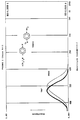
- Figure 1 is an absorption spectrogram indicating the solvatochromism exhibited by a first prior art electroactive compound, 4-(N,N-dimethylamino)-4'-nitrostilbene (DANS).
- DANS 4-(N,N-dimethylamino)-4'-nitrostilbene
- Figure 2 is an absorption spectrogram indicating the solvatochromism exhibited by the prior art electroactive compound 4-(N,N-dimethylamino)-4'-nitroazobenzene (DANAB).
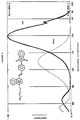
- Figures 3 through 5 are absorption spectrograms indicating the solvatochromism exhibited by exemplary electroactive compounds of the present invention whose structure is indicated in the Figure.
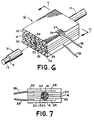
- Figure 6 is a view partly in perspective and partly in vertical section of an embodiment of one type of electrooptical device for modulating light passing through optical fibers, in which the device is constructed using compounds and compositions according to the present invention.
- Figure 7 is an end elevation view, partially in section, of the optical device of Figure 6 taken along lines 7--7 of Figure 6.
- Figure 8 is a view partly in perspective and partly in vertical section of an embodiment of one type of electrooptical device for modulating light passing through optical fibers, in which the device is constructed using compounds and compositions according to the present invention.
- Figure 9 is an end elevation view, partially in section, of the optical device of Figure 8 taken along lines 9--9 of Figure 8.
- Figure 10 is a schematic representation in four views (a) through (d) to illustrate the production of an optical waveguide in a film made of a composition according to the present invention containing a novel electroactive compound.
- the various aspects of the present invention are based upon the discovery of novel electroactive compounds having nonlinear optical properties which are capable of undergoing a reversible change in light absorption and refraction due to an applied electric field and a permanent change in refraction due to exposure to predetermined bands of optical radiation.
- the compounds have the general structure 1 : and an equivalent or corresponding resonance canonical structure 1A :
- the definition of each component of the compounds of the present invention, and various substituent groups are set forth above under the Summary of the Invention.
- the molecules of the novel compounds have a large dipole moment along a long axis of the molecule.
- One end of the molecule is deemed to be electropositive by virtue of the presence of electron donating groups, namely, the ⁇ D group, whereas the opposite end is deemed to be electronegative by virtue of the presence of electron-accepting or withdrawing groups A and A1.
- the molecules of the novel compounds will become highly oriented in various matrices when subjected to an orientation force, such as an applied electric field, stretching, compressing or combination of stretching or compression in the presence of a static electric field.
- the orientation of the molecules in the selected matrix will be such that the poles of the molecule are contrapolar to the polarization of the electrodes in the typical case of orientation in a static electric field when the compound is placed in a matrix between a positive electrode and a negative electrode.
- the polarized molecules tend to become aligned with respect to each other anisotropically with the electropositive ends of the molecules being in the same general direction (say, in concept, the "left" end as structure 1A is written), opposite to the electronegative end (say, in concept, the "right” end as structure 1A is written) of the same molecule.
- the present molecules are characterized by their ability to maintain this anisotropic alignment in a matrix to form an electroactive composition.
- novel electroactive compounds of the present invention have the broad general structure described above in the summary of the invention.
- more preferred compounds are those in which the components and the substituents are defined as follows, with reference to Tables 1 through 9 forming the last portion of this specification immediately prior to the claims.
- the symbols E1 and E independently represent the indicated elements of Group VA and Group VIA of the Periodic Table, respectively.
- each E may be the same or different, even in the same radical, except as specified hereinafter.
- D1 is any radical set forth in Table 2, where any E1 is N, P or As, Table 3, where any E1 is N, P or As and any E is O, S, Se or Te, Table 4, where any E1 is N, P or As and any E is O, S, Se or Te, Table 5, where any E is O, S, Se or Te;
- D2 C- is any radical set forth in Table 6 or Table 7, where any E1 is N, P or As and any E is O, S, Se or Te;
- the trivalent atom of X is N or P and the tetravalent atom of X is C, and where X is C, any substituted or unsubstituted aromatic carbocyclic ring system which is a substitutent of X is any radical set forth in Table 6, and where X is C and substituted with a substituted or unsubstituted aromatic heterocyclic ring system, the heterocyclic
- D1 is any radical set forth in Table 2, where any E1 is N or P, Table 3, where any E1 is N or P and any E is O, S or Se, Table 4, where any E1 is N or P, and any E is O, S or Se, Table 5, where E is O, S or Se;
- D2 C- is any radical set forth in Table 6 or Table 7, where any E1 is N and any E is O, S or Se;
- the trivalent atom of X is N and the tetravalent atom of X is C, and where X is C, any substituted or unsubstituted aromatic carbocyclic ring system which is a substitutent of X is any radical set forth in Table 6, and where X is C and substituted with a substituted or unsubstituted aromatic heterocyclic ring system, the heterocyclic ring system is any radical set forth in Table 7, where any E1 is N and
- Non-limiting examples of the presently most preferred Q groups are:
- Such carbanions are available by a broad range of methods well known to those skilled in the art, the most common of which is the reaction of a di(acceptor)substituted methane with a base:
- Such bases include amines or guanidines or metallic hydrides, hydroxides, alkyls, alkoxides, amides, phosphides, nitrides, imides, silanes and siloxides as the most preferred class.
- Preferred solvents include both protic and aprotic solvents.
- Preferred protic solvents include water; alcohols (1-22 carbons); aralkanols (1-28 carbons); amines (1 to 44 carbons); amides (1-22 carbons); and anilines (6 to 36 carbons).
- Preferred aprotic solvents include ethers (2 to 44 carbons); esters (2 to 44 carbons); nitriles (2-22 carbons); amides (3 to 36 carbons); sulfoxides (2 to 44 carbons); sulfones (2 to 44 carbons); phosphoramides (6 to 66 carbons); ureas (4 to 88 carbons); carbamates (3 to 66 carbons); amines (3 to 66 carbons); anilines ( 8 to 50 carbons); alkanes (4 to 22 carbons); arylalkanes (7 to 50 carbons) arenes (6 to 60 carbons); silanes (4 to 88 carbons); cycloalkanes (4 to 44 carbons); aromatic and saturated heterocyclic compounds (1 to 29 carbons); haloalkanes (1 to 44 carbons, 1 to 10 halogens from Cl, F, I, Br); haloureas (1-50 carbons, 1-10 halogens from Cl, F, I, Br); sulfonamides (2 to 44 carbons);
- the heterostilbene intermediate, prepared in step (a), whether in carbanion or acid form, is believed to be a new compound.
- the method used to make the intermediate compound is known as a result of this invention, modifications to the method of making the intermediate would be well-known to one of ordinary skill in the art.
- methods of doing so, based on the novel heterostilbene intermediates would also be known to those skilled in the art without undue experimentation, based on the present disclosure.
- Methods of making a carbanion containing an alpha-H atom are so well known that they need not be described in detail herein.
- the heterostilbene intermediate may be prepared by reacting a haloheterostilbene with the carbanion containing at least one alpha-hydrogen atom with various known transition metal catalysts, such as ligated Pd[O], such as ([C6H5]3P)4Pd[O]; ligated Ni[O], such as ([C6H5]3P)4Ni[O]; and ligated Cu[I] such as (CH3CN)4Cu[I]ClO4.
- transition metal catalysts such as ligated Pd[O], such as ([C6H5]3P)4Pd[O]
- ligated Ni[O] such as ([C6H5]3P)4Ni[O]
- Cu[I] such as (CH3CN)4Cu[I]ClO4.
- the reaction equations demonstrate that, rather than undergoing carbon-alkylation, for example, when reacting the heterostilbene carbanions with alkyl halides or other leaving groups, the alkylation does not occur at the -C(A)(A1) portion of the molecule, but rather, at the heterocyclic end of the molecule, such that the alkyl or other group bonds to a heteroatom.
- This reaction was not predicted and expected.
- one skilled in the art is made aware of this type of reaction based on the present disclosure, one could readily use this knowledge and general chemical principles to create a great many other electroactive compounds within the scope of this invention.
- Another novel process of making an electroactive compound according to the present invention comprises the following steps:
- step (a) preferably occurs using the transition metal catalysts referred to above where X2 is Cl, Br or I.
- the reaction occurs directly, where X2 is F or -OA2, in aprotic organic solvents.
- the step (b) reaction conditions are generally that the reaction take place at temperatures from about 0°C to about 300°C in any suitable organic solvent in the presence of a mild Lewis base catalyst, such as ammonia, alkylamine, alkali carbonate, alone or in the presence of a small amount of a mild acid, such as an aromatic carboxylic acid, an aromatic carboxylic acid, a heterocyclic carboxylic acid or a Lewis acid, such as Zn2 ⁇ , Mg2 ⁇ , Li ⁇ .
- More preferred reaction conditions include the use of excess piperidine with a smaller amount of acetic acid in an alcohol solvent at reflux conditions.
- reaction equations involving the aldehyde intermediate are set forth below, with the understanding that one skilled in the art could readily devise many other similar reaction equations involving other starting materials to produce other types of electroactive compounds according to the present invention.
- the aldehyde intermediate can be prepared by the following process:
- step (b) the reaction proceeds as set forth in step (b) above to produce the same novel electroactive compound according to the present invention.
- E2 is F, Cl, Br, I, -O-C6H5-R1, -O(CH2) n -H, or -SR1.
- reaction preferably taken place in an aprotic organic solvent at a temperature of about 0°C to about 300°C for up to 100 hours, preferably 1 to 10 hours. It is also preferred that the reaction take place in an excess of the carbanion or in the presence of a mild aprotic base, such as a tertiary amine.
- electroabsorption or electrochromism effects Changes in light absorption due to an applied electric field result in effects called electroabsorption or electrochromism effects. These effects are exhibited by the electroactive compounds of the present invention as demonstrated by the observation of extraordinary shifts of the absorption spectra of the molecules in aprotic solvents of differing polarity, such as tetrahydrofuran (THF) or dimethylsulfoxide (DMSO).
- THF tetrahydrofuran
- DMSO dimethylsulfoxide
- Figures 1 through 5 are absorption spectrograms indicating the solvatochromism exhibited by various electroactive compounds in two solvents of greatly differing polarity.
- Figures 1 and 2 represent the solvatochromism of two known prior art electroactive compounds, 4-(N,N-dimethylamino)-4'-nitrostilbene (DANS) and 4-(N,N-dimethylamino)-4'-nitroazobenzene (DANAB), respectively.
- DANS 4-(N,N-dimethylamino)-4'-nitrostilbene
- DANAB 4-(N,N-dimethylamino)-4'-nitroazobenzene
- the absolute difference between the wavelengths corresponding to the absorption maximum of the compounds as determined in the two different solvents represents the magnitude of the solvatochromism.
- the relative efficacy, that is, the degree of electroabsorption, of the novel compounds can be inferred by comparison of the magnitude of solvatochromism indicated in Figures 3 through 5 to that of DANS or DANAB as indicated in Figures 1 and 2. All of the conditions relating to the determination of solvatochromism in Figures 1 through 5 were identical. All spectra shown in the Figures 1 through 5 were conducted on solutions of 1.00 X 10 ⁇ 5 molar concentration at an optical pathlength of 1.00 cm and in very high purity, water-free THF and DMSO, respectively.
- the abscissa of the spectra is the wavelength of the absorbed radiation in nanometers (nm), and the ordinate is in absorbance units ranging from 0.00 to 1.00, on a logarithmic scale.
- the absorption spectra in THF is represented by a dark, thick, continuous line, while the absorption spectra in DMSO is represented by a light, thin dashed line.
- Figures 3 through 5 indicate that the novel electroactive compounds of the present invention exhibited solvatochromism of magnitudes 4 to 6 times those of DANS or DANAB.
- the solvatochromism magnitudes are: 20 nm for DANS in Figure 1; 24 nm for DANAB in Figure 2; 113 nm for the novel compound in Figure 3; 149 nm for the novel compound in Figure 4; and 86 nm for the novel compound in Figure 5.
- the material containing the electroactive compound will itself be electroaotive due to its ability to absorb or refract light.
- the term "light” means any wavelength of light in the electromagnetic spectrum capable of being transmitted by and through electrooptical devices and components, such as optical fibers, whether or not such light is in the visible spectrum range. Typically, light having a wavelength between about 800 nm and about 2,000 nm is readily transmittable using state of the art light emitting diodes (LED) and laser diodes. More particularly preferred are electroactive compounds and materials absorbing light within the wavelengths of about 850 nm, 1300 nm and about 1,550 nm.
- electroactive compositions and materials according to the present invention absorb certain wavelengths of light when they become electroactive in the presence of a static electric field, the materials have the ability to pulse or modulate the intensity of a light ray passing through the material. Increased absorption when an electric field is applied will decrease the intensity of the transmitted light, while decreased absorption will permit an increase in light transmission.
- the eleotroactive compounds and compositions of the present invention also undergo changes in light refraction due to an applied electric field. Such changes in light refraction are due to effects variously termed the electrooptical effect, the Kerr effect, or electric field induced birefringence.
- the electrooptical effect can also confer upon a material containing the compounds of the present invention the ability to modulate light intensity when applied in a system which uses polarized light and polarizing optics or interferometric optics.
- a field induced birefringent sample of material placed between two light polarizers in parallel orientation will pass polarized light if the applied field is off and prevent passage if the field is on.
- phase-sensitive interferometer such as a Mach-Zehnder interferometer, a Frans-Keldysh modulator, as well as multi-channel modulators.
- the electroactive compounds of the present invention also have a unique property of undergoing a permanent change in refraction upon exposure to certain, well-defined bands or wavelengths of optical radiation. This is a particularly novel phenomonen associated with the electroactive compounds of the present invention. This property permits the use of a photolithographic-type of process to generate electroactive optical waveguides made from materials containing the novel electroactive compounds. A typical photolithographic-type of process for making electroactive optical waveguides will be described hereinafter. Generally, an absorption band in the region of 250 nm to 550 nm can be irradiated in the compounds of this invention to effect the permanent refraction change.
- Electroactive compositions can be prepared based on the present invention by incorporating the novel electroactive compounds into various matrix materials, such as liquids, liquid crystals, polymeric materials or crystals.
- matrix materials such as liquids, liquid crystals, polymeric materials or crystals.
- the molecules of the novel compounds must be oriented such that their electric moments are aligned in the same direction so as to be polarized or anisotropic.
- the molecules of the electroactive compounds of the present invention will become highly oriented in solutions in the presence of low electric fields on the order of about 0.1 kv/cm to about 10 kv/cm.
- the novel molecules will undergo an increase in their dipole moment due to the high intrinsic distortion polarizability ( alpha ) of the compounds.
- the more highly polarized or hyperpolarized molecules will exhibit different optical absorption spectra and birefringence than the materials in a lover electric field. Therefore solutions will be capable of effecting optical modulation by electroabsorption or electrooptical mechanisms.
- molecules of the novel compounds can be oriented at moderate electric field strengths and fluids, the desired molecular orientation can be achieved at considerably lower fields if a matrix in which the compound is incorporated is a liquid crystal. Orientation may also be achieved in this type of matrix without any use of an electric field by use of mechanical processes, such as stretching or compression. If desired, compression or stretching in combination with an electric field could be used to enhance orientation of the molecules.
- the preferred liquid crystal molecules are nematic liquid crystals of a type well known to those skilled in the art. See, for example, G.W. Gray, Molecular Structure and the Properties of Liquid Crystals , Academic Press, New York, NY (1962); H. Kelker and R. Hatz, Handbook of Liquid Crystals , Verlag Chemie, Weinheim, Germany (1980); and A. Ciferri, W.R. Krigbaum and R.B. Meyer, Polymer Liquid Crystals , Academic Press, New York, NY (1982).
- a nematic liquid crystal is comprised of highly elongated molecules which are aligned in one direction in the nematic phase. Nematic order may be induced or extended by appropriate application of electric field, compression or stretching forces. Nematic liquid crystal systems are orientable at very low electric fields on the order of about 10 V/cm to about 1 kv/cm or by simple application of compression or stretching forces. Once the molecules of the present invention are aligned in nematic liquid crystal, application of very high fields on the order of higher fields on the order of about 10 kv/cm to about 10 MV/cm may be applied to effect electrooptical or electroabsorption modulation when hyperpolarized molecules are produced in the nematic liquid crystal matrix.
- compositions of the present invention comprising the novel electroactive compounds in liquid crystal matrices are capable of modulating light in two different mechanisms operating in two different electric field or applied voltage ranges.
- the compositions act as a dichroic modulator by virtue of their high dipole moment and elongated molecular structure.
- the electroactive compositions modulate light by electrooptical or electroabsorbance mechanisms as a result of their high polarisability ( alpha ) and first order hyperpolarizability ( beta ).
- the preferred matrix into which the electroactive compounds of the invention are incorporated to make electroactive compositions are polymeric matrices.
- the compounds can be dissolved in a polymeric matrix and subjected to strong electric field as the composite is melted and cooled to normal temperatures to retain the molecules of the electroactive compounds in field-induced alignment which will be maintained within the rigid amorphous regions of the polymer.
- the desired orientation can be obtained by polymerizing a crosslinked polymer containing the electroactive compounds in the presence of an electric field. Improved levels of orientation can also be achieved by compression or stretching during a heating-cooling cycle, with even better orientation achievable when compression or stretching is combined with the application of an electric field.
- the preferred polymeric matrix material is poly(vinylidene fluoride); a copolymer of vinylidene difluoride with hexafluoropropylene, trifluoroethylene or tetrafluoroethylene; a terpolymer of vinylidene difluoride or vinylidene trifluoride with tetrafluoroethylene and hexafluoropropylene; a terpolymer of a vinylic monomer, acrylic monomer or methacrylic monomer with tetrafluoroethylene and hexafluoropropylene; a copolymer of vinylidene difluoride and acrylic ester, methacrylic ester or acrylamide; or a tetrapolymer of vinylidene difluoride, vinylidene trifluoride, tetrafluoroethylene and hexafluoropropylene.
- the electroactive compounds be incorporated into a matrix to make a composition by including about 1 to about 10% of the compounds in the matrix material. This general concentration applies regardless of the type of matrix involved and regardless of whether the electroactive compound is used in a solvent system, blended in a melt or becomes covalently bonded to the polymeric matrix.
- the polymeric matrix may be a homopolymer, it is presently preferred that the matrix be a copolymer, terpolymer or tetrapolymer of the various monomers referred to above.
- the light scattering can be substantially eliminated if the vinylidene fluoride is combined with other monomers, and particularly fluorinated monomers.
- the light scattering is substantially eliminated. Clarity is improved even further upon a further addition of hexafluoropropylene.
- terpolymers of vinylidene difluoride, tetrafluoroethylene and hexafluropropylene are the presently preferred monomers for making a polymeric matrix containing the electroactive compounds of the present invention.
- the vinylidene difluoride component should be present in an amount greater than 50%, preferably in the range of about 85% to about 99%, to provide the ordered nematic liquid crystalline regions and the high level of dimensional stability to orient the molecules of the electroactive compounds of the present invention following polling and/or physical orientation. While terpolymers containing a broad range of vinylic or acrylic monomers should be able to be used effectively, the use of tetrafluoroethylene and hexafluoropropylene (and to some extent, the acrylic monomers) help prevent the formation of large crystals of vinylidene difluoride which scatter electromagnetic radiation in the ultraviolet, visible and near infrared regions.
- the tetrafluoroethylene component be present in the range of about 0.5% to about 49.5%, and most preferably, in a range of about 5% to about 40%. It is presently preferred that the terpolymer also contain hexafluoropropylene in a range of about 0.1% to about 25%, with the presently more preferred range of about 0.5% to about 10%.
- electroactive compounds of the present invention can be added to a polymeric matrix by merely blending the components together, it is presently preferred that the electroactive compounds of the present invention be incorporated into the molecular structure of the polymers as functional groups, thus creating electroactive functional polymers.
- the electroactive compounds can be incorporated either as pendant groups or into the backbone of the polymer.
- One technique for making polymers in which the electroactive compound is a pendant functional group employs the reaction of a monomer-alkylating agent which reacts with a composition of the present invention in a carbanion form, resulting in the formation of an electroactive monomer.
- the electroactive monomer is then polymerized using free radical initiation or anionic initiation, resulting in an addition polymer.
- the following reactions provide a specific, non-limiting illustration of these techniques. The reactions are intended to illustrate the general reaction schemes and the principles may be applied to other starting materials and monomers as would be recognized readily by those of ordinary skill in the art.
- the resulting monomers are examples of acrylic or vinylic types of monomers.
- condensation polymers as set forth below can be created easily using chemistry well known to those skilled in the art based on the present disclosures.
- monomers having the following schematic or diagrammatic structure 2 will be used: Using the simplified schematic structure 2 , to signify an electroactive monomer according to the present invention, the following condensation polymers will result, wherein m and n are each independently an integer of 1 to 22, for example.
- An addition polymer 3 or 4 is an addition polymer 3 or 4 :
- k indicates generally the degree of polymerization.
- Pendant polymers in which the electroactive compounds of the present invention are pendant functional groups in a polymer may also result from reactions using various nucleophilic groups.
- a heterostilbene carbanion or a 4-picoline are broadly representative of nucleophiles which may be reacted with an alkylating polymer, such as poly(2-bromoethyl methacrylate).
- Polymers with pendant electroactive functional groups can be prepared as indicated in the following specific, non-limiting examples of suitable reactions schemes.
- Nucleophiles such as the heterostilbene carbanion and 4-picoline may react with bis-alkylating agents, such as 2-bromoethyl methanesulfonate to generate electroactive alkylators 11 and 12 in the following specific, non-limiting examples of reactions:
- electroactive-alkylators 11 and 12 Reaction of the electroactive-alkylators 11 and 12 with silver poly(methacrylate) will generate electroactive functional polymers 9 and 10 , respectively, wherein 9 and 10 are set forth above.
- the electroactive alkylators 11 and 12 function as electroactive electrophiles.
- electroactive pendant homopolymers can be created as described above.
- spacer monomers can be provided between the electroactive pendant functional groups.
- Non-limiting examples of such copolymers are set forth below as 13 , 14 and 15 in which M5 is defined as below, q is an integer from 1 to 22, for example, and p is the degree of polymerization.
- electroactive polymers can be created in which the electroactive functional group is part of the backbone of the polymers.
- the compounds of the present invention include electron acceptor functions A and A1.
- electroactive functional monomers 16 and 17 may be prepared as typified by the specific, non-limiting reaction schemes below.
- the bifunctional monomeric intermediates 16 and 17 may be viewed as condensation monomers of general structure 18 , as follows: polycondensation with the elimination of water will transform the electroactive condensation monomers into electroactive polymers in which the electroactive functional groups are in the backbone, as set forth below with respect to polymer 19 , for example.
- E3 is O or NH, for example.
- r is the degree of polymerization.
- the electroactive compositions made using the electroactive compounds of the present invention can be used in a host of electrooptical components.
- the electrooptical components may be used to make a host of electrooptical devices for modulating light through light fiber systems, etc.
- the electroactive compounds of the present invention have their primary and most important use in modulating light as described herein, they may be used in a most basic sense as colorants for compositions containing them.
- the electroactive colorants of the present invention typically provide very good and stable coloration to compositions in which they are incorporated, and therefore, they also serve as dyes.
- Figure 6 is a rather diagrammatic illustration, on an extremely enlarged scale, of an electroactive device comprising an electroactive component 10 in accordance with the present invention.
- Component 10 is adapted to be connected as described below to optical fibers 12 and 14.
- optical fiber 12 may be an inlet fiber and optical fiber 14 may be an outlet fiber. This means that light enters electrooptical component 10 through optical fiber 12 and exits the component through optical fiber 14.
- the optical fibers typically include an optical fiber core 15 and a cladding 16 and typically are made of glass, although the optical fibers may also be made of acrylic or methacrylic polymers or copolymers.
- Electrooptical component 10 comprises a core 18 which comprises an electroactive composition.
- the electroactive composition preferably is a terpolymer of vinylidene difluoride, tetrafluoropropylene and hexafluoropropylene containing the electroactive compound of the present invention either as an additive or, preferably, as polymer bond functional groups.
- the molecules of the electroactive compound in core 18 have been polled and polarized as set forth above such that their long axes are in alignment and their electric moments are oriented in the same direction and perpendicular to the direction of propagation of the light beam.
- Core 18 includes a waveguide 20 preferably made in the manner to be described with respect to Figures 10a through 10d below.
- core 18 itself can be considered a separate electrooptical component which is part of the larger component 10.
- waveguide 20 has a higher index of refraction than the adjacent portions of core 18, even though core 18 and 20 are made from the same electroactive material, since the adjacent portions of core 18 surrounding waveguide 20 have been irradiated with light of a wavelength which caused the adjacent portions of core 18 to permanently undergo a permanent decrease in refraction.
- Layers 22 and 24 are cladding layers overlying opposed portions of waveguide 20, but not end faces of the waveguide to which the optical fibers are to be connected. The cladding layers prevent light leakage beyond the waveguide.
- Electrode 26 and 28 are also disposed on opposite sides of waveguide 20 such that the electric force field extends transversely through waveguide 20.
- Electrode 26 may be a negative electrode, while electrode 28 may be a positive electrode. In that case, the electric field effector would extend from positive electrode 28 through the waveguide to negative electrode 26.
- the electrodes may be extremely thin layers of metal, such as chromium, nickel, an alloy of chromium and nickel, aluminum, silver, gold, platinum and copper, among others well known to those skilled in the art. Chromium, nickel and chromium-nickel alloys are most preferred.
- the electrodes may be applied using standard photolithographic techniques, electrodeposition, sputtering or other suitable techniques well documented in the literature and known to those skilled in the art.
- Layers 30 and 32 illustrated in Figures 6 and 7 are encapsulating layers. Although the side edges of all of the layers of component 10 are illustrated in Figures 6 and 7 as being flush with each other, encapsulating layers 30 or 32 could extend around the whole component. Likewise, the entire component 10 may be further encapsulated within or otherwise contained in the components of an electrooptical device.
- the electrodes are energized by current passing through wires 36 and 38 which are attached by solder 34 or other suitable attachment technique.
- Figure 7 is a view of Figure 6 along lines 7--7 of Figure 6.
- Figure 7 illustrates the attachment of optical fiber 14 to component 10.
- Optical fiber core 15 is aligned with the end face of waveguide 20 and then the optical fiber is adhesively bonded to component 10 by an optical grade adhesive 40.
- Suitable optical grade adhesives include, for example, optical grade epoxies curable at room temperature or on gentle heating, or optical grade acrylics, typically containing ultraviolet or visible light sensitizers. The sensitizers cause the curing of the adhesive between fiber and component by a short irradiation with the appropriate wavelength of light.
- Suitable optical grade adhesives are available commercially and should be selected and have an index of refraction when cured to match that of either the fiber core or the waveguide, or preferably, to be between the indices of refraction of the fiber core and waveguide in value.
- a microoptical device such as a ball lens or grin (gradient index) lens, can be placed between the fiber core and the waveguide and held in place with the adhesive.
- FIGs 8 and 9 illustrate an alternative embodiment of another simple electrooptical device in accordance with the present invention.
- Components which are common between the embodiments of Figures 6 and 7 on the one hand and Figures 8 and 9 on the other hand are indicated in Figures 8 and 9 by primed numerals.
- the electrooptical device of Figures 8 and 9 comprises an electrooptical component 10' including a core 18' in which a waveguide 20' is formed.
- Waveguide 20' has a higher index of refraction than the adjacent core portions 18'.
- a cladding layer 22 lies adjacent to waveguide 20' (beneath waveguide 20 in the orientation of the embodiment illustrated in Figures 8 and 9).
- a separate, opposed cladding layer is not present in this embodiment, since the encapsulating layer 31 has a portion adjacent to (above in this embodiment) waveguide 20' and provides the cladding function.
- An electrode 25, which may be a negative electrode, and an electrode 27, which may be a positive electrode, are located in a plane parallel to the plane of the waveguide.
- electrodes 25 and 27 are located in a layer above waveguide 20'. Electrodes 25 and 27 extend at least partially along the length of waveguide 20 parallel to the sides of the waveguide. Thus, each electrode of the pair is adjacent to an opposed side of the waveguide.
- Electric leads 36' and 38' are attached to electrodes 25 and 27, respectively, by solder or other suitable electrical connection means.
- An encapsulating or embedding layer 29 underlies cladding layer 22.
- layer 31 combines both functions of cladding and encapsulation for waveguide 20 and electrodes 25 and 27, respectively.
- Optical fibers 12' and 14' may be optically connected to component 10' in a manner similar to that described with respect to the embodiment of Figures 6 and 7.
- an electric field vector extends from positive electrode 27 to negative electrode 25.
- the electric field vector extends through waveguide 20' in a direction transverse to the direction of the electric field of the embodiment illustrated in Figures 6 and 7.
- each waveguide of the plurality will have the same index of refraction.
- each waveguide system in each layer can independently carry signals and can be subject to interlayer transmission of signals by application of an appropriate electric field.
- FIGs 10a through 10d are used to illustrate a method of making the electroactive component comprising core 18 as used, for example, in electrooptical components illustrated in Figures 6 through 10.
- Core material 18 comprises an electroactive composition made electroactive by virtue of the alignment as described above of molecules of electroactive compounds of the present invention.
- the core material is illustrated as having a thickness "t" which, typically, is on the order of 1 to 100 microns, and, preferably, about 3 to 30 microns. These dimensions are consistent with the diameter or, in some instances, cross-sectional square dimension of optical fiber cores to which the waveguides are optically connected.
- Figure 10b illustrates the first step in the fabrication of a waveguide in an electrooptical film or core layer 18 after the preparation of the film itself.
- a mask 42 capable of masking light of a wavelength suitable to change the index of refraction of a material containing the electroactive compound overlies the portion of the film in which the waveguide is desired to be formed.
- mask 42 is illustrated as a straight rectangular mask having a width "t", it may be of any shape and have any width desired.
- Figure 10c illustrates the next step involved, that of irradiating the component 18 by light having a selected wavelength capable of changing the index of refraction in all areas of the component which are not protected by mask 42.
- long wavelength ultraviolet to visible absorption bands in the range of about 350 to about 700 nm are capable of inducing by absorption within these bands photobleaching of the electroactive compounds of the present invention by which their refraction undergoes a permanent change.
- the changes lower the index of refraction of any material containing the compounds.
- the photobleaching range of the bands of light or other optical radiation capable of causing a permanent change in refraction is a range in which most commercial compositions, films and coatings possess little or no optical absorption.
- Waveguide 20 As illustrated in Figure 10d. Waveguide 20 has a width "t" corresponding to the same width of mask 42.
- the electrooptical components and devices made using them according to the present invention are capable of modulating light by changing the electric field across the waveguides.
- Various electrooptical devices including electrooptical modulators of the Mach-Zehnder type, the Franz-Keldysh type, multi-channel type and other types can be constructed using the present invention.
- passive integrated electrooptical circuits can be fabricated by standard photolithographic techniques by irradiating a multi-film sheet in which one layer contains an electroactive compound according to the present invention within the composition capable of undergoing an irreversible change in refraction upon radiation of a specific wavelength of light during the photolithographic process.
- Such a passive integrated circuit may be fabricated with two or more layers having different optical circuits independently introduced by selective lithography by employing different electroactive compounds according to the present invention which undergo irreversible changes in refraction with different wavelengths of light.
- An electroactive device can be produced using the multilayer passive integrated circuit containing two or more layers having the different optical circuits made as described above. Such an electroactive or electrooptical device permits switching of optical signals between successive layers.
- Examples 1 through 20 are specific, illustrative working examples which have actually been performed.
- Examples 21 and 22 are proposed syntheses which are believed to be readily workable, although the specific syntheses of these two examples have not been performed.
- Example 23 comprises a series of other specific working examples using various compounds based on the general procedure and general reaction equation set forth in the example.
- the resulting mixture which now consists of an orange suspension, was heated at 50°C for 16 hours. After this time the mixture was heated to 70°C and filtered hot. The solid on the filter was washed with 1049 parts boiling glacial acetic acid.
- the combined filtrate and wash, which contained the desired product, were diluted with 1000 parts water and filtered to give 500 parts of a red precipitate (quantitative yield).
- the precipitate was recrystallized from 85% methanol in water to give a 78% recovery of purified product, 2-(4-formylphenyl)-1,3-indandione as a maroon to red microcrystalline solid.
- the lower layer of green paste was dissolved in 2454 parts acetone to form a dark green solution.
- To this dark green solution is added with rapid stirring 2124 parts ethyl ether which precipitated a dark green crystalline material.
- the crystalline material is removed by filtration and dried at 50°C in vacuo to yield 513 parts of dark green microcrystalline 4,4'-bis-(N,N-diethylamino)-4''-fluorotriphenylmethyl perchlorate or 83% of the theoretically possible amount.
- the crystalline material is removed by filtration to yield 3.5 parts of red microcrystalline 4-(N,N-dimethylamino)-4'-fluoro-2'',4'',6''-trimethyltriphenylmethyl perchlorate or 80% of the theoretically possible amount.
- the resulting mixture was cooled to 65°C and the source of heat was removed.
- water was added over 66 hours with continued stirring resulting in a suspension of fine, shiny green crystals. These crystals were removed by filtration and washed with 1186.5 parts methanol.
- the resulting wet crystalline green solids were added to a boiling rapidly stirred mixture of 2185 parts benzene, 22 parts decolorizing carbon and 22 parts sodium sulfate. This mixture was filtered hot and the filtrate cooled to ambient temperature.
- the resulting beads were then added to a solution of 33.4 parts 2-(4-formylphenyl)-1,3-indandione; 10.6 parts piperidine; and 0.42 parts glacial acetic in 235.5 parts 2-propanol solvent and the resulting mixture heated at reflux for eighteen hours during which time the coloration of the beads changed from peach to black.
- the resulting mixture was filtered and the filtrate discarded.
- the black beads on the filter were slurried three consecutive times with a solution consisting of 102.3 parts acetone and 98.1 parts 2-propanol.
- the yield of free flowing black beads of crosslinked polystyrene with pendant 4-methylene-4-stilbazolium-4'-[2-(1,3-indandione-2-ide] groups was 13.6 parts.
- the resulting mixture is concentrated in vacuo to a volume of 100 ml and the resulting mixture is treated with 500 ml ethyl ether.
- the salt which precipitated is removed by filtration and, while not with ether, suspended in 0.5 L water.
- the resulting mixture is concentrated in vacuo to a volume of 100 ml and the resulting mixture is treated with 50 ml ethyl ether.
- the salt which precipitated is removed by filtration and, while not with ether, suspended in 0.5 L water.
- the resulting suspension is steam distilled in a current of dry argon and the steam distillate discarded.
- the residue in the distillation flasks is cooled under argon, diluted to 0.5 L with water, and acidified to pH 1.0 with concentrated hydrochloric acid to precipitate the 4-(dicyanomethyl)-benzaldehyde.
Landscapes
- Chemical & Material Sciences (AREA)
- Organic Chemistry (AREA)
- Physics & Mathematics (AREA)
- Nonlinear Science (AREA)
- General Physics & Mathematics (AREA)
- Optics & Photonics (AREA)
- Plural Heterocyclic Compounds (AREA)
- Nitrogen Condensed Heterocyclic Rings (AREA)
- Addition Polymer Or Copolymer, Post-Treatments, Or Chemical Modifications (AREA)
- Quinoline Compounds (AREA)
- Pyridine Compounds (AREA)
- Heterocyclic Carbon Compounds Containing A Hetero Ring Having Nitrogen And Oxygen As The Only Ring Hetero Atoms (AREA)
- Organic Low-Molecular-Weight Compounds And Preparation Thereof (AREA)
Applications Claiming Priority (2)
| Application Number | Priority Date | Filing Date | Title |
|---|---|---|---|
| US07/629,781 US5334333A (en) | 1990-12-17 | 1990-12-17 | Electroactive compounds, compositions and devices and methods of making the same |
| US629781 | 1990-12-17 |
Publications (2)
| Publication Number | Publication Date |
|---|---|
| EP0491364A2 true EP0491364A2 (de) | 1992-06-24 |
| EP0491364A3 EP0491364A3 (en) | 1993-03-17 |
Family
ID=24524465
Family Applications (1)
| Application Number | Title | Priority Date | Filing Date |
|---|---|---|---|
| EP19910121628 Withdrawn EP0491364A3 (en) | 1990-12-17 | 1991-12-17 | Electroactive compounds, compositions and devices and methods of making the same |
Country Status (10)
| Country | Link |
|---|---|
| US (1) | US5334333A (de) |
| EP (1) | EP0491364A3 (de) |
| JP (1) | JPH04334343A (de) |
| KR (1) | KR920012007A (de) |
| AU (1) | AU8690491A (de) |
| CA (1) | CA2055652A1 (de) |
| CS (1) | CS385691A3 (de) |
| IE (1) | IE913803A1 (de) |
| NO (1) | NO914964L (de) |
| ZA (1) | ZA919838B (de) |
Cited By (3)
| Publication number | Priority date | Publication date | Assignee | Title |
|---|---|---|---|---|
| WO1999009111A1 (de) * | 1997-08-18 | 1999-02-25 | Bayer Aktiengesellschaft | Elektrochromes system mit gekoppeltem red-ox-system und speziellen anionen |
| WO1999009112A1 (de) * | 1997-08-18 | 1999-02-25 | Bayer Aktiengesellschaft | Uv-geschützte elektrochrome lösung |
| EP0880568B1 (de) * | 1996-02-15 | 2004-05-06 | Bayer Chemicals AG | Elektrochromes system |
Families Citing this family (8)
| Publication number | Priority date | Publication date | Assignee | Title |
|---|---|---|---|---|
| US5670091A (en) * | 1993-08-05 | 1997-09-23 | California Institute Of Technology | Nonlinear optical materials with reduced aromaticity and bond length alternation |
| US6140503A (en) * | 1999-01-25 | 2000-10-31 | Academia Sinica | Organometallic compounds |
| US6856461B2 (en) | 2001-06-08 | 2005-02-15 | Inphase Technologies, Inc. | Tunable optical filter |
| US8173045B2 (en) | 2008-05-28 | 2012-05-08 | University Of Washington | Diels-Alder crosslinkable dendritic nonlinear optic chromophores and polymer composites |
| WO2012084578A1 (en) | 2010-12-22 | 2012-06-28 | Solvay Specialty Polymers Italy S.P.A. | Vinylidene fluoride copolymers |
| KR101826388B1 (ko) | 2010-12-22 | 2018-02-06 | 솔베이 스페셜티 폴리머스 이태리 에스.피.에이. | 비닐리덴 플루오라이드 및 트리플루오로에틸렌 중합체 |
| KR102651578B1 (ko) | 2013-11-27 | 2024-03-25 | 매직 립, 인코포레이티드 | 가상 및 증강 현실 시스템들 및 방법들 |
| CN112882301B (zh) * | 2020-12-30 | 2022-08-19 | 浙江精一新材料科技有限公司 | 一种灰色基调的光阀及其应用 |
Family Cites Families (9)
| Publication number | Priority date | Publication date | Assignee | Title |
|---|---|---|---|---|
| CA617120A (en) * | 1961-03-28 | Litvan Franz | Substituted 2-phenyl-indan-1.3-dione and process for the production thereof | |
| US2361517A (en) * | 1939-09-22 | 1944-10-31 | Gen Electric | Sealing apparatus |
| BE668871A (de) * | 1964-08-27 | |||
| US3879468A (en) * | 1969-04-14 | 1975-04-22 | Union Carbide Corp | 2-(poly substituted phenyl)-1,3-indandione compounds |
| JPS566652A (en) * | 1979-06-26 | 1981-01-23 | Toshiba Corp | Manufacture of insulated winding for electric machine |
| US4767169A (en) * | 1987-02-26 | 1988-08-30 | Hoechst Celanese Corporation | Thin film waveguide electrooptic modulator |
| JP2520701B2 (ja) * | 1988-08-12 | 1996-07-31 | 保土谷化学工業株式会社 | ペンタジエン系化合物及び該化合物を使用する記録材料 |
| FR2636441B1 (fr) * | 1988-09-15 | 1993-11-05 | Rhone Poulenc Chimie | Composes organiques actif en optique non lineaire et dispositifs electrooptiques les contenant |
| JPH02135264A (ja) * | 1988-11-17 | 1990-05-24 | Hodogaya Chem Co Ltd | シクロアルケン化合物及び、該化合物を使用する記録材料 |
-
1990
- 1990-12-17 US US07/629,781 patent/US5334333A/en not_active Expired - Fee Related
-
1991
- 1991-10-30 IE IE380391A patent/IE913803A1/en not_active Application Discontinuation
- 1991-10-31 AU AU86904/91A patent/AU8690491A/en not_active Abandoned
- 1991-11-15 CA CA002055652A patent/CA2055652A1/en not_active Abandoned
- 1991-12-13 ZA ZA919838A patent/ZA919838B/xx unknown
- 1991-12-16 NO NO91914964A patent/NO914964L/no unknown
- 1991-12-16 JP JP3351738A patent/JPH04334343A/ja not_active Withdrawn
- 1991-12-17 EP EP19910121628 patent/EP0491364A3/en not_active Withdrawn
- 1991-12-17 KR KR1019910023183A patent/KR920012007A/ko not_active Withdrawn
- 1991-12-17 CS CS913856A patent/CS385691A3/cs unknown
Cited By (5)
| Publication number | Priority date | Publication date | Assignee | Title |
|---|---|---|---|---|
| EP0880568B1 (de) * | 1996-02-15 | 2004-05-06 | Bayer Chemicals AG | Elektrochromes system |
| WO1999009111A1 (de) * | 1997-08-18 | 1999-02-25 | Bayer Aktiengesellschaft | Elektrochromes system mit gekoppeltem red-ox-system und speziellen anionen |
| WO1999009112A1 (de) * | 1997-08-18 | 1999-02-25 | Bayer Aktiengesellschaft | Uv-geschützte elektrochrome lösung |
| AU730849B2 (en) * | 1997-08-18 | 2001-03-15 | Bayer Aktiengesellschaft | UV-protected electrochromic solution |
| AU733812B2 (en) * | 1997-08-18 | 2001-05-24 | Bayer Aktiengesellschaft | Electrochromic system featuring coupled red-ox system and specific anions |
Also Published As
| Publication number | Publication date |
|---|---|
| JPH04334343A (ja) | 1992-11-20 |
| IE913803A1 (en) | 1992-06-17 |
| CS385691A3 (en) | 1992-07-15 |
| ZA919838B (en) | 1993-04-28 |
| AU8690491A (en) | 1992-06-18 |
| NO914964L (no) | 1992-06-18 |
| EP0491364A3 (en) | 1993-03-17 |
| KR920012007A (ko) | 1992-07-25 |
| US5334333A (en) | 1994-08-02 |
| NO914964D0 (no) | 1991-12-16 |
| CA2055652A1 (en) | 1992-06-18 |
Similar Documents
| Publication | Publication Date | Title |
|---|---|---|
| US5061404A (en) | Electro-optical materials and light modulator devices containing same | |
| US5186865A (en) | Electro-optical materials and light modulator devices containing same | |
| EP0214828A2 (de) | Organische, optisch nichtlineare Substrate | |
| US4808332A (en) | Acrylic copolymers exhibiting nonlinear optical response | |
| US4605869A (en) | Polyacetylenic compositions | |
| JPS63113526A (ja) | 三次非線形光学応答を示す側鎖形液晶性高分子媒体 | |
| JPS63312304A (ja) | 非線形光学応答を示す懸垂型測鎖を持ったポリマー | |
| EP0491364A2 (de) | Elektroaktive Verbindungen, Zusammensetzungen und Vorrichtungen und Verfahren zu deren Herstellung | |
| US5196509A (en) | Side chain condensation polymer which exhibits nonlinear optical response | |
| US5247042A (en) | Isotropic acrylic polymer exhibiting nonlinear optical response | |
| US4711532A (en) | Novel diacetylenic and polydiacetylenic compositions | |
| US4703096A (en) | Novel diacetylenic and polydiacetylenic compositions | |
| CA1252117A (en) | Polyacetylenic compositions | |
| US4922003A (en) | Bisacrylate monomers and polymers exhibiting nonlinear optical response | |
| US5496899A (en) | Crosslinkable polymer material which may be used in non-linear optics and process for obtaining it | |
| US5041509A (en) | Side chain copolymers exhibiting nonlinear optical response | |
| US5100985A (en) | 1,4-bis(4-arylbutadienyl) benzenes exhibiting nonlinear optical response | |
| US5041510A (en) | Acrylic copolymers exhibiting nonlinear optical response | |
| EP0328268A1 (de) | Acrylpolymere und Copolymere, einen nichtlinearen optischen Effekt zeigend | |
| US5171803A (en) | Copolymer with side chains exhibiting nonlinear optical response | |
| US4818802A (en) | Hydrazide-containing thermoplastic polymers exhibiting nonlinear optical response | |
| JP3042212B2 (ja) | 重合性二重結合含有シクロブテンジオン誘導体、その単独または共重合体、およびそれを用いた非線形光学素子 | |
| US4867540A (en) | Condensation polymers exhibiting nonlinear optical response | |
| US4929696A (en) | Bisacrylate monomers and polymers exhibiting nonlinear optical response | |
| US4804255A (en) | Acrylic polymers exhibiting chiral and nonlinear optical properties |
Legal Events
| Date | Code | Title | Description |
|---|---|---|---|
| PUAI | Public reference made under article 153(3) epc to a published international application that has entered the european phase |
Free format text: ORIGINAL CODE: 0009012 |
|
| AK | Designated contracting states |
Kind code of ref document: A2 Designated state(s): AT BE CH DE DK ES FR GB GR IT LI LU NL SE |
|
| PUAL | Search report despatched |
Free format text: ORIGINAL CODE: 0009013 |
|
| AK | Designated contracting states |
Kind code of ref document: A3 Designated state(s): AT BE CH DE DK ES FR GB GR IT LI LU NL SE |
|
| STAA | Information on the status of an ep patent application or granted ep patent |
Free format text: STATUS: THE APPLICATION IS DEEMED TO BE WITHDRAWN |
|
| 18D | Application deemed to be withdrawn |
Effective date: 19930918 |