EP0493294A2 - Verfahren zur Minimierung der Wegverzögerung und zur Optimierung der Zykluszeit in einer Maschine - Google Patents
Verfahren zur Minimierung der Wegverzögerung und zur Optimierung der Zykluszeit in einer Maschine Download PDFInfo
- Publication number
- EP0493294A2 EP0493294A2 EP91480184A EP91480184A EP0493294A2 EP 0493294 A2 EP0493294 A2 EP 0493294A2 EP 91480184 A EP91480184 A EP 91480184A EP 91480184 A EP91480184 A EP 91480184A EP 0493294 A2 EP0493294 A2 EP 0493294A2
- Authority
- EP
- European Patent Office
- Prior art keywords
- net
- path
- delay
- segments
- slack
- Prior art date
- Legal status (The legal status is an assumption and is not a legal conclusion. Google has not performed a legal analysis and makes no representation as to the accuracy of the status listed.)
- Withdrawn
Links
Images





Classifications
-
- G—PHYSICS
- G06—COMPUTING OR CALCULATING; COUNTING
- G06F—ELECTRIC DIGITAL DATA PROCESSING
- G06F30/00—Computer-aided design [CAD]
- G06F30/30—Circuit design
- G06F30/39—Circuit design at the physical level
- G06F30/392—Floor-planning or layout, e.g. partitioning or placement
Definitions
- This invention relates to minimizing the path delay between circuits by optimizing their placement in an integrated circuit package as a function of path delay criticality thereby improving the cycle time and the performance of a machine.
- the speed of complex machines is commonly determined by the time delay of electrical signals through their electronic components.
- the critical paths since they are the ones that determine the machine cycle and help define how fast a machine can run.
- Attempts to minimize a machine cycle by improving the performance of circuits does not by itself guarantee a faster machine.
- Other considerations (independent of the functional circuit delay) pertaining to layout, such as chip or floor planning, partitioning, placement and wire routing have played an ever increasing role in the design of machines.
- Considerable effort has been expended by design practitioners in optimizing data paths by minimizing length so as to reduce wire capacitance and resistance and the distance for a signal to travel.
- Timing directed functions share a common factor in that they are all net oriented, handling all segments of a given net as one net entity.
- the present invention optimizes machine speed by specifically prioritizing a block placement that concurrently addresses the criticality of a path and the restricted degrees of freedom dictated by both the slack and the number of segments (i.e., block-to-block interconnections) in each path. It uses a deterministic process that prioritizes block placement and provides an initial block placement strategy and 'hierarchical nesting' of circuit groups that are based on timing requirements. This 'hierarchical nesting' can assist the human decision process needed for establishing partitioning boundaries within given I/O constraints.
- the present invention furthermore, introduces a novel 'cost' function by treating each net segment member as a path-weighted entity, and makes a judgement that is based on the prioritized path effects of moving a block placement.
- Another object is to provide a method for creating a 'Constructive Initial Placement Seed' for optimizing path delay and minimizing cycle time within long path and short path constraint considerations.
- a further object is to provide a method for improving cycle time by optimizing the combined effect of 'Functional Work' delay (e.g., logic block delay) and 'Communication' delay (e.g., wire connections between blocks dictated by placement, wiring, etc.).
- 'Functional Work' delay e.g., logic block delay
- 'Communication' delay e.g., wire connections between blocks dictated by placement, wiring, etc.
- Still another object of the invention is to generate a 'cost' function which circumvents 'Path Bundling' by executing net evaluation through composite critical path weighting in its quest for minimizing critical paths and machine cycle time.
- a more particular object is to provide an improved heuristic placement algorithm similar to the above described Simulated Annealing, Genetic Placement and Simulated Evolution to achieve optimimum logic block placement.
- Yet a further object is to foster a better human understanding and interactive participation in the design optimization process and, more particularly, in fostering intelligent decisions regarding initial conditions which reside outside the purview of the placement procedure.
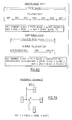
- the present invention is a method for minimizing path delay and optimizing machine cycle by identifying all the 'net segments' comprising the machine and prioritizing them in accordance to their relative importance; achieving an initial coarse approximation to the final optimum configuration based on relative 'net segment' criticality; improving this initial approximation to a final optimum configuration by assigning a cost function to those 'net segments' based on the previously determined relative 'net segment' criticality; and using the cost function to achieve an improved configuration by heuristic means.
- a single data path of excessive delay can limit the cycle time of a machine.
- combinatorial optimization techniques that optimize solutions for aggregate 'cost' or 'objective' functions (e.g., 'total wire' minimization) do not directly address the problem of minimizing cycle time.
- objectives such as 'total path delay' may be improper because a path delay distribution with low 'total' and low accumulated average (i.e., mean) but with uncharacteristic 2 and 3 sigma members, is less effective than a distribution with higher 'total' and nominal value, but with smaller deviation and shorter 'longest path'.
- minimizing 'total wire' length and, consequently, 'average path delay' may lead to a faster cycle time
- violations of this rule by intelligent fluctuation may produce an even faster cycle.
- Any 'averaging' technique measures total or accumulated behavior of the ensemble of paths, and is only inferentially related to the problem. Aggregate path behavior does not dictate cycle speed, only the slowest paths do. Thus any of the combinatorial optimization techniques that are chosen, whether Simulated Annealing, Genetic Placement, Simulated Evolution, etc., will require a careful definition of the optimized 'target parameter'.
- Block 100 'initialize path definition' contains an equation definition for each machine path, where the path delay is equal to the sum of all functional block member delays and all 'net segment' delays (FIG. 2a). For each functional block member listed in the path definition, an appropriate block delay field is retrieved. For each 'net segment' member, the corresponding source and destination names (also referred to as 'come from' and 'go to' blocks) are listed as variables.
- An initial placement 'seed' procedure does not require an exhaustive, complex or highly accurate approximation of the final optimum. Such algorithms are so time consuming and cost prohibitive that they are unrealizable in actual practice.
- An implementable 'seed' solution will only succeed if a set of powerful simple rules can be devised that accomplish the desired net slack to block location tailoring required to meet the machine path delay target. Accordingly, rules must be discovered that are simple in terms of computation and sufficiently powerful that they appropriately reflect the complexity of path interaction requirements and net slack tailoring in the positioning and partitioning of the blocks.
- the ultimate object is, therefore, to minimize the slowest path contribution and, in the process, to tighten up the slack distribution of the ensemble of paths by placement compensation.
- This is achieved by generating an equation for each path such that it expresses the path slack in terms of net slack contribution to the path.
- the set of path equations is then solved for the slack values of the 'net segments' and the values are used to construct an initial placement seed position for Simulated Annealing, Simulated Evolution, Genetic Placement, etc, equation.
- the equation is solved while carefully monitoring the 'target parameter', namely, the one that emphasizes minimum slack on the critical paths.
- y1 kx1+kx2+kx3+...+kx n
- y2 kx1+kx2+kx3...+kx n
- the matrix is sparce with most 'net segments' having their own individual degrees of freedom constrained solely by the path slack aggregate delay -- the sum of 'net segment's' delay in path ⁇ slack, and path interaction, whereby, pinning of some other path by the mutual sharing of one or more of the same segments occurs. If there is no pinning, the matrix degenerates into a listing of independent equations with no interactions. If all the paths share all 'net segments', the matrix becomes full and and potentially solvable by overdetermined regression techniques which are readily known to one skilled in the art.
- the matrix of equations usually fails to yield a unique or overdetermined approximate solution space, since so much 'freedom of action' exists in the placement of 'net segments' in spite of the partial pinning that links the paths. It is however, possible to generate a placement seed by 'equipartition' and substitution techniques without having to manipulate any matrix steps by supercomputer algorithms.
- a 'path slack' target is then defined (FIG. 1, block 101).
- the 'path slack' is defined as the difference between cycle time and the sum of all path member block delays.
- an 'equipartition' list (block 102) is created by determining the total count of the 'net segments' contained in the Path Slack Definition for each path is the list and, preferably, dividing each path slack by this number. It is evident that other forms of division could have been advantageously used, such as dividing by N 2/3 to reflect non-linear geometric constraints.
- a file is then created with fields for each 'net segment' and equipartition value. It is also evident that multiple paths can pass through any given block-to-block 'net segment'. If each path is analyzed independently during 'equipartition' as it also is intended, different values will arise for the multi-path 'net segments' based on the timing needs of each distinct path through that segment. A comparison is then made for multiple values of 'net segments' with the same name by searching the list for multiple occurrences and by comparing values and accepting the lowest one.
- each 'net segment' name appears only once.
- the accepted value is placed in the field associated with the corresponding 'net segment' name.
- the next step 'establish net segment length hierarchy' (block 103) essentially creates a 'net segment' timing priority list by means of the 'ascendency' procedure. Thereby, 'net segments' are ordered in ascending order as a function of individual delay values and implicit length.
- a list of multiple nested 'net segments' is created by the next step, 'solitaire' procedure, (block 104, FIG. 1) which modifies the placement hierarchy with respect to 'associativity'.
- the 'solitaire' procedure is based on net 'coagulation'. Starting from the 'shortest' nets in the 'distance-between-blocks' hierarchy, groups are columnized in a manner similar to playing solitaire. Every net connection comprised of its two blocks (source and destination) is represented by a pair of letters or symbols (e.g., x,y). With each succeeding entry, the following questions are asked:
- this pair becomes the first entry in a new list.
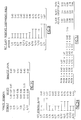
- FIG. 2a Shown in FIG. 2a is a simple logic arrangement consisting of 13 interconnected blocks having I1, I2 and I3 as inputs, and O1, O2 and O3 as outputs. Each total path delay is comprised of path member block delays and of 'net segment' delays.
- the first step of the inventive methodology 'initialize path definition' (block 100, FIG. 1) requires a listing of all the paths which complete some work function in a clock cycle. The inputs and outputs represent cycle initiation and termination points for the paths shown.
- each path is graphically represented by a unit block delay of every block in the path, leaving the previously defined slack as the balance of the cycle time (FIG. 2c).
- the next step calls for 'removing functional delays' (block 101, FIG. 1) leaving only the 'net segment' delays, as graphically shown in FIG. 2d.
- Particular attention is drawn to each 'net segment' which is expressed by its source and destination variables.
- a matrix is formed comprised of as many rows as there are paths and as many columns as there are 'net segments'.
- the pertinent elements of the matrix are given either 'P', for each 'pinned net segment' or 'X', for each 'free net segment' (FIG. 2e).
- each slack is divided by the corresponding number of 'net segments' (FIG. 2f) and each 'net segment' is then individually assigned the resulting 'net segment' value.
- FIG. 2h Listed in FIG. 2h are the slacks for each 'net segment'.
- 'Net segments' are prioritized next by means of the 'ascendency' rule (block 103, FIG. 1), whereby the net slack sequence is ordered in ascending order (FIG. 2i). If the actual placement of blocks results in precisely the same 'net segment' slack values, the path delays shown in FIG. 2j will then result.
- each 'net segment' will have a delay factor attached to it that can be used to generate a 'distance between blocks' hierarchy for generating a placement seed.
- a seed placement may start by placing all short 'net segments' delays required first. Thus, the blocks connected by these nets would be seeded locally first. Longer length segment member blocks would be placed next, etc. Conflicts arising between long and short requirements for a single block would be addressed by the Annealing algorithm to achieve minimum energy, which in this case is the difference between the desired net delay and the actual placement delay.
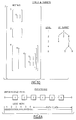
- FIG. 3a shows a new reduced list of 'net segments' arranged in increasing order of 'slack value' in accordance with the previously described 'ascendency' rule. From it, the 'solitaire' procedure is applied defining a natural partitioning that leads to the formation of a plurality of growth centers (FIG 3b).
- the dynamic sequence of growth center accretion and center-to-center aggregation may be captured and preserved in a coded structure. If growth centers are attributed and merging operations are catalogued in an indexed hierarchy, a road map or tree-structure of the developing logic mass will emerge.
- the nested groupings i.e., growth centers
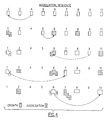
- the nested groupings within the 'ascendency' hierarchy reveals aspects of the evolution of the developing logic mass. It symbolizes dynamic partitioning due to the fact that specific groups are growing independently from one another until the first connection which merges that specific set of groupings is achieved. From that point on, the merged groups are treated as one larger group (FIG. 4).
- the 'ascendency' sequence listing provides the order in which groups are merged. Together, the nesting and list sequence provide a history of the evolution of 'aggregation' and 'accretion'.
- TCP timing compensation placement'
- FIG. 5 wherein an example of a 'net segment' hierarchy partitioned by growth order is shown, (FIG. 5a), leading to the indexed growth history (FIG. 5b); from it, to a plurality of nested levels (FIG. 5c), and finally to a representation of plural levels and corresponding subsets of those levels (FIG. 5d).
- the rectangular blocks referred to as 'growth centers', contain a plurality of sets of logic block connections (i.e., 'net segments') based on path criticality timing requirements and associativity.
- 'Aggregation' occurs when a 'net segment' links logic blocks members which reside in two previously independent growth center's groups. With this new 'net segment' the two groups are suddenly linked and merged in the nested hierarchy. As shown in FIG. 5, a new 'net segment' has linked a block in group 1 to a block in group 4. As a result, group 4 is now merged with group 1. Finally, 'accretion', the method for adding additional 'net segment' members to an existing growth center is symbolically and pictorially demonstrated in FIG. 4 by the widening of rectangles (growth center), blocks 6 and 8.
- the prioritized placement procedure can be followed by a preliminary design assessment of the most appropriate partition boundary choices. These choices can be inserted into the model and a new prioritized placement hierarchy established.
- the prioritized placement procedure is followed by a preliminary assessment of the most appropriate partitioning boundary choices. These choices can be taken into account by establishing a new placement hierarchy without resorting to any physical placement of blocks. This is true because the 'ascendency/nesting hierarchy' allows first-pass deductions without regard to geometric placement decisions. These considerations allow modelling an idealized placement which lacks partitioned boundaries. This is particularly well suited as a starting point for an analysis of the design process. More particularly, it allows a designer to assess in approximate form, the impact of placement within the constraints of a two-dimensional (planar) space. The master grid placement of blocks within a predefined x,y coordinate system results in a delay factor for each segment connected to the blocks.
- Provisions can be made so that partition choices can automatically change internal blocks to partition drivers, and their block delay to driver delay. Altered delay values of the selected driver blocks will permit new path slack calculations and new 'net segment' 'ascendency' hierarchies. The new 'net segment' list sequence may then result in an altered 'solitaire' procedure result and a new placement.
- a new delay value can be calculated based on the positions of the partitions and the resulting 'come from/go to' master grid coordinates.
- This length coupled to a module net delay multiplier, enables the construction of new path delay values based on the 'net segment' delays and block delays of all members of each path.
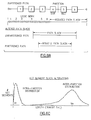
- FIG. 6a illustrates an unpartitioned path whereby, for illustration purposes, the functional blocks are set equal to each other, leaving a path slack independent of any partition.
- the mean (average) distance for the distribution of on-chip net segments is measured in cell pitches.
- the mean (average) distance for the distribution of chip-to-chip 'net segments' is measured in chip pitches.
- FIG. 6c shows a distribution of the 'net segments' alterations as a function of length (e.g., transit time).
- the curve shows two clusters, one centering around M i that corresponds to the intra-chip distribution and the other centering around M e that corresponds to the inter-chip distribution.
- the path slack is equally divided among all 'net segments' (a result of applying the equi- partition rule).
- the total 'net segment' slack is just the total slack divided by the number of 'net segments'.
- the altered 'equipartitioned' slack is modified where appropriate by the additional chip-to-chip considerations, thus providing a more realistic picture of the 'net segment' topology.
- a means for accounting for the difference between internal and external 'net segments' would be to generate an expression for the external 'net segments' which approximates their length (time delay) in internal 'net segment' equivalents.
- the partition boundary 'net segments' are re-expressed as an equivalent number of internal 'net segments'.
- This allows for executing the original 'equipartition' procedure in a more realistic division of the path slack apportionments (FIG. 6D).
- a new 'ascendency' hierarchy is established for prioritized placement. This prioritized placement is accomplished without physical placement of the blocks.
- the actual 'net segment' delays may be calculated from equations which determine the length from the x,y coordinate information of the physical placement.
- the x,y unpartitioned placement may contain most of the partitioning impact within it.
- the x,y placements and distances of the unpartitioned layout can correspond to the same distances that a partitoned external net would have.
- the alterations of the delay are primarily due to:
- Combinatorial optimization heuristic techniques have been developed with a variety of 'cost' or 'objective' functions to guide the exploration through the design space.
- a number of early iterative techniques made use of an evaluation criteria that accepted only rearrangements leading 'downhill', i.e., that improved the cost function. Such searches usually converged on a local optimum, but rarely on a global optimum. Succeeding refinements to the 'cost' function allowed for the probabilistic acceptance of 'uphill' as well as 'downhill' moves, allowing the algorithmic procedure to avoid becoming stuck at a local minimum.
- This 'priority based on criticality' methodology attempts to minimize the longest path delay and not the average path delay (e.g., total wire or total capacitance). Since in general, long paths contain a large number of functional blocks, the path definition results in the smallest slack time divided over a large number of not segments. Consequently, these paths have highly restricted degrees of placement freedom because of their limited 'net segment' length, and the number of 'net segments' which must lie in proximity of one another. Moreover, since placement freedom is not symmetric, expansion will end with better probability of success than contraction. Thus, the longest paths with the shortest slack are given the highest priority in placement.
- the average path delay e.g., total wire or total capacitance
- This technique can be considered global (also referred to as machine wide because the relative freedom of placement (or acceptance) is based on the criticality of all paths, 'nets segments', etc., of all the circuits that comprise the machine.
- 'cost' functions which essentially treats a net as the entity to be examined, may create 'path bundling', whereby path 'net segments' are grouped together and analyzed in aggregates. This transformation converts sets of distinct path-identified 'net segments' into a pseudo-delay variable to be called 'net'.
- a disadvantage of this approach is the conversion of specific path analysis capabilities into a technique for delay averaging.
- Critical path 'net segment' requirements end up being analyzed in conjunction with the combined statistics of non-critical 'net segment' members of the same net'.
- the analysis is conducted at a more abstract level, whereby less total wire, less net capacitance, etc., are considered as being better.
- This technique can be viewed as local because the relative freedom of placement (or acceptance) depends on criticalities (path slack/'net segment' slack) which are based only on 'net segments' participating in the net under consideration.
- FIG. 7B Three possible paths are shown in FIG. 7B with their respective slack, 'criticality' and assigned indexes weight, and the ensuing 'composite acceptance weight' for each of the paths and placement results (FIG. 7C).
Landscapes
- Engineering & Computer Science (AREA)
- Computer Hardware Design (AREA)
- Physics & Mathematics (AREA)
- Theoretical Computer Science (AREA)
- Architecture (AREA)
- Evolutionary Computation (AREA)
- Geometry (AREA)
- General Engineering & Computer Science (AREA)
- General Physics & Mathematics (AREA)
- Design And Manufacture Of Integrated Circuits (AREA)
- Information Transfer Systems (AREA)
Applications Claiming Priority (2)
| Application Number | Priority Date | Filing Date | Title |
|---|---|---|---|
| US632454 | 1990-12-21 | ||
| US07/632,454 US5237514A (en) | 1990-12-21 | 1990-12-21 | Minimizing path delay in a machine by compensation of timing through selective placement and partitioning |
Publications (2)
| Publication Number | Publication Date |
|---|---|
| EP0493294A2 true EP0493294A2 (de) | 1992-07-01 |
| EP0493294A3 EP0493294A3 (en) | 1993-08-04 |
Family
ID=24535592
Family Applications (1)
| Application Number | Title | Priority Date | Filing Date |
|---|---|---|---|
| EP19910480184 Withdrawn EP0493294A3 (en) | 1990-12-21 | 1991-12-17 | Method for minimizing path delay and optimizing cycle time in a machine |
Country Status (3)
| Country | Link |
|---|---|
| US (1) | US5237514A (de) |
| EP (1) | EP0493294A3 (de) |
| JP (1) | JPH04316151A (de) |
Families Citing this family (98)
| Publication number | Priority date | Publication date | Assignee | Title |
|---|---|---|---|---|
| JP2674353B2 (ja) * | 1991-04-04 | 1997-11-12 | 日本電気株式会社 | 概略配線処理方式 |
| JPH04342059A (ja) * | 1991-05-18 | 1992-11-27 | Fujitsu Ltd | 組み合わせ最適化装置 |
| US5349536A (en) * | 1991-08-20 | 1994-09-20 | Vlsi Technology, Inc. | Method for optimally placing components of a VLSI circuit |
| WO1993008598A1 (fr) * | 1991-10-17 | 1993-04-29 | Fujitsu Limited | Procede d'optimisation du temps de retard |
| JP2776120B2 (ja) * | 1992-03-10 | 1998-07-16 | 日本電気株式会社 | 集積回路の電源配線布設方法 |
| US5787010A (en) * | 1992-04-02 | 1998-07-28 | Schaefer; Thomas J. | Enhanced dynamic programming method for technology mapping of combinational logic circuits |
| EP0643855A1 (de) * | 1992-06-04 | 1995-03-22 | Xilinx, Inc. | Zeitliche steuerung für die implantierung einer gebrauchsschaltung auf einer programmierbaren integrierten schaltungsanordnung |
| US5355321A (en) * | 1992-06-12 | 1994-10-11 | Digital Equipment Corporation | Static timing verification |
| US5694328A (en) * | 1992-08-06 | 1997-12-02 | Matsushita Electronics Corporation | Method for designing a large scale integrated (LSI) layout |
| US5629859A (en) * | 1992-10-21 | 1997-05-13 | Texas Instruments Incorporated | Method for timing-directed circuit optimizations |
| US5546320A (en) * | 1992-10-23 | 1996-08-13 | Biro; Larry L. | Method for performing integrated section-level and full-chip timing verification for custom microprocessor designs |
| US5553000A (en) * | 1992-11-05 | 1996-09-03 | Nec Usa, Inc. | Eliminating retiming bottlenecks to improve performance of synchronous sequential VLSI circuits |
| US5648913A (en) * | 1993-03-29 | 1997-07-15 | Xilinx, Inc. | Frequency driven layout system and method for field programmable gate arrays |
| JP2601168B2 (ja) * | 1993-03-30 | 1997-04-16 | 日本電気株式会社 | 順次回路をリタイミングする方法および再設計する方法 |
| US5648912A (en) * | 1993-04-12 | 1997-07-15 | International Business Machines Corporation | Interconnection resource assignment method for differential current switch nets |
| US5654898A (en) * | 1993-05-10 | 1997-08-05 | Cascade Design Automation Corporation | Timing-driven integrated circuit layout through device sizing |
| US5566078A (en) * | 1993-05-26 | 1996-10-15 | Lsi Logic Corporation | Integrated circuit cell placement using optimization-driven clustering |
| US5596505A (en) * | 1993-07-23 | 1997-01-21 | Vlsi Technology, Inc. | Estimation of pin-to-pin timing for compiled blocks |
| US5461576A (en) * | 1993-09-01 | 1995-10-24 | Arcsys, Inc. | Electronic design automation tool for the design of a semiconductor integrated circuit chip |
| US5469366A (en) * | 1993-09-20 | 1995-11-21 | Lsi Logic Corporation | Method and apparatus for determining the performance of nets of an integrated circuit design on a semiconductor design automation system |
| JPH0793386A (ja) * | 1993-09-28 | 1995-04-07 | Fujitsu Ltd | Lsi実装設計システム |
| US5598532A (en) * | 1993-10-21 | 1997-01-28 | Optimal Networks | Method and apparatus for optimizing computer networks |
| US5506788A (en) * | 1994-01-13 | 1996-04-09 | Lsi Logic Corporation | Similarity-extraction force-oriented floor planner |
| US5563994A (en) * | 1994-03-11 | 1996-10-08 | Harmon; Samuel T. | System for graphically generating the sequence and temporal relationship between tasks in a project |
| US5608645A (en) * | 1994-03-17 | 1997-03-04 | Vlsi Technology, Inc. | Method of finding a critical path in a circuit by considering the clock skew |
| JP3210172B2 (ja) * | 1994-05-13 | 2001-09-17 | 富士通株式会社 | ディレイ・レーシング・エラーリスト出力装置 |
| US5774371A (en) * | 1994-08-03 | 1998-06-30 | Matsushita Electric Industrial Co., Ltd. | Semiconductor integrated circuit and layout designing method for the same |
| US5638288A (en) * | 1994-08-24 | 1997-06-10 | Lsi Logic Corporation | Separable cells having wiring channels for routing signals between surrounding cells |
| GB2292823B (en) * | 1994-08-26 | 1998-12-02 | Quickturn Design Systems Inc | Method for automatic clock qualifier selection in reprogrammable hardware emulation systems |
| US5587923A (en) * | 1994-09-07 | 1996-12-24 | Lsi Logic Corporation | Method for estimating routability and congestion in a cell placement for integrated circuit chip |
| US5568636A (en) * | 1994-09-13 | 1996-10-22 | Lsi Logic Corporation | Method and system for improving a placement of cells using energetic placement with alternating contraction and expansion operations |
| US6272668B1 (en) | 1994-12-14 | 2001-08-07 | Hyundai Electronics America, Inc. | Method for cell swapping to improve pre-layout to post-layout timing |
| US5644498A (en) * | 1995-01-25 | 1997-07-01 | Lsi Logic Corporation | Timing shell generation through netlist reduction |
| US5548747A (en) * | 1995-02-10 | 1996-08-20 | International Business Machines Corporation | Bit stack wiring channel optimization with fixed macro placement and variable pin placement |
| US5696693A (en) * | 1995-03-31 | 1997-12-09 | Unisys Corporation | Method for placing logic functions and cells in a logic design using floor planning by analogy |
| US5745372A (en) * | 1995-05-04 | 1998-04-28 | Hewlett-Packard Company | Apparatus and method for routing signals in a field programmable gate array integrated circuit |
| US5778216A (en) * | 1995-06-30 | 1998-07-07 | Cadence Design Systems, Inc. | Method for hierarchical time drive circuit layout by rebudgeting timing constraints of plurality of logical blocks after placement |
| US5671405A (en) * | 1995-07-19 | 1997-09-23 | International Business Machines Corporation | Apparatus and method for adaptive logical partitioning of workfile disks for multiple concurrent mergesorts |
| US5659717A (en) * | 1995-07-31 | 1997-08-19 | Altera Corporation | Methods for partitioning circuits in order to allocate elements among multiple circuit groups |
| US5764954A (en) * | 1995-08-23 | 1998-06-09 | International Business Machines Corporation | Method and system for optimizing a critical path in a field programmable gate array configuration |
| CA2187466A1 (en) * | 1995-10-19 | 1997-04-20 | Kwang-Ting Cheng | Method for inserting test points for full- and partial-scan built-in self-testing |
| US5740067A (en) * | 1995-10-19 | 1998-04-14 | International Business Machines Corporation | Method for clock skew cost calculation |
| US5745735A (en) * | 1995-10-26 | 1998-04-28 | International Business Machines Corporation | Localized simulated annealing |
| US5953236A (en) * | 1995-10-31 | 1999-09-14 | Vlsi Technology, Inc. | Method and apparatus for implementing engineering change orders in integrated circuit designs |
| US5666290A (en) * | 1995-12-27 | 1997-09-09 | Vlsi Technology, Inc. | Interactive time-driven method of component placement that more directly constrains critical paths using net-based constraints |
| US5787009A (en) * | 1996-02-20 | 1998-07-28 | Altera Corporation | Methods for allocating circuit design portions among physical circuit portions |
| US5751593A (en) * | 1996-04-10 | 1998-05-12 | Motorola, Inc. | Accurate delay prediction based on multi-model analysis |
| US5825661A (en) * | 1996-05-01 | 1998-10-20 | International Business Machines Corporation | Method and apparatus for automatic post-layout optimization of an integrated circuit |
| US5757653A (en) * | 1996-05-16 | 1998-05-26 | International Business Machines Corporation | Method and apparatus for dynamically varying net rules |
| US5838580A (en) * | 1996-06-20 | 1998-11-17 | Sun Microsystems, Inc. | Method of optimizing repeater placement in long lines of a complex integrated circuit |
| US6009253A (en) * | 1996-06-20 | 1999-12-28 | Sun Microsystems, Inc. | Spare repeater amplifiers for long lines on complex integrated circuits |
| US5971588A (en) * | 1996-06-28 | 1999-10-26 | Lsi Logic Corporation | Advanced modular cell placement system with optimization of cell neighborhood system |
| US5812740A (en) * | 1996-06-28 | 1998-09-22 | Lsi Logic Corporation | Advanced modular cell placement system with neighborhood system driven optimization |
| US5844811A (en) * | 1996-06-28 | 1998-12-01 | Lsi Logic Corporation | Advanced modular cell placement system with universal affinity driven discrete placement optimization |
| US6754879B1 (en) | 1997-01-27 | 2004-06-22 | Unisys Corporation | Method and apparatus for providing modularity to a behavioral description of a circuit design |
| US6718520B1 (en) | 1997-01-27 | 2004-04-06 | Unisys Corporation | Method and apparatus for selectively providing hierarchy to a circuit design |
| US6292926B1 (en) * | 1997-07-03 | 2001-09-18 | Matsushita Electric Industrial Co., Ltd. | Functional module model, pipelined circuit synthesis and pipelined circuit device |
| US6453446B1 (en) | 1997-12-24 | 2002-09-17 | Magma Design Automation, Inc. | Timing closure methodology |
| US6080201A (en) * | 1998-02-10 | 2000-06-27 | International Business Machines Corporation | Integrated placement and synthesis for timing closure of microprocessors |
| US6446239B1 (en) | 1998-03-10 | 2002-09-03 | Monterey Design Systems, Inc. | Method and apparatus for optimizing electronic design |
| US6449761B1 (en) * | 1998-03-10 | 2002-09-10 | Monterey Design Systems, Inc. | Method and apparatus for providing multiple electronic design solutions |
| US6385760B2 (en) * | 1998-06-12 | 2002-05-07 | Monterey Design Systems, Inc. | System and method for concurrent placement of gates and associated wiring |
| US6460166B1 (en) | 1998-12-16 | 2002-10-01 | International Business Machines Corporation | System and method for restructuring of logic circuitry |
| US6282695B1 (en) | 1998-12-16 | 2001-08-28 | International Business Machines Corporation | System and method for restructuring of logic circuitry |
| US6516453B1 (en) * | 1999-05-26 | 2003-02-04 | Get2Chip | Method for timing analysis during automatic scheduling of operations in the high-level synthesis of digital systems |
| US6470486B1 (en) * | 1999-05-26 | 2002-10-22 | Get2Chip | Method for delay-optimizing technology mapping of digital logic |
| US6339835B1 (en) | 1999-06-10 | 2002-01-15 | International Business Machines Corporation | Pseudo-anding in dynamic logic circuits |
| US6526560B1 (en) * | 1999-09-21 | 2003-02-25 | Seiko Epson Corporation | Macro cell creating method, apparatus and library thereof, and recording medium |
| US6763506B1 (en) | 2000-07-11 | 2004-07-13 | Altera Corporation | Method of optimizing the design of electronic systems having multiple timing constraints |
| US7133819B1 (en) * | 2000-08-24 | 2006-11-07 | Altera Corporation | Method for adaptive critical path delay estimation during timing-driven placement for hierarchical programmable logic devices |
| US6470476B2 (en) | 2001-03-16 | 2002-10-22 | International Business Machines Corporation | Substitution of non-minimum groundrule cells for non-critical minimum groundrule cells to increase yield |
| US6836753B1 (en) | 2001-06-13 | 2004-12-28 | Cadence Design Systems, Inc. | Cone slack allocator for computing time budgets |
| US7110525B1 (en) | 2001-06-25 | 2006-09-19 | Toby Heller | Agent training sensitive call routing system |
| US6703706B2 (en) * | 2002-01-08 | 2004-03-09 | International Business Machines Corporation | Concurrent electrical signal wiring optimization for an electronic package |
| US6859914B2 (en) * | 2002-08-27 | 2005-02-22 | Synopsys, Inc. | Smooth operators in optimization of circuit structures |
| US7007254B1 (en) * | 2003-01-17 | 2006-02-28 | Synplicity, Inc. | Method and apparatus for the design and analysis of digital circuits with time division multiplexing |
| US7185299B1 (en) * | 2003-01-30 | 2007-02-27 | Xilinx, Inc. | Methods of estimating routing delays during the placement process in programmable logic devices |
| US9818136B1 (en) | 2003-02-05 | 2017-11-14 | Steven M. Hoffberg | System and method for determining contingent relevance |
| US7003747B2 (en) * | 2003-05-12 | 2006-02-21 | International Business Machines Corporation | Method of achieving timing closure in digital integrated circuits by optimizing individual macros |
| US7051312B1 (en) * | 2003-06-24 | 2006-05-23 | Xilinx, Inc. | Upper-bound calculation for placed circuit design performance |
| US7207020B1 (en) * | 2004-02-09 | 2007-04-17 | Altera Corporation | Method and apparatus for utilizing long-path and short-path timing constraints in an electronic-design-automation tool |
| US7308664B1 (en) | 2004-02-09 | 2007-12-11 | Altera Corporation | Method and apparatus for utilizing long-path and short-path timing constraints in an electronic-design-automation tool for routing |
| US7448012B1 (en) | 2004-04-21 | 2008-11-04 | Qi-De Qian | Methods and system for improving integrated circuit layout |
| US7356793B2 (en) * | 2004-07-12 | 2008-04-08 | International Business Machines Corporation | Genie: a method for classification and graphical display of negative slack timing test failures |
| US7376924B2 (en) * | 2004-07-12 | 2008-05-20 | International Business Machines Corporation | Methods for placement which maintain optimized behavior, while improving wireability potential |
| US7120888B2 (en) * | 2004-07-12 | 2006-10-10 | International Business Machines Corporation | Method, system and storage medium for determining circuit placement |
| US7769618B2 (en) * | 2005-03-16 | 2010-08-03 | Tal Levanon | Method and computer program product for evaluating a project |
| US7464348B1 (en) * | 2005-09-30 | 2008-12-09 | Cadence Design Systems, Inc. | Method and system for mapping source elements to destination elements as interconnect routing assignments |
| US8300798B1 (en) | 2006-04-03 | 2012-10-30 | Wai Wu | Intelligent communication routing system and method |
| US20080155486A1 (en) * | 2006-12-20 | 2008-06-26 | International Business Machines Corporation | Systems and methods for reducing wiring vias during synthesis of electronic designs |
| US8977995B1 (en) * | 2007-01-10 | 2015-03-10 | Cadence Design Systems, Inc. | Timing budgeting of nested partitions for hierarchical integrated circuit designs |
| US8365113B1 (en) * | 2007-01-10 | 2013-01-29 | Cadence Design Systems, Inc. | Flow methodology for single pass parallel hierarchical timing closure of integrated circuit designs |
| US7895544B2 (en) * | 2008-09-10 | 2011-02-22 | International Business Machines Corporation | Method to graphically identify registers with unbalanced slack as part of placement driven synthesis optimization |
| CN102116841B (zh) * | 2011-01-04 | 2014-09-03 | 复旦大学 | 基于模型量化的fpga互联结构评估方法 |
| US9218445B2 (en) * | 2014-01-23 | 2015-12-22 | International Business Machines Corporation | Implementing enhanced physical design quality using historical placement analytics |
| US10846453B1 (en) * | 2018-09-20 | 2020-11-24 | Synopsys, Inc. | Generating interrelated path groups by using machine learning |
| CN115269760B (zh) * | 2022-08-08 | 2026-03-17 | 国投智能信息科技股份有限公司 | 一种线路轨迹查询方法及终端 |
| EP4645065A1 (de) | 2024-04-30 | 2025-11-05 | Deutsches Zentrum für Luft- und Raumfahrt e.V. | Verfahren zur ermittlung einer alternativschaltung |
Family Cites Families (11)
| Publication number | Priority date | Publication date | Assignee | Title |
|---|---|---|---|---|
| FR1502554A (de) * | 1965-12-01 | 1968-02-07 | ||
| US4263651A (en) * | 1979-05-21 | 1981-04-21 | International Business Machines Corporation | Method for determining the characteristics of a logic block graph diagram to provide an indication of path delays between the blocks |
| US4495559A (en) * | 1981-11-02 | 1985-01-22 | International Business Machines Corporation | Optimization of an organization of many discrete elements |
| US4656580A (en) * | 1982-06-11 | 1987-04-07 | International Business Machines Corporation | Logic simulation machine |
| US4564943A (en) * | 1983-07-05 | 1986-01-14 | International Business Machines | System path stressing |
| US4615011A (en) * | 1983-12-19 | 1986-09-30 | Ibm | Iterative method for establishing connections and resulting product |
| US4654851A (en) * | 1984-12-24 | 1987-03-31 | Rockwell International Corporation | Multiple data path simulator |
| US4698760A (en) * | 1985-06-06 | 1987-10-06 | International Business Machines | Method of optimizing signal timing delays and power consumption in LSI circuits |
| JPS63137A (ja) * | 1986-02-17 | 1988-01-05 | Mitsubishi Electric Corp | 配線領域決定処理装置 |
| US4688947A (en) * | 1986-02-18 | 1987-08-25 | California Institute Of Technology | Method and apparatus for characterizing propagation delays of integrated circuit devices |
| US4787061A (en) * | 1986-06-25 | 1988-11-22 | Ikos Systems, Inc. | Dual delay mode pipelined logic simulator |
-
1990
- 1990-12-21 US US07/632,454 patent/US5237514A/en not_active Expired - Fee Related
-
1991
- 1991-12-12 JP JP3350669A patent/JPH04316151A/ja active Pending
- 1991-12-17 EP EP19910480184 patent/EP0493294A3/en not_active Withdrawn
Non-Patent Citations (4)
| Title |
|---|
| 27TH ACM/IEEE DESIGN AUTOMATION CONFERENCE JUNE 24-28 1990 ORLANDO FLORIDA US pages 84 - 89 DONATH ET AL 'timing driven placement using complete path delays' * |
| IBM TECHNICAL DISCLOSURE BULLETIN vol. 28, no. 11, April 1986, ARMONK NY US pages 4981 - 4988 'timing-influenced layout design' * |
| IBM TECHNICAL DISCLOSURE BULLETIN vol. 33, no. 6B, November 1990, ARMONK NY US pages 1 - 6 'prioritizing factor for nets in timing-based phisical design of vlsi chips' * |
| IEEE INTERNATIONAL SYMPOSIUM ON CIRCUITS AND SYSTEMS MAY 1-3 1990 NEW ORLEANS LA US pages 877 - 880 SUTANTHAVIBUL ET AL 'cell-based physical design under timing constraints' * |
Also Published As
| Publication number | Publication date |
|---|---|
| EP0493294A3 (en) | 1993-08-04 |
| JPH04316151A (ja) | 1992-11-06 |
| US5237514A (en) | 1993-08-17 |
Similar Documents
| Publication | Publication Date | Title |
|---|---|---|
| US5237514A (en) | Minimizing path delay in a machine by compensation of timing through selective placement and partitioning | |
| JP2708287B2 (ja) | 回路設計方法 | |
| US6651235B2 (en) | Scalable, partitioning integrated circuit layout system | |
| EP1543449B1 (de) | Verfahren zur beseitigung von routing-stau in einem ic-layout | |
| US6578183B2 (en) | Method for generating a partitioned IC layout | |
| US6493658B1 (en) | Optimization processing for integrated circuit physical design automation system using optimally switched fitness improvement algorithms | |
| US8370783B2 (en) | Systems and methods for probabilistic interconnect planning | |
| US6543043B1 (en) | Inter-region constraint-based router for use in electronic design automation | |
| US6865726B1 (en) | IC layout system employing a hierarchical database by updating cell library | |
| US5838583A (en) | Optimized placement and routing of datapaths | |
| EP0388794A2 (de) | Verfahren und Gerät zur Optimierung der Elementplazierung und zur Entscheidung der optimalen Elementplazierung | |
| US5841664A (en) | Method for optimizing track assignment in a grid-based channel router | |
| US6066178A (en) | Automated design method and system for synthesizing digital multipliers | |
| EP1192559B1 (de) | Aktualisierung der platzierung während der technologieabbildung | |
| US6086625A (en) | Method and apparatus for designing a circuit by describing logic design information with a hardware description language | |
| CN119378485A (zh) | FinFET工艺标准单元布线控制方法及相关设备 | |
| WO2000073925A2 (en) | Using budgeted required time during technology mapping | |
| Esbensen et al. | An MCM/IC timing-driven placement algorithm featuring explicit design space exploration | |
| Kucar et al. | Hypergraph partitioning techniques | |
| CN113973061B (zh) | 电路时延预测方法、装置、终端设备和可读存储介质 | |
| Elder et al. | An interactive system for VLSI chip physical design | |
| JPH07319953A (ja) | 回路分割方法 | |
| Gelosh et al. | Modeling layout tools to derive forward estimates of area and delay at the rtl level | |
| Kumar | High level VLSI synthesis for multichip designs | |
| Gajski et al. | Partitioning |
Legal Events
| Date | Code | Title | Description |
|---|---|---|---|
| PUAI | Public reference made under article 153(3) epc to a published international application that has entered the european phase |
Free format text: ORIGINAL CODE: 0009012 |
|
| AK | Designated contracting states |
Kind code of ref document: A2 Designated state(s): DE FR GB |
|
| PUAL | Search report despatched |
Free format text: ORIGINAL CODE: 0009013 |
|
| AK | Designated contracting states |
Kind code of ref document: A3 Designated state(s): DE FR GB |
|
| STAA | Information on the status of an ep patent application or granted ep patent |
Free format text: STATUS: THE APPLICATION IS DEEMED TO BE WITHDRAWN |
|
| 18D | Application deemed to be withdrawn |
Effective date: 19940502 |