EP0493359A2 - Reifenvulkanisierform - Google Patents
Reifenvulkanisierform Download PDFInfo
- Publication number
- EP0493359A2 EP0493359A2 EP91890304A EP91890304A EP0493359A2 EP 0493359 A2 EP0493359 A2 EP 0493359A2 EP 91890304 A EP91890304 A EP 91890304A EP 91890304 A EP91890304 A EP 91890304A EP 0493359 A2 EP0493359 A2 EP 0493359A2
- Authority
- EP
- European Patent Office
- Prior art keywords
- profile webs
- shaped profile
- thermal conductivity
- tire vulcanizing
- vulcanizing mold
- Prior art date
- Legal status (The legal status is an assumption and is not a legal conclusion. Google has not performed a legal analysis and makes no representation as to the accuracy of the status listed.)
- Granted
Links
Images
Classifications
-
- B—PERFORMING OPERATIONS; TRANSPORTING
- B29—WORKING OF PLASTICS; WORKING OF SUBSTANCES IN A PLASTIC STATE IN GENERAL
- B29D—PRODUCING PARTICULAR ARTICLES FROM PLASTICS OR FROM SUBSTANCES IN A PLASTIC STATE
- B29D30/00—Producing pneumatic or solid tyres or parts thereof
- B29D30/06—Pneumatic tyres or parts thereof (e.g. produced by casting, moulding, compression moulding, injection moulding, centrifugal casting)
- B29D30/0601—Vulcanising tyres; Vulcanising presses for tyres
- B29D30/0606—Vulcanising moulds not integral with vulcanising presses
-
- B—PERFORMING OPERATIONS; TRANSPORTING
- B29—WORKING OF PLASTICS; WORKING OF SUBSTANCES IN A PLASTIC STATE IN GENERAL
- B29C—SHAPING OR JOINING OF PLASTICS; SHAPING OF MATERIAL IN A PLASTIC STATE, NOT OTHERWISE PROVIDED FOR; AFTER-TREATMENT OF THE SHAPED PRODUCTS, e.g. REPAIRING
- B29C33/00—Moulds or cores; Details thereof or accessories therefor
- B29C33/38—Moulds or cores; Details thereof or accessories therefor characterised by the material or the manufacturing process
- B29C33/3828—Moulds made of at least two different materials having different thermal conductivities
-
- B—PERFORMING OPERATIONS; TRANSPORTING
- B29—WORKING OF PLASTICS; WORKING OF SUBSTANCES IN A PLASTIC STATE IN GENERAL
- B29C—SHAPING OR JOINING OF PLASTICS; SHAPING OF MATERIAL IN A PLASTIC STATE, NOT OTHERWISE PROVIDED FOR; AFTER-TREATMENT OF THE SHAPED PRODUCTS, e.g. REPAIRING
- B29C33/00—Moulds or cores; Details thereof or accessories therefor
- B29C33/42—Moulds or cores; Details thereof or accessories therefor characterised by the shape of the moulding surface, e.g. ribs or grooves
-
- B—PERFORMING OPERATIONS; TRANSPORTING
- B29—WORKING OF PLASTICS; WORKING OF SUBSTANCES IN A PLASTIC STATE IN GENERAL
- B29D—PRODUCING PARTICULAR ARTICLES FROM PLASTICS OR FROM SUBSTANCES IN A PLASTIC STATE
- B29D30/00—Producing pneumatic or solid tyres or parts thereof
- B29D30/06—Pneumatic tyres or parts thereof (e.g. produced by casting, moulding, compression moulding, injection moulding, centrifugal casting)
- B29D30/0601—Vulcanising tyres; Vulcanising presses for tyres
- B29D30/0606—Vulcanising moulds not integral with vulcanising presses
- B29D2030/0607—Constructional features of the moulds
- B29D2030/0612—Means for forming recesses or protrusions in the tyres, e.g. grooves or ribs, to create the tread or sidewalls patterns
Definitions
- the invention relates to a tire vulcanizing mold with a molded body part which has a molded surface which forms the tread pattern and optionally the shoulder regions of a tire and carries molded profile webs.
- Conventional tire vulcanizing molds consist, for example, of two side wall molded shells and a profile molded shell divided into several segments in the radial direction. Molded profile webs are fastened, for example riveted, to the profile molded shell, which has a smooth inner molded surface which is generally formed by machining, and which are made of steel or aluminum and which together with the inner molded surface represent a negative image of the tire to be produced, in particular the tread profile thereof.
- the grooves desired on the finished tire such as transverse grooves, circumferential grooves and the like, are formed by the shaped profile webs. Particularly at the bottom of the profile grooves, vulcanization results in a higher degree of crosslinking of the mixture due to the lower tread compound volume compared to the block or tread band.
- the object is achieved according to the invention in that at least part of the shaped profile webs consists at least partially of a material with a low thermal conductivity coefficient.
- the shaped profile webs consist at least in part of a plastic, in particular a polyimide.
- This material is also particularly suitable because of its high strength and high temperature resistance.
- the shaped profile webs have a foot part, in particular of constant thickness, which consists of the material with a low coefficient of thermal conductivity.
- the thickness of this foot section should be at least 2.5 mm.
- the shaped profile webs consist entirely of the material with a low thermal conductivity coefficient.
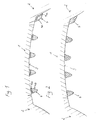
- FIG. 1 shows part of a cross section through a tire vulcanization mold with a first embodiment of the invention
- FIG. 2 shows a second embodiment of the invention in a representation analogous to FIG. 1.
- a tire vulcanizing mold usually has two side shells and a profile molding shell, which is composed, for example, of up to 8 profile segments.
- a profile segment 1 and the side shells 2 are shown, which have an inner molded surface 3, which is usually produced by cutting.
- molded profile webs On the tread segments 1 and the side shells 2 are molded profile webs, which ultimately bring about the design of the tread pattern with circumferential grooves, transverse grooves and the like on the tire.
- These shaped profile webs usually consist of metal, in particular aluminum.
- the shaped profile webs 4 are designed in two parts and consist of a foot part 4a and a head part 4b.
- the foot part 4a which rests on the inner molding surface 3, is made of a material with a low coefficient of thermal conductivity.
- the thickness of the foot part 4a and the height of the head part 4b are matched to one another in such a way that the desired tread depth is finally present on the finished vulcanized tire.
- the shaped profile webs 4 can be fastened in a conventional manner, for example by riveting.
- plastics with a high temperature resistance are suitable as the material for the foot part 4a.
- polyimide which has a coefficient of thermal conductivity of 1 W / mK. In comparison, this coefficient is 0.24 W / mK for rubber and 165 W / mK for aluminum.
- the minimum thickness of the foot part 4a when using polyimide should not be less than 2.5 mm. Accordingly, an insulating layer is formed by the foot part 4a, which complicates the heat transfer, so that in the profile grooves formed by the shaped profile webs, especially at the bottom of the groove, there is substantially less overheating than in conventional designs. The fully vulcanized tire will therefore have little or no tendency to crack at the bottom of the groove.
- the embodiment variant shown in FIG. 1 is simple to manufacture by producing the foot part 4a, for example by molding or chip removal.
- Fig.2 shows an embodiment in which the shaped profile webs 4 'are themselves made of a material with a low thermal conductivity coefficient.
- the plastic polyimide is also suitable for this variant. Compared to the first embodiment variant, this embodiment variant is somewhat more complex to manufacture.
- Various other, in particular filled or fiber-reinforced plastics for example turboplastics, can be considered as further materials for the foot part of the shaped profile webs.
- Carbon fibers are particularly suitable as reinforcing fibers.
- Plastics with a thermal conductivity coefficient ⁇ 5W / mK are particularly suitable.
Landscapes
- Engineering & Computer Science (AREA)
- Mechanical Engineering (AREA)
- Moulds For Moulding Plastics Or The Like (AREA)
- Heating, Cooling, Or Curing Plastics Or The Like In General (AREA)
- Saccharide Compounds (AREA)
- Preparation Of Compounds By Using Micro-Organisms (AREA)
Abstract
Description
- Die Erfindung betrifft eine Reifenvulkanisierform mit einem Formkörperteil, der eine die Profilierung der Lauffläche und gegebenenfalls der Schulterbereiche eines Reifens formende, Formprofilstege tragende Formfläche aufweist.
- Herkömmliche Reifenvulkanisierformen bestehen beispielsweise aus zwei Seitenwandformschalen und aus einer in Radialrichtung in mehrere Segmente geteilten Profilformschale. An der Profilformschale, die eine im allgemeinen durch Spanabhebung geformte glatte Innenformfläche aufweist, sind Formprofilstege befestigt, beispielsweise angenietet, die aus Stahl oder Aluminium bestehen und die mitsamt der Innenformfläche eine Negativabbildung des herzustellenden Reifen, insbesondere des Laufflächenprofiles desselben, darstellen. Durch die Formprofilstege werden die am fertigen Reifen gewünschten Nuten, wie Quernuten Umfangsnuten und dergleichen geformt. Insbesondere am Grund der Profilnuten kommt es bei der Vulkanisation, und zwar bedingt durch das dort im Vergleich zum Block oder Laufflächenband geringere Laufflächenmischungsvolumen, zu einer höheren Vernetzung der Mischung.
- Dies wiederum begünstigt die Rißbildung in den Profilnuten, was sich nachteilig auf die Haltbarkeit und die Lebensdauer des Reifens auswirkt.
- Hier setzt nun die Erfindung ein, deren Aufgabe darin besteht, eine Reifenvulkanisierform so zu gestalten, daß die genannte Rißbildung nicht mehr bzw. nicht mehr in so großem Ausmaß als bisher auftritt.
- Gelöst wird die gestellte Aufgabe erfindungsgemäß dadurch, daß zumindest ein Teil der Formprofilstege zumindest teilweise aus einem Material mit einem niedrigen Wärmeleitfähigkeitskoeffizienten besteht.
- Nach der Erfindung wird daher vorgeschlagen, den Wärmeübergang zu erschweren und somit eine gegenüber der bekannten Stahl- oder Aluminiumausführung für Formprofilstege geringere Vernetzung am Profilnutgrund zu erzielen. Dadurch kann wirkungsvoll die Rißbildung am Nutengrund verhindert bzw. verringert werden, da eine Überheizung, wie sie bei den Ausführungen nach dem Stand der Technik zwangsweise erfolgt, nicht mehr stattfindet.
- Gemäß einer bevorzugten Ausführungsvariante der Erfindung bestehen die Formprofilstege zumindest zum Teil aus einem Kunststoff, insbesondere aus einem Polyimid. Dieses Material ist auch wegen seiner hohen Festigkeit und seiner hohen Temperaturbeständigkeit besonders geeignet.
- Bei einer ersten Ausführungsvariante der Erfindung weisen die Formprofilstege einen Fußteil von insbesondere konstanter Dicke auf, der aus dem Material mit niedrigem Wärmeleitfähigkeitskoeffizenten besteht. Die Dicke dieses Fußteiles sollte dabei mindestens 2,5 mm betragen.
- Bei einer weiteren Ausführungsvariante der Erfindung ist vorgesehen, die Formprofilstege komplett aus dem Material mit einem niedrigen Wärmeleitfähigkeitskoeffizienten besteht.
- Weitere Merkmale Vorteile und Einzelheiten der Erfindung werden nun anhand der Zeichnung die zwei Ausführungsbeispiele darstellt, näher beschrieben. Dabei zeigt Fig. 1 einen Teil eines Querschnittes durch eine Reifenvulkanisationsform mit einer ersten Ausführungsform der Erfindung und Fig. 2 eine zweite Ausführungsvariante der Erfindung in einer zu Fig. 1 analogen Darstellung.
- Eine Reifenvulkanisierform weist üblicherweise zwei Seitenschalen und eine Profilformschale, die sich beispielsweise aus bis zu 8 Profilsegmenten zusammensetzt, auf. In den Zeichnungsfiguren sind ein Profilsegmente 1 und die Seitenschalen 2 dargestellt, die eine Innenformfläche 3, die üblicherweise durch Spanabhebung hergestellt ist, besitzen.
- Auf die Profilsegmente 1 und die Seitenschalen 2 sind Formprofilstege, die schließlich die Ausgestaltung des Laufflächenprofiles mit Umfangsnuten, Quernuten und dergleichen am Reifen bewirken, angebracht. Diese Formprofilstege bestehen üblicherweise aus Metall, insbesondere aus Aluminium.
- Nach dem ersten Ausführungsbeispiel der vorliegenden Erfindung, wie es in Fig. 1 dargestellt ist, sind die Formprofilstege 4 zweiteilig gestaltet und bestehen aus einem Fußteil 4a und einem Kopfteil 4b. Der Fußteil 4a, der an der Innenformfläche 3 anliegt, ist aus einem Material mit einer niedrigen Wärmeleitzahl gefertigt. Die Dicke des Fußteiles 4a und die Höhe des Kopfteiles 4b sind derart aufeinander abgestimmt, daß schließlich die gewünschte Profiltiefe am fertig vulkanisierten Reifen vorliegt. Die Befestigung der Formprofilstege 4 kann in herkömmlicher Weise, beispielsweise durch Aufnieten erfolgen. Als Material für den Fußteil 4a sind insbesondere Kunststoffe mit einer hohen Temperaturbe-ständigkeit geeignet. Eine dieser Kunststoffe ist Polyimid, welches einen Wärmeleitfähigkeitskoeffizienten von 1 W/mK aufweist. Im Vergleich dazu beträgt dieser Koeffizient bei Gummi 0,24 W/mK und bei Aluminium 165 W/mK. Die Mindestdicke des Fußteiles 4a bei Verwendung von Polyimid sollte 2,5 mm nicht unterschreiten. Durch den Fußteil 4a wird demnach eine isolierende Schicht gebildet, die den Wärmeübergang erschwert, so daß in den durch die Formprofilstege gebildeten Profilnuten, vor allem am Nutgrund, eine wesentlich geringere Überheizung als bei herkömmlichen Ausgestaltungen erfolgt. Der fertig vulkanisierte Reifen wird demnach nicht oder kaum noch zur Rißbildung am Nutengrund neigen.
- Die in Fig. 1 dargestellte Ausführungsvariante ist einfach herzustellen, indem der Fußteil 4a, beispielsweise durch Formen oder Spanabhebungen hergestellt wird.
- Fig.2 zeigt eine Ausführungsvariante, bei der die Formprofilstege 4′ selbst aus einem Material mit einem niedrigen Wärmeleitfähigkeitskoeffizienten gefertigt sind. Auch für diese Ausführungsvariante ist der Kunststoff Polyimid geeignet. Im Vergleich zur ersten Ausführungsvariante ist diese Ausführungsvariante in der Herstellung etwas aufwendiger.
- Als weitere Materialien für den Fußteil der Formprofilstege kommen verschiedene andere, insbesondere gefüllte oder faserverstärkte Kunststoffe, beispielsweise Turboplaste, in Frage. Als verstärkende Fasern sind vor allem Carbonfasern geeignet. Besonders geeignet sind dabei Kunststoffe, die einen Wärmeleitfähigkeitskoeffizienten < 5W/mK aufweisen.
Claims (7)
- Reifenvulkanisierform mit einem Formkörperteil, der eine die Profilierung der Lauffläche und gegebenenfalls der Schulterbereiche eines Reifens formende, Formprofilstege tragende Formfläche aufweist, dadurch gekennzeichnet, daß zumindest ein Teil der Formprofilstege (4, 4′) zumindest teilweise aus einem Material mit einem niedrigen Wärmeleitfähigkeitskoeffizienten besteht.
- Reifenvulkanisierform nach Anspruch 1, dadurch gekennzeichnet, daß die Formprofilstege (4) zumindest zum Teil aus einem Material mit einem Wärmeleitfähigkeitskoeffizienten, der wesentlich kleiner ist als jener von Aluminium oder Stahl, bestehen.
- Reifenvulkanisierform nach Anspruch 2, dadurch gekennzeichnet, daß die Formprofilstege (4) zumindest zum Teil aus einem Material mit einem Wärmeleitfähigkeitskoeffizienten < 5W/mK bestehen.
- Reifenvulkanisierform nach einem der Ansprüche 1 bis 3, dadurch gekennzeichnet, daß die Formprofilstege (4) zumindest zum Teil aus einem Kunststoff, insbesondere aus einem Polyimid, bestehen.
- Reifenvulkanisierform nach einem der Ansprüche 1 bis 4, dadurch gekennzeichnet, daß die Formprofilstege (4) einen Fußteil (4a) von insbesondere konstanter Dicke aufweisen, der aus dem Material mit niedrigem Wärmeleitfähigkeitskoeffizienten besteht.
- Reifenvulkanisierform nach Anspruch 5, dadurch gekennzeichnet, daß die Dicke des Fußteiles (4a) mindestens 2,5 mm beträgt.
- Reifenvulkanisierfom nach einem der Ansprüche 1 bis 4, dadurch gekennzeichnet, daß die Formprofilstege (4′) komplett aus dem Material mit einem niedrigen Wärmeleitfähigkeitskoeffizienten bestehen.
Applications Claiming Priority (2)
| Application Number | Priority Date | Filing Date | Title |
|---|---|---|---|
| AT0261790A AT396901B (de) | 1990-12-21 | 1990-12-21 | Reifenvulkanisierform |
| AT2617/90 | 1990-12-21 |
Publications (3)
| Publication Number | Publication Date |
|---|---|
| EP0493359A2 true EP0493359A2 (de) | 1992-07-01 |
| EP0493359A3 EP0493359A3 (en) | 1993-03-03 |
| EP0493359B1 EP0493359B1 (de) | 1995-04-12 |
Family
ID=3537462
Family Applications (1)
| Application Number | Title | Priority Date | Filing Date |
|---|---|---|---|
| EP91890304A Expired - Lifetime EP0493359B1 (de) | 1990-12-21 | 1991-12-12 | Reifenvulkanisierform |
Country Status (4)
| Country | Link |
|---|---|
| EP (1) | EP0493359B1 (de) |
| AT (2) | AT396901B (de) |
| DE (1) | DE59105174D1 (de) |
| ES (1) | ES2071287T3 (de) |
Cited By (1)
| Publication number | Priority date | Publication date | Assignee | Title |
|---|---|---|---|---|
| CN106029324A (zh) * | 2014-03-14 | 2016-10-12 | 住友橡胶工业株式会社 | 轮胎成型用刚性芯和轮胎制造方法 |
Family Cites Families (3)
| Publication number | Priority date | Publication date | Assignee | Title |
|---|---|---|---|---|
| US3734449A (en) * | 1970-10-14 | 1973-05-22 | Tokyo Shibaura Electric Co | Metal mold for injection molding |
| EP0006289A1 (de) * | 1978-05-30 | 1980-01-09 | Allied Corporation | Giessform zum Kontrollieren von Einsenkungsstellen an geformten Kunststoffgegenständen und Verfahren zum Herstellen der Gegenstände |
| US4568259A (en) * | 1985-08-02 | 1986-02-04 | The B. F. Goodrich Company | Tire mold |
-
1990
- 1990-12-21 AT AT0261790A patent/AT396901B/de not_active IP Right Cessation
-
1991
- 1991-12-12 ES ES91890304T patent/ES2071287T3/es not_active Expired - Lifetime
- 1991-12-12 EP EP91890304A patent/EP0493359B1/de not_active Expired - Lifetime
- 1991-12-12 DE DE59105174T patent/DE59105174D1/de not_active Expired - Fee Related
- 1991-12-12 AT AT91890304T patent/ATE121011T1/de not_active IP Right Cessation
Cited By (2)
| Publication number | Priority date | Publication date | Assignee | Title |
|---|---|---|---|---|
| CN106029324A (zh) * | 2014-03-14 | 2016-10-12 | 住友橡胶工业株式会社 | 轮胎成型用刚性芯和轮胎制造方法 |
| EP3117976A4 (de) * | 2014-03-14 | 2017-08-30 | Sumitomo Rubber Industries, Ltd. | Steifer kern zur reifenformung und reifenherstellungsverfahren |
Also Published As
| Publication number | Publication date |
|---|---|
| ATA261790A (de) | 1993-05-15 |
| EP0493359A3 (en) | 1993-03-03 |
| DE59105174D1 (de) | 1995-05-18 |
| ES2071287T3 (es) | 1995-06-16 |
| EP0493359B1 (de) | 1995-04-12 |
| AT396901B (de) | 1993-12-27 |
| ATE121011T1 (de) | 1995-04-15 |
Similar Documents
| Publication | Publication Date | Title |
|---|---|---|
| DE69210897T2 (de) | Reifenvulkanisierform | |
| DE69715738T2 (de) | Reifenvulkanisierungsformwerkzeug und Verfahren zu seiner Herstellung | |
| DE69314376T2 (de) | Verstärkte Elastomerauskleidung für ein Pumpengehäuse und Herstellungsverfahren dafür | |
| EP2987630B1 (de) | Verfahren zur herstellung einer vulkanisierform für fahrzeugreifen und vulkanisierform für fahrzeugreifen | |
| DE102015203212A1 (de) | Verfahren zur Herstellung eines Profilsegmentes einer segmentierten Gieß-Vulkanisierform für Fahrzeugreifen sowie eine Vulkansierform und ein Fahrzeugreifen | |
| DE60010989T2 (de) | Steifer Kern in zwei Teilen, zur Herstellung von Luftreifen | |
| DE3782655T2 (de) | Valukanisierungsform fuer luftreifen. | |
| DE3906092A1 (de) | Luftreifen und verfahren zu seiner herstellung | |
| EP0493359B1 (de) | Reifenvulkanisierform | |
| DE69004350T3 (de) | Verfahren und Form zum Formen eines Reifens. | |
| DE19532217C1 (de) | Heizbalg aus Gummi für die Vulkanisation von Reifen oder Luftfedern | |
| DE1965121A1 (de) | Form,insbesondere Vulkanisierform mit Entlueftungsoeffnungen | |
| EP3475070B1 (de) | Verfahren zur herstellung eines vollgummireifens und nach dem verfahren hergestellter vollgummireifen | |
| DE3311856A1 (de) | Innenschlauch fuer luftreifen sowie vorrichtung zu seiner herstellung | |
| EP0010224A1 (de) | Reifen für langsam fahrende Fahrzeuge | |
| DE69513524T2 (de) | Druckpressformwerkzeug zur herstellung von reifen | |
| WO2018228728A1 (de) | Fahrzeugreifen | |
| EP4417406B1 (de) | Reifenheizform | |
| DE1912598A1 (de) | Luftreifen | |
| DE102016223026B4 (de) | Vorrichtung zum Vulkanisieren von Nutzfahrzeugreifen | |
| DE1090844B (de) | Reifen-Form- und Vulkanisierpresse | |
| DE102018216880A1 (de) | Reifenvulkanisiervorrichtung | |
| EP3760424B1 (de) | Verfahren zum herstellen eines fahrzeugluftreifens, verwendung von strip-winding zum aufwickeln einer oder mehrerer kautschukkomponenten, vorrichtung zur durchführung des verfahrens und einen fahrzeugluftreifen herstellbar oder hergestellt gemäss dem verfahren | |
| DE612933C (de) | Verfahren zur Herstellung von Vollgummireifen | |
| DE1480936C (de) | Gürtelreifen |
Legal Events
| Date | Code | Title | Description |
|---|---|---|---|
| PUAI | Public reference made under article 153(3) epc to a published international application that has entered the european phase |
Free format text: ORIGINAL CODE: 0009012 |
|
| AK | Designated contracting states |
Kind code of ref document: A2 Designated state(s): AT DE ES FR GB IT |
|
| PUAL | Search report despatched |
Free format text: ORIGINAL CODE: 0009013 |
|
| AK | Designated contracting states |
Kind code of ref document: A3 Designated state(s): AT DE ES FR GB IT |
|
| 17P | Request for examination filed |
Effective date: 19930125 |
|
| 17Q | First examination report despatched |
Effective date: 19940519 |
|
| GRAA | (expected) grant |
Free format text: ORIGINAL CODE: 0009210 |
|
| AK | Designated contracting states |
Kind code of ref document: B1 Designated state(s): AT DE ES FR GB IT |
|
| REF | Corresponds to: |
Ref document number: 121011 Country of ref document: AT Date of ref document: 19950415 Kind code of ref document: T |
|
| REF | Corresponds to: |
Ref document number: 59105174 Country of ref document: DE Date of ref document: 19950518 |
|
| REG | Reference to a national code |
Ref country code: ES Ref legal event code: FG2A Ref document number: 2071287 Country of ref document: ES Kind code of ref document: T3 |
|
| ITF | It: translation for a ep patent filed | ||
| ET | Fr: translation filed | ||
| GBT | Gb: translation of ep patent filed (gb section 77(6)(a)/1977) |
Effective date: 19950717 |
|
| PLBE | No opposition filed within time limit |
Free format text: ORIGINAL CODE: 0009261 |
|
| STAA | Information on the status of an ep patent application or granted ep patent |
Free format text: STATUS: NO OPPOSITION FILED WITHIN TIME LIMIT |
|
| 26N | No opposition filed | ||
| PGFP | Annual fee paid to national office [announced via postgrant information from national office to epo] |
Ref country code: GB Payment date: 19971113 Year of fee payment: 7 Ref country code: FR Payment date: 19971113 Year of fee payment: 7 |
|
| PGFP | Annual fee paid to national office [announced via postgrant information from national office to epo] |
Ref country code: AT Payment date: 19971126 Year of fee payment: 7 |
|
| PGFP | Annual fee paid to national office [announced via postgrant information from national office to epo] |
Ref country code: DE Payment date: 19971128 Year of fee payment: 7 |
|
| PGFP | Annual fee paid to national office [announced via postgrant information from national office to epo] |
Ref country code: ES Payment date: 19971216 Year of fee payment: 7 |
|
| PG25 | Lapsed in a contracting state [announced via postgrant information from national office to epo] |
Ref country code: GB Free format text: LAPSE BECAUSE OF NON-PAYMENT OF DUE FEES Effective date: 19981212 Ref country code: AT Free format text: LAPSE BECAUSE OF NON-PAYMENT OF DUE FEES Effective date: 19981212 |
|
| GBPC | Gb: european patent ceased through non-payment of renewal fee |
Effective date: 19981212 |
|
| PG25 | Lapsed in a contracting state [announced via postgrant information from national office to epo] |
Ref country code: FR Free format text: LAPSE BECAUSE OF NON-PAYMENT OF DUE FEES Effective date: 19990831 |
|
| REG | Reference to a national code |
Ref country code: FR Ref legal event code: ST |
|
| PG25 | Lapsed in a contracting state [announced via postgrant information from national office to epo] |
Ref country code: DE Free format text: LAPSE BECAUSE OF NON-PAYMENT OF DUE FEES Effective date: 19991001 |
|
| PG25 | Lapsed in a contracting state [announced via postgrant information from national office to epo] |
Ref country code: ES Free format text: LAPSE BECAUSE OF NON-PAYMENT OF DUE FEES Effective date: 19991213 |
|
| REG | Reference to a national code |
Ref country code: ES Ref legal event code: FD2A Effective date: 20000114 |
|
| PG25 | Lapsed in a contracting state [announced via postgrant information from national office to epo] |
Ref country code: IT Free format text: LAPSE BECAUSE OF NON-PAYMENT OF DUE FEES Effective date: 20051212 |