EP0493361A2 - Combiné téléphonique muni d'un microphone directionnel - Google Patents
Combiné téléphonique muni d'un microphone directionnel Download PDFInfo
- Publication number
- EP0493361A2 EP0493361A2 EP91890309A EP91890309A EP0493361A2 EP 0493361 A2 EP0493361 A2 EP 0493361A2 EP 91890309 A EP91890309 A EP 91890309A EP 91890309 A EP91890309 A EP 91890309A EP 0493361 A2 EP0493361 A2 EP 0493361A2
- Authority
- EP
- European Patent Office
- Prior art keywords
- acoustic
- handset
- directional
- shaped
- directional microphone
- Prior art date
- Legal status (The legal status is an assumption and is not a legal conclusion. Google has not performed a legal analysis and makes no representation as to the accuracy of the status listed.)
- Granted
Links
Images




Classifications
-
- H—ELECTRICITY
- H04—ELECTRIC COMMUNICATION TECHNIQUE
- H04R—LOUDSPEAKERS, MICROPHONES, GRAMOPHONE PICK-UPS OR LIKE ACOUSTIC ELECTROMECHANICAL TRANSDUCERS; ELECTRIC HEARING AIDS; PUBLIC ADDRESS SYSTEMS
- H04R1/00—Details of transducers, loudspeakers or microphones
- H04R1/20—Arrangements for obtaining desired frequency or directional characteristics
- H04R1/32—Arrangements for obtaining desired frequency or directional characteristics for obtaining desired directional characteristic only
- H04R1/34—Arrangements for obtaining desired frequency or directional characteristics for obtaining desired directional characteristic only by using a single transducer with sound reflecting, diffracting, directing or guiding means
- H04R1/38—Arrangements for obtaining desired frequency or directional characteristics for obtaining desired directional characteristic only by using a single transducer with sound reflecting, diffracting, directing or guiding means in which sound waves act upon both sides of a diaphragm and incorporating acoustic phase-shifting means, e.g. pressure-gradient microphone
-
- H—ELECTRICITY
- H04—ELECTRIC COMMUNICATION TECHNIQUE
- H04M—TELEPHONIC COMMUNICATION
- H04M1/00—Substation equipment, e.g. for use by subscribers
- H04M1/02—Constructional features of telephone sets
- H04M1/03—Constructional features of telephone transmitters or receivers, e.g. telephone hand-sets
-
- H—ELECTRICITY
- H04—ELECTRIC COMMUNICATION TECHNIQUE
- H04M—TELEPHONIC COMMUNICATION
- H04M1/00—Substation equipment, e.g. for use by subscribers
- H04M1/02—Constructional features of telephone sets
- H04M1/19—Arrangements of transmitters, receivers, or complete sets to prevent eavesdropping, to attenuate local noise or to prevent undesired transmission; Mouthpieces or receivers specially adapted therefor
-
- H—ELECTRICITY
- H04—ELECTRIC COMMUNICATION TECHNIQUE
- H04R—LOUDSPEAKERS, MICROPHONES, GRAMOPHONE PICK-UPS OR LIKE ACOUSTIC ELECTROMECHANICAL TRANSDUCERS; ELECTRIC HEARING AIDS; PUBLIC ADDRESS SYSTEMS
- H04R9/00—Transducers of moving-coil, moving-strip, or moving-wire type
- H04R9/08—Microphones
Definitions
- the invention relates to a telephone handset designed as a directional microphone with a cardioid- or hypercardioid-shaped directional characteristic, in which the directional microphone consists of an electrodynamic moving coil transducer and an acoustic phase rotating element connected to it, the moving coil transducer being accommodated in a handset with two shells.
- a pressure receiver is used as the speech capsule, the directional characteristic of which is spherical. It is not possible to suppress any kind of interfering noises that can occur in the direct or immediate environment of a person using the telephone with such a speech capsule. Although so-called linear microphone capsules with downstream transistorized amplifiers have been used as speech capsules in the recent past, these only brought about an improvement in speech intelligibility, but not an improvement in the suppression of ambient noise.
- a handset designed in this way also fulfills the requirements regarding frequency response and line-related sensitivity required by the telecommunications authorities only to a very limited extent and with great restrictions.
- An electrical resistor and a filter are also required to adapt to the transmission values common in telecommunications systems.
- the present invention wants in the simplest way Avoid the defects previously encountered in the design of handsets with directional microphones and has set itself the task of keeping a moving coil transducer in the usual dimensions required by the telecommunications authorities and to make it an integral part of a directional microphone together with the handset.
- the object is achieved in that the electrodynamic moving coil transducer is a sound receiver with a predominantly figure-of-eight directional characteristic, and that the acoustic phase shifter connected to it for generating the cardioid or hypercardioid-shaped directional characteristic is part of one or both housing shells of the handset, the acoustic phase shifter contains, in a manner known per se, the acoustic elements required for this purpose, such as acoustic masses, suspensions and friction, and a cross-section of arbitrary design, which can also be a tube, with acoustic mass and leads to one free opening with one of its two openings into the free sound field Opening penetrates the housing of the handset at a distance from the speaking opening.
- the acoustic phase shifter contains, in a manner known per se, the acoustic elements required for this purpose, such as acoustic masses, suspensions and friction, and a cross-section of arbitrary design, which can also be a tube, with acou
- the invention has several advantages.
- the external dimensions of the dynamic moving coil transducer can be chosen as desired, which makes it easy to adapt to the given housing shape of the handset.
- the abundant cavity in the handset can be used for acoustic purposes in order to achieve the most optimal acoustic properties for a directional microphone.
- Such characteristics of a directional microphone are high directivity with either cardioid or hypercardioid-shaped directional characteristics with degrees of concentration of almost 3 for the cardioids and almost 4 for the hypercardioids, as well as the optionally usable strong or less strong effect of the near-talk effect. Beyond that too free choice of the main conference axis of the microphone according to its orientation towards the mouth.
- the opening of the acoustic phase shifter which penetrates the housing of the handset at a distance from the speaking opening and leads into the free sound field can be arranged at any point, as a result of which the directional characteristic with regard to the direction of speech and the effect of the near-talk effect can be freely selected.
- the arrangement is preferably such that the axis of symmetry of the directional characteristic points toward the mouth.
- the spatial division between the actual sound transducer and the acoustic phase shifter is particularly advantageous.
- the sound transducer which is designed as an electrodynamic moving coil transducer, can be produced in the simplest and cheapest way, preferably according to the current state of technology as a fully automatically produced product.
- the acoustic phase shifter consisting of network-like composed acoustic masses, suspensions and friction, can in turn, after its mode of operation has been successfully tested, be arranged inside the housing shell, all essential elements of the acoustic phase shifter in the injection molding tool also being taken into account in the injection molding manufacturing process.
- An advantageous embodiment of the invention is that that for generating the cardioid or hypercardioid-shaped directional characteristic required phase rotating element is arranged exclusively in the lower shell of the two-part handset, a cover, which is designed as a molded part, causes the acoustic separation from the upper shell.
- the structural design of the acoustic phase-rotating element can be simplified very considerably on only one injection molded part. Since the acoustic phase shifter is a network of chambers, which represent volumes, channels, which represent acoustic masses, and acoustic friction arranged at corresponding points, missing limitations, which cannot be accommodated in the lower shell, will be made in a lid-shaped molding which the lower shell is flush. This molded part is of course also an injection molded part made of plastic. Correspondingly acoustically tightly connected to the lower shell, for example by ultrasonic welding or gluing, it makes the acoustic separation from the upper shell.
- a further very advantageous embodiment of the telephone handset designed as a directional microphone is that the opening of the channel or tube with acoustic mass leading into the free sound field is arranged in the region of the boundary plane of the handset containing the cable entry, preferably directly next to the cable feed.
- This embodiment is very useful and useful because it avoids that the hand holding the handset while telephoning covers the opening leading into the free sound field, and thus the the pressure gradient receiver's own characteristics such as directivity and close-talking effect are destroyed.
- the opening connected to the free sound field will advantageously be accommodated, insofar as the construction of the handset permits, in the recess provided for the cable feed, but otherwise at least arranged directly next to the cable feed. This can be done above, below or to the right or left of it. In special applications, it may prove necessary to arrange the opening leading freely into the open, which means that a connection to the free sound field is created to the left and right of the cable feed.
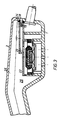
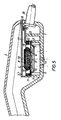
- FIGS. 2 to 5 show embodiments of the invention.
- 6 is an equivalent circuit diagram for the present invention.
- the chamber 3 for receiving the speech capsule 4 consisting of membrane 5, annular gap magnet system 6, protective cross 7 and the capsule body 8 produced by the injection molding process, is located at the appropriate point
- Speaking capsule 4 which is designed as an electrodynamic moving coil transducer, has an acoustic attachment for increasing the frequency response in the frequency range between 2 kHz and 3 kHz, which consists of the chamber 9 and the speaking openings 10.
- Below the membrane edge 11, a plurality of radially arranged narrow slots 12 lead into the volume 13. Large openings 15 lead from the narrow coupling space 14 behind the membrane 5 into the volume 16, to which the channel or the pipe 17 connects, which has one opening 18 leads to the outside.
- An acoustic friction resistor 19 is arranged near this outlet opening 18, which at the same time prevents dust and other particles from entering.
- This frictional resistance can also be designed in the form of a narrow point of the channel 17 as a so-called slot friction.
- the speech capsule 4, which is designed as an electrodynamic moving coil transducer, is a sound receiver with a predominantly figure-eight directional characteristic. This can be seen from the fact that from the narrow coupling space 14 behind the membrane 5 large openings 15, which acoustically contain negligible friction and mass, lead into the external environment of the transducer.
- this acoustic phase rotating element which is required to achieve the above-mentioned directivity, and which consists of the combination of an LR and RC element, is located in the two half-shells 1 and 2 of the handset, and is made from the channel (tube) which is subject to acoustic mass and friction. 17, the volumes 13 and 16 acting as acoustic suspension and the slots 12 acting as acoustic friction below the membrane edge.
- the electrical equivalent circuit diagram corresponding to this geometric arrangement and acoustic effect is shown Fig. 6. In this equivalent circuit diagram corresponds to the inductance L3 and the resistance R3 the channel (tube) 17, the resistance R4 the narrow slots 12 and the capacitance C4 the volume 13.
- This arrangement forms an LR element, in which to be considered Frequency range the capacity C4 is negligible in its effect.
- an extremely effective phase rotation network which increases linearly with the frequency in the phase curve results in the required frequency range, that ensures an almost frequency-independent directivity with optimal frequency response.
- the electrical equivalent circuit diagram would have to replace the inductance L3 and the resistor R3 with a quadrupole line that actually represents the channel or the tube. In the frequency range from about 200 Hz to about 3.5 kHz to be considered, however, the equivalent circuit diagram shown in FIG. 6 may occur in a first and good approximation.
- FIG. 2 contains the acoustic phase shifter divided into the lower shell 1 and upper shell 2 of the handset.
- the reference numerals 1 to 19 relate to the same parts as those in FIG. 1.
- a cover 20 with a pipe or duct connection 21 is used to close off the chambers forming the volumes 13 and 16, and that the channel (tube) 17 containing the acoustic mass is contained in the upper shell 2 as a molded plastic part.
- the opening 18 establishes the connection to the free sound field.
- This embodiment is, because it is tool-bound, simple and economical, because only the cover 20 can be produced as an additional, but cheaper part.
- the acoustic phase shifter is arranged exclusively in the lower shell 1 of the two-part handset.
- This embodiment is shown in FIG. 3.
- the reference numerals 1 to 19 refer to the same parts as in FIG. 1.
- a sealing ring 24 ensures that the outlet opening 18 remains acoustically connected to the outer, free sound field and that there is no coupling with the housing volume 25 delimited by the housing shells, which would lead to a very substantial impairment of the microphone directivity.
- This embodiment is always appropriate if the trough 26 of the lower shell is shaped very deep and the upper shell is correspondingly flat.
- An embodiment shown in Fig. 4 may be necessary if there is the possibility that the hand holding the handset covers the vicinity of the cable feed so much that the acoustic properties of the directional microphone are disturbed. In such a case, it is more favorable to move the opening 18 of the channel (tube) 31 with acoustic mass to the bottom of the lower shell 1 of the handset.
- a corresponding design of the cover 30, which has formed the channel (tube) 31, allows such a design without significant difficulties in the structural design.
- the narrow slots 12 below the membrane edge 11 lead into a volume 27 created for this embodiment.
- the chamber 3 accommodating the speech capsule 4 needs to be slightly redesigned.
- An acoustic friction resistor 29 that meets the acoustic network is accommodated near the opening 18.
- FIG. 5 shows an opening 18 guiding the sound field in the area near the cable entry 33.
- a cover 32 shaped accordingly for this purpose is provided in one piece with the channel (tube) 17. Otherwise, the design corresponds to the handset already described in FIGS. 1 and 2.
- the equivalent circuit diagram shown in FIG. 6 for the entire telephone handset designed as a directional microphone is intended to show in an analogous manner the relationship between the design of the invention and its acoustic mode of operation.
- the inductance L V , the resistance R V and the capacitance C V correspond to the front chamber 9 together with the acoustic mass contained in the speaking openings 10, a plate made of textile optionally not shown in the figures forming the openings forming the acoustic friction.
- the speech capsule 4 formed from the membrane 5, the annular gap magnet system 6 and the protective cross 7 corresponds in the equivalent circuit diagram to the electrical circuit symbols L M , C M , R M for the membrane 5, C2 for the coupling space 14 behind the membrane, which includes the volume V14, and L4, R4 for the narrow slots 12 below the membrane edge 11.
- the large openings 15 in the bottom of the speech capsule 4 are acoustically ineffective in the frequency range to be considered and are therefore negligible, so that these are not taken into account in the equivalent circuit diagram.
- the speech capsule 4, placed on its own in a flat sound field, would correspond to a transducer with figure-eight directional characteristics.
- a phase-shifting element is required in addition to the already existing speech capsule 4, which through the volumes 13 and 16, through the channel 17 with acoustic mass, and the acoustic friction 19 in cooperation with the narrow slots 12 formed becomes.
- these acoustic elements are represented by the circuit symbols C4, C3, L3, R3 and R4.
- a very exact electrical replica of the channel (tube) 17 for frequencies above about 3 kHz would require a line four-pole instead of the inductance L3 and the resistor R3.
Landscapes
- Engineering & Computer Science (AREA)
- Signal Processing (AREA)
- Physics & Mathematics (AREA)
- Acoustics & Sound (AREA)
- Health & Medical Sciences (AREA)
- Otolaryngology (AREA)
- Telephone Set Structure (AREA)
Applications Claiming Priority (2)
| Application Number | Priority Date | Filing Date | Title |
|---|---|---|---|
| AT2640/90 | 1990-12-27 | ||
| AT264090A AT395275B (de) | 1990-12-27 | 1990-12-27 | Als richtmikrophon ausgebildeter telefonhandapparat |
Publications (3)
| Publication Number | Publication Date |
|---|---|
| EP0493361A2 true EP0493361A2 (fr) | 1992-07-01 |
| EP0493361A3 EP0493361A3 (en) | 1993-05-12 |
| EP0493361B1 EP0493361B1 (fr) | 1995-03-15 |
Family
ID=3537885
Family Applications (1)
| Application Number | Title | Priority Date | Filing Date |
|---|---|---|---|
| EP19910890309 Expired - Lifetime EP0493361B1 (fr) | 1990-12-27 | 1991-12-23 | Combiné téléphonique muni d'un microphone directionnel |
Country Status (3)
| Country | Link |
|---|---|
| EP (1) | EP0493361B1 (fr) |
| AT (1) | AT395275B (fr) |
| DE (1) | DE59104962D1 (fr) |
Cited By (12)
| Publication number | Priority date | Publication date | Assignee | Title |
|---|---|---|---|---|
| WO1995001078A1 (fr) * | 1993-06-23 | 1995-01-05 | Apple Computer, Inc. | Moniteur d'affichage visuel informatique a haut-parleur stereo integre et microphone directionnel et son procede de construction |
| EP0692169A4 (fr) * | 1993-04-02 | 1996-03-06 | Jabra Corp | Microphone d'oreille unidirectionnel a orifices multiples |
| WO1997012495A1 (fr) * | 1995-09-28 | 1997-04-03 | Northern Telecom Limited | Configuration de montage d'un microphone antibruit |
| WO2000049788A1 (fr) * | 1999-02-18 | 2000-08-24 | Siemens Aktiengesellschaft | Appareil portatif pour technique telephonique |
| WO2000049789A1 (fr) * | 1999-02-18 | 2000-08-24 | Siemens Aktiengesellschaft | Microtelephone destine a la technique telephonique |
| EP1168884A1 (fr) * | 2000-06-26 | 2002-01-02 | Phone-Or Limited | Détecteur microphone optique |
| US6647118B1 (en) * | 1999-07-27 | 2003-11-11 | Nec Infrontia Corporation | Noise canceling microphone unit for composing noise canceling handset by using normal housing |
| WO2005011326A1 (fr) * | 2003-07-17 | 2005-02-03 | Siemens Aktiengesellschaft | Telephone mobile et transducteur acoustique pour telephone mobile de ce type |
| WO2004100690A3 (fr) * | 2003-05-19 | 2005-02-10 | Bitwave Private Ltd | Système de communication pour masque facial |
| FR2924523A1 (fr) * | 2007-12-03 | 2009-06-05 | Parrot Sa | Etui pour microphone unidirectionnel et appareil electronique comportant un tel etui |
| EP2214418A3 (fr) * | 2009-01-28 | 2012-10-17 | Funai Electric Co., Ltd. | Unité de microphone |
| US10887686B2 (en) | 2018-08-28 | 2021-01-05 | Ampacs Corporation | Directional microphone |
Families Citing this family (3)
| Publication number | Priority date | Publication date | Assignee | Title |
|---|---|---|---|---|
| JPS5341752Y2 (fr) * | 1974-06-08 | 1978-10-07 | ||
| US4141191A (en) * | 1977-05-31 | 1979-02-27 | Monier Colourtile Pty. Ltd. | Tile clip |
| CN110868669A (zh) * | 2018-08-28 | 2020-03-06 | 安普新股份有限公司 | 指向性麦克风 |
Family Cites Families (2)
| Publication number | Priority date | Publication date | Assignee | Title |
|---|---|---|---|---|
| ATA74486A (de) * | 1986-03-20 | 1987-04-15 | Akg Akustische Kino Geraete | Richtmikrophon nach dem elektrostatischen oder elektrodynamischen wandlerprinzip |
| CA1297578C (fr) * | 1988-02-26 | 1992-03-17 | Mark Walter Pocock | Microphone modulaire |
-
1990
- 1990-12-27 AT AT264090A patent/AT395275B/de active
-
1991
- 1991-12-23 EP EP19910890309 patent/EP0493361B1/fr not_active Expired - Lifetime
- 1991-12-23 DE DE59104962T patent/DE59104962D1/de not_active Expired - Fee Related
Cited By (16)
| Publication number | Priority date | Publication date | Assignee | Title |
|---|---|---|---|---|
| EP0692169A4 (fr) * | 1993-04-02 | 1996-03-06 | Jabra Corp | Microphone d'oreille unidirectionnel a orifices multiples |
| US5870485A (en) * | 1993-06-23 | 1999-02-09 | Apple Computer, Inc. | Computer visual display monitor with integral stereo speaker and directional microphone and method for construction |
| WO1995001078A1 (fr) * | 1993-06-23 | 1995-01-05 | Apple Computer, Inc. | Moniteur d'affichage visuel informatique a haut-parleur stereo integre et microphone directionnel et son procede de construction |
| US6421444B1 (en) | 1995-09-28 | 2002-07-16 | Nortel Networks Limited | Embedded higher order microphone |
| WO1997012495A1 (fr) * | 1995-09-28 | 1997-04-03 | Northern Telecom Limited | Configuration de montage d'un microphone antibruit |
| WO2000049788A1 (fr) * | 1999-02-18 | 2000-08-24 | Siemens Aktiengesellschaft | Appareil portatif pour technique telephonique |
| WO2000049789A1 (fr) * | 1999-02-18 | 2000-08-24 | Siemens Aktiengesellschaft | Microtelephone destine a la technique telephonique |
| US6647118B1 (en) * | 1999-07-27 | 2003-11-11 | Nec Infrontia Corporation | Noise canceling microphone unit for composing noise canceling handset by using normal housing |
| EP1168884A1 (fr) * | 2000-06-26 | 2002-01-02 | Phone-Or Limited | Détecteur microphone optique |
| WO2002001912A3 (fr) * | 2000-06-28 | 2002-05-10 | Phone Or Ltd | Microphone/capteur optique |
| WO2004100690A3 (fr) * | 2003-05-19 | 2005-02-10 | Bitwave Private Ltd | Système de communication pour masque facial |
| WO2005011326A1 (fr) * | 2003-07-17 | 2005-02-03 | Siemens Aktiengesellschaft | Telephone mobile et transducteur acoustique pour telephone mobile de ce type |
| FR2924523A1 (fr) * | 2007-12-03 | 2009-06-05 | Parrot Sa | Etui pour microphone unidirectionnel et appareil electronique comportant un tel etui |
| EP2214418A3 (fr) * | 2009-01-28 | 2012-10-17 | Funai Electric Co., Ltd. | Unité de microphone |
| US8559664B2 (en) | 2009-01-28 | 2013-10-15 | Funai Electric Co., Ltd. | Microphone unit |
| US10887686B2 (en) | 2018-08-28 | 2021-01-05 | Ampacs Corporation | Directional microphone |
Also Published As
| Publication number | Publication date |
|---|---|
| AT395275B (de) | 1992-11-10 |
| EP0493361B1 (fr) | 1995-03-15 |
| EP0493361A3 (en) | 1993-05-12 |
| ATA264090A (de) | 1992-03-15 |
| DE59104962D1 (de) | 1995-04-20 |
Similar Documents
| Publication | Publication Date | Title |
|---|---|---|
| EP0493361B1 (fr) | Combiné téléphonique muni d'un microphone directionnel | |
| DE2548597C2 (fr) | ||
| DE60303561T2 (de) | Hörgerät mit Richtmikrofonen | |
| DE3204567A1 (de) | Hoergeraet | |
| DE2815051C2 (de) | Kopfhörer in geschlossener Bauweise | |
| DE3641612C2 (de) | Zwei-Weg-Sprachkommunikations-Kopfhörer | |
| EP0755168A2 (fr) | Prothèse auditive avec transducteur acoustique électrodynamique | |
| DE2261122A1 (de) | Hoerteil eines fernsprechhandapparates | |
| DE19747562C2 (de) | Verfahren und Anordnung zum Steuern der Ausbreitung von Magnetfeldern durch elektrodynamische/-magnetische Wandler, insbesondere in Telekommunikationsgeräten | |
| DE2755718A1 (de) | Abgedichteter kopfhoerer | |
| DE69331308T2 (de) | Kompakte Lautsprecheranlage für eine Fernsprechstelle | |
| DE68910464T2 (de) | Fernsprechwandler. | |
| DE10214187C1 (de) | Lagerung eines elektroakustischen Miniaturwandlers in einem Gerät, insbesondere einem Hörhilfegerät, sowie elektroakustischer Miniaturwandler | |
| DE2608173A1 (de) | Richtmikrofon | |
| DE69737204T2 (de) | Telefonhandapparat, schnurloses telefon oder mobiltelefon | |
| DE69327396T2 (de) | Zweiweg-Kommunikations-Ohrhörer | |
| DE19620010A1 (de) | Lautsprechersystem mit Satellitengehäuse | |
| DE69523676T2 (de) | Selektive Schallaufnahmevorrichtung für reflektierende und geräuschvolle Umgebung | |
| DE3443907A1 (de) | Dynamische hoererkapsel fuer hoerbehinderte | |
| DE2508387A1 (de) | Adapter fuer einen handlosen gebrauch eines fernsprechapparats | |
| DE69736541T2 (de) | Hörhilfegerät | |
| DE3875659T2 (de) | Vorrichtung zur tonaufnahme und tonwiedergabe, insbesondere fuer audiokonferenzen. | |
| EP1460881B1 (fr) | Système magnétique d'un transducteur acoustique | |
| DE1114539B (de) | Mikrophonanordnung mit Stoergeraeuschunterdrueckung | |
| DE2416042A1 (de) | Wenigstens zwei dynamische wandler aufweisende hoerermuschel oder in schaumstoff eingebettete wandlerhalterung |
Legal Events
| Date | Code | Title | Description |
|---|---|---|---|
| PUAI | Public reference made under article 153(3) epc to a published international application that has entered the european phase |
Free format text: ORIGINAL CODE: 0009012 |
|
| AK | Designated contracting states |
Kind code of ref document: A2 Designated state(s): CH DE FR GB LI |
|
| PUAL | Search report despatched |
Free format text: ORIGINAL CODE: 0009013 |
|
| AK | Designated contracting states |
Kind code of ref document: A3 Designated state(s): CH DE FR GB LI |
|
| 17P | Request for examination filed |
Effective date: 19931029 |
|
| 17Q | First examination report despatched |
Effective date: 19940615 |
|
| GRAA | (expected) grant |
Free format text: ORIGINAL CODE: 0009210 |
|
| AK | Designated contracting states |
Kind code of ref document: B1 Designated state(s): CH DE FR GB LI |
|
| REF | Corresponds to: |
Ref document number: 59104962 Country of ref document: DE Date of ref document: 19950420 |
|
| GBT | Gb: translation of ep patent filed (gb section 77(6)(a)/1977) |
Effective date: 19950419 |
|
| ET | Fr: translation filed | ||
| PLBE | No opposition filed within time limit |
Free format text: ORIGINAL CODE: 0009261 |
|
| STAA | Information on the status of an ep patent application or granted ep patent |
Free format text: STATUS: NO OPPOSITION FILED WITHIN TIME LIMIT |
|
| 26N | No opposition filed | ||
| PGFP | Annual fee paid to national office [announced via postgrant information from national office to epo] |
Ref country code: FR Payment date: 19991215 Year of fee payment: 9 |
|
| PGFP | Annual fee paid to national office [announced via postgrant information from national office to epo] |
Ref country code: GB Payment date: 19991217 Year of fee payment: 9 |
|
| PGFP | Annual fee paid to national office [announced via postgrant information from national office to epo] |
Ref country code: CH Payment date: 19991228 Year of fee payment: 9 |
|
| PGFP | Annual fee paid to national office [announced via postgrant information from national office to epo] |
Ref country code: DE Payment date: 19991229 Year of fee payment: 9 |
|
| PG25 | Lapsed in a contracting state [announced via postgrant information from national office to epo] |
Ref country code: GB Free format text: LAPSE BECAUSE OF NON-PAYMENT OF DUE FEES Effective date: 20001223 |
|
| PG25 | Lapsed in a contracting state [announced via postgrant information from national office to epo] |
Ref country code: LI Free format text: LAPSE BECAUSE OF NON-PAYMENT OF DUE FEES Effective date: 20001231 Ref country code: CH Free format text: LAPSE BECAUSE OF NON-PAYMENT OF DUE FEES Effective date: 20001231 |
|
| GBPC | Gb: european patent ceased through non-payment of renewal fee |
Effective date: 20001223 |
|
| REG | Reference to a national code |
Ref country code: CH Ref legal event code: PL |
|
| PG25 | Lapsed in a contracting state [announced via postgrant information from national office to epo] |
Ref country code: FR Free format text: LAPSE BECAUSE OF NON-PAYMENT OF DUE FEES Effective date: 20010831 |
|
| REG | Reference to a national code |
Ref country code: FR Ref legal event code: ST |
|
| PG25 | Lapsed in a contracting state [announced via postgrant information from national office to epo] |
Ref country code: DE Free format text: LAPSE BECAUSE OF NON-PAYMENT OF DUE FEES Effective date: 20011002 |