EP0493878A2 - Détermination de la composition des métaux fondus - Google Patents
Détermination de la composition des métaux fondus Download PDFInfo
- Publication number
- EP0493878A2 EP0493878A2 EP91310382A EP91310382A EP0493878A2 EP 0493878 A2 EP0493878 A2 EP 0493878A2 EP 91310382 A EP91310382 A EP 91310382A EP 91310382 A EP91310382 A EP 91310382A EP 0493878 A2 EP0493878 A2 EP 0493878A2
- Authority
- EP
- European Patent Office
- Prior art keywords
- metal
- melt
- active substance
- halide
- particular metal
- Prior art date
- Legal status (The legal status is an assumption and is not a legal conclusion. Google has not performed a legal analysis and makes no representation as to the accuracy of the status listed.)
- Granted
Links
- 229910052751 metal Inorganic materials 0.000 title claims abstract description 71
- 239000002184 metal Substances 0.000 title claims abstract description 70
- 239000000155 melt Substances 0.000 title claims abstract description 5
- 239000003792 electrolyte Substances 0.000 claims abstract description 20
- 150000004820 halides Chemical class 0.000 claims abstract description 17
- 239000003513 alkali Substances 0.000 claims abstract description 9
- 229910045601 alloy Inorganic materials 0.000 claims abstract description 9
- 239000000956 alloy Substances 0.000 claims abstract description 9
- HCHKCACWOHOZIP-UHFFFAOYSA-N Zinc Chemical group [Zn] HCHKCACWOHOZIP-UHFFFAOYSA-N 0.000 claims description 46
- 229910052725 zinc Inorganic materials 0.000 claims description 46
- 239000011701 zinc Substances 0.000 claims description 46
- 229910052782 aluminium Inorganic materials 0.000 claims description 45
- 239000004411 aluminium Substances 0.000 claims description 43
- XAGFODPZIPBFFR-UHFFFAOYSA-N aluminium Chemical compound [Al] XAGFODPZIPBFFR-UHFFFAOYSA-N 0.000 claims description 43
- 239000013543 active substance Substances 0.000 claims description 12
- 239000000126 substance Substances 0.000 claims description 10
- 238000000034 method Methods 0.000 claims description 9
- 239000000203 mixture Substances 0.000 claims description 6
- 230000001105 regulatory effect Effects 0.000 claims description 5
- 239000007790 solid phase Substances 0.000 claims description 5
- 229910052784 alkaline earth metal Inorganic materials 0.000 claims description 4
- 238000004364 calculation method Methods 0.000 claims description 4
- 239000000654 additive Substances 0.000 claims description 3
- 230000000996 additive effect Effects 0.000 claims description 3
- 239000012047 saturated solution Substances 0.000 claims 2
- 150000001342 alkaline earth metals Chemical class 0.000 claims 1
- 239000007787 solid Substances 0.000 abstract description 7
- 229920006395 saturated elastomer Polymers 0.000 abstract description 5
- OKTJSMMVPCPJKN-UHFFFAOYSA-N Carbon Chemical compound [C] OKTJSMMVPCPJKN-UHFFFAOYSA-N 0.000 abstract description 3
- 229910002804 graphite Inorganic materials 0.000 abstract description 3
- 239000010439 graphite Substances 0.000 abstract description 3
- 239000010453 quartz Substances 0.000 abstract description 2
- VYPSYNLAJGMNEJ-UHFFFAOYSA-N silicon dioxide Inorganic materials O=[Si]=O VYPSYNLAJGMNEJ-UHFFFAOYSA-N 0.000 abstract description 2
- 230000001681 protective effect Effects 0.000 abstract 1
- 150000003839 salts Chemical class 0.000 description 29
- FAPWRFPIFSIZLT-UHFFFAOYSA-M Sodium chloride Chemical compound [Na+].[Cl-] FAPWRFPIFSIZLT-UHFFFAOYSA-M 0.000 description 18
- VSCWAEJMTAWNJL-UHFFFAOYSA-K aluminium chloride Substances Cl[Al](Cl)Cl VSCWAEJMTAWNJL-UHFFFAOYSA-K 0.000 description 16
- 229910000831 Steel Inorganic materials 0.000 description 12
- 239000010959 steel Substances 0.000 description 12
- 230000000694 effects Effects 0.000 description 10
- 239000011780 sodium chloride Substances 0.000 description 9
- 238000005192 partition Methods 0.000 description 8
- 150000002739 metals Chemical class 0.000 description 7
- 229910000873 Beta-alumina solid electrolyte Inorganic materials 0.000 description 6
- 238000001514 detection method Methods 0.000 description 6
- 239000002131 composite material Substances 0.000 description 4
- 239000011149 active material Substances 0.000 description 3
- 238000004458 analytical method Methods 0.000 description 3
- 238000003618 dip coating Methods 0.000 description 3
- 238000010438 heat treatment Methods 0.000 description 3
- 150000002500 ions Chemical class 0.000 description 3
- 239000007791 liquid phase Substances 0.000 description 3
- 239000011734 sodium Substances 0.000 description 3
- 229910001335 Galvanized steel Inorganic materials 0.000 description 2
- XEEYBQQBJWHFJM-UHFFFAOYSA-N Iron Chemical compound [Fe] XEEYBQQBJWHFJM-UHFFFAOYSA-N 0.000 description 2
- 229910007570 Zn-Al Inorganic materials 0.000 description 2
- 229910052783 alkali metal Inorganic materials 0.000 description 2
- 239000007864 aqueous solution Substances 0.000 description 2
- 238000006243 chemical reaction Methods 0.000 description 2
- 238000010586 diagram Methods 0.000 description 2
- 230000005496 eutectics Effects 0.000 description 2
- 239000008397 galvanized steel Substances 0.000 description 2
- 239000010416 ion conductor Substances 0.000 description 2
- 239000012071 phase Substances 0.000 description 2
- 229910001415 sodium ion Inorganic materials 0.000 description 2
- 239000007784 solid electrolyte Substances 0.000 description 2
- 230000004304 visual acuity Effects 0.000 description 2
- JIAARYAFYJHUJI-UHFFFAOYSA-L zinc dichloride Chemical compound [Cl-].[Cl-].[Zn+2] JIAARYAFYJHUJI-UHFFFAOYSA-L 0.000 description 2
- RZVAJINKPMORJF-UHFFFAOYSA-N Acetaminophen Chemical compound CC(=O)NC1=CC=C(O)C=C1 RZVAJINKPMORJF-UHFFFAOYSA-N 0.000 description 1
- RYGMFSIKBFXOCR-UHFFFAOYSA-N Copper Chemical compound [Cu] RYGMFSIKBFXOCR-UHFFFAOYSA-N 0.000 description 1
- 108091006629 SLC13A2 Proteins 0.000 description 1
- FKNQFGJONOIPTF-UHFFFAOYSA-N Sodium cation Chemical compound [Na+] FKNQFGJONOIPTF-UHFFFAOYSA-N 0.000 description 1
- 239000002253 acid Substances 0.000 description 1
- PNEYBMLMFCGWSK-UHFFFAOYSA-N aluminium oxide Inorganic materials [O-2].[O-2].[O-2].[Al+3].[Al+3] PNEYBMLMFCGWSK-UHFFFAOYSA-N 0.000 description 1
- 239000012491 analyte Substances 0.000 description 1
- 229910052787 antimony Inorganic materials 0.000 description 1
- WATWJIUSRGPENY-UHFFFAOYSA-N antimony atom Chemical compound [Sb] WATWJIUSRGPENY-UHFFFAOYSA-N 0.000 description 1
- 238000001479 atomic absorption spectroscopy Methods 0.000 description 1
- 229910052793 cadmium Inorganic materials 0.000 description 1
- BDOSMKKIYDKNTQ-UHFFFAOYSA-N cadmium atom Chemical compound [Cd] BDOSMKKIYDKNTQ-UHFFFAOYSA-N 0.000 description 1
- 239000000969 carrier Substances 0.000 description 1
- 238000007796 conventional method Methods 0.000 description 1
- 229910052802 copper Inorganic materials 0.000 description 1
- 239000010949 copper Substances 0.000 description 1
- 238000005336 cracking Methods 0.000 description 1
- 239000013078 crystal Substances 0.000 description 1
- 238000007598 dipping method Methods 0.000 description 1
- 238000004090 dissolution Methods 0.000 description 1
- 239000012535 impurity Substances 0.000 description 1
- 238000012625 in-situ measurement Methods 0.000 description 1
- 238000011065 in-situ storage Methods 0.000 description 1
- 229910052742 iron Inorganic materials 0.000 description 1
- 229910052744 lithium Inorganic materials 0.000 description 1
- 238000004519 manufacturing process Methods 0.000 description 1
- 239000000463 material Substances 0.000 description 1
- 238000005259 measurement Methods 0.000 description 1
- 239000012528 membrane Substances 0.000 description 1
- 230000004048 modification Effects 0.000 description 1
- 238000012986 modification Methods 0.000 description 1
- 239000000615 nonconductor Substances 0.000 description 1
- 230000000149 penetrating effect Effects 0.000 description 1
- 229910052700 potassium Inorganic materials 0.000 description 1
- 239000005297 pyrex Substances 0.000 description 1
- 238000005070 sampling Methods 0.000 description 1
- RPACBEVZENYWOL-XFULWGLBSA-M sodium;(2r)-2-[6-(4-chlorophenoxy)hexyl]oxirane-2-carboxylate Chemical compound [Na+].C=1C=C(Cl)C=CC=1OCCCCCC[C@]1(C(=O)[O-])CO1 RPACBEVZENYWOL-XFULWGLBSA-M 0.000 description 1
- 229910000679 solder Inorganic materials 0.000 description 1
- 238000000638 solvent extraction Methods 0.000 description 1
- 238000006467 substitution reaction Methods 0.000 description 1
- 238000011282 treatment Methods 0.000 description 1
- 235000005074 zinc chloride Nutrition 0.000 description 1
- 239000011592 zinc chloride Substances 0.000 description 1
Images


Classifications
-
- G—PHYSICS
- G01—MEASURING; TESTING
- G01N—INVESTIGATING OR ANALYSING MATERIALS BY DETERMINING THEIR CHEMICAL OR PHYSICAL PROPERTIES
- G01N27/00—Investigating or analysing materials by the use of electric, electrochemical, or magnetic means
- G01N27/26—Investigating or analysing materials by the use of electric, electrochemical, or magnetic means by investigating electrochemical variables; by using electrolysis or electrophoresis
- G01N27/28—Electrolytic cell components
- G01N27/30—Electrodes, e.g. test electrodes; Half-cells
-
- G—PHYSICS
- G01—MEASURING; TESTING
- G01N—INVESTIGATING OR ANALYSING MATERIALS BY DETERMINING THEIR CHEMICAL OR PHYSICAL PROPERTIES
- G01N33/00—Investigating or analysing materials by specific methods not covered by groups G01N1/00 - G01N31/00
- G01N33/20—Metals
- G01N33/205—Metals in liquid state, e.g. molten metals
Definitions
- the present invention relates to a sensing method and a chemical cell type of component sensor for detecting the concentration of a specific component contained in a metal melt and, more particularly, to a component sensor for high-temperature purposes, which uses a composite molten salt electrolyte consisting of a solid phase and a liquid phase.
- metal melt as used herein is understood to mean the melt of a metal or alloy.
- the present invention may provide a component sensor for molten metals, which can continuously detect the concentration of a particular component in a molten metal by electrical signals, can be used at relatively high temperatures, say, 420-800°C and has high resolving power in a wide concentration range.
- a chemical cell type of component sensor for detecting the concentration of a particular metal in a metal melt, wherein said metal melt is used as an measuring electrode and a pure form of said particular metal or an alloy containing said particular metal is used as a standard electrode.
- An active material to come into contact with the standard electrode and capable of coming into contact with the metal melt includes at least one halide of an alkali halide and/or an alkali earth halide, each having ion conductivity, and a halide of said particular metal, any one of said halides comprising a solid phase and a liquid phase.
- the component sensor for molten metals uses said active material to convert a chemical potential change of the particular metal into a chemical potential change of the alkali or alkali earth metal, and said active substance consisting a mixture of a solid salt and a molten salt is used as a composite electrolyte partition to construct a chemical cell where the ions of said alkali or alkali earth metal serve as change carriers.
- the invention provides a sensing method.
- the metal melt with which this component sensor is usable may preferably but not exclusively be selected from zinc, solder and copper. More preferably that metal melt is a zinc melt.
- the particular metal may preferably but not exclusively be at least one metal element selected from aluminium, cadmium, antimony, iron and lead. More preferably, that particular metal is aluminium.
- a component sensor as recited above which includes a protecting tube which is an electrical insulator and in which said standard electrode and said active material are tightly enclosed. a projection attached to the tip of said protecting tube, which is removable by snapping in use, and an electrically conductive holder which is designed to hold said protecting tube and is capable of coming into electrical contact with said metal melt.
- the protecting tube may carry a halide mixture of high hygroscopicity.
- a regulator arrangement for regulating the components of a metal melt, including said component sensor for molten metals, which is immersed in said metal melt; a control circuit for receiving a detection signal from said component sensor and calculating the target amount of said particular metal component to be added to said metal melt on the basis of said received signal, and feeder means for adding the said particular metal component to said metal melt on the basis of the result of said calculation made by said control circuit.
- ⁇ -alumina is used as a partitioning membrane for separating both the electrodes from each other.
- the ⁇ -alumina partition may be dispensed with.
- a component sensor generally shown by 1 includes a container 2 in a bottomed cylindrical form, which is provided at its tip with a detachable-by-snapping projection 3.
- the container 2 may be built up of, e.g. quartz or pyrex and is filled therein with, for instance, electrolytes 6 a and 6 b consisting of a mixed molten salt of NaCl-AlCl3 saturated with solid NaCl.
- the container 2 is provided to prevent the mixed molten salt of NaCl-AlCl3 filled therein from flowing out.
- Inserted into the electrolyte 6 a is a pure aluminium sheet 4 acting as a standard electrode, with which a lead 5 of pure aluminium is connected.
- the container 2 is supported by a protecting tube 7 which may be built up of, e.g. graphite or a heat-resistant alloy.
- the protecting tube 7 is also used as an electrode lead on the molten zinc side.
- the mixed molten salt electrolyte 6 a of NaCl-AlCl3 is isolated from the surrounding mixed molten salt electrolyte 6 b of NaCl-AlCl3 by a partition 8 formed of ⁇ -alumina. This is provided to prevent molten zinc from penetrating through the tip 2 a of the container 2 into the mixed molten salt of NaCl-AlCl3 surrounding the alumina sheet 4 when the component sensor 1 is used, causing the zinc or aluminium in the molten zinc to dissolve in the mixed molten salt phase of NaCl-AlCl3 and so vary its composition.
- the ⁇ -alumina partition which prevents such variation from occurring.
- the ⁇ -alumina partition 8 serves well to prevent any incidental influence from being induced by a lowering of the ion transference number due to the substitution of the molten salt by impurities.
- the partition 8 may be formed of other materials, provided that they are stable sodium ion conductors.
- the projection 3 is removed by snapping so that the tip 2 of the container 3 can be immersed in a zinc melt bath.
- an electromotive voltage occurring between the lead 5 and the lead of the protecting tube 7 is found by a voltmeter, not shown.
- the concentration of aluminium in a zinc melt was measured.
- the component sensor 1 was first immersed in 2kg of molten zinc in its pure form, stored in a graphite crucible. Then, pure aluminium was added to the molten zinc to measure the resulting electromotive voltages in varied aluminium concentrations.
- Fig. 3 As can be seen from Fig. 3, the logarithm of the electromotive voltage and aluminium concentration obviously shows a linear relation, indicating that the concentrations of aluminium could be measured with sufficiently high accuracy.
- Fig. 4 shows how the electromotive voltage changes with time, when some batches of aluminium are added at suitable intervals to a zinc melt bath. As can be understood from Fig. 4, the electromotive voltage changes drastically whenever one batch of aluminium is added to zinc melt bath, and remains well stabilized until the next batch is added.
- the component sensor 1 for zinc hot dipping, using such a composite molten salt electrolyte can be well used in a temperature range of a certain low temperature to up to around 800°c under NaCl saturation conditions, because the NaCl-AlCl3 (ZnCl3)-based composite molten salt electrolyte consists of a ternary eutectic crystal structure whose eutectic temperature is as low as about 100°C.
- This component sensor 1 can thus be effectively used to provide an in-situ continuous detection of aluminium concentrations of 0 to some thousand ppm at any desired position in molten zinc at a temperature of about 150 to 800°C within an error of some two-digit ppm.
- Fig. 2 illustrates the second embodiment of the component sensor according to this invention.
- a component sensor 10 according to the second embodiment is a modification of the first component sensor 1, wherein the partition 8 is removed from within the mixed molten salt electrolyte 6 shown in Fig. 1.
- This component sensor 10, because of the absence of the partition 8, is effectively used especially when the compositional variation of the mixed molten salt electrolyte 6 is considered to be negligible within a measuring period of time.
- the ratio of solid NaCl to be mixed with the mixed molten salt electrolyte packed in the container is regulated to minimize the ratio of the liquid-phase molten salt relative to the solid-phase salt, thereby enabling the component sensor to have a strength close to that of the solid electrolyte with the strength that the solid-phase salt itself possesses and making it easy to handle the component sensor due to its quasi-solid state.
- the Na salt in the aforesaid mixed molten salt electrolyte use may be made of Li, K and other salts.
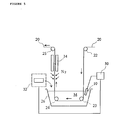
- Fig. 5 shows the 3rd embodiment of the component sensor according to this invention, which is designed such that an automatic regulation of the concentration of aluminium in a zinc melt bath is achieved with the aforesaid component sensor.
- a thin steel plate 20 is carried through rollers 22, 23, 24 and 25 in the direction shown by an arrow. While carried by the rollers 23 and 24, the steel plate 20 is being immersed in a zinc melt bath M located in a tank 26. Upon guided up from the bath M, N2 gas is blown onto the steel plate, which is then thermally treated through a heat-treatment furnace 34 to enhance the adhesion of zinc thereto.
- a detection signal from the component sensor 10, immersed in the zinc melt bath M is sent to a controller 30, which, on the basis of this input signal, in turn calculates the target weight of an aluminium-containing ingot to be added to the zinc melt bath M.
- the controller 30 outputs to an aluminium feeder 32 a signal for the weight of the aluminium-containing ingot to be fed into the zinc melt bath M.
- the feeder 32 introduces the aluminium-containing ingot into the zinc melt bath M. In this way, the concentration of aluminium in the zinc melt bath M can be regulated automatically.
- the concentration of aluminium in the zinc melt bath M can be put under continued control to make the zinc coated onto the surface of the steel plate homogeneous; it is possible to prevent the coated zinc from peeling off or cracking during post-treatments, thus assuring that the zinc remains well coated onto the steel plate.
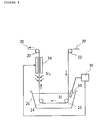
- Fig. 6 illustrates the 4th embodiment of this invention, according to which the heating temperature of the heat-treating furnace is automatically controlled in response to a sensor signal.
- parts that are substantially identical with those shown in Fig. 5 are referred to by the same reference numerals and so will not be explained.
- the controller 30 calculates at what temperature the steel plate 20 should be thermally treated in the heat-treating furnace 34 in response to the signal sent from the component sensor 10 to it, and outputs the resulting signal to the heat-treating furnace 34.
- the heat-treating furnace 34 controls the heating temperature to heat the steel plate 20.
- the inside temperature of the heat-treating furnace 34 is controlled primarily depending upon a change in the surface state of the zinc coated onto the surface of the steel plate, which is mainly caused by a change in the concentration of aluminium in the zinc melt bath M.
- the zinc remains uniformly well coated onto the surface of the steel plate 20.
- the component sensor of this invention can be applied to detecting not only aluminium but other metal elements as well. It is understood that this component sensor may be designed either as a disposable spot type that can be thrown away after use or as a continuously usable type for automatic control purposes.
- the present component sensor for molten metals can successfully provide a continuous detection of the concentration of a particular component in molten metals by means of electrical signals and can be well used at a relatively high temperature range of 420 to 800°C with high resolving power in a wide concentration range.
Landscapes
- Health & Medical Sciences (AREA)
- Life Sciences & Earth Sciences (AREA)
- Chemical & Material Sciences (AREA)
- Pathology (AREA)
- General Physics & Mathematics (AREA)
- Immunology (AREA)
- Physics & Mathematics (AREA)
- Analytical Chemistry (AREA)
- Biochemistry (AREA)
- General Health & Medical Sciences (AREA)
- Food Science & Technology (AREA)
- Medicinal Chemistry (AREA)
- Engineering & Computer Science (AREA)
- Molecular Biology (AREA)
- Chemical Kinetics & Catalysis (AREA)
- Electrochemistry (AREA)
- Investigating And Analyzing Materials By Characteristic Methods (AREA)
- Measuring Oxygen Concentration In Cells (AREA)
Applications Claiming Priority (2)
| Application Number | Priority Date | Filing Date | Title |
|---|---|---|---|
| JP416898/90 | 1990-12-29 | ||
| JP2416898A JPH0827252B2 (ja) | 1990-12-29 | 1990-12-29 | 溶融金属用成分センサ |
Publications (3)
| Publication Number | Publication Date |
|---|---|
| EP0493878A2 true EP0493878A2 (fr) | 1992-07-08 |
| EP0493878A3 EP0493878A3 (en) | 1992-08-26 |
| EP0493878B1 EP0493878B1 (fr) | 1998-05-20 |
Family
ID=18525077
Family Applications (1)
| Application Number | Title | Priority Date | Filing Date |
|---|---|---|---|
| EP91310382A Expired - Lifetime EP0493878B1 (fr) | 1990-12-29 | 1991-11-11 | Détermination de la composition des métaux fondus |
Country Status (6)
| Country | Link |
|---|---|
| US (1) | US5393400A (fr) |
| EP (1) | EP0493878B1 (fr) |
| JP (1) | JPH0827252B2 (fr) |
| KR (1) | KR0158890B1 (fr) |
| CA (1) | CA2058491C (fr) |
| DE (1) | DE69129446T2 (fr) |
Cited By (5)
| Publication number | Priority date | Publication date | Assignee | Title |
|---|---|---|---|---|
| WO1997033170A1 (fr) * | 1996-03-05 | 1997-09-12 | Sollac (Societe Anonyme) | Sonde de determination de la teneur en un element dissous d'un bain de revetement |
| WO1999045380A1 (fr) * | 1998-03-06 | 1999-09-10 | Vito - Vlaamse Instelling Voor Technologisch Onderzoek | Sonde pour metaux en fusion |
| USRE42625E1 (en) | 1990-03-13 | 2011-08-16 | The Regents Of The University Of California | Endovascular electrolytically detachable wire and tip for the formation of thrombus in arteries, veins, aneurysms, vascular malformations and arteriovenous fistulas |
| USRE42662E1 (en) | 1990-03-13 | 2011-08-30 | The Regents Of The University Of California | Endovascular electrolytically detachable wire and tip for the formation of thrombus in arteries, veins, aneurysms, vascular malformations and arteriovenous fistulas |
| USRE42756E1 (en) | 1990-03-13 | 2011-09-27 | The Regents Of The University Of California | Endovascular electrolytically detachable wire and tip for the formation of thrombus in arteries, veins, aneurysms, vascular malformations and arteriovenous fistulas |
Families Citing this family (9)
| Publication number | Priority date | Publication date | Assignee | Title |
|---|---|---|---|---|
| JP2503967Y2 (ja) * | 1991-04-19 | 1996-07-03 | 新日本製鐵株式会社 | 溶融金属めっき浴成分測定装置 |
| JP2549629Y2 (ja) * | 1992-10-23 | 1997-09-30 | 新日本製鐵株式会社 | アルミ濃度測定センサー |
| US6693443B2 (en) | 1999-04-02 | 2004-02-17 | Worcester Polytechnic Institute | Systems for detecting and measuring inclusions |
| KR100897136B1 (ko) * | 2002-08-13 | 2009-05-14 | 주식회사 포스코 | 아연도금욕의 알루미늄 농도 측정 센서 |
| US20040119483A1 (en) * | 2002-12-20 | 2004-06-24 | Gunter Topfer | Measurement of molten metal with ion conducting phase sensors by means of an electrical measuring unit |
| JP4901694B2 (ja) * | 2006-11-06 | 2012-03-21 | 新日本製鐵株式会社 | Al濃度センサー |
| US8173007B2 (en) * | 2007-05-29 | 2012-05-08 | West Virginia University | High temperature electrochemical characterization of molten metal corrosion |
| CN105806773B (zh) * | 2014-12-31 | 2018-07-10 | 国核(北京)科学技术研究院有限公司 | 高温氟盐参比电极及其制造方法 |
| US11131648B2 (en) * | 2019-06-20 | 2021-09-28 | U.S. Department Of Energy | Potentiometric sensor |
Family Cites Families (8)
| Publication number | Priority date | Publication date | Assignee | Title |
|---|---|---|---|---|
| US3205158A (en) * | 1962-10-04 | 1965-09-07 | Honeywell Inc | Condition responsive devices |
| US3705089A (en) * | 1970-09-28 | 1972-12-05 | Gen Electric | Reference electrode half cell |
| US3714014A (en) * | 1971-02-10 | 1973-01-30 | Atomic Energy Commission | Electrochemical apparatus for determination of molten salt composition |
| JPS5221915B2 (fr) * | 1972-03-31 | 1977-06-14 | ||
| US4492614A (en) * | 1983-07-08 | 1985-01-08 | Uop Inc. | Chlorine detection |
| CA1216895A (fr) * | 1984-11-05 | 1987-01-20 | Corporation De L'ecole Polytechnique (La) | Methode et dispositif de controle des elements specifiques dans un bain de fusion qui les renferme |
| US4601810A (en) * | 1985-10-03 | 1986-07-22 | General Motors Corporation | Electrochemical probe for measuring magnesium concentration in molten aluminum |
| US4902402A (en) * | 1989-03-30 | 1990-02-20 | Westinghouse Electric Corp. | Chloride containing solid electrolyte gas sensing apparatus |
-
1990
- 1990-12-29 JP JP2416898A patent/JPH0827252B2/ja not_active Expired - Lifetime
-
1991
- 1991-11-07 KR KR1019910019749A patent/KR0158890B1/ko not_active Expired - Fee Related
- 1991-11-08 US US07/789,489 patent/US5393400A/en not_active Expired - Lifetime
- 1991-11-11 EP EP91310382A patent/EP0493878B1/fr not_active Expired - Lifetime
- 1991-11-11 DE DE69129446T patent/DE69129446T2/de not_active Expired - Lifetime
- 1991-12-27 CA CA002058491A patent/CA2058491C/fr not_active Expired - Lifetime
Cited By (9)
| Publication number | Priority date | Publication date | Assignee | Title |
|---|---|---|---|---|
| USRE42625E1 (en) | 1990-03-13 | 2011-08-16 | The Regents Of The University Of California | Endovascular electrolytically detachable wire and tip for the formation of thrombus in arteries, veins, aneurysms, vascular malformations and arteriovenous fistulas |
| USRE42662E1 (en) | 1990-03-13 | 2011-08-30 | The Regents Of The University Of California | Endovascular electrolytically detachable wire and tip for the formation of thrombus in arteries, veins, aneurysms, vascular malformations and arteriovenous fistulas |
| USRE42756E1 (en) | 1990-03-13 | 2011-09-27 | The Regents Of The University Of California | Endovascular electrolytically detachable wire and tip for the formation of thrombus in arteries, veins, aneurysms, vascular malformations and arteriovenous fistulas |
| WO1997033170A1 (fr) * | 1996-03-05 | 1997-09-12 | Sollac (Societe Anonyme) | Sonde de determination de la teneur en un element dissous d'un bain de revetement |
| FR2745906A1 (fr) * | 1996-03-05 | 1997-09-12 | Lorraine Laminage | Sonde de determination de la teneur en un element dissous d'un bain de revetement |
| WO1999045380A1 (fr) * | 1998-03-06 | 1999-09-10 | Vito - Vlaamse Instelling Voor Technologisch Onderzoek | Sonde pour metaux en fusion |
| BE1011776A3 (nl) * | 1998-03-06 | 2000-01-11 | Vito | Sensor voor toepassing in metaalsmelten. |
| AU741695B2 (en) * | 1998-03-06 | 2001-12-06 | Vito - Vlaamse Instelling Voor Technologisch Onderzoek | Sensor for application in molten metals |
| US6514394B1 (en) | 1998-03-06 | 2003-02-04 | Vlaamse Instelling Voor Technologisch Onderzoek (V.I.T.O.) | Sensor for application in molten metals |
Also Published As
| Publication number | Publication date |
|---|---|
| DE69129446T2 (de) | 1998-11-05 |
| EP0493878A3 (en) | 1992-08-26 |
| JPH0827252B2 (ja) | 1996-03-21 |
| CA2058491C (fr) | 2000-02-29 |
| EP0493878B1 (fr) | 1998-05-20 |
| JPH04249758A (ja) | 1992-09-04 |
| KR0158890B1 (ko) | 1999-03-30 |
| DE69129446D1 (de) | 1998-06-25 |
| US5393400A (en) | 1995-02-28 |
| CA2058491A1 (fr) | 1992-06-30 |
| KR920012915A (ko) | 1992-07-28 |
Similar Documents
| Publication | Publication Date | Title |
|---|---|---|
| EP0493878B1 (fr) | Détermination de la composition des métaux fondus | |
| US8173007B2 (en) | High temperature electrochemical characterization of molten metal corrosion | |
| Senderoff et al. | The electrodeposition of coherent deposits of refractory metals: II. the electrode reactions in the deposition of tantalum | |
| Tiwari | Thermodynamic properties of liquid Al-Mg alloys measured by the Emf method | |
| US5580439A (en) | Reference electrode for electrochemical determination of oxygen partial pressure in an ionic melt | |
| US4645571A (en) | Method and apparatus for the continuous monitoring of specific elements in molten substances containing same | |
| US4639304A (en) | Apparatus for determination of aluminum oxide content of the cryolite melt in aluminum electrolysis cells | |
| US4764257A (en) | Aluminum reference electrode | |
| US3324013A (en) | Method and apparatus for determining composition of molten salt mixtures | |
| NO327789B1 (no) | Sensor for anvendelse i flytende metaller | |
| Monaghan | A four-probe dc method for measuring the electrical resistivities of molten metals | |
| Rose et al. | Studies in the thermodynamics of metallurgical reduction processes by electrochemical methods | |
| Arkhipov et al. | Electrode potentials of bismuth in a mixture of potassium and lead chlorides | |
| KR0169983B1 (ko) | 지르코니아 산소 센서 및 이의 용도 | |
| EP0679252B1 (fr) | Capteurs utilises dans l'analyse des metaux fondus | |
| Fafilek et al. | Voltammetric measurements on MexOy (Me= Bi, Cu, V) compounds and comparison with results for BICUVOX. 10 | |
| US5336389A (en) | Long lasting alkali and alkaline earth metal sensor | |
| Balaraju et al. | Studies on Low Temperature Al Electrolysis Using Composite Anodes in NaF‐KCl Bath Electrolyte | |
| CA2000185C (fr) | Capteurs electrolytiques | |
| Barbier | Continuous monitoring of lithium in dynamic Pb–17Li systems | |
| Johnson et al. | The Thermal Power of the Solid Electrolytes Ag4 MI 5 and of Molten Mixtures of the Same Composition | |
| JP3043841B2 (ja) | 複合固体電解質を用いた溶融金属用成分センサ | |
| Seetharaman et al. | Thermodynamic studies of Zn-O interactions in dilute liquid copper alloys | |
| Langová et al. | Electrochemical measurement of oxygen in liquid Fe O S/CaO Al2O3 Fe2O3 CaS system | |
| Van Norman | Contolled Potential Coulometry in Fused Lithium Chloride-Potassium Chloride Eutectic. |
Legal Events
| Date | Code | Title | Description |
|---|---|---|---|
| PUAI | Public reference made under article 153(3) epc to a published international application that has entered the european phase |
Free format text: ORIGINAL CODE: 0009012 |
|
| PUAL | Search report despatched |
Free format text: ORIGINAL CODE: 0009013 |
|
| AK | Designated contracting states |
Kind code of ref document: A2 Designated state(s): BE DE FR GB LU NL SE |
|
| AK | Designated contracting states |
Kind code of ref document: A3 Designated state(s): BE DE FR GB LU NL SE |
|
| 17P | Request for examination filed |
Effective date: 19920917 |
|
| 17Q | First examination report despatched |
Effective date: 19951023 |
|
| GRAG | Despatch of communication of intention to grant |
Free format text: ORIGINAL CODE: EPIDOS AGRA |
|
| GRAG | Despatch of communication of intention to grant |
Free format text: ORIGINAL CODE: EPIDOS AGRA |
|
| GRAH | Despatch of communication of intention to grant a patent |
Free format text: ORIGINAL CODE: EPIDOS IGRA |
|
| GRAH | Despatch of communication of intention to grant a patent |
Free format text: ORIGINAL CODE: EPIDOS IGRA |
|
| GRAA | (expected) grant |
Free format text: ORIGINAL CODE: 0009210 |
|
| AK | Designated contracting states |
Kind code of ref document: B1 Designated state(s): BE DE FR GB LU NL |
|
| REF | Corresponds to: |
Ref document number: 69129446 Country of ref document: DE Date of ref document: 19980625 |
|
| ET | Fr: translation filed | ||
| PLBE | No opposition filed within time limit |
Free format text: ORIGINAL CODE: 0009261 |
|
| STAA | Information on the status of an ep patent application or granted ep patent |
Free format text: STATUS: NO OPPOSITION FILED WITHIN TIME LIMIT |
|
| 26N | No opposition filed | ||
| REG | Reference to a national code |
Ref country code: GB Ref legal event code: IF02 |
|
| REG | Reference to a national code |
Ref country code: GB Ref legal event code: 732E |
|
| NLS | Nl: assignments of ep-patents |
Owner name: TECK COMINCO METALS LTD. |
|
| REG | Reference to a national code |
Ref country code: FR Ref legal event code: TP |
|
| PGFP | Annual fee paid to national office [announced via postgrant information from national office to epo] |
Ref country code: GB Payment date: 20061020 Year of fee payment: 16 |
|
| PGFP | Annual fee paid to national office [announced via postgrant information from national office to epo] |
Ref country code: FR Payment date: 20061025 Year of fee payment: 16 |
|
| PGFP | Annual fee paid to national office [announced via postgrant information from national office to epo] |
Ref country code: LU Payment date: 20061026 Year of fee payment: 16 Ref country code: NL Payment date: 20061026 Year of fee payment: 16 |
|
| PGFP | Annual fee paid to national office [announced via postgrant information from national office to epo] |
Ref country code: BE Payment date: 20061031 Year of fee payment: 16 |
|
| BERE | Be: lapsed |
Owner name: *TECK COMINCO METALS LTD Effective date: 20071130 |
|
| GBPC | Gb: european patent ceased through non-payment of renewal fee |
Effective date: 20071111 |
|
| NLV4 | Nl: lapsed or anulled due to non-payment of the annual fee |
Effective date: 20080601 |
|
| PG25 | Lapsed in a contracting state [announced via postgrant information from national office to epo] |
Ref country code: BE Free format text: LAPSE BECAUSE OF NON-PAYMENT OF DUE FEES Effective date: 20071130 |
|
| PG25 | Lapsed in a contracting state [announced via postgrant information from national office to epo] |
Ref country code: NL Free format text: LAPSE BECAUSE OF NON-PAYMENT OF DUE FEES Effective date: 20080601 |
|
| REG | Reference to a national code |
Ref country code: FR Ref legal event code: ST Effective date: 20080930 |
|
| PG25 | Lapsed in a contracting state [announced via postgrant information from national office to epo] |
Ref country code: GB Free format text: LAPSE BECAUSE OF NON-PAYMENT OF DUE FEES Effective date: 20071111 |
|
| PG25 | Lapsed in a contracting state [announced via postgrant information from national office to epo] |
Ref country code: FR Free format text: LAPSE BECAUSE OF NON-PAYMENT OF DUE FEES Effective date: 20071130 |
|
| PG25 | Lapsed in a contracting state [announced via postgrant information from national office to epo] |
Ref country code: LU Free format text: LAPSE BECAUSE OF NON-PAYMENT OF DUE FEES Effective date: 20071111 |
|
| PGFP | Annual fee paid to national office [announced via postgrant information from national office to epo] |
Ref country code: DE Payment date: 20100927 Year of fee payment: 20 |
|
| REG | Reference to a national code |
Ref country code: DE Ref legal event code: R071 Ref document number: 69129446 Country of ref document: DE |
|
| REG | Reference to a national code |
Ref country code: DE Ref legal event code: R071 Ref document number: 69129446 Country of ref document: DE |
|
| PG25 | Lapsed in a contracting state [announced via postgrant information from national office to epo] |
Ref country code: DE Free format text: LAPSE BECAUSE OF EXPIRATION OF PROTECTION Effective date: 20111112 |