EP0494037A2 - Assemblage rapide de trames dans un système utilisant le protocole HDLC modifié - Google Patents
Assemblage rapide de trames dans un système utilisant le protocole HDLC modifié Download PDFInfo
- Publication number
- EP0494037A2 EP0494037A2 EP91480180A EP91480180A EP0494037A2 EP 0494037 A2 EP0494037 A2 EP 0494037A2 EP 91480180 A EP91480180 A EP 91480180A EP 91480180 A EP91480180 A EP 91480180A EP 0494037 A2 EP0494037 A2 EP 0494037A2
- Authority
- EP
- European Patent Office
- Prior art keywords
- data frames
- data
- receiver
- frames
- transmitting
- Prior art date
- Legal status (The legal status is an assumption and is not a legal conclusion. Google has not performed a legal analysis and makes no representation as to the accuracy of the status listed.)
- Withdrawn
Links
Images


Classifications
-
- H—ELECTRICITY
- H04—ELECTRIC COMMUNICATION TECHNIQUE
- H04L—TRANSMISSION OF DIGITAL INFORMATION, e.g. TELEGRAPHIC COMMUNICATION
- H04L1/00—Arrangements for detecting or preventing errors in the information received
- H04L1/12—Arrangements for detecting or preventing errors in the information received by using return channel
- H04L1/16—Arrangements for detecting or preventing errors in the information received by using return channel in which the return channel carries supervisory signals, e.g. repetition request signals
- H04L1/1607—Details of the supervisory signal
- H04L1/1671—Details of the supervisory signal the supervisory signal being transmitted together with control information
-
- H—ELECTRICITY
- H04—ELECTRIC COMMUNICATION TECHNIQUE
- H04L—TRANSMISSION OF DIGITAL INFORMATION, e.g. TELEGRAPHIC COMMUNICATION
- H04L1/00—Arrangements for detecting or preventing errors in the information received
- H04L1/12—Arrangements for detecting or preventing errors in the information received by using return channel
- H04L1/16—Arrangements for detecting or preventing errors in the information received by using return channel in which the return channel carries supervisory signals, e.g. repetition request signals
- H04L1/1607—Details of the supervisory signal
- H04L1/1642—Formats specially adapted for sequence numbers
Definitions
- This invention relates to a method of transmitting data frames in a data processing system, and more particularly, to the immediate release of error-free data frames received over an asynchronous link to their destinations while simultaneously identifying and selectively retransmitting only the data frames having errors.
- SDLC Synchrorious Data Link Control
- HDLC High-Level Data Link Control
- IOC International Organization for Standardization
- REJ Reject
- SREJ Selective Reject
- the REJ scheme is representative of the so-called "Go-Back-N Automatic Repeat Request scheme.”
- the REJ scheme works in the following manner.
- a receiver detects the omission of a frame because of the reception of an out of sequence frame, it sends,back a signal REJn (where n represents the number of the erroneous frame) indicating a re-transmission request.
- the sending side retransmits the erroneous frame and also sends a series of sent frames succeeding thereto.
- the REJ scheme has the advantage that a small number of buffers suffice on both the sending and receiving sides.
- the SREJ scheme only erroneous frames are retransmitted. Therefore, no frame is transferred wastefully.
- two or more signals SREJ cannot be simultaneously sent back according to provisions of the HDLC protocol. Therefore, the SREJ capability experiences appreciable degradation in especially noisy conditions where multiple errors occur in a single burst of frames. Under such conditions, the SREJ capability reverts to the SDLC re-transmission rule, namely, the erroneous frame as well as all subsequent frames.
- Large numbers of buffers are also required on both the sending and receiving sides. These buffers serve to hold the error-free frames until the error frame is received and is properly sequenced.
- HDLC frames must be released from the receiving link station in the exact order in which they are delivered to the transmitting link station. In noisy environments where re-transmissions are taking place, this means that frames which have been correctly received cannot be released to their destinations until other unrelated packets have been retransmitted without error.
- the problem revolves around a fundamental provision of the protocol, namely, that HDLC assumes responsibility for re-sequencing the frames, to maintain data synchronization. The provision applies regardless of whether the receiver has an intelligent application layer capable of re-sequencing the frames.
- This invention relates to a method of early data frame release using a modified High-level Data Link Control (HDLC) protocol.
- a destination link station delivers received data frames immediately upon receipt. The data frames are directed to an intelligent application layer with sufficient information to permit resequencing out-of-order data frames to maintain data synchronization.
- a transmitter maintains and assigns, using a circular queue, sequential sequence numbers to each of a plurality of data frames in a radix cycle from zero to seven and back to zero. A maximum of seven sequence numbers are permitted to be in use at any one time.
- a transmit toggle bit is provided for data frame receipt confirmation with the transmitter altering the transmit toggle bit each time the same sequence number is reused. The method requires the confirmation of each data frame to make a sequence number available for reuse. .A list of data frame that are not confirmed must be maintained and each new received frame must be checked against the list before releasing a transmit sequence number for reuse.
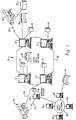
- FIG. 1 is a block diagram of a Data Processing System where this invention may be practiced.
- Figure 2 is the format for a data frame for the modified HDLC protocol.
- Figure 3 is the format for a null frame in the modified HDLC protocol.
- Figure 4 is the data transparency encoding transformations for the modified HDLC protocol.
- Figure 5 is an address, control, and data byte for the modified HDLC protocol.
- Figure 6 is the format for an address byte for the modified HDLC protocol.
- Figure 7 is the format of the control byte showing the bit significance of the bits composing the byte.
- data processing system 8 may include a plurality of networks, such as Local Area Networks (LAN) 10 and 32, each of which preferably includes a plurality of individual computers 12 and 30, respectively.
- LAN Local Area Networks
- IWS Interactive Work Stations
- each individual computer may be coupled to a storage device 14 and/or a printer/output device 16.
- a storage device 14 may be utilized, in accordance with the method of the present invention, to store applications or other programs which may be periodically accessed by any user within data processing system 8.
- data processing network 8 may also include multiple main frame computers, such as main frame computer 18, which may be preferably coupled to LAN 10 by means of communications link 22.
- the communications link 22 may further include modems (not shown) at each end of the link capable of simultaneous bidirectional data flows.
- Main frame computer 18 may also be coupled to a storage device 20 which may serve as remote storage for LAN 10.
- LAN 10 may be coupled via communications link 24 through a subsystem control unit/communications controller 26 and communications link 34 to a gateway server 28.
- Gateway server 28 is preferably an individual computer or Interactive Work Station (IWS) which serves to link LAN 32 to LAN 10.
- IWS Interactive Work Station
- main frame computer 18 may be located a great geographic distance from LAN 10 and similarly LAN 10 may be located a substantial distance from LAN 32.
- High-performance asynchronous (async) links may be required with specific sets of features, similar to those of this invention, to enable efficient transmissions over the communication links.
- the basic link concepts of this invention are derived from the High-Level Data Link Control (HDLC) protocol. The modifications meet the requirements of a high-performance async link using the limited data rates of low cost async modems.
- the link protocol of this invention requires very low overhead and allows application data to flow efficiently. On average, this invention adds only five bytes per frame to an application data packet.
- a packet refers to a sequence of binary digits, including data and controls signals, that is transmitted and switched as a composite whole.
- the data and control signals may also include error control information arranged in a specific format.
- the term packet is also synonymous with data frame.
- the target packet size is 60 bytes per frame, giving a framing overhead of approximately 8 percent.
- the target packet size increase to 120 bytes, reducing the framing overhead to 4 percent.
- This is a full-duplex protocol, and was selected to be so, in order to lessen or eliminate the delay of the negative acknowledgement of bad frames.
- half-duplex data flow can delay the negative acknowledgement of bad frames by up to six full frame times in a worst case situation.
- the full-duplex operation of this invention reduces the negative acknowledgement to a little over one full frame time in a worst case situation.
- Another positive effect of full-duplex operation, where bidirectional data flow is permitted, is a doubling of the bandwidth of the link by allowing data flow in both directions simultaneously.
- FIG. 2 the format for a data frame is shown.
- Two types of frames are defined by this invention- data frame and null frame -- to provide for the transport of data packets across the link and for timely acknowledgement of their receipt.
- Application data will be encapsulated in a data frame consisting of an initial flag byte 40, an address byte 42, a control byte 44, one or more data bytes 46, two frame check sequence (CRC) bytes 48, and a terminal flag byte 50.
- CRC frame check sequence
- the address 42, control 44, data 46 and CRC 48 bytes are subject to a data-transparency transformation and will be expanded to include escape sequences if necessary before being queued to the physical transmitter. Upon receipt, these same bytes are processed to reverse the data-transparency transformation before being examined.
- Data transparency is achieved by the use of byte stuffing logic.
- Byte stuffing refers to the final operations necessary to physically transmit a frame. It refers to the addition of the begin/end recognitions indicators, as well as data transparency information. Byte stuffing occurs only after a transmit data packet has been framed, had the CRC calculated and inserted, and has been (optionally) encrypted. Byte stuffing logic first defines an "escape" character.
- the escape character Whenever the escape character flows over the link, it is always the first character of a two character escape sequence.
- the escape character is used to provide an alternate encoding mechanism for occurrence of the frame begin/end character in normal data and to encode actual occurrences of the escape character itself when they occur in the normal data.
- the frame start flag 40 is defined to be the eight-bit byte 0x7e. This value is guaranteed not to occur within the frame by the data transparency transformation which is applied to the frame image before it is queued to the physical transmission process. This value is also used for the frame end flag 50. No conflict occurs, and by using the same value for the frame start 40 and end flag 50, it is possible to pack sequential frames end-to-end and allow the end flag 50 of the first frame to double as the start flag 40 of the next frame.
- the escape flag is defined to be the eight-bit byte 0x7d. On the physical link, this value is guaranteed to be the first byte of a two-byte escape sequence in which the second byte will never be equal to either the escape flag value or the frame start flag 40 value.
- escape sequences are substituted for any occurrences of the values 0x7e (the frame start flag 50) or 0x7d (the escape flag itself) in the address 42, control 44, data 46 and frame check sequence fields 48 of data frames.
- the transmitter substitutes an escape flag byte followed by the original byte value exclusive OR′ed with the byte value 0x20. This means transformations will occur as shown in Figure 4.
- the receiver reverses the transformations to reconstruct the original byte values in the address 42, control 44, data 46 and frame check sequence 48 fields after the frame is received by the physical transport layer.
- each frame is statistically guaranteed by a 16-bit CRC 48 frame check sequence which is calculated and inserted in each frame on transmission and checked and deleted from each frame on receipt. Frames which fail,the check sequence confirmation calculation are discarded just as through they had never been received.
- the frame check sequence consists of a two-byte cyclic redundancy check value calculated from the values of the address 42, control 44, and data 46 bytes before the data transparency transformation is performed.
- the CRC generator polynomial is defined by the 16 bit value 0x1021.
- FIG 3 the format for a null frame is shown.
- Data exchanged between two link stations takes the form of a series of data frames. These frames can be either the data frames as shown in Figure 2, or the null frame of Figure 3.
- a null frame carries no data, unlike the data frame which carries one or more bytes of application data.
- the link supervisory functions are handled by the exchange of null frames and application data frames.
- Data frames consist of a sequence of 8-bit bytes, with the bytes transmitted and received using an eight-bit data word with one start bit, one stop bit, and no parity bit.
- Every frame contains an address byte 70 which consists of eight individual receive toggle bits.
- Each receive toggle bit corresponds to one of the eight possible transmit sequence numbers from zero to seven. As shown in Figure 6, the least significant bit (lsb) corresponds to transmit sequence number zero and the most significant bit (msb) corresponds to transmit sequence number seven.
- the value of the receive toggle bits in the address byte 70 of the received frame are checked against the status of any unacknowledged transmitted frames. If the value of the appropriate receive toggle bit matches that expected for a particular transmitted frame, then that frame is considered to be acknowledged and the associated transmit sequence number becomes available for reuse.
- This invention provides an async link protocol with a selective reject (SREJ) capability similar to that used in the HDLC protocol. Under HDLC, a re-transmission of the damages frames occur only when a single error is discovered in a sequence of consecutive frames. This invention improves on the selective reject capability by allowing up to six damaged frames in a sequence of up to seven consecutive frames to be simultaneously identified and selectively retransmitted as necessary.
- SREJ selective reject
- This invention also minimizes the impact of error transmissions on error recovery.
- a dynamic frame size adjustment algorithm is employed that decreases the frame size when multiple errors occur. This allows more frames to pass over the link between failures. A positive throughput is thus achieved despite the occurrence of multiple errors. If no errors occur for a period of time, the frame size is allowed to rise back to the optimal values.
- the regular HDLC protocol station address supports several types of link topology including multi-drop and ring connections. Because of the operating environment -- modems only -- this modified HDLC protocol supports only point-to-point topology.
- This modified HDLC protocol provides for sixteen independent logical sessions on a single physical link. This is logically supported by a dedicated four-bit field in the data frame header which is used to route packets to specific application queues. Although this function is not strictly part of the link layer, it is efficiently integrated into the link layer and eliminates the need for a separate low-level packet router task.
- this invention uses a mechanism similar to that used by SDLC and HDLC to sequence frames.
- a three-bit transmit sequence number 80 is assigned to each frame. This invention however, never allows more than seven sequentially numbered frames to be unacknowledged at any one time.
- the transmitter can assure that data will not overrun the receiver and can automatically initiate re-transmissions based on acknowledgements from the receiver.
- frames which carry data include a control byte 72 which contains three distinct fields.
- the first field is a four-bit logical channel index 76 which is used to route the data to any of sixteen distinct destination queues.
- the second is a three-bit transmit sequence number 80 field which is used to assure sequential delivery of data packets to target queues in the face of possible transmission errors which might cause physical reception of packets to occur out of the order in which they were originally supplied to the transmitter.
- the third field is a single-bit transmit toggle bit 78 value which works in conjunction with the transmit sequence number 80 to detect and discard multiple copies of data frames which may be received when an acknowledgement of the first copy is lost due to line noise.
- the three-bit transmit sequence number 80 field is used to enforce serialization of data packets as they flow across the link. Under normal (low noise) conditions, packets will be received in the order in which they were scheduled for transmission. When errors occur which cause re-transmissions to occur, it becomes necessary to transmit frames out of order.
- the transmitter assigns sequential sequence numbers in a radix 8 cycle from zero to seven and then back to zero. All eight sequence numbers start out in an available status. A total of no more than seven sequence numbers may be in use at any one time. For the transmitter to schedule a data packet for transmission, the next sequence number must be available and the total number of sequence numbers in use must be six or less.
- the transmit toggle 78 bit is inverted by the transmitter each time a sequence number is reused.
- the receiver confirms receipt of a packet each time its transmit toggle bit 78 is different than the toggle bit of the last packet which carried the same transmit sequence number.
- the logical channel index 76 is logically treated as data by the link layer logic until a received packet is released by the link layer for delivery to the application layer. At this time, the value of the channel index 76 is use to index into a table of registered applications to determine the proper target queue for the incoming data.
- this invention permits the release of error-free frames to their destinations immediately upon receipt.
- Those skilled in the art will know that such a technique is applicable in packet switched environments where higher levels of the interapplication protocol can resequence frames as required. This is the case, for example, in X.25 networks.
- This invention provides a method of conveying data frames that will permit an intelligent application layer to reassemble the data frames received out of order. This is achieved by providing a transmitter which assigns sequential sequence numbers to each frame in a radix 8 cycle from zero to seven and back to zero. The protocol limits to a maximum of seven the number of sequence numbers permitted to be in use at any one time.
- a receiver accepts a frame by setting a corresponding bit in a receive toggle bit array with a value from a transmit toggle bit.
- the value of the transmit toggle bit is alternated with a particular sequence number each time it is reused to provide a reliable confirmation indication. This alternation is accomplished by considering the transmit toggle bit as the high order bit of a virtual four bit transmit sequence number.
- the full-duplex nature of this protocol allows multiple indications of erroneous data frames to be sent to a transmitter while immediately releasing to a destination any received frames containing no errors. The features of this protocol thus provide the capability for an intelligent application layer to resequence the frames at their destinations.
Landscapes
- Engineering & Computer Science (AREA)
- Computer Networks & Wireless Communication (AREA)
- Signal Processing (AREA)
- Communication Control (AREA)
- Detection And Prevention Of Errors In Transmission (AREA)
Applications Claiming Priority (2)
| Application Number | Priority Date | Filing Date | Title |
|---|---|---|---|
| US07/636,794 US5163054A (en) | 1990-12-31 | 1990-12-31 | Method for data transmission using a modified high level data link control protocal |
| US636794 | 1990-12-31 |
Publications (2)
| Publication Number | Publication Date |
|---|---|
| EP0494037A2 true EP0494037A2 (fr) | 1992-07-08 |
| EP0494037A3 EP0494037A3 (en) | 1993-05-26 |
Family
ID=24553354
Family Applications (1)
| Application Number | Title | Priority Date | Filing Date |
|---|---|---|---|
| EP19910480180 Withdrawn EP0494037A3 (en) | 1990-12-31 | 1991-12-06 | Early frame release in modified hdlc protocol |
Country Status (3)
| Country | Link |
|---|---|
| US (1) | US5163054A (fr) |
| EP (1) | EP0494037A3 (fr) |
| JP (1) | JPH077972B2 (fr) |
Cited By (2)
| Publication number | Priority date | Publication date | Assignee | Title |
|---|---|---|---|---|
| US6317430B1 (en) | 1998-02-19 | 2001-11-13 | Lucent Technologies Inc. | ARQ protocol support for variable size transmission data unit sizes using a hierarchically structured sequence number approach |
| CN103595506A (zh) * | 2013-11-15 | 2014-02-19 | 四川启明星蜀达电气有限公司 | 一种通用能效管理方法 |
Families Citing this family (11)
| Publication number | Priority date | Publication date | Assignee | Title |
|---|---|---|---|---|
| GB2236930B (en) * | 1989-10-11 | 1994-03-23 | Plessey Co Plc | Method and apparatus for identifying valid cells in a redundant path combining unit of an asynchronous transfer mode switch |
| US5524116A (en) * | 1992-02-14 | 1996-06-04 | At&T Corp. | Packet framer |
| US6098188A (en) * | 1992-02-14 | 2000-08-01 | Lucent Technologies Inc. | Packet framer |
| EP0707394B1 (fr) * | 1994-10-11 | 2002-03-20 | Nippon Telegraph And Telephone Corporation | Système de retransmission dans la communication de données |
| US5822543A (en) * | 1996-07-08 | 1998-10-13 | International Business Machines Corporation | Gathering data handling statistics in non-synchronous data communication networks |
| US5983271A (en) * | 1997-02-06 | 1999-11-09 | Paradyne Corporation | Method for processing asynchronous low-level protocols in a communication device to off load the main processor |
| US6873615B2 (en) * | 2000-03-24 | 2005-03-29 | Cirronet Inc. | Method and system for data transmission in a wireless network |
| US7249193B1 (en) * | 2001-08-28 | 2007-07-24 | Emc Corporation | SRDF assist |
| JP4201550B2 (ja) * | 2002-08-30 | 2008-12-24 | 富士通株式会社 | 負荷分散装置 |
| US9642019B2 (en) * | 2014-02-19 | 2017-05-02 | Maxlinear Asia Singapore Private Limited | Low latency, automatic repeat request (“ARQ”) in a multi-device communications link |
| TW202429304A (zh) * | 2023-01-12 | 2024-07-16 | 韓商愛思開海力士有限公司 | 能夠為互連協定準備能力資訊的控制器以及電子裝置 |
Family Cites Families (7)
| Publication number | Priority date | Publication date | Assignee | Title |
|---|---|---|---|---|
| DE3069762D1 (en) * | 1980-08-26 | 1985-01-17 | Ibm | System for the retransmission of incorrectly received numbered frames in a data transmission system |
| US4422171A (en) * | 1980-12-29 | 1983-12-20 | Allied Corporation, Law Department | Method and system for data communication |
| US4601035A (en) * | 1983-10-03 | 1986-07-15 | At&T Bell Laboratories | Data communication method and circuitry |
| US4551834A (en) * | 1983-10-25 | 1985-11-05 | U.S. Philips Corporation | Method and system for communicating over an open communication network |
| CN86101893A (zh) * | 1985-02-28 | 1986-11-05 | 佳能株式会社 | 数据通信设备 |
| FR2585909B1 (fr) * | 1985-08-02 | 1987-10-09 | Lmt Radio Professionelle | Procede de transmission de donnees par paquets a travers un reseau ou une chaine de transmission, et dispositif de mise en oeuvre |
| CA1306810C (fr) * | 1987-09-30 | 1992-08-25 | Gregory D. Dolkas | Methode et appareil de transmission de donnees |
-
1990
- 1990-12-31 US US07/636,794 patent/US5163054A/en not_active Expired - Fee Related
-
1991
- 1991-11-07 JP JP3318594A patent/JPH077972B2/ja not_active Expired - Lifetime
- 1991-12-06 EP EP19910480180 patent/EP0494037A3/en not_active Withdrawn
Cited By (2)
| Publication number | Priority date | Publication date | Assignee | Title |
|---|---|---|---|---|
| US6317430B1 (en) | 1998-02-19 | 2001-11-13 | Lucent Technologies Inc. | ARQ protocol support for variable size transmission data unit sizes using a hierarchically structured sequence number approach |
| CN103595506A (zh) * | 2013-11-15 | 2014-02-19 | 四川启明星蜀达电气有限公司 | 一种通用能效管理方法 |
Also Published As
| Publication number | Publication date |
|---|---|
| US5163054A (en) | 1992-11-10 |
| JPH077972B2 (ja) | 1995-01-30 |
| EP0494037A3 (en) | 1993-05-26 |
| JPH04296143A (ja) | 1992-10-20 |
Similar Documents
| Publication | Publication Date | Title |
|---|---|---|
| US5335233A (en) | Data packet format | |
| EP1190520B1 (fr) | Systeme et procede servant a mettre en application une demande de repetition automatique hybride au moyen d'une combinaison de controle de parite | |
| US6301249B1 (en) | Efficient error control for wireless packet transmissions | |
| US4841526A (en) | Data communications system | |
| US4617657A (en) | Transmitting sequence numbers of information in a packet data transmission system | |
| EP1166486B1 (fr) | Notification de rejet de paquets pour protocole de retransmission semi-fiable | |
| US6310892B1 (en) | Reliable connectionless network protocol | |
| EP0244117A2 (fr) | Méthode pour la transmission de données en duplex utilisant le protocole "émettre-et-attendre" | |
| US5163054A (en) | Method for data transmission using a modified high level data link control protocal | |
| US6640325B1 (en) | Immediate negative acknowledgement for a communication network | |
| KR20020042438A (ko) | 서브-패킷 전송 방법 및 수신 방법 | |
| KR20020095125A (ko) | 이동 통신 시스템의 데이터 재전송 장치 및 방법 | |
| JP2004180295A (ja) | 通信デバイスのモジュール間で伝送された喪失メッセージを検出するためのシステムおよび方法 | |
| JP2006287981A (ja) | 網通信システムにおいてデータパケットを伝送するための誤り訂正通信方法 | |
| US6925096B2 (en) | Method and apparatus for managing traffic flows | |
| JP2002152311A (ja) | Ir機能を具備したarqを用いて通信システムで情報を送信する方法 | |
| JPH06121001A (ja) | セル通信誤り時の再送制御方式 | |
| JPH01105644A (ja) | データ伝送制御方法およびデータ通信装置 | |
| CA2010809A1 (fr) | Methode de generation d'accuses de reception de paquet | |
| EP1225741B1 (fr) | Interconnection à grande vitesse pour systèmes intégrés dans un réseau d'ordinateurs | |
| EP0494036A2 (fr) | Transmission de trames de données avec retransmission des trames en erreurs en utilisant le protocole HDLC | |
| US7100078B1 (en) | Method and apparatus for restoration of lost blocks in a multicast data transmission | |
| JPH08251146A (ja) | データ伝送制御システム | |
| EP0093004B1 (fr) | Système de communication de données | |
| JP3027800B2 (ja) | 無線lanにおける伝送制御方法および伝送制御装置 |
Legal Events
| Date | Code | Title | Description |
|---|---|---|---|
| PUAI | Public reference made under article 153(3) epc to a published international application that has entered the european phase |
Free format text: ORIGINAL CODE: 0009012 |
|
| AK | Designated contracting states |
Kind code of ref document: A2 Designated state(s): DE FR GB |
|
| PUAL | Search report despatched |
Free format text: ORIGINAL CODE: 0009013 |
|
| AK | Designated contracting states |
Kind code of ref document: A3 Designated state(s): DE FR GB |
|
| STAA | Information on the status of an ep patent application or granted ep patent |
Free format text: STATUS: THE APPLICATION IS DEEMED TO BE WITHDRAWN |
|
| 18D | Application deemed to be withdrawn |
Effective date: 19931130 |