EP0495152A2 - Insert pour chaussures pour accommoder les pieds sensibles - Google Patents
Insert pour chaussures pour accommoder les pieds sensibles Download PDFInfo
- Publication number
- EP0495152A2 EP0495152A2 EP91108807A EP91108807A EP0495152A2 EP 0495152 A2 EP0495152 A2 EP 0495152A2 EP 91108807 A EP91108807 A EP 91108807A EP 91108807 A EP91108807 A EP 91108807A EP 0495152 A2 EP0495152 A2 EP 0495152A2
- Authority
- EP
- European Patent Office
- Prior art keywords
- shoe insert
- layer
- insert according
- foot
- core layer
- Prior art date
- Legal status (The legal status is an assumption and is not a legal conclusion. Google has not performed a legal analysis and makes no representation as to the accuracy of the status listed.)
- Withdrawn
Links
- 239000010410 layer Substances 0.000 claims abstract description 57
- 229920001971 elastomer Polymers 0.000 claims abstract description 42
- 239000000806 elastomer Substances 0.000 claims abstract description 41
- 239000012792 core layer Substances 0.000 claims abstract description 39
- 239000000463 material Substances 0.000 claims abstract description 19
- 239000000835 fiber Substances 0.000 claims abstract description 4
- 206010012601 diabetes mellitus Diseases 0.000 claims description 6
- 229920002379 silicone rubber Polymers 0.000 claims description 5
- 239000007799 cork Substances 0.000 claims description 4
- 238000004132 cross linking Methods 0.000 claims description 4
- 239000004945 silicone rubber Substances 0.000 claims description 4
- 229920002994 synthetic fiber Polymers 0.000 claims description 3
- 239000012209 synthetic fiber Substances 0.000 claims description 3
- 239000004753 textile Substances 0.000 claims description 3
- 239000004677 Nylon Substances 0.000 claims description 2
- 229920001778 nylon Polymers 0.000 claims description 2
- 239000000126 substance Substances 0.000 claims description 2
- 239000004952 Polyamide Substances 0.000 claims 1
- 239000002657 fibrous material Substances 0.000 claims 1
- 229920002647 polyamide Polymers 0.000 claims 1
- 229920006306 polyurethane fiber Polymers 0.000 claims 1
- 230000000087 stabilizing effect Effects 0.000 claims 1
- 238000002560 therapeutic procedure Methods 0.000 abstract description 14
- 208000037265 diseases, disorders, signs and symptoms Diseases 0.000 abstract description 10
- 230000003068 static effect Effects 0.000 abstract description 9
- 201000000585 muscular atrophy Diseases 0.000 abstract description 8
- 201000002282 venous insufficiency Diseases 0.000 abstract description 8
- 230000008822 capillary blood flow Effects 0.000 abstract description 5
- 230000004087 circulation Effects 0.000 abstract description 5
- 208000035475 disorder Diseases 0.000 abstract description 5
- 210000001226 toe joint Anatomy 0.000 abstract description 4
- 210000002683 foot Anatomy 0.000 description 57
- 208000000013 Hammer Toe Syndrome Diseases 0.000 description 6
- 238000004519 manufacturing process Methods 0.000 description 6
- 238000005096 rolling process Methods 0.000 description 6
- 206010028289 Muscle atrophy Diseases 0.000 description 5
- 201000010099 disease Diseases 0.000 description 5
- 230000008901 benefit Effects 0.000 description 4
- 238000000034 method Methods 0.000 description 4
- 230000020763 muscle atrophy Effects 0.000 description 4
- 230000008569 process Effects 0.000 description 4
- 230000001225 therapeutic effect Effects 0.000 description 4
- 208000010428 Muscle Weakness Diseases 0.000 description 3
- 206010028372 Muscular weakness Diseases 0.000 description 3
- 230000000694 effects Effects 0.000 description 3
- 230000000399 orthopedic effect Effects 0.000 description 3
- 208000008960 Diabetic foot Diseases 0.000 description 2
- 208000007101 Muscle Cramp Diseases 0.000 description 2
- 239000012790 adhesive layer Substances 0.000 description 2
- 210000004369 blood Anatomy 0.000 description 2
- 239000008280 blood Substances 0.000 description 2
- 244000309466 calf Species 0.000 description 2
- 238000010276 construction Methods 0.000 description 2
- 238000013461 design Methods 0.000 description 2
- 238000011161 development Methods 0.000 description 2
- 230000018109 developmental process Effects 0.000 description 2
- 210000003205 muscle Anatomy 0.000 description 2
- 208000035824 paresthesia Diseases 0.000 description 2
- 230000009467 reduction Effects 0.000 description 2
- 208000024891 symptom Diseases 0.000 description 2
- 210000003462 vein Anatomy 0.000 description 2
- 208000019901 Anxiety disease Diseases 0.000 description 1
- 206010009696 Clumsiness Diseases 0.000 description 1
- 206010030113 Oedema Diseases 0.000 description 1
- 206010030124 Oedema peripheral Diseases 0.000 description 1
- 206010033425 Pain in extremity Diseases 0.000 description 1
- 208000001431 Psychomotor Agitation Diseases 0.000 description 1
- 206010038743 Restlessness Diseases 0.000 description 1
- 229920002334 Spandex Polymers 0.000 description 1
- 230000017531 blood circulation Effects 0.000 description 1
- 230000007423 decrease Effects 0.000 description 1
- 230000004064 dysfunction Effects 0.000 description 1
- 230000005489 elastic deformation Effects 0.000 description 1
- 238000005516 engineering process Methods 0.000 description 1
- 239000004744 fabric Substances 0.000 description 1
- 230000006872 improvement Effects 0.000 description 1
- 238000010348 incorporation Methods 0.000 description 1
- 238000007373 indentation Methods 0.000 description 1
- 230000003993 interaction Effects 0.000 description 1
- 230000036244 malformation Effects 0.000 description 1
- 208000030159 metabolic disease Diseases 0.000 description 1
- 238000000465 moulding Methods 0.000 description 1
- 210000002346 musculoskeletal system Anatomy 0.000 description 1
- 230000027758 ovulation cycle Effects 0.000 description 1
- 239000004033 plastic Substances 0.000 description 1
- 238000012805 post-processing Methods 0.000 description 1
- 230000035935 pregnancy Effects 0.000 description 1
- 239000005060 rubber Substances 0.000 description 1
- 230000035945 sensitivity Effects 0.000 description 1
- 239000004759 spandex Substances 0.000 description 1
- 230000001502 supplementing effect Effects 0.000 description 1
- 238000012360 testing method Methods 0.000 description 1
- 210000003371 toe Anatomy 0.000 description 1
- 238000012549 training Methods 0.000 description 1
- 230000008320 venous blood flow Effects 0.000 description 1
- 238000004073 vulcanization Methods 0.000 description 1
Images
Classifications
-
- A—HUMAN NECESSITIES
- A43—FOOTWEAR
- A43B—CHARACTERISTIC FEATURES OF FOOTWEAR; PARTS OF FOOTWEAR
- A43B17/00—Insoles for insertion, e.g. footbeds or inlays, for attachment to the shoe after the upper has been joined
- A43B17/14—Insoles for insertion, e.g. footbeds or inlays, for attachment to the shoe after the upper has been joined made of sponge, rubber, or plastic materials
-
- A—HUMAN NECESSITIES
- A43—FOOTWEAR
- A43B—CHARACTERISTIC FEATURES OF FOOTWEAR; PARTS OF FOOTWEAR
- A43B13/00—Soles; Sole-and-heel integral units
- A43B13/02—Soles; Sole-and-heel integral units characterised by the material
- A43B13/12—Soles with several layers of different materials
-
- A—HUMAN NECESSITIES
- A43—FOOTWEAR
- A43B—CHARACTERISTIC FEATURES OF FOOTWEAR; PARTS OF FOOTWEAR
- A43B7/00—Footwear with health or hygienic arrangements
- A43B7/14—Footwear with health or hygienic arrangements with foot-supporting parts
- A43B7/1405—Footwear with health or hygienic arrangements with foot-supporting parts with pads or holes on one or more locations, or having an anatomical or curved form
- A43B7/1455—Footwear with health or hygienic arrangements with foot-supporting parts with pads or holes on one or more locations, or having an anatomical or curved form with special properties
- A43B7/147—Footwear with health or hygienic arrangements with foot-supporting parts with pads or holes on one or more locations, or having an anatomical or curved form with special properties for sick or disabled persons, e.g. persons having osteoarthritis or diabetes
-
- A—HUMAN NECESSITIES
- A43—FOOTWEAR
- A43B—CHARACTERISTIC FEATURES OF FOOTWEAR; PARTS OF FOOTWEAR
- A43B7/00—Footwear with health or hygienic arrangements
- A43B7/14—Footwear with health or hygienic arrangements with foot-supporting parts
- A43B7/28—Adapting the inner sole or the side of the upper of the shoe to the sole of the foot
Definitions
- the invention relates to a therapy shoe insert, for example for the bedding of stress-sensitive feet according to the preamble of claim 1.
- Such shoe insoles come in particular for the therapy in the case of disorders of the foot statics, for the treatment of venous insufficiency in the leg area or for the bedding of stress-sensitive feet, for example in the area orthopedics for the compensation of malformations of the foot apparatus or for the targeted support of the foot of a sick or disabled person in the rolling phase of the foot.
- Therapy shoe insoles are also required for foot bedding for diabetics with foot damage, where it is important not only to use the shoe insert to remove pain-causing pressure zones, but also to support the musculoskeletal system and blood circulation by functionally supplementing the weakened muscles.
- a conventional shoe insert which could be adapted in an optimal way to the particular clinical picture of the foot, was equipped with a relatively rigid scaffold, which was primarily intended to give the foot great support. Apart from the fact that such a shoe insert had to be renewed at short intervals in order to adapt to the changing footbed, such a shoe insert is not suitable for the therapy of diabetic feet that have changed in terms of disease.
- the diabetes foot regularly tends to hammer and claw toes. This causes the foot to curl when inserted into the shoe when using conventional orthopedic shoe inserts, which creates extremely unfavorable stress situations that are very painful.
- This conventional shoe insert in particular does not take into account the muscular atrophy in the area of the toe-universal joints, which is often pronounced in diabetic foot and which is used to absorb the rolling load when walking.
- the invention is therefore based on the object of a therapy shoe insert, in particular for therapy in the case of disorders of the foot statics, for the treatment of venous insufficiency in the leg area and for the bedding of stress-sensitive feet, such as, for. B. for bedding a diabetes foot to create, which not only has an excellent therapeutic effect for the above-mentioned areas of application, but is also constructed so that it is accepted by a large range of patients with economic manufacturability.
- This object is achieved by the features of claim 1.
- a simply constructed shoe insert is created, the deformation behavior of which is determined by the core layer so that the shoe insert acts like a pressure pump on the venous circulation with each step.
- the deep veins of the calf are thereby filled up to the maximum capacity and then emptied again by the muscle pressure of the calf, whereby the blood is pushed upwards.
- Due to the homogeneous elastic footbed the blood return transport values increased by 60 to 70% in trials which could even exceed the effect of rubber stockings and bandages.
- the main advantage of the invention is to be seen in the fact that the shoe insert by everyone, such. B. can also be worn by fashion-conscious, younger patients without hesitation, especially since it has been shown that the shoe insert showed the advantageous effects described above even with very small insert thicknesses.
- the structure of the shoe insert according to the invention is suitable for an economical production of corrective insoles for the targeted phlebological treatment by suitable adjustment of the elastomer core layer density or the degree of hardness of this layer.
- the shoe insert according to the invention it is also possible to provide a particularly advantageous product for the bedding of stress-sensitive feet, in particular for the bedding of feet for diabetics with foot damage.
- the more or less pronounced muscle atrophy in the area of the basic toe joints of the diabetes foot is not only largely compensated for by the therapy shoe insert according to the invention.
- the shoe insert can be designed with or without an additional sole-side support layer that differs materially from the elastomer core layer. If the support layer is omitted, however, it is advantageous to increase the thickness of the elastomer core layer, for example by 2 mm, in order to further improve the elastic rebound.
- a further support layer on the sole side is used, a large-area support for the elastomer core layer is created, the material properties of which with regard to an optimal, i.e. highly elastic support of the foot can be selected.
- a relief adapted to the individual requirements of the insole wearer is preferably incorporated or molded into the underside of the sole-side layer, preferably a separate support layer.
- the relief on the sole side forming the recesses or receptacles can be selected independently of the elastic setting of the elastomer core layer.
- the elasticity of the shoe insert can be specifically influenced or pressure-sensitive areas of the foot can be relieved precisely.
- the top cover layer in the form of the smooth fiber structure provides so little resistance even to the bare foot when inserted into the shoe that misalignment of the toes does not occur even if the foot is prone to hammer or claw toes. Due to the continuous layer structure of the shoe insert, the advantages shown above can be realized with a very simple and therefore inexpensive manufacturing process.
- the shoe insert is suitable for mass production.
- a separate support layer is omitted (claim 7), it is advantageous to increase the thickness of the elastomer core layer somewhat, for example, to make it about 2 mm thicker than with a separate support layer on the sole side. In this case, it is also advantageous to set the plastic of the elastomer core layer slightly harder, for example to 8 ° Shore A. With this setting it is also possible to adjust the layer on the sole, i.e. to provide the underside of the shoe insert with a relief adapted to the individual requirements of the insert wearer.
- the deformation behavior can also be controlled by the connection technology between the support layer on the sole side and the elastomer core layer.
- the support layer is preferably vulcanized onto the core layer, as a result of which a highly resilient and durable connection is created.
- the contact surfaces between the support layer on the sole side and the elastomer core layer lying above are preferably planar, as a result of which the production process can be further simplified.
- Another way of controlling the deformation behavior of the shoe insert is to shape the top of the elastomer core layer in relief in such a way that it largely matches the shape of the foot.
- this design can be used to influence the required flexibility in certain areas of the foot.
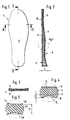
- 2 denotes a shoe insert which essentially has the outer contour of a shoe sole.
- the shoe insert is used to bed stress-sensitive feet, such as. B. for the footbed of diabetes feet, which often suffer from muscle atrophy due to disturbed capillary blood flow.
- the shoe insert is constructed in three layers.
- the shoe insert essentially consists of a central elastomer core layer 4, the elastomer being set as soft as possible.
- the elastomer is selected from the group of addition-crosslinking silicone rubbers, the elastomer being adjusted so that a quasi-gel-like deformation behavior is provided.
- the Schore A hardness is preferably in the range between 1 and 10 °, for example 1 °.
- the base layer of the elastomer core layer is provided with a flat surface 6, while on the upper side it bears a relief structure 8, which is evident from the cuts according to FIGS. 2 and 3. This relief structure 8 is preferably chosen so that it is largely adapted to the natural footbed.
- the elastomer core layer is connected via the flat surface 6 to a plate-like support layer 10 made of flexible and pressure-resistant material, which also has the property of being subjected to post-processing, for example in the grinding process.
- a plate-like support layer 10 made of flexible and pressure-resistant material, which also has the property of being subjected to post-processing, for example in the grinding process.
- so-called flexo cork is used as the material for the support layer, which is applied to the elastomer core layer 4 via a vulcanization layer 12.
- the thickness D of the flexocork sheet 10 ' is in the range between 1.5 and 3 mm.
- the thickness S of the elastomer core layer 4 differs over the length of the shoe insert 2 and is, for example, between 1.5 mm in the area of the ball of the foot and up to 15 mm in the area of the heel.
- the elastomer core layer is covered upwards by a thin cover layer 14 made of a synthetic fiber material, such as. B. a nylon-containing textile, which is available under the name "Lycra" on the market. This is a chemical silk with the one on the top a very slippery surface is provided.
- the cover layer 14 is preferably designed as a fabric or as a textile, which conforms particularly well to the relief structure 8 and does not apply relatively much.
- 16 denotes an adhesive layer, via which there is a connection between the elastomer core layer 4 and the cover layer 14.
- incorporations designated 18 can be seen, which are produced, for example, by grinding the support layer 10.
- the orthopedic surgeon carries out this grinding process in order to adapt the shoe insert or footbed to the individual boundary conditions of the wearer of the insert.
- pressure-sensitive areas on the diseased foot can be relieved precisely, in that the deformation behavior is influenced selectively or over a wide area in the interaction between the support layer 10 and the elastomer core layer 4.
- the advantages of the footbed according to the invention lie in particular in the fact that, with a simple construction, the very smooth covering layer 14 makes it very easy to insert the sick foot into the shoe. For this reason, the footbed is particularly suitable for the therapeutic treatment of diabetes feet that tend to have hammer and claw toes.
- the very soft elastomer elastically complements the muscle atrophy that often arises due to disturbed capillary blood flow, which is particularly important in the area of the basic toe joints, since this is where the crucial processes for trouble-free rolling of the foot take place.
- the elasticity on the sole side 18 allows the elasticity to be controlled in a targeted manner in order to provide elastic support to the load-sensitive foot, particularly where this is of particular importance with regard to pressure sensitivity and the required movement pattern.
- shoe insert with a three-layer structure An exemplary embodiment of the shoe insert with a three-layer structure has been described above, this shoe insert being particularly suitable for bedding load-sensitive feet, in particular for foot bedding for diabetics with foot damage, but also for treating venous insufficiency symptoms and vein dysfunction.
- FIG. 1 Another variant of the shoe insert, the production of which is additionally simplified and nevertheless fulfills the therapy functions described above for compensating for disturbances in the statics of the foot and / or leg anatomy, is shown schematically in FIG.
- FIG. 5 differs from the embodiment according to FIGS. 1 to 4 in that a separate support layer 10 has been omitted.
- the elastomer core layer 104 which is connected to the cover layer 114 via the adhesive layer 116, has a correspondingly increased thickness S * .
- the thickness or the thickness of the elastomer core layer 104 is increased by approximately 2 mm.
- indentations 118 can still be provided at individually adapted or predetermined locations in order to adapt the elastic deformation behavior to the respective therapy program.
- it is advantageous to slightly increase the hardness of the elastomer core layer 104 preferably in the range of approximately 8 ° Shore A hardness.
- the insole according to the variant according to FIG. 5 can also be provided on the upper side with a relief structure, preferably in the area of the heel with a larger depression, the position and the dimension of the depression advantageously depending on the extent of the deformities of the foot anatomy and / or the degree is adapted to venous insufficiency.
- the invention thus creates a therapy shoe insert, in particular for therapy in the case of disorders of the foot statics, for the treatment of venous insufficiency in the leg area or for bedding stress-sensitive feet, in particular for foot bedding for diabetics with foot damage.
- the shoe insoles have a multi-layer structure with a highly elastic, as soft as possible, elastomer core layer and a thin, top layer in the form of a smooth fiber structure.
- a separate support layer made of flexible, workable and pressure-resistant material can be provided on the sole side.
- the therapy shoe insert is characterized by an effective support of the back circulation on the one hand and on the other hand by the fact that it supports the foot apparatus in an economically producible manner in a way that is optimally adapted to the individual needs so that stressful situations that are as normal and therefore painless as possible occur when walking , even if the foot already suffers from advanced muscular atrophy in the area of the basic toe joints due to disturbed capillary blood flow.
Landscapes
- Health & Medical Sciences (AREA)
- Epidemiology (AREA)
- General Health & Medical Sciences (AREA)
- Public Health (AREA)
- Diabetes (AREA)
- Rheumatology (AREA)
- Chemical & Material Sciences (AREA)
- Engineering & Computer Science (AREA)
- Materials Engineering (AREA)
- Orthopedics, Nursing, And Contraception (AREA)
- Footwear And Its Accessory, Manufacturing Method And Apparatuses (AREA)
Applications Claiming Priority (2)
| Application Number | Priority Date | Filing Date | Title |
|---|---|---|---|
| DE9100326U DE9100326U1 (de) | 1991-01-12 | 1991-01-12 | Schuheinlage zur Bettung von belastungssensiblen Füßen |
| DE9100326U | 1991-01-12 |
Publications (2)
| Publication Number | Publication Date |
|---|---|
| EP0495152A2 true EP0495152A2 (fr) | 1992-07-22 |
| EP0495152A3 EP0495152A3 (en) | 1992-09-30 |
Family
ID=6863285
Family Applications (1)
| Application Number | Title | Priority Date | Filing Date |
|---|---|---|---|
| EP19910108807 Withdrawn EP0495152A3 (en) | 1991-01-12 | 1991-05-29 | Shoe insert for cushioning sensitive feet |
Country Status (3)
| Country | Link |
|---|---|
| US (1) | US5359791A (fr) |
| EP (1) | EP0495152A3 (fr) |
| DE (1) | DE9100326U1 (fr) |
Cited By (6)
| Publication number | Priority date | Publication date | Assignee | Title |
|---|---|---|---|---|
| EP1245167A1 (fr) * | 2001-03-26 | 2002-10-02 | Vitaflex Dr. Walter Mauch GmbH | Semelle intérieure pour chaussure |
| EP1266947A1 (fr) * | 2001-06-15 | 2002-12-18 | Thuasne | Procédé de fabrication d'une pièce orthopédique à base d'élastomère de silicone et pièce orthopédique obtenue |
| EP1602294A1 (fr) * | 2004-06-02 | 2005-12-07 | Spannrit Schuhkomponenten GmbH | Semelle intérieure en polyuréthane et procédé de fabrication |
| DE202009007240U1 (de) | 2009-05-20 | 2009-08-13 | Mauch, Margit | Innensohle, wie Einlegesohle, Fußbett oder feste Sohle für Schuhwerke, wie Schuhe, Stiefel, Sandalen, Turn-, Basketball-, Jogging-, Lauf-, Renn-, Segler-, Arbeitsschuhe o.dgl. |
| US7774883B2 (en) | 2003-09-16 | 2010-08-17 | Barak Yahoshua | Orthopedic insoles for protecting the metatarsal heads of the forefoot |
| CN113002006A (zh) * | 2021-04-06 | 2021-06-22 | 上海超足科技有限公司 | 一种定制矫形鞋垫加工设备及其加工工艺 |
Families Citing this family (37)
| Publication number | Priority date | Publication date | Assignee | Title |
|---|---|---|---|---|
| DE4320386A1 (de) * | 1993-06-19 | 1994-12-22 | Juergen Stumpf | Fußbett, insbesondere Einlage für an Diabetes erkrankte Personen |
| DE4439088A1 (de) * | 1994-11-02 | 1996-05-09 | Thaemert Orthopaedische Hilfsmittel Gmbh & Co Kg | Pelotte |
| EP0717941A2 (fr) * | 1994-12-21 | 1996-06-26 | IPOS GMBH & CO. KG. | Semelle orthopédique |
| DE19529245A1 (de) * | 1995-08-09 | 1997-02-13 | Kock Hans Juergen Dr Med | Fußsohleneinlage zur physikalischen Thromboseprophylaxe und Förderung der Abschwellung in der Medizin |
| US5678566A (en) * | 1995-09-13 | 1997-10-21 | Diagnostic Thermographics, Inc. | Method and apparatus of thermographic evaluation of the plantar surface of feet |
| DE19610981C1 (de) * | 1996-03-20 | 1997-07-03 | Matthias Comanns | Fußbettung |
| DE29616861U1 (de) * | 1996-09-27 | 1998-01-29 | Kunststoffverarbeitung Wilhelm GmbH, 66981 Münchweiler | Innensohle für Schuhe |
| US6315786B1 (en) * | 1999-07-20 | 2001-11-13 | Partnership Of Arthur H. Smuckler, James Grimes, Niko Efstathiou And Charles A. Sarris | Device for treating heel pain |
| US7264604B1 (en) | 2000-10-20 | 2007-09-04 | 3M Innovative Properties Company | Curable off-loading footwear and methods |
| USD489521S1 (en) | 2001-07-11 | 2004-05-11 | Knit-Rite, Inc. | Balance stabilizing foot orthotic |
| US6854199B2 (en) * | 2001-09-28 | 2005-02-15 | Joseph Paul Polifroni | Layered arch support |
| US6817115B2 (en) * | 2001-09-28 | 2004-11-16 | Joseph Paul Polifroni | Textured arch support device and method of manufacture |
| US6557273B2 (en) | 2001-09-28 | 2003-05-06 | Joseph Paul Polifroni | Layered arch support and method of manufacture |
| US6792699B2 (en) * | 2002-09-09 | 2004-09-21 | Royce Medical Company | Low shear customized footgear |
| US7210250B2 (en) * | 2005-06-07 | 2007-05-01 | Gallegos Alvaro Z | Multipiece footwear insole |
| US20090031583A1 (en) * | 2007-08-03 | 2009-02-05 | Schering-Plough Healthcare Products, Inc. | Foot Support For Alleviating Knee Pain |
| WO2009139893A1 (fr) | 2008-05-15 | 2009-11-19 | Ossur Hf | Ambulateur périphérique |
| US8758272B2 (en) | 2010-07-09 | 2014-06-24 | University Of Utah Research Foundation | Systems, devices, and methods for monitoring an under foot load profile of a tibial fracture patient during a period of partial weight bearing |
| US8758273B2 (en) * | 2010-07-09 | 2014-06-24 | The University Of Utah Research Foundation | Systems, devices, and methods for monitoring an under foot load profile of a patient during a period of partial weight bearing |
| US10595748B2 (en) | 2010-07-09 | 2020-03-24 | The University Of Utah Research Foundation | Systems, devices, and methods for providing foot loading feedback to patients and physicians during a period of partial weight bearing |
| US20130031809A1 (en) * | 2011-08-05 | 2013-02-07 | Roses & Rye LLC | Shoe having improved podiatric support |
| KR101127039B1 (ko) * | 2011-09-29 | 2012-03-26 | 오성관 | 신발 및 이의 제조 방법 |
| US9750303B2 (en) | 2013-03-15 | 2017-09-05 | New Balance Athletics, Inc. | Cambered sole |
| DE202013103808U1 (de) * | 2013-08-22 | 2013-11-15 | Christian Lenthe | Vorfußpolster, Computerprogrammprodukt für die individuelle Anfertigung des Vorfußpolsters |
| EP3046435B1 (fr) | 2013-09-18 | 2020-04-15 | Ossur Iceland EHF | Semelle pour un dispositif orthopédique |
| US9839550B2 (en) | 2013-09-25 | 2017-12-12 | Ossur Hf | Orthopedic device |
| US9668907B2 (en) | 2013-09-25 | 2017-06-06 | Ossur Iceland Ehf | Orthopedic device |
| US9839548B2 (en) | 2013-09-25 | 2017-12-12 | Ossur Iceland Ehf | Orthopedic device |
| US9839549B2 (en) | 2013-09-25 | 2017-12-12 | Ossur Iceland Ehf | Orthopedic device |
| WO2015089261A1 (fr) | 2013-12-12 | 2015-06-18 | Ossur Hf | Semelle exterieure pour dispositif orthopedique |
| USD742017S1 (en) | 2014-03-27 | 2015-10-27 | Ossur Hf | Shell for an orthopedic device |
| US20160073726A1 (en) * | 2014-09-13 | 2016-03-17 | Yu-Te Wu | Foot supporting structure of a cycling shoe with improved ergonomics |
| US9635904B2 (en) * | 2015-01-14 | 2017-05-02 | Superfeet Worldwide, Inc. | Insoles for footwear |
| US10391211B2 (en) | 2015-01-26 | 2019-08-27 | Ossur Iceland Ehf | Negative pressure wound therapy orthopedic device |
| US12156825B2 (en) | 2018-02-02 | 2024-12-03 | Ossur Iceland Ehf | Orthopedic walker |
| EP4247308B1 (fr) | 2020-11-19 | 2025-12-24 | Ossur Iceland Ehf | Déambulateur orthopédique |
| US12336591B1 (en) | 2024-01-29 | 2025-06-24 | Guntersville Breathables, Inc. | Outsole having cork overlay and method of making same |
Family Cites Families (19)
| Publication number | Priority date | Publication date | Assignee | Title |
|---|---|---|---|---|
| US280627A (en) * | 1883-07-03 | Insole | ||
| US975576A (en) * | 1908-09-14 | 1910-11-15 | Daniel Sexton | Innersole. |
| US1236924A (en) * | 1915-11-27 | 1917-08-14 | Meletios Golden | Arch-supporter. |
| US1630135A (en) * | 1926-07-30 | 1927-05-24 | Charles A Roberts | Insole |
| US2330398A (en) * | 1941-12-10 | 1943-09-28 | Vass Stephen | Arch support |
| US2826834A (en) * | 1957-04-16 | 1958-03-18 | Raymond R Ratcliff | Cushion for insoles |
| US3416245A (en) * | 1967-07-27 | 1968-12-17 | Frank Noone Shoe Co Inc | Contoured insole |
| CH467035A (de) * | 1968-05-08 | 1969-01-15 | Scholl S Orthopaedische Spezia | Innensohle für Schuhe |
| US4055699A (en) * | 1976-12-02 | 1977-10-25 | Scholl, Inc. | Cold insulating insole |
| DE2829704A1 (de) * | 1977-07-08 | 1979-01-25 | Nat Res Dev | Schuh |
| DE3037108A1 (de) * | 1980-10-01 | 1982-05-13 | Herbert Dr.-Ing. 8032 Lochham Funck | Polstersohle mit orthopaedischen eigenschaften |
| US4510699A (en) * | 1981-10-26 | 1985-04-16 | Toshiro Nakamura | Insole |
| DE8331925U1 (de) * | 1983-10-22 | 1984-02-16 | Müller, Hubert, 5342 Rheinbreitbach | Schuh-Unterbau |
| EP0154170B1 (fr) * | 1984-02-18 | 1989-04-26 | Keltsch, Bernhard | Procédé de fabrication de première ayant la propriété de chausser parfaitement |
| EP0159957A3 (fr) * | 1984-04-22 | 1987-04-15 | Bar Aharon | Première et son procédé de fabrication |
| US4689898A (en) * | 1985-09-11 | 1987-09-01 | Fahey Brian W | Running shoe |
| DE8800116U1 (de) * | 1988-01-08 | 1988-02-25 | Bauerfeind GmbH & Co, 4152 Kempen | Fersenkissen |
| US4876805A (en) * | 1988-04-29 | 1989-10-31 | Polymer Dynamics Technology, Inc. | Shock absorbing device for high heel footwear |
| US5101580A (en) * | 1989-09-20 | 1992-04-07 | Lyden Robert M | Personalized footbed, last, and ankle support |
-
1991
- 1991-01-12 DE DE9100326U patent/DE9100326U1/de not_active Expired - Lifetime
- 1991-05-29 EP EP19910108807 patent/EP0495152A3/de not_active Withdrawn
-
1993
- 1993-07-15 US US08/092,663 patent/US5359791A/en not_active Expired - Fee Related
Cited By (8)
| Publication number | Priority date | Publication date | Assignee | Title |
|---|---|---|---|---|
| EP1245167A1 (fr) * | 2001-03-26 | 2002-10-02 | Vitaflex Dr. Walter Mauch GmbH | Semelle intérieure pour chaussure |
| WO2002076255A1 (fr) * | 2001-03-26 | 2002-10-03 | Vitaflex Dr. Walter Mauch Gmbh | Semelle interieure pour chaussures |
| RU2286703C2 (ru) * | 2001-03-26 | 2006-11-10 | Витафлекс Др. Вальтер Маух Гмбх | Внутренняя подошва для обуви |
| EP1266947A1 (fr) * | 2001-06-15 | 2002-12-18 | Thuasne | Procédé de fabrication d'une pièce orthopédique à base d'élastomère de silicone et pièce orthopédique obtenue |
| US7774883B2 (en) | 2003-09-16 | 2010-08-17 | Barak Yahoshua | Orthopedic insoles for protecting the metatarsal heads of the forefoot |
| EP1602294A1 (fr) * | 2004-06-02 | 2005-12-07 | Spannrit Schuhkomponenten GmbH | Semelle intérieure en polyuréthane et procédé de fabrication |
| DE202009007240U1 (de) | 2009-05-20 | 2009-08-13 | Mauch, Margit | Innensohle, wie Einlegesohle, Fußbett oder feste Sohle für Schuhwerke, wie Schuhe, Stiefel, Sandalen, Turn-, Basketball-, Jogging-, Lauf-, Renn-, Segler-, Arbeitsschuhe o.dgl. |
| CN113002006A (zh) * | 2021-04-06 | 2021-06-22 | 上海超足科技有限公司 | 一种定制矫形鞋垫加工设备及其加工工艺 |
Also Published As
| Publication number | Publication date |
|---|---|
| US5359791A (en) | 1994-11-01 |
| DE9100326U1 (de) | 1991-06-13 |
| EP0495152A3 (en) | 1992-09-30 |
Similar Documents
| Publication | Publication Date | Title |
|---|---|---|
| EP0495152A2 (fr) | Insert pour chaussures pour accommoder les pieds sensibles | |
| EP0558897B1 (fr) | Semelle intérieure | |
| EP0971606B1 (fr) | Semelle interieure de chaussure | |
| DE3884755T2 (de) | Mittelfussstütze. | |
| DE69430733T2 (de) | Schuhwerk mit druckerniedrigten zonen | |
| EP1341495B1 (fr) | Chaussure a effet de massage du pied | |
| DE112010002897B4 (de) | Stützbandage für Fußleiden | |
| WO2001015560A1 (fr) | Article chaussant pour marche avec mouvement de roulement dynamique | |
| EP4391977A1 (fr) | Tampon pour bandage de tendon d'achille ou orthèse de tendon d'achille | |
| DE60104877T2 (de) | Härtbare einlegesohle zum entladen von druckpunkten und verfahren | |
| EP3579715B1 (fr) | Lit plantaire orthopédique et procédé de production d'un lit plantaire orthopédique | |
| CH664893A5 (de) | Akupressurmatte. | |
| DE3227505A1 (de) | Medizinisch therapeutische einlegesohle mit eingearbeiteten permanentmagneten | |
| EP0917835B1 (fr) | Semelle extérieure pour la thérapie des zones de réflexion | |
| DE3308731A1 (de) | Sohle aus flexiblem material fuer gesundheitsschuhwerk | |
| DE9115983U1 (de) | Stützvorrichtung, insbesondere Knöchelstütze | |
| EP1324728B1 (fr) | Natte de diagnostic et de readaptation | |
| EP0412141B1 (fr) | Chaussure orthopedique | |
| DE9312979U1 (de) | Schuh, insbesondere Therapieschuh für neuro-angiopathisch geschädigte Füße | |
| DE9417219U1 (de) | Fußgelenkbandage | |
| EP0520344B1 (fr) | Accessoire d'aide à la marche | |
| DE102023133691A1 (de) | Einlegeteil zur Behandlung von Triggerpunkten | |
| DE20009353U1 (de) | Einlegesohle für Kinder | |
| DE9102013U1 (de) | Schiene zur Stützung des unteren Bein- und Fußbereiches bei Bänder- und Sprunggelenkschäden | |
| DE20010644U1 (de) | Orthopädischer Schuh |
Legal Events
| Date | Code | Title | Description |
|---|---|---|---|
| PUAI | Public reference made under article 153(3) epc to a published international application that has entered the european phase |
Free format text: ORIGINAL CODE: 0009012 |
|
| AK | Designated contracting states |
Kind code of ref document: A2 Designated state(s): AT BE CH DE DK ES FR GB IT LI LU NL SE |
|
| PUAL | Search report despatched |
Free format text: ORIGINAL CODE: 0009013 |
|
| AK | Designated contracting states |
Kind code of ref document: A3 Designated state(s): AT BE CH DE DK ES FR GB IT LI LU NL SE |
|
| STAA | Information on the status of an ep patent application or granted ep patent |
Free format text: STATUS: THE APPLICATION IS DEEMED TO BE WITHDRAWN |
|
| 18D | Application deemed to be withdrawn |
Effective date: 19930331 |