EP0495332A1 - Bodenbelag für Tennisplätze - Google Patents
Bodenbelag für Tennisplätze Download PDFInfo
- Publication number
- EP0495332A1 EP0495332A1 EP91810020A EP91810020A EP0495332A1 EP 0495332 A1 EP0495332 A1 EP 0495332A1 EP 91810020 A EP91810020 A EP 91810020A EP 91810020 A EP91810020 A EP 91810020A EP 0495332 A1 EP0495332 A1 EP 0495332A1
- Authority
- EP
- European Patent Office
- Prior art keywords
- base layer
- over
- floor covering
- layer
- rubber granulate
- Prior art date
- Legal status (The legal status is an assumption and is not a legal conclusion. Google has not performed a legal analysis and makes no representation as to the accuracy of the status listed.)
- Granted
Links
Images
Classifications
-
- E—FIXED CONSTRUCTIONS
- E01—CONSTRUCTION OF ROADS, RAILWAYS, OR BRIDGES
- E01C—CONSTRUCTION OF, OR SURFACES FOR, ROADS, SPORTS GROUNDS, OR THE LIKE; MACHINES OR AUXILIARY TOOLS FOR CONSTRUCTION OR REPAIR
- E01C13/00—Pavings or foundations specially adapted for playgrounds or sports grounds; Drainage, irrigation or heating of sports grounds
- E01C13/02—Foundations, e.g. with drainage or heating arrangements
-
- E—FIXED CONSTRUCTIONS
- E01—CONSTRUCTION OF ROADS, RAILWAYS, OR BRIDGES
- E01C—CONSTRUCTION OF, OR SURFACES FOR, ROADS, SPORTS GROUNDS, OR THE LIKE; MACHINES OR AUXILIARY TOOLS FOR CONSTRUCTION OR REPAIR
- E01C13/00—Pavings or foundations specially adapted for playgrounds or sports grounds; Drainage, irrigation or heating of sports grounds
- E01C13/04—Pavings made of prefabricated single units
- E01C13/045—Pavings made of prefabricated single units the prefabricated single units consisting of or including bitumen, rubber or plastics
Definitions
- the present invention relates to a floor covering for tennis courts, in particular for roofless outdoor courts, which is applied over a preferably frost-proof foundation layer and over a plan layer of broken material such as gravel or the like arranged thereon. Even if the floor covering according to the invention is particularly well suited for careless outdoor spaces, it can also easily be used in a hall or in roofed outdoor spaces.
- Tennis courts can be constructed differently with regard to the flooring that falls under the preamble of claim 1; are known Clay courts, hard courts and courts with textile flooring.
- Clay courts undoubtedly offer very good playing comfort and can be used indoors and outdoors, but are expensive to maintain and maintain. Hard courts can also be realized in halls and outdoors, but leave a lot to be desired in terms of playing comfort, since the ankles of the tennis player are put under heavy stress; care and maintenance are only required with minimal effort. Textile tennis court surfaces combine the advantages of sand and hard courts to a large extent, ie they are pleasant for the player and require little care and maintenance; on the other hand, so far there are only tennis court floorings with a textile surface become known, which are particularly suitable for use in a covered hall.
- the textile surface covering must be applied to an elastic base layer, which is generally made of rubber, in order to be able to offer the players the expected playing comfort.
- this rubber support layer is impermeable to water, with the result that puddles form on the covering after a rain shower and only disappear again through evaporation. This means that it takes a long time before such a floor covering can be used again after a rain shower.
- a coating has proven to be a tried and tested rubber support layer, which is preferably applied to a planie layer made of broken material such as gravel or the like and which consists of rubber granulate particles or the like which are held together by a binder.
- the disadvantage here is that the granulate particles are enclosed in the binder, so that the rubber base layer becomes water-impermeable.
- the entire surface of the textile surface covering has previously been glued to the rubber granulate base layer.
- Bitumen can preferably be used as the readily available and inexpensive binder for the rubber granulate particles; a material that harmonises very well with the rubber of the granules in terms of its elastic properties.
- the rubber granulate particles are loosely connected to one another, that is to say preferably not over the full area, but only at individual points in order to ensure the unimpeded outflow of the water reaching thereon. Care should be taken to ensure that only part of the surface of the rubber granulate particles contains the binder, e.g. Bitumen, is applied.
- the binder e.g. Bitumen
- the flooring for tennis courts is e.g. structured as follows:
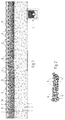
- a foundation layer 2 is provided above a filter mat 1 and is preferably frost-proof. Below this foundation layer 2, a drainage 3 is provided which is designed in a known manner.
- the surface of the foundation layer 2 is provided with a plane layer 4 made of broken material, e.g. an approximately 3-5 cm thick layer of gravel.
- the plane layer 4 carries a base layer 5, which can have a thickness of about 5 cm and which consists of loosely bound rubber granulate particles. Bitumen can preferably be used as the binder which holds the individual rubber granulate particles together.
- the individual rubber granulate particles 6 are not connected to one another over the full area and are also not cast in the bituminous binder, but are only connected to one another point by point. In any case, it is advantageous if less than half of the surface of the rubber granulate particles 6 are covered with binder. It is thereby achieved that the base layer 5 maintains the desired elastic properties, but is nevertheless completely water-permeable.
- the grain size of the rubber granulate particles 6 is between 0.5 and 15 mm, preferably between 1 and 7.0 mm.
- a textile floor covering 7 is applied to the surface of the base layer 5 and connected to the base layer 5 by gluing.
- the adhesive is not applied over the entire surface, but point by point, caterpillar-like, grid-like or meandering. Individual adhesive beads are designated 8 in FIG. 1. This also ensures that the adhesive layer is permeable to water.
- the textile floor covering 7 can have a knob-like surface structure, with rubber granules 10 with a grain size of approximately 0.5-1.5 mm without fine particles being sprinkled into the spaces between the knobs 9. This measure further improves the playing comfort.
- the base layer 5 is simple and inexpensive to manufacture, since, for example, ground waste tires can be used as rubber granulate particles.
Landscapes
- Engineering & Computer Science (AREA)
- Architecture (AREA)
- Civil Engineering (AREA)
- Structural Engineering (AREA)
- Road Paving Structures (AREA)
- Road Repair (AREA)
- Paints Or Removers (AREA)
- Floor Finish (AREA)
Abstract
Description
- Die vorliegende Erfindung bezieht sich auf einen Bodenbelag für Tennisplätze, insbesondere für unbedachte Aussenplätze, der über einer vorzugsweise frostsicheren Fundationsschicht und über einer darauf angeordneten Planieschicht aus gebrochenem Material wie Kies oder dgl. aufgebracht ist. Auch wenn der erfindungsgemässe Bodenbelag besonders gut für unbedachte Aussenplätze geeignet ist, kann er aber auch ohne weiteres in einer Halle oder bei bedachten Aussenplätzen Anwendung finden.
- Tennisplätze können bezüglich des Bodenbelags, der unter den Oberbegriff des Anspruchs 1 fällt, verschieden aufgebaut werden; bekannt sind u.a. Sandplätze, Hartplätze und Plätze mit textilem Bodenbelag.
- Sandplätze bieten unbestritten einen sehr guten Spielkomfort und sind in Hallen und im Freien anwendbar, sind jedoch bezüglich der Wartung und Pflege aufwendig. Hartplätze sind ebenfalls in Hallen und im Freien realisierbar, lassen aber bezüglich des Spielkomforts zu wünschen übrig, da die Fussgelenke des Tennisspielers hart beansprucht werden; dafür sind Pflege und Wartung nur mit einem minimalen Aufwand verbunden. Textile Tennisplatzbeläge verbinden die Vorteile der Sand- und Hartplätze in weitgehendem Mass, d.h. sie sind angenehm für den Spieler und benötigen wenig Pflege und Wartung; andererseits sind bisher nur Tennisplatz-Bodenbeläge mit textiler Oberfläche bekannt geworden, die sich vorzugsweise für den Gebrauch in einer gedeckten Halle eignen.
- Der Grund ist darin zu sehen, dass der textile Oberflächenbelag auf einer elastischen Tragschicht aufgebracht werden muss, die im allgemeinen aus Gummi besteht, um den Spielern den erwarteten Spielkomfort bieten zu können. Diese Gummitragschicht ist aber wasserundurchlässig mit der Folge, dass sich nach einem Regenschauer Pfützen auf dem Belag bilden, die erst durch Verdunstung wieder verschwinden. Dadurch dauert es geraume Zeit, bis ein derartiger Bodenbelag, nach einem Regenschauer, wieder bespielbar ist.
- Als bewährte Gummitragschicht hat sich ein Belag erwiesen, der vorzugsweise auf einer Planie-Schicht aus gebrochenem Material wie Kies oder dgl. aufgebracht wird und der aus Gummigranulat-Partikeln oder dgl. besteht, welche durch ein Bindemittel zusammengehalten sind. Der Nachteil dabei ist, dass die Granulat-Partikel im Bindemittel eingeschlossen sind, so dass die Gummitragschicht wasserundurchlässig wird. Ausserdem wurde der textile Oberflächenbelag bisher üblicherweise vollflächig mit der Gummigranulat-Tragschicht verklebt.
- Es ist die Aufgabe der vorliegenden Erfindung, einen Bodenbelag für Tennisplätze zu schaffen, der die Vorteile von Sandplätzen (hinsichtlich Spielkomfort) und Hartplätzen (hinsichtlich Wartungsarmut) in sich vereint und der problemlos auch auf unbedachten Tennisplätzen verwendet werden kann, die gelegentlich Regenschauern unterworfen sind, wobei erreicht werden soll, dass der Tennisplatz nach einem Regenschauer schnell abtrocknet und bald wieder bespielbar ist.
- Gemäss der Erfindung wird diese Aufgabe bei einem Bodenbelag für Tennisplätze der gattungsgemässen Art durch die Kombination der folgenden Merkmale gelöst:
- auf der Planieschicht ist eine wasserdurchlässige Tragschicht aufgebracht, welche lose gebundenen Gummigranulat-Partikeln oder dgl. aufweist;
- auf der Tragschicht ist ein wasserdurchlässiger textiler Belag aus einer synthetischen Faser mit inhomogener Oberflächenstruktur aufgebracht;
- der textile Belag ist über seine gesamte Flächenausdehnung an ausgewählten Stellen, aber nicht vollflächig, mit der Tragschicht verklebt.
- Dadurch ist erreicht, dass sich auf dem Bodenbelag ansammelndes Regenwasser durch die textile Schicht und die Gummitragschicht hindurch in die Planieschicht abfliessen kann, wo es einen Weg zur Drainage findet. Damit trocknet der Tennisplatz-Bodenbelag nach einem Regenschauer sehr schnell ab und der Platz ist rasch wieder für weiteres Spielen verfügbar.
- Als leicht verfügbares und billiges Bindemittel für die Gummigranulat-Partikel kann vorzugsweise Bitumen verwendet werden; ein Material, dass bezüglich seiner elastischen Eigenschaften sehr gut mit dem Gummi des Granulats harmoniert.
- Gemäss der Erfindung sind die Gummigranulat-Partikel lose miteinander verbunden, also vorzugsweise nicht vollflächig, sondern nur an einzelnen Punkten, um den ungehinderten Abfluss des darauf gelangenden Wassers zu gewährleisten. Dabei sollte darauf geachtet werden, dass nur ein Teil der Oberfläche der Gummigranulat-Partikel mit dem Bindemittel, z.B. Bitumen, beaufschlagt ist.
- In diesem Zusammenhang ist es auch vorteilhaft, den textilen Belag z.B. punktweise, raupenartig, mäanderartig oder rasterartig mit der Tragschicht zu verkleben, damit ein Durch- bzw. Abflussmöglichkeit für auf den textilen Oberflächenbelag gelangendes Wasser gegeben ist.
- Weiterbildungen und bevorzugte Ausführungsformen des Erfindungsgegenstandes gehen im übrigen aus den abhängigen Ansprüchen 2-8 hervor.
- Im folgenden wird ein Ausführungsbeispiel des erfindungsgemässen Bodenbelags unter Bezugnahme auf die beiliegenden Zeichnungen näher erläutert. In den Zeichnungen zeigen:
- Fig. 1
- einen (nicht maßstabsgetreuen) Teilquerschnitt durch den Bodenbelag samt Unterbau; und.
- Fig. 2
- einen vergrösserten Teilschnitt durch die wasserdurchlässige Tragschicht.
- Gemäss der Schnittdarstellung in Fig. 1 ist der Bodenbelag für Tennisplätze z.B. wie folgt aufgebaut:
- Über einer Filtermatte 1 ist eine Fundationsschicht 2 vorgesehen, die vorzugsweise frostsicher ausgebildet ist. Unterhalb dieser Fundationsschicht 2 ist eine in bekannter Weise ausgebildete Drainage 3 vorgesehen.
- Die Oberfläche der Fundationsschicht 2 ist mit einer Planie schicht 4 aus gebrochenem Material versehen, z.B. einer etwa 3-5 cm starken Kiesschicht. Die Planieschicht 4 trägt eine Tragschicht 5, die eine Dicke von etwa 5 cm besitzen kann und die aus lose gebundenen Gummigranulat-Partikeln besteht. Als Bindemittel, welches die einzelnen Gummigranulat-Partikel zusammenhält, kann vorzugsweise Bitumen eingesetzt werden.
- Aus der Fig. 2 ist ersichtlich, dass die einzelnen Gummigranulat-Partikel 6 nicht vollflächig miteinander verbunden sind und auch nicht im bituminösen Bindemittel eingegossen, sondern nur z.B. punktweise miteinander verbunden sind. Jedenfalls ist es vorteilhaft, wenn weniger als die Hälfte der Oberfläche der Gummigranulat-Partikel 6 mit Bindemittel bedeckt sind. Dadurch ist erreicht, dass die Tragschicht 5 die erwünschten, elastischen Eigenschaften beibehält, dennoch aber vollständig wasserdurchlässig ist. Die Korngrösse der Gummigranulat-Partikel 6 beträgt zwischen 0.5 und 15 mm, vorzugsweise zwischen 1 und 7.0 mm.
- Auf der Oberfläche der Tragschicht 5 ist ein textiler Bodenbelag 7 aufgebracht und mit der Tragschicht 5 durch Kleben verbunden. Die Verklebung erfolgt dabei nicht vollflächig, sondern punktweise, raupenartig, rasterartig oder mäanderartig. Einzelne Verklebungsraupen sind in Fig. 1 mit 8 bezeichnet. Auch damit ist erreicht, dass die Verklebungsschicht wasserdurchlässig ist.
- Der textile Bodenbelag 7 kann eine noppenartige Oberflächenstruktur aufweisen, wobei in die Zwischenräume zwischen den Noppen 9 ein Gummigranulat 10 mit einer Korngrösse von ca. 0.5-1.5 mm ohne Feinanteil eingestreut ist. Diese Massnahme verbessert den Spielkomfort weiter.
- Auf diese Weise lässt sich ein dem Regen ausgesetzter Aussenbelag für Tennisplätze realisieren, der rasch wieder abtrocknet, da das sich auf der Oberfläche ansammelnde Wasser durch den textilen Bodenbelag 7, durch die Klebstoffschicht 8 und durch die Tragschicht 5 schnell abfliessen kann. Die Tragschicht 5 ist einfach und billig in der Herstellung, da als Gummigranulat-Partikel z.B. gemahlene Altreifen verwendet werden können.
Claims (8)
- Bodenbelag für Tennisplätze, insbesondere für unbedachte Aussenplätze, der über einer vorzugsweise frostsicheren Fundationsschicht (2) und über einer darauf angeordneten Planieschicht (4) aus gebrochenem Material wie Kies oder dgl. aufgebracht ist, gekennzeichnet durch die Kombination folgender Merkmale- auf der Planieschicht (4) ist eine wasserdurchlässige Tragschicht (5) aufgebracht, welche lose gebundene Gummigranulat-Partikel (6) oder dgl. aufweist;- auf der Tragschicht (5) ist ein wasserdurchlässiger textiler Belag (7) aus einer synthetischen Faser mit inhomogener Oberflächenstruktur aufgebracht;- der textile Belag (7) ist über seine gesamte Flächenausdehnung an ausgewählten Stellen, aber nicht vollflächig, mit der Tragschicht (5) verklebt.wobei die Gummigranulat-Partikel (6) oder dgl. der Tragschicht (5) durch Bitumen miteinander verbunden sind.
- Bodenbelag nach Anspruch 1, dadurch gekennzeichnet, dass die Gummigranulat-Partikel (6) oder dgl. der Tragschicht (5) nicht vollflächig, sondern punktweise miteinander verbunden sind.
- Bodenbelag nach Anspruch 2, dadurch gekennzeichnet, dass das Bindemittel für die Gummigranulat-Partikel (6) nur an einem Teil der Oberfläche jedes einzelnen Gummigranulat-Partikels (6) haftet.
- Bodenbelag nach Anspruch 1, dadurch gekennzeichnet, dass die Tragschicht (5) eine Dicke von 2-8 cm, vorzugsweise 4-6 cm aufweist.
- Bodenbelag nach Anspruch 1, dadurch gekennzeichnet, dass die Korngrösse der Gummigranulat-Partikel (6) 0.5-15 mm, vorzugsweise 1.0-7.0 mm beträgt.
- Bodenbelag nach einem der vorhergehenden Ansprüche, dadurch gekennzeichnet, dass der textile Belag (7) punktweise mit der Tragschicht (5) verklebt ist.
- Bodenbelag nach einem der Ansprüche 1-5, dadurch gekennzeichnet, dass der textile Belag (7) raupen-, mäander- oder rasterartig mit der Tragschicht verklebt ist.
- Bodenbelag nach einem der vorhergehenden Ansprüche, dadurch gekennzeichnet, dass der textile Belag (7) mit einer Gummigranulat-Schicht (10) oder dgl. ohne Feinanteil mit einer Korngrösse von 0.8-1.5 mm bestreut ist.
Priority Applications (5)
| Application Number | Priority Date | Filing Date | Title |
|---|---|---|---|
| ES91810020T ES2056616T3 (es) | 1991-01-14 | 1991-01-14 | Pavimento para pistas de tenis. |
| DE59101869T DE59101869D1 (de) | 1991-01-14 | 1991-01-14 | Bodenbelag für Tennisplätze. |
| AT91810020T ATE106966T1 (de) | 1991-01-14 | 1991-01-14 | Bodenbelag für tennisplätze. |
| EP91810020A EP0495332B1 (de) | 1991-01-14 | 1991-01-14 | Bodenbelag für Tennisplätze |
| DK91810020.7T DK0495332T3 (da) | 1991-01-14 | 1991-01-14 | Overfladebelægning til tennisbaner |
Applications Claiming Priority (1)
| Application Number | Priority Date | Filing Date | Title |
|---|---|---|---|
| EP91810020A EP0495332B1 (de) | 1991-01-14 | 1991-01-14 | Bodenbelag für Tennisplätze |
Publications (2)
| Publication Number | Publication Date |
|---|---|
| EP0495332A1 true EP0495332A1 (de) | 1992-07-22 |
| EP0495332B1 EP0495332B1 (de) | 1994-06-08 |
Family
ID=8208809
Family Applications (1)
| Application Number | Title | Priority Date | Filing Date |
|---|---|---|---|
| EP91810020A Expired - Lifetime EP0495332B1 (de) | 1991-01-14 | 1991-01-14 | Bodenbelag für Tennisplätze |
Country Status (5)
| Country | Link |
|---|---|
| EP (1) | EP0495332B1 (de) |
| AT (1) | ATE106966T1 (de) |
| DE (1) | DE59101869D1 (de) |
| DK (1) | DK0495332T3 (de) |
| ES (1) | ES2056616T3 (de) |
Cited By (6)
| Publication number | Priority date | Publication date | Assignee | Title |
|---|---|---|---|---|
| DE4444030A1 (de) * | 1994-04-01 | 1995-10-05 | Ralph Schoepp | Bodenbelag insbesondere für Tennisplätze |
| FR2807078A1 (fr) | 2000-03-29 | 2001-10-05 | Envirosport | Revetement de sol sportif, notamment pour courts de tennis et autres jeux de balles |
| GB2396117A (en) * | 2002-12-14 | 2004-06-16 | Nottinghamshire Sports And Saf | A recreational playing surface |
| WO2004096734A3 (en) * | 2003-05-02 | 2005-01-20 | Sun Il Gwon | Puzzle type drain plate and method for quickly constructing lawn ground using the same |
| US7186450B2 (en) | 2003-04-03 | 2007-03-06 | Nottinghamshire Sports & Safety Systems Limited | Construction of playing surfaces |
| US7279212B2 (en) | 2003-04-03 | 2007-10-09 | Nottinghamshire Sports & Safety Systems Limited | Playing surface structure and method of construction of a playing surface |
Citations (5)
| Publication number | Priority date | Publication date | Assignee | Title |
|---|---|---|---|---|
| US2871774A (en) * | 1955-02-24 | 1959-02-03 | Us Rubber Reclaiming Co | Process of forming flooring surfaces with asphalt coated rubber pellets |
| DE1534411A1 (de) * | 1966-12-03 | 1969-06-19 | Verton & Wellensiek | Elastische Bodenbelagplatte |
| DE3129837A1 (de) * | 1981-07-15 | 1983-02-03 | Otto 4408 Dülmen Bager jun. | "sportbodenbelag" |
| EP0216953A2 (de) * | 1985-04-12 | 1987-04-08 | Jeschke & Hübner OHG | Tennisbodenbelag |
| WO1989009306A1 (en) * | 1988-03-29 | 1989-10-05 | Mitchell, James, Robert | Tracks for equestrian use |
-
1991
- 1991-01-14 EP EP91810020A patent/EP0495332B1/de not_active Expired - Lifetime
- 1991-01-14 AT AT91810020T patent/ATE106966T1/de not_active IP Right Cessation
- 1991-01-14 ES ES91810020T patent/ES2056616T3/es not_active Expired - Lifetime
- 1991-01-14 DE DE59101869T patent/DE59101869D1/de not_active Expired - Lifetime
- 1991-01-14 DK DK91810020.7T patent/DK0495332T3/da active
Patent Citations (5)
| Publication number | Priority date | Publication date | Assignee | Title |
|---|---|---|---|---|
| US2871774A (en) * | 1955-02-24 | 1959-02-03 | Us Rubber Reclaiming Co | Process of forming flooring surfaces with asphalt coated rubber pellets |
| DE1534411A1 (de) * | 1966-12-03 | 1969-06-19 | Verton & Wellensiek | Elastische Bodenbelagplatte |
| DE3129837A1 (de) * | 1981-07-15 | 1983-02-03 | Otto 4408 Dülmen Bager jun. | "sportbodenbelag" |
| EP0216953A2 (de) * | 1985-04-12 | 1987-04-08 | Jeschke & Hübner OHG | Tennisbodenbelag |
| WO1989009306A1 (en) * | 1988-03-29 | 1989-10-05 | Mitchell, James, Robert | Tracks for equestrian use |
Cited By (7)
| Publication number | Priority date | Publication date | Assignee | Title |
|---|---|---|---|---|
| DE4444030A1 (de) * | 1994-04-01 | 1995-10-05 | Ralph Schoepp | Bodenbelag insbesondere für Tennisplätze |
| FR2807078A1 (fr) | 2000-03-29 | 2001-10-05 | Envirosport | Revetement de sol sportif, notamment pour courts de tennis et autres jeux de balles |
| GB2396117A (en) * | 2002-12-14 | 2004-06-16 | Nottinghamshire Sports And Saf | A recreational playing surface |
| GB2396117B (en) * | 2002-12-14 | 2006-06-28 | Nottinghamshire Sports And Saf | Improvements relating to the construction of playing surfaces |
| US7186450B2 (en) | 2003-04-03 | 2007-03-06 | Nottinghamshire Sports & Safety Systems Limited | Construction of playing surfaces |
| US7279212B2 (en) | 2003-04-03 | 2007-10-09 | Nottinghamshire Sports & Safety Systems Limited | Playing surface structure and method of construction of a playing surface |
| WO2004096734A3 (en) * | 2003-05-02 | 2005-01-20 | Sun Il Gwon | Puzzle type drain plate and method for quickly constructing lawn ground using the same |
Also Published As
| Publication number | Publication date |
|---|---|
| DE59101869D1 (de) | 1994-07-14 |
| EP0495332B1 (de) | 1994-06-08 |
| ES2056616T3 (es) | 1994-10-01 |
| DK0495332T3 (da) | 1994-10-24 |
| ATE106966T1 (de) | 1994-06-15 |
Similar Documents
| Publication | Publication Date | Title |
|---|---|---|
| EP0015432B1 (de) | Bodenbelag für Sportplätze mit einem massiven Unterbau | |
| DE2652557C2 (de) | Mehrschichtiger Spielflächenbelag insbesondere für Tennisspiele | |
| EP1716291A1 (de) | Wasserdurchl ssiger bodenbelag und verfahren zur herstellung eines bodenbelags | |
| DE4416943C2 (de) | Aufbau einer Bewegungsfläche für Pferde, insbesondere für einen Reitplatz | |
| EP0064140A2 (de) | Bodenbelag für Freiflächen | |
| EP0504536A1 (de) | Beton-Formsteine | |
| DE102015117073A1 (de) | Formstein zur Verwendung in einem Flächenbelag und zugehöriger Flächenbelag | |
| EP0495332B1 (de) | Bodenbelag für Tennisplätze | |
| EP0425520B1 (de) | Feldgestaltung für sport oder ähnliches | |
| EP0140354B1 (de) | Bodenbelag für Tennisplätze u. dgl. | |
| CH601567A5 (en) | Surfacing for sports and playing field | |
| EP1939356B1 (de) | Belag für Wege, Spiel - und Sportflächen und Verfahren zur Herstellung eines solchen Belages | |
| EP0358209A2 (de) | Tennisplatzbelag | |
| DE2258566A1 (de) | Bodenbelag fuer tennisplaetze und dergleichen sportanlagen | |
| DE102010016570A1 (de) | Verlegeplatte | |
| DE1534394C3 (de) | Begehbarer Rasenplatz mit Entwässerung, insbesondere für Sportzwecke, sowie Verfahren zu seiner Herstellung | |
| DE19946947A1 (de) | Schichtaufbau und Verfahren zu dessen Herstellung | |
| DE4201758A1 (de) | Material fuer den unterbau von strassen u. dgl. | |
| DE8200994U1 (de) | Mattenartiges Bauelement zur Herstellung eines Bodenbelages | |
| DE1658467A1 (de) | Verfahren zur Regulierung und Verbesserung der physikalischen Eigenschaften einer Bodenflaeche und Bauelement zur Durchfuehrung des Verfahrens | |
| CA2035427C (en) | Floor covering for tennis courts | |
| DE202004001884U1 (de) | Wasserdurchlässiger Bodenbelag | |
| DE3129837C2 (de) | Tennisbodenbelag | |
| DE2549558A1 (de) | Vorrichtung zum be- und entwaessern von sport- und spielplaetzen aller art | |
| DE3335267A1 (de) | Bodenbelag fuer sportplaetze, insbesondere tennisplaetze |
Legal Events
| Date | Code | Title | Description |
|---|---|---|---|
| PUAI | Public reference made under article 153(3) epc to a published international application that has entered the european phase |
Free format text: ORIGINAL CODE: 0009012 |
|
| AK | Designated contracting states |
Kind code of ref document: A1 Designated state(s): AT BE CH DE DK ES FR GB GR IT LI LU NL SE |
|
| 17P | Request for examination filed |
Effective date: 19920805 |
|
| 17Q | First examination report despatched |
Effective date: 19930604 |
|
| RAP1 | Party data changed (applicant data changed or rights of an application transferred) |
Owner name: SETPOINT (INTERNATIONAL) AG |
|
| GRAA | (expected) grant |
Free format text: ORIGINAL CODE: 0009210 |
|
| AK | Designated contracting states |
Kind code of ref document: B1 Designated state(s): AT BE CH DE DK ES FR GB GR IT LI LU NL SE |
|
| PG25 | Lapsed in a contracting state [announced via postgrant information from national office to epo] |
Ref country code: GR Free format text: LAPSE BECAUSE OF FAILURE TO SUBMIT A TRANSLATION OF THE DESCRIPTION OR TO PAY THE FEE WITHIN THE PRESCRIBED TIME-LIMIT Effective date: 19940608 |
|
| REF | Corresponds to: |
Ref document number: 106966 Country of ref document: AT Date of ref document: 19940615 Kind code of ref document: T |
|
| ITF | It: translation for a ep patent filed | ||
| GBT | Gb: translation of ep patent filed (gb section 77(6)(a)/1977) |
Effective date: 19940613 |
|
| REF | Corresponds to: |
Ref document number: 59101869 Country of ref document: DE Date of ref document: 19940714 |
|
| ET | Fr: translation filed | ||
| REG | Reference to a national code |
Ref country code: ES Ref legal event code: FG2A Ref document number: 2056616 Country of ref document: ES Kind code of ref document: T3 |
|
| REG | Reference to a national code |
Ref country code: DK Ref legal event code: T3 |
|
| EAL | Se: european patent in force in sweden |
Ref document number: 91810020.7 |
|
| PLBE | No opposition filed within time limit |
Free format text: ORIGINAL CODE: 0009261 |
|
| 26N | No opposition filed | ||
| REG | Reference to a national code |
Ref country code: GB Ref legal event code: IF02 |
|
| PG25 | Lapsed in a contracting state [announced via postgrant information from national office to epo] |
Ref country code: IT Free format text: LAPSE BECAUSE OF NON-PAYMENT OF DUE FEES;WARNING: LAPSES OF ITALIAN PATENTS WITH EFFECTIVE DATE BEFORE 2007 MAY HAVE OCCURRED AT ANY TIME BEFORE 2007. THE CORRECT EFFECTIVE DATE MAY BE DIFFERENT FROM THE ONE RECORDED. Effective date: 20050114 |
|
| PGFP | Annual fee paid to national office [announced via postgrant information from national office to epo] |
Ref country code: DK Payment date: 20080212 Year of fee payment: 18 |
|
| PGRI | Patent reinstated in contracting state [announced from national office to epo] |
Ref country code: IT Effective date: 20080301 |
|
| PGFP | Annual fee paid to national office [announced via postgrant information from national office to epo] |
Ref country code: NL Payment date: 20080214 Year of fee payment: 18 Ref country code: IT Payment date: 20080218 Year of fee payment: 18 Ref country code: SE Payment date: 20080218 Year of fee payment: 18 Ref country code: LU Payment date: 20080221 Year of fee payment: 18 |
|
| PGFP | Annual fee paid to national office [announced via postgrant information from national office to epo] |
Ref country code: AT Payment date: 20080207 Year of fee payment: 18 |
|
| EUG | Se: european patent has lapsed | ||
| NLV4 | Nl: lapsed or anulled due to non-payment of the annual fee |
Effective date: 20090801 |
|
| REG | Reference to a national code |
Ref country code: DK Ref legal event code: EBP |
|
| PG25 | Lapsed in a contracting state [announced via postgrant information from national office to epo] |
Ref country code: AT Free format text: LAPSE BECAUSE OF NON-PAYMENT OF DUE FEES Effective date: 20090114 |
|
| PG25 | Lapsed in a contracting state [announced via postgrant information from national office to epo] |
Ref country code: NL Free format text: LAPSE BECAUSE OF NON-PAYMENT OF DUE FEES Effective date: 20090801 |
|
| PGFP | Annual fee paid to national office [announced via postgrant information from national office to epo] |
Ref country code: ES Payment date: 20100125 Year of fee payment: 20 Ref country code: CH Payment date: 20100125 Year of fee payment: 20 |
|
| PGFP | Annual fee paid to national office [announced via postgrant information from national office to epo] |
Ref country code: FR Payment date: 20100223 Year of fee payment: 20 |
|
| PGFP | Annual fee paid to national office [announced via postgrant information from national office to epo] |
Ref country code: GB Payment date: 20100121 Year of fee payment: 20 Ref country code: DE Payment date: 20100121 Year of fee payment: 20 |
|
| PG25 | Lapsed in a contracting state [announced via postgrant information from national office to epo] |
Ref country code: DK Free format text: LAPSE BECAUSE OF NON-PAYMENT OF DUE FEES Effective date: 20090731 |
|
| PGFP | Annual fee paid to national office [announced via postgrant information from national office to epo] |
Ref country code: BE Payment date: 20100315 Year of fee payment: 20 |
|
| BE20 | Be: patent expired |
Owner name: *SETPOINT (INTERNATIONAL) A.G. Effective date: 20110114 |
|
| REG | Reference to a national code |
Ref country code: CH Ref legal event code: PL |
|
| REG | Reference to a national code |
Ref country code: GB Ref legal event code: PE20 Expiry date: 20110113 |
|
| PG25 | Lapsed in a contracting state [announced via postgrant information from national office to epo] |
Ref country code: IT Free format text: LAPSE BECAUSE OF NON-PAYMENT OF DUE FEES Effective date: 20090114 |
|
| PG25 | Lapsed in a contracting state [announced via postgrant information from national office to epo] |
Ref country code: LU Free format text: LAPSE BECAUSE OF NON-PAYMENT OF DUE FEES Effective date: 20090114 |
|
| PG25 | Lapsed in a contracting state [announced via postgrant information from national office to epo] |
Ref country code: SE Free format text: LAPSE BECAUSE OF NON-PAYMENT OF DUE FEES Effective date: 20090115 |
|
| REG | Reference to a national code |
Ref country code: ES Ref legal event code: FD2A Effective date: 20110615 |
|
| PG25 | Lapsed in a contracting state [announced via postgrant information from national office to epo] |
Ref country code: ES Free format text: LAPSE BECAUSE OF EXPIRATION OF PROTECTION Effective date: 20110115 Ref country code: GB Free format text: LAPSE BECAUSE OF EXPIRATION OF PROTECTION Effective date: 20110113 |
|
| PG25 | Lapsed in a contracting state [announced via postgrant information from national office to epo] |
Ref country code: DE Free format text: LAPSE BECAUSE OF EXPIRATION OF PROTECTION Effective date: 20110114 |