EP0495622A2 - Indexation d'ensembles de données - Google Patents
Indexation d'ensembles de données Download PDFInfo
- Publication number
- EP0495622A2 EP0495622A2 EP19920300302 EP92300302A EP0495622A2 EP 0495622 A2 EP0495622 A2 EP 0495622A2 EP 19920300302 EP19920300302 EP 19920300302 EP 92300302 A EP92300302 A EP 92300302A EP 0495622 A2 EP0495622 A2 EP 0495622A2
- Authority
- EP
- European Patent Office
- Prior art keywords
- records
- data
- environment
- episode
- document
- Prior art date
- Legal status (The legal status is an assumption and is not a legal conclusion. Google has not performed a legal analysis and makes no representation as to the accuracy of the status listed.)
- Withdrawn
Links
Images


Classifications
-
- G—PHYSICS
- G06—COMPUTING OR CALCULATING; COUNTING
- G06F—ELECTRIC DIGITAL DATA PROCESSING
- G06F16/00—Information retrieval; Database structures therefor; File system structures therefor
- G06F16/40—Information retrieval; Database structures therefor; File system structures therefor of multimedia data, e.g. slideshows comprising image and additional audio data
- G06F16/48—Retrieval characterised by using metadata, e.g. metadata not derived from the content or metadata generated manually
- G06F16/489—Retrieval characterised by using metadata, e.g. metadata not derived from the content or metadata generated manually using time information
-
- H—ELECTRICITY
- H04—ELECTRIC COMMUNICATION TECHNIQUE
- H04N—PICTORIAL COMMUNICATION, e.g. TELEVISION
- H04N1/00—Scanning, transmission or reproduction of documents or the like, e.g. facsimile transmission; Details thereof
- H04N1/04—Scanning arrangements, i.e. arrangements for the displacement of active reading or reproducing elements relative to the original or reproducing medium, or vice versa
- H04N1/19—Scanning arrangements, i.e. arrangements for the displacement of active reading or reproducing elements relative to the original or reproducing medium, or vice versa using multi-element arrays
- H04N1/195—Scanning arrangements, i.e. arrangements for the displacement of active reading or reproducing elements relative to the original or reproducing medium, or vice versa using multi-element arrays the array comprising a two-dimensional [2D] array
- H04N1/19594—Scanning arrangements, i.e. arrangements for the displacement of active reading or reproducing elements relative to the original or reproducing medium, or vice versa using multi-element arrays the array comprising a two-dimensional [2D] array using a television camera or a still video camera
-
- G—PHYSICS
- G06—COMPUTING OR CALCULATING; COUNTING
- G06F—ELECTRIC DIGITAL DATA PROCESSING
- G06F16/00—Information retrieval; Database structures therefor; File system structures therefor
- G06F16/20—Information retrieval; Database structures therefor; File system structures therefor of structured data, e.g. relational data
- G06F16/28—Databases characterised by their database models, e.g. relational or object models
- G06F16/284—Relational databases
-
- G—PHYSICS
- G06—COMPUTING OR CALCULATING; COUNTING
- G06F—ELECTRIC DIGITAL DATA PROCESSING
- G06F16/00—Information retrieval; Database structures therefor; File system structures therefor
- G06F16/40—Information retrieval; Database structures therefor; File system structures therefor of multimedia data, e.g. slideshows comprising image and additional audio data
-
- G—PHYSICS
- G06—COMPUTING OR CALCULATING; COUNTING
- G06F—ELECTRIC DIGITAL DATA PROCESSING
- G06F3/00—Input arrangements for transferring data to be processed into a form capable of being handled by the computer; Output arrangements for transferring data from processing unit to output unit, e.g. interface arrangements
- G06F3/01—Input arrangements or combined input and output arrangements for interaction between user and computer
- G06F3/03—Arrangements for converting the position or the displacement of a member into a coded form
- G06F3/033—Pointing devices displaced or positioned by the user, e.g. mice, trackballs, pens or joysticks; Accessories therefor
-
- H—ELECTRICITY
- H04—ELECTRIC COMMUNICATION TECHNIQUE
- H04N—PICTORIAL COMMUNICATION, e.g. TELEVISION
- H04N1/00—Scanning, transmission or reproduction of documents or the like, e.g. facsimile transmission; Details thereof
- H04N1/04—Scanning arrangements, i.e. arrangements for the displacement of active reading or reproducing elements relative to the original or reproducing medium, or vice versa
- H04N1/19—Scanning arrangements, i.e. arrangements for the displacement of active reading or reproducing elements relative to the original or reproducing medium, or vice versa using multi-element arrays
- H04N1/195—Scanning arrangements, i.e. arrangements for the displacement of active reading or reproducing elements relative to the original or reproducing medium, or vice versa using multi-element arrays the array comprising a two-dimensional [2D] array
-
- H—ELECTRICITY
- H04—ELECTRIC COMMUNICATION TECHNIQUE
- H04N—PICTORIAL COMMUNICATION, e.g. TELEVISION
- H04N1/00—Scanning, transmission or reproduction of documents or the like, e.g. facsimile transmission; Details thereof
- H04N1/32—Circuits or arrangements for control or supervision between transmitter and receiver or between image input and image output device, e.g. between a still-image camera and its memory or between a still-image camera and a printer device
- H04N1/32101—Display, printing, storage or transmission of additional information, e.g. ID code, date and time or title
-
- H—ELECTRICITY
- H04—ELECTRIC COMMUNICATION TECHNIQUE
- H04N—PICTORIAL COMMUNICATION, e.g. TELEVISION
- H04N2201/00—Indexing scheme relating to scanning, transmission or reproduction of documents or the like, and to details thereof
- H04N2201/04—Scanning arrangements
- H04N2201/0402—Arrangements not specific to a particular one of the scanning methods covered by groups H04N1/04 - H04N1/207
- H04N2201/0436—Scanning a picture-bearing surface lying face up on a support
-
- H—ELECTRICITY
- H04—ELECTRIC COMMUNICATION TECHNIQUE
- H04N—PICTORIAL COMMUNICATION, e.g. TELEVISION
- H04N2201/00—Indexing scheme relating to scanning, transmission or reproduction of documents or the like, and to details thereof
- H04N2201/32—Circuits or arrangements for control or supervision between transmitter and receiver or between image input and image output device, e.g. between a still-image camera and its memory or between a still-image camera and a printer device
- H04N2201/3201—Display, printing, storage or transmission of additional information, e.g. ID code, date and time or title
- H04N2201/3212—Display, printing, storage or transmission of additional information, e.g. ID code, date and time or title of data relating to a job, e.g. communication, capture or filing of an image
- H04N2201/3215—Display, printing, storage or transmission of additional information, e.g. ID code, date and time or title of data relating to a job, e.g. communication, capture or filing of an image of a time or duration
-
- H—ELECTRICITY
- H04—ELECTRIC COMMUNICATION TECHNIQUE
- H04N—PICTORIAL COMMUNICATION, e.g. TELEVISION
- H04N2201/00—Indexing scheme relating to scanning, transmission or reproduction of documents or the like, and to details thereof
- H04N2201/32—Circuits or arrangements for control or supervision between transmitter and receiver or between image input and image output device, e.g. between a still-image camera and its memory or between a still-image camera and a printer device
- H04N2201/3201—Display, printing, storage or transmission of additional information, e.g. ID code, date and time or title
- H04N2201/3225—Display, printing, storage or transmission of additional information, e.g. ID code, date and time or title of data relating to an image, a page or a document
-
- H—ELECTRICITY
- H04—ELECTRIC COMMUNICATION TECHNIQUE
- H04N—PICTORIAL COMMUNICATION, e.g. TELEVISION
- H04N2201/00—Indexing scheme relating to scanning, transmission or reproduction of documents or the like, and to details thereof
- H04N2201/32—Circuits or arrangements for control or supervision between transmitter and receiver or between image input and image output device, e.g. between a still-image camera and its memory or between a still-image camera and a printer device
- H04N2201/3201—Display, printing, storage or transmission of additional information, e.g. ID code, date and time or title
- H04N2201/3225—Display, printing, storage or transmission of additional information, e.g. ID code, date and time or title of data relating to an image, a page or a document
- H04N2201/3242—Display, printing, storage or transmission of additional information, e.g. ID code, date and time or title of data relating to an image, a page or a document of processing required or performed, e.g. for reproduction or before recording
Definitions
- This invention relates to the activity-based indexing of data sets, in order to facilitate the fast retrieval at a later date of data of interest.
- the invention is based on there being at least one set of data defining activity.
- the retrieval process involves identifying an index point in a data set. Where there are multiple data sets, having index points in one of them facilitates access to the other set to reach the data in it at the point in time, or period, contemporaneous with the identified index point.
- the invention focuses upon improving access to information that humans find particularly difficult to retrieve. It exploits a suggested autobiographical model of human memory which observes that humans seem to organise their memory in episodes. Associated with each episode are the properties: Where? When? With whom? and, In pursuit of what goal? an episode occurred. Humans seem able to recall these key properties of an episode long after the details of the episode itself have been forgotten.
- the present invention is concerned with building a system that enables retrieval of episodes that would otherwise be difficult or impossible to retrieve, including matters for which records are not normally kept. This system has been called a 'Human memory prosthesis'.
- the present invention relies on a variety of apparatuses for monitoring, recording and time-stamping various key aspects of human activity, from which a readable list of episodes, or 'activity diary', can be generated automatically.
- This diary which correlates quite closely with human recollections of past episodes, can be used simply to stimulate further recall, or to identify an episode and its time of occurrence, or to show a set of episodes from different sets.
- the times may be used to locate the corresponding items in any other set of time-stamped data, such as a sequence of video frames or an audio record of a meeting.
- an 'episode' is defined as - a period of time containing a memorable sequence of events -. By dividing a long series of events into such episodes, sequences are formed that are particularly memorable. Episodes have flags associated with them that characterise them and can be used for retrieval.
- the aforementioned system has several practical limitations. These include the need on the part of the user to devote a lot of effort to identifying a particular time and place from the raw identity button data, and the lack of precise episode definition from such data. Also the system captures just the location of users, and not their activity or other significant episodes. These drawbacks would make the system of relatively little practical value.
- the present invention is based on devising pattern-matching techniques for constructing recognisable episodes from raw data. In this way it offers the user the means to arrive quickly at a particular point in one dataset, possibly in order to be able to obtain access more efficiently and quickly into at least one other dataset. This speed of access is one of the essential requirements in making the technique of practical value.
- the invention also takes into account situations where there may be relatively infrequent change of location by users, i.e. where location data would be of little use in identifying episodes with precision. In these situations, other forms of activity are likely to provide a more effective means of episode identification.
- the invention therefore presents means of instrumenting these activities and analysing the raw data, thus constructing recognisable episodes from these multiple sources of activity data.
- the invention also observes that retrieval often involves correlating activities of several different kinds, and therefore provides means for doing so.
- the data-retrieval system of this invention is intended to operate on activity-based data from a choice of sources.
- the data may be fed directly to a memory 4, prior to processing by the episode recogniser 6, or the recogniser might operate on raw data and store the processed data in a memory 8. Because the information to be retrieved is not known at the time of data capture, it is necessary to be able to specify the appropriate characteristics of the data to be retrieved by means of a query station 10, having a keyboard 12 which the user can use to alter the parameters of the recogniser 6 so that the raw data are processed into episodes having predetermined characteristics.
- the output of the recogniser 6 is fed into a diary composer 14 that is adapted to process the episode data fed to it and produce output data in the form of diary information which is fed to a driver 16.
- a driver is shown as operating a printer 18, a visual display unit 20 and a loudspeaker or other audio device 22, only one or none of these devices may be used in any specific embodiment, but there should always be at least one output device able to present the data or information to the user, and to enable him to identify a portion of the data which he associates with a particular episode he is trying to recall, so that the time-stamp of that episode then can be used to access video or audio recordings of the environment in which he was interested at the time of the episode in question.
- That apparatus shown in Fig. 2 uses two different sources 2 of raw of input data with two appropriately configured episode recognisers 6.
- Each episode recogniser feeds its output to a compound episode recogniser 24, of which the episode-recognition parameters are set by a query device 10, with the queries being passed as necessary upstream to each episode recogniser 6 feeding its output to the compound recogniser 24.
- This involvement of the individual recognisers with the compound recogniser is necessary in order to enable the latter to sort data into compound episodes involving data of two different types combined in a way specified by the query station 10.
- the compound recogniser 24 feeds its output to diary composer 14 and an output device driver 16 connected to selected output devices (not shown).
- the diary composer 3 is application-dependent, whereas the episode recogniser 2 is data-dependent.
- the compound recogniser accepts both simple queries, as in the Fig. 1 system, as well as compound queries specifying relationships between episodes from different sources.
- identifiers each intended to be carried by people working in the environment being monitored.
- One particularly-convenient form of identifier is the "active badge" offered by Olivetti .
- This identifier takes the form of miniaturised circuitry in a housing able to be pinned or clipped to the clothing of the person to whom the identifier is issued.
- the circuitry is designed to emit pulse width modulated infra-red coded signals for a tenth of a second every 12 to 15 seconds.
- the signals by their nature, have a range of about six metres, and will not travel through walls, which makes them very useful for keeping track of people moving between rooms in a normal working environment.
- each of the rooms or corridors of interest (which would normally exclude toilets, lifts and like utility spaces) would be positioned one or more sensors responsive to the infra-red output signals.
- the sensors would be connected to a master station processor, which would have the task of polling the sensors for identification 'sightings'; processing the data (which would include decoding the signals to determine which person was within range of a specific sensor at the time of polling), and presenting the processed data in a visual format.
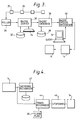
- the badge system shown in Fig. 3 uses a network of sensors 26 of which there is at least one in each zone of the building or other environment being monitored. In large rooms, the effective range of the badges might necessitate there being several sensors uniformly distributed over the room, as by being mounted from the ceiling, to ensure that each occupant who is carrying a badge is in range of at least one sensor, so that the room has no 'blind spots'.
- the sensors 26 are connected to a polling device 28 which sends pulses to the sensors at chosen intervals, and receives from the sensors encoded signals indicating the badges within range of each sensor at the time of polling.
- the poller 28 supplies this badge information to a badge server 30 having its own data memory 32.
- the badge server 30 supplies its signals to a badge database 36, having a data memory 38, so that the badge signals are decoded and the identity of the person allocated a badge becomes part of the badge signal.
- the badge server 30 accepts the poller data and maps sensor signals into people and locations using its own database 32, and maps the detection of a particular person in a particular location at a specific time into arrival and departure events.
- the database 36 stores badge event data if appropriate.
- a badge episode recogniser 40 operates on the output from the database 36 to characterise the badge signals into three types of episodes: gatherings; periods alone, and travel between or away from monitored locations. Similarly to what has been already described, the recogniser 40 has its output signals treated by diary composer 14 and driver 16.
- the sub-system of Fig. 4 details the way in which the badge event signals may be processed.
- the first stage of the badge episode recogniser 40 of Fig. 3 is a gathering recogniser 42, which receives badge event signals, and uses an event to keep a record of who is at each location, and notes the formation and dispersion of "gatherings". This term is a convenient one to use, as signifying an episode worthy of being recorded.
- a working definition of a "gathering" is that it is regarded as an - occasion which has started when two or more people are present concurrently at a specified location, for more than a specified minimum period, and at least one of the participants is not resident at that location -.
- the gatherings data are stored for use by a travel organiser 44, which receives badge events and supplies signals to a stopover list 46; the stopovers including locations where more than a minimum period was spent, locations at the terminus of a round trip of more than a minimum distance, and the locations of gatherings.
- Data from a floor-plan store 48 are used to recognise "round trips", by which term is meant - when a person being monitored leaves his office and moves around the environment before returning to it -.
- the stopover list 46 incorporates details of gatherings that are fed to the diary composer 14.
- the diary composer 14 operates as illustrated in Fig- 5.
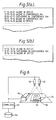
- the raw data showing a small part of the movements of one individual shown in Fig. 5 (a). This relatively-raw data would lead to an unnecessarily-long diary or event log.
- the diary composer 14 operates on this information to combine sequences of consecutive episodes that match specific patterns.
- the periods when he is alone in the conference room are treated as being part of the general gathering in that room, thus leading to the simplification shown in Fig. 5 (b).
- Fig. 6 shows the system which exploits scanning and image-processing technology to read the contents of documents on the desk surface: the user is then able to interact with these contents using a pointer such as a tablet and stylus.
- a pointer such as a tablet and stylus.
- a wide range of interaction techniques may be used, including menu selection and dialogue boxes, graphical selection and hand printed character recognition.
- the user is also free simply to write ondocuments with a pen or with an ink pen in the stylus.
- Particular tasks for which the system could be effective include: selecting key words for document filing; performing calculations on numeric data; translating foreign words, looking up technical terms in dictionaries, checking and filling in forms, retrieving other documents or information that cannot be printed, e.g. audio or video.
- the invention could therefore give desk workers and people attending meetings access to functions that are currently available only via work stations.
- the apparatus shown in Fig. 6 includes a video camera 50 and a video projector 52 mounted above a desk 54 at which the user sits, a data tablet 56 with a stylus 58, a high-resolution scanner 60, and a control computer 62 with its data store or memory 64 for images.
- the camera 50 is mounted so that it field of view includes the document on the desk 54 in front of the user.
- the video signal is digitised using a frame store, creating a bit map image of the document.
- Digital filtering techniques are applied to the image, first to determine size and rotation, and then to classify the document according to properties such as line spacing, line-length distribution, etc.
- Application of these techniques provides (a) a compact resolution-independent encoding of the images properties for use as a descriptor, and (b) orientation and position information.
- the data tablet 56 and stylus 58 permit the user to select items such as words or columns of numbers. When the user makes a selection as by pressing down on the tablet surface, the coordinates of the stylus 58 are transformed, using the inverse of the rotation and position information, to determine the selection in the coordinates of the page.
- the document can be scanned in at high resolution. This operation is done via the sanner 60, and it could be performed on the entire contents of the user's in-tray before a work session, or on an entire set of meeting papers before a meeting starts.
- the some digital filtering techniques as before are applied to the high-resolution page image to construct a descriptor and to correct for rotation.
- Optical character recognition (OCR) is applied to extract the text of the document. This text is stored for later use, indexed by the document descriptor. The page coordinates of each text item are included with the stored text.
- the memory 64 contains layout information for each document page entered into the system, indexed by descriptor.
- the user need not apply high-resolution scanning or OCR to a document page that is already stored.
- the existence of a stored version can be determined.
- Layout information describing computer-generated documents can be written directly to the memory 64, and descriptors generated, without recourse to scanning or OCR.
- the descriptor of each page of a multi-page document, or of each single document is non-unique, but is designed to ensure that descriptors are rarely duplicated.
- Descriptors for pairs of document images may be compared using a correlator to determine if the two images are of the same document.
- the corrected coordinates are used to identify the text item in the stored version.
- the appropriate function (translation, indexing, etc.) can then be applied to the item.
- the system can also supply hand-printing recognition to the stylus input, or record changes to the scanned image resulting from conventional handwriting.
- Fig. 7a Results of translations (Fig. 7a) or calculations (Fig. 7b) would normally be shown alongside the text. If space permits (and the system can determine this) the results could be displayed directly above the selected item.
- the video projector 52 also displays menus and dialogue boxes (see Fig. 7c) for interactive control.
- the system can detect the change in the video-scanned image and then recompute the image's descriptor. It searches for a matching descriptor in its file of documents. Thus if it finds a match, it retrieves the document. If, on the other hand, no match is found, it signals to the user to feed the document into the scanner 60.
- This embodiment of the invention can be compared either with workstation-based interaction or with traditional paper-based work practice.
- workstation-based interaction it has the advantage that it can deal with any incoming paper document, or print-out of an electronic document.
- Compared with paper-based methods it has the advantage of providing access to a number of computer-based functions and services. It has particular advantages in meeting rooms, where use of paper documents is a firmly-trenched practice.
- the "audit trail" left by the system provides a source of data about the user's interaction with paper documents. These data can be used to construt episodes in which paper documents are identified either by selected key words or by optically-read contents.
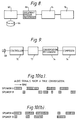
- the subsystem shown in Fig. 8 uses the data from the computer 62 and armory 64 of the Fig. 6 embodiment.
- the computer feeds raw document events to a document episode recogniser 66, the events including descriptors, commands and selected data.
- the recogniser builds episodes from consecutive events applied to the same document; episode descriptions include time-stamp, descriptor and type of episode (including reading, editing, filing, calculating).
- the diary composer 14 takes episodes describing individual document pages and builds episodes describing activity on multi-page documents and on folders of documents.
- Fig 9 showns a sub-system having the ability to detect conversations between people, without necessarily recording their voices, so as to provide a much more accurate indicator of group activity. Users typically remember conversations better than they remember other participants presence so the ability to detect that the conversation took place is likely to be useful for retrieval.
- a microphone 68 is carried by a user, and the level of the audio signal produced by the microphone is monitored by means of a circuit of the type used in cassette recorders.
- the circuit controller 70 transmits a signal whenever the energy level of the audio signal exceeds a threshold representing the wearer's minimum voice level.
- Fig. 10 (a) shows the audiostreams generated by participants in a typical conversation
- Fig. 10 (b) shows, in contrast, the audiostreams of two people engaged in conversations with others or in dictating, etc.
- Each composite signal can be divided into periods of silence, non-overlapping speech, and overlapping speech. In true conversation between two people, overlap would tend to represent less than 10 percent of all non-silence, while in random collections of speakers, the proportion will be considerably higher, at least 25 percent.
- an alternative method of capturing the conversation data is by radio telephony. Audio signals from users' microphones are collected at the central location, their energy levels are measured, and the conversation-detection analysis carried out. This is a more-expensive approach that offers increased bandwidth, but it may encounter channel limitations.
- the diary composer 14 reduces the list of episodes by excluding short episodes, and by linking conversations between identical groups.
- Fig. 11 shows a sub-system that builds a log of incoming and outgoing telephone calls that includes the names of respondents.
- the proposed device could be attached to a user's telephone and would be capable of building a text database, each record indicating the time and duration of a call, and both the caller's and the recipient's names, with one of the names being generated by a speech-recognition system.
- the system shown in Fig. 11 uses input from a telephone 76 from which signals are picked off and fed to a speech recogniser 78 that has its output routed to a telephone call episode recogniser 80, with its output, in turn, going to the now-usual composer 14. Output from the composer 14 builds the log, of which a typical set of entries is shown at 84.
- This aspect of the invention relies on recognising names spoken by the user in responding to incoming calls and in making outgoing calls.
- the speech recogniser 78 On making outgoing calls the speech recogniser 78, which is monitoring the audio signal continuously, will recognise an utterance of the form "Patrick Johnson please” or “Could I speak to Patrick", etc. As long as the person being called has corresponding voice identification data entered in a database 82, the utterance by the caller of the spoken name produces the audio signals which are fed to recogniser 80. The recogniser 80 generates the recipient's name as a text string. On receiving incoming calls, the speech recogniser 80 further responds to a recipient's utterance of the form "Hello Patrick" or "Hello Mr Johnson” and generates the caller's name as a text string. This recogniser generated data is stored, so it may be used for subsequent manual confirmation by the user.
- the diary composer 14 may combine consecutive calls to the same person, and ignore wrong numbers and interception by switchboards, etc. If the caller is not known to the user, or if the user calls somebody whose data is not in database 82, the system cannot supply the identification data. There is also the possibility that, in the case of an incoming call, the recipient may not respond, such as when speaking to callers who are relatively strange to him, in the way for which the recogniser 80 is programmed. This variation in response, or indeed any utterance in which the confidence of recognition is low, can be used to mark the caller as unknown in the log entry.
- a workstation activity episode recogniser 86 has a data memory 88.
- the recogniser has various forms of input from a workstation, as shown in the drawing.
- One input might relate to file activity, another to processor focus, and a third to program input focus.
- These inputs are from daemons or watchdog processes. These monitor activity such as: the creation, reading, modifying or deleting of files; the name of a program consuming processor resource in a given period, or changes in program input focus (in a window-based user interface).
- the recogniser 86 translates sequences of activity into user-recognisable episodes.
- the recogniser 86 applies pattern-matching to recognise common tasks , i.e. "change input focus to editor ⁇ change processor focus to editor ⁇ read file ⁇ write file ⁇ write file ⁇ change input focus", would be recognised as being the steps involved in editing a document.
- the composer 14 combines similar episodes and removes insignificant episodes.
- a query will specify an episode or episodes of interest, including a pattern of episodes, using key words and descriptions appropriate to the recogniser, for example:
Landscapes
- Engineering & Computer Science (AREA)
- Theoretical Computer Science (AREA)
- General Engineering & Computer Science (AREA)
- Databases & Information Systems (AREA)
- Physics & Mathematics (AREA)
- General Physics & Mathematics (AREA)
- Data Mining & Analysis (AREA)
- Multimedia (AREA)
- Signal Processing (AREA)
- Human Computer Interaction (AREA)
- Library & Information Science (AREA)
- Processing Or Creating Images (AREA)
- Information Retrieval, Db Structures And Fs Structures Therefor (AREA)
- Information Transfer Between Computers (AREA)
Applications Claiming Priority (2)
| Application Number | Priority Date | Filing Date | Title |
|---|---|---|---|
| GB9100733 | 1991-01-14 | ||
| GB919100733A GB9100733D0 (en) | 1991-01-14 | 1991-01-14 | Indexing of data sets |
Related Child Applications (1)
| Application Number | Title | Priority Date | Filing Date |
|---|---|---|---|
| EP93202218.9 Division-Into | 1992-01-14 |
Publications (2)
| Publication Number | Publication Date |
|---|---|
| EP0495622A2 true EP0495622A2 (fr) | 1992-07-22 |
| EP0495622A3 EP0495622A3 (en) | 1993-10-06 |
Family
ID=10688394
Family Applications (2)
| Application Number | Title | Priority Date | Filing Date |
|---|---|---|---|
| EP19930202218 Withdrawn EP0568161A1 (fr) | 1991-01-14 | 1992-01-14 | Système d'ordinateur de table interactif |
| EP19920300302 Withdrawn EP0495622A3 (en) | 1991-01-14 | 1992-01-14 | Indexing of data sets |
Family Applications Before (1)
| Application Number | Title | Priority Date | Filing Date |
|---|---|---|---|
| EP19930202218 Withdrawn EP0568161A1 (fr) | 1991-01-14 | 1992-01-14 | Système d'ordinateur de table interactif |
Country Status (3)
| Country | Link |
|---|---|
| EP (2) | EP0568161A1 (fr) |
| JP (1) | JPH06110755A (fr) |
| GB (1) | GB9100733D0 (fr) |
Cited By (26)
| Publication number | Priority date | Publication date | Assignee | Title |
|---|---|---|---|---|
| EP0660249A1 (fr) * | 1993-12-27 | 1995-06-28 | AT&T Corp. | Système d'indexation de tables des matières |
| EP0637807A3 (fr) * | 1993-07-26 | 1995-08-16 | Rank Xerox Ltd | Enregistrement et recouvrement d'informations en rapport aux activités d'un utilisateur. |
| US5511148A (en) * | 1993-04-30 | 1996-04-23 | Xerox Corporation | Interactive copying system |
| EP0710922A3 (fr) * | 1994-11-01 | 1996-05-29 | Rank Xerox Ltd | |
| EP0626636A3 (fr) * | 1993-03-16 | 1996-10-02 | Hitachi Ltd | Interface utilisateur pour un système de traitement d'information. |
| EP0752675A1 (fr) * | 1995-07-07 | 1997-01-08 | Sun Microsystems, Inc. | Méthode et dispositif de marquage d'événements dans des fichiers de données dans un système informatique |
| US6005547A (en) * | 1995-10-14 | 1999-12-21 | Xerox Corporation | Calibration of an interactive desktop system |
| WO2000021000A1 (fr) * | 1998-10-07 | 2000-04-13 | Promontory Software Technology | Systeme de gestion des donnees |
| US6067112A (en) * | 1996-07-12 | 2000-05-23 | Xerox Corporation | Interactive desktop display system for automatically adjusting pan and zoom functions in response to user adjustment of a feedback image |
| US6072907A (en) * | 1997-05-28 | 2000-06-06 | Xerox Corporation | Method and apparatus for enhancing and thresholding images |
| US6178270B1 (en) | 1997-05-28 | 2001-01-23 | Xerox Corporation | Method and apparatus for selecting text and image data from video images |
| US6330976B1 (en) | 1998-04-01 | 2001-12-18 | Xerox Corporation | Marking medium area with encoded identifier for producing action through network |
| WO2002050729A1 (fr) * | 2000-12-18 | 2002-06-27 | Koninklijke Philips Electronics N.V. | Application logicielle pour calendrier et journal liee a des donnees personnelles et evenementielles |
| WO2002091232A3 (fr) * | 2001-05-03 | 2003-04-24 | Ibm | Procede, systeme et programme de recherche de donnees dans une base de donnees de gestion d'informations personnelles |
| EP1054331A3 (fr) * | 1999-05-21 | 2003-11-12 | Hewlett-Packard Company, A Delaware Corporation | Système et procédé pour stocker et retrouver des données de documents |
| EP1139298A3 (fr) * | 2000-03-31 | 2004-08-11 | Fuji Photo Film Co., Ltd. | Procédé de collecte de données de travail |
| EP1246136A3 (fr) * | 2001-03-28 | 2004-08-11 | Fuji Photo Film Co., Ltd. | Procédé de collecte de données de travail |
| US6850934B2 (en) | 2001-03-26 | 2005-02-01 | International Business Machines Corporation | Adaptive search engine query |
| US6873851B2 (en) | 2001-05-03 | 2005-03-29 | International Business Machines Corporation | Method, system, and program for providing user location information for a personal information management system from transmitting devices |
| US7085818B2 (en) | 2001-09-27 | 2006-08-01 | International Business Machines Corporation | Method, system, and program for providing information on proximate events based on current location and user availability |
| US7139767B1 (en) | 1999-03-05 | 2006-11-21 | Canon Kabushiki Kaisha | Image processing apparatus and database |
| US7248872B2 (en) | 2002-01-08 | 2007-07-24 | International Business Machines Corporation | Method, system, and program for providing information on users of wireless devices in a database to a personal information manager |
| US7340691B2 (en) | 2001-06-25 | 2008-03-04 | International Business Machines Corporation | Method, system, and program for accessing calendar information for shadowed users from a database |
| US7370085B2 (en) | 2001-05-03 | 2008-05-06 | International Business Machines Corporation | Method, system, and program for providing user location information with a personal information management program |
| US7562043B2 (en) | 2001-06-29 | 2009-07-14 | International Business Machines Corporation | Method, system, and program for implementing an auction using calendar information |
| US9031958B2 (en) | 2011-04-18 | 2015-05-12 | International Business Machines Corporation | File searching on mobile devices |
Families Citing this family (10)
| Publication number | Priority date | Publication date | Assignee | Title |
|---|---|---|---|---|
| KR100324989B1 (ko) * | 1993-11-08 | 2002-06-24 | 마츠시타 덴끼 산교 가부시키가이샤 | 입력표시일체형정보처리장치 |
| JP3453428B2 (ja) * | 1994-07-07 | 2003-10-06 | キヤノン株式会社 | 情報処理装置及びその制御方法 |
| US5903904A (en) * | 1995-04-28 | 1999-05-11 | Ricoh Company | Iconic paper for alphabetic, japanese and graphic documents |
| US5717940A (en) | 1995-04-28 | 1998-02-10 | Ricoh Company, Ltd. | Method of selecting a target document using features of an example page |
| DE19612949C1 (de) * | 1996-04-01 | 1997-08-14 | Siemens Ag | Verfahren zur Erkennung mindestens eines fingerförmigen Objekts in einem ersten, handförmigen Objekt durch einen Rechner |
| JPH09319556A (ja) * | 1996-05-28 | 1997-12-12 | Matsushita Electric Ind Co Ltd | 情報処理装置 |
| EA199900649A1 (ru) * | 1997-01-13 | 2000-06-26 | Джон Овертон | Автоматизированная система для архивации изображений |
| US7103640B1 (en) | 1999-09-14 | 2006-09-05 | Econnectix, Llc | Network distributed tracking wire transfer protocol |
| US7233978B2 (en) | 1998-07-08 | 2007-06-19 | Econnectix, Llc | Method and apparatus for managing location information in a network separate from the data to which the location information pertains |
| US7131061B2 (en) | 2001-11-30 | 2006-10-31 | Xerox Corporation | System for processing electronic documents using physical documents |
Family Cites Families (4)
| Publication number | Priority date | Publication date | Assignee | Title |
|---|---|---|---|---|
| US4468694A (en) * | 1980-12-30 | 1984-08-28 | International Business Machines Corporation | Apparatus and method for remote displaying and sensing of information using shadow parallax |
| GB2142500B (en) * | 1983-06-17 | 1986-08-20 | Atomic Energy Authority Uk | Monitoring of dangerous environments |
| EP0175503A1 (fr) * | 1984-09-06 | 1986-03-26 | BRITISH TELECOMMUNICATIONS public limited company | Procédé et dispositif pour dialogue interactif |
| US4884132A (en) * | 1986-11-25 | 1989-11-28 | Morris James A | Personal security system |
-
1991
- 1991-01-14 GB GB919100733A patent/GB9100733D0/en active Pending
-
1992
- 1992-01-13 JP JP4003416A patent/JPH06110755A/ja active Pending
- 1992-01-14 EP EP19930202218 patent/EP0568161A1/fr not_active Withdrawn
- 1992-01-14 EP EP19920300302 patent/EP0495622A3/en not_active Withdrawn
Cited By (35)
| Publication number | Priority date | Publication date | Assignee | Title |
|---|---|---|---|---|
| EP0626636A3 (fr) * | 1993-03-16 | 1996-10-02 | Hitachi Ltd | Interface utilisateur pour un système de traitement d'information. |
| US5511148A (en) * | 1993-04-30 | 1996-04-23 | Xerox Corporation | Interactive copying system |
| EP0637807A3 (fr) * | 1993-07-26 | 1995-08-16 | Rank Xerox Ltd | Enregistrement et recouvrement d'informations en rapport aux activités d'un utilisateur. |
| US5539665A (en) * | 1993-07-26 | 1996-07-23 | Xerox Corporation | Recording and retrieval of information relevant to the activities of a user |
| EP0660249A1 (fr) * | 1993-12-27 | 1995-06-28 | AT&T Corp. | Système d'indexation de tables des matières |
| US5550965A (en) * | 1993-12-27 | 1996-08-27 | Lucent Technologies Inc. | Method and system for operating a data processor to index primary data in real time with iconic table of contents |
| EP0710922A3 (fr) * | 1994-11-01 | 1996-05-29 | Rank Xerox Ltd | |
| US5764508A (en) * | 1994-11-01 | 1998-06-09 | Xerox Corporation | Document processing and data distribution system for an air traffic control environment |
| EP0752675A1 (fr) * | 1995-07-07 | 1997-01-08 | Sun Microsystems, Inc. | Méthode et dispositif de marquage d'événements dans des fichiers de données dans un système informatique |
| US5799315A (en) * | 1995-07-07 | 1998-08-25 | Sun Microsystems, Inc. | Method and apparatus for event-tagging data files automatically correlated with a time of occurence in a computer system |
| US6005547A (en) * | 1995-10-14 | 1999-12-21 | Xerox Corporation | Calibration of an interactive desktop system |
| US6067112A (en) * | 1996-07-12 | 2000-05-23 | Xerox Corporation | Interactive desktop display system for automatically adjusting pan and zoom functions in response to user adjustment of a feedback image |
| US6072907A (en) * | 1997-05-28 | 2000-06-06 | Xerox Corporation | Method and apparatus for enhancing and thresholding images |
| US6178270B1 (en) | 1997-05-28 | 2001-01-23 | Xerox Corporation | Method and apparatus for selecting text and image data from video images |
| US6330976B1 (en) | 1998-04-01 | 2001-12-18 | Xerox Corporation | Marking medium area with encoded identifier for producing action through network |
| US6752317B2 (en) | 1998-04-01 | 2004-06-22 | Xerox Corporation | Marking medium area with encoded identifier for producing action through network |
| WO2000021000A1 (fr) * | 1998-10-07 | 2000-04-13 | Promontory Software Technology | Systeme de gestion des donnees |
| US7139767B1 (en) | 1999-03-05 | 2006-11-21 | Canon Kabushiki Kaisha | Image processing apparatus and database |
| EP1054331A3 (fr) * | 1999-05-21 | 2003-11-12 | Hewlett-Packard Company, A Delaware Corporation | Système et procédé pour stocker et retrouver des données de documents |
| EP1139298A3 (fr) * | 2000-03-31 | 2004-08-11 | Fuji Photo Film Co., Ltd. | Procédé de collecte de données de travail |
| EP1585066A3 (fr) * | 2000-03-31 | 2008-11-05 | FUJIFILM Corporation | Procédé de collecte de données de travail |
| WO2002050729A1 (fr) * | 2000-12-18 | 2002-06-27 | Koninklijke Philips Electronics N.V. | Application logicielle pour calendrier et journal liee a des donnees personnelles et evenementielles |
| US6850934B2 (en) | 2001-03-26 | 2005-02-01 | International Business Machines Corporation | Adaptive search engine query |
| EP1744286A3 (fr) * | 2001-03-28 | 2008-11-05 | FUJIFILM Corporation | Procédé de collecte de données de travail |
| EP1246136A3 (fr) * | 2001-03-28 | 2004-08-11 | Fuji Photo Film Co., Ltd. | Procédé de collecte de données de travail |
| US7370085B2 (en) | 2001-05-03 | 2008-05-06 | International Business Machines Corporation | Method, system, and program for providing user location information with a personal information management program |
| US6873851B2 (en) | 2001-05-03 | 2005-03-29 | International Business Machines Corporation | Method, system, and program for providing user location information for a personal information management system from transmitting devices |
| US6751626B2 (en) | 2001-05-03 | 2004-06-15 | International Business Machines Corporation | Method, system, and program for mining data in a personal information manager database |
| WO2002091232A3 (fr) * | 2001-05-03 | 2003-04-24 | Ibm | Procede, systeme et programme de recherche de donnees dans une base de donnees de gestion d'informations personnelles |
| US7340691B2 (en) | 2001-06-25 | 2008-03-04 | International Business Machines Corporation | Method, system, and program for accessing calendar information for shadowed users from a database |
| US7562043B2 (en) | 2001-06-29 | 2009-07-14 | International Business Machines Corporation | Method, system, and program for implementing an auction using calendar information |
| US7085818B2 (en) | 2001-09-27 | 2006-08-01 | International Business Machines Corporation | Method, system, and program for providing information on proximate events based on current location and user availability |
| US7248872B2 (en) | 2002-01-08 | 2007-07-24 | International Business Machines Corporation | Method, system, and program for providing information on users of wireless devices in a database to a personal information manager |
| US9031958B2 (en) | 2011-04-18 | 2015-05-12 | International Business Machines Corporation | File searching on mobile devices |
| US9047298B2 (en) | 2011-04-18 | 2015-06-02 | International Business Machines Corporation | File searching on mobile devices |
Also Published As
| Publication number | Publication date |
|---|---|
| EP0568161A1 (fr) | 1993-11-03 |
| JPH06110755A (ja) | 1994-04-22 |
| EP0495622A3 (en) | 1993-10-06 |
| GB9100733D0 (en) | 1991-02-27 |
Similar Documents
| Publication | Publication Date | Title |
|---|---|---|
| JPH06110755A (ja) | データセットをインデックスするシステム | |
| US20230402038A1 (en) | Computerized intelligent assistant for conferences | |
| CN108346034B (zh) | 一种会议智能管理方法及系统 | |
| KR102366754B1 (ko) | 캡처된 이미지들과 관련된 메타 데이터 저장 | |
| JP3549578B2 (ja) | 情報を記録し取り出すための装置及び方法 | |
| US7810020B2 (en) | Information retrieval system | |
| JP4466564B2 (ja) | 文書作成閲覧装置、文書作成閲覧ロボットおよび文書作成閲覧プログラム | |
| US7466334B1 (en) | Method and system for recording and indexing audio and video conference calls allowing topic-based notification and navigation of recordings | |
| Arons | The Audio-Graphical Interface to a Personal Integrated Telecommunications System | |
| KR101137041B1 (ko) | 문서 제어를 위한 컴퓨터 구현 방법, 문서 제어 시스템 및 컴퓨터 판독 가능한 저장 매체 | |
| JP3895892B2 (ja) | マルチメディア情報収集管理装置およびプログラムを格納した記憶媒体 | |
| CN106600223A (zh) | 一种日程创建的方法及装置 | |
| US20110078151A1 (en) | Computer systems and methods for collecting, associating, and/or retrieving data | |
| CN111193890B (zh) | 会议记录解析装置、方法和会议记录播放系统 | |
| JP2006085440A (ja) | 情報処理システム及び情報処理方法、並びにコンピュータ・プログラム | |
| WO1993007562A1 (fr) | Procede et appareil de gestion d'informations | |
| JP2005341015A (ja) | 議事録作成支援機能を有するテレビ会議システム | |
| US20130253932A1 (en) | Conversation supporting device, conversation supporting method and conversation supporting program | |
| US20180293440A1 (en) | Automatic narrative creation for captured content | |
| JP3234083B2 (ja) | 検索装置 | |
| US20070154008A1 (en) | Phone batch calling task management system | |
| JP3469561B2 (ja) | 検索装置 | |
| JPH09153069A (ja) | 情報収集装置、情報収集再生装置およびパトロール端末装置 | |
| JP2001202090A (ja) | 訪問者受付方法及び装置と、訪問者受付プログラムを記録した記録媒体 | |
| WO1997009683A1 (fr) | Systeme de mediatisation d'informations multimedia contenant des informations audio |
Legal Events
| Date | Code | Title | Description |
|---|---|---|---|
| PUAI | Public reference made under article 153(3) epc to a published international application that has entered the european phase |
Free format text: ORIGINAL CODE: 0009012 |
|
| AK | Designated contracting states |
Kind code of ref document: A2 Designated state(s): DE FR GB |
|
| PUAL | Search report despatched |
Free format text: ORIGINAL CODE: 0009013 |
|
| RIN1 | Information on inventor provided before grant (corrected) |
Inventor name: LAMMING, MICHAEL G. Inventor name: WELLNER, PIERRE Inventor name: NEWMAN, WILLIAM MAXWELL |
|
| AK | Designated contracting states |
Kind code of ref document: A3 Designated state(s): DE FR GB |
|
| 17P | Request for examination filed |
Effective date: 19940405 |
|
| 17Q | First examination report despatched |
Effective date: 19980827 |
|
| 18D | Application deemed to be withdrawn |
Effective date: 19990507 |