EP0496352B1 - Monoski - Google Patents
Monoski Download PDFInfo
- Publication number
- EP0496352B1 EP0496352B1 EP92100933A EP92100933A EP0496352B1 EP 0496352 B1 EP0496352 B1 EP 0496352B1 EP 92100933 A EP92100933 A EP 92100933A EP 92100933 A EP92100933 A EP 92100933A EP 0496352 B1 EP0496352 B1 EP 0496352B1
- Authority
- EP
- European Patent Office
- Prior art keywords
- monoski
- section
- shovel
- tail
- skier
- Prior art date
- Legal status (The legal status is an assumption and is not a legal conclusion. Google has not performed a legal analysis and makes no representation as to the accuracy of the status listed.)
- Expired - Lifetime
Links
- 230000027455 binding Effects 0.000 claims abstract description 10
- 238000009739 binding Methods 0.000 claims abstract description 10
- 238000005259 measurement Methods 0.000 claims 1
- 239000000463 material Substances 0.000 abstract description 14
- 229910052751 metal Inorganic materials 0.000 abstract description 8
- 239000002184 metal Substances 0.000 abstract description 8
- 238000000034 method Methods 0.000 abstract description 7
- 230000001681 protective effect Effects 0.000 abstract description 7
- 239000004698 Polyethylene Substances 0.000 abstract description 3
- -1 polyethylene Polymers 0.000 abstract description 3
- 229920000573 polyethylene Polymers 0.000 abstract description 3
- 230000003014 reinforcing effect Effects 0.000 abstract 1
- 230000009977 dual effect Effects 0.000 description 26
- 230000033001 locomotion Effects 0.000 description 13
- 229920000785 ultra high molecular weight polyethylene Polymers 0.000 description 7
- 230000008901 benefit Effects 0.000 description 6
- 238000010276 construction Methods 0.000 description 6
- 239000000843 powder Substances 0.000 description 6
- OKTJSMMVPCPJKN-UHFFFAOYSA-N Carbon Chemical compound [C] OKTJSMMVPCPJKN-UHFFFAOYSA-N 0.000 description 5
- 239000010410 layer Substances 0.000 description 5
- 238000002844 melting Methods 0.000 description 5
- 230000008018 melting Effects 0.000 description 5
- 229910052782 aluminium Inorganic materials 0.000 description 3
- XAGFODPZIPBFFR-UHFFFAOYSA-N aluminium Chemical compound [Al] XAGFODPZIPBFFR-UHFFFAOYSA-N 0.000 description 3
- 238000005516 engineering process Methods 0.000 description 3
- 239000003822 epoxy resin Substances 0.000 description 3
- 239000012530 fluid Substances 0.000 description 3
- 239000011521 glass Substances 0.000 description 3
- 229920000647 polyepoxide Polymers 0.000 description 3
- 239000007787 solid Substances 0.000 description 3
- 230000006835 compression Effects 0.000 description 2
- 238000007906 compression Methods 0.000 description 2
- 239000012141 concentrate Substances 0.000 description 2
- 230000007423 decrease Effects 0.000 description 2
- 239000004744 fabric Substances 0.000 description 2
- 239000006260 foam Substances 0.000 description 2
- 239000003562 lightweight material Substances 0.000 description 2
- 239000002023 wood Substances 0.000 description 2
- 210000003423 ankle Anatomy 0.000 description 1
- 244000309466 calf Species 0.000 description 1
- 239000004035 construction material Substances 0.000 description 1
- 230000001419 dependent effect Effects 0.000 description 1
- 230000009189 diving Effects 0.000 description 1
- 238000013213 extrapolation Methods 0.000 description 1
- 238000004519 manufacturing process Methods 0.000 description 1
- 229920003023 plastic Polymers 0.000 description 1
- 239000004033 plastic Substances 0.000 description 1
- 239000002984 plastic foam Substances 0.000 description 1
- 229920001296 polysiloxane Polymers 0.000 description 1
- 239000011435 rock Substances 0.000 description 1
- 238000004904 shortening Methods 0.000 description 1
- 239000002356 single layer Substances 0.000 description 1
- 238000005507 spraying Methods 0.000 description 1
- XLYOFNOQVPJJNP-UHFFFAOYSA-N water Substances O XLYOFNOQVPJJNP-UHFFFAOYSA-N 0.000 description 1
Images
Classifications
-
- A—HUMAN NECESSITIES
- A63—SPORTS; GAMES; AMUSEMENTS
- A63C—SKATES; SKIS; ROLLER SKATES; DESIGN OR LAYOUT OF COURTS, RINKS OR THE LIKE
- A63C5/00—Skis or snowboards
- A63C5/04—Structure of the surface thereof
- A63C5/0405—Shape thereof when projected on a plane, e.g. sidecut, camber, rocker
-
- A—HUMAN NECESSITIES
- A63—SPORTS; GAMES; AMUSEMENTS
- A63C—SKATES; SKIS; ROLLER SKATES; DESIGN OR LAYOUT OF COURTS, RINKS OR THE LIKE
- A63C5/00—Skis or snowboards
- A63C5/03—Mono skis; Snowboards
-
- A—HUMAN NECESSITIES
- A63—SPORTS; GAMES; AMUSEMENTS
- A63C—SKATES; SKIS; ROLLER SKATES; DESIGN OR LAYOUT OF COURTS, RINKS OR THE LIKE
- A63C5/00—Skis or snowboards
- A63C5/06—Skis or snowboards with special devices thereon, e.g. steering devices
- A63C5/07—Skis or snowboards with special devices thereon, e.g. steering devices comprising means for adjusting stiffness
-
- A—HUMAN NECESSITIES
- A63—SPORTS; GAMES; AMUSEMENTS
- A63C—SKATES; SKIS; ROLLER SKATES; DESIGN OR LAYOUT OF COURTS, RINKS OR THE LIKE
- A63C17/00—Roller skates; Skate-boards
- A63C17/14—Roller skates; Skate-boards with brakes, e.g. toe stoppers, freewheel roller clutches
- A63C2017/1472—Hand operated
Definitions
- snowboards should me mentioned.
- the monoski of Robert C. Weber, August 19, 1975, U. S. Pat. No. 3,900,204 is today considered a snowboard.
- snowboards are utilized with the skier standing sideways on the board and using a technique similar to surfing and skateboarding.
- the subject invention monoski totally eliminates the necessity for unweighting, and as does any monoski, eliminates the necessity of shifting weight from one ski to the other and the necessity of keeping both skis parallel and close together.
- the subject invention monoski therefore, eliminates the necessity for three of the five motions needed to properly turn dual skis. Only the two remaining motions need be used to properly turn the subject invention monoski and on groomed slopes only one of the two motions need be used by a beginning skier. This motion is the setting of the edge of the monoski. This means that the beginning skier can comfortably come down a groomed slope having to concentrate on only one motion, rocking the subject invention monoski from one edge to the other. This can easily be mastered in a matter of hours.
- the subject invention monoski is considerably easier to ski than dual skis or existing art monoskis. Any dual-ski skier or existing art monoskier, regardless of their skill level, can switch over to the subject invention monoski and immediately ski better than they did before and any beginning skier will become a better skier much sooner.
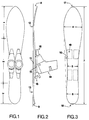
- the present invention is a monoski for alpine skiing where the skier's boots are side-by-side, close together and facing forward and which has an entirely new overall special shape and contour. Different lengths may be made, but the relationship of certain dimensions to each other must remain the same as the preferred embodiment.
- the monoski has an unusually wide forward or shovel area which is at least 30 percent or more wider than the narrowest part of the central or waist area. This creates the unusually severe side cut which allows the monoski to be easily turned and without unweighting. It also allows the monoski to float easily above or below the surface in light powder snow and to float easily on top of melting snow. Further, it allows the monoski to float through deep tracked "crud” conditions and ride over tracked melting snow which has refrozen without being directionally destabilized. Still further, it provides sideways platform stability when the skier is not moving.
- the rear or tail area of the monoski is considerably narrower than the forward or shovel area. This combined with the boots being mounted towards the rear or tail area results in the rear or tail area supporting at least twice the weight per square cm (square inch) as the forward or shovel area. This gives the monoski the capability of running straight when the skier wants to go straight, something hard to do on existing art monoskis.
- the monoski be of stiffer than normal construction and have greater than normal camber. This increases the bite into the snow of the severe concave side cut when the monoski is put on edge increasing the monoski's turning force. It also puts more weight on the rear area relative to the forward area, increasing the monoski's capability to run straight when the skier wants to go straight.
- the monoski can be made by methods and of materials as are commonly used in the ski industry.
- the subject invention is most like a monoski and is therefore called a monoski through the specification.
- the subject invention monoski is for alpine skiing and has both of the skier's boot bindings mounted so that the skier's boots are side by side, close together and both facing forward.
- the subject invention monoski has an entirely new overall special shape and contour.
- the decimal relationship of the new desired length is first established by dividing the straight line length of the new desired length monoski by the straight line length 7 of the preferred embodiment. This decimal relationship is then multiplied times the widest forward 4, narrowest central 5 and widest rear areas 6 of the preferred embodiment. Said obtained "decimal relationship determined dimensions" are held and modified as follows.
- the narrowest central area "decimal relationship determined dimension" width of the new desired length monoski is subtracted from the narrowest central area width of the new desired length monoski as is determined by the expected width of the two side-by-side ski boots. If the result is a minus figure, then this amount is subtracted from the "decimal relationship determined dimensions" for the widest forward area and the widest rear area of the new desired length monoski. If the result is a plus figure, then this amount is added to the "decimal relationship determined dimensions" for the widest forward area and the widest rear area of the new desired length monoski.
- the camber of the new desired length monoski is determined by multiplying the decimal relationship times the camber 11 of the preferred embodiment.
- the distance from the tip to the midsole mark on the mounted boot of the new desired length monoski is also determined by multiplying the decimal relationship times the distance from the tip 17 to the midsole mark 15 on the mounted boot 14 of the preferred embodiment.
- the unusually severe concave side cut 10 of the subject invention monoski is critical in the capability of the monoski to be turned by the skier with extreme ease and with no unweighting.
- the unusually severe concave side cut 10 is a result of the unusually wide forward or shovel area 1 and narrow as possible central or waist area 2.
- the side cut 10 is the maximum distance from the side of the monoski at the central or waist area 2 out to a point which intersects a straight line drawn from the widest part of the forward or shovel area 1 of the monoski to the widest part of the rear or tail area 3 of the monoski.
- This unweighting sufficiently frees the tail area of the ski from the resistance of the snow so that it can respond to the rotational forces applied by the skier and skid sideways through the desired turn.
- the unweighting is accomplished by either a hopping motion or a fast sinking motion. As this must be done on every turn, it can be seen a great deal of energy is consumed.
- the subject invention monoski can carve a tighter turn than any existing art dual or monoski; however when it rotates inside its own length or makes a very tight turn, even it can do so only with a considerable amount of sideways skidding.
- the unusually wide forward or shovel area 1 of the monoski serves a number of purposes. First, it creates the unusually severe concave side cut 10. Secondly, the unusually wide forward or shovel area 1 of the monoski allows the monoski to float easily above or below the surface in light powder snow. When skiing melting snow, unless the ski can float on top, as does the subject invention monoski, such melting snow can make turning conventional dual or monoskis which sink in, extremely difficult. The unusually wide forward or shovel area 1 also makes it possible for the subject invention monoski to float through and turn in deep tracked "crud” conditions without being directionally destabilized. Using conventional dual or monoskis, skiing in such "crud” is difficult for all but expert skiers.
- the unusually wide forward or shovel area 1 of the subject invention monoski is wide enough so that it is not directionally destabilized by these conditions and therefore can be easily turned in these conditions and without unweighting.
- a further advantage of the unusually wide forward or shovel area is that it provides sideways platform stability when the skier is not moving. The skier always has ski poles but it is safer and a more comfortable feeling for most skiers if they can easily balance themselves when not moving without having to use their ski poles.
- the central or waist area 2 of the monoski is where the boots 14 are mounted.
- the boots 14 are positioned side by side, close together and both facing forward.
- the midsole mark 15 on the mounted ski boot 14 should be 99,7 cm (39 1/4 inches) back on a straight line from the forward tip 17 of the monoski. This is 60.6 percent of the straight line length of the monoski back from the forward tip 17.
- the rear or tail area 3 of the monoski is considerably narrower than the forward or shovel area 1. As is explained further on, this helps to keep the monoski running straight when the skier wants to go straight. Typically, existing art monoskis turn easily but are difficult to ski straight.
- the subject invention monoski is considerably easier to turn than any existing art monoski even without unweighting and yet is easier to keep straight than any existing ar monoski. This is accomplished by the rear or tail area 3 being considerably narrower than the forward or shovel area 1 and in addition, the rear or tail area 3 supporting more of the weight of the skier.
- the preferred embodiment attaches the boots 14 towards the rear or tail area 3 of the monoski which results in the per square inch pressure on the snow being more than double in the rear or tail area 3 than the forward or shovel area 1.
- a boat which is heavy in the bow. Such a boat is directionally very unstable whereas the same boat becomes directionally stable if more weight is in the stern than in the bow.
- snow is not as fluid a medium as water, it is sufficiently fluid to where the principle still applies.
- the forward or shovel area 1 of the monoski slopes upward on a gentle curve 8 over 35,6 cm (14 inches) until it has raised 5,7 cm (2 1/4 inches) above the flat snow surface.
- This gentle forward, upward curve 8 is important and differs from prior art monoskis where boots are positioned side-by-side, close together and facing forward. Such prior art has a pronounced upward curve near the forward tip of the s,i.
- By having a gentle upward curve 8 the entire monoski can be kept below the surface of the snow when skiing deep light powder, a technique preferred by many expert deep powder skiers. If a skier inadvertently runs into a mogul, a sharply curved tip or shovel will usually be abruptly stopped by the mogul, throwing the skier forward.
- the monoski makes snow contact points 12 and 13, 35,6 cm (14 inches) back from the tip and 20,3 cm (8 inches) forward of the tail.
- a ski also can make shorter turns, the closer together the forward and rear snow contact points 12 and 13 become.
- the rear or tail area 3 of the monoski slopes upward on a gentle curve 9 over 20,3 cm (8 inches) until it has raised 3,2 cm (1 1/4 inches) above the flat snow surface.
- the tail end 18 is also rounded. As has been explained, as with all skis in tight turns, the tail of the ski skids through the turn sideways. As the rear 20,3 cm (8 inches) of the tail area 3 of the monoski is above the flat snow surface when the tail skids sideways through the turn, resistance to such sideways skidding is greatly reduced. While not as important as the unusually severe concave side cut 10, this lowered resistance is still important in the capability of the monoski to be turned by the skier with extreme ease and without unweighting.
- the rounded tail 18 also offers less resistance to any snow which it might have to ski through sideways, this being particularly true when the monoski is totally below the snow surface as in the generally preferred technique for deep light powder skiing.
- Increasing the stiffness and camber of conventional design skis generally decreases their ability to turn and increases their ability to track or ski straight. Therefore, dual skis made for high speed downhill racing are made as stiff and with as much camber as good overall design permits.
- Increasing the stiffness and camber of the subject invention monoski does not decrease its ability to turn with extreme ease and without unweighting but rather slightly increases this ability. The reason is that turning with extreme ease and without unweighting is largely made possible by the unusually severe concave side cut 10. When the subject invention monoski is put on edge by the skier, the stiffer the monoski and the more camber 11 it has, the more the forward part of the concave side cut arc digs into the snow transmitting an increasingly powerful turning force to the monoski itself.
- Increased stiffness and camber also increases the ability of the monoski to track or ski straight. As has been explained, this is a result of the per square cm (square inch) pressure on the snow being more than double in the rear or tail area 3 than in the forward or shovel area 1.
- the camber 11 of the preferred embodiment is 1,3 cm (1/2 inch). This is somewhat more than the camber generally found in conventional ski design.
- the stiffness of the monoski is accomplished by doubling the top structural layer of the monoski which conventionally is a single layer of epoxy resin reinforced with woven glass cloth.
- the skier's weight places a compression force on the top of the monoski and a tension force on the bottom of the monoski, particularly as the camber is increased.
- compression structural members must be stronger than tension structural members to resist the same force, only the top structural layer needs to be doubled in stiffness is to be increased.
- This increased stiffness also increases the strength of the monoski. This is important to protect the structural integrity of the subject invention monoski.
- the wide forward or shovel area 1 of the monoski imparts more than the normal amount of stress found in conventional ski design on the narrowest part of the central or waist area 2, particularly when the skier impacts a mogul. Since the extreme ease of turning and without unweighting, tracking or skiing straight and serviceable life of the monoski are all improved by increased strength and resulting stiffness, this then is the recommended construction.
- the monoski of the preferred embodiment of the present invention also may be manufactured to exhibit a predetermined torsional resistance during use.
- This torsional resistance for purposes of simplicity in explanation, can be best defined as the Nm (ft-lbs) of torquing force necessary to rotate the snow contact point 12 above the longitudinal axis of the monoski, through a circumferencial arch of three degrees relative to snow contact point 13.
- the torsional resistance is the torque in ft-lbs generated by twisting the monoski along its longitudinal axis through three degrees of rotation.
- the torsional resistance of the monoski are important to the design of the monoski of the present invention.
- the combined stiffness and torsion resistance afford the skier desired, predetermined response characteristics which substantially affect the skiers ability to control the path of the monoski through varied snow conditions and hill terrain.
- the stiffness of the monoski be sufficient to prevent the camber 11 from flattening, i.e. to prevent the bottom surface of the monoski between the snow contact points 12 and 13 to become generally planar in configuration.
- This stiffness is best defined as the minimum force (in N or pounds) applied to the monoski at the midsole mark 15 thereof which will cause the camber 11 of the monoski to flatten.
- the stiffness is recommended to be at least equivalent to 222,5 N (fifty pounds force), and more preferably with the range of 89 to 801 N (20 to 180 pounds force).
- the subject invention monoski like all conventional ski design for all types of skis, has the thickest part of the ski in the central or waist area 2 tapering out and becoming thinner towards the tip 17 and tail 18 of the monoski.
- This is normal design for structural beam members having to support load in the mid area, such as a ski.
- This variation in thickness is accomplished by a non-structural spacing material (called a core) in the center layer of the ski's typically laminated construction.
- This spacing material which is thicker in the central or waist area, in present art, is often of a plastic foam material.
- the subject invention monoski is recommended to be of a very stiff construction, any improved flex patterns from a wood core would be unnoticeable.
- a foam core is recommended as it will not rot from the inevitable introduction of moisture through binding attachment screw holes and will therefore improve the serviceable life of the monoski.
- Thin, high tensile strength aluminum or other lightweight material plates 19 should be laminated under the top epoxy resin double woven glass reinforced structural layer to securely hold the screws which attach the boot bindings 16 to the monoski. Manufacturers often use such plates but many such manufacturers will choose not to use such plates because of cost and or not wanting to increase the stiffness of the ski and interfere with its flex patterns. Once again, as the subject invention monoski is recommended to be of a very stiff construction, such plates may be used without detrimentally affecting the performance of the monoski. Such plates to securely hold the binding's attachment screws are recommended, and again to increase the serviceable life of the monoski.
- the top surface of the preferred embodiment of the subject invention monoski should be of the same P-Tex or similar material as the bottom running surface.
- the unusually wide forward or shovel area 1 of the monoski tends to mound up with collected snow. The snow will more easily slide off if the top surface of the monoski is P-Tex or a similar slippery material. Additional spraying of silicone will prevent even the stickiest snow from building up.
- Graphics are printed on the underside of the almost transparent P-Tex or similar material top surface as is common in the industry for the bottom P-Tex or similar material running surface.
- the tail 18 of the monoski should have an aluminum or other lightweight material protective tip molded into the laminated layers of the monoski when it is fabricated.
- the monoski is relatively heavy and when set upright on its tail by the skier, as is often necessary, the normal construction material of epoxy resin reinforced by woven glass cloth will soon become damaged and unsightly.
- a similar protective tip can be molded into the forward tip of the monoski for a more finished appearance but is not as necessary as few skiers will set the monoski upright on its tip.
- the bottom edges of the monoski should have protective metal edges. In the preferred embodiment, these edges should not be cracked but rather solid. Solid edges are stiffer, but as has been explained, added stiffness is a benefit for the subject invention monoski. Also, solid edges are stronger, extending the serviceable life of the monoski.
- the bottom metal edges in the preferred embodiment run the entire length of the monoski from the forward tip protective insert to the rear tail protective insert which gives the monoski a more finished appearance.
Landscapes
- Footwear And Its Accessory, Manufacturing Method And Apparatuses (AREA)
- Saccharide Compounds (AREA)
Claims (6)
- Monoski mit einem langgestreckten Körper auf dem die Bindungen (16) für den Skischuh so aufmontiert werden sollen, daß die Skischuhe (14) symmetrisch entlang jeder Seite des Monoski in Längsrichtung montiert sind, mit einem Schaufelabschnitt (1), der von einem Endabschnitt (2) durch einen Taillenabschnitt (2) getrennt ist, wobei jeder der Abschnitte (1, 2, 3) entlang einer sich mittig über den langgestreckten Körper erstreckenden Längsachse symmetrisch orientiert ist, wobei der Schaufelabschnitt (1), der Taillenabschnitt (2) und der Endabschnitt (3) eine kontinuierliche Bodenfläche des Monoskis bilden, wobei der Schaufelabschnitt (1) einen breitesten Bereich (4), gemessen rechtwinklig zur Längsachse, aufweist, der mindestens 30% größer als ein schmalster Bereich (5) des Taillenabschnittes (2) ist, gleichermaßen gemessen rechtwinklig zur Längsachse, wobei der Schaufelabschnitt (1) weiterhin einen vorderen Endbereich (17) aufweist, der sich nach oben in einer Richtung von der Bodenfläche weg krümmt, wobei der Endabschnitt (3) ebenfalls einen breitesten Bereich (6) hat, gemessen rechtwinklig zur Längsachse, der breiter als der schmalste Bereich (5) des Taillenabschnittes (2) und mindestens 25% schmaler als der breiteste Bereich (4) des Schaufelabschnittes (1) ist, wobei der Endabschnitt (3) weiterhin einen rückwärtigen Endbereich (18) aufweist, der sich nach oben in einer Richtung von der Bodenoberfläche wegkrümmt, wobei der langgestreckte Körper ein aufgewölbtes Segment (11) zwischen dem breitesten Bereich (4) des Schaufelabschnittes (1) und dem breitesten Bereich (6) des Endabschnittes (3) aufweist, wobei das aufgewölbte Segment (11) bewirkt, daß sich ein entsprechendes Segment der Bodenoberfläche in unbelastetem Zustand nach oben wölbt, wodurch dann, wenn der Monoski auf einer relativ flachen, geneigten Oberfläche, einschließlich eines mit Schnee bedeckten Hügels, angeordnet ist, die Steifigkeit des Monoski bewirkt, daß Kontaktkräfte zwischen der flachen geneigten Oberfläche und der Bodenoberfläche des Monoski am breitesten Bereich (4) des Schaufelabschnittes (1) und dem breitesten Bereich (6) des Endabschnittes (3) und weg vom Taillenabschnitt (2), dem vorderen Bereich (17) des Schaufelabschnittes (1) und dem rückwärtigen Bereich (18) des Endabschnittes (3) konzentriert sind, und wodurch eine nach unten gerichtete Kraft, die auf den Taillenabschnitt (3) aufgebracht wird, wegen der verglichen mit dem Schaufelabschnitt (1) geringeren Größe einen größeren Druck auf die flache geneigte Oberfläche ausübt als eine vergleichbare Kraft, die auf den Schaufelabschnitt (1) ausgeübt wird, dadurch gekennzeichnet, daß das aufgewölbte Segment (11) weiterhin mit einer Aufwölbungssteifigkeit im Bereich von 222,5 bis 668 Nm (50 bis 150 pounds force) ausgebildet ist, und daß der langgestreckte Körper mit einem Torsionswiderstand im Bereich von 23 bis 38,5 Nm (15 bis 25 ft-lbs) ausgebildet ist, gemessen als die Verdrehkraft, die erforderlich ist, den breitesten Bereich (4) des Schaufelabschnittes (1) um die Längsachse über einen Abstand von 3° zu verdrehen.
- Monoski nach Anspruch 1, wobei der Taillenabschnitt (2) eine Dicke aufweist, die größer ist als der Schaufelabschnitt (1) und der Endabschnitt (3).
- Monoski nach Anspruch 1 oder 2, wobei der breiteste Bereich (4) des Schaufelabschnittes (1) vom vorderen Endbereich (17) so beabstandet ist, daß er von ihm abgesetzt ist.
- Monoski nach einem der Ansprüche 1 bis 3, wobei der breiteste Bereich (6) des Endabschnittes (3) so vom rückwärtigen Endbereich (17) beabstandet ist, daß er von ihm abgesetzt ist.
- Monoski nach einem der Ansprüche 1 bis 4 mit seitlichen Ausschnitten (10), die mindestens 1,9 cm (3/4 Zoll) betragen, wobei die Seitenausschnitt-Messungen als minimaler Abstand vom engsten Bereich (5) des Taillenabschnittes (4) bis zu einem Punkt definiert sind, der eine gerade Linie schneidet, die vom breitesten Bereich (4) des Schaufelabschnittes (1) zum breitesten Bereich (6) des Taillenabschnittes (3) gezogen ist.
- Monoski nach Anspruch 1, wobei die Steifigkeit der Aufwölbung ausreichend ist, um zu verhindern, daß Kräfte unter 89 N (20 Pfund), die auf den langgestreckten Körper aufgebracht sind, das Segment der Bodenoberfläche, das mit dem aufgewölbten Segment (11) korrespondiert, abflachen.
Applications Claiming Priority (2)
| Application Number | Priority Date | Filing Date | Title |
|---|---|---|---|
| US644323 | 1991-01-22 | ||
| US07/644,323 US5096217A (en) | 1988-12-01 | 1991-01-22 | Monoski with deep side cuts and cambered segment in the binding portion |
Publications (2)
| Publication Number | Publication Date |
|---|---|
| EP0496352A1 EP0496352A1 (de) | 1992-07-29 |
| EP0496352B1 true EP0496352B1 (de) | 1996-05-15 |
Family
ID=24584407
Family Applications (1)
| Application Number | Title | Priority Date | Filing Date |
|---|---|---|---|
| EP92100933A Expired - Lifetime EP0496352B1 (de) | 1991-01-22 | 1992-01-21 | Monoski |
Country Status (6)
| Country | Link |
|---|---|
| US (1) | US5096217A (de) |
| EP (1) | EP0496352B1 (de) |
| JP (1) | JPH05168738A (de) |
| AT (1) | ATE137983T1 (de) |
| CA (1) | CA2059738A1 (de) |
| DE (1) | DE69210634T2 (de) |
Families Citing this family (26)
| Publication number | Priority date | Publication date | Assignee | Title |
|---|---|---|---|---|
| US5618053A (en) * | 1990-06-11 | 1997-04-08 | Kneissl Dachstein Sportartikel Ag | Short ski-like sports device |
| DE4116118C2 (de) * | 1991-05-17 | 2000-11-23 | Bosch Gmbh Robert | System zur Erzeugung von Signalen zur Steuerung oder Regelung eines steuerbaren oder regelbaren Fahrwerkes |
| US5603522A (en) * | 1991-08-29 | 1997-02-18 | Nelson; Paul N. | Wide short ski |
| US5375868A (en) * | 1993-03-03 | 1994-12-27 | Sarver; Jeff | Ski having compound curve undersurface |
| FR2704155B1 (fr) * | 1993-04-20 | 1995-07-07 | Salomon Sa | Surf des neiges a plateforme en materiau a faible module et inserts locaux. |
| FR2704440B1 (fr) * | 1993-04-30 | 1995-07-28 | Salomon Sa | Planche de glisse, notamment surf de neige. |
| US5813688A (en) * | 1993-12-08 | 1998-09-29 | Steven Beck | Snowboard binding |
| US5405161A (en) * | 1994-02-04 | 1995-04-11 | Dennis Young | Alpine ski with exaggerated tip and tail |
| BG61865B1 (bg) * | 1994-12-30 | 1998-08-31 | "Орион Ски" Ад | алпийски ски |
| US5765854A (en) * | 1995-10-23 | 1998-06-16 | Moore; Lonny J. | Binding mounting system |
| US5863050A (en) * | 1995-12-15 | 1999-01-26 | K-2 Corporation | Snowboard insert plate |
| US5839747A (en) * | 1996-01-22 | 1998-11-24 | Thermal Snowboards, Inc. | Binding anchor |
| US5782482A (en) * | 1996-01-30 | 1998-07-21 | K-2 Corporation | Snowboard and method of construction |
| ATE261747T1 (de) * | 1996-04-15 | 2004-04-15 | Uniboard Inc | Skibrett |
| US5816590A (en) * | 1997-04-02 | 1998-10-06 | Uniboard Corporation | Nordic skiboard |
| AT406735B (de) * | 1996-06-27 | 2000-08-25 | Atomic Austria Gmbh | Skipaar für den alpinskilauf |
| US6357782B1 (en) * | 1998-06-25 | 2002-03-19 | Fischer Geserllschaft M.B.H. | Cross-country ski |
| FR2807670B1 (fr) * | 2000-04-14 | 2002-06-07 | Rossignol Sa | Ski alpin |
| US20030127812A1 (en) * | 2002-01-04 | 2003-07-10 | Charles Mehrmann | Bi-directional sliding board |
| WO2003106241A2 (en) * | 2002-06-12 | 2003-12-24 | Tim Farmer | Snowboard scooter |
| US7240908B2 (en) * | 2004-04-01 | 2007-07-10 | Rsv Invention Enterprises | Pogo-ski |
| FR2870501A1 (fr) * | 2004-05-18 | 2005-11-25 | Philippe Claude Laffont | Traineau pour glisser et se diriger avec maitrise sur tout type de pente glissante |
| US7690674B2 (en) * | 2006-08-10 | 2010-04-06 | Armada Skis, Inc. | Snow riding implement |
| FR2926735B1 (fr) * | 2008-01-25 | 2010-03-26 | Salomon Sa | Ski alpin avec moyens de reglage |
| DE102008034293A1 (de) * | 2008-07-22 | 2010-01-28 | Marker Völkl (International) GmbH | Ski, insbesondere Abfahrtski |
| US12031346B2 (en) | 2021-04-15 | 2024-07-09 | Aob Products Company | Hay bale hunting blind |
Family Cites Families (22)
| Publication number | Priority date | Publication date | Assignee | Title |
|---|---|---|---|---|
| US3154312A (en) | 1961-05-11 | 1964-10-27 | Marco Systems Inc | Mono ski |
| US3326564A (en) * | 1964-10-28 | 1967-06-20 | Johan G F Heuvel | Ski with torsional-responsive rigidity |
| DE1298024B (de) * | 1965-02-26 | 1969-06-19 | Maximilian Friedrich Dr Ing | Einrichtung zum Veraendern des Durchfederungsvermoegens eines Skis |
| US3758127A (en) | 1971-05-06 | 1973-09-11 | M Doyle | Single snow ski |
| US3782745A (en) | 1972-09-29 | 1974-01-01 | Dimitrije Miloch | Snow surfboard |
| US3900204A (en) | 1973-06-25 | 1975-08-19 | Robert C Weber | Mono-ski |
| CA989435A (en) * | 1974-09-25 | 1976-05-18 | Alec Pedersen | Monoski |
| US3947049A (en) | 1974-11-05 | 1976-03-30 | Alec Pedersen | Mono-ski |
| US4221400A (en) * | 1978-11-08 | 1980-09-09 | Powers John T | Method and apparatus for selectively adjusting the stiffness of a ski |
| WO1980002232A1 (fr) * | 1979-04-24 | 1980-10-30 | H Vuigier | Planche a neige |
| DE2936368A1 (de) | 1979-09-08 | 1981-04-02 | Müller + Müller, Basel | Schneegleiter |
| US4300786A (en) * | 1979-12-19 | 1981-11-17 | Johnson Wax Associates | Snow ski with adjustable camber |
| US4405139A (en) | 1980-09-05 | 1983-09-20 | Kuniaki Kawahard | Boards for sliding on snow |
| SE436690B (sv) * | 1983-05-20 | 1985-01-21 | Eriksson Karl G V | Anordning vid skida med variabelt spann |
| AT385667B (de) * | 1984-11-15 | 1988-05-10 | Head Sportgeraete Gmbh | Ski fuer die verwendung mit einer auflageplatte fuer die aufnahme von bindungsteilen |
| EP0209569B1 (de) * | 1985-01-07 | 1994-09-21 | FLOREANI, Adrian J. | Ski |
| US4696487A (en) * | 1985-10-07 | 1987-09-29 | Girard Donald A | Ski which is stiff in torsion and relatively weak in beam |
| DE3620078A1 (de) * | 1986-06-14 | 1987-12-17 | Feldmuehle Ag | Ski |
| FR2618077B1 (fr) * | 1987-07-15 | 1989-11-17 | Salomon Sa | Ski a face superieure convergente |
| DE8802415U1 (de) * | 1988-02-24 | 1988-05-05 | Reisenauer, Andreas, 8042 Oberschleißheim | Wintersportgerät |
| FR2638649B1 (fr) * | 1988-11-07 | 1991-01-11 | Salomon Sa | Ski muni de masses d'inertie laterales |
| JPH02200281A (ja) * | 1988-12-01 | 1990-08-08 | Kent Hunter | モノスキー |
-
1991
- 1991-01-22 US US07/644,323 patent/US5096217A/en not_active Expired - Fee Related
-
1992
- 1992-01-21 CA CA002059738A patent/CA2059738A1/en not_active Abandoned
- 1992-01-21 EP EP92100933A patent/EP0496352B1/de not_active Expired - Lifetime
- 1992-01-21 AT AT92100933T patent/ATE137983T1/de active
- 1992-01-21 DE DE69210634T patent/DE69210634T2/de not_active Expired - Fee Related
- 1992-01-22 JP JP4048116A patent/JPH05168738A/ja active Pending
Also Published As
| Publication number | Publication date |
|---|---|
| CA2059738A1 (en) | 1992-07-23 |
| JPH05168738A (ja) | 1993-07-02 |
| DE69210634T2 (de) | 1996-11-07 |
| ATE137983T1 (de) | 1996-06-15 |
| US5096217A (en) | 1992-03-17 |
| EP0496352A1 (de) | 1992-07-29 |
| DE69210634D1 (de) | 1996-06-20 |
Similar Documents
| Publication | Publication Date | Title |
|---|---|---|
| US5096217A (en) | Monoski with deep side cuts and cambered segment in the binding portion | |
| EP0371514B1 (de) | Monoski mit schmalen Flanken für verbesserte Stabilität und Kontrolle | |
| US4007946A (en) | Short ski | |
| US4705291A (en) | Alpine ski | |
| US3378274A (en) | Surf-type snow ski | |
| US7213823B1 (en) | Two-wheeled riding-board apparatus | |
| US5816590A (en) | Nordic skiboard | |
| US4952184A (en) | Cross-water ski | |
| US3854739A (en) | Skis with steering strings | |
| US20070267847A1 (en) | Snow Skis and Snowboards Having Split Tips and/or Tails | |
| US4715612A (en) | Alpine ski | |
| US5667238A (en) | Ski having compound curve undersurface | |
| US3782744A (en) | Snow surfboard with stepped stabilizing sides | |
| JP2004534626A (ja) | カービング小型そり | |
| US7172205B1 (en) | Two-wheeled riding-board apparatus | |
| US5603522A (en) | Wide short ski | |
| US5618053A (en) | Short ski-like sports device | |
| US20050029757A1 (en) | Swivelable mount for attaching a binding to a snowboard | |
| US5213535A (en) | Slalom/trick water ski with side by side binding | |
| WO2003086554A1 (en) | Non-metallic edge gliding board | |
| JP3074096U (ja) | スノーボード | |
| US5591059A (en) | Water ski | |
| EP0925097B1 (de) | Skibrett | |
| EP0546109B1 (de) | Übungsvorrichtung für die winterzeit | |
| WO2001066202A1 (en) | Cross-country ski for skiing especially on ice |
Legal Events
| Date | Code | Title | Description |
|---|---|---|---|
| PUAI | Public reference made under article 153(3) epc to a published international application that has entered the european phase |
Free format text: ORIGINAL CODE: 0009012 |
|
| AK | Designated contracting states |
Kind code of ref document: A1 Designated state(s): AT CH DE FR IT LI |
|
| 17P | Request for examination filed |
Effective date: 19930128 |
|
| 17Q | First examination report despatched |
Effective date: 19940328 |
|
| GRAH | Despatch of communication of intention to grant a patent |
Free format text: ORIGINAL CODE: EPIDOS IGRA |
|
| GRAA | (expected) grant |
Free format text: ORIGINAL CODE: 0009210 |
|
| AK | Designated contracting states |
Kind code of ref document: B1 Designated state(s): AT CH DE FR IT LI |
|
| REF | Corresponds to: |
Ref document number: 137983 Country of ref document: AT Date of ref document: 19960615 Kind code of ref document: T |
|
| REF | Corresponds to: |
Ref document number: 69210634 Country of ref document: DE Date of ref document: 19960620 |
|
| ET | Fr: translation filed | ||
| ITF | It: translation for a ep patent filed | ||
| REG | Reference to a national code |
Ref country code: CH Ref legal event code: NV Representative=s name: PATENTANWALTSBUERO JEAN HUNZIKER |
|
| PLBE | No opposition filed within time limit |
Free format text: ORIGINAL CODE: 0009261 |
|
| STAA | Information on the status of an ep patent application or granted ep patent |
Free format text: STATUS: NO OPPOSITION FILED WITHIN TIME LIMIT |
|
| 26N | No opposition filed | ||
| PGFP | Annual fee paid to national office [announced via postgrant information from national office to epo] |
Ref country code: FR Payment date: 20000127 Year of fee payment: 9 Ref country code: AT Payment date: 20000127 Year of fee payment: 9 |
|
| PGFP | Annual fee paid to national office [announced via postgrant information from national office to epo] |
Ref country code: CH Payment date: 20000131 Year of fee payment: 9 |
|
| PGFP | Annual fee paid to national office [announced via postgrant information from national office to epo] |
Ref country code: DE Payment date: 20000229 Year of fee payment: 9 |
|
| PG25 | Lapsed in a contracting state [announced via postgrant information from national office to epo] |
Ref country code: AT Free format text: LAPSE BECAUSE OF NON-PAYMENT OF DUE FEES Effective date: 20010121 |
|
| PG25 | Lapsed in a contracting state [announced via postgrant information from national office to epo] |
Ref country code: LI Free format text: LAPSE BECAUSE OF NON-PAYMENT OF DUE FEES Effective date: 20010131 Ref country code: CH Free format text: LAPSE BECAUSE OF NON-PAYMENT OF DUE FEES Effective date: 20010131 |
|
| REG | Reference to a national code |
Ref country code: CH Ref legal event code: PL |
|
| PG25 | Lapsed in a contracting state [announced via postgrant information from national office to epo] |
Ref country code: FR Free format text: LAPSE BECAUSE OF NON-PAYMENT OF DUE FEES Effective date: 20010928 |
|
| PG25 | Lapsed in a contracting state [announced via postgrant information from national office to epo] |
Ref country code: DE Free format text: LAPSE BECAUSE OF NON-PAYMENT OF DUE FEES Effective date: 20011101 |
|
| REG | Reference to a national code |
Ref country code: FR Ref legal event code: ST |
|
| PG25 | Lapsed in a contracting state [announced via postgrant information from national office to epo] |
Ref country code: IT Free format text: LAPSE BECAUSE OF NON-PAYMENT OF DUE FEES;WARNING: LAPSES OF ITALIAN PATENTS WITH EFFECTIVE DATE BEFORE 2007 MAY HAVE OCCURRED AT ANY TIME BEFORE 2007. THE CORRECT EFFECTIVE DATE MAY BE DIFFERENT FROM THE ONE RECORDED. Effective date: 20050121 |