EP0496830B1 - Total synthesis of northebaine, normorphine, noroxymorphone enantiomers and derivatives via n-nor intermediates - Google Patents
Total synthesis of northebaine, normorphine, noroxymorphone enantiomers and derivatives via n-nor intermediates Download PDFInfo
- Publication number
- EP0496830B1 EP0496830B1 EP90917159A EP90917159A EP0496830B1 EP 0496830 B1 EP0496830 B1 EP 0496830B1 EP 90917159 A EP90917159 A EP 90917159A EP 90917159 A EP90917159 A EP 90917159A EP 0496830 B1 EP0496830 B1 EP 0496830B1
- Authority
- EP
- European Patent Office
- Prior art keywords
- ketal
- base
- ether
- northebaine
- yield
- Prior art date
- Legal status (The legal status is an assumption and is not a legal conclusion. Google has not performed a legal analysis and makes no representation as to the accuracy of the status listed.)
- Expired - Lifetime
Links
- QKQQEIVDLRUZRP-UUWFMWQGSA-N (4r,7ar,12bs)-7,9-dimethoxy-1,2,3,4,7a,13-hexahydro-4,12-methanobenzofuro[3,2-e]isoquinoline Chemical compound C([C@@H](NCC1)C2=CC=C3OC)C4=CC=C(OC)C5=C4[C@@]21[C@H]3O5 QKQQEIVDLRUZRP-UUWFMWQGSA-N 0.000 title claims description 15
- QKQQEIVDLRUZRP-UHFFFAOYSA-N northebaine Natural products COC1=CC=C2C(NCC3)CC4=CC=C(OC)C5=C4C23C1O5 QKQQEIVDLRUZRP-UHFFFAOYSA-N 0.000 title claims description 13
- 239000000543 intermediate Substances 0.000 title abstract description 15
- 238000006257 total synthesis reaction Methods 0.000 title description 12
- HLMSIZPQBSYUNL-IPOQPSJVSA-N Noroxymorphone Chemical class O=C([C@@H]1O2)CC[C@@]3(O)[C@H]4CC5=CC=C(O)C2=C5[C@@]13CCN4 HLMSIZPQBSYUNL-IPOQPSJVSA-N 0.000 title description 10
- ONBWJWYUHXVEJS-ZTYRTETDSA-N Normorphine Chemical compound C([C@@H](NCC1)[C@@H]2C=C[C@@H]3O)C4=CC=C(O)C5=C4[C@@]21[C@H]3O5 ONBWJWYUHXVEJS-ZTYRTETDSA-N 0.000 title description 5
- 229950006134 normorphine Drugs 0.000 title description 4
- 238000000034 method Methods 0.000 claims abstract description 32
- WYURNTSHIVDZCO-UHFFFAOYSA-N Tetrahydrofuran Chemical compound C1CCOC1 WYURNTSHIVDZCO-UHFFFAOYSA-N 0.000 claims abstract description 22
- RTZKZFJDLAIYFH-UHFFFAOYSA-N Diethyl ether Chemical compound CCOCC RTZKZFJDLAIYFH-UHFFFAOYSA-N 0.000 claims abstract description 18
- 229940127240 opiate Drugs 0.000 claims abstract description 10
- CPELXLSAUQHCOX-UHFFFAOYSA-N Hydrogen bromide Chemical class Br CPELXLSAUQHCOX-UHFFFAOYSA-N 0.000 claims abstract description 9
- 239000004081 narcotic agent Substances 0.000 claims abstract description 4
- YLQBMQCUIZJEEH-UHFFFAOYSA-N tetrahydrofuran Natural products C=1C=COC=1 YLQBMQCUIZJEEH-UHFFFAOYSA-N 0.000 claims abstract description 4
- 238000006243 chemical reaction Methods 0.000 claims description 25
- 239000000203 mixture Substances 0.000 claims description 14
- 239000003814 drug Substances 0.000 claims description 11
- 229940079593 drug Drugs 0.000 claims description 10
- 150000003839 salts Chemical class 0.000 claims description 10
- 239000002585 base Substances 0.000 claims description 9
- 229950004392 norcodeine Drugs 0.000 claims description 8
- LPNYRYFBWFDTMA-UHFFFAOYSA-N potassium tert-butoxide Chemical compound [K+].CC(C)(C)[O-] LPNYRYFBWFDTMA-UHFFFAOYSA-N 0.000 claims description 8
- 239000005557 antagonist Substances 0.000 claims description 7
- 238000004821 distillation Methods 0.000 claims description 7
- HKOIXWVRNLGFOR-KOFBORESSA-N norcodeine Chemical compound O[C@H]([C@@H]1O2)C=C[C@H]3[C@H]4CC5=CC=C(OC)C2=C5[C@@]13CCN4 HKOIXWVRNLGFOR-KOFBORESSA-N 0.000 claims description 7
- 239000002904 solvent Substances 0.000 claims description 7
- 238000004519 manufacturing process Methods 0.000 claims description 6
- HKOIXWVRNLGFOR-UHFFFAOYSA-N norcodeine Natural products O1C2C(O)C=CC3C4CC5=CC=C(OC)C1=C5C23CCN4 HKOIXWVRNLGFOR-UHFFFAOYSA-N 0.000 claims description 6
- 150000007524 organic acids Chemical class 0.000 claims description 6
- 238000010992 reflux Methods 0.000 claims description 5
- LFQSCWFLJHTTHZ-UHFFFAOYSA-N Ethanol Chemical compound CCO LFQSCWFLJHTTHZ-UHFFFAOYSA-N 0.000 claims description 4
- 239000003795 chemical substances by application Substances 0.000 claims description 4
- 230000001476 alcoholic effect Effects 0.000 claims description 3
- 239000003513 alkali Substances 0.000 claims description 3
- 230000002140 halogenating effect Effects 0.000 claims description 3
- 125000004178 (C1-C4) alkyl group Chemical group 0.000 claims description 2
- LJGHYPLBDBRCRZ-UHFFFAOYSA-N 3-(3-aminophenyl)sulfonylaniline Chemical compound NC1=CC=CC(S(=O)(=O)C=2C=C(N)C=CC=2)=C1 LJGHYPLBDBRCRZ-UHFFFAOYSA-N 0.000 claims description 2
- FIPWRIJSWJWJAI-UHFFFAOYSA-N Butyl carbitol 6-propylpiperonyl ether Chemical compound C1=C(CCC)C(COCCOCCOCCCC)=CC2=C1OCO2 FIPWRIJSWJWJAI-UHFFFAOYSA-N 0.000 claims description 2
- 239000004215 Carbon black (E152) Substances 0.000 claims description 2
- 125000001475 halogen functional group Chemical group 0.000 claims description 2
- 229930195733 hydrocarbon Natural products 0.000 claims description 2
- 150000002430 hydrocarbons Chemical class 0.000 claims description 2
- 230000003647 oxidation Effects 0.000 claims description 2
- 238000007254 oxidation reaction Methods 0.000 claims description 2
- 229960005235 piperonyl butoxide Drugs 0.000 claims description 2
- 238000006467 substitution reaction Methods 0.000 claims description 2
- 239000000010 aprotic solvent Substances 0.000 claims 2
- 230000003301 hydrolyzing effect Effects 0.000 claims 1
- 230000001590 oxidative effect Effects 0.000 claims 1
- 230000015572 biosynthetic process Effects 0.000 abstract description 11
- 238000003786 synthesis reaction Methods 0.000 abstract description 10
- 239000007858 starting material Substances 0.000 abstract description 9
- AFVFQIVMOAPDHO-UHFFFAOYSA-N Methanesulfonic acid Chemical compound CS(O)(=O)=O AFVFQIVMOAPDHO-UHFFFAOYSA-N 0.000 abstract description 8
- 239000000556 agonist Substances 0.000 abstract description 5
- 229940098779 methanesulfonic acid Drugs 0.000 abstract description 4
- CSCPPACGZOOCGX-UHFFFAOYSA-N Acetone Chemical compound CC(C)=O CSCPPACGZOOCGX-UHFFFAOYSA-N 0.000 abstract description 3
- VBTQNRFWXBXZQR-UHFFFAOYSA-N n-bromoacetamide Chemical compound CC(=O)NBr VBTQNRFWXBXZQR-UHFFFAOYSA-N 0.000 abstract description 3
- 238000009795 derivation Methods 0.000 abstract 1
- OKKJLVBELUTLKV-UHFFFAOYSA-N Methanol Chemical compound OC OKKJLVBELUTLKV-UHFFFAOYSA-N 0.000 description 85
- HEDRZPFGACZZDS-UHFFFAOYSA-N Chloroform Chemical compound ClC(Cl)Cl HEDRZPFGACZZDS-UHFFFAOYSA-N 0.000 description 70
- KFZMGEQAYNKOFK-UHFFFAOYSA-N Isopropanol Chemical compound CC(C)O KFZMGEQAYNKOFK-UHFFFAOYSA-N 0.000 description 40
- 238000003756 stirring Methods 0.000 description 27
- 239000011541 reaction mixture Substances 0.000 description 21
- 150000001875 compounds Chemical class 0.000 description 19
- OROGSEYTTFOCAN-DNJOTXNNSA-N codeine Chemical compound C([C@H]1[C@H](N(CC[C@@]112)C)C3)=C[C@H](O)[C@@H]1OC1=C2C3=CC=C1OC OROGSEYTTFOCAN-DNJOTXNNSA-N 0.000 description 18
- ILAHWRKJUDSMFH-UHFFFAOYSA-N boron tribromide Chemical compound BrB(Br)Br ILAHWRKJUDSMFH-UHFFFAOYSA-N 0.000 description 16
- FQXXSQDCDRQNQE-UHFFFAOYSA-N markiertes Thebain Natural products COC1=CC=C2C(N(CC3)C)CC4=CC=C(OC)C5=C4C23C1O5 FQXXSQDCDRQNQE-UHFFFAOYSA-N 0.000 description 16
- 229960004592 isopropanol Drugs 0.000 description 14
- 239000000243 solution Substances 0.000 description 14
- FQXXSQDCDRQNQE-VMDGZTHMSA-N thebaine Chemical compound C([C@@H](N(CC1)C)C2=CC=C3OC)C4=CC=C(OC)C5=C4[C@@]21[C@H]3O5 FQXXSQDCDRQNQE-VMDGZTHMSA-N 0.000 description 14
- WSFSSNUMVMOOMR-UHFFFAOYSA-N Formaldehyde Chemical compound O=C WSFSSNUMVMOOMR-UHFFFAOYSA-N 0.000 description 12
- 238000004817 gas chromatography Methods 0.000 description 12
- 238000004809 thin layer chromatography Methods 0.000 description 12
- 229930003945 thebaine Natural products 0.000 description 11
- CDBYLPFSWZWCQE-UHFFFAOYSA-L Sodium Carbonate Chemical compound [Na+].[Na+].[O-]C([O-])=O CDBYLPFSWZWCQE-UHFFFAOYSA-L 0.000 description 10
- 238000010520 demethylation reaction Methods 0.000 description 10
- BQJCRHHNABKAKU-KBQPJGBKSA-N morphine Chemical compound O([C@H]1[C@H](C=C[C@H]23)O)C4=C5[C@@]12CCN(C)[C@@H]3CC5=CC=C4O BQJCRHHNABKAKU-KBQPJGBKSA-N 0.000 description 10
- HEMHJVSKTPXQMS-UHFFFAOYSA-M Sodium hydroxide Chemical compound [OH-].[Na+] HEMHJVSKTPXQMS-UHFFFAOYSA-M 0.000 description 9
- YXFVVABEGXRONW-UHFFFAOYSA-N Toluene Chemical compound CC1=CC=CC=C1 YXFVVABEGXRONW-UHFFFAOYSA-N 0.000 description 9
- 239000000047 product Substances 0.000 description 9
- XKRFYHLGVUSROY-UHFFFAOYSA-N Argon Chemical compound [Ar] XKRFYHLGVUSROY-UHFFFAOYSA-N 0.000 description 8
- 229910015845 BBr3 Inorganic materials 0.000 description 8
- XEKOWRVHYACXOJ-UHFFFAOYSA-N Ethyl acetate Chemical compound CCOC(C)=O XEKOWRVHYACXOJ-UHFFFAOYSA-N 0.000 description 8
- 229960004126 codeine Drugs 0.000 description 8
- 238000002425 crystallisation Methods 0.000 description 8
- 230000008025 crystallization Effects 0.000 description 8
- 239000012458 free base Substances 0.000 description 8
- OROGSEYTTFOCAN-UHFFFAOYSA-N hydrocodone Natural products C1C(N(CCC234)C)C2C=CC(O)C3OC2=C4C1=CC=C2OC OROGSEYTTFOCAN-UHFFFAOYSA-N 0.000 description 8
- 229960005297 nalmefene Drugs 0.000 description 7
- DQCKKXVULJGBQN-XFWGSAIBSA-N naltrexone Chemical compound N1([C@@H]2CC3=CC=C(C=4O[C@@H]5[C@](C3=4)([C@]2(CCC5=O)O)CC1)O)CC1CC1 DQCKKXVULJGBQN-XFWGSAIBSA-N 0.000 description 7
- 238000001953 recrystallisation Methods 0.000 description 7
- 239000003039 volatile agent Substances 0.000 description 7
- QTBSBXVTEAMEQO-UHFFFAOYSA-N Acetic acid Chemical compound CC(O)=O QTBSBXVTEAMEQO-UHFFFAOYSA-N 0.000 description 6
- 239000008896 Opium Substances 0.000 description 6
- BRUQQQPBMZOVGD-XFKAJCMBSA-N Oxycodone Chemical compound O=C([C@@H]1O2)CC[C@@]3(O)[C@H]4CC5=CC=C(OC)C2=C5[C@@]13CCN4C BRUQQQPBMZOVGD-XFKAJCMBSA-N 0.000 description 6
- 150000002084 enol ethers Chemical class 0.000 description 6
- 238000000605 extraction Methods 0.000 description 6
- 239000003887 narcotic antagonist Substances 0.000 description 6
- 229960001027 opium Drugs 0.000 description 6
- BWHMMNNQKKPAPP-UHFFFAOYSA-L potassium carbonate Chemical compound [K+].[K+].[O-]C([O-])=O BWHMMNNQKKPAPP-UHFFFAOYSA-L 0.000 description 6
- IAZDPXIOMUYVGZ-UHFFFAOYSA-N Dimethylsulphoxide Chemical compound CS(C)=O IAZDPXIOMUYVGZ-UHFFFAOYSA-N 0.000 description 5
- UQCNKQCJZOAFTQ-ISWURRPUSA-N Oxymorphone Chemical compound O([C@H]1C(CC[C@]23O)=O)C4=C5[C@@]12CCN(C)[C@@H]3CC5=CC=C4O UQCNKQCJZOAFTQ-ISWURRPUSA-N 0.000 description 5
- KDLHZDBZIXYQEI-UHFFFAOYSA-N Palladium Chemical compound [Pd] KDLHZDBZIXYQEI-UHFFFAOYSA-N 0.000 description 5
- -1 chloroformate ester Chemical class 0.000 description 5
- 239000000706 filtrate Substances 0.000 description 5
- 239000006260 foam Substances 0.000 description 5
- 125000002496 methyl group Chemical group [H]C([H])([H])* 0.000 description 5
- 229960003086 naltrexone Drugs 0.000 description 5
- 230000003389 potentiating effect Effects 0.000 description 5
- 229910000029 sodium carbonate Inorganic materials 0.000 description 5
- 239000006188 syrup Substances 0.000 description 5
- 235000020357 syrup Nutrition 0.000 description 5
- 238000005406 washing Methods 0.000 description 5
- QCQCHGYLTSGIGX-GHXANHINSA-N 4-[[(3ar,5ar,5br,7ar,9s,11ar,11br,13as)-5a,5b,8,8,11a-pentamethyl-3a-[(5-methylpyridine-3-carbonyl)amino]-2-oxo-1-propan-2-yl-4,5,6,7,7a,9,10,11,11b,12,13,13a-dodecahydro-3h-cyclopenta[a]chrysen-9-yl]oxy]-2,2-dimethyl-4-oxobutanoic acid Chemical compound N([C@@]12CC[C@@]3(C)[C@]4(C)CC[C@H]5C(C)(C)[C@@H](OC(=O)CC(C)(C)C(O)=O)CC[C@]5(C)[C@H]4CC[C@@H]3C1=C(C(C2)=O)C(C)C)C(=O)C1=CN=CC(C)=C1 QCQCHGYLTSGIGX-GHXANHINSA-N 0.000 description 4
- YCPXWRQRBFJBPZ-UHFFFAOYSA-N 5-sulfosalicylic acid Chemical compound OC(=O)C1=CC(S(O)(=O)=O)=CC=C1O YCPXWRQRBFJBPZ-UHFFFAOYSA-N 0.000 description 4
- IJGRMHOSHXDMSA-UHFFFAOYSA-N Atomic nitrogen Chemical compound N#N IJGRMHOSHXDMSA-UHFFFAOYSA-N 0.000 description 4
- UIQMVEYFGZJHCZ-SSTWWWIQSA-N Nalorphine Chemical compound C([C@@H](N(CC1)CC=C)[C@@H]2C=C[C@@H]3O)C4=CC=C(O)C5=C4[C@@]21[C@H]3O5 UIQMVEYFGZJHCZ-SSTWWWIQSA-N 0.000 description 4
- QAOWNCQODCNURD-UHFFFAOYSA-N Sulfuric acid Chemical compound OS(O)(=O)=O QAOWNCQODCNURD-UHFFFAOYSA-N 0.000 description 4
- 229910052786 argon Inorganic materials 0.000 description 4
- 239000003153 chemical reaction reagent Substances 0.000 description 4
- 235000019439 ethyl acetate Nutrition 0.000 description 4
- 238000001704 evaporation Methods 0.000 description 4
- 230000008020 evaporation Effects 0.000 description 4
- BDAGIHXWWSANSR-UHFFFAOYSA-N methanoic acid Natural products OC=O BDAGIHXWWSANSR-UHFFFAOYSA-N 0.000 description 4
- 238000007069 methylation reaction Methods 0.000 description 4
- 229960005181 morphine Drugs 0.000 description 4
- 229960000938 nalorphine Drugs 0.000 description 4
- 239000012074 organic phase Substances 0.000 description 4
- 239000012279 sodium borohydride Substances 0.000 description 4
- 229910000033 sodium borohydride Inorganic materials 0.000 description 4
- JLVNEHKORQFVQJ-PYIJOLGTSA-N 6alpha-Naltrexol Chemical compound C([C@]12[C@H]3OC=4C(O)=CC=C(C2=4)C[C@@H]2[C@]1(O)CC[C@H]3O)CN2CC1CC1 JLVNEHKORQFVQJ-PYIJOLGTSA-N 0.000 description 3
- VHUUQVKOLVNVRT-UHFFFAOYSA-N Ammonium hydroxide Chemical compound [NH4+].[OH-] VHUUQVKOLVNVRT-UHFFFAOYSA-N 0.000 description 3
- 238000005481 NMR spectroscopy Methods 0.000 description 3
- WJBLNOPPDWQMCH-MBPVOVBZSA-N Nalmefene Chemical compound N1([C@@H]2CC3=CC=C(C=4O[C@@H]5[C@](C3=4)([C@]2(CCC5=C)O)CC1)O)CC1CC1 WJBLNOPPDWQMCH-MBPVOVBZSA-N 0.000 description 3
- 229960000583 acetic acid Drugs 0.000 description 3
- 230000029936 alkylation Effects 0.000 description 3
- 238000005804 alkylation reaction Methods 0.000 description 3
- BHELZAPQIKSEDF-UHFFFAOYSA-N allyl bromide Chemical compound BrCC=C BHELZAPQIKSEDF-UHFFFAOYSA-N 0.000 description 3
- AEILLAXRDHDKDY-UHFFFAOYSA-N bromomethylcyclopropane Chemical compound BrCC1CC1 AEILLAXRDHDKDY-UHFFFAOYSA-N 0.000 description 3
- 238000009903 catalytic hydrogenation reaction Methods 0.000 description 3
- 239000012043 crude product Substances 0.000 description 3
- 239000013078 crystal Substances 0.000 description 3
- 238000001035 drying Methods 0.000 description 3
- 235000019253 formic acid Nutrition 0.000 description 3
- 239000012362 glacial acetic acid Substances 0.000 description 3
- 238000005984 hydrogenation reaction Methods 0.000 description 3
- 230000007062 hydrolysis Effects 0.000 description 3
- 238000006460 hydrolysis reaction Methods 0.000 description 3
- 229910010272 inorganic material Inorganic materials 0.000 description 3
- 239000011147 inorganic material Substances 0.000 description 3
- NETZHAKZCGBWSS-CEDHKZHLSA-N nalbuphine Chemical compound C([C@]12[C@H]3OC=4C(O)=CC=C(C2=4)C[C@@H]2[C@]1(O)CC[C@@H]3O)CN2CC1CCC1 NETZHAKZCGBWSS-CEDHKZHLSA-N 0.000 description 3
- 229960000805 nalbuphine Drugs 0.000 description 3
- 229960004127 naloxone Drugs 0.000 description 3
- UZHSEJADLWPNLE-GRGSLBFTSA-N naloxone Chemical compound O=C([C@@H]1O2)CC[C@@]3(O)[C@H]4CC5=CC=C(O)C2=C5[C@@]13CCN4CC=C UZHSEJADLWPNLE-GRGSLBFTSA-N 0.000 description 3
- 150000007530 organic bases Chemical class 0.000 description 3
- 229910052763 palladium Inorganic materials 0.000 description 3
- 229910000027 potassium carbonate Inorganic materials 0.000 description 3
- 238000000746 purification Methods 0.000 description 3
- 238000010561 standard procedure Methods 0.000 description 3
- 238000000967 suction filtration Methods 0.000 description 3
- DQCKKXVULJGBQN-OBZTUIKSSA-N (4s,4ar,7as,12br)-3-(cyclopropylmethyl)-4a,9-dihydroxy-2,4,5,6,7a,13-hexahydro-1h-4,12-methanobenzofuro[3,2-e]isoquinoline-7-one Chemical compound N1([C@H]2CC3=CC=C(C=4O[C@H]5[C@@](C3=4)([C@@]2(CCC5=O)O)CC1)O)CC1CC1 DQCKKXVULJGBQN-OBZTUIKSSA-N 0.000 description 2
- 125000003903 2-propenyl group Chemical group [H]C([*])([H])C([H])=C([H])[H] 0.000 description 2
- OIJXLIIMXHRJJH-KNLIIKEYSA-N Diprenorphine Chemical compound C([C@]12[C@H]3OC=4C(O)=CC=C(C2=4)C[C@@H]2[C@]11CC[C@]3([C@H](C1)C(C)(C)O)OC)CN2CC1CC1 OIJXLIIMXHRJJH-KNLIIKEYSA-N 0.000 description 2
- RIKMCJUNPCRFMW-ISWURRPUSA-N Noroxycodone Chemical compound O=C([C@@H]1O2)CC[C@@]3(O)[C@H]4CC5=CC=C(OC)C2=C5[C@@]13CCN4 RIKMCJUNPCRFMW-ISWURRPUSA-N 0.000 description 2
- 241000209094 Oryza Species 0.000 description 2
- 235000007164 Oryza sativa Nutrition 0.000 description 2
- VYPSYNLAJGMNEJ-UHFFFAOYSA-N Silicium dioxide Chemical compound O=[Si]=O VYPSYNLAJGMNEJ-UHFFFAOYSA-N 0.000 description 2
- UIIMBOGNXHQVGW-UHFFFAOYSA-M Sodium bicarbonate Chemical compound [Na+].OC([O-])=O UIIMBOGNXHQVGW-UHFFFAOYSA-M 0.000 description 2
- FAPWRFPIFSIZLT-UHFFFAOYSA-M Sodium chloride Chemical compound [Na+].[Cl-] FAPWRFPIFSIZLT-UHFFFAOYSA-M 0.000 description 2
- 238000004458 analytical method Methods 0.000 description 2
- TZCXTZWJZNENPQ-UHFFFAOYSA-L barium sulfate Chemical compound [Ba+2].[O-]S([O-])(=O)=O TZCXTZWJZNENPQ-UHFFFAOYSA-L 0.000 description 2
- 239000012267 brine Substances 0.000 description 2
- 239000002178 crystalline material Substances 0.000 description 2
- ATDGTVJJHBUTRL-UHFFFAOYSA-N cyanogen bromide Chemical compound BrC#N ATDGTVJJHBUTRL-UHFFFAOYSA-N 0.000 description 2
- 239000000284 extract Substances 0.000 description 2
- 239000007789 gas Substances 0.000 description 2
- 150000003840 hydrochlorides Chemical class 0.000 description 2
- 239000000463 material Substances 0.000 description 2
- 238000002844 melting Methods 0.000 description 2
- 230000008018 melting Effects 0.000 description 2
- 230000003533 narcotic effect Effects 0.000 description 2
- 238000006386 neutralization reaction Methods 0.000 description 2
- 229910052757 nitrogen Inorganic materials 0.000 description 2
- 230000003287 optical effect Effects 0.000 description 2
- 230000000144 pharmacologic effect Effects 0.000 description 2
- 239000002243 precursor Substances 0.000 description 2
- 238000002360 preparation method Methods 0.000 description 2
- 239000002994 raw material Substances 0.000 description 2
- 238000006722 reduction reaction Methods 0.000 description 2
- 238000005932 reductive alkylation reaction Methods 0.000 description 2
- 235000009566 rice Nutrition 0.000 description 2
- ODZPKZBBUMBTMG-UHFFFAOYSA-N sodium amide Chemical compound [NH2-].[Na+] ODZPKZBBUMBTMG-UHFFFAOYSA-N 0.000 description 2
- HPALAKNZSZLMCH-UHFFFAOYSA-M sodium;chloride;hydrate Chemical compound O.[Na+].[Cl-] HPALAKNZSZLMCH-UHFFFAOYSA-M 0.000 description 2
- 239000007787 solid Substances 0.000 description 2
- 238000011916 stereoselective reduction Methods 0.000 description 2
- PYOKUURKVVELLB-UHFFFAOYSA-N trimethyl orthoformate Chemical compound COC(OC)OC PYOKUURKVVELLB-UHFFFAOYSA-N 0.000 description 2
- BQJCRHHNABKAKU-UHFFFAOYSA-N (-)-morphine Chemical compound C12C=CC(O)C3OC4=C5C32CCN(C)C1CC5=CC=C4O BQJCRHHNABKAKU-UHFFFAOYSA-N 0.000 description 1
- PLGXEPHZCXBYLP-UHFFFAOYSA-N (-)-munitagine Chemical compound C1C2=CC=C(OC)C(O)=C2C2CC(C=C(C(=C3)O)OC)=C3C1N2C PLGXEPHZCXBYLP-UHFFFAOYSA-N 0.000 description 1
- BLUMEJOOWLSPSE-OWCLPIDISA-N (1S,9R,10S)-17-azatetracyclo[7.5.3.01,10.02,7]heptadeca-2,4,6-trien-10-ol Chemical class C1CCC[C@@]2(O)[C@]3([H])NCC[C@@]21C1=CC=CC=C1C3 BLUMEJOOWLSPSE-OWCLPIDISA-N 0.000 description 1
- XJZOLKDBHJPTAT-ATNYCFDYSA-N (4r,4ar,7ar,12bs)-7,9-dimethoxy-3-methyl-2,4,4a,5,7a,13-hexahydro-1h-4,12-methanobenzofuro[3,2-e]isoquinoline Chemical compound C([C@@H](N(CC1)C)[C@@H]2CC=C3OC)C4=CC=C(OC)C5=C4[C@@]21[C@H]3O5 XJZOLKDBHJPTAT-ATNYCFDYSA-N 0.000 description 1
- YYCRAERBSFHMPL-XFKAJCMBSA-N (4r,4as,7ar,12bs)-4a-hydroxy-9-methoxy-3-methyl-2,4,7a,13-tetrahydro-1h-4,12-methanobenzofuro[3,2-e]isoquinoline-7-one Chemical compound O=C([C@@H]1O2)C=C[C@@]3(O)[C@]4([H])N(C)CC[C@]13C1=C2C(OC)=CC=C1C4 YYCRAERBSFHMPL-XFKAJCMBSA-N 0.000 description 1
- PFHGRTXJSIKXPW-GNUVVZJLSA-N (4r,4as,7r,7ar,12bs)-3-(cyclopropylmethyl)-7-fluoro-1,2,4,5,6,7,7a,13-octahydro-4,12-methanobenzofuro[3,2-e]isoquinoline-4a,9-diol Chemical group N1([C@@H]2CC3=CC=C(C=4O[C@@H]5[C@](C3=4)([C@]2(CC[C@H]5F)O)CC1)O)CC1CC1 PFHGRTXJSIKXPW-GNUVVZJLSA-N 0.000 description 1
- UZHSEJADLWPNLE-PIKADFDJSA-N (4s,4ar,7as,12br)-4a,9-dihydroxy-3-prop-2-enyl-2,4,5,6,7a,13-hexahydro-1h-4,12-methanobenzofuro[3,2-e]isoquinoline-7-one Chemical compound O=C([C@H]1O2)CC[C@]3(O)[C@@H]4CC5=CC=C(O)C2=C5[C@]13CCN4CC=C UZHSEJADLWPNLE-PIKADFDJSA-N 0.000 description 1
- YYCRAERBSFHMPL-UHFFFAOYSA-N 14beta-Hydroxycodeinone Natural products O1C2C(=O)C=CC3(O)C4CC5=CC=C(OC)C1=C5C23CCN4C YYCRAERBSFHMPL-UHFFFAOYSA-N 0.000 description 1
- QOTAQTRFJWLFCR-UHFFFAOYSA-N 3,4-dihydro-2H-pyrano[2,3-b]quinolin-7-yl-(4-methoxycyclohexyl)methanone Chemical compound C1CC(OC)CCC1C(=O)C1=CC=C(N=C2C(CCCO2)=C2)C2=C1 QOTAQTRFJWLFCR-UHFFFAOYSA-N 0.000 description 1
- OSWFIVFLDKOXQC-UHFFFAOYSA-N 4-(3-methoxyphenyl)aniline Chemical compound COC1=CC=CC(C=2C=CC(N)=CC=2)=C1 OSWFIVFLDKOXQC-UHFFFAOYSA-N 0.000 description 1
- CBTLTHNUFAXDBE-UHFFFAOYSA-N C12=CC=3OCOC=3C=C2C23CCN(C)C3CCC3C2OC1O3 Chemical compound C12=CC=3OCOC=3C=C2C23CCN(C)C3CCC3C2OC1O3 CBTLTHNUFAXDBE-UHFFFAOYSA-N 0.000 description 1
- 0 CCC(C[C@](*C(CC1)=O)([C@@]11O)c2c3[O+])(Cc2ccc3O)C1N* Chemical compound CCC(C[C@](*C(CC1)=O)([C@@]11O)c2c3[O+])(Cc2ccc3O)C1N* 0.000 description 1
- FXQGMPHJBDEAFX-QYKBZSJISA-N CCC(C[C@]1([C@]2(CC3)O)c4c5O[IH]C1C3=C)(Cc4ccc5O)C2NCC1CC1 Chemical compound CCC(C[C@]1([C@]2(CC3)O)c4c5O[IH]C1C3=C)(Cc4ccc5O)C2NCC1CC1 FXQGMPHJBDEAFX-QYKBZSJISA-N 0.000 description 1
- NHTMVDHEPJAVLT-UHFFFAOYSA-N Isooctane Chemical compound CC(C)CC(C)(C)C NHTMVDHEPJAVLT-UHFFFAOYSA-N 0.000 description 1
- 238000007126 N-alkylation reaction Methods 0.000 description 1
- 239000007832 Na2SO4 Substances 0.000 description 1
- HLMSIZPQBSYUNL-ZWHFUDEPSA-N O[C@](CC1)(C(Cc2ccc3O)NCC4)[C@]44c2c3OC4C1=O Chemical compound O[C@](CC1)(C(Cc2ccc3O)NCC4)[C@]44c2c3OC4C1=O HLMSIZPQBSYUNL-ZWHFUDEPSA-N 0.000 description 1
- 102000003840 Opioid Receptors Human genes 0.000 description 1
- 108090000137 Opioid Receptors Proteins 0.000 description 1
- YGYAWVDWMABLBF-UHFFFAOYSA-N Phosgene Chemical compound ClC(Cl)=O YGYAWVDWMABLBF-UHFFFAOYSA-N 0.000 description 1
- KEAYESYHFKHZAL-UHFFFAOYSA-N Sodium Chemical compound [Na] KEAYESYHFKHZAL-UHFFFAOYSA-N 0.000 description 1
- PMZURENOXWZQFD-UHFFFAOYSA-L Sodium Sulfate Chemical compound [Na+].[Na+].[O-]S([O-])(=O)=O PMZURENOXWZQFD-UHFFFAOYSA-L 0.000 description 1
- JZRWCGZRTZMZEH-UHFFFAOYSA-N Thiamine Natural products CC1=C(CCO)SC=[N+]1CC1=CN=C(C)N=C1N JZRWCGZRTZMZEH-UHFFFAOYSA-N 0.000 description 1
- CKUAXEQHGKSLHN-UHFFFAOYSA-N [C].[N] Chemical group [C].[N] CKUAXEQHGKSLHN-UHFFFAOYSA-N 0.000 description 1
- 230000021736 acetylation Effects 0.000 description 1
- 238000006640 acetylation reaction Methods 0.000 description 1
- 238000005917 acylation reaction Methods 0.000 description 1
- 125000005233 alkylalcohol group Chemical group 0.000 description 1
- 230000004075 alteration Effects 0.000 description 1
- 230000000954 anitussive effect Effects 0.000 description 1
- 239000003434 antitussive agent Substances 0.000 description 1
- 229940124584 antitussives Drugs 0.000 description 1
- 239000008346 aqueous phase Substances 0.000 description 1
- 210000004556 brain Anatomy 0.000 description 1
- RMRJXGBAOAMLHD-IHFGGWKQSA-N buprenorphine Chemical compound C([C@]12[C@H]3OC=4C(O)=CC=C(C2=4)C[C@@H]2[C@]11CC[C@]3([C@H](C1)[C@](C)(O)C(C)(C)C)OC)CN2CC1CC1 RMRJXGBAOAMLHD-IHFGGWKQSA-N 0.000 description 1
- 229960001736 buprenorphine Drugs 0.000 description 1
- 238000003965 capillary gas chromatography Methods 0.000 description 1
- 238000000451 chemical ionisation Methods 0.000 description 1
- FZFAMSAMCHXGEF-UHFFFAOYSA-N chloro formate Chemical compound ClOC=O FZFAMSAMCHXGEF-UHFFFAOYSA-N 0.000 description 1
- 239000002036 chloroform fraction Substances 0.000 description 1
- 238000010960 commercial process Methods 0.000 description 1
- 238000001816 cooling Methods 0.000 description 1
- 125000004981 cycloalkylmethyl group Chemical group 0.000 description 1
- 230000006378 damage Effects 0.000 description 1
- ZJULYDCRWUEPTK-UHFFFAOYSA-N dichloromethyl Chemical compound Cl[CH]Cl ZJULYDCRWUEPTK-UHFFFAOYSA-N 0.000 description 1
- 150000004683 dihydrates Chemical class 0.000 description 1
- 229960000920 dihydrocodeine Drugs 0.000 description 1
- JVSWJIKNEAIKJW-UHFFFAOYSA-N dimethyl-hexane Natural products CCCCCC(C)C JVSWJIKNEAIKJW-UHFFFAOYSA-N 0.000 description 1
- 229950002494 diprenorphine Drugs 0.000 description 1
- 238000000921 elemental analysis Methods 0.000 description 1
- 230000007717 exclusion Effects 0.000 description 1
- 238000001914 filtration Methods 0.000 description 1
- 238000004508 fractional distillation Methods 0.000 description 1
- 238000005194 fractionation Methods 0.000 description 1
- 238000010438 heat treatment Methods 0.000 description 1
- XLYOFNOQVPJJNP-ZSJDYOACSA-N heavy water Substances [2H]O[2H] XLYOFNOQVPJJNP-ZSJDYOACSA-N 0.000 description 1
- LLPOLZWFYMWNKH-CMKMFDCUSA-N hydrocodone Chemical compound C([C@H]1[C@H](N(CC[C@@]112)C)C3)CC(=O)[C@@H]1OC1=C2C3=CC=C1OC LLPOLZWFYMWNKH-CMKMFDCUSA-N 0.000 description 1
- 229960000240 hydrocodone Drugs 0.000 description 1
- AKPUJVVHYUHGKY-UHFFFAOYSA-N hydron;propan-2-ol;chloride Chemical compound Cl.CC(C)O AKPUJVVHYUHGKY-UHFFFAOYSA-N 0.000 description 1
- 238000011065 in-situ storage Methods 0.000 description 1
- 238000002329 infrared spectrum Methods 0.000 description 1
- OROGSEYTTFOCAN-KEMUOJQUSA-N isocodeine Chemical class C([C@H]1[C@H](N(CC[C@@]112)C)C3)=C[C@@H](O)[C@@H]1OC1=C2C3=CC=C1OC OROGSEYTTFOCAN-KEMUOJQUSA-N 0.000 description 1
- 238000002372 labelling Methods 0.000 description 1
- 239000010410 layer Substances 0.000 description 1
- 230000014759 maintenance of location Effects 0.000 description 1
- 238000001819 mass spectrum Methods 0.000 description 1
- XYDYWTJEGDZLTH-UHFFFAOYSA-N methylenetriphenylphosphorane Chemical compound C=1C=CC=CC=1P(C=1C=CC=CC=1)(=C)C1=CC=CC=C1 XYDYWTJEGDZLTH-UHFFFAOYSA-N 0.000 description 1
- 239000002808 molecular sieve Substances 0.000 description 1
- 239000012457 nonaqueous media Substances 0.000 description 1
- 239000012044 organic layer Substances 0.000 description 1
- 239000003960 organic solvent Substances 0.000 description 1
- 229960005118 oxymorphone Drugs 0.000 description 1
- 230000020477 pH reduction Effects 0.000 description 1
- 239000007793 ph indicator Substances 0.000 description 1
- 229920001296 polysiloxane Polymers 0.000 description 1
- 238000002600 positron emission tomography Methods 0.000 description 1
- 239000000843 powder Substances 0.000 description 1
- 230000002035 prolonged effect Effects 0.000 description 1
- 230000002829 reductive effect Effects 0.000 description 1
- 230000010076 replication Effects 0.000 description 1
- 229920006395 saturated elastomer Polymers 0.000 description 1
- 239000000741 silica gel Substances 0.000 description 1
- 229910002027 silica gel Inorganic materials 0.000 description 1
- URGAHOPLAPQHLN-UHFFFAOYSA-N sodium aluminosilicate Chemical compound [Na+].[Al+3].[O-][Si]([O-])=O.[O-][Si]([O-])=O URGAHOPLAPQHLN-UHFFFAOYSA-N 0.000 description 1
- 229910000030 sodium bicarbonate Inorganic materials 0.000 description 1
- 239000011780 sodium chloride Substances 0.000 description 1
- 239000012312 sodium hydride Substances 0.000 description 1
- 229910000104 sodium hydride Inorganic materials 0.000 description 1
- 229910052938 sodium sulfate Inorganic materials 0.000 description 1
- 230000003595 spectral effect Effects 0.000 description 1
- 239000000126 substance Substances 0.000 description 1
- 125000001424 substituent group Chemical group 0.000 description 1
- KYMBYSLLVAOCFI-UHFFFAOYSA-N thiamine Chemical compound CC1=C(CCO)SCN1CC1=CN=C(C)N=C1N KYMBYSLLVAOCFI-UHFFFAOYSA-N 0.000 description 1
- 229960003495 thiamine Drugs 0.000 description 1
- 235000019157 thiamine Nutrition 0.000 description 1
- 239000011721 thiamine Substances 0.000 description 1
- 231100000331 toxic Toxicity 0.000 description 1
- 230000002588 toxic effect Effects 0.000 description 1
- 230000009466 transformation Effects 0.000 description 1
Classifications
-
- C—CHEMISTRY; METALLURGY
- C07—ORGANIC CHEMISTRY
- C07D—HETEROCYCLIC COMPOUNDS
- C07D489/00—Heterocyclic compounds containing 4aH-8, 9 c- Iminoethano-phenanthro [4, 5-b, c, d] furan ring systems, e.g. derivatives of [4, 5-epoxy]-morphinan of the formula:
- C07D489/02—Heterocyclic compounds containing 4aH-8, 9 c- Iminoethano-phenanthro [4, 5-b, c, d] furan ring systems, e.g. derivatives of [4, 5-epoxy]-morphinan of the formula: with oxygen atoms attached in positions 3 and 6, e.g. morphine, morphinone
-
- C—CHEMISTRY; METALLURGY
- C07—ORGANIC CHEMISTRY
- C07D—HETEROCYCLIC COMPOUNDS
- C07D489/00—Heterocyclic compounds containing 4aH-8, 9 c- Iminoethano-phenanthro [4, 5-b, c, d] furan ring systems, e.g. derivatives of [4, 5-epoxy]-morphinan of the formula:
- C07D489/02—Heterocyclic compounds containing 4aH-8, 9 c- Iminoethano-phenanthro [4, 5-b, c, d] furan ring systems, e.g. derivatives of [4, 5-epoxy]-morphinan of the formula: with oxygen atoms attached in positions 3 and 6, e.g. morphine, morphinone
- C07D489/04—Salts; Organic complexes
Definitions
- the present invention relates to a total synthesis proceeding from nordihydrocodeinone (4) as in the post scheme, and a key aspect is that a facile method has now been developed, utilizing said nordihydrocodeinone intermediates throughout, for conversion of (4) to northebaine (12), noroxymorphone (19), norcodeine (39), normorphine (42) and derivatives. Since both (+)- and (-)-nordihydrocodeinone are equally available by the earlier Rice patents, the present disclosure is applicable and pertains to synthesis of compounds of both the natural (-)- and unnatural (+)-stereochemical series.
- naloxone (20), naltrexone (21), nalmefene (22), and the agonist-antagonist nalbuphine (26) is obtained by extraction from opium and utilized as starting material.
- (-)-Codeine has also been advanced as a possible starting material for these compounds. Since both natural thebaine and codeine have a methyl substituent on the nitrogen, removal of the methyl group and replacement with a cycloalkylmethyl or allyl group and other structural alterations are necessary in order to obtain the desired pharmacological profile in the final products.
- natural thebaine is sequentially oxidized to 14-hydroxycodeinone, reduced to 14-hydroxydihydrocodeinone, O-demethylated to oxymorphone.
- the methyl group is then removed by the following sequence: acetylation to the 3,14-diacetoxy derivative, reaction with cyanogen bromide or a chloroformate ester, and hydrolyzed to noroxymorphone which is finally alkylated with the appropriate allyl halide.
- a major disadvantage of the commercial process is the multistep removal of N-methyl group involving the acylation reaction, reaction with cyanogen bromide or phosgene-derived chloroformate (which are toxic and otherwise dangerous reagents), and the hydrolysis step.
- the hydrolysis of the N-cyano employed in the standard process requires prolonged heating with a large excess of 25% sulfuric acid that results in partial destruction of the desired noroxymorphone
- a process of producing an intermediate for the production of opiate narcotics, agonist-antagonist drugs, and stereoisomers thereof comprising the steps of:
- hydrobromide salt of optically active crystalline (+)7-bromodialkyl ketal of nordihydrocodeinone (III) and salts thereof is provided.
- the instant invention is a process in which nordihydrocodeinone (4), an early intermediate in the total synthesis of codeine, morphine and thebaine, Chart 1, is converted through intermediates without substituents on nitrogen to a number of versatile N-nor intermediates. These compounds can serve as precursors for a number of important drugs (with the natural opiate stereochemistry) currently used in the practice of medicine. The process thus eliminates the need for thebaine for the total synthesis of these drugs. Since nordihydrocodeinone is directly available by the total synthesis as either the (+)- or (-)-enantiomer, optional access is provided to either the natural or unnatural opiate series. Since the N-nor intermediates can be N-alkylated at any stage to afford a desired N-substituted product, the process is much more versatile than the classical route, and substantially shorter because the N-demethylation sequence is eliminated.
- the instant invention thus differs from the prior art by not utilizing thebaine, that is, it is unnecessary to introduce the methyl group (4-->5, Chart 1) and then remove it after further transformation of thebaine.
- each step in the process gives very high yields and each isolated intermediate is obtained pure, or very nearly so, by simple crystallization and washing.
- halogenating reagent preferably a brominating reagent such as N-bromoacetamide and organic acid such as methanesulfonic acid, 5-sulfosalicylic acid
- a strong organic base such as potassium t-butoxide in dimethylsulfoxide or sodium hydride, sodium amide in aprotic organic solvent then gives northebaine (12) in 97% yield.
- Catalytic hydrogenation of compound (13) (generally with palladium) smoothly affords crude nearly pure noroxycodone (18) in quantitative yield.
- Addition of formaldehyde in this hydrogenation provides the clinically used agonist percodan (17).
- Brief treatment (O-demethylation) of compound (18) with BBr 3 or other standard O-demethylation procedure then gives noroxymorphone (19).
- Percodan (17) and numorphan (16) are also available by N-methylation of compounds (18) and (19), respectively, using standard methods.
- Noroxymorphone (19) is a centrally important precursor for naloxone (20), naltrexone (21) nalmefene (22), all valuable narcotic antagonists in the natural stereochemical series (Chart 3).
- N-alkylation of compound (19) with allyl or cyclopropylmethyl bromide by standard methods gives naloxone and naltrexone, respectively.
- These compounds can also be obtained (Chart 3) by alkylation of noroxycodone (18) to compounds (23) and (24), followed by O-demethylation with BBr 3 or other suitable reagent.
- Reaction of naltrexone (21) with methylene triphenylphosphorane according to standard protocol then gives nalmefene (22).
- N-cyclobutyl-methylation of (15) to (25) followed by O-demethylation of (25) gives nalbuphine (26, Nubaine), a clinically useful agonist-antagonist drug.
- O-demethylation of (15) to 14-hydroxydihydronormorphine (27) followed by N-cyclobutylation gives nalbuphine.
- the potent narcotic agonist Foxy which is useful in pharmacological studies can also be obtained (Chart 5) from (-)-(14) by hydrogenation in the presence of formaldehyde to (28), previously converted to Foxy (29). Hydrogenation of (14) to (15) followed by N-methylation of (15) gives (28) the same intermediate to Foxy.
- This compound is easily available from (15) by N-cyclopropylation to (31) which is O-demethylated to the corresponding 6 ⁇ -naltrexol 32 and treated as previously described by prior art.
- conversion of (27) to the N-cyclopropylmethyl derivative affords the same intermediate naltrexol.
- the naltrexol was prepared by borohydride reduction of naltrexone and required chromatographic fractionation to remove the corresponding 6-B-isomer.
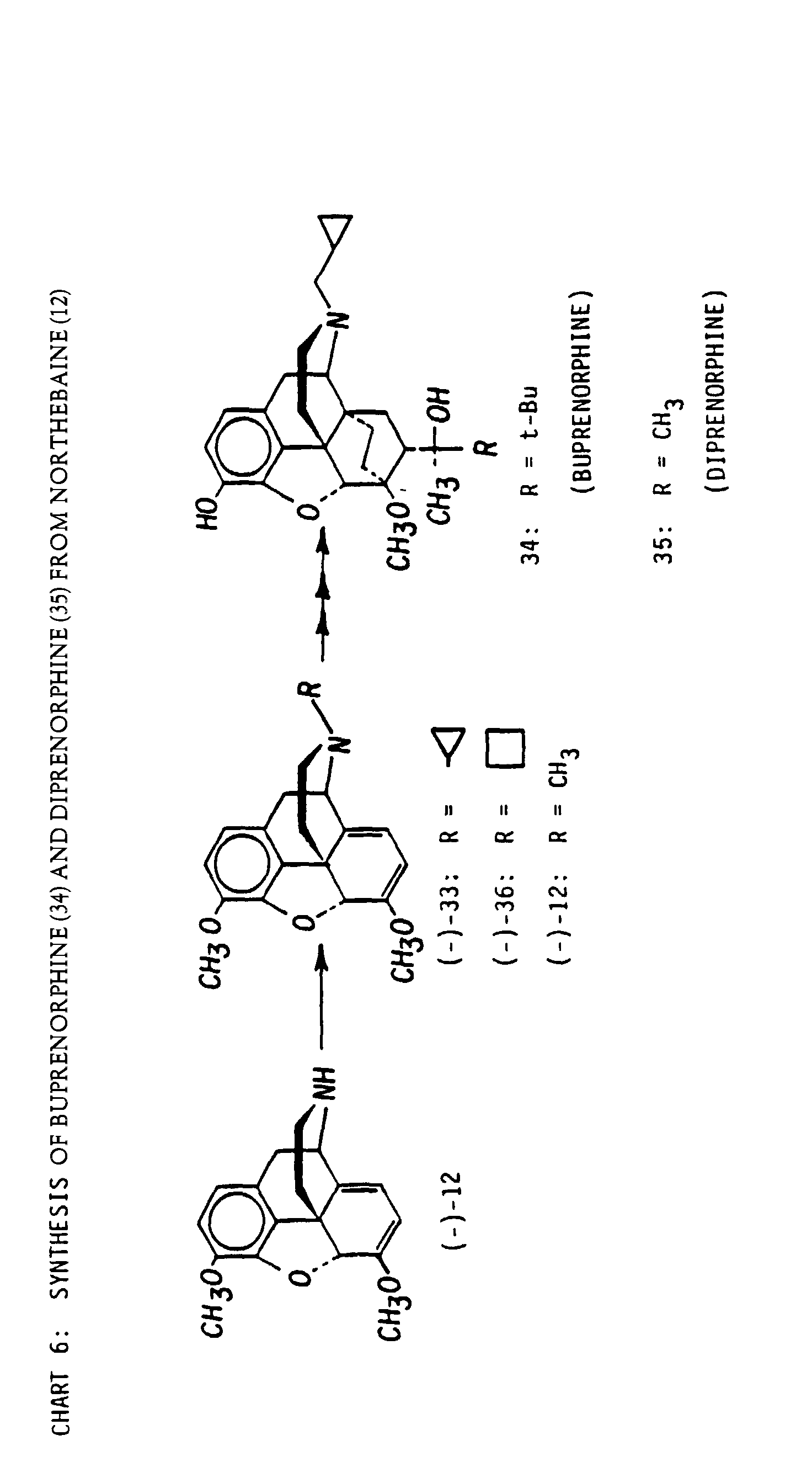
- N-alkylnorthebaines including thebaine (8) readily available by total synthesis in either the natural or unnatural series by simple alkylation or reductive alkylation of the appropriate enantiomer of northebaine (12) as shown in Chart 6.
- N-alkylnorthebaines including thebaine (8) readily available by total synthesis in either the natural or unnatural series by simple alkylation or reductive alkylation of the appropriate enantiomer of northebaine (12) as shown in Chart 6.
- cyclopropylmethylnorthebaine 33
- an intermediate useful for synthesis of buprenorphine 34
- the potent antagonist diprenorphine (35) can also be prepared from N-cyclopropylmethylnorthebaine by prior art procedures which were demonstrated only in the natural stereochemical series.
- the instant invention is an extremely practical thebaine-free total synthesis of all clinically used 14-hydroxymorphinans and other (-)-thebaine derivatives, such as (34) and (35), as well as other important compounds derived from opium.
- the process is shorter and more flexible than total synthesis through thebaine and is also applicable to synthesis of the unnatural opiate series (not available from opium derivatives), some members of which are potent antitussives.
- the instant invention eliminates requirements for thebaine for the production of medically useful drugs by total synthesis.
- the process is, however, applicable to synthesis of drugs from opium derived starting material via semisynthetic northebaine since northebaine is an intermediate in the invention and existing methodology developed by others permits facile, high-yielding synthesis of (-)-northebaine from natural thebaine.
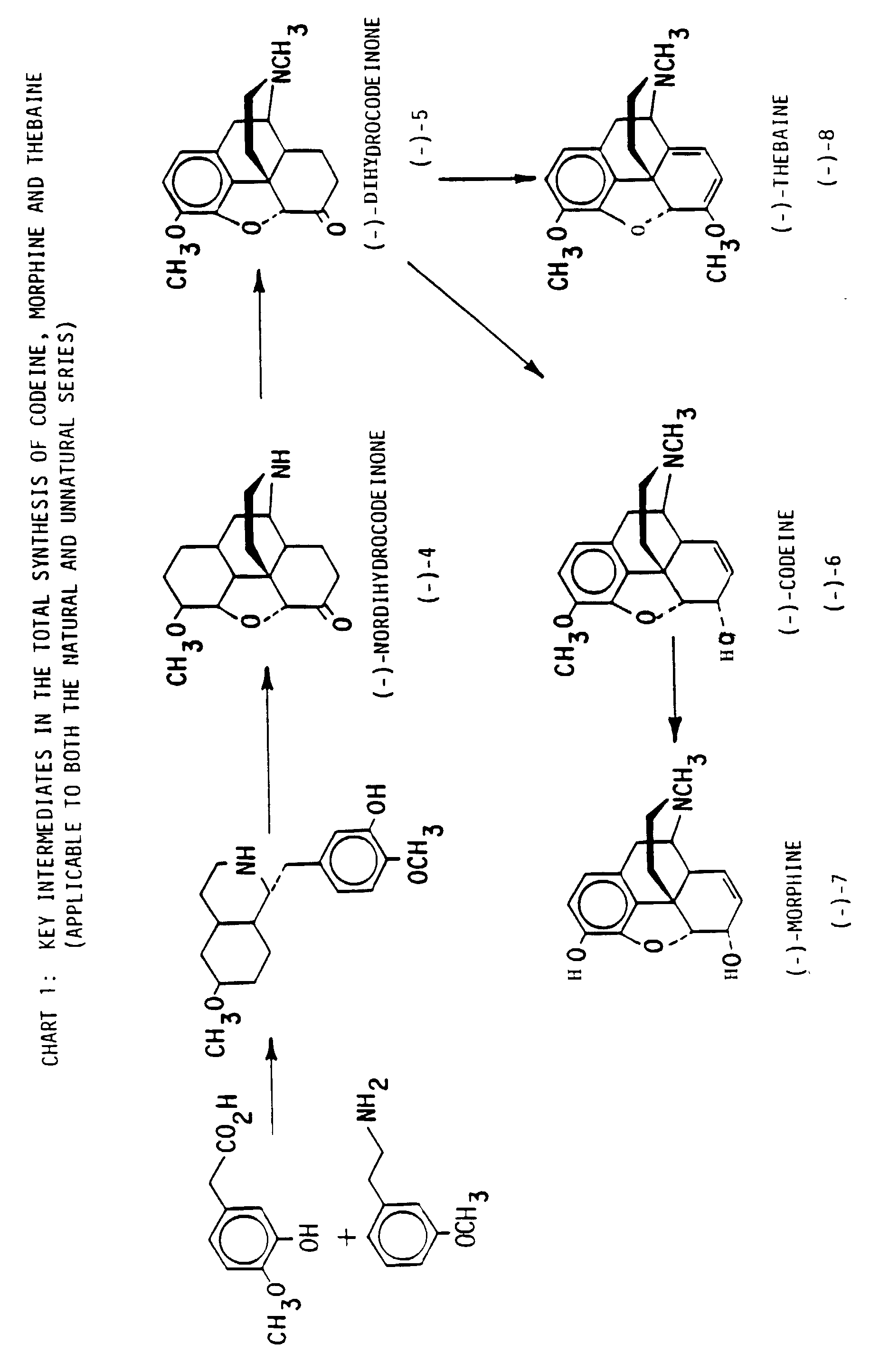
- the instant invention can also be used to prepare codeine (6), morphine (7), and related compounds via norcodeine (39) and normorphine (42) in both the natural and unnatural opiate series.
- a strong base for example an organic base such as potassium t-butoxide, or sodium hydroxide or sodium amide, in an ether or hydrocarbon solvent such as tetrahydrofuran to give norcodeinone ketal (37).
- Hydrolysis to norcodeinone (38) followed by reduction, e.g., with sodium borohydride or other alkali butoxide, gives norcodeine (39).
- norcodeine O-demethylation of norcodeine with BBr 3 e.g., then gives normorphine (42).
- N-methylation of (39) and (42) provides codeine (6) and morphine (7), respectively, as either the natural or unnatural isomers, depending upon the absolute configuration of (11).
- Codeine can also be obtained from norcodeinone (38) by treatment with formaldehyde and sodium borohydride or cyanoborohydride. Codeine can also be obtained by reductive alkylation of norcodeine with formaldehyde and borohydride.
- nalorphine 3-O-methyl ether (40) and nalorphine (41, Nalline) can be obtained by alkylation with allyl bromide under standard conditions. Treatment of 40 with BBr 3 also gives nalorphine (41), a clinically used narcotic antagonist.
- (+)nordihydrocodeinone [(+)-4] illustrate the instant invention in the unnatural (+)-opiate series.
- (-)-nordihydrocodeinone [(-)-4] it is merely necessary to employ (-)-nordihydrocodeinone [(-)-4] in an exact replication of the process.
- the (-)-enantiomers described above are obtained which are identical in every respect with authentic samples prepared by classical routes from opium.
- (-)-northebaine prepared by N-demethylation of natural (-)-thebaine could be utilized instead of the identical substance prepared by total synthesis.
- the addition funnel was rinsed with 10 mL dry THF and the reaction mixture stirred at reflux for 30 min at which time GC analysis of the basic fraction showed complete loss of starting material and a mixture of 90% ketal and 10% 8,14-dihydrothebaine.
- the condenser was replaced with a fractional distillation apparatus and 30 mL MeOH was removed by distillation.
- the reaction mixture became cloudy, as crystals (5-sulfosalicyclic acid salt of 10) separated.
- reaction mixture was poured, under an atmosphere of argon, into 150 mL of vigorously stirred 10% NaOH, at 0°C, and allowed to stir for 5 min; the reaction flask was washed with 30 mL THF. Removal of the residual THF in vacuo, followed by extraction with 1 x 100 mL and 2 x 50 mL CHCl 3 then washing the combined organic extract with 1 x 50 mL H 2 O and removal of volatiles in vacuo resulted in a brown syrup.
- Northebaine [(+)-12] (14.8 g, 50 mmol) was added to a solution of 6.5 mL 88% formic acid and 26 mL 0.7% sulfuric acid, followed by addition of 7.2 mL 30% H 2 O 2 .
- the resulting heterogeneous reaction mixture became homogeneous and golden brown and was allowed to stir at room temperature for 48 h.
- Neutralization with 120 mL 10% Na 2 CO 3 (pH 9.5) gave crystalline material that was filtered and washed with 50 mL H 2 O and 100 mL MeOH to give 12.1 g (81%) cream-colored crystalline product.
- the aqueous filtrate was saturated with NaCl, extracted with 4 x 100 mL CHCl 3 /MeOH (9:1).
- (+)-18 O-Demethylation of (+)-18 was performed, dissolving 150 mg of (+)-18 (0.5 mmol) in 1.5 mL CHCl 3 and adding the solution to a stirring mixture of BBr 3 (0.3 mL, 30 mmol) in 1.5 mL CHCl 3 at 0°C.
- the pale yellow heterogeneous reaction mixture was allowed to stir at 0°C for 20 min and at room temperature for 40 min.
- the reaction was quenched by pouring onto 4 g ice/2 ml NH 4 OH (pH 9.5) and was allowed to stir at 0°C for 30 min.
- the white crystalline material was filtered, washed with 10 mL cold H 2 O and 10 mL cold CHCl 3 , and dried in a vacuum oven over night.
- This compound can be prepared from (+)-naltrexone [(+)-21] as described by Hahn, et al, J. Med. Chem., 1975, Vol. 18, pp 259-262, for the (-)-isomer.
- the hydrochloride salt was prepared in 2-propanol with HCl/2-propanol (pH 2), and crystallized and recrystallized in 2 propanol to give (+)-nalmefene.HCl mp 199-200°C, lit.
- (+)-37 was isolated as a white feathery dihydrate (as seen in NMR analysis) 1.60 g (100%) mp 113-114°C, lit., Bartels-Keith, J. Chem. Soc. (C) , 1966, 617-624, for (-)-37, mp 113-114°C.
Landscapes
- Chemical & Material Sciences (AREA)
- Organic Chemistry (AREA)
- Organic Low-Molecular-Weight Compounds And Preparation Thereof (AREA)
- Pharmaceuticals Containing Other Organic And Inorganic Compounds (AREA)
- Nitrogen Condensed Heterocyclic Rings (AREA)
Abstract
Description
- The present invention relates to a total synthesis proceeding from nordihydrocodeinone (4) as in the post scheme, and a key aspect is that a facile method has now been developed, utilizing said nordihydrocodeinone intermediates throughout, for conversion of (4) to northebaine (12), noroxymorphone (19), norcodeine (39), normorphine (42) and derivatives. Since both (+)- and (-)-nordihydrocodeinone are equally available by the earlier Rice patents, the present disclosure is applicable and pertains to synthesis of compounds of both the natural (-)- and unnatural (+)-stereochemical series.
- previous Rice patents, US 4,368,326 and 4,521,601, disclose the total synthesis of either enantiomer of nordihydrocodeinone (4) and the subsequent conversion of this compound to the N-methyl derivative, dihydrocodeinone (5), which is a useful intermediate in this context for synthesis of codeine (6), morphine (7) and thebaine (8); (see Chart 1, illustrated with the natural stereo-chemistry). The latter three compounds are the only raw materials obtained from opium which are of value in the production of narcotics, narcotic antagonists and the agonist-antagonist drugs. In the standard manufacturing process of the narcotic antagonists, naloxone (20), naltrexone (21), nalmefene (22), and the agonist-antagonist nalbuphine (26), (-)-thebaine [(-)-8] is obtained by extraction from opium and utilized as starting material. (-)-Codeine has also been advanced as a possible starting material for these compounds. Since both natural thebaine and codeine have a methyl substituent on the nitrogen, removal of the methyl group and replacement with a cycloalkylmethyl or allyl group and other structural alterations are necessary in order to obtain the desired pharmacological profile in the final products. For example, in the synthesis of the narcotic antagonists, natural thebaine is sequentially oxidized to 14-hydroxycodeinone, reduced to 14-hydroxydihydrocodeinone, O-demethylated to oxymorphone. The methyl group is then removed by the following sequence: acetylation to the 3,14-diacetoxy derivative, reaction with cyanogen bromide or a chloroformate ester, and hydrolyzed to noroxymorphone which is finally alkylated with the appropriate allyl halide.
- A major disadvantage of the commercial process is the multistep removal of N-methyl group involving the acylation reaction, reaction with cyanogen bromide or phosgene-derived chloroformate (which are toxic and otherwise dangerous reagents), and the hydrolysis step. The hydrolysis of the N-cyano employed in the standard process requires prolonged heating with a large excess of 25% sulfuric acid that results in partial destruction of the desired noroxymorphone
- Accordingly, in a first aspect of the invention, there is provided a process of producing an intermediate for the production of opiate narcotics, agonist-antagonist drugs, and stereoisomers thereof, comprising the steps of:
- (a) refluxing nordihydrocodeinone having an
unsubstituted N-substituent with an organic acid and
trialkylorthoformate in a short chain alcohol ROH, where
R is C1-C4 alkyl under an inert atmosphere to yield an
alcoholic mixture of dialkyl ketal (I):
and a delta-6-enol ether (II):
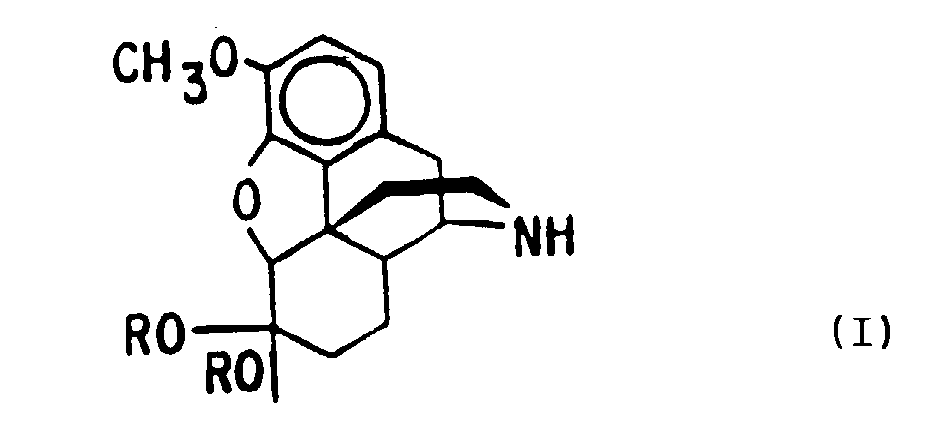

- (b) completely converting the dialkyl ketal (I) in said mixture to the delta-6-enol ether (II);
- (c) reacting the delta-6-enol ether (II) from step
(b) with an organic acid and a halogenating agent to
yield a hydrohalide salt of a 7-halo-dialkyl ketal (III) :
where X=halo, wherein said process occurs without substitution of said N-substituent.
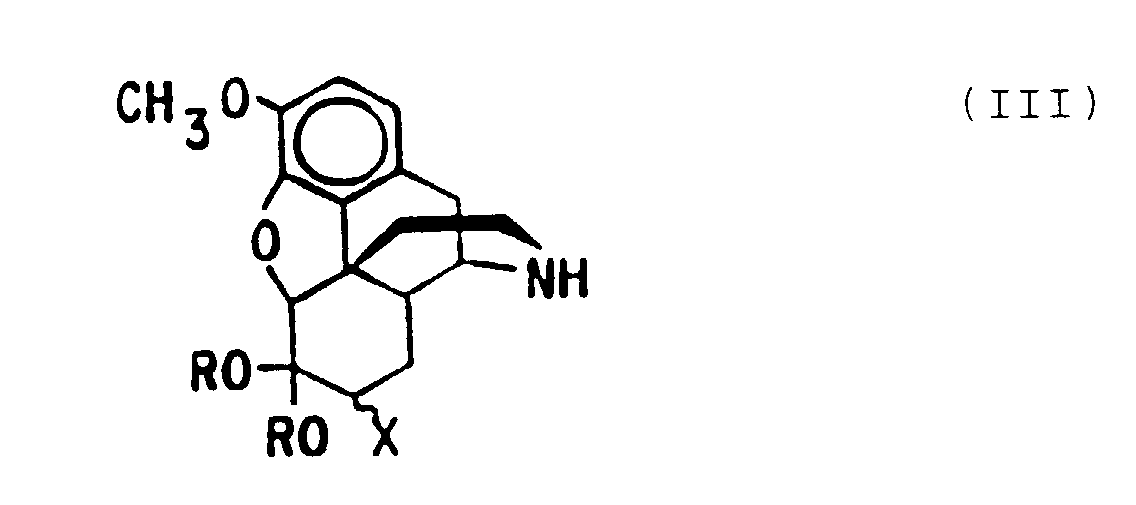
-
- In a second aspect of the invention, there is provided hydrobromide salt of optically active crystalline (+)7-bromodialkyl ketal of nordihydrocodeinone (III) and salts thereof.
- Preferred embodiments of the invention in either of its aspects are as defined in the sub-claims.
- The instant invention is a process in which nordihydrocodeinone (4), an early intermediate in the total synthesis of codeine, morphine and thebaine, Chart 1, is converted through intermediates without substituents on nitrogen to a number of versatile N-nor intermediates. These compounds can serve as precursors for a number of important drugs (with the natural opiate stereochemistry) currently used in the practice of medicine. The process thus eliminates the need for thebaine for the total synthesis of these drugs. Since nordihydrocodeinone is directly available by the total synthesis as either the (+)- or (-)-enantiomer, optional access is provided to either the natural or unnatural opiate series. Since the N-nor intermediates can be N-alkylated at any stage to afford a desired N-substituted product, the process is much more versatile than the classical route, and substantially shorter because the N-demethylation sequence is eliminated.
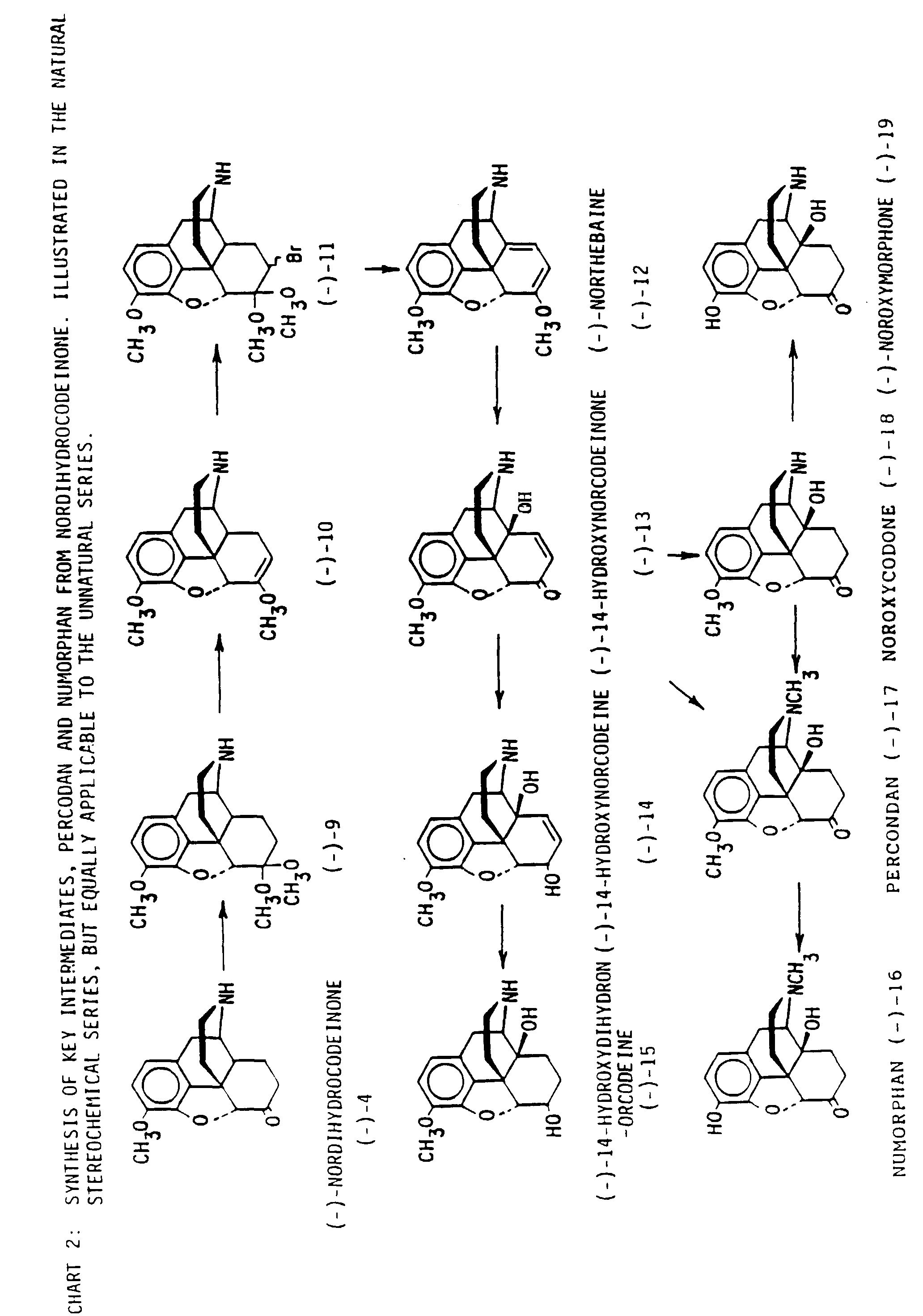
- For total synthesis, the instant invention thus differs from the prior art by not utilizing thebaine, that is, it is unnecessary to introduce the methyl group (4-->5, Chart 1) and then remove it after further transformation of thebaine. This results in a shorter and more economical process by eliminating a substantial number of steps and requirements for labor and raw materials. Furthermore, each step in the process gives very high yields and each isolated intermediate is obtained pure, or very nearly so, by simple crystallization and washing.
- A description of the preferred process follows (Chart 2-7). Anhydrous nordihydrocodeinone (4) as either enantiomer is treated with a mixture of trialkyl orthoformate, corresponding short chain alkyl alcohol, such as methanol and 5-sulfosalicylic acid, methane sulfonic acid or other organic acid to give a mixture of the ketal (9) and enol ether (10) Tetrahydrofuran is added and distilled to completely convert the mixture to enol ether (10) which can be isolated in 90% yield. Conversion can also be accomplished by addition of a strong base, such as potassium t-butoxide, or other organic base. Treatment of the enol ether (10) in a short chain alcohol such as methanol with halogenating reagent, preferably a brominating reagent such as N-bromoacetamide and organic acid such as methanesulfonic acid, 5-sulfosalicylic acid, give 88% yield of crystalline bromoketal (11) as the hydrobromide. Treatment of compound (11) with a strong organic base, such as potassium t-butoxide in dimethylsulfoxide or sodium hydride, sodium amide in aprotic organic solvent then gives northebaine (12) in 97% yield. Oxidation of northebaine (12) with performic acid formed in situ afforded pure 14-hydroxynorcodeinone (13) in 90% yield after crystallization from any short chain alcohol, such as methanol or other suitable purification technique. Catalytic hydrogenation of compound (13) (generally with palladium) smoothly affords crude nearly pure noroxycodone (18) in quantitative yield. Addition of formaldehyde in this hydrogenation provides the clinically used agonist percodan (17). O-Demethylation of percodan (17) by standard procedures gives numorphan (16) also used clinically as a potent narcotic agonist. Brief treatment (O-demethylation) of compound (18) with BBr3 or other standard O-demethylation procedure then gives noroxymorphone (19). Percodan (17) and numorphan (16) are also available by N-methylation of compounds (18) and (19), respectively, using standard methods.
- Noroxymorphone (19) is a centrally important precursor for naloxone (20), naltrexone (21) nalmefene (22), all valuable narcotic antagonists in the natural stereochemical series (Chart 3). N-alkylation of compound (19) with allyl or cyclopropylmethyl bromide by standard methods gives naloxone and naltrexone, respectively. These compounds can also be obtained (Chart 3) by alkylation of noroxycodone (18) to compounds (23) and (24), followed by O-demethylation with BBr3 or other suitable reagent. Reaction of naltrexone (21) with methylene triphenylphosphorane according to standard protocol then gives nalmefene (22). Stereoselective reduction of 14-hydroxynorcodeinone (13) generally with any stereoselective reduction agent, preferably an alkali borohydride such as sodium borohydride, gives 14-hydroxynorcodeine (14) to the exclusion of the isocodeine derivatives (Chart 2). Catalytic hydrogenation of compound (14), typically with palladium, provides a quantitative yield of 14-hydroxynor-dihydrocodeine (15).
- As shown in Chart 4, N-cyclobutyl-methylation of (15) to (25) followed by O-demethylation of (25) gives nalbuphine (26, Nubaine), a clinically useful agonist-antagonist drug. Alternately, O-demethylation of (15) to 14-hydroxydihydronormorphine (27) followed by N-cyclobutylation gives nalbuphine.
- The potent narcotic agonist Foxy which is useful in pharmacological studies can also be obtained (Chart 5) from (-)-(14) by hydrogenation in the presence of formaldehyde to (28), previously converted to Foxy (29). Hydrogenation of (14) to (15) followed by N-methylation of (15) gives (28) the same intermediate to Foxy. The potent narcotic antagonist cyclofoxy (30), when labeled with [18F], was recently shown to be a highly useful agent for labeling opiate receptors in the living brain by positron emission tomography. This compound is easily available from (15) by N-cyclopropylation to (31) which is O-demethylated to the corresponding 6 α-naltrexol 32 and treated as previously described by prior art. Alternately, conversion of (27) to the N-cyclopropylmethyl derivative affords the same intermediate naltrexol. Previously, the naltrexol was prepared by borohydride reduction of naltrexone and required chromatographic fractionation to remove the corresponding 6-B-isomer.
- An additional utility of the instant invention is that it renders N-alkylnorthebaines including thebaine (8) readily available by total synthesis in either the natural or unnatural series by simple alkylation or reductive alkylation of the appropriate enantiomer of northebaine (12) as shown in Chart 6. For example, treatment of northebaine with cyclopropylmethylbromide gives cyclopropylmethylnorthebaine (33), an intermediate useful for synthesis of buprenorphine (34), a state of the art agonist antagonist drug which is effective by sublingual administration. The potent antagonist diprenorphine (35) can also be prepared from N-cyclopropylmethylnorthebaine by prior art procedures which were demonstrated only in the natural stereochemical series.
- It is thus clear that the instant invention is an extremely practical thebaine-free total synthesis of all clinically used 14-hydroxymorphinans and other (-)-thebaine derivatives, such as (34) and (35), as well as other important compounds derived from opium. The process is shorter and more flexible than total synthesis through thebaine and is also applicable to synthesis of the unnatural opiate series (not available from opium derivatives), some members of which are potent antitussives.
- As discussed above, the instant invention eliminates requirements for thebaine for the production of medically useful drugs by total synthesis. The process is, however, applicable to synthesis of drugs from opium derived starting material via semisynthetic northebaine since northebaine is an intermediate in the invention and existing methodology developed by others permits facile, high-yielding synthesis of (-)-northebaine from natural thebaine.
- The instant invention can also be used to prepare codeine (6), morphine (7), and related compounds via norcodeine (39) and normorphine (42) in both the natural and unnatural opiate series. In this sequence (Chart 7), the norbromoketal (11) is treated with a strong base, for example an organic base such as potassium t-butoxide, or sodium hydroxide or sodium amide, in an ether or hydrocarbon solvent such as tetrahydrofuran to give norcodeinone ketal (37). Hydrolysis to norcodeinone (38), followed by reduction, e.g., with sodium borohydride or other alkali butoxide, gives norcodeine (39). O-demethylation of norcodeine with BBr3 e.g., then gives normorphine (42). N-methylation of (39) and (42) provides codeine (6) and morphine (7), respectively, as either the natural or unnatural isomers, depending upon the absolute configuration of (11). Codeine can also be obtained from norcodeinone (38) by treatment with formaldehyde and sodium borohydride or cyanoborohydride. Codeine can also be obtained by reductive alkylation of norcodeine with formaldehyde and borohydride.
- As an example of the utility of (39) and (42), nalorphine 3-O-methyl ether (40) and nalorphine (41, Nalline) can be obtained by alkylation with allyl bromide under standard conditions. Treatment of 40 with BBr3 also gives nalorphine (41), a clinically used narcotic antagonist.
- Melting points were determined on a Thomas-Hoover melting point apparatus and are corrected. Elemental analyses were performed by Atlantic Microlabs, Atlanta, Georgia. IR spectra were determined on a Beckman IR 4230 spectrophotometer; mass spectra (chemical ionization NH3) were obtained on a Finnegan 1015 spectrometer (NH3-CI) and lN-NMR were obtained on Varian XL 300 or Varian 220 NMR spectrometers. Optical rotations were measured with a Perkin-Elmer Model 241 polarimeter. Silica gel GF plates (Analtech, Newark, Del.) were employed for thin layer chromatography (TLC) and a Hewlett Packard 5880A gas chromatograph with a 6-ft methyl silicone column was used for capillary gas chromatography (GC). Acidification of non-aqueous solutions in some cases was monitored by application of an aliquot to moist pH indicator sticks (E. Merck). TLC and GC were used to compare all enantiomeric compounds throughout the synthesis and as criteria for purity. All synthesized products had Rf values and retention times which were identical with those of their authentic (-)-enantiomers. All other spectral data obtained on each (+)-enantiomer were identical to that of authentic (-)-enantiomers with the exception of opposite optical rotation.
- The following examples beginning with (+)nordihydrocodeinone [(+)-4] illustrate the instant invention in the unnatural (+)-opiate series. For synthesis of the (-)-compounds with the natural opiate absolute configuration of the carbon nitrogen skeleton, it is merely necessary to employ (-)-nordihydrocodeinone [(-)-4] in an exact replication of the process. In this manner, the (-)-enantiomers described above are obtained which are identical in every respect with authentic samples prepared by classical routes from opium. Obviously, (-)-northebaine prepared by N-demethylation of natural (-)-thebaine could be utilized instead of the identical substance prepared by total synthesis.
- A solution of 22.8 g 5-sulfosalicylic acid (90 mmol) in 8 mL MeOH was added to 38 g trimethyl orthoformate (352 mmol) in 8 mL MeOH and allowed to stir at reflux for 5 min, under an atmosphere of argon. A solution of 22.8 g (64 mmol) of anhydrous (+)-nordihydrocodeinone [(+)-4] in 30 mL MeOh was added dropwise at a constant rate to the refluxing reaction mixture via addition funnel over 1 h. If the addition is too rapid the insoluble salt of the starting material will crystallize and the reaction will not go to completion because of the low solubility of this salt. The addition funnel was rinsed with 10 mL dry THF and the reaction mixture stirred at reflux for 30 min at which time GC analysis of the basic fraction showed complete loss of starting material and a mixture of 90% ketal and 10% 8,14-dihydrothebaine. The condenser was replaced with a fractional distillation apparatus and 30 mL MeOH was removed by distillation. The reaction mixture became cloudy, as crystals (5-sulfosalicyclic acid salt of 10) separated. Dry THF was added at the rate of distillation via addition funnel; after distillation of 300 mL THF, GC (RT = 4.90, 220°C) and TLC analysis showed reaction was complete. The reaction mixture was poured, under an atmosphere of argon, into 150 mL of vigorously stirred 10% NaOH, at 0°C, and allowed to stir for 5 min; the reaction flask was washed with 30 mL THF. Removal of the residual THF in vacuo, followed by extraction with 1 x 100 mL and 2 x 50 mL CHCl3 then washing the combined organic extract with 1 x 50 mL H2O and removal of volatiles in vacuo resulted in a brown syrup. Crystallization from EtOAc afforded 17.09 g (90%) of (+)-10; mp 148.5-150.5°C (mp lit 152--152.5°C) which was homogeneous and identical to the (-)-enantiomer by TLC and homogenous by TLC and GC analysis (220°C). Anal. calc. for C18H21NO3: C, 72.26; H, 7.02: N, 4.64. Found: C, 72.16; H, 7.12; N, 4.64. [α]D 20 + 217.6 (c, 1.27, CHCl3).
- A solution of 27.0 g (+)-10 (90 mmol) in 400 mL MeOH was mechanically stirred at 0°C under an atmosphere of argon. A solution of 9.45 mL methanesulfonic acid (126 mmol) in 75 mL MeOH was added and the reaction mixture was allowed to stir at 0°C for 10 min N-bromoacetamide (NB; 11.2 g, 81 mmol) was slowly added portionwise to the reaction mixture. After stirring for 20 min, 1.0 g NBA (6.3 mmol) was added followed by 20 min stirring and an additional 250 mg NBA (1.8 mmol). After 10 min additional stirring, the reaction was complete by GC and TLC analysis. Saturation with NH3 gas to pH 9.5 followed by removal of MeOH, in vacuo, resulted in a yellow syrup. The mixture was treated with 200 mL of 20% NH4OH and extracted with 3 x 100 mL of CHCl3. The organic phase was washed with 100 mL 20% NH4OH/H2O and evaporated to a syrup. Distillation of toluene followed by isooctane, and drying in high vacuum gave 37.55 g of off-white foam that was 95% pure by GC analysis. This material was dissolved in 40 mL hot MeOH and acidified with freshly prepared HBr/MeOH. Cooling to 0°C gave 38.1 g of white crystalline (+)-11.HBr (88%), mp 232°C. Anal. calc. for C19H24No4.HBr: C, 46.47; H, 4.09; N, 2.58. Found: C, 46.30; H, 5.18; N, 2.80. [a]D 28 + 116.0 (c, 1.06, CHCl3).
- To a mixture of potassium t-butoxide (9.0 g, 83.2 mmol) and 40 mL DMSO at 0°C, was added 5.0 g of (+)-11 base (10.4 mmol) and allowed to stir at room temperature. The orange reaction mixture was gently warmed to 45°C and after 30 min, GC analysis showed complete loss of starting material. After 2 h, 2.25 g potassium t-butoxide was added (20.8 mmol) and the reaction was completed in 15 min. The reaction mixture was cooled to 0°C, quenched with 100 mL H2O and extracted with 3 x 100 mL CHCl3. The organic phase was washed with 50 mL H2O and evaporated to a yellow syrup. Addition and evaporation of MeOH gave crystalline product: 2.87 g (97%), mp 157-158°C, lit. Bartels-Keith, J. Chem. Soc. (C), 1966, 617-624, mp for (-)-12, mp 157-159°C. Anal. Calc. for CF18H19NO3: C, 72.74; H, 6.39; N, 4.71. Found: C, 72.60; H, 6.48; N, 4.65. [α]D 28 + 235.2 (C, 1.08, CHCl3).
- Northebaine [(+)-12] (14.8 g, 50 mmol) was added to a solution of 6.5 mL 88% formic acid and 26 mL 0.7% sulfuric acid, followed by addition of 7.2 mL 30% H2O2. The resulting heterogeneous reaction mixture became homogeneous and golden brown and was allowed to stir at room temperature for 48 h. Neutralization with 120 mL 10% Na2CO3 (pH 9.5) gave crystalline material that was filtered and washed with 50 mL H2O and 100 mL MeOH to give 12.1 g (81%) cream-colored crystalline product. The aqueous filtrate was saturated with NaCl, extracted with 4 x 100 mL CHCl3/MeOH (9:1). Evaporation of the extracts in vacuo and crystallization in MeOH resulted in 1.3 g (9%) crystalline product. Recrystallization of the combined material gave 13.4 ag (90%) product which was homogeneous by TLC; mp 209210°C. Anal. calc. for C17H17NO4.3/4 H2O: C, 65.29; H, 5.92; N, 4.47. Found: C, 65.12; H, 6.02; N, 4.45. [α]D 25 + 171.73 (10.4, CHCl3).
- Catalytic hydrogenation of (-)-13 (4.5 g, 15 mmol) in 90 mL 10% glacial acetic acid (w/w) and 500 mg 5% Pd/BaSO4 was followed by filtration over celite and washing the filter pad with 100 mL glacial acetic acid and 100 mL 10% glacial acetic acid. Neutralization of the filtrate with NH4 OH to pH 9.5 and extraction with 3 x 50 mL CHCl2 and 3 x 50 mL CHCl3/MeOH 9:1 followed by removal of volatiles, in vacuo, resulted in a white powder 4.5 g (100% crude) that was 98.8% pure by GC analysis. Purification by preparation of the HI salt, in MeOH followed by recrystallization with MeOH/ether gave the HI salt of (+)-18 which was homogeneous by TLC. Anal. calc. for C17H19NO4.HI : C, 47.58; H, 4.66; N, 3.26. Found: C, 47.55; H, 4.74; N,. 3.23.[α]D 25 + 100.4 (C, 0.55, MeOH).
- O-Demethylation of (+)-18 was performed, dissolving 150 mg of (+)-18 (0.5 mmol) in 1.5 mL CHCl3 and adding the solution to a stirring mixture of BBr3 (0.3 mL, 30 mmol) in 1.5 mL CHCl3 at 0°C. The pale yellow heterogeneous reaction mixture was allowed to stir at 0°C for 20 min and at room temperature for 40 min. The reaction was quenched by pouring onto 4 g ice/2 ml NH4 OH (pH 9.5) and was allowed to stir at 0°C for 30 min. The white crystalline material was filtered, washed with 10 mL cold H2O and 10 mL cold CHCl3, and dried in a vacuum oven over night. The crystalline (+)-19, 80 mg (60% yield), was homogeneous and identical to authentic (-)-noroxymorphone by TLC, mp d >260°, mp (-)-noroxymorphone d >260°C, MS (CI) M+1 288, (HCl salt). The HCl salt of (+)-19 was formed in MeOH and gave (+)-19°HCl which was homogeneous by TLC, mp >260°C. [α]D 22 + 126.95 (C, 0.82, MeOH).
- A mixture of 2.1 g of (+)-18 (7 mmol), 21 mL dry DMF and 4.9 g anhydrous K2CO3 (35 mmol) was allowed to stir at 0°C. Allyl bromide (0.7 mL, 8 mmol) was added and the heterogeneous reaction mixture was allowed to stir at 0°C for 10 min and room temperature for 1.5 h. The inorganic material was removed by suction filtration and washed repeatedly with a total of 50 mL CHCl3. The filtrate was then washed with 3 x 10 ml 10% Na2CO3 and 1 x 10 mL H2O; evaporated in vacuo to a clear syrup, then dried on a vacuum pump at 50°C, resulting in 2.2 g white foam (92% crude). The crude product was dissolved in a minimum volume of hot 2-propanol and acidified in pH <2 with HCl/2 propanol. Crystallization and recrystallization in 2 propanol gave 2.8 g of (+)-23.HCl (86%) mp 248-250°C. Anal. calc. for C20H23NO4.HCI.1/2 H2O: C, 62.12; H, 6.21; N, 3.62. Found: C, 62.34; H, 6.49; N, 3.62. [α]2 D 2 + 176.11 (C, 0.95, MeOH).
- Conversion of 680 mg of (+)-23.HCl (1.8 mmol) to the free base was performed in the usual manner. The dry, foamy free base was dissolved in 5 mL CHCl3 and added dropwise to a stirring solution of 1.0 mL BBr3 (10.7 mmol) in 5 mL CHCl3 at 0°C. The addition funnel was washed with 2 ml CHCl3 and the reaction mixture was allowed to stir at 0°C for 40 min then room temperature for 20 min. The reaction was quenched by pouring onto 15 g ice/4 mL NH4 OH (pH 9) and allowed to vigorously stir at 0°C for 30 min. The organic layer was removed and the aqueous layer extracted with 4 x 10 mL CHCl3. The organic fractions were combined and washed with 2 x 10 mL brine and 2 x 10 mL H2O. Volatiles were removed in vacuo to give 450 mL white solid (80% crude). The crude product crystallized and was recrystallized in hot EtOAc to give 300 mg crystalline (+)-20 (60%), mp 167-168°. The free base was converted to the hydrochloride salt by dissolving in a minimum volume of 2 propanol and accordingly to pH 2 with HC1/2-propanol. Recrystallization in absolute ethanol gave (+)-20:HCl as white crystals, mp 206-210°C, lit. Merck Index, 10th ed., 1983 or (-)-2 0:HC 1, mp 200-205°C. Anal. Calc. C19H21NO4:HCl:2H2O: C, 57.10; H, 6.51; N, 3.50. Found: C, 57.07; H, 6.37; N, 3.37. [A]2 D 2 + 148.6 (0.97, MeOH).
- A heterogeneous solution of 5.57 g of (+)-18 (18.5 mmol), 50 mL dry DMF and 13.0 g anhydrous K2CO3 (92.5 mmol) was allowed to stir at 0°C. Bromomethylcyclopropane (2.2 mL, 22 mmol) was added and the heterogeneous reaction mixture was allowed to stir at 0°C for 10 min, then for 24 h at room temperature. The inorganic material was removed by suction filtration and washed with 200 mL CHCl3. The filtrate was washed with 3 x 100 mL 10% aqueous Na2CO3 and 100 mL H2O and the volatiles were removed in vacuo. Distillation of toluene and drying at 50°C in high vacuum gave a white foamy product, 5.9 g (90% crude). The free base was converted into the hydrochloride salt by dissolving in a minimum volume of hot 2-propanol and acidifying to pH 2 with HC1/2-propanol. Crystallization and recrystallization gave 7.0 g (84%) of (+)-24.HCl.1 isopropanol white crystalline salt; mp 235-238°C. Anal. Calc. C21H25NO4:HCl:3/2 H2O: C, 60.23; H, 6.93; N, 3.34. Found: C, 60.41; H, 6.89; N, 3.34.
- Conversion of 2.35 g (+)-24.HCl isopropanol into the free base was performed by extraction from 10% aqueous Na2CO3 into CHCl3 to give 2.1 g of white foamy free base which was dissolved in 18 mL CHCl3 (dried over 3A molecular sieves) and added dropwise to a stirring solution of 3.5 mL BBr3 (freshly distilled over Hg) and 18 mL CHCl3 at 0°C. The addition funnel was washed with 7 mL CHCl3 and the reaction was allowed to stir for 20 min at 0°C and 45 min at room temperature. The reaction mixture was quenched on 53 g ice/18 mL NH4 OH (pH 9.5) and after washing the reaction flask with aqueous NH4OH/CHCl3, it was allowed to stir for 30 min at 0°C. The aqueous mixture was extracted with 4 x 30 mL CHCl3 and the organic phase was washed with 2 x 30 mL H2O and 2 x 50 mL brine, dried (Na2SO4) and the volatiles were removed in vacuo resulting in 1.8 g white foam (88% crude). Crystallization and recrystallization in EtOAc gave 1.15 g of (+)-21 white crystals (57%); mp 155°C. Anal. calc for: C20H23NO4.1/4 EtOAc: C, 69.44; H, 6.88; N, 3.85. Found: C, 69.42; H, 6.88; N, 4.00.[α]2 D 2 + 194.51 ;(C, 0.82, MeOH).
- This compound can be prepared from (+)-naltrexone [(+)-21] as described by Hahn, et al, J. Med. Chem., 1975, Vol. 18, pp 259-262, for the (-)-isomer. The (+)-compound showed mp 186-187°C, (-)-nalmefene, mp 187-189°C (GC analysis showed 100% purity, RT = 7.42, 220°C). The hydrochloride salt was prepared in 2-propanol with HCl/2-propanol (pH 2), and crystallized and recrystallized in 2 propanol to give (+)-nalmefene.HCl mp 199-200°C, lit. Hahn, et al, J. Med. Chem., 1975, Vol. 18, pp 259-262, mp for (-)-nalmefene.HCl 197-198°C. Anal. calc. for C21H25NO3.HCl.1/2 H2O: C, 65.47; H, 7.41; N, 3.45. Found: C, 65.52; H, 7.07; N, 3.63. [c]22 + 1.43.7 (C, 1.05, MeOH), corrected for anhydrous + 147.2 [α]D 22 (authentic (-)-145.4 (C, 1.04, MeOH).
- Conversion of 2.5 g of (+)-11 to the free base (2.13 g foam, 4.26 mmol) was done with 20% NH4 OH and ether extraction followed by drying. To a solution of the free base in 42 mL dry THF, 1.15 g potassium t-butoxide (8.5 mmol) was added and the reaction mixture was allowed to stir at room temperature, under an atmosphere of argon for 24 h. GC analysis showed the reaction was complete (RT = 5.17, 220°C); the THF was removed in vacuo and 15 ml H2O was added. The (+)-37 was isolated as a white feathery dihydrate (as seen in NMR analysis) 1.60 g (100%) mp 113-114°C, lit., Bartels-Keith, J. Chem. Soc. (C), 1966, 617-624, for (-)-37, mp 113-114°C. Anal. calc. for C19H23NO4.3/4 H2O: C, 66.58; H, 7.14; N, 4.08. Found: C, 66.49; H, 7.23; N, 4.00 D 28 + 215.9 (C, 1.09, CHCl3).
- A solution of 1.0 g (+)-37 (3 mmol) in 15 mL 3N HCOOH (2.35 g 88% HCOOH in a total volume of 15 mL H2O) was allowed to stir at room temperature for 20 min at which time GC analysis showed complete loss of starting material. The reaction mixture was neutralized to pH 5.5-6.0 with portionwise addition of solid NaHCO3 at 0°C1. Sodium borohydride (90 mg, 3.4 mmol) was added and the reaction mixture, was allowed to stir for 20 min. To the completed reaction mixture, 6 ML 1.0 N NaOH was added and extraction with 3 x 10 mL CHCl3 followed by removal of solvent in vacuo resulted in a white foam which crystallized in 2-propanol to give a(+)-6. 750 mg (90%) mp 178-181°C, d-authentic sample of (-)-6, mp 181-183°C. Anal. Calc. for C17H19NO3: C, 71.60; H, 6.66; N, 4.91. Found: C, 71.45; H, 6.76; N, 4.84. [α]2 D 8 + 115.23 (C, 1.09, CHCl3).
- To a solution of 540 mg (+)-norcodeine [(+)-39] (1.9 mmol) in 6 mL of dry DMF, 1.33 g K2CO3 (9.5 mmol) and 0.19 mL allyl bromide (2.1 mmol) were added at 0°C. The reaction mixture was allowed to stir at 0°C for 10 min, then at room temperature for 50 min. Inorganic material was removed by suction filtration and washed with 10 mL CHCl3. Volatiles were removed in vacuo from the filtrate which was then extracted with 3 x 10 mL CHCl3 from 10 mL 10% Na2CO3 followed by washing of the organic phase with 10 mL H2O and evaporation of solvent. Crystallization from ether gave 445 mg white crystalline (+)-40 (72%) that was homogeneous by TLC. mp 91-93°C, lit, J. Am. Chem. Soc., 1942, 64:869, mp for (-)-40, 93°C. Anal. Calc. for C20H23NO3: C, 73.86; H, 7.07; N, 4.31. Found: C, 73.76; H, 7.13; N, 4.28. [α]2 D 5 + 130.40 (C, 0.99, CHCl3).
- A solution of 235 mg (+)-40 (.72 mmol) in 1.5 mL CHCl3 was added dropwise over 1 min to a solution of 0.44 mL BBr3 (4.3 mmol freshly distilled over Hg) in 13 mL CHCl3 at 0°C. The addition funnel was washed with 1 mL CHCl3 and the reaction mixture was allowed to stir at 0°C for 20 min and room temperature for 20 min. The yellow heterogeneous reaction mixture was poured onto 6 g ice/3 mL NH4 OH (pH 9.5) and allowed to stir at 0°C for 45 min. The volatiles were removed in vacuo resulting in a gummy product which was dissolved in 5 mL CHCl3 and washed with 2 x 10 mL 10% NH4 OH; the aqueous phase was then washed with 5 x 10 mL CHCl3 and the combined CHCl3 fractions were washed with 1 x 10 mL H2O. Evaporation of solvent and distillation of toluene resulted in 300 mg crude product which crystallized in ether, to give 200 mg of (+)-41, (89%) mp 188-191°C, lit, Merck Index, 10th ed., 1983, mp for (1)-41, 208-209°C. Purification by formation of the hydrochloride salt in 2-propanol and recrystallization in MeOH gave 150 mg (45%) of pure HCl (+)-41 as the salt, mp d >260, lit. Merck Index, 10th ed., 1983, mp for (-)-41:HCl d 269°C. [α]2 D 5 + 99.91 :(C, 1.06, MeOH).
- It is understood that in the claim structure below the compounds in their preparation and use are made both in the natural (generally (-)-) and the unnatural (generally (+)-) stereochemical series.



Claims (13)
- A process of producing an intermediate for the production of opiate narcotics, agonist-antagonist drugs, and stereoisomers thereof, comprising the steps of:(a) refluxing nordihydrocodeinone having an unsubstituted N-substituent with an organic acid and trialkylorthoformate in a short chain alcohol ROH, where R is C1-C4 alkyl under an inert atmosphere to yield an alcoholic mixture of dialkyl ketal (I):and a delta-6-enol ether (II):

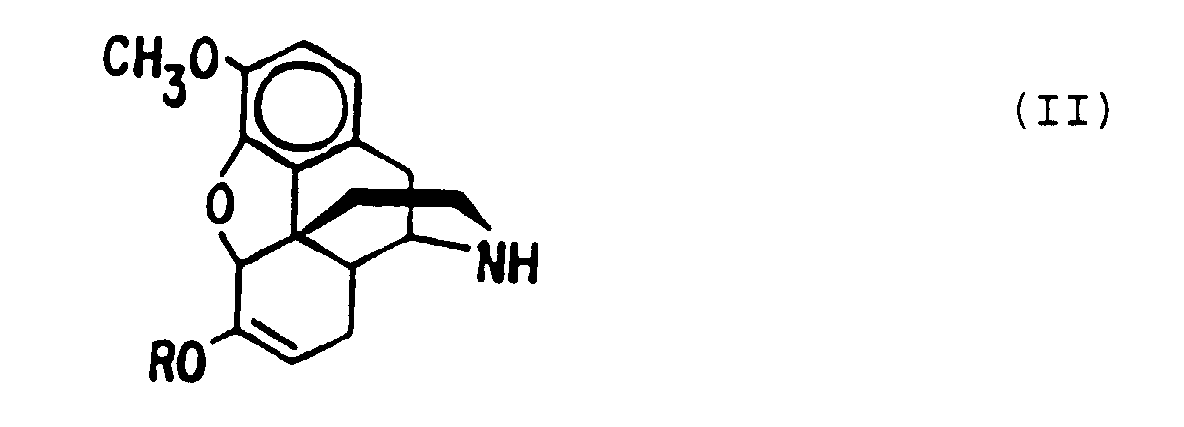 (b) completely converting the dialkyl ketal (I) in said mixture to the delta-6-enol ether (II);(c) reacting the delta-6-enol ether (II) from step (b) with an organic acid and a halogenating agent to yield a hydrohalide salt of a 7-halo-dialkyl ketal (III) :where X=halo, wherein said process occurs without substitution of said N-substituent.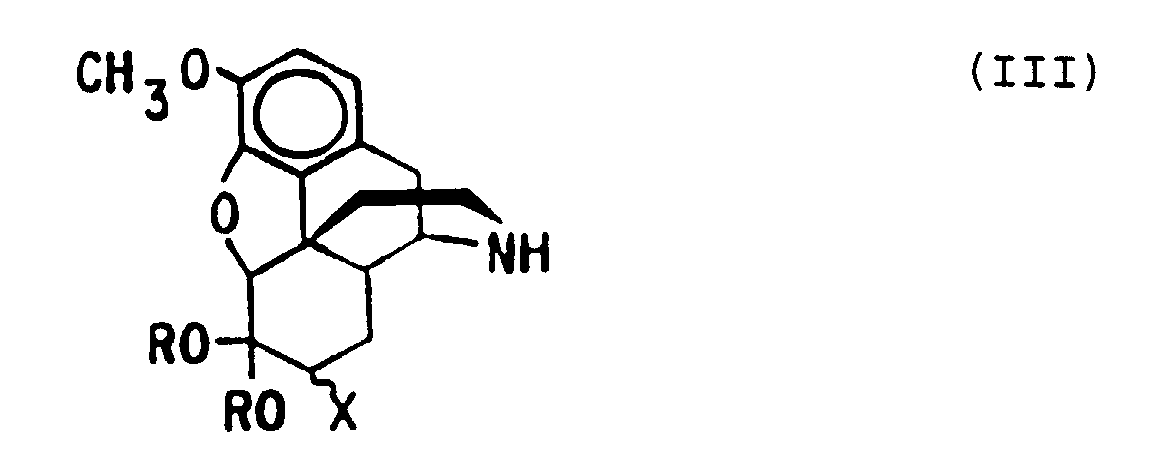
- A process as claimed in claim 1, wherein step (b) is performed by continuously adding a dry aprotic solvent to said mixture and removing said alcoholic solvent, and alcohol formed during said conversion, by distillation.
- A process as claimed in claim 1, wherein step (b) is performed by addition of a base.
- A process as claimed in claim 3, wherein said base is organic.
- A process as claimed in claim 4, wherein said base is potassium t-butoxide.
- A process as claimed in any one of the preceding claims, further comprising dehalogenating said 7-halodialkyl ketal (III) by reaction with a base in an aprotic solvent to produce northebaine.
- A process as claimed in claim 6, further comprising oxidizing said northebaine to yield 14-hydroxynorcodeinone.
- A process as claimed in claim 7, wherein said oxidation of northebaine to 14-hydroxynorcodeinone is accomplished by reaction with a performic acid.
- A process as claimed in any one of claims 1-5, further comprising dehalogenating said 7-halodialkylether by reaction with a base in an ether or hydrocarbon solvent to yield norcodeinone ketal.
- A process as claimed in claim 9, wherein said solvent is tetrahydrofuran and said base is potassium t-butoxide.
- A process as claimed in claims 9 or 10, further comprising hydrolyzing said norcodeinone ketal to norcodeinone, and reducing said norcodeinone to yield norcodeine.
- A process as claimed in claim 11, wherein said reducing is by reaction with an alkali butoxide.
- Hydrobromide salt of optically active crystalline (+)7-bromodialkyl ketal of nordihydrocodeinone (III) and salts thereof.
Applications Claiming Priority (3)
| Application Number | Priority Date | Filing Date | Title |
|---|---|---|---|
| US42190089A | 1989-10-16 | 1989-10-16 | |
| US421900 | 1989-10-16 | ||
| PCT/US1990/005911 WO1991005768A1 (en) | 1989-10-16 | 1990-10-16 | Total synthesis of northebaine, normorphine, noroxymorphone enantiomers and derivatives via n-nor intermediates |
Publications (3)
| Publication Number | Publication Date |
|---|---|
| EP0496830A1 EP0496830A1 (en) | 1992-08-05 |
| EP0496830A4 EP0496830A4 (en) | 1992-09-30 |
| EP0496830B1 true EP0496830B1 (en) | 1999-03-31 |
Family
ID=23672545
Family Applications (1)
| Application Number | Title | Priority Date | Filing Date |
|---|---|---|---|
| EP90917159A Expired - Lifetime EP0496830B1 (en) | 1989-10-16 | 1990-10-16 | Total synthesis of northebaine, normorphine, noroxymorphone enantiomers and derivatives via n-nor intermediates |
Country Status (10)
| Country | Link |
|---|---|
| EP (1) | EP0496830B1 (en) |
| JP (1) | JP2694156B2 (en) |
| AT (1) | ATE178329T1 (en) |
| AU (1) | AU642447B2 (en) |
| CA (1) | CA2067200C (en) |
| DE (1) | DE69033035T2 (en) |
| DK (1) | DK0496830T3 (en) |
| ES (1) | ES2129395T3 (en) |
| GR (1) | GR3030101T3 (en) |
| WO (1) | WO1991005768A1 (en) |
Families Citing this family (16)
| Publication number | Priority date | Publication date | Assignee | Title |
|---|---|---|---|---|
| WO2006084389A1 (en) * | 2005-02-11 | 2006-08-17 | Cilag Ltd. | Method for purifying noroxymorphone compounds |
| ATE493417T1 (en) * | 2005-06-16 | 2011-01-15 | Mallinckrodt Inc | SYNTHETIC ROUTE TO 14-HYDROXYLOPIATES VIA 1-HALOGENETHEBAIN OR ANALOGS |
| WO2008131567A1 (en) * | 2007-04-27 | 2008-11-06 | Cilag Ag | Solvent-free crystalline form of naltrexone |
| WO2009067275A1 (en) * | 2007-11-21 | 2009-05-28 | Progenics Pharmaceuticals, Inc | N-oxides of 4,5-epoxy-morphinanium analogs |
| NZ611651A (en) * | 2007-12-17 | 2014-11-28 | Mallinckrodt Llc | Sinomenine derivatives and processes for their synthesis |
| EP2222642B1 (en) * | 2007-12-17 | 2014-02-12 | Mallinckrodt LLC | Process and compounds for the production of (+) opiates |
| RS55777B1 (en) * | 2010-11-05 | 2017-07-31 | H Lundbeck As | NALTREXONE MANUFACTURING PROCEDURE |
| US8580963B2 (en) | 2010-11-05 | 2013-11-12 | H. Lundbeck A/S | Method for the manufacturing of naltrexone |
| JO3209B1 (en) * | 2010-11-05 | 2018-03-08 | H Lundbeck As | Method for the manufacturing of naltrexone |
| CN103619847A (en) * | 2011-05-06 | 2014-03-05 | 布鲁克大学 | Process for the preparation of morphine analogs via metal catalyzed N-demethylation/functionalization and intramolecular group transfer |
| US20140155608A1 (en) | 2012-05-03 | 2014-06-05 | H. Lundbeck A/S | Method for the manufacturing of naltrexone |
| ES2631197T3 (en) | 2012-12-14 | 2017-08-29 | Purdue Pharma Lp | Pyridonamorfinan analogs and biological activity on opioid receptors |
| US9340542B2 (en) | 2013-12-26 | 2016-05-17 | Purdue Pharma L.P. | Propellane-based compounds and the use thereof |
| MA40170A (en) * | 2014-06-13 | 2017-04-19 | Purdue Pharma Lp | Heterocyclic morphinan derivatives and use thereof |
| EP4225312A1 (en) | 2020-10-06 | 2023-08-16 | Scilex Holding Company | Oral delayed burst formulation of low-dose naltrexone or naloxone used for treating fibromyalgia and long covid |
| CN120703275B (en) * | 2025-08-27 | 2025-11-25 | 上海万巷制药有限公司 | Method for measuring contents of codeine, morphine, papaverine, narcotine and thebaine in poppy oil |
Family Cites Families (13)
| Publication number | Priority date | Publication date | Assignee | Title |
|---|---|---|---|---|
| CA913077A (en) * | 1972-10-24 | J. Pachter Irwin | Process of preparing n-substituted 14-hydroxydihydronormorphines | |
| BE638369A (en) * | 1962-10-10 | |||
| FR2208902A1 (en) * | 1972-06-15 | 1974-06-28 | Merck & Co Inc | 14-Hydroxy dihydronormorphinone prepn. - from 1-halo-nor codeinone, by oxidn., catalytic redn. and hydrolysis |
| US4141897A (en) * | 1976-12-20 | 1979-02-27 | Research Corporation | N-dealkylation of N-alkyl-14-hydroxymorphinans and derivatives thereof |
| NO793297L (en) * | 1978-10-19 | 1980-04-22 | Mallinckrodt Inc | PROCEDURE FOR THE MANUFACTURE OF OXYMORPHONE |
| NO802139L (en) * | 1979-08-09 | 1981-02-10 | Mallinckrodt Inc | OUTPUT CONNECTIONS FOR PREPARING MORPHINE DERIVATIVES, AND PROCEDURE FOR PREPARING OUTPUT |
| US4368326A (en) * | 1980-07-03 | 1983-01-11 | Rice Kenner C | Short total synthesis of dihydrothebainone, dihydrocodeinone, and nordihydroccodeinone |
| US4521601A (en) * | 1981-05-20 | 1985-06-04 | The United States Of America As Represented By The Department Of Health & Human Services | Practical total synthesis unnatural enantiomers of opium-derived morphinans |
| US4472253A (en) | 1981-08-17 | 1984-09-18 | The Florida Board Of Regents On Behalf Of The Florida State University | Process for the preparation of an N-substituted 3-O-alkyl-14-hydroxynormorphinone derivative |
| US4613668A (en) * | 1983-12-22 | 1986-09-23 | The United States Of America As Represented By The Department Of Health And Human Services | Short total synthesis or morphinan compounds which uses cyclization of a cycloalkylcarbonyl compound selected from cyclopropylcarbonyl and cyclobutylcarbonyl |
| US4639520A (en) * | 1984-03-27 | 1987-01-27 | Mallinckrodt, Inc. | Preparation of 14-hydroxy-N-ethoxy-carbonyl-norcodeinone |
| JPS62123444A (en) * | 1985-08-07 | 1987-06-04 | Japan Synthetic Rubber Co Ltd | Radiation sensitive resinous composition |
| JPH0721626B2 (en) * | 1985-08-10 | 1995-03-08 | 日本合成ゴム株式会社 | Resist composition for semiconductor fine processing |
-
1990
- 1990-10-16 CA CA002067200A patent/CA2067200C/en not_active Expired - Lifetime
- 1990-10-16 WO PCT/US1990/005911 patent/WO1991005768A1/en not_active Ceased
- 1990-10-16 EP EP90917159A patent/EP0496830B1/en not_active Expired - Lifetime
- 1990-10-16 AT AT90917159T patent/ATE178329T1/en not_active IP Right Cessation
- 1990-10-16 JP JP3500396A patent/JP2694156B2/en not_active Expired - Fee Related
- 1990-10-16 DE DE69033035T patent/DE69033035T2/en not_active Expired - Fee Related
- 1990-10-16 ES ES90917159T patent/ES2129395T3/en not_active Expired - Lifetime
- 1990-10-16 DK DK90917159T patent/DK0496830T3/en active
- 1990-10-16 AU AU67426/90A patent/AU642447B2/en not_active Ceased
-
1999
- 1999-04-30 GR GR990401183T patent/GR3030101T3/en unknown
Also Published As
| Publication number | Publication date |
|---|---|
| DE69033035T2 (en) | 1999-08-05 |
| WO1991005768A1 (en) | 1991-05-02 |
| CA2067200C (en) | 1998-06-30 |
| GR3030101T3 (en) | 1999-07-30 |
| EP0496830A4 (en) | 1992-09-30 |
| JP2694156B2 (en) | 1997-12-24 |
| DK0496830T3 (en) | 1999-10-11 |
| AU642447B2 (en) | 1993-10-21 |
| ES2129395T3 (en) | 1999-06-16 |
| DE69033035D1 (en) | 1999-05-06 |
| EP0496830A1 (en) | 1992-08-05 |
| CA2067200A1 (en) | 1991-04-17 |
| JPH04504861A (en) | 1992-08-27 |
| AU6742690A (en) | 1991-05-16 |
| ATE178329T1 (en) | 1999-04-15 |
Similar Documents
| Publication | Publication Date | Title |
|---|---|---|
| US5668285A (en) | Total synthesis of northebaine, normophine, noroxymorphone enantiomers and derivatives via N-Nor intermediates | |
| AU2009233315B2 (en) | An improved process for the preparation of morphinane analogues | |
| AU642447B2 (en) | Total synthesis of northebaine, normorphine, noroxymorphone enantiomers and derivatives via N-nor intermediates | |
| US4613668A (en) | Short total synthesis or morphinan compounds which uses cyclization of a cycloalkylcarbonyl compound selected from cyclopropylcarbonyl and cyclobutylcarbonyl | |
| EP0023576B1 (en) | 7- and 7,8-substituted 4,5-alpha-epoxymorphinan-6-ones and therapeutically active compositions containing them | |
| US4089855A (en) | Process for the stereoselective reduction of 6- and 8-keto morphine and morphinan derivatives with formamidinesulfinic acid and compounds obtained thereby | |
| JP5824448B2 (en) | Preparation of morphinan and morphinone compounds | |
| EP1664061B1 (en) | Process for the synthesis of morphinane compounds and intermediates thereof | |
| EP2222643B1 (en) | Sinomenine derivatives and processes for their synthesis | |
| US8106201B2 (en) | Process for the synthesis of morphinane compounds and intermediates thereof | |
| EP1981891B1 (en) | The use of oripavine as a starting material for buprenorphine | |
| Granchelli et al. | Aporphines. 27. Mechanistic aspects of the rearrangement of thebaine and codeine analogs in methanesulfonic acid. Improved method for the synthesis of N-alkylated aporphines | |
| CN118994178A (en) | General intermediate of opioid derivatives, preparation method and application thereof | |
| CN121949333A (en) | Preparation methods of various opioid drugs and their intermediates | |
| AU2004274038B2 (en) | Process for the synthesis of morphinane compounds and intermediates thereof |
Legal Events
| Date | Code | Title | Description |
|---|---|---|---|
| PUAI | Public reference made under article 153(3) epc to a published international application that has entered the european phase |
Free format text: ORIGINAL CODE: 0009012 |
|
| 17P | Request for examination filed |
Effective date: 19920424 |
|
| AK | Designated contracting states |
Kind code of ref document: A1 Designated state(s): AT BE CH DE DK ES FR GB GR IT LI LU NL SE |
|
| A4 | Supplementary search report drawn up and despatched |
Effective date: 19920807 |
|
| AK | Designated contracting states |
Kind code of ref document: A4 Designated state(s): AT BE CH DE DK ES FR GB GR IT LI LU NL SE |
|
| 17Q | First examination report despatched |
Effective date: 19950321 |
|
| GRAG | Despatch of communication of intention to grant |
Free format text: ORIGINAL CODE: EPIDOS AGRA |
|
| GRAG | Despatch of communication of intention to grant |
Free format text: ORIGINAL CODE: EPIDOS AGRA |
|
| GRAG | Despatch of communication of intention to grant |
Free format text: ORIGINAL CODE: EPIDOS AGRA |
|
| GRAH | Despatch of communication of intention to grant a patent |
Free format text: ORIGINAL CODE: EPIDOS IGRA |
|
| GRAH | Despatch of communication of intention to grant a patent |
Free format text: ORIGINAL CODE: EPIDOS IGRA |
|
| GRAA | (expected) grant |
Free format text: ORIGINAL CODE: 0009210 |
|
| AK | Designated contracting states |
Kind code of ref document: B1 Designated state(s): AT BE CH DE DK ES FR GB GR IT LI LU NL SE |
|
| REF | Corresponds to: |
Ref document number: 178329 Country of ref document: AT Date of ref document: 19990415 Kind code of ref document: T |
|
| REG | Reference to a national code |
Ref country code: CH Ref legal event code: NV Representative=s name: MOINAS SAVOYE & CRONIN Ref country code: CH Ref legal event code: EP |
|
| REF | Corresponds to: |
Ref document number: 69033035 Country of ref document: DE Date of ref document: 19990506 |
|
| ET | Fr: translation filed | ||
| REG | Reference to a national code |
Ref country code: ES Ref legal event code: FG2A Ref document number: 2129395 Country of ref document: ES Kind code of ref document: T3 |
|
| REG | Reference to a national code |
Ref country code: DK Ref legal event code: T3 |
|
| PLBE | No opposition filed within time limit |
Free format text: ORIGINAL CODE: 0009261 |
|
| STAA | Information on the status of an ep patent application or granted ep patent |
Free format text: STATUS: NO OPPOSITION FILED WITHIN TIME LIMIT |
|
| 26N | No opposition filed | ||
| REG | Reference to a national code |
Ref country code: GB Ref legal event code: IF02 |
|
| PGFP | Annual fee paid to national office [announced via postgrant information from national office to epo] |
Ref country code: DK Payment date: 20071031 Year of fee payment: 18 Ref country code: ES Payment date: 20071026 Year of fee payment: 18 Ref country code: DE Payment date: 20071130 Year of fee payment: 18 Ref country code: NL Payment date: 20071024 Year of fee payment: 18 Ref country code: LU Payment date: 20071106 Year of fee payment: 18 |
|
| PGFP | Annual fee paid to national office [announced via postgrant information from national office to epo] |
Ref country code: IT Payment date: 20071030 Year of fee payment: 18 Ref country code: CH Payment date: 20071030 Year of fee payment: 18 |
|
| PGFP | Annual fee paid to national office [announced via postgrant information from national office to epo] |
Ref country code: BE Payment date: 20071107 Year of fee payment: 18 Ref country code: SE Payment date: 20071029 Year of fee payment: 18 |
|
| PGFP | Annual fee paid to national office [announced via postgrant information from national office to epo] |
Ref country code: FR Payment date: 20071017 Year of fee payment: 18 Ref country code: GB Payment date: 20071029 Year of fee payment: 18 |
|
| PGFP | Annual fee paid to national office [announced via postgrant information from national office to epo] |
Ref country code: GR Payment date: 20071030 Year of fee payment: 18 |
|
| PGFP | Annual fee paid to national office [announced via postgrant information from national office to epo] |
Ref country code: AT Payment date: 20081002 Year of fee payment: 19 |
|
| BERE | Be: lapsed |
Owner name: THE *UNITED STATES OF AMERICA AS REPRESENTED BY TH Effective date: 20081031 |
|
| REG | Reference to a national code |
Ref country code: CH Ref legal event code: PL |
|
| REG | Reference to a national code |
Ref country code: DK Ref legal event code: EBP |
|
| EUG | Se: european patent has lapsed | ||
| GBPC | Gb: european patent ceased through non-payment of renewal fee |
Effective date: 20081016 |
|
| NLV4 | Nl: lapsed or anulled due to non-payment of the annual fee |
Effective date: 20090501 |
|
| REG | Reference to a national code |
Ref country code: FR Ref legal event code: ST Effective date: 20090630 |
|
| PG25 | Lapsed in a contracting state [announced via postgrant information from national office to epo] |
Ref country code: NL Free format text: LAPSE BECAUSE OF NON-PAYMENT OF DUE FEES Effective date: 20090501 |
|
| PG25 | Lapsed in a contracting state [announced via postgrant information from national office to epo] |
Ref country code: IT Free format text: LAPSE BECAUSE OF NON-PAYMENT OF DUE FEES Effective date: 20081016 Ref country code: DE Free format text: LAPSE BECAUSE OF NON-PAYMENT OF DUE FEES Effective date: 20090501 |
|
| PG25 | Lapsed in a contracting state [announced via postgrant information from national office to epo] |
Ref country code: BE Free format text: LAPSE BECAUSE OF NON-PAYMENT OF DUE FEES Effective date: 20081031 |
|
| PG25 | Lapsed in a contracting state [announced via postgrant information from national office to epo] |
Ref country code: CH Free format text: LAPSE BECAUSE OF NON-PAYMENT OF DUE FEES Effective date: 20081031 Ref country code: DK Free format text: LAPSE BECAUSE OF NON-PAYMENT OF DUE FEES Effective date: 20081031 Ref country code: LI Free format text: LAPSE BECAUSE OF NON-PAYMENT OF DUE FEES Effective date: 20081031 Ref country code: FR Free format text: LAPSE BECAUSE OF NON-PAYMENT OF DUE FEES Effective date: 20081031 |
|
| PG25 | Lapsed in a contracting state [announced via postgrant information from national office to epo] |
Ref country code: GR Free format text: LAPSE BECAUSE OF NON-PAYMENT OF DUE FEES Effective date: 20090505 Ref country code: GB Free format text: LAPSE BECAUSE OF NON-PAYMENT OF DUE FEES Effective date: 20081016 |
|
| REG | Reference to a national code |
Ref country code: ES Ref legal event code: FD2A Effective date: 20081017 |
|
| PG25 | Lapsed in a contracting state [announced via postgrant information from national office to epo] |
Ref country code: ES Free format text: LAPSE BECAUSE OF NON-PAYMENT OF DUE FEES Effective date: 20081017 |
|
| PG25 | Lapsed in a contracting state [announced via postgrant information from national office to epo] |
Ref country code: LU Free format text: LAPSE BECAUSE OF NON-PAYMENT OF DUE FEES Effective date: 20081016 |
|
| PG25 | Lapsed in a contracting state [announced via postgrant information from national office to epo] |
Ref country code: SE Free format text: LAPSE BECAUSE OF NON-PAYMENT OF DUE FEES Effective date: 20081017 |
|
| PG25 | Lapsed in a contracting state [announced via postgrant information from national office to epo] |
Ref country code: AT Free format text: LAPSE BECAUSE OF NON-PAYMENT OF DUE FEES Effective date: 20091016 |