EP0497101A2 - Formkörper auf Basis von Fasern - Google Patents
Formkörper auf Basis von Fasern Download PDFInfo
- Publication number
- EP0497101A2 EP0497101A2 EP92100251A EP92100251A EP0497101A2 EP 0497101 A2 EP0497101 A2 EP 0497101A2 EP 92100251 A EP92100251 A EP 92100251A EP 92100251 A EP92100251 A EP 92100251A EP 0497101 A2 EP0497101 A2 EP 0497101A2
- Authority
- EP
- European Patent Office
- Prior art keywords
- weight
- und
- gew
- bis
- oder
- Prior art date
- Legal status (The legal status is an assumption and is not a legal conclusion. Google has not performed a legal analysis and makes no representation as to the accuracy of the status listed.)
- Granted
Links
- 239000000835 fiber Substances 0.000 title claims abstract description 38
- 239000000206 moulding compound Substances 0.000 title 1
- 229920000642 polymer Polymers 0.000 claims abstract description 47
- VVQNEPGJFQJSBK-UHFFFAOYSA-N Methyl methacrylate Chemical compound COC(=O)C(C)=C VVQNEPGJFQJSBK-UHFFFAOYSA-N 0.000 claims abstract description 32
- -1 vinyl halide Chemical class 0.000 claims abstract description 32
- 239000000178 monomer Substances 0.000 claims abstract description 28
- BAPJBEWLBFYGME-UHFFFAOYSA-N Methyl acrylate Chemical compound COC(=O)C=C BAPJBEWLBFYGME-UHFFFAOYSA-N 0.000 claims abstract description 19
- 125000004432 carbon atom Chemical group C* 0.000 claims abstract description 17
- NLHHRLWOUZZQLW-UHFFFAOYSA-N Acrylonitrile Chemical compound C=CC#N NLHHRLWOUZZQLW-UHFFFAOYSA-N 0.000 claims abstract description 11
- NIXOWILDQLNWCW-UHFFFAOYSA-N acrylic acid group Chemical group C(C=C)(=O)O NIXOWILDQLNWCW-UHFFFAOYSA-N 0.000 claims abstract description 11
- 150000001298 alcohols Chemical class 0.000 claims abstract description 10
- GYCMBHHDWRMZGG-UHFFFAOYSA-N Methylacrylonitrile Chemical compound CC(=C)C#N GYCMBHHDWRMZGG-UHFFFAOYSA-N 0.000 claims abstract description 9
- 229920001567 vinyl ester resin Polymers 0.000 claims abstract description 8
- 125000005395 methacrylic acid group Chemical group 0.000 claims abstract description 7
- 125000000391 vinyl group Chemical group [H]C([*])=C([H])[H] 0.000 claims abstract description 7
- 229920002554 vinyl polymer Polymers 0.000 claims abstract description 6
- 125000002877 alkyl aryl group Chemical group 0.000 claims abstract description 5
- 125000000217 alkyl group Chemical group 0.000 claims abstract description 5
- 125000003710 aryl alkyl group Chemical group 0.000 claims abstract description 5
- 125000003118 aryl group Chemical group 0.000 claims abstract description 5
- 229910052799 carbon Inorganic materials 0.000 claims abstract description 3
- 229910052739 hydrogen Inorganic materials 0.000 claims abstract description 3
- 239000006185 dispersion Substances 0.000 claims description 34
- 238000000034 method Methods 0.000 claims description 24
- 230000008569 process Effects 0.000 claims description 16
- 238000004519 manufacturing process Methods 0.000 claims description 13
- 238000000465 moulding Methods 0.000 claims description 13
- 239000002557 mineral fiber Substances 0.000 claims description 12
- 239000000725 suspension Substances 0.000 claims description 7
- 239000007900 aqueous suspension Substances 0.000 claims description 2
- 125000004178 (C1-C4) alkyl group Chemical group 0.000 abstract description 3
- 238000002360 preparation method Methods 0.000 abstract description 2
- XLYOFNOQVPJJNP-UHFFFAOYSA-N water Substances O XLYOFNOQVPJJNP-UHFFFAOYSA-N 0.000 description 31
- 239000004815 dispersion polymer Substances 0.000 description 30
- 239000011230 binding agent Substances 0.000 description 27
- IBDVWXAVKPRHCU-UHFFFAOYSA-N 2-(2-methylprop-2-enoyloxy)ethyl 3-oxobutanoate Chemical compound CC(=O)CC(=O)OCCOC(=O)C(C)=C IBDVWXAVKPRHCU-UHFFFAOYSA-N 0.000 description 24
- 239000005995 Aluminium silicate Substances 0.000 description 17
- 235000012211 aluminium silicate Nutrition 0.000 description 17
- NLYAJNPCOHFWQQ-UHFFFAOYSA-N kaolin Chemical compound O.O.O=[Al]O[Si](=O)O[Si](=O)O[Al]=O NLYAJNPCOHFWQQ-UHFFFAOYSA-N 0.000 description 17
- 229920002522 Wood fibre Polymers 0.000 description 15
- 239000002025 wood fiber Substances 0.000 description 15
- 239000000243 solution Substances 0.000 description 14
- WNROFYMDJYEPJX-UHFFFAOYSA-K aluminium hydroxide Chemical compound [OH-].[OH-].[OH-].[Al+3] WNROFYMDJYEPJX-UHFFFAOYSA-K 0.000 description 11
- 239000000839 emulsion Substances 0.000 description 11
- 239000004743 Polypropylene Substances 0.000 description 10
- 229920001155 polypropylene Polymers 0.000 description 10
- 229910052717 sulfur Inorganic materials 0.000 description 10
- 229920003043 Cellulose fiber Polymers 0.000 description 9
- 239000005871 repellent Substances 0.000 description 9
- 230000002940 repellent Effects 0.000 description 9
- DIZPMCHEQGEION-UHFFFAOYSA-H aluminium sulfate (anhydrous) Chemical compound [Al+3].[Al+3].[O-]S([O-])(=O)=O.[O-]S([O-])(=O)=O.[O-]S([O-])(=O)=O DIZPMCHEQGEION-UHFFFAOYSA-H 0.000 description 8
- CERQOIWHTDAKMF-UHFFFAOYSA-N Methacrylic acid Chemical compound CC(=C)C(O)=O CERQOIWHTDAKMF-UHFFFAOYSA-N 0.000 description 7
- 239000003995 emulsifying agent Substances 0.000 description 7
- 239000011094 fiberboard Substances 0.000 description 7
- 239000011490 mineral wool Substances 0.000 description 7
- 239000000203 mixture Substances 0.000 description 7
- SMZOUWXMTYCWNB-UHFFFAOYSA-N 2-(2-methoxy-5-methylphenyl)ethanamine Chemical compound COC1=CC=C(C)C=C1CCN SMZOUWXMTYCWNB-UHFFFAOYSA-N 0.000 description 6
- WSFSSNUMVMOOMR-UHFFFAOYSA-N Formaldehyde Chemical compound O=C WSFSSNUMVMOOMR-UHFFFAOYSA-N 0.000 description 6
- 230000000052 comparative effect Effects 0.000 description 6
- 229920001577 copolymer Polymers 0.000 description 6
- 125000002496 methyl group Chemical group [H]C([H])([H])* 0.000 description 6
- PPBRXRYQALVLMV-UHFFFAOYSA-N Styrene Chemical compound C=CC1=CC=CC=C1 PPBRXRYQALVLMV-UHFFFAOYSA-N 0.000 description 5
- 239000000654 additive Substances 0.000 description 5
- CQEYYJKEWSMYFG-UHFFFAOYSA-N butyl acrylate Chemical compound CCCCOC(=O)C=C CQEYYJKEWSMYFG-UHFFFAOYSA-N 0.000 description 5
- 238000001035 drying Methods 0.000 description 5
- 238000005189 flocculation Methods 0.000 description 5
- 230000016615 flocculation Effects 0.000 description 5
- 239000003999 initiator Substances 0.000 description 5
- 229920002239 polyacrylonitrile Polymers 0.000 description 5
- 238000003756 stirring Methods 0.000 description 5
- 239000002023 wood Substances 0.000 description 5
- HRPVXLWXLXDGHG-UHFFFAOYSA-N Acrylamide Chemical compound NC(=O)C=C HRPVXLWXLXDGHG-UHFFFAOYSA-N 0.000 description 4
- NIXOWILDQLNWCW-UHFFFAOYSA-M Acrylate Chemical compound [O-]C(=O)C=C NIXOWILDQLNWCW-UHFFFAOYSA-M 0.000 description 4
- 229920002261 Corn starch Polymers 0.000 description 4
- 229920002472 Starch Polymers 0.000 description 4
- 238000010521 absorption reaction Methods 0.000 description 4
- 125000000218 acetic acid group Chemical group C(C)(=O)* 0.000 description 4
- 239000007864 aqueous solution Substances 0.000 description 4
- 125000003236 benzoyl group Chemical group [H]C1=C([H])C([H])=C(C([H])=C1[H])C(*)=O 0.000 description 4
- 238000000576 coating method Methods 0.000 description 4
- 150000001875 compounds Chemical class 0.000 description 4
- 239000008120 corn starch Substances 0.000 description 4
- 125000001495 ethyl group Chemical group [H]C([H])([H])C([H])([H])* 0.000 description 4
- 125000001997 phenyl group Chemical group [H]C1=C([H])C([H])=C(*)C([H])=C1[H] 0.000 description 4
- 238000006116 polymerization reaction Methods 0.000 description 4
- 238000003825 pressing Methods 0.000 description 4
- 239000007787 solid Substances 0.000 description 4
- 235000019698 starch Nutrition 0.000 description 4
- 210000002268 wool Anatomy 0.000 description 4
- QHVBLSNVXDSMEB-UHFFFAOYSA-N 2-(diethylamino)ethyl prop-2-enoate Chemical compound CCN(CC)CCOC(=O)C=C QHVBLSNVXDSMEB-UHFFFAOYSA-N 0.000 description 3
- GOXQRTZXKQZDDN-UHFFFAOYSA-N 2-Ethylhexyl acrylate Chemical compound CCCCC(CC)COC(=O)C=C GOXQRTZXKQZDDN-UHFFFAOYSA-N 0.000 description 3
- WVDDGKGOMKODPV-UHFFFAOYSA-N Benzyl alcohol Chemical compound OCC1=CC=CC=C1 WVDDGKGOMKODPV-UHFFFAOYSA-N 0.000 description 3
- OKKJLVBELUTLKV-UHFFFAOYSA-N Methanol Chemical compound OC OKKJLVBELUTLKV-UHFFFAOYSA-N 0.000 description 3
- HEMHJVSKTPXQMS-UHFFFAOYSA-M Sodium hydroxide Chemical compound [OH-].[Na+] HEMHJVSKTPXQMS-UHFFFAOYSA-M 0.000 description 3
- 230000015572 biosynthetic process Effects 0.000 description 3
- 238000007720 emulsion polymerization reaction Methods 0.000 description 3
- 239000004744 fabric Substances 0.000 description 3
- 239000008394 flocculating agent Substances 0.000 description 3
- RKMMVVNDDRHOQQ-UHFFFAOYSA-N n-(2-benzoyl-3-oxo-3-phenylpropyl)prop-2-enamide Chemical compound C=1C=CC=CC=1C(=O)C(CNC(=O)C=C)C(=O)C1=CC=CC=C1 RKMMVVNDDRHOQQ-UHFFFAOYSA-N 0.000 description 3
- LASVABQGWNRGEP-UHFFFAOYSA-N n-(2-benzoyl-3-oxobutyl)prop-2-enamide Chemical compound C=CC(=O)NCC(C(=O)C)C(=O)C1=CC=CC=C1 LASVABQGWNRGEP-UHFFFAOYSA-N 0.000 description 3
- 239000008107 starch Substances 0.000 description 3
- 239000000126 substance Substances 0.000 description 3
- MYRTYDVEIRVNKP-UHFFFAOYSA-N 1,2-Divinylbenzene Chemical compound C=CC1=CC=CC=C1C=C MYRTYDVEIRVNKP-UHFFFAOYSA-N 0.000 description 2
- KBPLFHHGFOOTCA-UHFFFAOYSA-N 1-Octanol Chemical compound CCCCCCCCO KBPLFHHGFOOTCA-UHFFFAOYSA-N 0.000 description 2
- BCQHHYHGZQLDLH-UHFFFAOYSA-N 2-(2-cyanoacetyl)oxyethyl 2-methylprop-2-enoate Chemical compound CC(=C)C(=O)OCCOC(=O)CC#N BCQHHYHGZQLDLH-UHFFFAOYSA-N 0.000 description 2
- YIWUKEYIRIRTPP-UHFFFAOYSA-N 2-ethylhexan-1-ol Chemical compound CCCCC(CC)CO YIWUKEYIRIRTPP-UHFFFAOYSA-N 0.000 description 2
- YHSYGCXKWUUKIK-UHFFFAOYSA-N 2-prop-2-enoyloxyethyl 3-oxobutanoate Chemical compound CC(=O)CC(=O)OCCOC(=O)C=C YHSYGCXKWUUKIK-UHFFFAOYSA-N 0.000 description 2
- PICTWXAWDCLLKO-UHFFFAOYSA-N 4-prop-2-enoyloxybutyl 3-oxobutanoate Chemical compound CC(=O)CC(=O)OCCCCOC(=O)C=C PICTWXAWDCLLKO-UHFFFAOYSA-N 0.000 description 2
- KAKZBPTYRLMSJV-UHFFFAOYSA-N Butadiene Chemical compound C=CC=C KAKZBPTYRLMSJV-UHFFFAOYSA-N 0.000 description 2
- 241000196324 Embryophyta Species 0.000 description 2
- LFQSCWFLJHTTHZ-UHFFFAOYSA-N Ethanol Chemical compound CCO LFQSCWFLJHTTHZ-UHFFFAOYSA-N 0.000 description 2
- JIGUQPWFLRLWPJ-UHFFFAOYSA-N Ethyl acrylate Chemical compound CCOC(=O)C=C JIGUQPWFLRLWPJ-UHFFFAOYSA-N 0.000 description 2
- VZCYOOQTPOCHFL-OWOJBTEDSA-N Fumaric acid Chemical compound OC(=O)\C=C\C(O)=O VZCYOOQTPOCHFL-OWOJBTEDSA-N 0.000 description 2
- DGAQECJNVWCQMB-PUAWFVPOSA-M Ilexoside XXIX Chemical compound C[C@@H]1CC[C@@]2(CC[C@@]3(C(=CC[C@H]4[C@]3(CC[C@@H]5[C@@]4(CC[C@@H](C5(C)C)OS(=O)(=O)[O-])C)C)[C@@H]2[C@]1(C)O)C)C(=O)O[C@H]6[C@@H]([C@H]([C@@H]([C@H](O6)CO)O)O)O.[Na+] DGAQECJNVWCQMB-PUAWFVPOSA-M 0.000 description 2
- AMQJEAYHLZJPGS-UHFFFAOYSA-N N-Pentanol Chemical compound CCCCCO AMQJEAYHLZJPGS-UHFFFAOYSA-N 0.000 description 2
- QAOWNCQODCNURD-UHFFFAOYSA-N Sulfuric acid Chemical compound OS(O)(=O)=O QAOWNCQODCNURD-UHFFFAOYSA-N 0.000 description 2
- DKGAVHZHDRPRBM-UHFFFAOYSA-N Tert-Butanol Chemical compound CC(C)(C)O DKGAVHZHDRPRBM-UHFFFAOYSA-N 0.000 description 2
- 239000002585 base Substances 0.000 description 2
- 230000008901 benefit Effects 0.000 description 2
- 239000011248 coating agent Substances 0.000 description 2
- 235000014113 dietary fatty acids Nutrition 0.000 description 2
- 238000004455 differential thermal analysis Methods 0.000 description 2
- 150000002148 esters Chemical class 0.000 description 2
- 239000000194 fatty acid Substances 0.000 description 2
- 229930195729 fatty acid Natural products 0.000 description 2
- 150000002191 fatty alcohols Chemical class 0.000 description 2
- 239000003365 glass fiber Substances 0.000 description 2
- 230000009477 glass transition Effects 0.000 description 2
- ZSIAUFGUXNUGDI-UHFFFAOYSA-N hexan-1-ol Chemical compound CCCCCCO ZSIAUFGUXNUGDI-UHFFFAOYSA-N 0.000 description 2
- PHTQWCKDNZKARW-UHFFFAOYSA-N isoamylol Chemical compound CC(C)CCO PHTQWCKDNZKARW-UHFFFAOYSA-N 0.000 description 2
- 230000007774 longterm Effects 0.000 description 2
- 239000002245 particle Substances 0.000 description 2
- PNJWIWWMYCMZRO-UHFFFAOYSA-N pent‐4‐en‐2‐one Natural products CC(=O)CC=C PNJWIWWMYCMZRO-UHFFFAOYSA-N 0.000 description 2
- 229920001296 polysiloxane Polymers 0.000 description 2
- 229920001592 potato starch Polymers 0.000 description 2
- 150000003254 radicals Chemical class 0.000 description 2
- 239000011734 sodium Substances 0.000 description 2
- 229910052708 sodium Inorganic materials 0.000 description 2
- CHQMHPLRPQMAMX-UHFFFAOYSA-L sodium persulfate Chemical compound [Na+].[Na+].[O-]S(=O)(=O)OOS([O-])(=O)=O CHQMHPLRPQMAMX-UHFFFAOYSA-L 0.000 description 2
- 239000001488 sodium phosphate Substances 0.000 description 2
- 235000011008 sodium phosphates Nutrition 0.000 description 2
- 159000000000 sodium salts Chemical class 0.000 description 2
- 238000005507 spraying Methods 0.000 description 2
- 239000004753 textile Substances 0.000 description 2
- VZCYOOQTPOCHFL-UHFFFAOYSA-N trans-butenedioic acid Natural products OC(=O)C=CC(O)=O VZCYOOQTPOCHFL-UHFFFAOYSA-N 0.000 description 2
- 230000004584 weight gain Effects 0.000 description 2
- 235000019786 weight gain Nutrition 0.000 description 2
- JHPBZFOKBAGZBL-UHFFFAOYSA-N (3-hydroxy-2,2,4-trimethylpentyl) 2-methylprop-2-enoate Chemical compound CC(C)C(O)C(C)(C)COC(=O)C(C)=C JHPBZFOKBAGZBL-UHFFFAOYSA-N 0.000 description 1
- QOVCUELHTLHMEN-UHFFFAOYSA-N 1-butyl-4-ethenylbenzene Chemical compound CCCCC1=CC=C(C=C)C=C1 QOVCUELHTLHMEN-UHFFFAOYSA-N 0.000 description 1
- DMADTXMQLFQQII-UHFFFAOYSA-N 1-decyl-4-ethenylbenzene Chemical compound CCCCCCCCCCC1=CC=C(C=C)C=C1 DMADTXMQLFQQII-UHFFFAOYSA-N 0.000 description 1
- PPLRQCYFUAGBBY-UHFFFAOYSA-N 1-prop-2-enoyloxybutyl 3-oxobutanoate Chemical compound C=CC(=O)OC(CCC)OC(=O)CC(C)=O PPLRQCYFUAGBBY-UHFFFAOYSA-N 0.000 description 1
- JAHNSTQSQJOJLO-UHFFFAOYSA-N 2-(3-fluorophenyl)-1h-imidazole Chemical compound FC1=CC=CC(C=2NC=CN=2)=C1 JAHNSTQSQJOJLO-UHFFFAOYSA-N 0.000 description 1
- HDIHXJHFGDGGCM-UHFFFAOYSA-N 2-(3-oxobutanoyloxymethylidene)hexanoic acid Chemical compound CCCCC(C(O)=O)=COC(=O)CC(C)=O HDIHXJHFGDGGCM-UHFFFAOYSA-N 0.000 description 1
- OEPOKWHJYJXUGD-UHFFFAOYSA-N 2-(3-phenylmethoxyphenyl)-1,3-thiazole-4-carbaldehyde Chemical compound O=CC1=CSC(C=2C=C(OCC=3C=CC=CC=3)C=CC=2)=N1 OEPOKWHJYJXUGD-UHFFFAOYSA-N 0.000 description 1
- GEQZTCMVWVDEDF-UHFFFAOYSA-N 2-cyanoacetyl chloride Chemical compound ClC(=O)CC#N GEQZTCMVWVDEDF-UHFFFAOYSA-N 0.000 description 1
- ILZXXGLGJZQLTR-UHFFFAOYSA-N 2-phenylethyl 2-methylprop-2-enoate Chemical compound CC(=C)C(=O)OCCC1=CC=CC=C1 ILZXXGLGJZQLTR-UHFFFAOYSA-N 0.000 description 1
- JLBJTVDPSNHSKJ-UHFFFAOYSA-N 4-Methylstyrene Chemical compound CC1=CC=C(C=C)C=C1 JLBJTVDPSNHSKJ-UHFFFAOYSA-N 0.000 description 1
- NDWUBGAGUCISDV-UHFFFAOYSA-N 4-hydroxybutyl prop-2-enoate Chemical compound OCCCCOC(=O)C=C NDWUBGAGUCISDV-UHFFFAOYSA-N 0.000 description 1
- JHWGFJBTMHEZME-UHFFFAOYSA-N 4-prop-2-enoyloxybutyl prop-2-enoate Chemical compound C=CC(=O)OCCCCOC(=O)C=C JHWGFJBTMHEZME-UHFFFAOYSA-N 0.000 description 1
- BHPQYMZQTOCNFJ-UHFFFAOYSA-N Calcium cation Chemical compound [Ca+2] BHPQYMZQTOCNFJ-UHFFFAOYSA-N 0.000 description 1
- OKTJSMMVPCPJKN-UHFFFAOYSA-N Carbon Chemical compound [C] OKTJSMMVPCPJKN-UHFFFAOYSA-N 0.000 description 1
- ZAMOUSCENKQFHK-UHFFFAOYSA-N Chlorine atom Chemical compound [Cl] ZAMOUSCENKQFHK-UHFFFAOYSA-N 0.000 description 1
- 239000004641 Diallyl-phthalate Substances 0.000 description 1
- PXGOKWXKJXAPGV-UHFFFAOYSA-N Fluorine Chemical compound FF PXGOKWXKJXAPGV-UHFFFAOYSA-N 0.000 description 1
- UFHFLCQGNIYNRP-UHFFFAOYSA-N Hydrogen Chemical compound [H][H] UFHFLCQGNIYNRP-UHFFFAOYSA-N 0.000 description 1
- 239000004890 Hydrophobing Agent Substances 0.000 description 1
- 206010020751 Hypersensitivity Diseases 0.000 description 1
- KFZMGEQAYNKOFK-UHFFFAOYSA-N Isopropanol Chemical compound CC(C)O KFZMGEQAYNKOFK-UHFFFAOYSA-N 0.000 description 1
- 239000005909 Kieselgur Substances 0.000 description 1
- JLVVSXFLKOJNIY-UHFFFAOYSA-N Magnesium ion Chemical compound [Mg+2] JLVVSXFLKOJNIY-UHFFFAOYSA-N 0.000 description 1
- CERQOIWHTDAKMF-UHFFFAOYSA-M Methacrylate Chemical compound CC(=C)C([O-])=O CERQOIWHTDAKMF-UHFFFAOYSA-M 0.000 description 1
- LRHPLDYGYMQRHN-UHFFFAOYSA-N N-Butanol Chemical compound CCCCO LRHPLDYGYMQRHN-UHFFFAOYSA-N 0.000 description 1
- 229910019142 PO4 Inorganic materials 0.000 description 1
- 235000008331 Pinus X rigitaeda Nutrition 0.000 description 1
- 235000011613 Pinus brutia Nutrition 0.000 description 1
- 241000018646 Pinus brutia Species 0.000 description 1
- 239000004952 Polyamide Substances 0.000 description 1
- ZLMJMSJWJFRBEC-UHFFFAOYSA-N Potassium Chemical class [K] ZLMJMSJWJFRBEC-UHFFFAOYSA-N 0.000 description 1
- OFOBLEOULBTSOW-UHFFFAOYSA-N Propanedioic acid Natural products OC(=O)CC(O)=O OFOBLEOULBTSOW-UHFFFAOYSA-N 0.000 description 1
- VYPSYNLAJGMNEJ-UHFFFAOYSA-N Silicium dioxide Chemical compound O=[Si]=O VYPSYNLAJGMNEJ-UHFFFAOYSA-N 0.000 description 1
- BCKXLBQYZLBQEK-KVVVOXFISA-M Sodium oleate Chemical compound [Na+].CCCCCCCC\C=C/CCCCCCCC([O-])=O BCKXLBQYZLBQEK-KVVVOXFISA-M 0.000 description 1
- 239000003568 Sodium, potassium and calcium salts of fatty acids Substances 0.000 description 1
- ULUAUXLGCMPNKK-UHFFFAOYSA-N Sulfobutanedioic acid Chemical class OC(=O)CC(C(O)=O)S(O)(=O)=O ULUAUXLGCMPNKK-UHFFFAOYSA-N 0.000 description 1
- XTXRWKRVRITETP-UHFFFAOYSA-N Vinyl acetate Chemical compound CC(=O)OC=C XTXRWKRVRITETP-UHFFFAOYSA-N 0.000 description 1
- BZHJMEDXRYGGRV-UHFFFAOYSA-N Vinyl chloride Chemical compound ClC=C BZHJMEDXRYGGRV-UHFFFAOYSA-N 0.000 description 1
- YKTSYUJCYHOUJP-UHFFFAOYSA-N [O--].[Al+3].[Al+3].[O-][Si]([O-])([O-])[O-] Chemical compound [O--].[Al+3].[Al+3].[O-][Si]([O-])([O-])[O-] YKTSYUJCYHOUJP-UHFFFAOYSA-N 0.000 description 1
- 239000002253 acid Substances 0.000 description 1
- 150000007513 acids Chemical class 0.000 description 1
- 238000007605 air drying Methods 0.000 description 1
- 125000001931 aliphatic group Chemical group 0.000 description 1
- 229910052783 alkali metal Inorganic materials 0.000 description 1
- XYLMUPLGERFSHI-UHFFFAOYSA-N alpha-Methylstyrene Chemical compound CC(=C)C1=CC=CC=C1 XYLMUPLGERFSHI-UHFFFAOYSA-N 0.000 description 1
- 125000000129 anionic group Chemical group 0.000 description 1
- 239000008346 aqueous phase Substances 0.000 description 1
- QVGXLLKOCUKJST-UHFFFAOYSA-N atomic oxygen Chemical compound [O] QVGXLLKOCUKJST-UHFFFAOYSA-N 0.000 description 1
- 238000010923 batch production Methods 0.000 description 1
- AOJOEFVRHOZDFN-UHFFFAOYSA-N benzyl 2-methylprop-2-enoate Chemical compound CC(=C)C(=O)OCC1=CC=CC=C1 AOJOEFVRHOZDFN-UHFFFAOYSA-N 0.000 description 1
- 235000019445 benzyl alcohol Nutrition 0.000 description 1
- 230000003115 biocidal effect Effects 0.000 description 1
- QUDWYFHPNIMBFC-UHFFFAOYSA-N bis(prop-2-enyl) benzene-1,2-dicarboxylate Chemical compound C=CCOC(=O)C1=CC=CC=C1C(=O)OCC=C QUDWYFHPNIMBFC-UHFFFAOYSA-N 0.000 description 1
- 229910021538 borax Inorganic materials 0.000 description 1
- 150000001642 boronic acid derivatives Chemical class 0.000 description 1
- MKUWVMRNQOOSAT-UHFFFAOYSA-N but-3-en-2-ol Chemical compound CC(O)C=C MKUWVMRNQOOSAT-UHFFFAOYSA-N 0.000 description 1
- BTANRVKWQNVYAZ-UHFFFAOYSA-N butan-2-ol Chemical compound CCC(C)O BTANRVKWQNVYAZ-UHFFFAOYSA-N 0.000 description 1
- 229940043430 calcium compound Drugs 0.000 description 1
- 150000001674 calcium compounds Chemical class 0.000 description 1
- 229910001424 calcium ion Inorganic materials 0.000 description 1
- 238000004364 calculation method Methods 0.000 description 1
- 150000001735 carboxylic acids Chemical class 0.000 description 1
- 230000015556 catabolic process Effects 0.000 description 1
- 239000007795 chemical reaction product Substances 0.000 description 1
- 239000000460 chlorine Substances 0.000 description 1
- 229910052801 chlorine Inorganic materials 0.000 description 1
- YACLQRRMGMJLJV-UHFFFAOYSA-N chloroprene Chemical compound ClC(=C)C=C YACLQRRMGMJLJV-UHFFFAOYSA-N 0.000 description 1
- 125000004093 cyano group Chemical group *C#N 0.000 description 1
- HPXRVTGHNJAIIH-UHFFFAOYSA-N cyclohexanol Chemical compound OC1CCCCC1 HPXRVTGHNJAIIH-UHFFFAOYSA-N 0.000 description 1
- OIWOHHBRDFKZNC-UHFFFAOYSA-N cyclohexyl 2-methylprop-2-enoate Chemical compound CC(=C)C(=O)OC1CCCCC1 OIWOHHBRDFKZNC-UHFFFAOYSA-N 0.000 description 1
- KBLWLMPSVYBVDK-UHFFFAOYSA-N cyclohexyl prop-2-enoate Chemical compound C=CC(=O)OC1CCCCC1 KBLWLMPSVYBVDK-UHFFFAOYSA-N 0.000 description 1
- 238000005034 decoration Methods 0.000 description 1
- 238000006731 degradation reaction Methods 0.000 description 1
- WASQWSOJHCZDFK-UHFFFAOYSA-N diketene Chemical compound C=C1CC(=O)O1 WASQWSOJHCZDFK-UHFFFAOYSA-N 0.000 description 1
- 239000003085 diluting agent Substances 0.000 description 1
- USIUVYZYUHIAEV-UHFFFAOYSA-N diphenyl ether Natural products C=1C=CC=CC=1OC1=CC=CC=C1 USIUVYZYUHIAEV-UHFFFAOYSA-N 0.000 description 1
- 238000007598 dipping method Methods 0.000 description 1
- UQGFMSUEHSUPRD-UHFFFAOYSA-N disodium;3,7-dioxido-2,4,6,8,9-pentaoxa-1,3,5,7-tetraborabicyclo[3.3.1]nonane Chemical compound [Na+].[Na+].O1B([O-])OB2OB([O-])OB1O2 UQGFMSUEHSUPRD-UHFFFAOYSA-N 0.000 description 1
- LQZZUXJYWNFBMV-UHFFFAOYSA-N dodecan-1-ol Chemical compound CCCCCCCCCCCCO LQZZUXJYWNFBMV-UHFFFAOYSA-N 0.000 description 1
- 125000003438 dodecyl group Chemical group [H]C([H])([H])C([H])([H])C([H])([H])C([H])([H])C([H])([H])C([H])([H])C([H])([H])C([H])([H])C([H])([H])C([H])([H])C([H])([H])C([H])([H])* 0.000 description 1
- 230000000694 effects Effects 0.000 description 1
- GLVVKKSPKXTQRB-UHFFFAOYSA-N ethenyl dodecanoate Chemical compound CCCCCCCCCCCC(=O)OC=C GLVVKKSPKXTQRB-UHFFFAOYSA-N 0.000 description 1
- AFSIMBWBBOJPJG-UHFFFAOYSA-N ethenyl octadecanoate Chemical compound CCCCCCCCCCCCCCCCCC(=O)OC=C AFSIMBWBBOJPJG-UHFFFAOYSA-N 0.000 description 1
- UIWXSTHGICQLQT-UHFFFAOYSA-N ethenyl propanoate Chemical compound CCC(=O)OC=C UIWXSTHGICQLQT-UHFFFAOYSA-N 0.000 description 1
- SUPCQIBBMFXVTL-UHFFFAOYSA-N ethyl 2-methylprop-2-enoate Chemical compound CCOC(=O)C(C)=C SUPCQIBBMFXVTL-UHFFFAOYSA-N 0.000 description 1
- 150000004665 fatty acids Chemical class 0.000 description 1
- 150000002193 fatty amides Chemical class 0.000 description 1
- 230000002349 favourable effect Effects 0.000 description 1
- 239000010433 feldspar Substances 0.000 description 1
- 239000012765 fibrous filler Substances 0.000 description 1
- 239000000945 filler Substances 0.000 description 1
- 239000003063 flame retardant Substances 0.000 description 1
- 229910052731 fluorine Inorganic materials 0.000 description 1
- 239000011737 fluorine Substances 0.000 description 1
- 239000001530 fumaric acid Substances 0.000 description 1
- 230000000855 fungicidal effect Effects 0.000 description 1
- VOZRXNHHFUQHIL-UHFFFAOYSA-N glycidyl methacrylate Chemical compound CC(=C)C(=O)OCC1CO1 VOZRXNHHFUQHIL-UHFFFAOYSA-N 0.000 description 1
- 238000000227 grinding Methods 0.000 description 1
- 239000003673 groundwater Substances 0.000 description 1
- 125000004051 hexyl group Chemical group [H]C([H])([H])C([H])([H])C([H])([H])C([H])([H])C([H])([H])C([H])([H])* 0.000 description 1
- 239000001257 hydrogen Substances 0.000 description 1
- 229920001477 hydrophilic polymer Polymers 0.000 description 1
- 239000004569 hydrophobicizing agent Substances 0.000 description 1
- XLYOFNOQVPJJNP-UHFFFAOYSA-M hydroxide Chemical compound [OH-] XLYOFNOQVPJJNP-UHFFFAOYSA-M 0.000 description 1
- 238000005470 impregnation Methods 0.000 description 1
- 238000011065 in-situ storage Methods 0.000 description 1
- 208000015181 infectious disease Diseases 0.000 description 1
- 238000009413 insulation Methods 0.000 description 1
- 150000002500 ions Chemical class 0.000 description 1
- 235000000396 iron Nutrition 0.000 description 1
- 229910001425 magnesium ion Inorganic materials 0.000 description 1
- VZCYOOQTPOCHFL-UPHRSURJSA-N maleic acid Chemical compound OC(=O)\C=C/C(O)=O VZCYOOQTPOCHFL-UPHRSURJSA-N 0.000 description 1
- 239000011976 maleic acid Substances 0.000 description 1
- FPYJFEHAWHCUMM-UHFFFAOYSA-N maleic anhydride Chemical compound O=C1OC(=O)C=C1 FPYJFEHAWHCUMM-UHFFFAOYSA-N 0.000 description 1
- 239000000463 material Substances 0.000 description 1
- FQPSGWSUVKBHSU-UHFFFAOYSA-N methacrylamide Chemical compound CC(=C)C(N)=O FQPSGWSUVKBHSU-UHFFFAOYSA-N 0.000 description 1
- LVHBHZANLOWSRM-UHFFFAOYSA-N methylenebutanedioic acid Natural products OC(=O)CC(=C)C(O)=O LVHBHZANLOWSRM-UHFFFAOYSA-N 0.000 description 1
- 239000010445 mica Substances 0.000 description 1
- 229910052618 mica group Inorganic materials 0.000 description 1
- 244000005700 microbiome Species 0.000 description 1
- 230000005012 migration Effects 0.000 description 1
- 238000013508 migration Methods 0.000 description 1
- 238000002156 mixing Methods 0.000 description 1
- KMBPZZXKWNJNSA-UHFFFAOYSA-N n-(2-benzoyl-3-oxo-3-phenylpropyl)-2-methylprop-2-enamide Chemical compound C=1C=CC=CC=1C(=O)C(CNC(=O)C(=C)C)C(=O)C1=CC=CC=C1 KMBPZZXKWNJNSA-UHFFFAOYSA-N 0.000 description 1
- PUUNULJUGZKHEH-UHFFFAOYSA-N n-(2-benzoyl-3-oxobutyl)-2-methylprop-2-enamide Chemical compound CC(=C)C(=O)NCC(C(=O)C)C(=O)C1=CC=CC=C1 PUUNULJUGZKHEH-UHFFFAOYSA-N 0.000 description 1
- 125000004108 n-butyl group Chemical group [H]C([H])([H])C([H])([H])C([H])([H])C([H])([H])* 0.000 description 1
- 230000003472 neutralizing effect Effects 0.000 description 1
- 230000009965 odorless effect Effects 0.000 description 1
- 239000003921 oil Substances 0.000 description 1
- 229910052760 oxygen Inorganic materials 0.000 description 1
- 239000001301 oxygen Substances 0.000 description 1
- 239000000123 paper Substances 0.000 description 1
- 150000003013 phosphoric acid derivatives Chemical class 0.000 description 1
- 229920002432 poly(vinyl methyl ether) polymer Polymers 0.000 description 1
- 229920002401 polyacrylamide Polymers 0.000 description 1
- 229920002647 polyamide Polymers 0.000 description 1
- 239000011591 potassium Chemical class 0.000 description 1
- 229910052700 potassium Inorganic materials 0.000 description 1
- 239000002244 precipitate Substances 0.000 description 1
- 238000001556 precipitation Methods 0.000 description 1
- 239000003755 preservative agent Substances 0.000 description 1
- 230000002335 preservative effect Effects 0.000 description 1
- HJWLCRVIBGQPNF-UHFFFAOYSA-N prop-2-enylbenzene Chemical compound C=CCC1=CC=CC=C1 HJWLCRVIBGQPNF-UHFFFAOYSA-N 0.000 description 1
- BDERNNFJNOPAEC-UHFFFAOYSA-N propan-1-ol Chemical compound CCCO BDERNNFJNOPAEC-UHFFFAOYSA-N 0.000 description 1
- 238000005086 pumping Methods 0.000 description 1
- 238000004080 punching Methods 0.000 description 1
- 238000005096 rolling process Methods 0.000 description 1
- 125000002914 sec-butyl group Chemical group [H]C([H])([H])C([H])([H])C([H])(*)C([H])([H])[H] 0.000 description 1
- 230000035945 sensitivity Effects 0.000 description 1
- 239000010865 sewage Substances 0.000 description 1
- 230000035943 smell Effects 0.000 description 1
- RYYKJJJTJZKILX-UHFFFAOYSA-M sodium octadecanoate Chemical compound [Na+].CCCCCCCCCCCCCCCCCC([O-])=O RYYKJJJTJZKILX-UHFFFAOYSA-M 0.000 description 1
- 229910000162 sodium phosphate Inorganic materials 0.000 description 1
- 235000013875 sodium salts of fatty acid Nutrition 0.000 description 1
- 239000004328 sodium tetraborate Substances 0.000 description 1
- 235000010339 sodium tetraborate Nutrition 0.000 description 1
- RPACBEVZENYWOL-XFULWGLBSA-M sodium;(2r)-2-[6-(4-chlorophenoxy)hexyl]oxirane-2-carboxylate Chemical compound [Na+].C=1C=C(Cl)C=CC=1OCCCCCC[C@]1(C(=O)[O-])CO1 RPACBEVZENYWOL-XFULWGLBSA-M 0.000 description 1
- 125000001424 substituent group Chemical group 0.000 description 1
- 150000003460 sulfonic acids Chemical class 0.000 description 1
- 229920001059 synthetic polymer Polymers 0.000 description 1
- 125000000999 tert-butyl group Chemical group [H]C([H])([H])C(*)(C([H])([H])[H])C([H])([H])[H] 0.000 description 1
- 229920001169 thermoplastic Polymers 0.000 description 1
- 238000009757 thermoplastic moulding Methods 0.000 description 1
- 229920001187 thermosetting polymer Polymers 0.000 description 1
- 239000004416 thermosoftening plastic Substances 0.000 description 1
- RYFMWSXOAZQYPI-UHFFFAOYSA-K trisodium phosphate Chemical compound [Na+].[Na+].[Na+].[O-]P([O-])([O-])=O RYFMWSXOAZQYPI-UHFFFAOYSA-K 0.000 description 1
- 230000000007 visual effect Effects 0.000 description 1
- 238000004078 waterproofing Methods 0.000 description 1
- 239000001993 wax Substances 0.000 description 1
- 238000005303 weighing Methods 0.000 description 1
- 238000009736 wetting Methods 0.000 description 1
Classifications
-
- D—TEXTILES; PAPER
- D04—BRAIDING; LACE-MAKING; KNITTING; TRIMMINGS; NON-WOVEN FABRICS
- D04H—MAKING TEXTILE FABRICS, e.g. FROM FIBRES OR FILAMENTARY MATERIAL; FABRICS MADE BY SUCH PROCESSES OR APPARATUS, e.g. FELTS, NON-WOVEN FABRICS; COTTON-WOOL; WADDING ; NON-WOVEN FABRICS FROM STAPLE FIBRES, FILAMENTS OR YARNS, BONDED WITH AT LEAST ONE WEB-LIKE MATERIAL DURING THEIR CONSOLIDATION
- D04H1/00—Non-woven fabrics formed wholly or mainly of staple fibres or like relatively short fibres
- D04H1/40—Non-woven fabrics formed wholly or mainly of staple fibres or like relatively short fibres from fleeces or layers composed of fibres without existing or potential cohesive properties
- D04H1/42—Non-woven fabrics formed wholly or mainly of staple fibres or like relatively short fibres from fleeces or layers composed of fibres without existing or potential cohesive properties characterised by the use of certain kinds of fibres insofar as this use has no preponderant influence on the consolidation of the fleece
- D04H1/4209—Inorganic fibres
-
- C—CHEMISTRY; METALLURGY
- C08—ORGANIC MACROMOLECULAR COMPOUNDS; THEIR PREPARATION OR CHEMICAL WORKING-UP; COMPOSITIONS BASED THEREON
- C08J—WORKING-UP; GENERAL PROCESSES OF COMPOUNDING; AFTER-TREATMENT NOT COVERED BY SUBCLASSES C08B, C08C, C08F, C08G or C08H
- C08J3/00—Processes of treating or compounding macromolecular substances
- C08J3/20—Compounding polymers with additives, e.g. colouring
- C08J3/205—Compounding polymers with additives, e.g. colouring in the presence of a continuous liquid phase
- C08J3/21—Compounding polymers with additives, e.g. colouring in the presence of a continuous liquid phase the polymer being premixed with a liquid phase
- C08J3/215—Compounding polymers with additives, e.g. colouring in the presence of a continuous liquid phase the polymer being premixed with a liquid phase at least one additive being also premixed with a liquid phase
-
- C—CHEMISTRY; METALLURGY
- C08—ORGANIC MACROMOLECULAR COMPOUNDS; THEIR PREPARATION OR CHEMICAL WORKING-UP; COMPOSITIONS BASED THEREON
- C08K—Use of inorganic or non-macromolecular organic substances as compounding ingredients
- C08K7/00—Use of ingredients characterised by shape
- C08K7/02—Fibres or whiskers
-
- C—CHEMISTRY; METALLURGY
- C08—ORGANIC MACROMOLECULAR COMPOUNDS; THEIR PREPARATION OR CHEMICAL WORKING-UP; COMPOSITIONS BASED THEREON
- C08L—COMPOSITIONS OF MACROMOLECULAR COMPOUNDS
- C08L57/00—Compositions of unspecified polymers obtained by reactions only involving carbon-to-carbon unsaturated bonds
- C08L57/04—Copolymers in which only the monomer in minority is defined
-
- D—TEXTILES; PAPER
- D04—BRAIDING; LACE-MAKING; KNITTING; TRIMMINGS; NON-WOVEN FABRICS
- D04H—MAKING TEXTILE FABRICS, e.g. FROM FIBRES OR FILAMENTARY MATERIAL; FABRICS MADE BY SUCH PROCESSES OR APPARATUS, e.g. FELTS, NON-WOVEN FABRICS; COTTON-WOOL; WADDING ; NON-WOVEN FABRICS FROM STAPLE FIBRES, FILAMENTS OR YARNS, BONDED WITH AT LEAST ONE WEB-LIKE MATERIAL DURING THEIR CONSOLIDATION
- D04H1/00—Non-woven fabrics formed wholly or mainly of staple fibres or like relatively short fibres
- D04H1/40—Non-woven fabrics formed wholly or mainly of staple fibres or like relatively short fibres from fleeces or layers composed of fibres without existing or potential cohesive properties
- D04H1/42—Non-woven fabrics formed wholly or mainly of staple fibres or like relatively short fibres from fleeces or layers composed of fibres without existing or potential cohesive properties characterised by the use of certain kinds of fibres insofar as this use has no preponderant influence on the consolidation of the fleece
- D04H1/4209—Inorganic fibres
- D04H1/4218—Glass fibres
-
- D—TEXTILES; PAPER
- D04—BRAIDING; LACE-MAKING; KNITTING; TRIMMINGS; NON-WOVEN FABRICS
- D04H—MAKING TEXTILE FABRICS, e.g. FROM FIBRES OR FILAMENTARY MATERIAL; FABRICS MADE BY SUCH PROCESSES OR APPARATUS, e.g. FELTS, NON-WOVEN FABRICS; COTTON-WOOL; WADDING ; NON-WOVEN FABRICS FROM STAPLE FIBRES, FILAMENTS OR YARNS, BONDED WITH AT LEAST ONE WEB-LIKE MATERIAL DURING THEIR CONSOLIDATION
- D04H1/00—Non-woven fabrics formed wholly or mainly of staple fibres or like relatively short fibres
- D04H1/40—Non-woven fabrics formed wholly or mainly of staple fibres or like relatively short fibres from fleeces or layers composed of fibres without existing or potential cohesive properties
- D04H1/58—Non-woven fabrics formed wholly or mainly of staple fibres or like relatively short fibres from fleeces or layers composed of fibres without existing or potential cohesive properties by applying, incorporating or activating chemical or thermoplastic bonding agents, e.g. adhesives
- D04H1/64—Non-woven fabrics formed wholly or mainly of staple fibres or like relatively short fibres from fleeces or layers composed of fibres without existing or potential cohesive properties by applying, incorporating or activating chemical or thermoplastic bonding agents, e.g. adhesives the bonding agent being applied in wet state, e.g. chemical agents in dispersions or solutions
Definitions
- Shaped bodies based on mineral fibers are known per se.
- DE-A 29 24 085 US-A 4 187 142 and US-A 4 189 345 describe a process for the production of fiberboard, in which the aggregates are filtered off on a wire with the - optionally precipitated - binder ( so-called sheet formation) and the fiberboard is then dried at elevated temperature.
- ceiling tiles are made from kaolin, mineral fibers and starches.
- the serious disadvantage of such very rigid plates is that they lose their shape in moist, but especially in warm, humid rooms - i.e. under a tropical climate - i.e. bend under their own weight. The visual impression of such arched ceilings is ugly and therefore undesirable.
- Another disadvantage is the sensitivity of such fabrics to the degradation of the starch binder by microorganisms, which is expressed by dark spots and the loss of mechanical strength.
- microcids such as with formaldehyde depot substances. These gradually protect formaldehyde against infection.
- higher doses of preservative must be selected, which can lead to unpleasant smells and, under certain circumstances, to allergic reactions by the residents.
- Fiberboard containing acrylate copolymers is known from EP-A 367 023. These can be used as an aqueous solution. When using these binder systems in practice, however, it has been shown that some points can still be improved. In the production of mineral fiber boards on the Fourdrinier screen, it can be seen that the viscosity of the polymer solutions for common operational measures, such as e.g. Pumping and dosing is too high. The viscosity of such an approximately 10% polymer solution is approximately 25 Pas. Only solutions with solids contents of significantly less than 10% by weight can be used without problems on almost all systems, which is uneconomical due to the high amount of the diluent water. Furthermore, such polymers tend to migrate during the drying of the raw panels, i.e.
- Shaped articles are known from EP-A 386 579, which are bound with acrylate dispersions.
- the molded parts produced with these binders and those of EP-A 367 023 have satisfactory properties overall, but their mechanical strength and their water absorption can still be improved. An increase in water resistance could result in a higher dosage of waterproofing done happen, but you have to accept a decrease in mechanical strength and wetting and sticking problems with the molded parts.
- Glass fiber reinforced polyamides are known from DE-A 23 46 310. Approx. 1% by weight of a copolymer which consists predominantly of butyl acrylate with small amounts of butanediol monoacrylate acetylacetate is used as the size. A thermoplastic molding composition with high impact strength is thus obtained. There is no reference to fiberboard. However, if such polymers are nevertheless used for the production of fiberboard, undesirably high densities with acceptable stability and an embossability which is unsatisfactory for acoustic panels are obtained.
- textile materials can be bound with aqueous polymer dispersions.
- aqueous polymer dispersions These are copolymers which contain, as the main component, ethyl acrylate and butyl acrylate with small proportions of, for example, acetylacetoxyethyl acrylate.
- An essential goal is to obtain textiles with a high degree of flexibility. The person skilled in the art was therefore discouraged from considering polymers of the type disclosed for the production of rigid fiberboard or fiber moldings.
- the object of the present invention was to provide moldings based on fibers which avoid the disadvantages described above and combine low water absorption with high rigidity.
- Mineral fibers can be considered as fibers, e.g. Rock wool, basalt wool, slag wool and glass fibers with fiber lengths of mostly 0.2 to 5, in particular 0.5 to 2.5 cm and thicknesses of about 1.7 to 3.3 dtex.
- Organic fibers can also be used. These primarily include wood fibers such as shredded and / or digested wood such as pine wood. Such wood fibers are usually made from wood chips, wood chips or sawdust (e.g. Ullmann's Encyklopadie der Technische Chemie, 4th ed., Vol. 12, p. 720ff).
- the wood fibers can also be added in minor amounts to other organic fibers such as cellulose fibers or fibers of synthetic polymers such as polypropylene fibers and / or polyacrylonitrile fibers, generally in amounts of 5 to 60, preferably 15 to 40 and in particular 15 to 25% by weight, based on wood fibers be. These fibers usually have a length of 0.3 to 1.5 cm and a thickness of 10 to 30 dtex.
- the polymer B is used in amounts of 5 to 25, preferably 5 to 15,% by weight, based on the fibers A. It is preferably composed of 75 to 96% by weight of bi, 2 to 20% by weight of b 2 , and 0 to 20% by weight of b 3 .
- Suitable vinylaromatic monomers are those having up to 20 carbon atoms, preferably vinyltoluene, a- and para-methylstyrene, a-butylstyrene, 4-n-butylstyrene, 4-n-decylstyrene and preferably styrene.
- the vinyl halides are chlorine, fluorine or bromine-substituted ethylenically unsaturated compounds, preferably vinyl chloride and vinylidene chloride.
- Suitable monomers b i are esters of acrylic or methacrylic acid from alcohols containing 2 to 12 carbon atoms, preferably alkanols.
- Alcohols which may be mentioned are methanol, ethanol, n- or i-propanol, n-, s- and t-butanol, n-pentanol, isoamyl alcohol, n-hexanol, cyclohexanol, octanol, 2-ethylhexanol, lauryl alcohol, benzyl alcohol and vinylethanol.
- esters of acrylic and methacrylic acid are hexyl (meth) acrylate, lauryl (meth) acrylate, cyclohexyl acrylate, phenylethyl methacrylate, methyl acrylate, ethyl acrylate and n-, s- and t-butyl (meth) acrylate, benzyl methacrylate, cyclohexyl methacrylate, methyl methacrylate, ethyl methacrylate and especially 2-ethylhexyl acrylate and n-butyl acrylate.
- Vinyl esters with up to 20 carbon atoms are, for example, vinyl acetate, vinyl propionate, vinyl laurate and vinyl stearate.
- Acetylacetoxyethyl acrylate and methacrylate are preferred Acetylacetoxybutyl acrylate and methacrylate Cyanoacetoxyethyl methacrylate and cyanoacetoxyethylarylate where R is H or CH 3 .
- Such compounds are known per se from DE-A 17 93 660, US-A 4 088 499 or EP-A 241 127 and can be prepared in a conventional manner by reacting a hydroxyalkyl ester, for example the hydroxyethyl ester of acrylic or methacrylic acid with diketene or cyanoacetyl chloride. Good results are also obtained with 1,1-dibenzoyl-2-methacrylamidoethane, 1,1-dibenzoyl-2-acrylamidoethane, 1-benzoyl-1-acetyl-2-methacrylamidoethane and 1-benzoyl-1-acetyl-2-acrylamidoethane where RH or CH is 3 .
- Such compounds are known per se from DE-A 38 19 455 and can be prepared in a conventional manner by amidomethylation of 1,3-diketones in the presence of strong acids.
- b 3 are, for example, acrylic acid, methacrylic acid, acrylamide, methacrylamide, maleic acid, fumaric acid, itaconic acid, maleic anhydride, butanediol monoacrylate, glycidyl methacrylate or else diunsaturated monomers such as divinylbenzene, butanediol diacrylate, diallyl phthalate, butadiene or chloroprene.
- Acrylic acid and methacrylic acid which is usually used in amounts between 1 and 8% by weight, based on B, are preferred.
- the polymer B is preferably prepared by radical emulsion polymerization in the aqueous phase.
- aqueous copolymer dispersions mostly have a concentration of copolymer, i.e. a solids content of 40 to 60, in many cases 45 to 55% by weight.
- anionic and / or nonionic emulsifiers for example sodium dialkyl sulfosuccinates, sodium salts of sulfated oils, sodium salts of alkyl sulfonic acids, sodium, potassium and ammonium alkyl sulfates, alkali metal salts of sulfonic acids are used as emulsifiers , Fatty acids, fatty alcohols, fatty amides and alkylphenols, their ethoxylated and / or sulfated derivatives, furthermore sodium salts of fatty acids such as sodium stearate and sodium oleate and sulfonated alkyl diphenyl ether.
- anionic and / or nonionic emulsifiers for example sodium dialkyl sulfosuccinates, sodium salts of sulfated oils, sodium salts of alkyl sulfonic acids, sodium, potassium and ammonium alkyl sulfates, alkali metal salt
- the pH values of the polymer dispersions are in the range from 3 to 9, preferably 4 to 8.5.
- the polymer dispersions are usually low-viscosity, ie about 10 to 20 mPa. at 23 ° C and a shear rate of 280 S - 1.
- the average particle size is in the range from 100 to 300, preferably 100 to 200 ⁇ m (Dso value, ultracentrifuge, W. Maechtle, Makromolekulare Chemie 185 (1984), 1025).
- the polymer B has a glass transition temperature of 60 to 150, preferably 70 to 100 and in particular 70 to 95 ° C.
- the low residual monomer content of the polymers used according to the invention which is usually well below 500 ppm, based on dispersion, is advantageous for processing. This means that the concentration of working substances in the air at the workplace is extremely low and that the finished articles are practically odorless.
- the polymer dispersions are stable to shear forces and can be easily transported and pumped using suitable pumps. Nevertheless, they have a very favorable precipitation behavior. They coagulate with the circulating or process water found in mineral fiber plants without any further additives, so that advantageously the addition of precipitants such as e.g. Aluminum sulfate can be dispensed with. In the production of molded wood parts, however, it can sometimes be advantageous to coagulate the polymer dispersions with small doses e.g. to support dilute aqueous aluminum sulfate solutions.
- the moldings according to the invention can contain non-fibrous fillers C. It can be fire-dried sands, finely divided clays such as kaolin or montmorrilonite, feldspar, chalk, diatomaceous earth and mica, which are preferably used with the mineral fibers. Their amount can be between 20 and 80, preferably 30 and 60% by weight, based on the fibers used.
- the moldings can contain up to 10, preferably 1 to 3,% by weight, based on fibers, of conventional fire retardants such as aluminum silicate or hydroxide, borates such as sodium tetraborate and / or phosphates such as prim. Contain sodium phosphate.
- conventional fire retardants such as aluminum silicate or hydroxide, borates such as sodium tetraborate and / or phosphates such as prim. Contain sodium phosphate.
- customary hydrophobicizing agents such as silicones and / or waxes, are added in the production of the moldings.
- starch such as corn starch or potato starch can usually be added in amounts of 1 to 5% by weight, based on the fibers.
- Known flocculants such as polyacrylamides can also be present in small amounts.
- the moldings can be produced in various processes.
- an aqueous suspension can be prepared from the fibers A, optionally the fillers C and other additives with thorough mixing.
- the polymer B is advantageously added as an aqueous dispersion.
- the procedure is generally carried out at room temperature, that is between 15 and 35 ° C.
- the suspension is then generally flocculated by adding flocculants.
- the resulting mixture is placed in a mold and dewatered, e.g. can be done by suction and / or pressing.
- the molded article, which is still wet, is usually dried at 100 to 250 ° C. in the course of 0.1 to 5 hours. Drying cabinets, circulating air dryers, IR emitters or microwave emitters and / or heatable presses can be used.
- sheet formation can be carried out on the Fourdrinier wire and dried at an elevated temperature (approx. 70 to 150 ° C.). It is also possible to carry out a deformation process after the sheet has formed and only then to dry at an elevated temperature. Furthermore, all additives can be mixed in the dry or moist state, which can be done in a fluidized bed. Then it is deformed and preferably dried under heat.
- the base moldings are advantageously impregnated with the aqueous dispersion, preference being given to impregnation on all sides, and then coated with the pigmented dispersion as a decoration after drying.
- compositions according to the invention can be applied by spraying, rolling or pouring, the surface of the base body being generally ground beforehand.
- the amounts applied are generally (calculated in amounts M of the anhydrous copolymer present in the coating or impregnating composition) from 2 to 100 g / m 2 .
- the generally concrete-free shaped bodies according to the invention are in particular slabs, i.e. cuboid bodies with a ratio of width: length of 1: 1 to 1: 5 and height: length of 1:10 to 1: 100.
- Examples are mineral fiber boards or wood fiber boards that can be used as ceiling boards or soundproofing boards.
- the panels can be provided on their visible surface with known sound-absorbing structures and in a manner known per se with decorative coatings.
- the soundproofing (ceiling) panels obtained in this way have very good insulation properties, are very stiff - even when damp - and give off the absorbed moisture very easily.
- the disadvantages indicated above are avoided in the molded articles according to the invention.
- the polymers B are thermoplastics, as components of the molded bodies they fulfill all the binding functions of the thermosets, e.g. Stiffness. It is also surprising that these hydrophilic polymers ensure the rigidity of the moldings even in a humid and warm atmosphere, even if starch is present to a limited extent in the moldings. Another positive factor is that the polymers can be easily prepared by emulsion polymerization. A biocidal or fungicidal finishing of the shaped bodies is unnecessary, since the polymers are not degraded under the conditions of the manufacture and use of the plates. Nevertheless, the disposal of binder residues and the moldings produced with them do not pose any problems.
- the polymers form with polyvalent ions such as Calcium ions, magnesium ions or Fe (III) ions are water-insoluble compounds or are precipitated by these and therefore cannot get into the groundwater.
- the calcium compounds adsorb very strongly to the solid particles in sewage plants.
- Polymers made up of only carbon, hydrogen and oxygen offer particular advantages in this regard.
- Test specimens are cut out with the dimensions 250 mm x 50 mm. The thickness is determined with a caliper and used to calculate the volume. The density is calculated in g / cm 3 as the average of two test specimens.
- the thickness is measured with a caliper, used for volume calculation, and the density in g / cm 3 is calculated as an average from 3 test specimens.
- Test specimens with the longitudinal dimensions of 250 mm x 50 mm are stored under weight for 1 or 2 hours at room temperature under water. After careful blotting by weighing, the weight gain is determined as the average of 2 test specimens in percent of the weight gain.
- Test specimens measuring 250 mm x 50 mm are grinded using a belt grinder until they are 15 mm thick. Grinding is carried out on the side facing away from the sieve during the formation of the sheet.
- test specimens obtained in this way are placed horizontally in a climate of 38 ° C and 95% relative humidity on the flat side near the end edges and loaded in the middle with a 1 kg weight, so that the load affects the total length of the test specimen.
- the deflection of the test specimen is measured in the unloaded state and thus a reference point for the long-term behavior of mineral fiber boards is determined.
- the dried test specimens (dimensions 17 cm x 2 cm x 2 cm) are placed near the end edges and subjected to a continuously increasing force in the middle, so that the load affects the total length of the test specimen.
- the force at break is given as the average of five test specimens in kg / cm 2 .
- the tear strength is determined according to DIN 53 455.
- the fatty acid salts mentioned as examples of emulsifiers in Examples 3, 4, 5, 7 to 13 and V1 were prepared in situ by neutralizing the corresponding carboxylic acids with sodium hydroxide solution.
- the monomer emulsions were prepared by adding the monomers and, if appropriate, water or the other emulsifiers. In these examples, a third of the make-up water was furthermore introduced and two-thirds used for the monomer emulsion. Otherwise the procedure was as described above.
- the glass transition temperatures Tg were determined by differential thermal analysis (DTA) according to ASTM D 3418-82 ("midpoint temperature").
- a suspension of fibers in 6 l of water is prepared with thorough stirring. This takes about 3 minutes. If necessary, hydrophobing agents are now added.
- the next step is the addition of the aqueous binder dispersion, optionally followed by aluminum sulfate. 4.5 g of a 10% strength aqueous solution of a polymer on 70% by weight of acrylamide and 30% by weight of diethylaminoethyl acrylate as flocculant are also added with stirring.
- the raw plates are dried in a microwave oven to residual moisture of 10 to 15% and then in a heated press at 220 ° C and 50 kp / cm 2 for 90 s.
Landscapes
- Chemical & Material Sciences (AREA)
- Chemical Kinetics & Catalysis (AREA)
- Organic Chemistry (AREA)
- Engineering & Computer Science (AREA)
- Textile Engineering (AREA)
- Health & Medical Sciences (AREA)
- Medicinal Chemistry (AREA)
- Polymers & Plastics (AREA)
- Inorganic Chemistry (AREA)
- General Chemical & Material Sciences (AREA)
- Dispersion Chemistry (AREA)
- Paper (AREA)
- Addition Polymer Or Copolymer, Post-Treatments, Or Chemical Modifications (AREA)
- Treatments For Attaching Organic Compounds To Fibrous Goods (AREA)
- Yarns And Mechanical Finishing Of Yarns Or Ropes (AREA)
- Multicomponent Fibers (AREA)
- Compositions Of Macromolecular Compounds (AREA)
- Nonwoven Fabrics (AREA)
- Reinforced Plastic Materials (AREA)
- Macromonomer-Based Addition Polymer (AREA)
- Road Paving Structures (AREA)
- Curing Cements, Concrete, And Artificial Stone (AREA)
- Chemical Or Physical Treatment Of Fibers (AREA)
Abstract
- bi) 75 bis 99,9 Gew.%, bezogen auf B, vinylaromatischen Monomeren, Methylmethacrylat, Methylacrylat, Acrylnitril, Methacrylnitril, vinylhalogenid, Acrylestern und Methacrylestern von 2 bis 12 C-Atome enthaltenden Alkoholen und/oder Vinylestern mit bis zu 20 C-Atomen, wobei die Summe der Acryl- und Methacrylester von 2 bis 12 C-Atomen enthaltenden Alkoholen und der Vinylester bis zu 20 Gew.-%, bezogen auf B, betragen kann,
- b2) 0, 1 bis 25 Gew.%, bezogen auf B, wenigstens eines Monomeren der allgemeinen Formel I

- R1 und R2 -H oder C1-C4-Alkyl,
- R3 ein Brückenglied mit 1 bis 20 C-Atomen,
- R 4 -C(0)R6, -C(O)OR6 oder -CN
- R5 -H, -C(0)R9, -C(O)OR9 oder -CN
- X -O- oder -NR7-,
- Z eine einfache Bindung, -CH2-, -O-, -NR8- oder -O-C(O)- und
- R6,R7,R8 und R9 -H, Alkyl, Aryl, Alkaryl oder Aralkyl mit bis zu 12 C-Atomen sind, und
- b3) 0 bis 10 Gew.%, bezogen auf B, weiteren copolymerisierbaren Monomeren und deren Herstellung.
Description
- Die Erfindung betrifft Formkörper auf Basis von Fasern (Komponente A), enthaltend
- B) 5 bis 25 Gew.%, bezogen auf A, eines Polymerisates aus
- bi) 75 bis 99,9 Gew.%, bezogen auf B, vinylaromatischen Monomeren, Methylmethacrylat, Methylacrylat, Acrylnitril, Methacrylnitril, Vinylhalogenid, Acrylestern und Methacrylestern von 2 bis 12 C-Atome enthaltenden Alkoholen und/oder Vinylestern mit bis zu 20 C-Atomen, wobei die Summe gebildet aus den Acryl- und Methacrylestern von 2 bis 12 C-Atome enthaltenden Alkoholen und den Vinylestern bis zu 20 Gew.-%, bezogen auf B, betragen kann,
- b2) 0,1 bis 25 Gew.-%, bezogen auf B, wenigstens eines Monomeren der allgemeinen Formel
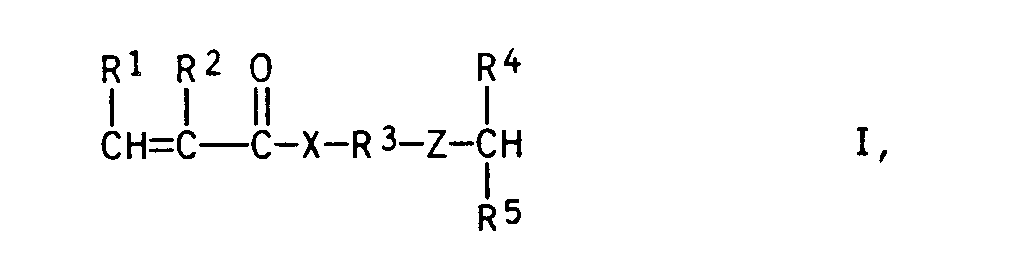
- R1 und R2 -H oder C1-C4-Alkyl,
- R3 ein Brückenglied mit 1 bis 20 C-Atomen,
- R 4 -C(0)R6, -C(O)OR6 oder -CN
- R5 -H, -C(0)R9, -C(O)OR9 oder -CN
- X -O- oder -NR7-,
- Z eine einfache Bindung, -CH2-, -O-, -NR8- oder -O-C(O)- und
- R6,R7,R8 und R9 -H, Alkyl, Aryl, Alkaryl oder Aralkyl mit bis zu 12 C-Atomen sind,
und
- b3) 0 bis 10 Gew.%, bezogen auf B, weiteren copolymerisierbaren Monomeren.
- Formkörper auf Basis von Mineralfasern sind an sich bekannt. So wird in den DE-A 29 24 085, US-A 4 187 142 und US-A 4 189 345 ein Verfahren zur Herstellung von Faserplatten beschrieben, bei dem die Zuschlagstoffe zusammen mit dem - gegebenenfalls ausgefällten - Bindemittel auf einem Langsieb abfiltriert werden (sog. Blattbildung) und die Faserplatten anschließend bei erhöhter Temperatur getrocknet werden.
- Auf diese Weise stellt man beispielsweise aus Kaolin, Mineralfasern und Stärken Deckenplatten her. Der gravierende Nachteil solcher an sich sehr steifen Platten ist, daß sie in feuchten, besonders aber in feuchtwarmen Räumen - also unter tropischem Klima - ihre Form verlieren, d.h. sich unter ihrem Eigengewicht durchbiegen. Der optische Eindruck solcher durchbogener Decken ist häßlich und daher unerwünscht. Ein weiterer Nachteil ist die Empfindlichkeit solcher Flächengebilde gegenüber dem Abbau des Bindemittels Stärke durch Mikroorganismen, was durch dunkle Flecken und den Verlust der mechanischen Festigkeit zum Ausdruck kommt. Natürlich kann man solche Platten mit Microciden ausrüsten wie z.B. mit Formaldehyd-Depotstoffen. Diese gewährleisten durch allmähliche Abgabe von Formaldehyd einen Schutz gegen den Befall. Um aber einen langjährigen Schutz zu gewährleisten, muß man höhere Konservierungsmitteldosierungen wählen, die zu Geruchsbelästigungen und unter Umständen zu allergischen Reaktionen der Bewohner führen können.
- Aus EP-A 367 023 sind Faserplatten bekannt, die Acrylatcopolymerisate enthalten. Diese können als wäßrige Lösung eingesetzt werden. Beim Einsatz dieser Bindersysteme in der Praxis hat sich jedoch gezeigt, daß einige Punkte noch verbesserungsfähig sind. So zeigt sich bei der Herstellung von Mineralfaserplatten auf dem Langsieb, daß die Viskosität der Polymerlösungen für übliche betriebliche Maßnahmen, wie z.B. Fördern und Dosieren, zu hoch ist. Die Viskosität von solchen ca. 10 %igen Polymerlösungen liegt bei etwa 25 Pas. Erst Lösungen mit Feststoffgehalten von deutlich unter 10 Gew.% können auf fast allen Anlagen problemlos eingesetzt werden, was durch die hohe Menge des Verdünnungsmittels Wasser unwirtschaftlich ist. Weiterhin neigen solche Polymerisate während der Trocknung der Rohplatten zum Migrieren, d.h. zu einer Bindemittelverarmung im Inneren der Mineralfaserplatten, was sich negativ auf die Weiterverarbeitung der Rohplatten auswirken kann. Dieser Bindemittelmigration weiß der Fachmann zwar durch den Einsatz von Stoffen mit inverser Löslichkeit, wie z.B. Polyvinylmethylether, zu begegnen. Sie verursachen aber zusätzliche Kosten und können die Feuchtigkeitsaufnahme der Endprodukte steigern.
- Aus der EP-A 386 579 sind Formkörper bekannt, die mit Acrylatdispersionen gebunden werden. Die mit diesen Bindemitteln und denen der EP-A 367 023 hergestellten Formteile haben insgesamt befriedigende Eigenschaften, ihre mechanische Festigkeit und ihre Wasseraufnahme können jedoch noch verbessert werden. Eine Erhöhung der Wasserfestigkeit könnte mit einer höheren Dosierung von Hydrophobierungsmitteln geschehen, dabei muß man jedoch einen Rückgang der mechanischen Festigkeit sowie Benetzungs- und Verklebungsprobleme bei den Formteilen in Kauf nehmen.
- Aus DE-A 23 46 310 sind glasfaserverstärkte Polyamide bekannt. Als Schlichte werden ca. 1 Gew.% eines Copolymerisates eingesetzt, das zum überwiegenden Teil aus Butylacrylat mit geringen Mengen an Butandiolmono-acrylat-acetylacetat besteht. Man erhält so eine thermoplastische Formmasse mit hoher Schlagzähigkeit. Ein Hinweis auf Faserplatten findet sich nicht. Werden solche Polymerisate jedoch trotzdem zur Herstellung von Faserplatten verwendet, so erhält man unerwünscht hohe Raumgewichte bei annehmbarer Stabilität und eine für Akustikplatten unbefriedigenden Prägbarkeit.
- Gemäß EP-A 241 127 können Textilmaterialien mit wäßrigen Polymerdispersionen gebunden werden. Es handelt sich dabei um Copolymerisate, die als Hauptkomponente Ethylacrylat und Butylacrylat mit geringen Anteilen an beispielsweise Acetylacetoxyethylacrylat enthalten. Ein wesentliches Ziel ist es, Textilien mit hoher Flexibilität zu erhalten. Daher wurde der Fachmann davon abgehalten, Polymerisate der offenbarten Art zur Herstellung von steifen Faserplatten oder Faserformkörpern in Betracht zu ziehen.
- Aufgabe der vorliegenden Erfindung war es, Formkörper auf Basis von Fasern bereitzustellen, die die oben geschilderten Nachteile vermeiden und eine geringe Wasseraufnahme mit hoher Steifigkeit kombinieren.
- Demgemäß wurden die eingangs definierten Formkörper und ein Verfahren zu ihrer Herstellung gefunden. Bevorzugte Ausführungsformen sind den Unteransprüchen zu entnehmen.
- Als Fasern kommen Mineralfasern in Betracht, z.B. Steinwolle, Basaltwolle, Schlackenwolle und Glasfasern mit Faserlängen von meist 0,2 bis 5, insbesondere 0,5 bis 2,5 cm und Dicken von etwa 1,7 bis 3,3 dtex. Auch organische Fasern kommen in Betracht. Dazu zählen in erster Linie Holzfasern wie zerkleinertes und/oder aufgeschlossenes Holz wie Kiefernholz. Solche Holzfasern werden üblicherweise aus Holzspänen, Hackschnitzeln oder Sägespänen hergestellt (z.B. Ullmann's Encyklopädie der technischen Chemie, 4. Aufl., Bd. 12, S. 720ff). Den Holzfasern können in untergeordneten Mengen auch andere organische Fasern wie Cellulosefasern oder Fasern von synthetischen Polymerisaten wie Polypropylenfasern und/oder Polyacrylnitrilfasern im allgemeinen in Mengen von 5 bis 60, bevorzugt 15 bis 40 und insbesondere 15 bis 25 Gew.%, bezogen auf Holzfasern, zugesetzt sein. Diese Fasern haben üblicherweise eine Länge von 0,3 bis 1,5 cm und eine Dicke von 10 bis 30 dtex.
- Das Polymerisat B wird in Mengen von 5 bis 25, bevorzugt 5 bis 15 Gew.%, bezogen auf die Fasern A, eingesetzt. Es ist bevorzugt aus 75 bis 96 Gew.% bi, 2 bis 20 Gew.% b2, und 0 bis 20 Gew.% b3 aufgebaut.
- Als vinylaromatische Monomere kommen solche mit bis zu 20 C-Atomen, vorzugsweise Vinyltoluol, a-und para-Methylstyrol, a-Butylstyrol, 4-n-Butylstyrol, 4-n-Decylstyrol und vorzugsweise Styrol in Betracht. Die Vinylhalogenide sind mit Chlor, Fluor oder Brom substituierte ethylenisch ungesättigte Verbindungen, bevorzugt Vinylchlorid und Vinylidenchlorid.
- Als Monomere bi kommen weiterhin Ester der Acryl- oder Methacrylsäure von 2 bis 12 C-Atome enthaltenden Alkoholen, bevorzugt Alkanolen in Frage. Als Alkohole seien genannt Methanol, Ethanol, n-oder i-Propanol, n-, s- und t-Butanol, n-Pentanol, Isoamylalkohol, n-Hexanol, Cyclohexanol, Octanol, 2-Ethylhexanol, Laurylalkohol, Benzylalkohol und Vinylethanol.
- Als Ester der Acryl- und Methacrylsäure seien genannt Hexyl(meth)acrylat, Lauryl(meth)acrylat, Cyclohexylacrylat, Phenylethylmethacrylat, Methylacrylat, Ethylacrylat und n- , s- und t-Butyl(meth)acrylat, Benzylmethacrylat, Cyclohexylmethacrylat, Methylmethacrylat, Ethylmethacrylat und vor allem 2-Ethylhexylacrylat und n-Butylacrylat.
- Vinylester mit bis zu 20 C-Atomen sind beispielsweise Vinylacetat, Vinylpropionat, Vinyllaurat und Vinylstearat.
- In der allgemeinen Formel I von b2 sind die folgenden Substituenten bevorzugt:
- R1: H,
- R 2 : H oder Methyl,
- R3: ein aliphatisches oder aromatisches Brückenglied wie -CH2-, -C2H4-, -C4H8- und daneben auch -C3 H6 - oder -C8 H16-,
- R4 : -C(0)R6 wie Acetyl, Benzoyl oder -CN
- R 5 : -H, -C(0)R9 wie Benzoyl und Acetyl,
- X -O- oder -NH-,
- Z: -OC(O)- oder eine einfache Bindung,
- R6: Methyl, Ethyl und Phenyl und
- R9: Methyl, Ethyl und Phenyl.
- Bevorzugt seien genannt Acetylacetoxyethylacrylat und -methacrylat


- Solche Verbindungen sind an sich bekannt aus DE-A 17 93 660, US-A 4 088 499 oder EP-A 241 127 und in üblicher Weiser herstellbar durch Umsetzung eines Hydroxyalkylesters, z.B. des Hydroxyethylesters der Acryl- oder Methacrylsäure mit Diketen oder Cyanoacetylchlorid. Gute Ergebnisse werden auch mit 1, 1-Dibenzoyl-2-methacrylamidoethan, 1,1-Dibenzoyl-2-acrylamidoethan,


- Solche Verbindungen sind an sich bekannt aus DE-A 38 19 455 und in üblicher Weise herstellbar durch Amidomethylierung von 1,3-Diketonen in Gegenwart starker Säuren.
- b3 sind beispielsweise Acrylsäure, Methacrylsäure, Acrylamid, Methacrylamid, Maleinsäure, Fumarsäure, Itaconsäure, Maleinsäureanhydrid, Butandiolmonoacrylat, Glycidylmethacrylat oder auch zweifach ungesättigte Monomere wie Divinylbenzol, Butandioldiacrylat, Diallylphthalat, Butadien oder Chloropren. Bevorzugt wird Acrylsäure und Methacrylsäure, die meist in Mengen zwischen 1 und 8 Gew.%, bezogen auf B, eingesetzt wird.
- Gute Erfolge werden mit Polymerisaten aus
- bi) einem Gemisch aus 55 bis 90 Gew.%, bezogen auf B, eines vinylaromatischen Monomeren, 2 bis 25 Gew.%, bezogen auf B, eines oder mehrerer Monomerer ausgewählt aus Methylacrylat, Acrylnitril, Methacrylnitril und 0 bis 20, bevorzugt 5 bis 20 Gew.%, bezogen auf B, Acrylester und/oder Methacrylester von 2 bis 12 C-Atome enthaltenden Alkoholen,
- b2) 2 bis 15 Gew.%, bezogen auf B, eines Monomeren der allgemeinen Formel I, und
- b3) 0 bis 10 Gew.% weiterer copolymerisierbarer Monomerer und mit Polymerisaten aus
- bi) einem Gemisch aus 55 bis 96, bevorzugt bis 95 Gew.%, bezogen auf B, Methylmethacrylat, 0 bis 35 Gew.% mindestens eines Monomeren ausgewählt aus Methylacrylat, Acrylnitril, Methacrylnitril und 0 bis 20, bevorzugt 1 bis 20 Gew.%, bezogen auf B, Acrylester und/oder Methacrylester von 2 bis 12 C-Atome enthaltenden Alkoholen,
- b2) 4 bis 20 Gew.% eines Monomeren der allgemeinen Formel I, und
- b3) 0 bis 10, bevorzugt 0 Gew.%, bezogen auf B, weiterer copolymerisierbarer Monomerer erzielt.
- Das Polymerisat B wird vorzugsweise durch radikalische Emulsionspolymerisation in wäßriger Phase hergestellt.
- Batchverfahren oder Zulaufverfahren, in denen der Initiator und/oder die gegebenenfalls in Wasser emulgierten Monomeren während der Polymerisation portionsweise oder kontinuierlich zugegeben werden, können benutzt werden (siehe beispielsweise Encyclopaedia of Polymer Science and Engineering, Vol. 6 (1986) 1 bis 52). Die entstehenden wäßrigen Copolymerdispersionen haben meist eine Konzentration an Copolymer, d.h. einen Feststoffgehalt von 40 bis 60, in vielen Fällen 45 bis 55 Gew.%. Als Emulgiermittel werden meist 0,2 bis 3 Gew.-%, bezogen auf die eingesetzten Monomeren, anionische und/oder nichtionische Emulgatoren, beispielsweise Natriumdialkylsulfosuccinate, Natriumsalze von sulfatierten Ölen, Natriumsalze von Alkylsulfonsäuren, Natrium-, Kalium- und Ammoniumalkylsulfate, Alkalisalze von Sulfonsäuren, Fettsäuren, Fettalkohole, Fettamide und Alkylphenole, deren ethoxylierte und/oder sulfatierte Derivate, ferner Natriumsalze von Fettsäuren, wie Natriumstearat und Natriumoleat und sulfonierte Alkyldiphenylether verwendet.
- Die pH-Werte der Polymerdispersionen liegen im Bereich von 3 bis 9, bevorzugt 4 bis 8,5. Die Polymerdispersionen sind meist niedrig-viskos, d.h. etwa 10 bis 20 mPa. bei 23 ° C und einem Schergefälle von 280 S-1. Die mittlere Teilchengröße liegt im Bereich von 100 bis 300, bevorzugt 100 bis 200 um (Dso-Wert, Ultrazentrifuge, W. Maechtle, Makromolekulare Chemie 185 (1984), 1025).
- Gute Erfolge werden erzielt, wenn das Polymerisat B eine Glasübergangstemperatur von 60 bis 150, bevorzugt 70 bis 100 und insbesondere 70 bis 95 ° C aufweist.
- Vorteilhaft für die Verarbeitung ist der niedrige Restmonomerengehalt der erfindungsgemäß eingesetzten Polymerisate, der meist deutlich unter 500 ppm, bezogen auf Dispersion, liegt. Dies bedeutet, daß die Arbeitsstoffkonzentration in der Luft am Arbeitsplatz außerordentlich niedrig ist und daß die Fertigartikel praktisch geruchsfrei sind.
- Die Polymerisatdispersionen sind stabil gegenüber Scherkräften und können problemlos transportiert und mit geeigneten Pumpen gefördert werden. Trotzdem besitzen sie ein sehr günstiges Fällungsverhalten. Sie koagulieren mit dem in Mineralfaserwerken anzutreffenden Kreislauf- oder Prozeßwasser ohne weitere Zusätze, so daß vorteilhafterweise auf den Zusatz von Fällungsmitteln wie z.B. Aluminiumsulfat verzichtet werden kann. Bei der Herstellung von Holzformteilen kann es manchmal jedoch von Vorteil sein, die Koagulation der Polymerdispersionen durch kleine Dosen z.B. verdünnter wäßriger Aluminiumsulfatlösungen zu unterstützen.
- Die erfindungsgemäßen Formkörper können neben den Bestandteilen A und B nichtfaserige Füllstoffe C enthalten. Es kann sich dabei um feuergetrocknete Sande, feinteilige Tone wie Kaolin oder Montmorrilonit, Feldspat, Kreide, Kieselgur und Glimmer handeln, die bevorzugt mit den Mineralfasern eingesetzt werden. Ihre Menge kann zwischen 20 und 80, vorzugsweise 30 und 60 Gew.%, bezogen auf die eingesetzten Fasern, betragen.
- Zusätzlich können die Formkörper noch bis zu 10, vorzugsweise 1 bis 3 Gew.%, bezogen auf Fasern, übliche Brandschutzmittel wie Aluminiumsilikat, -hydroxid, Borate wie Natriumtetraborat und/oder Phosphate wie prim. Natriumphosphat enthalten.
- Manchmal fügt man bei der Herstellung der Formkörper noch bis zu 5, vorzugsweise 1 bis 2 Gew.%, bezogen auf die Fasern, an üblichen Hydrophobierungsmitteln wie Silikone und/oder Wachse zu.
- Weiterhin können noch Stärke wie Maisstärke oder Kartoffelstärke meist in Mengen von 1 bis 5 Gew.%, bezogen auf die Fasern, zugesetzt werden.
- Auch bekannte Flockungshilfsmittel wie Polyacrylamide können in geringen Mengen vorhanden sein.
- Die Formkörper können in verschiedenen Verfahren hergestellt werden.
- Man kann beispielsweise aus den Fasern A, gegebenenfalls den Füllstoffen C und weiteren Zuschlägen unter Durchmischen eine wäßrige Suspension herstellen. Dabei oder danach wird das Polymerisat B vorteilhafterweise als wäßrige Dispersion zugesetzt. Man arbeitet im allgemeinen bei Raumtemperatur, also zwischen 15 und 35 C. Anschließend wird die Suspension im allgemeinen durch Zugabe von Flockungshilfsmitteln ausgeflockt. Die entstehende Mischung wird in eine Form gegeben und entwässert, was z.B. durch Absaugen und/oder Pressen geschehen kann. Der noch nasse Formkörper wird üblicherweise im Verlauf von 0,1 bis 5 Stunden bei 100 bis 250 ° C getrocknet. Dabei können Trockenschränke, Umlufttrockner, IR-Strahler oder Mikrowellenstrahler und/oder beheizbare Pressen verwendet werden.
- Auch andere Herstellungsvarianten sind möglich. Man kann beispielsweise bei der Herstellung von Flächengebilden die Blattbildung auf dem Langsieb vornehmen und bei erhöhter Temperatur (ca. 70 bis 150°C) trocknen. Es ist auch möglich, nach der Blattbildung einen Verformungsprozeß vorzunehmen und erst dann bei erhöhter Temperatur zu trocknen. Weiterhin können alle Zuschlagstoffe im trocknen oder feuchten Zustand vermischt werden, was in einem Wirbelbett geschehen kann. Danach wird verformt und vorzugsweise in der Wärme getrocknet.
- Andere, in der Praxis vielfach bewährte Herstellungsverfahren sind das Befeuchten der Fasern und gegebenenfalls weiterer Zuschlagstoffe durch Besprühen oder Tauchen mit nachfolgendem Abquetschen und anschließender Trocknung bei erhöhter Temperatur, wobei man durch mehr oder weniger starkes Pressen während der Trocknung die Raumgewichte solcher Flächengebilde einstellen kann.
- Weiterhin kann man zunächst aus Fasern und gegebenenfalls Fäll- und Zuschlagstoffen einen Formkörper bilden, der dann anschließend mit der wäßrigen Dispersion des Polymerisates B imprägniert wird. Dieses Verfahren ist in der EP-A 386 579 beschrieben.
- Dabei werden die Formgrundkörper in vorteilhafter Weise zunächst mit der wäßrigen Dispersion imprägniert, wobei eine allseitige Imprägnierung bevorzugt wird, und nach anschließendem Trocknen mit der pigmentierten Dispersion als Dekor beschichtet.
- Um optisch ansprechende Beschichtungen zu erhalten, ist es dabei von Vorteil, die Gesamtbeschichtung in mehreren Arbeitsgängen durchzuführen und zwischen den einzelnen Arbeitsgängen die jeweils aufgetragene Schicht zu trocknen, wobei in der Regel Temperaturen von 100 bis 180°C angewendet werden. Das Verfahren kann mit besonderem Vorteil zur Herstellung von Schalldämmplatten mit in Gegenwart von Luftfeuchtigkeit verbesserter Formbeständigkeit eingesetzt werden, wobei die flächigen Formgrundkörper gegebenenfalls mit schallabsorbierenden Strukturen versehen sein können. Das Auftragen der erfindungsgemäßen Massen kann durch Sprühen, Rollen oder Gießen erfolgen, wobei die Oberfläche des Formgrundkörpers in der Regel zuvor abgeschliffen wird. Die aufgetragenen Mengen betragen im allgemeinen (gerechnet in Mengen M des in der Beschichtungs- oder Imprägnierungsmasse enthaltenen wasserfreien Copolymerisats) 2 bis 100 g/m2.
- Bei den erfindungsgemäßen im allgemeinen betonfreien Formkörpern handelt es sich insbesondere um Platten, d.h. quaderförmige Körper mit üblicherweise einem Verhältnis von Breite:Länge von 1:1 bis 1:5 und Höhe:Länge von 1:10 bis 1:100.
- Beispiele sind Mineralfaserplatten oder Holzfaserplatten, die als Deckenplatten oder Schalldämmplatten verwendet werden können. Die Platten können auf ihrer Sichtfläche mit bekannten schallabsorbierenden Strukturen und in an sich bekannter Weise mit Dekorbeschichtungen versehen sein. Die auf diese Weise erhaltenen Schalldämm(decken)-Platten haben sehr gutes Dämmverhalten, sind sehr steif - auch in feuchtem Zustand - und geben die aufgenommene Feuchte sehr leicht wieder ab.
- Überraschenderweise werden bei den erfindungsgemäßen Formkörpern die vorstehend aufgezeigten Nachteile vermieden. Obwohl es sich bei den Polymerisaten B um Thermoplaste handelt, erfüllen sie als Bestandteile der Formkörper alle Bindefunktionen der Duroplaste wie z.B. Steifigkeit. Überraschend ist ferner, daß diese hydrophilen Polymeren die Steifigkeit der Formkörper auch in feuchter und warmer Atmosphäre gewährleisten, sogar wenn in begrenztem Umfang Stärke in den Formteilen vorhanden ist. Als weiteres Positivum kommt hinzu, daß die Polymeren sich leicht durch Emulsionspolymerisation herstellen lassen. Eine biozide oder fungizide Ausrüstung der Formkörper ist entbehrlich, da die Polymeren unter den Bedingungen der Herstellung und der Verwendung der Platten nicht abgebaut werden. Trotzdem bereitet die Entsorgung von Bindemittelresten und auch der damit hergestellten Formkörper keine Probleme. Die Polymerisate bilden mit mehrwertigen Ionen wie z.B. Calciumionen, Magnesiumionen oder Fe(III)ionen in Wasser unlösliche Verbindungen oder werden durch diese ausgefällt und können somit nicht ins Grundwasser gelangen. Die Calciumverbindungen adsorbieren sehr ausgeprägt an die Feststoffpartikel in Kläranlagen. Polymerisate, die nur aus Kohlenstoff, Wasserstoff und Sauerstoff aufgebaut sind, bieten in dieser Hinsicht besondere Vorteile.
- In den folgenden Beispielen beziehen sich die Prozente und Teile auf das Gewicht, wenn nichts anderes angegeben ist.
- Die Untersuchungen der beispielhaft hergestellten Platten wurden nach folgenden Methoden durchgeführt:
- Prüfkörper werden mit den Maßen 250 mm x 50 mm ausgeschnitten. Die Dicke wird mit einer Schieblehre bestimmt und zur Berechnung des Volumens verwendet. Die Dichte wird in g/cm3 als Mittelwert aus 2 Prüfkörpern berechnet.
- Kreisrunde Prüfkörper mit D = 9 mm werden mittels Stanzeisen ausgestanzt. Die Dicke wird mit einer Schieblehre gemessen, zur Volumenberechnung eingesetzt, und die Dichte in g/cm3 als Mittelwert aus 3 Prüfkörpern berechnet.
- Prüfkörper mit den Längsmaßen 250 mm x 50 mm werden unter Gewichtsbelastung 1 bzw. 2 Stunden bei Raumtemperatur unter Wasser gelagert. Die Gewichtszunahme wird nach sorgfältigem Abtupfen durch Wägen als Mittelwert aus jeweils 2 Prüfkörpern in Prozent der Gewichtszunahme bestimmt.
- Man schleift mittels Bandschleifgerät Prüfkörper mit den Maßen 250 mm x 50 mm, bis diese 15 mm dick sind. Geschliffen wird auf der dem Sieb bei der Blattbildung abgewandten Seite.
- Die so gewonnenen Prüfkörper werden in einem Klima von 38 °C und 95 % relativer Luftfeuchte flachseitig nahe den Endkanten waagrecht aufgelegt und in der Mitte mit einem 1 kg-Gewicht belastet, so daß sich die Belastung auf die Gesamtlänge des Prüfkörpers auswirkt. Die Durchbiegung des Prüfkörpers wird im entlasteten Zustand gemessen und so ein Anhaltspunkt für das Langzeitverhalten von Mineralfaserplatten ermittelt.
- Die getrockneten Prüfkörper (Maße 17 cm x 2 cm x 2 cm) werden nahe den Endkanten aufgelegt und in der Mitte mit einer kontinuierlich steigenden Kraft belastet, so daß sich die Belastung auf die Gesamtlänge des Prüfkörpers auswirkt. Die beim Bruch anliegende Kraft wird als Mittelwert von fünf Prüfkörpern in kg/cm2 angegeben.
- Die Reißkraft wird nach DIN 53 455 ermittelt.
- Folgende Abkürzungen werden verwendet:
- AAEM Acetylacetoxyethylmethacrylat
- AN Acrylnitril
- AS Acrylsäure
- EHA 2-Ethylhexylacrylat
- MMA Methylmethacrylat
- MA Methylacrylat
- MAS Methacrylsäure
- n-BA n-Butylacrylat
- S Styrol
- Die bei den Beispielen 3, 4, 5, 7 bis 13 und V1 als Emulgatoren genannten Fettsäuresalze wurden in situ durch Neutralisation der korrespondierenden Carbonsäuren mit Natronlauge hergestellt. Durch Zugabe der Monomeren und gegebenenfalls Wasser bzw. der anderen Emulgatoren wurden die Monomeremulsionen hergestellt. Bei diesen Beispielen wurden weiterhin ein Drittel des Ansatzwassers vorgelegt und zwei Drittel für die Monomeremulsion verwendet. Ansonsten wurde wie oben beschrieben gearbeitet.
- Die Glastemperaturen Tg wurden durch Differentialthermoanalyse (DTA) nach ASTM D 3418-82 ("midpoint temperature") bestimmt.
- Bindemittel: 42 %ige wäßrige Dispersion eines Polymerisates aus
- 92 Gew.% MMA
- 7 Gew.% AAEM
- 1 Gew.% MAS
- Man stellt unter schonendem Rühren eine Suspension aus

- 240 g Basaltwolle
- 90 g Kaolin
- 15 g Aluminiumhydroxid
- 57 g der o.g. Polymerdispersion
- 3 g einer handelsüblichen ca. 35 %igen Polysiloxandispersion als Hydrophobiermittel
- in 6 I Prozeßwasser her. Hierzu benötigt man etwa 3 Minuten. Durch Zugabe von 4,5 g einer 10 %igen wäßrigen Lösung eines Polymerisates aus 70 Gew.% Acrylamid und 30 Gew.% Diethylaminoethylacrylat wird diese Suspension geflockt. Den so erhaltenen Faserbrei gießt man in einen Siebkasten mit einer Siebfläche von 25 cm x 25 cm und verteilt ihn gleichmäßig mit einem Holzspatel. Unter leichtem Unterdruck und vorsichtigem Pressen mit einem Stempel (25 cm x 25 cm, Druck höchstens 0,1 bar) wird die Faserbreischicht entwässert, wozu man höchstens 0,5 Minuten benötigt.
- Man erhält eine etwa 18 mm dicke Rohplatte mit einer Restfeuchte von im Mittel 60 %. Die Rohplatte wird auf silikonisiertem Papier im Umlufttrockenschrank bei 180°C getrocknet, was etwa 2,5 h dauert. Eigenschaften der Mineralfaserplatte

- Bindemittel: 46 %ige wäßrige Dispersion eines Polymerisats aus
- 88 Gew.% MMA
- 12 Gew.% AAEM

- Arbeitsweise gemäß Beispiel 1
- Eingesetzt:
- 250 g Basaltwolle
- 100 g Kaolin
- 38 g o.g. Polymerdispersion
- 8 g Maisstärke
- Flockungs- und Hydrophobierungsmittel gemäß Beispiel 1.
-

- Bindemittel: 48 %ige wäßrige Dispersion eines Polymerisats aus
- 60 Gew.% MMA
- 25 Gew.% AN
- 10 Gew.% AAEM
- 5 Gew.% MA

- Eingesetzt:
- 235 g Schlackenwolle
- 80 g Kaolin
- 10 g Aluminiumhydroxid
- 37 g o.g. Polymerdispersion
- Arbeitsweise, Flockungs- und Hydrophobierungsmittel gemäß Beispiel 1.
-

- Bindemittel: 43 %ige wäßrige Dispersion eines Polymerisats aus
- 73 Gew.% S
- 15 Gew.% n-BA
- 12 Gew.% AAEM
-

- Eingesetzt:
- 240 g Schlackenwolle
- 5 95 g Kaolin
- 15 g Aluminiumhydroxid
- 6,3 g Kartoffelstärke
- 36 g o.g. Polymerdispersion
- Arbeitsweise, Flockungs- und Hydrophobierungsmittel gemäß Beispiel 1.
-

- Bindemittel: 45,8 %ige wäßrige Dispersion eines Polymerisats aus
- 60 Gew.% S
- 20 Gew.% AN
- 12 Gew.% n-BA
- 8 Gew.% AAEM
-

- 220 g Schlackenwolle
- 120 g Kaolin
- 10 g Aluminiumhydroxid
- 7,5 g Maisstärke
- 27 g o.g. Polymerdispersion
- Arbeitsweise, Flockungs- und Hydrophobierungsmittel gemäß Beispiel 1.
-

- Bindemittel: 39 %ige wäßrige Dispersion eines Polymerisats aus
- 78 Gew.% MMA
- 16 Gew.% MA
- 6 Gew.% Cyanoacetoxyethylmethacrylat

- Eingesetzt:
- 235 g Schlackenwolle
- 80 g Kaolin
- 12 g Aluminiumhydroxid
- 2,5 g Maisstärke
- 50 g o.g. Polymerdispersion
- Arbeitsweise, Flockungs- und Hydrophobierungsmittel gemäß Beispiel 1.
-

- Bindemittel: 50,8 %ige wäßrige Dispersion eines Polymerisats aus
- 65 Gew.% MMA
- 30 Gew.% AN
- 5 Gew.% MA

-
- 235 g Schlackenwolle
- 80 g Kaolin
- 10 g Aluminiumhydroxid
- 35 g o.g. Polymerdispersion
- Arbeitsweise, Flockungs- und Hydrophobierungsmittel gemäß Beispiel 1.
-

- Man stellt unter gutem Rühren eine Suspension von Fasern in 6 I Wasser her. Hierzu benötigt man etwa 3 Minuten. Bei Bedarf setzt man nun Hydrophobierungsmittel zu. Der nächste Schritt ist die Zugabe der wäßrigen Bindemitteldispersion, gegebenenfalls gefolgt von Aluminiumsulfat. Ebenfalls unter Rühren erfolgt der Zusatz 4,5 g einer 10 %igen wäßrigen Lösung eines Polymerisats auf 70 Gew.% Acrylamid und 30 Gew.% Diethylaminoethylacrylat als Flockungsmittel.
- Zur Blattbildung gießt man den Faserbrei in einen Siebkasten mit der Siebfläche von 25 cm x 25 cm und verteilt die Masse gleichmäßig mit einem Holzspatel. Unter leichtem Unterdruck wird nun die Masse entwässert. Unter leichtem Pressen (weniger als 0,1 bar) mit einem Stempel (25 cm x 25 cm) und vorsichtigem Absaugen erhält man feuchte Rohplatten, die meist 8 bis 9 mm dick sind und ca. 60 % Wasser enthalten.
- Die Rohplatten trocknet man in einem Mikrowellenherd auf Restfeuchten von 10 bis 15 % und anschließend in einer beheizten Presse bei 220 ° C und 50 kp/cm2 während 90 s.
- Bindemittel: 45 %ige wäßrige Dispersion eines Polymerisats aus
- 62 Gew.% MMA
- 20 Gew.% AN
- 10 Gew.% MA
- 8 Gew.% AAEM
- Eingesetzt:

- 105 g Holzfasern
- 10 g Cellulosefasern
- 10 g Polypropylenfasern
- 15 g 8 %ige wäßrige Emulsion von Stearyldiketen (Hydrophobierungsmittel)
- 18 g o.g. Polymerdispersion
- 11 g wäßrige 10 %ige Aluminiumsulfatlösung
- 4,5 g Flockungsmittel
-

- Bindemittel: 41 %ige wäßrige Dispersion eines Polymerisats aus
- 75 Gew.% S
- 15 Gew.% n-BA
- 10 Gew.% AAEMpH-Wert : 8,0

-
- 6 I Prozeßwasser
- 100 g Holzfasern
- 10 g Cellulosefasern
- 10 g Polypropylenfasern
- 24 g o.g. Polymerdispersion
- 4,5 g Flockungsmittel wie in Beispiel 7
-

- Bindemittel: 46,5 %ige wäßrige Dispersion eines Polymerisats aus 91 Gew.% MMA
- 9 Gew.% AAEM

- Eingesetzt:
- 6 I Prozeßwasser
- 90 g Holzfasern
- 10 g Cellulosefasern
- 20 g Polypropylenfasern
- 19 g o.g. Polymerdispersion
- 3 g wäßrige Aluminiumsulfatlösung 10 %ig
- 4,5 g Flockungsmittel wie in Beispiel 7
-

- Bindemittel: 38 %ige wäßrige Dispersion eines Polymerisats aus
- 82 Gew.% S
- 10 Gew.% MA
- 7 Gew.% Acetylacetoxy-n-butylacrylat
- 1 Gew.% AS
-

- 6 I Prozeßwaser
- 100 g Holzfasern
- 5 g Cellulosefasern
- 15 g Polyacrylnitrilfasern
- 24 g o.g. Polymerdispersion
- 4,5 g Flockungsmittel wie in Beispiel 7
-

- Bindemittel: 42,5 %ige wäßrige Dispersion eines Polymerisats aus
- 80 Gew.% S
- 10 Gew.% EHA
- 5 Gew.% 1,1-Dibenzoyl-2-acrylamidoethan
- 5 Gew.% AS

-
- 6 I Prozeßwasser
- 100 g Holzfasern
- 10 g Polyacrylnitrilfasern
- 10 g Polypropylenfasern
- 25 g o.g. Polymerdispersion
- 4,5 g Flockungsmittel wie in Beispiel 7
-

- Bindemittel: 44 %ige wäßrige Dispersion eines Polymerisats aus
- 79 Gew.% S
- 5 Gew.% AN
- 10 Gew.% EHA
- 5 Gew.% 1-Benzoyl-1-acetyl-2-acrylamidoethan
- 1 Gew.% AS
-

- 6 I Prozeßwasser
- 95 g Holzfasern
- 5 g Cellulosefasern
- 10 g Polyacrylnitrilfasern
- 10 g Polypropylenfasern
- 26 g o.g. Polymerdispersion
- 4,5 g Flockungsmittel wie in Beispiel 7
-

- Bindemittel: 49,3 %ige wäßrige Dispersion eines Polymerisats aus
- 90 Gew.% MMA
- 5 Gew.% AAEM
- 5 Gew.% AS
-

- 6 I Prozeßwasser
- 100 g Holzfasern
- 10 g Polyacrylnitrilfasern
- 10 g Polypropylenfasern
- 21 g o.g. Polymerdispersion
- 4,5 g Flockungsmittel wie in Beispiel 7
-

- Bindemittel: 40 %ige wäßrige Dispersion eines Polymerisats aus
- 60 Gew.% MMA
- 30 Gew.% n-BA
- 10 Gew.% MAS

- Eingesetzt:
- 86 g Holzfasern
- 10 g Cellulosefasern
- 24 g Polypropylenfasern
- 24 g wäßrige Stearyldiketen-Emulsion 8 %ig
- 24 g o.g. Polymerdisperion
- 25 g wäßrige Aluminiumsulfatlösung 10 %ig
- 4,5 g Flockungsmittel wie in Beispiel 7
-
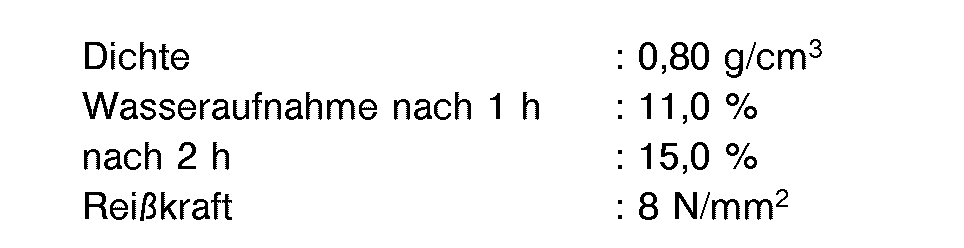
- Bindemittel: 30,2 %ige wäßrige Dispersion eines Polymerisats aus 70 Gew.% MMA
- 30 Gew.% MAS

- Eingesetzt:
- 86 g Holzfasern
- 10 g Cellulosefasern
- 24 g Polypropylenfasern
- 24 g wäßrige Stearyldiketen-Emulsion 8 %ig
- 24 g o.g. Polymerdisperion
- 25 g wäßrige Aluminiumsulfatlösung 10 %ig
- 4,5 g Flockungsmittel wie in Beispiel 7
-

- Bindemittel: 29,2 %ige wäßrige Dispersion eines Polymerisats aus
- 60 Gew.% MMA
- 35 Gew.% n-BA
- 5 Gew.% AAEM
- Tg : 61°C
- Emulgator : 1,4 % Na-Salz eines Fettalkoholethoxilat-Schwefelsäurehalbesters(EO-Grad: 2)
- pH-Wert :2,9
- Arbeitsweise gemäß Beispiel 1
- Eingesetzt:
- 250 g Basaltwolle
- 100 g Kaolin
- 60 g o.g. Polymerdispersion
-

- Bindemittel: Wie in Vergleichsbeispiel 4
- Arbeitsweise gemäß Beispiel 7
- Eingesetzt:
- 105 g Holzfasern
- 10 g Cellulosefasern
- 10 g Polypropylenfasern
- 15 g 8 %ige wäßrige Emulsion von Stearyldiketen (Hydrophobierungsmittel)
- 29 g o.g. Polymerdisperion
- 11 g wäßrige 10 %ige Aluminiumsulfatlösung
- 4,5 g Flockungsmittel
-

Gemäß der folgenden allgemeinen Vorschrift wurden die in den Beispielen als Bindemittel verwendeten Polymerisatdispersionen B hergestellt:
Die Dispersionen wurden durch wäßrige radikalische Emulsionspolymerisation aus den Monomeren, die mit Hilfe der Emulgatoren in der Hälfte des Ansatzwassers emulgiert waren, unter Verwendung von 0,5 Gew.-%, bezogen auf die Monomeren, Natriumperoxodisulfat als Initiator in Form einer 2,5 gew.%igen wäßrigen Lösung bei 80 C hergestellt. Dazu wurde die Hälfte des Ansatzwassers vorgelegt und unter Rühren bei Polymerisationstemperatur 10 Gew.-% der Initiatorlösung zugegeben. Anschließend wurden die Monomeremulsion innerhalb von 2 Stunden und die Initiatorlösung innerhalb von 2,5 Stunden dem Polymerisationsgefäß unter Rühren kontinuierlich zugeführt. Zur Nachpolymerisation wurde noch 2 h bei Polymerisationstemperatur gerührt und dann in bekannter Weise aufgearbeitet. Die Menge des Ansatzwassers wurde so bemessen, daß die angegebenen Feststoffgehalte erzielt wurden.
Claims (5)
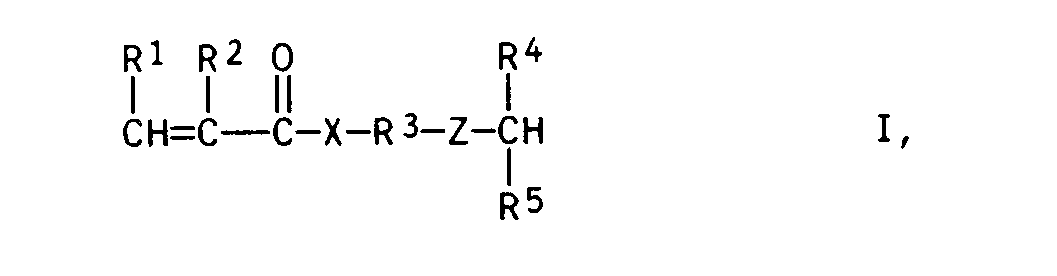
Applications Claiming Priority (2)
| Application Number | Priority Date | Filing Date | Title |
|---|---|---|---|
| DE4102345A DE4102345A1 (de) | 1991-01-26 | 1991-01-26 | Formkoerper auf basis von fasern |
| DE4102345 | 1991-01-26 |
Publications (3)
| Publication Number | Publication Date |
|---|---|
| EP0497101A2 true EP0497101A2 (de) | 1992-08-05 |
| EP0497101A3 EP0497101A3 (en) | 1993-02-03 |
| EP0497101B1 EP0497101B1 (de) | 1995-09-06 |
Family
ID=6423795
Family Applications (1)
| Application Number | Title | Priority Date | Filing Date |
|---|---|---|---|
| EP92100251A Expired - Lifetime EP0497101B1 (de) | 1991-01-26 | 1992-01-09 | Formkörper auf Basis von Fasern |
Country Status (8)
| Country | Link |
|---|---|
| EP (1) | EP0497101B1 (de) |
| JP (1) | JPH04333695A (de) |
| AT (1) | ATE127494T1 (de) |
| CA (1) | CA2059626A1 (de) |
| DE (2) | DE4102345A1 (de) |
| DK (1) | DK0497101T3 (de) |
| ES (1) | ES2076562T3 (de) |
| FI (1) | FI920326L (de) |
Cited By (3)
| Publication number | Priority date | Publication date | Assignee | Title |
|---|---|---|---|---|
| WO2005097849A1 (de) * | 2004-03-17 | 2005-10-20 | Röhm Gmbh | (meth)acrylatsirup als suspensionsstabilisatoren für farbmittel |
| WO2018222460A1 (en) * | 2017-05-29 | 2018-12-06 | Dow Global Technologies Llc | Thermoplastic polyolefin compositions useful for aldehyde abatement |
| CN110637058A (zh) * | 2017-05-29 | 2019-12-31 | 陶氏环球技术有限责任公司 | 适用于醛减少的热塑性聚烯烃组合物 |
Family Cites Families (1)
| Publication number | Priority date | Publication date | Assignee | Title |
|---|---|---|---|---|
| US4900615A (en) * | 1986-03-11 | 1990-02-13 | Union Oil Company Of California | Textile materials and compositions for use therein |
-
1991
- 1991-01-26 DE DE4102345A patent/DE4102345A1/de not_active Withdrawn
-
1992
- 1992-01-09 ES ES92100251T patent/ES2076562T3/es not_active Expired - Lifetime
- 1992-01-09 EP EP92100251A patent/EP0497101B1/de not_active Expired - Lifetime
- 1992-01-09 DE DE59203505T patent/DE59203505D1/de not_active Expired - Lifetime
- 1992-01-09 DK DK92100251.5T patent/DK0497101T3/da active
- 1992-01-09 AT AT92100251T patent/ATE127494T1/de not_active IP Right Cessation
- 1992-01-20 CA CA002059626A patent/CA2059626A1/en not_active Abandoned
- 1992-01-24 JP JP4010892A patent/JPH04333695A/ja not_active Withdrawn
- 1992-01-24 FI FI920326A patent/FI920326L/fi not_active Application Discontinuation
Cited By (6)
| Publication number | Priority date | Publication date | Assignee | Title |
|---|---|---|---|---|
| WO2005097849A1 (de) * | 2004-03-17 | 2005-10-20 | Röhm Gmbh | (meth)acrylatsirup als suspensionsstabilisatoren für farbmittel |
| WO2018222460A1 (en) * | 2017-05-29 | 2018-12-06 | Dow Global Technologies Llc | Thermoplastic polyolefin compositions useful for aldehyde abatement |
| CN110637058A (zh) * | 2017-05-29 | 2019-12-31 | 陶氏环球技术有限责任公司 | 适用于醛减少的热塑性聚烯烃组合物 |
| CN110651001A (zh) * | 2017-05-29 | 2020-01-03 | 陶氏环球技术有限责任公司 | 适用于醛减少的热塑性聚烯烃组合物 |
| US11377542B2 (en) | 2017-05-29 | 2022-07-05 | Dow Global Technologies Llc | Thermoplastic polyolefin compositions useful for aldehyde abatement |
| CN110637058B (zh) * | 2017-05-29 | 2023-10-24 | 陶氏环球技术有限责任公司 | 适用于醛减少的热塑性聚烯烃组合物 |
Also Published As
| Publication number | Publication date |
|---|---|
| DE59203505D1 (de) | 1995-10-12 |
| DK0497101T3 (da) | 1995-10-23 |
| ES2076562T3 (es) | 1995-11-01 |
| FI920326A7 (fi) | 1992-07-27 |
| CA2059626A1 (en) | 1992-07-27 |
| EP0497101A3 (en) | 1993-02-03 |
| JPH04333695A (ja) | 1992-11-20 |
| ATE127494T1 (de) | 1995-09-15 |
| FI920326L (fi) | 1992-07-27 |
| FI920326A0 (fi) | 1992-01-24 |
| EP0497101B1 (de) | 1995-09-06 |
| DE4102345A1 (de) | 1992-07-30 |
Similar Documents
| Publication | Publication Date | Title |
|---|---|---|
| EP0536597B1 (de) | Wässrige Polymerisatdispersionen | |
| EP0123234B1 (de) | Schalldämmplatten auf Basis von mineralischen Fasern und thermoplastischen Bindemitteln | |
| EP0178612B1 (de) | Leichtbauplatten auf Basis von mineralischen Fasern und thermoplastischen Bindemitteln | |
| EP1086934A2 (de) | Zementzusammensetzungen, enthaltend redispergierbare Polymerisatpulver | |
| DE19853461A1 (de) | Schutzkolloid-stabilisierte Copolymerisat-Latexteilchen mit heterogener Morphologie auf Basis eines Vinylacetat/Ethylen-Copolymerisats, Verfahren zu ihrer Herstellung sowie ihre Verwendung | |
| DE69125040T2 (de) | Verfahren zur Herstellung von Spanplatten und einem Bindemittel zur Behandlung der Holzspäne vor dem Pressen | |
| DE3907013A1 (de) | Formkoerper | |
| EP0367023B1 (de) | Herstellen von Formteilen aus einem kleinteiligen Zuschlagstoff sowie einer ein Acrylatpolymeres enthaltenden Bindemittelzubereitung | |
| EP0497100A2 (de) | Formkörper auf Basis von Fasern | |
| EP0033391A1 (de) | Verfahren zum Herstellen schwer entflammbarer oder nicht brennbarer Produkte auf der Basis fasriger Materialien | |
| EP0497101B1 (de) | Formkörper auf Basis von Fasern | |
| CH646929A5 (de) | Verfahren zur herstellung von leichtbaumaterial und nach dem verfahren hergestelltes leichtbaumaterial. | |
| DE3603433C2 (de) | ||
| DE68921616T2 (de) | Verbundfaserplatte und verfahren zu deren herstellung. | |
| EP0735061B1 (de) | Verwendung kationisch stabilisierter wässriger Polymerisatdispersionen als Bindemittel für Formkörper auf der Basis von einer negativen Oberflächenladung aufweisenden feinteiligen Materialien | |
| WO2003012199A1 (de) | Papierstreichmassen für das gussstrichverfahren | |
| EP0475166B1 (de) | Leichtbauplatten | |
| DE2460994B2 (de) | Wäßrige Tränkharzlösung und Verfahren zu ihrer Herstellung | |
| DE2743168C3 (de) | Verfahren zum Herstellen von leichten, platten- oder tafelförmigen mineralischen Formteilen aus geblähtem Perlit und nach dem Verfahren hergestellte Formteile | |
| DE2121806C3 (de) | Verfahren zur Herstellung eines formbeständigen Mineralfaserformkörpers | |
| DE60308585T2 (de) | Polymermodifizierter Faserzement-Zusammensetzung | |
| DE2937268C2 (de) | Wäßrige Emulsion aus einem synthetischen Mehrkomponentenharz und Verfahren zu ihrer Herstellung | |
| CH567638A5 (en) | Fibre panel - bonded with a starch reacted with phthalic or succinic anhydride in alkaline medium | |
| EP0771847A2 (de) | Wässrige Polymerdispersionen | |
| DE2037765A1 (de) | Klebmittelmischung |
Legal Events
| Date | Code | Title | Description |
|---|---|---|---|
| PUAI | Public reference made under article 153(3) epc to a published international application that has entered the european phase |
Free format text: ORIGINAL CODE: 0009012 |
|
| AK | Designated contracting states |
Kind code of ref document: A2 Designated state(s): AT BE CH DE DK ES FR GB IT LI NL SE |
|
| PUAL | Search report despatched |
Free format text: ORIGINAL CODE: 0009013 |
|
| AK | Designated contracting states |
Kind code of ref document: A3 Designated state(s): AT BE CH DE DK ES FR GB IT LI NL SE |
|
| 17P | Request for examination filed |
Effective date: 19921222 |
|
| 17Q | First examination report despatched |
Effective date: 19940811 |
|
| GRAA | (expected) grant |
Free format text: ORIGINAL CODE: 0009210 |
|
| AK | Designated contracting states |
Kind code of ref document: B1 Designated state(s): AT BE CH DE DK ES FR GB IT LI NL SE |
|
| REF | Corresponds to: |
Ref document number: 127494 Country of ref document: AT Date of ref document: 19950915 Kind code of ref document: T |
|
| REF | Corresponds to: |
Ref document number: 59203505 Country of ref document: DE Date of ref document: 19951012 |
|
| GBT | Gb: translation of ep patent filed (gb section 77(6)(a)/1977) |
Effective date: 19950918 |
|
| REG | Reference to a national code |
Ref country code: DK Ref legal event code: T3 |
|
| REG | Reference to a national code |
Ref country code: ES Ref legal event code: FG2A Ref document number: 2076562 Country of ref document: ES Kind code of ref document: T3 |
|
| ITF | It: translation for a ep patent filed | ||
| ET | Fr: translation filed | ||
| PLBE | No opposition filed within time limit |
Free format text: ORIGINAL CODE: 0009261 |
|
| STAA | Information on the status of an ep patent application or granted ep patent |
Free format text: STATUS: NO OPPOSITION FILED WITHIN TIME LIMIT |
|
| 26N | No opposition filed | ||
| PGFP | Annual fee paid to national office [announced via postgrant information from national office to epo] |
Ref country code: FR Payment date: 19971210 Year of fee payment: 7 |
|
| PGFP | Annual fee paid to national office [announced via postgrant information from national office to epo] |
Ref country code: SE Payment date: 19971211 Year of fee payment: 7 |
|
| PGFP | Annual fee paid to national office [announced via postgrant information from national office to epo] |
Ref country code: DK Payment date: 19971218 Year of fee payment: 7 |
|
| PGFP | Annual fee paid to national office [announced via postgrant information from national office to epo] |
Ref country code: NL Payment date: 19971222 Year of fee payment: 7 |
|
| PG25 | Lapsed in a contracting state [announced via postgrant information from national office to epo] |
Ref country code: SE Free format text: LAPSE BECAUSE OF NON-PAYMENT OF DUE FEES Effective date: 19990110 |
|
| PG25 | Lapsed in a contracting state [announced via postgrant information from national office to epo] |
Ref country code: DK Free format text: LAPSE BECAUSE OF NON-PAYMENT OF DUE FEES Effective date: 19990202 |
|
| PG25 | Lapsed in a contracting state [announced via postgrant information from national office to epo] |
Ref country code: NL Free format text: LAPSE BECAUSE OF NON-PAYMENT OF DUE FEES Effective date: 19990801 |
|
| PG25 | Lapsed in a contracting state [announced via postgrant information from national office to epo] |
Ref country code: FR Free format text: LAPSE BECAUSE OF NON-PAYMENT OF DUE FEES Effective date: 19990930 |
|
| REG | Reference to a national code |
Ref country code: FR Ref legal event code: ST |
|
| REG | Reference to a national code |
Ref country code: DK Ref legal event code: EBP |
|
| REG | Reference to a national code |
Ref country code: GB Ref legal event code: IF02 |
|
| PGFP | Annual fee paid to national office [announced via postgrant information from national office to epo] |
Ref country code: CH Payment date: 20021220 Year of fee payment: 12 Ref country code: AT Payment date: 20021220 Year of fee payment: 12 |
|
| PGFP | Annual fee paid to national office [announced via postgrant information from national office to epo] |
Ref country code: GB Payment date: 20030102 Year of fee payment: 12 |
|
| PGFP | Annual fee paid to national office [announced via postgrant information from national office to epo] |
Ref country code: ES Payment date: 20030110 Year of fee payment: 12 |
|
| PGFP | Annual fee paid to national office [announced via postgrant information from national office to epo] |
Ref country code: BE Payment date: 20030117 Year of fee payment: 12 |
|
| PG25 | Lapsed in a contracting state [announced via postgrant information from national office to epo] |
Ref country code: GB Free format text: LAPSE BECAUSE OF NON-PAYMENT OF DUE FEES Effective date: 20040109 Ref country code: AT Free format text: LAPSE BECAUSE OF NON-PAYMENT OF DUE FEES Effective date: 20040109 |
|
| PG25 | Lapsed in a contracting state [announced via postgrant information from national office to epo] |
Ref country code: ES Free format text: LAPSE BECAUSE OF NON-PAYMENT OF DUE FEES Effective date: 20040110 |
|
| PG25 | Lapsed in a contracting state [announced via postgrant information from national office to epo] |
Ref country code: LI Free format text: LAPSE BECAUSE OF NON-PAYMENT OF DUE FEES Effective date: 20040131 Ref country code: CH Free format text: LAPSE BECAUSE OF NON-PAYMENT OF DUE FEES Effective date: 20040131 Ref country code: BE Free format text: LAPSE BECAUSE OF NON-PAYMENT OF DUE FEES Effective date: 20040131 |
|
| BERE | Be: lapsed |
Owner name: *BASF A.G. Effective date: 20040131 |
|
| GBPC | Gb: european patent ceased through non-payment of renewal fee |
Effective date: 20040109 |
|
| REG | Reference to a national code |
Ref country code: CH Ref legal event code: PL |
|
| PGFP | Annual fee paid to national office [announced via postgrant information from national office to epo] |
Ref country code: DE Payment date: 20050106 Year of fee payment: 14 |
|
| PG25 | Lapsed in a contracting state [announced via postgrant information from national office to epo] |
Ref country code: IT Free format text: LAPSE BECAUSE OF NON-PAYMENT OF DUE FEES;WARNING: LAPSES OF ITALIAN PATENTS WITH EFFECTIVE DATE BEFORE 2007 MAY HAVE OCCURRED AT ANY TIME BEFORE 2007. THE CORRECT EFFECTIVE DATE MAY BE DIFFERENT FROM THE ONE RECORDED. Effective date: 20050109 |
|
| REG | Reference to a national code |
Ref country code: ES Ref legal event code: FD2A Effective date: 20040110 |
|
| PG25 | Lapsed in a contracting state [announced via postgrant information from national office to epo] |
Ref country code: DE Free format text: LAPSE BECAUSE OF THE APPLICANT RENOUNCES Effective date: 20060304 |