EP0497261A2 - Dispositif pour déterminer l'intensité acoustique d'un transducteur électroacoustique focalisant - Google Patents
Dispositif pour déterminer l'intensité acoustique d'un transducteur électroacoustique focalisant Download PDFInfo
- Publication number
- EP0497261A2 EP0497261A2 EP92101319A EP92101319A EP0497261A2 EP 0497261 A2 EP0497261 A2 EP 0497261A2 EP 92101319 A EP92101319 A EP 92101319A EP 92101319 A EP92101319 A EP 92101319A EP 0497261 A2 EP0497261 A2 EP 0497261A2
- Authority
- EP
- European Patent Office
- Prior art keywords
- transducer
- reflection body
- focus
- positioning aid
- reflection
- Prior art date
- Legal status (The legal status is an assumption and is not a legal conclusion. Google has not performed a legal analysis and makes no representation as to the accuracy of the status listed.)
- Withdrawn
Links
- 238000000034 method Methods 0.000 claims description 28
- 238000005259 measurement Methods 0.000 claims description 25
- 238000005516 engineering process Methods 0.000 claims description 3
- 230000035939 shock Effects 0.000 abstract description 21
- 230000001105 regulatory effect Effects 0.000 abstract 1
- 230000008878 coupling Effects 0.000 description 4
- 238000010168 coupling process Methods 0.000 description 4
- 238000005859 coupling reaction Methods 0.000 description 4
- 230000000694 effects Effects 0.000 description 3
- 239000000463 material Substances 0.000 description 3
- 238000002604 ultrasonography Methods 0.000 description 3
- XAGFODPZIPBFFR-UHFFFAOYSA-N aluminium Chemical compound [Al] XAGFODPZIPBFFR-UHFFFAOYSA-N 0.000 description 2
- 229910052782 aluminium Inorganic materials 0.000 description 2
- 238000013461 design Methods 0.000 description 2
- 238000002686 lithotriptor Methods 0.000 description 2
- 239000004575 stone Substances 0.000 description 2
- 230000001225 therapeutic effect Effects 0.000 description 2
- 230000006978 adaptation Effects 0.000 description 1
- 238000006243 chemical reaction Methods 0.000 description 1
- 238000010276 construction Methods 0.000 description 1
- 238000011982 device technology Methods 0.000 description 1
- 230000005284 excitation Effects 0.000 description 1
- 238000003384 imaging method Methods 0.000 description 1
- 230000001681 protective effect Effects 0.000 description 1
- 238000004154 testing of material Methods 0.000 description 1
Images


Classifications
-
- G—PHYSICS
- G01—MEASURING; TESTING
- G01H—MEASUREMENT OF MECHANICAL VIBRATIONS OR ULTRASONIC, SONIC OR INFRASONIC WAVES
- G01H3/00—Measuring characteristics of vibrations by using a detector in a fluid
- G01H3/005—Testing or calibrating of detectors covered by the subgroups of G01H3/00
Definitions
- the invention relates to a method for determining the acoustic power-focusing electroacoustic transducers, in particular transducers intended for medical technology for the treatment of objects inside the body. Furthermore, the invention relates to a device which is intended and suitable in particular for carrying out the method according to the invention.
- a focusing electroacoustic transducer of the type mentioned at the outset is known, for example, from DE-OS 37 32 131.
- This transducer has a concave spherical cap, on the cap surface of which piezoelectric transducer elements are arranged which can be excited electrically to vibrate and can be aligned with the focus on the transducer axis to the respective object, the sound impulses generated being able to be transmitted into the patient's body via a coupling medium are.
- the acoustic parameters of a shock wave generator must be kept constant over long periods of time. This applies in particular to the acoustic power emitted by the shock wave transducer and the resulting sound pressure in focus. It is therefore necessary to have appropriate Take measurements of the sound pressure in order to be able to keep the acoustic power of the shock wave generator constant by taking suitable measures.
- separate acoustic measurement receivers hydrophones
- the sound pressure in and outside of the focus is measured.
- a further procedure when checking devices for extracorporeal shock wave treatment, in particular for stone crushing, is to bring a target into the therapeutic focus and to shatter this target up to a preselected size by means of shock waves. Taking into account the number of shock waves required and their respective energy until the desired degree of shattering has been reached, a measure of the shattering effect of the respective device is obtained.
- the design of a target for this method can be found, for example, in EP-OS 0 336 085.
- the main disadvantages of this method for checking the smashing effect on stone models is that this method is difficult to reproduce and is also very time-consuming.
- the present invention is therefore based on the object of providing a method for determining the acoustic power-focusing electroacoustic transducers which, on the one hand, can be carried out quickly, easily and without major expenditure on equipment and, on the other hand, provides measurement results that are as accurate as possible. Furthermore, an apparatus for performing such a method is to be created.
- the procedural part of this object is achieved in that the sound waves emitted by the transducer are at least partially deflected in the direction of the transducer, the electrical signal thereby induced in the transducer serving as a measure of the emitted acoustic power. It is known that electrical quantities can be determined very precisely, so that very precise measurements can be carried out with this method. In addition, the expenditure on equipment is extremely low, since the electrical measurement in the line of the shock wave generator can take place between the generator and the converter.
- a reflection body for deflecting the sound waves in the direction of the transducer and then to arrange this at a defined point between the transducer and the transducer focus.
- the defined position is expediently to be chosen so that the sound waves generated by the transducer hit the reflection body before they split up.
- the electrical signal induced in the converter serves as a measure of the emitted acoustic power.
- the signal power can be determined, for example.
- the reflection body is advantageously designed and arranged in such a way that the highest possible proportion of reflected sound waves is produced. This creates a strong, easily measurable signal at the converter. Incidentally, the more sound waves are detected, the more precise the measurement, of course. H. be reflected to the transducer.
- the reflection body is first positioned anywhere on the transducer axis between the transducer and the focus.
- the reflection body is then moved step by step, sound waves being emitted by the converter after each step and the electrical signal induced in the converter, for example the voltage, being measured.
- the defined position is reached when the electrical signal is at a maximum. This type of positioning not only minimizes the expenditure in terms of the device, but also optimizes the measuring method, since in this defined position of the reflection body, a large part of the sound waves emitted by the transducer is reflected on it.
- Another method is that the locating device (ultrasound or X-ray) which is present in any case with lithotripsy devices is used in conjunction with a positioning aid for the defined arrangement of the reflection body.
- the additional advantage of this positioning method is that it can be checked at the same time whether the focus point displayed in the locating device matches the actual focus of the transducer.
- Such a holder for arranging the reflection body at a defined point between the transducer and the focus is to be produced in adaptation to the design of the device, for example the lithotripsy device. Since, in particular in the case of transducers in medical technology, there are generally numerous adjustment possibilities of the transducer within the device or the device with respect to the transducer, a simple construction of the holder, which roughly positions the reflection body, is generally sufficient here. A fine adjustment can then usually be made using the adjustment options already available on the device.
- the reflection body is expediently designed so that the highest possible sound reflection is achieved.
- the geometric surface shape is expediently designed to correspond to the emitted sound front.
- a reflection body which is designed in the form of a dome toward the converter will be used.
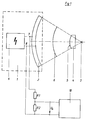
- the device according to the invention essentially consists of a shock wave generator 1 with an electroacoustic transducer 2, which is able to emit sound impulses by electrical excitation, which are bundled in a focus 3.
- a reflection body 4 positionable which is preferably made of a reverberant material not too high density, for. B. aluminum.
- the reflection body 4 is positioned between the transducer 2 and the focus 3 in such a way that its axis of symmetry coincides with that of the transducer 2 and its reflective surface 5 faces the transducer 2.
- This surface 5 is located in a region of the sound field in which the effect of the division of the waves is not yet significantly pronounced. The positioning in the range described above is u. a. therefore necessary so that the largest possible proportion of the sound is thrown back to the transducer 2, which would no longer be the case in the area of substantial division.
- the reflecting surface 5 of the reflection body 4 is advantageously chosen to be larger or at least equal to the front surface of the sound wave 6 which strikes the surface 5 of the reflection body 4 in the region mentioned.
- the surface 5 facing the transducer 2 expediently has a shape which corresponds to the geometry of the sound wave 6 incident from the transducer 2 in the direction of the focus 3.
- the examples of the drawings show a spherical section as a shape for the reflection body 4. However, other shapes are also conceivable, e.g. B. a circular area.
- the sound thrown back by the reflection body 4 to the transducer 2 generates an electrical voltage when it hits the transducer 2 at its connecting terminals 7 and 8. Since the converter 2 is supplied with a high voltage by an electrical generator 9, this voltage is preferably tapped via a voltage divider R1, R2 and on a measuring and display device 10, e.g. B. an oscilloscope.
- the voltage divider should advantageously be equipped with a protective circuit known per se and therefore not shown, which limits the value of its output voltage in transmit mode.
- FIG. 2 shows the use of the device according to the invention in a lithotriptor.
- the converter 2 forms the bottom part of a container 11, which turns the recess 12 in a patient bed 13 down like a pot.
- the container 11 can be filled with a coupling medium 14.
- a holder 15 carrying the reflection body 4 can be inserted into the recess 12.
- the reflector 4 is arranged on a rod 16 which is pivotably mounted about an axis 17 fastened to the holder 15.
- the holder 15 and the rod 16 are dimensioned such that the reflection body 4, when it is in the measurement position, dips into the coupling medium 14, specifically in the area between focus 3 and electroacoustic transducer 2 described above.
- FIGS. 3a and 3b show the possibility of simultaneously checking the correspondence between the shock wave focus and the target area of the locating device, not shown.
- a positioning aid 18 on the end of the rod 16 facing away from the reflection body 4.
- This positioning aid 18 consists of a material that is acoustically reflective to the coupling medium 14 or can be represented well in the X-ray image, or of a material that is simultaneously used for the representation by X-rays, as well as by ultrasound is suitable.
- the positioning aid takes on a shape that can be easily recognized with the respective locating device and is nevertheless of a small size, e.g. B. pen, ball, cross or ring.
- This device can be handled as follows: To position the reflection body 4, it is first brought into the position shown in FIG. 3a on its holder 15. The reflecting surface 5 of the reflection body 4 faces away from the transducer 2, while the positioning aid 18, facing the transducer 2, in the region of the Target point 19 of the location device is located. By moving the patient couch 13, the reflection body 4 connected to the positioning aid 18 is positioned such that the positioning aid 18 is located in the target point 19 of the locating device. When the locating device is correctly adjusted, its target point 19 coincides with the shock wave focus 3.
- the device according to the invention is brought into a measuring position at the target point 19 of the locating device after the alignment of the positioning aid 18 described above, as it e.g. is shown in Figure 2.
- the reflector 4 is aligned with the maximum amplitude of the measurement voltage induced in the converter.
- the device is brought into the adjustment position again and the positioning aid 18 is located, whereby it can be ascertained whether the foci of the transducer and the locating device coincide and to what extent they differ, if necessary.
- the locating device can then be readjusted accordingly.
- the positioning aid 18 is actually in the focus 3 of the transducer 2 and thus the reflection body 4 assumes the correct position between the focus 3 and transducer 2 during the subsequent measuring operation. This could practically not be guaranteed by positioning based on the transducer geometry. Because in general the shock wave focus 3, which, as mentioned above, coincides with the correct adjustment of the locating device with its target point 19, is not necessarily in the geometric focus of the electroacoustic transducer. In the present drawing examples, this geometric focus would be the center of the spherical shell-shaped sound transmitter.
- the reflecting surface 5 of the reflection body 4 is spaced from the axis 17 such that the surface 5 is concentric with the geometric focus of the transducer 2 and the surface of the positioning aid 18 coincides with the target point 19 of the locating device, which generally corresponds to the Shock wave focus 3 is adjusted.
- the reflection body 4 is rotated about the axis 17, so that its reflecting surface 5 faces the transducer 2 according to FIGS. 2, 3b, 4b.
- the shock wave generator 1 is activated, i. H. the transducer 2 is excited by pulse-shaped signals and the acoustic power reflected by the reflection body 4 onto the transducer 2 is converted into electrical power in the transducer 2 and measured in the manner described above.
- the measurement result determined in this way is displayed on the measuring and display device 10 and can be read by the user and compared with a predetermined target value. Such a target / actual value comparison can also be carried out by the measuring and display device 10, so that the measurement result can then be displayed directly as a good / bad display.
- FIGS. 4a and 4b show a further possible embodiment of the reflector 4 according to the invention with positioning aid 18, which is also well suited for a shock wave generator equipped with an X-ray location system.
- the reflection body 4 is rotatably mounted about a common axis 20 located on the holder 15.
- the reflector 4 is provided with a rod 21 which merges into two legs 22 which are parallel to one another and which are fastened to the axis 20. These two legs 22 of the rod 21 form a free space 23 which can accommodate the positioning aid 18 attached to the axis 17 between the two legs 22.
- the reflection body 4 When the positioning aid 18 is aligned with the target point 19 of the locating device, the reflection body 4 is in a position corresponding to FIG. 3a or is pivoted out laterally according to FIG. 4a.
- the latter position is advantageously chosen for shock wave generators equipped with X-ray location systems, since when the z. B. existing aluminum reflection body 4 according to Figure 3a, X-ray location of the positioning aid 18 is not possible.
- the reflection body 4 is then pivoted back into the measuring position according to FIG. 4b for measurement.
- the positioning aid in the Measurement can remain in the alignment position, it can easily be checked at any time whether the reflection body is still correctly placed by simply pivoting the reflection body 4 out of the measurement position and locating the positioning aid 18.
- the positioning aid 18 for the reflection body 4 can be omitted. The procedure is then that the reflection body 4 is aligned in the area between the focus 3 and the transducer 2 and the latter is then moved in all three spatial coordinates until the measurement voltage reaches its maximum amplitude.
- the carrier 16 is rotated about an axis 24 parallel to the axis of symmetry of the transducer 2, so that either the positioning aid 18 is pivoted into the target area 19 of the locating device or the reflector 4 is brought into its measuring position.
- the positioning aid 18 and the reflector 4 are located at mutually opposing, diametrically arranged ends of the carrier 16 (in relation to the axis 24)
- one position is the other (FIG. 5b) a pivoting movement of 180 ° around the axis 24 is required.
- This device can also be used to determine both the performance of the converter 2 and the correct adjustment of the locating device with respect to the converter 2.
- the carrier 16 is slidably arranged such that depending on the sliding position either the positioning aid 18 is brought into the target area 19 of the locating device (adjustment position) or the reflector 4 is in a position opposite the transducer (measuring position).
- the carrier 16 is slidably mounted on the holding device 15 by means of a guide 25.
- the guide 25 can be designed as a dovetail guide or in another manner known per se and enables the carrier 16 to be displaced on the holding device 15 transversely to the transducer axis.
- the positioning aid 18 shown in FIG. 6 is, as can be clearly seen from FIG. 7, in the form of a wire cross with a spherical center. To avoid disturbing reflections when locating To avoid possible, the wire cross is formed from the finest possible wires. Because of the then only low mechanical stability, the positioning aid 18 is encapsulated in plastic 26, so that this ensures adequate mechanical stability.
- FIGS. 5 and 6 are particularly well suited when imaging is to take place both by means of X-rays and by means of ultrasound.
- the method and the device according to the invention are not only limited to transducers for generating high-power pulses and shock waves and to the therapeutic field, but also in other electroacoustic transducers with high sound pulse power, e.g. B. converter for material testing, advantageously applicable.
- the transducers only have to be excited by pulse-shaped signals, since e.g. B. with continuous sound no exact measurement result can be achieved.
Landscapes
- Physics & Mathematics (AREA)
- General Physics & Mathematics (AREA)
- Surgical Instruments (AREA)
Applications Claiming Priority (2)
| Application Number | Priority Date | Filing Date | Title |
|---|---|---|---|
| DE4102551 | 1991-01-29 | ||
| DE19914102551 DE4102551A1 (de) | 1991-01-29 | 1991-01-29 | Verfahren zum bestimmen der akustischen leistung fokussierender elektroakustischer wandler und vorrichtung zur durchfuehrung des verfahrens |
Publications (2)
| Publication Number | Publication Date |
|---|---|
| EP0497261A2 true EP0497261A2 (fr) | 1992-08-05 |
| EP0497261A3 EP0497261A3 (en) | 1993-04-07 |
Family
ID=6423913
Family Applications (1)
| Application Number | Title | Priority Date | Filing Date |
|---|---|---|---|
| EP19920101319 Withdrawn EP0497261A3 (en) | 1991-01-29 | 1992-01-28 | Method for determining the acoustic intensity of focussing electroacoustic transducers and apparatus for carrying out this method |
Country Status (2)
| Country | Link |
|---|---|
| EP (1) | EP0497261A3 (fr) |
| DE (1) | DE4102551A1 (fr) |
Cited By (1)
| Publication number | Priority date | Publication date | Assignee | Title |
|---|---|---|---|---|
| CN111678587A (zh) * | 2020-06-23 | 2020-09-18 | 同济大学 | 一种自聚焦超声换能器焦域与灵敏度测量装置及方法 |
Families Citing this family (1)
| Publication number | Priority date | Publication date | Assignee | Title |
|---|---|---|---|---|
| DE10138434C1 (de) * | 2001-08-06 | 2003-02-13 | Wolf Gmbh Richard | Fokussierender elektroakustischer Wandler und Verfahren zum Test seiner Ausgangsleistung |
Family Cites Families (7)
| Publication number | Priority date | Publication date | Assignee | Title |
|---|---|---|---|---|
| GB1570898A (en) * | 1976-12-22 | 1980-07-09 | Standard Telephones Cables Ltd | Ultrasonic faucet control |
| DE3545353A1 (de) * | 1985-12-20 | 1987-06-25 | Siemens Ag | Verfahren und vorrichtung zur messung der schalleistung eines fokussierten ultraschallfeldes |
| DE3669203D1 (de) * | 1985-12-20 | 1990-04-05 | Siemens Ag | Verfahren zur kontrolle der eigenschaften des fokus eines ultraschallfeldes und vorrichtung zur durchfuehrung des verfahrens. |
| EP0255636B1 (fr) * | 1986-07-30 | 1990-04-25 | Siemens Aktiengesellschaft | Capteur pour des ondes de chocs acoustiques |
| DE3732131A1 (de) * | 1987-09-24 | 1989-04-06 | Wolf Gmbh Richard | Fokussierender ultraschallwandler |
| US4955366A (en) * | 1987-11-27 | 1990-09-11 | Olympus Optical Co., Ltd. | Ultrasonic therapeutical apparatus |
| DE3807304A1 (de) * | 1988-03-05 | 1989-09-28 | Dornier Medizintechnik | Target |
-
1991
- 1991-01-29 DE DE19914102551 patent/DE4102551A1/de active Granted
-
1992
- 1992-01-28 EP EP19920101319 patent/EP0497261A3/de not_active Withdrawn
Cited By (2)
| Publication number | Priority date | Publication date | Assignee | Title |
|---|---|---|---|---|
| CN111678587A (zh) * | 2020-06-23 | 2020-09-18 | 同济大学 | 一种自聚焦超声换能器焦域与灵敏度测量装置及方法 |
| CN111678587B (zh) * | 2020-06-23 | 2021-09-03 | 同济大学 | 一种自聚焦超声换能器焦域与灵敏度测量方法 |
Also Published As
| Publication number | Publication date |
|---|---|
| EP0497261A3 (en) | 1993-04-07 |
| DE4102551A1 (de) | 1992-07-02 |
| DE4102551C2 (fr) | 1993-06-17 |
Similar Documents
| Publication | Publication Date | Title |
|---|---|---|
| DE3721187C2 (fr) | ||
| DE3501355A1 (de) | Verfahren und einrichtung zum eichen eines biopsievorsatzes fuer ultraschallabbildungseinrichtungen | |
| DE2710038C2 (de) | Vorrichtung zur Ultraschall-Untersuchung von Geweben eines Patienten | |
| DE3015837A1 (de) | Ultraschall-abbildungsvorrichtung | |
| DE19520749C1 (de) | Therapiegerät mit einer Quelle akustischer Wellen | |
| EP0000068A1 (fr) | Dispositif pour la representation par ultrasons utilisant la focalisation dynamique | |
| DE4310390A1 (de) | Vorrichtung zur Erfassung von Oberflächenstrukturen | |
| DE1264681B (de) | Fuer die medizinische Ultraschalldiagnose nach dem Impuls-Echoverfahren bestimmtes ultraschall-spiegeloptisches System zum Senden und Empfangen von Ultraschallwellen | |
| EP0019793B1 (fr) | Procédé de détermination de la vitesse de matière en mouvement, notamment dans le corps et dispositif pour cette détermination et pour la visualisation de parties du corps | |
| EP0152905B1 (fr) | Procédé et appareil pour localiser des points de mesure par des impulsions ultrasoniques | |
| EP0783870B1 (fr) | Dispositif pour la localisation de concrétions dans le corps d'un patient | |
| DE2643126A1 (de) | Einrichtung zur untersuchung von objekten nach dem reflexionsprinzip | |
| EP0265742A1 (fr) | Lithotripteur avec moyens de localisation | |
| DE2919476C2 (de) | Ultraschallgerät für die medizinische Diagnostik zur Durchführung von Untersuchungen nach dem Schnittbildverfahren | |
| DE2911613C2 (de) | Abtastmodul für ein Gerät zur Ultraschall-Abbildung | |
| DE2609425B2 (fr) | ||
| EP0497261A2 (fr) | Dispositif pour déterminer l'intensité acoustique d'un transducteur électroacoustique focalisant | |
| DE3047177A1 (de) | "ultraschallgeraet zur durchfuehrung von untersuchungen nach dem schnittbildverfahren" | |
| DE2709925C2 (de) | Schallkopf für Untersuchungen mit Ultraschall nach dem Impuls-Echoverfahren | |
| DE2919000C2 (de) | Gerät zur Darstellung von Schnittbildern durch Objekte nach dem Ultraschall-Schnittbildverfahren für die medizinische Diagnostik | |
| DE3703335C2 (de) | Lithotripter mit PVDF-Folie als Ortungselement | |
| EP0033463A2 (fr) | Multisonde ultrasonore | |
| DE19640050C2 (de) | Vorrichtung und Verfahren zum Prüfen einer Quelle akustischer Wellen | |
| DE8809253U1 (de) | Stoßwellengenerator zum berührungslosen Zertrümmern von Konkrementen im Körper eines Lebewesens | |
| DE2036613C3 (de) | Verfahren und Vorrichtung zum Analysieren von Diskontinuitäten hinsichtlich ihrer geometrischen Daten mittels eines auf die Diskontinuität gerichteten Bündels aus wiederkehrenden kurzen akustischen Impulsen |
Legal Events
| Date | Code | Title | Description |
|---|---|---|---|
| PUAI | Public reference made under article 153(3) epc to a published international application that has entered the european phase |
Free format text: ORIGINAL CODE: 0009012 |
|
| AK | Designated contracting states |
Kind code of ref document: A2 Designated state(s): AT BE DK ES FR GB IT NL |
|
| PUAL | Search report despatched |
Free format text: ORIGINAL CODE: 0009013 |
|
| AK | Designated contracting states |
Kind code of ref document: A3 Designated state(s): AT BE DK ES FR GB IT NL |
|
| 17P | Request for examination filed |
Effective date: 19930724 |
|
| 17Q | First examination report despatched |
Effective date: 19950116 |
|
| STAA | Information on the status of an ep patent application or granted ep patent |
Free format text: STATUS: THE APPLICATION HAS BEEN WITHDRAWN |
|
| 18W | Application withdrawn |
Withdrawal date: 19950311 |