EP0497362A1 - Silberiodohalogenidemulsionen von hohem Chloridgehalt mit einem erhöhten Anteil an Jodid - Google Patents
Silberiodohalogenidemulsionen von hohem Chloridgehalt mit einem erhöhten Anteil an Jodid Download PDFInfo
- Publication number
- EP0497362A1 EP0497362A1 EP92101609A EP92101609A EP0497362A1 EP 0497362 A1 EP0497362 A1 EP 0497362A1 EP 92101609 A EP92101609 A EP 92101609A EP 92101609 A EP92101609 A EP 92101609A EP 0497362 A1 EP0497362 A1 EP 0497362A1
- Authority
- EP
- European Patent Office
- Prior art keywords
- iodide
- silver
- chloride
- emulsion
- bromide
- Prior art date
- Legal status (The legal status is an assumption and is not a legal conclusion. Google has not performed a legal analysis and makes no representation as to the accuracy of the status listed.)
- Withdrawn
Links
- 239000000839 emulsion Substances 0.000 title claims abstract description 102
- XMBWDFGMSWQBCA-UHFFFAOYSA-N hydrogen iodide Chemical compound I XMBWDFGMSWQBCA-UHFFFAOYSA-N 0.000 title claims abstract description 74
- HKZLPVFGJNLROG-UHFFFAOYSA-M silver monochloride Chemical compound [Cl-].[Ag+] HKZLPVFGJNLROG-UHFFFAOYSA-M 0.000 title claims abstract description 25
- 230000001965 increasing effect Effects 0.000 title abstract description 16
- -1 silver halide Chemical class 0.000 claims abstract description 55
- 229910052709 silver Inorganic materials 0.000 claims abstract description 47
- 239000004332 silver Substances 0.000 claims abstract description 47
- VEXZGXHMUGYJMC-UHFFFAOYSA-M Chloride anion Chemical compound [Cl-] VEXZGXHMUGYJMC-UHFFFAOYSA-M 0.000 claims description 41
- CPELXLSAUQHCOX-UHFFFAOYSA-M Bromide Chemical compound [Br-] CPELXLSAUQHCOX-UHFFFAOYSA-M 0.000 claims description 26
- BQCADISMDOOEFD-UHFFFAOYSA-N Silver Chemical compound [Ag] BQCADISMDOOEFD-UHFFFAOYSA-N 0.000 claims description 18
- QZRGKCOWNLSUDK-UHFFFAOYSA-N Iodochlorine Chemical compound ICl QZRGKCOWNLSUDK-UHFFFAOYSA-N 0.000 claims description 7
- 239000013078 crystal Substances 0.000 description 35
- 229910021612 Silver iodide Inorganic materials 0.000 description 31
- 239000012071 phase Substances 0.000 description 31
- 150000004820 halides Chemical class 0.000 description 29
- FAPWRFPIFSIZLT-UHFFFAOYSA-M Sodium chloride Chemical compound [Na+].[Cl-] FAPWRFPIFSIZLT-UHFFFAOYSA-M 0.000 description 24
- JKFYKCYQEWQPTM-UHFFFAOYSA-N 2-azaniumyl-2-(4-fluorophenyl)acetate Chemical compound OC(=O)C(N)C1=CC=C(F)C=C1 JKFYKCYQEWQPTM-UHFFFAOYSA-N 0.000 description 23
- 229940045105 silver iodide Drugs 0.000 description 23
- 238000002360 preparation method Methods 0.000 description 21
- 239000000203 mixture Substances 0.000 description 20
- 239000000243 solution Substances 0.000 description 20
- SQGYOTSLMSWVJD-UHFFFAOYSA-N silver(1+) nitrate Chemical compound [Ag+].[O-]N(=O)=O SQGYOTSLMSWVJD-UHFFFAOYSA-N 0.000 description 16
- 238000000034 method Methods 0.000 description 15
- 235000002639 sodium chloride Nutrition 0.000 description 15
- 239000011780 sodium chloride Substances 0.000 description 15
- 238000010348 incorporation Methods 0.000 description 14
- 229910021607 Silver chloride Inorganic materials 0.000 description 10
- 108010010803 Gelatin Proteins 0.000 description 8
- HOLVRJRSWZOAJU-UHFFFAOYSA-N [Ag].ICl Chemical compound [Ag].ICl HOLVRJRSWZOAJU-UHFFFAOYSA-N 0.000 description 8
- 229920000159 gelatin Polymers 0.000 description 8
- 239000008273 gelatin Substances 0.000 description 8
- 235000019322 gelatine Nutrition 0.000 description 8
- 235000011852 gelatine desserts Nutrition 0.000 description 8
- 238000000634 powder X-ray diffraction Methods 0.000 description 8
- ADZWSOLPGZMUMY-UHFFFAOYSA-M silver bromide Chemical compound [Ag]Br ADZWSOLPGZMUMY-UHFFFAOYSA-M 0.000 description 7
- IJGRMHOSHXDMSA-UHFFFAOYSA-N Atomic nitrogen Chemical compound N#N IJGRMHOSHXDMSA-UHFFFAOYSA-N 0.000 description 6
- 238000006243 chemical reaction Methods 0.000 description 6
- 238000001556 precipitation Methods 0.000 description 6
- CPELXLSAUQHCOX-UHFFFAOYSA-N Hydrogen bromide Chemical compound Br CPELXLSAUQHCOX-UHFFFAOYSA-N 0.000 description 5
- 210000000988 bone and bone Anatomy 0.000 description 5
- 238000011835 investigation Methods 0.000 description 4
- 239000011159 matrix material Substances 0.000 description 4
- 230000005855 radiation Effects 0.000 description 4
- JHJLBTNAGRQEKS-UHFFFAOYSA-M sodium bromide Chemical compound [Na+].[Br-] JHJLBTNAGRQEKS-UHFFFAOYSA-M 0.000 description 4
- VEXZGXHMUGYJMC-UHFFFAOYSA-N Hydrochloric acid Chemical compound Cl VEXZGXHMUGYJMC-UHFFFAOYSA-N 0.000 description 3
- 238000013459 approach Methods 0.000 description 3
- 229910052757 nitrogen Inorganic materials 0.000 description 3
- ZUNKMNLKJXRCDM-UHFFFAOYSA-N silver bromoiodide Chemical compound [Ag].IBr ZUNKMNLKJXRCDM-UHFFFAOYSA-N 0.000 description 3
- 238000003756 stirring Methods 0.000 description 3
- 229910014265 BrCl Inorganic materials 0.000 description 2
- XUIMIQQOPSSXEZ-UHFFFAOYSA-N Silicon Chemical compound [Si] XUIMIQQOPSSXEZ-UHFFFAOYSA-N 0.000 description 2
- 238000002441 X-ray diffraction Methods 0.000 description 2
- 238000004458 analytical method Methods 0.000 description 2
- 238000009835 boiling Methods 0.000 description 2
- 229940006460 bromide ion Drugs 0.000 description 2
- CODNYICXDISAEA-UHFFFAOYSA-N bromine monochloride Chemical compound BrCl CODNYICXDISAEA-UHFFFAOYSA-N 0.000 description 2
- XMBWDFGMSWQBCA-UHFFFAOYSA-M iodide Chemical compound [I-] XMBWDFGMSWQBCA-UHFFFAOYSA-M 0.000 description 2
- 229940006461 iodide ion Drugs 0.000 description 2
- 238000010587 phase diagram Methods 0.000 description 2
- 238000011160 research Methods 0.000 description 2
- VWDWKYIASSYTQR-UHFFFAOYSA-N sodium nitrate Chemical compound [Na+].[O-][N+]([O-])=O VWDWKYIASSYTQR-UHFFFAOYSA-N 0.000 description 2
- XLYOFNOQVPJJNP-UHFFFAOYSA-N water Substances O XLYOFNOQVPJJNP-UHFFFAOYSA-N 0.000 description 2
- BHKKSKOHRFHHIN-MRVPVSSYSA-N 1-[[2-[(1R)-1-aminoethyl]-4-chlorophenyl]methyl]-2-sulfanylidene-5H-pyrrolo[3,2-d]pyrimidin-4-one Chemical compound N[C@H](C)C1=C(CN2C(NC(C3=C2C=CN3)=O)=S)C=CC(=C1)Cl BHKKSKOHRFHHIN-MRVPVSSYSA-N 0.000 description 1
- NIPMJVLJVGQZRB-UHFFFAOYSA-N Cl[IH]Br Chemical class Cl[IH]Br NIPMJVLJVGQZRB-UHFFFAOYSA-N 0.000 description 1
- 239000004606 Fillers/Extenders Substances 0.000 description 1
- HCHKCACWOHOZIP-UHFFFAOYSA-N Zinc Chemical compound [Zn] HCHKCACWOHOZIP-UHFFFAOYSA-N 0.000 description 1
- 230000001174 ascending effect Effects 0.000 description 1
- 230000015572 biosynthetic process Effects 0.000 description 1
- 230000015271 coagulation Effects 0.000 description 1
- 238000005345 coagulation Methods 0.000 description 1
- 239000000084 colloidal system Substances 0.000 description 1
- 230000000052 comparative effect Effects 0.000 description 1
- 239000002131 composite material Substances 0.000 description 1
- 230000000694 effects Effects 0.000 description 1
- 230000002708 enhancing effect Effects 0.000 description 1
- 238000013213 extrapolation Methods 0.000 description 1
- 238000010438 heat treatment Methods 0.000 description 1
- 238000011065 in-situ storage Methods 0.000 description 1
- 239000007791 liquid phase Substances 0.000 description 1
- 238000005259 measurement Methods 0.000 description 1
- 239000013081 microcrystal Substances 0.000 description 1
- 238000002156 mixing Methods 0.000 description 1
- 239000002245 particle Substances 0.000 description 1
- 238000005192 partition Methods 0.000 description 1
- 239000012266 salt solution Substances 0.000 description 1
- 229910052710 silicon Inorganic materials 0.000 description 1
- 239000010703 silicon Substances 0.000 description 1
- 239000011863 silicon-based powder Substances 0.000 description 1
- 150000003378 silver Chemical class 0.000 description 1
- 235000010344 sodium nitrate Nutrition 0.000 description 1
- GGCZERPQGJTIQP-UHFFFAOYSA-N sodium;9,10-dioxoanthracene-2-sulfonic acid Chemical compound [Na+].C1=CC=C2C(=O)C3=CC(S(=O)(=O)O)=CC=C3C(=O)C2=C1 GGCZERPQGJTIQP-UHFFFAOYSA-N 0.000 description 1
- 238000006467 substitution reaction Methods 0.000 description 1
- 238000002076 thermal analysis method Methods 0.000 description 1
- 229910052725 zinc Inorganic materials 0.000 description 1
- 239000011701 zinc Substances 0.000 description 1
- 229910052984 zinc sulfide Inorganic materials 0.000 description 1
Images


Classifications
-
- G—PHYSICS
- G03—PHOTOGRAPHY; CINEMATOGRAPHY; ANALOGOUS TECHNIQUES USING WAVES OTHER THAN OPTICAL WAVES; ELECTROGRAPHY; HOLOGRAPHY
- G03C—PHOTOSENSITIVE MATERIALS FOR PHOTOGRAPHIC PURPOSES; PHOTOGRAPHIC PROCESSES, e.g. CINE, X-RAY, COLOUR, STEREO-PHOTOGRAPHIC PROCESSES; AUXILIARY PROCESSES IN PHOTOGRAPHY
- G03C1/00—Photosensitive materials
- G03C1/005—Silver halide emulsions; Preparation thereof; Physical treatment thereof; Incorporation of additives therein
- G03C1/035—Silver halide emulsions; Preparation thereof; Physical treatment thereof; Incorporation of additives therein characterised by the crystal form or composition, e.g. mixed grain
Definitions
- the invention is directed to silver halide photography. More specifically, the invention is directed to a novel silver halide emulsion for use in photography.
- Figure 1 is a matrix graphically illustrating all possible choices of any one or combination of chloride, bromide and iodide ions to satisfy a total halide requirement.
- Figure 2 is a plot of X-ray diffraction relative intensity versus scattering angle.
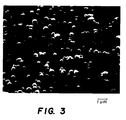
- Figure 3 is a scanning electron photomicrograph of the grains of an emulsion according to the invention.
- Photographic silver halide emulsions contain radiation-sensitive microcrystals, commonly referred to as grains. Radiation-sensitive grains which consist essentially of silver iodide, bromide or chloride, with no other halide being present are each known. Radiation-sensitive grains containing mixtures of halides in their crystal structure are also known. However, the range of halide combinations that can exist within a crystal structure is limited, since silver iodide favors different crystal habits than that of silver bromide or chloride.
- each halide at any selected intermediate point being determined by the spacing of the intermediate point from the matrix 100% point and the 0% axis for that halide.
- Silver chloride and silver bromide each form a face centered cubic rock salt type crystal lattice structure.
- These crystal structures are known which consist of silver ions and (a) bromide ions as the sole halide ions, (b) chloride ions as the sole halide ions, or (c) mixtures of chloride and bromide ions in all proportions.
- All possible combinations along the Br-Cl axis in Figure 1 are known in silver halide grain structures.
- the crystal structures differ solely by their unit cell dimensions, which are a reflection of the differing sizes of chloride and bromide ions. Measurements of crystal lattice parameters are an accepted method of determining the ratio of halides present.
- Silver iodide exhibits a face centered cubic rock salt crystal structure, but only at very high pressure levels (3,000 to 4,000 times atmospheric pressure). This form of silver iodide, referred to as ⁇ phase silver iodide, has no relevance to silver halide photography.
- a silver iodide crystal structure that is stable under ambient conditions is the hexagonal wurtzite type, commonly referred to as ⁇ phase silver iodide.
- Another crystal structure of silver iodide sufficiently stable to be usable at room temperature is the face centered cubic zinc blend type, commonly referred to as ⁇ phase silver iodide.
- Silver iodide emulsions have been prepared containing each of ⁇ phase and ⁇ phase crystal structures.
- a fourth crystallographic form of silver iodide is a phase, a body centered cubic crystal structure which is stated by James, The Theory of Photographic Process , 4th Ed., Macmillan (1977), page 1, to require a temperature of 146°C for its formation. (James, pp. 1-5, are relevant to this and following portions of this discussion.)
- Patent 4,184,878 is illustrative of a high iodide silver halide emulsion. Since silver iodide emulsions have found limited photographic utility, very limited investigation of bromide and/or chloride ion containing variations have occurred. It is generally believed, however, that the silver iodide crystal structure will not tolerate the incorporation of more than 10 mole percent of bromide and/or chloride ion before the halides partition themselves in different phases. Referring to Figure 1, high iodide silver halide crystal structures exist within the area defined by points W, V and I.
- the silver bromide crystal structure can tolerate less than equal amounts of iodide.
- the maximum amount of iodide incorporated in silver bromide is 46.5 mole percent reported by H. Hirsch, "Photographic Emulsion Grains with Cores: Part I. Evidence for the Presence of Cores", J. of Photog. Science, Vol. 10 (1962) pp. 129-134.
- halide ion selection is known to impart particular photographic advantages. Although known and used for many years for selected photographic applications, the more rapid developability and the ecological advantages of high chloride silver iodohalide emulsions have provided an impetus for employing these emulsions over a broader range of photographic applications.
- high chloride silver iodohalide as applied to emulsions, grains and crystal structures is herein defined to require that the concentration of the halide ions other than iodide ions exceed or at least equal the concentration of iodide ions and that the concentration of chloride ions exceed or at least equal the concentration of bromide ions.
- High chloride iodohalides include silver iodochlorides, iodochlorobromides and bromoiodochlorides. Referring to Figure 1, all of the silver halide compositions in the area bounded by points Cl, Y, C and D satisfy the high chloride silver iodohalide definition.
- the iodide concentrations in high chloride iodohalide emulsions are particularly limited where bromide ion concentrations are less than 20 mole percent.
- substitution of chloride ions for bromide ions is not possible, since no high chloride iodohalide emulsion is available that can tolerate comparable iodide ion inclusion levels within the crystal structure of the grains.
- this invention is directed to a photographic silver halide emulsion comprised of a high chloride silver iodohalide grain structure in which the proportions of chloride, bromide and iodide ions are chosen to lie within the boundary defined by A, B, C and D in Figure 1.
- the B-A axis in Figure 1 defines the upper limit of iodide incorporation in a high chloride silver iodohalide crystal structure prepared by conventional photographic emulsion preparation techniques. These limits were confirmed by emulsion preparations included in the Examples below for purposes of comparison.
- the highest iodide incorporation level achieved in a silver iodochloride emulsion prepared for purposes of comparison was 12.8 mole percent, based on total silver.
- This silver iodochloride composition is located in Figure 1 on the I-Cl axis just below point A, which lies at an iodide level of 13 mole percent.
- the highest iodide incorporation level achieved in a silver iodohalide emulsion containing equal molar amounts chloride and bromide ions prepared for purposes of comparison was 27.3 mole percent, based on total silver.
- This composition is located in Figure 1 just below point B, which lies at an iodide level of 28 mole percent.
- the axis B-A lies just above the upper iodide concentration limit in conventional high chloride silver iodohalide grain structures.
- the present invention is directed to photographic silver halide emulsions comprised of a high chloride silver iodohalide grain structure in which the proportions of chloride, bromide and iodide ions are chosen to lie within the boundary defined by A, B, C and D in Figure 1. That is, the high chloride silver iodohalide grains structures provided by this invention contain iodide concentrations above the maximum iodide incorporation levels in conventional high chloride iodohalide emulsion grain structures.
- the high chloride iodohalide grain structures exhibit the proportions of chloride, bromide and iodide ions that lie within the boundary defined by A', B', C and D in Figure 1, where A' and B' require a 1 mole percent (optimally 2 mole percent) higher iodide concentration than A and B, respectively.
- photographic silver iodohalide emulsions are prepared by running an aqueous silver salt into an aqueous dispersing medium which usually contains an organic hydrophilic colloid peptizer. Since the silver iodohalide grains formed during precipitation must remain dispersed, precipitation is necessarily limited to temperatures compatible with retaining a liquid phase dispersing medium. Because of the increasingly high vapor pressure of water on heating, a temperature of 90°C constitutes an accepted practical upper limit for the preparation of silver halide emulsions in a well controlled and reproducible manner. Even if an emulsion preparation temperature could be increased to 100°C, the boiling point of water, iodide level extrapolations from workable temperatures suggested no significant increase in iodide levels.
- a preparation procedure was therefore proposed that departed entirely from conventional photographic emulsion preparation techniques. It was proposed to use elevated pressures in combination with emulsion preparation temperatures above 130°C. It was postulated that elevated pressures alone would be ineffective and such elevated temperatures would be unattainable in the absence of an elevated pressure.
- iodide incorporation levels were increased from 27.3 mole percent (below point B, Figure 1) to 39.6 mole percent, based on silver, as shown at point E6 in Figure 1 (Example 6 below). This was an iodide concentration increase of 45 percent.
- the high chloride silver iodohalide emulsions satisfying the requirements of this invention are viewed as proof that incorporation of silver iodide into a high chloride face centered cubic crystal lattice grain structure can be enhanced by undertaking incorporation under conditions of elevated temperature and pressure. While the investigations undertaken to date demonstrate the feasibility of the approach to achieving high chloride iodohalide emulsions with increased iodide contents, they have provided no indication of any upper iodide incorporation limit. The reason for this is that investigations reported have had as their purpose to demonstrate feasibility rather than to optimize the preparation process. The preparation process was chosen as the simplest available approach for achieving grain growth at elevated temperatures and pressures.
- the high chloride iodohalide emulsions and the processes of their preparation are compatible with conventional emulsions and processes for their preparation. Attention is directed to Research Disclosure , Vol. 308, December 1989, Item 308,119, particularly Section I, Emulsion preparation and types and Section IX, Vehicles and vehicle extenders. Research Disclosure is published by Kenneth Mason Publications, Ltd., Dudley Annex, 21a North Street, Emsworth, Hampshire P010 7DQ, England.
- the novel grain structure of the invention is found in the majority if not each of the grains of an emulsion and extends more or less uniformly throughout each grain.
- the novel grain structure can alternatively form only a portion of a grain.
- the novel grain structure can be formed in only a core or only a shell region of a grain.
- This example is a control. It illustrates that only 12.8 mole % iodide can be incorporated in AgICl emulsion grains precipitated at 90°C.
- Portions of this emulsion were mixed with portions of a fine grain AgI emulsion as given in Table I below.
- the AgI emulsion had a pAg of 10.3 and consisted of particles ⁇ 0.05 ⁇ m.
- the mixtures (325g) were placed in an autoclave and pressured to 689.5 kPa (100 psi) above ambient with nitrogen. With stirring, the mixtures were heated to 160°C and held at this temperature for 15 min. They were then cooled to 40°C requiring 3 min. The resulting emulsions were washed free of NaNO3 and resuspended in 35g of a 5% gelatin solution.
- Emulsion B The x-ray powder diffraction pattern of Emulsion B is shown in Figure 2, where 2 ⁇ is the scattering angle and the highest scattering intensity has been assigned a normalized value of 100.
- the peaks 1 and 4 are produced by a silicon internal standard. Peak 2 is the ⁇ 331 ⁇ reflection, and the peak 3 is the ⁇ 420 ⁇ reflection.
- This emulsion consisted of grains having an average diameter of 0.5 ⁇ m.
- a fine grain AgCl emulsion was made similar to that of Example 2 except that 4 L of a 10% bone gelatin solution was used and the emulsion was precipitated at 40°C and pAg of 7.5.
- An AgICl emulsion was made similar to that of Example 2B, except the mixture of AgCl and AgI emulsions was heated to 150°C and held at this temperature for 5.0 minutes. The emulsion was cooled to 40°C (3 minutes required) and washed by the phthalated gelatin coagulation process of H. Yutzy and F. Russell U.S. Patent 2,614,929.
- the resulting emulsion consisted of grains having a mean size of 0.30 ⁇ m, 95% of the grains were within the size range 0.19 ⁇ m--0.41 ⁇ m.
- a scanning electron photomicrograph of this emulsion is shown in Figure 3.
- This example is a control. It illustrates that a maximum of 27.3 mole % iodide can be incorporated in a 1:1 AgClBr crystal phase precipitated at 90°C.
- Emulsion 4B contained two phases.
- the other phase consisted essentially of silver iodide. This analysis demonstrated that increasing the proportion of iodide present during precipitation is not capable of increasing the iodide concentration in the mixed halide phase.
- This example gives the preparation of an AgBrClI emulsion which consists of one phase having a composition of 35.6 mole % I, 32.2 mole % Br and 32.2 mole % Cl.
- a fine grain emulsion containing the desired amounts of chloride, bromide and iodide but consisting of multiple phases was prepared by the following procedure: To a stirred reaction vessel containing 4 L of a solution 10% in bond gelatin and 0.028M in NaCl at 40°C were added a solution 4M in AgNO3 at 150 ml/min and a solution 1.33 M in NaCl, 1.30 M in NaBr and 1.40 M in NaI at a rate needed to maintain a pAg of 7.5. The total silver and halide solutions consumed were 1.00L.
- the resulting emulsion consisted of grains having an average diameter of 0.8 ⁇ m.
- This example gives the preparation of an AgBrClI emulsion which consists of a main phase of a rock salt crystal structure having a composition of 30.2 mole % Br, 30.2 mole % Cl and 39.6 mole % I and a substantially smaller amount of a silver iodide phase.
- a fine grain emulsion containing multiple phases having a combined composition of 27.5 mole % Cl, 27.5 mole % Br and 45.0 mole % I was prepared by the following procedure: To a stirred reaction vessel containing 4 L of a solution 10% in bone gelatin and 0.028M in NaCl at 40°C were added a solution 4M in AgNO3 at 150 ml/min and a solution 1.16 M in NaCl, 1.10 M in NaBr and 1.80 M in NaI at a rate needed to maintain a pAg of 7.5. The total silver and halide solutions consumed were 1.00 L.
- the resulting emulsion consisted of grains having an average diameter of 0.7 ⁇ m.
- the x-ray powder diffraction pattern of this emulsion showed that it consisted of a mixed halide phase of the rock salt type crystal structure and a smaller amount of a phase consisting essentially of silver iodide.
Landscapes
- Chemical & Material Sciences (AREA)
- Crystallography & Structural Chemistry (AREA)
- Chemical Kinetics & Catalysis (AREA)
- Engineering & Computer Science (AREA)
- Materials Engineering (AREA)
- Physics & Mathematics (AREA)
- General Physics & Mathematics (AREA)
- Silver Salt Photography Or Processing Solution Therefor (AREA)
Applications Claiming Priority (2)
| Application Number | Priority Date | Filing Date | Title |
|---|---|---|---|
| US07/649,511 US5288603A (en) | 1991-02-01 | 1991-02-01 | High chloride silver iodohalide emulsions containing an increased proportion of iodide |
| US649511 | 1991-02-01 |
Publications (1)
| Publication Number | Publication Date |
|---|---|
| EP0497362A1 true EP0497362A1 (de) | 1992-08-05 |
Family
ID=24605116
Family Applications (1)
| Application Number | Title | Priority Date | Filing Date |
|---|---|---|---|
| EP92101609A Withdrawn EP0497362A1 (de) | 1991-02-01 | 1992-01-31 | Silberiodohalogenidemulsionen von hohem Chloridgehalt mit einem erhöhten Anteil an Jodid |
Country Status (4)
| Country | Link |
|---|---|
| US (1) | US5288603A (de) |
| EP (1) | EP0497362A1 (de) |
| JP (1) | JPH04318841A (de) |
| CA (1) | CA2059685A1 (de) |
Cited By (2)
| Publication number | Priority date | Publication date | Assignee | Title |
|---|---|---|---|---|
| EP1276007A1 (de) * | 2001-07-12 | 2003-01-15 | Fuji Photo Film Co., Ltd. | Wärmeentwickelbares lichtempfindliches Material und Bilderzeugungsverfahren |
| US7262000B2 (en) | 2002-10-21 | 2007-08-28 | Fujifilm Corporation | Photothermographic material and image forming method for the photothermographic material |
Families Citing this family (4)
| Publication number | Priority date | Publication date | Assignee | Title |
|---|---|---|---|---|
| DE69517372T2 (de) | 1994-08-26 | 2001-02-15 | Eastman Kodak Co., Rochester | Tafelkornemulsionen mit verbesserter Sensibilisierung |
| US5792601A (en) | 1995-10-31 | 1998-08-11 | Eastman Kodak Company | Composite silver halide grains and processes for their preparation |
| US5695923A (en) * | 1996-08-30 | 1997-12-09 | Eastman Kodak Company | Radiation-sensitive silver halide grains internally containing a discontinuous crystal phase |
| US20040224250A1 (en) * | 2003-03-05 | 2004-11-11 | Minoru Sakai | Image forming method using photothermographic material |
Citations (2)
| Publication number | Priority date | Publication date | Assignee | Title |
|---|---|---|---|---|
| DE522766C (de) * | 1929-08-12 | 1931-04-14 | Albert Steigmann Dr | Verfahren zur Herstellung gruen entwickelbarer photographischer Silbersalzemulsionen |
| DE2328868A1 (de) * | 1972-06-06 | 1973-12-13 | Fuji Photo Film Co Ltd | Sensibilisierte photoempfindliche silberhalogenidzusammensetzung |
Family Cites Families (5)
| Publication number | Priority date | Publication date | Assignee | Title |
|---|---|---|---|---|
| DE505012C (de) * | 1929-08-12 | 1930-08-12 | Albert Steigmann Dr | Verfahren zur Herstellung gruen entwickelbarer photographischer Jodsilberemulsionen |
| US4184878A (en) * | 1976-06-10 | 1980-01-22 | Ciba-Geigy Aktiengesellschaft | Process for the manufacture of photographic silver halide emulsions containing silver halide crystals of the twinned type |
| US4094684A (en) * | 1977-02-18 | 1978-06-13 | Eastman Kodak Company | Photographic emulsions and elements containing agel crystals forming epitaxial junctions with AgI crystals |
| US4339532A (en) * | 1981-01-08 | 1982-07-13 | Polaroid Corporation | Novel photosensitive silver halide emulsion and method of preparing same |
| JPS5945437A (ja) * | 1982-09-08 | 1984-03-14 | Konishiroku Photo Ind Co Ltd | ハロゲン化銀乳剤およびその製造方法 |
-
1991
- 1991-02-01 US US07/649,511 patent/US5288603A/en not_active Expired - Fee Related
-
1992
- 1992-01-20 CA CA002059685A patent/CA2059685A1/en not_active Abandoned
- 1992-01-31 EP EP92101609A patent/EP0497362A1/de not_active Withdrawn
- 1992-01-31 JP JP4040676A patent/JPH04318841A/ja active Pending
Patent Citations (2)
| Publication number | Priority date | Publication date | Assignee | Title |
|---|---|---|---|---|
| DE522766C (de) * | 1929-08-12 | 1931-04-14 | Albert Steigmann Dr | Verfahren zur Herstellung gruen entwickelbarer photographischer Silbersalzemulsionen |
| DE2328868A1 (de) * | 1972-06-06 | 1973-12-13 | Fuji Photo Film Co Ltd | Sensibilisierte photoempfindliche silberhalogenidzusammensetzung |
Cited By (3)
| Publication number | Priority date | Publication date | Assignee | Title |
|---|---|---|---|---|
| EP1276007A1 (de) * | 2001-07-12 | 2003-01-15 | Fuji Photo Film Co., Ltd. | Wärmeentwickelbares lichtempfindliches Material und Bilderzeugungsverfahren |
| US7060423B2 (en) | 2001-07-12 | 2006-06-13 | Fuji Photo Film Co., Ltd. | Heat-developable photosensitive material and image forming method |
| US7262000B2 (en) | 2002-10-21 | 2007-08-28 | Fujifilm Corporation | Photothermographic material and image forming method for the photothermographic material |
Also Published As
| Publication number | Publication date |
|---|---|
| US5288603A (en) | 1994-02-22 |
| JPH04318841A (ja) | 1992-11-10 |
| CA2059685A1 (en) | 1992-08-02 |
Similar Documents
| Publication | Publication Date | Title |
|---|---|---|
| EP0336425B1 (de) | Photographische Emulsionen mit im Inneren modifizierten Silberhalogenidkörnern | |
| US4142900A (en) | Converted-halide photographic emulsions and elements having composite silver halide crystals | |
| JPS648323B2 (de) | ||
| US5378599A (en) | High bromide chloride containing silver iodohalide emulsions exhibiting an increased proportion of iodide | |
| EP0019917B1 (de) | Photographische Emulsion mit kompositen und epitaxialen Kristallen, Iod-Bromid-Emulsion und Verfahren zur Herstellung | |
| EP0497362A1 (de) | Silberiodohalogenidemulsionen von hohem Chloridgehalt mit einem erhöhten Anteil an Jodid | |
| EP0334320B1 (de) | Mischemulsionen mit verbessertem Empfindlichkeits-Körnigkeitsverhältnis | |
| EP0606894B1 (de) | Photographische Emulsionen mit im Inneren und Äusseren modifizierten Silberhalogenidkörnern | |
| US5663041A (en) | High chloride (100) tabular grain emulsions containing large, thin tabular grains and a process for their preparation | |
| EP0610670B1 (de) | Photographische Silberhalogenidemulsion, die Kontraststeigernde Dotierungsmittel enthält | |
| EP0515894A1 (de) | Emulsionen mit tafelförmigen Körnern hoher Kanten-Kubizität | |
| US5614359A (en) | High speed emulsions exhibiting superior contrast and speed-granularity relationships | |
| EP0606895B1 (de) | Photographische Emulsionen, die intern und extern modifizierte Silberhalogenidkörner enthalten | |
| US5612177A (en) | (111) tabular grain emulsions exhibiting increased speed | |
| US6689335B1 (en) | Silver ion sequester and release agent | |
| EP0606893B1 (de) | Photographische Silberhalogenidemulsion, die kontraststeigernde Modifikatoren der Kornoberfläche enthält | |
| EP0833195B1 (de) | Emulsionen mit ultradünnen Tafelkörnern enthaltende radiographische Elemente | |
| EP0576910A1 (de) | Neue radiographische Anordnung mit minimalem bildmässigem Crossover Effekt und von sehr schneller Verarbeitbarkeit | |
| US5558982A (en) | High chloride (100) tabular grain emulsions with modified edge structures | |
| US5695923A (en) | Radiation-sensitive silver halide grains internally containing a discontinuous crystal phase | |
| DE69810237T2 (de) | Emulsionen aus tafelförmigen Körnern mit hohem Chloridgehalt sowie Verfahren zu deren Herstellung | |
| DE69517372T2 (de) | Tafelkornemulsionen mit verbesserter Sensibilisierung | |
| CA1089278A (en) | Photographic emulsions containing agi crystals with crystals converted from agcl to agbr forming epitaxial junctions therewith | |
| EP0678774A2 (de) | Ablagerungssensibilisierte Emulsionen | |
| EP0670514A2 (de) | Emulsionen, die chloridreiche, tafelförmige (100) Körner mit modifizierten Kantenstrukturen enthalten |
Legal Events
| Date | Code | Title | Description |
|---|---|---|---|
| PUAI | Public reference made under article 153(3) epc to a published international application that has entered the european phase |
Free format text: ORIGINAL CODE: 0009012 |
|
| AK | Designated contracting states |
Kind code of ref document: A1 Designated state(s): BE DE FR GB NL |
|
| 17P | Request for examination filed |
Effective date: 19921119 |
|
| 17Q | First examination report despatched |
Effective date: 19960223 |
|
| STAA | Information on the status of an ep patent application or granted ep patent |
Free format text: STATUS: THE APPLICATION IS DEEMED TO BE WITHDRAWN |
|
| 18D | Application deemed to be withdrawn |
Effective date: 19960705 |