EP0497367B1 - Dérivés de thiazoline, procédés pour leur préparation et compositions pesticides les contenant - Google Patents
Dérivés de thiazoline, procédés pour leur préparation et compositions pesticides les contenant Download PDFInfo
- Publication number
- EP0497367B1 EP0497367B1 EP92101620A EP92101620A EP0497367B1 EP 0497367 B1 EP0497367 B1 EP 0497367B1 EP 92101620 A EP92101620 A EP 92101620A EP 92101620 A EP92101620 A EP 92101620A EP 0497367 B1 EP0497367 B1 EP 0497367B1
- Authority
- EP
- European Patent Office
- Prior art keywords
- group
- trifluoromethyl
- atom
- tetrafluoroethylidene
- bis
- Prior art date
- Legal status (The legal status is an assumption and is not a legal conclusion. Google has not performed a legal analysis and makes no representation as to the accuracy of the status listed.)
- Expired - Lifetime
Links
- 0 C*C(N(*)C(S1)=N[C@](C)(C(F)(F)F)C1=C(*)C(F)(F)F)=O Chemical compound C*C(N(*)C(S1)=N[C@](C)(C(F)(F)F)C1=C(*)C(F)(F)F)=O 0.000 description 6
- OGELJEFHVDSCEV-OWOJBTEDSA-N N=C(NC1(C(F)(F)F)C(F)(F)F)S/C1=C(\C(F)(F)F)/F Chemical compound N=C(NC1(C(F)(F)F)C(F)(F)F)S/C1=C(\C(F)(F)F)/F OGELJEFHVDSCEV-OWOJBTEDSA-N 0.000 description 2
- YCIIJAQZRRKBGW-UHFFFAOYSA-N N=C1SC(C(C(F)(F)F)F)C(C(F)(F)F)(C(F)(F)F)N1 Chemical compound N=C1SC(C(C(F)(F)F)F)C(C(F)(F)F)(C(F)(F)F)N1 YCIIJAQZRRKBGW-UHFFFAOYSA-N 0.000 description 1
Classifications
-
- C—CHEMISTRY; METALLURGY
- C07—ORGANIC CHEMISTRY
- C07D—HETEROCYCLIC COMPOUNDS
- C07D417/00—Heterocyclic compounds containing two or more hetero rings, at least one ring having nitrogen and sulfur atoms as the only ring hetero atoms, not provided for by group C07D415/00
- C07D417/02—Heterocyclic compounds containing two or more hetero rings, at least one ring having nitrogen and sulfur atoms as the only ring hetero atoms, not provided for by group C07D415/00 containing two hetero rings
- C07D417/12—Heterocyclic compounds containing two or more hetero rings, at least one ring having nitrogen and sulfur atoms as the only ring hetero atoms, not provided for by group C07D415/00 containing two hetero rings linked by a chain containing hetero atoms as chain links
-
- C—CHEMISTRY; METALLURGY
- C07—ORGANIC CHEMISTRY
- C07D—HETEROCYCLIC COMPOUNDS
- C07D277/00—Heterocyclic compounds containing 1,3-thiazole or hydrogenated 1,3-thiazole rings
- C07D277/02—Heterocyclic compounds containing 1,3-thiazole or hydrogenated 1,3-thiazole rings not condensed with other rings
- C07D277/20—Heterocyclic compounds containing 1,3-thiazole or hydrogenated 1,3-thiazole rings not condensed with other rings having two or three double bonds between ring members or between ring members and non-ring members
- C07D277/32—Heterocyclic compounds containing 1,3-thiazole or hydrogenated 1,3-thiazole rings not condensed with other rings having two or three double bonds between ring members or between ring members and non-ring members with hetero atoms or with carbon atoms having three bonds to hetero atoms with at the most one bond to halogen, e.g. ester or nitrile radicals, directly attached to ring carbon atoms
- C07D277/38—Nitrogen atoms
- C07D277/44—Acylated amino or imino radicals
- C07D277/46—Acylated amino or imino radicals by carboxylic acids, or sulfur or nitrogen analogues thereof
-
- C—CHEMISTRY; METALLURGY
- C07—ORGANIC CHEMISTRY
- C07D—HETEROCYCLIC COMPOUNDS
- C07D277/00—Heterocyclic compounds containing 1,3-thiazole or hydrogenated 1,3-thiazole rings
- C07D277/02—Heterocyclic compounds containing 1,3-thiazole or hydrogenated 1,3-thiazole rings not condensed with other rings
- C07D277/20—Heterocyclic compounds containing 1,3-thiazole or hydrogenated 1,3-thiazole rings not condensed with other rings having two or three double bonds between ring members or between ring members and non-ring members
- C07D277/32—Heterocyclic compounds containing 1,3-thiazole or hydrogenated 1,3-thiazole rings not condensed with other rings having two or three double bonds between ring members or between ring members and non-ring members with hetero atoms or with carbon atoms having three bonds to hetero atoms with at the most one bond to halogen, e.g. ester or nitrile radicals, directly attached to ring carbon atoms
- C07D277/38—Nitrogen atoms
- C07D277/44—Acylated amino or imino radicals
- C07D277/48—Acylated amino or imino radicals by radicals derived from carbonic acid, or sulfur or nitrogen analogues thereof, e.g. carbonylguanidines
Definitions
- This invention relates to a novel thiazoline derivative such as 2-acylamino-2-thiazoline derivative or 1-(thiazolin-2-yl)-3-benzoylurea derivative which is available as a chemical for controlling noxious organisms and a process for preparing the same.
- thiazoline derivatives such as 2-acylamino-2-thiazoline derivative or 1-(thiazolin-2-yl)-3-benzoylurea derivative of the present invention are novel compounds, and thus their activities of controlling noxious organisms have been not known.
- An object of the present invention is to provide a novel thiazoline derivative such as 2-acylamino-2-thiazoline derivative or 1-(thiazolin-2-yl)-3-benzoylurea derivative, a process for preparing the same and a chemical for controlling noxious organisms containing the same as an effective ingredient.
- the present inventors have studied intensively in order to solve the above problems, and consequently found that a novel thiazoline derivative has remarkable activity of controlling noxious organisms, to accomplish the present invention.
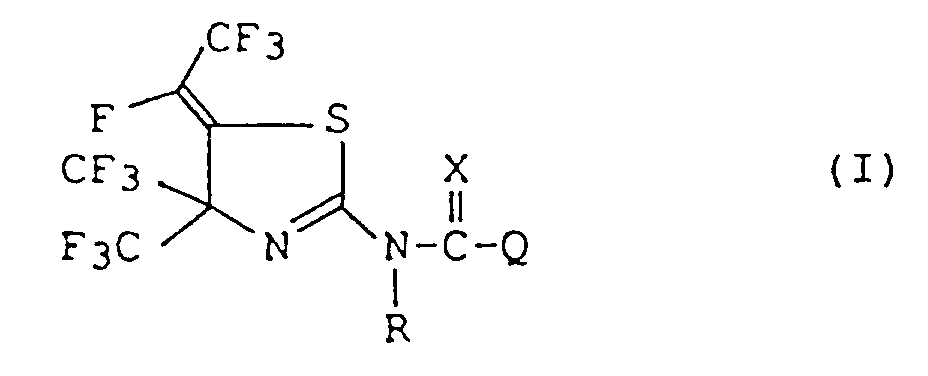
- the present invention is concerned to a thiazoline derivative represented by the following formula (I): wherein R represents hydrogen atom or a C 1 -C 6 alkyl group, X represents oxygen atom or sulfur atom, and Q represents Ar (where Ar represents a phenyl group which may be substituted by 1 to 5 substituents selected from the group consisting of a halogen atom, a C 1 -C 6 alkoxy group a C 1 -C 6 alkyl group, nitro group, a halo-(C 1 -C 6 alkyl) group, cyano group, a phenyloxy group which may be substituted by a halogen atom, an aralkyloxy group which may be substituted by a halogen atom selected from benzyloxy, phenethyloxy and phenylpropoxy group, a C 1 -C 6 alkylamino group, hydroxyl group, carboxyl group, a halo-(C 1 -)
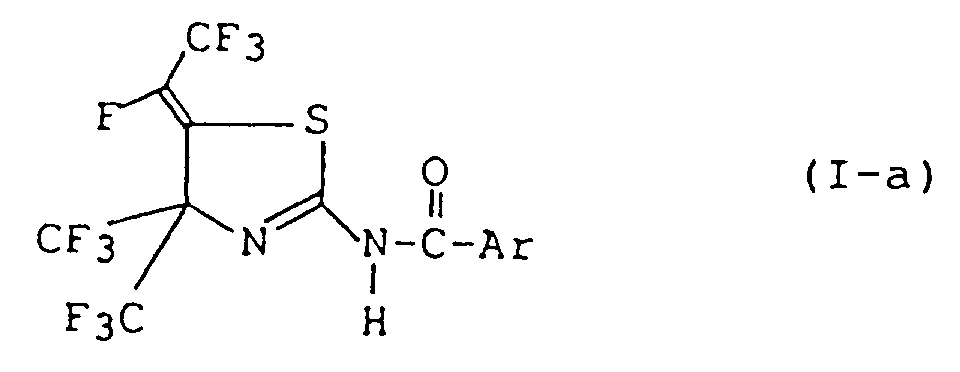
- the second invention relates to a process for preparing a 2-acylamino-2-thiazoline derivative represented by the formula (I-a): wherein Ar represents a phenyl group which may be substituted by 1 to 5 substituents selected from the group consisting of a halogen atom, a C 1 -C 6 alkoxy group, a C 1 -C 6 alkyl group, nitro group, a halo-(C 1 -C 6 alkyl) group, cyano group, a phenyloxy group which may be substituted by a halogen atom, an aralkyloxy group which may be substituted by a halogen atom selected from benzyloxy, phenethyloxy and phenylpropoxy group, a C 1 -C 6 alkylamino group, hydroxyl group, carboxyl group, a halo-(C 1 -C 6 )alkoxy group, a C 1 -C 6 alkylsulfon
- the third invention relates to a process for preparing a 2-amino-2-thiazoline derivative (I-b) represented by the following formula: wherein Ar and R each have the same meanings as defined above, among the compound represented by the above formula (I) which comprises reacting a 2-amino-2-thiazoline derivative represented by the following formula (IV): wherein R has the same meaning as defined above, with the benzoic acid derivative represented by the above formula (III) or the reactive derivative thereof.
- the fourth invention relates to a process for preparing a 2-thioacylamino-2-thiazoline derivative represented by the following formula (I-c): wherein Ar and R have the same meanings as defined above, among the compound represented by the above formula (I) which comprises subjecting the above compound (I-a) or the above 2-acylamino-2-thiazoline derivative represented by the above formula (I-b) to thiocarbonylation.
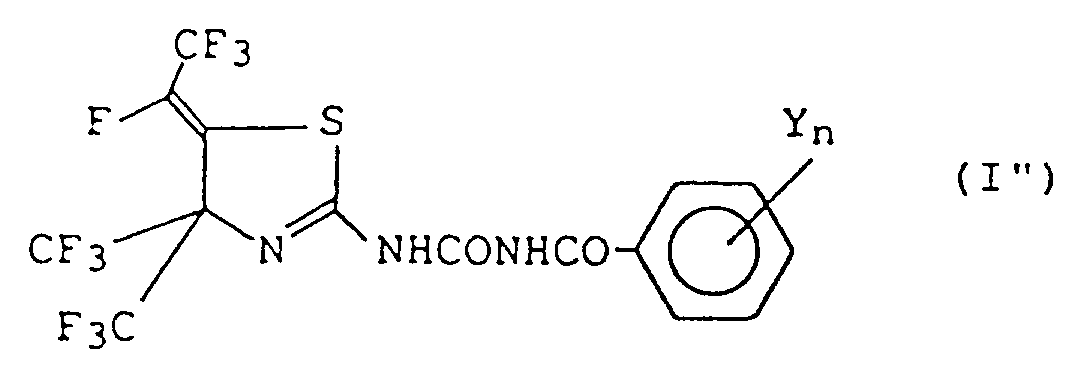
- the fifth invention relates to a process for preparing a 1-(thiazolin-2-yl)-3-benzoylurea derivative represented by the formula (I-d): wherein Y and n have the same meanings as defined above, among the compound represented by the above formula (I) which comprises reacting the iminothiazolidine derivative represented by the above formula (II) with a benzoylisocyanate derivative represented by the following formula: wherein Y and n have the same meanings as defined above.
- the sixth invention relates to a chemical for controlling noxious organisms containing the thiazoline derivative represented by the above formula (I) as an effective ingredient.
- R represents hydrogen atom or a C 1 -C 6 alkyl group
- X represents oxygen atom or sulfur atom
- Ar represents a phenyl group which may be substituted by 1 to 5 substituents selected from the group consisting of a halogen atom, a C 1 -C 6 alkoxy group, a C 1 -C 6 alkyl group, nitro group, a halo-(C 1 -C 6 alkyl) group, cyano group, a phenyloxy group which may be substituted by a halogen atom, an aralkyloxy group which may be substituted by a halogen atom selected from benzyloxy, phenethyloxy and phenylpropoxy group, a C 1 -C 6 alkylamino group, hydroxyl group, carboxyl group, a halo-(C 1 -C 6 )alkoxy group, a C
- Y represents a halogen atom, a C 1 -C 6 alkyl group, a C 1 -C 6 alkoxy group, a halo-(C 1 -C 6 alkyl) group, a halo-(C 1 -C 6 alkoxy) group, nitro group, acetyl group or cyano group
- Preferred substituents for Ar are as follows.
- halogen atom e.g. chlorine atom, iodine atom, bromine atom and fluorine atom
- chlorine atom, bromine atom and fluorine atom are preferred.
- alkoxy group a straight or branched one having 1 to 4 carbon atoms is preferred, and particularly preferably methoxy group.
- alkyl group a straight or branched one having 1 to 4 carbon atoms is preferred, and particularly preferred methyl group.
- haloalkyl group e.g. a straight or branched one having 1 to 6 carbon atoms having a halogen atom such as chlorine atom, iodine atom, bromine atom and fluorine atom
- a straight or branched one having 1 to 4 carbon atoms is preferred, and more preferably trifluoromethyl group.
- phenyloxy group which may be substituted by a halogen atom (e.g. chlorine atom, iodine atom, bromine atom and fluorine atom), 4-fluorophenoxy group and phenoxy group are preferred.
- a halogen atom e.g. chlorine atom, iodine atom, bromine atom and fluorine atom
- 4-fluorophenoxy group and phenoxy group are preferred.
- alkylamino group (a straight or branched one), a straight or branched one having 1 to 4 carbon atoms is preferred, and more preferably dimethylamino group.
- haloalkoxy group e.g. a straight or branched one having a halogen atom such as chlorine atom, iodine atom, bromine atom and fluorine atom
- a straight or branched one having 1 to 4 carbon atoms is preferred, and more preferably trifluoromethoxy group, 2-chloro-1,1,2-trifluoroethoxy group.
- alkylsulfonyl group e.g. a straight or branched one
- a straight or branched one having 1 to 4 carbon atoms is preferred, and more preferably methanesulfonyl group.
- alkylthio group e.g. a straight or branched one
- a straight or branched one having 1 to 4 carbon atoms is preferred, and more preferably methylthio group.
- the number of the substituent an integer of 1 to 5 may be mentioned and the position(s) of the substituent(s) is/are not limited, but preferred number and the position thereof are as follows.
- the halogen atom is 2, 3, 4, 5 and/or 6-position.
- the alkoxy group is 3-position.
- the alkyl group is 4-position.
- the nitro group is 3, 4 and/or 5-position.
- the haloalkyl group is 3, 4 and/or 5-position.
- the cyano group is 4-position.
- the phenyloxy group which may be substituted by a halogen atom is 3 and/or 4-position.
- the aralkyloxy group which may be substituted by a halogen atom is 3 -position.
- the alkylamino group is 3-position.
- the hydroxyl group is 3-position.
- the carboxyl group is 6-position.
- the haloalkoxy group is 4 and/or 5-position.
- the alkylsulfonyl group is 4-position.
- the alkylthio group is 4-position.
- the reactive derivative of the benzoic acid derivative represented by the formula (III) which is a starting compound to be used for producing the compound (I) of the present invention there may be mentioned, for example, an acid anhydride, acid chloride or acid bromide of a carboxylic acid corresponding to the benzoic acid derivative, or a carboxylate (e.g. methyl carboxylate, ethyl carboxylate, phenyl carboxylate), but preferably an acid anhydride or acid chloride of a carboxylic acid.
- an acid anhydride, acid chloride or acid bromide of a carboxylic acid corresponding to the benzoic acid derivative or a carboxylate (e.g. methyl carboxylate, ethyl carboxylate, phenyl carboxylate), but preferably an acid anhydride or acid chloride of a carboxylic acid.
- R hydrogen atom or methyl group is preferred.
- oxygen atom and sulfur atom may be mentioned.
- n an integer of 0 to 5 may be mentioned, but preferably 1 or 2.
- the position of Y n is/are not specifically limited, but preferably 2- or 4-position.
- Y's may form an unsaturated 6-membered ring fused to the benzene ring with carbon atoms to which Y's are bonded, and preferably form ⁇ -naphthyl group or ⁇ -naphthyl group with the benzene ring.
- the compound (I) of the present invention can be prepared, for example, according to the preparation methods 1 to 4 as mentioned below.
- Synthesis of the compound (I-a) of the present invention can be carried out by reacting the starting compound (II) and the compound (III) in a solvent in the presence of a reaction aid as shown below. wherein Ar has the same meaning as defined above.
- the solvent is not particularly limited so long as it does not participate in the present reaction directly, and may include, for example, chlorinated or unchlorinated aromatic, aliphatic or alicyclic hydrocarbons such as benzene, toluene, xylene, methylnaphthalene, petroleum ether, ligroin, hexane, chlorobenzene, dichlorobenzene, methylene chloride, chloroform, dichloromethane, dichloroethane, trichloroethylene and cyclohexane; ethers such as diethyl ether, tetrahydrofuran and dioxane; ketones such as acetone and methyl ethyl ketone; alcohols such as methanol, ethanol and ethylene glycol or hydrates thereof; amides such as N,N-dimethylformamide and N,N-dimethylacetamide; organic bases such as triethylamine, pyridine and N,N-
- the solvent may be used such an amount that a concentration of the compound (II) is in the range of 5 to 80 % by weight, but preferably such an amount that the concentration of the compound (II) is in the range of 10 to 70 % by weight.
- a base e.g. organic bases such as triethylamine, pyridine, 4-(N,N-dimethylamino)pyridine and N,N-dimethylaniline; alkali metal alkoxides such as sodium methoxide and sodium ethoxide; and inorganic bases such as sodium amide, sodium hydroxide, potassium hydroxide, potassium carbonate, sodium carbonate and sodium hydride or a dehydrating agent (e.g.
- organic bases such as triethylamine, pyridine, 4-(N,N-dimethylamino)pyridine and N,N-dimethylaniline
- alkali metal alkoxides such as sodium methoxide and sodium ethoxide
- inorganic bases such as sodium amide, sodium hydroxide, potassium hydroxide, potassium carbonate, sodium carbonate and sodium hydride or a dehydrating agent (e.g.
- dicyclohexylcarbodiimide 1-ethyl-8-(8-dimethylaminopropyl)carbodiimide hydrochloride, 1,1-carbodiimidazole, phosphorus pentachloride, phosphorus trichloride, phosphorus oxychloride, thionyl chloride and phosgene).
- the reaction aid may be used in an amount of 0.001 to 5-fold mole per mole of the compound (II).
- the reaction temperature is not particularly limited, but it is generally carried out in the temperature range of from room temperature to a boiling point or lower of a solvent used.
- the reaction time varies depending on the above concentration of the starting material and the temperature, but may be generally 0.3 to 24 hours.
- the starting compound (III) may be used in an amount of 0.5 to 2-fold mole based on the mole of the starting compound (II), but preferably 0.8 to 1.5-fold mole.
- the compound (II) to be used in the present invention can be easily produced by using perfluoro-(2-methyl-2-pentene), etc. and thiourea according to the method described in, for example, Japanese Provisional Patent Publication No. 57371/1983, etc.
- the reactive derivative of the carboxylic acid (III) to be used in the present invention can be produced, when it is an acid chloride of carboxylic acid corresponding to benzoic acid derivative, according to the following reaction scheme in accordance with the method described in, for example, J. Chem. Soc., Vol. 1934, p. 1406, etc. wherein Ar has the same meaning as defined above.
- Synthesis of the compound (I-b) can be carried out in the same manner as in Synthetic method 1 except for using a compound (IV) in place of the starting compound (II).
- the compound (IV) to be used in the present invention can be synthesized by isomerizing the compound (II) in sulfuric acid or by reacting perfluoro-(2-methyl-2-pentene) and N-methylthiourea in accordance with the method as described in Japanese Provisional Patent Publication No. 57371/1983, etc.
- Synthesis of the compound (I-c) of the present invention can be carried out by reacting the compound (I-b) with a thiocarbonylation reagent such as phosphorus pentasulfate, Lawesson's reagent and hydrogen sulfide as shown below.
- a thiocarbonylation reagent such as phosphorus pentasulfate, Lawesson's reagent and hydrogen sulfide as shown below.
- Ar and R have the same meanings as defined above.
- the solvent is not particularly limited so long as it does not participate in the present reaction directly, and may include, for example, chlorinated or unchlorinated aromatic, aliphatic or alicyclic hydrocarbons such as benzene, toluene, xylene, methylnaphthalene, petroleum ether, ligroin, hexane, chlorobenzene, dichlorobenzene, methylene chloride, chloroform, dichloromethane, dichloroethane, trichloroethylene and cyclohexane; ethers such as diethyl ether, tetrahydrofuran and dioxane; alcohols such as methanol, ethanol and ethylene glycol or hydrates thereof; dimethyl sulfoxide; carbon disulfide; and a mixture of the above solvents.
- chlorinated or unchlorinated aromatic, aliphatic or alicyclic hydrocarbons such as benzene, toluene, x
- the solvent may be used such an amount that a concentration of the compound (I-b) is in the range of 5 to 80 % by weight, but preferably such an amount that the concentration of the compound (I-b) is in the range of 10 to 70 % by weight.
- the reaction temperature is not particularly limited, but it is generally carried out in the temperature range of from room temperature to a boiling point or lower of a solvent used.
- the reaction time varies depending on the above concentration of the starting material and the temperature, but may be generally 0.3 to 24 hours.
- Synthesis of the compound (I-d) or (I'') can be carried out by reacting the starting compound (II) and the starting compound (V) in the presence or absence of a solvent as shown below. Also, in order to accelerate the reaction, a base is frequently used as a catalyst. wherein Y and n have the same meanings as defined above.
- the solvent is not particularly limited so long as it does not participate in the present reaction directly, and may include, for example, chlorinated or unchlorinated aromatic, aliphatic or alicyclic hydrocarbons such as benzene, toluene, xylene, methylnaphthalene, petroleum ether, ligroin, hexane, chlorobenzene, dichlorobenzene, methylene chloride, chloroform, dichloromethane, dichloroethane, trichloroethylene and cyclohexane; ethers such as diethyl ether, tetrahydrofuran and dioxane; ketones such as acetone and methyl ethyl ketone; amides such as N,N-dimethylformamide and N,N-dimethylacetamide; organic bases such as triethylamine, pyridine and N,N-dimethylaniline; 1,3-dimethyl-2-imidazolidinone;
- the solvent may be used such an amount that a concentration of the compound (II) is in the range of 5 to 80 % by weight, but preferably such an amount that the concentration of the compound (II) is in the range of 10 to 70 % by weight.
- the base to be used as a catalyst is not particularly limited, but there may be mentioned, for example, organic bases such as triethylamine, pyridine, 4-(N,N-dimethylamino)pyridine, N,N-dimethylaniline and DBU (1,8-diazabicyclo[5.4.0]undec-7-ene).
- organic bases such as triethylamine, pyridine, 4-(N,N-dimethylamino)pyridine, N,N-dimethylaniline and DBU (1,8-diazabicyclo[5.4.0]undec-7-ene).
- the base may be used in an amount of 0.001 to 5-fold mole per mole of the compound (II).
- the reaction temperature is not particularly limited, but it is generally carried out in the temperature range of from room temperature to a boiling point or lower of a solvent used.
- the reaction time varies depending on the above concentration of the starting material and the temperature, but may be generally 0.3 to 24 hours.
- the starting compound (V) may be used in an amount of 0.5 to 2-fold mole based on the mole of the starting compound (II), but preferably 0.8 to 1.5-fold mole.
- the compound (II) to be used in the present invention can be easily produced by using perfluoro-(2-methyl-2-pentene), etc. and thiourea according to the method described in, for example, Japanese Provisional Patent Publication No. 57371/1983, etc.
- the compound (V) to be used in the present invention can be produced according to the following reaction scheme in accordance with the method described in, for example, Org. Synth., Vol. 46, p. 16, (1963), etc. wherein Y and n have the same meanings as defined above.
- each compound (referred to as Compound (V) 48 to (V) 75 ) comprising respective kinds of substituents corresponding to Compounds No. 48 to 75 shown in Table 1 below may be mentioned (for example, compound (V) corresponding to Compound No. 48 is referred to as Compound (V) 48 .
- Compound (V) 48 is a compound wherein Y n in the formula (V) is 2,6-Cl 2 .).
- the desired compound (I) as mentioned above can be optionally purified, after completion of the reaction, by the conventional post-treatment such as extraction, condensation and filtration, and if necessary, by the known means such as recrystallization and various kinds of chromatographies.
- each compound (referred to as Compound (I) 1 to (I) 75 ) comprising respective kinds of substituents corresponding to Compounds No. 1 to 75 shown in Table 1 below may be mentioned (for example, compound (I) corresponding to Compound No. 1 is referred to as Compound (I) 1 .
- Compound (I) 1 is a compound wherein R in the formula (V) is H, X is O and Ar is 2,6-F 2 phenyl group.).
- agricultural and horticultural noxious insects e.g. Hemiptera (e.g. planthoppers, leafhoppers, aphids and whiteflies), Lepidoptera (e.g. cabbage armyworms, diamondback moth, leafroller moths, pyralid moths and common cabbage worm), Coleoptera (e.g. tenebrionid beetles, leaf beetles, weevils and scarabs) and Acarina (e.g.
- Hemiptera e.g. planthoppers, leafhoppers, aphids and whiteflies
- Lepidoptera e.g. cabbage armyworms, diamondback moth, leafroller moths, pyralid moths and common cabbage worm
- Coleoptera e.g. tenebrionid beetles, leaf beetles, weevils and scarabs
- Acarina e.g.
- brown rust wheat
- powdery mildew barley
- downy mildew cucumber
- blast rice
- tomato late blight
- the chemical for controlling noxious organisms of the present invention has remarkable insecticidal, acaricidal and fungicidal effects, and contains at least one compound (I) as an active ingredient.
- the compound (I) can be used singly, but may be preferably used by mixing with a carrier, a surfactant, a dispersant and an auxiliary (for example, prepared as a composition such as a dust, an emulsion, a fine granule, a granule, a wettable powder, an aqueous or oily suspension and an aerosol) according to a conventional method.
- a carrier for example, a surfactant, a dispersant and an auxiliary (for example, prepared as a composition such as a dust, an emulsion, a fine granule, a granule, a wettable powder, an aqueous or oily suspension and an aerosol) according to a conventional method.
- a surfactant for example, prepared as a composition such as a dust, an emulsion, a fine granule, a granule, a wettable powder, an aqueous or oily suspension and an aerosol
- a solid carrier such as talc, bentonite, clay, kaolin, diatomaceous earth, white carbon, vermiculite, slaked lime, siliceous sand, ammonium sulfate and urea
- a liquid carrier such as hydrocarbons (e.g. kerosine and mineral oil), aromatic hydrocarbons (e.g. benzene, toluene and xylene), chlorinated hydrocarbons (e.g. chloroform and carbon tetrachloride), ethers (e.g. dioxane and tetrahydrofuran), ketones (e.g.
- esters e.g. ethyl acetate, ethylene glycol acetate and dibutyl maleate
- alcohols e.g. methanol, n-hexanol and ethylene glycol
- polar solvents e.g. dimethylformamide and dimethylsulfoxide
- water e.g. water, water, and a gas carrier such as air, nitrogen, carbon dioxide and freon (in the case of a gas carrier, mixed spray can be carried out).
- a gas carrier such as air, nitrogen, carbon dioxide and freon
- surfactant and dispersant which can be used for improving attachment of the present chemical to and absorption thereof in animals and plants, and improving characteristics such as dispersion, emulsification and spreading of the chemical
- there may be mentioned for example, alcohol sulfates, alkylsulfonate, lignin sulfonate and polyoxyethylene glycol ether.
- carboxymethyl cellulose, polyethylene glycol and gum arabic can be used as an auxiliary.
- the above carrier, surfactant, dispersant and auxiliary can be used singly or in a suitable combination, respectively, depending on the respective purposes.
- the concentration of the active ingredient is generally 1 to 50 % by weight in an emulsion, generally 0.3 to 25 % by weight in a dust, generally 1 to 90 % by weight in a wettable powder, generally 0.5 to 5 % by weight in a granule, generally 0.5 to 5 % by weight in an oily dispersion, and generally 0.1 to 5 % by weight in an aerosol.
- These medical preparations can be provided for various uses by diluting them to have a suitable concentration and spraying them to stems and leaves of plants, soil and paddy field surface, or by applying them directly thereto, depending on the purposes.
- the starting compound (II) was synthesized as described below.
- reaction mixture was extracted with ethyl acetate, and the extract was washed with water and dried over anhydrous sodium sulfate, and then the solvent was removed under reduced pressure.
- reaction mixture was extracted with ethyl acetate, and the extract was washed with water and dried over anhydrous sodium sulfate, and then the solvent was removed under reduced pressure.
- reaction mixture was extracted with ethyl acetate, and the extract was washed with water and dried over anhydrous sodium sulfate, and then the solvent was removed under reduced pressure.
- reaction mixture was extracted with ethyl acetate, and the extract was washed with water and dried over anhydrous sodium sulfate, and then the solvent was removed under reduced pressure.
- reaction mixture was extracted with ethyl acetate, and the extract was washed with water and dried over anhydrous sodium sulfate, and then the solvent was removed under reduced pressure.
- reaction mixture was extracted with ethyl acetate, and the extract was washed with water and dried over anhydrous sodium sulfate, and then the solvent was removed under reduced pressure.
- reaction mixture was extracted with ethyl acetate, and the extract was washed with water and dried over anhydrous sodium sulfate, and then the solvent was removed under reduced pressure.
- reaction mixture was extracted with ethyl acetate, and the extract was washed with water and dried over anhydrous sodium sulfate, and then the solvent was removed under reduced pressure.
- reaction mixture was extracted with ethyl acetate, and the extract was washed with water and dried over anhydrous sodium sulfate, and then the solvent was removed under reduced pressure.
- reaction mixture was extracted with ethyl acetate, and the extract was washed with water and dried over anhydrous sodium sulfate, and then the solvent was removed under reduced pressure.
- reaction mixture was extracted with ethyl acetate, and the extract was washed with water and dried over anhydrous sodium sulfate, and then the solvent was removed under reduced pressure.
- reaction mixture was extracted with ethyl acetate, and the extract was washed with water and dried over anhydrous sodium sulfate, and then the solvent was removed under reduced pressure.
- reaction mixture was extracted with ethyl acetate, and the extract was washed with water and dried over anhydrous sodium sulfate, and then the solvent was removed under reduced pressure.
- reaction mixture was extracted with ethyl acetate, and the extract was washed with water and dried over anhydrous sodium sulfate, and then the solvent was removed under reduced pressure.
- reaction mixture was extracted with ethyl acetate, and the extract was washed with water and dried over anhydrous sodium sulfate, and then the solvent was removed under reduced pressure.
- reaction mixture was extracted with ethyl acetate, and the extract was washed with water and dried over anhydrous sodium sulfate, and then the solvent was removed under reduced pressure.
- reaction mixture was extracted with ethyl acetate, and the extract was washed with water and dried over anhydrous sodium sulfate, and then the solvent was removed under reduced pressure.
- reaction mixture was filtered and the resulting mother liquor was extracted with ethyl acetate.
- the extract was washed with water and dried over anhydrous sodium sulfate, and then the solvent was removed under reduced pressure.
- reaction mixture was extracted with ethyl acetate, and the extract was washed with water and dried over anhydrous sodium sulfate, and then the solvent was removed under reduced pressure.
- reaction mixture was extracted with ethyl acetate, and the extract was washed with water and dried over anhydrous sodium sulfate, and then the solvent was removed under reduced pressure.
- reaction mixture was extracted with ethyl acetate, and the extract was washed with water and dried over anhydrous sodium sulfate, and then the solvent was removed under reduced pressure.
- reaction mixture was extracted with ethyl acetate, and the extract was washed with water and dried over anhydrous sodium sulfate, and then the solvent was removed under reduced pressure.
- reaction mixture was extracted with toluene, and the extract was washed with water and dried over anhydrous sodium sulfate, and then the solvent was removed under reduced pressure.
- Compound 1 Five (5) parts by weight of Compound 1 was uniformly mixed with 35 parts by weight of bentonite, 57 parts by weight of talc, 1 part by weight of Neopelex powder (trade name, produced by Kao K.K.) and 2 parts by weight of lignin sodium sulfonate, and then the mixture was kneaded with addition of a small amount of water, followed by granulation and drying, to obtain a granule.
- Neopelex powder trade name, produced by Kao K.K.
- Compound 1 Ten (10) parts by weight of Compound 1 was uniformly mixed with 70 parts by weight of kaolin, 18 parts by weight of white carbon, 1.5 parts by weight of Neopelex powder (trade name, produced by Kao K.K.) and 0.5 part by weight of Demol (trade name, produced by Kao K.K.), and then the mixture was pulverized to obtain a wettable powder.
- Compound 1 Twenty (20) parts by weight of Compound 1 was uniformly mixed with 70 parts by weight of xylene by adding 10 parts by weight of Toxanone (trade name, produced by Sanyo Kasei Kogyo K.K.), and dissolved therein to obtain an emulsion.
- Toxanone trade name, produced by Sanyo Kasei Kogyo K.K.
- Compound 1 Five (5) parts by weight of Compound 1 was uniformly mixed with 50 parts by weight of talc and 45 parts by weight of kaolin to obtain a dust.
- the respective wettable powders of the compound (I) shown in Table 1 prepared in accordance with Example 2 were diluted to 500 ppm with water containing a surfactant (0.01 %), and in these respective chemical solutions obtained, soybean leaves were dipped for 30 seconds, respectively. Then, one soybean leaf thus treated was placed in a plastic cup and air-dried.
- the insecticidal effect of each chemical was evaluated by using 4 ranks depending on the % mortality (A: 100 %, B: 99 to 80 %, C: 79 to 60 % and D: 59 % or less).
- the respective wettable powders of the compound (I) shown in Table 1 prepared in accordance with Example 2 were diluted to 300 ppm with water containing a surfactant (0.01 %), and in these respective chemical solutions obtained, cabbage leaves (5 cm x 5 cm) were dipped for 30 seconds, respectively. Then, one cabbage leaf thus treated was placed in a plastic cup and air-dried.
- the respective wettable powders of the compound (I) shown in Table 1 prepared in accordance with Example 2 were diluted to 500 ppm with water containing a surfactant (0.01 %), and 1 ml of each chemical solution obtained was dropped thoroughly on a filter paper (7.8 cm in diameter, one piece of paper) in each of plastic cups and air-dried.
- the respective wettable powders of the compound (I) shown in Table 2 prepared in accordance with Example 2 were diluted to 300 ppm with water containing a surfactant (0.01 %), and in these respective chemical solutions obtained, kidney bean leaf strips (diameter: 20 mm) on which 10 female adult two-spotted spider mites were parasitic were dipped for 15 seconds, respectively.
- barleys were grown in a glass greenhouse for 2 days, and then conidiospores of powdery mildew collected from infected leaves was dusted thoroughly to the plant leaves to be inoculated thereinto. Subsequently, these barleys were grown in a glass greenhouse for a week, and the degree of lesion of powdery mildew (barley) appeared on the first leaves was examined.
- novel thiazoline derivatives of the present invention can be used as agricultural chemicals useful as a chemical for controlling noxious organisms.
Landscapes
- Chemical & Material Sciences (AREA)
- Organic Chemistry (AREA)
- Agricultural Chemicals And Associated Chemicals (AREA)
- Thiazole And Isothizaole Compounds (AREA)
- Plural Heterocyclic Compounds (AREA)
Claims (17)
- Composé de thiazoline représenté par la formule suivante (I):


- Composé selon la revendication 1, caractérisé en ce que le composé est représenté par la formule:

- Composé selon la revendication 2, caractérisé en ce que le substituant pour Ar est choisi parmi le groupe se composant d'un atome de chlore, d'un atome de brome, d'un atome de fluor, d'un atome d'iode, le groupement alkoxy ayant de 1 à 6 atomes de carbone, le groupement alkyle inférieur ayant de 1 à 6 atomes de carbone, le groupement haloalkyl, linéaire ou ramifié, ayant de 1 à 6 atomes de carbone, le groupement phényloxy qui peut être substitué par un atome de chlore, un atome d'iode, un atome de brome ou un atome de fluor, le groupement aralkyloxy, qui peut être substitué par un atome de chlore, un atome d'iode, un atome de brome ou un atome de fluor, le groupement alkylamino, linéaire ou ramifié, ayant de 1 à 6 atomes de carbone, le groupement haloalkoxy, linéaire ou ramifié, ayant de 1 à 6 atomes de carbone et ayant un atome de chlore, un atome d'iode, un atome de brome ou un atome de fluor, le groupement alkylsulfonyle inférieur linéaire ou ramifié ayant de 1 à 6 atomes de carbone, et le groupement alkylthio linéaire ou ramifié ayant de 1 à 6 atomes de carbone.
- Composé selon la revendication 2, caractérisé en ce que le substituant pour Ar est choisi parmi le groupe se composant d'un atome de chlore, d'un atome de brome, d'un atome de fluor, le groupement alkoxy ayant de 1 à 4 atomes de carbone, le groupement alkyle ayant de 1 à 4 atomes de carbone, le groupement haloalkyle, linéaire ou ramifié, ayant de 1 à 4 atomes de carbone, le groupement phényloxy qui peut être substitué par un atome de chlore, un atome d'iode, un atome de brome ou un atome de fluor, le groupement aralkyloxy, qui peut être substitué par un atome de chlore, un atome d'iode, un atome de brome ou un atome de fluor, le groupement alkylamino, linéaire ou ramifié, ayant de 1 à 4 atomes de carbone, le groupement haloalkoxy, linéaire ou ramifié, ayant de 1 à 4 atomes de carbone et ayant un atome de chlore, un atome d'iode, un atome de brome ou un atome de fluor, le groupement alkylsulfonyle, linéaire ou ramifié, ayant de 1 à 4 atomes de carbone, et le groupement alkylthio linéaire ou ramifié ayant de 1 à 4 atomes de carbone.
- Composé selon la revendication 2, caractérisé en ce que le substituant pour Ar est choisi parmi le groupe se composant d'un atome de chlore, d'un atome de brome, d'un atome de fluor, d'un groupement méthoxy, d'un groupement trifluorométhyle, d'un groupement 4-fluorophénoxy, d'un groupement phénoxy, d'un groupement benzyloxy, d'un groupement phénéthyloxy, d'un groupement phénylpropyloxy, d'un groupement diméthylamino, d'un groupement trifluorométhoxy, d'un groupement 2-chloro-1,1,2-trifluoroéthoxy, d'un groupement méthanesulfonyle et d'un groupement méthylthio.
- Composé selon la revendication 5, caractérisé en ce que R est un atome d'hydrogène ou un groupement méthyle.
- Composé selon la revendication 1, caractérisé en ce que le composé est représenté par la formule:
- Composé selon la revendication 7, caractérisé en ce que Y est au moins une entité choisie parmi le groupe se composant d'un atome de chlore, d'un atome de brome, d'un atome de fluor, le groupement alkyle ayant de 1 à 6 atomes de carbone, le groupement alkoxy, linéaire ou ramifié, ayant de 1 à 6 atomes de carbone, le groupement haloalkyle, linéaire ou ramifié, ayant de 1 à 6 atomes de carbone, et ayant un atome de chlore, un atome d'iode, un atome de brome ou un atome de fluor, et le groupement haloalkoxy, linéaire ou ramifié, ayant de 1 à 6 atomes de carbone et ayant un atome de chlore, un atome d'iode, un atome de brome ou un atome de fluor.
- Composé selon la revendication 7, caractérisé en ce que Y est au moins une entité choisie parmi le groupe se composant d'un atome de chlore, d'un atome de brome, d'un atome de fluor, le groupement alkyle ayant de 1 à 4 atomes de carbone, le groupement alkoxy, linéaire ou ramifié, ayant de 1 à 4 atomes de carbone, le groupement haloalkyle, linéaire ou ramifié, ayant de 1 à 4 atomes de carbone, et ayant un atome de chlore, un atome d'iode, un atome de brome ou un atome de fluor, et le groupement haloalkoxy, linéaire ou ramifié, ayant de 1 à 4 atomes de carbone et ayant un atome de chlore, un atome d'iode, un atome de brome ou un atome de fluor.
- Composé selon la revendication 7, caractérisé en ce que Y est au moins une entité choisie parmi le groupe se composant d'un atome de chlore, d'un atome de brome, d'un atome de fluor, d'un groupement méthyle, d'un groupement méthoxy, d'un groupement trifluorométhyle, et d'un groupement trifluorométhoxy.
- Composé selon la revendication 10, caractérisé en ce que n est un nombre entier de 1 ou 2.
- Composé selon la revendication 1, caractérisé en ce que le composé est choisi parmi le groupe se composant de:
2-(2,6-difluorobenzoylamino)-4,4-bis(trifluorométhyl)-5-(tétrafluoroéthylidène)-2-thiazoline,
2-(4-chlorobenzoylamino)-4,4-bis(trifluorométhyl)-5-(tétrafluoroéthylidène)-2-thiazoline,
2-(3-chlorobenzoylamino)-4,4-bis(trifluorométhyl)-5-(tétrafluoroéthylidène)-2-thiazoline,
2-(3,5-dichlorobenzoylamino)-4,4-bis(trifluorométhyl)-5-(tétrafluoroéthylidène)-2-thiazoline,
2-(3,4-dichlorobenzoylamino)-4,4-bis(trifluorométhyl)-5-(tétrafluoroéthylidène)-2-thiazoline,
2-(3-trifluorométhylbenzoylamino)-4,4-bis(trifluorométhyl)-5-(tétrafluoroéthylidène)-2-thiazoline,
2-(3-nitrobenzoylamino)-4,4-bis(trifluorométhyl)-5-(tétrafluoroéthylidène)-2-thiazoline,
2-(4-trifluorométhylbenzoylamino)-4,4-bis(trifluorométhyl)-5-(tétrafluoroéthylidène)-2-thiazoline,
2-(3-fluorobenzoylamino)-4,4-bis(trifluorométhyl)-5-(tétrafluoroéthylidène)-2-thiazoline,
2-(2,4-dichlorobenzoylamino)-4,4-bis(trifluorométhyl)-5-(tétrafluoroéthylidène)-2-thiazoline,
2-(4-cyanobenzoylamino)-4,4-bis(trifluorométhyl)-5-(tétrafluoroéthylidène)-2-thiazoline,
2-(4-fluorobenzoylamino)-4,4-bis(trifluorométhyl)-5-(tétrafluoroéthylidène)-2-thiazoline,
2-(3-bromobenzoylamino)-4,4-bis(trifluorométhyl)-5-(tétrafluoroéthylidène)-2-thiazoline,
2-(4-trifluorométhoxybenzoylamino)-4,4-bis(trifluorométhyl)-5-(tétrafluoroéthylidène)-2-thiazoline,
2-(4-fluoro-3-trifluorométhylbenzoylamino)-4,4-bis(trifluorométhyl)-5-(tétrafluoroéthylidène)-2-thiazoline,
2-(3-trifluorométhoxybenzoylamino)-4,4-bis(trifluorométhyl)-5-(tétrafluoroéthylidène)-2-thiazoline,
4-trifluorométhylbenzènethioamide de N-[4,4-bis(trifluorométhyl)-5-(tétrafluoroéthylidène)-2-thiazolin-2-yle]
2-(3,4-difluorobenzoylamino)-4,4-bis(trifluorométhyl)-5-(tétrafluoroéthylidène)-2-thiazoline,
2-[4-(2-chloro-1,1,2-trifluoroéthoxy)benzoylamino]-4,4-bis(trifluorométhyl)-5-(tétrafluoroéthylidène)-2-thiazoline
2-(2-chloro-4-nitrobenzoylamino)-4,4-bis(trifluorométhyl)-5-(tétrafluoroéthylidène)-2-thiazoline,
1-[4,4-bis(trifluorométhyl)-5-(tétrafluoroéthylidène)-2-thiazolin-2-yl]-3-(2,6-dichlorobenzoyl)urée
1-[4,4-bis(trifluorométhyl)-5-(tétrafluoroéthylidène)-2-thiazolin-2-yl]-3-(2,6-difluorobenzoyl)urée
1-[4,4-bis(trifluorométhyl)-5-(tétrafluoroéthylidène)-2-thiazolin-2-yl]-3-(2-chlorobenzoyl)urée
1-[4,4-bis(trifluorométhyl)-5-(tétrafluoroéthylidène)-2-thiazolin-2-yl]-3-(2-fluorobenzoyl)urée
1-[4,4-bis(trifluorométhyl)-5-(tétrafluoroéthylidène)-2-thiazolin-2-yl)-3-(2-méthylbenzoyl)urée
1-[4,4-bis(trifluorométhyl)-5-(tétrafluoroéthylidène)-2-thiazolin-2-yl]-3-(2,4-dichlorobenzoyl)urée,
1-[4,4-bis(trifluorométhyl)-5-(tétrafluoroéthylidène)-2-thiazolin-2-yl]-3-(2-chloro-4-nitrobenzoyl)urée
1-[4,4-bis(trifluorométhyl)-5-(tétrafluoroéthylidène)-2-thiazolin-2-yl]-3-(2,4-difluorobenzoyl)urée,
1-[4,4-bis(trifluorométhyl)-5-(tétrafluoroéthylidène)-2-thiazolin-2-yl]-3-(2-trifluoromethylbenzoyl) urée,
1-[4,4-bis(trifluorométhyl)-5-(tétrafluoroéthylidène)-2-thiazolin-2-yl]-3-(2,4,6-trichlorobenzoyl)urée,
1-[4,4-bis(trifluorométhyl)-5-(tétrafluoroéthylidène)-2-thiazolin-2-yl]-3-(2-bromobenzoyl)urée,
1-[4,4-bis(trifluorométhyl)-5-(tétrafluorométhylidène)-2-thiazolin-2-yl]-3-(2,3-dichlorobenzoyl)urée et
1-[4,4-bis(trifluorométhyl)-5-(tétrafluoroéthylidène)-2-thiazolin-2-yl]-3-(2-chloro-6-fluorobenzoyl)urée. - Procédé de préparation d'un dérivé de la 2-acylamino-2-thiazoline représenté par la formule (I-a):
qui comprend la mise en réaction d'un dérivé de la 2-iminothiazolidine représenté par la formule suivante (II):
Ar-COOH (III)
dans laquelle Ar a la même signification que celle définie dans la revendication 1. - Procédé de préparation d'un dérivé de la 2-amino-2-thiazoline (I-b), représenté par la formule suivante:

qui comprend la mise en réaction d'un dérivé de la 2-amino-2-thiazoline représenté par la formule suivante (IV):
Ar-COOH (III)
dans laquelle Ar a la même signification que celle définie dans la revendication 1. - Procédé de préparation d'un dérivé de la 2-thioacylamino-2-thiazoline, représenté par la formule suivante (I-c):

qui comprend la soumission à thiocarbonylation d'un dérivé de la 2-acylamino-2-thiazoline, représenté par la formule (I-b):
- Procédé de préparation d'un dérivé de la 1-(thiazolin-2-yl)-3-benzoylurée, représenté par la formule (I-d):

qui comprend la mise en réaction du dérivé de l'iminothiazolidine représenté par la formule suivante (II):

- Produit chimique destiné au contrôle d'organismes toxiques, qui comprend le dérivé de thiazoline représenté par la formule (I), défini dans la revendication 1, en tant qu'ingrédient actif et en tant qu'agent vecteur.
Applications Claiming Priority (6)
| Application Number | Priority Date | Filing Date | Title |
|---|---|---|---|
| JP9836491 | 1991-02-01 | ||
| JP98364/91 | 1991-02-01 | ||
| JP26330891 | 1991-07-09 | ||
| JP263308/91 | 1991-07-09 | ||
| JP29858891 | 1991-08-30 | ||
| JP298588/91 | 1991-08-30 |
Publications (2)
| Publication Number | Publication Date |
|---|---|
| EP0497367A1 EP0497367A1 (fr) | 1992-08-05 |
| EP0497367B1 true EP0497367B1 (fr) | 1996-07-24 |
Family
ID=27308643
Family Applications (1)
| Application Number | Title | Priority Date | Filing Date |
|---|---|---|---|
| EP92101620A Expired - Lifetime EP0497367B1 (fr) | 1991-02-01 | 1992-01-31 | Dérivés de thiazoline, procédés pour leur préparation et compositions pesticides les contenant |
Country Status (4)
| Country | Link |
|---|---|
| US (1) | US5221685A (fr) |
| EP (1) | EP0497367B1 (fr) |
| DE (1) | DE69212340T2 (fr) |
| ES (1) | ES2090374T3 (fr) |
Families Citing this family (9)
| Publication number | Priority date | Publication date | Assignee | Title |
|---|---|---|---|---|
| JP2710088B2 (ja) * | 1992-07-03 | 1998-02-10 | 宇部興産株式会社 | ポリフッ化チアゾリン誘導体、その製法及び有害生物防除剤 |
| US6046222A (en) * | 1993-09-15 | 2000-04-04 | Warner-Lambert Company | Use of thiazolidinedione derivatives in the treatment of polycystic ovary syndrome, gestational diabetes and disease states at risk for progressing to noninsulin-dependent diabetes mellitus |
| ATE528411T1 (de) | 2006-06-07 | 2011-10-15 | Otago Innovation Ltd | Diagnoseverfahren und -marker |
| EP2089722B1 (fr) | 2006-09-07 | 2017-11-08 | Otago Innovation Limited | Biomarqueur pour la détection précoce de troubles cardiaques aigus |
| CN102037014A (zh) | 2008-03-12 | 2011-04-27 | 奥塔哥创新有限公司 | 生物标记物 |
| AU2009224114B2 (en) | 2008-03-12 | 2013-02-21 | Otago Innovation Limited | Biomarkers |
| WO2012007426A1 (fr) * | 2010-07-13 | 2012-01-19 | Basf Se | Composés d'isoxazoline benzamide à substitution azoline pour lutter contre les organismes nuisibles |
| JP6087816B2 (ja) | 2010-07-19 | 2017-03-01 | オタゴ イノベーション リミテッド | シグナルバイオマーカー |
| CN104470942B (zh) | 2012-03-20 | 2018-12-14 | 奥塔哥创新有限公司 | 生物标志物 |
Family Cites Families (9)
| Publication number | Priority date | Publication date | Assignee | Title |
|---|---|---|---|---|
| OA01933A (fr) * | 1965-04-06 | 1970-02-04 | Pechiney Saint Gobain | Dérivés du thiazole. |
| US3551442A (en) * | 1965-04-06 | 1970-12-29 | Pechiney Saint Gobain | Thiazole derivatives |
| US3682945A (en) * | 1968-07-05 | 1972-08-08 | Exxon Research Engineering Co | Certain 2-acylamino-4,5,6,7-tetrahydrobenzothiazoles |
| US3862165A (en) * | 1972-09-21 | 1975-01-21 | August Amann | New 2-imino-5-methylenethiazolidines |
| US4134984A (en) * | 1975-11-18 | 1979-01-16 | John Wyeth & Brother Limited | Thiazole compositions |
| GB1571826A (en) * | 1976-03-09 | 1980-07-23 | Shell Int Research | Method of combating pests and pesticidal compositions and thiazoline derivatives useful therefor |
| US4164581A (en) * | 1978-09-05 | 1979-08-14 | Gulf Oil Corporation | 1-(2,6-Dichlorobenzoyl)-3-(4-trifluoromethyl-2-thiazolyl)urea and use as insecticide |
| US4326876A (en) * | 1980-01-28 | 1982-04-27 | Chevron Research Company | 2-Aminosubstituted-5-methylene-thiazole and 3-aminosubstituted-1 methylene-2,4-thiazaspiro[5.4]decane herbicides |
| JPS5857371A (ja) * | 1981-09-30 | 1983-04-05 | Daikin Ind Ltd | 含フツ素2−アミノ(又はアルキルアミノ)−2−チアゾリン化合物及びその製造方法 |
-
1992
- 1992-01-30 US US07/828,110 patent/US5221685A/en not_active Expired - Fee Related
- 1992-01-31 EP EP92101620A patent/EP0497367B1/fr not_active Expired - Lifetime
- 1992-01-31 DE DE69212340T patent/DE69212340T2/de not_active Expired - Fee Related
- 1992-01-31 ES ES92101620T patent/ES2090374T3/es not_active Expired - Lifetime
Also Published As
| Publication number | Publication date |
|---|---|
| DE69212340D1 (de) | 1996-08-29 |
| DE69212340T2 (de) | 1997-01-09 |
| ES2090374T3 (es) | 1996-10-16 |
| US5221685A (en) | 1993-06-22 |
| EP0497367A1 (fr) | 1992-08-05 |
Similar Documents
| Publication | Publication Date | Title |
|---|---|---|
| EP0532022B1 (fr) | Composés acryliques, procédé pour leur préparation et fongicides les contenant | |
| AU598624B2 (en) | Thiazole and pyrazole derivatives, methods for their preparation and fungicides containing them as active ingredients | |
| EP0104532B1 (fr) | Dérivés d'un acide o-halobenzoique, leur procédé de préparation, compositions herbicides et leur utilisation | |
| HU213635B (en) | Carboxanilide derivatives, arthropodicidal compositions containing the compounds as active ingredients and method for extermination of arthropodes | |
| EP0665225A1 (fr) | 4-Phénylaminopyrimidines, procédé pour leur préparation et pesticides pour l'agriculture et l'horticulture les contenant | |
| US5104886A (en) | Amide derivatives, processes for production thereof, and agricultural-horticultural fungicide containing them | |
| DE3713774C2 (de) | Pyrazol-Derivate, Verfahren zu ihrer Herstellung und diese enthaltende Fungizide | |
| US5221685A (en) | Thiazoline derivative, process for preparing the same and chemical for controlling noxious organisms containing the same | |
| US5470984A (en) | 1-dimethylcarbamoyl-3-substituted-5-substituted-1H-1,2,4-triazoles | |
| CN101977502A (zh) | 杀真菌剂肟基-四唑衍生物 | |
| JPH06157469A (ja) | ピラゾールカルボニルウレア誘導体、その製法及び有害生物防除剤 | |
| US5021412A (en) | Thiadiazines, and insecticidal and acaricidal preparations | |
| EP0354297B1 (fr) | Thiadiazines, procédé pour leur préparation et agents insecticides et acaricides les contenant | |
| JP4169810B2 (ja) | 除草活性を有するアリール複素環類 | |
| US5369116A (en) | Polyfluorinated thiazoline derivative and chemical for controlling noxious organisms containing the same | |
| JP2000159610A (ja) | 農園芸用植物病害防除剤および新規イソオキサゾールカルボン酸誘導体 | |
| EP0866056B1 (fr) | Composes n- (fluoroalcoxy)phenoxyalkyl]benzamide, leurs intermediaires, des procedes pour les produire et des pesticides agricoles et horticoles | |
| EP0453137A2 (fr) | Derivés d'aminopyrimidine, procédé pour leur préparation et leur utilisation | |
| CA3164362A1 (fr) | Derives de pyrido[2,3-e]oxazine utilises en tant que produits chimiques agricoles | |
| JP2710083B2 (ja) | 2−アシルアミノ−2−チアゾリン誘導体、その製法及び有害生物防除剤 | |
| EP0618195B1 (fr) | Dérivés de phénoxyalkylamines comme insecticides, acaricides et fongicides et procédés de préparation | |
| EP0655444A1 (fr) | Oxazolines, procédé pour les préparer et compositions agricoles et horticoles pour le contrôle des organismes nuisibles les contenant | |
| US5252596A (en) | Phenoxyalkylamine derivative and method for controlling noxious organisms containing the same | |
| JP2666099B2 (ja) | 2−アシルアミノ−2−チアゾリン化合物、その製法及び有害生物防除剤 | |
| KR900003390B1 (ko) | 피라졸 유도체, 그의 제조방법 및 농원예용 살균제 |
Legal Events
| Date | Code | Title | Description |
|---|---|---|---|
| PUAI | Public reference made under article 153(3) epc to a published international application that has entered the european phase |
Free format text: ORIGINAL CODE: 0009012 |
|
| AK | Designated contracting states |
Kind code of ref document: A1 Designated state(s): DE ES FR IT |
|
| 17P | Request for examination filed |
Effective date: 19921209 |
|
| 17Q | First examination report despatched |
Effective date: 19950519 |
|
| GRAH | Despatch of communication of intention to grant a patent |
Free format text: ORIGINAL CODE: EPIDOS IGRA |
|
| GRAA | (expected) grant |
Free format text: ORIGINAL CODE: 0009210 |
|
| AK | Designated contracting states |
Kind code of ref document: B1 Designated state(s): DE ES FR IT |
|
| GRAH | Despatch of communication of intention to grant a patent |
Free format text: ORIGINAL CODE: EPIDOS IGRA |
|
| REF | Corresponds to: |
Ref document number: 69212340 Country of ref document: DE Date of ref document: 19960829 |
|
| REG | Reference to a national code |
Ref country code: ES Ref legal event code: FG2A Ref document number: 2090374 Country of ref document: ES Kind code of ref document: T3 |
|
| ITF | It: translation for a ep patent filed | ||
| ET | Fr: translation filed | ||
| REG | Reference to a national code |
Ref country code: ES Ref legal event code: FG2A Ref document number: 2090374 Country of ref document: ES Kind code of ref document: T3 |
|
| PLBE | No opposition filed within time limit |
Free format text: ORIGINAL CODE: 0009261 |
|
| STAA | Information on the status of an ep patent application or granted ep patent |
Free format text: STATUS: NO OPPOSITION FILED WITHIN TIME LIMIT |
|
| 26N | No opposition filed | ||
| PGFP | Annual fee paid to national office [announced via postgrant information from national office to epo] |
Ref country code: FR Payment date: 19971223 Year of fee payment: 7 |
|
| PGFP | Annual fee paid to national office [announced via postgrant information from national office to epo] |
Ref country code: ES Payment date: 19980130 Year of fee payment: 7 |
|
| PGFP | Annual fee paid to national office [announced via postgrant information from national office to epo] |
Ref country code: DE Payment date: 19980220 Year of fee payment: 7 |
|
| PG25 | Lapsed in a contracting state [announced via postgrant information from national office to epo] |
Ref country code: ES Free format text: LAPSE BECAUSE OF NON-PAYMENT OF DUE FEES Effective date: 19990201 |
|
| PG25 | Lapsed in a contracting state [announced via postgrant information from national office to epo] |
Ref country code: FR Free format text: LAPSE BECAUSE OF NON-PAYMENT OF DUE FEES Effective date: 19990930 |
|
| PG25 | Lapsed in a contracting state [announced via postgrant information from national office to epo] |
Ref country code: DE Free format text: LAPSE BECAUSE OF NON-PAYMENT OF DUE FEES Effective date: 19991103 |
|
| REG | Reference to a national code |
Ref country code: FR Ref legal event code: ST |
|
| REG | Reference to a national code |
Ref country code: ES Ref legal event code: FD2A Effective date: 20010503 |
|
| PG25 | Lapsed in a contracting state [announced via postgrant information from national office to epo] |
Ref country code: IT Free format text: LAPSE BECAUSE OF NON-PAYMENT OF DUE FEES;WARNING: LAPSES OF ITALIAN PATENTS WITH EFFECTIVE DATE BEFORE 2007 MAY HAVE OCCURRED AT ANY TIME BEFORE 2007. THE CORRECT EFFECTIVE DATE MAY BE DIFFERENT FROM THE ONE RECORDED. Effective date: 20050131 |